Why are the Self Help Groups (SHGs) in Decline?
A Case Study of SHGs in Gurgaon
Anuradha Tiwari1 Jaskiran Arora2
1.Economics Department,GD Goenka World Institute, Sohna Road ,Gurgoan 2.Finance Department ,GD Goenka World Institute ,Sohna Road ,Gurgoan
*E-mail of the corresponding author: [email protected] Abstract
Microfinance is a revolutionary movement targeted to provide credit to the poor. Self Help Group’s (SHGs) have had a record of success, but they are gradually losing their significance as a source of loans to the poor. This paper analyses the reasons for the decline of SHGs as a source of funds to the poor. It is based on a case study of 30 SHGs in Gurgaon district. The study suggests that the SHGs in Gurgaon lack cohesion; the membership of the groups is non –homogenous in terms of caste, income and occupational background. Our analysis also suggests that the SHGs do not conform to the guidelines laid out by NABARD. Some of the problems associated with the SHGs could be mitigated with much more active and elaborate involvement of the NGOs than that appears to be the case.
Keywords: Self Help Group Promoting Institutions, Microfinance Institutions, Sustainability, Growth. 1. Introduction
Microfinance is a movement targeted to provide credit and other financial services to the poor. The objective of the micro finance agencies is stated by The National Bank For Agriculture and Rural Development ( NABARD), a government rural development agency as “To facilitate sustained access to financial services for the unreached poor in rural areas through various micro-finance innovations in a cost effective and sustainable manner.” 1.1Approaches to Microfinance
(A) Self-Help Groups (SHGs)-Bank Linkage Program
One of the significant initiatives by the NABARD to promote its objective was the SHG-Bank Linkage Program initiated in 1992. An SHG as defined by NABARD (2005) has an average size of about 15 people from a homogeneous community. They are encouraged to make voluntary contributions to a common fund on a regular basis. They use the pooled resource to provide small interest bearing loans to their members. Borrowers are selected on the basis of the immediacy of their need for money, accounts are kept meticulously and terms and conditions of the loans are set by the group. Since the group’s own accumulated savings are part and parcel of the aggregate loans made by the groups to their members, peer pressure ensures timely repayments. This process helps them imbibe the essentials of financial intermediation and financial discipline. They also learn to manage sizeable volumes of resources. Once the group demonstrates mature financial behavior, banks come forth with loans to the SHG in multiples of the accumulated savings of the SHGs, at market interest rates. The bank loans are provided without any collateral asthe accumulated savings of the SHG demonstrates their organizational abilities.
The promise of success demonstrated by the groups in the initial stages appears to have influenced the Reserve Bank of India in the year 1996 to include SHGs in the priority sector lending portfolio of the banks, which resulted in a substantial growth in the number of SHGs formed over time. The program that started with 255 SHGs reached a massive 6.95 million by March 2010. These SHGs have empowered the poor by enhancing their contribution to household income, increasing the value of their assets and generally by giving them better control over decisions that affect their lives.
The SHGs can have three types of parentage (Sriram & Kumar, 2006). The first type is SHGs formed and financed directly by the banks i.e. Commercial Banks including Public, Private, Regional Rural Banks and Co-operative Banks. In this type the cost of formation is borne by the banks. The second and one of the most popular ways of forming SHGs is through the intermediation of Non-Government Organizations(NGOs) or Government organizations, the cost of formation is borne by these external parties. In this model, the external agencies assist the SHGs to come into being and then link these SHGs to a bank. The agencies do not get involved in financing activities. The third model is one, where external parties usually Non-financial Organizations, act as the financing intermediaries and help the formation of SHGs and then finance them. The number of different kind of SHGs formed in India as per the NABARD 2009 report are:
i. 20% of the total SHGs formed in 2009 were formed and financed directly by banks;
(B) Micro-finance Institutions (MFIs) – Bank Linkage Program
The second mode of Micro-finance is MFI-Bank Linkage Program, and it is different from the SHG model in that MFIs are financed by banks and other agencies in the first instance and then these funds are lent to the small borrowers by the MFIs. MFIs act as a financial intermediary in the entire process. The first MFI in India was set up in 1974, though it gained momentum only in the 1990’s. MFIs are uniquely positioned to reach out to the poor, and can exist either as –Associations, Trusts or Companies and could be either profit or non-profit organizations.
1.2 Comparison between the two models In the SHG - Bank Linkage Model SHGs are financed directly by the banks. They work like “Mutual’s” (Sriram & Kumar, 2006). In the MFI - Bank Linkage Model,Micro Finance Institutions (MFIs) are funded by banking agencies who then lend to SHGs and other small borrowers. They are like “Providers”. Since the group member’s own savings are an integral part of the loaned amount in the SHG model and they ‘mutually’ work towards wealth maximization, there is no agency problem. Further, since they are not provided with loans from the banks until they have demonstrated financial discipline, available evidence shows that rates of repayment of loans are relatively high in the case of the SHG model. Also heavy penalties on individual members who are unable to repay loans for reasons beyond their control are not imposed as the group covers their payments.
The two models do present certain significant contrasts. The MFI Bank linkage model exhibits much more of a market oriented profit maximizing features whilst the SHG/NGO model is a heavily development oriented model. The latter is designed to reach the relatively poor in the rural areas. It emphasizes group formation and coordination, it also aims at inculcating and promoting organizational and management skills in the members of the SHGs. The nature and the role of the MFIs as profit seekers, are the subject of debates ever since the crisis in the microfinance activities in the year 2006 (Reddy2009). Sriram (2011) and Reddy (2011) also opined that whilst MFIs are not to be regarded on the same footing as the commercial banks, they cannot also be regarded as development agencies. They are certainly several rungs removed from being development agencies compared with the SHGs.
1.3 Growth of SHGs
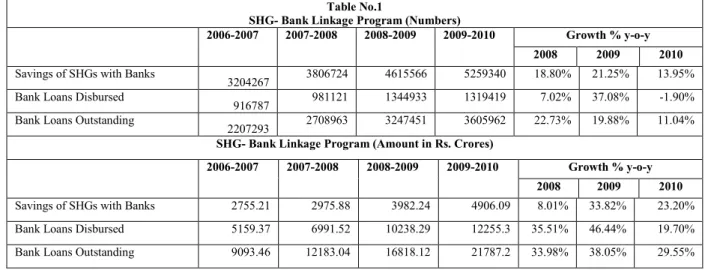
Extracts from the NABARD reports for the period of 2006-2010 shows the growth patterns in the number and volume of Savings, Bank Loans Disbursed and Bank Loans Outstanding:
Table No.1
SHG- Bank Linkage Program (Numbers)
2006-2007 2007-2008 2008-2009 2009-2010 Growth % y-o-y
2008 2009 2010
Savings of SHGs with Banks
3204267 3806724 4615566 5259340 18.80% 21.25% 13.95% Bank Loans Disbursed
916787 981121 1344933 1319419 7.02% 37.08% -1.90% Bank Loans Outstanding
2207293 2708963 3247451 3605962 22.73% 19.88% 11.04% SHG- Bank Linkage Program (Amount in Rs. Crores)
2006-2007 2007-2008 2008-2009 2009-2010 Growth % y-o-y
2008 2009 2010
Savings of SHGs with Banks 2755.21 2975.88 3982.24 4906.09 8.01% 33.82% 23.20% Bank Loans Disbursed 5159.37 6991.52 10238.29 12255.3 35.51% 46.44% 19.70% Bank Loans Outstanding 9093.46 12183.04 16818.12 21787.2 33.98% 38.05% 29.55%
Source: NABARD Reports 2006-2010
The number of SHGs and the amount of savings the SHGs maintain with their banks increased till 2009, but it has decreased in 2010. Similar trends are also reflected in the number of bank loans disbursed and the volume of loans disbursed to SHGs, similar are the statistics on the number of and volume of loans outstanding
with SHGs. This trend clearly reflects that SHGs are losing their significance as a source of micro-finance ‘mutual’s’.
The spread of SHGs across the states of the Indian union differs significantly. An extract from NABARD (2008) reports that within the northern states in India, Haryana has 54 SHGs per lakh of population and the average loan to SHGs is Rs 86.6 thousand. These numbers pale South India where the number of SHGs per lakh of population is 891 and average loan to SHGs is Rs115.5 thousands.
SOUTHERN REGION
State Share (%) in Indicator Of SHG
Total SHGs Total Loans Spread Finance
AP 20.8 37.5 891 115.5 K’taka 10.0 10.0 611 64.0 Kerala 4.2 4.5 435 68.2 T’nadu 13.1 19.2 695 94.1 P’cherry P’cherry 0.1 0.2 231 140.4
Source: NABARD (As on March 31, 2008)
Note: *Indicator of SHG Spread is taken as number of SHGs per lakh population. **Indicator of SHG Finance is taken as average loan (in thousand Rs.) to SHGs. 2. Research Issues
Inspite of the fact that SHGs display high recovery rates, the ‘savings’ of SHGs with banks and ‘loans disbursed’ to them have declined. Nair’s(2012) comparison of the trends in the flow of funds to MFIs and SHGs reveals that “commercial banking system had steadily shifted its patronage to large MFIs from the mid-2000s”. The statistics above reflect that the volume of business transacted by SHGs is declining across the country. Especially noticeable is the decline of the SHGs in Haryana, the state with a highly productive and relatively large agricultural sector. The failure of the SHGs to increase the volume and spread of their activities and establish themselves as self sustaining organizations requires analysis. In order to explore the reasons for the declining role of SHGs, this study based on a sample of 30 SHG’s formed by an NGO in Haryana has the following objectives:
I. To study the role of NGOs as per the NABARD directives, in the formation and growth of SHGs, II. To analyze the specific features of the SHGs under our study
III. To identify the challenges and the problems that the SHGs face during their development and growth.
3. Research Methodology
This paper is exploratory in nature and both primary and secondary data have been used to meet the stated objectives. Primary data is collected from a sample of 30 Self Help Groups initiated by an NGO in Sohna, a district of Haryana. Structured Questionnaire and in-depth interviews with women members of two SHG groups were undertaken. Employees of the operations department of NGOs were also interviewed to get an insight into their functioning. Admittedly our study has various limitations. 30 SHGs might not be a large enough and representative sample of the SHG‘s in the state of Haryana. There may be a sampling bias in our study as the SHGs we interviewed were selected for us by the NGOs and the 30 we interviewed may not constitute a scientific random sample. But given constraints on our time and our limited resources, only an exploratory study could be undertaken. Hopefully this study will lay the foundations for a more detailed study with a larger sample. 4. Discussion and Analysis
4.1 NABARD in its handbook on ‘forming SHGs’ lays down the following steps to be followed in forming SHGs in a village:
I. Community Mobilization should be done by the facilitator from an NGO with regular home Visits NORTHERN REGION
State Share (%) in Indicator Of SHG
Total SHGs Total Loans Spread* Finance**
Haryana 0.4 0.5 54 86.6 HP 0.9 0.6 473 43.6 J&K 0.1 0.1 30 57.6 Punjab 0.3 0.3 33 69.2 Rajasthan Rajasthan 5.0 2.3 275 29.7 New Delhi 0.0 0.0 3 110.1
III. Evaluation of prospective members should be undertaken by examining the background of each of the members of the group
IV. The NGO facilitator should decide upon -name of the group, its vision, and its norms. Then, the members of the group should select their leader
V. SHG should then be linked to the Bank and encouraged to save and lend to members of the group VI. After about three months of operations, the SHG that wishes to borrow from the bank should be
assessed by the NGO on behalf of the Bank. The assessment should focus on the quality and financial discipline of the members of the group.
Finally, when credit is sanctioned, the bank and the NGO should keep a record of repayments. As per the NABARD Directives, it is the NGOs who initiate the process of the formation of SHGs. They mobilize the villagers; assess the socio-economic background of prospective members of an SHG through the administration of detailed questionnaires seeking information on family incomes, size of families, family assets and level of education of family members. Following the assessment of prospective members the NGOs organize meetings with the villagers including members of the ‘panchayats’ and the ‘sarpanch’ of the village. These meetings are designed to inform the villagers the sort of benefits they can expect from SHGs and the structure of such organizations. Following the meeting with the NGOs those who wish to form a SHG, discuss the compatibility of the prospective member’s structure of the group. Once the membership of the group is settled, the group members in consultation with the NGO name the leader of the group as well as the treasurer of the group. The office of the leader and the treasurer rotates amongst the members of the group over time. Once the group is formed, the most important item on the agenda for the SHG members is the decision regarding the amount the group is able to save and invest and equally important is deciding upon the periodicity of savings and investments i.e. weekly or monthly? This process of saving money by each member is an integral part of the meeting itself and the money is kept with the leader or the treasurer. The NGO helps the group to open a savings bank account with the nearest branch of a bank. The group then begins to lend money to individual members at a nominal interest rate. This helps them understand the nitty-gritty of financial operations. These meetings continue for two or three months. If the group then wishes to borrow from the bank, an assessment of the financial health of the group is undertaken by the NGO. The assessment also includes various factors such as the attendance record of the members at group meetings, their awareness of the objectives of the group, the homogeneity of the group dictated by family income levels, caste and age of the members and the geographical proximity of their houses, and the purpose for which the loan is asked for, the period over which they wish to borrow and the repayment terms. Once the SHGs assessment is done by the NGO member, and the group is regarded as a viable entity to borrow the NGO links the SHG with the bank and facilitates the loan transaction. The NGO also monitors repayments of the loan to the bank.
Our analysis of the organization of SHGs based on the case studies, suggests that the NGOs weren’t lacking in initiative. However, the assessment forms they used to collate information in operational efficiency of the SHG, missed out on details such as timings of the meetings of SHGs, number of members in the SHGs, the education levels of members. These points as per the NABARD directives should form a significant part of the records maintained. There were also many computational errors in the completed forms. When the information on these lapses was shared with the NGOs, they (NGO) pleaded lack of resources and man power in mitigation.
4.2 Assessment
Financial health of an SHG is vital for ensuring the utility of the loan it borrows from the bank and repayment of the loan. Assessment of the creditworthiness of a SHG is very different from that of an individual. SHGs are not to be assessed in terms of their ability to provide collateral or guarantees of net worth. The SHGs have to be assessed as a group centering on their constitution, conceptual knowledge about the SHG functioning, group dynamics like goal-oriented action, participation of members, democratic decision making and collective leadership. The process of linking the SHG with the bank begins when the promoting institution (NGO) is satisfied with the credentials of the group. This study has assessed the sample of SHGs with the following NABARD criteria as the basis for its assessment.
Figure:1
Concept awareness: Ideally the members of the SHG should be aware of the purpose of group formation, its operations and activities, and the savings and the credit details of the group and individuals etc. Our investigation of the 30 SHGs (Fig.1) suggests that members of only 37% of the total of 30 SHGs had more than 80% members who understood the concept of SHGs. In the case of the other 63% of the SHGs, only 50% to 80% members were aware of the purpose and workings of SHGs.
Figure: 2
Homogeneity: Homogeneity refers to socio economic origins of the members based on commonality of age income and caste. The sample of SHGs in the study (Fig. 2) revealed that out of total sample, on average each group had only 44% of the group members who lied in the income band of Rs.1000 to 3000, 63% of the members in each SHGs were from the same caste, 81% of the SHGs members were between the age group of 18-45 years, 75% of group members were not in blood relation and 94% of the members in the SHGs belonged to the same moholla. Thus the features that were homogenous for members of the groups were confined to age and place of residence ‘the Mohalla’. However, homogeneity in age is subject to the limitation of a large frequency interval and thus could be considered to be not a very dependable factor reflecting homogeneity. Therefore, this leaves the sample of SHGs under study to be homogenous only on the geographical proximity i.e. “same mohalla.”
Figure: 3
Meetings & attendance with group participation: The next parameter under consideration was the periodicity of the group meetings i.e., do the SHG meet - weekly, fortnightly or monthly. In the sample of SHGs under study
have any records on attendance; thus reflecting poor record-keeping. Given the fact that the frequency of the meeting was as low as once month, the attendance records were very poor.
Figure: 4
Minutes of the meeting & Participation in group discussion: The study revealed that only 37% of the SHGs maintained the minutes of meeting properly and systematically (Fig.4). However, it was also found that 75% of the SHGs had more than 80% of the members participating actively in group discussion, reflecting that atleast the group members were interested in the concept of SHGs.
Figure: 5
Recovery of the loans: Prompt and timely recovery of loans has for long been considered the hallmark of efficient SHGs. Our sample of SHGs does not perform well on this score either. Only 31% SHGs were able to recover more than 80% of the loans offered to their members (Fig.5), 38% SHGs were able to recover loans between 60-80% and 25% of SHGs were yet to lend money to their members.
Figure: 6
Utilization of saving for lending to members: Regular saving and utilization of saving for internal lending is among the core principles of SHGs. The study observed that (Fig. 6) only 77% of the SHGs utilized 60% to 80% of their savings for internal lending to the individual group members. The lack of basic core principles is well manifested in these statistics which reflect that only 23% of the total sample SHGs is using more than 80% of their savings for loaning and others are just able to utilize 60% to 80% of their savings for loaning.
Figure: 7
Record Keeping: SHG should ideally maintain books that give details regarding its accounts, number of meetings held, decisions taken in the meetings, amount of savings of the members and credit availed, and repayments. We observed that only 25% of the total SHGs under study (Fig. 7) maintained their records properly in the books of accounts. 69% of the total SHGs under study, however, were updating their records but not properly detailing them and 6% of the SHG were not even maintaining their records. This reflects such a dismal state of affairs at record keeping.
Membership of SHGs: Under the SHGs bank linkage program, the number of members in a group is usually expected to be between 15- 20 members. This number is considered ideal for group cohesion and stability (NABARD, 2007). The data given by the NGO reveals that the average membership of the 30 SHGs considered for the study is 11. The numbers of members in the SHG define the quality of the group and the credentials of the promoting institutions.
In sum, our findings of SHG profiling, in the light of NABARD criteria shows that the SHGs in the study should be bigger in size in terms of membership, should meet more frequently for their group meetings, and attendance and participation needs improvement. Laxity in record keeping of minutes and accounts is another area for concern. Efforts need to be put in at improving the recovery rates of loans made to the members. As per the Directives of NABARD, primary education and leadership amongst the SHGs are important parameters for the sustainability of SHGs. Unfortunately, the NGO’s questionnaire on SHG profiling did not have any information seeking point on these important parameters.
4.3 Challenges and the problems faced by Self Help Groups
In order to explore the problems faced by SHGs, ‘Focused Group Interviews’ were held with members of two SHG and we observed that the local culture in the villages in Sohna is not very conducive to accepting women in the groups or activities of the groups. Looking after their family was the priority for the women in the villages (more because of family pressure) and if they were left with any spare time could they engage in self-development or empowering activities. Members preferred to buy a cow or a generator with the borrowed money and rent them out rather than engaging in entrepreneurial activity that could in the long run be converted into a micro-enterprise. The reasons the members cited for not engaging in entrepreneurial activity was that it was difficult for them to find time or manpower to deliver the product they could produce from door-to-door. And even if they could conceive a business idea, marketing that product was another big challenge as a competitive market was not readily available to absorb the products produced/manufactured by them.
5. Conclusion
Self-help groups, the flagship in Indian microfinance sector, have grown by leaps and bounds since 1992. However the recent trends are an area of concern. Statistics show that SHGs are fast losing their significance. This study suggests that the onus of promoting efficiency of SHGs rests on the NGOs. NGOs should not only facilitate the availability of credit from the financial institution to SHGs but also assist SHGs in identifying suitable products which they can manufacture and sell, further they should impart the necessary skills and training to the members of SHGs. They should also look into the provision of effective marketing outlets for the products manufactured by SHGs. As quoted in MYRADA(2005) ”To move from income –generating activities to microenterprises, several inputs are required ,such as large loans, improved skills and better marketing linkages”. Manpower available to NGOs should be increased. Ideally Self Help Groups formed under their umbrella, should graduate into microenterprises that provide significant gain in income and assets for the poor
“Zealous state governments” could work wonders. Therefore, if Haryana government can put SHGs prominently on its agenda, times ahead can be promising.
6. References
EDA/APMAS 2006. “Self Help Groups in India: A study of the lights and shades”. New Delhi, India. Ghate, Prabhu 2006 & 2007. “Microfinance India - State of the Sector Report”. New Delhi, India.
MYRADA.2005b.”Sustainability of self –help affinity groups or SAGs as understood by MYRADA”. Rural Management Systems Series-Paper-41.May.bangore (also available ar
www.myrada.org/paper_rural_management .htm).
NABARD, 2005: Progress of SHG-Bank Linkage in India, 2005-06. Accessed on 15.12.2011 from http://www.nabard.org/pdf/introduction05-06.pdf
NABARD, GTZ, SDC (2006) Report on “Towards a Sustainable Microfinance Outreach in India: Experiences and Perspectives”.
Nair, Tara S. (2012), “Financing of Indian Microfinance-Evidence and Implications”, Economic and Political Weekly (EPW), June 23, 2012 pp 33-40
Navin Bhatia(2007)”Revisiting bank-linked Self Help Groups (SHGs) - A study of Rajasthan State” Reserve Bank of India Occasional Papers Vol. 28, No. 2
NCAER 2008, National Council of Applied Economic Research. Impact and Sustainability of SHG Bank Linkage Programme. New Delhi, India
Reddy Y.V (2009), “India’s Financial Sector in Current Times”, Economic and Political Weekly (EPW), November 7, 2009 pp 13- 15
Reddy Y.V (2011), “Microfinance Industry in India: Some Thoughts”, Economic and Political Weekly (EPW), October 8, 2011 pp 46-49
Sriram M.S (2011), “Microfinance Industry in India: More thoughts”, Economic and Political Weekly (EPW), December 10, 2011 pp 110-112
Sriram M.S & Kumar,Radha (2006), “Conditions in which microfinance has emerged in certain regions – consequent policy implications” Towards a Sustainable Microfinance Outreach in India: Experiences and Perspectives.
Thorat, Y.S.P (2006), “Microfinance in India: Sectoral Issues and challenges”, Ch.2, Towards a Sustainable Microfinance Outreach in India: Experiences and Perspectives.