Organizational Commitment
(A Case Study: Islamic Banks in Medan)
Dissertation
Written by:
PERMANAN GINTING MUNTHE
NIM: 94315050606
Compiled as a partial requirement in achieving Doctoral Degree at
Post-graduate Programs of State Islamic University of North Sumatera
STUDY PROGRAM OF SHARIA ECONOMICS
POSTGRADUATE PROGRAMS OF STATE ISLAMIC
UNIVERSITY OF NORTH SUMATERA
i
É
Ο
ó
¡
Î
0
«
!
$
#
Ç
≈
u
Η
÷
q
§
9
$
#
É
ΟŠ
Ï
m
§
9
$
#
First of all, I would like to thank to Allah SWA. The Merciful The Beneficent
for His continuous guidance (
hidayah
) and grace. My prayers always be upon the
Prophet Muhammad SAW the Grand Master of all teachers.
In this occasion, I also would like to thank all those wonderful people who
had helped and supported the researcher all the ways in completing this research:
1.
Prof. Dr. Saidurrahman, MA, Rector of State Islamic University of North
Sumatera (UINSU)
2.
Director of Post Graduate Program Prof. Dr. Syukur Kholil Dalimunthe, MA
3.
Head of Study Program of Sharia Economics Dr. Sri Sudiarti, MA
4.
My first Promoter Prof. Dr. M. Yasir Nasution, MA
5.
My Co-promoter Dr. Saparuddin Siregar, SE, Ak, MA
6.
Vice-director of Post Graduate Program Dr. Achyar Zein, MA
7.
Vice-head of Study Program of Sharia Economics Dr. Pangeran Harahap, MA
8.
All respected examiners Prof. Ahmad Qorib, MA, Dr. Andri Soemitra, MA
and Dr. Muslim Marpaung, M.Si and Post Graduate Program Lecturers and
the big family of State Islamic University of North Sumatera (UINSU)
9.
Special thanks to H. Zulman’s family for the vast and unmentionable kindness
10.
Friends and colleagues who had full-heartedly assisted me in many ways
11.
All Islamic Banks in Medan which had kindly contributed in providing the
data for this research
12.
Last but not least and the most special and unforgettable persons, my beloved
families; parents, wife, and kids.
Yours, faithfully,
ii
Praise be to Allah SWA. and peace be upon His Messenger Muhammad SAW.
This research is especially dedicated to Islam and faithful Muslims believers, My
lovely father the late H. Saksi Ginting Munthe (may Allah SWA put him into jannah,
aamiin) and mother Hj. Herlina Hasibuan.
Last but not least my lovely wife Chairawaty Hanim, S.T., sons Prinz Faqih Al Haq
Ginting Munthe, Prinz Syahid Al Haq Ginting Munthe, and daugther Princez
Kasyifah Al Haq Ginting Munthe.
iii
AN ANALYSIS OF THE IMPACT OF
ISLAMIC WORK ETHIC ON JOB
SATISFACTION AND ITS IMPLICATION
TOWARDS ORGANIZATIONAL
COMMITMENT
(Case Study: Islamic Banks in Medan)
PERMANAN GINTING MUNTHE
NIM
: 94315050606
Study Program
: Sharia Economics (EKSYA)
Place/Date of birth : Tebing Tinggi, 18 September 1978
Father’s name
: (Alm.) H. Saksi Ginting Munthe
Mother’s name
: Hj. Herlina Hasibuan
Promoter
: Prof. Dr. M. Yasir Nasution, MA
Co-promoter
: Dr. Saparuddin Siregar, SE, Ak, MA
Nowadays spirit of Indonesian Muslims and the Government of Republic of Indonesia
in reviving sharia economy should be appreciated and supported by all elements
especially by Islamic financial institutions of this country. One the most popular and
familiar Islamic financial institutions to Indonesian people is Islamic Banks.
Unfortunately, the data show that the problems of employees’ turnover, tardiness,
embezzlement, etc. do happen in Islamic Banking sector. This situation, of course, is
contradictory to Islamic Work Ethic principles in one side, and would disturb and
even threaten the operational smooth running of the institutions in the other side.
Hence, investigating such behavioral phenomenon would be imperative to minimize
the negative effects. Therefore, this research is meant to examine the impact of
Islamic work ethic on job satisfaction and its implication towards organizational
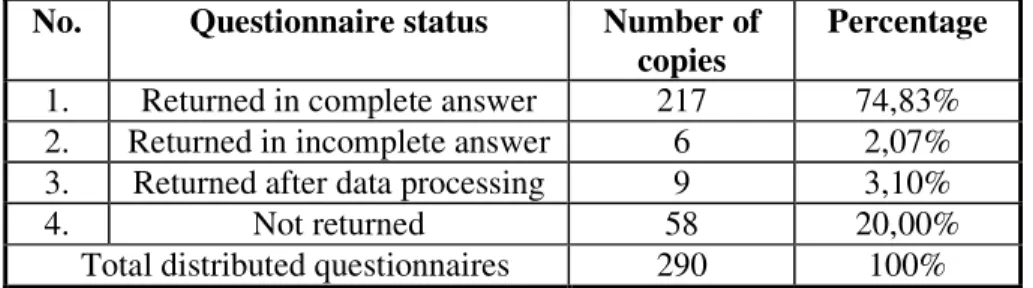
commitment. The data was collected from Islamic Banks in Medan with total of 217
respondents. The data was analyzed using Smart Partial Least Square (PLS) 3.0
Structural Equation Model (SEM). The results show that Islamic work ethic has a
positive significant impact on employees’ job satisfaction. However, Islamic work
ethic has no direct impact on organizational commitment, but it has an indirect
impact on it. In addition, from six profiles of respondents, only employees’ level of
iv
with organizational commitment.
Keywords
:
Islamic Work Ethic, Job satisfaction, Organizational commitment
Address: Jl. M. Nawi Harahap, Gg. Suka, No. 18, Medan
Cell-phone: 0821 6163 6269
v
Saat ini semangat umat Islam Indonesia dan Pemerintah Republik Indonesia dalam
menghidupkan kembali ekonomi syariah harus dihargai dan didukung oleh semua
elemen terutama oleh lembaga keuangan Islam negara ini. Salah satu lembaga
keuangan Islam yang paling populer dan akrab bagi masyarakat Indonesia adalah
Bank Islam. Sayangnya, data menunjukkan bahwa masalah pergantian karyawan,
keterlambatan, penggelapan, dan lain-lain, masih terjadi di sektor Perbankan Islam.
Situasi ini, tentu saja, bertentangan dengan prinsip-prinsip Etika Kerja Islami di satu
sisi, dan akan mengganggu dan bahkan mengancam kelancaran operasional
lembaga-lembaga tersebut di sisi lain. Oleh karena itu, menyelidiki fenomena
perilaku seperti ini akan menjadi sangat penting untuk meminimalkan efek negatif.
Oleh karena itu, penelitian ini dimaksudkan untuk menguji dampak Etika Kerja
Islami terhadap kepuasan kerja dan implikasinya terhadap komitmen organisasi.
Data angket yang dikumpulkan dari karayawan-karyawan Bank Islam di Medan
berjumlah 217 responden. Selanjutnya data tersebut dianalisis menggunakan Smart
Partial Least Square (PLS) 3.0 Structural Equation Model (SEM). Hasil penelitian
menunjukkan bahwa etika kerja Islam memiliki dampak positif yang signifikan
terhadap kepuasan kerja karyawan. Namun, etika kerja Islam tidak berdampak
langsung pada komitmen organisasi, tetapi memiliki dampak tidak langsung
terhadapnya. Selain itu, dari enam profil responden, hanya tingkat pendidikan
karyawan adalah satu-satunya profil yang memiliki hubungan dengan kepuasan
kerja. Sementara itu, tingkat pendidikan karyawan serta penghasilan bulanan mereka
ditemukan berpengaruh terhadap komitmen organisasi.
vi
حور نإ
د
ا ش إ
و إ ر
و
و ا
! "ا
#$ % "ا &
'( )* "او # + " , -./0 نأ 23 45ه % أ *#7"ا
!("ا ا5ه
89 ا " "ا ت 9; "ا $ <
.
" "ا ت 9; "ا ة او
ا 2 7"ا ى "
"? #@آBاو ( C #@آBا
89 ا
ك %("ا ه
و
89 ا
.
، #<? "ا ، FG "ا نارود 'آ 7 نأ ت ("ا # .0 ، H9I"
89 ا ك %("ا ع K ث / M"ذ -"إ و ، س8 < ا
.
(K, ، &P "ا ا5ه
Q ?C و ، او 2 89 ا ' "ا ت 8<أ ئد ( & S % ، ل /"ا
ةراد ا د وأ U*V نأ
#<Wا 2 3"ا ت 9; !" ! "ا 5 F% "ا
.
" " ,و
(! "ا ر XWا /!"
# أ آ ! "ا ة#ه ."ا 45ه '@ Y +/ "ا نZ ،
.
P#"ا -!*
89 ا ' "ا ت 8<أ # X?0 9ارد -"إ [/("ا ا5ه ف ، M"5"
ماV " ا -!* ه# X?0و F G "ا
.% "ا
.
)0
&
("ا
ت
ك %("ا
89 ا
نا
&
"
إ
217
كر 7
.
ت ("ا ' !/0 )0
ما ^ 9 ,
جذ
.[Smart Partial Least Square (PLS) 3.0 Structural Equation
Model (SEM)]
, 3 إ # X?0 " 89 ا ' "ا ت 8<أ نأ U` %"ا # .0
FG !" F G "ا P#"ا -!* # (آ
.
89 ا ' "ا ت 8<أ نZ ، M"ذ & و
-!* #C ( # a # X?0 " "و ،
.% "ا ماV " ا -!* #C ( # X?0 " b "
M"ذ
.
) ! 0 ى
، ( 3
!"
^C ت F! 9 ، M"ذ -"إ P ,
F G "ا P#"ا & ط (0را Q " ي5"ا
"ا H! "ا ه e+ FG "ا
.
f "ا و
) ! 0 ى
نأ و ، Q F
e(0# ي# 7"ا ) !<د * 8g FG "ا
ماV " ,
.% "ا
.
vii
viii
Page
Acknowledgements
i
Dedications
ii
Abstract
iii
Table of Contents
viii
List of Tables
xi
List of Figures
xiii
CHAPTER I
INTRODUCTION
1
A.
Background of the Study
1
B.
Problem Statement
14
C.
Research Questions
14
D.
Scope of Study
15
E.
Significance of the Study
15
F.
Objectives of the Study
16
CHAPTER II
LITERATURE REVIEW
18
A.
Business and Ethic in History
18
B.
Islamic Work Ethic (IWE)
25
C.
Job Satisfaction
38
D.
Organizational Commitment
43
E.
Job Satisfaction and Organizational Commitment
51
F.
Past Studies
52
G.
Theoretical Framework
55
H.
Hypotheses
57
CHAPTER III
ix
C.
Questionnaire Design and Data Collection
60
1. Islamic Work Ethic Measure
61
2. Job Satisfaction Measure
63
3. Organizational Commitment Measure
65
4. Demographic Variables
66
D. Research Design
66
1. Research Model
68
E. Variables’ Operational Definitions
70
1. Islamic Work Ethic
70
2. Job Satisfaction
71
3. Organizational Commitment
72
F. Data Test Analysis
72
1. Validity Test
73
2. Reliability Test
73
G. Data Analysis Methods
74
1. Statistic Descriptive Analysis
74
2. Structural Equation Modeling (SEM) Analysis
75
CHAPTER 4
DATA ANALYSIS AND FINDINGS
77
A.
A Glance on Research Location
77
B.
Profiles of Respondents
80
C.
Instruments Validity Test
100
D.
Instruments Reliability Test
102
E.
Descriptive Analysis on Research Variables
103
F.
Descriptive Analysis on Research Variables’ Indicators
113
G.
Crosstabs Analysis on Respondent’s Profiles and Research Variables 117
H.
Structural Equation Modeling (SEM) Analysis
119
x
I. Research Discussions
132
1. Data Collection
132
2. Profiles of Respondents
132
3. Indicators, Profiles of Respondents, and Research Variables
133
a. Islamic Work Ethic
133
b. Profiles of Respondents and Islamic Work Ethic
134
c. Job Satisfaction
136
d. Profiles of Respondents and Job Satisfaction
137
e. Organizational Commitment
137
f. Profiles of Respondents and Organizational Commitment
138
g. Hypotheses Discussion
140
J. Findings
142
CHAPTER V
CONCLUSIONS AND SUGGESTIONS
145
A.
Conclusions
145
B.
Suggestions
145
BIBLIOGRAPHY
ATTACHMENTS:
SPSS OUTPUTS
PLS SEM OUTPUTS
LETTERS OF RESEARCH ACCEPTANCE
QUESTIONNAIRES
xi
Page
Table 1: Factors which Trigger Employees’ Intention of Turnover
11
Table 2: Employees Turnover in Bank Rakyat Indonesia Syariah
(BRIS) Bandung Suniaraja 2010-2011
12
Table 3: Percentage of Employees’ Tardiness in Bank Rakyat
Indonesia Syariah (BRIS) Bandung Suniaraja Branch
2010-2011
13
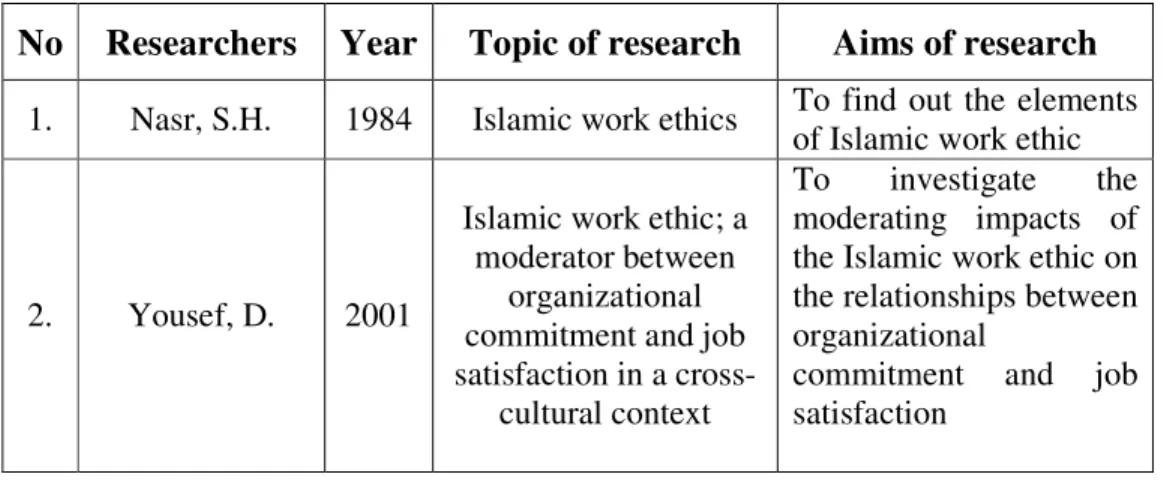
Table 4: List of Several Past Studies
52
Table 5: Questionnaires Level of Turnover
80
Table 6: Profiles of Respondents of BRIS
81
Table 7: Profiles of Respondents of Bank SUMUT Syariah
83
Table 8: Profiles of Respondents of OCBC NISP Syariah
85
Table 9: Profiles of Respondents of Bank BUKOPIN Syariah
86
Table 10: Profiles of Respondents of Bank Permata Syariah
88
Table 11: Profiles of Respondents of CIMB Niaga Syariah
89
Table 12: Profiles of Respondents of Bank Negara Indonesia
(BNI) Syariah
91
Table 13: Profiles of Respondents of Bank Muamalat
93
Table 14: Profiles of Respondents of Bank Syariah Mandiri (BSM)
95
Table 15: Profiles of Respondents of Bank Aceh Syariah
97
Table 16: Profiles of Respondents of All Banks
98
Table 17: Validity of Islamic Work Ethic
101
Table 18: Validity of Job Satisfaction
101
Table 19: Validity of Organizational Commitment
102
Table 20: Reliability of Research Variables
103
Table 21: Respondents’ Profile towards Islamic Work Ethic
104
Table 22: Respondents’ Profile towards Job Satisfaction
106
xii
Table 26: The Average Score of Organizational Commitment’s
Indicators
116
Table 27: Pearson Chi-Square Values of Inter-variable Crosstabs
118
Table 28: Outer Loading PLS Algorithm Model 1
120
Table 29: Outer Loading PLS Algorithm Model 2
122
Table 30: Outer Loading PLS Algorithm Model 3
124
Table 31: Outer Loading PLS Bootstrapping Model 3
125
Table 32: Construct Reliability Based on Convergent Validity
126
Table 33: Cross Loading
127
Table 34: AVE and AVE Root Comparison
127
Table 35: Latent Variable Correlation
128
Table 36: Path Coefficients
129
xiii
Page
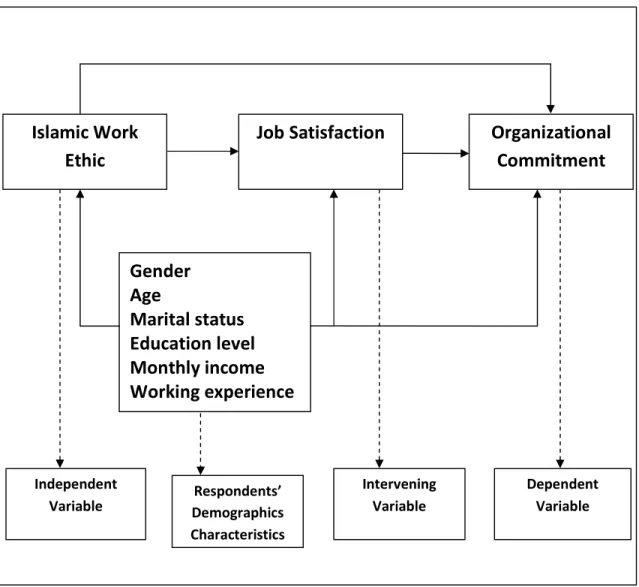
Figure 1: Theoretical Framework
57
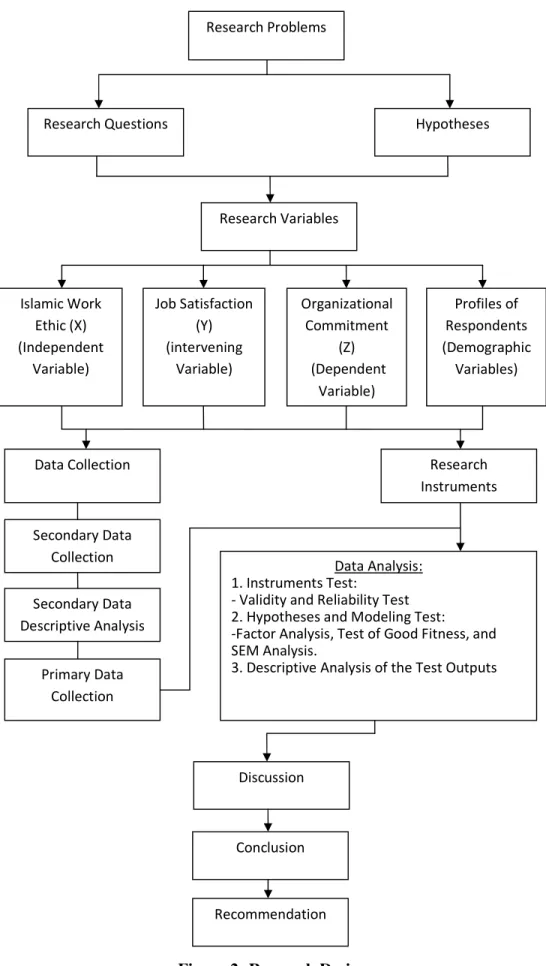
Figure 2: Research Design
67
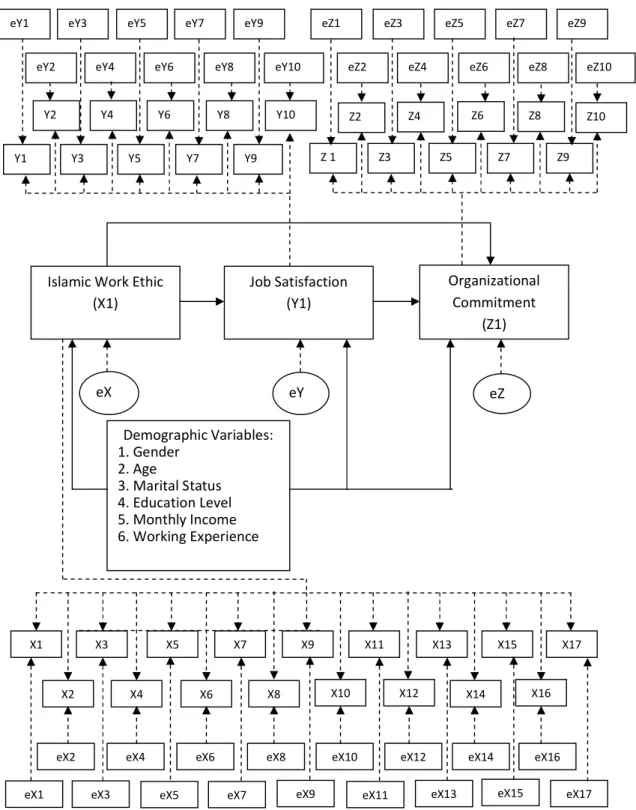
Figure 3: Research Path Model
68
Figure 4: PLS Algorithm Model 1
119
Figure 5: PLS Algorithm Model 2
122
Figure 6: PLS Algorithm Model 3
123
1
A. Background of the Study
In Islam, working is not merely a worldly matter but it also has more crucial and ultimate dimension in the life of hereafter. In the other words, working in Islam has horizontal as well as vertical dimensions. Islam conveyed that working has economic as well as moral and social dimensions. Therefore, in Islam working is viewed not as an end in itself, but as a means to foster personal growth and social relations.1 In accordance, Islam has stated its principles and rules of work ethics through Quran and Hadith, because working in Islam is obligated for its followers as a way to fulfill their existence needs in one side and to prove their genuine submission and worshipping Allah the Most Merciful in another. These are, in general, the factors which differentiate Islam and the Materialism, whereby Islam never dissociate between economic activities and ethic.2 Consequently, every Muslim hold responsible and, in the end, will be informed as well as questioned on whatever he/she has done.
Hereby, one of main goals of this study is to examine whether Islamic Work Ethic (IWE) has become an absolute undisputed guide obeyed by Muslims and how compliant do Muslims to IWE. It is because the nature of IWE is not equal to work ethic in other religions such as Christians and Judaism.3 For example, one of fundamental differences between the Protestant Work Ethic (PWE) and the IWE is that in Islam all deeds performed by Muslims will be justified through their intensions, which is in line with the hadith of Prophet Mohamed (ﷺ) ”actions are recorded according to intention, and man will be rewarded or punished accordingly.” Therefore, in Islam, unlike in other religions,
1
Ali A, and Al-Owaihan, A., 2008, “Islamic Work Ethic: A Critical Review”, Cross Cultural Management: An International Journal, Vol. 15, No. 1, pp. 5-19.
2
Yusuf Qardhawi, (1997), Norma dan Etika Ekonomi Islam, Jakarta, Gema Insani, pp. 51.
3
being good at human eyes does not guarantee that it would be valued as good deed too by Allah the Know of all things.
Allah SWT the Almighty has mentioned in the Holy Qur’an in sura At-Taubah (9) verse 105:
È
≅
è
%
u
ρ
(
#
θ
è
=
y
ϑ
ô
ã
$
#
“
u
z
|
¡
s
ù
ª
!
$
#
ö
/
ä
3
n
=
u
Η
x
å
…
ã
&
è
!
θ
ß
™
u
‘
u
ρ
t
βθ
ã
Ζ
Ï
Β
÷
σ
ß
ϑ
ø
9
$
#
u
ρ
(
š
χρ
–
Š
u
ä
I
y
™
u
ρ
4
’
n
<
Î
)
É
Ο
Î
=≈
t
ã
É
=
ø
‹
t
ó
ø
9
$
#
Í
ο
y
‰
≈
p
κ
¤
¶
9
$
#
u
ρ
/
ä
3
ã
∞
Îm
7
t
⊥
ã
‹
s
ù
$
y
ϑ
Î
/
÷
Λ
ä
Ζ
ä
.
t
βθ
è
=
y
ϑ
÷
è
s
?
∩⊇⊃∈∪
105. “And say (O Muhammad ﷺ) "Do deeds! Allah will see your deeds, and (so will) His Messenger and the believers. And you will be brought back to the All-Knower of the unseen and the seen. Then He will inform you of what you used to do.”
The command of working and doing deeds by seeking the bounties including the sustenance provided by Allah to His servants has clearly been revealed by Allah in Qur’an sura Al-Jumu’ah (62) verse 10:
#
s
Œ
Î
*
s
ù
Ï
M
u
Š
Å
Ò
è
%
ä
ο
4
θ
n
=
¢
Á
9
$
#
(
#
ρ
ã
Ï
±
t
F
Ρ
$
$
s
ù
’
Î
û
Ç
Ú
ö
‘
F
{
$
#
(
#
θ
ä
ó
t
G
ö
/
$
#
u
ρ
Ï
Β
È
≅
ô
Ò
s
ù
«
!
$
#
(
#
ρ
ã
ä
.
ø
Œ
$
#
u
ρ
©
!
$
#
#
Z
Ï
W
x
.
ö
/
ä
3
¯
=
y
è
©
9
t
βθ
ß
s
Î
=
ø
#
è
?
∩⊇⊃∪
10. “Then when the (Jumu'ah) Salat (prayer) is finished, you may disperse through the land, and seek the Bounty of Allah (by working, etc.), and remember Allah much, that you may be successful.”
Interestingly, Allah the Most Beneficent has made this universe easy for human beings to earn their sustenance as long as they keep moving and active in seek of the bounties of Allah as stated in Quran in respective sura:
t
¤
‚
y
™
u
ρ
/
ä
3
s
9
$
¨
Β
’
Î
û
Ï
N
≡
u
θ≈
y
ϑ
¡
¡
9
$
#
$
t
Β
u
ρ
’
Î
û
Ç
Ú
ö
‘
F
{
$
#
$
Y
è
‹
Ï
Η
s
d
ç
µ
÷
Ζ
Ïi
Β
4
¨
β
Î
)
’
Î
û
š
Ï
9≡
s
Œ
;
M
≈
t
ƒ
U
ψ
5
Θ
ö
θ
s
)
Ïj
9
š
χρ
ã
©
3
x
#
t
G
t
ƒ
∩⊇⊂∪
13. “He [God] has also made subservient to you all that is in the heavens and the earth; it is all as a favour and kindness from Him. Verily, in it are signs for people who think deeply.” (Al-Jathiyah, 45:13).
Then Allah the Almighty also said:
*
$
t
Β
u
ρ
Ï
Β
7
π
−
/
!
#
y
Š
’
Î
û
Ç
Ú
ö
‘
F
{
$
#
ā
ω
Î
)
’
n
?
t
ã
«
!
$
#
$
y
γ
è
%
ø
—
Í
‘
Þ
Ο
n
=
÷
è
t
ƒ
u
ρ
$
y
δ
§
s
)
t
F
ó
¡
ã
Β
$
y
γ
t
ã
y
Š
θ
ö
t
F
ó
¡
ã
Β
u
ρ
4
@
≅
ä
.
’
Î
û
5
=
≈
t
G
Å
2
&
Î
7
•
Β
∩∉∪
6. “And no (moving) living creature is there on earth but its provision is due from Allah. And He knows its dwelling place and its deposit (in the uterous, grave, etc.). all is in a Clear Book (Al-Lauh Al-Mahfuz - the Book of Decrees with Allah).” (Huud, 11:6).
In addition, the Prophet Mohamed (ﷺ) has declared on how admirable are the Muslims who work and eat foods from their own efforts, and explicitly he also has asked Allah to forgive those Muslims who strive and work hard. The hadiths are narrated as follow:
،َناَ ْ َ ِ ْ ِ ِ َ ْ َ ،ٍرْ َ ْ َ ، َ ِ ََ َْ َأ ، َ ُ ُ ْ ُ ِهاَ ِْإ َ!َ" َ#
َ َل َ% & و ( & )ا &* ِ("& ا ِل ُ َر ْ َ ـ (! )ا ,ر ـ ِماَ ْ.ِ/ْا ِ َ
ٌَ#َأ َ1َآَأ
َأ ْ ِ اً َْ 45َ% ً َ َ6
ـ َدُواَد ِ("& ا "8َِ "نِإَو ،ِ9ِ َ: ِ1َ/َ ْ ِ َ1ُآْ;َ: ْن
ِ9ِ َ: ِ1َ/َ ْ ِ ُ1ُآْ;َ: َن َآ ـ ُمَ<" ا ِ(َْ&َ
.
Narrated Al-Miqdam:The Prophet (ﷺ) said, “Nobody has ever eaten a better meal than that which one has earned by working with one's own hands. The Prophet (ﷺ) of Allah, David used to eat from the earnings of his manual labor.”4
In another hadith, Allah’s apostle said:
8َِ َْ َأ َل َ% ،>يِ ْه4@ ا ِ َ ،َAُ ُ: ْ َ ،ِ("& ا ُ َْ ََ َْ َأ ،ُناَ َْ َ!َ" َ#
ُ/ْا ُ ْا
&* "8ِ"! ا ُBْ ِ/َ َل َ% ـ (! )ا ,ر ـ َةَ ْ:َ ُه ََأ َDِ/َ ،ِE"َ
( & )ا
& و
ُل ُ.َ:
':
ُBْ َ@َ!َF ،ٌ َْد َGَْ&َ ٍE ِ&َ% َ&َ 8ِ!ُHْ:َأَر ٌِI َ ََأ َ!َْ
َعَ@َ!َF ،َKَF َLُ% 8َِأ ُ ْا َهَMَ َأ " ُ ،ُ("& ا َء َO َ َGْ!ِ
،ِ َْ َُذ ْوَأ ً َُذ َGِ
ُ ْا َهَMَ َ;َF ، ًْ َQ ْBَ َLَHْ ا " ُ ،ُ(َRْ َ, ُ(َ ُ ِRْSَ: ُ("& اَو ،ٌTْ َ, ِ(ِ ْ@َ 8ِFَو
ُس "! ا َبَ َ, "Hَ# ،َ َ/ُ َعْ@َ ُعِ@ْ!َ: ِس "! ا َ ِ W:ِ َ.َْ َرَأ ْ َ&َF ،ِب "XَYْا
ٍ َXَ ِ
.'
Narrated Abu Huraira:I heard Allah's Messenger (ﷺ) saying, “While I was sleeping, I saw myself standing at a well, on it there was a bucket. I drew water from the well as
4
Muḥammad Ibn Ismā‘il Abū ‘Abdullāh al-Bukhāri al-Ja‘fiy, Al-Jāmi‘ al-Musnad aṣ -ṣaṣiṣ al-Mukhtaṣar min Umūr Rasūlullāh ṣallallāh ‘Alaih Wasallam wa Sunanih wa Ayyāmih
(ṣaṣiṣ al-Bukhāri), ed. Muhammad Zuhair Ibn Nāḥir an-Nāḥir (Dār ḥūq an-Najāh, 1422 H),
much as Allah wished. Then Ibn Abi Quhafa (i.e. Abu Bakr) took the bucket from me and brought out one or two buckets (of water) and there was weakness in his drawing the water. May Allah forgive his weakness for him. Then the bucket turned into a very big one and Ibn Al-Khattab took it over and I had never seen such a mighty person amongst the people as him in performing such hard work, till the people drank to their satisfaction and watered their camels that knelt down there.”5
As stated earlier, the necessity of hard working is inevitable; however, workers’ work ethic (good manners at work) is not negotiable too. As an example, since the early 1990s, Flynn6 has reported that work ethic having higher priority than skill for the employers to recruit the employees. This study proved that employers are giving more and more attention on work ethic rather than skill in recruiting the employees. However, the research does not nullify the need of skillful employees, rather it emphasizes on the demand of ethical as well as skillful employees.
In this regard, Islamic work ethic should become a guide for Muslims in behaving with a good conducts especially in their work places. Whereby Muslims realize that by persistently performing Islamic work ethic means the same as they have followed and obeyed the commandments of Allah and His apostle Mohamed
(ﷺ). Subsequently, this faith would lead Muslims to become satisfied with their job, because Muslims believe that doing a good and favorable work performance is also a form of submitting themselves Allah’s will and worshipping Him.
Although it’s not quite similar, satisfaction in everything in Muslims’ life, including satisfaction on their job, is usually called as “qana’ah”. Qana’ah in Islam is not merely a matter of possessing ample and plentiful of wealth, qana’ah
is a matter of Muslims’ grateful sense for whatever they are bestowed. It is about
5
Muḥammad Ibn Ismā‘il Abū ‘Abdullāh al-Bukhāri al-Ja‘fiy, Al-Jāmi‘ al-Musnad aṣ -ṣaṣiṣ al-Mukhtaṣar min Umūr Rasūlullāh ṣallallāh ‘Alaih Wasallam wa Sunanih wa Ayyāmih
(ṣaṣiṣ al-Bukhāri), ed. Muhammad Zuhair Ibn Nāḥir an-Nāḥir (Dār ḥūq an-Najāh, 1422 H),
Bāb Qaul an-Nabi Shallallahu ‘Alaihi Wa Sallam, Hadist 3664, Book V, pp. 6.
6
a person’s feeling of gratefulness and satisfaction after doing his/her best efforts, including prayers, regardless of the outcomes. Due to its praiseworthy character in Islam, being qana’ah therefore consequently will be awarded with huge rewards. In his decree, the Prophet Mohamed (ﷺ) said how wonderful are Muslims’ life with this qana’ah attribute:
ََ َْ َأ ،ُئِ ْ.ُ/ْا َ :ِ@َ: ُ ْ ِ("& ا ُ َْ َ!َ" َ# ،4يِرو4 ا ٍ "/َLُ ُ ْ ُس "َ ْا َ!َ" َ#
َ ْ وَ ْ/َ ،^8ِ&َ ََأ "نَأ ،48َِ_ْ َYْا ٍ`ِ َه َُأ 8َِ َْ َأ ،ٍaْ:َ ُO ُ ْ ُةَ َْ#
َbَF ْ َ ُ9َ َْ َأ "8ِْ!َcْا ٍdِ َ
)ا &* ِ("& ا َل ُ َر َDِ/َ ُ("َأ ،ٍ َُْ ِ ْ َKَ
ُل ُ.َ: & و ( &
"
َDِ!َ%َو ًF َRَآ ُ(ُeَْ َن َآَو ِمَ<ْ ِfا َِإ َيِ ُه ْ َ/ِ َ ُ6
."
ٍ`ِ َه ُ ْ ُ َْ/ُ# ُ(ُ/ْ ا ٍ`ِ َه َُأَو َل َ%
.
ٌ َ َ# ٌg:ِ َ# اَMَه َ ِ َُأ َل َ%
ٌa ِLَ*
.
Fadalah bin 'Ubaid narrated that he heard the Messenger of Allah (ﷺ)
saying:
“Glad tidings to whoever is guided to Islam, his livelihood was sufficient and he was satisfied.”7
In the same way, the Prophet Mohamed (ﷺ) used to seek refuge with Allah the Almighty from a greedy personality which is the opposite of qana’ah. Allah’s apostle Mohamed (ﷺ) used to ask Allah in his prayers:
7
Muhammad Ibn ‘Isā Ibn Saurah Ibn Mūsā Ibn ḥahhāk at-Tirmizi, 1975, Sunan at-Tirmizi, ed. Ahmad Muhammad Syākir, et.al. print 2 (Cairo: Syirkah Maktabah wa Maḥba‘ah Muḥtafā al-Bābi al-ḥalabi), Bāb Mā Jā`a fi al-Kafāf wa ash- Shabr ‘Alaihi, Hadist2349, Book IV, pp. 576.
ِ ا نَأ ،ٍ ََأ ْ َ ،ٍ َْ ْ َ ،ٌ ََ ََ َ َل َ ،ُ َْ!َ"ُ ََ#َْ َأ
$ا % &
ِتاَ(َ ا ِ)ِ*َ+ِ, (ُ ْ َ- َن َآ / 0و 2!
"
َ4 ٍ/ِْ ْ ِ5 َ6ِ, ُذ(ُ َأ 8ِإ /ُ+ ا
ُ:َْ;َ< َ4 ٍ ََْو ُ:َ=ْ>ُ- َ4 ٍء َ ُدَو ُ:َ;ْAَ- َ4 ٍBََْو
ُ:ََْ-"
.
ُل(ُDَ- /ُ
"
/ُ+ ا
ِءَ4ُEَه ْ ِ5 َ6ِ, ُذ(ُ َأ 8ِإ
ِ:َ,ْرَHا
"
.
It was narrated from Anas that:
The Prophet (ﷺ) used to say these supplications: “Allahumma inni a'udhu bika min 'ilmin la yanfa'u, wa qalbin la yakhsha'u, wa du'a'in la yusma'u, wa nafsin la tashba'u. (O Allah, I seek refuge with You from knowledge that is of no benefit, a heart that is not humble, a supplication that is not heard and a soul that is not satisfied.)” Then he would say: ‘Allahumma inni a'udhu bika min ha'ula'il-arba' (O Allah, I seek refuge with You from these four)’.8
Afterwards, Islamic work ethic, in fact, does not only affect the employees’ job satisfaction, it also motivates them to be committed to the organizations. With regards to Islamic work ethic (IWE), job satisfaction and organizational commitment in a study held by Norshidah et al., it was found that Islamic work ethic has a positive and significant impact to make the employees satisfied and committed.9
To this end, Islam is extremely concerned, and urged Muslims to be committed and highly determined in good works and deeds. Because only such a strong commitment that able to transform ideas and dreams into reality and a
8
Imam An-Nasa`i, Sunan Al-Sughrā, 1986, ed. Abu Al-Fattah Abu Ghadah, print 2, (Hilb: Maktabah al-Matbu`ah al-Islamiyyah), BābAl-isti’azah min Nafs la Tasyba’, Hadist 5470, Book VIII, pp. 263.
9
Norshidah, M., Nor Shahriza, A.K and Ramlah, H, 2010. ‘Linking Islamic Work Ethic to Computer Use Ethics, Job Satisfaction, and Organizational Commitment’, Journal of Business Systems, Governance and Ethics, 5, pp. 13-23.
person reserves the right only for what he/she attempts to. Allah the All-Wise explicitly mentioned in Quran:
β
r
&
u
ρ
}
§
ø
Š
©
9
Ç
≈
|
¡
Σ
M
∼
Ï
9
ā
ω
Î
)
$
t
Β
4
t
ë
y
™
∩⊂∪
39. ‘‘Human being can have nothing but what they strive for’’ (An-Najm, 53:39).
Besides, the Prophet Mohamed (ﷺ) was the most committed person in performing his duties and deeds as it is clearly described in the following hadith:
َ(ُه ،ُ#َ=ُ َِ َ َل َ ،ٍBْهَو ُ ْ,ا َِ َ َل َ ،َن َ=ْ!َُ0 ُ ْ, %َ!ْIَ- ََ َ
ْ َ َ#َ=ُ ُ ْ,ا ََِJَ0 َل َ ،ِ2!ِ,َأ ْ َ ُ2َ َ ،َ/َْ0َأ َ ْ, َ ْ-َز نَأ ٍ =َIُ5 ُ ْ,ا
ْJَL ،ِMْNَ,
ُ2ُ<ْ#َْ َJَO ـ َ#َ=ُ ِْNَ- ـ ِ2ِ
.
ِل(ُ0َر َ ْNَ, QRَ اً َ َأ ُTْ-َأَر َ5 ،َل َDَO
ْ ِ5 %َ+َ"ْا %"َ َدَ(ْUَأَو َUَأ َن َآ َMُِ َ !ِ ْ ِ5 / 0و 2! $ا % & ِ2 ا
ِب WَAْا ِ ْ, َ#َ=ُ
.
Narrated Aslam:
Ibn `Umar asked me about some matters concerning `Umar. He said, “Since Allah's Messenger (ﷺ) died. I have never seen anybody more serious, hard working and generous than `Umar bin Al-Khattab (till the end of his life.”10
10
Muḥammad Ibn Ismā‘il Abū ‘Abdullāh al-Bukhāri al-Ja‘fiy, Al-Jāmi‘ al-Musnad aṣ -ṣaṣiṣ al-Mukhtaṣar min Umūr Rasūlullāh ṣallallāh ‘Alaih Wasallam wa Sunanih wa Ayyāmih
(ṣaṣiṣ al-Bukhāri), ed. Muhammad Zuhair Ibn Nāḥir an-Nāḥir (Dār ḥūq an-Najāh, 1422 H),
It is obvious that in the hadith above, the word ‘serious’ refers to something done with high level of commitment and determination. And in fact, the Prophet Mohamed (ﷺ) instructed seriousness not only in terms of doing deeds but also in terms of saying our prayers to The Almighty Allah. It is apparently stressed in the hadith below:
ْ َ ،ِجَ ْ َiا ِ َ ،ِد َ>@ ا 8َِأ ْ َ ،ٍdِ َ ْ َ ،َKَ/َ&ْ َ ُ ْ ِ("& ا ُ َْ َ!َ" َ#
َل َ% & و ( & )ا &* ِ("& ا َل ُ َر "نَأ ـ (! )ا ,ر ـ َةَ ْ:َ ُه 8َِأ
"
ا ُ ُآُ َ#َأ " َ ُ.َ: َ_
َBْjِO ْنِإ ،8ِ!ْ/َ#ْرا " ُG"& ا ،8ِ ْ ِRْQا " ُG"&
.
،َKََ;ْ َ/ْا ِمِ@ْ َِ
ُ(َ َ9ِ ْkُ َ_ ُ("ِlَF
"
.
Narrated Abu Huraira:Allah's Messenger (ﷺ) said, “None of you should say: 'O Allah, forgive me if You wish; O Allah, be merciful to me if You wish,' but he should always appeal to Allah with determination, for nobody can force Allah to do something against His Will.”11
The study on the affective reactions of employees to organizations has become the most prevalent researched areas, in particular, Islamic work ethic, job satisfaction and organizational commitment and have been the focus of much of such research (Norshidah, M., et. al.,12 Yousef, D.,13 and Paul, E.L. & Jane, R.W.14).
11
Muḥammad Ibn Ismā‘il Abū ‘Abdullāh al-Bukhāri al-Ja‘fiy, Al-Jāmi‘ al-Musnad aṣ -ṣaṣiṣ al-Mukhtaṣar min Umūr Rasūlullāh ṣallallāh ‘Alaih Wasallam wa Sunanih wa Ayyāmih
(ṣaṣiṣ al-Bukhāri), ed. Muhammad Zuhair Ibn Nāḥir an-Nāḥir (Dār ḥūq an-Najāh, 1422 H),
Bāb liyughrim al-Mas`alah, Hadist 6339, Book VIII, pp. 74.
12
Norshidah, M., Nor Shahriza, A.K and Ramlah, H, (2010). ‘Linking Islamic Work Ethic..., pp.13-23.
13
Yousef, D. (2001). ‘‘Islamic work ethic; a moderator between organizational commitment and job satisfaction in a cross-cultural context’’, Personal Review, 30, pp. 152-69.
14
Paul, E.L. & Jane, R.W. (1998). 'the Role of Perceived System Knowledge in Predicting Appraisal Reactions, Job Satisfaction, and Organizational Commitment', Journal of
Moreover, such satisfaction and commitment have been linked to organizational outcomes such as turnover, absenteeism, performance and grievances as well as antecedents and correlates like demographics, role states, job characteristics, employee-leader relations, and organizational characteristics (Hackett & Guion15; Judge & Wattanabe16; Petty, McGee, & Cavender17; Scott & Taylor18). From the above statement, we clearly see the importance of such dynamic study for the organizations to operate smoothly i.e. by taking the employees' job satisfaction into consideration as it will influence their commitment to the organizations.
Let’s take an example of the most common problem faced by organization such as turnover. Turnover represents a major problem especially in terms of recruitment costs and organizational continuity. Arnold and Feldman,19 Bluedorn,20 Hollenbeck and Williams21 found that job satisfaction and organizational commitment, have invariably been reported to be negatively related to turnover and intent to leave and positively correlated to one another.22 In other words, job satisfaction and organizational commitment are negatively related to turnover and intent to stay, while they are positively related to each other.
Organizational Behavior, 19, pp. 53-65.
15
Hackett, R.D. & Guion, R.M. (1985). 'A Reevaluation of the Absenteeism-Job Satisfaction Relationship', Organizational Behavior and Human Decision Processes, 35, pp. 340-381.
16
Judge, T.A. & Wattanabe, S. (1993). 'Another Look at the Job Satisfaction and Life Satisfaction Relationship', Journal of Applied Psychology, 78, pp. 939-948.
17
Petty, M.M, McGee, G.N., & Cavender, J.W. (1984). ' A Meta-Analysis of the Relationships between the Individual Job Satisfaction and Individual Performance.', Academy of Management Review, 9, pp. 712-721.
18
Scott, K.D. & Taylor, G.S. (1985). 'An Examination of Conflicting Findings on the Relationship between Job Satisfaction and Absenteei sm ', Academv of Management Journal, 28, pp. 599-612.
19
Arnold, H.J. & Feldman, D.C. (1982). 'A Multivariate Analysis of the Determinants of Job Turnover', Journal of Applied Psychology, 67, pp. 350- 360.
20
Bluedorn, A.C (1982). 'A Unified Model of Turnover from Organizations', Human Relations, 35, pp. 135-153.
21
Hollenbeck, lR. & Williams, CR. (1986). 'Turnover Functionality Versus Turnover Frequency: A Note on Work Attitudes and Organizational Effectiveness', Journal of Applied Psychology, 71, pp. 606-611.
22
Unfortunately, the problem arises since the above relationships becoming inconsistent and slightly ruined by the findings of some organizations. For instance, PricewaterhouseCoopers (PwC) Indonesia23 made a survey since January to February 2014 on banking industries in Indonesia and found 15% employees turnover occurred in this sector. This significant level of employees’ turnover was the result of inadequate human resource supply while the demand is high.
In the survey, PwC Indonesia also found that the employees were frequently switching from one bank to another. As much as 54% of the respondents switched over for the sake of higher income, meanwhile 37% of the respondents moved to get a career development. The need of a new challenge and dissatisfaction on leadership styles had been responded as much as 4% respectively.
To make it clearer and easier to understand, the following table displays the hierarchy of the factors which trigger the intention of employees’ turnover based on PwC’s findings.
Table 1: Factors which Trigger Employees’ Intention of Turnover
No. Triggering Factors Percentage
1. Seeking for higher income 54%
2. Career development 37%
3. New work challenge 4%
4. Dissatisfaction on leadership styles 4%
Source: PwC Indonesia’s survey findings on banking industries in Indonesia (2014).
PwC Indonesia claimed that the survey represented 80% banking industries assets in Indonesia. The respondents were top level management of 30
23
http://finansial.bisnis.com/read/20140515/90/228134/survei-sdm-perbankan-turn-over-karyawan-15-motif-utamanya-cari-tunjangan-lebih-menjanjikan; accessed 18/082017.
big banks in Indonesia. Therefore, the results of the survey could be taken as representative situations of Indonesian banking sectors.
In case of Islamic banks, the evidence of employees’ turnover is quite similar. For example, employees’ turnover at BRIS (Bank Rakyat Indonesia Syariah) Bandung Suniaraja branch in 2010-2011 increased from 12 employees in 2010 to 15 employees in 201124 as shown on the table 2 below:
Table 2 : Employees Turnover in Bank Rakyat Indonesia Syariah (BRIS) Bandung Suniaraja 2010-2011
Year Total Employees Turnover
2010 12 employees
2011 15 employees
Source: HRD Division of BRIS (Bank Rakyat Indonesia Syariah) Bandung Suniaraja branch.
The data shows that there is an increasing trend of employees’ turnover at BRIS Bandung Suniaraja branch from 12 employees 15 employees in 2010 and 2011 respectively. Meanwhile, the total employees of BRIS Bandung Suniaraja branch at that time were 62 employees in 2010 and 60 employees in 2011. Thus, the employees’ turnover can be categorized as high which is about 25% of the total BRIS Bandung Suniaraja branch employees.
In addition, antecedent conditions of employees turnover such as being late to work, in fact had been reflected in the forth coming table. The incremental level of employees’ lateness in BRIS Bandung Suniaraja branch can be seen as manifested in the following table25:
24
Hidayat, A. Syarif, (2015), ‘Pengaruh Kompensasi dan Pengembangan Karir terhadap Komitmen Organisasi (Studi Kasus pada PT. Bank BRI Syariah Cabang Bandung Suniaraja)’,
Ecodemica, 3-1, pp. 335.
25
Table 3: Percentage of Employees’ Tardiness in BRIS (Bank Rakyat Indonesia Syariah) Bandung Suniaraja branch 2010-2011
Month Percentage (%) Trend 2010 2011 January 10 7 Decrease February 5 5 Stable March 7 2 Decrease April 5 4 Decrease May 9 3 Decrease June 9 3 Decrease July 7 2 Decrease August 5 10 Increase September 2 5 Increase October 4 7 Increase November 3 5 Increase December 2 9 Increase
Source: HRD Division of BRIS (Bank Rakyat Indonesia Syariah) Bandung Suniaraja branch.
Bank Syariah Mandiri (BSM) in fact, had also fired and reported the fraud and embezzlement of fund by its two employees to State Police Metro Jaya November 2014, which caused financial loss for about Rp. 75 billions.26 Ironically, those two employees got strategic positions at BSM, respectively Marketing Manager and Trade Specialist Officer.
26
https://news.detik.com/berita/2821619/bank-syariah-mandiri-pecat-pegawai-yang-gelapkan-dana-rp-75-m, (Accessed, July 23rd, 2018, 08:40 AM.)
Meanwhile, in Bogor, BSM also fired three 3 employees from November 2012 until October 2013 for credit funds manipulation. The case had been submitted to Indonesian Police authority in Jakarta on 12 September 2013.27 In fact, among those fired employees two of them were heads of BSM branch offices and one accounting officer of BSM. This implies that higher job position does not guarantee ethical commitment and compliance by the employees.
Therefore, the need to study the impact of Islamic work ethic (IWE) on job satisfaction and organizational commitment is inevitable. Anyway, to understand how organizations work and be able to predict and manage employees behavior in organizations, especially the Islamic ones, seems to require a thorough understanding of these three work-related attitudes.
This study, however, is aimed at examining the impact of Islamic work ethic (IWE) on job satisfaction in one side, and its implication towards the organizational commitment of the Islamic bank’ employees in Medan in the other side (partial as well as impartial impact/effect). In the other hand, this study also attempts to investigate the associations between Islamic bank’ employees’ demographic characteristics such as gender (sex), age, marital status, monthly income, level of education, and years of work experience, and the above mentioned variables. Whereby, such studycould provide a clear outlook on real situation of Islamic banks in Medan and ultimately becomes one of the key successes of current organizational performance.
B. Problem Statement
This study would like to investigate the impact of Islamic work ethic on job satisfaction and towards employees’ organizational commitment. Thus, the main emphasis of the study is to show the relationship of Islamic work ethic on job satisfaction and it’s implication towards employees' organizational commitment. This study also tries to analyze the direct impact of Islamic work
27
https://ekbis.sindonews.com/read/797840/34/karyawan-bsm-sempat-kabur-saat-audit-internal-1382604292, (Accessed, July 23rd, 2018, 09:55 AM.)
ethic on employees’ organizational commitment in one side and Islamic work ethic impact on employees’ organizational commitment with job satisfaction as the intervening variable in the other side. In turn, we would like to identify how far do the profiles of respondents such as marital status, gender, age, and length of working experience correlate to those three research variables.
C. Research Questions
The study is conducted based on five main questions:
1. Whether there is an impact of Islamic work ethic on Islamic Banks employees’ job satisfaction?
2. Whether there is a direct impact of Islamic work ethic on Islamic Banks employees’ organizational commitment?
3. Whether there is an indirect impact of Islamic work ethic on Islamic Banks employees’ organizational commitment, when job satisfaction set as an intervening factor?
4. Whether there is an impact of Islamic Banks employees’ job satisfaction on their organizational commitment?
5. Whether there are associations between profiles of Islamic Banks employees with Islamic work ethic, job satisfaction, and organizational commitment?
D. Scope of the Study
The impact of Islamic work ethics on job satisfaction and employees' organizational commitment has become the main focus of this study, and the respondents are those people who are attached in various Islamic banks in Medan, be them the government or private banks such as Bank Sumut Syariah, Bank Syariah Mandiri (BSM), Bank Negara Indonesia (BNI) Syariah, Bank Rakyat Indonesia Syariah (BRIS), Bank Muamalat, OCBC NISP Syariah, BUKOPIN Syariah, Bank Permata Syariah, CIMB Niaga Syariah, and Bank Aceh Syariah, etc. Thus, people who are engaged with this kind of organizations might be taken as the respondents of the research. Thus, basically this study employs convenience sampling.
E. Significance of the Study
Despite its importance, little research has been devoted to an in-depth study of the Islamic work ethic and its impacts on job-related outcomes such as organizational commitment, job satisfaction, job performance, and the like (Yousef,28& Morrison29). Thus, due to the dynamic and inconsistency of the subject matter of this study, the research on this particular area is needed.
As with a number of other studies, this study attempts to address the above question and may reduce the existing ambiguity on the relationship between Islamic work ethic on job satisfaction and its implication towards organizational commitment. It is hoped that the findings of this study can reveal that Islamic work ethic has its own impact on employee's job satisfaction and their organizational commitment. At least, an obvious relationship between the three items, which is moderated by some demographic factors like gender (sex), age, marital status, monthly income, education level and years of working experiences, can be seen clearly after the completion of the study.
Nevertheless, it is imperative to mention several novelties found in this study:
1. This study tries to investigate the impact of IWE on Islamic banks employees’ job satisfaction (as intervening variable) and its implication towards their commitment to their organizations.
2. The above relationships have never been studied earlier especially in Islamic banking sector.
3. Moreover, the research on the above relationships in Medan, can be categorized as a new research has ever been done so far.
28
Yousef, D. (2001b), ‘‘Islamic work ethic; a moderator between organizational commitment and job satisfaction in a cross-cultural context’’, Personal Review, 30, pp. 153.
29
Morrison, K.A. (1997). 'How Franchise Job Satisfaction and Personality Affect Performance, Organizational Commitment', Journal of Small Business Management, 35(3), pp. 39-67.
F. Objectives of the Study
Several objectives of the study might be stated as follows:
1. To find out whether Islamic work ethic has an impact on Islamic Banks employees’ job satisfaction.
2. To find out whether Islamic work ethic has a direct impact on Islamic Banks employees’ organizational commitment.
3. To find out whether Islamic work ethic has an indirect impact on Islamic Banks employees’ organizational commitment, when job satisfaction set as an intervening factor.
4. To find out whether Islamic Banks employees’ job satisfaction has an impact on their organizational commitment.
5. To find out whether profiles of Islamic Banks employees have associations with Islamic work ethic, job satisfaction, and organizational commitment.
CHAPTER II
LITERATURE REVIEW
A. Business and Ethic in History
History has shown that business activity always correlates with ethical issues. The discussion about business and ethic can’t be separated from each other. Therefore, in terms of business activities, both are having the same age which means at the time business existed and so did the ethic. Consequently, in doing business there are several the does and the don’ts that should be obeyed by either the businessman as an individual or the organization as an institution.
Anyway, it is quite astonishing actually, where the fact shows that academically the field of business ethics as a science is widely discussed just about the last five decades, or approximately since 1970s30. Meanwhile business and ethic did exist so long time ago, the same time with the existence of human beings in this world. In this case, Richard De George proposed to differ between ‘ethics in business’ and ‘business ethics’31. Ethics in business means ethics has been related to business as it is related to other aspects of human life such as politics, education, family, etc. That means ethics is still seen as global or general. It can be connected to every aspects of human life. However, when it is called as
business ethics, it becomes more specific with new and special identity. It can be understood that the word business ethics is specifically indicating a new field of science. Therefore, the discussion of ethics in business is having a very long history while the discussion of business ethics is vise-versa.
Utilizing De George’s view, the shift of ethics in business to business ethics can be divided into five different periods32:
30
Darsono, P. & Siswandoko, T., (2011). Manajemen Sumber Daya Manusia Abad 21,
Jakarta, Nusantara Consulting, pp. 349.
See also, Bertens, K., (2013). Pengantar Etika Bisnis, Yogyakarta, Kanisius, pp. 37.
31
De George, Richard, (1986). Business Ethichs, New York, Macmillan Publishing Company, 2nd Edition.
32
Bertens, K., (2013). Pengantar Etika Bisnis, Yogyakarta, Kanisius, pp. 35-40.
1. Earlier Situation
It’s been centuries that ethics talked - on a scientific level - on economic and business issues as one of many other topics related to ethical issues. At the beginning of the history of philosophy, Plato, Aristotle, and other Greek philosophers investigated on how to organize human life together in a state and in that context they also discussed how economic and commercial activity should be governed. In medieval philosophy and theology this discussion continues, both in Christian as well as in Islam, including moral topics on economics and commerce which are of the great attention of philosophy (and theology) in modern times.
By focusing to the situation in the United States during the first half of the 20th century, De George described how moral issues regarding economy and business in colleges were mainly highlighted in theology. At that time, religious discourse was given in many universities in which students studied the problems on moral issues surrounding the economy and business. The discussion is of course different, as far as this course is given in Catholic or Protestant. In Catholic, generally this course tends to concentrate on the "social teaching of the church". What he meant was a systematic description of the teachings of the popes in social encyclicals, beginning with the encyclical Rerum Novarum (1891) of Pope Leo XIII. In this case, there were many topics of discussion pertaining to morality in socio-economic life such as the right of workers to good working conditions and appropriate remuneration; the importance of moral values contradicts a materialistic and consumerist atmosphere; social justice and efforts to improve the lives of the poor people; the responsibility of rich countries to poor countries, and so on. In the other side in the Protestant, the book of German theologian Reinhold Niebuhr ‘Moral Man and Immoral Society’ (New York, 1932) had given a major influence on ethical teaching on the socio-economic and business topics in their colleges.
Thus, in the United States during the first half of the 20th century ethics-in-business is primarily practiced in the context of religion and theology. And this approach still continues to this day, in the United States as well as elsewhere. The popes issued new social encyclicals up to Caritas in Veritate (2009) from Pope Benedict XVI. A particular good example for the United States is the pastoral document issued by US bishops entitled Economic Justice for All. Catholic Social Teaching and the U.S. Economy (1986). 2. Transition period: 1960s
In the 1960s there was a new development that could be seen as a direct preparation for the emergence of business ethics in the next decade. This 1960s decade in the United States (and the western world in general) was characterized by an uprising against power and authority, student revolutions (begun in the French Capital on May 1968), and the denial of establishment. This uneasy atmosphere is reinforced by the frustration felt especially by young people with United States involvement in the Vietnam War. This dissatisfaction resulted in the largest demonstrations ever witnessed in the United States. Young people rejected, in particular, the collusion that occurred between the military and industry. The industry is primarily considered to serve the interests of the military. Simultaneously, for the first time, awareness of ecological problems and especially the industry was seen as the cause of environmental problems through air, water and land pollution and toxic waste and nuclear waste. At the same time there is also an anti-consumerist behavior. The atmosphere of consumerism was increasingly seen as an unhealthy tendency in society and was caused by modern business, among others, through advertising campaigns which were often exaggerated. All of these factors resulted in an anti-business attitude to young people, especially students.
In this way, colleges (scholars) responded to this situation differently. One of the most important reactions was a significant attention had been given to social issues in many management lectures. Some business schools had begun to include new courses in their curriculum commonly called Business and
Society. This lecture was given by management lecturers by publishing text books and other publications to support this new course. One of the topics that became popular in that context was Corporate Social Responsibility. The approach was based on management, which was combined with law and sociology as well, but philosophical ethical theories had not been used at the time.
3. The birth of business ethics in U.S.: 1970s
Business ethics as an intellectual and academic field with its own identity began to exist in the United States since the 1970s. If ethics, in the past, talked on moral aspects in business besides many other morality matters (ethics-in-relation-to-business), it now began to develop business ethics in its true meaning. There were mainly two factors that contributed greatly to the emergence of business ethics in the United States in the mid-1970s: a number of philosophers began to engage in thinking about ethical issues in business, and business ethics which was regarded as an appropriate response to the current moral crisis in business in the United States.
In the previous time, only theologians and clerics at the scientific (theological) stage discussed the moral issues of business, in the 1970s philosophers entered into this area of research and soon became the most dominant group. Basically, several years earlier, other philosophers had discovered biomedical ethics (also called bioethics) as a new scientific field. Therefore, some philosophers were actually involving themselves into business ethics research driven by the above success, while others willingly encouraging themselves to develop business ethics as another branch of applied ethics. In fact, for the philosophers this step was a radical change, because the common atmosphere of philosophical research at the time was far from practical problems. Hence, in developing business ethics, philosophers used to work with other experts, especially economists and management. In this way, they kept tight the tradition of developing applied ethics as multidisciplinary. Norman E. Bowie referred to such partnership as the date of birth of business ethics, the first business ethics conference held at the University of Kansas by the Philosophy
Department (Richard De George) with the College of Business (Joseph Pichler) in November 1974. His paper was then published in book form:
Ethics, Free Enterprise, and Public Policy: Essays on Moral Issues in Business in 1978.33
The second factor that triggered the emergence of business ethics as a serious field of study is the moral crisis experienced by the American business world in the early 1970s. The moral crisis in the business world was reinforced by the more general moral crisis that suffered all American society at that time. Also in 1970s there were still large demonstrations against US involvement in the Vietnam War. Due to this war, many people began to doubt the credibility of the federal government in Washington and the politicians in general. This moral crisis became even greater by revealing the "Watergate Affair" which eventually forced President Richard Nixon to resign (first in American history).34
As the result of general moral crisis, the American business world was hit by a special moral crisis. In the early 1970s there were several scandals in American business, where businesspeople attempted to bribe politicians or make illegal donations to political campaigns. The biggest publicity among the business scandals is the "Lockheed Affair", a corruption case involving the leading American aircraft company. Such cases of corruptions and commissions made morality in business becoming increasingly questionable. People began to realize that there were unhealthy conditions in the U.S. business and that the moral crisis must be overcome soon.
33
Norman E. Bowie, Business Ethics, in Joseph P. De Marco/Richard M. Fox (eds.), (1986). New Directions in Ethics. The Challenge of Applied Ethics, New York/London, Rouledge and Kegan Paul, pp. 158.
34
Bertens, K., (2013). Pengantar Etika Bisnis…, pp. 58. (With the "Watergate Affair" meant that the Republican Party (Nixon's party) instigated a secret microphone at the Democratic Party's headquarters in the Watergate building (Washington DC) to tap into their talks during the preparation for the 1972 election campaign. The event was first demolished by two journalists from Washington Post daily. the main question arises whether President Nixon is involved in this incident or in an attempt to cover it up. Over time, President Nixon had a habit of recording all the talks with his staff. The judge ordered Nixon to hand over all the tapes for inspection. but when examined it was part of the tape removed. The Senate Commission's examination of Nixon's staff was broadcast live on television.)