Pacific Island
Governments and
non Government
Agencies with
Coastal
Management
related
Responsibilities
SPREP
South Pacific Regional Environment Programme
COASTAL
MANAGEMENT
PROFILES
Photo: Da vid W ac henfeldSPREP Library Cataloguing-in-Publication Data Coastal Management Profiles : A Directory of
Pacific Island Governments and non-Government Agencies with Coastal Management Related Responsibilities. – Apia, Samoa : SPREP, 1999.
vi, 205 p. ; 29 cm
ISBN: 982-04-0198-4
1. Coastal zone management – Oceania – Directories. 2. Coastal engineering - Oceania – Directories. I. South Pacific Regional Environment Programme.
025.1641
Published in June 1999 by the
South Pacific Regional Environment Programme PO Box 240
Apia, Samoa
Email: [email protected] Website: http://www.sprep.org.ws/
Produced by SPREP Edited by Carole Hunter
Layout and design by Andreas Wagner (WWd, Australia) email: [email protected]
Cover photo: David Wachenfeld (Triggerfish Images, Australia) email: [email protected]
Typeset in 9.5/12 (New Century Schoolbook)
Printed on recycled paper 90gsm Savannah Matt Art (60%) by Quality Print Ltd, Fiji
© South Pacific Regional Environment Programme, 1999. The South Pacific Regional Environment Programme
authorises the reproduction of this material, whole or in part, in any form provided appropriate
acknowledgement is given.
COASTAL MANAGEMENT PROFILES
A DIRECTORY OF PACIFIC ISLAND GOVERNMENTS AND
NON GOVERNMENT AGENCIES WITH COASTAL MANAGEMENT
RELATED RESPONSIBILITIES
South Pacific Regional Environment Programme
and Integrated Coastal
Management Programme
FOREWORD
T
hese Coastal Management Profiles are a direct response to country
requests for a directory containing guidance on who is doing what
in coastal management within the Pacific islands region.
Until now, there has been no document available which provided
comprehensive information on the agencies involved in coastal management
activities in the Pacific islands region although there have been specific
directories relating to Fisheries contacts. Even within many of SPREP’s
member countries and territories there can be uncertainty about the
responsibilities and mandates for managing coastal areas and resources.
This Directory aims to identify and briefly describe all of the organisations,
agencies and individuals in the Pacific islands region which have a mandate
or interest in coastal management. It is hoped that this document will fill an
important information gap, providing the necessary information for initiating
and developing integrated coastal management plans and strategies.
It is natural for organisations to undergo change as their mandate evolves or
they restructure. Therefore it is intended that this publication will be a
"living" document, updated as regularly as funding permits.
Tamari’i Tutangata
Background
iv
The Pacific islands Region
1
American Samoa
21
Cook Islands
30
Fiji
37
Guam
49
Kiribati
57
Marshall Islands
66
Micronesia, Federated States of
71
Nauru
81
Niue
85
Northern Mariana Islands
88
Nouvelle Calédonie/ New Caledonia
96
Palau
118
Papua New Guinea
125
Pitcairn Islands
138
Polynésie Française/ French Polynesia
140
Samoa
157
Solomon Islands
167
Tokelau
175
Tonga
178
Tuvalu
184
Vanuatu
193
Wallis and Futuna
201
BACKGROUND
U
ntil now there has been no document which provided an overview of integrated coastal management (ICM)1 issues and information,or the agencies involved in ICM, in the Pacific islands region. Even within many countries and territories, there continues to be uncertainty about what coastal management and planning actually entails, and the responsibilities of the various agencies that may be involved in it.
The present directory is intended to help fill this gap by providing basic information on ICM throughout the 22 island member countries and territories of the South Pacific Regional Environment Programme (SPREP). A chapter on each country presents the major ICM issues, documents relevant legislation and lists contact and descriptive information on key agencies whose mandate is in some way connected to ICM. The information was compiled by a large number of individuals from published and
unpublished materials and with country, territory and agency assistance via fax, telephone, e-mail and PEACESAT. Details of the agencies listed were in most cases either provided or verified by
representatives of the agency concerned.
In addition to information on individual countries and territories, a separate chapter on regional organisations is included. Regionalism is an
important characteristic of the Pacific islands. There are a number of inter-governmental agencies and international non-government organisations (NGOs) helping Pacific island nations deal with ICM
problems, especially those that recur in many countries, or are of such a large scale that they can only be dealt with on a multi-country basis. There are also international organisations such as the various UN agencies that have offices throughout the region. An attempt has been made to include as many of these agencies as possible. However, in order to maintain the ICM focus of the directory and to keep the compilation work within manageable limits it has been necessary to exclude generalist agencies (e.g. bilateral aid donors and embassies) as well as international organisations which do not have a base
in a Pacific island country, even though they may from time to time be involved in ICM projects in the region.
An attempt was made to develop a standard format for the presentation of information, but this was not fully achieved. Pacific island countries differ in many ways, and this includes their ICM situations. The wide variety of ICM issues and responses, the differences in political and administrative structure of the various countries and territories of the region, and the non-availability of comprehensive
information in some cases, ultimately defeated the objective of a universal information format, although progress has been made towards this goal. It is anticipated that further standardisation will be possible in future issues of the directory.
ICM is only now beginning to gain attention in many Pacific island countries, and a number of agency reorganisations or restructuring exercises were underway at the time this directory was prepared. In addition, some countries were in the process of reviewing their legislation relating to aspects of ICM, and not all agencies were able to provide up-to-date information on their activities. The situation is therefore quite dynamic and as a result some information presented here may be incomplete or already outdated. This is somewhat inevitable in a publication of this nature. If funding is available, the directory will be updated periodically so that it retains its usefulness as a primary source of information and contacts relating to ICM in the region.
P
roduction of this directory was managed by James Aston of SPREP and coordinated by Garry Preston of Gillett, Preston and Associates Inc. It is the result of the efforts of many people who have been involved in the various stages of preparation since it was first conceived in 1994. SPREP is grateful to all the contributors, who are listed overleaf. SPREP would also like to acknowledge with gratitude the numerous staff of the various organisations listed, many of whom went to1 Note: Previously CZM (coastal zone management) was a common acronym. Currently, ICM (integrated coastal management), ICZM (integrated coastal zone management) and ICAM (integrated coastal area management are more common and virtually interchangeable. The “coastal zone” in many small islands, from a systems and ecological perspective, is for all intents and purposes the whole island. Layered on top of this are a range of political, cultural and legal arrangements which affect the utilisation and management of resources in the coastal zone. Therefore, defining the coastal zone or coastal areas in the small islands context should involve flexibility.
Background
I N T R O D U C T I O N
date as possible.
■ Moses Amos
Department of Fisheries, Port Vila, Vanuatu.
■ James Aston
South Pacific Regional Environment Programme, Apia, Samoa.
■ William Fitzgerald
Oceania-Pacific Rim Consultant Services, Guam.
■ Catherine Gabrie
Freelance Consultant, Vanves, France.
■ John Gourley
Micronesian Environmental Services, Saipan, Northern Mariana Islands.
■ Alison Green
Coral Reef Consultant, Buderim, Queensland, Australia.
■ Paul Holthus
World Conservation Union, Geneva, Switzerland.
■ Noah Idechong
Palau Conservation Society, Koror, Palau.
■ Jennifer Kallie
Fisheries Division, Apia, Samoa.
■ Ursula Kolkolo
National Fisheries Authority, Port Moresby, Papua New Guinea.
■ Michelle Lam
Fisheries Division, Honiara, Solomon Islands.
■ Ed Lovell
Biological Consultants (Fiji) Ltd., Suva, Fiji.
■ Mike McCoy
Gillett, Preston and Associates Inc., Kona-Kailua, Hawaii.
■ Patrick Nunn
University of the South Pacific, Suva, Fiji.
■ Tom Panholzer
College of Micronesia, Pohnpei, Federated States of Micronesia.
■ Kelvin Passfield
Fisheries and Environmental Resource Consultants Ltd., Rarotonga, Cook Islands.
■ Garry Preston
Gillett, Preston & Associates Inc., Noumea, New Caledonia.
■ Samisoni Sauni
Marine Studies Programme, University of the South Pacific, Suva, Fiji.
Papua New Guinea.
■ Neil Sims
Black Pearls Inc., Kona-Kailua, Hawaii.
■ Andrew Smith
The Nature Conservancy, Koror, Palau.
■ Marie-Hélène Teulières
Gillett, Preston & Associates Inc., Noumea, New Caledonia.
■ Anna Tiraa
Fisheries and Environmental Resource Consultants Ltd., Rarotonga, Cook Islands.
■ Veikila Vuki
Marine Studies Programme, University of the South Pacific, Suva, Fiji.
■ Being Yeeting
Atoll Research Programme, USP Centre, Tarawa, Kiribati.
Background
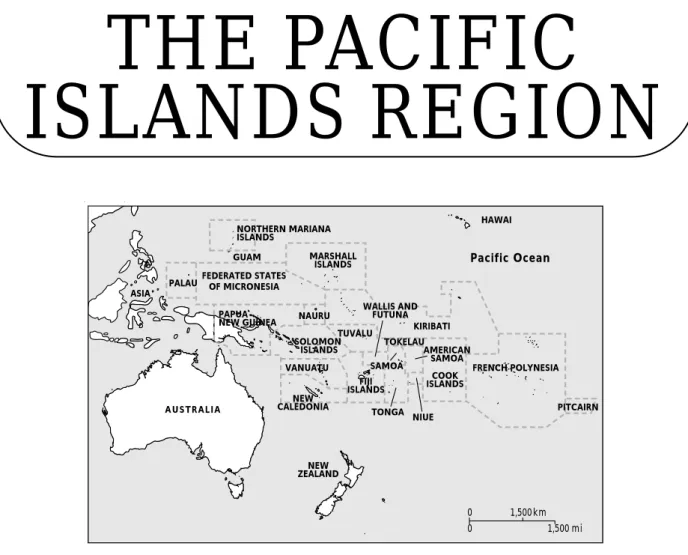
THE PACIFIC
ISLANDS REGION
T
he Pacific islands region comprises the 22 island states of the central and western Pacific, generally referred to as Pacific Island Countries (PICs).State/ territory Land area EEZ area Est population
(sq km.) (sq km.) (1995) American Samoa 197 390 000 57 000 Cook Islands 180 1830 000 18 100 Fiji 18 376 1290 000 768 700 French Polynesia 3521 5030 000 221 300 Guam 549 218 000 150 000 Kiribati 726 3550 000 80 400 Marshall Islands 720 2131 000 56 500
Micronesia, Federated States of 702 2978 000 125 100
Nauru 21 320 000 10 400
New Caledonia 19 103 1740 000 186 800
Niue 258 390 000 2200
Northern Marianas 475 1823 000 71 800
Palau 500 629 000 16 900
Table 1: Key characteristics of Pacific Island countries.
K E Y S T A T I S T I C S
FRENCH POLYNESIA COOK ISLANDS AMERICAN SAMOA NIUE KIRIBATI WALLIS AND FUTUNA TOKELAU TUVALU HAWAI MARSHALL ISLANDS OF MICRONESIA FEDERATED STATES NORTHERN MARIANA ISLANDS NAURU PAPUA NEW GUINEA SOLOMON ISLANDS NEW CALEDONIA NEW ZEALAND ASIA PALAU GUAM A U S T R A L I A VANUATU SAMOA FIJI ISLANDS TONGA Pacific Ocean 0 1,500 km 1,500 mi 0 PITCAIRNThe P
Although the region contains only 0.55 million sq km of land, its exclusive economic zones (EEZs) cover an estimated ocean area of 30.57 million sq km,
equivalent to about 29% of the world EEZ area. The disposition of land and population in the region varies greatly from country to country but in most cases the area of maritime jurisdiction is many thousands of times greater than the available land area.
T
he region contains about 200 high islands and 2500 low islands and atolls. Apart from the Pitcairn group and the southern part of French Polynesia, all of these lie in the tropical zone. The islands tend to increase in size from east to west, with Papua New Guinea comprising most of the region’s land area. In general, the islands rise steeply from the deep ocean floor and have very littleunderwater shelf area. Coral reefs characteristically surround the islands, either close to the shore (fringing reef) or further offshore (barrier reef), in which case a coastal lagoon is enclosed. The area includes many atolls, which are the remnant barrier reefs of islands that have subsided. Some of the more recent islands in the area lack coral reefs. Mangrove forests often border the inshore waters, especially those of the larger islands, and provide habitat for the juveniles of many important food fish.
Biodiversity tends to be at a maximum in the equatorial region in the west of the Pacific Islands area, and decreases markedly towards the east. For example, the number of naturally occurring species of animals and plants is much greater in the Solomon Islands than in Tahiti. This is also true of the marine environment, where fish and invertebrate species, including corals, are far more numerous in the west of the sub-region than in the east.
Due to the relatively small size of most islands, major bodies of fresh water are not widespread in the
region, with substantial rivers and lakes only being found in some of the larger islands of Melanesia. The small land areas of most islands create limited freshwater and nutrient runoff, resulting in low enrichment of the nearby sea. The ocean waters of the area are usually clear and low in productivity.
Upwellings occur in the boundaries between currents and in other localised areas, and have important implications for the abundance and harvesting of marine resources.
In general, the larger islands have more fertile soil, resulting in the greater availability of food plants. Conversely, on the small islands (and especially the atolls) the poor soil results in limited plant food production and a greater dependence on marine products for food and income. As an extreme example, in Tokelau there were only two species of edible land plants at the time of first European contact. The amount of arable land per person in the Pacific Islands area is relatively small. Estimates of this statistic, in hectares per person, are: Fiji (2.1), Solomon Islands (1.4), Tonga (1.8), Vanuatu (1.4) and Samoa (3.5) (Kofe, 1990).
Annual rainfall generally varies between 2000 and 3500 mm, although considerable variation is experienced across the area. Rain is frequently seasonal, but not consistently so across the area: Palau in the west has two periods of heavy rainfall (July/ August and December/ January) while most of the rain in French Polynesia in the east occurs in November and March. Considerable inter-annual variation in rainfall also occurs and droughts are common, especially on the smaller islands. The windward sides of the larger islands are
characteristically much wetter than their leeward sides due to the existence of rain shadows.
There are also major differences in the wind patterns of the region. Those islands in the west are more strongly affected by the Asian land mass (seasonal reversals of the wind direction), while in the east the southeasterly trade winds dominate for most of the
The P
acific Islands Region
Papua New Guinea 461 690 3120 000 4173 200
Pitcairn 5 800 000 100 Samoa 2934 120 000 163 900 Solomon Islands 29 785 1340 000 375 000 Tokelau 12 290 000 1600 Tonga 696 700 000 98 900 Tuvalu 26 900 000 9900 Vanuatu 12 189 680 000 168 300
Wallis & Futuna 124 300 000 14 700
Total 552 789 30 569 000 6770 800
The P
acific Islands Region
stronger and more constant.
Tropical (cyclonic or, in the northern hemisphere, anticyclonic) storms represent the most prevalent natural disaster of the region, and occur in all but a few of the equatorial countries (notably Kiribati). On average the northwestern portion of the region (FSM, Palau, Guam) experiences about four times the number of destructive tropical storms as the areas south of the equator. Tropical storms tend to occur at the time of the year when oceanic warmth is at a maximum.
The periodic oceanographic phenomenon known as the El Niño–Southern Oscillation can produce major climatic aberrations in the Pacific Islands. At roughly 3–7 year intervals a warm south-flowing current off the west coast of South America changes course and alters the patterns of ocean water temperature across the Pacific Ocean. This can result in major changes in rainfall patterns and other aspects of the weather, including the frequency, intensity and distribution of tropical storms.
E
thnically the region is usually broken into three sub regions:Micronesia, comprising the northwestern countries of Palau, Federated States of Micronesia, Guam, Northern Mariana Islands, Marshall Islands and Kiribati;Polynesia, which includes the southeastern countries
of Cook Islands, Niue, Pitcairn, French Polynesia, the Samoas, Tokelau, Tonga, Tuvalu and Wallis and Futuna (as well as New Zealand); and Melanesia, which comprises Papua New Guinea, Solomon Islands,
All but one of the countries of the region (Tonga) were colonised by European nations during the 18th century. Some have since become independent states, while others continue to be formally associated in some way with the original colonising nations, or with other nations.
The region’s ethnic origins, combined with modern-day political affiliations, and the various indigenous and introduced languages now shared among some groups of states, influence the composition of the various political and economic groupings that exist in the region. Principal among these is the South Pacific Forum, a political alliance which brings together the independent countries and self-determining states (the latter being the US- and NZ-affiliated developing countries shown in table 2) of the region, including Australia and New Zealand. Outside the Forum, the various US, French and NZ-affiliated states and territories also have formal political and economic links, often with their respective ‘mother’ countries. The region has a strong history of ‘regionalism’, which derives from several considerations: the fact that many countries share problems which justify a collaborative search for common solutions; the small size and limited human and financial resources of most countries, which constrains their ability to fully address the wide range of economic development problems they face; and the region’s colonial history, during which the main metropolitan powers
established mechanisms for dialogue and mutually beneficial cooperation, some of which persist today. Historically, extensive migration has taken place throughout the region, and this continues today in the form of labour movement and economic migration.
P O L I T I C A L C H A R A C T E R I S T I C S
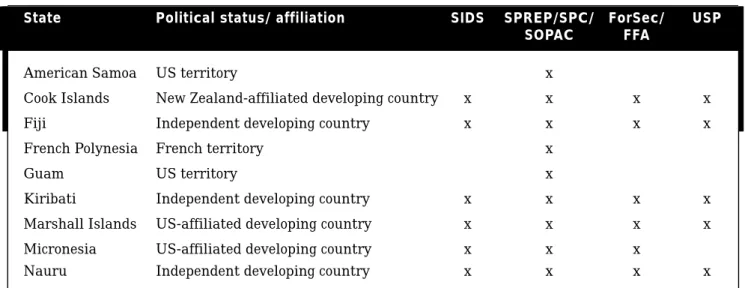
State Political status/ affiliation SIDS SPREP/SPC/ ForSec/ USP
SOPAC FFA
American Samoa US territory x
Cook Islands New Zealand-affiliated developing country x x x x
Fiji Independent developing country x x x x
French Polynesia French territory x
Guam US territory x
Kiribati Independent developing country x x x x
Marshall Islands US-affiliated developing country x x x x
Micronesia US-affiliated developing country x x x
Nauru Independent developing country x x x x
Table 2: The political status of the region’s constituent countries, their status as small island developing states, and their membership of the main regional organisations.
S
ocioeconomic conditions vary widely in PICs. In general, those people living in territories of metropolitan countries (e.g. Guam (USA), New Caledonia and French Polynesia (France)) have better access to goods and services than inhabitants of the independent states or those in free association with metropolitan powers. Throughout the region, urban residents live a more consumerist lifestyle than those in small isolated islands, remote coastal areas, and the interior of large islands, who generally live a subsistence lifestyle and have a relatively low standard of living.The socioeconomic conditions of the independent Pacific Islands countries have recently been summarised in the Pacific Human Development Report (UNDP, 1994). With respect to relative development the report concludes that, based on the Human Development Index (HDI), the Pacific Island countries with the exception of Papua New Guinea, Solomon Islands, and Vanuatu would fall into the category of ‘medium human development’. Globally, of the 173 countries listed in the report, 65 fall into this category. PNG, Solomons, and Vanuatu are placed in the ‘low human development’ category, amongst 55 countries in this category. Unlike Australia and New Zealand, none of the 13 Pacific Island countries covered by the report are amongst the 53 countries categorised as ‘high human development’.
For the region as a whole, economic growth during the past decade was almost nil (World Bank, 1995). When this is viewed in association with population growth, the resulting outlook is gloomy. Between 1970 and 1990 the population of the region grew by 2 222 000 people which is equal to an annual growth rate of 2.3%, high relative to the world average of 1.8% (NCDS, 1994). The resulting situation of high population growth coupled with little or no economic growth is arguably the Pacific Islands’ greatest long-term problem.
The economies of many PICs are largely based on agriculture (which for statistical purposes often includes fishing). Fiji, FSM, Tonga, Samoa, Kiribati, Vanuatu and the Solomon Islands all have
agricultural sectors which employ more than 40% of the labour force (Booth and Muthiah, 1993). There is a tendency, however, for increasing diversification into the industry and services sectors, especially in the smaller countries. Tourism is the most important sector in some Pacific Islands economies while in others it is non-existent. SPC (1995) estimates that the Northern Mariana Islands, Fiji and French Polynesia received 536 263, 287 462 and 147 847 overseas visitors respectively in 1994. No data was available for Guam, probably the region’s most important tourist destination. The Cook Islands, Kiribati, Marshall Islands, Niue and Tuvalu recorded fewer than 10 000 visitors each.
A characteristic of Pacific island countries is the large number of people who derive most of their basic
New Caledonia French territory x
Niue New Zealand-affiliated developing country x x x x
Northern Marianas US territory x
Palau US-affiliated developing country x x x
Papua New Guinea Independent developing country x x
Pitcairn Islands UK territory x
Samoa Independent developing country x x x x
Solomon Islands Independent developing country x x x
Tokelau New Zealand territory x x x
Tonga Independent developing country x x x x
Tuvalu Independent developing country x x x x
Vanuatu Independent developing country x x x
Wallis and Futuna French territory x
Note: SIDS=Small Island Developing States; SPREP=South Pacific Regional Environment Programme; SPC=Secretariat for the Pacific Community; SOPAC=South Pacific Applied Geoscience Commission; ForSec=South Pacific Forum Secretariat; FFA=South Pacific Forum Fisheries Agency; USP=University of the South Pacific.
E C O N O M I C C H A R A C T E R I S T I C S
The P
The P
acific Islands Region
needs from non-monetary subsistence production. In 1992 the Forum Secretariat estimated the proportion of the subsistence economy in the Solomon Islands (80% of the population), Tuvalu (80%), Kiribati (80%), Samoa (60%) and FSM (at least 50%).
The term ‘subsistence affluence’ is sometimes used to describe the relatively high quality of life on some of the Pacific Islands. The term refers to a condition of well-being outside the cash economy. Factors
contributing to this situation include low population densities, fertile soil, a benevolent climate, effective traditional resource management and social systems which provide a safety net for disadvantaged
members of society. Recently, however, high birth rates, unsustainable commercial practices in regard to natural resource use, increasing dependency on the cash economy, labour migration and the deterioration of traditional authority and social systems are having a negative impact on the quality of subsistence life on many islands. Nevertheless, the fact that widespread poverty has not emerged in response to the gradually deteriorating economic conditions in most Pacific Island countries gives some indication as to the effectiveness of the traditional social support systems
Population movement from outer islands or rural areas into towns and cities is a prominent
characteristic of most Pacific Island countries. The average urbanisation rate across the region was 17% in 1970 but had increased to 24% in 1990. The problems of low per capita GDP becomes much more acute as populations become more urbanised. Urban migrants are usually unable to find employment and have no access to land or fishing rights, both of which are usually governed by strict traditional systems. Urban migration generates urban poverty which contrasts starkly with the ‘subsistence affluence’ categorisation, and which is the source of many other social problems, including rising urban crime rates. The high amount of development assistance received by the region, and remittance income, are two external factors which will tend to mitigate, at least in the short term, the appearance of poverty. Overall the region receives a relatively large US$204 of aid per capita (Fairbairn 1994) which is quite unevenly distributed between the countries.
In many countries, particularly Tonga, Samoa and the Cook Islands, cash remittances by relatives living overseas are substantial, and may in fact exceed the value of all exports. Remittances from overseas employment are also very important to Kiribati and Tuvalu (a large number of whose citizens work as crew on merchant and fishing vessels, and in the Nauru phosphate mining industry), as well as to Vanuatu (fishing vessels), and to a lesser extent Fiji and American Samoa (various types of vessels).
Both aid and remittances face an uncertain future as the countries which provide aid and the countries which accept Pacific Island immigrants show signs of changing their policies. In addition, although
increasing employment of Pacific Islanders aboard foreign fishing vessels is anticipated, the future prospects of employment in Nauru are poor due to the exhaustion of phosphate reserves.
Natural disasters are common in the Pacific Islands. In the period 1960 to 1989, many countries across the region experiences tropical cyclones, including the Cook Islands (15), Fiji (34), Solomon Islands (14), Tonga (15), Vanuatu (32), Samoa (10), and Papua New Guinea (2) (Chung, 1991). Other types of common disasters are coastal floods, river floods, drought, earthquake, tsunami and volcanic eruption. Although there is no evidence that the incidence of disasters is increasing, for various reasons the amount of damage from each event and the subsequent disaster relief is growing.
T
he coastal zone is regularly referred to in PIC discussions and documents relating to ‘coastal planning’, ‘coastal management’, ‘coastal zone management’, ‘integrated coastal zone management’, or ‘integrated coastal management ‘collectively referred to here as ICM. These expressions refer to the concept of multi-disciplinary, multi-sector management arrangements that take into account the full range of often-conflicting uses of the coastal zone.Unfortunately a definition of what exactly constitutes the coastal zone, both in the Pacific Islands region and in other regions of the world, remains elusive. Clark (1992) states that: “By virtually any set of criteria the coastal zone is a linear band of land and water that straddles the coast—a ‘corridor’ in planning parlance.” However, he then goes on to add that:
“There is no single description of the coastal area or coastal zone: boundaries are delineated on the basis of the particular problems that ICM attempts to solve. The zone may extend inland and seaward to a variable extent—the boundaries of the coastal zone depend on political, administrative, legal, ecological and pragmatic considerations because there is a broad array of possible coastal issues and because the zone can be affected by remote activities. A narrow coastal zone could be appropriate if the purpose were to manage only the shoreline and intertidal areas. If watershed issues are of concern, then an inland extension
is necessary. Likewise, if the issues extend far seaward then the EEZ might be included. The boundaries must be adaptive to the goals and objectives.”
Sorensen and McCreary (1990) agree that
“boundaries for integrated coastal zone management programmes should be tailored to capture and enable resolution of all the major coastal issues. Because there is a broad array of possible coastal issues there is also a broad array of possible management
boundaries”. Some boundaries are quite narrow, and are best suited to deal with use conflicts occurring at the immediate shoreline. But if watershed-generated impacts are serious then a coastal management boundary extending far inland would be justified. The (ICM) zone of jurisdiction may be based on political and administrative considerations as well as economic and biogeographic ones.
Although the coastal zone may be drawn broadly or narrowly, it always includes the water’s edge—the boundary line between land and sea that includes the subtidal, intertidal and supratidal zones. This is where authority changes abruptly, where storms hit, where waterfront development locates, where boats make their landfalls, and where some of the richest aquatic habitat is found. It is also where typical terrestrial type planning and resource management programmes are at their weakest. The edge zone includes coastal flood plains, mangroves, marshes and tidal flats, beaches and dunes and fringing corals. It is a place of great dynamism and energy. The water’s edge is also the place where the greatest competition and conflict between users is found (Clark, 1992). By these criteria the entire land area of many PICs can be defined as falling within the coastal zone. Even in the larger PICs the inland areas are
sufficiently close to the coast, and intimately-enough connected to it through watersheds and groundwater resources, that almost all inland development activities would have direct impacts on the coastal zone. In the case of PICs and other small island states, therefore, the concept of ICM becomes modified, such that it essentially comprises the expansion and enhancement of general development planning to adequately cater for the needs and sensitivities of the coastal zone.
Uses of the coastal zone, or activities that take place within it, in PICs may be aquatic or terrestrial and typically include the following:
■ fishing;
■ coastal shipping;
■ port and harbour development;
■ water-based recreation, such as diving and other tourism-related activities;
■ coastal construction—building of houses, hotels, commercial and industrial premises; ■ infrastructure development—building of roads,
installation of power and water supply; ■ sewage treatment and disposal;
■ rubbish dumping, discharge of factory effluent and other forms of waste disposal;
■ coastal protection - construction of sea walls or other forms of shoreline stabilisation;
■ agriculture; ■ logging;
■ mining of various types, including petrochemical extraction; and
■ modification of watercourses (dams and so on).
These and other activities take place at variable distances from the coast, and affect the coastal zone in one way or another to varying degrees. ICM aims to ensure that development of the coastal zone takes place in a sustainable manner which allows for multiple uses of the zone, and attempts to prevent the activities of one user group having negative consequences for those of another (or for itself). Where it exists as a formal process, ICM in the region is the responsibility of government agencies. The evidence suggests, however, that PICs have made limited progress in this type of planning and management. Only a few countries have formally established national or state-level coastal zone management plans. Various planning and ICM development exercises have taken place in other countries, some of which have put in place inter-departmental committees to coordinate or facilitate multi-disciplinary approaches to coastal zone development. In the main, however, approaches to ICM in the region remain informal and ad hoc. In any case, incorporation of ICM issues into the national development planning cycle would only be a first step. Even in those countries that have national development plans, the actual implementation of the plan tends to be incomplete, with development activities often responding to the needs of short-term political or economic expediency rather than to long-term strategies for sustainable resource use. The reasons vary from country to country, but are generally related to the widespread difficulties encountered in all PICs in establishing mechanisms whereby government departments communicate and interact effectively with each other, with political decision-makers, and with institutions, organisations, communities and individuals outside the public sector.
PICs are far from being alone in this regard. According to UN (1992):
“Experience shows integrated marine and coastal area planning and management to be a
The P
The P
acific Islands Region
highly complex process, entailing the use of various policy and economic instruments, and the introduction of special institutional arrangements. Most countries have
encountered difficulties in implementing this form of management and attribute these to a general failure to effectively incorporate the marine and coastal dimension into national development planning processes and thereby command adequate political and financial support. That impediment is also experienced at the sectoral level, even with respect to such valuable economic assets as fisheries”.
Despite these failures, it is becoming increasingly important that the principles of integrated coastal management be adopted in PICs, most of which are now beginning to see the deleterious effects of increased sedimentation, eutrophication, toxic pollution, habitat destruction and other negative impacts of indiscriminate coastal zone use. Truly integrated coastal management involves a
representative cross section of coastal resource users
in the planning and management process. Mechanisms whereby this can occur need to be developed and implemented in PICs in order to avoid further coastal degradation, additional pressure on coastal resources which may already be stressed, economic loss and a deterioration in the quality of life.
In the absence of formal government ICM arrangements, an increasing number of non-government organisations (NGOs) and
informally-constituted groups are becoming active in this area. This often takes place with the sanction and support of governments, who are increasingly seeing community-based or participatory
arrangements as an appropriate and cost-effective alternative to centralised resource management systems. Although few NGOs have formal ICM responsibilites, and many are focussed only on local or specialised issues, their collective influence on development activities within the coastal zone, and on government policy in regard to the zone, is significant and growing.
R E G I O N A L I N T E R - G O V E R N M E N T A L O R G A N I S A T I O N S
PO Box 240 Tel: (685) 21929
Apia Fax: (685) 20231
Samoa E-mail: [email protected]
Mr Tamarii Tutangata E-mail: [email protected]
Director
Mr James Aston E-mail: [email protected]
Coastal Management Officer
Ms Lucille Apis-Overhoff E-mail: [email protected]
Wetlands and Mangroves Officer
SPREP is a fully independent inter-governmental agency responsible for providing professional advice, coordinating environmental activities and facilitating the implementation of the Action Plan for Managing
the Environment of the South Pacific Region 1997–2000 (Action Plan). The decision to create SPREP
was taken during the 1982 Conference on the Human Environment in the South Pacific in Rarotonga.
SPREP is the implementing body for two international conventions:
■ Convention for the Protection of the Natural Resources and Environment of the South Pacific Region and related protocols 1986 (the SPREP Convention); and
■ Convention on Conservation of Nature in the South Pacific 1976 (the Apia Convention).
SPREP’s mission is to promote cooperation in the South Pacific region and to provide assistance in order to protect and improve its environment and to ensure sustainable development for present and future generations. The 1997–2000 Action Plan sets out the objectives and strategies for SPREP and provides the framework for a regional approach to address environmental issues of the Pacific region. For the period of the Action Plan, attention will be given to building capacity in environmental and resource management through support to government agencies, non-government agencies and the private sector.
To achieve the Action Plan goal and objectives the SPREP Secretariat develops and implements a regionally coordinated and interrelated range of activities under several programme areas. The Coastal Management and Planning programme assists member countries and territories to manage and plan for the multiple use, ecologically sustainable development and conservation of coastal areas and habitats. The broad mandate of the programme covers five key areas including:
■ training in Coastal Habitats Survey and Monitoring methods;
■ Integrated Coastal Management to help develop unique and integrated holistic approaches for the sustainable management of Pacific Islands;
■ improving the capacity of Pacific Island countries to manage changes and threats to the coastal areas and its resources;
■ follow-up initiatives arising from the 1997 Pacific Year of the Coral Reef Campaign to raise public awareness about the plight of coral reefs in the countries and territories of the region; and ■ identification of in-country wetlands and mangrove priorities and issues, and development of
management tools and responses under the Wetlands and Mangroves Management subprogramme.
Each project within this programme is seen as a step in achieving a broader and more general goal of providing the impetus to initiate integrated coastal management appropriate to the circumstances and aspirations of Pacific Islanders.
Key publications include: state of the environment reports and national environmental management strategies for several countries of the region; reviews of environmental legislation in several countries; various technical reports on environmental issues relevant to the coastal zone (oil spill contingency planning, ship grounding, traditional use of coastal and marine resources); papers and proceedings of meetings and workshops relating to coastal zone management issues; and the SPREP newsletter. ■
Private Mail Bag Tel: (679) 381139/ 381377
Suva Fax: (679) 370040
Mr Alfred Simpson E-mail: [email protected] Director
Dr Russell Howorth E-mail: [email protected] Program Manager
Mr Robert B. Smith E-mail: [email protected] Marine Geophysicist
Mr Xue Chunting E-mail: [email protected] Coastal Geologist
Dr Graham Shorten E-mail: [email protected] Coastal Engineering Geologist
Mr Jackson Lum E-mail: [email protected] Marine Geologist
SOPAC was first established in 1972 as the UN Coordinating Committee for Offshore Prospecting in the South Pacific. The agency’s original responsibilities were to assist South Pacific countries by
investigating their non-living marine resources, coordinating marine geological and geophysical studies, and obtaining baseline data to determine design criteria for coastal engineering and development. SOPAC’s coastal responsibilities were subsequently extended to include the provision of information on the physical environment of coastal areas in order to assist with resource and environmental
management, coastal protection works and the planning and implementation of coastal development projects.
Following a review of SOPAC’s future role and direction endorsed by Council in 1997, activities of the SOPAC Work Program of direct relevance to coastal management are implemented primarily by the Coastal Unit and secondarily the Mineral Resources Unit (coastal sand and gravel, aggregates studies) and Hazard Assessment Unit (coastal hazards and risk assessment studies). Support activities are also
South Pacific Applied Geoscience Commission (SOPAC)
The P
The P
acific Islands Region
carried out in training, information technology, publications and library.
The overall goal of the Coastal Unit and related coastal activities elsewhere in the SOPAC Work Program is improved management of the coastal zone of island member countries for sustainable development. The purpose is to assist decision-makers and planners to develop coastal zones and extract resources while protecting coastal zones from degradation.
Outputs include:
■ coastal process evaluation and assessment studies; ■ coastal environment and resource assessment maps; ■ coastal baseline studies;
■ coastal hydrodynamic models; ■ sediment budget analyses; and ■ trained member country individuals. Activities include:
■ collection, assessment and analysis of information on coastal, oceanic and atmospheric processes; ■ planning and conducting coastal mapping, bathymetric and marine geophysical surveys;
■ monitoring beach erosion;
■ modelling coastal circulation and sediment transport; ■ developing storm surge numerical models;
■ investigating climate variations and their geological causes leading to sea-level rise;
■ training member country professionals in coastal assessment and management techniques; and ■ advising on best-practice coastal management procedures.
Reporting on activities to the member countries and regional agencies is primarily by way of technical reports, papers and proceedings of meetings and workshops relating to coastal zone management issues; annual reports to SOPAC Council, SOPAC Projects (biannual) and SOPAC News (biannual). ■
PO Box 1168 Tel: (679) 313900
Suva, Fiji Fax: (679) 301305
Mr Esekia Solofa Fax: (679) 302556 Vice Chancellor
Prof. G. Robin South Tel: (679) 305272 Professor of Marine Studies Fax: (679) 301490
E-mail: [email protected] Ms Vina Ram-Bidesi Tel: (679) 212584 Coordinator, Ocean Resources Fax: (679) 302338
Management Programme E-mail [email protected] Ms Bale Rabuka Tamata Tel: (679) 302403 or 212551 Research Fellow, Institute Fax: (679) 300373
of Applied Science E-mail: [email protected]
USP provides higher education and training in a wide range of disciplines including several relevant to the coastal zone. The University also provides technical consulting services in these fields to various regional and national organisations. The University’s priority is to serve the countries of the USP region (Cook Islands, Fiji, Kiribati, Marshall Islands, Nauru, Niue, Samoa, Solomon Islands, Tokelau, Tonga, Tuvalu and Vanuatu) but it also has links to many other countries through strategic alliances, exchange schemes, student enrollment and the provision of consultancy services.
The University Departments most relevant to the area of ICM are:
■ The Marine Studies Programme, which covers aspects of marine biology, marine chemistry,
oceanography, fisheries management and maritime law, and marine pollution. The main campus at Laucala Bay, Suva, has world-class facilities for all aspects of training, education and research in marine science. The Marine Studies Programme regularly hosts visiting researchers from all over the world.
The Marine Studies Programme also operates the Institute of Marine Resources in Honiara, Solomon Islands, and the Atoll Research Programme in Tarawa, Kiribati. These are described in this directory under the relevant chapters on those countries.
■ PIMRIS is the Pacific Islands Marine Resources Information System and is a formal marine information network system of regional organisations and Pacific Island countries devoted to the collection, storage, retrieval and dissemination of information on fisheries and other living and non-living marine resources in the tropical Pacific.
■ The Institute of Applied Science, which deals with aspects of terrestrial and marine pollution. It has an analytical service which supports industries and offers help and support in areas of effluent disposal and water quality testing. The environmental unit has conducted many significant EIAs for the region and has assisted in drafting environmental legislation for Fiji.
Key publications include courses, teaching materials, newsletters, conference proceedings and technical
reports. ■
BP D5 Tel: (687) 262000
98848 Noumea Cedex, New Caledonia Fax: (687) 263818
Dr Bob Dun Director General
Ms Lourdes T. Pangelinan Deputy Director General
Dr Tim Adams E-mail: [email protected] Director, Marine Resources Division
SPC was established in 1947 as a multi-disciplinary technical assistance organisation providing
advisory services to states of the Pacific Islands region. SPC’s membership includes all 22 Pacific Island countries and territories as well as the metropolitan nations of Australia, France, New Zealand, United Kingdom and USA.
The Marine Resources Division is the largest component of the work programme and the main element relevant to ICM. The Division consists of two branches:
■ Coastal Fisheries: includes programmes relating to inshore fisheries management, development of coastal fisheries, training, post-harvest fisheries technology, information, and the role of women in fisheries. There is currently a particular focus on the use of participatory, community-based arrangements as a means of improving the management of fisheries as well as of the coastal zone in general.
■ Oceanic fisheries: carries out research and monitoring of the regions industrial and commercial fisheries for tuna and allied species, and makes this information available to Pacific Island governments, the South Pacific Forum Fisheries Agency (see entry in this chapter), and other organisations involved in management of these fisheries.
The Noumea headquarters houses a wide range of other social and economic development programmes relating to public health, sanitation, nutrition, education, rural technology, statistics, economics and women’s development. Many activities carried out under these programmes are also relevant to management of the coastal zone. In addition, SPC maintains a centre in Fiji which has a maritime law component (see next entry).
Key publications include technical reports; Fisheries Information Bulletins; Tuna Bulletin; technical meeting papers and reports; Fisheries Newsletter; other newsletters and annual reports. SPC also has a
world wide web site at http://www.spc.org.nc/. ■
Secretariat of the Pacific Community (SPC)
The P
The P
acific Islands Region
Private Mail Bag Tel: (679) 370733/ 370496
Suva, Fiji Fax: (679) 370021
Dr Jimmie Rodgers E-mail: [email protected] Deputy Director General
Dr Peter Heathcote Maritime Law Specialist
SPC’s main headquarters is in Noumea (see previous entry) but the organisation also maintains a centre in Fiji which houses programmes in agriculture, information and media, veterinary science and other areas. The main programme relevant to ICM is the maritime law programme, which provides advice and assistance to Pacific Island countries in the development and implementation of legislation relating to ports, shipping and other uses of marine spaces, and the harmonisation of such legislation
with international standards. ■
Secretariat of the Pacific Community (SPC)—Suva Office
PO Box 629 Tel: (677) 21124
Honiara, Solomon Islands Fax: (677) 23995
Mr Victorio Uherbelau E-mail: [email protected] Director
Mr Ian Cartwright E-mail: [email protected] Deputy Director
FFA provides the Secretariat for the Forum Fisheries Committee, which serves as a means of coordinating the national fishery management efforts of South Pacific Forum member countries, particularly in regard to the region’s international fisheries for tuna and allied species. FFA also provides the Secretariat to a number of sub-regional fishery management arrangements, particularly the Nauru Agreement, Federated States of Micronesia Arrangement and the Palau Arrangement, as well as administering the Treaty between The Governments of Certain Pacific Island States and the Government of the Untied States of America.
In addition FFA gathers and interprets economic and other fisheries data on behalf of its member countries, and provides technical services and advice in support of regional fishery management systeMs These include maintenance of the Regional Register of Foreign Fishing Vessels, and the development of a regional satellite-based Vessel Monitoring System.
FFA has a total of 48 staff positions, of whom 28 are professional staff recruited predominately from member countries.
Key publications include technical reports, Fishery Resource Profiles of selected countries, FFA News Digest Newsletter, and a monthly membership-only newsletter, From the Director’s Desk. FFA also has a
world wide web site at http://www.ffa.org/. ■
South Pacific Forum Fisheries Agency (FFA)
PO Box 856 Tel: (679) 312600
Suva, Fiji Fax: (679) 301102
Mr W. Noel Levi E-mail: [email protected] Secretary-General
Originally established as the South Pacific Bureau for Economic Cooperation, the Forum Secretariat has recently divested itself of many of its long-term technical activities in order to function more effectively as the Secretariat to the South Pacific Forum, the region’s main political grouping of independent states. Although not having a formal role in ICM, the Forum Secretariat undertakes research and provides advisory services on many issues relating to the development of the coastal zone, such as domestic and international shipping, energy policies and practices (including oil transportation and storage), and the development of coastal resources. ForSec has a staff of 71 persons, of whom 33 are professional officers. The organisation has a world wide web site at http://www.forumsec.org.fj/. ■
South Pacific Forum Secretariat (ForSec)
The P
acific Islands Region
OTHER GOVERNMENTAL AND INTER-GOVERNMENTAL ORGANISATIONS BASED IN THE PI REGION
PO Box 127 Tel: (678) 23300
Port Vila Fax: (678) 23138
Vanuatu E-mail: [email protected]
Mr M. E. Tusneem E-mail: [email protected] Regional Representative
ADB–SPRM is a part of the Office of Pacific Operations (OPO) based at the ADB headquarters in Manila. The Bank’s 12 developing member countries (DMCs) in the Pacific are: Cook Islands, Fiji, Kiribati, Marshall Isalnds, Federated States of Micronesia, Nauru, Papua New Guinea, Samoa, Solomon Islands, Tonga, Tuvalu and Vanuatu. ADB provides assistance for major development projects and programmes in the region through concessional loans and technical assistance grants in all major sectors of the economy, including natural resource management. A number of ADB-financed projects in the region have direct implications for coastal zone management. These include, among others, a
programme of ICM training implemented through SPREP, management of marine resources and ecology in Cook Islands, fishery management in Papua New Guinea, Marshall Islands and Federated States of Micronesia, and commercial fishery development in Federated States of Micronesia and Tonga. SPRM has a multi-disciplinary team of eight staff (of whom four are from the Pacific region) with expertise in economics and finance, engineering, infrastructure, agriculture and natural resources management. ■
Asian Development Bank—South Pacific Regional Mission (ADB–SPRM)
Private Mail Bag 004 Tel: (678) 23458
Port Vila Fax: (678) 23921
Vanuatu E-mail: [email protected]
Mr Savenaca Siwatibau Head
Dr Anthony V. Hughes
Regional Advisor, Economic Development & Planning Mr Godfred J. Shuma
Regional Advisor, Ports and Harbours Development Mr Serge Belloni
Regional Advisor, Development Economics and Strategic Planning Mr Sakaru Tsuchiya
Regional Advisor, Infrastructure Planning, Design & Implementation Dr Charles G. Kick III
Regional Advisor, Social Development & Planning Mr Siliga Kofe
Regional Advisor, Development Policy Formulation & Implementation
ESCAP/POC is a UN body which provides policy and technical advisory services to ESCAP member and associate member states in the Pacific. Although the Centre does not have a direct ICM mandate, it has occasional involvement through policy advice and studies for governments and regional bodies which affect development management in or near the coastal zone, and through technical assistance which have coastal zone dimensions. Recent examples of the latter include a survey of markets for giant clams and support to the management of a national fishing company. ■
Economic and Social Commission for Asia and the Pacific—
The P
acific Islands Region
FAO Private Mail Bag Tel: (685) 20710/ 22127
Apia Fax: (685) 22126
Samoa E-mail: [email protected]
Dr Vili Fuavao E-mail: [email protected] Sub-Regional Representative
Mr Masanami Izumi E-mail: [email protected] Fisheries Officer
Mr Lui Bell E-mail: [email protected] National Professional Officer
Mr Gilles Hosch
Associate Professional Officer
The FAO office in Apia is the sub-regional office of the Rome-based FAO, a UN agency concerned with monitoring and enhancing agricultural production, living resource management and world food security. The FAO Apia office, known by its acronym of SAPA, was upgraded to a sub-regional office in 1996 and has since expanded its activities in the area of natural resource management in the South Pacific. The establishment of SAPA is a tangible reflection of FAO’s desire to decentralise and to bring its operations closer to its member countries of the Pacific. SAPA’s mandate is to galvanise regional efforts towards food security. FAO also provides technical assistance to the Pacific Island countries in the fisheries sector. Recent projects have included the strengthening of fisheries management in Fiji, Solomon Islands, Papua New Guinea and Vanuatu, a fisheries sector study in Tonga and a regional initiative in the area of seafood quality control and food safety.
FAO’s Sub-Regional Office consists of 18 staff including 7 technical officers (fisheries, integrated resources management, farming systems development & marketing, plant protection, forestry, nutrition and policy), 2 Associate Professional Officers (marine resources information and women in development) and a National Professional Officer, under the overall managerial and administrative leadership of the Sub-Regional Representative.
FAO headquarters in Rome has a fisheries department which compiles world fishery and aquaculture statistics and promotes international cooperation to support better utilisation and management of fishery resources, including in the Pacific Islands region. ■
Food and Agriculture Organization of the United Nations—
Sub-Regional Office for the Pacific Islands (FAO–SAPA)
c/o UNDP Private Mail Bag Tel: (679) 313750
Suva Fax: (679) 313985
Fiji E-mail: [email protected]
Mr Hideyuki Tanaka Chief Technical Advisor
SPADP-Phase II is a 5-year project which runs from 1994–1999 and which provides 15 Pacific Island project member countries with technical assistance and support in the field of aquaculture development. The project’s work takes place in both the coastal zone and inland, and includes the promotion of subsistence and commercial aquaculture production (both freshwater and marine) as well as re-stocking of over-exploited fisheries resources. In addition the project has carried out resource surveys and provided management
advice in regard to living marine resources. ■
The P
acific Islands Region
PO Box 5766, Matautu uta PO Tel: (685) 24276
Apia, Samoa Fax: (685) 22253
Ms Edna Tait Director
Vacant (formerly Trevor Sankey)
Science Adviser E-mail: [email protected]
UNESCO, the United Nations Educational, Scientific and Cultural Organization, is the arm of the United Nations system charged with promoting the international exchange and sharing of all forms of intellectual knowledge. The aim is to build peace in the world. UNESCO’s programmes cover a very wide range of topics and include the social and human sciences, communication through the media, information and informatics as well as education, science and culture. UNESCO particularly encourages the different disciplines to find new and constructive ways of working together.
The UNESCO Office for the Pacific States in Apia, Samoa was opened in 1984 and serves fourteen member states through a staff team of 12, which includes five professionals. UNESCO in the Pacific has a particular interest in promoting the joint application of social and environmental sciences and in exploring the cultural aspects of the sustainable use of natural resources, including indigenous knowledge. A number of UNESCO programmes relate to coastal zone management. These are implemented in close cooperation with regional organisations such as SPREP, SOPAC and USP. The UNESCO project on Environment and development in coastal regions and in small islands (CSI) is a platform for cross-sectoral action to elaborate ‘wise practices’ for coastal areas. In the Pacific it works with the International Hydrological Programme on the combined technical and social study of
freshwater resources. It has community projects on ‘Education for sustainable village living’ and ‘Values for sustainable village living’.
In the Pacific, the International Hydrological Programme (IHP) promotes combined technical and social science studies of key freshwater resource problems with a strong training element. Studies on
‘Groundwater pollution in villages’ and ‘Atoll groundwater recharge’ are nearing completion.
United Nations Educational, Social and Cultural Organization (UNESCO)
Office for the Pacific States
UNDP Private Mail Bag Tel: (679) 312500
Suva Fax: (679) 301718
Fiji E-mail: [email protected]
Mr Romulo V. Garcia E-mail: [email protected] United Nations Resident Coordinator and
UNDP Resident Representative
Mr Francois d’Artagnan E-mail: [email protected] Deputy Resident Representative
Ms Jenny Bryant-Tokalau E-mail: [email protected] Sustainable Development Advisor
The United Nations Development Programme office in Suva is responsible for UNDP country programmes in Fiji, Kiribati, Nauru, Solomon Islands, Tonga, Palau, Federated States of Micronesia, Marshall Islands, Tuvalu and Vanuatu. It also has responsibility, in collaboration with UNDP Headquarters in New York, for the preparation and monitoring of regional and sub-regional projects affecting these countries, and such regional and sub-regional activities which may be of interest to other members of the Pacific Community (such as French Polynesia, New Caledonia and Wallis and Futuna), as well as liaising with the Secretariat of the Pacific Community, Forum Secretariat and other regional institutions which affect the above countries. (UNDP also has offices in Samoa and Papua New Guinea which deal with programmes in those countries, and which are included under the relevant country chapters).
The only UNDP country programme which is relevant to ICM is the Coastal Zone Management Project in the Republic of Marshall Islands. This is described in more detail in the Marshall Islands chapter of
this directory. ■
The P
acific Islands Region
The Intergovernmental Oceanographic Commission of UNESCO coordinates international cooperative
work on technical aspects of marine science and its application to coastal management. It is also the lead agency in coordinating the emerging Global Ocean Observing System (GOOS) which includes a coastal component.
The World Heritage Convention provides an international system for designating sites of understanding cultural or natural value. UNESCO’s World Heritage Centre is active in promoting the system in the Pacific and works with other conservation agencies, particularly the World Conservation Union (IUCN). The Man and the Biosphere programme supports basic research on biodiversity and the International Biosphere Reserve network, which can include marine protected areas. In the Pacific the focus is on preserving culturally important plants together with the scientific and cultural knowledge about them through the UNESCO-WWF-Royal Botanic Gardens People & Plants initiative.
The World Solar Programme supports education and information activities related to the application of solar and other types of renewable energy, and is providing some seed money for a projected regional renewable energy and training centre in PNG.
Key publications include office three-monthly report, technical meeting papers and reports. ■
Box 16737 Tel: (679) 312371
Suva, Fiji Fax: (679) 303053
Ms Diane Russell E-mail [email protected] Senior Programme Officer/ Social Scientist
BCN is a US$ 20 million, 6-year programme funded by the US Agency for International Development through the US-Asia Environmental Partnership. BCN is part of the Biodiversity Support Program, a consortium of the World Wildlife Fund/ US, The Nature Conservancy and the World Resources Institute. BCN provided twenty sizable grants to organisations in seven countries to set up or maintain
enterprises that are highly linked to biodiversity. The bulk of the projects involve harvesting or
processing non-timber forest products, and eco-tourism projects (one of them marine-based). One project funded by BCN involves deep-water fishing enterprises for communities living around a community-managed marine sanctuary. In addition, BCN’s mandate includes analysis of the effectiveness and impact of enterprise-based conservation strategies.
BCN’s main offices are in Washington DC, USA. The South Pacific Field Office currently comprises eight professional staff—one Director and seven programme officers located in five countries—and five administrative staff, along with interns and consultants. The programme is due to end in March 1999. BCN has a world wide web site whose address is www.bcnet.org. ■
Biodiversity Conservation Network (BCN)—South Pacific Field Office
N O N - G O V E R N M E N T A L O R G A N I S A T I O N S
Private Mail Bag Tel: (679) 312861
Suva Fax: (679) 312784
Fiji E-mail: [email protected]
Ms Bunny McDiarmid Regional Coordinator
Greenpeace Pacific is a regional campaign answerable to Greenpeace International. Greenpeace’s goal is to enhance understanding of the working of the natural environment and to stop deleterious effects upon it. Like other Greenpeace branches, Greenpeace Pacific participates in or contributes to global campaigns as well as concentrating on environmental issues of concern to Pacific peoples.
The P
acific Islands Region
Current or recent activities relating to coastal management include:
■ recording outbreaks of coral bleaching (which includes many associated with the coast); ■ contributing to a database of indications of climate change;
■ studying the effects of upstream development on coastal land forms and ecosystems; ■ community-based management of coral reefs;
■ construction of mooring buoys to prevent anchor damage to reefs;
■ identifying land-based sources of marine pollution and their impacts on coral reefs and assisting in the identification of possible solutions.
There are 6 professional staff in the Greenpeace office in Suva, as well as professional staff based in the Solomons, Papua New Guinea, New Zealand and the United States who work on Pacific environmental issues. Greenpeace Pacific receives its funds entirely from private donation. It employs volunteer
workers in addition to its professional staff. ■
USP Marine Studies Programme Tel: (679) 305446 / 212404
PO Box 1168, Suva, Fiji Fax: (679) 301490
Prof. G. Robin South Tel: (679) 305272 Director Fax: (679) 301490
E-mail: [email protected] Mr Seremaia Tuqiri
Coordinator
IOI-SP is one of four operational centres of the IOI, which was established in 1972 in the Netherlands. The organisation aims to promote peaceful uses of ocean space and its resources, their management and regulation as well as the protection and conservation of the marine environment. The Institute is based at the University of the South Pacific and serves the countries of the USP region. There are 2
professional staff, but the Institute also has access to other University staff, particularly those of the Marine Studies Programme.
IOI-SP’s activities are mainly concerned with offshore areas but many impinge on the coast and have implications for coastal management. Major programmes include: ocean resources and their
management; fisheries; marine environment management strategies; marine biodiversity; law of the sea; marine technology; ports and marine transportation; renewable energy; communications and networking; and marine public awareness. IOI-SP cooperates with the organisations of the UN systems, other international organisations concerned with ocean affairs, governments, foundations, industries and academic institutions.
Key publications include courses, teaching materials, Ocean Year Book, quarterly newsletters,
conference proceedings and reports. ■
International Ocean Institute of the South Pacific (IOI-SP)
PO Box 16737 Tel: (679) 312371
Suva, Fiji Fax: (679) 303053
Ms Leba Halofaki Mataitini Tel: (679) 300690/ 212410 Chairperson
Ms Cherie Whippy-Morris E-mail: [email protected] Acting Coordinator
Established in 1983, SPACHEE’s major objectives are to improve cooperation and communication between people and agencies involved in environmental management and protection, environmental and human ecological research, and formal and non-formal environmental education.
South Pacific Action Committee for Human Ecology
and the Environment (SPACHEE)
The P
acific Islands Region
SPACHEE activities include:
■ community-based integrated resource management projects and workshops;
■ Ecowoman (network of women in the region who are involved in science, technology and
environment) projects. SPACHEE identifies projects and training programmes that will help rural women in managing their resources and also in appropriate technology; and
■ organising conferences and lectures on environmental issues by visiting speakers.
Key publications include SPACHEE Newsletter (issued thrice-yearly), SPACHEE Environmental News
Alert and Ecowoman Newsletter. ■
1116 Smith Street Tel: (1-808) 537 4508
Honolulu, Hawaii 96817 Fax: (1-808) 545 2019
Ms Audrey Newman E-mail: [email protected] Acting Director
The Nature Conservancy is a US-based international NGO founded in 1951 as a private, non-profit organisation. TNC’s mission is ‘to preserve plants, animals and natural communities that represent the diversity of life on Earth by protecting the lands and water they need to survive’. There are
approximately 2000 staff in total, of whom approximately 75 are employed in the Asia/Pacific program. There are Pacific field offices in Palau, NZ (South Pacific programs), Federated States of Micronesia (Pohnpei), Solomon Islands and PNG.
TNC’s policy is to use cooperation rather than confrontation to forge effective partnerships with business, government, individuals and organisations that share a concern about the escalating rate of extinction worldwide. Strategies to achieve this include maintenance of on-the-ground presence, encouragement of community participation, and building of in-country capacity to manage resources in a sustainable manner.
Current and recent activities relating to coastal management are wide-ranging and include: ■ combating the use of sodium cyanide to capture live reef fish;
■ providing policy and management assistance for the control of the live reef fish trade; ■ installing mooring buoys at diving sites to protect coral reefs from dive boat anchors;
■ supporting grouper spawning aggregation research and the developing management measures; ■ supporting the development of catch-and-release sport fishing activities;
■ development of alternative sources of income to support marine conservation areas; ■ various Rapid Ecological Assessments on marine areas;
■ establishing a community-managed marine conservation area in Melanesia; and ■ assisting in the development of local environmental NGOs.
TNC’s main Asia-Pacific Office is based in Hawaii, and the South Pacific Program Office in New Zealand (see next entry). The organisation also has representatives in Micronesia, Palau, Papua New Guinea and Solomon Islands, entries for which are contained under the relevant country chapters. ■
The Nature Conservancy—Asia/Pacific Regional Office
17 Gulf View Road Tel: (649) 478 9632
Murray’s Bay, Auckland, NZ Fax: (649) 479 1944
Mr Peter Thomas E-mail: [email protected] Director, South Pacific Program
The South Pacific Program is responsible for developing and managing the South Pacific country
programmes in the Solomon Islands and PNG. ■
The P
acific Islands Region
c/- Chemistry Department
University of the South Pacific Tel: (679) 212446)
PO Box 1168, Suva, Fiji Fax: (679) 302548
Dr Kanayathu Koshy E-mail: [email protected] Chairman
This is an informally constituted group established to acquire and disseminate information pertaining to the broad issue of climate change, and to enhance awareness of this and related issues among the people of the Pacific region. The group comprises mostly USP staff but with some outside people, mainly from the Government of the Fijian Islands.
The group has supplied people to work on SPREP-funded projects to investigate the probable implications of climate change and sea-level rise on Pacific Island nations. Many of these studies involved assessing present and future coastal management needs and problems, and making recommendations regarding legislation and policy changes.
Other activities have included:
■ sponsoring a conference on the effects of climate change on Pacific Island ecosystems;
■ production of public information pamphlets on the ‘Greenhouse Effect in Fiji’ and ‘Sea-Level Rise in Fiji’; and
■ organising conferences and lectures on climate change issues by visiting speakers. ■
USP Climate Change Researchers’ Group
Private Mail Bag Tel: (679) 315533
4 Ma’afu Street, Domain Fax: (679) 315410
Suva, Fiji E-mail: [email protected]
Mr Peter Hunnam Regional Representative
WWF receives its funding from WWF International and also from other funding agencies through its projects. Conservation of Marine and Coastal Ecosystems of the Western Pacific is one of six core initiatives of WWF’s strategy in the Pacific. The five-year objective of this strategy is careful stewardship of inshore marine resources by coastal communities and other stakeholders in Pacific Islands. WWF is involved in initiating and promoting a series of model marine conservation areas in Melanesia as demonstrations of practical marine conservation and sustainable fisheries. At a broader level, WWF aims to support marine conservation ethics to renew attitudes of careful stewardship of inshore marine resourc