EBA European market guide
Version 2.0Disclaimer
This document is not designed to set out any commitments in relation to any intentions or plans for the activities of the Euro Banking Association (EBA).
The information contained in this document is provided for information purposes only and should not be construed as professional advice. The views expressed are those of the authors and not necessarily the views of the EBA. EBA or its affiliates do not accept any liability whatsoever arising from any alleged consequences or damages arising from the use or application of the information and give no warranties or any kind in relation to the information provided.
Copyright © 2014 Euro Banking Association (EBA) All rights reserved. Brief excerpts may be reproduced for non-commercial purposes,with an acknowledgement of the source.
Page 3
Abstract and Management Summary
The key focus areas elaborate on the layers of work specified in the SCWG Terms of Reference, and are as follow:
1.
Describing the ecosystem for supply chain management and SCF and what drivers are propelling or constraining take-off and adoption.
2.
Raising issues relating to market terminology and conceptual language. In describing the various instruments of SCF the Guide pro poses a ‘holistic’ approach and discusses some key definitions that need to be aligned in common industry parlance.
3.
Identifying and explaining the key risk and regulatory issues impacting SCF.
4.
Linking SCF to the trend towards automated supply chain processes and describing how it is benefiting and could benefit further from the application of technology and busi-ness-to-business (B2B) platform capabilities.
5.
Making recommendations on managing financial industry collaboration and partner-ships at all levels.
The Euro Banking Association (EBA) is a country-neutral banking association for pay-ment and transaction banking practitioners with a pan-European mind-set and vision. In 2011, the EBA Board launched a new EBA Supply Chain Working Group (SCWG). The initial objective of the SCWG was to carry out a study of the Supply Chain Finance (SCF) market as represented by this Market Guide. This document represents the second edition of the Market Guide and includes the work of the SCWG over the last few months as well as latest market developments.
The intended audience for the Market Guide is the European transaction banking commu-nity, both specialist and those with a general interest in SCF.
In addition to providing a wide range of de-scrip tive and explanatory materials, the Market Guide makes a number of recommen -dations and expresses a number of positions developed by the EBA SCWG.
Abstract and Management
Summary
Page 4
Abstract and Management Summary
Inventory-centric (or ‘pre-shipment’) –
such as Purchase Order (P.O.)-based finance and Inventory Finance.
Bank Payment Obligation (BPO) –
an interbank instrument developed initially by SWIFT (as a development arising from its SWIFT Trade Services Utility) and now adopted by the International Chamber of Commerce (to be governed by ICC rules set out in Uniform Rules for the Bank Payment Obligation (URBPO) on the basis of which a variety of SCF transactional structures can be enabled).
Traditional documentary trade finance –
such as Letters of Credit, and documentary and related trade loans – summarised in an Annex.
Complemented by other instruments and enablers, e.g. other types of asset
finance, longer term export and project finance, and hedging and payment instruments – not described in detail in this Guide.
A Market Guide of this nature must neces sarily be focused as the topic is large and complex. The key categories of SCF instru-ments or enablers in focus are as follows:
Accounts Payable or Buyer-centric – called
‘Approved Payables Finance’ or sometimes ‘Reverse Factoring’, ‘Supplier Finance’ or ‘Confirming’, and sometimes (confusingly) simply ‘Supply Chain Finance’, and based on the discounted payment of accounts payable in favour of suppliers by accessing a financial institution’s or a buyer’s own liquidity. Another related instrument is Dynamic Discounting, through which a buyer itself provides variable discounts for early payment of supplier invoices.
Accounts Receivable or Supplier-centric
– such as Receivables Finance (the category term used in this guide), Receivables Pur-chase and Invoice Discounting (all three being common names for similar financing instruments) and Factoring, which is a form of Receivables Finance but different in character from those previously mentioned.
Following a short introduction, the Market Guide starts with an overview of corporate supply chain management and SCF trends and characteristics – the ecosystem. A summary of the essential conclusions of the analysis of the ecosystem is provided in the chapter entitled Description of the market ecosystem, which covers the rapid evolution of corporate supply chains and their
mission-critical processes.
Working capital management is now an urgent and pressing issue and, with the The ecosystem
availability of automation and Internet tech-nology, practitioners are able to offer a rich array of supply chain management tech-niques and to trigger a range of ‘event-driven’ financings. Large buyers are often seeking to lengthen payment terms and suppliers are subject to liquidity pressures arising from this and general credit constraints.
On such a basis, a new market for SCF is growing rapidly. The point is made that SCF is currently a ‘niche’ activity (outside the tradi-tional domains of factoring and documentary
Page 5
Abstract and Management Summary
Further analysis is provided in the four main chapters that follow, which address the four key issues of: definition, risk and regulation, automation and collaboration.
trade finance). This niche largely engages larger buyers and suppliers, but has yet to apply its potential to the SME segment, where there is considerable demand for new sources of finance and liquidity generation.
There is a need to take great care with the language used by practitioners and drive towards much greater clarity of definitions, conceptual language and commonly used terms. This is illustrated by the definition of Supply Chain Finance (SCF) itself, which sometimes is an umbrella term for a whole range of financial instruments and sometimes denotes a specific technique or component of the SCF portfolio as mentioned already above.
SCF is most commonly described as “a portfolio or series of financial practices and technologies that support the trade flows and financial processes of endtoend business supply chains”. This is a holistic definition in -cluding a broad range of traditional and evolv-ing financial techniques. The EBA SCWG supports this description and further proposes that Supply Chain Finance is defined as
“the use of financial instruments, prac-tices and technologies to optimise the management of the working capital and liquidity tied up in supply chain processes for collabo rating business partners. SCF is largely ‘event-driven’. Each intervention (finance, risk mitigation or payment) in the financial supply chain is driven by an event in the physical supply chain. The development of advanced technologies to track and control events in the physical
More clarity is needed on definitions
of Supply Chain Finance and its components
supply chain creates opportunities to auto-mate the initiation of SCF interventions.”
Whereas the categories of SCF and trade finance set out above are generally well accepted, the market for SCF is still evolving and the next levels of definition for SCF structures and components are not well established.
In response, banking associations and other organisations have already started to build glossaries and bodies of knowledge to support their membership and associates in adopting common definitions and terms. The most noteworthy and active is the Bankers’ Association for Finance and Trade (BAFT ), the US-based global association for organ-isations actively engaged in international transaction banking.
The EBA SCWG has concluded that with the exceptions set out in Chapter 3, the terms and definitions elaborated by BAFT for trade finance and supply chain finance instruments are worthy of support and do indeed reflect the experience and acceptance of a large community of organisations actively engaged in international transaction banking and finance. The International Chamber of Com -merce (ICC ) has created the industry stand-ards for definitions of traditional documentary trade finance instruments, which command
Page 6
Abstract and Management Summary
terminology, which can evolve over time. Following a number of discussions between SCF practitioners, it has now been decided to create a Global SCF Forum to develop a set of standard market definitions for the range of SCF instruments offered by the market. It is expected that all stakeholders, e.g. customers, banks and nonbank finance providers, regulators and investors will benefit from the clarity that these definitions will deliver. See Annex 5 for further details. universal respect and adoption. ICC has
recently been working with SWIFT on the definition of a Bank Payment Obligation (BPO) and this is to be welcomed. For other open account based supply chain finance areas, ICC had not until recently embarked on any official work in the area.
Other bodies in the factoring and forfaiting markets employ other terminologies and there is a plethora of proprietary language in use. At a working level there appears to be a real need for more consensus on definitions and the development of a cogent market
There are four issues that deserve discussion within the headings of risk and regulation as summarised below:
1.
Internal risk management for SCF
For a better understanding and to assist the thought process, this section provides a full discussion of the risk characteristics of SCF and its essentially short-term self-liquidating nature. Measures are proposed to adequately manage SCF business lines and risks, togeth-er with a numbtogeth-er of searching questions that bankers could usefully ask themselves. In structuring financing transactions, there is a discussion of the difference between credit and performance risk and the relative value of transaction controls and collateral security.
2.
Regulation and Basel III impacts on SCF
It is a common view of bankers that the perceived level of risk arising from trade and
SCF as seen by regulators does not always match economic reality. Basel III and its Euro-pean counterpart, the Capital Requirements Directive IV and related Regulations, had proposed tighter risk and capital allocations than its predecessor Basel II, and many con-cerns had been expressed as to the possible impact on the availability of finance to under-pin growth in world trade.
As a result of continuing dialogue a number of concessions and reliefs have been achieved in the area of maturity floors, capital treat-ment for contingent trade-related liabilities, and in relation to liquidity rules treatment. Without constituting a complete explanation of a complex subject the main regulatory approaches are briefly described and refer-ence made to industry sources for further information.
The EBA SCWG proposes no role for itself in relation to Basel III other than to monitor the issue. There is clearly a need for the financial
Risk and regulation –
Page 7
Abstract and Management Summary
4.
Accounting aspects of SCF
Issues arising in relation to accounting treat-ment are discussed. Achieving the correct balance sheet treatment in particular for the Approved Payable Finance structure is impor-tant to avoid the re-classification of trade indebtedness as bank debt on the balance sheet under certain transactional structures.
These four areas are discussed in Chapter 4. industry and its customers to document in a
transparent way its representations and back this up with evidence of loss experience and credit quality indicators, an initiative that is underway at the ICC Banking Commission.
3.
Compliance and Anti-Money Laundering in relation to SCF
Reference is made to a set of proposed guide-lines in relation to Anti-Money Laundering, Terrorist Financing and Sanctions com-pliance under discussion within the BAFT community.
Automation refers to the range of IT-based and business tools that support the manage-ment of Supply Chains and SCF. Several categories of automation tools are identified and explained.
With the increasing use of fully automated end-to-end solutions, the transmission of dematerialised business documents over a B2B network can now mean that SCF offerings can be substantially automated. A key aspect is the ability to accelerate cycle times especially invoice, payment and other approvals in order to trigger event-driven SCF interventions. The growing popularity of business-to-business networks, which support e-invoicing and supply chain automa-tion, is creating capabilities and benefits to end-users and other intermediaries such as financial institutions. Through its demateriali -sation and the acceleration effects, e-invoic-ing is clearly demonstrate-invoic-ing its potential as a ‘game-changer’ for the SCF business.
Automation enables Supply Chain Finance and e-invoicing automation is a ‘game-changer’
The development of platforms and networks that directly support the provision of SCF itself is also accelerating. Some of these are proprietary and potentially quite limited in scope; on-boarding of suppliers is a particular challenge. Collaborative platforms have the potential to create substantial value.
Page 8
Abstract and Management Summary
1.
Competitive space, where collaboration has no role. This will certainly cover the value propositions of individual competitors, pricing and customer specific information.
2.
Collaboration between business entities undertaken on a bilateral basis through part-nerships or commercial contracts, covering areas such as geographic coverage, four corner models, technical outsourcing and cooperation with B2B networks and SCF- enabling platforms.
3.
Collaboration on a collective basis between market participants in areas defined in advance as being non-competitive, non- infringing of competition law and having the effect of creating the basis of overall market development to the benefit of individual competitors. This section covers governance and joint industry initiatives promoting collaboration on areas such as regulation, standards and infrastructural development. In a networked industry, a debate usually
takes place about the relevant roles of com-petition and collaboration between market participants. Up to now, outside the frame-work of traditional trade finance and the areas of payments and financial trading (foreign exchange and derivatives), SCF has largely been conducted as a purely competitive activity with industry cooperation limited to syndication/asset distribution and the activi-ties of some successful collaborative finance platforms.
Industry collaboration is recognised as a growing need and the EBA SCWG has identi -fied or confirmed numerous areas of potential collaboration among financial institutions and other stakeholders.
The following breakdown of relevant spaces is identified:
Collaboration and competition – there is a collaboration space in SCF
Page 9
Abstract and Management Summary
The following sections have been subject to major updates or changes:
– some new material on the analysis of stakeholders is included in Chapter 2 – reference to the formation of the Global
SCF Forum to develop standard market definitions is made in Chapter 3 and in Annex 5
– a comprehensive analysis of the Bank Payment Obligation (BPO) is included in Chapter 3
– an update on regulatory developments has been brought to Chapter 4
– Chapter 6 on industry cooperation models has been expanded
– a new Chapter 7 summarising the corporate value proposition has been introduced
Additionally, minor corrections and improve-ments have been made throughout the document. As appropriate the abstract and management summary section has been amended.
Specific changes included in this edition of the Market Guide
Page 10
Abstract and Management Summary
– continue to undertake further research and analysis of SCF topics on a phased basis.
– bring its skills and experience to bear in the collaborative space and support its mem-bers to develop the SCF component of the transaction banking business together with its related payment, liquidity and transac-tional elements.
– support the above activities with its educa-tion and communicaeduca-tion activities.
The following propositions have been broken out of the body of the Market Guide, where they are developed as part of the fact-based discussion of the issues involved. At this stage they represent an initial list of action areas, which EBA and its member community will take forward in a manner and at a pace developed by the membership:
EBA will
– actively contribute to the clarification of definitions and market terminology in cooperation with other stakeholders.
– reach out to other stakeholder organisa-tions with an interest in SCF.
– participate in any emerging Global SCF Forum.
– monitor the evolving risk and regulatory framework and provide its members with information and updates.
– keep abreast of automation and technolog-ical developments and continue to partici-pate in the EU Multi-Stakeholder Forum on e-Invoicing.
Summary of the specific recommendations and ideas for the future role of EBA in relation to SCF mentioned in this Market Guide
Page 11 Table of contents
Table of contents
Abstract and management summary 3
1 Purpose of this market guide 16
1.1 Introduction 16
1.2 The SCF instruments in focus in this Market Guide
18
1.3 Why Supply Chain Finance is important to banks and why should transaction bankers take an interest?
19
2 Description of the market ecosystem 20
2.1 Description of the ecosystem of physical and financial supply chains
20
2.2 The impact of the physical supply chain on the components of working capital at a detailed level
22
2.3 How the physical and the financial chains connect
25
2.4 How supply chain management is changing 28
2.5 From SCM to SCF- trends and drivers 29
2.6 SCF key statistical indicators 31
2.7 Factors driving SCF adoption 32
2.8 There are some constraints and challenges for SCF growth, but they are not insurmountable
33
2.9 Impact of SCF for SMEs 34
Page 12 Table of contents
3 Towards a clear conceptual language and common set of definitions for supply chain finance
44
3.1 Definitions- More clarity needed on definitions of supply chain finance and its components
44
3.2 Approved Payable Finance 48
3.3 Dynamic Discounting 54
3.4 Receivables Finance 56
3.5 Pre-shipment or Purchase Order-based finance 61
3.6 Inventory finance 64
3.7 The Bank Payment Obligation (BPO) 66
4 Risk and regulation – a number of issues need addressing
78
4.1 Internal risk management for SCF 78
4.2 Regulation and Basel III 85
4.3 Compliance and Anti-Money Laundering 88
4.4 Accounting issues 89
5 Automation unleashes scf and e-invoicing is a ‘game-changer’
90
5.1 Automation tools 90
5.2 Challenges and constraints 92
Page 13 Table of contents
6 Collaboration and competition- identifying the collaboration space in scf
97
6.1 Bilateral collaboration 100
6.2 Collective collaboration 109
7 The corporate value proposition for supply chain finance
113 7.1 Instruments are developed into products as
part of a marketing mix
113
7.2 From Supply Chain triggers to meeting customer needs
114
7.3 Key considerations in establishing an SCF Programme
121
7.4 SCF Enabling Technologies 125
Annex 1 Glossary of terms 128
Annex 2 BAFT definitions of SCF instruments 133 Annex 3 EBA SCwG: terms of reference,
membership and methodology
137 Annex 4 Traditional trade finance and payments 140 Annex 5 ICC global SCF forum terms of reference 144 Annex 6 Reference & Sources Documentary
and other bank services for trade
148
Authors 150
Page 14 Table of figures
Table of figures
Figure 1 ‘Source-to-Pay’, ‘Fulfil-to-Service’
and ‘Order-to-Cash’ macro-processes
21
Figure 2 The Cash-to-Cash Cycle Time Illustrated 24
Figure 3 The Flow of the Physical Supply Chain Processes
25
Figure 4 Supply Chain Finance ‘Trigger Points’
(examples)
26
Figure 5 Distribution of SCF Instruments 29
Figure 6 The Complete Supply Chain Finance Portfolio
46
Figure 7 Approved Payables Finance Flow 51
Figure 8 Dynamic Discounting 54
Figure 9 Dynamic Discounting Process Flows 55
Figure 10 Receivables Purchase Process Flows 59
Figure 11 PO-Based Finance Process Flows 62
Figure 12 BPO basic structure 67
Figure 13 Illustration of the BPO Process Flows 76
Figure 14 Perceived and Real Risk Profile
of a Shipment
80
Figure 15 Breaking Down Supply Chain Processes 80
Figure 16 Further Breaking Down
Supply Chain Processes
Page 15 Table of figures
Figure 17 E-invoicing expands the
‘window of opportunity’
94
Figure 18 Three-Corner vs. Four-Corner Model 101
Figure 19 Overview: Corporate Clients, Banks,
Clearing and B2B Networks
102
Figure 20 Model 1 – Bank-owned proprietary
SCF platform
103
Figure 21 Model 2 – Cooperation with e-invoicing
and B2B integration networks
105
Figure 22 Model 3 – B2B platforms as
facilitators of financing
107
Figure 23 Model 4 – Future-orientated
‘Networked Economy Market Approach’
111
Figure 24 The ‘5Ps’ Model 113
Figure 25 Trigger Points 115
Figure 26 Open Account Processing and
Financing Opportunities
Page 16
1 Purpose of this Market Guide / 1.1
In 2011, the EBA decided to enlarge the scope of its e-invoicing initiative to encom-pass related supply chain processes and launched a new EBA Supply Chain Working Group (SCWG). The initial objectives of the SCWG are to carry out a study of the Supply Chain Finance (SCF) market and its opportunities, based on four layers of work:
1.
provide a common basis for the EBA commu-nity to understand the ecosystem of supply chains (physical and financial) and provide a picture of the market and opportunities for related SCF services
2.
analyse and make recommendations for com-mon definitions, terminology and conceptual language related to the financial supply chain and SCF
3.
explore the explicit link between e-invoicing and SCF and how dematerialisation in gen-eral supports the process of better working capital management, optimal financing struc-tures, and the control of payables/liquidity
4.
describe possible model(s) for the integration of SCF-related messaging in a four-corner service context, and on the assumption that a cooperative space for market development is identified and supported.
1.1
Introduction
The Euro Banking Association (EBA) plays an important role in the European financial industry as a forum established to discuss and drive pan-European payment-related initiatives. As a country-neutral banking asso-ciation for payment and transaction banking practitioners with a pan-European mindset and vision, EBA is well positioned to support banks in their continuing migration to the Single Euro Payments Area (SEPA) and in other bank-driven initiatives requiring hands-on co-operatihands-on at a pan-European level. Since 2006 the EBA Board actively supported its new EBA EInvoicing Working Group in assessing the market opportunities for banks. The Group worked on analysing the potential role of banks in activating customer engage-ment, the linkage to internet banking and on the development of concepts for a pan-Eu-ropean network model for the delivery and processing of e-invoices based on exchanges between banks and non-bank service provid-ers.
As part of its market monitoring activities, two market guides on e-invoicing were published in conjunction with Innopay in 2008 and 2010, and a service description and draft rulebook proposal was released in 2011. Externally, EBA made a significant contribution to the European Commission’s Expert Group on E-Invoicing and participates in the European Multi-Stakeholder Forum on e-Invoicing.
1
Page 17
1 Purpose of this Market Guide / 1.1
The key focus areas of the Guide elaborate on the layers of work specified in the Terms of Reference, and are as follows:
1.
Describing the ecosystem for supply chain management and SCF and the drivers that are propelling or constraining take-off and adoption.
2.
Raising issues relating to market terminology and conceptual language. In describing the various instruments of SCF the Guide propos-es a ‘holistic’ approach and discusspropos-es some key definitions that are mainly aligned with common industry parlance.
3.
Identifying and explaining the key risk and regulatory issues impacting SCF.
4.
Linking SCF to the trend towards automated supply chain processes and describing how it is benefiting and could benefit further from the application of technology and busi-ness-to-business (B2B) platform capabilities.
5.
Making recommendations on managing industry collaboration and partnerships at all levels.
6.
Summarising work on the corporate value proposition.
The intended audience for the Guide is
the European transaction banking community, both specialist and those with a general interest in SCF.
This guide is the first deliverable of this work program and is intended to be a ‘living’ document that will evolve. It is certainly not a manual of procedures, practices and detailed product descriptions. Reference is made to convenient sources of information for these areas where these are readily identifiable. Nor is the work based on a systematic data collection of transaction volumes, country differences or forecasts of future develop-ments. It simply reflects the aggregation of general research, the views of members of the EBA SCWG, the perspective of guest speakers and external sources and the current body of written materials on the sub-ject. In addition to providing a wide range of descriptive and explanatory materials, the Guide makes a number of recommendations and expresses a number of positions devel-oped by the EBA SCWG. It is recognised that this brief description is the beginning of a process in contributing to better understand-ing of the practical issues and may raise more questions than answers in the mind of the reader. If that is the result and further discussion and solutionfinding is encouraged then its objectives will have been achieved.
Page 18
1 Purpose of this Market Guide / 1.2
Inventory-centric (or ‘pre-shipment’)
– such as Purchase Order (P.O.)-based finance and Inventory Finance.
Bank Payment Obligation (BPO)
– an interbank instrument developed initially by SWIFT (as a development arising from its SWIFT Trade Services Utility) and now adopted by the International Chamber of Commerce (to be governed by ICC rules set out in Uniform Rules for the Bank Payment Obligation (URBPO) on the basis of which a variety of SCF transactional structures can be enabled).
Traditional documentary trade finance
– such as Letters of Credit, and documentary and related trade loans – summarised in an Annex.
Complemented by other instruments and enablers, e.g. other types of asset finance,
longer term export and project finance, and hedging and payment instruments – not described in detail in this Guide.
A Market Guide of this nature must necessar ily be focused as the topic is large and complex. The key categories of SCF instru-ments or enablers in focus are as follows:
Accounts Payable or Buyer-centric – called
‘Approved Payables Finance’ or sometimes ‘Reverse Factoring’, ‘Supplier Finance’ or ‘Confirming’, and sometimes (confusingly) simply ‘Supply Chain Finance’, and based on the discounted payment of accounts paya-ble in favour of suppliers by accessing a financial institution’s or a buyer’s own liquid-ity. Another related instrument is Dynamic Discounting, through which a buyer itself provides variable discounts for early payment of supplier invoices.
Accounts Receivable or Supplier-centric
– such as Receivables Finance (the category term used in this guide), Receivables Pur-chase and Invoice Discounting (all three being common names for similar financing instruments) and Factoring, which is a form of Receivables Finance but different in char-acter from those previously mentioned.
1.2
Page 19
1 Purpose of this Market Guide / 1.3
interventions and events in the physical supply chain is that there is greater visibility and control of bank exposure and earlier warning of potential repayment problems.
5.
There is therefore an opportunity for banks to profitably intermediate or re-intermediate themselves using tried and tested tech - niques in the core working capital arena even as traditional trade finance products are apparently in relative decline. The increasing automation and dematerialisation of supply chains are creating new attractive financing opportunities that are short-term ‘self-liqui-dating’, open account-based, and triggered by identifiable supply chain events.
6.
In a tough economic and credit environment it is less easy for customers to access funds through traditional channels; SCF provides a new opportunity to unlock new sources of finance and liquidity for many corporate segments including SMEs.
7.
There is a requirement and an opportunity to partner with vendors and B2B platforms, which bring new solutions and sources of value.
A recent EBA questionnaire demonstrated that a large number of banks have a strong interest in Supply Chain Finance (SCF) service offerings and such findings were very consistent with the above points.
There are a number of key strategic reasons and imperatives that are today driving the interest by banks in SCF:
1.
Meeting essential customer needs is recog-nised to be vital in the ‘post-crisis’ financial markets and customers expect banks to be more ‘customer-centric’ in the supply of core working capital finance.
2.
Payments, cash management and traditional lending services are maturing and represent challenges in terms of the development of new sources of value-added services. For ex-ample, the development of SEPA, the squeeze on payment fees and the pressures on Risk Weighted Assets are impelling bankers to engage in new ways of supporting customer working capital processes.
3.
Corporate customers are managing the risk in their supply chains holistically as a source of enhanced efficiency and liquidity and expect their banks to engage in an area of real im-portance to them.
4.
One of the benefits of SCF is its close and meaningful alignment with the actual move-ment of goods and paymove-ments throughout the supply chain, based on the introduction of improved and automated supply chain management monitoring and event-driven processes. An additional benefit of the close alignment between supply chain finance
1.3
Why is Supply Chain Finance important to banks and why should transaction bankers take an interest?
Page 20
2 Description of the market eco-system / 2.1
of financial processes that support the physical supply chain such as credit assessment and control, deployment of financing and risk mitigation instruments, supply chain automation processes in-cluding purchase orders, e-invoicing and payments.
The material in this chapter is primarily de-scriptive and details how the physical and the financial supply chains interact with each other. A critical role is identified for a range of physical supply chain ‘events and triggers’ in activating responses in the financial supply chain. This builds the case for SCF. The part played by various stakeholders engaged in SCF is discussed.
This chapter explores some important themes in the development of SCF within the context of rapidly evolving supply chain management (SCM) practices. Supply chain management can be described as a disciplined blend of practices, information, organisation and tech-nologies that support users in the design, planning, sourcing, manufacturing, delivery, and return of goods and information delivered to customers in the global market. The ration-ale is to perform such activities in a way that contributes tangibly to profitability.
The physical supply chain is defined as the series of business processes by which goods and services are purchased, transformed, and delivered, whereas the financial supply chain covers the series
2
Description of the market
ecosystem
2.1
Description of the ecosystem of physical and financial supply chains
Globalisation has created internationally dis -persed supply chains as production has been relocated to emerging markets, logistics have become more cost-effective and global com-munications easier and pervasive. The recent downturn is not likely to do long-term damage to the growth in global trade, although protec-tionism and contractions are always downside risks. Global trade tends to grow faster than aggregate GDP.
Supply chain management techniques and proactively managed procurement have become key disciplines of effective corporate management. Larger buying organisations are much more sensitive to the inherent risk and resilience of their supply chains, as mission-critical product components are fre-quently dependent on third party suppliers. In this interconnected global environment the following factors are driving concerted supply chain management practices:
Page 21
2 Description of the market eco-system / 2.1
ing liquidity available to a business. In numerical terms, working capital is calculated as:
WC = (AR) + (Inv) - (AP) + (Cash) (AR) stands for Accounts Receivable, the amount that customers owe a business. (Inv) is the Inventory value calculated as the total amount of inventory held by the busi-ness in raw materials, work in progress, and finished goods. (AP) is Accounts Payable, payments due to suppliers for goods and ser-vices purchased. (Cash) is self-explanatory.
4.
Significant value can be derived from the optimal use of management processes in the supply chain: Source-to-Pay and Order-to-Cash process flows (Figure 1), with banks supporting working capital management and the improvement of their clients’ cash utilisation.
1.
The demands of operating in global markets are transformational and businesses have major incentives to identify and better utilise sources of precious liquidity within their own operational processes.
2.
It is widely acknowledged that strong SCM practices will reduce operating costs and help organisations control their logistics expenses. Managers of the physical supply chain have responded by taking the lead in delivering billions of dollars of savings in inventories, freight costs, procurement and other costs associated with supply chain logistics.
3.
For Chief Executive Officers (CEOs) focused on profitable growth, working capital control has become a key metric. Working capital represents the amount of day-by-day
operat-Figure 1
‘Source-to-Pay’, ‘Fulfil-to-Service’ and
‘Order-to-Cash’ macro-processes
Source: Camerinelli Review and Approve Invoice Generate and Send Payment Reconcile and Account Turn into Sales Order and ConfirmPage 22
2 Description of the market eco-system / 2.2
through their own local initiatives in order to support their companies’ strategic visions and overall performance. Collaboration be-tween procurement and treasury profession-als is essential.
Many executives are beginning to understand the intrinsic connection between compe-tency in physical supply chain management and corporate performance measured in financial terms. For that reason supply chain
2.2
The impact of the physical supply chain on the components of working capital at a detailed level
It is relevant to examine the financial com -ponents of working capital and analyse how they are affected – positively or negatively – by management practices in the physical side of the supply chain.
1. Account receivable element
First let’s take the accounts receivable ele-ment (AR). To more accurately assess the impact of SCM operations on receivables, it is useful to use the time-related figure for Days Sales Outstanding (DSO). This figure represents the average time interval required to collect an outstanding receivable and, therefore, measures the speed with which customers are invoiced and payment is re-ceived. The crucial control responsibility sits with the sales and credit control functions in terms of interpreting changes in DSO and its relationship to sales.
An obvious problem that may arise in the physical supply chain is when the product is not delivered, or it is delivered in the wrong quantity, with the wrong specifications or in the wrong package, or is damaged and is eventually returned in full. Attention must also be paid to the activities of distributors in linking with the end-customer, delivering product and receiving/remitting funds. Ad-ditionally, poor performance in the invoicing process due to incorrect information will
extend the time period between sales and the collection of funds. Ultimately AR is affected by the ability or willingness of a buyer to pay on time or at all (credit risk). Customer relationship management and credit control procedures are keys to this process.
A good way to illustrate this is to differentiate between the ‘can’t pay’ scenario and the ‘can pay/won’t pay’ scenario. The former is all about credit risk whilst the latter is about performance risk. An effective credit control process should mitigate the first and will provide early warning of the second. Credit control and effective management of collec-tion of receivables can significantly speed up the process, shortening DSO and reducing finance costs.
2. Inventory
Inventory (Inv) is the second component of working capital. We can take a similar time-based approach as with DSO to measure SCM’s impact on inventory value using the Days in Inventory indicator (DII).
There are many events that can occur in the physical supply chain processes that will in-crease inventory, in particular time required to receive inward supplies, factory move-ments, time for order processing, preparing goods for shipment, and poor performance of
Page 23
2 Description of the market eco-system / 2.2
3. Accounts Payable
The contribution of supply chain practices to working capital in its third component, Accounts Payable (AP), can be appreciated as in the previous cases by focusing on its time-based equivalent, Days Payables Outstanding (DPO), and by applying concrete measures to the management of the supplier base and flow of in-bound goods and services. In the following paragraphs the tension between imposing longer payment terms by buyers to maximise DPO and the need to ensure stabil-ity and liquidstabil-ity within the critical supplier base is discussed.
By focusing on the practices in the physical supply chain that impact DPO we can also compute a further metric for the financial supply chain – cash-to-cash cycle time – that has already become a significant ingredi -ent of successful SCM.
Cash-to-cash cycle time = [(DSO + DII) – DPO] and represents the interval between payment for raw materials and the receipt of cash generated by selling final goods.
If the cash-to-cash cycle time is short then a company can reasonably consider itself to be managing its working capital well. If the cycle time is long a company must conclude that it could have too much working capital tied up in its business operations, which means it cannot be used for other purposes such as investing in growth projects.
This is another way of saying the aim of efficient SCM is to shorten DSO and extend DPO whilst minimising DII. Figure 2 graphi-cally illustrates the cash-to-cash cycle com-ponents and their correlation.
the distribution channel. Further issues can arise from failures in management processes such as forecasting and requirement sizing, order cycles being commenced too early in the cycle and purchasing based on price factors rather than paying attention to what is really required.
There may, of course, be legitimate reasons why a buyer might need to hold inventories in greater quantity than might be required using a ‘just in time’ principle: for example, a factory might need to gear-up/set-up ma-chinery to make a production run efficient. A series of low volume product runs might be impractical and excessively expensive. A single large run might be the only option, resulting in a build-up of inventory either with the supplier or with the buyer.
Transit costs might be such that a low volume shipment is far more expensive at unit level than a high volume shipment. The practical impact of logistics might mean that there is a minimum practical size of consignment (e.g. one container-load or one tanker). A signif-icant unit price advantage may be possible with a larger consignment, although this would have to be offset against the higher finance requirement and associated cost and the practical implications of holding, secur-ing and insursecur-ing physical stock.
Some types of stock are subject to urgent call-off demands (e.g. aerospace spare parts) so that stock levels will tend to be dispropor-tionately high. Incidentally, a possible reme-dy here in the physical supply chain space is the collaborative inventory-holding model, in which the trading parties agree to share inventory holding and which has certain parallels with the collaborative approach to SCF.
Page 24
2 Description of the market eco-system / 2.2
The link between SCM operations and cash-to-cash cycle time becomes clear when a company realises that the longer its cash remains tied up in inventories (DII) the great-er the time required for its production process and consequently the longer the delay in re-ceiving payment from customers. A common response is to increase the value of DPO to counterbalance the increased combination of
(DSO + DII).
Leaning on suppliers to increase their pay -ment terms is not usually a valid or advisable long-term strategy and will create a natural tension between trading parties. Suppliers will suffer if they are forced to wait for payment as a result of decisions taken on a unilateral basis and this particularly impacts smaller DII – Days in Inventory Indicator
DSO – Days Sales Outstanding DPO – Days Payables Outstanding
or more vulnerable suppliers with limited bargaining power. The key point here is that by extending DPO a company can indeed reduce the cash-to-cash cycle time, but this merely passes the problem onto the sup-pliers unless there is also a commensurate improvement in the efficiency of the SCM process.
Longer terms of payment can be reasonably negotiated only if there is an appealing counter-offer to the supplier, such as certainty of payment date or an SCF facility with the support of a financial institution releasing cash on behalf of the buyer.
Collect from customer DSO DII Pay supplier Purchase from supplier DPO Cash-to-Cash Cycle Sale to customer
Figure 2
The Cash-to-Cash Cycle Time Illustrated
Page 25
2 Description of the market eco-system / 2.3
– It is important to recognise that supply chain management is much more than purchase orders, logistics, and inventory management. While these are, indeed, a key part of the scope of supply chain man-agement, there are many more additional activities (Figure 3) such as production and procurement planning, the management of suppliers, inventory control, sales and distribution planning, and the pro-active management of the receivables portfolio. It should now be clear that there are many
ways in which businesses can influence the values of working capital with their time-based components of DSO, DII, and DPO utilising pro-active management of the physical supply chain.
2.3
How the physical and the financial chains connect Source: Camerinelli Source Suppliers Transport Select Supplier and Goods Ship Goods and Invoice Prepare to Load Shipment Confirm Estimated Time of Arrival Prepare to Offload Shipment Offload, Inspect and Store Goods Receive
Invoice DisputeResolution
Reconcile and Account Collect Payment Process Payment Advice Receive Payment Advice Reconcile
Invoice Generate and Send Payment Manage
Inventory ProduceGoods ConfirmOrder Receive Order Negotiate Sales Terms Source-to-Pay Source-to-Pay Order-to-Cash Order-to-Cash Order-to-Cash Fulfil-to-Service Purchase Order Request Purchase Order Approval Send Purchase Order
Figure 3:
The Flow of the Physical Supply Chain Processes
Page 26
2 Description of the market eco-system / 2.3
Points’ in Figure 4), it will be in a position to offer a rich range of value-added services well beyond the domain of traditional trade finance and in a way that fully engages with open-account trade.
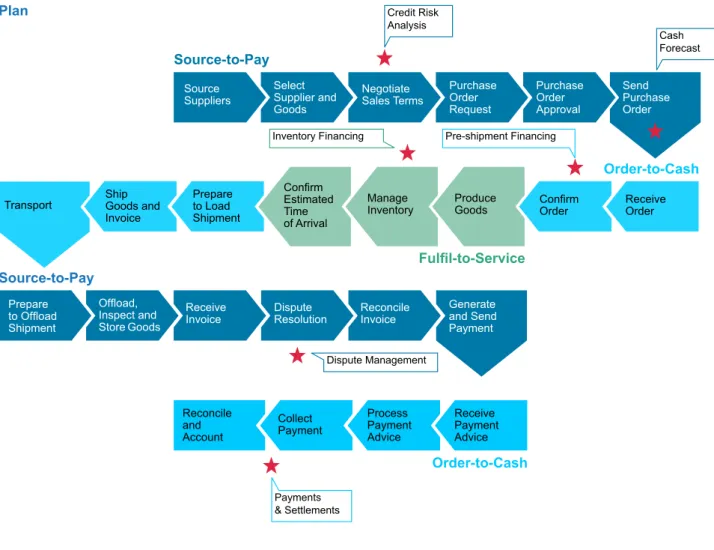
– A forward-looking perspective for a bank’s SCF offering should be based on an event- driven process mindset. As soon as the bank is able to pinpoint when a financially significant event is triggered by the phys-ical supply chain process (see ‘Trigger
– As noted in the illustration, there are many ‘trigger points’ that may activate these value-added SCF services. The bank can detect them – and therefore increase its
value-added offer – by learning to integrate its SCF value proposition with its customers’ physical supply chains.
Source Suppliers Transport Select Supplier and Goods Ship Goods and Invoice Prepare to Load Shipment Confirm Estimated Time of Arrival Prepare to Offload Shipment Offload, Inspect and Store Goods Receive
Invoice DisputeResolution
Reconcile and Account Collect Payment Process Payment Advice Receive Payment Advice Reconcile
Invoice Generate and Send Payment Manage
Inventory ProduceGoods ConfirmOrder Receive Order Negotiate Sales Terms Source-to-Pay Source-to-Pay Order-to-Cash Order-to-Cash Order-to-Cash Fulfil-to-Service Purchase Order Request Purchase Order Approval Send Purchase Order Credit Risk Analysis Payments & Settlements Cash Forecast Pre-shipment Financing Post-shipment Financing Inventory Financing
Dispute Management Post-shipment Finance
Figure 4:
Supply Chain Finance ‘Trigger Points’ (examples)
Source: Camerinelli
Page 27
2 Description of the market eco-system / 2.3
G / Supply chain management creates the
context for the use of a wide range of pay-ments and cash management services.
– In addressing the above it is important to recognise the necessity to deploy both busi-ness and technological capabilities in order to exploit the value of event-driven SCF. An example of this is the use of developing technologies such as RFID1 tags. These
might include monitoring of: raw materials on site, production in progress (tracked against key stages), independent/buyer inspection pre-shipment, goods loaded on vessel, unloaded, in warehouse or delivered to buyer.
– Examples of these triggers are as follows:
A / The evaluation of counterparties for
supply and sales requires credit analysis and due diligence. From the ‘trigger point’ of negotiate sales terms support of credit risk analysis by the bank could be activat-ed.
B / Send purchase order can be
supple-mented with a financing proposition based on the purchase order.
C / Supplier management triggers a
financial supply chain response such as improved cash forecasting for future cash outflows and optimal management of DPO referred to above. Assistance with cash forecasting could be a bank service triggered by the whole SCM process.
D / Inventory planning, purchasing and
tracking demands an ability to manage purchase order and inventory financing and, perhaps, letters of credit, or forward foreign exchange (FX) transactions.
E / Production planning may trigger an
analysis of available capital equipment finance and asset-based lending services.
F / Post-shipment finance may be offered
once the goods have been shipped. Elec-tronic invoicing and management of residual or related paper documents are all services that could be offered.
1
Radiofrequency identification
(RFID) is the use of a wireless non-contact system that uses radio-frequency
electromagnet-ic fields to transfer data from
a tag attached to an object, for the purposes of automatic
Page 28
2 Description of the market eco-system / 2.4
tronic chains transform the supply chain from the buyer sending orders and the supplier fulfilling the request into integrated supply chains, in which buyers and suppliers contin-uously exchange many types of information regarding forecasts, production plans, capac-ity constraints, and performance objectives. Thus, they have evolved from traditional supply-side concerns (i.e. supply chain) to demand creation by providing attractive features, which support the generation of demand (i.e. demand-supply chain). These processes are managed by cross-functional teams, including participants from logistics, production, purchasing, marketing, and re-search and development. The benefits made possible by reviewing supply chain manage-ment activities under the process-focused lens can be replicated and transferred to the financial flows that constitute the financial supply chain. This requires new concepts for the management of the instruments that make up the SCF portfolio and enable a shift from financing ordertocash activities to financing a more informationintensive and event-based collaboration.
It is likely that collaboration will become an even more intense feature of SCM touching all aspects of manufacturing, procurement, logistics, finance functions and related enter -prise information and automated applications at every level. As competition in international markets becomes progressively more dependent upon the reliability and quality of deliveries, this collaboration between sup-pliers and buyers has become an important characteristic of the supply chain. It has become more important to have knowledge of the availability of products (i.e. inventory levels), price fluctuations (i.e. tendering) and existing contracts (i.e. orders) than the mere information about the physical shipment of goods.
The benefits of a collaborative perspective can be further appreciated given the current situation of liberalised and globalised inter-national trade: the analysis of the processes underpinning production, and sourcing con-sumer products from across the globe are enhancing the interdependence between pro-ducers and wholesalers in globalised supply chains. The distribution of competitiveness in physical exchanges with the rest of the world is now crucial for economic prosperity, and has given rise to new forms of electronic transactions and methods of collaboration. Electronically-based manufacturing supply chains have created digital business eco-systems which deliver collaboration and transparency. The adoption of communication standards (e.g. RosettaNet) further improves the opportunities for success. These elec-2.4
How is supply chain management changing2
2
With the kind collaboration
of Usva Kuusiholma, Aalto University – School of Science
Page 29
2 Description of the market eco-system / 2.5
3.
The SCF market is still evolving – it is a competitive business and business undertaken is covered by customer confidentiality and therefore sources of information are con-strained and not widely in the public domain.
4.
The receivables financing segment including factoring, invoice discounting and receiv-ables finance in all its forms remains the largest segment with an estimated3 60 – 70
percent market share (Figure 5). It is primar-ily domestic (although there is a growing cross-border segment), and is likely to experi-ence steady growth. Banks, bank-owned sub-sidiaries and a variety of non-bank financial institutions are the main providers. Country practices vary widely.
It is important to understand the key trends and drivers in the SCF market:
1.
SCF practices initially focused on cross- border east-west trade where the relationship between buyers and suppliers was typically characterised by a balance of power in favour of the former. Large international buyers offered financial support to their small sup-pliers in exchange for a better purchase price. The application of supply chain finance instru ments is now more widely used includ-ing at domestic and regional levels with the main objective of securing business continu-ity and flows of supplies as well as financing sales growth on the side of the supplier.
2.
Orders-to-cash cycles have lengthened in many cases and large buyers have sought to squeeze suppliers by increasing payment terms. SME and emerging market suppliers are consequently vulnerable to constraints in the availability of finance and working capital through traditional channels.
2.5
From SCM to SCF – trends and drivers
3
Estimates derive from results collected through e-mail survey, the views of the EBA
SCWG and the authors’
experience. Inventory and pre-shipment financing 10% Payables financing 25% Receivables financing 65%
Figure 5:
Distribution of SCF Instruments
Source: Bryant, Camerinelli, EBA Member interviews
Page 30
2 Description of the market eco-system / 2.5
to the acceptability of the risk. The LC busi-ness has benefited from greater automation and the use of electronic processes.
9.
Banks provide funding and payment/trans-actional support, although liquid customers and non-bank financial institutions also provide financing services and create market liquidity – a secondary market is strongly developing.
10.
Collaboration services, e-invoicing service providers, automation platforms, software and ERP vendors are proving themselves to be a valuable complement in supporting market growth. Partnering is common.
11.
It has been already demonstrated that there are many opportunities stemming from supply chain management activities such as production planning, forecasting customer demand, inventory management, and distri-bution planning, that can expand the reach of the supply chain manager’s responsibilities and which can trigger opportunities for SCF.
12.
Banks are increasingly motivated to investi-gate SCF based on a contraction of traditional payment fees, the need to optimise the use of Risk Weighted Assets and identify additional sources of revenue in the working capital cycle.
5.
Buyer-centric SCF techniques, such as Re-verse Factoring or Approved Payables Finance, represent less than 15 – 20 percent (estimates vary) of the market but have strong growth potential. Global banks are today mainly concentrated on the large buyer side of the trade equation and this is the heritage of the cleverly structured solutions engineered and provided by banks for large international trading companies. It will need a ‘tipping point’ to see these instruments take-off on a broad scale and eventually en-compass SMEs. In particular the value of this SCF technique in stabilising the supply chain, directing liquidity to where it is needed, and creating a win-win situation for buyers and their suppliers is increasingly recognised.
6.
Inventory and pre-shipment finance are more specialised and not widely practiced outside certain industries and the commodity mar-kets. These practices hold perhaps a 5 – 10 percent share in market size.
7.
The development of ‘four corner’ models may enable a further acceleration of volumes of SCF transactions as providers cooperate to extend reach into new groups of potential users.
8.
International trade finance based on classi-cal documentary instruments is in relative decline, but should not be underestimated in terms of importance in Asian and emerging markets. LCs still have a key role to play in respect of ‘big ticket’ transactions, especially where control of goods as collateral is critical
Page 31
2 Description of the market eco-system / 2.6
In a presentation to the ICC Supply Chain Finance Conference in October 2012, a speaker noted the consistently low impair-ment rates experienced with invoice-based finance compared with conventional corpo -rate loans. At the same event Factors Chain International reported that its Import
‘Two-Factor’ (cross-border) business grew strongly in 2011 in the U.S. and Europe (except in the UK and Spain, which are already mature factoring markets). Looking at Export Two – Factor activity, Asia shows huge growth, especially in Turkey, Taiwan, Hong Kong and China (the latter at over 200 percent in the first half of 2012, as China increasingly adopted the factoring model). According to market research4, the
aggregat-ed European invoice finance market was worth over EUR 1 trillion in 2011. The invoice finance market includes factoring and invoice discounting, supply chain finance (equating to approved payables finance as defined herein) and trade receivables securitisation as well as other techniques such as forfaiting, and distributor finance. This market value represents some 8 percent of EU GDP and more than 8 percent of total bank lending. It is five times the volume of leasing transac -tions. Growth of the market has been over 10 percent p.a. since 2009 and is expected to continue.
Another market research publication rec-ognised the importance of optimum liquidity management and estimated that SCF (approved payables finance) growth rates in developed countries range from 10 to 30 percent and in developing countries from 20 to 25 percent p.a. (source: Aite Group).
2.6
SCF key statistical indicators
4
Demica Reports, issues n.15,16, May-October 2012.
Page 32
2 Description of the market eco-system / 2.7
markets such as Germany, where other forms of finance are more common and many developing economies where capability is not evolved. There are opportunities for technolo-gy transfers to new markets.
4.
Buyer-centric SCF supports the objective of de-risking the supply chain and relieves suppliers, many of whom are SMEs, of the complexity of arranging their own SCF solution. Leveraging the credit strength of highly rated buyers seems a sensible and untapped opportunity.
5.
Pre-shipment finance can be facilitated through SCF, although this is largely an aspiration at this stage outside specialised commodity finance structures.
6.
Although traditional documentary trade finance is in relative decline, the benefits of its related globally standardised risk mitigation, finance and settlement infrastruc-ture remain valid. This infrastrucinfrastruc-ture can be leveraged and further developed in the open account space through the emergence of SCF enablers such as the Bank Payment Obligation.
7.
Supply chain automation techniques, trans-parency and routine data availability can be transformed into valuable information or ‘triggers’ for SCF offerings.
A large number of drivers are encouraging the growth of SCF:
1.
Open account trading and lengthened supply chain cycles are promoting SCF demand as are often quoted constraints on traditional bank finance such as overdraft. These two factors are highlighting the need for alterna-tive sources of finance and efficient credit structures.
2.
As credit spreads have widened there is more scope to develop new approaches to pricing these alternative structures. On both the supplier and buyer side, the availability of working capital throughout the supply chain is a key issue. Manufacturers and retailers operating towards the end of the physical supply chain are able to act as a catalyst for enhancing financial supply chain efficiency for upstream supply chain participants in-volved in raw material sourcing, processing and refining functions. Dynamic markets especially in emerging countries in Asia and Latin America represent further opportuni-ties for SCF adoption given their trade focus, especially those in high interest rate environ-ments. Indeed it will be a litmus test for open account based SCF instruments that they find favour in Asian markets in particular, but also across the spectrum of emerging economies.
3.
Receivables finance is already well-estab-lished and growing – some mature markets such as USA, UK and Italy being ahead, of
2.7
Page 33
2 Description of the market eco-system / 2.8
networks. The latter are capable of support-ing a widensupport-ing out from a niche business based on large value transactions to a wide-spread SME support based on automation, especially e-invoicing.
8.
Many of the institutional ingredients are in place well-connected supply chains, will-ing financial institutions and other essentials such as B2B automation platforms and
2.8
There are some constraints and challenges for SCF growth, but they are not insurmountable There are a lot of potential constraints and
challenges, but provided they are actively managed they are not insurmountable:
1.
Most businesses are still attached to core banking relationships and to traditional forms of credit, which dwarf SCF transaction volumes. Gauging the real and feasible de-mand for alternatives such as SCF remains elusive, although growth trends are encour-aging.
2.
There is lack of a clear market terminology and standards for key concepts and defini-tions need to be addressed. There is confu-sion as to what SCF encompasses making widespread SCF adoption difficult to meas-ure. There is no well-articulated generic value proposition for SCF in a highly fragmented market.
3.
Leaders in a growing field are less likely to support moves to integrate ‘laggards’ through market cooperation, even if overall market enlargement would benefit them. There is a trade-off to be made between tailored solu-tions and standard market products.
4.
Risk, regulatory, tax, VAT, and accounting issues need to be understood and managed so as to remove uncertainty. The risk-based capital allocation rules applicable to SCF are still evolving. Accounting treatments need to be carefully planned to avoid reclassification of trade obligations into bank debt.
5.
There is a challenge to onboard suppliers onto automation platforms and to meet KYC requirements. There is a danger inherent in too many proprietary platforms and more attention could be paid to the collaborative space and open models, so as to save users the complexity of managing too many platform connections. This raises an issue of scalability of SCF solutions based on so many existing platforms.
6.
Credit availability and balance sheet capacity remain key requirements and are subject to uncertainty. Confidence in continuing credit availability needs to be built if SCF is to attract regular users.
7.
There is a complexity factor with many individuals needing to collaborate and coordinate the ‘moving parts’ within
finan-Page 34
2 Description of the market eco-system / 2.9
9.
Industry collaboration and governance is presently quite fragmented and requires improvement to address non-competitive issues such as standards, infrastructure, and market rules.
10.
There is not yet a deep secondary market for SCF assets that are generally heterogene-ous, unrated and not well understood by potential institutional investors. There is clearly growing activity and there is a grow-ing appetite for such assets. Most secondary market activity is bilateral or accomplished through specialist intermediaries, both evidence of an ‘early stage’ market. cial institutions; various product silos, and
management relationship groups need to be coordinated – a challenge in large and complex organisations especially with the global dimension demanded by SCF. Custom-er education, long sales cycles and systems integration are demanding areas especially if short term profit goals inhibit investment.
8.
Corporate buyers and suppliers need to work together and share the benefits – in so doing they must try to eliminate the tension often present in supplier/buyer relationships; this is a pre-condition for success. Both supplier and buyer need to perceive a tangible benefit from such interactions.
2.9
Impact of SCF for SMEs
Small and medium-sized enterprises (SMEs) are facing tough credit constraints and yet require sources of credit and liquidity. Recent developments such as the latest Late Pay -ments Directive (2011/7/EU) and measures taken at country level to accelerate supplier payments testify to the seriousness with which this problem is regarded. SCF has a potential role to play.
1.
SMEs credit risk is typically more challenging to assess than that of larger businesses. Con-sequently many have struggled to gain access to traditional forms of finance.
2.
Banks’ willingness to lend to small business-es has diminished, as a rbusiness-esult of deteriorating credit quality caused by the economic down-turn. This has had a fundamental impact on the ability of small businesses to grow.
3.
Through supply chain finance and logistics, it is possible to achieve a win-win situa - tion between core enterprises and their SME partners.
4.
SCF enables banks to support SMEs at a level that is more commensurate with their trading activity. By contrast, traditional forms of bank finance are primarily dependent on the SME’s balance sheet strength, security values and the value of supporting guarantees. Finance availability is, therefore, constrained by factors that are unconnected with an SME’s trading activity.
Page 35
2 Description of the market eco-system / 2.10
SCF ecosystem is provided. The companies quoted are assigned to the category where major activities are undertaken, although they may also carry out other functions. The lists are illustrative and non-exhaustive.
The objective of the following brief description of the main market segments involved in SCF is to frame the market in terms of what solu-tions are currently available, what players are involved, and what roles they play. An illus-trative listing of the most active players in the 2.10.1
Corporate customers
The types of corporate customers with an interest in SCF – Approved Payables Finance will be first class credit risks and represent many sectors including, consumer goods, retail, pharmaceuticals and health care, information/communications technology, electronics and automotive, for which supply chain management and supplier stability are key issues. They will often have regard for the liquidity needs of their SME suppliers. At the very least they will have a number of strategic suppliers where collaborating on raising liquidity will be fruitful to both buyers and their suppliers. Some of these customers will also cooperate with lenders to create preshipment finance programmes. The types of large corporate customers interested in receivables finance in all its various guises will often be exporters in the capital goods field who wish to raise sales finance for their buyers in emerging markets and/or where extended terms are required. Other sellers of intermediate goods such as vehicles and construction machinery may put in place distributor finance programmes. It is in the broad swathe of SME market
segments that the core market for receivable finance is common through many varieties of receivables purchase, factoring and invoice discounting facilities.
Leaving aside financing opportunities, corpo -rate customers are increasingly cooperating through B2B connections for the conduct of electronic trading and post-contract award processes such as order generation, inven-tory management, logistics, and invoicing/ payment. These practices are spreading from the large company environment to other corporate sectors.
2.10