
Impact Factor (2012): 3.358
Towards MapReduce Performance Optimization: A
Look into the Optimization Techniques in Apache
Hadoop for BigData Analytics
Kudakwashe Zvarevashe1, Dr. A Vinaya Babu21
M Tech Student, Dept of CSE, Jawaharlal Nehru Technological University, Hyderabad, India 2
Professor,Dept of CSE, Jawaharlal Nehru Technological University, Hyderabad, India
Abstract: The evolution of data over the years has since lead to the need to have efficient processing and storage techniques. We know live in the era in which BigData is one of the most talked issues together with the problems associated with it. This has lead to the development of Apache Hadoop and NoSQL databases to alleviate these problems. MapReduce has been the backbone and heart of Apache Hadoop a software tool designed for the distributed processing and storage of these massive datasets. Many researchers over the years have since tried to find ways to improve the MapReduce process performance and so many techniques have been designed. In this paper we expose all these techniques in an effort to reveal other research avenues in this domain.
Keywords: MapReduce, big data, hadoop, processing, storage, NoSQL, techniques
1.
Introduction
Big data is the collection of large and complex data sets that are difficult to process using on-hand database management tools or traditional data processing applications. The invention of online social networks, smart phones, fine tuning of ubiquitous computing and many other technological advancements have led to the generation of multiple petabytes of both structured, unstructured and semi-structured data. These massive data sets have lead to the birth of some distributed data processing and storage technologies like Apache Hadoop and MongoDB[1].
In the years building up to 2004 [1] Google embarked on a project to set up their very own proprietary database which they named [3]"Big Table". Big Table was an instant hit and it solved many of the problems with relational databases. In 2006 Yahoo built the first prototype called Hadoop and in 2008 they went commercial. Amongst the companies that started implementing this technology, Facebook was the first to join followed by Twitter and the others [4].
Map Reduce is a programming model for processing massive datasets on distributed clusters such as Hadoop Large datasets are split into blocks and are then processed by the datanodes in parallel. Hadoop MapReduce is a software framework for easily writing applications which process vast amounts of data (multi-terabyte data-sets) in-parallel on large clusters (thousands of nodes) of commodity hardware in a reliable, fault-tolerant manner.
A MapReduce job usually splits the input data-set into independent chunks which are processed by the map tasks in a completely parallel manner. The framework sorts the outputs of the maps, which are then input to the reduce tasks. Typically both the input and the output of the job are stored in a file-system. The framework takes care of scheduling tasks, monitoring them and re-executes the failed tasks [6].
Figure 1: MapReduce Illustration
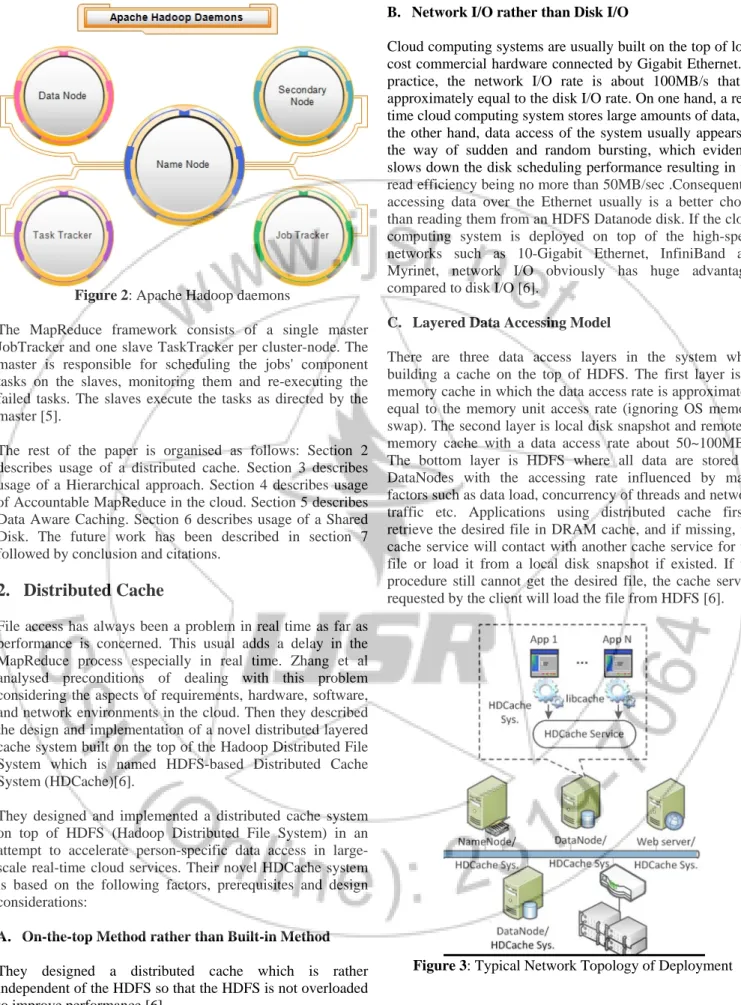
Apache Hadoop consists of five daemons [5] which are also known as processes and these are shown in Figure 2 and these are:
NameNode - This daemon stores and maintains the metadata for HDFS.
Jobtracker - Manages MapReduce jobs, distributes individual tasks to machines running the Task Tracker.
TaskTracker - Responsible for instantiating and monitoring individual Map and Reduce tasks.
Datanode- Stores actual HDFS data blocks.
Secondary NameNode - Performs housekeeping functions for the NameNode. In fact when the NameNode goes down, the secondary NameNode will be promoted to become the NameNode.
NameNode, secondary NameNode and Jobtracker daemons run on the master nodes while Datanode and TaskTracker run on the slave nodes. A Java piece of code (e.g. wordcount) will be converted into a jar (java archive file) before it is submitted to Hadoop as a new task.
International Journal of Science and Research (IJSR)
ISSN (Online): 2319-7064Impact Factor (2012): 3.358
Volume 3 Issue 7, July 2014
www.ijsr.net
Licensed Under Creative Commons Attribution CC BY Figure 2: Apache Hadoop daemons
The MapReduce framework consists of a single master JobTracker and one slave TaskTracker per cluster-node. The master is responsible for scheduling the jobs' component tasks on the slaves, monitoring them and re-executing the failed tasks. The slaves execute the tasks as directed by the master [5].
The rest of the paper is organised as follows: Section 2 describes usage of a distributed cache. Section 3 describes usage of a Hierarchical approach. Section 4 describes usage of Accountable MapReduce in the cloud. Section 5 describes Data Aware Caching. Section 6 describes usage of a Shared Disk. The future work has been described in section 7 followed by conclusion and citations.
2.
Distributed Cache
File access has always been a problem in real time as far as performance is concerned. This usual adds a delay in the MapReduce process especially in real time. Zhang et al analysed preconditions of dealing with this problem considering the aspects of requirements, hardware, software, and network environments in the cloud. Then they described the design and implementation of a novel distributed layered cache system built on the top of the Hadoop Distributed File System which is named HDFS-based Distributed Cache System (HDCache)[6].
They designed and implemented a distributed cache system on top of HDFS (Hadoop Distributed File System) in an attempt to accelerate person-specific data access in large-scale real-time cloud services. Their novel HDCache system is based on the following factors, prerequisites and design considerations:
A. On-the-top Method rather than Built-in Method
They designed a distributed cache which is rather independent of the HDFS so that the HDFS is not overloaded to improve performance [6].
B. Network I/O rather than Disk I/O
Cloud computing systems are usually built on the top of low-cost commercial hardware connected by Gigabit Ethernet. In practice, the network I/O rate is about 100MB/s that is approximately equal to the disk I/O rate. On one hand, a real-time cloud computing system stores large amounts of data, on the other hand, data access of the system usually appears in the way of sudden and random bursting, which evidently slows down the disk scheduling performance resulting in the read efficiency being no more than 50MB/sec .Consequently, accessing data over the Ethernet usually is a better choice than reading them from an HDFS Datanode disk. If the cloud computing system is deployed on top of the high-speed networks such as 10-Gigabit Ethernet, InfiniBand and Myrinet, network I/O obviously has huge advantages compared to disk I/O [6].
C. Layered Data Accessing Model
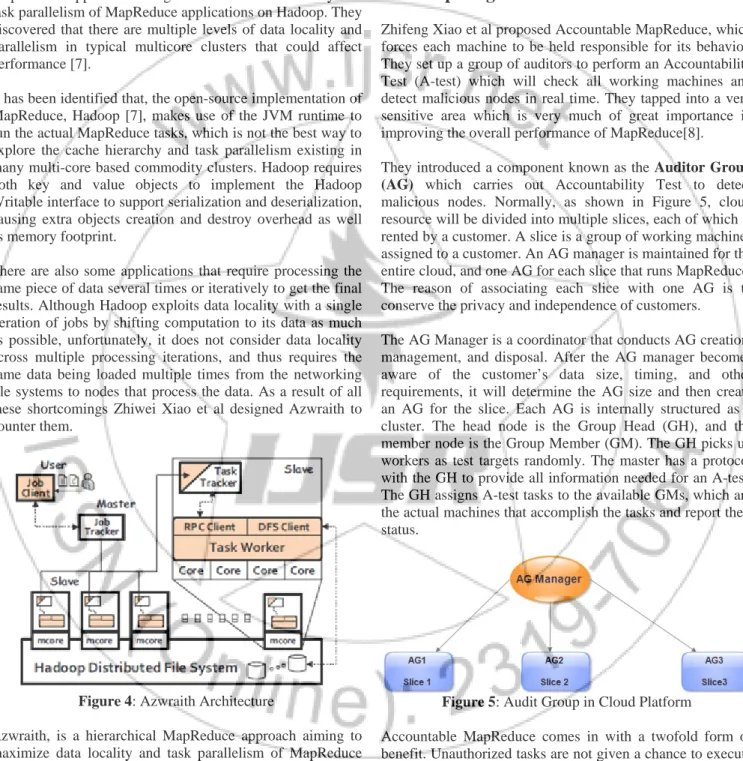
There are three data access layers in the system when building a cache on the top of HDFS. The first layer is in memory cache in which the data access rate is approximately equal to the memory unit access rate (ignoring OS memory swap). The second layer is local disk snapshot and remote in memory cache with a data access rate about 50~100MB/s. The bottom layer is HDFS where all data are stored in DataNodes with the accessing rate influenced by many factors such as data load, concurrency of threads and network traffic etc. Applications using distributed cache firstly retrieve the desired file in DRAM cache, and if missing, the cache service will contact with another cache service for the file or load it from a local disk snapshot if existed. If the procedure still cannot get the desired file, the cache service requested by the client will load the file from HDFS [6].
Figure 3: Typical Network Topology of Deployment
Impact Factor (2012): 3.358
3.
Maximising MapReduce Process Using a
Hierarchical Approach
Zhiwei Xiao et al found out that Hadoop had limitations in exploiting data locality and task parallelism for multi-core platforms. Then they extended Hadoop with a hierarchical MapReduce scheme. An in-memory cache scheme is also seamlessly integrated to cache data that is likely to be accessed in memory. They proposed Azwraith, a hierarchical MapReduce approach aiming to maximize data locality and task parallelism of MapReduce applications on Hadoop. They discovered that there are multiple levels of data locality and parallelism in typical multicore clusters that could affect performance [7].
It has been identified that, the open-source implementation of MapReduce, Hadoop [7], makes use of the JVM runtime to run the actual MapReduce tasks, which is not the best way to explore the cache hierarchy and task parallelism existing in many multi-core based commodity clusters. Hadoop requires both key and value objects to implement the Hadoop Writable interface to support serialization and deserialization, causing extra objects creation and destroy overhead as well as memory footprint.
There are also some applications that require processing the same piece of data several times or iteratively to get the final results. Although Hadoop exploits data locality with a single iteration of jobs by shifting computation to its data as much as possible, unfortunately, it does not consider data locality across multiple processing iterations, and thus requires the same data being loaded multiple times from the networking file systems to nodes that process the data. As a result of all these shortcomings Zhiwei Xiao et al designed Azwraith to counter them.
Figure 4: Azwraith Architecture
Azwraith, is a hierarchical MapReduce approach aiming to maximize data locality and task parallelism of MapReduce applications on Hadoop[4]. In the hierarchical MapReduce model of Azwraith, each Map or Reduce task assigned to a single node is treated as a separate MapReduce job and is further decomposed into a Map and a Reduce task, which are processed by a MapReduce runtime specially optimized on a single node. Specifically, Azwraith integrates an efficient MapReduce runtime for multi-core to Hadoop.
To exploit data locality among nodes at networking level, Azwraith integrates an in-memory cache system that caches data in memory that will likely be reused again, to avoid unnecessary networking and disk traffics. Through the use of word count, gigasort algorithm and linear regression their experiments proved that Azwraith, their extension to Hadoop outperformed Hadoop.
4.
Accountable MapReduce in Cloud
Computing
Zhifeng Xiao et al proposed Accountable MapReduce, which forces each machine to be held responsible for its behavior. They set up a group of auditors to perform an Accountability Test (A-test) which will check all working machines and detect malicious nodes in real time. They tapped into a very sensitive area which is very much of great importance in improving the overall performance of MapReduce[8].
They introduced a component known as the Auditor Group (AG) which carries out Accountability Test to detect malicious nodes. Normally, as shown in Figure 5, cloud resource will be divided into multiple slices, each of which is rented by a customer. A slice is a group of working machines assigned to a customer. An AG manager is maintained for the entire cloud, and one AG for each slice that runs MapReduce. The reason of associating each slice with one AG is to conserve the privacy and independence of customers.
The AG Manager is a coordinator that conducts AG creation, management, and disposal. After the AG manager becomes aware of the customer’s data size, timing, and other requirements, it will determine the AG size and then create an AG for the slice. Each AG is internally structured as a cluster. The head node is the Group Head (GH), and the member node is the Group Member (GM). The GH picks up workers as test targets randomly. The master has a protocol with the GH to provide all information needed for an A-test. The GH assigns A-test tasks to the available GMs, which are the actual machines that accomplish the tasks and report their status.
Figure 5: Audit Group in Cloud Platform
Accountable MapReduce comes in with a twofold form of benefit. Unauthorized tasks are not given a chance to execute and this will automatically improve the performance of MapReduce in the cloud. However, the drawback in this method is that sometimes false positives can distort everything. This is also introduced as an extra independent component which will be added on top of the inbuilt MapReduce such that the original set up of MapReduce is not altered as it may create some new problems [8].
International Journal of Science and Research (IJSR)
ISSN (Online): 2319-7064Impact Factor (2012): 3.358
Volume 3 Issue 7, July 2014
www.ijsr.net
Licensed Under Creative Commons Attribution CC BY
5.
Data aware caching for BigData applications
using MapReduce
An observation regarding Hadoop and NoSQL database applications is that they generate and store a large amount of intermediate data [1], and this abundant information is thrown away after the processing finishes. Motivated by this observation, Yaxiong Zhao et al proposed a data-aware cache framework for big-data applications, which they called Dache. In Dache, tasks submit their intermediate results to the cache manager. A task, before initiating its execution, queries the cache manager for potential matched processing results, which could accelerate its execution or even completely saves the execution. A novel cache description scheme and a cache request and reply protocols are designed. They implemented Dache by extending the relevant components of the Hadoop project [9]. Testbed experiment results demonstrated that Dache significantly improves the completion time of MapReduce jobs and saves a significant chunk of CPU execution time.
Figure 6: High level description of the architecture of Dache Dache requires only a slight modification in the input format and task management of the MapReduce framework, and applications need only slight changes in order to utilize Dache[9]. They implemented Dache in Hadoop. Testbed experiments showed that it can eliminate all the duplicate tasks in incremental MapReduce jobs and doesn't require substantial changes to the application code hence improving the overall performance of Hadoop.
Dache identifies the source input from which a cache item is obtained, and the operations applied on the input. In the reduce phase, they devised a mechanism to take into consideration the partition operations applied on the output in the map phase. They also discovered a method for reducers to utilize the cached results in the map phase to accelerate their execution. They implemented Dache in the Hadoop project by extending the relevant components. Their implementation follows a non-intrusive approach, so it only requires minimum changes to the application code.
6.
Shared Disk BigData Analytics with Apache
Hadoop
For organizations which don’t need a horizontal, internet order scalability in their analytics platform, Big Data
analytics can be built on top of a traditional POSIX Cluster File Systems employing a shared storage model. Anirban Mukherjee et al in their study compared a widely used clustered file system: VERITAS Cluster File System (SF-CFS) with Hadoop Distributed File System (HDFS) using popular Map-reduce benchmarks like Terasort, DFS-IO and Gridmix on top of Apache Hadoop[10]. In their experiments, VxCFS could not only match the performance of HDFS, but also outperformed in many cases. This way, enterprises can fulfill their Big Data analytics need with a traditional and existing shared storage model without migrating to a different storage model in their data centers. This also includes other benefits like stability & robustness, a rich set of features and compatibility with traditional analytics applications.
They gathered a credible reasoning behind the need of a new non-POSIX storage stack for Big Data analytics and advocate, based on evaluation and analysis that such a platform can be built on traditional POSIX based cluster file systems. They developed a file system connector module for SF-CFS to make it work inside Apache Hadoop platform as the backend file system replacing HDFS altogether and also have taken advantage of SF-CFS’s potential by implementing the native interfaces from this module. This scheme did not require any changes in the Map Reduce applications. Just by setting a few parameters in the configuration of Apache Hadoop, the whole Big Data analytics platform can be made up and running very quickly.
The clustered file system connector module they developed for Apache Hadoop platform has a very simple architecture. It removes the HDFS functionality from the Hadoop stack and replaces it with VERITAS Clustered File System. It introduces SF-CFS to the Hadoop class by implementing the APIs which are used for communication between Map/Reduce Framework and the File System. This could be achieved because the Map-Reduce framework always talks in terms of a well-defined FileSystem [10] API for each data access. The FileSystem API is an abstract class which the file serving technology underneath Hadoop must implement. Both HDFS and their clustered file system connector module implement this FileSystem class, as shown in Figure 7.
Figure 7: Architecture of SC-CFS Hadoop Connector

![Figure 6: High level description of the architecture of Dache Dache requires only a slight modification in the input format and task management of the MapReduce framework, and applications need only slight changes in order to utilize Dache[9]](https://thumb-us.123doks.com/thumbv2/123dok_us/1362925.2682464/4.892.73.822.255.1086/description-architecture-requires-modification-management-mapreduce-framework-applications.webp)
