D
ISCUSSION
P
APER
Community AffairsNovember 2007 07-5The Case for the Community Partner
in Economic Development
By Anna Steiger, Federal Reserve Bank of Boston,
Tessa Hebb, Labor and Worklife Program, Harvard Law School, and Lisa Hagerman, Oxford University Centre for the Environment
The Case for the Community Partner in Economic Development
Anna SteigerFederal Reserve Bank of Boston Tessa Hebb
Labor and Worklife Program Harvard Law School
Lisa Hagerman
Oxford University Centre for the Environment
November 2007
Abstract. Community-based organizations promote economic development by assembling investments in affordable housing, mixed-use real estate, community facilities, and small business in specific geographies. A principal way that community-based organizations tap institutional investors for deals is by partnering with investment intermediaries who manage the risk of these transactions by pooling assets, spreading risk across investors, and pricing the transaction up to the associated risk. Such a partnership allows an investment intermediary, or what the industry calls an “investment vehicle,” to use its expertise to structure a deal that delivers high financial returns to the institutional investor while allowing the community-based organization, or “community partner,” to ensure that the investment provides a community benefit.
In this paper, we argue that both sets of actors are necessary to achieve revitalized communities. Communities need to be able to tap into large-scale investment opportunities made possible by institutional investors while simultaneously ensuring that community residents benefit from such investment. We develop case studies of two investment vehicles and their community partners: the first investment vehicle we examine is the Urban Strategies America Fund, a for-profit urban development real estate fund in Boston; the second is Coastal Enterprises, Inc., of Portland, Maine, a not-for-profit community development corporation with for-profit investment subsidiaries.
The views expressed in this publication do not necessarily reflect official positions of the Federal Reserve Bank of Boston or the Federal Reserve System.
The Case for the Community Partner in Economic Development
Table of Contents
Introduction……….. 1
The Investment Vehicle and the Community Partner Relationship ……… 2
Case Studies ……… 5
The Role of the Investment Partner ……… 10
The Role of the Community Partner ……… 11
Conclusion ………. 12
References ……… 14
List of Interviewees ……… 15
Introduction
Large institutional investors are increasingly placing capital in what we refer to as community investments.1 These investors seek opportunities to earn high financial returns while spurring
economic growth in underserved areas. They aim to invest large amounts of capital into easily replicable financial instruments that generate risk-adjusted market-rate returns. In contrast, investments in underserved communities are generally small, illiquid, and highly specialized to meet the needs of the community. The challenge has been to find ways to funnel large amounts of institutional capital to community investments that have both high financial returns and meaningful benefits for communities.2
Hagerman, Clark, and Hebb (2007) set forth the role of intermediaries in community-based investing, noting that investment intermediaries, or “investment vehicles,” and community intermediaries, or “community partners,” are needed to link the institutional investor to the economic development area. Investment vehicles intervene between the investor and the community by pooling investments, spreading risk across investors, and pricing the transaction up to the associated risk. They also link with community partners, who draw on their specialized knowledge of the local area to help structure deals that ensure social benefits for low- and moderate-income residents. As such, the partnership between the investment vehicle and community partner act to unlock value for institutional investors and communities alike.
In this paper, we argue for the necessity of the partnership between the investment vehicle and the community partner. There are various arrangements that establish the relationship between the two. We discuss the strengths and weaknesses of different business models of partnerships. We find two scenarios are particularly successful at yielding tangible benefits for the community. In the first scenario, a not-for-profit community partner owns or contracts with the for-profit investment vehicle. In the second, the for-profit investment vehicle affiliates with a not-for profit community partner. We argue that investments made in partnership with a community development corporation (CDC) or community development financial institution (CDFI) provide some of the strongest community benefits.3
1 These are investments targeting geographic areas and businesses that have traditionally had difficulty attracting private
sector capital. Most of these investments are in lower-income urban areas, but some are targeted to rural areas as well. Other terms to describe these investments include emerging domestic markets, urban revitalization, and investments in underserved areas.
2 Community benefits are composed of the economic, social, and environmental returns to the local area. Economic
returns include the creation of jobs, affordable housing, and other real estate developments. Social returns include the creation of community facilities, open spaces, and services for local residents. Environmental returns include promoting mixed-use, transit-oriented, and “green” developments as well as sustainable practices in local industries. In this paper we use the convention of referring to these three types of returns collectively as social returns.
3
A community development corporation (CDC) is a resident-owned and -controlled organization engaged in affordable housing, business and commercial development, and community services for low- and moderate-income areas. Most are nonprofit, tax-exempt 501(c) 3 organizations. A community development financial institution (CDFI) is a financial institution whose primary mission is to promote community development in low- and moderate-income areas. CDFIs provide comprehensive credit, investment, banking, and development services. Some are chartered banks, others are credit unions, and many operate as self-regulating, nonprofit institutions that gather private capital from a range of investors for community development or lending.
Through the use of two case studies we will illustrate how investment vehicles and community partners work with each other. The first case study looks at the model of a for-profit investment vehicle and its partnerships with two not-for-profit CDCs in the Boston area. The Urban Strategies America (USA) Fund is a for-profit urban development real estate fund that has partnered with the Lena Park CDC and the Asian CDC in major real estate developments in the Mattapan and Chinatown neighborhoods of Boston. The second case study examines Coastal Enterprises, Inc. (CEI), of Wiscasset, Maine, a not-for-profit CDC and CDFI. In this case, parent organization CEI owns several for-profit subsidiaries, including CEI Capital Management, which creates investments in low-income areas using the New Markets Tax Credit (NMTC) program.4
Public pension funds in California, New York, and Massachusetts were early adopters of economic development policies that place capital with an investment vehicle. Lessons learned from these cases demonstrate that these investments yield both high financial returns and social returns (Hagerman, Hebb 2005). To date, public pension funds have committed $11 billion of their capital to urban or economic development investments (Hagerman 2007).5 Investments from other types of
institutional investors, such as foundations, are increasing as well. Market-rate, mission-related investments from foundations grew at a 19.5 percent compound annual rate since 2000 and are funded from program funds and endowment funds (Cooch 2007).
While in some cases it is still too early to report on the financial returns of these investments, they are already yielding tangible social returns to communities. Opportunities exist to increase the flow of institutional capital into underserved communities. This paper illustrates how the investment vehicle and community partner work together to create investments that meet the needs of both investors and communities.
The Investment Vehicle and the Community Partner Relationship
The community development finance industry is increasingly trying to tap institutional investors— insurance companies, large commercial banks, public sector pension funds, foundations—as new sources of capital. Such investors can provide the patient capital needed for community investments, many of which do not yield returns for several years out. The underlying assumption is that engaging the financial markets in economic development is an effective way to transform lower-income communities. Several market barriers have traditionally prevented institutional investors from allocating capital to these types of investments. Daniels (2005) cites five reasons why capital does not flow easily to low-income neighborhoods: 1) insufficient risk pricing, pooling, and spreading mechanisms; 2) high information and transaction costs; 3) market prejudice; 4) insufficient market
4
The New Markets Tax Credit (NMTC) program, established by Congress in December 2000 and administered by the CDFI Fund at the U.S. Department of Treasury, gives individual and corporate taxpayers the opportunity to receive a credit against income taxes by investing in qualified Community Development Entities (CDEs). Investors can earn attractive rates of return while meeting a community need, qualified businesses gain access to development funds at reasonable rates, and CDEs fulfill their mission by helping stimulate economic growth and job creation in specifically targeted lower-income communities.
5 The figure includes programs intended to stimulate economic activity in the underserved markets but does not include broad in-state targeted investments, which are significant across the United States.
competition; and 5) market-distorting government policies.
Institutional investors seeking to deploy capital to underserved areas do not have the time or expertise to actively manage these specialized investments. Investment vehicles intervene by using their financial expertise to pool assets and lower transaction costs. By creating scale, the investment vehicle produces the high financial return and large-size investments required by institutional investors. These investors allocate capital to economic revitalization through three asset classes: fixed income, equity real estate, and private equity (Hagerman et al. 2007).6 Many community
developments are multi-use projects, which are seen by investors as inherently more difficult to evaluate and implement. Investors consequently favor larger, more experienced fund managers and developers for these types of projects (Gyourko and Rybczynski 2000).
The community partner links the investment vehicle to the neighborhood. It uses its local knowledge to identify investment opportunities, enlist the participation of other partners such as developers, and assemble the support of civic leaders, government officials, and residents. The community partner also works to ensure that the investment yields benefits for the local neighborhood and does not lead to the displacement of lower-income residents—which occurs when revitalization projects raise property prices to the point that local residents can no longer afford to live or work in the community. Generally, community partners have previous experience promoting economic development through assembling smaller-scale investments in affordable housing, mixed-use real estate, community facilities, and small businesses.
Structures of Investment Vehicles
The investment vehicle uses a variety of operating models to link the institutional investor to the area needing revitalization. Daniels (2004) identifies four approaches to the oversight of an investment fund. These models are shown in Table 1. We suggest that two models, the Contractual Model and the Ownership Model, hold the greatest promise for unlocking value for institutional investors and communities alike. In the Contractual Model, a not-for-profit community partner organization or “sponsor,” such as a registered 501(c) 3, contracts with a well-established for-profit investment fund manager. In the Ownership Model, a not-for-profit community partner (often a well-established CDC or CDFI) owns the for-profit fund manager. The Legislative Model has been effective in Massachusetts, but it is dependent on supportive legislatures. The Fund Manager Model is effective in aggregating investment for institutional investors but can lack grounding in the community unless it affiliates with a community partner. We find that most funds currently operating in this investment space fall into the Fund Manager Model and may or may not affiliate with a community partner. We provide examples of the investment vehicles in Table 2.
The Contractual, Ownership, and Fund Manager Models all draw on the strength of the for-profit fund manager to aggregate investments that allow for the scale and track records necessary to engage institutional investors. Such for-profit fund managers often establish a commingled fund that is structured as a limited partnership or limited liability company. Often reciprocal targeted investing is
6 Hagerman et al. (2007) describe three asset classes of investments made by public pension funds: fixed income, equity real estate, and private equity (early and later-stage venture capital). Fixed incomeis a debt-based real estate and small business development finance product investing in affordable housing. Equity real estateis a real estate finance product investing in the potential growth in market value of the investment property. Private equity is the business finance product investing in mission-oriented companies at the early and expansion stages of the company’s development.
a feature of a commingled fund.7 Another for-profit fund manager structure, often used in private
equity investing in underserved capital markets, is a fund-of-funds that provides an opportunity for a fund to achieve scale and diversify its investments. Here an institutional investor can have small investments in ten different funds but makes only one large investment in the single fund-of-funds (Hagerman et al. 2007). This lowers the degree of due diligence required by the investor, who only selects the fund-of-funds vehicle rather than each of the smaller vehicles.
The Community Partner “Toolkit”
Community partners work with the investment vehicle and the community to unlock both the financial and social benefits of investments. Community partners are organizations and businesses that are rooted in the community and that have an explicit mission to promote community benefits. Community partners also make use of various “tools” available to them to help structure community investments. First come financial tools. Community partners have access to tools that affect the financial value of investments. Examples include land zoning and encumbrances, Low Income Housing Tax Credits (LIHTCs), New Markets Tax Credits (NMTCs), philanthropic grants provided by foundations and private donors, and other types of public and private subsidies.8 Not all
community investments require these types of subsidies, but in some cases these tools help to create investments that might not have otherwise occurred. Or they may help to provide greater social returns than might have otherwise been possible. Social and political tools are the second kind of tool.
Community partners are rooted in the local area and often have a track record of contributing to local economic development. As a result, they have earned the community’s trust and have extensive ties with key community stakeholders who can be called upon to help get a development project approved and to leverage resources. Material tools are the third kind of tool. An example would be land or a community facility owned by a community partner that underpins the investment.
Types of Community Partners
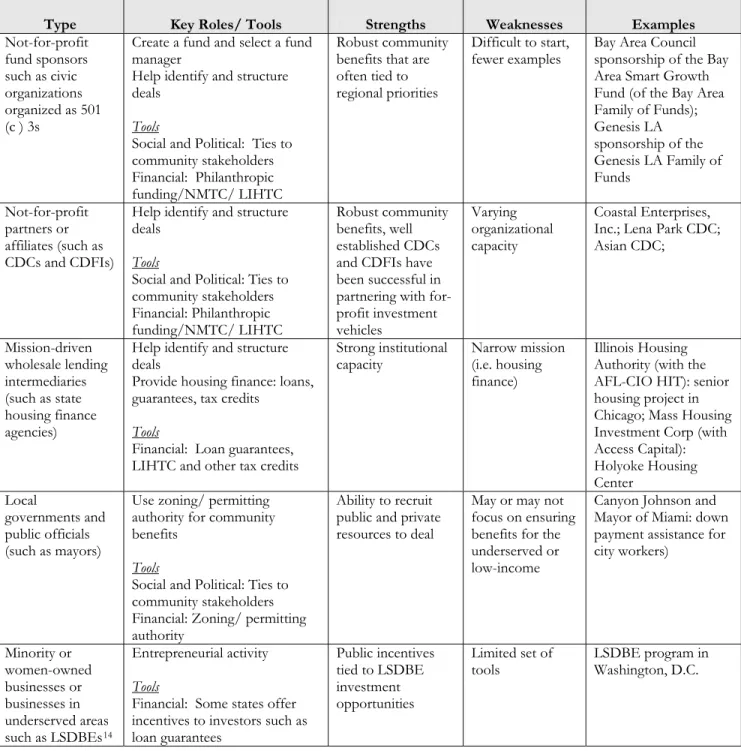
Community partners by definition are rooted in the local community and are mission-driven. We have categorized community partners into five types. They are not-for-profit fund sponsors; other profit affiliates; mission-driven wholesale lending intermediaries, which may be not-for-profit, for-not-for-profit, or public intermediaries; local governments and public officials; and underserved businesses. Underserved businesses include minority- and women-owned businesses, and local, small, and disadvantaged business enterprises (LSDBEs) as certified by certain state economic development agencies. The different types of community partners are shown in Table 3.
We argue that not-for-profit fund sponsors and affiliates, in particular CDCs and CDFIs, are the strongest community partners because their mission is most closely aligned with the needs of
7
The fund manager targets investments in geographic areas based on the limited partner’s investment percentage in the fund, while investors receive a return based on the total portfolio, not just their own geographic target.
8 Subsidies for economic development come in a variety of forms, including grants, loans, loan guarantees, the provision of in-kind products and services, regulation, and tax credits. Land zoning includes land use regulation; easements are land preservation agreement between a landowner and a municipality or a qualified land protection organization on conservation lands; the Low Income Housing Tax Credit program is run by the IRS and allows companies to invest in low-income housing, while receiving 10 years of tax credits; and the New Markets Tax Credit program permits taxpayers to receive a credit against federal income taxes over a seven-year period for making qualified equity investments in low-income businesses.
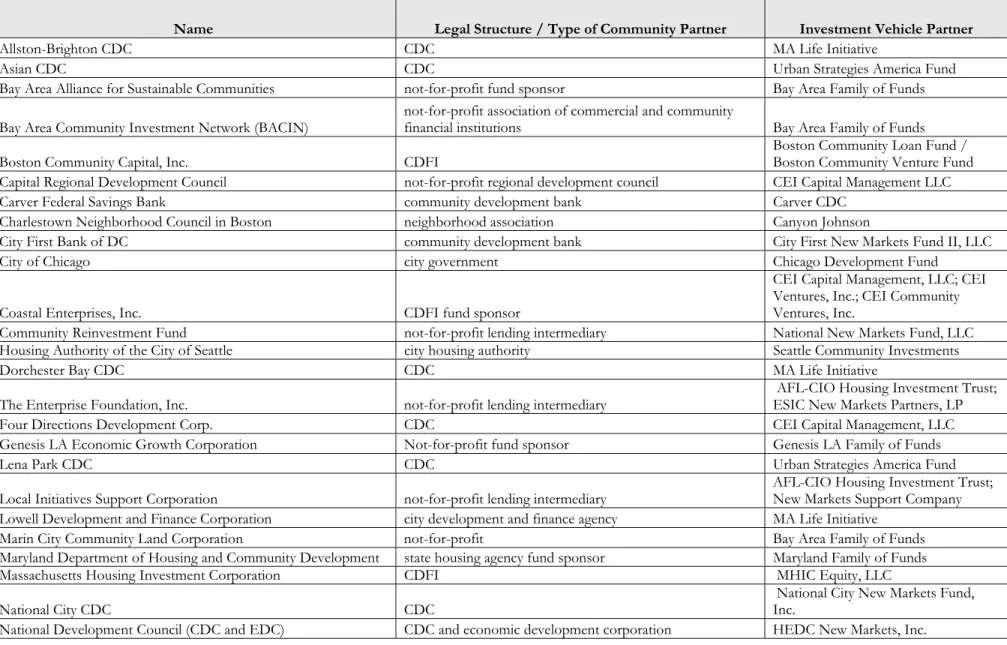
underserved areas and because they have access to the greatest number of tools in the toolkit. Mission-driven wholesale lending intermediaries can play the roles of either community partner or investment vehicle, depending on the investment. However, these institutions often have a more focused mission and role than a CDC (e.g., to assemble housing loans), which can limit their ability to bring a diverse array of community benefits to an investment. Local governments and public officials such as mayors can bring resources to an investment, but are not necessarily focused on securing benefits for lower-income and other underserved groups. Finally, underserved businesses can also be community partners in as much as they provide investment opportunities tied to public incentives for investors, but they have a limited set of tools with which to create community impact. In areas that do not have a strong presence of not-for-profit partners like CDCs or CDFIs, underserved businesses can provide opportunities for institutional investors seeking to make community investments. Table 4 provides examples of community partners.
Investment vehicles can partner with multiple community partners to augment the social returns of a project. The Contractual Model lends itself to multi-institutional partnerships. In this model, the fund sponsor—sometimes a council of local organizations (e.g. Bay Area Council)—works closely with local stakeholders to identify investment opportunities and recruit additional private, not-for-profit, and public resources. The fund sponsor often has a regional focus and connects investment decisions to regional economic priorities (Flynn et al. forthcoming).
Next we turn to our case studies to illustrate the link between the investment vehicle and the community partner.
Case Studies
In this section, we examine two cases studies: The Urban Strategy America Fund, a for-profit fund manager that partners with CDCs in its real estate developments and Coastal Enterprises, Inc., a not-for-profit CDC and CDFI that owns several for-profit fund manager subsidiaries. We illustrate how the investment vehicles work with the community partners to develop investments and the social returns on their investments. We also highlight the benefits accruing to the community partners who participated in these deals.
The Urban Strategy America Fund
The Urban Strategy America (USA) Fund is an example of a for-profit Fund Manager Model that takes a triple bottom line approach, seeking financial, social, and environmental returns on investments. The USA Fund was founded in 2004 by the New Boston Fund, a middle-market equity real estate investment fund started in 1993. With $170 million under management, the USA Fund participates in projects as direct investments or joint ventures on a scale of $10 million to $70 million or more in New England and the Mid-Atlantic states. In addition to its real estate investment expertise, the USA Fund brings development expertise via the New Boston Developers group. The USA Fund counts among its institutional investors, national banks, foundations, insurance companies, and public pension funds. Below we describe the fund’s financial engineering model and then highlight its two largest projects, which were both done in partnership with CDCs: Olmstead Green, a $144 million residential housing joint venture with Lena Park CDC in the Mattapan neighborhood of Boston, and Parcel 24, a $120 million residential housing joint venture with the
Asian CDC in the Chinatown neighborhood of Boston. The USA Fund’s Financial Engineering Model
The USA Fund provides preconstruction dollars as well as risk-adjusted equity to its community investment partnerships. The fund’s financial expertise and ability to supply capital also provide credibility with the public sector, which is important for securing approvals and public or subsidy financing. In a typical deal, the USA Fund is responsible for obtaining third-party debt financing of up to 75 percent of project cost. Joint venture partners (developers and/or community partners) may provide up to 20 percent of project equity through cash, third-party predevelopment expenses, or contribution of land. In return, local partners receive a development fee commensurate with development expertise as well as profit participation after equity investors receive a preferred 12 percent rate of return.
Olmstead Green
Olmstead Green is a joint effort between the USA Fund and its not-for-profit community partner, Lena Park CDC.9 Olmstead Green is being built on the former site of the Boston State Hospital,
land that had been undeveloped for 25 years. In 2001, Lena Park CDC decided to reenter real estate development and hired Kirk Sykes, an architect, to help them think through a detailed strategy for the Boston State Hospital site. Together with Sykes, the CDC interviewed 29 developers and decided to go with New Boston Real Estate. New Boston impressed them because of its proven track record working with community-based organizations--for example, when it built One Brigham Circle, a mixed-use real estate project in the Mission Hill section of Boston. Sykes subsequently was hired at New Boston and the company formalized its triple bottom line strategy by creating the USA Fund. Olmstead Green was the fund’s first investment. The project broke ground in May 2006. E. Lorraine Baugh, executive director of Lena Park CDC, explains, “Neither of the partners could have done the deal without the other.” The USA Fund brought the equity and know-how of a large real estate fund and development firm. And according to Sykes, Lena Park CDC brought knowledge of the local needs and the “hearts and minds of the community.”
Community Benefits: Olmstead Green will create 287 workforce housing condominiums and 153 affordable rental units. Four hundred jobs in construction and 400 permanent positions also will be created. The design is energy-efficient and includes green public spaces. Lena Park CDC will develop 83 units of senior housing, a 123-bed skilled nursing care facility, an urban farm, a Heritage House mental health center, a job training center, a fitness facility, and a community center, which will house Lena Park’s new offices.
Organizational Transformation: The Lena Park CDC has made its foray back into real estate development with its participation in Olmstead Green. This has helped the CDC strengthen its organizational capacity and is expected to provide a revenue stream that will cross-subsidize Lena Park’s health and human service activities. The project will also help cement Lena Park’s role in the community. According to Baugh, the experience also taught the CDC how to “partner with the private sector without getting swallowed up.”
9 Lena Park CDC is a health and human services organization with a 35-year history of serving low-income families in
Parcel 24
Parcel 24 is a joint initiative of the USA Fund and the Asian CDC.10 The land that Parcel 24 will sit
on had been taken from 300 Chinatown residents in 1962 by the City of Boston as part of the Massachusetts Turnpike extension project. In 2000, the Asian CDC led a comprehensive organizing, community planning, and legislative effort to have the site returned to the community as part of the completion of the Central Artery/Tunnel Project commonly known as the “Big Dig.” According to the Asian CDC’s executive director, Jeremy Liu, the group was able to capture the social value of the land by getting encumbrances placed on the site that ensured it would be used for affordable housing and open spaces. As a result, the Asian CDC found itself in the position of looking for a partner that could help unlock the financial value of the land, given the encumbrances. The Asian CDC brought the deal to New Boston Real Estate/USA Fund and was impressed with the fund’s willingness to have an ongoing conversation about how to balance the risk of the project with the need to ensure community benefits. The USA Fund and the Asian CDC formed Parcel 24, LLC, and won the designation for the project from the Massachusetts Turnpike Authority in April 2006. Parcel 24 is scheduled to break ground in 2009.
Community Benefits: Parcel 24 will create 324 residential units, including 70 affordable rentals and approximately 85 affordable and 169 market-rate condominiums. The mixed-use design will feature 165 parking spaces, an urban park, and 11,000 square feet of retail and community space. The project will also create approximately 700 construction jobs and up to 40 permanent jobs in retail, community organizations, and property management. This development will be a “green construction” with a LEED project certification.11
Organizational Transformation: Executive Director Jeremy Liu indicates that what the Asian CDC learned about developing large-scale projects through its partnership with the USA Fund has helped the CDC “emerge out of an era where projects happen to us” and become more forward-looking. The Asian CDC has experienced several key growth milestones over the past few years, many of which were made possible through its participation in Parcel 24. Some of these milestones include: a larger staff and a more diverse representation of expertise reflected by board members; a five-year strategic plan that includes the organization’s first operating pro forma; a budget of over $1 million in 2007-2008 compared with $200,000 in 1997-1998; and real estate pipeline prospects in three municipalities outside of the City of Boston.
Coastal Enterprises, Inc.
CEI is a private, not-for-profit CDC and CDFI. Founded in 1977, the organization provides financing and support in the development of small businesses, natural resources industries, community facilities, and affordable housing. CEI takes a triple bottom line approach (seeking financial, social, and environmental returns) and works primarily in rural areas in Maine, northern
10 The Asian CDC, established in 1987, develops affordable housing and promotes economic development and financial
education in the Chinatown area of Boston (http://www.asiancdc.org).
11 The Leadership in Energy and Environmental Design (LEED) is a nationally accepted benchmark for the design,
New England, and upstate New York. CEI operates as both a community partner and as an investment vehicle, via its three for-profit subsidiary companies: CEI Capital Management, LLC (CCML), which manages CEI's $129 million New Markets Tax Credit (NMTC) allocation, and CEI Ventures, Inc. (CVI), and CEI Community Ventures, Inc. (CCVI), which together are investing $35 million of venture capital in promising job-generating ventures.12 We focus most of our discussion
here on CCML because of the ways in which its business model relies on extensive relationships with community partners.
CEI Capital Management (CCML)
CCML is the entity set up to manage CEI’s NMTC allocation, operating in eligible low-income, primarily rural, areas in New England and New York. CCML identifies investment opportunities in these areas through its network of community partners. In recent years it has extended this network and is now planning to do NMTC deals in rural areas across America. Charlie Spies, managing director of CCML, explains that the NMTC is a critical instrument for this type of investing. He says, “The NMTC provides the missing piece, which is equity, in these types of investments. While we might have had a state guarantee in the past, the NMTC has proven to be essential for these deals.” Institutional investment in CCML deals has come from national and local banks, foundations, and private investment companies.
CEI’s New Markets Tax Credit Model
CCML plays an important role in the community development finance industry through its capacity to structure NMTC investments in rural areas. Table 5 diagrams how CEI’s NMTC model works. In a NMTC deal, the capital flows to a business through a special-purpose financing LLC, known as a Certified Development Entity (CDE). A bank, private equity investor, or other capital source can invest directly in the CDE or through an upper-tier conduit LLC as a means of leveraging the equity capital and bifurcating the tax credits. In the leveraged transaction, investors can provide the debt, equity, or both. Community partners often provide debt capital alongside other investors in a leveraged transaction. The equity provider would most likely receive its return using the available tax credits calculated on the basis of the combined total investment amount (debt and equity), thereby assuming nominal project risk. The 39 percent tax credit on the amount invested is realized over seven years. The business gets the capital on favorable terms and the investor gets the tax credits. Any debt financing in such a leveraged NMTC model could be at market rates if the available tax credits are mostly allocated to the equity investors. Alternatively, some tax credits could be allocated to the debt provider as incentive to make the capital available at more attractive financing rates and terms.
Example of a CEI NMTC Project: Mid-State Health Center (Plymouth, NH)
Health centers in rural communities face big hurdles in recruiting and retaining physicians. Tight quarters had hampered Mid-State’s ability to add services and operate efficiently. The facility had to move to attract good doctors and grow, but it could not afford a conventionally financed building. Mid-state CEO Sharon Beaty turned to Capital Regional Development Council (CRDC), a statewide
12 CEI’s fourth subsidiary, CEI Staffing Services, Inc., is a not-for-profit organization that builds partnerships with businesses throughout southern Maine to develop full-time, supportive, and flexible employment for dependent populations, including people with disabilities, non-English speakers, those receiving public assistance, and the homeless.
not-for-profit economic developer, for help. CRDC understood the health center needed a below-market lease to stay viable and brought the opportunity to CCML. CCML and CRDC crafted an investment using NMTCs, and CRDC constructed a new building. They lease it to Mid-State at an affordable rate. Investors in the new building include CRDC, a consortium of three community banks, the New Hampshire Community Development Finance Authority, and others.
Community Benefits: Mid-State’s 19,000-square-foot state-of-the-art Health Center opened in 2007. With the new clinic space, Mid-State will be able to integrate behavioral health services, such as counseling, with telemedicine (the use of technology to facilitate consultation between two medical specialists in different locations). The clinic also plans to have on-site daycare for children of staff, as well as community members. According to Beaty, “Our job is to protect access to primary care. This building is exciting for our community.”
Organizational Benefits: CRDC’s participation with CCML in the Mid-State Health Center has influenced its strategic planning. CRDC is hoping to do additional NMTC investments with CCML as well as other organizations. CRDC is also talking to the parent company, CEI, about partnering on other initiatives, such as on the delivery of Small Business Administration (SBA) 504 loans. CEI Ventures, Inc. (CVI)
Founded in 1996, CVI is a venture capital fund that manages $25.5 million in two funds providing financial and social returns to investors. Its first fund has invested $5 million in 20 companies in northern New England. Since the first closing in March 2001, CVI’s second fund has invested $7 million in 13 companies. It has expanded its geographical reach throughout the Northeast and has the potential to invest nationally. Targeting underserved markets, CVI funds invest in companies that have significant competitive advantages, strong management teams, and the potential to create quality jobs for people from low-income backgrounds. Investments promote socially beneficial products and services, opportunities for women and minorities, environmentally friendly business practices, and the enrichment of distressed and rural communities.
CEI Community Ventures, Inc. (CCVI)
CCVI manages a $10 million venture capital fund that places at least 80 percent of its investments in companies in targeted areas of Maine, New Hampshire, and Vermont. As part of the federal New Markets Venture Capital (NMVC) program, CCVI is restricted to investing in companies that qualify as small businesses according to the SBA's definition: having earnings less than $2 million annually, net assets less than $6 million, and a location in a low-income census tract. The NMVC program is structured to provide equity to small businesses as well as grant money that can be used for technical assistance.
In order to source deals, CCVI focuses on community education and proactive origination. In the area of education, CCVI has partnered with regional economic development organizations and business sponsors to organize and deliver nearly 40 Financing Fast Growth seminars to more than 1,500 attendees over the past three years. Such capital clinics serve two purposes: to inform potential and existing entrepreneurs that this unique form of capital exists and to create opportunities for CCVI. The fund also contributes articles on venture capital and small business growth issues to business periodicals in the targeted states. CCVI develops investment opportunities directly by
identifying, researching, and contacting companies whose business and market appear suited to the fund’s form of capital.
The Role of the Investment Vehicle
This section uses examples from our cases to illustrate three central roles that investment vehicles play in community-based investing: sourcing deals, financial engineering, and developing a niche industry.
Sourcing Deals
Investment vehicles engage in two types of deal-flow strategies (Flynn et al. forthcoming). Top-down strategies leverage relationships with mayors and other government officials and executives of banks, real estate firms, and insurance companies. Bottom-up strategies look for specific deals and development opportunities, often before they are on the market. Sources include developers, real estate professionals, and community partners. In our cases studies, the investment vehicles work closely with community partners to source deals. CCML’s business model is explicit about community partners taking a lead role in sourcing deals. The partnership agreement between CEI and the community partner establishes a fee structure for successful deals brought to CCML. CCML equips the community partners to source deals by providing presentation materials and participating with them on investment road shows. For both the USA Fund and CCML, once the deal comes to the investment vehicle, the vehicle is responsible for undertaking a due diligence review process, structuring the transaction, monitoring development, and creating an exit strategy.
Financial Engineering
The capital structure of an investment fund is developed through complex financial engineering. The structure can involve a debt component that helps bring the deal to scale. This is an important factor in understanding how the investment vehicle provides scale that leads to a transformation of neighborhoods and significant investment in growth companies. A successful real estate development includes a well-structured capital source. This is outlined in a pro forma detailing the sources and uses of funds. Funding sources include a combination of equity and often a bank loan for construction financing and other third-party debt financing. Equity is leveraged with mortgage financing to generate substantial capital in new developments. The role of subsidies is another component in the capital structure of private equity funds. While the second and third generations of funds have moved away from a reliance on public subsidies, they can still play a role. Examples of financial engineering by the investment vehicles were presented in the previous section. As mentioned, the USA Fund and CCML are responsible for obtaining the bulk of third-party financing, while joint venture partners may provide some of the remainder of the financing. CCML uses the NMTCs as incentives for investors. Both investment vehicles work with community partners to secure other types of subsidy financing.
Developing a Niche Industry
Investment vehicles engaged in community-based investing are attentive to the fact that they participate in an emerging, niche industry. The investment vehicle works to increase demand for and supply of community investments by educating potential investors, community partners, and other
stakeholders about how these investments work and about the typical returns. Investment vehicles also actively recruit resources to strengthen the industry, such as technical assistance providers to work with entrepreneurs and researchers that help catalogue the financial and social returns for investors and communities. The investment vehicles we examined have worked to overcome market prejudices in a number of ways. New Boston Real Estate Fund had developed proof of concept in a traditional investment fund before moving to triple bottom line investments with the USA Fund. As mentioned, CCML works closely with its community partners to educate potential investors and growing businesses about the NMTC.
The Role of the Community Partner
This section uses examples from our cases to illustrate two central roles that community partners play in community-based investing: sourcing deals and ensuring community benefits.
Sourcing Deals
Community partners work with investment vehicles to identify investment opportunities. Community partners are aware of local needs and draw on this knowledge to pursue resources and partners that help address these needs. The community partner may also recruit smaller, local investors and/or invest themselves in the projects. Rural Opportunities Enterprise Center, Inc. (ROECI), a community development and human services not-for-profit based in Rochester, New York, has worked with CCML since 2005 to identify eligible NMTC opportunities in upstate New York. ROECI markets the NMTC program and does the preliminary screening of investment opportunities for financially viability. In 2005, ROECI brought the Brooks Landing project to CEI, an opportunity to revitalize a section of city waterfront in Rochester. Using $10 million in NMTC allocations, CEI and ROECI were able to leverage an additional $10 million in public and private funds that is helping create an extended-stay hotel linked to Strong Memorial Hospital and the University of Rochester, commercial and office space, a public boardwalk, and boat docking facilities.
Ensuring Community Benefits
Community partners ensure that the community investment has social returns for local residents, a responsibility that aligns well with a community partner’s mission to promote local development. The community partner is more closely linked to the community than the investment vehicle and more likely to be held accountable by the community for delivering these benefits. The community partner has in-depth knowledge of local needs and leverages its tools to garner resources for the investment. Its social and political tools may provide the “credibility pass” needed for the project to get approval, and, as mentioned, the financial tools may help overcome market barriers or create greater social returns than would otherwise be the case. The Nature Conservancy, a global conservation organization, is a good example of how a community partner can employ financial tools for community benefit. The Conservancy worked with CCML to create a financing scheme using $32 million in NMTCs that allowed the Great Northern Paper Company in Millinocket, Maine, to preserve and/or reactivate 620 jobs. The Conservancy used its industry expertise to craft sustainability covenants into the loan agreement, resulting in Great Northern transferring 41,000 acres of land to the Conservancy and placing a conservation easement on an additional 200,000
acres of land.
In addition to the social metrics normally tracked, we found that the community partners participating in these deals also received direct benefits to their organizations. First, they strengthened their organizational capacity. A simple example is CCML’s use of the fees it earns for assembling NMTC deals to subsidize CEI’s other activities. Second, we found the community partners were able to consider engaging in more-complex project and products after participating in deals with the investment vehicle. As such, these partnerships helped to foster innovation in the community partners. For example, after working with CCML to develop “River Valley,” a food co-op in Northampton, Massachusetts, the Western Mass Enterprise Fund (WMEF) began looking at other ways to offer equity-like products to customers. They then decided to roll out royalty options, products that combine debt with an equity-like component; namely, a right to a percentage of the company’s future sales. Third, community partners increased their collaborative efforts after working with investment vehicles. Across the board, the community partners examined in this study said that after partnering with investment vehicles, they had a greater appreciation for the value that large collaborative efforts could have for their communities and their organizations.
Conclusion
There are opportunities to attract larger amounts of institutional capital to the emerging domestic markets while promoting the mechanisms that help ensure these investments have a meaningful impact on underserved communities. This study shows that the partnership between the investment vehicle and community partner unlocks value for institutional investors and communities alike. The investment vehicle and the community partner form a symbiotic relationship that allows for scale to effectively transform neighborhoods and yield financial returns to the institutional investor. Without the investment vehicle, large pools of capital would not be placed in the economic development area. The community partner helps ensure that the investment provides meaningful social returns to the neighborhood.
We have presented several models of investment vehicles and community partners. Investment vehicles that formally recognize the role of the community partner provide the understanding of the local area that is necessary to ensure social returns. Community partners such as not-for-profit fund sponsors and not-for-profit affiliates are deeply rooted in the community, engender community trust, and often bring with them financial, social and political, and material tools that help maximize community benefits.
Investment vehicles and community partners work to overcome market barriers in a number of ways. One of the most important ways investment vehicles do this is by pooling assets and investors. Another important way investment vehicles and community partners do this is by leveraging public incentives. Just as the LIHTC program opened the door to significant amounts of institutional capital for affordable housing, the NMTC program is attracting hundreds of millions of dollars to investments in businesses and mixed-use real estate. Additional research on the costs and benefits of these programs could lead to a better understanding of the value of the incentives for attracting institutional capital as an engine for economic development and poverty alleviation.
Studies of the financial and social returns of these investments are slowly being made available and are essential for the growth of the industry.13 Not captured in these metrics is the impact
partnerships can have on the community partner. These partnerships are helping increase the institutional capacity of community partners and fostering innovation and collaboration. As such, partnerships between investment vehicles and community partners are helping the latter organizations achieve the scale so widely called for in the industry of late.
Lessons learned from early adopters among institutional investors demonstrate that these investments yield both high financial and social returns. The amount of capital committed by institutional investors is growing. Nonetheless, challenges remain. Deal flow remains a problem and the relative complexity of these investments makes it difficult for some investors to classify them. The ability of investment vehicles to partner with community organizations is essential for generating more deals and successfully placing institutional capital in the underserved areas. We argue that the community partner toolkit that includes the financial, social and political, and material tools is the leverage that not-for-profit community partners bring to community-based investing. Opportunities remain for investment and community intermediaries to find new avenues for funneling institutional dollars into community investments such that these investments will provide robust benefits for investors and communities alike.
13 For more information on measuring the social outcomes of these investments, see Hagerman’s More than a Profit?
References
Cooch, Sarah, and Mark Kramer. 2007. Compounding Interest: Mission Investing By U.S. Foundations. Social Impact Advisors.
Daniels, Belden, and Economic Innovation International, Inc. 2004. Market Assessment and Investment Strategy for a Northwest Louisiana Community Development Fund,
Shreveport, Louisiana. Boston, MA.
Daniels, Belden, and Economic Innovation International, Inc. 2005. Market Assessment and Investment Strategy for a Maryland Community Development Fund. Boston, MA.
Flynn, Erin, et al. Forthcoming. The Double Bottom Line Handbook: A Practitioner’s Guide to Regional Double Bottom Line Investment Initiatives and Funds.
Gyourko, Joseph E., and Witold Rybczynski. 2000. “Financing New Urbanism Projects: Obstacles and Solutions.” Housing Policy Debate, 11 (3).
Hagerman, Lisa, et al. 2005. Pension Funds and Urban Revitalization: Competitive Returns and a Revitalized New York. Oxford University Centre for Environment, WP 05-13.
Hagerman, Lisa. 2007. More than a Profit? Measuring the Social and Green Outcomes of Urban Investments.
Oxford University Centre for Environment working paper.
Hagerman, Lisa, et al. 2007. Investment Intermediaries in Economic Development: Linking Pension Funds to Urban Revitalization. Labor and Worklife Program at Harvard Law School. Cambridge, MA.
Hebb, Tessa. 2005. California Case Study: A Private Equity CalPERS’ California Initiative. Oxford University Centre for Environment, WP 05-15.
List of Interviewees
Kirk A. Sykes, President and Managing Director, Urban Strategy America Fund E. Lorraine Baugh, Executive Director, Lena Park CDC
Jeremy Liu, Executive Director, Asian CDC
John Dalzell, Senior Architect, Boston Redevelopment Authority
Charles J. Spies, Managing Director, and Steve Weems, Executive Investment Officer, CEI Capital Management, LLC
Michael H. Gurau, President, CEI Community Ventures, Inc. Nathaniel V. Henshaw, President, CEI Ventures, Inc
Christopher Sikes, Executive Director, Western Mass Enterprise Fund; Board of Advisors, CEI Capital Management LLC
Dana Brunett, President, Enterprise Center, Rural Opportunities Enterprise Center, Inc.; Board of Advisors, CEI Capital Management LLC
Rosalie Cates, Executive Director, Montana CDC; Board of Advisors, CEI Capital Management LLC
Neil Cannon, Executive Director, Capital Regional Development Council
William Ginn, Director, Global Forest Program at the Nature Conservancy; Board of Advisors, CEI Capital Management LLC
Appendices
Table 1: Structures of Investment Vehicles Legal
Model Structure Strengths Weaknesses Examples Contractual
Model Not-for-profit community partner sponsors or affiliate contracts with a proven fund manager. The project can be structured either as an LLC or Limited Partnership
Proven outside fund
manager Fund Manager may lack accountability to the not-for-profit sponsor and may run off with the idea if ongoing funds are not built into the contract.
Genesis LA Funds, Bay Area Family of Funds, San Diego Capital Collaborative, Nehemiah Sacramento Valley Fund
Ownership
Model Not-for-profit community fund sponsor owns for- profit fund manager
Not-for-profit community fund sponsor has control over fund manager
Institutional investors may not have confidence in the not-for-profit manager
Community Preservation Corporation (owns CPC Resources,
Coastal Enterprises , Inc.(owns CEI Ventures), MA Housing Investment (owns MHIC Equity LLC) Legislative
Model Fund criteria and tax deal codified in state legislation
Good option with a sympathetic legislature
Not an option with an unsympathetic legislature
MA Life Initiative, MA Property and Casualty Initiative Fund Manager Model For-profit fund manager operates without a not-for-profit sponsor or affiliate* Investors like returns, fund managers, and double bottom line concept
Who is monitoring
second bottom line? American Ventures, CA Urban Investment, Urban Strategy America Fund, New Boston USA Fund, Urban America, Canyon Johnson Urban Fund
Source: Daniels (2004)
* Note: We present in this case study an example of a for-profit fund manager that affiliates with a not-for-profit CDC as shown in the case of the New Boston USA Fund affiliating with Lena Park CDC and the Asian CDC.
Table 2: Examples of Investment Vehicles Assembling Community Investments
Key:
O: Ownership Model (27 examples) FI: Fixed Income
C: Contractual Model (8 examples) ERE: Equity Real Estate FM: Fund Manager Model (44 examples) PE: Private Equity L: Legislative (2 examples)
Name Model Parent Organization (if applicable)
Sponsor is a Not-for-Profit/Pub
lic Entity? Examples of Partners Asset Class
Access Capital Strategies, LLC FM n/a n/a
Massachusetts Housing Investment Corporation, Fannie Mae American
Communities Fund, ACORD, and Community
Development Financial Institutions FI
Advantage Capital Community Development Fund, LLC FM Advantage Capital Partners No PE
AFL-CIO Housing Investment Trust
Comm-on law busin-ess trust
regi-stered n/a n/a
Illinois Housing Development Authority; New York City Housing Development Corp; National Low Income Housing Coalition; the National Housing Conference; the Enterprise Foundation; LISC; FHA; Ginnie Mae; Fannie Mae; Freddie Mac; and state and local agencies. FI
American Community Renewable Energy Fund, LLC FM n/a n/a PE
American Ventures FM n/a n/a ERE
Banc of America Capital Access Funds FM n/a n/a CCC, Pacific Community Ventures (both help advise entrepreneurs) PE
Banc of America CDE, LLC FM Bank of America No ERE
Bay Area Family of Funds C Bay Area Council Yes
Bay Area Alliance for Sustainable Communities, Bay Area Community Investment Network (BACIN), LA Chamber of Commerce; Marin City Community Land Corporation; Joint
venture developers ERE, PE
Boston Community Loan Fund O Boston Community Capital, Inc. Yes FI
Name Model Parent Organization (if applicable)
Sponsor is a Not-for-Profit/Pub
lic Entity? Examples of Partners Asset Class
Bridge Housing Construction FM n/a n/a ERE
CA Urban Investment Partners FM n/a n/a ERE
Canyon Johnson Urban Fund FM n/a n/a Charlestown Neighborhood Council in Boston ERE
Capital One Community Renewal Fund, LLC FM Hibernia National Bank No PE
Carver CDC O Carver Federal Savings Bank No ERE
CCG Community Partners, LLC FM CityScape Capital Group, LLC No ERE
CEI Capital Management LLC O Coastal Enterprises Inc. (CEI) Yes
The Nature Conservancy, Western Mass Enterprise Fund, Capital Regional
Development Council, Rural Opportunities Enterprise Center, Inc., Four Directions
Development Corp. ERE
CEI Community Ventures Fund O Coastal Enterprises Inc. (CEI) Yes Chambers of commerce; regional development corporations PE
CEI Ventures Fund O Coastal Enterprises Inc. (CEI) Yes Angel funds; CDVC members PE
Chase New Markets Corporation FM Chase No ERE
Cherokee Investment Partners FM n/a n/a
Municipalities, economic development organizations, city and regional planners, local and national developers, U.S. Conference of
Mayors ERE
Chevron NMTC Fund LLC FM Chevron No ERE
Chicago Development Fund O City of Chicago Yes ERE
Citibank NMTC Corporation FM Citibank No ERE
City First New Markets Fund II, LLC O City First Bank of D.C. Yes ERE
Commonwealth Cornerstone Group O Pennsylvania Housing Finance Agency Yes ERE
Community Capital Management (formerly CRA Fund
Advisors) FM n/a n/a FI
Community Preservation Corp O Community Preservation Corp. Yes FI
Community Preservation Corp. Resources O Community Preservation Corp. Yes Asian Americans for Equity ERE
Consortium America, LLC FM Trammell Crow Company No ERE
CT/KDF Community Development Partners, LLC FM
Partnership between CT Realty (private) and KDF Communities
Name Model Parent Organization (if applicable)
Sponsor is a Not-for-Profit/Pub
lic Entity? Examples of Partners Asset Class
Dakotas America, LLC FM
So. Dakota Rural Enterprise (RE), Inc., Rural Development Associations, the No. Dakota Rural Electric Assoc., East River Electric Power Coop., So. Dakota RE, and several development organizations and
financial institutions Hybrid PE
Empowerment Reinvestment Fund, LLC O SEEDCO Yes PE
Enhanced Delta Community Development, LLC FM
partnership between Enhanced Capital Partners (private) and
the Delta Regional Authority Hybrid PE
ESIC New Markets Partners, LP O The Enterprise Foundation, Inc. Yes ERE
Genesis LA CDE, LLC O Genesis LA Yes ERE
Genesis LA Family of Funds C Genesis LA Yes community-based developers, public-private partnerships ERE, PE
Greenville New Markets Opportunity LLC O Greenville Local Development Corporation Yes ERE
Greystone CDE LLC FM Greystone and Co. Inc. No ERE
HEDC New Markets, Inc O National Development Council Yes ERE, PE
Hospitality Fund II, LLC FM n/a n/a ERE
Johnson Community Development Company FM SC Johnson Enterprises No ERE
M&I New Markets Fund, LLC FM n/a n/a ERE
MA Life Initiative L n/a n/a
Dorchester Bay CDC, Allston-Brighton CDC, and Lowell Development and Finance
Corporation PE
MA Property and Casualty Initiative L n/a n/a FI
Maryland Community Development Family of Funds C
Enterprise Community Investment Owned By
Enterprise Community Partners Yes Maryland Department of Housing FI, ERE
MHIC Equity, LLC O Massachusetts Housing Investment Corporation Yes ERE
Name Model Parent Organization (if applicable)
Sponsor is a Not-for-Profit/Pub
lic Entity? Examples of Partners Asset Class
Merrill Lynch Community Development Company FM Merrill Lynch No FI, ERE
MK La Charitable Healthcare Facilities Fund LLC FM Morgan Keegan and Company No FI
National Cities Fund, LLC O Historic Restoration, Inc. Yes ERE
National City New Markets Fund, Inc. O National City CDC Yes ERE
National New Markets Fund, LLC O Community Reinvestment Fund Yes ERE
Sunchild Tribal Development Services, Inc. O National Tribal Development Association Yes PE
National Trust Community Investment Corporation O National Trust for Historic Preservation Yes ERE
NCB Development Corporation O National Cooperative Bank Yes ERE
Nehemiah Sacramento Valley Fund C
Nehemiah Community Reinvestment Fund and Nehemiah Community
Foundation Yes Nehemiah Urban Land Trust, Nehemiah Urban Ministries ERE
New Markets Support Company O Local Initiatives Support Corp. Yes ERE
Northwest Louisiana Community Development Fund C Strategic Action Council Yes ERE
Oregon Investment Fund, a Credit Suisse Fund of Funds FM n/a n/a
Oregon Economic and Community Development, Oregon Entrepreneur Forum
and many others PE
Paradigm Properties FM n/a n/a ERE
PNC Community Partners, Inc. FM PNC Bank No ERE
Portland Family of Funds C Portland Development Corporation Yes
Holding company for Portland New Markets Fund, LLC and Portland Historic Rehabilitation
Fund ERE, PE
Puget Sound Family of Funds C Martin Luther King Housing Development Association Yes ERE
Name Model Parent Organization (if applicable)
Sponsor is a Not-for-Profit/Pub
lic Entity? Examples of Partners Asset Class
Rockland Trust CDC II FM Rockland Trust No PE
Rural Development Partners, LLC O Ag Ventures Alliance Coop Yes PE
San Diego Capital Collaborative C SD City Council Reinvestment Task Force Yes FI, ERE
Seattle Community Investments O Housing Authority of the City of Seattle Yes ERE
Shorebank Enterprise Pacific O Shorebank Corporation Yes PE
SJF Ventures FM N/A Note: not-for-profit affiliate: SJF Advisory Services No
SJF Advisory Services, CEI Ventures (Portland, ME), Boston Community Capital, Community Development Venture Capital Alliance,
Opportunity Finance Network. PE
Sovereign Community Development Company FM Sovereign Bank No ERE
Stonehenge Community Development, LLC FM Stonehenge Capital No PE
Structured Products Group CDE, LLC FM GMAC Commercial Holding Capital Corporation. No ERE
Urban Development Fund, LLC FM Aries Capital, Inc. No ERE
Urban Research Park CDE, LLC FM Townsend Capital No ERE
Urban Strategies America Fund FM n/a n/a Bonaventure Realty Group; Lena Park CDC, Asian CDC ERE
UrbanAmerica FM Fisher Brothers No ERE
USBCDE, LLC FM Firstar Bank, N.A. No ERE
Wachovia Community Development Enterprises, LLC FM Wachovia Corporation No ERE
WNC National Community Development Advisors, LLC FM WNC and Associates, Inc. n/a ERE
Table 3: Types of Community Partners
Type Key Roles/ Tools Strengths Weaknesses Examples Not-for-profit fund sponsors such as civic organizations organized as 501 (c ) 3s
Create a fund and select a fund manager
Help identify and structure deals
Tools
Social and Political: Ties to community stakeholders Financial: Philanthropic funding/NMTC/ LIHTC
Robust community benefits that are often tied to regional priorities
Difficult to start,
fewer examples Bay Area Council sponsorship of the Bay Area Smart Growth Fund (of the Bay Area Family of Funds); Genesis LA sponsorship of the Genesis LA Family of Funds Not-for-profit partners or affiliates (such as CDCs and CDFIs)
Help identify and structure deals
Tools
Social and Political: Ties to community stakeholders Financial: Philanthropic funding/NMTC/ LIHTC Robust community benefits, well established CDCs and CDFIs have been successful in partnering with for-profit investment vehicles Varying organizational capacity Coastal Enterprises, Inc.; Lena Park CDC; Asian CDC; Mission-driven wholesale lending intermediaries (such as state housing finance agencies)
Help identify and structure deals
Provide housing finance: loans, guarantees, tax credits
Tools
Financial: Loan guarantees, LIHTC and other tax credits
Strong institutional
capacity Narrow mission (i.e. housing finance)
Illinois Housing Authority (with the AFL-CIO HIT): senior housing project in Chicago; Mass Housing Investment Corp (with Access Capital): Holyoke Housing Center Local governments and public officials (such as mayors)
Use zoning/ permitting authority for community benefits
Tools
Social and Political: Ties to community stakeholders Financial: Zoning/ permitting authority
Ability to recruit public and private resources to deal
May or may not focus on ensuring benefits for the underserved or low-income
Canyon Johnson and Mayor of Miami: down payment assistance for city workers) Minority or women-owned businesses or businesses in underserved areas such as LSDBEs14 Entrepreneurial activity Tools
Financial: Some states offer incentives to investors such as loan guarantees Public incentives tied to LSDBE investment opportunities Limited set of
tools LSDBE program in Washington, D.C.
14 LSDBEs refer to “local, small, and disadvantaged business enterprises” as certified by certain state economic development agencies.
Table 4: Examples of Community Partners
Name Legal Structure / Type of Community Partner Investment Vehicle Partner
Allston-Brighton CDC CDC MA Life Initiative
Asian CDC CDC Urban Strategies America Fund
Bay Area Alliance for Sustainable Communities not-for-profit fund sponsor Bay Area Family of Funds
Bay Area Community Investment Network (BACIN) not-for-profit association of commercial and community financial institutions Bay Area Family of Funds
Boston Community Capital, Inc. CDFI Boston Community Loan Fund / Boston Community Venture Fund
Capital Regional Development Council not-for-profit regional development council CEI Capital Management LLC
Carver Federal Savings Bank community development bank Carver CDC
Charlestown Neighborhood Council in Boston neighborhood association Canyon Johnson
City First Bank of DC community development bank City First New Markets Fund II, LLC
City of Chicago city government Chicago Development Fund
Coastal Enterprises, Inc. CDFI fund sponsor
CEI Capital Management, LLC; CEI Ventures, Inc.; CEI Community Ventures, Inc.
Community Reinvestment Fund not-for-profit lending intermediary National New Markets Fund, LLC
Housing Authority of the City of Seattle city housing authority Seattle Community Investments
Dorchester Bay CDC CDC MA Life Initiative
The Enterprise Foundation, Inc. not-for-profit lending intermediary AFL-CIO Housing Investment Trust; ESIC New Markets Partners, LP
Four Directions Development Corp. CDC CEI Capital Management, LLC
Genesis LA Economic Growth Corporation Not-for-profit fund sponsor Genesis LA Family of Funds
Lena Park CDC CDC Urban Strategies America Fund
Local Initiatives Support Corporation not-for-profit lending intermediary AFL-CIO Housing Investment Trust; New Markets Support Company
Lowell Development and Finance Corporation city development and finance agency MA Life Initiative
Marin City Community Land Corporation not-for-profit Bay Area Family of Funds
Maryland Department of Housing and Community Development state housing agency fund sponsor Maryland Family of Funds
Massachusetts Housing Investment Corporation CDFI MHIC Equity, LLC
National City CDC CDC National City New Markets Fund, Inc.
Name Legal Structure / Type of Community Partner Investment Vehicle Partner
National Tribal Development Association national tribal not-for-profit Sunchild Tribal Development Services, Inc.
NCB Cooperative Bank coop bank NCB Development Corporation
Nehemiah Community Foundation community foundation Nehemiah Sacramento Valley Fund
Nehemiah Community Reinvestment Fund CDFI Nehemiah Sacramento Valley Fund
Nehemiah Urban Land Trust land trust Nehemiah Sacramento Valley Fund
Nehemiah Urban Ministries Initiatives not-for-profit Nehemiah Sacramento Valley Fund
Pacific Community Ventures CDFI Banc of America CDE, LLC
Pennsylvania Housing Finance Agency housing finance agency Commonwealth Cornerstone Group
Rural Opportunities Enterprise Center, Inc. not-for-profit (regional community development and human services) CEI Capital Management LLC
SEEDCO not-for-profit lending intermediary Empowerment Reinvestment Fund, LLC
Shorebank Corporation CDFI Shorebank Enterprise Pacific
South Dakota Rural Enterprise, Inc. not-for-profit lending intermediary Dakotas America, LLC
The Nature Conservancy not-for-profit (conservation organization) CEI Capital Management LLC
Table 5: Coastal Enterprises (CEI) New Markets Tax Credit Investment Model
Equity Investor
(Owns 99.99% of Investment LLC) Investment Pooling Conduit LLC (Owns 99.99% of CDE) Certified Development Entity (CDE) (99.99%)Lender
Bank, private equity investor, or other debt capital source
CDE Sponsor and NMTC Mgr (owns 0.01%) CDE Sponsor and NMTC Mgr (owns 0.01%) In a NMTC deal, an investor can invest directly in the CDE (direct investment model) or through an upper-tier "conduit" LLC as a means of leveraging the equity capital and bifurcating the tax credits (leveraged investment model).
Borrower
Qualified Active Low-Income Community Business (QALICB)
Table 6: Partnerships and Deals Examined in the Case Studies
Deal Name Investment Vehicle Community [and other] Partners Deal Description Deal Size Olmstead Green
(Boston, MA)
USA Fund Lena Park CDC Affordable housing and neighborhood amenities
$144 m Parcel 24
(Boston, MA) USA Fund Asian CDC Affordable housing $120 m Mid-State Community Health Center (Plymouth, NH) CCML Capital Regional Development Council
Community health center $4 m
Katahdin Forest Management (Millinocket, ME) CCML The Nature Conservancy Company restructuring; conservation $50 m Brooks Landing
(Rochester, NY) CCML Rural Opportunities Enterprise Center, Inc.
Park/river land development $10 m
River Valley Market
(Northampton, MA) CCML Western Massachusetts Enterprise Fund
Food Co-op $10 m
Innov-X Systems, Inc.
(Woburn, MA) CVI [Angel Community investors, Development Venture Capital Association (CDVCA)] Technology manufacturing company $28 m
The Natural Pasta Co., LLC (Brattleboro, VT) CCVI [Regional development corporations, chambers of commerce]