Unicentre
CH-1015 Lausanne http://serval.unil.ch
RRRRYear : 2018
How Earmarking Drives Efficiency: A DEA and SFA Approach on
Swiss Cantonal Panel Data
Christen Ramon
Christen Ramon, 2018, How Earmarking Drives Efficiency: A DEA and SFA Approach on Swiss Cantonal Panel Data
Originally published at : Thesis, University of Lausanne
Posted at the University of Lausanne Open Archive http://serval.unil.ch
Document URN : urn:nbn:ch:serval-BIB_F29162E15F773
Droits d’auteur
L'Université de Lausanne attire expressément l'attention des utilisateurs sur le fait que tous les documents publiés dans l'Archive SERVAL sont protégés par le droit d'auteur, conformément à la loi fédérale sur le droit d'auteur et les droits voisins (LDA). A ce titre, il est indispensable d'obtenir le consentement préalable de l'auteur et/ou de l’éditeur avant toute utilisation d'une oeuvre ou d'une partie d'une oeuvre ne relevant pas d'une utilisation à des fins personnelles au sens de la LDA (art. 19, al. 1 lettre a). A défaut, tout contrevenant s'expose aux sanctions prévues par cette loi. Nous déclinons toute responsabilité en la matière.
Copyright
The University of Lausanne expressly draws the attention of users to the fact that all documents published in the SERVAL Archive are protected by copyright in accordance with federal law on copyright and similar rights (LDA). Accordingly it is indispensable to obtain prior consent from the author and/or publisher before any use of a work or part of a work for purposes other than personal use within the meaning of LDA (art. 19, para. 1 letter a). Failure to do so will expose offenders to the sanctions laid down by this law. We accept no liability in this respect.
FACULTÉ DE DROIT,DES SCIENCES CRIMINELLES ET D'ADMINISTRATION PUBLIQUE
INSTITUT DE HAUTES ÉTUDES EN ADMINISTRATION PUBLIQUE (IDHEAP)
How Earmarking Drives Efficiency:
A DEA and SFA Approach on Swiss Cantonal Panel Data
THÈSE DE DOCTORAT
présentée à la
Faculté de Droit, Des Sciences Criminelles Et D'administration Publique de l'Université de Lausanne
pour l’obtention du grade de Docteur en Administration Publique
par
Ramon Christen Directeur de thèse Prof. Dr. Nils C. Soguel
Jury
Prof. Dr. Reiner Eichenberger Prof Dr. Mehdi Farsi Prof Dr. Christian Thöni
ll,"L
UNll I Université de Lausanne
IDHEAP
lnstitut de hautes études
en administration publique
IMPRIMATUR
Le Décanat de la Faculté de droit, des sciences criminelles et d'administration publique,
sur proposition d'un
jury
formé des professeurs Nils Soguel, Christian Thoeni, ReinerEichenberger
et
Mehdi Farsi, sans se prononcer sur les opinions du candidat, autorise l'impression de la thèse de Ramon Christen intitulée :How Earmarking Drives Efficiency:
A DEA and SFA Approach on Swiss Cantonal Panel Data
Lausanne, le 13 septembre 2018.
fCI
Prof. An ner
Vice-Doyen de la Faculté de droit,
des sciences criminelles
One of the things we have to be thankful for is that we don’t get as much government as we pay for. (Charles F. Kettering)
Acknowledgements
Certainly, writing a thesis demands a lot of self-motivation and stamina. It would, however, be presumptuous to assume that such a work would be possible without the support of many surrounding persons. First and foremost, I want to express my deep gratitude to my supervisor Prof. Dr. Nils Soguel, who not only backed my ideas from the very beginning but also fostered my other projects. When language barriers decelerated and complicated discussions, he was always patient, and during generously sponsored trips with the team he became more a colleague than a boss.
Further precious and substantial contributions came from the other jury members: Prof. Dr. Reiner Eichenberger, Prof. Dr. Mehdi Farsi, and Prof. Dr. Christian Thöni. I appreciate their effort and the time they have invested to enhance my project.
The newly initiated fund at the IDHEAP encourages PhD students to broaden their horizon and exchange with other universities. Benefitting from this opportunity, I had the chance to spend two months with Prof. Dr. Subal Kumbhakar at the State University New York at Binghamton. Despite his bad health conditions, he always found the time for discussions for which I am very grateful.
Writing a quantitative thesis also means collecting a lot of data, which usually requires obliging contributors. Most of the queried cantons and federal bureaus were very helpful and the staff buckled down to provide me with the necessary data. When requested, the upper management also took the time to listen to my ideas and to propose potential improvements. In particular, I want to express my gratitude to Basilius Scheidegger, who not only challenged my theories but also taught me a lot in the way of working before starting my PhD.
Since the thesis also contains a qualitative part, I relied on the accessibility of non-public information of the canton of Solothurn. Therefore, I thank Dr. Andreas Bühlmann, Beat Loosli, Fritz Brechbühl and Dr. Michael Strebel for the trust they placed in me.
My sincere thanks also go to Michelle Bailat-Jones who put a lot of effort into proofreading. The working environment is one thing. The private context is another. My family and friends have been constantly supportive – whether by listening to and commenting on heavy subjects or by continually urging me to finally start working. Most importantly, they kept a relaxing atmosphere at home even when I spent all the week in Lausanne. Clearly, Angela is the person to whom I owe the most for this. David and Bene also advised me on mathematical questions.
Contents
1. Introduction ... 1
2. Literature review ... 5
2.1. Two views on earmarking ... 6
2.2. Fiscal illusion ... 9
2.3. Interim conclusion ... 11
3. Theoretical models ... 11
3.1. The intuition behind debate prevention and its limits ... 13
3.2. A formal model of debate prevention ... 15
3.3. Flypaper effect ... 23
3.4. Other sources of fiscal illusion ... 27
3.5. Interim conclusion ... 29
4. Empirical context ... 29
4.1. Budgeting and spending process ... 30
4.2. Public domains under investigation ... 36
4.3. Interim conclusion ... 37
5. Operationalization of revenue characteristics ... 37
5.1. Earmarked revenue ... 38
5.2. Transfers ... 46
5.3. Further variables related to fiscal illusion ... 47
5.4. Practical relevance of the revenue characteristics ... 49
5.5. Interim conclusion ... 55
6. Approaching efficiency ... 56
6.1. Efficiency measurement in general ... 57
6.2. Data Envelopment Analysis ... 60
6.3. Stochastic Frontier Analysis ... 73
6.4. Inputs and Outputs ... 78
6.5. Efficiency estimates ... 86
6.6. Interim conclusion ... 90
7. Explaining efficiency ... 90
7.1. Quasi fixed effects algorithm ... 91
7.2. Heteroscedasticity in Stochastic Frontier Analysis ... 98
7.3. Reverse causality ... 98
7.4. Environmental variables ... 101
7.5. Results ... 105
7.6. Conditional effects of earmarking on efficiency ... 113
7.7. Robustness checks ... 116 7.8. Interim conclusion ... 122 8. Qualitative Analysis ... 123 8.1. Process-tracing method ... 124 8.2. Empirical fingerprints ... 125 8.3. Interim conclusion ... 131 9. General conclusion ... 132 Bibliography ... 136 Appendix ... 149
Figures
Figure 1 – Interrelationship of the debate prevention with the public choice models ... 13
Figure 2 – Bureaucrat’s reaction on lump-sum and earmarked transfers ... 25
Figure 3 – Financial flows of earmarked funds ... 39
Figure 4 – Accounting diagram of earmarked revenues ... 40
Figure 5 – Expenditures through special financings 2000 to 2014 ... 50
Figure 6 – Volume of special financings 2000 to 2014 ... 51
Figure 7 – Total (in million CHF) and percentage of different tiers of earmarked transfers 2000 to 2014 ... 52
Figure 8 – Tax complexity and diversification by canton 2000 to 2014 ... 53
Figure 9 – Progressivity of the tax system by canton 2000 to 2014 ... 54
Figure 10 – Gross debt (in 1’000 CHF per capita) by canton 2000 to 2014 ... 55
Figure 11 – Deterministic efficient frontiers ... 58
Figure 12 – DEA example with one input and two outputs ... 62
Figure 13 – DEA example with one input and one output ... 65
Figure 14 – Cost frontier example with DEA ... 71
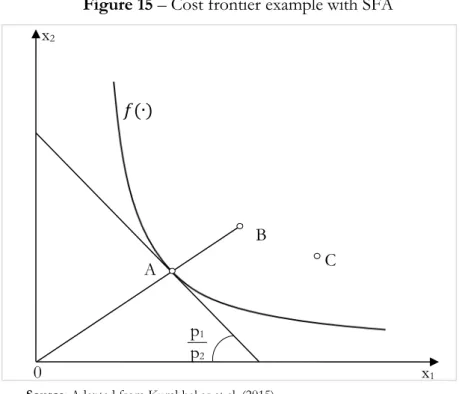
Figure 15 – Cost frontier example with SFA ... 77
Figure 16 – Marginal effects of expenditures through special financings ... 108
Figure 17 – Marginal effects of expenditures through special financings with interactions ... 116
Figure 18 – Robustness checks of marginal effects of expenditures through special financings 121 Figure 19 – Expected mechanism how earmarking leads to inefficiency ... 125
Figure 20 – Budgetary amendments (expenditures) of the Solothurn cantonal budget 2017 ... 128
Figure 21 – Minister A’s reaction on an increased earmarked share ... 151
Figure 22 – Densities of sample estimates ... 154
Figure 23 – Accounting scheme for the special financing (SF) with non-immediate depreciation ... 157
Figure 24 – Accounting scheme for the special financing (SF) with immediate depreciation .... 158
Figure 25 – Tax complexity and diversification by year ... 158
Figure 26 – Progressivity of the tax system by year ... 159
Figure 27 – Gross debt (in 1’000 CHF per capita) by year ... 159
Figure 28 – Marginal effects within the domain of general administration ... 160
Figure 29 – Marginal effects within the domain of public order and security ... 161
Figure 30 – Marginal effects within the domain of education ... 162
Figure 31 – Marginal effects within the domain of culture ... 163
Figure 32 – Marginal effects within the domain of health ... 164
Figure 33 – Marginal effects within the domain of social security ... 165
Figure 34 – Marginal effects within the domain of transportation ... 166
Figure 35 – Marginal effects within the domain of environment and spatial planning ... 167
Figure 36 – Marginal effects within the domain of national economy ... 168
Figure 37 – Budgetary amendments of the Solothurn cantonal budget 2017 (operating and capital expenditures) ... 169
Figure 38 – Marginal effects of expenditures through special financings conditional to the party dominance in parliament ... 169
Tables
Table 1 – Budgeting process ... 32
Table 2 – Spending process for non-ordinary credits ... 35
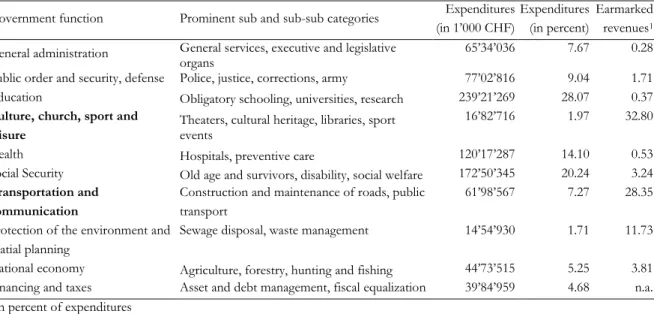
Table 3 – Cantonal expenditures and earmarked funding in 2014 by government function ... 36
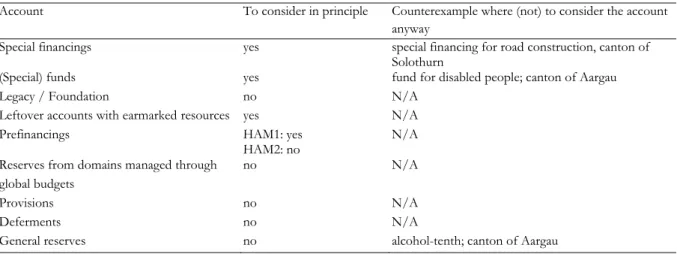
Table 4 – Specific purpose accounts of HAM1 and HAM2 and their consideration ... 43
Table 5 – Descriptive statistics of the revenue characteristics ... 50
Table 6 – Categorization of efficiency measurement methods ... 57
Table 7 – Input-oriented DEA example with one input and one output... 61
Table 8 – Input-oriented DEA example with one input and two outputs ... 61
Table 9 – Input-oriented BCC vs. CCR model to estimate efficiency ... 67
Table 10 – Efficiencies of an input-oriented DEA example with one input and one output ... 67
Table 11 – Efficiencies of an input-oriented DEA example with two inputs and one output ... 70
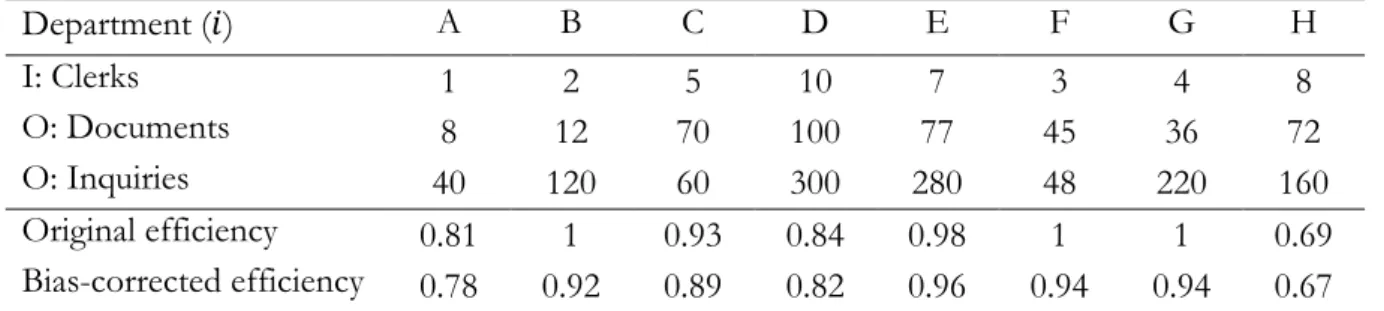
Table 12 – Original vs. bootstrap-corrected efficiencies ... 73
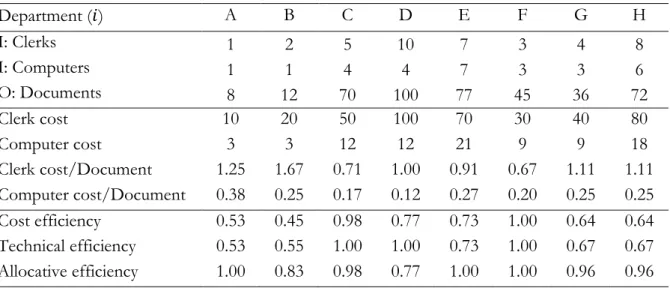
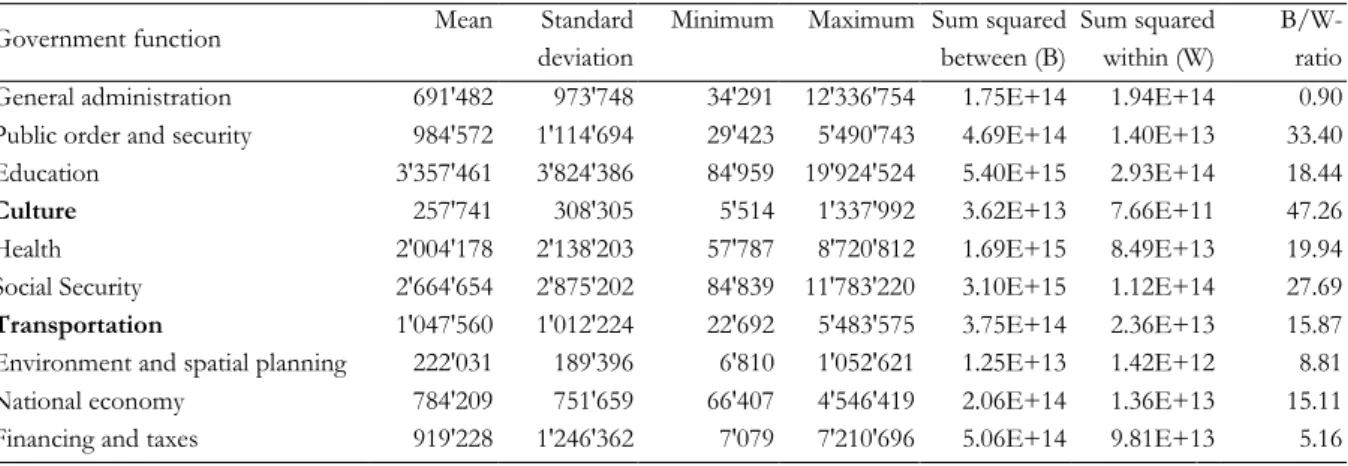
Table 13 – Descriptive statistics of cantonal expenditures by government function 2000 to 2014 ... 79
Table 14 – Cantonal expenditures by expenditure type and government function 2000 to 2014 . 80 Table 15 – Monthly gross salaries in the public administration across greater regions ... 81
Table 16 – Descriptive statistics of output measures ... 82
Table 17 – Fixed or random effects regression by government function ... 85
Table 18 – Cantonal DEA and SFA technical efficiency by government function 2000 to 2014 88 Table 19 – Descriptive statistics of the environmental variables ... 101
Table 20 – Influence of the revenue characteristics on efficiency ... 107
Table 21 – Truncated regressions with different interactions ... 115
Table 22 – Robustness checks ... 119
Table 23 – Sources for process tracing ... 126
Table 24 – Distributions and parameters used for the data-generating process... 152
Table 25 – Estimated coverage rates of confidence intervals ... 153
Table 26 – Mean and standard deviation of cantonal expenditures by expenditure type and government function 2000 to 2014 ... 170
Table 27 – Mean and standard deviation of variables related to revenue characteristics by government function ... 171
Table 28 – Cantonal expenditure shares by state function and expenditure type 2000 to 2014 . 171 Table 29 – Mean cantonal DEA technical efficiency by government function 2000 to 2014... 172
Table 30 – Mean cantonal SFA technical efficiency by government function 2000 to 2014 ... 173
Table 31 – Truncated regression of the DEA efficiency score on environmental variables by government function (two-step approach) ... 174
Acronyms of cantons
AG Aargau NW Nidwalden
AI Appenzell Innerrhoden OW Obwalden
AR Appenzell Ausserrhoden SG St. Gallen
BE Bern SH Schaffhausen
BL Basel Landschaft SO Solothurn
BS Basel Stadt SZ Schwyz
FR Fribourg TG Thurgau GE Geneva TI Ticino GL Glarus UR Uri GR Graubünden VD Vaud JU Jura VS Valais LU Lucerne ZG Zug NE Neuchâtel ZH Zurich
Other acronyms
art. article
BCC Banker, Charnes and Cooper (the variable returns to scale DEA model)
CCR Charnes, Cooper and Rhodes (the constant returns to scale DEA model)
CD Cobb-Douglas
CHF Swiss francs
COLS Corrected Ordinary Least Squares
CRS constant returns to scale
DEA Data Envelopment Analysis
DMU decision making unit
FDH Free Disposal Hull
FE fixed effect
GSW road and route law of May 30, 1996 (Gesetz über Strassen und Wege des
Kantons Zug)
ha hectare
HAM Harmonized Accounting Model
IAFP Four-year financial blueprint, financial plan (Integrierter Aufgaben und Finanzplan des Kantons Solothurn)
IPSAS International Public Sector Accounting Standards
LSDV least squares dummy variables
MFHG model financial budget law of October 10, 2015
(Musterfinanzhaushaltsgesetz)
MLE Maximum Likelihood Estimation
MOLS Modified Ordinary Least Squares
n.a. not applicable
NDRS non-decreasing returns to scale
NIRS non-increasing returns to scale
no. number
NPM new public management
OECD Organization of Economic Cooperation and Development
OLS Ordinary Least Squares
RE random-effects
SFA Stochastic Frontier Analysis
SVAG federal heavy vehicle fee law of December 19th 1997 (Bundesgesetz über die
leistungsabhängige Schwerverkehrsabgabe)
U.S. United States
TL translog
VRS variable returns to scale
WoV-G SO impact oriented administration management law of January 1, 2015
(Gesetz über die wirkungsorientierte Verwaltungsführung des Kantons Solothurn)
WoV-Vo SO impact oriented administration management decree of July 1, 2015
(Verordnung zum Gesetz über die wirkungsorientierte Verwaltungsführung des Kantons Solothurn)
1. Introduction
Earmarking means dedicating specific public revenue streams to a specific purpose. These revenues then accumulate in earmarked funds. Politicians utilize earmarks to serve their clientele while voters are pleased to trace the taxes they pay (Wilkinson 1994). In an exemplary case, a recent ballot on the federal level in Switzerland cemented a road fund which joined its previously installed counterpart for the railroads. 1 Both funds benefit from various earmarked revenues, such as the
motor vehicle tax, the petroleum tax, or the fees for the motorway sticker. Revenues from these sources are either totally or partly appropriated to the funds without going through the ordinary budgeting progress. With respect to the road fund, the Swiss Federal Council (2015, p. 2085) argues that “earmarked funds ensure that most of the money accumulated from road traffic fees are allocated to the road infrastructure”, which should warrant the user-pays-principle.2 Counting the
motorist as their clientele, the Swiss People’s Party (2014) supporting the bill complained about the intended alienation of appropriated funds. They feared that the earmarked revenues could be used for a broader target group beyond their electoral base. On the other side of the political spectrum, the Social Democratic Party (2014), likewise in favor of the bill, wanted to extend the scope of the earmark to fund projects that were useful to the pedestrians and cyclists who are their clientele.
Despite the enthusiasm, politicians also acknowledge the drawbacks that earmarking might entail. When contemplating the railroad fund, the Swiss Federal Council (2012, p. 1610) admits that “from a fiscal policy point of view, fund solutions entail disadvantages as they potentially limit the budget controllability and transparency and they can undermine economic solutions.” 2 From
this point of view, earmarking prevents an optimal budget allocation. Accordingly, the expenditures for and, consequently, the amount of a public good, do not correspond to the public demand (Deran 1965). For this argument to hold, exponents of public administration literature assume the bureaucrat’s nature to be benevolent (Schönenberger 2013). On the contrary, earmarking can also be seen as a mechanism that enforces the government to spend a certain share of the total budget for the intended purpose. In the words of public choice scholars, earmarking is a remedy to tame the Leviathan. As a result, earmarking enhances the budget allocation according to the taxpayers preferences (Buchanan 1963). The two opinions have provoked a rich discussion in the literature, which has not yet come to a conclusion.
The two opposing views show the general disagreement as to whether earmarking forces or impedes the budget allocation to correspond to the taxpayers’ preferences. To consider the predicted impacts of earmarking in more detail, some clarification of terminology is vital. Budget allocation means the allotment of public resources to the different public services in response to taxpayer preferences. Moreover, a government is considered technically efficient compared to its peers if it provides the maximum number of public services (i.e. outputs) given its bundle of expenditures (i.e. inputs). In contrast, a government provides its services inefficiently if there is overspending for excessively large offices, unproductive programs, et cetera. Furthermore, allocative efficiency denotes the optimal combination of inputs in consideration of their prices.
1 The vote about the fund for national roads and agglomeration traffic (Fonds für die Nationalstrassen und den
Agglomerationsverkehr) took place on February 12th 2017 and obtained an approval rate of 61.9 percent. Its rail related pendant, the fund for railroad infrastructure (Bahninfratrukturfonds),was accepted by 62.0 percent of voters on February 9th 2014.
The definition of these terms underline that the technical and allocative efficiency on the one hand differ sharply from the concept of budget allocation on the other hand. While the former two are at the heart of the analysis, the latter is outside its scope. The methods to assess an optimal budget allocation are fundamentally different from an efficiency analysis and a corresponding assessment would therefore focus on a different research area. Accordingly, turning back to the empirical discussion of earmarking and efficiency, the further analysis focusses on the technical efficiency.
Interestingly enough, when the question of whether to earmark transfers turns up, the politics and the scientific literature concur. They agree that earmarked grants negatively affect technical efficiency. Particularly, in 2008, the inefficient use of financial resources led to the reform of the fiscal equalization between the federal state and the cantons. One fundamental aim of the reform was to drastically shrink the share of earmarked transfers.3 The Swiss Federal Council (2001, p.
2365) considers the cantonal use of earmarked transfers as less efficient than their non-earmarked counterpart. Following this logic, one might wonder why earmarking only unfolds its negative effect on efficiency with grants while other earmarked revenues are unsuspicious. So far, very few scientific papers have discussed the effect that earmarking has on efficiency, and in the practical debate the subject is basically absent.
The neglected connection between earmarking and technical inefficiency in the political debates is surprising. Not only do earmarked revenues amount to significant fractions of the total budget (e.g. the cultural domain benefits on average from 35 percent of earmarked revenues), but also the politicians constantly seek for tools to induce an efficient administration. During the debate on the 2018 federal budget for instance, the terms efficiency and efficient were mentioned more than 40 times covering different parties, departments, and government bodies. While the parliament usually demands a more efficient provision of the public services, the executive claims to act accordingly. A right-wing parliament member expresses his concern about the newly reformed federal management system (Neues Führungsmodell des Bundes) that links financial resources with outputs and should then give the parliament more possibilities to control the administration. He doubts the benefits of the new system and he still considers the executive responsible as it “has the necessary expertise to set priorities and to stand up to the administration”.4 The statement
exposes the fundamental intricacy involved when the aim is to make an administration more efficient. The external standpoint not only prevents identifying the part of the administration with potential for improvement, but it also challenges any overall determination of efficiency.
A broad literature already works to approach and explain the efficiency of the public sector. All these studies share a common empirical structure. They relate some inputs to some outputs to attain an efficiency measure and they link them with certain environmental variables which potentially affect efficiency. Narbón-Perpiñá & De Witte (2017) provide a systematic overview of the efficiency studies focusing on the local public sector. They demonstrate the immense scope of the studies in terms of geographical coverage, methodological approaches, or the considered inputs and outputs. Moreover, while some authors concentrate on the public sector altogether, others assess the efficiency of some specific domains such as education, health, transportation, et cetera.
3 While the regime change of 2008 seemingly provides a promising setting to study the effect of earmarking, at least two counterarguments speak against such an identification strategy. First, the reform can be viewed neither as exogenous nor as an unexpected intervention. It responded to critiques of the old inefficiency-promoting system and its implementation had a long lead time. Second, the regime change concerned only the transfers but not all the remaining earmarked revenues. If anything, the reform would only enable testing the effect of earmarked transfers on efficiency.
As explaining factors, Narbón-Perpiñà & De Witte (2007) list several categories like social, economic, political, institutional, or financial determinants of efficiency. Among the financial determinants, they mention transfers, debt, or the tax system. However, no study has so far considered earmarked revenues as revenue characteristic, which likewise might affect efficiency. Therefore, this study aims to determine whether earmarking has a positive or negative effect on the efficiency of public service provision and what factors condition this relationship.
While the other financial related efficiency determinants generally arise from the fiscal illusion theory, no comparable line of argument exists for earmarked revenues yet. Arguing with a public choice logic, taxpayers are subject to a fiscal illusion if they fail to correctly perceive the cost of the public service (Buchanan 1967). Underestimated costs seduce bureaucrats to exploit voter generosity and to appropriate personal rents which eventually leads to inefficiency (Wyckoff 1990). The misperception might arise, among others, from the revenue characteristics mentioned above (i.e. debt, transfers etc.)(Oates 1985). Likewise based on the public choice framework, this study develops a formal argument, claiming that ministers prevent the debate during the budgeting process by hiding behind revenues that are earmarked for their department. They are thereby less monitored by their colleagues and thus able to appropriate personal rents. As a result, the government provides its service again less efficiently. This chain of reasoning, henceforth called debate prevention, hypothesizes that higher shares of earmarked revenues lead to a less efficient public service provision.
As an empirical foundation to test the hypothesis, the 26 Swiss cantons provide an appropriate data source. Given their shared legal context paired with ample fiscal autonomy, the Swiss second state layer has already led to various empirical applications in economics, public administration, and political science literature. Particularly in public finance, the data prove valuable as the Federal Finance Administration (2016) harmonizes the figures of the annual accounts, which improves comparability. In addition, a common functional classification splits the revenues and expenditures into different domains of public activities (Conference of cantonal finance directors 2008). This enables testing the hypotheses for specific domains. Since it turns out that earmarked revenues are most dominant in the two domains culture and transportation, the study mainly focuses on these two government functions. In order to account for canton-specific effects and to increase the number of observations, the study rests on panel data from 2000 to 2014.
While the official statistics provide a tremendous amount of quantitative information about the cantons, a statistic regarding earmarking is still lacking. One reason for this gap is the proliferation of different applications of earmarking among cantons. Despite the common chart of accounts, which also outlines the application of earmarking, the actual practice is still rather heterogeneous. This study sets a milestone by defining earmarking in detail and by giving an overview of its relevance in the Swiss cantonal context.
Following numerous previous publications (e.g. Kalb, 2010a; Widmer & Zweifel, 2012; Afonso & Fernandes, 2008; Seifert & Nieswand, 2014), two methods assess the theory and challenge the hypotheses. The non-parametric Data Envelopment Analysis (DEA), on one side, first estimates cantonal efficiency and, in a second step, regresses the revenue characteristics on these efficiency scores. While largely avoiding specification problems of the production frontier, DEA struggles with integrating a stochastic error. The parametric Stochastic Frontier Analysis (SFA), on the other side, incorporates both steps in one estimator and roughly turns the drawbacks of the DEA to advantages and vice versa.
The main results show that earmarked revenues affect efficiency differently depending on which government function is considered. Using data from the culture domain, earmarking indeed impedes an efficient public service provision, which supports the debate prevention hypothesis. On the contrary, earmarking in the transportation domain has a positive effect on efficiency. The principal explanation for this difference comes from the existing literature, which sees three conditions for an earmark to work: first, a strong link between the taxed and the benefitting good; second, the possibility of differentiating the benefitting good from other public goods or services; third, a close match of people utilizing the taxed good and the beneficiary good and an excludability of those who do not contribute (Brazer 1984; Lee & Wagner 1991; McCleary 1991).
However, the empirical evidence found is insufficient to exclude alternative explanations. A second possible reason for the opposing results of the two domains is the inherently differing intentions of the earmarks. While the transportation domain indeed seeks to mimic the user-pays principle of a private good, the earmarks in the cultural domain might instead be driven by a redistribution idea, where efficiency is not a priority. Yet another cause for the unexpected positive effect in the transportation domain even challenges the debate prevention fundamentally. Preventing the debate also means that the administration can focus on effective service provision instead of putting effort into political discussions; in consequence the departments benefitting from earmarked revenue could provide their services more efficiently. A further explanation is a methodological one, since both approaches applied here cannot handle possible endogeneity problems. Briefly speaking, the results show that earmarking is not good or bad per se, but the insights cannot make a final assessment on the true mechanisms leading to a positive or a negative effect on efficiency.
In sum, the study involves three major contributions. First, it formalizes a theory to link earmarked revenues and the efficiency of public service provision. Second, it proposes a measure to quantify the practice of earmarking in the Swiss cantons and provides the respective statistical information for 2000 to 2014. Third, it demonstrates how to apply the two-stage Data Envelopment Analysis in a panel context without contradictory ad-hoc assumptions. In addition, several minor but novel approaches provide alternative practices for old questions. For instance, instead of treating plain transfers, they are split into three tiers according to their intensity of appropriation. Likewise, a single measure to approximate the progressivity of the tax system is developed in order to estimate the effect of the tax illusion in the Swiss cantons. Lastly, a widening of the data sources (to the association of Swiss museums, the federal office of sport, or to the federal office of police) makes it possible to more accurately estimate the cantonal efficiencies.
The study is structured as follows: After the introduction, the literature review presents the previous discussion in the relevant research areas. Hereupon, the theoretical models develop the hypotheses before the subsequent fourth chapter demarcates the empirical context. Next, the revenue characteristics are operationalized in Chapter five and the sixth chapter proposes measures of efficiency. The seventh chapter combines the efficiency estimates with the revenue characteristics and tests the hypotheses. To introduce a further methodological perspective, chapter eight examines the theory qualitatively and, finally, the last chapter concludes. To provide a non-technical summary, an introduction and a conclusion enclose each chapter.
2. Literature review
The current theoretical literature mainly treats two related questions with respect to earmarking: What motivation do governments have to earmark revenues? What influence does earmarking have on public support for new taxes? Regarding the first question, several authors argue that the government utilizes earmarks to bind future administrations to their policies (Brett & Keen 2000; Jackson 2013). At the same time, the incumbent administration might use earmarking to commit to its policy program and thereby to increase its reelection probability (Anesi 2006; Stratmann 2013). Alternatively, some departments might use earmarking as a signal for their competence. According to Glazer and Proost (2007), competent departments bundle a less transparent public service with a more observable one if they provide the latter of high quality. Earmarking thus serves as a credible bundling mechanism. Addressing the second question, Baranzini and Carattini (2017) find in their survey-based study that the acceptance of additional taxes is higher if they are earmarked. They explain the willingness and higher trust the taxpayer puts into the government if she can trace the financial resources. In contrast to these two prominent questions, the aspect treated in this paper has not been developed for a long time, although the research community did not come to a conclusion yet. The further literature review therefore rests largely on older studies that assess the impact of earmarked revenues on efficiency.
The theoretical literature on earmarking in relation to efficiency mainly separates into two camps. On one side, there are the public finance scholars who reject earmarking due to its inflexibility in terms of budget allocation (Lee & Wagner 1991). On the other side, public choice scholars see earmarking as a solution to tame the Leviathan (Buchanan 1963). Ultimately, it is the fundamentally different image of humanity that sunder the two camps, which possibly impedes a final agreement. And yet, critique of the public administration scholars is indicated as most of them insufficiently substantiate their argument, why earmarking should have a negative impact on technical efficiency. Only a few papers unify earmarking and technical efficiency in a formalized theory but they either disregard the supposed underlying mechanism of the causal effect, or the theory covers only a specific field (Martínez 2014; Brennan & Buchanan 1978; Bös 2000). Just as in the theoretical literature, the empirical papers assessing the effect of earmarking on efficiency are very rare.
When it comes to further revenue features that potentially affect efficiency, the theoretical literature is much more developed. Since the seminal paper by Oates (1985), the idea of fiscal illusion disseminated into different directions and encouraged researchers to advance the theory. Today, five sources of fiscal illusion are broadly accepted and three of them have also been tested empirically with technical efficiency as a dependent variable. However, neither grants nor indebtedness furnishes unambiguous evidence for a negative or positive effect on efficiency. Only one study exists with respect to tax complexity, and this hardly suffices for a substantial statement.
2.1. Two views on earmarking
Unlike the still meager literature would suggest, the earmarking of revenue is a widespread practice. Roberts (2002) lists several examples for the US in various policy areas such as security, infrastructure, health, telecommunication, education, environment, and social security. McCleary (1991) provides a similar enumeration for other countries. Particularly in Switzerland, a report of the Swiss Federal Council (2013) names a large scope where public revenues are earmarked: agriculture, air traffic, infrastructure, environment, et cetera. Additionally, the inventive vocabulary used to frame earmarking indicates the popularity of this kind of funding mechanisms. The creativity ranges from ring-fenced fund over recycle revenues, segregated funding, autonomous revenue streams, pork-barrel spending, tax hypothecation, or hypothecation to lockboxing (Roberts 2002; Jackson 2013).
From a political point of view, politicians and citizens may simultaneously relish earmarking revenues. Frequently mentioned among practitioners is the ease to sell new taxes to the citizen in return for a new program, that is earmarking taxes lowers the resistance for increasing them. The argument works on both sides of the political spectrum. Leftwing voters appreciate earmarked revenue as they feel they are paying directly for more or better services. To the libertarian right, earmarking seemingly demonstrates the cost of state services in a more transparent fashion (Wilkinson 1994). In addition, earmarking stabilizes the revenue for a certain service or at least guarantees a minimal financial foundation desired by specific interest groups from either political camp (Brazer 1984). For further and more profound political arguments see Bird & Jun (2005).
Despite the political acceptance of earmarked taxes among citizens, one possibility why policy-makers keep on looking for new terms to describe the same practice is that they feel urged to exculpate themselves when introducing a new fund. Given the mainstream view of classic public administration literature, this feeling is comprehensible. In the Weberian tradition, where the administration is omniscient and follows a logic of a benevolent despotism, earmarking revenues does not compute (Ostrom 2008). A predefined budget allocation unnecessarily limits the administration’s scope to maximize social welfare (Lee & Wagner 1991). In general, the argument of misallocation due to predefined appropriation is the most prominent reasoning of opposing earmarks (Deran 1965; Oakland 1984; Jankowski 1984). Schönenberger (2013) underlines the confining aspect towards the administration and he dismisses earmarked revenues as being politically motivated. Jankowski (1984) sees in earmarked funds even an encouragement for special program advocates who seek to prevent a debate about limited financial resources. In sum, theorists following the logic of public administration conclude that earmarking revenue cuts the efficiency of public service provision.
With the advent of public choice literature, the practice of earmarking revenues increasingly attracted attention among researchers. It became seen as a disciplinary tool hindering politicians from abusing their influential position in the budgetary process. To put it more positively, earmarking makes it possible to redress tie-in sales offered by the government under general fund financing (Buchanan 1963; Goetz 1968). The necessity to curb the administration reveals the underlying skepticism against its benevolent nature, which is typical for supporters of the public choice stream (Tullock 2008; Niskanen 1975; Migué et al. 1974; Wyckoff 1990; Persson & Tabellini
2002) and which is writ large in the view of the state as a Leviathan (Brennan & Buchanan 1978). From this perspective, earmarking can even help to fight against rigid budgeting procedures under certain circumstances (Bird 1982). Moreover, linking a levy with a certain public service seems to be a fairer tax system because the beneficiary pays for his own utility (McCleary 1991). Also, it provides the administration with information about the true demand for a public good (Bird & Jun 2005). In this sense, earmarking per se is not the first best solution but it substitutes a direct user charge if the latter is not feasible (Lee & Wagner 1991). Besides the fairness argument, user charges induce no or less distortions in contrast to income taxes for instance and they are therefore more efficient (Brazer 1984). Briefly speaking, in the view of – prior – public choice scholars, earmarked revenues force the administration to provide their services more efficiently (Buchanan 1963).
The positive attitude towards earmarking among adherents of the public choice school has again provoked critique. Two arguments challenge the charge-characteristic of earmarks. On one hand, the buyer of a good whose tax is earmarked for a specific service cannot decide individually upon the amount of the service financed by the earmarked tax; only the median voter has this privilege (Bös 2000). On the other hand, according to Musgrave & Musgrave (1973), earmarking fails to meet the intended benefit (i.e. user-pays) principle because the link between the taxed complement and the benefitting public good is usually rather weak; Lee & Wagner (1991) acknowledge this weakness. In fact, the unavailability of a complement to guarantee a user charging mechanism is often the reason why the state, instead of a private supplier, performs a certain task in the first place (Oakland 1984). McMahon & Sprenkle (1970) detail the argument in pointing towards the different price elasticities of the taxed good and the public service financed by earmarked taxes. Assuming nevertheless that the good to be taxed and the benefitting public service are perfect complements and have the same elasticities, the tax rate still remains arbitrary. Besides many others, Goel & Nelson (1999) and Lee & Tollison (2013) show both theoretically and empirically that the tax rate imposed on a good in order to fund a particular public service depends on political considerations. Moreover, from a distributional point of view a beneficiary financing is doubtful after all because the service might be publicly provided in order to make it available for poorer classes of the population; according to Oakland (1984) beneficiary financing is just as little desirable if the public good in question has important merits. In case of a pure public good, the free riding problem incentivizes the beneficiaries to hide their true preferences anyway (Teja 1988). In sum, the dispute seems to bear three recurrent conditions under which earmarking might lead to more efficient public service provision: First, a high correlation between the taxed good and the benefitting public service or good; second, a significant differentiation from other public goods or services in order to prevent hidden cross-financing; third, a strong homogeneity among payers of the taxed good and the beneficiaries of the good financed by the earmarked revenue and an excludability of those who do not pay (Brazer 1984; Lee & Wagner 1991; McCleary 1991).
Drawing premature conclusions from the theoretical literature bears some risks though. First, it is often unclear what the scholars mean by efficiency. For instance, Buchanan (1963) mostly puts the word efficiency in quotation marks and his examples of tie-in sales indicate that he means a budget allocation that corresponds to the preferences of the taxpayer; this understanding of
‘efficiency’ is far from how efficiency is defined in our analysis.5 At the same time, Roberts (2002),
among others, refers to technical efficiency citing the expression of ‘getting more for less’. Second, the rationale behind the opposition against earmarked revenue is poorly substantiated. The opponents simply criticize the rigidity that earmarking imposes and they defeat theories that emphasize any positive aspects of earmarking. However, they mostly fail to explain how the inefficiency effectively comes about.
Nonetheless, a few critical authors autonomously develop and formalize a line of argument that links earmarking with low technical efficiency. Possibly the first authors who married the two concepts were Brennan & Buchanan (1978). The authors emanate from the Leviathan, in other words from the state as a monopolist that enables the bureaucrat to maximize his utility. Assuming that bureaucrat’s goal is to maximize the surplus he can use as slack, earmarking can prevent some inefficiencies. If the public good and the taxed private good are complementary, the bureaucrat has an incentive to provide some of the public good in order to be able to raise taxes in the first place. Perfect complementary goods even lay the ground to create a tax law that ensures a fully efficient public good provision, i.e. there is no surplus left the bureaucrat can pinch as slack. Martínez (2014) chooses a different approach. He relies on the assumption that a voter is better informed about general tax revenue than about earmarked revenue and in consequence, the bureaucrat puts more effort toward an efficient public good provision. This assumption is plausible in his case, because he only considers royalties from the extraction of oil as earmarked revenue, which limits the scope of his model. Bös (2000) makes the decision about earmarking endogenous and concludes that even a welfare-maximizing parliament must collect too much tax in order to make sure they meet the earmarking constraint, i.e. guaranteeing that the earmarked tax covers the cost of the benefiting public service. Because of the distortionary effect of taxes, earmarking indirectly engenders inefficiency.
Albeit all three authors theoretically explain why earmarking decreases the technical efficiency, they stay at the macro level without penetrating the underlying functional chain. Put differently, the earmarking literature did not succeed in exploring the conceptual underpinnings with enough care and rigor. The lack of a substantiated theory is probably the reason why authors of public choice literature usually refer to some vague classic literature on public budgeting, public administration, et cetera when designating their opponents rather than explicitly citing specific articles (see for instance Dye & McGuire, 1992; Gwilliam & Shalizi, 1999; Bös, 2000; Bird & Jun, 2005). Section 3.1 yields an attack surface for the defenders of earmarking. Instead of simply criticizing existing ideas that promote earmarking, the debate prevention theory is a formalized model that explains why earmarking generally impairs the technical efficiency of public service provision when a collegial government is in charge.
The empirical evidence is mixed. First and foremost, no more than one article actually empirically studies the efficiency of the public service provision as the dependent variable, whereas all the others examine the effect of earmarked revenues on public expenditure, which is another question. The exception is Martínez (2014) who examines the influence of earmarked revenue on local public good provision in Colombian municipalities. The Colombian law appropriates the
revenue stemming from oil royalties to basic public services. Martínez operationalizes efficiency with specific outcome variables depending on the service in question. With the net school enrolment rate of six- to fourteen-year-olds he approximates the efficiency in education. In the health domain, he rests on the infant mortality rate and the percentage of the poor population with access to subsidized health insurance. Finally, the water quality should approximate the quality of the infrastructure. His results show that increases of the general budget boost the public goods indicators at least ten times more than an equivalent increase in earmarked revenues.
Empirical studies explaining the expenditures by earmarked revenue largely pivot on the state level of the U.S. and on a limited scope in terms of government functions. Regarding expenditures for highways, education, and welfare, Deran (1965) finds only for the welfare a significant positive effect of earmarked revenue on expenditures. A later study differentiates between absolute levels of earmarked revenues and the earmarked share of total revenues (Dye & McGuire 1992). Only the latter specification yields a significantly negative effect in the case of education spending. In none of the models does earmarking significantly affect highway expenditures; Crowley and Hoffer (2012) explain this phenomena by crowding-out effects. They claim that the government uses the earmarked revenue to replace unbound funds which in sum leads to a growth of the total expenditures. Likewise, Nesbit & Kreft (2009) assess an almost proportional positive effect. On the contrary, Goel & Nelson (2003) report a 2.5 dollar decrease of highway expenditures for every dollar of motor-fuel taxes diverted for general fund purposes. Afonso's (2015) results point in the same direction. Jung (2002), who focuses on data from Georgian counties, provides some evidence for a positive link. The earmarked revenues originate from sales taxes and are designated to finance local capital projects ranging from infrastructure for transportation (roads, streets, airport facilities), security (police, jails, courthouses, correctional facilities), to health (hospitals), et cetera. According to him, an extra dollar of earmarked revenue leads to a fifty percent increase in the envisaged spending area. Navarro (2002) and Evans & Zhang (2007) even estimate an increase of about 80 percent when lottery revenues are linked with educational spending. In sum, earmarking seems rather to have a crowding-out effect that results in lower spending compared to general fund financing.
The outlined overview should not give the impression of an unrestricted comparability of the results. Particularly when it comes to any international comparison, earmarks and their funds are shaped so differently that a mixing of the results could lead to false conclusions (Bird & Jun 2005). Nevertheless, the literature review shows that there is neither theoretical nor empirical agreement among researchers as to whether earmarking has a positive or a negative effect on the efficiency of public service provision.
2.2. Fiscal illusion
The early literature, from which the idea of fiscal illusion emanates, dates back to Puviani (1903). He already mentions revenue characteristics such as debt financing or tax diversification that later drew a lot of attention in the literature. However, it took more than sixty years until the research
community jumped on the bandwagon.6 While Buchanan (1967) by and large seizes on the earlier
ideas and repeats archaic superficial theories, Oates (1985) scrapes out the most important aspects, research-wise for today, and concisely defines fiscal illusion as the “systematic misperception of key fiscal parameters [that] significantly distort fiscal choices by the electorate”. The trigger for such a misperception may be various and Oates summarizes them under the following characteristics: 1. the complexity of the revenue structure, 2. the renter illusion, 3. the income elasticity of the tax structure, 4. the debt illusion and 5. the flypaper effect. In the meantime, Wagner (1976) was the first to test fiscal illusion empirically, whereas in the same paper, he developed a formal model which explains public overspending based on the complexity of the revenue system. After a bunch of further empirical studies assessing other revenue characteristics, Dollery & Worthington (1996) embedded the other four revenue characteristics in the formal model. Concentrating on the specificities of the flypaper effect alone, Wyckoff (1990) proposes a similar model which links overspending with intergovernmental transfers. In contrast to the Dollery & Worthington (1996) model though, Wyckoff (1990) shows that the voter’s misperception does not only lead to overspending but also to a stronger extraction of rents on the side of the bureaucrats. In other words, Wyckoff (1990) links an inefficient public service provision with intergovernmental grants. The theory chapter of the present work seizes on this idea (section 3.3) and adds the other revenue characteristics to it (section 3.4).
Besides the before-mentioned relatively old papers, fiscal illusion was also tested empirically in more recent works. The most prominent variable among the revenue characteristics is the amount of grants and how this affects efficiency. Mostly, the papers report a negative effect (De Borger & Kerstens 1996; Balaguer-Coll et al. 2007; Kalb 2010b; Widmer & Zweifel 2012; Pérez-López et al. 2015), while there are also ambiguous results (Loikkanen & Susiluoto 2005) and even counterexamples (Geys & Moesen 2009; Bönisch et al. 2011; Da Cruz & Marques 2014; Ashworth et al. 2014). Bischoff et al. (2017) put the latter results into question arguing that state entities with a lower fiscal capacity, on the one hand, are under stronger financial pressure and thus are forced to be more efficient, while on the other hand, these entities receive the most grants. Without taking into account some measure of the pre-grant capacity, the estimates are biased due to the omitted variable. The study of Porcelli (2014) contrasts the other papers in terms of the design. The author focuses on a tax reform in 1998, where the Italian regional governments started to gather their own earmarked taxes to finance their health domain instead of depending on earmarked grants. The results show that efficiency increased after the reform, which the author explains by the higher local autonomy. In sum, most empirical papers find evidence for the flypaper effect.
Turning to the other sources of fiscal illusion, little has been done in relation to efficiency. In fact, the only aspect of fiscal illusion that has been tested besides the flypaper effect is the indebtedness. Benito et al. (2010) find, contrary to the theoretical prediction, an insignificant positive correlation between debt and efficiency. They argue that the current indebtedness is the result of former capital expenditures that allow greater efficiency today. Likewise providing insignificant results, Pérez-López et al. (2015) contribute little knowledge in this manner. Bischoff
6 Buchanan (1967) presumes that rather than negligence, a lack of knowledge is what prevented the fiscal illusion idea from sparking a broader discussion. Until its translation in 1960 into German, Puviani's (1903) book existed only in
et al. (2017) claim that governments with high debt face fiscal stress and they are therefore forced to provide the services more efficiently. Indeed, they find a positive effect of the debt on efficiency for municipalities of Saxony-Anhalt. Using Portuguese municipal data, Da Cruz & Marques (2014) and Cordero et al. (2017) provide some evidence for debt illusion without specifically discussing it. Also Ashworth et al. (2014) find a significant negative relationship between indebtedness and efficiency in Flemish municipalities, but they do not refer to the fiscal illusion literature. Altogether, it seems that the researchers working in the field of efficiency analysis are not interested in or aware of the full scope of the fiscal illusion theory. Yet, the few studies taking the debt into account do report illusionary tendencies.
Among the tax related variables (i.e. tax complexity, progressivity, and diversification), only one study provides some empirical insights on their effect on efficiency. Boetti et al. (2012) finds Italian municipalities work less efficiently if their share of non-tax revenues (i.e. fees and charges) is high. 2.3. Interim conclusion
Today’s limited interest in the theoretical literature on earmarking in relation to efficiency makes it arduous to recognize that the existing literature actually left a gap. On one side, there are the public finance scholars who reject earmarking due to its inflexibility in terms of budget allocation (Lee & Wagner 1991). On the other side, public choice scholars see earmarking as a solution to tame the Leviathan (Buchanan 1963). Ultimately, it is the fundamentally different views of humanity that sunder the two camps, which possibly impedes a final agreement. And yet, it is possible to criticize public administration scholars as most of them insufficiently substantiate their argument as to why earmarking should have a negative impact on technical efficiency. Only a few papers unify earmarking and technical efficiency in a formalized theory but they disregard the supposed underlying mechanism of the causal effect, or the theory covers only one specific field (Martínez 2014; Brennan & Buchanan 1978; Bös 2000). Just as in the theoretical literature, the empirical papers assessing the effect of earmarking on efficiency are very rare.
When it comes to further revenue features that potentially affect efficiency, the theoretical literature is much more developed. Since the seminal paper by Oates (1985), the idea of fiscal illusion disseminated into different directions and encouraged researchers to advance the theory. Today, five sources of fiscal illusion are broadly accepted and three of them have also been tested empirically with technical efficiency as a dependent variable. However, neither grants nor indebtedness furnishes unambiguous evidence for a negative or positive effect on efficiency. Only one study exists with respect to tax complexity and this hardly suffices for a substantial statement. 3. Theoretical models
This chapter aims at theoretically predicting in what direction and why the different revenue characteristics influence the efficiency of public service provision. In order to reach that objective, a discussion of debate prevention and the flypaper effect both constitute a separate section that develops a theoretical model based on the public choice framework. They thereby cover earmarked
revenues and transfers as explaining variables of inefficiency. Because the development of the debate prevention theory turns out to be rather technical, a separate section first presents the intuition behind the theory and stipulates its limits. The fourth subsection embeds the remaining revenue characteristics in the mutual theory of fiscal illusion.
As to the dependent variable, all models understand inefficiency as a positive monetary rent that politicians or bureaucrats use for means other than public service provision (see Le Maux 2009 for an equivalent interpretation). In other words inefficiency means “to hire more staff than necessary, to hire more capital than necessary, to pay workers more than necessary, or to fund perquisites of office such as lavish offices, large expense accounts, short working hours, etc.” (Wyckoff 1988: 272).7 Therefore, a positive rent either induces excessive expenditures or insufficient public good
provision, which are both attributes of technical inefficiency. Eventually, each model predicts the expected direction of the causality between the revenue characteristics and the rent, i.e. efficiency. While the models formalizing fiscal illusion and the flypaper effect are established in the current literature, debate prevention is a novel theory.
Beginning with a standard public choice framework, debate prevention takes up the result of an established voting model with uncertainty and an ideological bias (Persson & Tabellini 2002). Because of the latter two factors, politicians in office manage to appropriate a personal rent even under electoral competition. The extent of the rent depends on some transaction cost, which this established model considers as exogenously given. At this point, the new aspect - i.e. the herein developed theory called debate prevention – comes into play, arguing that the transaction cost depends on the monitoring activities within the governing council. The monitoring activities, in turn, are a function of the earmarked part of the total budget linked via ministerial incentives. Hence, the debate prevention theory eventually creates a connection between earmarking and a monetary rent which translates into inefficiency. This chain of reasoning grounds the central hypothesis (H1): A higher share of earmarked revenues leads to less efficient public service
provision, other things equal.
The hypotheses concerning the further revenue characteristics derive from the fiscal illusion idea (Oates 1985). That is, the voter underestimates the price for the public service which opens up the leeway for bureaucrats to appropriate rents. The voter’s misperception originates from different revenue characteristics which all engender their own hypothesis. The most prominent among them stems from intergovernmental transfers, which often appear under the label of the flypaper effect (Courant et al. 1979). It states that a higher share of transfers implies poor efficiency levels (H2) (Wyckoff 1990). Debt illusion, for its part, predicts a lower efficiency for highly indebted
states (H3). Likewise, the voters may be misled by the sheer amount of revenue sources, which
substantiates the fourth hypothesis: A more complex tax system, ceteris paribus, results in lower efficiency levels (H4). Finally, the voters might misjudge the price for public services if it rises due
to the non-linear tax curve. Hence the prediction that a rising income in combination with a stronger tax progressivity provokes poor efficiency (H5).
3.1. The intuition behind debate prevention and its limits
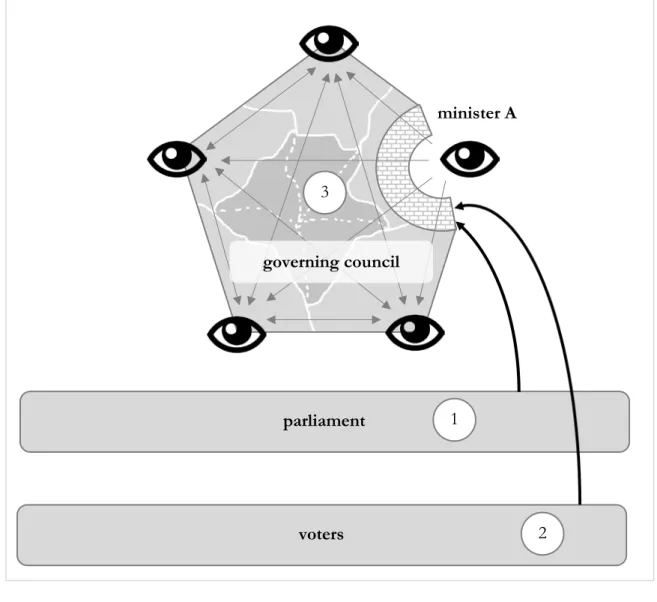
The subsequent fairly extensive and detailed development of the debate prevention theory calls for a brief intuitive introduction. At the same time this section contrasts the theory with existing public choice models related to earmarked revenue and thereby clarifies its limits. To this end, Figure 1 shows the main actors involved in the dynamics of earmarked revenues. On top, the ministers illustrated as eyes form a pentagon representing the governing council’s debate about the budget. In Niskanen's (1994) terminology, the eyes are equivalent to bureaus while the governing council together with the parliament can be viewed as the sponsor.8 Within the executive branch
of government, the ministers monitor each other; this is shown by the grey arrows. While four ministers both actively participate in monitoring activities and passively face their colleague’s pressure, minister A hides behind a wall protecting him from the respective surveillance. The wall signifies a special financing. On the bottom, the voters establish the foundation of the parliament and of the executive government branch.
Figure 1 – Interrelationship of the debate prevention with the public choice models
8 Niskanen (1994, p.28) recognizes the budget evolving from a two-stage process with the executive reviewing it in the first stage and the legislature in the second. Accordingly, the tandem executive-legislative (i.e. the government)
voters parliament 2 governing council 3 1 minister A
Source: Own illustration
The parliament (1) is the first actor motivated to install a wall around minister A. As mentioned in the literature review (section 2.1), the parliament, well aware of its ephemerality, attempts to lock future budgets according to its current preferences (Jackson 2013). While budget restrictions on future governments affect the budget allocation, they have no effect, per se, on the technical implementation, cost, nor the allocative efficiency.9 Instead, they might reduce the welfare since
the earmark prevents politicians from adjusting the budget according to the voters’ preferences (Lee & Wagner 1991). The scope of the paper at hand encompasses only the efficiency aspect and leaves aside the welfare considerations.
The second arrow takes up the voter’s (2) desire to earmark certain revenues in order to strengthen their preferences (Buchanan 1963). In the same vein as above, the earmarked revenues should ensure a certain budget allocation, which again links to welfare rather than to efficiency. Accordingly, the parliamentary incentives and interests to establish new special financings falls likewise outside the scope of this analysis.
The third relationship refers to the dynamics within the governing council (3) and it illustrates debate prevention. In the first budget round, the five ministers present their policy programs along with the corresponding financial needs (the fraction of the light and dark grey areas attached to each corner). When designing their policy programs, the ministers choose their degree of engagement to reach a certain quality, which simultaneously entails a cost (e.g. longer working hours, etc.). A higher quality ensures that the monitoring activities of the other ministers (i.e. the grey arrow’s ends pointing towards each minister) are less effective and that the proposals pass the budgetary discussions without substantial cuts; the combination of the own quality and the other ministers’ effort yields the absolute bargaining power. At the same time, the ministers try to convert the other minister’s budget share to their own use by monitoring their colleagues (i.e. the arrow’s ends pointing away from each minister). If the monitoring is successful and the ministers find potential savings in their colleagues’ programs, the free-up funds remain on the negotiation table. After the first budget round, each minister defends the light grey fraction of the budget. In the subsequent budgetary rounds, the ministers allocate the rest of the budget (i.e. the dark grey area) amongst each other according to their relative bargaining power.10
Yet, during all these debates, the budgetary fraction behind minister A’s special financing wall remains undisputable. Out of A’s demanded budget, there is only a small part up for discussion and this alleviates any incentive to monitor A’s policy programs in the first place. Being less monitored, minister A enjoys a larger leeway to generate budgetary slack and consequently he offers the services within his domain less efficiently. In general, the larger the share behind earmark-walls, the less incentive the ministers have to monitor each other and the less efficient the public service will be provided.
9 Remember the earlier definition, according to which budget allocation refers to the allotment of public resources to the different public services (outputs); technical efficiency describes a production process that converts a given its bundle of inputs into the maximum number of outputs. Finally, allocative efficiency denotes the optimal combination of inputs taking their prices into account.
10 Note that debate prevention entails no Nash equilibrium but a Nash bargaining solution making implicitly use of the axiomatic approach as proposed by Nash (1950). In other words, the ministers define some conditions that the
The rather specific setup of the model raises the question of its applicability to an environment outside of Switzerland. Answering this question requires some contemplation about the central elements and whether they are exclusively present in the Swiss case. The most critical of which is the formally equal distribution of power among the ministers debating about the budget allocation. Such a system is unique in the world. Yet, it is likely that the dynamics are similar in a system with a president or a prime minister who takes the executive branch’s final decision about the budget. The subordinate ministers still debate about their share of the budget and the tactics to protect one’s own budget share or to snag a part of the other minister’s budget share remain the same. Although, the minister’s incentives to monitor their colleagues are less clear, because – depending on the concrete budgeting process – the president or the prime minister can decide upon the budget allocation independently of the possibly found weaknesses in some policies. For instance, if the prime minister has an ideological preference for a specific public service, she might provide generous financial resources in spite of considerable flaws in the respective policy proposals. Ministers who face such a prime minister have less incentive to monitor their colleagues, which disperses the negative effect that earmarking has on monitoring. In sum, debate prevention might affect the budgeting process in other countries too, but its effect is possibly less distinct.
3.2. A formal model of debate prevention
Primal median voter models with electoral competition à la Lindbeck & Weibull (1987) came to the gratifying conclusion that politicians cannot reap rents in equilibrium. If the politicians do so, another candidate would waive his own rent in order to increase the public service provision or decrease taxes. With a more efficient combination of public services and taxes, the candidate can kick the incumbent out of office. The anticipatory incumbent therefore reduces his rent to zero in the first place, guaranteeing the voters an optimal bundle. Referring to Polo (1998), Persson & Tabellini (2002) introduce in their probabilistic voting model not only an uncertainty about the election outcome but also ideological preferences and thereby they formulate the conditions under which politicians can obtain positive rents, even under electoral competition. An extension of Persson & Tabellini’s model reveals the effect earmarking has on the extent to which politicians can retain rents. Equally, the modification of the model accounts for the specific composition of collegial governments. In contrast to the usual probabilistic voting model, here elected politicians cannot rule the government by themselves as a monolithic planner and executer, but they make part of a governing council, where they take over a department that provides specific public goods. The literature calls this type of government consensus democracies with executive power-sharing (Vatter & Freitag 2007). When running for office, the candidates commit to an overall policy platform, since, before the election, they do not know which department they will undertake.11
In the following, capital letters in equations denote functions while lowercase letters signify parameters. Upper bars on letters indicate externally given parameters whereas a tilde marks a guess
11 Admittedly, there is usually more than one candidate running for office. As Persson & Tabellini (2002) show though, additional candidates lead to a lower extraction of rents, but as long as the number of candidates does not go to infinity,