RESEARCH
Genetic Evolution during the
development of an attenuated EIAV vaccine
Xue‑Feng Wang
1,2†, Yue‑Zhi Lin
1†, Qiang Li
1,3, Qiang Liu
1, Wei‑Wei Zhao
1, Cheng Du
1, Jie Chen
1, Xiaojun Wang
1*and Jian‑Hua Zhou
1,4*Abstract
Background: The equine infectious anemia virus (EIAV) vaccine is the only attenuated lentiviral vaccine applied on a large scale that has been shown to be effective in controlling the prevalence of EIA in China. This vaccine was devel‑ oped by successive passaging of a field‑isolated virulent strain in different hosts and cultivated cells. To explore the molecular basis for the phenotype alteration of this vaccine strain, we systematically analyzed its genomic evolution during vaccine development.
Results: Sequence analysis revealed that the genetic distance between the wild‑type strain and six representative strains isolated from key development stages gradually increased with the number of passages. Env gene, but not gag and pol, showed a clear evolutionary flow similar to that of the whole genomes of different generations during the attenuation. Stable mutations were identified in multiple regions of multiple genes along with virus passaging. The adaption of the virus to the growth environment of cultured cells with accumulated genomic and genetic variations was positively correlated with the reduction in pathogenicity and rise of immunogenicity. Statistical analyses revealed significant differences in the frequency of the most stable mutations between in vivo and ex vivo‑adapted strains and between virulent and attenuated strains.
Conclusions: These data indicate that EIAV evolution during vaccine development generated an accumulation of mutations under the selective drive force, which helps to better understand the molecular basis of lentivirus patho‑ genicity and immunogenicity.
Keywords: EIAV, Genetic Evolution, Lentiviral vaccine
© 2016 Wang et al. This article is distributed under the terms of the Creative Commons Attribution 4.0 International License (http://creativecommons.org/licenses/by/4.0/), which permits unrestricted use, distribution, and reproduction in any medium, provided you give appropriate credit to the original author(s) and the source, provide a link to the Creative Commons license, and indicate if changes were made. The Creative Commons Public Domain Dedication waiver (http://creativecommons.org/ publicdomain/zero/1.0/) applies to the data made available in this article, unless otherwise stated.
Background
Vaccination is the most effective means of controlling infectious diseases. However, the development of a safe and effective lentiviral vaccine, such as a human immu-nodeficiency virus-1 (HIV-1) vaccine, remains a huge scientific challenge. Studies on the development of lenti-viral vaccines targeting HIV-1, simian immunodeficiency virus (SIV), chimeric simian-human immunodeficiency virus (SHIV), equine infectious anemia virus (EIAV) and feline immunodeficiency virus (FIV) have demonstrated
that the live attenuated formulation is the most effective formulation [1, 2]. Because lentiviral genomes integrate into host chromosomes and feature a high frequency of genomic mutations, attenuated live vaccines are generally not considered as an option for practical lentiviral vac-cines. However, the study of immune responses induced by attenuated vaccines can provide a useful reference to elucidate the protective immune responses to lentiviral infections [3].
EIAV is a member of the Lentivius genus in the Retro-viridae family. The major features of EIAV, including its genomic structure, life cycle, in vivo antigen evolution, cell tropism and the interaction between the virus and host, are similar to HIV-1. Most horses infected with EIAV exhibit a repeated high-titer viremia with typical clinical features such as fever, thrombocytopenia and
Open Access
*Correspondence: [email protected]; [email protected] †Xue‑Feng Wang and Yue‑Zhi Lin contributed equally to this work 1 State Key Laboratory of Veterinary Biotechnology, Harbin Veterinary Research Institute, Chinese Academy of Agricultural Sciences, Harbin 150001, China
anemia. Some infected horses may eventually control viral replication and become asymptomatic carriers after several months or years of acute or chronic infection. EIAV infection is life-long.
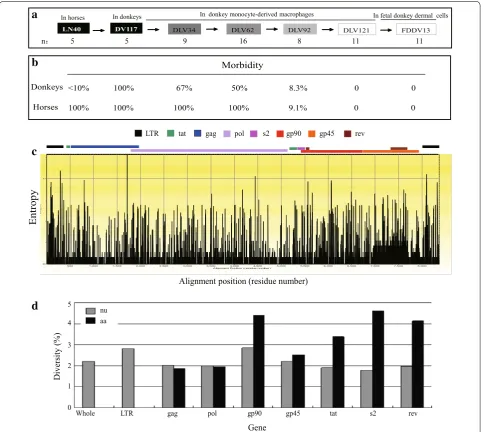
EIAVLN40, which is an EIAV strain that is highly lethal to horses (experimental lethality of 80–100 %), was devel-oped by passaging a field isolate in horses for 16 passages. The pathogenicity of this virus in donkeys was largely enhanced (raised from generally asymptomatic to near 100 % lethality) by the continuous passaging of EIAVLN40 in donkeys for 117 rounds (Fig. 1a). The resultant strain (EIAVDV117) was subsequently continuously acclimatized in cultivated primary donkey monocyte-derived mac-rophages (dMDM). The lethality of EIAVDV117 to horses and donkeys was gradually decreased by passaging in dMDM and was finally reduced to the point of not caus-ing any clinical symptoms in either horses or donkeys after 90 passages (Fig. 1b). The ability to induce pro-tective immunity in inoculated horses was detected in viruses that were attenuated in dMDM for approximately 110–125 passages. The resultant viral strain (termed EIA-VDLV121) was able to elicit resistance to challenge with EIAVLN40 (the average genomic divergence to EIAVDLV121 was 2.8 %) in >75 % of the inoculated horses and >95 % of the inoculated donkeys. This attenuated viral strain was used as a vaccine to massively immunize 61 mil-lion horses and mules to prevent EIA infection in China from 1975 to the 1990s [4]. This nationwide vaccination program ended the incidence of equine infectious ane-mia (EIA) in this country. The successful application of the EIAV vaccine has provided an important and unique reference model for studies on lentivirus immunity and vaccines. EIAVDLV121 was further adapted to cultivated fetal donkey dermal (FDD) cells (termed EIAVFDDV13) to reduce the preparation costs of this attenuated EIAV strain. Part of the historic data on EIAVDLV121 protection of disease in laboratory infected horses indicated that the protection efficiency to challenge with the parental viru-lent strain (EIAVLN40, the average variation in Env amino acid sequences is 7.1 %) and an American strain (EIAV W-yoming, the average variation in Env amino acid sequences is 37.8 %) was 81 % (25/31) and 80 % (8/10), respectively [4]. Our resent experiments on the immunogenicity of EIAVDLV121 and EIAVFDDV13 demonstrated a 50 % (2/4) and 83 % (5/6) similar protection of disease (Additional file 1: Table S1) [4, 5].
During the development process of the attenuated EIAV vaccine, a series of virus strains with different pathogenicities or immunogenicities were obtained. These strains provided a useful resource for the study of essential factors that induce protective immunity to lentiviruses. In this article, we analyzed the provi-ral genomic characteristics and the evolutionary trend
of representative strains from key stages of the process, including EIAVLN40, EIAVDV117, EIAVDLV34, EIAVDLV62, EIAVDLV92, EIAVDLV121 and EIAVFDDV13. Among these strains, EIAVDLV34, EIAVDLV62 and EIAVDLV92 were col-lected from the 34th, 62nd and 92nd passages of EIA-VDV117 in dMDM, respectively (Fig. 1a).
Results and discussion
Analysis of viral genome variants over the course of the development of an attenuated EIAV vaccine
To examine the overall contributions of genes or gene fragments of the EIAV genome to the evolution of this virus during the development of the vaccine strains EIA-VDLV121 and EIAVFDDV13, the frequency of each nucleotide of 65 full genomic sequences of EIAV strains sampled from key stages of the process was analyzed using Shan-non Entropy (SE). As presented in Fig. 1c, nucleotides with high SE values were not randomly distributed but were clustered as different-sized islands. These nucleo-tides were largely located in the LTR and env regions.
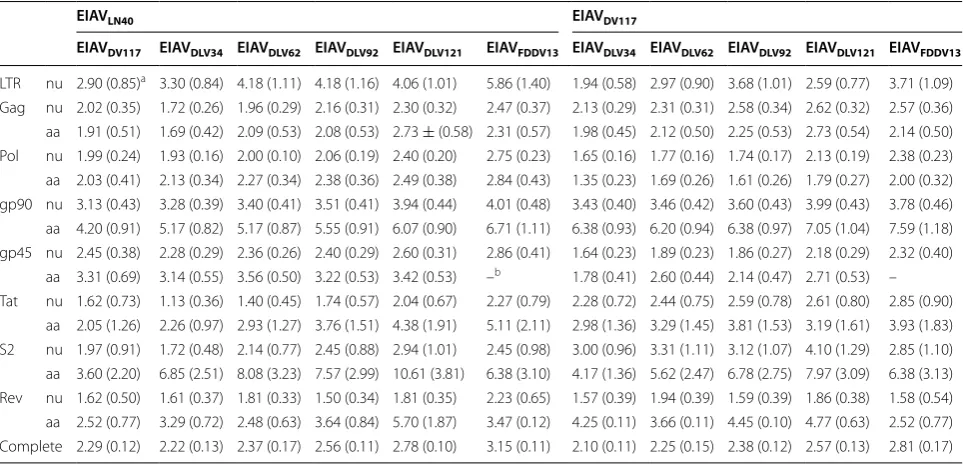
The proviral genome size of different EIAV strains ranged from 7549 to 8277 bp. A detailed analysis of the average mutation rates of different genes and the LTR revealed that the overall diversity among the total 65 genomes of the seven EIAV strains was 2.0 %. The diver-sity was highest in the LTR (2.95 ± 0.26 %), followed by env (consisting of the gp90 and gp45 genes, which were 2.90 ± 0.19 and 2.11 ± 0.26 %, respectively) (Fig. 1d). The variation in the encoded proteins among these EIAV strains was considerably higher. The S2 accessary pro-tein exhibited the highest diversity in the amino acid sequence, reaching 5.02 ± 1.58 %, followed by the surface unit (SU or gp90) of the envelope protein (Env) and Rev, which were 4.81 ± 0.48 and 3.99 ± 0.84 %, respectively (Fig. 1d). Moreover, the genetic distances between the different viral strains and the parental strains EIAVLN40 and EIAVDV117 gradually increased with the increasing passage numbers (Table 1).
Phylogenetic analysis of strains collected during the development of an attenuated EIAV vaccine
species from EIAVDLV34, EIAVDLV62 and EIAVDLV92 in the map. This result indicated that viral evolution was a long-term process with selective mutations accumulating dur-ing continuous passages in cultured cells. Furthermore,
dramatic alterations of the growth environment could speed up viral genomic mutations.
The evolutionary behavior of each individual EIAV gene and the LTR region were also phylogenetically analyzed.
LN40
<10% 100% 67% 50% 8.3% 0 0
100% 100% 100% 100% 9.1% 0 0
b
MorbidityHorses Donkeys
Alignment Position (residue number)4,000 4,500 5,000 5,500 6,000 6,500 7,000 7,500 8,000 3,500
3,000 2,500 2,000 1,500 1,000 500
Entr
opy
(Hx)
1
0
LTR tat gag pol s2 gp90 gp45 rev
c
Entropy
Alignment position (residue number)
d
Whole LTR gag pol gp90 gp45 tat s2 rev
Gene
Diversity
(%
)
DV117 DLV34 DLV62 DLV92 DLV121 FDDV13
In donkey monocyte-derived macrophages In fetal donkey dermal cells
LN40
a
In horses In donkeysn˖ 5 5 9 16 8 11 11
5
nu aa 4
3
2
1
0
Fig. 1 Genome variants of EIAV strains during vaccine development. a The flowchart of EIAV vaccine development. Four major stages were included the process of vaccine development: the in vivo passages in horses and donkeys and the passages in cultured dMDM and fetal donkey dermal (FDD) cells. The representative strains isolated from each of these stages and the numbers of clones used for the proviral genome analysis are indicated. These viral strains included the virulent strains EIAVLN40 and EIAVDV117, the vaccine strains EIAVDLV121 and EIAVFDDV13 and three strains
of EIAVDV117 passaged in dMDM (the 34th passage strain EIAVDLV34, the 62nd passage strain EIAVDLV62 and the 92nd passage strain EIAVDLV92). b The
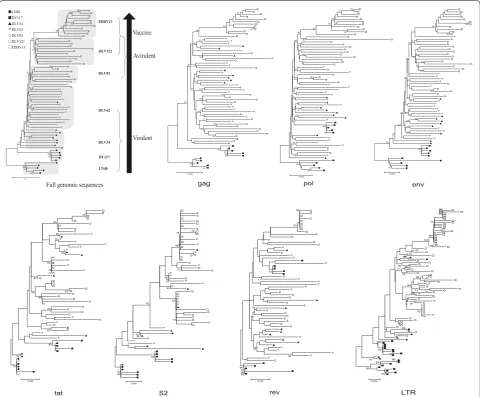
[image:3.595.58.544.89.521.2]Three different evolutionary patterns were observed, as presented in Fig. 2. The first pattern was observed for the env gene and clearly demonstrated a direction toward the flow of the vaccine development process similar to that identified for the total viral genome, with a remark-able clustering of sequences from attenuated strains (EIAVDLV92, EIAVDLV121 and EIAVFDDV13) (Fig. 2). This result implied that there was a close association of the env evolution with the EIAV phenotypic change dur-ing the in vivo and ex vivo passages. The pol sequences also displayed a separated distribution between the EIAV virulent and attenuated strains (Fig. 2). However, the genes were not well-separated among strains with a similar pathogenicity, suggesting a close association with pathogenicity. The second pattern was observed for LTR and gag (Fig. 2), which showed separated branches of sequences that clustered according to the different EIAV growth environments. Specifically, sequences of EIAVLN40 (from horses), EIAVDV117 (from donkeys) and EIAVFDDV13 (from FDD cells) each formed a clearly separated branch. Although clones from strains grown in eMDM (EIAVDLV strains 34, 62, 92 and 121) were well-distinguished from the other strains, sequences within these EIAVDLV strains were mixed in the sub-branches of their clusters. This phylogenetic pattern suggested the association of LTR and gag with EIAV adaption to the environmental change and the reduced importance of pathogenicity. The third genetic evolutionary pattern was observed for the genes
of three accessory proteins (tat, s2 and rev) (Fig. 2). For tat and rev in particular, the sequence distribution in the phylogenetic tree did not follow the trend of in vivo and ex vivo passaging of EIAV. Viral genes in different pas-sages were largely mixed within different branches, dem-onstrating no obvious evolutionary direction. However, s2 exhibited a separation between sequences from strains replicated either in vivo or cultured cells (Fig. 2).
Combined with Fig. 1d, which depicts the higher amino acid mutation rate, our data on EIAV genetic evolution suggest that: (1) Gag, Pol and accessary proteins have higher percentages of silent nt substitutions or substitu-tions that are not consistent with the substitution patterns of the whole genome during the alteration of growth envi-ronment, implying that they are less driven by selective pressures; and (2) these mutations do not significantly contribute to the attenuation of pathogenicity. The above results suggest that viral genome evolution is a compre-hensive result of different gene changes and mutations during the process of vaccine development and that the env may play crucial roles in the attenuation of patho-genicity [6]. The env is closely related to the virus’s target-ing ability and immunogenicity. Multiple lines of evidence have demonstrated that the Env of highly virulent lenti-viral strains contributes to stronger neutralization escape capabilities, enterotoxic activities and the ability to acti-vate signaling pathways of inflammatory factors com-pared to the Env of attenuated strains [7].
Table 1 Comparison of nucleotide and amino acid genetic distances of the various EIAVs compared to EIAVLN40
and EIA-VDV117
a The number in parenthesis indicate standard deviation b The gp45 amino acid genetic distances of EIAV
FDDV13 with EIAVLN40 and EIAVDV117 no showed, because existence of truncated gp45
EIAVLN40 EIAVDV117
EIAVDV117 EIAVDLV34 EIAVDLV62 EIAVDLV92 EIAVDLV121 EIAVFDDV13 EIAVDLV34 EIAVDLV62 EIAVDLV92 EIAVDLV121 EIAVFDDV13
LTR nu 2.90 (0.85)a 3.30 (0.84) 4.18 (1.11) 4.18 (1.16) 4.06 (1.01) 5.86 (1.40) 1.94 (0.58) 2.97 (0.90) 3.68 (1.01) 2.59 (0.77) 3.71 (1.09)
Gag nu 2.02 (0.35) 1.72 (0.26) 1.96 (0.29) 2.16 (0.31) 2.30 (0.32) 2.47 (0.37) 2.13 (0.29) 2.31 (0.31) 2.58 (0.34) 2.62 (0.32) 2.57 (0.36) aa 1.91 (0.51) 1.69 (0.42) 2.09 (0.53) 2.08 (0.53) 2.73 ± (0.58) 2.31 (0.57) 1.98 (0.45) 2.12 (0.50) 2.25 (0.53) 2.73 (0.54) 2.14 (0.50) Pol nu 1.99 (0.24) 1.93 (0.16) 2.00 (0.10) 2.06 (0.19) 2.40 (0.20) 2.75 (0.23) 1.65 (0.16) 1.77 (0.16) 1.74 (0.17) 2.13 (0.19) 2.38 (0.23) aa 2.03 (0.41) 2.13 (0.34) 2.27 (0.34) 2.38 (0.36) 2.49 (0.38) 2.84 (0.43) 1.35 (0.23) 1.69 (0.26) 1.61 (0.26) 1.79 (0.27) 2.00 (0.32) gp90 nu 3.13 (0.43) 3.28 (0.39) 3.40 (0.41) 3.51 (0.41) 3.94 (0.44) 4.01 (0.48) 3.43 (0.40) 3.46 (0.42) 3.60 (0.43) 3.99 (0.43) 3.78 (0.46) aa 4.20 (0.91) 5.17 (0.82) 5.17 (0.87) 5.55 (0.91) 6.07 (0.90) 6.71 (1.11) 6.38 (0.93) 6.20 (0.94) 6.38 (0.97) 7.05 (1.04) 7.59 (1.18) gp45 nu 2.45 (0.38) 2.28 (0.29) 2.36 (0.26) 2.40 (0.29) 2.60 (0.31) 2.86 (0.41) 1.64 (0.23) 1.89 (0.23) 1.86 (0.27) 2.18 (0.29) 2.32 (0.40)
aa 3.31 (0.69) 3.14 (0.55) 3.56 (0.50) 3.22 (0.53) 3.42 (0.53) –b 1.78 (0.41) 2.60 (0.44) 2.14 (0.47) 2.71 (0.53) –
[image:4.595.57.539.114.346.2]Stable mutation rates during the development of an EIAV attenuated vaccine
To elucidate the meaning of the EIAV genome evolu-tion and the contribuevolu-tions of the mutaevolu-tions in each gene to the altered viral functions during long-term in vivo and ex vivo passaging, the mutational characteristics of the LTR and viral genes were extensively analyzed using the predominant sequence of EIAVLN40 as the reference (Figs. 3, 4 and Additional file 2: Figure S2, Table 2). Some sequences contained premature stop codons in the cod-ing region; these genes might play some roles in the qua-sispecies reservoir but were defective in the virus and were excluded from the analysis. For the convenience of
description, we classified the seven viral strains accord-ing to their pathogenicity and origins into the followaccord-ing groups: virulent strains (EIAVLN40, EIAVDV117, EIAVDLV34 and EIAVDLV62); in vivo highly virulent strains (EIA-VLN40 and EIAVDV117); attenuated strains (EIAVDLV92, EIAVDLV121 and EIAVFDDV13); cell culture adapted viral strains (EIAVDLV34, EIAVDLV62, EIAVDLV92, EIAVDLV121 and EIAVFDDV13); and vaccine strains (EIAVDLV121 and EIAVFDDV13). Some strains could be placed in more than one group because of different classification categories.
The LTR region contained the highest mutation rate in the genomic sequence because of insertions, dele-tions and point substitudele-tions. The mutadele-tions were
gag pol env
99 99 83 95 99 99 88 99 76 99 99 94 87 71 90 71 77 86 93 82 86 71 85 89 71 80 77 0.005 99 99 99 77 85 70 99 99 95 99 99 99 85 88 91 82 92 87 76 77 71 88 83 84 75 81 0.005 99 75 99 76 99 99 99 95 99 81 91 84 90 84 83 74 81 95 71 90 93 80 89 86 76 73 0.005
tat S2 rev
89 70 83 83 79 70 72 70 70 82 91 78 77 90 71 92 74 0.005 90 82 82 80 92 70 70 83 82 76 80 71 73 75 86 8073 75 0.005 84 86 93 70 77 78 79 90 83 73 86 0.005 LTR 86 73 85 89 79 89 75 86 85 85 85 73 74 80 83 75 73 92 91 86 88 85 85 94 76 78 76 71 0.005 LN40 DV117 DLV34 DLV62 DLV121 FDDV13 Virulent Vaccine 99 99 74 99 74 99 99 99 97 99 99 99 77 72 78 71 87 99 75 95 77 95 76 91 95 81 91 78 50 Avirulent ƽLN40 ƵDV117 ƷDLV34 ͩDLV62 ƺDLV92 ƻDLV121 ƶFDDV13 DLV92
Full genomic sequences
Fig. 2 Phylogenetic tree analysis of EIAV proviral genomes and individual genes (gag, pol, env,tat, s2, rev and LTR). Sequence data were collected from 65 complete proviral genomes of seven viral strains. The phylogenetic trees were constructed using the neighbor‑joining method and calculated with the Kimura 2 parameter in MEGA 5. Bootstrap values above 70 % are indicated. The virulent strains, including EIAVLN40, EIAVDV117,
EIAVDLV34 and EIAVDLV62, are viruses that cause typical EIA symptoms (rectal temperature >39 °C, the platelet count <100,000/μL and the plasma viral
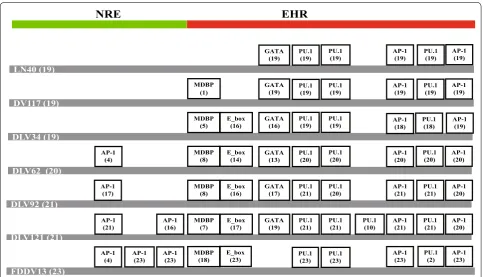
[image:5.595.58.539.90.487.2]largely clustered in the U3 region, which consisted of the negative regulation element (NRE) and enhancer region (EHR). Most of the deletion and insertion muta-tions were identified in this region and were presumed to result in changes in the number and specificity of binding sites for cellular transcription factors (Fig. 3). The E_box is the bHLH transcription factor binding sequence. It was originally absent in the two in vivo virulent strains, but it appeared in the EHR in all of the cell culture adapted virus strains. The E_box sequence in the LTR of HIV-1 and human T cell leukemia virus-1 (HTLV-1) was found to significantly decrease or delay the transcription of the provirus [8]. Additionally, sequences with AP-1 binding sites in the NRE region began to appear and gradually increased concomitantly with the successive passages in cultured cells. The clones of the most attenuated strain (EIAVFDDV13) contained two to three AP-1 binding sites. The transcription factor AP-1 is known to regulate cell differentiation, proliferation and apoptosis in multiple cell types. Studies of FIV revealed that the AP-1 binding sites in the U3 region improved viral replication in feline kidney cell lines but decreased viral propagation in feline T lymphocytes and PBMCs [9]. In this study, the repli-cation ability in cultured cells of the EIAV strains was
positively correlated with the AP-1 copy number and the percentage of clones with high-copy AP-1 but was nega-tively correlated with viral pathogenicity. The fibroblast (FDD cells)-adapted EIAVFDDV13 lost the GATA binding site, which was present in the EHR region in the other strains. The transcription factor GATA regulates hemat-opoietic differentiation and is necessary for the devel-opment, differentiation and maturation of erythrocytes [10].
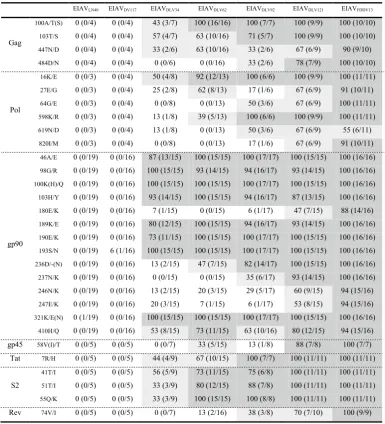
A predominant mutation in coding sequences is defined as that more than 10 % of clones in different viral strains exhibit mutations causing the change of same amino acid or more than 2/3 of clones in the same viral strain display the identical mutation sites. The EIAV Gag protein is a precursor that is subsequently hydro-lyzed into the p15 matrix, p26 capsid, p11 nucleocapsid and p9 proteins. Four out of 14 predominant mutations were specifically generated during the period of ex vivo attenuation (Additional file 2: Figure S2A). Among these four sites, 100A/T(S), 103T/S and 447N/D were mostly observed in the cell culture adapted viruses; the first two were located in the CTL epitope region in the E2 domain of p15 and the third was located in p9. In contrast, the 484D/N mutation was only identified in p9 in the three
DLV121 (21)
GATA
(19) PU.1(21) PU.1(21) AP-1(21) PU.1(21) AP-1(20) AP-1
(16) AP-1
(21) MDBP(7) E_box(17) PU.1(10)
DV117 (19)
GATA
(19) PU.1(19) PU.1(19) AP-1(19) PU.1(19) AP-1(19) MDBP
(1)
DLV34 (19)
GATA
(16) PU.1(19) PU.1(19) AP-1(18) PU.1(18) AP-1(19) MDBP
(5) E_box(16)
DLV92 (21)
GATA
(17) PU.1(21) PU.1(20) AP-1(21) PU.1(21) AP-1(20) MDBP
(8) E_box(16) AP-1
(17) DLV62 (20)
GATA
(13) PU.1(20) PU.1(20) AP-1(20) PU.1(20) AP-1(20) MDBP
(8) E_box(14) AP-1
(4)
FDDV13 (23)
PU.1
(23) PU.1(23) AP-1(23) AP-1
(4) AP-1(23) AP-1(23) MDBP(18) E_box(23) PU.1(2) AP-1(23)
LN40 (19)
GATA
(19) PU.1(19) PU.1(19) AP-1(19) PU.1(19) AP-1(19)
NRE
EHR
[image:6.595.57.541.88.365.2]fully attenuated virus strains. The p9 protein is important for provirus formation and viral budding [11].
The cleavage of the EIAV Pol precursor protein gen-erates several viral enzymes that are essential for the viral life cycle, including the reverse transcriptase (RT)/ RNaseH, a viral protease, a dUTPase and an integrase. During the EIAV vaccine development process, 24 pre-dominant mutation sites were observed in Pol (Addi-tional file 2: Figure S2B). Among these sites, three were primarily identified in the viral strains adapted
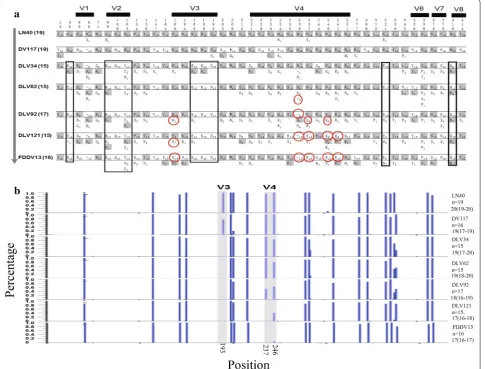
in cultured cells (16 K/E, 27E/G and 598 K/R), with the first two located in the leader sequences. Additionally, another three mutations were primarily confined to the three attenuated strains (64G/E, 619 N/D and 820I/M), with two located in the RT/RNaseH region and one in the dUTPase region. The dUTPase plays important roles in influencing pathogenicity [12]. Indeed, Pol is closely associated with viral replication and the induction of immune responses. The outcomes of these viral strain-associated mutations in EIAV Pol are less understood Fig. 4 The stable mutations of EIAV gp90. a Stable mutations in gp90 proteins generated during different vaccine development stages. The amino acid sequences were deduced from the gene sequences originating from either the proviral genomes or from the directly cloned PCR products after removing sequences containing premature stop codons. The gp90 sequences were aligned to the reference sequence EIAVLN40. The shadowed
residues and white background residues are identical to or different from the reference sequence, respectively. Stable mutation sites detected primarily in virus strains adapted to cultivated cells are boxed, whereas those limited in the attenuated strains are marked with red circles. V1–V8 designate the eight variable regions. The numbers on the top of the graphs show the positions of stable mutation sites, and those at the left side
[image:7.595.58.544.92.461.2]than the outcomes of mutations in other proteins such as Env and S2 [7, 13–15], and therefore they require further investigation.
The env gene was the structural gene with the highest mutation rate during vaccine development. Most of these mutations were located in the envelope surface unit gp90, which contained 43 predominant mutation sites (Fig. 4a). Impressively, nine of these mutations were confined to the cell culture adapted viral strains. Five were primar-ily observed in the attenuated strains (180E/K in the V3 region and 236D/-, 237N/K, 246N/K and 247E/K in the V4 region), including four that resulted in a change of an
acidic amino acid to a basic amino acid. The deletion of negatively charged 236D in the V4 region may lead to a polarity change of the V4 region. Liang et al. previously demonstrated that the reverse mutation of these nine substituted residues in gp90 in the vaccine strain EIA-VFDDV13 did significantly alter the pathogenicity of EIAV [16]. Heavy glycosylation is a common feature of lenti-viral envelope proteins, and the locations and numbers of glycosylation sites are associated with viral biologi-cal characteristics [17]. We found that the EIAV strains exhibited a decrease in gp90 glycosylation sites with the increasing passages in cultured cells. The average number
Table 2 The proportion of stable amino acid substitutions of each gene in various EIAVs
EIAVLN40 EIAVDV117 EIAVDLV34 EIAVDLV62 EIAVDLV92 EIAVDLV121 EIAVFDDV13
Gag
100A/T(S) 0 (0/4) 0 (0/4) 43 (3/7) 100 (16/16) 100 (7/7) 100 (9/9) 100 (10/10) 103T/S 0 (0/4) 0 (0/4) 57 (4/7) 63 (10/16) 71 (5/7) 100 (9/9) 100 (10/10)
447N/D 0 (0/4) 0 (0/4) 33 (2/6) 63 (10/16) 33 (2/6) 67 (6/9) 90 (9/10)
484D/N 0 (0/4) 0 (0/4) 0 (0/6) 0 (0/16) 33 (2/6) 78 (7/9) 100 (10/10)
Pol
16K/E 0 (0/3) 0 (0/4) 50 (4/8) 92 (12/13) 100 (6/6) 100 (9/9) 100 (11/11)
27E/G 0 (0/3) 0 (0/4) 25 (2/8) 62 (8/13) 17 (1/6) 67 (6/9) 91 (10/11)
64G/E 0 (0/3) 0 (0/4) 0 (0/8) 0 (0/13) 50 (3/6) 67 (6/9) 100 (11/11)
598K/R 0 (0/3) 0 (0/4) 13 (1/8) 39 (5/13) 100 (6/6) 100 (9/9) 100 (11/11)
619N/D 0 (0/3) 0 (0/4) 13 (1/8) 0 (0/13) 50 (3/6) 67 (6/9) 55 (6/11)
820I/M 0 (0/3) 0 (0/4) 0 (0/8) 0 (0/13) 17 (1/6) 67 (6/9) 91 (10/11)
gp90
46A/E 0 (0/19) 0 (0/16) 87 (13/15) 100 (15/15) 100 (17/17) 100 (15/15) 100 (16/16)
98G/R 0 (0/19) 0 (0/16) 100 (15/15) 93 (14/15) 94 (16/17) 93 (14/15) 100 (16/16)
100K(H)/Q 0 (0/19) 0 (0/16) 100 (15/15) 100 (15/15) 100 (17/17) 100 (15/15) 100 (16/16)
103H/Y 0 (0/19) 0 (0/16) 93 (14/15) 100 (15/15) 94 (16/17) 87 (13/15) 100 (16/16) 180E/K 0 (0/19) 0 (0/16) 7 (1/15) 0 (0/15) 6 (1/17) 47 (7/15) 88 (14/16) 189K/E 0 (0/19) 0 (0/16) 80 (12/15) 100 (15/15) 94 (16/17) 93 (14/15) 100 (16/16) 190E/K 0 (0/19) 0 (0/16) 73 (11/15) 100 (15/15) 100 (17/17) 100 (15/15) 100 (16/16) 193S/N 0 (0/19) 6 (1/16) 100 (15/15) 100 (15/15) 100 (17/17) 100 (15/15) 100 (16/16) 236D/-(N) 0 (0/19) 0 (0/16) 13 (2/15) 47 (7/15) 82 (14/17) 100 (15/15) 100 (16/16) 237N/K 0 (0/19) 0 (0/16) 0 (0/15) 0 (0/15) 35 (6/17) 93 (14/15) 100 (16/16) 246N/K 0 (0/19) 0 (0/16) 13 (2/15) 20 (3/15) 29 (5/17) 60 (9/15) 94 (15/16) 247E/K 0 (0/19) 0 (0/16) 20 (3/15) 7 (1/15) 6 (1/17) 53 (8/15) 94 (15/16) 321K/E(N) 0 (1/19) 0 (0/16) 100 (15/15) 100 (15/15) 100 (17/17) 100 (15/15) 100 (16/16)
410H/Q 0 (0/19) 0 (0/16) 53 (8/15) 73 (11/15) 63 (10/16) 80 (12/15) 94 (15/16) gp45 58V(I)/T 0 (0/5) 0 (0/5) 0 (0/7) 33 (5/15) 13 (1/8) 88 (7/8) 100 (7/7)
Tat 7R/H 0 (0/5) 0 (0/5) 44 (4/9) 67 (10/15) 100 (7/7) 100 (11/11) 100 (11/11)
S2
41T/I 0 (0/5) 0 (0/5) 56 (5/9) 73 (11/15) 75 (6/8) 100 (11/11) 100 (11/11) 51T/I 0 (0/5) 0 (0/5) 33 (3/9) 80 (12/15) 88 (7/8) 100 (11/11) 100 (11/11) 55Q/K 0 (0/5) 0 (0/5) 33 (3/9) 100 (15/15) 100 (8/8) 100 (11/11) 100 (11/11) Rev 74V/I 0 (0/5) 0 (0/5) 0 (0/7) 13 (2/16) 38 (3/8) 70 (7/10) 100 (9/9)
[image:8.595.58.444.100.525.2]of glycosylation sites in the virulent strains was 19–20 compared to an average of 18 in the initially attenuated strain EIAVDLV92 and 17 for the vaccine strains EIA-VDLV121 and EIAVFDDV13 (Fig. 4b).
The 237N/K and 246N/K substitutions in the gp90 of the attenuated strains resulted in the loss of two potential glycosylation sites (237NNTW240 and 246NETW249) in the V4 region (Fig. 4b). Additionally, all cell cul-ture adapted viral strains lost the glycosylation site 191NSSN194 in the V3 region because of the 193S/N substitution (Fig. 4b). Han et al. reported that these substitutions reduced viral replication and sensitivity to neutralizing antibodies in cultured cells [18]. Howe et al. demonstrated that the structure of the V4 region was important for EIAV evasion of immune surveillance, and the glycosylation sites in the V4 region blocked the principle neutralizing domain (PND) in the V3 region [19]. These structural features improved the resistance to host immune responses. The EIAV V3/V4 regions and the HIV-1 V1/V2 regions are topologically simi-lar [20]. Recently, an analysis of the HIV-1 vaccine that was assessed in the Thailand RV-144 trial suggested that antibodies targeting the V1/V2 regions of gp120, which together form a five-strand beta barrel, were correlated with immune protection [21]. Therefore, the loss of glyco-sylation sites in the V4 region in attenuated EIAV strains may cause viruses to expose more epitopes for immune recognition (particularly the PND in the V3 region), lead-ing to stronger stimulation of immune responses.
Our sequencing data displayed that the diversity of gp90 a.a was the highest among other EIAV structural proteins, ranging from 1.85 ± 0.25 % for EIAVLN40 to 4.14 ± 0.50 % for EIAVDV117, which implicated a wide variation in the surface antigens in different viral clones of EIAV quasispecies. Together with constant antigen shifting, the complexity in EIAV antigen composition results in the difficulty in vaccine development. We pre-viously reported that a proviral derivate from the vaccine strain EIAVFDDV12 failed to elicit immune protection like its parental strain. The reduction of gp90 variation was considered the major difference between these two types of vaccine [4].
The EIAV trans membrane protein gp45 displayed a total of 10 predominant mutations, among which 58V(I)/T was primarily detected in the vaccine strains (Additional file 2: Figure S2C). We previously dem-onstrated that this mutation decreased the tempera-ture sensitivity of gp45 [22], which might affect viral infection. Furthermore, all seven analyzed EIAVFDDV13 genomes contained a G/A mutation at the 795th nucleo-tide that created a premature stop codon (793TGA795) in the gp45 gene, resulting in a truncated gp45. The viruses
expressing truncated gp45 grew significantly better in FDD cells than in horse macrophage. However, there was no significant difference in replication in horses between the two EIAV strains with different gp45 configurations [23]. The C-terminal truncated mutant may be positively selected because of its benefits for viral replication in FDD cells.
EIAV encodes three accessory proteins (Tat, S2 and Rev). Corresponding functional domains in Tat and the LTR bind to the TAR region of the EIAV genomic RNA to increase gene transcription efficiency. Our analysis revealed that Tat contained four predominant mutations, among which 7R/H was primarily found in the cell cul-ture adapted viral strains (Additional file 2: Figure S2D). S2, which was the EIAV-encoded protein with the highest amino acid mutation rate in the vaccine strains compared to the initial EIAVLN40, contained six predominant muta-tions. Of these, 6K/R was only observed in the highly vir-ulent EIAVDV117 strain, whereas 41T/I, 51T/I and 55Q/K were mostly located in the cell culture adapted adapted strains (Additional file 2: Figure S2D). We previously demonstrated that the reverse mutation of these four substituted residues in the vaccine strain EIAVFDDV13 compared to the residues from EIAVDV117 did not sig-nificantly change the replication features of this vaccine strain in cultured cells [24]. Rev assists viral RNA trans-portation out of the nucleus and is an important factor influencing lentivirus pathogenicity. Eleven predomi-nant mutations were generated in Rev during the vaccine development process (Additional file 2: Figure S2D). Compared to the initial strain EIAVLN40, most clones of other strains displayed a deletion of residue N at posi-tion 22. Two stable mutaposi-tions were principally observed in EIAVDV117, and a third mutation (74V/I) was primarily detected in the vaccine strains.
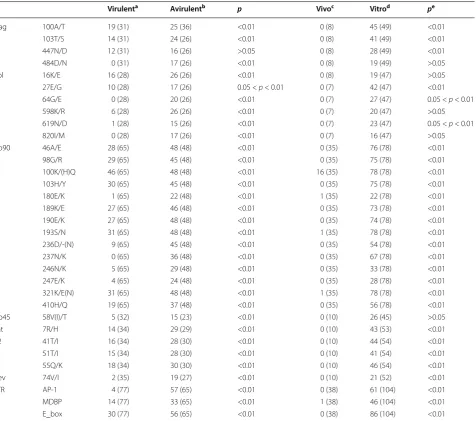
virulent and attenuated strains. Furthermore, all stable mutation sites summarized in Table 3 were significantly different between the in vivo-originated strains and the cell culture adapted strains, with the exception of a few mutations including 484D/N in Gag, 16K/E, 598K/R and 820I/M in Pol and 58V(I)/T in gp45. These data suggest that most of these stable mutations are responsible for EIAV adaptation to cultured cells and are correlated with changes in pathogenicity.
Conclusions
The vaccine development process of the attenuated EIAV vaccine is based on successive passages in different hosts and cultivated permissive cells to reduce pathogenicity while retaining immunogenicity. Viral strains collected at key stages of this process provided an important source of genomic information for studies on the molecular basis of the altered virological and immunological features. Our data demonstrated that different regions of the viral
Table 3 Differences between various amino acid sequences or LTR sequences derived from virulent and avirulent EIAV and in vivo and cell culture derived EIAV
a Virulent strains including EIAV
LN40, EIAVDV117, EIAVDLV34, and EIAVDLV62 b Avirulent strains including EIAV
DLV92, EIAVDLV121, and EIAVFDDV13 c In vivo strains including EIAV
LN40 and EIAVDV117 d Ex vivo strains including EIAV
DLV34, EIAVDLV62, EIAV DLV92, EIAVDLV121, and EIAVFDDV13 e Determined by the Chi square test of the SAS 9.2
Virulenta Avirulentb p Vivoc Vitrod pe
Gag 100A/T 19 (31) 25 (36) <0.01 0 (8) 45 (49) <0.01
103T/S 14 (31) 24 (26) <0.01 0 (8) 41 (49) <0.01 447N/D 12 (31) 16 (26) >0.05 0 (8) 28 (49) <0.01
484D/N 0 (31) 17 (26) <0.01 0 (8) 19 (49) >0.05
Pol 16K/E 16 (28) 26 (26) <0.01 0 (8) 19 (47) >0.05
27E/G 10 (28) 17 (26) 0.05 < p < 0.01 0 (7) 42 (47) <0.01 64G/E 0 (28) 20 (26) <0.01 0 (7) 27 (47) 0.05 < p < 0.01
598K/R 6 (28) 26 (26) <0.01 0 (7) 20 (47) >0.05
619N/D 1 (28) 15 (26) <0.01 0 (7) 23 (47) 0.05 < p < 0.01
820I/M 0 (28) 17 (26) <0.01 0 (7) 16 (47) >0.05
gp90 46A/E 28 (65) 48 (48) <0.01 0 (35) 76 (78) <0.01
98G/R 29 (65) 45 (48) <0.01 0 (35) 75 (78) <0.01 100K/(H)Q 46 (65) 48 (48) <0.01 16 (35) 78 (78) <0.01 103H/Y 30 (65) 45 (48) <0.01 0 (35) 75 (78) <0.01 180E/K 1 (65) 22 (48) <0.01 1 (35) 22 (78) <0.01 189K/E 27 (65) 46 (48) <0.01 0 (35) 73 (78) <0.01 190E/K 27 (65) 48 (48) <0.01 0 (35) 74 (78) <0.01 193S/N 31 (65) 48 (48) <0.01 1 (35) 78 (78) <0.01 236D/‑(N) 9 (65) 45 (48) <0.01 0 (35) 54 (78) <0.01 237N/K 0 (65) 36 (48) <0.01 0 (35) 67 (78) <0.01 246N/K 5 (65) 29 (48) <0.01 0 (35) 33 (78) <0.01 247E/K 4 (65) 24 (48) <0.01 0 (35) 28 (78) <0.01 321K/E(N) 31 (65) 48 (48) <0.01 1 (35) 78 (78) <0.01 410H/Q 19 (65) 37 (48) <0.01 0 (35) 56 (78) <0.01 gp45 58V(I)/T 5 (32) 15 (23) <0.01 0 (10) 26 (45) >0.05
Tat 7R/H 14 (34) 29 (29) <0.01 0 (10) 43 (53) <0.01
S2 41T/I 16 (34) 28 (30) <0.01 0 (10) 44 (54) <0.01
51T/I 15 (34) 28 (30) <0.01 0 (10) 41 (54) <0.01 55Q/K 18 (34) 30 (30) <0.01 0 (10) 46 (54) <0.01
Rev 74V/I 2 (35) 19 (27) <0.01 0 (10) 21 (52) <0.01
LTR AP‑1 4 (77) 57 (65) <0.01 0 (38) 61 (104) <0.01
[image:10.595.63.540.113.534.2]genome that are associated with decreased pathogenicity exhibited a series of stable mutations and that the per-centage of mutated sites in the viral population gradually increased. These results indicated that these mutations were closely involved in pathogenicity attenuation and immunogenicity enhancement. The evolutionary analysis revealed that although the direction of evolution of the whole genome was consistent with the extent of attenu-ation, not all of the individual genes followed the same evolutionary pattern. This finding implicates the differ-ent contributions of each gene to the adaption of EIAV to changes in the growth environment and attenuation. Fur-thermore, our results suggest that there is a cumulative effect of the mutations in each individual gene on phe-notypic alterations, including pathogenicity and immu-nogenicity. The stable mutation data presented in this article provide genetic information for future studies to determine the factors involved in viral infectivity.
Methods Viruses and cells
EIAV strains were stocked in the Harbin Veterinary Research Institute, Chinese Academy of Agricultural Sci-ences. EIAVLN40 and EIAVDV117 were originally obtained from peripheral blood mononuclear cells (PBMCs) col-lected during febrile episodes from horses or donkeys infected with EIAVLN40 or EIAVDV117, respectively. The strains were stored at −80 °C prior to analysis. EIAVDLV34, EIAVDLV62, EIAVDLV92, EIAVDLV121 and EIAVFDDV13 were obtained as lyophilized cell culture supernatants and reconstituted in sterile cattle serum. EIAVDLV34, EIA-VDLV62, EIAVDLV92 and EIAVDLV121 were rejuvenated in dMDM, and the cells were harvested when they showed cytopathic effects. EIAVFDDV13 was rejuvenated in FDD, and the cells were harvested 10 days after inoculation. Dynamic replication curves were performed for sev-eral passages of EIAV strains, including EIAVDLV34, EIA-VDLV62, EIAVDLV92, EIAVDLV121 and EIAVFDDV13. The same copy number of EIAVDLV34, EIAVDLV62, EIAVDLV92, EIAVDLV121 and EIAVFDDV13 was used to infect cultured dMDM, which was determined by quantitative real-time revers transcription (RT)-PCR of the gag gene fragment [4, 6]. The supernatants were collected from the infected cells at 2, 4, 6, 8 and 10 days post-infection to measure the viral quantity by assessing the reverse transcriptase (RT) activity (Additional file 2: Figure S1) [21].
Amplification and sequencing
The proviral DNA of EIAVLN40 and EIAVDV117 were pre-pared from peripheral blood mononuclear cells (PBMC) taken during febrile episodes of horses or donkeys infected by EIAVLN40 or EIAVDV117, respectively. Proviral DNA of EIAVDLV34, EIAVDLV62, EIAVDLV92 and EIAVDLV121 were
obtained from cultured dMDM, EIAVFDDV13 proviral DNA was from FDD cells, infected by respective EIAV strains. Total cellular DNA was extracted using the OMEGA Blood DNA Kit (OMEGA, Shanghai, China) according to the manufacturer’s protocols. Proviral genomes of EIA-VLN40, EIAVDV117, EIAVDLV121 and EIAVFDDV13 were cloned and sequenced from two amplified fragments using long and accurate PCR (LA-PCR) [25, 26]. The near entire pro-viral genome (7.9 kb of 8.2 kb) of EIAVDLV34, EIAVDLV62 and EIAVDLV92 proviral genomes were amplified by LA-PCR. To analyze the evolutionary characteristics of the long terminal repeat (LTR) region and the gp90 gene in detail, specific gene fragments were also directly amplified from proviral DNA of individual virus strains and cloned individually in addition to the whole genomes. After T-A cloning of PCR products, positive clones were sent for sequencing to obtain 5–16 whole-genome sequences, 19–23 LTR sequences and 16–21 gp90 sequences from different viral strains. All clones were obtained from indi-cated viral genomic fragments amplified by three to five independent PCR reactions.
Sequence and phylogenetic analysis
Nucleotide sequences were edited and assembled using the SeqManII tool of the Lasergene DNAStar program 7.1 (DNAStar) (Madison, WI, USA, 2006). The Mega-lign tool (DNAStar) was used for pairwise and multiple alignments of DNA sequences and for deducing amino acid sequences. Shannon entropy was calculated using BioEdit software [27]. Diversity and distance were calcu-lated using the Molecular Evolutionary Genetics Analy-sis (MEGA) program 5 and a pairwise deletion option. Phylogenetic and molecular evolutionary analyses were conducted using MEGA5 (Center for Evolution-ary Functional Genomics Biodesign Institute, Arizona State University, Tempe, AZ, USA, 2011) by the neighbor joining method [28]. Bootstrap values (based on 1000 replicates) for each node were provided if they were at least 70 %. N-glycosylation sites were predicted using N-GlycoSite (http://www.hiv.lanl.gov/content/sequence/ GLYCOSITE/glycosite.html). The stable mutation rates (marginal frequencies at each position of the amino acid sequence) were calculated using the MargFreq software (http://sray.med.som.jhmi.edu/SCRoftware/MargFreq/). The statistical analysis of the sequence variations was performed using SAS (Statistical Analysis System) (ver-sion 9.2, SAS Institute Inc, SAS Campus Drive, Cary, NC, USA, 2008).
Nucleotide sequence accession numbers
HM141909–HM141912, HM1419113–HM141918, HM1419120– HM1419123, KT806081–KT806112).
Authors’ contributions
JHZ, XFW and YZL designed the experiments and wrote the paper, JHZ and XW conceived the project, XFW, YZL, QLi, QLiu, WWZ, CD and JC performed the experiments and analyzed the data. All authors read and approved the final manuscript.
Author details
1 State Key Laboratory of Veterinary Biotechnology, Harbin Veterinary Research Institute, Chinese Academy of Agricultural Sciences, Harbin 150001, China. 2 Department of Preventive Veterinary Medicine, College of Veterinary Medi‑ cine, Northeast Agricultural University, Harbin, China. 3 Harbin Weike Biotech‑ nology Development Company, Harbin, China. 4 Harbin Pharmaceutical Group Biovaccine Co., Harbin 150069, China.
Acknowledgements
This study was supported by grants from the National Natural Science Foun‑ dation of China (31302066 to X‑F W, 31572537 to C D), the National Key Labo‑ ratory of Veterinary Biotechnology (SKLVBP201312 and SKLVBP201427) to X‑F W, the Postdoctoral Foundation of Heilongjiang province, China (LBH‑Z14033), and the Chinese Postdoctoral Science Foundation Project (2015M571386).
Competing interests
The authors declare that they have no competing interests.
Received: 3 November 2015 Accepted: 18 January 2016
References
1. Koff WC, Johnson PR, Watkins DI, Burton DR, Lifson JD, Hasenkrug KJ, McDermott AB, Schultz A, Zamb TJ, Boyle R, Desrosiers RC. HIV vac‑ cine design: insights from live attenuated SIV vaccines. Nat Immunol. 2006;7:19–23.
2. Craigo JK, Ezzelarab C, Cook SJ, Liu C, Horohov D, Issel CJ, Monte‑ laro RC. Protective efficacy of centralized and polyvalent envelope immunogens in an attenuated equine lentivirus vaccine. PLoS Pathog. 2015;11:e1004610.
Additional files
Additional file 1: Table S1. Protective efficacy of EIAVDLV121 and EIAVFDDV13.
Additional file 2: Figure S1. Replication efficacies of EIAV strains. The growth rates of five EIAV strains (EIAVDLV34, EIAVDLV62, EIAVDLV92, EIAVDLV121 and EIAVFDDV13) in cultivated dMDM for 2, 4, 6, 8 and 10 days were compared by measuring reverse transcriptase (RT) activity. Data were collected from three independent experiments. Figure S2. Stable mutations in Gag (A), Pol (B), gp45 (C), Tat, S2 and Rev (D) generated during different vaccine development stages. The amino acid sequences were deduced from the gene sequences originating from either the proviral genomes or from the directly cloned PCR products after removing sequences containing premature stop codons. The sequences of each gene were aligned to the reference sequence EIAVLN40. The shadowed residues and white background residues are identical to or different from the reference sequence, respectively. Stable mutation sites detected pri‑ marily in virus strains adapted to cultivated cells are boxed, whereas those limited in the attenuated strains are marked with red circles. The numbers on the top of the graphs show the positions of stable mutation sites, and those at the left side indicate the sequences applied for the analysis. The downward arrows indicate the direction of the vaccine development process.
3. Craigo JK, Montelaro RC. Lessons in AIDS vaccine development learned from studies of equine infectious, anemia virus infection and immunity. Viruses. 2013;5:2963–76.
4. Ma JA, Shi N, Jiang CG, Lin YZ, Wang XF, Wang SA, Lv XL, Zhao LP, Shao YM, Kong XG, et al. A proviral derivative from a reference attenu‑ ated EIAV vaccine strain failed to elicit protective immunity. Virology. 2011;410:96–106.
5. Lin YZ, Shen RX, Zhu ZY, Deng XL, Cao XZ, Wang XF, Ma J, Jiang CG, Zhao LP, Lv XL, et al. An attenuated EIAV vaccine strain induces significantly different immune responses from its pathogenic parental strain although with similar in vivo replication pattern. Antiviral Res. 2011;92:292–304. 6. Shen T, Liang H, Tong X, Fan X, He X, Ma Y, Xiang W, Shen R, Zhang X, Shao Y. Amino acid mutations of the infectious clone from Chinese EIAV attenuated vaccine resulted in reversion of virulence. Vaccine. 2006;24:738–49.
7. Ball JM, Swaggerty CL, Pei X, Lim WS, Xu X, Cox VC, Payne SL. SU proteins from virulent and avirulent EIAV demonstrate distinct biological proper‑ ties. Virology. 2005;333:132–44.
8. Terme JM, Calvignac S, Duc Dodon M, Gazzolo L, Jordan A. E box motifs as mediators of proviral latency of human retroviruses. Retrovirology. 2009;6:81.
9. Miyazawa T, Tomonaga K, Kawaguchi Y, Kohmoto M, Inoshima Y, Maeda K, Mikami T, Maedadel K. Effects of insertion of multiple AP‑1 binding sites into the U3 region of the long terminal repeat of feline immunodefi‑ ciency virus. Arch Virol. 1994;139:37–48.
10. Pimkin M, Kossenkov AV, Mishra T, Morrissey CS, Wu W, Keller CA, Blobel GA, Lee D, Beer MA, Hardison RC, Weiss MJ. Divergent functions of hematopoietic transcription factors in lineage priming and differentiation during erythro‑megakaryopoiesis. Genome Res. 2014;24:1932–44. 11. Jin S, Chen C, Montelaro RC. Equine infectious anemia virus Gag p9
function in early steps of virus infection and provirus production. J Virol. 2005;79:8793–801.
12. Payne SL, Elder JH. The role of retroviral dUTPases in replication and virulence. Curr Protein Pept Sci. 2001;2:381–8.
13. Liu L, Wu L, Li H, Hu X, Sun J, Ma L, Wan Y, Shao Y. Broader HIV‑1 neutral‑ izing antibody responses induced by envelope glycoprotein mutants based on the EIAV attenuated vaccine. Retrovirology. 2010;7:71. 14. Tagmyer TL, Craigo JK, Cook SJ, Even DL, Issel CJ, Montelaro RC. Envelope
determinants of equine infectious anemia virus vaccine protection and the effects of sequence variation on immune recognition. J Virol. 2008;82:4052–63.
15. Li F, Craigo JK, Howe L, Steckbeck JD, Cook S, Issel C, Montelaro RC. A live attenuated equine infectious anemia virus proviral vaccine with a modified S2 gene provides protection from detectable infection by intravenous virulent virus challenge of experimentally inoculated horses. J Virol. 2003;77:7244–53.
16. Liang H, He X, Shen RX, Shen T, Tong X, Ma Y, Xiang WH, Zhang XY, Shao YM. Combined amino acid mutations occurring in the envelope closely correlate with pathogenicity of EIAV. Arch Virol. 2006;151:1387–403. 17. Vigerust DJ, Shepherd VL. Virus glycosylation: role in virulence and
immune interactions. Trends Microbiol. 2007;15:211–8.
18. Han X, Zhang P, Wang X, Kong X, Xiang W, Zhou J. Construction of an Infectious Clone within the V3 Region of gp90 Surface Protein of EIAV by N‑ glycosylation Revers‑mutations. Acta Veterinaria et Zootechnica Sinica. 2008;39:1731–6.
19. Howe L, Leroux C, Issel CJ, Montelaro RC. Equine infectious anemia virus envelope evolution in vivo during persistent infection progressively increases resistance to in vitro serum antibody neutralization as a domi‑ nant phenotype. J Virol. 2002;76:10588–97.
20. Li H, Zhang X, Fan X, Shen T, Tong X, Shen R, Shao Y. A conservative domain shared by HIV gp120 and EIAV gp90: implications for HIV vaccine design. AIDS Res Hum Retroviruses. 2005;21:1057–9.
21. Edlefsen PT, Rolland M, Hertz T, Tovanabutra S, Gartland AJ, deCamp AC, Magaret CA, Ahmed H, Gottardo R, Juraska M, et al. Comprehensive sieve analysis of breakthrough HIV‑1 sequences in the RV144 vaccine efficacy trial. PLoS Comput Biol. 2015;11:e1003973.
• We accept pre-submission inquiries
• Our selector tool helps you to find the most relevant journal
• We provide round the clock customer support
• Convenient online submission
• Thorough peer review
• Inclusion in PubMed and all major indexing services
• Maximum visibility for your research
Submit your manuscript at www.biomedcentral.com/submit
Submit your next manuscript to BioMed Central
and we will help you at every step:
23. Jiang CG, Gao X, Ma J, Lin YZ, Wang XF, Zhao LP, Hua YP, Liu D, Zhou JH. C‑terminal truncation of the transmembrane protein of an attenuated lentiviral vaccine alters its in vitro but not in vivo replication and weakens its potential pathogenicity. Virus Res. 2011;158:235–45.
24. Gao X, Jiang CG, Wang XF, Lin YZ, Ma J, Han XE, Zhao LP, Shen RX, Xiang WH, Zhou JH. Reverse mutation of the virulence‑associated S2 gene does not cause an attenuated equine infectious anemia virus strain to revert to pathogenicity. Virology. 2013;443:321–8.
25. Wang X, Wang S, Lin Y, Jiang C, Ma J, Zhao L, Lv X, Wang F, Shen R, Kong X, Zhou J. Genomic comparison between attenuated Chinese equine infec‑ tious anemia virus vaccine strains and their parental virulent strains. Arch Virol. 2011;156:353–7.
26. Qi X, Wang X, Wang S, Lin Y, Jiang C, Ma J, Zhao L, Lv X, Shen R, Wang F, et al. Genomic analysis of an effective lentiviral vaccine‑attenuated equine infectious anemia virus vaccine EIAV FDDV13. Virus Genes. 2010;41:86–98.
27. Hall TA. BioEdit: a user‑friendly biological sequence alignment editor and analysis program for Windows 95/98/NT. Nucleic Acids Symp Ser. 1999;41:95–8.