Open Access
Research
Efficient inhibition of HIV-1 expression by LNA modified antisense
oligonucleotides and DNAzymes targeted to functionally selected
binding sites
Martin R Jakobsen
†1, Joost Haasnoot
†2, Jesper Wengel
3, Ben Berkhout
2and
Jørgen Kjems*
1Address: 1Department of Molecular Biology, University of Aarhus C.F. Møllers Allé, building 130, DK-8000 Århus C, Denmark, 2Department of Human Retrovirology Academic Medical Center, University of Amsterdam, Meibergdreef 15, 1105 AZ, Amsterdam, The Netherlands and 3Department of Chemistry, University of Southern Denmark, Campusvej 55, DK-5230 Odense M, Denmark
Email: Martin R Jakobsen - [email protected]; Joost Haasnoot - [email protected]; Jesper Wengel - [email protected]; Ben Berkhout - [email protected]; Jørgen Kjems* - [email protected]
* Corresponding author †Equal contributors
Abstract
Background: A primary concern when targeting HIV-1 RNA by means of antisense related technologies is the accessibility of the targets. Using a library selection approach to define the most accessible sites for 20-mer oligonucleotides annealing within the highly structured 5'-UTR of the HIV-1 genome we have shown that there are at least four optimal targets available.
Results: The biological effect of antisense DNA and LNA oligonucleotides, DNA- and LNAzymes targeted to the four most accessible sites was tested for their abilities to block reverse transcription and dimerization of the HIV-1 RNA template in vitro, and to suppress HIV-1 production in cell culture. The neutralization of HIV-1 expression declined in the following order: antisense LNA > LNAzymes > DNAzymes and antisense DNA. The LNA modifications strongly enhanced the in vivo inhibitory activity of all the antisense constructs and some of the DNAzymes. Notably, two of the LNA modified antisense oligonucleotides inhibited HIV-1 production in cell culture very efficiently at concentration as low as 4 nM.
Conclusion: LNAs targeted to experimentally selected binding sites can function as very potent inhibitors of HIV-1 expression in cell culture and may potentially be developed as antiviral drug in patients.
Background
Targeting specific mRNAs by annealing complementary oligonucleotides is a basic principle of several different gene silencing technologies. In the simplest form, anti-sense single stranded oligonucleotides (or derivatives hereof) are introduced into the cell to block gene expres-sion by interfering with translation of the mRNA or by
degrading the RNA in a DNA/RNA heteroduplex via an RNaseH dependent pathway. This antisense approach has been used for more than two decades to study gene func-tion in the laboratory and in attempts to treat animal and human diseases [1-4]. However, the antisense technology has never fulfilled the initially anticipated break-through as a therapeutic tool. Poor intracellular delivery, in vivo Published: 26 April 2007
Retrovirology 2007, 4:29 doi:10.1186/1742-4690-4-29
Received: 8 February 2007 Accepted: 26 April 2007
This article is available from: http://www.retrovirology.com/content/4/1/29 © 2007 Jakobsen et al; licensee BioMed Central Ltd.
instability of the single stranded oligonucleotide, chemi-cal toxicity and lack of mRNA target accessibility are pos-sibly obstacles for a lacking antisense effect. The latter problem is mainly due to the formation of stable RNA structures and assembly of the mRNA into nucleoprotein complexes rendering the target site inaccessible to base pairing [5,6]. Furthermore, it has been estimated that only 2–5% of randomly chosen antisense oligonucleotides have any effect on gene expression [5,7] and computer generated structure models are generally not sufficient for rational prediction of effective targets.
In a related approach, RNA- or DNA-based endonucleases (ribozymes and DNAzymes) are used to cleave comple-mentary targets in mRNA. The most commonly used ribozyme, the hammerhead, has been used extensively in vitro and with more limited success in vivo (reviewed in [8,9]). One of the main reasons is probably the notorious instability of unmodified RNA in vivo. DNAzymes do not appear to exist in nature, but have been selected in vitro
from random DNA oligo pools. One of the most active DNAzymes, named 10–23, bears some structural resem-blance to the hammerhead ribozyme [10-12] but, in spite of the higher in vivo stability of single stranded DNA com-pared to RNA, it also demonstrated only variable success
in vivo [13]. In the reported examples of targeting nucleic acid enzymes to HIV-1 RNA, either relatively large concen-trations and combination of catalytic molecules are required or an in vivo expression system is used [14-17]. Common to both the antisense and the enzymatic approach are that the knock down efficacy is restricted by the accessibility of the targets in the mRNA in vivo.
More recently, RNA interfering (RNAi) has been devel-oped as a highly potent approach to knock down gene expression in mammalian cells with an unprecedented efficiency and specificity (Reviewed in [3]). The active molecule is a small interfering RNA (siRNA), a 20–23 nucleotides RNA duplex composed of two complemen-tary strands, one of which is complemencomplemen-tary to the mRNA target. Although it was initially suggested that the siRNA approach is less sensitive to RNA structure in the target, it was recently demonstrated that the efficiency of RNAi-mediated "knock down" can also be influenced by the RNA structure in HIV-1 [18-21].
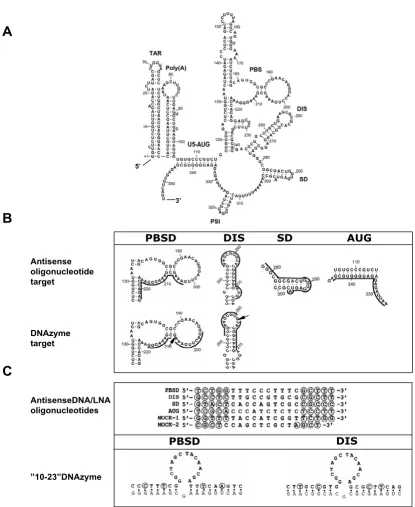
To address the general problem of accessibility of mRNA we have previously developed a SELEX approach that selects for the most effectively binders from a 20-mer complete antisense library through repeated binding cycles [22]. The selection protocol was applied specifically to the 355-nucleotides 5'-terminal fragment of the HIV-1 RNA genome because: a) it contains several functionally important elements including the trans-activation response element (TAR), the 5' polyadenylation signal
(Poly(A)), the primer binding site (PBS), the dimer initia-tion site (DIS), the major splice donor (SD) and the pack-aging signal (PSI) that precedes the Gag open reading frame (Fig. 1A; reviewed in [23,24]); b) most of the region is positioned upstream of the major splice donor site and is therefore present in all viral mRNA species; c) this region is scanned by the ribosome prior to cap-dependent protein synthesis; d) it is the most conserved region of the HIV-1 genome, thus increasing the chance that all HIV-1 strains are inhibited and reducing the likelihood of escape mutants; and e) we have previously tested several siRNA targeted to this region and in all cases non or very low effi-ciencies were observed (unpublished data). This study revealed four sites that are particularly accessible to anti-sense binding and these targets are here subjected to fur-ther analysis.
Chemical modifications are often introduced at the ribose and/or phosphate group of the backbone to increase the stability of oligonucleotides for in vivo applications. In this report the antisense effect of DNA and DNAzyme was compared to oligos that are modified with locked nucleic acid (LNA) residues. This modification consist of a meth-ylene bridge that connects the 2'oxygen with the 4'carbon of the furanose ring, This modification locks the structure into the C3'-endo configuration, which is ideal for recog-nition of RNA motifs, renders the nucleic acid inaccessible the nucleases and increases the melting temperature with the RNA target strands by 2–7°C per LNA residue [25,26]. To enable efficient RNaseH cleavage of the target mRNA by the antisense oligo, it is important to avoid LNA resi-dues in a stretch of at least 6 nucleotides, a design gener-ally referred to as a gap-mer [27-29]. Moreover, in the design of DNAzymes with LNA modifications it has been reported that 2–3 modifications in each arm gives the optimal binding affinity versus binding kinetic [30,31]. Here we tested DNA and LNA (gap-mer) antisense oligos, DNA- and LNAzymes directed towards four highly acces-sible targets in the HIV-1 leader. We found that the LNA antisense is the most potent inhibitor, neutralizing viral expression efficiently when applied in nanomolar concen-trations. The LNAzymes had a moderate effect, whereas unmodified DNA/DNAzymes have no or very little effect.
Results
Construct design and LNA modification of targeting oligonucleotides
Oligonucleotides and their respective targets in the 5' end of the HIV-1 RNA genome
Figure 1
Oligonucleotides and their respective targets in the 5' end of the HIV-1 RNA genome. (A) Secondary structural model of the HIV-1 leader RNA. The stem-loops are named according to assigned function (see text for details) and the sequence is num-bered from the 5' end of the RNA transcript. (B) The targets for the various oligonucleotide constructs. The annealing sites for the oligonucleotides are indicated by a solid line and the cleavage sites of the DNA/LNAzymes are marked by arrows. (C) Sequences of the antisense oligonucleotides and DNAzymes containing the 10–23 catalytic motif [10] named according to their target sites shown in panel B. The selected target sequences for the antisense constructs include sequences downstream of the primer binding site (PBSD), the dimerization initiation site (DIS), the splice donor site (SD) and the Gag initiation codon (AUG). The nucleotides that are substituted with LNA residues in the LNA antisense gap-mers and LNAzymes constructs are circled. The target sequences of the "10–23" DNAzymes are indicated with grey letters.
A
B
AntisenseDNA/LNA oligonucleotides
”10-23”DNAzyme Antisense oligonucleotide target
PBSD DIS SD AUG
DNAzyme target
C
PBSD DIS
5’
interfering properties were synthesized: DNA antisense, LNA antisense, "10–23" DNAzyme and "10–23" LNAzyme. All DNA- and LNA-antisense constructs con-tained 20 nucleotides that were complementary to the selected targets in the HIV-1 RNA, whereas the DNA- and LNAzymes contained two arms of 8–9 nucleotides com-plementary to the target (Fig. 1B and 1C). The LNA anti-sense oligonucleotides were designed as gap-mers with 5 LNA residues flanking a 10-mer phosphorothioate modi-fied DNA body to enable RNase H cleavage. The incorpo-ration of the LNA monomers was calculated to raise the Tm values by approximately 20 degrees.
Blocking reverse transcription with LNA oligonucleotides
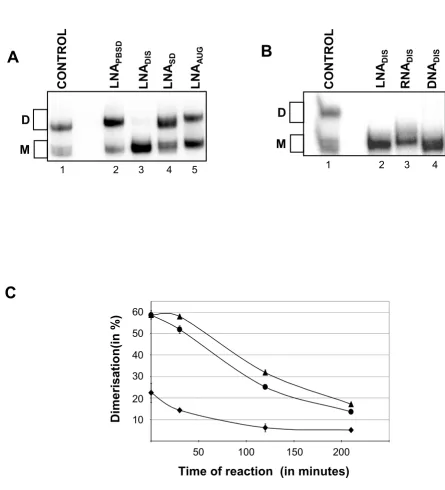
Reverse transcription of the RNA genome into DNA is an essential step in the viral replication cycle, and antisense oligonucleotides may inhibit this step. We therefore tested the ability of the four LNA antisense oligonucleotides to inhibit reverse transcription in vitro (Fig. 2). The PBSD, SD, and AUG specific LNAs blocked reverse transcription from a downstream primer almost completely and pre-cisely at the expected site (94–99%; Fig. 2, lanes 1, 2 and 4), whereas the LNADIS only showed a partial effect (Fig. 2, lane 3). Interestingly, the latter effect is not caused by insufficient binding of the LNA to DIS, since this LNA inhibits RNA dimerization almost completely (Fig. 3A). The extra band observed at a position corresponding to the PSI hairpin when adding LNADIS can be explained by partial sequence complementarity between the LNA and this region (Fig. 2 lane 3, marked by asterisk). When using the DNA versions of the same oligonucleotides only 60– 70% inhibition of reverse transcription was observed for any of the selected sites ([22]; data not shown), clearly demonstrating the superior stability of RNA-LNA duplexes.
Of all the LNAs tested only LNADIS blocked HIV-1 RNA dimerization and with an efficacy of 97% if added to the dimerization reaction prior to incubation (Fig. 3A). Simi-lar levels of inhibition were observed for DNA and RNA oligos (Fig. 3B). However, if the antisense oligonucle-otides were added after pre-dimerization of the HIV-1 RNA, the LNA modified antisense oligonucleotide was significantly more potent then RNA and DNA in dissoci-ating the dimer (Fig. 3C).
Enzymatic cleavage of the HIV-1 leader sequence with DNAzymes and modified LNAzymes optimized for binding
We wanted to investigate whether the selected regions in the HIV-1 leader were accessible to enzymatic cleavage by DNAzymes. Nucleotide enzymes targeting the selected DIS and PBS sites were synthesized both as DNA (DNAzy-meDIS and DNAzymePBSD, respectively; Fig. 1) and with two LNA modifications in each arm (LNAzymeDIS and LNAzymePBSD, respectively). The cleavage efficiency was
assessed by incubating 5'-end radioactively labeled HIV-1 leader RNA with the DNAzymes or LNAzymes for differ-ent time points at 10 mM Mg2+ at an enzyme to substrate ratio of 20:1, 1:1 to 1:20. The HIV RNA cleavage products were separated by denaturing gel electrophoresis and quantified (Fig. 4). The DNAzymeDIS and DNAzymePBSD and their LNA modified counterpart oligonucleotides cleaved the HIV-1 RNA at the expected position, produc-ing 5'-end labelled fragments of approximately 261 and 205 nucleotides, respectively.
When incubating the HIV-1 RNA with an excess of enzyme (20:1) both DNAzymes showed significant levels of cleavage after 24 hours (Fig. 4A and 4C). At lower stoi-chiometric amounts (1:1 and 1:20) only DNAzymePBSD showed moderate cleavage in the PBS loop after 24 hours (Fig. 4C). Introduction of LNA in the arms of
DNAzyme-DIS strongly induced the efficacy to nearly 100% cleavage after 24 hours (20:1 excess) and to a moderate cleavage level at lower enzyme concentration (1:1 and 1:20) (Fig. 4B). In contrast, LNA modifications did not improve the activity of DNAzymePBSD (Fig. 4D). A small decline in its inhibitory activity was measured, indicating that the advantage of introducing LNA residues into a DNAzyme is not universal but rather depends on the nature of the tar-get.
Blocking expression of HIV-1 in vivo
To evaluate the capacity of the antisense LNA to inhibit cellular HIV-1 expression the expression of the viral Gag derived CA-p24 protein was measured in the presence of 20 nM of the four different antisense and two mock LNAs (Fig. 5A). HEK 293-T cells were co-transfected with HIV-1 LAI genomic DNA plasmid, renilla luciferase plasmid and the LNAs. The CA-p24 production was strongly affected by all the HIV-1 specific LNAs, particularly by LNAPBSD and LNAAUG, which reduced protein production by 22-and 12-fold, respectively (Fig. 5A). In contrast, the inter-nal luciferase control was only margiinter-nally affected (+/- 2-fold) by some of the LNAs (data no shown). The effect of the most potent LNAPBSD construct was investigated fur-ther at lower concentrations (Fig. 5B). Notably, CA-p24 expression was severely affected at concentrations as low as 4 nM (15-fold inhibition) and a complete block was apparent at 20 nM LNAPBS (Fig. 5B). This block was spe-cific for HIV protein expression since the renilla luciferase signal was not affected at these concentrations of LNA (data no shown).
inhibitors, leading to almost complete knock down (below detection) at 20–100 nM and to a 3- and 18-fold inhibition, respectively, at 4 nM. In contrast, the DNA antisense oligos showed little effect. Notably, both the DNA- and LNAzymes led to a specific knock down. The LNAzymes were more effective than DNAzymes, giving a 100-fold knockdown at 100 nM (Fig. 5C). However, the LNAzymes also exhibited significant cell toxicity when applied at 100 nM concentration (data no shown).
Discussion
A major concern in the design of therapeutic antisense strategies against highly structured viral RNA genomes is the inaccessibility of the target sequence. To overcome this barrier we have chosen 4 targets in the HIV-1 genome that were previously selected as optimal annealing sites in vitro, and we tested them as targets for DNA and LNA anti-sense oligonucleotides, and DNA- and LNA-zymes. The antisense oligonucleotides were tested in vitro for their ability to interfere with reverse transcription and RNA dimerization and all inhibitors were assayed in vivo for their capacity to inhibit HIV-1 production in a cell culture assay.
Reverse transcription of viral RNA into double stranded DNA is an essential step in the retroviral replication cycle. A comparison of the antisense oligos for their ability to block this reaction revealed that all LNAs, except for LNADIS, caused a near complete block in reverse transcrip-tion. In addition to a significant level of read through, two pause sites were observed for LNADIS: one site mapped to the expected 5'end of the LNA, the other corresponded to the 3' nucleotide of the DIS loop (Fig. 1B). A likely inter-pretation for this observation is that a significant part of the LNADIS molecules anneal only to the exposed loop region, yet is unable to unzip the DIS stem in the HIV-1 RNA. This may explain the partial effect on reverse tran-scription. In contrast, RNA dimerization is nearly 100% blocked by LNADIS, suggesting that annealing of the LNA antisense to the single stranded loop of the DIS hairpin is very effective and sufficient to block dimerization.
The inhibitory potential of the antisense oligos in vivo was dramatically improved upon LNA incorporation. Especially the LNAs targeted to the PBSD, DIS and AUG regions were strong inhibitors of CA-p24 capsid protein expression. The advantage of LNA may in part rely on higher stability in the cells, but increased stability of the interaction between LNA and target most likely also plays an important role. The mechanism for the observed inhi-bition may involve numerous steps in the viral life cycle. All of the LNA gap-mers may degrade the mRNA via an RNase H dependent pathway and, if not degraded, block scanning of the ribosome during cap-dependent transla-tion or the HIV-1 reverse transcriptase while copying the
[image:5.612.60.286.87.556.2]The effect of antisense LNA on reverse transcription of HIV-1 RNA
Figure 2
The effect of antisense LNA on reverse transcription of HIV-1 RNA. An equimolar amount (HIV-1pmol) of HIV RNA and LNA oligo was mixed and incubated prior to primer extension using a primer complementary to position 384–401. Anti-sense LNA oligonucleotides, included LNAAUG (lane 1), LNASD (lane 2), LNADIS (lane 3), LNAPBSD (lane 4), and the major sites of transcriptional termination are indicated to the right. Read through to the 5' end of the HIV-1 RNA is denoted by +1. A sequence latter obtained by dideoxyse-quencing of the HIV-1 RNA is included in lanes 6–9. The level of read through reverse transcription is calculated as read-through/(read through + paused) × 100% and indicated below.
C T
PBSD
DIS
SD
AUG CONTROL G
1 2 3 4 5 6 7 8 9 Primer
AUG PSI loop SD loop DIS loop PBS loop Poly(A) loop TAR loop
Gag ORF
*
Lane Read-through
(in %) >1 >1 35 6 100 A
RNA template. In addition, the individual LNA may also have more specific actions that cannot directly be assessed in our single-round HIV-1 expression assay: the LNAPBSD may interfere with tRNA binding to the PBS and
subse-quent initiation of reverse transcription and the LNADIS may, in addition to dimerization, hinder effective packag-ing of the genome into viral particles. The LNASD covers the major splice donor site and may therefore interfere
[image:6.612.63.509.80.570.2]The effect of antisense LNA versus RNA and DNA on dimerization of HIV-1 RNA
Figure 3
The effect of antisense LNA versus RNA and DNA on dimerization of HIV-1 RNA. The ability of (A) antisense LNA oligonucle-otides directed towards different targets or (B) antisense LNA, RNA or DNA oligonucleotide directed towards the DIS target, to inhibit the formation of the DIS dimer-complex during 30 min incubation were investigated. Monomeric and dimer bands are indicated to the left. (C) A similar experiment, but where the indicated antisense oligonucleotide was added after the dim-ers were allowed to pre-form for 30 mins and subsequently incubated for the indicated time, hence evaluating the efficiency of breaking a stable DIS dimer-complex as a function of time time. Diamonds = LNADIS; Bullet = RNADIS; Triangle = DNADIS.
1 2 3 4 5
CONTROL
CONTROL
D
M
D
M
1 2 3 4
LNA
PBSD
LNA
DIS
LNA
SD
LNA
AUG
LNA
DIS
RNA
DIS
DNA
DIS
Dimerisation(in %)
20 40 60 50
10 30
Time of reaction (in minutes)
A
B
C
In vitro cleavage of HIV-1 RNA by DNA- and LNAzymes
Figure 4
In vitro cleavage of HIV-1 RNA by DNA- and LNAzymes. One hundred nmol 5' end labeled leader RNA (+1–355) was incu-bated with 5 nmol, 100 nmol or 2 pmol DNAzymes or LNAzymes for the indicated time. The DNAzymes targeted to the PBSD and DIS regions cleaved primarily at the expected site, yielding a 5'-end labeled fragment of 205 and 261 nucleotides, respectively (product; panel A and C). The same bands were obtained using the LNAzyme (panel B and C). The experiment was made in duplicates yielding essentially the same result and the cleavage efficiencies indicated below each autoradiogram were calculated as (cleaved RNA/cleaved RNA and uncleaved RNA) × 100% averaged over both experiments.
5 10 15 20 25 10
20 30 40 50 60 70 80 100 90
Percent cleavage
Reaction time (hours)
DNAzymePBSD LNAzymePBSD
1:20
20:1 1:1 1:20 20:1 1:1
product substrate
Ratio [E]:[S]
25 5 10 15 20 10
20 30 40 50 60 70 80 100 90
Percent cleavage
Reaction time (hours)
24 1 2 4 24 1 2 4 24 1 2 3 24 1 2 4 24 1 2 4 24 1 2 4 24
DNAzymeDIS LNAzymeDIS
1:20
20:1 1:1 1:20 20:1 1:1
product substrate
Ratio [E]:[S]
Hours
25 5 10 15 20
Percent cleavage
Reaction time (hours)
10 20 30 40 50 60 70 80 100 90
24 1 2 4 24 1 2 4 24 1 2 4 24 1 2 4 24 1 2 4 24 1 2 4 24
Hours
5 10 15 20
Percent cleavage
Reaction time (hours)
25 10
20 30 40 50 60 70 80 100 90
A
B
Inhibition of intracellular HIV-1 production in the presence of antisense LNA and LNAzymes
Figure 5
Inhibition of intracellular 1 production in the presence of antisense LNA and LNAzymes. One hundred nanograms of HIV-1 genomic LAI plasmid was co-transfected with a renilla luciferase expression construct and the indicated amounts of antisense LNA or LNAzyme, and the HIV-1 production was measured by CA-p24 ELISA 72 hours later. (A) HIV-1 production in the presence 20 nM of the four different HIV-1 specific LNAs and 2 LNA controls (Mock 1 and Mock 2). (B) Measuring HIV-1 pro-duction in the presence of low range concentration of LNAPBSD (0.16–20 nM). The inhibition is calculated as the average value
of two independent experiments where the relative CA-p24 expression is normalized for unspecific inhibition of renilla expres-sion. (C) Comparing the inhibitory capacity of DNA versus LNA containing antisense or 10–23 enzymes targeted to the DIS and PBSD regions. The identity and the concentration of the oligonucleotide are indicated below. The assay was performed in duplicates.
2
Relative CA
-p
24
(x10
-5)
4 6 7
5
3
1 8 2 3 4 5 6 7
1
B
A
0 0,16 0,8 4 20
LNAPBSD
PBSD DIS SD AUG Mock 1
Mock 2 Non
20 20 20 20 20 20 20
Conc. (in nM)
Relative CA
-p
24
(x10
-5)
Conc. (in nM)
Relative CA
-p
24(x10
-6)
4 6 8 12
2
0 4 20 100
10
Conc. (in nM) 4 20 100 4 20 100 4 20 100 4 20 100 4 20 100 4 20 100 20 100 PBSD DIS PBSD DIS
with splice site recognition but RNA packaging may also be disturbed based on the contribution of the region to this process [32-35]. Finally, the LNAAUG that covers the Gag initiation codon may interfere with the assembly of translational initiation complexes or disturb the long dis-tance interaction recently reported between this region and upstream sequences [36,37]. Hence, the multi-func-tional capacities of the LNAs applied in this study may be beneficial for their antiviral effect.
Of the four antisense targets we tested, LNAAUG was partic-ular interesting since it overlaps with the previously described phosphorothioate modified 25-mer antisense oligonucleotide, GEM91 [38-40]. In cell culture experi-ments this oligo has been shown to inhibit HIV-1 replica-tion for up to 20 days when applied at 1 μM [38,40] and pharmacokinitical studies have been initiated in HIV-1 patients but abounded due to dose-limiting toxicity [41]. Considering that the general improved affect of LNAs compared to DNA it will be interesting to further develop the AUG directed LNA oligos as antiviral drugs for clinical use. In another study several antisense polyamide nucle-otide analog (PNA) oligonuclenucle-otides targeted to the TAR stem-loop were tested, and one of the PNAs was found to have significant inhibitory potential on HIV-1 protein expression [42], however only at concentrations of more than 1 mM [43]. The efficacy of these constructs were recently improved by conjugating cell penetrating pep-tides to them [44].
In general the TAR-tat interaction have been objective for several antisense approaches using either LNA modified oligos [45,46], LNA/DNA aptamers [47], mixmer of 2'-OMe and LNA modified oligos [48,49] or PNA modified oligos [50-53]. These results do indeed indicate that the TAR region is a useful antisense target site and that various antisense oligos can inhibit the replication of HIV in dif-ferent cell systems. The absence of binding sites in the TAR region in our screen suggest that this region is less accessi-ble then the sites we have selected.
In another report, antisense gap-mer LNAs targeted to the DIS region have been tested [54]. One of these oligos resembles our LNADIS, but it is shifted a few nucleotides upstream and is two nucleotides shorter. A relatively mod-est 2-fold inhibitory effect was described, both in terms of in vitro dimerization and on HIV-1 expression in vivo in the presence of 160 nM oligonucleotide. This implies that small changes in target selection may have a dramatic effect, which is consistent with our in vitro binding stud-ies [22]. However the results are not directly comparable since Elmén et al. used a subtype A HIV-1 strain that exhibits a different DIS loop sequence than the subtype B used in this report. The strong dependence on target avail-ability creates a risk that adaptive mutations in the HIV-1
genome will render the antisense oligo less effective. It may therefore be favourable to combine the most effective LNA in future tests.
As an alternative to the antisense technology we tested the inhibitory capacity of one of the best-characterized DNAzymes, "10–23". The cleavage efficiency of this enzyme has previously been reported to be highly varia-ble, which has limited its use [12,31,55-57]. The reason for this is believed to be the poor annealing of the DNAzymes to their targets. In this report, DNAzymes were targeted to the PBSD and DIS sites. The PBSD site was selected because it represents the most efficient target site for antisense molecules and hence may also be a good tar-get for a DNAzyme and the DIS tartar-get due to it is partially inaccessible to at least one of the arms in the DNAzyme, allowing us to test the hypothesis that incorporation of LNA residues can enhance the cleavage efficiency ([30]; Fig. 1B). Indeed, we also observed that the activity of the DNAzyme directed towards the DIS target was strongly induced upon LNA incorporation, whereas the PBSD spe-cific DNAzyme was approximately equally active in its modified and unmodified form. The LNAzymeDIS abro-gated CA-p24 expression compared to the unmodified DNAzyme by at least 10-fold at 100 nM, which is consist-ent with a previous study on a cellular mRNA target [58]. In light of our in vitro data, this induction is most likely a result of increased cleavage of the target rather then being a stability issue. This interpretation is consistent with the much more modest effect observed when introducing LNA modifications in the more active DNAzymePBSD, both in vitro and in vivo. A potential disadvantage from introducing LNA residues in the arms of a DNAzyme is that the interaction between the LNAzyme and the target becomes too strong, which may reduce the turned over. This may explain why we never reached the point of mul-tiple turnover using LNA modified enzymes, indicated by nearly complete digestion of target at sub-stoichiometric concentration of the enzyme.
siRNA targeted to the four highly accessible regions in the 5'UTR had almost no effect on HIV-1 gene expression (J.H., M.R.J. and J.K. unpublished observation). However, a direct comparison with the antisense approach is not meaningful since the selected target sequences are subop-timal using state of art design rules for siRNA [59]. Effi-cient knock down of HIV-1 expression by RNAi has been demonstrated using other targets [21,60-62] and this approach is generally considered to be more potent than antisense. However, we find that the inhibitory effects observed with selected LNA antisense constructs in the low nanomolar range is able to match some of the best HIV-1 specific siRNAs reported in literature [63].
Conclusion
Four sites that were pre-selected as highly accessible regions in the HIV-1 leader were accessed as potential tar-gets for various antisense based technologies and we con-clude that antisense LNA targeted to specific sites in the PBS and the DIS regions were the most effective inhibitor of HIV-1 expression. LNA may have additional advantages for in vivo applications, such as more efficient cell uptake and increased stability. Moreover, the lower molecular weight and single stranded nature of LNA makes it poten-tially more inexpensive to synthesise in large quantities than double stranded siRNA. LNA therefore provides a serious alternative platform for development of therapeu-tics for human diseases.
Methods
Constructs
The plasmids pUC18-LAI and pUC18-LAI-1–444 contain +1–355 nucleotides and +1–444, respectively, of the HIV-1 genome sequence of the LAI isolate behind a T7 pro-moter and have been described earlier [64]. LNA oligonu-cleotides (Exiqon) were all designed as gap-mers with 5 LNA residues flanking a 10-mer phosphorothioate modi-fied DNA body, except from MOCK-2 that were an 18-mer with only 4 LNA residues at each termini. Both MOCK-1 and MOCK-2 contain random sequences without exten-sive match to human or HIV-1 sequences. The LNAzymes (Exiqon) and DNAzymes (DNA Technology) were con-structed as "10–23" enzymes [12] with an arm length of 9 nucleotides. RNA transcription was performed as described earlier [22].
Primer extension assay
The primer extension assay was performed using 1 pmol RNA spanning the first 444 nucleotides of the HIV-1 genome and 80 fmol 5'end-labeled RT primer (5'-CCT-TAACCGAATTTTTTCCC-3') complementary to position 384–401. The template and the primer were annealed for 2 min at 90°C in a total volume of 6 μl annealing buffer (100 mM Tris-HCl, pH 7.5, 400 mM KCl) followed by 5 min at room temperature. Then 1 pmol LNA
oligonucle-otides were added and incubated for 20 min at 50°C. Reverse transcription and gel analysis was performed according to Damgaard et al. [65,66].
Dimerization assay
One pmol [γ-P32] HIV-1 leader RNA and five pmol LNA oligonucleotide was incubated in 20 ul of water at 85°C for 5 min and then snap-cooled on ice for 5 minutes. The buffer was adjusted to dimerization conditions (50 mM Na-cacodylate; pH 7.5, 250 mM KCl, 5 mM MgCl2) and incubated at 37°C for 30 min in The sample was analyzed on a 6% native TBM gel (50 mM Tris-borate; pH 8.3, 5 mM MgCl2) and autoradiographed using phosphor image screens (Biorad).
In the kinetic assay, 1 pmol HIV-1 leader RNA was allowed to predimerize for 30 min at 37°C at dimeriza-tion condidimeriza-tions and then either 5 pmol LNA, DNA or RNA DIS oligonucleotide was added. After 0, 30, 120 and 240 minutes aliques were taken out and placed on ice before analyzed on a 6% native TBM gel and autoradiographed on phosphor image screens.
DNazyme and LNazyme cleavage assay
One hundred nmol 5' end labelled leader (+1–355) RNA was incubated at 85°C in 7 μl water for 5 min and cooled on ice for 5 min. The RNA were then mixed with 5 nmol, 100 nmol or 2 pmol DNAzymes or LNAzymes and incu-bated at 37°C for 1, 2, 4 or 24 hours in DNazyme buffer (10 mM MgCl2, 50 mM Tris-HCl; pH 8.0) and stopped with 100 mM EDTA. The samples were precipitated and analyzed on an 8% denaturing polyacrylamide gel run at 18 W and analyzed by phosphor imaging (Biorad).
HIV-1 production assay
HEK 293-T cells were seeded one day before transfection at 150.000 cells/ml/well in a 24-well plate. Transfection was performed at 40% confluency in duplicate using Lipofectamine-2000 (Invitrogen) in 400 μl medium with-out antibiotics. Per transfection, 100 ng of HIV-1 genomic LAI plasmid was diluted in 50 μl OPTIMEM and the respectively final concentration of the various oligonucle-otides. Two μg Lipofectamine was added to 48 μl OPTI-MEM and incubated for 5 min at RT. The diluted DNA and lipofectamine were combined to a final sample volume of 100 μl. This mixture was incubated for 20 min at 20°C before adding to cells. Six hours post-transfection 1 ml medium containing antibiotics replaced the original medium. Three days post-transfection 100 μl from the culture media was collected and inactivated by adding 10
using the Dual-luciferase Reporter Assay System (Promega).
Abbreviations
HIV: Human Immunodeficiency Virus
LNA: Locked Nucleic Acid
5'-UTR: 5' Untranslated Region
RT: Reverse Transcriptase
TAR: Trans-activation response element
PBS: Primer binding site
DIS: Dimer initiation site
SD: Major splice donor
PSI: Packaging signal
PBSD: Primer binding site downstream
Competing interests
The author(s) declare that they have no competing inter-ests.
Authors' contributions
MRJ: Construct design, primer extension assay, enzymatic cleavage assay and manuscript preparation
JH: HIV-1 production assay
JW: LNA oligonucleotide and LNAzyme design
BB: Manuscript preparation
JK: Experimental design, manuscript preparation
All authors read and approved the final manuscript.
Acknowledgements
We are grateful to Rita Rosendahl for excellent technical assistance. We would also like to thank Exiqon for advice on LNA design. The work in the Kjems lab was supported in parts by grants from the Danish Natural Research Councils, The Danish AIDS Foundation and EU FP6 STREP "Hid-den HIV". Studies in the Berkhout lab are supported by a ZonMw (vici grant) and NWO-CW (TOP grant). The interaction between the two labs was supported by NORFA.
References
1. Kurreck J: Antisense technologies. Improvement through novel chemical modifications. Eur J Biochem 2003,
270:1628-1644.
2. Nielsen MH, Pedersen FS, Kjems J: Molecular strategies to inhibit HIV-1 replication. Retrovirology 2005, 2:10.
3. Schubert S, Kurreck J: Oligonucleotide-based antiviral strate-gies. Handb Exp Pharmacol 2006:261-287.
4. Turner JJ, Fabani M, Arzumanov AA, Ivanova G, Gait MJ: Targeting the HIV-1 RNA leader sequence with synthetic oligonucle-otides and siRNA: Chemistry and cell delivery. Biochim Biophys Acta 2006, 1758:290-300.
5. Sohail M, Southern EM: Selecting optimal antisense reagents. Adv Drug Deliv Rev 2000, 44:23-34.
6. Sohail M, Southern EM: Hybridization of antisense reagents to RNA. Curr Opin Mol Ther 2000, 2:264-271.
7. Sohail M, Hochegger H, Klotzbucher A, Guellec RL, Hunt T, Southern EM: Antisense oligonucleotides selected by hybridisation to scanning arrays are effective reagents in vivo. Nucleic Acids Res 2001, 29:2041-2051.
8. Schubert S, Kurreck J: Ribozyme- and deoxyribozyme-strate-gies for medical applications. Curr Drug Targets 2004, 5:667-681. 9. Sioud M, Iversen PO: Ribozymes, DNAzymes and small inter-fering RNAs as therapeutics. Curr Drug Targets 2005, 6:647-653. 10. Santoro SW, Joyce GF: A general purpose RNA-cleaving DNA
enzyme. Proc Natl Acad Sci U S A 1997, 94:4262-4266.
11. Santoro SW, Joyce GF: Mechanism and utility of an RNA-cleav-ing DNA enzyme. Biochemistry 1998, 37:13330-13342.
12. Schubert S, Gul DC, Grunert HP, Zeichhardt H, Erdmann VA, Kur-reck J: RNA cleaving '10-23' DNAzymes with enhanced stabil-ity and activstabil-ity. Nucleic Acids Res 2003, 31:5982-5992.
13. Sun LQ, Cairns MJ, Gerlach WL, Witherington C, Wang L, King A:
Suppression of smooth muscle cell proliferation by a c-myc RNA-cleaving deoxyribozyme. J Biol Chem 1999,
274:17236-17241.
14. Sood V, Unwalla H, Gupta N, Chakraborti S, Banerjea AC: Potent knock down of HIV-1 replication by targeting HIV-1 Tat/Rev RNA sequences synergistically with catalytic RNA and DNA. Aids 2007, 21:31-40.
15. Barroso-DelJesus A, Puerta-Fernandez E, Tapia N, Romero-Lopez C, Sanchez-Luque FJ, Martinez MA, Berzal-Herranz A: Inhibition of HIV-1 replication by an improved hairpin ribozyme that includes an RNA decoy. RNA Biol 2005, 2:75-79.
16. Ikeda M, Habu Y, Miyano-Kurosaki N, Takaku H: Suppression of HIV-1 replication by a combination of endonucleolytic ribozymes (RNase P and tRNnase ZL). Nucleosides Nucleotides Nucleic Acids 2006, 25:427-437.
17. Ramezani A, Ma XZ, Ameli M, Arora A, Joshi S: Assessment of an anti-HIV-1 combination gene therapy strategy using the antisense RNA and multimeric hammerhead ribozymes. Front Biosci 2006, 11:2940-2948.
18. Westerhout EM, Vink M, Joost Haasnoot PC, Das AT, Berkhout B: A conditionally replicating HIV-based vector that stably expresses an antiviral shRNA against HIV-1 replication. Mol Ther 2006.
19. Westerhout EM, Ooms M, Vink M, Das AT, Berkhout B: HIV-1 can escape from RNA interference by evolving an alternative structure in its RNA genome. Nucleic Acids Res 2005, 33:796-804. 20. Das AT, Brummelkamp TR, Westerhout EM, Vink M, Madiredjo M, Bernards R, Berkhout B: Human immunodeficiency virus type 1 escapes from RNA interference-mediated inhibition. J Virol 2004, 78:2601-2605.
21. Berkhout B: RNA interference as an antiviral approach: tar-geting HIV-1. Curr Opin Mol Ther 2004, 6:141-145.
22. Jakobsen MR, Damgaard CK, Andersen ES, Podhajska A, Kjems J: A genomic selection strategy to identify accessible and dimer-ization blocking targets in the 5'-UTR of HIV-1 RNA. Nucleic Acids Res 2004, 32:e67.
23. Huthoff H, Berkhout B: Multiple secondary structure rear-rangements during HIV-1 RNA dimerization. Biochemistry 2002, 41:10439-10445.
24. Berkhout B: Multiple biological roles associated with the repeat(R) region of the HIV-1 RNA genome. Adv in Pharmacol-ogy 2000, 48:29-73.
25. Wengel J, Petersen M, Nielsen KE, Jensen GA, Hakansson AE, Kumar R, Sorensen MD, Rajwanshi VK, Bryld T, Jacobsen JP: LNA (locked nucleic acid) and the diastereoisomeric alpha-L-LNA: con-formational tuning and high-affinity recognition of DNA/ RNA targets. Nucleosides Nucleotides Nucleic Acids 2001,
20:389-396.
27. Wahlestedt C, Salmi P, Good L, Kela J, Johnsson T, Hokfelt T, Brob-erger C, Porreca F, Lai J, Ren K, Ossipov M, Koshkin A, Jakobsen N, Skouv J, Oerum H, Jacobsen MH, Wengel J: Potent and nontoxic antisense oligonucleotides containing locked nucleic acids. Proc Natl Acad Sci U S A 2000, 97:5633-5638.
28. Crinelli R, Bianchi M, Gentilini L, Magnani M: Design and character-ization of decoy oligonucleotides containing locked nucleic acids. Nucleic Acids Res 2002, 30:2435-2443.
29. Kurreck J, Wyszko E, Gillen C, Erdmann VA: Design of antisense oligonucleotides stabilized by locked nucleic acids. Nucleic Acids Res 2002, 30:1911-1918.
30. Vester B, Hansen LH, Lundberg LB, Babu BR, Sorensen MD, Wengel J, Douthwaite S: Locked nucleoside analogues expand the potential of DNAzymes to cleave structured RNA targets. BMC Mol Biol 2006, 7:19.
31. Vester B, Lundberg LB, Sorensen MD, Babu BR, Douthwaite S, Wen-gel J: Improved RNA cleavage by LNAzyme derivatives of DNAzymes. Biochem Soc Trans 2004, 32:37-40.
32. Amarasinghe GK, Zhou J, Miskimon M, Chancellor KJ, McDonald JA, Matthews AG, Miller RR, Rouse MD, Summers MF: Stem-loop SL4 of the HIV-1 psi RNA packaging signal exhibits weak affinity for the nucleocapsid protein. structural studies and implica-tions for genome recognition. J Mol Biol 2001, 314:961-970. 33. Amarasinghe GK, De Guzman RN, Turner RB, Chancellor KJ, Wu
ZR, Summers MF: NMR structure of the HIV-1 nucleocapsid protein bound to stem-loop SL2 of the psi-RNA packaging signal. Implications for genome recognition. J Mol Biol 2000,
301:491-511.
34. McBride MS, Panganiban AT: Position dependence of functional hairpins important for human immunodeficiency virus type 1 RNA encapsidation in vivo. J Virol 1997, 71:2050-2058. 35. McBride MS, Schwartz MD, Panganiban AT: Efficient
encapsida-tion of human immunodeficiency virus type 1 vectors and further characterization of cis elements required for encap-sidation. J Virol 1997, 71:4544-4554.
36. Berkhout B, Ooms M, Beerens N, Huthoff H, Southern E, Verhoef K:
In vitro evidence that the untranslated leader of the HIV-1 genome is an RNA checkpoint that regulates multiple func-tions through conformational changes. J Biol Chem 2002,
277:19967-19975.
37. Damgaard CK, Andersen ES, Knudsen B, Gorodkin J, Kjems J: RNA interactions in the 5' region of the HIV-1 genome. J Mol Biol 2004, 336:369-379.
38. Lisziewicz J, Sun D, Weichold FF, Thierry AR, Lusso P, Tang J, Gallo RC, Agrawal S: Antisense oligodeoxynucleotide phospho-rothioate complementary to Gag mRNA blocks replication of human immunodeficiency virus type 1 in human periph-eral blood cells. Proc Natl Acad Sci U S A 1994, 91:7942-7946. 39. Yamaguchi K, Papp B, Zhang D, Ali AN, Agrawal S, Byrn RA: The
multiple inhibitory mechanisms of GEM 91, a gag antisense phosphorothioate oligonucleotide, for human immunodefi-ciency virus type 1. AIDS Res Hum Retroviruses 1997, 13:545-554. 40. Zhang R, Diasio RB, Lu Z, Liu T, Jiang Z, Galbraith WM, Agrawal S:
Pharmacokinetics and tissue distribution in rats of an oligo-deoxynucleotide phosphorothioate (GEM 91) developed as a therapeutic agent for human immunodeficiency virus type-1. Biochem Pharmacol 1995, 49:929-939.
41. Sereni D, Tubiana R, Lascoux C, Katlama C, Taulera O, Bourque A, Cohen A, Dvorchik B, Martin RR, Tournerie C, Gouyette A, Schech-ter PJ: Pharmacokinetics and tolerability of intravenous tre-covirsen (GEM 91), an antisense phosphorothioate oligonucleotide, in HIV-positive subjects. J Clin Pharmacol 1999,
39:47-54.
42. Mayhood T, Kaushik N, Pandey PK, Kashanchi F, Deng L, Pandey VN:
Inhibition of Tat-mediated transactivation of HIV-1 LTR transcription by polyamide nucleic acid targeted to TAR hairpin element. Biochemistry 2000, 39:11532-11539.
43. Kaushik N, Basu A, Pandey VN: Inhibition of HIV-1 replication by anti-trans-activation responsive polyamide nucleotide ana-log. Antiviral Res 2002, 56:13-27.
44. Tripathi S, Chaubey B, Ganguly S, Harris D, Casale RA, Pandey VN:
Anti-HIV-1 activity of anti-TAR polyamide nucleic acid con-jugated with various membrane transducing peptides. Nucleic Acids Res 2005, 33:4345-4356.
45. Wengel J, Vester B, Lundberg LB, Douthwaite S, Sorensen MD, Babu BR, Gait MJ, Arzumanov A, Petersen M, Nielsen JT: LNA and
alpha-L-LNA: towards therapeutic applications. Nucleosides Nucle-otides Nucleic Acids 2003, 22:601-604.
46. Turner JJ, Arzumanov AA, Gait MJ: Synthesis, cellular uptake and HIV-1 Tat-dependent trans-activation inhibition activity of oligonucleotide analogues disulphide-conjugated to cell-pen-etrating peptides. Nucleic Acids Res 2005, 33:27-42.
47. Darfeuille F, Reigadas S, Hansen JB, Orum H, Di Primo C, Toulme JJ:
Aptamers targeted to an RNA hairpin show improved spe-cificity compared to that of complementary oligonucle-otides. Biochemistry 2006, 45:12076-12082.
48. Brown D, Arzumanov AA, Turner JJ, Stetsenko DA, Lever AM, Gait MJ: Antiviral activity of steric-block oligonucleotides target-ing the HIV-1 trans-activation response and packagtarget-ing signal stem-loop RNAs. Nucleosides Nucleotides Nucleic Acids 2005,
24:393-396.
49. Brown DE, Arzumanov A, Syed S, Gait MJ, Lever AM: Inhibition of HIV-1 replication by oligonucleotide analogues directed to the packaging signal and trans-activating response region. Antivir Chem Chemother 2006, 17:1-9.
50. Turner JJ, Jones S, Fabani MM, Ivanova G, Arzumanov AA, Gait MJ:
RNA targeting with peptide conjugates of oligonucleotides, siRNA and PNA. Blood Cells Mol Dis 2007, 38:1-7.
51. Turner JJ, Ivanova GD, Verbeure B, Williams D, Arzumanov AA, Abes S, Lebleu B, Gait MJ: Cell-penetrating peptide conjugates of peptide nucleic acids (PNA) as inhibitors of HIV-1 Tat-dependent trans-activation in cells. Nucleic Acids Res 2005,
33:6837-6849.
52. Riguet E, Tripathi S, Chaubey B, Desire J, Pandey VN, Decout JL: A peptide nucleic acid-neamine conjugate that targets and cleaves HIV-1 TAR RNA inhibits viral replication. J Med Chem 2004, 47:4806-4809.
53. Boulme F, Freund F, Moreau S, Nielsen PE, Gryaznov S, Toulme JJ, Lit-vak S: Modified (PNA, 2'-O-methyl and phosphoramidate) anti-TAR antisense oligonucleotides as strong and specific inhibitors of in vitro HIV-1 reverse transcription. Nucleic Acids Res 1998, 26:5492-5500.
54. Elmen J, Zhang HY, Zuber B, Ljungberg K, Wahren B, Wahlestedt C, Liang Z: Locked nucleic acid containing antisense oligonucle-otides enhance inhibition of HIV-1 genome dimerization and inhibit virus replication. FEBS Lett 2004, 578:285-290.
55. Wang DY, Lai BH, Feldman AR, Sen D: A general approach for the use of oligonucleotide effectors to regulate the catalysis of RNA-cleaving ribozymes and DNAzymes. Nucleic Acids Res 2002, 30:1735-1742.
56. Chakraborti S, Banerjea AC: Inhibition of HIV-1 gene expression by novel DNA enzymes targeted to cleave HIV-1 TAR RNA: potential effectiveness against all HIV-1 isolates. Mol Ther 2003, 7:817-826.
57. Chakraborti S, Banerjea AC: Identification of cleavage sites in the HIV-1 TAR RNA by 10-23 and 8-17 catalytic motif con-taining DNA enzymes. Biomacromolecules 2003, 4:568-571. 58. Fahmy RG, Khachigian LM: Locked nucleic acid modified DNA
enzymes targeting early growth response-1 inhibit human vascular smooth muscle cell growth. Nucleic Acids Res 2004,
32:2281-2285.
59. Zamore PD, Aronin N: siRNAs knock down hepatitis. Nat Med 2003, 9:266-267.
60. Hayafune M, Miyano-Kurosaki N, Park WS, Moori Y, Takaku H:
Silencing of HIV-1 gene expression by two types of siRNA expression systems. Antivir Chem Chemother 2006, 17:241-249. 61. Nishitsuji H, Kohara M, Kannagi M, Masuda T: Effective
suppres-sion of human immunodeficiency virus type 1 through a combination of short- or long-hairpin RNAs targeting essen-tial sequences for retroviral integration. J Virol 2006,
80:7658-7666.
62. Konstantinova P, de Vries W, Haasnoot J, Ter Brake O, de Haan P, Berkhout B: Inhibition of human immunodeficiency virus type 1 by RNA interference using long-hairpin RNA. Gene Ther 2006.
63. Rossi JJ: RNAi as a treatment for HIV-1 infection. Biotechniques 2006, Suppl:25-29.
64. Andersen ES, Jeeninga RE, Damgaard CK, Berkhout B, Kjems J:
Publish with BioMed Central and every scientist can read your work free of charge
"BioMed Central will be the most significant development for disseminating the results of biomedical researc h in our lifetime."
Sir Paul Nurse, Cancer Research UK
Your research papers will be:
available free of charge to the entire biomedical community
peer reviewed and published immediately upon acceptance
cited in PubMed and archived on PubMed Central
yours — you keep the copyright
Submit your manuscript here:
http://www.biomedcentral.com/info/publishing_adv.asp
BioMedcentral
65. Andersen ES, Contera SA, Knudsen B, Damgaard CK, Besenbacher F, Kjems J: Role of the TAR hairpin in dimerization of HIV-1 RNA. J Biol Chem 2004.