This is a repository copy of
Groundwork for a resource in computational hearing for
extended string techniques
.
White Rose Research Online URL for this paper:
http://eprints.whiterose.ac.uk/76764/
Proceedings Paper:
Beeston, A.V. and Summers, M.A.C. (2013) Groundwork for a resource in computational
hearing for extended string techniques. In: Proceedings of the 10th International
Symposium on Computer Music Multidisciplinary Research (CMMR). 10th International
Symposium on Computer Music Multidisciplinary Research (CMMR), 15-18th October
2013, Marseilles, France. Publications du L.MA. , pp. 662-669. ISBN 978-2-909669-23-6
Reuse
Unless indicated otherwise, fulltext items are protected by copyright with all rights reserved. The copyright exception in section 29 of the Copyright, Designs and Patents Act 1988 allows the making of a single copy solely for the purpose of non-commercial research or private study within the limits of fair dealing. The publisher or other rights-holder may allow further reproduction and re-use of this version - refer to the White Rose Research Online record for this item. Where records identify the publisher as the copyright holder, users can verify any specific terms of use on the publisher’s website.
Takedown
If you consider content in White Rose Research Online to be in breach of UK law, please notify us by
Groundwork for a Resource in Computational
Hearing for Extended String Techniques
Amy V. Beeston1and Mark A. C. Summers2
1
Department of Computer Science, University of Sheffield, UK
2
Department of Music, University of Sheffield, UK
{a.beeston,m.summers}@sheffield.ac.uk
Abstract. Extended techniques and signal processing devices are in-creasingly common in contemporary music composition and performance. At present, few machine listening methods deal reliably with extended techniques. Moreover, existing instrumental corpora have not tradition-ally included sources of variation that arise naturtradition-ally in every-day per-formance environments. In the current study, timbral descriptors are extracted for a range of instrumental techniques, and their dispersion is quantified in order to examine the variation stemming from recording strategy choice and performer repetition.
Keywords: Extended techniques, performance variability, instrumental dataset, timbral analysis, machine listening.
1
Introduction
As ‘extended techniques’ have become mainstream in contemporary music com-position and performance, work is underway to develop machine listening meth-ods that allow a more fruitful integration of acoustic instrument with signal pro-cessing technologies (see e.g., [1–5]). The current paper describes ongoing work developing a database of extended string techniques recorded under naturalis-tic performance conditions, and examines computational hearing methods that attempt to summarise sonically interesting aspects of sound. To motivate this work, Section 1 describes existing datasets and reveals the gap between these and modern musicians’ requirements. Section 2 outlines our corpus creation meth-ods, describing the selection of extended techniques, recording conditions, data preparation, annotation and assessment processes. Illustrative examples are pre-sented in Section 3, and the paper concludes with a discussion in Section 4.
2 A. V. Beeston and M. A. C. Summers
concerned more with timbal variation than with pitch. Extended techniques in-clude ways of preparing and playing an instrument that fall outside traditional standard practice [7], [8] and can involve timbral changes (e.g., sul ponticello), unconventional musical material (e.g., seagull glissando), and methods to de-liver sound that the instrument was not originally designed to produce (e.g., subharmonics [9]).
Extended techniques can be problematic for a composer to notate, and hard for a performer to achieve consistently. Moreover, the variability in reproduc-tion of such techniques can be a serious concern for performers who use live signal processing in their work. Our auditory systems afford a degree of context-sensitivity to human hearing (e.g., constancy for spectral envelope ‘colour’ [10], or for the temporal envelope in reverberation [11]), but these effects have not yet been adequately replicated for machine listeners. Thus while people tend to hear the (context-dependent) ‘interesting’ variation in a signal, machines often end up overly reliant on cues that vary unintentionally.
Datasets containing sound material to address the variability inherent in instrumental performance (intentional or otherwise) are not common at present. Instrument corpora first documented standard performance techniques, often based around a collection of semitone-spaced pitches, in a normal working range, at a range of loudness levels [12–14]. Usefully, [12] is being updated to include second recordings of instruments, and to augment the corpus with extended techniques. A number of commercial ventures have also recognised the increasing desire for extended performance techniques [15–17], but such datasets suffer from proprietary interfaces and a lack of information regarding the audio signal processing undertaken [18]. Moreover, while such sound libraries may allow a composer to work with sound in a convenient manner, they are of no immediate use to an instrumentalist. Sample banks intended for use by performers are typically work-specific and designed to return material in real-time, for example using parameters derived from an input audio signal [1], [5].
2
Methods
In the pilot study described below, a prototype corpus was used to examine the variation naturally arising in normal and extended performance techniques due to (i) the recording conditions and (ii) iteration of the technique by the performer. This section describes four main operations undertaken to gather data appropriate to the task: selection of performance techniques; selection of microphones and their placement; sample extraction and storage; automatic an-notation with timbral descriptors.
2.1 Selection of Techniques
The current study draws its sound material from an ongoing project documenting the sound world of the viola da gamba. An instrument-specific list of techniques (normal and extended) has been compiled, informed by the performing back-ground of one of the present authors (MS) with cross-reference to other surveys of extended techniques on string instruments [7], [8], [17]. A list of 90 individual techniques serves as the basis for the corpus.
A small number of these techniques have been picked for illustrative analyses in Section 3. Firstly, we fix the pitch, loudness and duration (as in typical timbre studies), and examine bowing this pitch normally on six different strings. Sec-ondly, we use a single string to examine the effect of different bowing techniques.
2.2 Selection of Microphones and their Placement
Recordings were made in an acoustically isolated room in the University of Sheffield Sound Studios (volume 34.7 m3). Two walls were covered with heavy felt curtains, and there was an upright piano on another wall. The player sat in one corner pointing diagonally towards a ‘far’ room microphone at a distance of 3.6 meters. Three further ‘close’ microphones were placed on or near the instrument as described in Table 1.
[image:4.595.68.410.530.601.2]The signal arriving at each microphone was recorded via an RME Fireface 800 audio interface connected to a MacBook in an adjoining control studio, running Audacity software [19]. Two DPA microphones were directly attached to the instrument itself, and represent the highest signal-to-noise ratio practicably
Table 1. Description of microphones selected, their directional characteristics and placement in regard to the instrument and room.
Microphone Direction Proximity Placement
4 A. V. Beeston and M. A. C. Summers
achievable. The close Neumann microphone recording represents the best data capture available for a player who is unwilling to attach ‘gadgets’ directly to their instrument. On the other hand, the far Neumann microphone registers the signal after transformation by a small room with a moderate level of reflections, and is more representative of the sound typically transferred to the audience.
2.3 Sample Extraction and Storage
Groups of samples were recorded simultaneously with four microphones into in-dependent channels of a long sound file. A click track of 120 beats per minute was provided over headphones to the performer (MS) to facilitate the session timing. Four seconds elapsed between the start of each sound event (2-seconds of bowing, 2-seconds of rest), and multiple iterations of every technique were recorded (six repetitions at minimum). For some techniques, the natural reso-nance of the instrument persisted beyond the 2-second rest period assigned, but we did not extend the recording period in such instances since it would be rare in performance to wait for the resonance to decay fully. Moreover, any overlapping resonance was naturally masked by the next sound event.
Individual samples were extracted from the long audio recordings, separating 24 audio files for each technique (6 iterations× 4 microphones). Segmentation was achieved in a two-stage process. Firstly, time points of the player’s excita-tion onset and offset (e.g., bow movement start and stop) were marked by hand in a Praat textgrid [20], guided by audition and by viewing the waveform and spectrogram of a DPA 4060 microphone recording. Secondly, the Praat textgrid was read in Matlab [21], where time boundaries were moved to the nearest zero-crossing (independently for each microphone channel) to reduce artefacts in subsequent signal analyses. The samples were then excised individually, nor-malised to achieve a consistent root-mean-square level across the entire group, and rescaleden masseto be saved as 44.1 kHz, 16-bit WAV files without clipping.
2.4 Annotation with Timbral Descriptors
Automatic annotation was undertaken in Matlab using the Timbre Toolbox [22]. Every audio file was individually analysed to obtain an array of numerical values, each one a ‘timbral descriptor’ that characterises an aspect of the signal.
Instinctively, we aim to represent aspects of the audio in such a way that the performer can repeat a technique and have it interpreted in the ‘same’ way by the machine each time. To best match human audition, we reason that the unim-portant variation across a single technique due to either recording conditions or performer iteration should be characterised by a small variance in an ideal parameter. Furthermore, that parameter should register a large change due to the important variation in sound when the instrumentalist selects a contrasting technique to perform.
and temporal variability of spectro-temporal properties, the temporal energy en-velope and the periodicity of the signal. We inspect variation inherent in record-ing condition and performer iteration accordrecord-ing to the first and last of these, using spectral centroid and spectral flatness measures.
2.5 Measure of Variability
The variability of human repetition was measured by means of the quartile coefficient of dispersion (QCD), a relative and dimensionless measure of variation [23]. First, the inter-quartile range (iqr= Q3 - Q1) and median parameter values were derived for individual audio samples by time-varying, frame-based analysis methods in the Timbre Toolbox [22]. Secondly, QCD quantified the quartile deviation (=iqr/2) as a percentage of the median,
QCD= iqr
2 ×
100
median, (1)
such that a stable parameter results in a low QCD value (close to zero). Con-versely, a large QCDvalue implies a high degree of variability.
3
Illustrative Examples
Variation arising from alterations in recording strategy (§ 3.1) and from perfor-mance iteration (§ 3.2) are illustrated in this section with perceptually-correlated parameters addressing spectro-temporal variation and periodicity.
3.1 Recording Strategy
6 A. V. Beeston and M. A. C. Summers
2 3 4 5 6 7
200 400 600 800 1000
String number
Spectral centroid median (Hz)
[image:7.595.78.401.56.220.2]DPA string 1 DPA string 4 Neumann close Neumann far
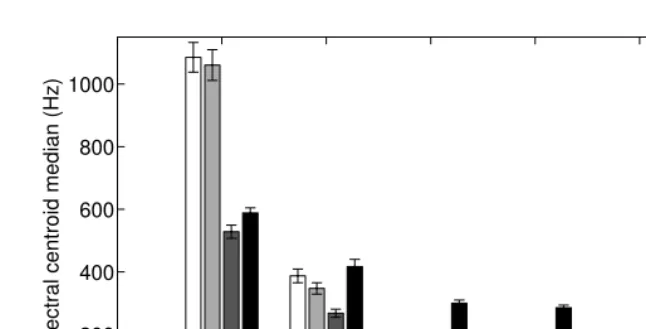
Fig. 1.Mean and standard error of six performance iterations for standard bowing of the pitch A3 played on strings 2 to 7, as captured by the spectral centroid median of
the Short-Term Fourier Transform power spectrum. The open string (2) showed a high centre of gravity, especially when recorded by the DPAs. For the stopped strings (3–7) the three ‘close’ microphones recorded lower values than the ‘far’ Neumann microphone.
3.2 Performance Iteration
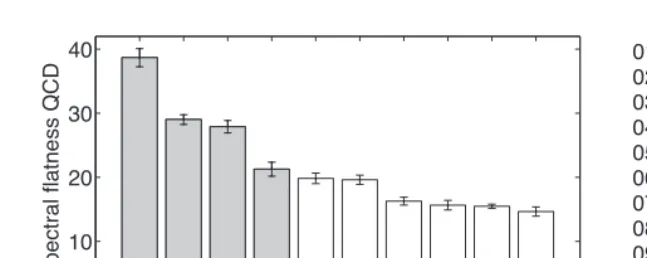
The following analysis incorporates data from the three ‘close’ recording strate-gies, using the on- and off-instrument microphone positions that are frequently encountered in performance (cf. § 2.2). Figure 2 presents a range of performance techniques for the pitch A3, ranked according to their variability,QCD, derived from the spectral flatness of the STFT power spectrum. The spectral flatness measure approaches 1 for ‘noisy’ timbres (with characteristically flat spectra) and 0 for ‘peaky’ spectra comprising sinusoidal (tonal) components [22]. Here, it is not the flatness parameter value that is of primary interest, but rather its consistency through time (in a series of consecutive frames). When the balance of noisy and tonal components alters throughout the duration of the audio file (and a largeriqrresults for a givenmedianvalue), theQCDincreases. Figure 2 clearly shows that the four extended techniques (ranking 1–4) were measured as being inherently unstable in comparison to the standard bowing techniques (ranking 5–10). Though extended techniques are often reported to be difficult for a player to reproduce consistently, the variability recorded in this data was in fact similar to that of standard bowing on the open string (the error bars are of comparable size).
4
Discussion
01 02 03 04 05 06 07 08 09 10 0
10 20 30 40
Technique
Sp
e
ct
ra
l
fl
a
tn
e
ss
Q
C
D 01 = str 2, colegtratnot02 = str 2, alf
[image:8.595.78.402.57.186.2]03 = str 2, sulpont 04 = str 2, sultast 05 = str 5, bow 06 = str 2, bow 07 = str 3, bow 08 = str 4, bow 09 = str 6, bow 10 = str 7, bow
Fig. 2. Ten techniques ranked according to their quartile coefficient of dispersion (QCD) derived from the spectral flatness of the Short-Term Fourier Transform power spectrum. Extended techniques (shaded) were unstable and resulted in high QCD
scores (col legno tratto– with the wood of the bow (notched from previous use);
anoma-lous low frequencies– frequencies below the fundamental of the string (subharmonics);
sul ponticello– bowing at the bridge;sul tasto– bowing over the fingerboard). The
stan-dard bowing techniques (unshaded) were more stable in their spectral flatness measure throughout the full duration of the sound, and achieved lowerQCD scores.
[22] and used to quantify variation attributable to the microphone setup and to human reproducibility for a range of normal and extended performance tech-niques. For standard bowing techniques, close microphone positions produced similar numerical values for the spectral centroid (median), irrespective of the microphone type or location (§ 3.1). However, this measure did not describe the stability of this centroid over time. When the spectral flatness parameter varia-tion was addivaria-tionally tracked throughout the duravaria-tion of the sound (using iqr) and incorporated in a dispersion measurement to assess iterative consistency, extended bowing techniques were found to contain more inherent variation than normal bowing (§ 3.2).
Much work has been done in recent years to extract control parameters from audio signals in live performance. Simple parameters with small computational loads were typically favoured (e.g., pitch, duration and mean amplitude [1]; pitch, amplitude, and ‘roughness’ [4]). At times, richer feature sets and more sophis-ticated approaches have been implemented (e.g., a dynamic performance state vector approach using instrument-appropriate features [2]; hidden Markov mod-els with spectral, pitch strength and textural features [3]). However, it appears in all these works that signal variability arising from a change of room, microphone or performance iteration was considered either negligible or irrelevant.
8 A. V. Beeston and M. A. C. Summers
References
1. Parker, M.: Searching sound with sound: Creating sonic structures from sound li-braries. In: 2nd International Verband Deutscher Tonmeister (VDT) Symposium (2007)
2. Young, M.W.: NN Music: Improvising with a ‘living’ computer. In: International Computer Music Conference (ICMC), pp. 508–511 (2007)
3. Van Nort, D., Braasch, J., Oliveros, P.: A system for musical improvisation com-bining sonic gesture recognition and genetic algorithms. In: 6th Sound and Music Computing Conference (SMC), pp. 131–135 (2009)
4. Hsu, W.: Strategies for managing timbre and interaction in automatic improvisation systems. Leonardo Music J. 20, 33–39 (2010)
5. Tremblay, P. A., Schwarz, D.: Surfing the waves: live audio mosaicing of an electric bass performance as a corpus browsing interface. In: 10th International Conference on New Interfaces for Musical Expression (NIME), pp. 15–18 (2010)
6. Biber, H. I. F.: Battalia (1673)
7. Strange, P., Strange, A.: The contemporary violin: extended performance tech-niques. University of California Press, Berkeley (2001)
8. Turetzky, B.: The contemporary contrabass. 2nd ed. University of California Press, Berkeley (1989)
9. Kimura, M.: How to produce subharmonics on the violin. J. New Music Res. 28(2), 178–184 (1999)
10. Stilp, C. E., Alexander, J.M., Kiefte, M., Kluender, K.R.: Auditory color constancy: calibration to reliable spectral properties across nonspeech context and targets. Atten. Percept. Psycho. 72(2), 470–480 (2010)
11. Watkins, A. J.: Perceptual compensation for effects of reverberation in speech identification, J. Acoust. Soc. Am. 118(1), 249–262 (2005)
12. Fritts, L.: University of Iowa Musical Instrument Samples (MIS),
http://theremin.music.uiowa.edu/MIS.html
13. Goto, M., Hashiguchi, H., Nishimura, T., Oka, R.: RWC Music Database: Music Genre Database and Musical Instrument Sound Database. In: 4th International Conference on Music Information Retrieval (ISMIR), pp. 229–230 (2003)
14. Opolko, F., Wapnick, J.: The McGill University Master Samples collection on DVD (3 DVDs). McGill University, Quebec, Canada (2006)
15. Vienna Symphonic Library,http://www.vsl.co.at
16. UVI, IRCAM Prepared Piano,
http://www.uvi.net/en/composer-tools/ircam-prepared-piano.html
17. UVI, IRCAM Solo Instruments,
http://www.uvi.net/en/composer-tools/ircam-solo-instruments.html
18. Eerola, T., Ferrer, R.: Instrument library (MUMS) revised. Music Percept. 25(3), 253–255 (2008)
19. Audacity, version 1.3.14,http://audacity.sourceforge.net
20. Praat, version 5.0.40,http://www.praat.org
21. Matlab, version 8.1.0.604 (R2013a),http://www.mathworks.co.uk
22. Peeters, G., Giordano, B. L., Susini, P., Misdariis, N., McAdams, S.: The Timbre Toolbox: extracting audio descriptors from musical signals. J. Acoust. Soc. Am. 130(5), 2902–16 (2011)
23. Francis, A.: Business mathematics and statistics. 6th ed., pp. 150–155. Thomson Learning, London (2004)