Review
Chemical equilibrium analysis of hydrogen production from shale gas
using sorption enhanced chemical looping steam reforming
Zainab Ibrahim S G Adiya
⁎
, Valerie Dupont, Tariq Mahmud
School of Chemical and Process Engineering (SCAPE), The University of Leeds, Leeds LS2 9JT, UK
a b s t r a c t
a r t i c l e i n f o
Article history: Received 21 July 2016
Received in revised form 14 January 2017 Accepted 16 January 2017
Available online xxxx
Detailed chemical equilibrium analysis based on minimisation of Gibbs Energy is conducted to illustrate the ben-efits of integrating sorption enhancement (SE) and chemical looping (CL) together with the conventional catalyt-ic steam reforming (C-SR) process for hydrogen production from a typcatalyt-ical shale gas feedstock. CaO(S)was chosen
as the CO2sorbent and Ni/NiO is the oxygen transfer material (OTM) doubling as steam reforming catalyst. Up to
49% and 52% rise in H2yield and purity respectively were achieved with SE-CLSR with a lower enthalpy change
compared to C-SR at S:C 3 and 800 K. A minimum energy of 159 kJ was required to produce 1 mol of H2at S:C 3
and 800 K in C-SR process, this significantly dropped to 34 kJ/mol of produced H2in the CaO(S)/NiO system at
same operating condition without regeneration of the sorbent, when the energy of regenerating the sorbent at 1170 K was included, the enthalpy rose to 92 kJ/mol H2, i.e., significantly lower than the Ca-free system. The
pres-ence of inert bed materials in the reactor bed such as catalyst support or degraded CO2sorbent introduced a very
substantial heating burden to bring these materials from reforming temperature to sorbent regeneration temper-ature or to Ni oxidation tempertemper-ature. The choice of S:C ratio in conditions of excess steam represents a compro-mise between the higher H2yield and purity and lower risk of coking, balanced by the increased enthalpy cost of
raising excess steam.
© 2017 Published by Elsevier B.V. Keywords:
Shale gas Steam reforming Chemical looping Sorption enhancement
Contents
1. Introduction . . . 129
2. Process description . . . 130
3. Methodology of the thermodynamic equilibrium calculation . . . 132
4. Results and discussion . . . 133
4.1. Effect of temperature and presence of C2-C3 feedstock on both C-SR and SE-SR processes . . . 134
4.2. Effect of steam to carbon ratio on steam reforming processes . . . 134
4.3. Sorption enhancement with CaO sorbent (SE-SR) . . . 135
4.4. Chemical looping with NiO coupled with steam reforming (CL-SR) of shale gas . . . 136
4.5. Sorption enhanced chemical looping steam reforming . . . 138
4.5.1. H2yield, H2purity and selectivity to carbonate . . . 138
4.5.2. Enthalpy balance of SE-CLSR . . . 138
4.5.3. Effect of inert materials on enthalpy balance of the cyclic processes . . . 140
4.6. Carbon product . . . 140
4.7. Effect of pressure on C-SR and SE-CLSR . . . 142
5. Conclusion andfinal remarks . . . 142
Acknowledgments . . . 142
Appendix A. Supplementary data . . . 142
References . . . 142
⁎ Corresponding author.
E-mail addresses:[email protected](Z.I. S G Adiya),[email protected](V. Dupont).
http://dx.doi.org/10.1016/j.fuproc.2017.01.026
0378-3820/© 2017 Published by Elsevier B.V.
Contents lists available atScienceDirect
Fuel Processing Technology
1. Introduction
Hydrogen is at present of enormous value in the production of synthetic fertilizers via ammonia manufacture, as well as an essential reagent in petroleum refinery operations[1,2]. Ammonia is the back-bone of the fertilizer industry and is generated in industrial processes by reaction between hydrogen and nitrogen at medium temperature and high pressure. Although the use of high pressure in the industrial H2production process is detrimental to the equilibrium feedstock
conversion and thus of the H2yield per mol of feedstock, it permits
the utilization of more compact and thus less capital intensive plants. Ammonia production individually represents the largest H2
consump-tion, with 50% of all the hydrogen produced in the globe[1–3]. Rapid growth in world population is generating increased demand for food and providing a continued need for agricultural chemicals, especially fertilizers[4]. World-wide ammonia capacity is anticipated to rise 16% (over/in comparison to 2013), reaching 245 Mt NH3in 2018[5].
Hydro-gen production, management and recovery within petroleum refineries is also increasing particularly in the production of low-sulphur and die-sel fuels using hydrotreating and hydrocracking processes[6,7]. Perhaps hydrogen is the most significant utility in a modern petroleum refinery
[8]. As more severe product specifications come into effect, a classic re-finery is either‘bottlenecked’due to lack of hydrogen or will be in the future[9]. The increasing stringent requirements on refinery products quality have effect on hydrogen production and demand. Hydrogen at refineries is provided in part by catalytic reforming (main product: cracked fractions, by-product: hydrogen), the remainder being supplied on site or off site by steam reforming (main product: hydrogen, by-product: CO or CO2), and, to a much smaller extent partial oxidation
and autothermal reforming are used[6,9]. Steam reforming can also form thefirst step in Fischer Tropsch processes, which convert natural gas to gasoline-like liquid fuel[10]via‘GTL’technology. Feedstocks for steam reforming at refineries vary from gases (natural gas‘NG’, but also, associated gases,flare gas) to naphtha[11,12]. A boom in shale gas production[13]and unconventional gas resources in the world (e.g. hydrates) foresees that gas will remain the main feedstock of steam reforming in the near term, in contrast to naphtha, which is de-clining due to high availability of natural gas[13,14].‘Shale gas is a nat-ural gas found within shale formations’[15](a form of sedimentary rock). The recent development in oil and gas extraction e.g. drilling and fracking have made shale gas production economically viable. In 2013, the Annual Energy Outlook projected that the U.S (world largest producer of shale gas) natural gas production will increase an estimate of 44% over the next 30 years. Enormous amount of this projected in-crease is expected from shale gas extraction. Shale gas is also expected to grow from 7.8 million MMcF (million cubic feet) extracted in 2011, to 16.7 million MMcf in 2040. In future, shale gas production in the U.S is anticipated to rise, whereas all other extraction method are likely to remain steady or decline[15,16]. Furthermore, many developed countries have extensive natural gas distribution networks which can act as energy storage and transport facilities with lower losses than their electricity grids, which positions gas as an attractive energy carrier (e.g. UK). The use Natural Gas (NG) fuelled vehicles and NG power sta-tions is also increasing in the world. Gas feedstock composista-tions are characterised by significant content in hydrocarbons with carbon num-ber 2 to 6, in addition to the main component methane, as well as great-ly varying contents in N2, CO2, H2S according to their source[12].
Despite having reached technological maturity, steam reforming is one of the most energy consuming processes in hydrocarbon processing and ammonia production via its heating requirement, with additional disadvantages such as greenhouse gas and other air pollutants emission, high operational and maintenance cost[17].
Researchers are focusing onfinding alternative energy efficient tech-nologies that can mitigate the economic and environmental impacts of the forecasted large increases in hydrogen demand. Sorption enhance-ment (i.e. process with in situ CO2capture on a solid sorbent) which
shifts favourably the chemical equilibria of H2-producing reactions,
and chemical looping (i.e. oxygen for oxidative heat is provided by a solid transfer material undergoing redox cycles at medium tempera-tures), have both drawn attention as promising modifications to the conventional steam reforming process. This is because of their potential for significant energy savings and lower environmental impacts brought about by process intensification features and milder reactive conditions[18]. Addition of‘high temperature’(as opposed to‘flue tem-perature’) solid CO2sorbent in the reformer that captures CO2, shifts the
equilibrium of the steam reforming and water gas shift reaction towards maximum hydrogen yield and purity, as well as increasing feedstock conversion[19,20]. Moreover, CO2chemisorption is highly exothermic,
providing energy directly inside the reformer. Lyon and Cole[21] pro-posed the coupling of sorption enhancement and chemical looping to-gether for endothermic reactions such as steam reforming, the process first termed‘unmixed’reforming, was later termed‘sorption enhanced chemical looping’steam reforming (SE-CLSR). The process has been studied and analysed using variety of fuels, such as methane[18]and waste cooking oil[22], for hydrogen production using both the inter-connectedfluidised bed and thefixed bed reactors configurations, which both have their advantages and drawbacks. However, studies on the thermodynamic analysis and process simulation, which are rele-vant to both types of configurations are limited. Researchers have focused mainly on either the sorption enhanced process[23,24]or the chemical looping process[25]separately. Coupling of sorption en-hanced water gas shift and chemical looping with partial oxidation has also been investigated[18]. Moreover, to date, the processes that use typical/actual gas composition containing higher hydrocarbons and inert have not been investigated.
Global warming is presently one of the major concern in the world
[26]. The conventional steam reforming (C-SR) process is one of leading causes of global warming; by increasing the CO2(the primary
green-house gas bringing about global warming) concentration in the atmo-sphere. For every 4 mol of H2produced by complete steam methane
reforming process for example, a mole of CO2is generated. In addition
to tons of CO2generated and release into the atmosphere by furnace
flue gas. SE-CLSR process aimed to overcome this by capturing the CO2
during the steam reforming process[18,22,27]and eliminating the use of furnaceflue gas at steady state operation.
Sorbent degration is a major concern and drawback on sorption en-hanced processes. To make things worse degradation cannot be studied via equilibrium thermodynamics. Researchers worlwide work towards understanding the reasons behind sorbents' loss of CO2capacity with
repeated cycling and increasing the durability of Ca based CO2sorbent
[20,28].
In this study, a detailed thermodynamic equilibrium analysis of H2
production from Marcellus shale gas (see composition inTable 1) using SE-CLSR with CaO(S)sorbent and NiO as both catalyst and oxygen
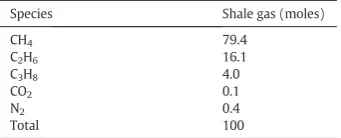
transfer material (OTM), was conducted. The gas represents a typical composition of natural gas, containing roughly up to 80% of methane with roughly 20% higher hydrocarbons (NC3), CO2and inert gas[29],
representing a mixture rich in ethane and propane. This composition can also be representative of typical composition of natural gases from Nigeria[30]and the North Sea[31], by containing up to 80% methane
[image:2.595.352.523.674.743.2][31]. The effect of different input parameters such as temperature,
Table 1
Composition of shale gas used for stimulations[63].
Species Shale gas (moles)
pressure, and molar steam-to-carbon ratio were investigated on the main process outputs of hydrogen yield, purity, feedstock and steam conversion, and carbon formation. The purpose of the study is to dem-onstrate the effect of coupling SE and CL in C-SR process as well as iden-tify optimum operating conditions of the studied processes using a realistic feedstock. Sorption enhanced reduction of the Nickel oxygen carrier catalyst is also report in the present study for thefirst time.
2. Process description
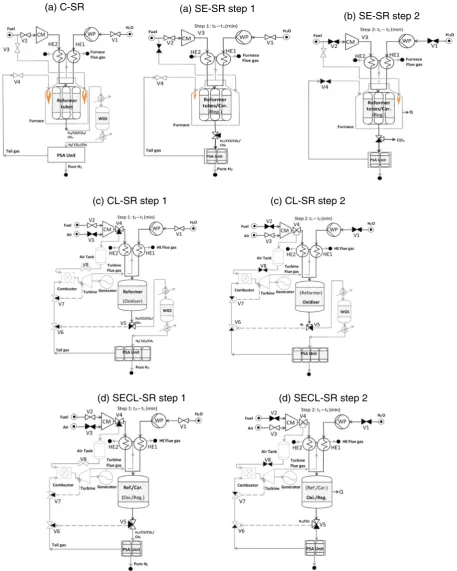
Steam methane reforming (SMR) is the most established and com-monly used process to produce hydrogen on a large scale[32]. Approx-imately, 90% of the world's overall hydrogen production is by SMR of fossils fuels[3,32,33].Fig. 1a depicts a simplified schematic representa-tion of the convenrepresenta-tional SMR process henceforth termed‘C-SR’.
(a) C-SR
(c) CL-SR step 1
(c) CL-SR step 2
(d) SECL-SR step 1
(d) SECL-SR step 2
[image:3.595.64.522.136.708.2](b) SE-SR step 2
(a) SE-SR step 1
Fig. 1.Schematic description of (a) C-SR, (b) SE-SR steps 1 & 2, (c) CL-SR steps 1 & 2 and (d) SE-CLSR steps 1 & 2 processes. CaCO3(S)regeneration occurs during step 2 (highlighted in black, using energy from the exothermic oxidation and gas turbine). Units in grey colour are not covered in our calculation. Blacked out valve symbols (if any) represent closed toflow. Size of
The process (C-SR), consists of mainly two basic steps followed by separation. In thefirst stage; water (in the form of high-temperature steam) reacts with feedstock (mainly natural gas) to generate syngas (CO, CO2, H2O, H2) in the presence of nickel oxide catalyst at an elevated
temperature (almost 800–950 °C) and medium pressure (at 20–35 atm)
[34,35]. In the second stage, the water gas shift (WGS) reaction runs at a lower temperature (almost 200–400 °C)[36,37]. Although the latter re-action is exothermic, the overall energy demand of the process is signif-icantly endothermic, requiring part of the natural gas to be burnt in the reformer furnace. Separation of the H2from the syngas leaving the WGS
reactor (mostly unreacted CH4, CO, H2O, and CO2) is carried out in the
final stage. Numerous techniques can be used to undertake separation. Three of the most common techniques used are; pressure swing absorp-tion (PSA), membranes, cryogenics[38,39]. Chemical absorption for ex-ample CO2 scrubbing using methyldiethanolamine (MDEA) and
monoethanolamine (MEA) are also used for separation[40]. However, the separation step is not covered in the present thermodynamic analy-sis.Fig. 1a represents the most common configuration in industrial H2
production where a PSA unit performs the H2separation and the tail
gas from the PSA is recycled to the furnace and contributes to meet the reformers heating load.
The purpose of sorption enhanced steam reforming (SE-SR) is to enhance H2yield in the conventional steam reforming (C-SR) process
[41]. In 1868, H2production from hydrocarbon in the presence of
CaO(s)sorbent reportedly took place [18]. A patent for hydrogen
production using SE-SR process was issued as early as 1933[18,42]. As mentioned earlier, the C-SR process route has at least three basic steps; SMR process, WGS andfinally the separation/purification step. The logic behind SE-SR process is to perform all those three steps (SMR, WGS and CO2capture) simultaneously in a single reactor vessel
in the presence of a solid CO2sorbent. The role of CO2sorbent can be
performed cheaply by the abundant calcium oxide or calcium hydroxide
[18], but there are other suitable CO2sorbents such as hydrotalcites (e.g.
Mg6Al2(OH)16(CO)3 × 4H2O/K2CO3) and Li-based sorbents (e.g.
Li4SiO4). The process is usually configured either using two packed
bed reactors operated in cyclic reforming/calcining mode achieved with alternating feedflows, or twofluidised bed reactors with circulat-ing bed materials movcirculat-ing between the reformer (fuel reactor) and the calciner (air reactor). In both cases, the calcination conditions perform the regeneration of the CO2sorbent. Although, it is feasible to perform
reforming and calcination semi-batch wise in a single reactor vessel, resulting in intermittent H2production, a continuous operating process
using at least two reactor vessels seems to be more attractive[18]. The CO2produced during steam reforming is captured by the sorbent,
which once nearly-saturated with CO2, is regenerated in situ by
temper-ature or pressure swing adsorption principle. For a Ca-based sorbent, as the CO2is been captured CaCO3(S), the equilibrium of the H2-producing
reactions is shifted towards the right, increasing hydrogen generation at fairly lower/medium temperatures (723–873 K) compared to the con-ventional (C-SR) process (1073–1300 K)[18,20,43,44].Fig. 1b depicts a schematic of the two-step SE-SR process in a packed bed confi gura-tion, where step 1 is the H2producing step and step 2 the CO2sorbent
regeneration step. The sorbents play a significant role in the SE-SR pro-cess. It is vital for the sorbent to have some certain basic characteristics such as; high selectivity and adsorption ability at operating temperature and pressure, good and steady adsorption capability of CO2after
repeat-ed adsorption and desorption cycles, and good mechanical strength of adsorbent particles after cyclic exposure to high pressure streams[45, 46]. The most commonly used CO2sorbent is CaO[18], which is reduced
with CO2in an exothermic reaction forming CaCO3(S)[20]. The
carbon-ated sorbent can be regenercarbon-ated in order to be useable again by calcina-tion[18,20].
The advantages of SE-SR over C-SR process are; potential to use a lower operating temperature, reduction of purification steps and extent of the reduction, minimisation of reactor size and decrease in the quan-tity of steam to be used as opposed to C-SR[45,46]. Brun-Tsekhovoi et al.
[47]revealed that the SE-SR process is able to reduce the overall energy required by the system with a potential of saving up to 20–25% as opposed to the C-SR process. In addition to these benefits, the SE-SR process has the advantage of increasing feed conversion, producing high purity hydrogen with a minimum CO2, proficient CO2capture
from the product as CaCO3(S), and potential to generate pure CO2during
the sorbent calcination step that is suitable for subsequent use or sequestration[45,46,48]. These advantages are illustrated inFig. 1b in contrast toFig. 1a by the absence of WGS stage, a smaller PSA unit, and no large demand of fresh natural gas in the furnace. In the past few years, various SE-SR pilot plants with capacity of 2–20 MW were built in Sweden, Australia, and Germany[49–51]. However, all of the plants used wood chips or woods pellets as fuel for syngas production and the process was demonstrated during gasification[49]. Presently, numerous research groups, both at research institutes and university levels, are investigating the performance of the SE-SR process[41]
using various/diverse fuel and feedstocks ranging from methane[24]
to propane[23], including hydroxyacetone[52], acetic acid[53], and urea[20].
The chemical looping steam reforming (CL-SR) is a special case which combines chemical looping combustion (CLC) and steam reforming. A metal oxide is used as an intermediate to transport oxygen from air to fuel in order to provide heat of oxidation to the endothermic H2production process. This necessitates keeping the air to fuel ratio low
to avoid the fuel from been oxidised completely to H2O and CO2[18].
Fig. 1c depicts a schematic of the CL-SR process, step 1 representing the OTM reduction combined with H2production, and step 2
corre-sponding to the oxidation of the OTM.
The process gas is fed into the reactor where both reduction of OTM and steam reforming occur simultaneously. A fraction of the feedstock is expected to be used as reductant in the metal oxide reduction to pro-duce H2O and CO2but the remainder would then reform to CO/CO2
and H2by the catalytically active reduced metal. The second step
in-volves oxidation of the OTM back to its initial state. A best choice of OTM for CL-SR is nickel, as it not only an excellent steam reforming cat-alyst when reduced by hydrocarbonflow (or NH3, or H2)[54]but is
readily oxidised (mainly to NiO) using air, thus an ideal OTM for the CL-SR process. However, the heats of reactions are dependent on oxy-gen carrier and fuel type[55,56]. The large scale application of CLC and CL-SR is still reliant upon the obtainability of appropriate oxygen carriers. The most commonly studied OTMs are oxides of nickel, copper, iron and manganese. Nickel has been the most used oxygen carrier and considered as state of the art[57,58]because of its high reactivity, neg-ligible volatility, and thermal steadiness which are favourable factors for elevated temperature and high gas turbine CLC[55,56,59,60]. Neverthe-less, nickel in particulate form is toxic upon inhalation, and has a ther-modynamic constraint of 99–99.5% fuel conversion, conditional on temperature and pressure[58]. Advantages of the CL-SR process over conventional steam reforming are illustrated inFig. 1c in comparison toFig. 1a, where the overall surplus energy contained in the syngas and lack of external heating demand in the reformer would in theory permit operating a combustor/gas turbine/electrical generator system. As a result single‘squat’reformer units would be possible that would made the whole plant economical at smaller scales.
The combination of sorption enhancement and CL-SR in one single process and is called sorption enhanced chemical looping steam reforming (SE-CLSR). The material bed then consists of a mixture of par-ticles comprising of solid oxygen carrier and CO2sorbent. The reforming
reactor normally operates at a low/medium temperature, partially re-ducing the fuel with the oxygen provided by oxygen carrier and steam reforming most of the fuel, and at the same time any CO2produced
during the process is captured by the CO2sorbent, causing sorption
endothermic steam reforming and reduction reactions could be provid-ed by the exothermic sorbent carbonation reaction, while the heat from re-oxidation of the OTM is utilised for sorbent regeneration[19]in a separate time step. Hence, this could mean near complete elimination of dependency onflue gas use to provide reformer heat at steady state operation. However, full benefits of the process are discussed in detail later.Fig. 1d depicts the SE-CLSR process, with step 1 consisting of the combined OTM reduction, H2production under gas and steamflow
with in situ CO2capture by the sorbent, and step 2 carrying out the
coupled OTM oxidation under airflow and CO2sorbent calcination. It
is suggested that a smaller scale separation process be used, owing to the fact that nearly pure H2can be generated in step 1 of the process
under well chosen operating conditions. Another capital cost reducing aspect is that instead of needing to use an assembly of many long thin reformer tubes exposed to harsh combustion environments, the re-former could be a single reactor making little use of external heat (e.g. for startup only). The benefits of intensifying the C-SR process by using SE-CLSR technology are pointed out inFig. 1d in comparison to
Fig. 1a, where the furnace and WGS reactor are no longer required, the energy content of the separation gases is used to run (as an exam-ple) a combustor/gas turbine-generator, the‘squat’reformer aspect and the reduced separation stage all permit economical downsizing and potentially co-generation.
3. Methodology of the thermodynamic equilibrium calculation
The CEA (Chemical Equilibrium and Applications ) software by NASA
[62]was used to perform the thermodynamic equilibrium calculations of the gas-water-solid (Ca-based CO2sorbent/Ni-OTM) system of four
different processes as illustrated inFig. 1using a model composition of shale gas as the hydrocarbon feedstock. First, conventional steam reforming (C-SR), then sorption enhanced steam reforming (SE-SR), followed by chemical looping steam reforming (CL-SR) andfinally, sorption enhanced chemical looping steam reforming (SE-CLSR) have been simulated. The program uses a solution procedure based on the minimisation of the Gibbs energy function of a feed mixture consisting of hydrocarbon gas, water and solids (Ca-sorbent/Ni-OTM) to calculate the mole fractions of the equilibrium mixture of products. The CEA cal-culations were conducted at isothermal and isobaric conditions given the endothermicity of the main reaction of steam reforming, permitting changes in volume of the system and representing a reactor mostly ne-cessitating external heat. However, the energy balance of the combined processes will show exothermic balance in some cases, whereby the iso-thermal conditions would have represented a cooled reactor. Included in the program outputs were specific enthalpy, internal energy, entropy and molar masses of the initial and equilibrium mixtures.
The species considered at equilibrium in the gas-water system in addition to all the gaseous reactants (CH4, C2H6, C3H8, N2, CO2and
H2O) were: H2, CO, C(S), and NH3when simulating the C-SR process.
In addition, Ca containing solid species CaO(S)and Ca(OH)2(s)were
included in the reactant mixtures of the sorption enhanced processes (SE-SR and SE-CLSR), with CaCO3(s)as additional product, while
NiO(S)was included in the reactant mixture of the chemical looping
processes (CL-SR and SE-CLSR), with Ni(S)as additional product
spe-cies. Other related species such as CH2, CH3, CH2OH, C2H4, C2H5, and
CH3COOH to mention few, were also included in the equilibrium
cal-culations but their molar fractions wereb5 × 10−6and considered
negligible.
The thermodynamic properties (specific heats, enthalpies, entro-pies) for the initial feed mixture and the equilibrium mixture of products were obtained from NASA[62]and the NIST (National Insti-tute of Standards and Technology) database. The Aspen Plus software's RGibbs model reactor with ideal as well as Peng-Robinson thermodynamic properties were also used for the verification of re-sults. The selected feedstock model composition was based on values found in the literature[63]. A shale gas containing roughly up to 80%
of methane with a significant quantity of higher hydrocarbons (NC1), CO2and inert gas was simulated, representing a mixture rich in
eth-ane and propeth-ane. Conditions at equilibrium were provided on the basis of moles of each hydrocarbon gas input (CH4, C2H6, C3H8), the
molar steam-to-carbon ratio (S:C), the molar calcium-to-carbon ratio (Ca:C), and the molar nickel oxide-to-carbon ratio (NiO:C), as well as system pressure and temperature. The four S:C equilibrium conditions of 0, 1, 2, and 3 were calculated in the study, where‘C’ represents‘hydrocarbon’moles of carbon in the gas feed, and S the moles of water feed, as steam. Their choice is justified as follows: S:C of 0 represents the thermal decomposition of the gas. S:C of 1 is the stoichiometric S:C ratio for complete conversion of CnH2n
feed-stock to CO and H2, hence it represents the minimum S:C ratio of
practical operation for H2generation. S:C of 2 is the condition of
stoi-chiometry for complete conversion of CnH2nto CO2and H2
forma-tion, while S:C 3 is the condition of excess steam typically used in industrial steam methane reforming, aimed at H2production rather
than syngas generation[20]. The excess steam also increases the yield and purity of H2via Le Chatelier's principle, and in practice
in-hibits carbon deposition on the catalyst as well as consumes already formed carbon deposits, if any, via steam gasification.
The authors applied their own post processing procedures allowing the calculations of reactants conversions and molar yields of products. A carbon balance was used to facilitate the calculation of the equilibrium total moles produced for the initial mixture chosen (‘Neq’) and derive products yields and reactants conversions‘Xi’using Eqs.(1.1)–(7). Presentation and discussion of results was based on the following definitions:
Neq¼ ∑
i;inαi nCi;in
∑ j;eqα
jyCj;eq ð
1:1Þ
wherenCrepresents number of moles of carbon species represented by the subscript indicesiin the initial‘in’mixture, andjin the equilibrium ‘eq’mixtures.αis the number of carbon atoms in the relevant carbon species.yC,j,eqare the equilibrium mol fraction of carbon containing spe-ciesj. Henceforth, molar amountsnj,eqobey the equation:
nj;eq¼yj;eqNeq ð1:2Þ
whereystands for molar fraction of a particular species in the relevant mixture. Reactants gas and steam conversions (percent or fraction) were defined based on Eqs.(2)-(3)
Xgasð Þ ¼% 100 ∑
i;inαi
nCi;in− ∑ i;inαi
nCi;eq
∑ i;inαi
nCi;in ð
2Þ
XH20¼
nH2O;in−nH2O;eq
nH2O;in ð
3Þ
wherenis the number of moles of the relevant species (e.g.‘H2O’is the
sum of moles of water) in the relevant conditions (e.g.‘in’or‘eq’). In Eq.
(2)subscriptiis relevant only to the hydrocarbon species present in the feed mixture.
Two definitions of H2yield were used: on mass basis, expressed as %
mass of fuel feed (Eq.(4)), and on an absolute molar basis (Eq.(5))
H2yieldðwt:%Þ ¼
1002:02 g of H2 mol of H2
nH2;eq
MWgas g of gas
mol of gas
ngas in
ð4Þ
And H2purity was defined using Eq.(6).
H2purity dry basisð Þ ¼
nH2;eq ∑nj;eq
100 ð6Þ
A Ca:C ratio of 1 was used in the SE processes, representing the stoi-chiometry of the calcium oxide and calcium hydroxide carbonation re-actions. The regeneration temperature of 1170 K (~ 900 °C) was selected to represent temperatures used in practice for decarbonation (calcination) of calcium carbonate in mixtures that may have siginificant CO2content[20,64]. Calculations were made based on the
following outputs, where TRis the reaction temperature:
Carbon products selectivity to CaCO3:
SC to CaCO3¼
nCaCO3;eq TnC;eq
100 ð7Þ
The enthalpy balances were performed by summing up the‘ reac-tants’terms to the‘reaction’terms according to the relevant step in the process covered.‘Reactants’term is the enthalpy change of bringing individual reactants from ambient temperature (25 °C) and in their nat-ural phase to a given reaction temperature and potentially new phase (e.g. liquid water to water vapour). A‘Reaction’term is the enthalpy change of conversion to products isothermally at the given reaction temperature for the process step considered. Thermal efficiency of the process is assessed via the‘ΔH ratio’factor.‘ΔH ratio’is the ratio of the total enthalpy change of generating 1 mol of H2via the equilibrium
steam reforming process under consideration (e.g. C-SR, SE-SR, etc.) to that of generating 1 mol of H2via thermal water splitting. Total enthalpy
change assumes reactants in their natural state at 298 K (25 °C) and ending with products at reaction temperature.ΔH ratios below the value of 1 showcase a H2production process that is thermodynamically
advantageous to water splitting. Furthermore, a negativeΔH ratio is ob-tained for an overall exothermic H2production process. Two scenarios
were considered in the processes that featured solids:‘A’is used for a total energy balance which does not account for the energy of regener-ation of the CO2sorbent while‘B’includes the sorbent regeneration
en-ergy. The enthalpy terms with the index‘1’apply to step 1 of the process considered (fuel and steam feed), and‘2’to step 2 (air feed). These ter-minologies are used in thefigures legends and their relevant equations are provided in the supplementary data section.
4. Results and discussion
In this section the effects of nine system conditions on the equi-librium process outputs are discussed, namely: varying tempera-ture, varying S:C ratio, reforming with or without Ca-based CO2
sorbent, when using CaO, reforming with Nickel Oxygen Transfer Material, reforming with both Ca-based CO2sorbent and Ni-OTM,
effect of alumina (Al2O3) support and degraded sorbent on
enthal-py, solid carbon formation andfinally pressure. The precise gas composition selected for this study is given inTable 1and corre-sponds to Marcellus shale gas (North America). A comparison be-tween C-SR of the shale gas with SE-SR followed by CL-SR and finally SE-CLSR was made to assess the effect on H2yield, purity
and energy efficiency of the processes, bearing in mind that C-SR of natural gas is at present the industrial standard of H2generation.
Figures and results at S:C ratio of 3 will be mainly used for illustrations.
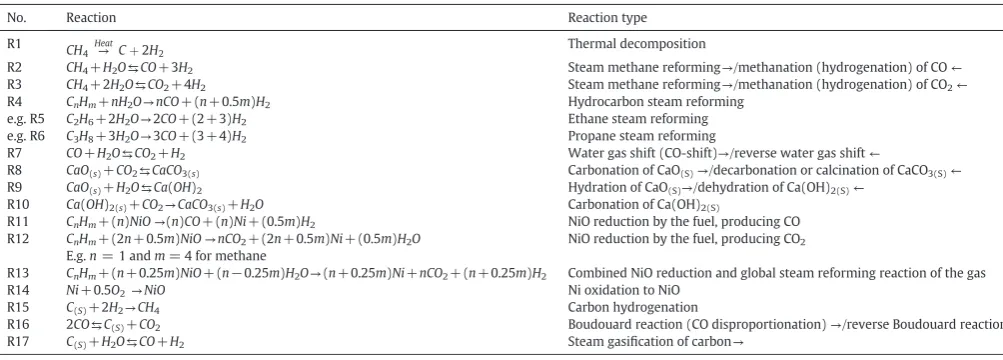
The chemical reactions involved in C-SR, SR, CL-SR- and SE-CLSR of shale gas are many and can be summarised by the global re-actions R1–R17 (Table 2). Based on the molar inputs ofTable 1for the shale gas/water equilibrium system, the maximum theoretical out-puts can be determined according to stoichiometry of the H2
produc-ing reactions listed inTable 2. Accordingly, the maximum H2yield is
obtained via the complete reactions R3, R5, R6 (steam reforming of CH4, C2H6and C3H8respectively) followed by complete R7 (WGS
re-action). This would correspond to a H2yield of 49.0 wt.% of the shale
gas feedstock using Eq.(4). Therefore chemical equilibrium calcula-tions of H2yield cannot exceed this value. In the case of H2purity,
the maximum could be obtained in two ways, thefirst of which by complete thermal decomposition of CH4, C2H6and C3H8(e.g. R1),
which would achieve a nearly pure H2 product. This, however,
would be to the detriment of the amount of H2produced (yield).
The second, more desirable way of obtaining a nearly pure gas prod-uct would be via complete reactions R3–R7 followed by complete carbonation via R8 or R10, after condensation of water product. The desirable outcomes of the equilibrium calculations are therefore first, a H2yield close to the maximum theoretical (stoichiometric)
yield, followed by low energy cost, followed last by high H2purity.
[image:6.595.45.547.566.746.2]This is because due to stringent purity requirements of some com-mercial applications, such as in chemicals, pharmaceuticals and pe-troleum industries, food and beverages industries[2]as well as fuel cell technologies [2,17]a last purification stage may always be needed.
Table 2
Main reactions identified in the gas-water-Ni-Ca equilibrium system.
No. Reaction Reaction type
R1 CH
4 → Heat
Cþ2H2 Thermal decomposition
R2 CH4+H2O⇆CO+ 3H2 Steam methane reforming→/methanation (hydrogenation) of CO←
R3 CH4+ 2H2O⇆CO2+ 4H2 Steam methane reforming→/methanation (hydrogenation) of CO2← R4 CnHm+nH2O→nCO+ (n+ 0.5m)H2 Hydrocarbon steam reforming
e.g. R5 C2H6+ 2H2O→2CO+ (2 + 3)H2 Ethane steam reforming e.g. R6 C3H8+ 3H2O→3CO+ (3 + 4)H2 Propane steam reforming
R7 CO+H2O⇆CO2+H2 Water gas shift (CO-shift)→/reverse water gas shift←
R8 CaO(s)+CO2⇆CaCO3(s) Carbonation of CaO(S)→/decarbonation or calcination of CaCO3(S)←
R9 CaO(s)+H2O⇆Ca(OH)2 Hydration of CaO(S)→/dehydration of Ca(OH)2(S)←
R10 Ca(OH)2(s)+CO2→CaCO3(s)+H2O Carbonation of Ca(OH)2(S)
R11 CnHm+ (n)NiO→(n)CO+ (n)Ni+ (0.5m)H2 NiO reduction by the fuel, producing CO R12 CnHm+ (2n+ 0.5m)NiO→nCO2+ (2n+ 0.5m)Ni+ (0.5m)H2O
E.g.n= 1 andm= 4 for methane
NiO reduction by the fuel, producing CO2
R13 CnHm+ (n+0.25m)NiO+ (n−0.25m)H2O→(n+0.25m)Ni+nCO2+ (n+ 0.25m)H2 Combined NiO reduction and global steam reforming reaction of the gas
R14 Ni+ 0.5O2→NiO Ni oxidation to NiO
R15 C(S)+ 2H2→CH4 Carbon hydrogenation
R16 2CO⇆C(S)+CO2 Boudouard reaction (CO disproportionation)→/reverse Boudouard reaction←
4.1. Effect of temperature and presence of C2-C3 feedstock on both C-SR and SE-SR processes
H2yield and purity plots between 500 and 1200 K at S:C ratios of
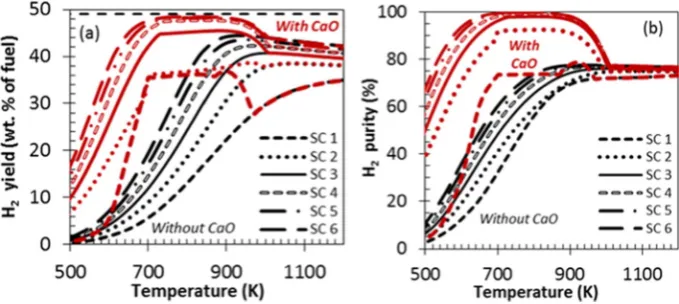
1, 2, 3, 4, 5 and 6 are displayed inFig. 2(a and b), respectively. These profiles illustrate a comparative analysis of C-SR and SE-SR of shale gas. In the absence of water (S:C = 0, not shown inFig. 2), the gas re-quired in excess of 900 K to undergo thermal decomposition and to begin converting significantly to H2. For S:C of 1, 2, and 3, H2yield
and purity increased steeply as temperature increased for both the processes. For C-SR, this was caused by conditions shifting from being favourable to methanation (main products CH4 and CO2
below 900 K) and other solid carbon forming reactions at a low tem-perature, to promoting steam methane reforming (main products H2
and CO2). This occurred up to roughly 1100 K, where H2yield and
rity declined and a gentle dwindling in both hydrogen yield and pu-rity was seen with further temperature increase, independent of the S:C ratio, and caused by reverse water gas shift. In the case featuring in situ CO2sorption (SE-SR), the H2yield and purity profiles with
temperature showed a much sharper rise with a wider range of pla-teau of maximum H2yield and purity with temperature, exhibiting
the sorption enhancement effects; this is discussed in more detail inSection 4.3. In the low temperature range (b720 K), the presence of C2and C3species in the reactant gas increases CH4yield signifi
-cantly resulting from the cracking of those species and methanation as further confirmed by the negative CH4conversion from 500 to
720 K for C-SR process and from 500 to 540 K for SE-SR process (not shown). The latter resulted from the exothermicity of methana-tion, favoured at low temperature. Sorption enhancement results in reducing the equilibrium concentration of CH4in favour of the
pro-cess at a higher temperature, thus the higher yield and purity than the conventional processs. Modelling the conditions S:C = 3 with Aspen Plus V8.8 (reactor option RGibbs, properties method Peng Robinson) resulted in an excellent agreement with the results de-rived from CEA. However, for the SE-SR process a slight difference (decreased in H2purity and selectivity of carbon to calcium
carbon-ate) was observed at 1000 K, which might result from the difference in thermodynamic properties of the programmes (ideal in CEA, non-ideal in Aspen Plus). Nonetheless this is relatively insignificant since Ca-sorption enhancement wanes at such high temperature. Similar thermodynamic studies were also conducted with or without Ca sor-bent (C-SR and SE-SR process) using several fuels including methane
[24], propane[23], hydroxyacetone[52], acetic acid[53], and urea
[20]. These results showed a similar trend to those of shale gas (this paper) with regards to H2yield and purity and the effect of
S:C ratio to be discussed later.
4.2. Effect of steam to carbon ratio on steam reforming processes
For the C-SR process, H2yield and purity behaviour with respect to
S:C ratio follows Le Chatelier”'s principle, whereby an increase in the water reactant concentration in the system moves the equilibrium to-wards higher water conversion, thus causing higher H2yield and purity
(Fig. 2). However, operating at a large S:C ratio requires higher reactor volume, as well as high operational expenditure for raising steam[20, 23,53]. The effect of S:C ratio levels off at higher values (above S:C 4 and 700–1200 K approximately)[65]as depicted inFig. 2. The slight in-crease in the temperature range of 500–700 K in both H2yield and
pu-rity (above S:C 4) is reasonably insignificant, as industrial steam reforming plant operate around 1073–1273 K roughly[36,37]. Further-more, using higher S:C ratio is known to cause catalyst and sorbent de-activation because of pore blocking[66,67]. Thus, S:C ratio of 3 typically used in industrial steam methane reforming will be focus on in the pres-ence studies[20]. The curves of H2yield and purity against temperature
for the varied S:C ratio demonstrate the benefits of operating with high S:C ratio. For example, at 800 K, with the C-SR process case at S:C ratio of 1, the equilibrium H2yield is 13.2 wt.% of fuel with 56.0% purity, but it
becomes 24.3 wt.% of fuel with 65.4% purity at S:C ratio of 3. This is equivalent to 84% and 17% rises in H2yield and H2purity, respectively.
The higher the S:C ratio, the closer the H2yield gets to the theoretical
(stoichiometric) maximum of 49.0 wt.%, as well as increasing H2purity.
The use of high S:C ratio also prevents carbon product (potential deposition on the catalyst) through reaction (R17), however equilibri-um carbon is discussed separately inSection 4.6.
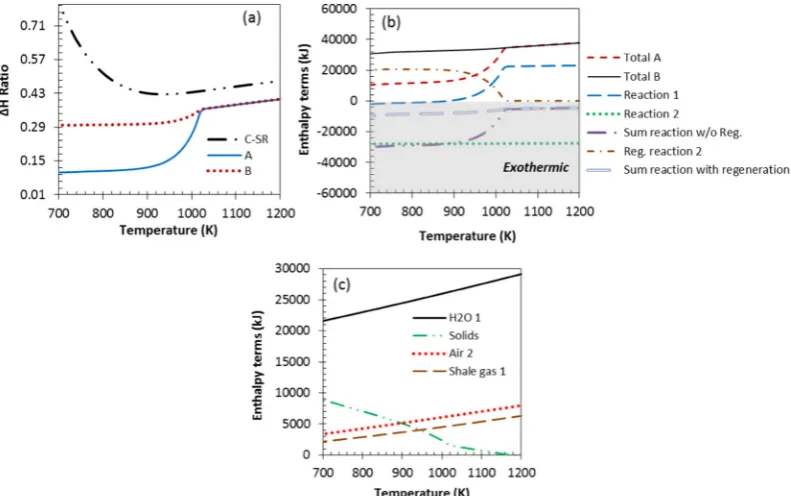
Fig. 3(a) depicts the impact of S:C ratio through the value of theΔH ratio for the C-SR process (2nd y axis). Recall that the furthestΔH ratio below 1, the more thermally efficient the process is. The profiles in
Fig. 3(a) indicate that theΔH ratio of C-SR penetrated theb1 viability area at similar temperatures of 670 K for S:C ratio of 1, 2, and 3. For S:C ratio of 0 the process was viable at roughly 600 K, representing a process where H2is only a minor product, this is confirmed by the
grow-ing energy costs of operatgrow-ing at increasgrow-ing S:C ratio, e.g. minimumΔH ratio of 0.41 was obtained at stoichiometric S:C ratio of 1 and 800 K, but minimumΔH ratio became 0.51 at the same temperature at S:C ratio of 3.
The energy balance for molar inputs of shale gas composition in
[image:7.595.123.463.575.727.2]Table 1is further analysed with the help ofFig. 3(b) which depicts in-dividual enthalpy terms profiles against temperature. The scales shown on the y axis ofFig. 3(b) in kJ are not particularly significant be-cause they depend on the molar inputs chosen for the system, however what is significant is the relative positions of each enthalpy term profiles in thefigure. The total enthalpy change of the process, and consequently theΔH ratio, is seen to be dominated by the enthalpy change terms of
bringing the gas and water reactants to reaction temperature, and in particular that of the water reactant, as opposed to the change in reac-tion enthalpy. At S:C 1 the total enthalpy change of the process at 800 K and 1070 K were 129 and 118 kJ per mol of H2produced,
respec-tively, which further increased to 150 and 130 kJ/mol H2at S:C 2, and
159 and 145 kJ/mol H2at S:C 3, indicating the increased energy penalty
of operating at higher S:C ratios.
4.3. Sorption enhancement with CaO sorbent (SE-SR)
Several benefits of in situ CO2sorption are identifiable in the
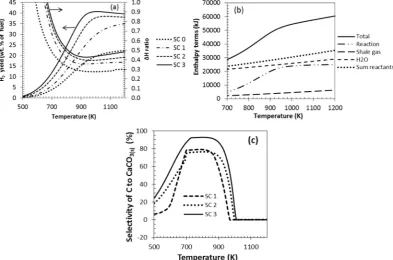
temper-ature zone of the highest CaCO3(s)yield (500–990 K) on the gas water
system at equilbrium. Firstly, H2yield increased, bringing it closer to
theoretical maximum as depicted byFig. 2(a). The effects of the CaO(s)
sorbent on the H2yield in the low temperature range was brought
about by the shift in equilibrium favouring the two H2generating
reac-tions (water gas shift and steam reforming), caused by removal of the CO2from the syngas product (see diagramFig. 1(b)). This would have
increased both H2yield and purity simultanously as seen inFig. 2. For
in-stance, the H2purity increased from 65.4% without Ca sorbent in the
system to 98.0% with CaO(s)sorbent, at S:C ratio of 3 and temperature
of 800 K. This is equivalent to 50.0% rise in purity between the two pro-cesses at a steam reforming temperature on the low side, ie. mild for the solid materials, thus preventing sintering. The latter was accompanied by significant CO and CO2reductions with dry mole fractions below
0.01 at 800 K and 0.1 at 1070 K. H2yield and efficiency of CO2capture
is favoured in the low temperature range not only due to thermal de-composition of the sorbent at higher temperatures but also because the equilibrium vapour pressure of CO2over CaO(S)is low at low
temperatures[18,19]. Effectively the SE-SR process extends by roughly 110–200 K (depending on S:C ratio in use) the conditions resulting in higher H2yield, shifted towards lower temperature, as depicted by
Fig. 2(a).
Two regions of temperature were observed in the trends of the pro-cess, that result from the sudden drops of Ca(OH)2(s)and CaCO3(s)
prod-uct yield to zero. This was expected because at temperatures higher
than 700 K, thermal decomposition of Ca(OH)2(s)occurs, while that of
CaCO3(s)happens at temperatures higher than 1000 K (Fig. 3(c)).
In addition, the presence of CaO(s)lowered the energy demand of H2
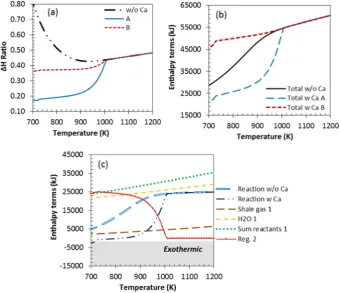
generation from the gas-water system. This can be seen in theΔH ratio farther from 1 for the system with CaO compared to the system without CaO, as shown inFig. 4(a), due to the lower total change in enthalpy ob-tained with CaO (Fig. 4b).
Another benefit is reduced energy demand, as shown by theΔH ratio notably below that of the sorbent-free system, even when accounting for regeneration of the CaCO3(s)back to CaO(s)through a
de-carbonation step conducted at 1170 K, as represented by case‘B’(Fig. 4). Sorbent carbonation was reduced at S:C ratio of 0 and 1 due to low car-bonate produced. Thus, the effect of sorption enhancement is not prop-erly active at those conditions. For S:C of 2 and 3 the SE-SR process was overall moderately endothermic without sorbent regeneration (case A), but became overall significantly endothermic when accounting for the regeneration step of the sorbent (case B). Regeneration enthalpy change dropped to zero above 1000 K for all the S:C ratios considered due to thermal decomposition of CaCO3(s), and as a result, theΔH ratio vs.
tem-perature profiles of the C-SR and SE-SR processes (with and without re-generation) merged with each other, making the later equivalent to the typical C-SR process. The heating cost of the gas was the same for the four S:C ratios (0, 1, 2, and 3) as their molar input remained unchanged. The enthalpy change of raising steam increased with S:C ratio as expect-ed. The energy of heating up the water further confirms the growing cost of operating at a high S:C ratio. The enthalpies of evaporating water and superheating steam at the reaction temperature still domi-nated the energy balance of the process with sorption enhancement as well. The reaction enthalpy is the backbone of the major difference seen between the two processes (C-SR and SE-SR), illustrated in the ΔH ratios as depicted byFig. 4(c). This no doubt can be accredited to the carbonation process which is strongly exothermic.
To illustrate the energy savings brought about by in situ CO2sorption
using CaO(s)sorbent, the case of S:C ratio of 3 is used. The minimum
[image:8.595.105.499.54.314.2]en-ergy required to bring the system at equilibrium, starting from feed ma-terials of the gas and liquid water at 298 K, was 159 kJ per mol of produced H2at 800 K without CaO(s)in the system. This decreased to
59 kJ/mol H2with CaO(s)without regeneration of the CaCO3(s)(i.e.
al-most isenthalpic). When including the enthalpy of CaCO3(s)
regenera-tion back to CaO(s)performed at 1170 K, the total enthalpy change
rose to 114 kJ per mol of produced H2at 800 K respectively, i.e. signifi
-cantly lower than the sorbent-free system. It is noteworthy that the H2
producing step (step 1) would be physically separate from the sorbent regeneration step (step 2), and thus during the H2production, near
autothermal conditions would be reached in step 1 of the SE-SR process. Accounting for Ca(OH)2(s)and CaCO3(S)as possible products of
CaO(s)conversion had different effects on process outputs depending
on the S:C ratio and temperature. In situ CO2capture by CaO(S)(R8)
and hydration reaction of CaO to produce Ca(OH)2(s)(R9) are active at
low to intermediate temperatures (b700 K) and the latter competes with both steam reforming and water gas shift reactions for water usage. At temperature of maximum H2yield, 800 K approximately,
re-moval of water by CaO was insignificant because thermal decomposi-tion of Ca(OH)2(s)occured at around the same temperature. Hence
CaO(s)was permitted to transform to CaCO3(s)producing the desired
sorption enhancement.
4.4. Chemical looping with NiO coupled with steam reforming (CL-SR) of shale gas
Fig. 5summarises the outputs of steam reforming of shale gas when coupled with chemical looping (CL-SR) using NiO as the oxygen transfer material. For the purpose of comparison of processes, the outputs of C-SR are also included in thefigure. The process was investigated byfirst varying the NiO:C ratio while maintaining S:C of 3 inFig. 5(a and b), then followed by changing the S:C between 0 and 3 while maintaining NiO:C 1.0 constant, as depicted inFig. 5(c and d).
In the CL-SR process, complete conversion of the gas and good selec-tivity towards the desired products was achieved. NiO reduction with
the fuel is thermodynamically possible at temperatures as low as 400 K, as indicated by negative water conversion below 400 K. Increas-ing the NiO:C ratio decreases monotonically the H2yield and purity
(Fig. 5a). The decrease in H2yield can be attributed to CL-processes
using part of the fuel according to either R11 (co products CO and H2)
or R12 (co-products CO2and H2O) to meet the energy demand of
steam reforming, a role that is normally played by the gasfired furnace in the C-SR process (seeFig. 1a). H2purity also decreases with growing
NiO:C ratio. This can be explained by concurrent CO2generation via the
NiO reduction reaction (R12).
One significant benefit of coupling C-SR with chemical looping is the reduced energy demand of the overall H2production. This is evidenced
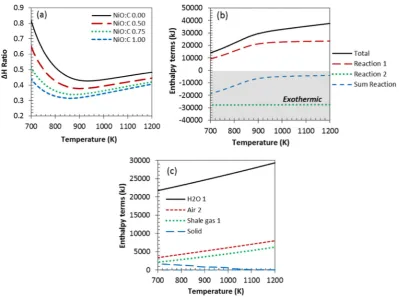
by theΔH ratio notably below that of the NiO-free system (Fig. 6). The reduced energy demand can be attributed to the strongly exothermic nickel oxidation process (one of the major difference be-tween the CL-SR and C-SR process) as shown inFig. 6(b). TheΔH ratio of the CL-SR process (steps 1&2) was fairly endothermic at low/ medium temperature (700–850 K) but slightly decreases at higher tem-peratures (850–1200 K) with increase in operating temperature. The overall energy demand of the process decrease with increase in NiO:C ratio, making the process almost autothermal at the highest NiO:C ratio (1.0). However, even at the lowest NiO:C ratio energy demand of the CL-SR proces was still siginificantly lower than that of the conven-tional process (see table SD4 in the supplementary data forΔH total andΔH ratio values with varying NiO:C ratios). As expected, theΔH ratio increased with increasing S:C (0–3) due to the accrued cost of rais-ing the excess steam, as explained earlier (figure not shown). This con-firmed that the CL-SR process was also dominated by the cost of raising excess steam (S:C ratio in use). The energy demand of the whole process was dominated in the order of contributions of the following enthalpy terms: sum heating up reactantsNsum reactions 1 & 2 as depicted in
[image:9.595.123.464.53.346.2]Fig. 5.(a) H2yield vs temperature at 1 bar, S:C 3 and varied NiO:C (0.5–1.0) (b) H2purity vs temperature at 1 bar, S:C 3 and varied NiO:C (0.5–1.0) (c) H2yield vs temperature at 1 bar, NiO:C of 1.0 and varied S:C (0–3) (d) H2purity vs temperature at 1 bar, NiO:C of 1.0 and varied S:C (0–3) (note: NiO:C 0.0 denote C-SR process and the straight line in H2yield represents the theoretical maximum).
[image:10.595.103.503.413.710.2]the order H2ONairNshale gas. The cost of heating up the gas was
rela-tively insiginificant compared to those of raising steam from liquid water feed and preheating air.
4.5. Sorption enhanced chemical looping steam reforming
4.5.1. H2yield, H2purity and selectivity to carbonate
The effect of temperature on H2yield and purity is illustrated inFig. 7
for the three processes (C-SR, SE-SR and SE-CLSR) in the particular case of Ni:C 1.0 and the two S:C of 2 and 3. Note that in the chemical looping processes CL-SR and SE-CLSR, some feedstock is consumed for NiO re-duction according to R11 and R12, while for C-SR and SE-SR the fuel is fully available for the steam reforming process. Thefigure clearly por-trays the significance of coupling sorption enhancement and chemical looping in steam reforming with both the superior H2yield ca. 700–
850 K and H2purity ca. 700–1000 K obtained for SE-CLSR compared to
the C-SR process (i.e. region of maximum CO2capture/efficient
carbon-ation reaction). The presence of the CO2sorbent shifts the
thermody-namic equilibria of both the steam reforming and the water gas shift reaction (R2 and R7) towards higher conversion to CO, then to CO2,
followed by capture of the CO2on the sorbent, with the carbon product
becoming almost exclusively solid calcium carbonate. Subsequently, the presence of the nickel based OTM in SE-CLSR led to even greater H2yield
(in region of effective carbonation) than C-SR, although part of the fuel was used for reduction. This is because the reduction of fuel by NiO (R12) produces total oxidation products CO2and H2O, with the former
being captured by the sorbent, and the latter increasing the water con-centration of the system, effectively achieving a double or synergetic en-hancement effect. The effect of coupling between C-SR and SE-SR on the H2purity in the low/medium temperature zone is explained by the effi
-ciency of CO2capture by the Ca sorbent. At high temperatures (roughly
above 1000 K), the efficiency of CO2capture declined rapidly and
dropped to zero, hence the SE-SR process reverted back to C-SR, as con-ditions favoured CaCO3decomposition[18,19]. Regarding H2purity in
the high temperature zone (above 1000 K), the inferiority of SE-CLSR process compared to C-SR and SE-SR was due to the additional CO2
present at equilibrium resulting from the NiO reduction, while C-SR and SE-SR performed equally due to decomposition of the CaCO3(S).
On the other hand, the inferiority of the process (SE-CLSR) compared to SE-SR with regards to H2yield was due to the fact that part of fuel
was used for NiO reduction while the fuel was completely available for steam reforming in the case of SE-SR process[68].
Therefore the optimal operating temperatures for both SE-SR and SE-CLSR at atmospheric pressure were around 700–850 K approximate-ly, as illustrated inFig. 7.
In practice, when using packed bed configuration used with alter-nating feedflows, it is envisaged that at least two packed bed reactors would be used in parallel, one undergoing the reductive stage with in situ CO2capture while the other is in oxidative stage with sorbent
[image:11.595.124.466.53.200.2]re-generation (and potentially carbon burn off), as shown inFig. 1(d).
Table 3compares the equilibrium outputs of C-SR and SE-CLSR process using CaO as the CO2sorbents at 800 K.
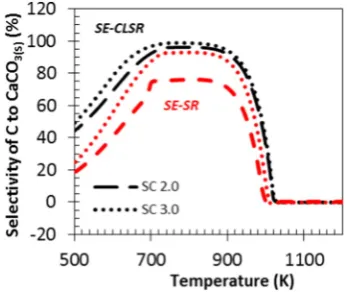
Fig. 8depicts the selectivity of carbon products to CaCO3(S)as a
func-tion of temperature for the SE-SR and the SE-CLSR processes. SE-CLSR offers higher selectivity to the carbonate product for a wider range of temperature over SE-SR with CaO. This is because the reduction process increased the water concentration in the system, in favour of CO2
forma-tion, hence allowing the maximum sorption. At temperatures above 1000 K the efficiency of the CO2capture declined because of the
favoured carbonate decomposition[18,19].
4.5.2. Enthalpy balance of SE-CLSR
[image:11.595.340.514.572.719.2]Significantly reduced energy demand was seen in the SE-CLSR process as despicted inFig. 9, notably below those of both the C-SR Fig. 7.(a) H2yield vs temperature with CaO(s)sorbent at 1 bar, Ca:C 1, NiO:C 1.0 and S:C 2 and 3(b) H2purity vs temperature with CaO(s)sorbent at 1 bar, Ca:C 1, NiO:C 1.0 and S:C 2 and 3 (note: the straight line in H2yield represent the theoretical maximum).
Table 3
Equilibrium outputs comparing C-SR and SE-CLSR at 800 K Ca:C 1, NiO:C 1.0 and S:C of 2 and 3.
S:C ratio
Conditions H2yield (wt.% of available fuel)
H2purity (%)
Selectivity of C to CacO3(s)(%)
2 Without Ca 19.0 59.2 n/a
2 With CaO & NiO 35.0 98.5 96.1
3 Without Ca 24.3 65.4 n/a
[image:11.595.34.285.683.744.2]and SE-SR process, even when accounting for complete regeneration of the CaCO3(s)back to CaO(s)via a decarbonation step conducted at
1170 K. TheΔH ratio without regeneration was slightly endothermic (overall authothermal process) at low/medium temperature range (700–900 K) for S:C 2 but moderately endothermic (almost autothermal process) at S:C 3 with CaO(s)sorbent. When the enthalpy
of regenerating the CaO(S)sorbent at 1170 K was included, theΔH ratios
became significantly endothermic (positive) but remained significantly lower than the C-SR process, thus more energetically favourable. The heating demand of the gas and air was the same for the S:C 2 and 3 as their molar input remained unchanged. On the other hand, the heating demand of water increased with increase in S:C ratio (discussed earlier) i.e. S:C 2bS:C 3. Although steam reforming and NiO reduction are endo-thermic processes, the total reaction enthalpy of the two-step cyclic process (stage 1 + stage 2) was overall exothermic, with the exother-micity decreasing with increase in stage 1 reaction temperature. We chose to show how this excess energy could be used by including a com-bustor/gas turbine/generator system inFig. 1(d), as it is the mostfl exi-ble way to utilise the enthalpy of combustiexi-ble as well as non-combustible streams via by-passing the combustor. The overall exother-micity resulted from the strongly exothermic Ni oxidation process, as shown inFig. 9. Both Ni oxidation and carbonation reactions have signif-icantly lowered the energy demand of the hydrogen production. The ΔH ratio of the two processes (C-SR and SE-CLSR) did not merge when decarbonation process stopped (at roughly 1000 K) like the SE-SR process, this effect can be explained by the activity of chemical looping and no doubt can be accredited to the strongly exothermic nick-el oxidation. The total energy cost of the process was, again, dominated by water enthalpy change followed by the reaction enthalpy (Fig. 9(c)). The results of the chemical looping processes (CL-SR and SE-CLSR) were further verified by the authors with Aspen plus‘RGibbs’reactor modelling and were in good agreement to those of CEA. Previous studies were conducted on CL-SR process by[25]and SE-CLSR process by[18, 19,65,69]. The results are in good agreement to those of the present study with regards to H2yield and purity, selectivity of carbon to
calci-um carbonates (SE-CLSR process only) as well as reduced energy re-quirement of the processes when compared to the conventional
process. Optimum operating conditions for SE-CLSR also happen to be in the same range to those reported in the present study 700–850 K, 1–4 bar pressure, S:C 3 and Ca:C 0.8–1[19]. Zhu and Fan, 2015[69]
analysed the influence of Ca:M ratio, M(fuel):M ratio and Ni:M ratio on SE-CLSR process using equilibrium calculations, they found Ca:M = 1, M(fuel):M of 0.2 and Ni:M of 0.8 were optimum operating condition. Their conclusion (production of high purity hydrogen in the lower operating temperature range compared to CL-SR process) is in good agreement with the present study. Fan and Zhu, 2015[70] investi-gated the performance of a novel polygeneration system driven by methane aimed at producing high-purity H2through chemical looping
combustion thermally coupled with CaO sorption enhanced methane steam reforming (they termed it CLC-SEMSR) combined with power generation through combined cycle. They stimulated the process using Aspen Plus exiting functions and build in functions. They found that the novel polygeneration system can achieve higher exergy efficiency of 83.1% compared to 68.7% in the C-SR process. Their conclusion that polygeneration systems for H2production and power generation
sim-plifies the overall process with a more reasonable utilization of fuel, in addition to CLC-SEMSR process potential to produce higher H2yield
and purity with reduced energy consumption for CO2separation is in
good agreement with the present study. However, all of the thermody-namic studies (on SE-CLSR process) focussed pure methane as fuel in previous literature and most of the previous studies such as[69,70]
usedfluidised bed reactor (air and fuel reactor separate). Researchers also investigated the performance of Ca-supported sorbent on the SE-CLSR process. For example, Fernandez et al.[71], modelled the SE-CLSR process using a Ni based (9% on Al2O3support) OTM/catalyst
and a Ca/Cu sorbent with pure methane feedstock. They investigated the effect of catalyst/sorbent ratio, space velocity, S:C ratio, temperature and pressure. They found the optimum operating condition in the tem-perature range of 923–1023 K, at low-medium pressures (5–15 bar) and high S:C ratio of 3–6. The differences in the optimum operating condi-tion with the present study could be attributed to differences in operat-ing conditions, model used for stimulation and most likely differences in CO2sorbent used in addition to the fact that temperatures lower than
[image:12.595.105.501.52.300.2]and complete process design of a H2generation plant using natural gas
as feedstock, Ni based OTM/catalyst and a novel Ca/Cu CO2sorbent as
well. Theirfindings, compact design and the use of cheaper materials compared to C-SR process is in good agreement with the present study (Table 4).
4.5.3. Effect of inert materials on enthalpy balance of the cyclic processes The presence of inert solid materials in the reactor bed does not af-fect the equilibrium materials balances (i.e. H2yield and purity are the
same with inert materials compared to without inert materials), as they do not affect the gas phase equilibrium reactions. However, inert materials would require heating or cooling as required during the cycles of the CL processes. There are two types of inert materials that may be present at any time in the reactor: the oxygen transfer catalyst support, and the degraded CO2sorbent material. During cyclic operation, the bed
materials require heating from reaction temperature to regeneration temperature (SE-SR with regeneration, and SE-CLSR) or to oxidation temperature (CL-SR), and the active part of the sorbent undergoes de-carbonation during regeneration. In the SE-CLSR process, Ni oxidation and decarbonation reactions occur together at sorbent regeneration temperature, 1170 K. In the following section, the individual effects of catalyst support and of degraded sorbent on the total enthalpy change of the cyclic processes are discussed.
4.5.3.1. Oxygen transfer catalyst support.In practice, oxygen transfer ma-terials as well as solid phase catalysts are structured so that a significant part of the material does not participate in the reactions (or it does in a minimal way), but imparts desirable properties to the reactor bed, e.g. morphological (high surface area), mechanical (strength) and thermal (phase stability), so they act as‘support’to the chemically active com-ponent[56]. Thus NiO is not used on its own in the reactor, but as part of NiO on a support. To represent this effect on the enthalpy balance, an 18 wt.% NiO on α-Al2O3 support (typical commercial steam
reforming catalyst)[73]was simulated for the CL-SR and the SE-CLSR processes (Fig. 10). This introducedα-Al2O3(corundum) as an
addi-tional‘inert reactant’in the molar ratio of Al2O3: NiO of 3.34, and the
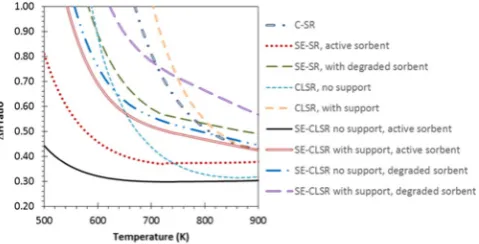
cases are described as either‘with support’or‘without support’. Typi-cally it was found that a cyclic process with support in proportions of
Al2O3: NiO of 3.34 saw itsΔH ratio increase by about 0.2 compared to
the same process without support, although the gap between the two reduced as reforming temperature increased. For instance, at the reforming temperature of 800 K, CL-SR without support had aΔH ratio of 0.33 compared to 0.54 with support. For the SE-CLSR, at 800 K,
ΔH ratio was 0.30 without support but 0.45 with support. By compari-son C-SR at 800 K had aΔH ratio of 0.51. Here the CL-SR appears at dis-advantage compared to the conventional process for reforming temperatures below 840 K, which was caused by the assumption that the nickel oxidation step was carried out at 1100 K. When reducing the oxidation temperature to 1050 K, which is sufficient to completely oxidise carbon black deposits on an 18 wt.% NiO/α-Al2O3catalyst[74],
theΔH ratios of the CL-SR with support and the C-SR processes were the same at a reforming temperature of 800 K.
This implies that heat recuperation from the solids and gases from the regeneration step, not represented here, could play a crucial role in making the CL-SR viable when using a highly supported catalyst. The incentive is thus to minimise the amount of support required for the bed materials to maintain the right properties.
4.5.3.2. Degraded CO2sorbent.Similarly, another potential additional en-ergy cost can be brought about by the deactivation of the CO2sorbent.
Over many cycles, natural Ca-based sorbents typically stabilise to ca. 8–10% of their‘fresh’CO2capacity[75]. Sorbent materials such as
lime-stone would then contain 90–92 wt.% of inert sorbent. The latter would also present a sensible enthalpy burden when bringing the bed mate-rials to regeneration temperature (here assumed 1170 K). The effect of degraded sorbent in the bed was represented by introducing in the reactants mix the equivalent of 90 wt.% of the total molar calcium in the feed as inert CaO. The Ca:C ratio of 1 quoted in thefigures refers to the active CaO.
TheΔH ratios of the SE processes (SE-SR and SE-CLSR with and w/o support) were seen to also increase by around 0.2 at 800 K for the cases with degraded sorbent compared to the active sorbent, with a narrowing gap as the reforming temperature approached the regenera-tion temperature of 1170 K. Note that above 880 K, the sorpregenera-tion en-hancement gradually disappeared as a result of decarbonation of the sorbent. This meant that, typically for reforming temperatures above 800 K, the SE-SR with 90% degraded sorbent and the SE-CLSR with sup-port and 90% degraded sorbent both became less energetically viable than the conventional C-SR process. For the SE-CLSR process with sup-port and 90% degraded sorbent to become more energetically viable than the C-SR process, reforming temperatures would have to reach 720 K, which is the equilibrium lower limit for sorption enhancement as perFigs. 7 and 8. This would imply the use of a very active steam reforming catalyst. At lower temperatures, energetics would be favourable but selectivity to hydrogen product would drop (lower yield and lower purity).
With regards to environmental aspects; SE-CLSR process could be an effective and eco-friendly way of generating H2if the challenges
associ-ated with the energy costs of heating the bed materials to regeneration/ oxidation temperature were to be addressed. The overall GWP of a C-SR plant is 11,888 g CO2equivalent/kg of H2from which Hydrogen plant
operation only account for 78.8% (8895 g CO2equivalent/kg of H2)
[76]. SE-CLSR would also have to address the issues of life cycle analysis brought about by the use, operation lifetime and recyclability of the OTM catalyst and sorbent materials. As the majority of the world's hy-drogen is generated through steam reforming of fossil fuels, there will be no elimination of greenhouse gases till CO2is sequestered at the
source[77].
4.6. Carbon product
[image:13.595.33.285.94.164.2]Generally, operating at a high S:C ratio inhibits solid carbon forma-tion, as gasification reactions are promoted. This is one of the reasons steam reforming plants aim to operate with some excess of steam. Fig. 10.SE-CLSR: process 2 at 1170 K, active Ca:C = 1, CL-SR: process 2 at 1100 K, S:C = 3,
[image:13.595.41.281.587.709.2]NiO:C = 1,“no support”: NiO 100 wt.%,“with support”: 18 wt.% NiO/Al2O3,“active sorbent”: 100% CaO,“degraded sorbent”: 10% active CaO and 90% inert CaO.
Table 4
Equilibrium outputs at 800 K (ΔH total andΔH ratio at 1 bar, Ca:C 1, NiO:C 1.0, and S:C 2 and 3. A and B mean without sorbent regeneration and with sorbent regeneration respectively).
Conditions ΔH total (kJ/mol H2) ΔH ratio
C-SR S:C 2 150 0.49
SE-CLSR S:C 2 With CaO A 12 0.04
SE-CLSR S:C 2 With CaO B 71 0.23
C-SR S:C 3 159 0.51
SE-CLSR S:C 3 With CaO A 34 0.11
Solid carbon in the equilibrium products not only deactivates catalyst by covering its active sites but also reduces H2yield and purity because it
represents carbon that does not react with steam to generate H2. Solid
carbon product is completely prevented at equilibrium conditions of S:C 2 and 3 in all the processes via steam gasification of carbon (R17)
[78]. As shown inFig. 11, solid carbon product mainly occurs at S:C be-tween 0 and 1, with the quantity of carbon product depending on the process in use. As expected, enormous carbon was generated at S:C ratio of 0 in both the Ca free and CaO(s)sorbent system. No doubt this
resulted from the absence of steam reactant in the system which lowered the amount of CO2product to be generated and thus to be
adsorbed. Hence, the process behaves like C-SR, consequently the out-puts of the SE-SR and C-SR processes at S:C 0 merge with each other. For S:C 1 in the Ca-free and CaO(s)sorbent system, solid carbon
equilib-rium product was siginificantly low (nearly zero) in the low tempera-ture range (500–650 K) but rose in the region of maximum H2yield
[image:14.595.133.473.53.197.2]before exhibiting a gentle dwindling that approches zero at higher tem-peratures (1000−1200 K). The sub stoichiometric conditions (limited water in the system) again are the reason behind this observation. As depicted inFig. 11(b), solid carbon product is significantly low in the CL-SR system compared to C-SR system at same operating conditions. This stems from the fact that water can be a product in the NiO reduc-tion process (R12), thus, favours suppression of equilibrium solid car-bon. At S:C 1 in the CL-SR system, solid carbon formation declines gradually and approches 0 significantly owing to the increase in water concentration in the system as mentioned previously. This further portrayed the positve impacts of operating at super-stoichiometric S:C ratio. In the SE-CLSR process, formation of solid carbon was completely eliminated not only at S:C ratio of 2 and 3 but also at S:C ratio 0 and 1 as well. This no doubt is attributed to effectively achieving sorption en-hancement of the NiO reduction reaction, which is identifed here for thefirst time, and the sorption enhanced steam reforming reaction. Fig. 11.Carbon yield at 1 bar and S:C 0 and 1, (a) Ca free and Ca sorbent systems, (b) Ca free and CL-SR system at NiO:C 1.0.
[image:14.595.133.474.416.719.2]