
Tourism in Europe 1995
216
0
0
Full text
(2) eurostat STATISTISCHES AMT DER EUROPÄISCHEN GEMEINSCHAFTEN STATISTICAL OFFICE OF THE EUROPEAN COMMUNITIES OFFICE STATISTIQUE DES COMMUNAUTÉS EUROPÉENNES L-2920 Luxembourg — Tél. (352) 43 01-1 — Télex COMEUR LU 3423 B-1049 Bruxelles, rue de la Loi 200 — Tél. (32-2) 299 11 11. Eurostat hat die Aufgabe, den Informationsbedarf der Kommission und aller am Aufbau des Binnenmarktes Beteiligten mit Hilfe des europaischen statistischen Systems zu decken.. It is Eurostat's responsibility to use the European statistical system to meet the requirements of the Commission and all parties involved in the development of the single market.. Um der Öffentlichkeit die große Menge an verfügbaren Daten zugänglich zu machen und Benutzem die Orientierung zu erleichtem, werden zwei Arten von Publikationen angeboten: Statistische Dokumente und Veröffentlichungen.. To ensure that the vast quantity of accessible data is made widely available, and to help each user make proper use of this information, Eurostat has set up two main categories of document: statistical documents and publications.. Statistische Dokumente sind für den Fachmann konzipiert und enthalten das ausführliche Datenmaterial: Bezugsdaten, bei denen die Konzepte allgemein bekannt, standardisiert und wissenschaftlich fundiert sind. Diese Daten werden in einer sehr tiefen Gliederung dargeboten. Die Statistischen Dokumente wenden sich an Fachleute, die in der Lage sind, selbständig die benötigten Daten aus der Fülle des dargebotenen Materials auszuwählen. Diese Daten sind in gedruckter Form und/oder auf Diskette, Magnetband, CD-ROM verfügbar. Statistische Dokumente unterscheiden sich auch optisch von anderen Veröffentlichungen durch den mit einer stilisierten Graphik versehenen weißen Einband. Veröffentlichungen wenden sich an eine ganz bestimmte Zielgruppe, wie zum Beispiel an den Bildungsbereich oder an Entscheidungsträger in Politik und Verwaltung. Sie enthalten ausgewählte und auf die Bedürfnisse einer Zielgruppe abgestellte und kommentierte Informationen. Eurostat übernimmt hier also eine Art Beraterrolle. Für einen breiteren Benutzerkreis gibt Eurostat Jahrbücher und periodische Veröffentlichungen heraus. Diese enthalten statistische Ergebnisse für eine erste Analyse sowie Hinweise auf weiteres Datenmaterial für vertiefende Untersuchungen. Diese Veröffentlichungen werden in gedruckter Form und In Datenbanken angeboten, die in Menütechnik zugänglich sind. Um Benutzem die Datensuche zu erleichtem, hat Eurostat Themenkreise, d. h. eine Untergliederung nach Sachgebieten, eingeführt. Daneben sind sowohl die Statistischen Dokumente als auch die Veröffentlichungen in bestimmte Reihen, wie zum Beispiel „Jahrbücher", „Konjunktur", „Methoden", untergliedert, um den Zugriff auf die statistischen Informationen zu erleichtem. Y. Franchet Generaldirektor. The statistical document is aimed at specialists and provides the most complete sets of data: reference data where the methodology is well-established, standardized, uniform and scientific. These data are presented in great detail. The statistical document is intended for experts who are capable of using their own means to seek out what they require. The information is provided on paper and/or on diskette, magnetic tape, CD-ROM. The white cover sheet bears a stylized motif which distinguishes the statistical document from other publications. The publications proper tend to be compiled for a well-defined and targeted public, such as educational circles or political and administrative decisionmakers. The information in these documents is selected, sorted and annotated to suit the target public. In this instance, therefore, Eurostat works in an advisory capacity. Where the readership is wider and less well-defined, Eurostat provides the information required for an initial analysis, such as yearbooks and periodicals which contain data permitting more in-depth studies. These publications are available on paper or in videotext databases. To help the user focus his research, Eurostat has created themes', i.e. subject classifications. The statistical documents and publications are listed by series: e.g. yearbooks, short-term trends or methodology in order to facilitate access to the statistical data. Y. Franchet Director-General. Pour établir, évaluer ou apprécier les différentes politiques communautaires, la Commission européenne a besoin d'informations. Eurostat a pour mission, à travers le système statistique européen, de répondre aux besoins de la Commission et de l'ensemble des personnes impliquées dans le développement du marché unique. Pour mettre à la disposition de tous l'importante quantité de données accessibles et faire en sorte que chacun puisse s'orienter correctement dans cet ensemble, deux grandes catégories de documents ont été créées: les documents statistiques et les publications. Le document statistique s'adresse aux spécialistes. Il fournit les données les plus complètes: données de référence où la méthodologie est bien connue, standardisée, normalisée et scientifique. Ces données sont présentées à un niveau très détaillé. Le document statistique est destiné aux experts capables de rechercher, par leurs propres moyens, les données requises. Les informations sont alors disponibles sur papier et/ou sur disquette, bande magnétique, CD-ROM. La couverture blanche ornée d'un graphisme stylisé démarque le document statistique des autres publications. Les publications proprement dites peuvent, elles, être réalisées pour un public bien déterminé, ciblé, par exemple l'enseignement ou les décideurs politiques ou administratifs. Des informations sélectionnées, triées et commentées en fonction de ce public lui sont apportées. Eurostat joue, dès lors, le rôle de conseiller. Dans le cas d'un public plus large, moins défini, Eurostat procure des éléments nécessaires à une première analyse, les annuaires et les périodiques, dans lesquels figurent les renseignements adéquats pour approfondir l'étude. Ces publications sont présentées sur papier ou dans des banques de données de type vidéotex. Pour aider l'utilisateur à s'orienter dans ses recherches, Eurostat a créé les thèmes, c'est-à-dire une classification par sujet. Les documents statistiques et les publications sont répertoriés par série — par exemple, annuaire, conjoncture, méthodologie — afin de faciliter l'accès aux informations statistiques. Y. Franchet Directeur général.
(3) TOURISM IN EUROPE. EUROPEAN COMMISSION EUROSTAT - DG XXIII.
(4) This report was prepared under the responsibility of Photios Nanopoulos, Director of Directorate D - Eurostat "Business and Energy Statistics, Research and Development and Statistical Methods", John Jordan, Director of Directorate A - DG XXIII "Enterprise Policy, Distributive Trade, Tourism and Cooperatives", Marco Lancetti, Head of Unit D4 - Eurostat "Distributive Trade, Services and Transport", Nassos Christoyannopoulos, Head of Unit A3 - DG XXIII "Tourism".. General Co-ordination E. Pongas, L. Sforza. Publication Management, Network Co-ordination, Technical Editing A. Föhr. Technical Assistance, Layout N. Bartholomé, L. Binetti, S. Bouzerara. The views expressed in this publication do not necessarily reflect the official opinion of the European Commission. For further information on the statistics in this publication please contact Eurostat:. Alfred Fahr. Tel...(352) - 4301 - 33098 Fax...(352) - 4301 - 32600 Evangelos Pongas: Tel...(352) - 4301 - 34723 Fax...(352) - 4301 - 32600. Cataloguing data can be found at the end of this publication. Luxembourg: Office for Official Publications of the European Communities, 1995 ISBN 92-827-3969-4 © ECSC-EC-EAEC, Brussels · Luxembourg, 1995 Reproduction is authorized, except for commercial purposes, provided the source is acknowledged. Printed in the Netherlands.
(5) Acknowledgements Eurostat and Directorate-General XXIII contributions of all network participants.. gratefully. acknowledge. the valuable. Contributors Parti Prof. A. Franz, W. Sliepen, G. Vaccaro, A. Macchiavelli. Partii A. Föhr, N. Kirwan, A. Luhtio, A. Petit, Prof. C. Secchi, C. Sideris. Data input, data control and verification of chapters by the following institutions: Institute National de Statistique (Belgium) Danmarks Statistik (Denmark) Statistisches Bundesamt (Germany) National Statistical Service (Greece) Instituto Nacional de Estadística (Spain) Institut National de la Statistique et des Etudes Economiques (France) Ministère de l'Equipement, des Transports et du Tourisme (France) Central Statistical Office (Ireland) Insituto Central di Statistica (Italy) Service Central de la Statistique et des Etude Economiques (Luxembourg) Centraal Bureau voor de Statistiek (Netherlands) Instituto Nacional de Estatistica (Portugal) Central Statistical Office (United Kingdom) Department of National Heritage (United Kingdom) Österreichisches Statistisches Zentralamt (Österreich) Statistics Finland (Finland) National Economic Institute (Iceland) Amt für Volkswirtschaft (Liechtenstein) Statistics Norway (Norway) Statistics Sweden (Sweden) Bundesamt für Statistik (Switzerland). III.
(6)
(7) Foreword. Tourism is an activity which has enjoyed steady growth over a long period of time. It contributes to reinforcing economic and social cohesion in the Union as well as the European identity and people's mutual understanding. Its importance will grow still more in the coming years, offering some of the best prospects for creating new jobs. Despite the evident success of Europe as the driving force for tourism, there are no grounds for complacency. Strengthening the competitiveness of Europe as a tourist destination and successfully matching tourists' needs with tourism supply without damaging the various local assets are the new challenges to be faced. As a basic tool of this modernisation process, reliable and comparable statistical information help us to identify trends and changes. This knowledge enables businesses, professional organisations and public authorities to better plan their strategies. By providing a great deal of essential information about the current state of Europe's tourist industry, this publication is intended to contribute to achieving these goals.. Christos Papoutsis Commissioner. YvesThibaiMt de ¡ilguy Commissioner. ν.
(8)
(9) Introduction. This publication is a result of the joint efforts of Eurostat, the Statistical Office of the European Communities, and Directorate General ΧΧΠΙ of the European Commission, responsible for enterprise policy, trade, tourism and cooperatives, which have been undertaken over a period of several years, with a view to improving the knowledge of the tourism sector. The first edition of "Tourism in Europe" was published in 1990. This new edition, by going into more detail and trying to take a wider approach, has benefitted from the fruitful co-operation developed between the European Union, member States and EFTA countries. Despite the current lack of harmonised statistical data on tourism, an attempt is made to present the relevant elements of Europe's tourism structure and to outline recent trends. A major step towards the qualitative improvement and integration of the tourism statistical information system at European level will be the development of adequate Community measures as set out in the Directive proposed by the European Commission to the Council. By providing the means for a better understanding of the tourism industry and its market, it is hoped to make a useful contribution to the work of all decision-makers and researchers interested in this field.. A. s. --- Heirrricn von Moltke Director General X DG XXIII. nM/tUMy. J^lbk'fc í Directop General < ^ \ Eurostat. ■J. VII.
(10)
(11) Technical Note In Part I the EU and EFTA countries are looked at globally. An extensive chapter focuses on analysing very recent trends and developments in tourism, offering the latest and in some cases still provisional data. The three following chapters provide structural information on tourism supply, tourism demand and the impact of tourism. In Part. II the individual EU/EFTA countries are dealt with. The objective is to present an analysis focusing on issues and characteristics specific to the respective countries. These chapters were written in very close co-operation with the Member States. The data used in the country specific chapters are to a huge extent based on the Eurostat information system "TOUR". Data contributions by the Member States are up to now provided on a voluntary basis. Numerous additional sources were used in order to supplement the "TOUR" information system. For the country specific chapters (Part II) the final data selection and control was carried out by the respective National Statistical Institutes. For the general chapters (Part I) the principal sources for all tables and graphics are indicated. The terminology specific to tourism used in this publication is fully in line with the definitions developed by the World Tourism Organisation and the Eurostat Methodology on Tourism Statistics. A fundamental definition is that of the term "Tourism" which - according to the World Tourism Organisation - comprises the activities of persons travelling to and staying in places outside their usual, environment for not more than one consecutive year for leisure, business and other purposes. In relation to a given country the following forms of tourism can be distinguished: * Domestic tourism, involving residents of the given country travelling only within this country; * Inbound tourism, involving non-residents travelling in the given country; * Outbound tourism, involving residents travelling in another country.. m. eurostat. IX.
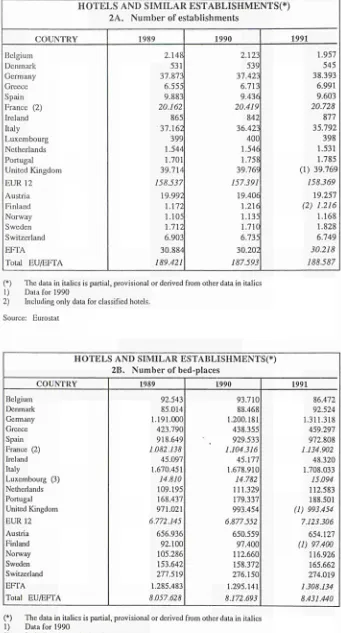
(12) The three basic forms of tourism can be combined in various ways to derive the following categories of tourism: * Internal tourism, which comprises domestic tourism and inbound tourism; * National tourism, which comprises domestic tourism and outbound tourism; * International tourism, which consists of inbound tourism and outbound tourism. Also very important establishments.. are. the. definitions. of. tourist. accommodation. "Tourist accommodation" is any facility that, regularly or occasionally provides overnight accommodation for visitors. "Collective accommodation establishments" are establishments which provide overnight lodging for the traveller in a room or some other unit. The number of places it provides must be greater than a specified minimum amount for groups of persons exceeding a single family unit and all the places in the establishment must come under a common commercial-type management, even if it is notprofit-making. "Hotels and similar establishments" are collective accommodation establishments typified as being arranged, in rooms, in numbers exceeding a specified minimum, and as providing certain services including room services and. daily bed-making and cleaning of the sanitary facilities. "Supplementary accommodation and specialised establishments" are the remaining types of tourist accommodation belonging to the division of collective accommodation establishments. Such establishments are intended for tourists, may be non-profit-making, coming under a common management, providing minimum common 'services (not necessarily room service), and not necessarily being arranged rooms but perhaps in dwelling-type units, campsites or collective dormitories and often engaging in some activity besides accommodation, such as health care, social welfare or transport. Balance of Payments data eue in line with the definitions in the Balance of Payments Manual by the International Monetary Fund. The "Balance of Payments" is defined as the record of a countries international transactions with the rest of the world (or, in other words, transactions of its residents with non-residents). Data in this publication mainly focus on transactions concerning "Travel". "Travel" covers goods and services acquired from an economy by non-resident travellers during their stay on the territory of that economy and for their own use.. χ. m. eurostat.
(13) As this publication was prepared in 1994 and is based on data from the late 1980s and early 1990s, the reference base for the presentation of data is the European Union and the EFTA as defined until 31 December 1994 (EU with 12 Member States, EFTA with 7 Member States). Monetary figures are in most cases presented in ECU. Data have been calculated according to the respective average annual exchange rates.. For further information by Eurostat on Tourism-Statistics please refer to the following publications: Tourism. - Annual Statistics: Eurostat, Theme 7 - Services and Transport, Series C - Accounts Surveys and Statistics Tourism - Monthly Statistics: Eurostat, Theme 7 - Services and Transport, Series Β - Short Tenn Trends. m. eurostat. XI.
(14)
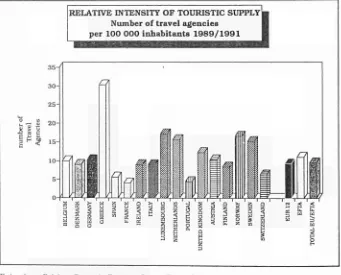
(15) Contents Part I: Tourism in Europe - recent trends and general structures Tourism in Europe - Recent trends 1. 1.1 1.2 1.3 2. 2.1 2.2 2.3 2.4 2.5 2.6 2.7 2.8 3. 3.1 3.2 3.3 3.4 3.5 3.6 3.7. Overview Scenario Private consumption expenditure Price levels and currency exchanges Demand Europe and the international tourism market Europe at regional level Mediterranean area Tourism and exchange rates International demand and domestic demand Development from 1992 to 1993 Utilisation of hotels and similar establishments Particular countries aspects Supply Introduction Tourist accommodation establishments Hotels and similar establishments in 1989 and 1993 Variation in the structure of hotels and similar establishments Camp sites and tourist villages Other supplementary accommodation establishments Restaurants, cafés, bars and travel agencies. 3 5 5 6 7 13 13 14 15 16 17 18 21 21 24 24 24 25 27 30 31 32. Tourism in Europe - Supply. 35. 1. Tourism in general 2. Tourism supply 2.1 Tourist accommodation 2.1.1 Hotels and similar establishments 2.1.2 Campsites and tourist villages 2.1.3 Other supplementary accommodation establishments 2.1.4 Total accommodation capacity 2.2 Restaurants and similar establishments 2.3 Cafés and bars 2.4 Travel agencies 2.5 Other tourist related activities. 37 38 38 40 42 44 44 46 47 48 48. m. eurostat. XIII.
(16) Tourism in Europe - Demand. 49. 1. Introduction 2. Holiday patterns of the EU population 2.1 The global picture 2.2 Main generating countries 3. Inbound tourism the EU/EFTA region 3.1 Introduction 3.2 The global picture 3.3 The southern countries of the EU 3.4 France 3.5 The northern zone of the EU 3.6 EFTA countries 3.7 Summarising tables on EU/EFTA inbound tourism 4. The near future 4.1 Macro economy 4.2 Transport 4.3 Consumer behaviour 4.4 Competition 4.5 Expected shifts in origin-destination flows. 51 51 51 52 53 53 54 55 55 55 56 57 57 57 58 58 59 59. Tourism in Europe - Impact. 61. 1. Some preliminaries 2. The economies as a whole 3. Touristic characters 3.1 A decade of tourism in Europe 3.2 Tourism in the Economy... 3.3 Factors working on the European tourism market 3.3.1 Price levels 3.3.2 Accommodation quality 3.3.3 Extra EEA origin 3.3.4 Net balance in travel. XIV. HZ'Δ. eurostat. 63 64 66 68 70 ..71 71 72 73 73.
(17) Part II: Tourism in Europe - country reports for member states of the EU and EFTA All country reports are structured as follows: * General Situation and Key Indicators: Development and Impact of Tourism * Tourism Supply * Tourism Demand. Belgium Denmark Germany Greece Spain France Ireland Italy Luxembourg Netherlands Portugal United Kingdom. 77 83 89 95 103 109 119 127 133 141 147 153. Austria Finland Iceland Liechtenstein Norway Sweden Switzerland. 161 167 171 175 177 181 187. m. eurostat. XV.
(18)
(19) PARTI Tourism in Europe recent trends and general structures. m. eurostat.
(20)
(21) TOURISM IN EUROPE Recent Trends. m. eurostat.
(22)
(23) TOURISM. IN EUROPE. - RECENT. showing a decline of 0.4 per cent of GDP (in real terms), a drop not occurring since the time of thefirstoil 1.1 Scenario crisis. This recession has affected the Inkeeping with worldwide economic entire continent except for the UK growth, 1994 was a favourable pe- and some smaller countries. Howriod for the EU, which registered a ever, recession hit the UK earlier recovery in growth equal to a 2.6% (1991-92), when the rest of Europe increase ofthe GDP. The growth was had not yet been affected. particularly due to an increment by The 1993 decline of GDP represents around 10% of the exports destined the peak in a complex period of crisis to non European countries. Conse- which started in 1990, not due to quently, investments that had de- outside factors, as was that of the 70s creased in 1993, also made a recov- and early 80s, butforinternal reasons, ery in 1994. The only negative note is which - asidefromthe differences in the unemployment rate, which still individual national situations and the shows no sign of improvement and, extent to which these are influenced on the contrary, has increased slightly by external factors - all derive in principle from the need to redress in respect to 1993. public spending and recover competitiveness with respect to other Nineteen ninety-three closed with an overall negative situation for Euro- major world economies. The resultpean and EU economies, together ing severe budget policies, moderate 1.. OVERVIEW. wages and income growth, restructuring of economic activities and high interest rates have therefore led everywhere to a slow down of domestic demand and economic activity. This has even been true for many of those countries whose currencies were strongly devalued after the summer of 92, and which enjoyed notable increases in the nominal value oftheir exports. Developing country economies, and international finance movements in general, have continued to be strongly affected by the costs of German reunification and its consequences, notably on lending rates (exceptional costs in terms ofglobal amount and in terms of historical events which generated them). Nevertheless, this enormous financial effort is now beginning to show signs of positive results which go beyond a national context.. EU: GDP TRENDS AND FORECAST (%). - 1 _¿aEEE. 80. 82. 83. 84. 85. 86. 87. J. -0.4. -M^síi^sí!íííff!S!S!ffíísísi^{SSstfi(ff0-:-.-. 81. TRENDS. <ΪΪΧίΜΪΪ{Μ0;ϊΖ!ΜΜΪβΜ33ψ. 88. (f): forecasts Source: European Commission. m. eurostat. 89. 90. 91. 92. 93. 94. 95(f) 96(f).
(24) TOURISM. IN EUROPE. - RECENT. EU: FORECAST GDP AND PRIVATE CONSUMPTION (%). TRENDS. i. GDP Private consumption. -0.4 Source: European Commission. In 1993 recession was preceded by a currency storm that dealt a near-fatal blow to the EMS and put a risk the solidarity of the European Union itself, forming the occasion to make significant adjustments to European exchange rates. Nonetheless, the countries that gained economic advantage through devaluation did not manageto turn it into concretegrowth to any great extent; the nominal increase in exports did not have a corresponding development in real terms, given the generally weak demand from other European states. 1.2 Private consumption expenditure Private householdfinalconsumption expenditure is particularly important to the analysis of the dynamics of the tourism sector within the aggregate demand. In 1994 there was an increaseof 1.5% in private consumption. This upturn. in respect to 1993 also appears to be confirmed for the following years in that forecasts indicate an increase of 2.0% for 1995 and 2.5% for 1996. However in both cases the increase remains below similar predictions for the changes in GDP. These recent forecasts of an increase are higher than previous ones, since the economic upsurge in European countries is more intense than the expectations formulated. However the growth differential in consumption with respect to GDP will not be mitigated if it also varies more than 1994 summer forecasts predicted. Therefore, in the final analysis the following can be stated: private consumption expenditure is increasing at a rate that is less than the overall economy and is destined to continue to do so for the next few years. This is obviously no good news for the tourism sector, neither for actual data nor for forecasts.. m. eurostat. According tofiguresprovided by the European Commission', in 1993 private consumption fell by 0.1%; this is a weighted average of very diverse trends (which themselves are due to some obvious cyclical lags and to national specificities). Even when it is of positive sign, in no case is it an appreciable amount, except in the United Kingdom, for the reasons already mentioned, and in some smaller countries. Concerning 1993 the economic consequences for the tourism sector of this trend in the aggregate private consumption are certainly not, nor could they have been, of a positive sign. On the basis of the information available for 1993, the value added of the sector presents, net of inflation, increases of 1-2 percentage points (the Netherlands and France) and vice versa, negative changes in Italy (over 2 points) and in Finland (for a 1) C0M(94) 615 final, Brussels, 13.12.1994.
(25) TOURISM. IN EUROPE. good 12 points). Even wider losses are found in occupational levels (in France, Italy, Finland, Switzerland) and these are often greater than in the value added, a sign that in some countries the cyclical difficulties grew wider due to a reorganization ofbusiness in order to recover productivity and profitability margins, as always happens when the market restricts. Finally the effective activity of the sector, measured by nights spent in tourist establishments, has been reduced. At the root, the unsatisfactory economic results are evidently due to a net reduction ofthe real activity of the sector; an extension of the available dataalso indicates that thevalue added and the occupation levels have suf-. - RECENT. fered wider and more general losses beyond those of the countries cited above. In terms of nights a decrease on the order of 1.8% has taken place in sector activity; this is more attributable to the EU area (-2%) than to the EFTA area which is, instead, substantially stable.. TRENDS. previous year) in terms of international arrivals and 0.6% (compared to -4.8%) in terms of receipts 1.3 Price levels and currency changes. Even without establishing statistical correlations, international tourism, especially that for pleasure, may be The situation in 1994 nevertheless considered, all other factors held equal, shows a distinct improvement. The to be dependent to a large measure on increase in private consumption the relative levels of prices, which in means an increase in the buying power turn are determined by exchange rate offamilies for luxuries with a positive relationships between the different effect on tourism. Although a break- national currencies and, in the short down offiguresis not yet available, term, by inflation rate differentials. according to the WTO in Europe in The drastic realignment of European 1994 a rise of 1.9% over 1993 was currency exchange rates during the recorded (compared to 0.9% of the summer of 1992, a fact already al-. ]. TREND AND FORECAST OF TOTAL DOMESTIC DEMAND IN THE EU COUNTRIES (%). Belgium ^6.9. 95(f) mmm 94 93 6.2 -5,6. Netherlands | | | | | | | | | g -0.5 WS -0.8. -0.1. United Kingdom -6%. -4%. -2%. 2%. f: forecast Source: European Commission. m. eurostat. 4%. 6%. 8%.
(26) TOURISM. IN EUROPE. - RECENT. TRENDS. Exchange rate trends 1992-1993: relative changes in competitivene SS* Belgium. Denmark. Germany. Greece. Spain. France. Ireland. -. 1.00. 1.02. 0.90. 0.87. 1.00. 0.92. 0.84. 1.00. -. 1.02. 0.90. 0.87. 1.00. 0.92. 0.84. 0.85. 0.99. 0.91. 0.83. Belgium Denmark. Italy. Germany. 0.98. 0.98. -. 0.88. Greece. 1.12. 1.12. 1.14. -. 0.97. 1.12. 1.03. 0.94. Spain. 1.15. 1.15. 1.17. 1.03. -. 1.16. 1.07. 0.97. France. 1.00. 1.00. 1.01. 0.89. 0.86. -. 0.92. 0.84. Ireland. 1.08. 1.08. 1.10. 0.97. 0.94. 1.09. -. 0.91. Italy. 1.19. 1.19. 1.21. 1.06. 1.03. 1.19. 1.10. -. Luxembourg. 1.00. 1.00. 1.02. 0.90. 0.87. 1.00. 0.92. 0.84. Netherlands. 0.98. 0.98. 1.00. 0.88. 0.85. 0.99. 0.91. 0.83. Portugal. 1.10. 1.11. 1.13. 0.99. 0.96. 1.11. 1.02. 0.93 0.91. UK. 1.08. 1.08. 1.10. 0.97. 0.94. 1.09. 1.00. Norway. 1.06. 1.06. 1.08. 0.95. 0.92. 1.07. 0.98. 0.89. Austria. 0.99. 0.99. 1.00. 0.88. 0.86. 0.99. 0.91. 0.83. Switzerland. 0.98. 0.98. 1.00. 0.88. 0.85. 0.99. 0.91. 0.83. Finland. 1.19. 1.19. 1.21. 1.06. 1.03. 1.19. 1.10. 1.00. Sweden. 1.24. 1.25. 1.27. 1.11. 1.08. 1.25. 1.15. 1.05. Luxembourg. Netherlands. Portugal. U.K.. Norway. Belgium. 1.00. 1.02. 0.91. 0.92. 0.94. 1.02. Denmark. 1.00. 1.02. 0.90. 0.92. 0.94. Germany. 0.98. 1.00. 0.89. 0.91. Greece. 1.12. 1.14. 1.01. Spain. 1.15. 1.17. France. 1.00. Ireland. 1.08. Italy. Austria Switzerland. Finland. Sweden. 1.02. 0.84. 0.80. 1.01. 1.02. 0.84. 0.80. 0.92. 1.00. 1.00. 0.83. 0.79. 1.03. 1.05. 1.13. 1.14. 0.94. 0.90. 1.04. 1.06. 1.09. 1.17. 1.17. 0.97. 0.93. 1.01. 0.-90. 0.92. 0.94. 1.01. 1.01. 0.84. 0.80. 1.10. 0.98. 1.00. 1.02. 1.10. 1.10. 0.91. 0.87. 1.19. 1.21. 1.08. 1.10. 1.12. 1.21. 1.21. 1.00. 0.96. Luxembourg. -. 1.02. 0.91. 0.92. 0.94. 1.02. 1.02. 0.84. 0.80. Netherlands. 0.98. -. 0.89. 0.91. 0.92. 1.00. 1.00. 0.83. 0.79. Portugal. 1.10. 1.12. -. 1.02. 1.04. 1.12. 1.12. 0.93. 0.89. UK. 1.08. 1.10. 0.98. -. 1.02. 1.10. 1.10. 0.91. 0.87. Norway. 1.06. 1.08. 0.96. 0.98. -. 1.08. 1.08. 0.90. 0.85. Austria. 0.99. 1.00. 0.89. 0.91. 0.93. -. 1.00. 0.83. 0.79. Switzerland. 0.98. 1.00. 0.89. 0.91. 0.92. 1.00. -. 0.83. 0.79. Finland. 1.19. 1.21. 1.07. 1.09. 1.12. 1.20. 1.21. -. 0.95. Sweden. 1.24. 1.27. 1.13. 1.15. 1.17. 1.26. 1.27. 1.05. -. *) Variations in competitiveness among European countries' currencies have been calculated as follows: variation 1993/1992 of the exchange rate of a national currency In respect to the ECU divided by the variation 1993/1992 of the exchange rates of each of the other national currencies in respect to the ECU Source: elaborations based on average annual values of trends In national currencies. HZ'Δ. eurostat.
(27) TOURISM. IN EUROPE. luded to previously, profoundly changed the relative prices (in na tional currencies ofthe different coun tries) for European citizens with the aim of moving from one country to another for tourism purposes. Asisknown,theyears 1993 and 1994 were characterized by a profound change in currency exchange ratio within the EU countries. This has evidently had a considerable influ ence on the prices of products and services offered to tourists and, as a consequence, on international tour ism. The general trend has been the. - RECENT. strengthening of strong currencies within Europe, the DM, HFL, SFR, which mainly coincide with the more substantial markets of origin of the tourist flow. The UKL recorded up and down trends. Devaluation mainly occurred in Southern European countries (Greece, Spain, Italy andPortugal) as well as in the S candinavian countries : the first, therefore especially ben efitedfromthe considerable increase of the tourist flow in a North/South direction, thereby increasing the de mand for Mediterranean shores. The above described trends, even though less accentuated, continued. TRENDS. during 1994 (the exception being the recovery ofthe FMK and the stability oftheESCandFF). On the basis of the average exchange rates of national currencies with re spect to the ECU in 1992 and in 1993, the changes for each country with respect to all the others have been calculated. The results, shown in the table, evidence the relative variations ofprice competitiveness for all move ments from one country towards all of the others; a Danish citizen who travels to the United Kingdom or Ireland between 1992 and 1993 will find it to be more economical by. Empi oyment and value added in the tourism sector Value added at factor cost1. Employment 1992. 1993. 92/93 (%). 1992. 1993. 92/93 (%). Consumption deflationary factor. n.a.. n.a.. . n.a.. n.a.. . 2.8. Denmark. 96 081. n.a.. . 9 615. n.a.. . 1.5. Germany. 951 000. 952 000. 0.1. n.a.. n.a.. . 4.0. Greece. n.a.. n.a.. . n.a.. n.a.. . 14.0. Spain. n.a.. n.a.. . n.a.. n.a.. . 5.1. France. 762 500. 754 200. 1.1. 226 428. 235 877. 4.2. 2.1. Ireland. n.a.. n.a.. . n.a.. n.a.. . 1..9. 976 700. 974 500. 0.2. 46 351. 47 363. Luxembourg. n.a.. n.a.. . n.a.. n.a.. . .·' 5. Netherlands. 182 500. 195 000. 6.8. 16 756. 17 327. 3. 2.1. Portugal. 185 000. 197 000. 6.5. n.a.. n.a.. . ©J. 1 205 000. n.a.. . 24 114. 5. . 3.5. Norway. 14 112. n.a.. . n.a.. n.a.. . (¡!5'. Austria. 136 543. 137 963. 1.0. n.a.. n.a.. . 3.®. Switzerland. 72 184. 70 767. 2.0. n.a.. n.a.. . 2.®. Finland. 63 000. 59 000. 6.3. 7 '-:■}. 71120. &.©. 17. Sweden. n.a.. n.a.. . u.a.. . ©.H. Belgium. Italy. United Kingdom. (1) At current prices in national currency Source: elaboration based on Eurostat data. eurostat. ' ? ? ?'s. 4.®. : :.
(28) TOURISM. IN EUROPE. - RECENT. The tourism account balance (in billions of ECU) 1992 Debits. Balance. Credits. 1993 Debits. Balance. 3 136. 5 109. -1 973. 3 479. 5 439. -1 960. Denmark. 2 869. 2 867. 2. 2 599. 2 738. -139. Germany. 8 546. 28 287. -19 741. 8 974. 32 041. -23 067. Greece. 2 460. 911. 1 549. n.a.. n.a.. -. Spain. 17 103. 4 261. 12 842. 16 516. 4 021. 12 495. France. 19 397. 10 609. 8 788. 19 922. 10919. 9 003. Ireland. 1 245. 1 037. 208. 1 607. n.a.. -. 17 678. 13 903. 3 775. 18 840. 12 005. 6 835. Netherlands. 4010. 7 356. -3 346. 3 990. 7 669. -3 679. Portugal. 2 841. 891. 1 950. 3 568. 1 574. 1 994. 10 466. 15 134. -4 668. 11 025. 14 588. -3 563. 89 748. 90 353. -605. 92 904. 92 884. 20. Finland. 1 017. 1 864. -847. 1 059. 1 382. -323. Sweden. 2 363. 5 196. -2 833. n.a.. n.a.. -. Norway. 1 831. 3 119. Austria. 11 304. 6 487. 5 966. 4 735. Credits BLEU. Italy. United Kir gdom EUR 12. 1. Switzerlar d (1) Estimate Source: Eurostat. approximately 8% due to changes in the exchange rate; such being the revaluation ofthe Danish kroner with respect to the currencies of the other two countries. He will notfindthere to be any difference when travelling to Belgium orto Luxembourg and he will find it to be more expensive by 2% when travelling to the Netherlands or to Germany, and so on. Some countries, as can be seen, have gained in competitiveness with respect to many others (United Kingdom, Ireland, Italy, Spain, Portugal,. 10. TRENDS. individual countries on the basis of their exchange rate variation with respect to the ECU and on the basis ofthe difference between the domestic inflation rate and the EU average. Four groups of European countries are evidenced: those of central Europe (Germany, the Netherlands, Denmark, etc.), those of the south (Italy, Greece, Portugal, Spain) those of the north (Sweden, Finland, Norway) and the United Kingdom-Ireland duo. These last three groups include, therefore, those countries that should have attracted the majority oftouristsfromthefirstgroup, and that should have kept their own citizens at home due to discouragement from travelling abroad by unfavourable exchange rate relationships.. The importance of also taking the inflation rate into consideration is -1 288 1 580 -1 464 3 044 underscored bythepositionofGreece. 11 487 4817 A close to 15% increase in domestic 4 490 6 997 prices, approximately 11 points higher 1 231 1 026 4 971 5 997 than the EU average, has completely reabsorbed the competitive advantage deriving from a less than 10% devaluation. The same thing, in part, has taken place for Portugal, while almost all the other countries that Greece, Finland, Sweden and Nor- have greatly devalued their currency way); the others have lost this advan- have had inflation differentials (with tage. The first group includes those respect to countries that have not countries potentially able to attract devalued) that have permitted them greater flows of tourists and at the to maintain, to a large degree, the same time keep their own citizens, margins acquired through the depredue to the greater expense involved ciation of the national currency. when travelling to countries of the Among the EFTA countries, while second group and vice versa. Finland, Norway and Sweden have In the short term, these changes in combined a strong devaluation with a exchange rate relationships may be low increase in prices thereby gaining modified positively or negatively by in competitiveness, Switzerland and inflation rate differentials. A graph Austria have not substantially modisummarizes this and positions the fied their positions with respect to the. E. eurostat.
(29) TOURISM. IN EUROPE. central European countries and have maintained nearly constant exchange rates and analogous variations in prices. This may explain the strong increase in the presence of tourists in the first group of countries, to the detriment of the second, when one considers the Central-European flows of tour ists that do not end up in the seaside resorts of the Mediterranean coun tries. AmongtheMediterranean countries, for example, only Spain seems to have benefited by the devaluation, and in a much more modest manner. - RECENT. so has Greece, while Italy has suf fered a slight reduction in the foreign tourism presence both in hotels and in supplementaryaccommodations. The price advantage has instead favoured Finland and Norway, whoseflowsof foreign tourists are not however of a great absolute importance. The ex change rate penalty has been felt in Austria and Switzerland, as in almost all the central European countries, where notable reductions in the hotel tourism presence have been regis tered. During the course of 1993 these changes in competitiveness havecom-. TRENDS. bined with the recession of the major continental economies described above and have thereby penalized the foreign component as was shown by the tourism presence data. Strictly speaking, the explanatory model based on exchange rates and inflation rate differentials seems to work although it is distorted by cycli cal components; it is predictable that the relative repositioning of each coun try with respect to the rest in terms of foreignflowsoftourists is noticeable in 1994 due to the improvement in the economic climate. Apart from real flows measured in. EXCHANGE RATE CHANGES AND INFLATION RATE DIFFERENTIALS 15;. ]. <u. £. O. o <u Q.. Greece I. 10!. ΙΛ 111 1-. .C. 5. UI. ra. C 0) S* 0) k •Ό CI. ra >Portugal. 4-1. ra D l. ra O) '~ > raΓ3ra — * UJ c o. Sweden. Norway. Spain. Italy. Germany. Austria •Luxembourg Switzerland · •Belgium »France Netherland • Denmark. #. UK. Finland. •Ireland. 10. 15. 20. 25. Nominal exchange rate changes 1992-1993 (%). Source: elaboration based on annual value of currencies and Eurostat data. HZ'Δ. eurostat. II.
(30) TOURISM. IN EUROPE. "nights", those countries that have devalued generally have improved their tourism account balance by an increase in monetary receipts and/or by a decrease in payments; the con trary is obviously true for the other cases. As examples of these two opposing situations, Germany and Italy maybe considered. The first has worsened its negative position in the tourism account balance from 4.6 to 5.1% (elaborations based on the average of credits and debits), due, above all to the debits caption (it passesfrom28 to 32 trillion ECU) which is not compensated for by the slight in crease of credit flows; Italy, on the other hand, has improved its position (from 0.4 to 0.7%), due to an increase in the credit caption (from 17.6 to 18.8 trillion ECU), but above all be cause of the decrease in the debit caption(from 13,9to 12trillionECU). Although it has not suffered a reduc tion in the foreign tourist presence, Italy has increased the monetary value of receipts because of the devalua tion. At the same time, Italian tourist flows have been restrained (more than the numbers of monetary value. 12. - RECENT. indicate) from venturing abroad be cause of the devaluation and the re sultant decrease in purchasing power. Finally, considering the countries in aggregate terms, the position of the tourist account balance cancels the domestic balances of opposite sign, and expresses therefore the result of exchange movements with the rest of the world. In this way, one can ob serve that in all of the EU countries the balance of currency movements wentfrom-605 billion ECU in ' 92 to +20 billion ECU in '93 since the increase in the credits caption (+3.5 %) is higher than the increase in the debits caption (+2.8%). This is a result of both the decreasing propensity ofEU citizens to travel abroad and the in creasing flows coming from those non-European countries (in particu lar the United States) already enjoy ing an economic upsurge. The group of EFTA countries, ex cluding Sweden (for which datais not available), instead, has worsened its position (although still structurally positive) and has fallen from +3 913 to +3 729 billion ECU. This is due to the sum of the less. HZ'Δ. eurostat. TRENDS. positive balance of Austria and Swit zerland (-410 billion ECU) and ofthe less negative balance of Finland and Norway (which has improved by 348 billion ECU); trends that are com pletely in line with the preceding analy sis ofthe relative changes ofcompeti tiveness which have shifted the flows of tourists, which are most likely Central-European, from one group of countries to another. Therefore, 1993 was certainly a diffi cult year for the tourism sector in most of the countries because of the slumping state of the continental economies. From the first available data, changes in exchange rate rela tionships have affected the flows of tourists in 1994. The devaluation has left practically unchanged the relative positions within some big groups of countries which are homogenous also in terms of attractions and environ mental characteristics; in these cases the relative positions will be deter mined by the reciprocal inflation rate differentials and on the capacity to improve the supply both from the receptive point of view and from the environmental one..
(31) TOURISM. IN EUROPE. - RECENT. TRENDS. It is also relevant to note that this pace than the arrivals, demonstrating erosion ofthe European share took that tourist spending in Europe was place at a much faster rate in the increasing more than proportionally 2.1 Europe and the period 19901994 than in the preced with respect to other areas. How international tourism ing decade 198090. While in the ever, in the period 9094 European market nineteeneighties the market share tourism share decreased more in terms For years Europe has been primary diminished at 0.3% annually, the lat of receipts than of arrivals (6.1%), tourist destination worldwide. Still ter fouryear period saw it fall off at a meaning that tourists in Europe in today, it covers nearly 60% of the yearly average of 0.75%. Europe is creased their spending capacities less market in terms ofinternational arriv having to face international competi than proportionally to those in other tion which, although in the past may areas. als. However, it is now clear that this have been somewhat restricted, now This last phenomenon is indicative of market share is undergoing a process promises much more aggression for the new situation thatEuropean tour ism is now having to face: the greater oferosion, and that competition from the future. spending capacity that international developing areas is growing steadily. Europe's share ofthe world market in 1994 appears to have been a more tourists have always shown in Eu terms of arrivals passedfrom72.5% favourable year for Europe. Accord rope, with respect to other areas, has, in 1960 to 59.6% in 1994 (it was ing to WTO data the market share in in recent years, no longer been borne 59.3% in 1993X Most ofthe gain terms of international arrivals has out by the facts. The problem for went to the Far Eastern and Pacific improved slightly compared to 1993 European tourism is that of improv ing the quality ofwhat it offers and of regions, whose quota grewfrom1% (59.6% compared to 59.3%). to 14.1%. The American continent, The most worrying aspect can be increased selectivity in its interna as well as Europe, has also lost out, seenfroma market analysis in terms tional demand, creating incentive for with its share shrinking from 24.1 ofreceipts. Up until 1990 the share in longer stays in the country of destina receipts was declining at a slower tion. to 20.5%. DEMAND. EUROPE IN THE INTERNA TIONA L MA RKET (% share in world tourism) 80 72.5. 70.5. 70. 66.0 62.0. 50. 59.7. 56.8. 60. wmmm international arrivals mmm® international receipts 62.6 59.6 .. WyyyWyì. i. 47 7. 40 -yyyyyyyyyy^. 30 20. m. :::;. : : : x;:::::::;:::::. mågm. 10 0 1960. 1970. 1980. 1990. 1993. Source: Wto. HZ'Δ. eurostat. I3.
(32) TOURISM. IN EUROPE. 2.2 Europe at regional level From analysis ofthe latest trends in European states and regions, the fol lowing points emerge: 1. The trend for nights accom modation for international tourists is reasonably stable in EU countries, with a slight increase of 0.8% for the period 9093. Confronted with a pro portionally larger increase in arrivals, it is reasonable to conclude that aver age stay time has fallen, a phenom enon that is tending to characterise aü countries, which can be attributed to the increasing number of vacations taken and the growth in short trips. A 3.45% increase from 91 to 92 is seen to be followed by a 2.1% de crease from 92 to 93, the year in. - RECENT. which the symptoms ofthe interna tional economic crisis were felt more. 2. A lthough the situation for EU countries is stable, significant differ ence, includingthosein annual trends, are observed for other parts of Eu rope. Eastern and Central Europe, follow ing strongly negative trends (32% from 90 to 92), show a reversal in tendency (+18.5%) for the succes sive year, which would appear to mark a decisive development oftour ism in those countries. The EFTA regions show an overall increase of 2.2%, while for the remaining areas (OtherEurope), the dataare strongly affected by the crisis in exYugosla vian states. 3. Trends in international hotel. EUROPEAN A REA S TRENDS (International tourist nights in hotels and similar establishments). I. E.U.. 1993. ' Bulgaria, Hungary, Poland, Romania, Slovakia ** Croatia, Cyprus, Gibraltar, Israel, Malta, Monaco, San Marino, Slovenia, Turkey, F.R. Yugoslavia Source: WTO. 14. HZ'Δ. eurostat. TRENDS. tourism for single countries show the following situation: Countries in the Scandinavia area show very significant average annual growth rates for the period 9093, with 1993 being a particularly posi tive year for Norway (a 6.72% in crease on 1992), Sweden (+7.27%) and Finland (+16.53%). It is likely that these countries have enjoyed a positive influence from the onset of tourism from exSoviet bloc coun tries, particularly from Baltic states. Denmark shows stability over the same period, with a falloff in 93, probably due to the revaluation of local currency with respect to many other European currencies. Germany is showing negative ten dencies, strongly affected by the re valuation ofthe Deutschmark. Tour ist nights have fallen off at an annual average of 5.7% in the period 9093, and dropped 9.4% in 1993. The UK too, shows a negative trend for the same period, although slightly less serious, at an annual average of 2.2%. A strongly positive trend can be seen for Spain (an average 7% increase over the above threeyear period), and Ireland (+4.8%). With 15.1% of the entire market, Spain is consolidat ing its leading position in European tourism. Ireland, although only hav ing a marginal role (1.75%) in the European tourism market, seems to be gathering the fruit of an incisive promotional policy enacted in recent years. France too, shows a consist ently positive trend (3.2% average over the threeyears period), despite revaluation ofthe FF. against many.
(33) TOURISM. IN EUROPE. - RECENT -. INTERNATIONAL ARRIVALS IN EUROPEAN MEDITERRANEAN COUNTRIES (as % of total arrivals in Mediterranean countries) 100. 1990 Source: WTO. European currencies (especially the Pound, Lira and Peseta).. great concentration along the coast; strongly affected by season;. Trends for Greece show stability over the period in question, while Italy suffered a slight decline (1.2%) the last year; the tendency for Portugal was decidedly negative in the period, with a fall in international hotel tour ists of over 8%> in '93 with respect to '92. 2.3 Mediterranean area SincetheMediterranean area receives the highest tourist concentration in Europe, the four European countries in the Mediterranean group (Greece, Spain, France and Italy) merit special attention in terms of tourism policies implemented. Tourist demand in the Mediterranean has the following characteristics:. TRENDS largely concentrated injust 3 coun tries (France, Spain and Italy).. The four European Mediterranean countries have always held a very large share ofthe tourism market for the entire basin, and this trend is continuing, with 85% of tourists go ing there. Nevertheless, this share is in considerable decline, which began to show significantly from 1985, when political and military conflict in the area started to diminish. The future oftourism in the Mediter ranean will therefore probably in volve a strong increase in competi tion from non-European countries, for many of which overall economic development will be closely linked with the growth of tourism. This applies to both those countries al ready operating in the world tourism market (Turkey, Tunisia, Morocco, Egypt), and to those that have yet to organise their offers (for example Syria, Lebanon and the Palestinian area).. Mediterranean countries on the European market (non-resident tourist nights) 1993. 1990. N°(O00). European market share1 %. Ν°(Ό00). European market share1 %. Spain. 64 627. 14.1. 82 872. 17.6. France. 55 934. 12.2. 61 298. 13.1. Italy. 66 012. 14.4. 62 650. 13.3. Greece. 35 012. 7.6. 36 475. 7.8. Total. 221 585. 48.4. 243 295. 51.8. EU+EFTA. 457 215. 469 695. (1) on EU+EFTA countries Source: WTO and Euroslat. m. eurostat. 15.
(34) TOURISM. IN EUROPE. - RECENT. TRENDS. different countries, in function of changes in exchange rate between individual currencies and the ECU. Although it is clear that this situation cannot faithfully represent the com petitiveness ofeach country for inter national tourism, which depends on exchange rates between single coun ■: ■ \, yr,.-\\teJr&ww?&: ^l^:t.-<~ü~^-<Cs^'A MnnmriTmiiT.iimiVin tries, it provides a reliable reference 2.4 Tourism and exchange rates indicator, at least showing competi In 1993 tourist movements were sig tion with respect to the European nificantly influenced by the variations market as a whole, which still remains in currency exchange rates after Sep the most consistent of markets for tember 1992. Exchange rate fluctua each country. tions were felt even more in the 1994 The chart would appear to fully inter tourist season (not yet fully docu pret the phenomena which occurred mented), not only because rates be in 1993, which can be summarised as tween certain countries widened even follows: sea and coastal environment pro further, but also because there was enough time for tourists to consider 1) Nearly all countries whose tection; decongestion of coast in favour of the new competitive conditions and currencies were devalued against the change their holiday plans for the ECU show higher nights quotas for inland tourism areas; international tourists, sometimes with quality in accommodation and serv summer. o ices; The chart here shows variations in considerable increases (quadrant I ). Nearly all countries whose management cost control. international tourist movements for 2). The four European countries in the Mediterranean area show, within the European panorama, overall growth in the threeyear period 9093. The growth trend for Spain and France, stability for Greece and slight decline for Italy, overall represent an increase in market shares for the Mediterra nean group within Europe as a whole, currently holding 52% (among EC + EFTA countries) in terms of nights. However, the future is uncertain, and closely linked with the policies on tourism, implemented together and independently, by these countries. Matters central to tourism policies will include:. % change 1993/92 international tourist nights. The future role ofEuropean Mediter ranean countries in terms of interna tional tourism will depend on policies for improved quality and segmenta tion ofthe supply, while market shares will tend to be measured more in terms of receipts than of arrivals. r. NATIONAL CURRENCY/ ECU EXCHANG E RATES AND TOURIST FLOWS. 1. Finland.. 12 10. Luxembourg. (Spain. Norway. Sweden. France 2 4 6 8 10 12. Ireland»·:. UK. 'Greece'. Switzerland Italy. »Austria ■■■ Netherland Germany··]· ·: :*Belgiunr β. .. Portugal·;. !.. Denmark. 4 3 2 1 0 1 2 3 4 5 6 7 8 910111213141516171819202122 % rate of change revaluation devaluation national currency / ECU 1993/92. Source: Eurostat and WTO. m. eurostat.
(35) TOURISM. IN EUROPE. - RECENT. 2.5 International demand and domestic demand. J. TOURISTS IN EUROPE (EU+EFTA) (Nights 1993) mil.. 565. residents non residents 462. Supplementary accommodations. Hotels and similar establishments Source: Eurostat and WTO. 2. The chart largely substantiates the correlation between economic com petitiveness and tourist movements. The correspondence between eco nomic competition and tourist flows is therefore substantially confirmed.. The overall European demand, in terms of nights spent by tourists in accommodation establishments ofthe commercial circuit, is estimated for 1993 to be around one billion and seven hundredfifty2.Of this, 59% is attributable to domestic tourism, the remainder to international tourism. On the basis ofthe available informa tion, the flows of tourists in supple mentary accommodations can be quantified as 41% ofthe total; this share increases to 64% if reference is made to residents alone. Hotel tour-. The estimate procedure is rendered necessary by the scarcity of some official data or by the. currencies were revalued against the ECU show a decrease in tourist nights. The largest fall-off is for Germany, whose currency lays at the origin of the new exchange-rates. (Quadrant IIIo). 3) Only three exceptions can be seen. Italy, and more negatively, Por tugal show declines in tourist move ments despite more competitive ex change rates fortheir currencies. Both countries show substantial recovery in 1994, however. The opposite, posi tive trend is seen for France, thus confirming its leading position in the world tourism market. Increased com petitiveness with respect to Ameri can tourism may have contributed to this situation.. TRENDS. supplementary accommodation often is not ho. diverse source of some of the data. It must be. mogeneous. It is reasonable therefore to maintain. remembered that the information relating to. that the real number is higher.. DOMESTIC TOURISM IN HOTELS (% on total tourist nights). ]. Luxembourg Austria Greece. m ι. Belgium United Kingdom Portugal Spain Switzerland Netherland Denmark France Italy Norway Finland Sweden Germany %. 20. 40. 60. 80. 100. Source: elaboration from Eurostat data. m. eurostat. 17.
(36) TOURISM. IN EUROPE. ism, a more likely destination for the international tourist, is characterized by a greater balance between the two : in fact in this case residents represent 55% ofthe total. We observe also that, while the relationships cited for supplementary accommodations are substantially equal both for European Union and EFTA countries, in the case of hotels in EFTA countries a decisively higher share has been registered for non-resident tourists.. - RECENT. The relationship between domestic tourism and international tourism is subject to various factors: the proximity to international markets, the availabilityofalargepoolofdomestic demand, the development of a tourism policy, and the economic and cultural level of the population on which the propensity to international travel depends. All contribute to determinethefrequencyofintemational tourism.. Nights spent by tourists in all types of accommodations 1993 ('000) Resident. Non-resident. Total. Belgium. 12 253. 11 681. 23 934. Denmark. 13 830. 10 453. 24 283. Germany. 276 382. 34 694. 311 076. Greece. 12 537. 37 108. 49 645. Spain. 68 512. 88 132. 156 644 1. 153187. 110 909. Ireland. n.a.. 9 475. -. 169 039. 82 594. 251 633. 373. 2 537. 2 910. Netherland. 38 991. 17 178. 56 169. Portugal. 13 458. 17 831. 31 289. 180 100. 338 000. Luxembourg. 2. United Kingdorr. 157 900. EU 12. 916 462. 602 692. 1 519 154. Norway. 11 941. 6 882. 18 823. Austria. 24 306. 70 494. 94 800. Switzerland. 38 142. 36 729. 74 871. 2 929. 12 667. 6 060. 32 060. 110 127. 123 094. 233 221. 1 026 589. 725 786. 1 752 375. 9 738. Finland Sweden EFTA TOTAL. 26 000. 2. (1) Campings only (except Ile de France) (2) Estimate Source: Eurostat - WTO. is. m. eurostat. Among the countries in which the greatest frequency of domestic tourism in hotels is found (because ofthe fragmentary nature ofthe data it is advisable to take into consideration only the most organized system of accommodations, that is the hotel system) we find in first place Germany (84.5%) followed by agroup of three Scandinavian countries. The geographic and climatic conditions of these countries explain the lower frequency of international tourism. The situation in Italy is, however, different (65% domestic hotel tourism); it is only recently that the tourism demand has begun to consider international destinations. In last place wefindcountries ofsmall size (Austria and Belgium, for example) where it is easier to cross the borders, and countries where the domestic demand for tourism is still rather low (Greece and Portugal).. 264 096. France. Italy. TRENDS. 2.6 Development from 1992 to 1993. 2. 2. As has been observed, during 1993 the overall demand for tourism in EU and EFTA countries has suffered a reduction in terms of nights (-1.8%). The decrease is slightly less for tourists who have chosen hotels (-1.6%) as compared to those who have chosen supplementary accommodations (-2.0%); similarly the difference is slightly less for international tourists (-1.6%) as compared to domestic tourists (-1.9%). However, in the case of hotel tourism, the reduction has been confirmed for domestic tourists only (-3.0%) while for international tourists there has been no change. This phenomenon is explained by the fact that domestic demand (in which vacation tourism has the great-.
(37) TOURISM. IN EUROPE. - RECENT. TRENDS. Nights spent by tourists by type of accommodation 1993 (Ό00) Supplementary accommodatior s. Hotels and similar establishments. Total. residents. non-residents. Total. residents. EU 12. 505 857. 377 534. 883 391. 410 605. EFTA. 58 975. 92 161. 151 136. 51 152. 30 933. 82 085. 564 832. 469 695. 1 034 527. 461 757. 256 091. 717 848. TOTAL. non-residents 1. 225 158. 2. 635 763. (1) Concerning France: campings only (except île de France) (2) Estimate Source: Eurostat - WTO. est weight) is more sensitive to eco- lation with the devaluation of the an increase in domestic demand as a nomic crises as compared to interna- currency, even though it is less obvi- response to the decreased purchasing ous than in the case of foreign tour- power abroad. tional demand. The countries which have felt the ism, since it is also more sensitive to As was seen previously in the case of greatest decline in demand are Bel- other phenomena. As was already international flows, two countries gium (-13.3%), Portugal (-7.2%), shown for international flows, the diverge from the rule: Italy and Porand Denmark (-5.47%>). However, graph relates national currency vari- tugal. Added to these are the United the countries that have greatly in- ations with respect to the ECU, the Kingdom and Luxembourg, the latcreased their overall flows, besides average ofEuropean currencies, and ter of which however, due to its Luxembourg (8.9%) whose role in the 1992/1993 variation of nights particular characteristics, is subject the tourism market is of a particular among resident tourists. It is apparent to different variables. nature, are the following: Sweden that the economic law is substantially In the light ofthe considerations de(8.5%), Finland (6.7%) and Spain confirmed; the revaluation ofthe cur- veloped up to this point and on the (6.3%). The Scandinavian countries rency results in a decrease in domestic basis of the analysis of the 1993 have therefore registered high per- nights due to the propensity of tour- tourism trends, the following concluformances both on the foreign and ists in one country to look for more sions may be drawn: domestic markets. This latter fact is economical solutions abroad (parthe European Union has witprobably due to a shift from flows that ticularly in those countries that have 1) witnessed an inverse monetary varianessed the effect of the economic were once towards international destion), while the devaluation results in crisis which has been manifested in an tinations to national destinations. As a result consumption has Nights spent by tourists. Variation 1993/1992 (%) contracted due Supplementary accommodations Hotels and similar establishments to the ecoTotal nomic crisis residents non-resident Total residents non-residents andthe respec-4.83 -2.46 -1.75 -1.11 1 -3.37 0.51 EU 12 tive currencies -0.27 2.67 1.54 -1.01 0.68 -2.06 have been de- EFTA valued. -2.02 -4.30 -0.71 -1.64 0.00 -2.96 TOTAL Domestic tourism also (1) Concerning France: campings only (except île de France) seems to show (2) Estimate a close corre- Source: Eurostat - WTO. m. eurostat. 19.
(38) TOURISM. IN EUROPE. - RECENT. N I G H T S IN T O T A L A C C O M M O D A T I O N S (% v a r i a t i o n 1993/92) -20. 10. -10. -r-. -13.3. 30. 40. -+-. -t-. 20 Belgium. 50. TRENDS. 1 60. 70. 80. H. Denmark. -5.4. Germany. -2.0. Greece. 0.6 6.3. Spain. -1.6. France. -2.2 [. Italy Luxembourg. -4.2 |. Netherland. -7.2. Portugal United Kingdom. -4.2. Norway. 3.9. 3o. -. -1.7. :. Austria. Ώ. Switzerland 16.6. Finland. 18.4 -2.0 Ξ. -14. 2.3. Sweden EU 12 Efta. Q. Total. Source: Eurostat and WTO. % change 1993 / 92 domestic tourist nights 12. NATIONAL CURRENCY/ ECU EXCHANGE RATES AND DOMESTIC TOURIST FLOWS. Luxembourg. 1. Sweden. 10 8 6. Finland. 4. Norway'. 2 0 -2 -4 -6. Germanyj:rance• f' • • D e n m a r k ¿•Austria I Switzerland ' N e t h e r l a n d '". ,Spain j Greece". Portugal. IV. ι · Italy. UK. -8. Iti. -10 -12 -14. Belgium. -16 4. 3. 2. 1. 0 1 2 3 4 5. revaluation. 6 7. 91011121314151617181920 21 22 „, rafe „ f „ h s l n „ Q % rate of change devaluation national currency / ECU 1993/92. Source: Eurostat and WTO. 20. 2. eurostat.
(39) TOURISM. IN EUROPE. - RECENT. overall decrease in tourist activities in terms of nights, and even more so in monetary terms; 2) the Scandinavian countries seem to have reacted positively to the effects of the crisis and seem to be gathering at the present time the fruits both ofthe opening ofEastern European markets to exchange and of a more incisive tourism policy; 3) among the countries in a dominant position, only Spain is continuing along its strong overall growth trend, showing that it knows how to derive profit from the devaluation of its currency by increasing its own domestic (3.7%) and international (8.6%) flows. 4) Italy and Portugal are in a critical position with regard to the evolution of the market. For these two countries difficulties of a structural nature have emerged since an increase inflowshas not accompanied their improved economic competitiveness.. The comparison between the usage levels of the different countries is highly variable; among the countries with a low gross usage rate are those which receive most visitors in the summer months because either the main resource is the sea and the coast (Italy and Greece), or because the climate is a determinant factor (Sweden and Finland). Particularly high gross usage rates are registered in Spain, Switzerland and Denmark ( in this case however it must be remembered that only those hotels with over 40 beds have been surveyed). The net usage rate expresses the capacity to utilize more fully establishments during the periods in which they are open for business. Inthis case the highest levels coincide with countries that have the best performances in the international tourist market (France and Spain above all). The situation however, seems to be critical in Belgium, a country that presents a very low net usage rate.. 2.7 Utilization of hotels and similar establishments. 2.8 Particular countries aspects. Netherlands The less than brilliant trend of 1993 In 199.3 Dutch tourism registered an tourist activities is evidenced also by obvious decline in foreign tourism (the utilization levels of hotels and 8.6%) and, on the other hand, an similar establishments. In almost all increase in domestic tourism. The the countries in fact, a decrease in the arrivals offoreign tourists, over 50% use ofbeds in such establishments has of whom come from Germany and been registered when considering ei- theUnited Kingdom, have decreased ther the gross usage or the net usage more than the nights which indicates (that is excludingthe periods in which nevertheless that foreign tourists tend the hotels are closed). Only Portugal to stay longer in the Netherlands. This is an exception; its negative year was constant tendency of the last few preceded by another negative year of years is the fruit of a tourism policy similar magnitude. It canbe observed that offers alternatives to the basic in fact that from 1990 to 1993 the visit to Amsterdam, through new gross usage rate has fallenfrom37% initiatives justifying a lengthening of to 3 4% although a slight recovery has the stay and through a diverse product supply. taken place during the last year.. m. eurostat. TRENDS. The first months of 1994 indicate that the arrivals trend is recovering. The vacation rate (at least 4 nights) of the Dutch is one of the highest in Europe (70.3% in 1992). United Kingdom In the United Kingdom a decrease has been registered above all in domestic tourism; in fact, in this case both nights and arrivals have decreased. On the other hand, however, international arrivals have increased, but the average length-of-stay has decreased (from 3.8 days to 3.3). All the same, however, overall tourist Hotel and similar establishments: net utilization of bed-places in % (1990-1993) Met utilization 1990 1991 1992. 1993. Belgium. 31. 29. 29. 28. Denmark*. 35. 36. 38. 36. Germany. 39. 40. 39. 37. Greece. 60. 56. 62. 57. Spain*. n.a.. n.a.. 36. 37. France. n.a.. n.a.. 60. 56. Ireland. n.a.. 47. 47. n.a.. 41. 42. 41. 40. Luxembourg. n.a.. n.a.. n.a.. n.a.. Netherlands. 39. 38. 38. 34. Portugal. 51. 52. 46. 48. United Kingdf )m. 46. 41. 38. 39. Norway. 35. 36. 36. 37. Austria*. n.a.. n.a.. 34. 33. Switzerland. 45. 45. 43. 42. Finland. 36. 32. 30. 33. Sweden. n.a.. 31. 27. 27. Italy. " gross rate Source: Eurostat. 2I.
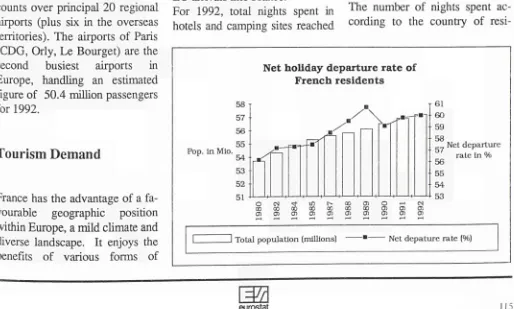
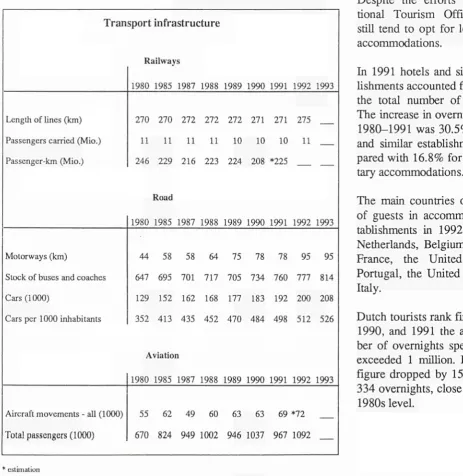
(40) TOURISM. IN EUROPE. - RECENT. The economic significance of tourism in France amounted to 1,737 billion French francs in 1993 (approximately 262 billion ECU); since 1989 it has grown at an average annual rate of 4.4%. The tourism account balance in 1993 was positive by approximately 9 billion ECU. In 1992 the average vacation rate of the French reached 60%; 20% ofthe Approximately 50% ofthe visitors to the UK come from the European French spend their vacations abroad, Union (France and Germany above a level that seems to be rather stable. all) and the other 5 0%fromthe rest of Eighty-two percent of foreign tourists comefromthe European Union. the world. Scotland is the region experiencing The country of origin with the greatthe least reduction of flows; while est number of touri st visitors to France nights have decreased slightly a con- is Germany with almost a 22% share. siderable increase in trips has been registered. Italy expenses have increased; in 1993 the average daily expenses of a UK resident tourist were UK £ 33.06, approximately 24% more than in 1992. In addition the overall expenses of overseas visitors increased by 16.5% (in 1992 the average daily expenses were UK £41.9.). TRENDS. country the greatest amount of international tourist flow originates, there was no increase in tourist presence. In other words: the increase of international tourism in Italy was not on the whole proportional to the competitive advantage obtained, which evidences some problems of a structural nature regarding Italian tourism. In particular two relevant phenomena give this evidence:. 1) the substantial stability of international flows ofthe past several years (except for 1993) as compared to the consistent increases of all the major countries (during the period 1985-1992 the average rate of increase of international arrivals was 0.62%, the lowest in the world!); In 1994, there was a 6,2% increase in 2) France the growing demand for forThe tourism sector in France repre- Italian touristflowin terms of tourist eign tourism on the part of Italians sents almost 12% ofGDP. It does not presence, mainly due to the devalua- who thereby detract domestic deappear that the growth trend will tion ofthe LIT, the entity of which mand from the tourist system (the slow and even in 1993, although an nevertheless was considerable. growth rate ofthe expenses of Italoverall reduction in nights has been Instead, in 1993, inspite of a strong ians abroad in the period 1985-1992 registered, an increase in flows com- devaluation of the LIT, especially was32.8%,thehighestintheworld!). compared to the DM, from which Not even 1993, a year particularly ing from abroad has taken piace. favourable to the economic situation of the country, brought NETHERLANDS about positive signals; these are, Non-resident tourists: average length of stay however, expected for 1994. The first signs indicate, in fact, that the 3.10 1994 growth forecast will be 304 around 3%. This is attributable to 2.90 5% for foreign tourism and to less than 2% for domestic tour-2.70 ism. The fact remains that the tourist system must rediscover the conditionsfor competition. This procdays ess implies reorganization is necessary in order to bring about a greater efficiency in the entire supply system. 1988 Finally, it must be pointed out. I. Source: CBS. 22. m. eurostat.
(41) TOURISM. IN EUROPE. that in 1992 a vacation rate equal to 54.9% was registered, alevel slightly less than the preceding year (55.3%). Portugal 1993 will be remembered as one of the worst years for Portuguese tourism. In some regions, such as the Algarve, the major tourist area ofthe country, the drop in hotel occupation was very significant causingthewhole system of businesses which operate in the sector to experience elements of crisis. In this country, as well, the fruits of competitive advantage have not been gathered. It is difficult to indicate clearly what the causes ofthis are since they are in all likelihood of a diverse nature. Above all, the country, given its greater structural weakness, has felt the international economic crisis much more heavily than others, which has therefore impacted the domestic demand. In second place, the country has probably begun to feel the effects ofthe heretofore disorganized development of the tourism industry, which has been founded more upon the growth of the building industry than on an organic development of services. As. - RECENT. a result the overall quality level ofthe services industry has begun to show itself as lacking. Finally, an overall strategy in the country seems to be missing since there is no full agreement between the various decision making centres in which policy is made.. TRENDS. in the old Lander since with the new, even in the last year, an increase (10%) has been registered. However, the new Lander represent in terms of bed nights only 10% ofthe tourist flows, which are almost entirely domestic. Even the length-ofstay tends to be shorter. In 1993 that of domestic tourists was 3.6 days, while that offoreigners was 2.3 days.. 1994 indicates a positive trend is underway although its size is still not quantifiable. Spain In 1993 Spain has consolidated its leading position in the European Germany In Germany the tourist industry rep- market. resents approximately 5% of GDP; In fact, it has fully drawn gains from occupation is estimated at approxi- the competitive advantages derived mately 2 million. from the devaluation of Peseta with As is known, the country represents respect to the main north-Europe the biggest and strongest outbound national currencies. tourist market not only at the Euro- Balearic Islands are the favourite despean level, but at the world level. It is tination of foreign tourists (28.1%), not surprising then that the balance Valencian region (18.9%) and presents a significant deficit which Cataluna (18.4%) follow. reached its peak in 1993 with 43 Domestic tourism trend is increasing, billion DM. 77% ofthe receipts are in too. Europe (the Netherlands, Austria and In the first half of 1994, the rate of France are the countries with the departure for vacation purpose of highest shares). Foreign visitors have Spaniards was 52.5%. But only the consistently declined since 1991; all 6.7% of them prefers an overseas the same the decrease has been noted destination.. m. eurostat. 23.
Figure
Related documents
Rather than shifting the mainstream understanding of queer experiences to be understood on an individual basis, racial overlap was often ignored during the gay rights movement,
Applying the real estate index and the individual property data in Japanese market, we develop a model for the real estate portfolio hedged with TRS, and assess the
As the existing literature has found parent-child separation and reunification practices of this nature to be linked to poor socioemotional functioning in children,
• carry out a complete performance analysis of all the time critical MAC behaviors of IEEE 802.15.4e in terms of throughput and delay.. The remaining of the paper is organized
Cite this article as: Tuiskunen et al.: Phenotypic characterization of patient dengue virus isolates in BALB/c mice differentiates dengue fever and dengue hemorrhagic fever from
This report seeks to combine and modify existing landscape performance metrics taken from the Sustainable SITES Guidelines, the Landscape Architecture Foundation (LAF) Landscape
Usage of Islamic banking will be evaluated based on proposed behavioural framework comprising of perceived risk, perceived behavioural control, subjective norms,
While there was no change in hand function test results of the patients who had had minor injuries, those who had received major injuries showed improvement in their power grip (49%
