S H O R T R E P O R T
Open Access
Expression analysis of
LIM
gene family in poplar,
toward an updated phylogenetic classification
Dominique Arnaud
1, Annabelle Déjardin
1, Jean-Charles Leplé
1, Marie-Claude Lesage-Descauses
1, Nathalie Boizot
1,
Marc Villar
1, Hélène Bénédetti
2and Gilles Pilate
1*Abstract
Background:Plant LIM domain proteins may act as transcriptional activators of lignin biosynthesis and/or as actin binding and bundling proteins. PlantLIMgenes have evolved in phylogenetic subgroups differing in their
expression profiles: in the whole plant or specifically in pollen. However, several poplarPtLIMgenes belong to uncharacterized monophyletic subgroups and the expression patterns of theLIMgene family in a woody plant have not been studied.
Findings:In this work, the expression pattern of the twelve duplicated poplar PtLIMgenes has been investigated by semi quantitative RT-PCR in different vegetative and reproductive tissues. As in other plant species, poplarPtLIM genes were widely expressed in the tree or in particular tissues. Especially,PtXLIM1a, PtXLIM1bandPtWLIM1bgenes were preferentially expressed in the secondary xylem, suggesting a specific function in wood formation. Moreover, the expression of these genes and of thePtPLIM2agene was increased in tension wood. Western-blot analysis confirmed the preferential expression of PtXLIM1a protein during xylem differentiation and tension wood formation. Genes classified within the pollen specific PLIM2 and PLIM2-like subgroups were all strongly expressed in pollen but also in cottony hairs. Interestingly, pairs of duplicatedPtLIMgenes exhibited different expression patterns indicating subfunctionalisations in specific tissues.
Conclusions:The strong expression of severalLIMgenes in cottony hairs and germinating pollen, as well as in xylem fibers suggests an involvement of plant LIM domain proteins in the control of cell expansion. Comparisons of expression profiles of poplarLIMgenes with the published functions of closely related plant LIMgenes suggest conserved functions in the areas of lignin biosynthesis, pollen tube growth and mechanical stress response. Based on these results, we propose a novel nomenclature of poplar LIM domain proteins.
Background
Plant LIM domain proteins are related to animal Cystein Rich Proteins (CRP), and contain two LIM domains characterized by the consensus sequence [C-X2-C-X17-H-X2-C]-X2-[C-X2-C-X17-C-X2-H] [1,2]. In animals, the CRP proteins mostly expressed in muscle tissues are involved in muscle differentiation, transcriptional regula-tion and actin organizaregula-tion [3,4]. In plant, the tobacco NtWLIM1 protein functions in the nucleus as a tran-scription factor regulating the expression of genes involved in lignin biosynthesis [5], and in the cytoplasm as an actin binding and bundling protein like the CRP1
protein in animal [6,7]. More recently, it has been shown that lily LlLIM1 and all Arabidopsis LIM domain proteins also regulate the actin cytoskeleton organiza-tion and dynamics [8,9].
Since the discovery of SF3/PLIM1, the first gene cod-ing for a plant LIM domain protein [10,11], an increased
number of LIM genes has been identified in a wide
range of plant species including Arabidopsis, rice and
poplar [1,2]. Whereas both Arabidopsis thalianaand
Oryza sativa genomes contain six gene models, the
Populus trichocarpa genome contains at least twelve
PtLIMgene models resulting from the duplication of six ancestral genes [1]. These duplicated genes probably
appeared during the “salicoid”whole-genome
duplica-tion event [1,12]. The plant LIM domain protein family
has been divided into four groups: aLIM1, bLIM1,
* Correspondence: [email protected]
1
INRA, UR0588 Amélioration, Génétique et Physiologie Forestières, CS 40001 Ardon, F-45075 Orléans Cedex 2, France
Full list of author information is available at the end of the article
gLIM2, δLIM2 containing monophyletic subgroups dif-fering according to their classification in plant taxo-nomic class or subclass and/or in their expression specificities [1]. In sunflower, tobacco and Arabidopsis, genes belonging to the WLIM1 and WLIM2 subgroups are widely expressed in plant, whereas genes belonging to the PLIM1 and PLIM2 subgroups are preferentially expressed in pollen [2,8,13]. However, the expression
pattern of genes classified into the bLIM1 group and
the XLIM1 and PLIM2-like subgroups remains unknown and there is no Arabidopsis and rice orthologs within these newly identified monophyletic groups [1].
Although EST distribution analysis in cDNA libraries from different poplar tissues may be indicative of their expression profile, the expression pattern ofPtLIMgenes has not been investigated. Using EST and microarray
data, some poplarLIMgenes (e.g.PtWLIM1aandband
PtXLIM1aandb) appear highly expressed in wood or in tension wood [1,14,15]. In trees, the formation of wood (or secondary xylem) is an important developmental pro-cess involving different steps: firstly cell division from the cambial meristem followed by xylem differentiation that include cell expansion, secondary wall synthesis, lignifica-tion and finally programmed cell death [16]. Produced in response to mechanical stresses, tension wood is a pecu-liar cellulose-rich and poorly lignified wood characterized by specific mechanical and structural properties that allow the tree to re-orientate its axis [17].
In this article, the expression of the twelve poplar
PtLIMgenes was investigated in different reproductive
and vegetative tissues. SomePtLIMgenes were
ubiqui-tously expressed whereas others showed a preferential expression in pollen, cottony hairs or secondary xylem. Interestingly a subset ofPtLIMgenes was up-regulated in tension wood area and all duplicated genes exhibited dis-tinct expression pattern suggesting subfunctionalisations. From this expression analysis and considering the pre-vious phylogenetic classification we suggest a simplified nomenclature for the poplar LIM domain family.
Findings
Expression of poplarLIMgenes in vegetative and reproductive organs
Previous EST distribution analyses indicated that
PtXLIM1aandbandPtWLIM1aandbtranscripts were
mostly found in wood forming tissues whereasPtWLIM2a
and b genes seemed to be ubiquitously expressed [1].
However, only a fewPtLIM1aandbESTs were found in
undifferentiated cells and vegetative buds cDNA libraries.
Moreover,PtPLIM2a, b, canddtranscripts were not or
only poorly represented in poplar cDNA libraries prevent-ing any inference on their expression profile. Therefore,
the expression level of the twelve PtLIM genes was
measured in different vegetative and reproductive tissues by semi quantitative RT-PCR.
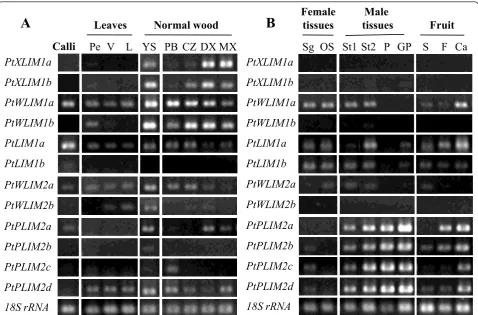
ThePtXLIM1aandbandPtWLIM1aandbgenes were strongly expressed in poplar stem particularly in wood, whatever the age of the tree (Figure 1 and Additional file 1). Moreover, they also showed a strong expression in the root differentiating xylem. These genes, except
PtWLIM1a, were not or only weakly expressed in leaves, calli, and reproductive organs indicating a preferential
expression in vascular tissues. PtXLIM1aexpression
appeared higher in developing and mature xylem (DX and MX) than in cambial zone (CZ) and phloem, sug-gesting specificity toward secondary xylem
differentia-tion. Its duplicated genePtXLIM1bas well asPtWLIM1b
were more expressed in DX than in MX both in stem
and root. Although the expression ofPtWLIM1agene
was stronger in the stem, it seemed to be widely expressed in the whole tree except in pollen. From these results, genes from the XLIM1 and WLIM1 subgroups may play an important function during wood formation in poplar.
The duplicated PtLIM1aand b genes displayed
dis-tinct expression patterns. Whereas PtLIM1a gene was
expressed in a wide range of tissues, the PtLIM1bgene
appeared specifically expressed in reproductive organs including fruit, male and female flowers and to a lesser extent pollen (Figure 1). Interestingly, likePtWLIM1a, PtLIM1aexpression is the highest in calli as well as in cottony hair (F). The expression pattern of the
dupli-cated PtWLIM2a andb genes were strikingly different
although their expression appeared rather weak in most
poplar tissues. Indeed, PtWLIM2a was ubiquitously
expressed in the plant when PtWLIM2b was mostly
expressed in leaf and stem tissues. The PtWLIM1a,
PtLIM1a and PtWLIM2a and b genes were also expressed in young roots collected from in vitropoplar plantlets, indicative of a preferential expression in tis-sues at primary growth stage (data not shown). Thus,
PtLIM1a, PtWLIM1a and PtWLIM2aappeared widely expressed in poplar whereas the expression of their respective duplicated genes seemed more restricted to particular tissues.
PtPLIM2aandbexhibited a very strong expression in stamens, mature pollen and especially in germinated pol-len. Interestingly, the duplicatedPtPLIM2canddgenes,
closely related to PtPLIM2a and b, were also highly
bearing these fibers, indicative of a dual expression in both
pollen and cotton fibers. ThePtPLIM2agene was also
expressed, but to a lower extent, in DX and MX, and
PtPLIM2dtranscript was detected in all parts of leaves
and stems. These results indicate thatPtPLIM2aandb
genes and their paralogsPtPLIM2canddmay have redun-dant functions during pollen tube growth as well as in cot-ton fiber development.
Comparison of poplarLIMgene expression between opposite and tension wood
Previously, PtXLIM1a ESTs were shown to be more
abundant in tension wood DX than in opposite wood DX [1,15] and microarray analyses indicated a higher
expression ofPtXLIM1bin tension wood than in normal
wood [14]. This prompted us to investigate more pre-cisely the expression pattern of thePtLIMgenes during
tension wood differentiation on artificially tilted poplar trees. Tension wood, formed at the upper side of the tilted stem, is easily recognizable as a bright whitish crescent, and its presence was confirmed by the
amplifi-cation ofPopFLA1 gene (data not shown) a marker of
tension wood formation [18].
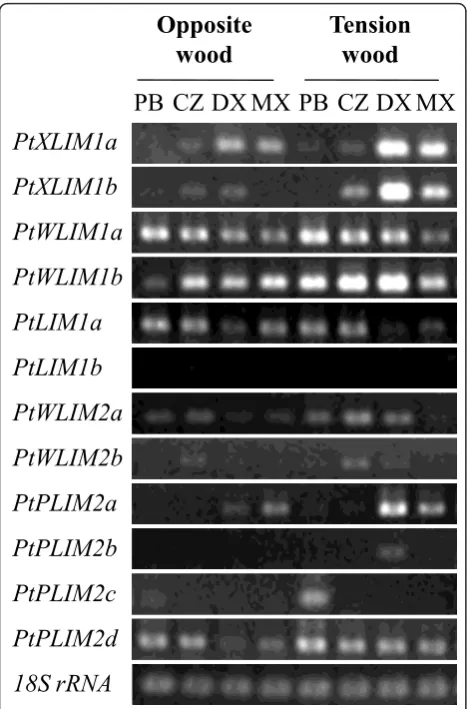
Unexpectedly, the semi quantitative RT-PCR results
showed that a number of poplarPtLIMgenes:PtXLIM1a
andb, but alsoPtWLIM1b, PtWLIM2a, PtPLIM2aand
PtPLIM2dexhibited a higher expression in tension wood compared to opposite wood (Figure 2). These results
confirmed the increased accumulation ofPtXLIM1aand
btranscripts in DX from tension wood but also revealed
a high expression level in tension wood MX.PtPLIM2a
expression in tension wood appeared to be restricted to
DX and MX. By contrast, the accumulation ofPtWLIM1b
transcript in tension wood was mainly localized in DX,
Sg OS St1 St2 P GP S F Ca
Male
tissues
Fruit
Female
tissues
PtXLIM1a
PtXLIM1b
PtLIM1b
PtLIM1a
PtWLIM1b
PtWLIM1a
18S rRNA
PtPLIM2a
PtPLIM2b
PtPLIM2c
PtPLIM2d
PtWLIM2a
PtWLIM2b
PB CZ DX MX
Pe V L
Calli
YS
PtXLIM1a
PtXLIM1b
PtLIM1b
PtLIM1a
PtWLIM1b
PtWLIM1a
Normal wood
Leaves
18S rRNA
PtPLIM2a
PtPLIM2b
PtPLIM2c
PtPLIM2d
PtWLIM2a
PtWLIM2b
[image:3.595.59.538.88.403.2]A B
CZ and phloem/bark. The accumulation ofPtWLIM2a
andPtPLIM2din DX was only slightly higher in tension
wood compared to opposite wood and the otherPtLIM
genes did not exhibit any tension wood preferential up-reg-ulation. The induction ofPtXLIM1agene in tension wood was supported at the protein level by western blot analysis using purified anti-6His-PtXLIM1a antibodies. A 29 kDa polypeptide corresponding to the expected size of the PtXLIM1a protein was detected from the CZ to the MX but not in leaves and reproductive organs (Additional file 2, data not shown). The PtXLIM1a protein was particularly more expressed in DX from tension wood compared to
opposite wood. In summary,PtXLIM1aandbas well as
PtWLIM1band PtPLIM2aare unambiguously tension
wood-induced genes and their expression appears to fluc-tuate depending on xylem differentiation.
Discussion
Expression ofLIMduplicated genes in poplar, toward a simplified nomenclature
The previous classification and nomenclature of plant LIM domain protein was complex because of the lack of expression data concerning genes belonging to newly
identified XLIM1, PLIM2-like subgroups andbLIM1
group [1]. Furthermore, the expression of poplar genes from WLIM1, WLIM2 and PLIM2 subgroups was pre-dicted from EST analysis and phylogenetic comparison.
Thus, the expression pattern ofPtLIMgenes was
ana-lyzed on an exhaustive set of poplar tissues covering most of the tree developmental stages. From our results, the 12PtLIMgenes were all expressed in poplar indicat-ing that pseudogenization events did not occur. Poplar
PtLIMgenes are organized in six pairs of duplicated genes, and the high sequence similarity between
dupli-cated PtLIMgenes, ranging from 85 to 95% of amino
acid identity, suggests that they share similar functions [1]. However, a few pair of genes exhibit distinct expres-sion patterns suggesting a subfunctionalisation in specific tissues or possibly a neofunctionalisation [19]. For
exam-ple, thePtWLIM1aandPtLIM1agenes almost
constitu-tively expressed may be involved in a general cellular function, whereas the corresponding duplicated genes probably evolved towards specific functions such as
xylem development forPtWLIM1band eventually
repro-ductive processes for PtLIM1b. The finding that
PtXLIM1aandbgenes were preferentially expressed in xylem strengthens their classification into the XLIM1 monophyletic subgroup distinct from the WLIM1
sub-group (Additional file 3) [1]. XLIM1genes probably
result from an older duplication of the ancestralWLIM1
gene with a further specialization towards new vascular specific functions potentially important for tree physiol-ogy. From our results, we have now strong evidence sup-porting a pollen preferential expression for thePtPLIM2c
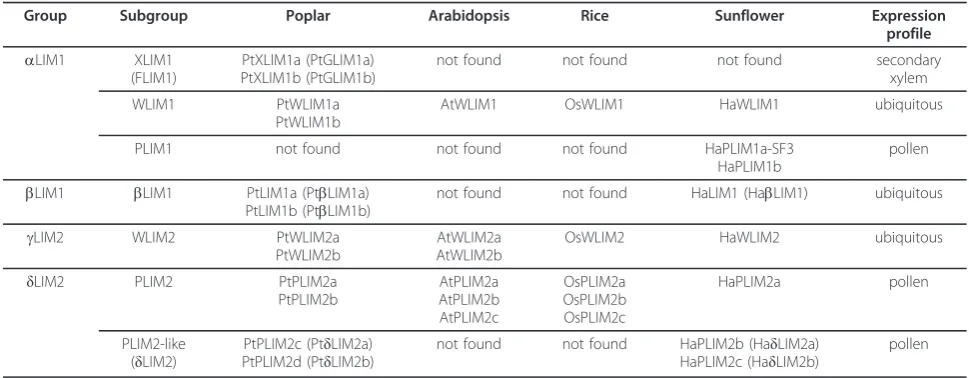
anddgenes classified into the PLIM2-like subgroup phy-logenetically close to the pollen specific PLIM2 subgroup (Additional file 3) [1]. It is thus likely that orthologous genes from sunflower and tobacco classified within the PLIM2-like subgroup also share the same pollen prefer-ential expression. According to their expression profile and phylogeny, we propose a new nomenclature for the poplar LIM domain protein family (Table 1). For simplifi-cation and clarity, the formerly namedPtbLIM1aandb, PtδLIM2a and b and PtGLIM1a and b genes were
renamedPtLIM1aandb, PtPLIM2canddandPtXLIM1a
andbrespectively. This revised and more consistent gene nomenclature taking into consideration the expression
PB CZ DX MX PB CZ DX MX
Opposite
wood
Tension
wood
PtXLIM1a
18S rRNA
PtXLIM1b
PtWLIM1a
PtWLIM1b
PtWLIM2a
PtWLIM2b
PtLIM1a
PtLIM1b
[image:4.595.57.291.88.443.2]PtPLIM2a
PtPLIM2b
PtPLIM2c
PtPLIM2d
pattern of poplar LIMgene could serve as a basis for gene naming in other plant species and will hopefully improve communication among scientists working on the LIM domain family.
Expression pattern ofLIMgenes in differentiating secondary xylem and tension wood
According to the expression study, thePtXLIM1aandb
andPtWLIM1bgenes were preferentially expressed in dif-ferentiating secondary xylem both in root and shoot, and were up-regulated in tension wood (Figures 1 and Figure 2, Additional file 1). Wood formation involves cell expansion and deposition of a highly lignified secondary cell wall [15,16]. The tobacco NtWLIM1 ortholog prob-ably acts as a transcription factor activating the expression ofPAL, 4CLandCADgenes coding for enzymes of the lig-nin biosynthesis pathway [5]. Interestingly, this protein also acts on the stabilization of actin bundles [6]. Actin cables, longitudinally oriented in vessels and fibers, cer-tainly play an essential role in the cytoplasmic streaming and the distribution of cellulose and lignin precursors throughout these very elongated cells [20]. Taken together, both expression patterns and potential functions suggest
the involvement ofPtXLIM1aandb andPtWLIM1bin
the differentiation of xylem cells, during cell elongation and secondary cell wall formation. Although some varia-tions do exist, the common up-regulation of severalPtLIM
genes in tension wood may be indicative of a functional redundancy during tension wood formation. We know that tension wood is enriched in cellulose and contains less lignin than opposite or normal wood [17], and in
accordance, the expression ofPAL, 4CLandCADgenes
involved in lignin biosynthesis is lower in poplar tension wood [14]. However, this merely applies during the deposition of the cellulose rich gelatinous layer (G-layer),
specific to tension wood fibers, that is possibly devoid of any lignin, whereas the sub layers (S1 and S2) deposited before the G-layer contains regular amount of lignin [21]. Therefore, we cannot rule out that poplar LIM domain proteins act as transcriptional activators of lignin biosyn-thetic genes as proposed for the NtWLIM1 protein [5]. Interestingly, it was demonstrated that muscle specific CRP2 and CRP3 proteins are involved in the stretch response and the regulation of cell contractile force by interacting with actin stress fibers [22,23]. The actin bind-ing and bundlbind-ing functions between plant LIM domain proteins and the related animal CRP proteins is highly conserved [6-9]. According to the high expression of sev-eralPtLIMgenes in tension wood, it is tempting to specu-late that poplar LIM proteins may also be implicated in the perception/transduction of mechanical stresses through interactions with actin cables just as proposed for CRP in muscle cells [3,22]. However, such an involvement of actin bundles in tensile or contractile strain still needs to be demonstrated in tree wood fibers.
Plant LIM domain proteins and anisotropic cell elongation
PoplarPLIM2genes are preferentially expressed in mature and germinating pollen. These genes are potentially involved in pollen tube growth as already suggested for their orthologs in tobacco, sunflower andArabidopsis.
Indeed,NtPLIM1, NtPLIM2, HaPLIM2, AtPLIM2a, band
cgenes are highly expressed in pollen and HaPLIM1-SF3
protein strongly accumulates in germinating pollen cones [2,8,13]. PoplarPLIM2genes together with thePtWLIM1a
[image:5.595.55.540.99.288.2]andPtLIM1agenes were also strongly expressed in cott-ony fibers and capsules. Poplar cottcott-ony fibers resemble to cotton fibers fromGossypium sp. even though they origi-nate from placenta and are borne by the capsule base [24]. Cotton fibers are unicellular trichomes composed of 95% Table 1 Phylogenetic classification and nomenclature of poplarPtLIMgenes
Group Subgroup Poplar Arabidopsis Rice Sunflower Expression
profile aLIM1 XLIM1
(FLIM1)
PtXLIM1a (PtGLIM1a) PtXLIM1b (PtGLIM1b)
not found not found not found secondary xylem WLIM1 PtWLIM1a
PtWLIM1b
AtWLIM1 OsWLIM1 HaWLIM1 ubiquitous PLIM1 not found not found not found HaPLIM1a-SF3
HaPLIM1b
pollen
bLIM1 bLIM1 PtLIM1a (PtbLIM1a) PtLIM1b (PtbLIM1b)
not found not found HaLIM1 (HabLIM1) ubiquitous
gLIM2 WLIM2 PtWLIM2a PtWLIM2b
AtWLIM2a AtWLIM2b
OsWLIM2 HaWLIM2 ubiquitous
δLIM2 PLIM2 PtPLIM2a PtPLIM2b
AtPLIM2a AtPLIM2b AtPLIM2c
OsPLIM2a OsPLIM2b OsPLIM2c
HaPLIM2a pollen
PLIM2-like (δLIM2)
PtPLIM2c (PtδLIM2a) PtPLIM2d (PtδLIM2b)
not found not found HaPLIM2b (HaδLIM2a) HaPLIM2c (HaδLIM2b)
pollen
cellulose that undergo considerable cell elongation with thick longitudinally oriented actin filaments [25,26]. Remarkably a high number of EST homologous to LIM domain protein has been detected in cotton fibers libraries [1]. Both our data and previous studies indicate that most of the plantLIMgenes are expressed in cells with aniso-tropic elongation, such as xylem fibers, pollen tubes, and cottony fibers. This expression pattern is in agreement with the capacity of plant LIM proteins to bind and bundle actin filaments in order to favor the formation of thick actin cables [6,8,9]. Indeed longitudinally-oriented thick actin cables may be very important for effective tip growth and anisotropic cell expansion. Further genetics, biochem-ical and cell biologbiochem-ical studies are required to characterize the function of plant LIM domain protein during cell elongation.
Methods
Sampling of poplar tissues
Vegetative tissues have been harvested onPopulus tremula
xP. alba, INRA clone 717-1-B4, poplar trees. Coppiced poplar trees kept at 4°C during the winter were transferred mid-March in the greenhouse, potted in compost (3 L) and individually supplied with water and fertilizers by a drip system. Straight stems and leaves were collected on three individual 3 month-old young poplar trees. Differen-tiating xylem (DX) and mature xylem (MX) samples were sequentially scraped from the debarked stem with a scalpel (Additional file 4). Cambial zone (CZ) was first lightly scraped from the peeled bark, while the remaining tissues consisted of the phloem and bark (PB) samples. Young stem (YS) samples enriched in primary growth tissues were the green stem portions collected below the apex. Following the sampling procedure described above, ten-sion and opposite wood samples were collected, respec-tively at the upper and lower sides of the stems of three trees tilted for one month. Petiole (Pe) and main vessels (V) were separated from the limb (L) of leaves with a scalpel.
A number of samples were also collected during the spring, when cambium was very active, on a four year-old mature poplar tree cultivated in the tree nursery. CZ sam-ples were lightly scraped from the peeled bark of the trunk. Then, phloem (Ph) samples were peeled from bark (B) samples. DX samples were first gently scraped from the debarked stem, while MX was sampled as wood chips from the remaining stem. The different samples from the main root were harvested following the same procedure, except that the peeled cortex contains both secondary phloem and root epidermis (PE), and after DX removal, the root MX consisted of the entire central cylinder including the pith. Undifferentiated cells were collected from calli (INRA clone 717-1-B4) cultivated for 2 weeks at 24°C in the dark on MB5 agar plates [27].
BecausePopulus tremula xP. alba trees from INRA
717-1-B4 clone were female hybrid clones, female and
male flowers have been collected onPopulus nigraand
P. nigravar.Italicapoplar trees. Excised branches bearing immature male or female flower catkins from trees grow-ing on the Loire riverside were harvested in early April 2006. Female and male branches were respectively trans-ferred in compost and water. One month later, after anthesis, the rachis, peduncles and bracts were removed from female flowers with a forceps and a scalpel. The stig-mas (Sg) were separated from the ovaries and styles (OS) (See Additional file 4). After removal of protecting calyx, stamens with peduncles and rachis were collected from male flowers at early (St1) or late (St2) developmental stages. St1 corresponded to young and small partially-open male flowers, bearing sessile stamens on the rachis, whereas at St2, just before anthesis, male flowers were fully expanded and bore elongated rachis and peduncles with spreader stamens. Mature pollen (P) was spread on modified MS/2 media [28,29] and germinated pollen (GP) with elongated pollen tubes was harvested 24 h after ger-mination. In order to produce and collect seeds, female flowers were manually fecundated with a paintbrush; one month later, the cottony hairs or fibers (F) were separated from seeds (S) and capsules (Ca).
Samples were immediately frozen upon collection, ground in liquid nitrogen and stored at -80°C before use. Samples collected from leaves and stem of 3 differ-ent greenhouse-grown poplar trees were pooled after grinding and before RNA extraction.
RNA extraction and semi quantitative RT-PCR analyses
Total RNAs were prepared using the method described by Chang and colleague [30]. After overnight precipitation with LiCl, RNAs were further purified using QIAGEN RNEasy kit®according to manufacturer’s instructions. RNA concentration and quality were determined by OD measurement at 260 nm and 280 nm. Two micrograms of total RNA were reverse transcribed using 500 ng of oligo (dT)12-18 and 200 units of SuperScript™II RT in a total volume of 20μl following the manufacturer’s instructions (Invitrogen™, Life technologies). After first-strand cDNA synthesis, RNA complementary to the cDNA was removed by incubating the reaction with 2 units ofE. coliRNase H at 37°C for 20 min. Gene-specific PCR primers were
designed to amplifyPtLIMgenes inPopulus trichocarpa
Nisqually genotype as well as inP. tremula × P. alba
(INRA clone 717-1-B4) when cDNA sequences (PtXLIM1a andb, PtWLIM1a andb, PtWLIM2a and
polymerase (Invitrogen™, Life technologies), 1,25 mM
MgCl2 and 0,2μM of gene specific primers (Additional
file 5) in a total volume of 20μl. For each primer pair, gene-specific amplification was optimized and verified on availablePtLIMcDNA clones used as template. ForPtLIM
genes, the cycling conditions were 94°C for 5 min for one initial step followed by 94°C for 45 s, 65 or 60°C for 45 s and 72°C for 1 min, for 25 to 40 cycles (See Additional file 5). For18S rRNA, the cycling conditions were 94°C for 5 min for one initial step followed by 94°C for 45 s, 55°C for 1 min and 72°C for 1 min 30, for 20 cycles [18]. The PCR was terminated with one extra step at 72°C for 10 min and hold at 4°C. The amplification was done using a
Gen-eAmp® PCR System 9700 (Applied Biosystems). Ten
microliters of each PCR product were electrophoresed on a 1% agarose gel that was scanned under UV light after ethidium bromide staining. Results presented are the representative illustration of at least three independent semi quantitative RT-PCR experiments. The identity of each PCR product was checked by sequencing.
Production of 6His-PtXLIM1a protein, protein extraction and Western blot
See Additional file 6 for detailed description of the procedure.
Availability of supporting data
The data sets supporting the results of this article are included within the article and its additional files.
Additional material
Additional file 1: PtLIM genes expression in wood tissues of an adult poplar tree. Expression ofPtLIMgenes using semi quantitative RT-PCR analysis in the trunk and main root of a four-year old poplar tree.
Additional file 2: Expression of PtXLIM1a protein in opposite and tension wood. Immunodetection of PtXLIM1a protein in total protein extracts collected from tilted trunk of four-year old poplar trees.
Additional file 3: Phylogenetic tree of plant LIM domain proteins. Phylogenetic tree of poplar, Arabidopsis, rice, tobacco and sunflower LIM domain proteins.
Additional file 4: Sampling of wood tissues and reproductive organs. Illustration of samples collected from wood forming tissues on stems and description of male and female flowers used in the study.
Additional file 5: Primers used in semi-quantitative RT-PCR. Forward and reverse primer sequences (5’to 3’) for allPtLIMgenes analyzed and PCR conditions used for semi-quantitative RT-PCR.
Additional file 6: Supplemental methods for protein extraction and western blot. Method used for protein extraction, western-blot analysis, production and purification of 6His-PtXLIM1a recombinant protein.
Acknowledgements
DA was supported by a PhD grant from the‘Région Centre’. The authors acknowledge Alain Roussel and Franck Coste (CNRS-CBM Orléans) for their help to produce the recombinant PtXLIM1a protein.
Author details
1INRA, UR0588 Amélioration, Génétique et Physiologie Forestières, CS 40001
Ardon, F-45075 Orléans Cedex 2, France.2CNRS, UPR4301, Centre de Biophysique Moléculaire, Equipe «Signalisation cellulaire et neurofibromatose», F-45000 Orléans, France.
Authors’contributions
DA participated in the conception and design of the study, carried out semi-quantitative RT-PCR experiments as well as the production and purification of recombinant protein, and wrote the manuscript. AD and J-CL participated in the design of the study, manuscript revising and provided helpful discussions. M-CL-D performed sequencing of PCR products. MV participated in the collection of reproductive samples. NB carried out protein extraction, antibodies purification and western blot. HB coordinated and contributed to production and purification of recombinant protein. GP coordinated the study, participated in its conception and design as well as revisions to the manuscript. All authors have read and approved the final manuscript.
Competing interests
The authors declare that they have no competing interests.
Received: 21 October 2011 Accepted: 17 February 2012 Published: 17 February 2012
References
1. Arnaud D, Déjardin A, Leplé J-C, Lesage-Descauses M-C, Pilate G: Genome-wide analysis ofLIMgene family inPopulus trichocarpa, Arabidopsis thaliana, andOryza sativa.DNA Res2007,14:103-116.
2. Eliasson Å, Gass N, Mundel C, Baltz R, Kräuter R, Evrard J-L, Steinmetz A:
Molecular and expression analysis of a LIM protein gene family from flowering plants.Molecular and General Genetics2000,264:257-267. 3. Kadrmas JL, Beckerle MC:The LIM domain: from the cytoskeleton to the
nucleus.Nat Rev Mol Cell Biol2004,5:920-931.
4. Weiskirchen R, Günther K:The CRP/MLP/TLP family of LIM domain proteins: acting by connecting.BioEssays2003,25:152-162. 5. Kawaoka A, Kaothien P, Yoshida K, Endo S, Yamada K, Ebinuma H:
Functional analysis of tobacco LIM protein Ntlim1 involved in lignin biosynthesis.Plant J2000,22:289-301.
6. Thomas C, Hoffmann C, Dieterle M, Van Troys M, Ampe C, Steinmetz A:
Tobacco WLIM1 is a novel F-Actin binding protein involved in actin cytoskeleton remodeling.Plant Cell2006,18:2194-2206.
7. Tran T, Singleton C, Fraley T, Greenwood J:Cysteine-rich protein 1 (CRP1) regulates actin filament bundling.BMC Cell Biol2005,6:45.
8. Papuga J, Hoffmann C, Dieterle M, Moes D, Moreau F, Tholl S, Steinmetz A, Thomas C:ArabidopsisLIM proteins: a family of actin bundlers with distinct expression patterns and modes of regulation.Plant Cell2010,
22:3034-3052.
9. Wang H-J, Wan A-R, Jauh G-Y:An actin-binding protein, lllim1, mediates calcium and hydrogen regulation of actin dynamics in pollen tubes.
Plant Physiol2008,147:1619-1636.
10. Baltz R, Domon C, Pillay D, Steinmetz A:Characterization of a pollen-specific cDNA from sunflower encoding a zinc finger protein.Plant J
1992,2:713-721.
11. Baltz R, Evrard JL, Domon C, Steinmetz A:A LIM motif is present in a pollen-specific protein.Plant Cell1992,4:1465-1466.
12. Tuskan GA, DiFazio S, Jansson S, Bohlmann J, Grigoriev I, Hellsten U, Putnam N, Ralph S, Rombauts S, Salamov A,et al:The genome of black cottonwood,Populus trichocarpa(Torr. & Gray).Science2006,
313:1596-1604.
13. Baltz R, Schmit A-C, Kohnen M, Hentges F, Steinmetz A:Differential localization of the LIM domain protein PLIM-1 in microspores and mature pollen grains from sunflower.Sexual Plant Reproduction1999,
12:60-65.
15. Déjardin A, Leplé J-C, Lesage-Descauses M-C, Costa G, Pilate G:Expressed sequence tags from poplar wood tissues - a comparative analysis from multiple libraries.Plant Biol2004,6:55-64.
16. Mellerowicz EJ, Baucher M, Sundberg B, Boerjan W:Unravelling cell wall formation in the woody dicot stem.Plant Mol Biol2001,47:239-274. 17. Timell TE:The chemical composition of tension wood.Svensk
Papperstidning1969,72:173-181.
18. Lafarguette F, Leplé J-C, Déjardin A, Laurans F, Costa G, Lesage-Descauses M-C, Pilate G:Poplar genes encoding fasciclin-like arabinogalactan proteins are highly expressed in tension wood.New Phytologist2004,164:107-121.
19. Lynch M, Conery JS:The evolutionary fate and consequences of duplicate genes.Science2000,290:1151-1155.
20. Chaffey N, Barlow P, Sundberg B:Understanding the role of the cytoskeleton in wood formation in angiosperm trees: hybrid aspen (Populus tremula×P. tremuloides) as the model species.Tree Physiol2002,
22:239-249.
21. Pilate G, Chabbert B, Cathala B, Yoshinaga A, Leplé J-C, Laurans F, Lapierre C, Ruel K:Lignification and tension wood.Comptes Rendus Biologies2004,327:889-901.
22. Kim-Kaneyama Jr, Suzuki W, Ichikawa K, Ohki T, Kohno Y, Sata M, Nose K, Shibanuma M:Uni-axial stretching regulates intracellular localization of Hic-5 expressed in smooth-muscle cellsin vivo.J Cell Sci2005,
118:937-949.
23. Knoll R, Hoshijima M, Hoffman HM, Person V, Lorenzen-Schmidt I, Bang M-L, Hayashi T, Shiga N, Yasukawa H, Schaper W,et al:The cardiac mechanical stretch sensor machinery involves a z disc complex that is defective in a subset of human dilated cardiomyopathy.Cell2002,111:943-955. 24. Boes TK, Strauss SH:Floral phenology and morphology of black
cottonwood,Populus trichocarpa(Salicaceae).Am J Bot1994,81:562-567. 25. Li X-B, Fan X-P, Wang X-L, Cai L, Yang W-C:The cottonACTIN1gene is
functionally expressed in fibers and participates in fiber elongation.
Plant Cell2005,17:859-875.
26. Ruan Y:Rapid cell expansion and cellulose synthesis regulated by plasmodesmata and sugar: insights from the single-celled cotton fibre.
Functional Plant Biol2007,34:1-10.
27. Gamborg OL, Miller RA, Ojima K:Nutrient requirements of suspension cultures of soybean root cells.Exp Cell Res1968,50:151-158. 28. Leplé JC, Brasileiro ACM, Michel MF, Delmotte F:Transgenic poplars;
expression of chimeric genes using four different constructs.Plant Cell Rep1992,11:137-141.
29. Murashige T, Skoog F:A revised medium for rapid growth and bio assays with tobacco tissue cultures.Physiologia Plantarum1962,15:473-497. 30. Chang SJ, Puryear J, Cairney J:A simple and efficient method for isolating
RNA from pine trees.Plant Mol Biol Report1993,11:113-116.
doi:10.1186/1756-0500-5-102
Cite this article as:Arnaudet al.:Expression analysis ofLIMgene family in poplar, toward an updated phylogenetic classification.BMC Research Notes20125:102.
Submit your next manuscript to BioMed Central and take full advantage of:
• Convenient online submission
• Thorough peer review
• No space constraints or color figure charges
• Immediate publication on acceptance
• Inclusion in PubMed, CAS, Scopus and Google Scholar
• Research which is freely available for redistribution