International Journal of Innovative Technology and Exploring Engineering (IJITEE) ISSN: 2278-3075, Volume-8 Issue-8 June, 2019
Abstract: Agriculture plays a major role in the development of a country. Issues concerning agribusiness have been continually thwarting the advancement of the nation. Farmers face a huge number of issues, for example, insufficiency of water for irrigation, crops withering because of climatic changes, soils lacking in nutrients and harm to crops because of pests and wildlife. In the course of recent decades innovation has created to give proficient solutions for huge numbers of these issues. In any case, the protection of farm from wild creatures has not been adequately tended to till now. Elephants, monkeys, wild boars etc. causes serious damage to the fields. The productivity is decreased by the wild creatures trampling over harvests and eating them. This project provides a solution for these problems without hurting creatures or setting human life at stake. In this project we use Raspberry pi to protect the farmland from animals. Farmland intrusions is detected utilizing PIR sensors and photos are take utilizing Pi camera. Classification of the intruded animals as local or wild animals is done using the photos taken utilizing Convolutional Neural Network. CNN a special architecture of artificial neural networks model is mainly used for classification of images. After classification is done accordingly sounds are used to ward off the creature and an SMS is sent on account of wild creature to the land owner. Data regarding these intrusions of wild and domestic creatures are sent to cloud by means of web. This way it is easy to arrive at useful information regarding the intrusions and take measures against it
Index Terms: Image Classification, Convolutional Neural Network, Raspberry Pi, PIR Sensors, Pi Camera.
I. INTRODUCTION
Agriculture is the most important sector of Indian Economy but the issue of damage to crops by wild creatures has turned into a noteworthy social issue in current occasions. So far there is no effective solution to this problem and therefore requires earnest consideration. Existing methods include building wire fences and electric fences which are not so effective. Electric fences are equipped with batteries that are charged by solar panels to inflict shock on animals that makes contact with it and also there is a possibility of fire hazard if plants or shrubs grow too close to fence. If the fence is not
Revised Manuscript Received on June 7, 2019
Vidhya S, Department of Computer Science and Engineering, Amrita School of Engineering, Coimbatore, Amrita Vishwa Vidyapeetham, India,
Vishwashankar TJ, Department of Computer Science and Engineering, Amrita School of Engineering, Coimbatore, Amrita Vishwa Vidyapeetham, India,
Akshaya K, Department of Computer Science and Engineering, Amrita School of Engineering, Coimbatore, Amrita Vishwa Vidyapeetham, India,
Aiswarya Premdas, Department of Computer Science and Engineering, Amrita School of Engineering, Coimbatore, Amrita Vishwa Vidyapeetham, India,
Rohith R, Department of Computer Science and Engineering, Amrita School of Engineering, Coimbatore, Amrita Vishwa Vidyapeetham, India,
maintained properly, it creates electromagnetic interferences which affect telephone and radio transmissions. Electric fencing is lethal to both animal and human life though it is the most commonly used farm protection technique. Thorn fencing which is likewise a pervasive strategy followed has a similar impact as the previous. This project provides a smart solution to resolve this problem. In this framework, image is captured when an animal intrudes and then image is classified as domestic or wild animal using Convolution Neural Network (CNN) and deep learning technique. This classification helps in alerting the farmer by sending SMS in case of intrusion of wild animal. The smart farm protection system gives reliable security and safety to crops. This system guarantees the wellbeing of creatures while warding them off. It likewise diminishes the exertion made by man in securing the field.
II. LITERATURESURVEY
A. Design and Implementation of an Intelligent Security System for Farm Protection from Wild Animals
Prof. A.V. Deshpande in this paper has proposed a system to detect motion on animal intrusion in a farmland and ward it away with light. The author portrays the proposed strategy to shield farmlands from wild creatures by means of ubiquitous wired system gadgets, which is used alongside conventional strategies to improve the protection. Operational amplifier circuits are used basically for the discovery of creature intruding from the outside of fields. The checking plan is to give an early cautioning about the possible intrusion and harm by wild creatures. In their proposed work, fencing wire is used as a sensor. When there is interaction of animals with the open link an input signal is generated initially that shows that an animal is detected at fencing. For getting the resistance of fencing a microcontroller block is used. Entire procedure is constrained by microcontroller. The GSM module is utilized for sending SMS to the owner thereby cautioning that there is an intrusion.
B. Intelligent Surveillance System for the Crop Protection from Intruders(Animals)
In this paper the authors M. Gogoi and S.R. Philip provide a detailed research on designing a system using image processing techniques like SIFT algorithm to recognize an animal. Proposed algorithm in this paper is:
•Input video is got and it is cut it into frames.
•Then background subtraction technique is applied for detecting motion of objects.
•Morphological operations are applied.
•Objects are separated from original frame by cropping.
Smart Crop Protection using Deep Learning
Approach
•For feature extraction objects are given to SIFT algorithm. ○Main key points are found using Harris corner point locations by the use of multistate filter bank.
○Orientation points are found using gradient values. •Using SIFT algorithm feature extraction has to be done for data set images.
•Features are matched using Euclidean Distance. •Match points are sorted and object is classified.
•SMS is sent using GSM
C. Prevention of Intrusion of Wild Animals in the Crop Fields
Dilip kumar M D et al depicts that the protection of farm fields has been a principle content and a mind boggling issue. The creatures from the ensured region are ceaselessly assaulting the harvest fields throughout the years and the security of this farm fields has turned into a fundamental concern. The strategies that previously being utilized is insufficient, in this article we are exhibiting a down to earth technique to ward them off, by making a framework which thinks about the behavior of the animals, identifies the animal and makes the distinctive sound that bothers the creature and furthermore cautions the approved individual by sending sms. They additionally give a multi-class classification by showing zero false alert rate and accurately identifying the species. The purpose of this proposed framework is to distinguish the elephant utilizing image processing on Raspberry Pi board and send a caution sms to the owner by means of GSM module. Images captured are utilized for distinguishing or comparing the images in the database. The picture taken by the raspberry pi it is compared with images in the database. Subsequent to comparing pictures positive/negative output is generated then it offers directions to GSM module. GSM module is accustomed to sending a message to the concerned individual after examination yield is negative or positive.
D. Smart Crop Protection System
P. Prasher et al. has proposed a system to detect the intrusion of animals in the farms and sound an ultrasonic buzzer on detection. The camera and the different other components that are associated with the microcomputer which is turned on 24×7 for the entire day. The camera constantly screens the fields and gives the video feed to the microcomputer. Going about as the brain of the framework, the microcomputer ceaselessly checks for the movement in the field or plantation. In the event that any sort of movement is recognized in the field, the microcomputer checks for the presence of creatures in the picture. If any creature is discovered, buzzers are turned on. The framework guarantees that the buzzers aren‟t activated by the detection of a human in the field, or by means of any random movement. The framework additionally gives ongoing pictures of the field over the web, which can be seen by utilizing an internet browser on gadgets like PC and portable, and the buzzers can be turned on physically if the need emerges. Real time monitoring is provided by this system.
E. Tensor flow Tutorial 2: image classifier using convolutional neural network
Ankit in this tutorial has trained a convolutional neural network to classify the images of cats and dogs from a dataset. In this tutorial, a neural network with six layers is built that will identify and separate pictures of cats from that of dogs.
This network can be run on CPU too because it is an extremely small network. Traditional neural networks take a lot of time whenever prepared on CPU as they have a lot more parameters to take into consideration.
F. Image net classification with deep convolutional neural networks
In this paper A. Krizhevsky, I. Sutskever and G. E. Hinton have classified high resolution images into thousand different classes by training a large CNN network. They concluded that the accuracy of the network is affected by 2% on removal of even a single convolutional layer. They trained the models using stochastic gradient descent. Models had a batch size of 128 examples, 0.0005 was the weight decay and 0.9 momentum. They found out the importance of this small amount of weight decay for the model to learn.
III. PROPOSEDMETHODOLOGY
A. Block Diagram
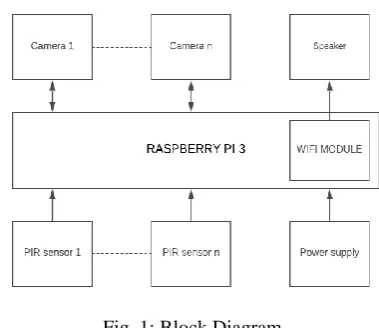
[image:2.595.330.520.301.465.2]Fig. 1: Block Diagram
The PIR sensor acts as a trigger to the camera which capture the image of the intruded animal when motion detection is sensed. This image is then classified using the model created and a sound is generated to ward of if the animal detected is wild animal. An alert SMS is sent to the owner about the intrusion of wild animal and the data is sent into cloud for statistics.
B. Classification of Images
Neural Networks are basically scientific models that can solve optimization problems. The basic computation unit of neural networks are the neurons which the neural networks are made up of. A type of feed forward neural network is the CNN which is very efficient for speech recognition and image classification. There are a set of neurons associated with specific regions of visual field known as the receptive field. CNN comprises of various layers with neurons in each layer connected to neurons in adjacent layer. The three main layers of CNN are Input Layer, Hidden Layer and Output Layer. The output from each layer is computed by matrix multiplication of output of the previous layer. The output of hidden layer is then given into a logistic function like sigmoid or softmax which then converts the
International Journal of Innovative Technology and Exploring Engineering (IJITEE) ISSN: 2278-3075, Volume-8 Issue-8 June, 2019
Fig. 2: CNN(Convolutional Neural Network)
C. Algorithm for Training the Model
The network is trained with a dataset containing a large number of images in each class. The accuracy of each epoch is calculated. After each epoch the network is tested with a validation dataset and the accuracy is determined. The training process is called back propagation. Each iteration consists of four processes which are explained in the forthcoming subsections. Such iterations are carried out for predefined number of times.
Forward pass
A batch of images from the training data is taken and passed through the entire neural network. Since the weights are randomly initialized, the output gives equal probability for all the classes.
Loss function
As the class labels of the images are already known, the loss function is calculated. There are many ways for calculating the loss. But, commonly MSE is used. MSE is calculated using the formula,
Backward pass
This process determines the derivative of loss function with respect to each weight. This is used to determine which weight contributes more to the loss.
Weight update
In order to reduce the loss, each weight is updated using the formula given below
where, w = weight of neuron wi = initial weight of neuron Ƞ = learning rate
D. Flowchart
Fig. 2: CNN(Convolutional Neural Network)
This is the flowchart of the prototype that gives trigger when there is a motion detection, captures an image and classified. Then alert is given if there is wild animal intrusion.
[image:3.595.374.508.175.445.2]IV. RESULTANALYSIS
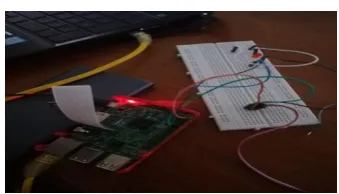
Fig. 4: Raspberry Pi Connections
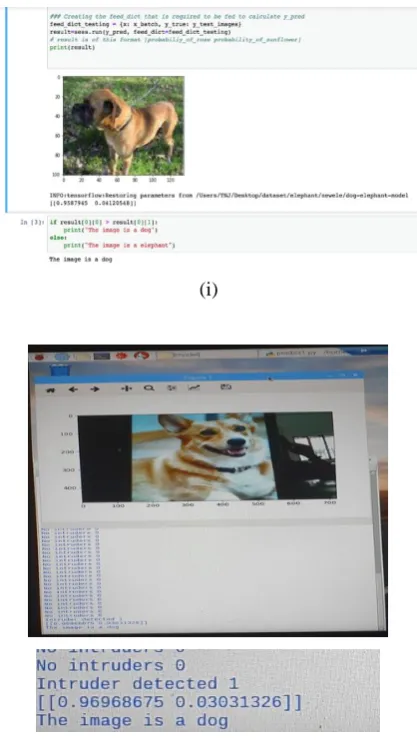
Once the intrusion had been detected using PIR sensors, the camera was triggered to capture an image. The harvests are harmed through two sorts of animals which would be elephants and dogs. Hence, the dataset which consisted of 10000 pictures of these both animals, was used as a development set for CNN. The CNN was tested with various test images including images
[image:3.595.341.511.546.643.2]than 90% of the images. The testing accuracy of the system is more than 90%. Depending on the classification, the ward off system was activated to play the appropriate sound using Bluetooth audio system. On detection of animal under the class wild animals, a monophonic sound of siren was played, an alert message was sent and was received immediately. Two variables representing the two classes were created and updated in the cloud once the ward off system was activated. When an animal corresponding to a particular class has intruded, the corresponding variable was stored with the value „1‟ and the other variable was stored with value „0‟ in Ubidots. Since the message and details of intrusion was sent over the internet, the Raspberry Pi should be connected to the internet via Wi-Fi. For prototype version, Soft toys were used and for real time implementation, pi camera was used to capture the images of elephant and dog. Both the images of soft toys and real time images were perfectly classified by the system.
(i)
[image:4.595.322.531.47.420.2](ii)
Fig. 5: Image classified as elephant in (i) training model (ii) raspberry pi
(i)
(ii)
Fig. 6: Image classified as Dog in (i) training model (ii) raspberry pi
V. CONCLUSION
[image:4.595.63.271.262.684.2]International Journal of Innovative Technology and Exploring Engineering (IJITEE) ISSN: 2278-3075, Volume-8 Issue-8 June, 2019
REFERENCES
1. Prof. A.V. Deshpande. (2013). Design and Implementation of an Intelligent Security System for Farm Protection from Wild Animals. International Journal of Science and Research. [Online]. Available: https://www.ijsr.net/archive/v5i2/NOV161327.pdf
2. M. Gogoi and S.R. Philip, “Protection of Crops from Animals using Intelligent Surveillance System,” Journal of Applied and Fundamental Sciences, vol.1, no.2, pp.200-206, 2015.
3. Bindu D et al, International Journal of Engineering, Basic sciences, Management & Social studies, Volume 1, Issue 1, May 2017. 4. P. Prasher, A. Dhiman and K. V. Rai, “Smart Crop Protection System,”
summerschool.sristi.org, Jun. 25, 2015. [Online]. Available: http://summerschool.sristi.org/smart-crop-protection-system. [Accessed: Oct.13, 2017].
5. Ankit, “Tensorflow Tutorial 2: image classifier using convolutional neural network,” cv-tricks.com. [Online]. Available: http://cv-tricks.com/tensorflowtutorial/training-convolutional-neural-network-for-image-classification. [Accessed: Feb. 12, 2018]. 6. A. Krizhevsky, I. Sutskever and G. E. Hinton, "Image net classification
with deep convolutional neural networks", NIPS, November 2012. 7. Deshpande, A. A beginner‟s guide to understanding convolutional
neural networks. A Beginner's Guide to Understanding Convolutional Neural Networks–Adit Deshpande–CS Undergrad at UCLA ('19). Np, 2016.
8. Jaswal, D., Vishvanathan, S. and Kp, S. Image Classification Using Convolutional Neural Networks. International Journal of Scientific and Engineering Research 5 (6) (2014) 1661-1668.
9. Anil, R., Manjusha, K., Kumar, S. and Soman, K.P. Convolutional neural networks for the recognition of malayalam characters. Advances in Intelligent Systems and Computing 328 (2015) 493-500.
AUTHORSPROFILE
Vidhya S. joined School of Engineering, Amrita Vishwa Vidyapeetham, Coimbatore, as a teaching faculty in July 2014. She received her B. Tech. degree in Computer Science and Engineering from
Government Engineering College,
Sreekrishnapuram, Palakkad, and M. E. degree in Computer Science and Engineering from Anna University. She currently serves as Assistant Professor in the Department of Computer Science and Engineering, School of Engineering, Coimbatore Campus. Her areas of interest include Data Structures and Algorithms, Operating System. Her areas of research include Social Computing, Graphs.
Link to his Profile: https://www.amrita.edu/faculty/s-vidhya
Vishwashankar TJ was born in Chennai, Tamilnadu, India in 1997. He is doing his final year B.Tech. in Computer Science and Engineering from Amrita Vishwa Vidyapeetham, Coimbatore, Tamil Nadu. He has done part time 2 years Research Internship under Dr.T.N. Janakiraman, National Institute of Technology and having experience to work on the problems related to crypto models, prime factorisation problem, few Graph operations and with some approximation algorithms and their applications. He has also done Machine Learning Intern at VoxEdu, California in 2018 and developed a machine learning model to help non-native English speakers. He is currently a Software Developer Intern at Infosys.
Link to his Profile:
https://www.linkedin.com/in/vishwashankar-tj-004528141/
Akshaya K was born in Tiruchirappalli,
Tamilnadu, India in 1997. She is pursuing her final year B.Tech in Computer Science and Engineering from Amrita Vishwa Vidyapeetham, Coimbatore, Tamil Nadu. She is currently working as a software developer at Cerner Healthcare Solutions. She has undergone internship at ROOT IT learning Centre during May 2018. She is expertise in machine learning and statistical modeling techniques to develop and evaluate algorithms to improve performance, data management and accuracy. She has
got certification from NPTEL, IIT madras for the course IMAD. Proficient in languages like C++, java, python.
Link to her
Profile: https://www.linkedin.com/in/akshaya-krishnamoorthy-53b77414a/
Aiswarya Premdas was born in Calicut, Kozhikode, India in 1996. She is doing her final year B. Tech in Computer Science and Engineering. She has done internship in networking with 3i infotech, Chennai. She was part of a mentorship programme at Amazon, Chennai in 2018 and has experience in machine learning concepts, aws and its applications. She has also done a course on introduction to mordern application development with NPTEL and recieved a certification.
Rohith R was born in Tiruchirappalli, Tamilnadu,