of peer-reviewed research and commentary in the population sciences published by the Max Planck Institute for Demographic Research Doberaner Strasse 114 · D-18057 Rostock · GERMANY www.demographic-research.org
DEMOGRAPHIC RESEARCH
VOLUME 6, ARTICLE 14, PAGES 383-408
PUBLISHED 24 MAY 2002
www.demographic-research.org/Volumes/Vol6/14/
DOI: 10.4054/DemRes.2002.6.14
DESCRIPTIVE FINDINGS
The Fertility Pattern of Twins and the
General Population Compared:
Evidence from Danish Cohorts 1945-64
Hans-Peter Kohler
Lisbeth B.Knudsen
Axel Skytthe
Kaare Christensen
1 Introduction 384
2 Data Sources 386
3 The Fertility of Danish Twin Cohorts 1945-64 as Compared to the Danish Population
388
3.1 Childlessness and age at first birth 390 3.2 Number of children at different ages and completed
fertility
393
4 Postponement Effects: the Relation Between the Age at First Birth and Completed Cohort Fertility
397
5 Conclusions 398
Notes 402
The Fertility Pattern of Twins and the General Population
Compared: Evidence from Danish Cohorts 1945–64
Hans-Peter Kohler1 Lisbeth B. Knudsen2
Axel Skytthe3 Kaare Christensen4
Abstract
Twin studies provide an important possibility for demographers to analyze patterns of heritability and to estimate structural models with controls for endowments. These pos-sibilities are increasingly used in the context of fertility and related behaviors. A close congruence between the fertility patterns of twins and that of the general population, however, is an essential pre-condition in order to generalize the results of twbased in-vestigations of fertility and related behaviors to the general population. In this paper we therefore compare the fertility of Danish twins born 1945–64 to the fertility pattern of the general population born during the same period. Our analyses find a very close correspon-dence between the fertility pattern of twins and of the general population. There exist only few statistically significant differences, and the primary difference pertains to the fact that female twins have a slightly later onset of childbearing than non-twins. There are virtually no relevant differences between the fertility patterns of dizygotic and monozygotic twins.
1Head of Research Group on Social Dynamics and Fertility, Max Planck Institute for Demographic Re-search, Doberaner Str. 114, 18057 Rostock, Germany. Tel: +49-381-2081-123, Fax: +49-381-2081-423, Email: [email protected], www: http://user.demogr.mpg.de/kohler.
2Associate Research Professor, Danish Center for Demographic Research, SDU-Odense, Sdr. Boulevard 23A, 5000 Odense C, Denmark. Tel: +45-6550 3378, email: [email protected]
3Research Scientist, Institute of Public Health and Danish Center for Demographic Research, SDU-Odense, Sdr. Boulevard 23A, 5000 Odense C, Denmark, Tel: +45-6550-3034, email: [email protected]
1
Introduction
Social scientists frequently rely on natural or quasi-‘experiments’ in order to infer de-terminants of human behavior, or interrelations between processes that affect human behavior, which are inherently unidentified with standard survey data. This identification problem in survey data arises because these data usually consist of random or stratified samples of a population, along with a set of—mostly individual-level—socioeconomic variables. Such data quickly reach their limitations when analysts are interested in po-tential genetic influences on human behavior (e.g., Plomin 1990), or when unobserved heterogeneity is a potentially important determinant of behavioral patterns (e.g., Manski 1995; Rosenzweig and Wolpin 2000).
A classic natural experiment used in the social sciences to overcome these limitations is the twin experiment, i.e., the fact that in between 1 and 1.5 percent of cases a pregnancy results in a multiple birth—including twins, triplets and quadruplets—instead of a single-ton birth (e.g., Derom et al. 1995; Kyvik et al. 1996, 1995). Among multiple births, data on twins are particularly useful for at least two reasons. First, twins grow up concurrently in the same household and thus share many environmental influences mediated by the parental household. Second, twins occur in two different ‘types’ as monozygotic (identi-cal) twins and dizygotic (fraternal) twins. While the former are genetically identical and share all genes, the latter share on average only 50% of their genes, which is the usual figure for siblings. Hence, twin studies do not only provide the means to observe indi-viduals who have grown up in the same household (or ‘shared environment’), but also to observe individuals who share genetic influences to a different extent. This unique prop-erty of the ‘twin experiment’ allows researchers to shed light on a variety of questions, including the central issue in the social sciences of whether ‘nature’ or ‘nurture’ is most important in determining human traits and behaviors (Hamer and Copeland 1998; Plomin 1990; Plomin et al. 1997).
increas-ingly important because these factors seem to be especially relevant in contemporary low fertility settings which have consciously controlled reproduction.
While the methodology used in the above studies focuses on the heritability of de-mographic behaviors/outcomes, and is hence similar to the standard methodology in behavioral genetics (Neale and Cardon 1992), the use of twin studies is not restricted to such applications. For instance, medical researchers have used twins to investigate whether differences in the intra-uterine environment, such as provided by the presence and absence of a co-twin and its sex, affects fecundity or the degree of masculiniza-tion later in life (Christensen et al. 1998; Gaist et al. 2000). Economists have used the occurrence of a twin birth as a random event that is uncorrelated with other behaviors determining fertility, and they have used this event in instrumental variable estimations of the interrelation between fertility behavior and labor market decisions, investments in children, etc. (Bronars and Grogger 1994; Rosenzweig and Wolpin 1980a,b). Another application of twin data builds on the economic research on the returns to human capi-tal (Ashenfelter and Rouse 1998; Behrman and Rosenzweig 1999, 2002; Behrman et al. 1994, 1996) that uses monozygotic twins – i.e., twins who share the same genes and have grown up in the same parental household – to control for unobserved heterogeneity that may distort the inference of fundamental relations between fertility and its determinants. We have also used a similar approach to improve the estimation of how the age at first birth, and other determinants of early fertility, are related to completed fertility (Kohler, Skytthe, and Christensen 2001).
In order to evaluate the relevance of research on twin fertility, and in order to assess the validity of inferences from the twin population about the general population, it is essential to investigate the extent to which the fertility pattern of the twin population is comparable to the fertility behavior of the general population. While for the above reasons we do not expect that there is equality in the fertility patterns between these populations, we do hope to find close relationships, i.e., patterns in fertility levels, trends and determinants, that closely mirror each other. In this paper we therefore provide a comparison of the fertility behavior of Danish cohorts (males and females) born between 1945 and 1964 with the respective cohorts in the Danish Twin-Fertility database. The former data are provided by the Fertility of Women and Couples in Denmark (FWCD) data set, and the latter data are obtained from a link of the Danish Twin register with the Danish Central Person Register. In particular, we investigate whether the twin population differs from the general population with respect to: (a) the completed fertility level and the fertility level at age 30, 35 and 40 years; (b) the extent of childlessness at age 30, 35 and 40 years; (c) the age at first birth; and (d) the interrelation between the age at first birth and completed fertility.
Our analyses find a very close correspondence between the fertility level and its change across cohorts in both the twin and the general population. Only a few statis-tically significant differences exist; the primary difference pertains to the fact that female twins seem to have a slightly later onset of childbearing, which may be due to sibling in-fluences, since twins always have at least one sibling (e.g., see also Murphy and Knudsen 2002). [Note 1] There are virtually no relevant differences between the fertility patterns of MZ and DZ twins.
2
Data Sources
The following comparison is based on the Danish Twin-Fertility database, which provides information about the fertility of twins in the Danish Twin Register, and the population-based database of the Fertility of Women and Couples in Denmark, which provides comprehensive information on the fertility of the Danish population. Both data sets are created from national population-based registers using the Person Number as a unique identifier to facilitate linkages between registers (Eurostat/Statistics Denmark 1995).
chil-dren, but the number of valid links decreases considerably for children born before 1960, and links are mostly missing for children born before 1953.
The Fertility of Women and Couples in Denmark (FWCD) data is a national data set including information on all women born in the period from January 1, 1930 to December 31, 1981 and with a registered residence in Denmark at least on one January 1 during the years 1980–1994. In addition, the data include information on co-residing male partners during the period 1980–94 and the children born to either of them. The creation and the content of the FWCD data has been described in detail elsewhere (Knudsen and Murphy 1999). For the purpose of this comparison, we restricted the data to the birth cohorts 1945–64 with a residence in Denmark on January 1, 1994.
Since the data set is intended for the study of women and couples, we augmented the FWCD data with information on males who were not included according to the above selection criteria. With this extension, the FWCD data allow a comprehensive study of the male and female fertility for the cohorts 1945–64.
The FWCD data used in the below comparisons are derived from the Danish Fertility Database (FTDB), which comprises data on births (time and number) together with annual data on socio-demographic characteristics of both women and men, regardless of whether or not they have children (Knudsen 1998).
The population of children is primarily identified from the Danish Civil Registration System (CRS) and from the Medical Register of Births and Deaths (MRBD; see Knudsen and Olsen 1998) and includes all children in Denmark with at least one parental reference to one of the adults in the population (either to a mother or to a father). Children in the FTDB are born from 1942 onwards, but due to the proportion of missing references in the first years of the registers, the links between children and parents are considered to have validity and nearly full coverage only for children born from 1960 and parents born from 1945 (Knudsen 1993). Moreover, the information on the birth year of the women and the children is derived from the Person Number. The age at the birth of the first child and any subsequent child are retrieved from the MRBD to FTDB and originally calculated on the basis of the Person Numbers of mother and child. Likewise, the registration of whether the child was live born and whether it was a multiple birth were retrieved from the MRBD. [Note 2]
mailed to living persons or by verification in birth registers in case of death or emigra-tion. Twins from the birth cohorts between 1953 and 1982 were ascertained utilizing the link between mother and children in CRS. Two persons who were linked to the same mother and born within 3 days were considered twins. Due to the decreasing number of valid links, the number of twin pairs that were identified decreased for twins born in 1960 or before (Kyvik et al. 1996, 1995). The zygosity of same-sexed twins was determined by the questionnaire method using the same method for the two cohorts. Based on four questions about the similarity of the twins, the pair is assigned as either monozygotic (identical), dizygotic (fraternal) or of uncertain zygosity. The method has been proved to determine the zygosity correctly in approximately 95% of the twin pairs (Hauge 1981). The zygosity of opposite-sexed twins does not need to be verified since these twins are always dizygotic.
The DTFD data are generated by merging the fertility information from the CRS with the Danish Twin Register. In particular, a birth was assigned to a twin in the Twin Register if the information on this birth in the CRS contained at least one parental reference to a person, father or mother, who is part of the twin register. [Note 3] The links in CRS between children and parents represent legal parenthood, and the register contains no information about the biological parents of adopted children. Therefore, it is not possible to distinguish between biological and adoptive parents in the data set. However, only about 1.2% of the children born in the study period were adopted, according to the official statistics. Besides the reference to the parents, the information about each child in the CRS include year of birth, sex, vital status, and, if not alive, year of death, and these data included in the DTFD.
The children included in DTFD were either alive on April 2, 1968 (the date when the CRS was established) or are born after that date. Infant deaths before April 2, 1968 are not included in the data set since these events are not registered in the CRS. However, only relatively few births for the cohorts 1945 and later occurred prior to 1968, and with an infant mortality rate of about 20 per 1000 live births in the 1960s, the number of missing children due to infant deaths is very low. Hence, for twins born after 1945 the link with the CRS provides an almost comprehensive coverage of fertility, and the quality of the fertility information in DTFD can be considered very high.
3
The Fertility of Danish Twin Cohorts 1945–64 as
Com-pared to the Danish Population
potentially non-volitional variation in the number of children due to an unanticipated multiple birth. [Note 4] Moreover, we restrict the twin population to the subset of twins in complete same-sex MZ or DZ twin pairs because this is the most relevant subset of the data that is used for both heritability analyses and structural models based on within-twin-pair estimators.
The analyses are conducted separately for the birth cohorts 1945–49, 1950–54, 1955– 59 and 1960–64. In order to achieve comparability across cohorts, we measure fertility at three different ages at 30, 35 and 40 years. Fertility after age 40 is not included in these comparisons. In addition, since the FWCD data include only fertility until 1994, we censor the fertility experience of twins at the beginning of 1994. For cohorts that are below age 40 on January 1st, 1994 – that is, for cohorts born from 1954 onwards – we only include births up to the end of 1993 in the calculations of the age at first birth. Moreover, we do not include cohorts born from 1954 onwards in fertility measures for age 40 and we do not include cohorts born after 1959 in fertility measures for age 35.
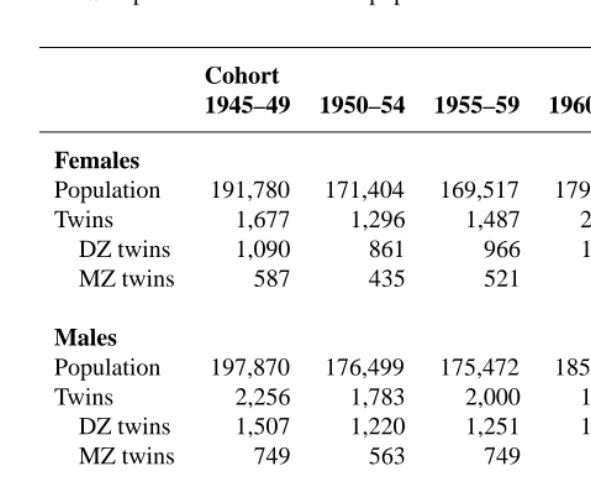
Table 1 reports the respective number of twins and the size of the birth cohorts. In particular, the size of these 5-year birth cohorts varies between 345,000 and 390,000 individuals, and the size of the twin cohorts vary between 3,000 and 4,100 twins (in complete same-sex pairs). Except for the last period 1960–64, there are about 30% more males than females in complete same-sex twin pairs. Moreover, the ratio of MZ to DZ twins increases from about .5 in the early cohorts to slightly above .6 in recent cohorts, which is due to a decline in the DZ twinning rate. This decline has been observed for the period from the 1930s to the 1970s, and it persists even after adjustments for changes in maternal age (e.g., see Olsen and Rachootin 1983). The cause of this decline is not known. Some see it as a decline in fecundity while others view it as a positive avoidance of risky pregnancies. Starting in the 1980s there was a renewed increase in DZ twinning again due to fertility treatments. The MZ rate, however, is very constant in different populations and time periods. Only recently has there been some evidence that fertility treatment can increase this rate as well (e.g. Schachter et al. 2001; Sills et al. 2000), but the availability of these methods is too recent to affect the MZ twinning rates in the birth cohorts investigated in this paper.
Table 1: Sample sizes for the Danish population and twin data used in the analyses
Cohort
1945–49 1950–54 1955–59 1960–64 Total
Females
Population 191,780 171,404 169,517 179,527 712,228
Twins 1,677 1,296 1,487 2,117 6,577
DZ twins 1,090 861 966 1,255 4,172
MZ twins 587 435 521 862 2,405
Males
Population 197,870 176,499 175,472 185,906 735,747
Twins 2,256 1,783 2,000 1,997 8,036
DZ twins 1,507 1,220 1,251 1,232 5,210
MZ twins 749 563 749 765 2,826
Females and males combined
Population 389,650 347,903 344,989 365,433 1,447,975
Twins 3,933 3,079 3,487 4,114 14,613
DZ twins 2,597 2,081 2,217 2,487 9,382
MZ twins 1,336 998 1,270 1,627 5,231
3.1
Childlessness and age at first birth
Table 2: Females: childlessness and age at first birth
Proportion still childless at Age at first birth
Females age 30 age 35a
age 40b
meanc
Std. Dev.
Cohort
1945–49 Population 0.156 0.118 0.108 23.03 4.13
Twins 0.186
0.126 0.110 23.79
4.36
DZ twins 0.194 0.134 0.117 23.78 4.42
MZ twins 0.170 0.112 0.097 23.81 4.24
1950–54 Population 0.209 0.156 0.137 23.63 4.32
Twins 0.223 0.158 0.134 24.31
4.33
DZ twins 0.225 0.167 0.143 24.23 4.28
MZ twins 0.218 0.140 0.117 24.46 4.43
1955–59 Population 0.270 0.187 24.14 4.19
Twins 0.336
0.236
25.35
4.00
DZ twins 0.337 0.241 25.21 3.96
MZ twins 0.334 0.225 25.60 4.06
1960–64 Population 0.308 24.35 3.40
Twins 0.302 24.45 3.42
DZ twins 0.299 24.28 3.46
MZ twins 0.306 24.70++
3.35
All cohorts Population 0.234 0.150 0.120 23.73 4.08
Twins 0.265
0.167
0.120 24.42
4.06
DZ twins 0.265 0.175 0.127 24.33 4.08
MZ twins 0.263 0.152+
0.105+
24.59++
4.03
Tests for significant differences: Results of tests for differences between overall population and
twins:
p0:10;
p0:05;
p0:01. Results test for differences between dizygotic
and monozygotic twins:+
p0:10; ++
p0:05; +++
p0:01. Further notes: (a) does not include cohorts born 1954 or later; (b) does not include cohorts born 1959 or later; (c) includes
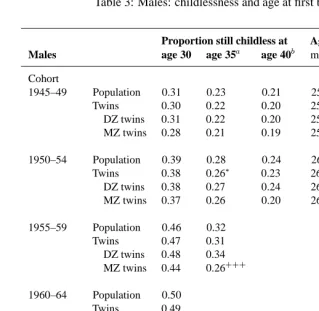
Table 3: Males: childlessness and age at first birth
Proportion still childless at Age at first birth
Males age 30 age 35a
age 40b
meanc
Std. Dev.
Cohort
1945–49 Population 0.31 0.23 0.21 25.630 4.501
Twins 0.30 0.22 0.20 25.714 4.366
DZ twins 0.31 0.22 0.20 25.733 4.437
MZ twins 0.28 0.21 0.19 25.678 4.226
1950–54 Population 0.39 0.28 0.24 26.384 4.565
Twins 0.38 0.26
0.23 26.520 4.511
DZ twins 0.38 0.27 0.24 26.547 4.491
MZ twins 0.37 0.26 0.20 26.462 4.557
1955–59 Population 0.46 0.32
Twins 0.47 0.31
DZ twins 0.48 0.34
MZ twins 0.44 0.26+++
1960–64 Population 0.50
Twins 0.49
DZ twins 0.50 MZ twins 0.49
All cohorts Population 0.41 0.27 0.22 26.071 4.174
Twins 0.41 0.26
0.21
26.218
4.130
DZ twins 0.41 0.27 0.21 26.225 4.181
MZ twins 0.40 0.24++
0.19 26.206 4.037
Tests for significant differences: Results of tests for differences between overall population and
twins:
p0:10;
p0:05;
p0:01. Results test for differences between dizygotic
and monozygotic twins:+
p0:10; ++
p0:05; +++
p0:01. Further notes: (a) does not include cohorts born 1954 or later; (b) does not include cohorts born 1959 or later; (c) includes
twins and the general population, although the twin cohorts experience a marked increase in childlessness at younger ages. There are also no systematic differences in the patterns of childlessness between monozygotic and dizygotic twins.
In general, therefore, there is a broad agreement between the female twin and non-twin population, and between female DZ and MZ non-twins, with regard to childlessness. The only pattern that is suggested by the analyses in Table 2 is a slightly later onset of fertility for twins than for the non-twin population: childlessness at age 30 is 15.6% in the overall female population born 1945–49, and it is 18.6% in the female twin population. Similarly, it is 27% in the female population born 1955–59 and 33.6% in the female twin population born in the same period. The differences, however, seem to diminish at later ages. The reasons for this difference cannot be identified in our data, which do not include socioeconomic characteristics, but they may be due to sibling influences as found, for instance, in Murphy and Knudsen (2002).
The slightly later onset of fertility for female twins is further supported by the last two columns in Table 2 that report the age at first birth. This age at first birth is based on children from when they are born up to the age of 40, and for cohorts that are below age 40 on January 1st, 1994, it includes births until the beginning of 1994. In almost all female
cohorts the age at first birth is somewhat higher in the twin population, with a difference ranging from .1 to 1.2 years, and this difference is mostly statistically significant.
The patterns of childlessness for the male twin population and overall male popu-lation are reported in Table 3. While the level of childlessness is somewhat higher for males than for females at all ages—due to a later pattern of childbearing for men and a somewhat larger number of men than women at these ages in the population—the overall pattern is similar: there has been an increase in childlessness at age 30 (and 35) due to a delay in childbearing, and these increases are partially compensated by a shift towards late first-birth fertility. This pattern is similar for the twin and general population, and there are no relevant systematic differences in the level of childlessness. Similar to our results for the female population, twins tend to have a slightly later pattern of entering parenthood. This is reflected in a somewhat higher age at first birth. For males, how-ever, this difference is not statistically significant or substantially more relevant for twins than for non-twins. Moreover, there are no statistically significant or otherwise systematic differences between male MZ and DZ twins in their patterns of first-birth childbearing.
3.2
Number of children at different ages and completed fertility
Table 4: Females: fertility at age 30, 35 and 40 years and parity progression ratios
Parity Progression Number of children at age Ratio
Females age 30 age 35a
age 40b
1 to 2c
2 to 3c
Cohort
1945–49 Population 1.66 1.87 1.94 0.820 0.338
Twins 1.59
1.84 1.91 0.811 0.336
DZ twins 1.61 1.85 1.92 0.820 0.362
MZ twins 1.55 1.81 1.88 0.794 0.287++
1950–54 Population 1.45 1.70 1.80 0.791 0.304
Twins 1.39
1.68 1.80 0.806 0.281
DZ twins 1.38 1.64 1.75 0.800 0.269
MZ twins 1.40 1.75+
1.89++
0.817 0.305
1955–59 Population 1.30 1.64
Twins 1.14
1.49
DZ twins 1.14 1.48
MZ twins 1.13 1.50
1960–64 Population 1.21
Twins 1.24
DZ twins 1.25 MZ twins 1.23
All cohorts Population 1.41 1.75 1.88 0.808 0.324
Twins 1.33
1.69
1.86 0.809 0.315
DZ twins 1.34 1.68 1.85 0.812 0.326
MZ twins 1.32 1.71 1.88 0.803 0.294
Tests for significant differences: Results of tests for differences between overall population
and twins:
p0:10;
p0:05;
p0:01. Results test for differences between
dizygotic and monozygotic twins:+
p 0:10; ++
p 0:05; +++
p 0:01. Further notes: (a) does not include cohorts born 1954 or later; (b) does not include cohorts born 1959
or later; (c) parity progression ratios do not include cohorts born 1954 later and do not include
Table 5: Males: fertility at age 30, 35 and 40 years and parity progression ratios
Parity Progression Number of children at age Ratio
Males age 30 age 35a
age 40b
1 to 2c
2 to 3c
Cohort
1945–49 Population 1.21 1.54 1.68 0.797 0.320
Twins 1.23 1.58 1.72 0.797 0.335
DZ twins 1.20 1.55 1.69 0.789 0.337
MZ twins 1.28 1.63 1.77 0.813 0.332
1950–54 Population 1.00 1.37 1.57 0.767 0.309
Twins 1.01 1.39 1.59 0.754 0.324
DZ twins 1.00 1.38 1.57 0.769 0.311
MZ twins 1.03 1.41 1.62 0.725 0.350
1955–59 Population 0.85 1.30
Twins 0.84 1.31
DZ twins 0.81 1.26
MZ twins 0.89 1.41++
1960–64 Population 0.79
Twins 0.82
DZ twins 0.82 MZ twins 0.82
All cohorts Population 0.97 1.41 1.63 0.785 0.316
Twins 0.98 1.44
1.67
0.781 0.331
DZ twins 0.97 1.42 1.65 0.782 0.327
MZ twins 1.00 1.50++
1.71 0.779 0.339
Tests for significant differences: Results of tests for differences between overall population
and twins:
p0:10;
p 0:05;
p 0:01. Results test for differences between
dizygotic and monozygotic twins:+
p 0:10; ++
p 0:05; +++
p 0:01. Further notes: (a) does not include cohorts born 1954 or later; (b) does not include cohorts born 1959
or later; (c) parity progression ratios do not include cohorts born 1954 later and do not include
Female cohorts born between 1945–49 attained a cohort fertility at age 40 of 1.93 children per woman while this fertility level declined to 1.8 for the cohort born between 1950–54 (Table 4). The cohort fertility at age 35 declined from 1.87 (cohorts born 1945– 49) to 1.64 (cohorts born 1955–59), and fertility at age 30 declined from 1.66 (cohorts born 1945–49) to 1.21 (cohorts born 1960–64). This decline of fertility at age 30 is in part due to the delay of childbearing. It is therefore likely that the decline in completed cohort fertility will be substantially less than the decline in fertility at age 30 due the adoption of an older pattern of childbearing in the youngest cohort.
Most important for the purpose of our analysis in this paper is the fact that there are no important differences in the fertility pattern of female twins and the female overall population. Female cohort fertility at age 35 and 40 neither differs in a statistically sig-nificant nor in a substantively relevant manner. The only difference occurs at age 30 at which point twins tend to have a slightly lower fertility than non-twins. This pattern is consistent with and related to the already mentioned later onset of fertility in twins as compared to the overall population (see our discussion in the previous section).
The last two columns in Table 4 also report the parity progression probabilities for female cohorts born during 1945–49 and 1950–54 (taking into account births up to age 40). About 80% of women progress from the first to the second child in both sets of cohorts, and there is no relevant difference for the twin population. About 34% of women in the older cohorts, and about 30% of women in the younger cohort, progress from the second to the third child, and this pattern is again shared by both the female twin and female overall population.
4
Postponement Effects: the Relation Between the Age
at First Birth and Completed Cohort Fertility
In recent years there has been a renewed interest in the relationship between age at first birth and completed cohort fertility as it pertains to assessing the implications of delayed childbearing and completed cohort fertility (Billari and Kohler 2002; Frejka and Calot 2001a,b; Kohler, Billari, and Ortega 2002; Kohler and Ortega 2002; Kohler, Skytthe, and Christensen 2001; Morgan and Rindfuss 1999). The investigation of this issue has a long tradition in demography (e.g., Bumpass and Mburugu 1977; Bumpass et al. 1978; Heckman et al. 1985; Marini and Hodsdon 1981; Presser 1971; Trussell and Menken 1978), and these studies have established a systematic relationship between a delayed onset of fertility and a reduced level of completed fertility.
In Kohler, Skytthe, and Christensen (2001) we have recently used fixed-effect analyses with monozygotic twins pairs in order to overcome potential problems related to unob-served characteristics. In particular, we have used within-MZ twin estimators to properly estimate the postponement effect—i.e., the reduction in fertility that is causally associated with a delay in childbearing—in order to obtain better estimates of the causal impact of delayed childbearing. Under certain assumptions, within-MZ twin estimates allow for identification of the true postponement effect even when individuals differ with respect to their child-preferences, fecundity and ability. The analyses in Kohler et al. (2001) anal-yses confirm the existence of a relevant postponement effect for both males and females. On average, an additional year of delay in childbearing reduces completed fertility by 3% for females and 3.4% for males. If interactions with birth years are included, a clear trend towards a reduced relevance of this postponement effect in younger cohorts emerges for both males and females. The failure to account for unobserved factors such as preferences for children or economic ability can substantially distort these estimates of the postpone-ment effect and its change over time. On one hand, ordinary least square regression (OLS) substantially underestimates the relevance of first-birth timing on completed fertility for cohorts born around 1945. In addition, standard OLS estimations also underestimate the pace at which this effect is reduced in younger birth cohorts: the decline in the magnitude of the postponement effect is up to twice as large in the within-MZ estimation as in the OLS results.
In this paper, we extend these analyses and additionally investigate this postponement effect in both the twin and general Danish populations. In particular, in Table 6 we report the coefficient on the age-at-first birth,1, of a simple regression of fertility at age 40 on the age at first birth as
N i
=
0
;
1
AFB
i +"
where
0is the constant, AFB
i is the age at first birth and N
i the number of children at age 40 of individuali, "
i is a disturbance term and the coefficient
1 measures the postponement effect. We perform this analysis for twins born between 1945–53, that is, the subset of twins for whom fertility at age 40 is observed prior to 1994. Moreover, we include only individuals who have had a first birth prior to to age of 32. This mirrors the respective assumptions in Kohler, Skytthe, and Christensen (2001) and Kohler, Billari, and Ortega (2002), and it avoids problems associated with a potentially non-linear relation between theAFBand completed fertility at relatively late ages of childbearing.
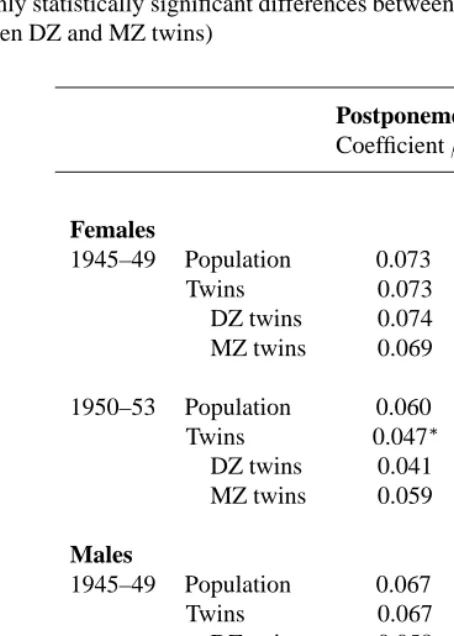
The results in Table 6 reveal a postponement effect for females of about7:3%in co-horts born from 1945–49 and of 6.0% in coco-horts born from 1950–53 for the overall Danish population. These effects are not substantially different for the twin and general popula-tions in the older cohorts, while the postponement effect is slightly smaller for female twins as compared to female non-twins in the younger cohorts. The postponement effect for males in the overall population is equal to6:7%in cohorts born 1945–49 and5:7%in cohorts born 1950–53. This postponement effect for males is somewhat smaller for the twin than for the overall population in the younger cohorts, and it is slightly larger for MZ twins as compared to DZ twins in the cohorts born from 1945–49. These differences in the postponement effect between the twin and overall population, and between DZ and MZ twins, however, are relatively modest and do not have substantive implications for using twins data in demographic analyses of fertility.
5
Conclusions
Table 6: Postponement effect: the reduction in fertility that is associated with a one-year delay in the age at first birth (the postponement effect,1, is statistically significant at the 5% level in all analyses, and at the 1% or higher level in most analyses, and we therefore indicate only statistically significant differences between the twin and overall population, and between DZ and MZ twins)
Postponement effecta Coefficient
1 Std. Error
Females
1945–49 Population 0.073 (0.0006)
Twins 0.073 (0.0060)
DZ twins 0.074 (0.0070) MZ twins 0.069 (0.0110)
1950–53 Population 0.060 (0.0007)
Twins 0.047
(0.0071) DZ twins 0.041 (0.0081) MZ twins 0.059 (0.0134)
Males
1945–49 Population 0.067 (0.0006)
Twins 0.067 (0.0058)
DZ twins 0.058 (0.0066) MZ twins 0.088++
(0.0112)
1950–53 Population 0.057 (0.0008)
Twins 0.043
(0.0076) DZ twins 0.049 (0.0090) MZ twins 0.032 (0.0138)
Tests for significant differences: Results of tests for differences
between overall population and twins:
p0:10;
p0:05;
p0:01. Results test for differences between dizygotic and
monozygotic twins:+
p0:10; ++
p0:05; +++
patterns of twins and that of the general population constitutes an essential pre-condition in order to generalize the results of twin-based investigations into bio-social determinants of fertility to the general population.
In our analyses we compare the twins in the Danish twin register born during 1945–64 to the overall Danish population born during the same period. We restrict these analyses to members of complete same-sex twin pairs because this is the most frequently used subset of the twin data. The fertility of the twin and general population is obtained from the Danish Twin-Fertility Database (DTFD) and the Fertility of Women and Couples in Denmark (FWCD) data. Our comparisons are based on several measures of fertility, including the level of childlessness at ages 30, 35 and 40 years, the age at first birth, the level of cohort fertility at ages 30, 35 and 40 years, the parity progression ratios from the first to the second and from the second to the third child, and finally the relation between the age at entering parenthood and completed fertility.
The results of our analyses reveal a broad agreement between the fertility pattern of the Danish twin and non-twin population. Both twins and non-twins exhibit the same trends across cohort and across age, and there are very few statistically significant differ-ences in the various fertility measures calculated for these two populations. Moreover, the existing differences between twins and non-twins are usually not substantively rel-evant even if they turn out to be statistically significant. An exception to this finding pertains to a slightly later onset of fertility in female twins as compared to non-twins— which is significant and regular across cohort in our analyses—and this difference may be caused by sibling influences. Finally, our analyses reveal that the fertility of dizygotic and monozygotic twins is very similar and there are virtually no systematic and/or relevant differences in the fertility pattern of DZ and MZ twins.
The absence of important differences in fertility patterns in these analyses of the twin and overall population in Denmark born 1945–64, and the absence of important differ-ences between DZ and MZ twins, therefore supports the use of Danish twin data for investigating aspects of fertility behavior that are not identifiable in standard survey or registration data, and it suggests that the specific aspects of being a member of a twin pair in itself does not have important influences on the timing and level of fertility during the life-course.
Notes
1. In particular, Murphy and Knudsen (2002) find a stronger correlation between the fertility pattern of parents and their daughters as compared to sons. This is consistent with our finding of a somewhat later fertility of female twins since twin mothers tend to be some-what older than mothers of singletons, and this fact causes twins to have a later age at birth if there is intergenerational transmission.
2. The FWCD data set also includes stillborn children, and this information is considered valid for cohorts born from 1973 onwards. Stillborn children are not included in the analyses conducted in this paper since these children are not available in the twin data; see Note 3.
3. Stillborn children are not included in the data set, since no Personal Number is assigned to them.
4. If twinning is not heritable, then excluding twin births merely results in slightly lower estimates for cohort fertility since twins constitute, to some extent, “extra” unanticipated children. In this case, focusing on singletons has no implications for our analyses and even yields better estimates of “desired” fertility since individuals with unanticipated quantum-variations are excluded. If twinning is heritable, as seems to be the case for DZ twins and to a lesser extent for MZ twins (e.g., Bulmer 1970; Lichtenstein et al. 1996), then twins would have a higher genetic disposition to give births to twins compared to parents born as singletons and this would constitute a reason for them having higher fertility. Excluding parents who give births to twins, therefore, eliminates this effect and reflects more appropriately the comparison of “desired fertility” between twins and non-twins.
5. Despite the fact that we compare differences in fertility outcomes between “twins” and the “general population”, our analyses identifies fertility differences between twins and non-twins because “general population” = “twins” + “non-twins”. Not identifying the exact non-twin population in the FWCD data set merely results in an underestimate of the difference, but this effect is minuscule if only about 1–1.5% of the general population are twins.
7. In 1980, for instance, births at ages 40+ contributed less than 0.83% to the period total fertility rate, and this contribution increased to 1.48% in 1994, representing a relative increase of 75% as compared to 1980, and the contribution of 40+ fertility increased to 1.8% in 1999, that is a more than two-fold increase since 1980 (the data for these calculations has been obtained from Council of Europe 2000).
8. That is, if males marry women that tend to be younger, then the appropriate comparison group for male cohort fertility is not the female cohort born in the same year (or five-year interval), but a cohort that is born at a somewhat later period.
References
Ashenfelter, O. and C. Rouse (1998). Income, schooling and ability: Evidence from a new sample of identical twins. Quarterly Journal of Economics 113(1), 153–284.
Behrman, J. R. and M. R. Rosenzweig (1999). ”Ability” biases in schooling returns and twins: A test and new estimates. Economics of Education Review 18(2), 159–167.
Behrman, J. R. and M. R. Rosenzweig (2002). Does increasing women’s schooling raise the schooling of the next generation? American Economic Review, forthcoming.
Behrman, J. R., M. R. Rosenzweig, and P. Taubman (1994). Endowments and the allo-cation of schooling in the family and in the marriage market: The twins experiment.
Journal of Political Economy 102(6), 1131–1173.
Behrman, J. R., M. R. Rosenzweig, and P. Taubman (1996). College choice and wages: Estimates using data on female twins. Review of Economics and Statistics 73(4), 672– 685.
Billari, F. C. and H.-P. Kohler (2002). The impact of union formation dynamics on first births in West Germany and Italy: Are there signs of convergence? In E. Klijzing and M. Corijn (Eds.), Fertility and Partnership in Europe: Findings and Lessons from
Com-parative Research, Volume 2, pp. forthcoming. Geneva / New York: United Nations.
Bortolus, R., F. Parazzini, L. Chatenoud, G. Benzi, M. M. Bianchi, and A. Marini (1999). The epidemiology of multiple births. Human Reproduction Update 5(2), 179–187.
Bronars, S. G. and J. Grogger (1994). The economic consequences of unwed motherhood: Using twin births as a natural experiment. American Economic Review 84(5), 1141– 1156.
Bryan, E. M. (1992). The role of twin studies in epidemiologic studies. Paediatric and
Perinatal Epidemiology 6, 460–464.
Bulmer, M. G. (1970). The Biology of Twinning in Man. Oxford: Clarendon Press.
Bumpass, L. L. and E. K. Mburugu (1977). Age at marriage and completed family size.
Social Biology 24(1), 31–37.
Bumpass, L. L., R. R. Rindfuss, and R. B. Janosik (1978). Age and marital status at first birth and the pace of subsequent fertility. Demography 15(1), 75–86.
Council of Europe (2000). Recent Demographic Developments in Europe. Strasbourg: Council of Europe Publishing.
Derom, R., J. Orlebeke, A. Eriksson, and M. Thiery (1995). The epidemiology of multiple births in Europe. In L. G. Keith, E. Papiernik, D. M. Keith, and B. Luke (Eds.), Multiple
Pregnancy: Epidemiology, Gestation and Perinatal Outcome, pp. 145–162. New York:
Partheon Publishing Group.
Eurostat/Statistics Denmark (1995). Statistics on Persons in Denmark: A Register-Based
Statistical System. Copenhagen: Statistics Denmark.
Frejka, T. and G. Calot (2001a). Cohort reproductive patterns in low-fertility countries.
Population and Development Review 27(1), 103–132.
Frejka, T. and G. Calot (2001b). L’´evolution du calendrier des naissances par g´en´eration dans les pays `a basse f´econdit´e `a la fin du XXe si`ecle. Population 56(3), 397–420.
Gaist, D., L. Bathum, A. Skytthe, T. K. Jensen, M. McGue, J. W. Vaupel, and K. Chris-tensen (2000). Strength and anthropometric measures in identical and fraternal twins: No evidenceof masculinization of femals with male co-twins. Epidemiology 11(3), 340–343.
Hamer, D. and P. Copeland (1998). Living with Our Genes: Why They Matter More Than
You Think. London: Doubleday.
Hauge, M. (1981). The Danish twin register. In S. A. Mednich, A. E. Baert, and B. P. Bauchmann (Eds.), Prospective Longitudinal Research: An Empirical Basis for the
Primary Prevention of Pshychological Disorders, pp. 217–221. Oxford: Oxford
Uni-versity Press.
Heckman, J. J., V. J. Hotz, and J. R. Walker (1985). New evidence on the timing and spacing of births. American Economic Review 75(2), 179–184.
Herskind, A. M., M. McGue, N. V. Holm, T. I. A. Sorensen, B. Harvald, and J. W. Vaupel (1996). The heritability of human longevity: A population based study of 2872 Danish twin pairs born 1870–1900. Human Genetics 97(3), 319–323.
Knudsen, L. B. (1993). Fertility Trends in Denmark in the 1980s: A Register Based
Socio-demographic Analysis of Fertility Trends. Copenhagen: Statistics Denmark.
Knudsen, L. B. (1998). The Danish fertility database. Danish Medical Bulletin 45, 221– 225.
Knudsen, L. B. and M. Murphy (1999). Registers as data sources in studies of reproduc-tive behaviour. Danish Center for Demographic Research Research Report #12.
Knudsen, L. B. and J. Olsen (1998). The Danish medical birth registry. Danish Medical
Bulletin 45, 320–323.
Kohler, H.-P., F. C. Billari, and J. A. Ortega (2002). Towards a theory of lowest-low fertility. Population and Development Review, forthcoming. (earlier version available as MPIDR Working Paper #2001-032 at http://www.demogr.mpg.de).
Kohler, H.-P. and K. Christensen (2000). Genetic influences on fertility behavior: Find-ings from a Danish twin study, 1910-1923. In J. L. Rodgers, D. C. Rowe, and W. B. Miller (Eds.), Genetic Influences on Fertility and Sexuality, pp. 67–84. Kluwer Aca-demic Publishers.
Kohler, H.-P. and J. A. Ortega (2002). Tempo-adjusted period parity progression mea-sures, fertility postponement and completed cohort fertility. Demographic Research [online available at http://www.demographic-research.org] 6(6), 91–144.
Kohler, H.-P., J. L. Rodgers, and K. Christensen (1999). Is fertility behavior in our genes: Findings from a Danish twin study. Population and Development Review 25(2), 253– 288.
Kohler, H.-P., A. Skytthe, and K. Christensen (2001). The age at first birth and completed fertility reconsidered: Findings from a sample of identical twins. Max Planck Institute for Demographic Research, Rostock, Germany, Working Paper #2001-006 (available at http://www.demogr.mpg.de).
Kyvik, K. O., K. Christensen, A. Skytthe, B. Harvald, and N. V. Holm (1996). The Danish twin register. Danish Medical Bulletin 43(5), 465–470.
Kyvik, K. O., A. Green, and H. Beck-Nielsen (1995). The new Danish twin register: Es-tablishment and analysis of twinning rates. International Journal of Epidemiology 24, 589–596.
Lewontin, R. C., S. Rose, and L. Kamin (1985). Not in our Genes: Biology, Ideology, and
Lichtenstein, P., P. Otterblad Olausson, and A. J. B. Kallen (1996). Twin births to mothers who are twins: a registry based study. British Medical Journal 312, 879–881.
Manski, C. F. (1995). Identification Problems in the Social Sciences. Cambridge, MA: Harvard University Press.
Marini, M. M. and P. J. Hodsdon (1981). Effects of the timing of marriage and first birth on the spacing of subsequent births. Demography 18(4), 529–548.
Morgan, P. S. and R. R. Rindfuss (1999). Reexamining the link of early childbearing to marriage and to subsequent fertility. Demography 36(1), 59–75.
Murphy, M. (1999). Is the relationship between fertility of parents and children really weak? An analytic review. Social Biology 46(1–2), 122–145.
Murphy, M. and L. B. Knudsen (2002). The relationship of full and half sibs, birth order and gender with fertility in contemporary Denmark. Population Studies, forthcoming
Neale, M. C. and L. R. Cardon (1992). Methodology for Genetic Studies of Twins and
Families. London: Kluwer Academic Publishers.
Olsen, J. and P. Rachootin (1983). The end of the decline in twinning rates. Scandinavian
Journal of Social Medicine 11(3), 119.
Plomin, R. (1990). Nature and Nurture: An Introduction to Human Behavioral Genetics. Pacific Grove, CA: Brooks/Cole.
Plomin, R., J. C. Defries, and G. E. Mclearn (1997). Behavioral Genetics. Freemann & Co.
Presser, H. B. (1971). The timing of the first birth, female roles and black fertility.
Mil-bank Memorial Fund Quarterly 49, 329–362.
Rodgers, J. L., K. Hughes, H.-P. Kohler, K. Christensen, D. Doughty, D. C. Rowe, and W. B. Miller (2001). Genetic influence helps explain variation in human fertility outcomes: Evidence from recent behavioral and molecular genetic studies. Current
Directions in Psychological Science 10(5), 184–188.
Rodgers, J. L., H.-P. Kohler, K. Kyvik, and K. Christensen (2001). Behavior genetic modeling of human fertility: Findings from a contemporary Danish twin study.
De-mography 38(1), 29–42.
Rosenzweig, M. R. and K. I. Wolpin (1980b). Testing the quantity-quality fertility model: The use of twins as a natural experiment. Econometrica 48(1), 227–240.
Rosenzweig, M. R. and K. I. Wolpin (2000). Natural “natural” experiments in economics.
Journal of Economic Literature 38(4), 827–874.
Schachter, M., A. Raziel, S. Friedler, D. Strassburger, O. Bern, and R. Ron-El (2001). Monozygotic twinning after assisted reproductive techniques: A phenomenon inde-pendent of micromanipulation. Human Reproduction 16(6), 1264–1269.
Sills, E. S., M. Moomjy, N. Zaninovic, L. L. Veeck, M. McGee, G. D. Palermo, and Z. Rosenwaks (2000). Human zona pellucida micromanipulation and monozygotic twinning frequency after IVF. Human Reproduction 15(4), 890–895.
Trussell, J. and J. Menken (1978). Early childbearing and subsequent fertility. Family
Planning Perspectives 10(4), 209–218.
Westergaard, T., J. Wohlfahrt, P. Aaby, and M. Melbye (1997). Population based study of rates of multiple pregnancies in Denmark, 1980–94. Britisch Medical
Jour-nal 314(7083), 775–779.
White, H. (1980). A heteroscedasticity-consistent covariance matrix estimator and a direct test for heteroscedasticity. Econometrica 48(4), 817–838.
Yashin, A. I. and I. A. Iachine (1997). How frailty models can be used for evaluat-ing longevity limits: Takevaluat-ing advantage of an interdisciplinary approach.