International Journal of Innovative Technology and Exploring Engineering (IJITEE) ISSN: 2278-3075, Volume-8 Issue-11, September 2019
Abstract: The accuracy and quality of the steel strip exit thickness depends on the structure of the automatic gauge control system (HAGCS) of reversible cold rolling mill. This structure is based on the position control of the work rolls. The design and implementation of a new HAGCS by the backstepping approach with high gain observer are discussed in this paper. Backstepping controller of HAGCS and high gain observer (HGO) has been implemented using MATLAB/SIMULINK software. The simulation results show the effectiveness of the proposed control for improving the quality of the output strip.
Keywords: Automatic Gauge Control; Backstepping; High Gain Observer; Hydraulic Roll gap Control; reversible cold rolling mill.
I. INTRODUCTION
Steel bands of precise thicknesses with a good surface finish are very important products in many industries such as the steel industry. The laminated metal strip requires strict adherence to manufacturing tolerances for many industrial applications such as aerospace, automotive, metal construction, household appliances, food packaging, household appliances, machinery and others. The reversible cold rolling mill used HAGCS to produce a steel strip of the desired thickness with great precision. This system is based on the control of the work rolls dynamic position of a reversible quatro mill during the strip rolling. This system is called the Hydraulic Roll gap Control (HRGC) which is the inner loop of the AGC. The HAGCS is an electrohydraulic servo system with time-varying characteristics and complex non-linear terms subject to internal and external disturbances. Due to the nonlinear nature, uncertain process variables and strongly coupled, it is important to find an appropriate tool to control the work rolls position in real time. Several control strategies and algorithms are developed in the literature to obtain a good effect dynamic control of thickness. In [1] authors have designed a robust tracking controller, based on the control theory, to Revised Manuscript Received on September 07, 2019
Abdelmajid Akil, pursuing the Ph.D. degree at the Department of Electrical Engineering, Laboratory of Structural Engineering, Intelligent Systems and Electrical Energy, National Higher School of Arts and Crafts (ENSAM), Hassan II University, Casablanca, MOROCCO.
Abdelwahed Touati, Research Professor Laboratory of Structural Engineering, Intelligent Systems & Electrical Energy ENSAM, Department of Electrical Engineering - Hassan II University Casablanca, Morocco.
Mourad Zegrari,professor and head of electrical engineering department of Ecole Nationale Supérieure d’Arts et Métiers (ENSAM) of Casablanca.
Nabila Rabbah, professor in the department of electric engineering of the ENSAM-Casablanca.
ensure stability and performance.Moreover, some articles have developed several methods of predictive control. The cascade predictive control used in [2] by the combination of PID control for the HAGC and dynamic matrix control for inner loop of the screw-down servo system. This method can hardly solve the problem of gaining the step response of the whole HAGC. Furthermore, most control method is based on PID control for HAGC controller design. Because of the pure delay in the monitor AGC system, a fuzzy self-tuning PID Smith prediction controller is developed in [3]. The authors use several models based on the adaptive Smith predictor, to cover uncertainties of temporal delay in [4]. In [5], the PI controller in outer loop is designed for the output thickness of the tape, and PD controller in inner loop is designed to adjust the work roll. In addition, the compensation for the roll eccentricity using the Fuzzy neural network with in-line adjustment is proposed. In [6], a fuzzy adaptive PI controller is designed on the basis of professional knowledge to adjust PI parameters in proportion to thickness error, thickness error change rate, and desired exit thickness.Traditionally, controllers that have based on the PID method are designed in these systems to achieve the desired thickness of web. This is due to the complexity of HAGCS and its nonlinear mathematical model. Thus, the HAGCS of the cold rolling mill becomes difficult to control to improve performance. In addition, for economic, technological or even feasibility and reliability reasons measures in engineering practices, many hydraulic states in the AGC system are not readily available, such as the pressures in different cylinder chambers, the position of the spool, the speed and the gap between work rolls. In this context the authors in [7] propose a predictive control strategy based on an extended state observer (ESO) for the HAGC system. This ESO observer is designed to estimate the unmeasured state for the mismatched nonlinear system. A modified Smith predictor is used to compensate for the delay. As the AGC hydraulic system has nonlinearities and to ensure the stability and improve the performance of the Hydraulic AGC system, strong nonlinear control is used as the backstepping approach with high gain observer. We design this high-gain observer for state estimation without transformation to normal form and to reduce the effects of nonlinear terms. The main objective of this approach is to simultaneously improve the quality of the web, the desired thickness and to compensate for the internal and external disturbances of the system.
Nonlinear Backstepping Control Design using a
High Gain Observer for Automatic Gauge
Control
This goal is achieved by applying the developed
algorithm to the Hydraulic AGC system through of the work roll gap control by a backstepping controller with high gain observer. This document is organized as follows. Section 2 shows the problematic and the mathematical model of AGC. A high-gain observer is presented in section 3. The design of AGC control by backstepping is developed in section 4. To illustrate the efficiency of the proposed control and observer, some simulations are performed in the section 5, furthermore we find the study of the robustness of this approach in section 6. The conclusions are drawn in section 7.
II. DEFINITIONOFAGCPROBLEMAND
MATHEMATICALMODEL
A. Definition of AGC problem
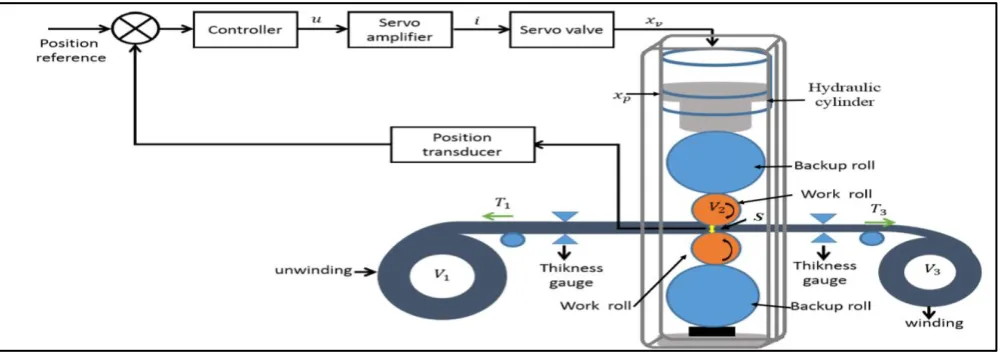
[image:2.595.41.542.198.374.2]A reversible cold rolling mill is a system for reducing the thickness of the metal strip during one or more passes through the rolling gap by alternating the rolling direction. The rolled strip thickness is mainly determined by the gap between two work rollers that is initially set by the AGC. The work rollers are the rollers used to deform the steel plate, while the backup rolls serve to support the work rolls (fig.1).
Fig. 1.Basic configuration of AGC system
This avoids excessive bending of the work rolls.
t is possible to modify the exit thickness by moving the upper roll during the passage, that is to say, hydraulic systems are actuators of the thickness control system. The hydraulic positioning system used to adjust the position of the upper roller is called Hydraulic AGC.
The problem is to control the web thickness and the frontal tension on the support by adjusting the space and the speed of the rolls on this support as a function of the thickness and the tension between the webs [8-10], respectively measured by X-ray thickness gauges and tensiometers.
In practice, the technique used to measure the thickness deviations corresponds to the installation of the X-ray sensor located after the roll stand, which causes a delay in the reaction system and causes a significant deterioration of the performance of the control. This delay time depends on the web speed and the distance between the thickness gauge and the middle of the roll stand. This always has a detrimental effect on the stability and control of system performance. So, the difficulty in measuring thickness without delay is one of the major problems in the design of controllers for rolling systems. On the other hand, as can be seen in the Hydraulic AGC Model hereafter, there is a relatively strong coupling relationship between reversible cold mill state variables due to sigmoid and square root functions, which goes against the improvement of the steel strip quality. Although there are various noise factors such as input thickness variation, input material hardness variation that affects the final output thickness and the tape thickness deviations will exhibit undesirable deviations in the production. The latter are generally due to factors such as the eccentricity of the rolls (defects, distortions or irregularities of the bearings), the mechanical vibrations of the rolling mill (grinding problem)
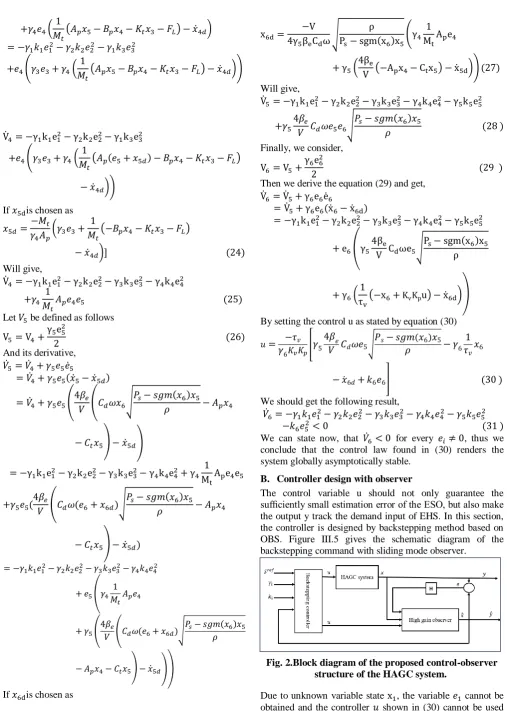
and the thermal noise in the cold rolling mills.Given the basic description of the control problem, we conclude that control of the AGC is primarily a problem of the Hydraulic RGC regulator in which the main task of thickness control is to eliminate the process disturbances effects.A backstepping control strategy with a state observer for HAGC system is developed in this work. We propose a new SO to estimate the unmeasured state for the mismatched nonlinear system. This control technique overcomes the delay in this process and can eliminate the thickness gauge sensor.
B. Mathematical model of the HAGC system
The mathematical model of the Hydraulic AGC system can be described by the system of equations including nonlinear dynamic equations presented in [11] by posing
, , , , , et
as state variables:
International Journal of Innovative Technology and Exploring Engineering (IJITEE) ISSN: 2278-3075, Volume-8 Issue-11, September 2019
With
The state vector is and the controller .
The Table 1 contains the symbol description.
Table- I: Symbol description
Symbol Parameter unites
the spool valve position mm Servovalve amplifier gain the proportional gain of the servo
valve
The associated time constants. s servo valve input current A
Servo valve flux
the flow coefficient of the valve port - Servo valve natural frequency m and the inlet and outlet pressure of the
servo valve respectively
MPa
the oil density
the active area of the cylinder piston the total leakage coefficient The oil pocket volume of the
hydraulic cylinder
the bulk modulus of elasticity MPa the equivalent total mass of moving parts of the upper roller system
kg
the viscosity coefficient of cylinder N.s / m the elastic stiffness coefficient of load N/m the cylinder piston displacement m Other load force acting on the piston kN the plastic stiffness coefficient of the rolled piece
N/m
and are the input and output thickness of the rolled piece respectively
mm
T The constant delay time. s the rolling load kN the mill modulus kN/m
the roll gap mm
Unloaded roll gap mm and the magnitude and period of
thickness deviation respectively
Mm and m
the entry strip is passed through the roll stand with the velocity
m/s
Time constant of hydraulic servo s constants specified -
The model of the HAGC System presented in the above equation is nonlinear because of the sigmoid and square root functions. In this state representation, only the state variables are expressed as a function of time. However, hydraulic and mechanical parameters also vary during the operation of the AGC system.
III. DEVELOPMENTOFNONLINEARHIGHGAIN
OBSERVER
The so-called high gain techniques can be applied without transformation of the initial system. As a result, we separated the linear behavior from the dynamics of the nonlinear system, to obtain a complete stability design procedure. This technique uses the Lyapunov stability theory to adapt the techniques developed in the linear case. This approach satisfies a fairly general class of observers and covers the nonlinear system considered. However, it is not easy to design constant observer gain which ensure sufficient stability of the system.
A. Basic theory of high gain observer
The original approach of the design of a high-gain observer presented in [12] gives sufficient conditions for convergence of the estimated state towards the real state of the system, for the class of nonlinear systems described by the following model:
Then, inspired by the high-gain observer proposed in [13] and the ESO model in [14], and the high-gain observer is designed as follows:
The name high gain comes from the structure of the observer: when the nonlinear function has a large Lipschitz constant, any error between the actual state and the estimated state will be reflected and grow. Therefore, the gain H of the observer (9) must be important to compensate for this amplification of the error.
The dynamics of the estimation error can be deduced from and :
B. Observer stability analysis
The stability of our observer will depend on the choice of a gain matrix that will ensure the asymptotic convergence of the observer's state estimation error in two steps.
The first step is to ensure the stability of the linear part by assuming in equation zero while checking the Lyapunov equation:
In order to study the convergence of the error towards zero, we consider the quadratic function of Lyapunov
, where whose existence guarantees the
asymptotic stability among others the convergence of the error towards zero for t large enough .
By an arbitrary choice of a positive definite matrix and a gain matrix , the latter would be a possible solution if and only if there exists a positive definite symmetric matrix satisfying the expression .
The second step will focus on the non-linear part which must satisfy the following Lipschitz condition:
In other words, for the same gain matrix , the Lipschitz constant δ, the smallest possible must satisfy the condition of the following inequality [17]:
Where Represents the eigenvalues of the matrix (.).
C. Observer of the HAGC
We design a high-gain state observer to estimate the complete state of the HAGC system, which can be used in controller design. For this, we take advantage of the structure of the HAGC system model to design the observer who is not in a strict canonical form.
According to , the non-linear model of HRGC can be rewritten as
With respect to the HRGC hydraulic system under study, taken from , we can establish the equation of our high-gain observer to estimate X as follows:
Where with
And
, and
IV. NONLINEARCONTROLBYBACKSTEPPING
DESIGN
This section addresses the problem of designing a controller with asymptotic stability of the operation interest point. The nonlinear system described by a nonlinear model is in the form of strict feedback. This special form allows the use of a recursive backstepping procedure for controller design [15].
The backstepping control law is derived based on a Lyapunov function, to provide input-output stability of the system. The method essentially provides a recursive framework for the construction of a CLF and the corresponding control action for system stabilization [13]. In the remainder of this section, this idea is adopted to design a non-linear controller for position tracking in a hydraulic servo system.
A. Controller design without observer
We denote by and parameter for
the error between each state variable and its desired trajectory.
Let us choose a candidate Lyapunov function defined by, Then its derivative is given by,
Thus, taking
Then
Where stand for weighting parameters. Now, in order to go one step ahead, a new Lyapunov-like function is defined as
By taking the derivative of (17)
If is chosen as
Will give,
The new weighting parameter is also introduced. Let be defined as follows
By taking the derivative of , one may write
If is chosen as
Will give,
Let be defined as follows
And its derivative,
International Journal of Innovative Technology and Exploring Engineering (IJITEE) ISSN: 2278-3075, Volume-8 Issue-11, September 2019
If is chosen as
Will give,
Let be defined as follows
And its derivative,
If is chosen as
Will give,
Finally, we consider,
Then we derive the equation (29) and get,
By setting the control u as stated by equation (30)
We should get the following result,
We can state now, that for every , thus we conclude that the control law found in (30) renders the system globally asymptotically stable.
B. Controller design with observer
[image:5.595.44.552.34.745.2]The control variable u should not only guarantee the sufficiently small estimation error of the ESO, but also make the output y track the demand input of EHS. In this section, the controller is designed by backstepping method based on OBS. Figure III.5 gives the schematic diagram of the backstepping command with sliding mode observer.
Fig. 2.Block diagram of the proposed control-observer structure of the HAGC system.
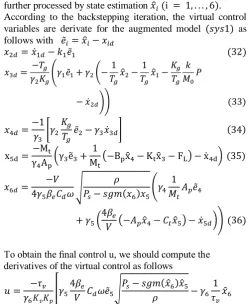
Due to unknown variable state , the variable cannot be obtained and the controller shown in (30) cannot be used directly. In this section, the
further processed by state estimation . According to the backstepping iteration, the virtual control variables are derivate for the augmented model as follows with
To obtain the final control u, we should compute the derivatives of the virtual control as follows
V. RESULTSOFSIMULATIONSTUDIES
In this section, we will present the results of the backstepping controller with high gain observer of the HAGC simulation using MATLAB / Simulink to reveal its efficiency, robustness and verification of the validity of this
observer.
A. Compiled results for the nonlinear observer design
Based on repeated simulations for the choice of the gain matrix H through tests "error test", the results obtained with reference to the relations (12) and (13) are among others: For an exemplary H gain matrix that maintains the stability of the system and that is:
And a symmetric matrix
These matrices allow us to determine the matrix and the Lipschitz constant .
And
B. Main Results
We present the simulation results of adaptive backstepping control with integral action, we simulated the system for a reference velocity , and references tensions with the constants of the regulators and the adaptation gains :
.
The evolution over time of the thickness of the band and its
[image:6.595.43.293.51.356.2]properties of the trajectory tracking error and highlighted the high performance of the backstepping control strategy and the high gain observer proposed for the AGC.
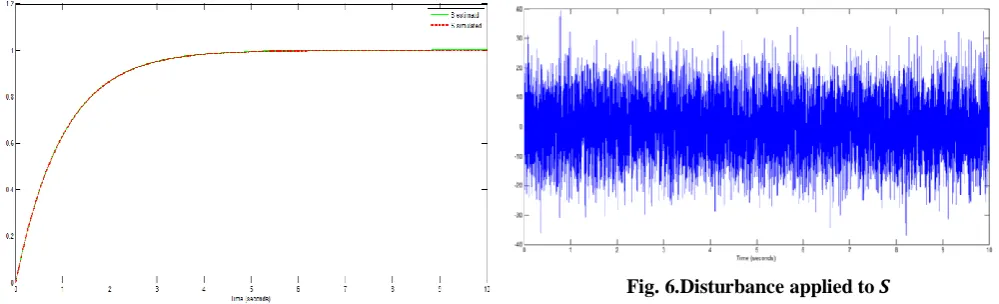
Fig. 3. Exit thickness deviation adopting backstepping control and Evolution of the estimate and its reference
signal in HAGCS
The output thickness of the system h and its estimated, in Fig.3, stabilizes at equilibrium at time t = 4 seconds and follow the desired reference with a tracking error tends to zero in steady state. there is a delay in measuring the thickness, which is why we can see that the system response takes a long time to respond to the order because of the installation of the thickness gauge at 1-3 m behind the roll stand. This delay on the output of the thickness is neglected in the estimate delivered by the proposed high gain observer. Therefore, we notice that the estimate provided by the observer is more accurate than that obtained by the thickness gauge measurement and the tracking performance is satisfactory at the level of stability and without exceeding. On the other hand, the appearance of the thickness error on the backstepping control is given by the fig.4 where we observe the convergence towards zero of this error.
Fig. 4.The exit thickness error on the backstepping control
[image:6.595.305.554.79.255.2] [image:6.595.309.553.485.679.2]International Journal of Innovative Technology and Exploring Engineering (IJITEE) ISSN: 2278-3075, Volume-8 Issue-11, September 2019
Fig. 5.response of hydraulic roll gap by backstepping control and its estimated in HAGCS
Note in Fig.5 that the control law used to allow the stabilization of the gap of work rolls and the convergence to a constant value which allows well determine the tape desired thickness offering better quality thick and more stable operation. this figure also shows that the estimated value of the gap of work rolls and the measured value asymptotically converge to a constant value from 3 sec.
[image:7.595.306.552.213.369.2]To ensure the quality of the backstepping control by law applied to the HAGCS, it is proposed to compare the results obtained in simulation with those obtained by other methods of control. The following table gives a comparison with other control techniques:
Table- II: comparison between several control techniques for AGC
papers Control Strategy % Peak overshoot
The settling time for 5%
[6] traditional PI 150% 1s
fuzzy adaptive PI controller 210% 1s
[3] fuzzy PI controller 210% 1s Traditional PID Smith
prediction controller
25% 2
[4] Single adaptive Smith 20% 10
Multiple adaptive Smith 2% 4
Comparing backstepping control, PI controller, Smith PID, Single adaptive Smith, and Multiple adaptive Smith, we found that the first describes good system performance in terms trajectory and the elimination of overshot.The results obtained by the application of the proposed control gives appreciable performances and a better control AGC without overshot. Which justifies at the end of our work the choice of this approach and the proposition that we presented for the model of system.
VI. STUDYOFROBUSTNESS
To study the proposed backstepping control disturbance rejection performance, we verified the robustness and effectiveness of our approach to HAGCS mathematical model.
The system is subject to disturbances shown in Fig.6.
Fig. 6.Disturbance applied to
In Fig.7 it is found that the desired thickness is reached for this controller even the addition of disturbance.
Fig. 7.Exit thickness deviation adopting backstepping control with perturbation and his estimate in HAGCS
In figure (2), it is found that the actual thickness and the thickness estimated at a rapid convergence to the desired thickness despite the delay of the actual measurement and the existence of a disturbance.
Figure (4) shows the evolution of the control error that shows the signal is converging to zero even the existence of disturbances.
Figure 6 shows the response of the air gap system with a backstepping controller and its high gain observer estimate with the addition of disturbances to the air gap.
Fig. 8.Evolution of the time response of the gap and its estimated
Through these figures we find that the different states are reconstructed despite the presence of disturbances. This observer is robust to disturbances and parametric uncertainties.The results of backstepping controller simulations with disturbance of HAGCS show clearly the rejection of this disturbance and the perfect tracking of the thickness reference. this result
[image:7.595.41.290.416.564.2] [image:7.595.305.553.530.681.2]controller of the HAGCS. moreover, the proposed observer perfectly solves the compromise between speed of convergence and sensitivity to measurement noise.therefore, these results are overall similar to those obtained with backstepping control without disturbance. From these results, we can conclude that the control by the backstepping approach presents a very attractive solution for the AGC control. So, we can first conclude that the control by the backstepping approach presents a very attractive solution for the control of the AGC. And secondly, according to this result, we can say that the high gain observer effectively estimates the thickness of the band and attenuates the effects of all delays, non-linearities, external disturbances and perfectly resolves the compromise between speed of convergence and sensitivity to measurement noise.
VII. CONCLUSION
This paper discusses a new concept of web thickness control of a reversible cold rolling mill via nonlinear control of HAGCS. We proposed a robust nonlinear controller for HAGCS by a backstepping approach with the HGO. A high gain technique has been used to reduce the effect of nonlinear terms. The control performance of the proposed control structures is underlined by simulation results from Simulink implementation. This result of the simulation showed that the desired control objective was achieved with a very fast convergence of the control signal to its desired value. Our goal was to take into account the non-linearity of the HAGCS and to show that the stability of the system is generally guaranteed by this controller based on the Lyapunov function.
Our future work is to implement a non-linear observer based on sliding mode controller for roll gap to reveal the effectiveness and make improvements if necessary.
REFERENCES
1. Koofigar, H.R., Sheikholeslam, F. & Hosseinnia,” Unified gauge-tension control in cold rolling mills: A robust regulation technique “ S. Int. J. Precis. Eng. Manuf. (2011) 12: 393. https://doi.org/10.1007/s12541-011-0051-6.
2. S. Menghui, W. Yiqun and Z. Wei, "Research on Cascade Predictive Control in Hydraulic AGC of Cold Rolling Mill," 2007 2nd IEEE Conference on Industrial Electronics and Applications, Harbin, 2007, pp. 2775-2780. doi: 10.1109/ICIEA.2007.4318917
3. Jie SUN, Dian-hua ZHANG, Xu LI, Jin ZHANG, De-shun DU, Smith Prediction Monitor AGC System Based on Fuzzy Self-Tuning PID Control, Journal of Iron and Steel Research, International, Volume 17, Issue 2, 2010, Pages 22-26, ISSN 1006-706X, https://doi.org/10.1016/S1006-706X(10)60053-2.
4. Jiangyun Li, Kang Wang, and Yang Li, “Automatic Gauge Control in Rolling Process Based on Multiple Smith Predictor Models,” Abstract and Applied Analysis, vol. 2014, Article ID 872418, 10 pages, 2014. https://doi.org/10.1155/2014/872418.
5. W. Hameed and K. Mohamad, "Strip Thickness Control of Cold Rolling Mill with Roll Eccentricity Compensation by Using Fuzzy Neural Network," Engineering, Vol. 6 No. 1, 2014, pp. 27-33. doi: 10.4236/eng.2014.61005.
6. S. Khosravi, A. Afshar and F. Barazandeh, "Design of a novel fuzzy adaptive PI controller for monitor hydraulic AGC system of cold rolling mill," 2011 2nd International Conference on Instrumentation Control and Automation, Bandung, 2011, pp. 53-58. doi: 10.1109/ICA.2011.6130129
7. Hua, Changchun & Yu, Caixia. (2014). Modeling and observer based predictive control for rolling system. 1242-1247. 10.1109/ICMC.2014.7231751.
8. Akil A., Zegrari M., Rabbah N. (2019) Nonlinear Control of the Web Winding System by Backstepping with Integral Action. In: El Hani S., Essaaidi M. (eds) Recent Advances in Electrical and Information
Technology & Innovation (IEREK Interdisciplinary Series for Sustainable Development). Springer, Cham . DOI : https://doi.org/10.1007/978-3-030-05276-8_7
9. Akil, Abdelmajid and Zegrari, Mourad and Nabila, Rabbah, Nonlinear Control of the Web Winding System by Adaptive Backstepping (May 26, 2018). Smart Application and Data Analysis for Smart Cities
(SADASC'18). Available at
SSRN: https://ssrn.com/abstract=3185341 or http://dx.doi.org/10.2139/ ssrn.3185341
10. Akil, A., Zegrari, M. and Rabbah, N. (2018b). Robust Adaptive Backstepping Control for web winding system of reversible cold rolling mill” International Conference on Control, Automation and Diagnosis, Marrakech, Morocco.
11. Abdelmajid Akil, Mourad Zegrari & Nabila Rabbah “NONLINEAR MODEL OF THE HYDRAULIC ROLL GAP CONTROL SYSTEM” International Journal of Mechanical and Production Engineering Research and Development (IJMPERD) Vol. 9, Special Issue 1, Jan 2019, 627-638
12. F.E. THAU. Observing the state of non-linear dynamic systems. International Journal of Control, American Control Conference, San.Francisco, USA, 1993.
13. W. Kim, D. Won, D. Shin, and C. C. Chung, “Output feedback nonlinearcontrol for electro-hydraulic systems,” Mechatronics, vol. 22, no. 6, pp.766–777, Sep. 2012.
14. J. Yao, Z. Jiao, and D. Ma, “Extended-state-observer-based output feed-back nonlinear robust control of hydraulic systems with backstepping,”IEEE Trans. Ind. Electron., vol. 24, no. 6, pp. 993–1015, Apr. 2014.
15. Kaddissi, Claude et al. “Position Control of an Electro-Hydraulic Servosystem - A Non-Linear Backstepping Approach.” ICINCO (2004).
16. Zhong-Ping Jiang and D. J. Hill, "A robust adaptive backstepping scheme for nonlinear systems with unmodeled dynamics," in IEEE Transactions on Automatic Control, vol. 44, no. 9, pp. 1705-1711,
Sept. 1999.
doi: 10.1109/9.788536
17. Yu D. Diagnosing simulated faults for an industrial furnace based on bilinear model. IEEE Trans Control Syst Technol 2000;8(2):4311–442.
AUTHORSPROFILE
Abdelmajid Akil ([email protected]) received the Master of Science and Technology degree in Automatic, Signal Processing and Industrial Computing from faculties of science and technology, Hassan University 1, Settat in 2012.
From 2010 to 2012, he was electrician industrial equipment within the society Moroccan food processing (MFPO), Berrechid, Morocco. Since 2013, he has been a Professor of mathematics at Ibn Rochd High School, Berrechid, Morocco.
He is currently pursuing the Ph.D. degree at the Department of Electrical Engineering, Laboratory of Structural Engineering, Intelligent Systems and Electrical Energy, National Higher School of Arts and Crafts (ENSAM), Hassan II University, Casablanca, MOROCCO. His research interests include the nonlinear control of dynamical systems as applied to metal rolling processes.
Abdelwahed Touati was born in Casablanca, Morocco, in 1970. He received the Engineer degree in electrical Engineering from High Institute of Technical Education (ENSET) of Mohammedia in 1993. In 1999, he successfully passed the external aggregation contest. In 2012 he received the MASTER ATSII (Automatic Signal Processing and Industrial Computing) from HASSAN 1 University – FST of SETTAT Morocco. Currently he is Research Professor Laboratory of Structural Engineering, Intelligent Systems & Electrical Energy ENSAM, Department of Electrical Engineering - Hassan II University Casablanca, Morocco.
International Journal of Innovative Technology and Exploring Engineering (IJITEE) ISSN: 2278-3075, Volume-8 Issue-11, September 2019
Mourad Zegrari is graduated from Higher Normal School of Technical Education (ENSET) of Rabat in 1994. He obtained The PhD degree in Industrial control from Hassan II University of Casablanca in 2012, then the University habilitation in electrical engineering. Actually, He is professor and head of electrical engineering department of Ecole Nationale Supérieure d’Arts et Métiers (ENSAM) of Casablanca. The author is consultant for several industrial units and author for many modeling and industrial control works.