http://eprints.whiterose.ac.uk/91236/
Version: Accepted Version
Article:
Grell, M., Althagafi, T.M., Algarni, S.A. et al. (2 more authors) (2015) Precursor- route ZnO
films from mixed casting solvent for high performance aqueous electrolyte- gated
transistors. Physical Chemistry Chemical Physics. ISSN 1463-9084
https://doi.org/10.1039/C5CP03326H
[email protected] https://eprints.whiterose.ac.uk/ Reuse
Unless indicated otherwise, fulltext items are protected by copyright with all rights reserved. The copyright exception in section 29 of the Copyright, Designs and Patents Act 1988 allows the making of a single copy solely for the purpose of non-commercial research or private study within the limits of fair dealing. The publisher or other rights-holder may allow further reproduction and re-use of this version - refer to the White Rose Research Online record for this item. Where records identify the publisher as the copyright holder, users can verify any specific terms of use on the publisher’s website.
Takedown
If you consider content in White Rose Research Online to be in breach of UK law, please notify us by
This is an Accepted Manuscript, which has been through the Royal Society of Chemistry peer review process and has been accepted for publication.
Accepted Manuscripts are published online shortly after
acceptance, before technical editing, formatting and proof reading. Using this free service, authors can make their results available to the community, in citable form, before we publish the edited article. We will replace this Accepted Manuscript with the edited and formatted Advance Article as soon as it is available.
You can find more information about Accepted Manuscripts in the
Information for Authors.
Please note that technical editing may introduce minor changes to the text and/or graphics, which may alter content. The journal’s standard Terms & Conditions and the Ethical guidelines still apply. In no event shall the Royal Society of Chemistry be held responsible for any errors or omissions in this Accepted Manuscript
or any consequences arising from the use of any information it contains.
Accepted Manuscript
www.rsc.org/pccp
PCCP
This article can be cited before page numbers have been issued, to do this please use: T. M. Althagafi, S. A. Algarni, A. Al Naim, J. Mazher and M. Grell, Phys. Chem. Chem. Phys., 2015, DOI:
a)
Author to whom correspondence should be addressed.
Electronic mail: [email protected]
1
Precursor- route ZnO films from mixed casting solvent for high performance
aqueous electrolyte- gated transistors
!
Talal M. Althagafi1*, Saud A. Algarni1, Abdullah Al Naim2, Javed Mazher2, Martin Grell1
! 1
Physics&Astronomy, University of Sheffield, Hicks Building, Hounsfield Rd, Sheffield S3 7RH, UK
2
Physics department, King Faisal University, Al-Ahsa, Saudi Arabia.
Abstract
We significantly improved the performance of precursor- route semiconducting zinc oxide (ZnO) films in electrolyte- gated thin film transistors (TFTs). We find that the organic precursor to ZnO, Zinc Acetate (ZnAc), dissolves more readily in a 1:1 mix of ethanol (EtOH) and acetone than in either pure EtOH, pure acetone, or pure isopropanol. XPS and SEM characterisation show improved morphology of ZnO films converted from mixed solvent cast ZnAc precursor compared to EtOH cast precursor. When gated with a biocompatible electrolyte, phosphate buffered saline (PBS), ZnO thin film transistors (TFTs) derived from mixed solvent cast ZnAc give 4 times larger field effect current than similar films derived
from ZnAc cast from pure EtOH. Sheet resistance at VG = VD = 1V is 30 kΩ/!, lower than for
any organic TFT, and lower than for any electrolyte- gated ZnO TFT reported to date.
Key Words: Thin film transistor, Zinc oxide, Zinc acetate, precursor, PBS, Biosensor
Introduction
Horowitz et al.[1] discovered that semiconducting organic films can be gated by field
effect with very low threshold using deionised (DI) water as gate medium. Gating is due to
the high capacitance electric double layer (EDL) that develops at the water/semiconductor
interface even for DI water as ‘electrolyte’. This discovery has triggered an interest in
developing such thin film transistors (TFTs) into a novel type of biosensor, wherein an
aqueous sample under test is an active part of the transducer. TFT devices gated by a
biologically realistic aqueous electrolyte, phosphate- buffered saline (PBS) solution, were
sensitised (e.g. by enzymes) either at the semiconductor/water interface [2, 3], or at the
gate electrode [4]. The latter is easier and more versatile as it requires no chemical
modification of the semiconductor, which can lead to loss of performance. Compared to DI
water, more concentrated electrolyte gate media like PBS favourably display higher
capacitance up to somewhat higher frequencies. However, organic semiconductors often
suffer stability problems under concentrated electrolytes, and may become doped by
penetrating ions, i.e. electrochemical transistor behaviour competes with field effect gating
Ph
ys
ic
al
C
he
m
is
tr
y
C
he
m
ic
al
Ph
ys
ic
s
A
cc
ep
te
d
Ma
nu
sc
rip
2
[5], which makes the transducer’s output difficult to interpret. This can largely be avoided
when an inorganic semiconducting film is used instead. Ong et al. [6] had shown that the
II-VI semiconductor Zinc oxide (ZnO) can be prepared by casting a soluble precursor, Zinc
acetate (ZnAc, Zn(O2CCH3)2), with subsequent thermal conversion into ZnO under
atmosphere. Ong et al. reported n- type field effect transistors using such films, with
electron mobility μ ~ 5 cm2/Vs and good on/off ratio. However, their conventional ‘dry’
dielectric gate medium with low capacitance lead to high operational voltages. Al Naim et al.
have since shown that precursor route ZnO can also be gated with aqueous media [7].
Electrolyte- gated precursor- route ZnO transistors may show similar mobility as reported by
Ong et al. for dry- gated devices at much reduced threshold due to the high EDL
capacitance, thus delivering a solution-processed electrolyte gated TFTs that do not suffer
from electrochemical doping. However, so far, mobility in precursor- route ZnO still falls
short of the performance of ZnO when deposited by methods such as magnetron sputtering
or pulsed laser deposition [8-11].
Here, we report on the preparation of precursor- route ZnO films that perform
significantly better in electrolyte- gated TFTs than any previously reported precursor- route
ZnO films. The key to improved performance is the use of a mixed solvent for the ZnAc
precursor.
Experimental
We dissolved 0.1M ZnAc in EtOH, isopropanol, Acetone, or 1:1 EtOH/Acetone, by
continuous stirring at elevated temperature for prolonged periods. TFT contact substrates
with geometry factor width/length (W/L) = 1 mm/30 μm = 33.3 were prepared using a
shadow mask on synthetic quartz substrates sourced from Ossila and thermal evaporation
of Au contacts with an underlying Cr adhesion layer under high vacuum. ZnAc solution was
casted onto contact substrates at 2000 rpm for 50s and thermally converted into ZnO under
atmosphere on a hotplate at 450o C for 12 minutes. ZnAc coating and conversion was
repeated three times. Resulting ZnO films were characterised by XPS and SEM. XPS was
calibrated by the graphitic carbon C 1s peak [12]. Graphitic carbon is adsorbed on the
surface during exposure of the sample to ambient atmosphere, and is commonly used for
ZnO XPS calibration[13]. ZnO surfaces were imaged by SEM at 15 kV. For transistor
manufacture, we applied a droplet of the aqueous electrolyte 0.01M phosphate buffered
Ph
ys
ic
al
C
he
m
is
tr
y
C
he
m
ic
al
Ph
ys
ic
s
A
cc
ep
te
d
Ma
nu
sc
rip
3
saline (pH =7.4) (PBS, Aldrich catalogue No P4417) as a gate medium. The gate medium was
electrically addressed by an L- shaped Au gate needle that was lowered to very close
proximity (200 μm adjusted by a glass cover slip used as spacer) using a probe head. The
‘foot’ of the L was oriented along the width W of the transistor channel and overlapped the
channel completely. Source and drain (S/D) were contacted by Tungsten (W) needles that
readily pierced through the ZnO film that had formed on the evaporated Au contacts. We
recorded TFT output and transfer characteristics with two Keithley source/measure units
configured for TFT characterisation.
Results and discussion
Previous reports [7, 14] on water- gated ZnO transistors from ZnAc precursor used
ethanol (EtOH) as the casting solvent for the precursor. However, we observe that pure
EtOH is not a good solvent for ZnAc. To completely dissolve 0.1 M ZnAc in EtOH, we need to
heat and stir the mixture for prolonged periods (5 hours), and on storage at ambient
temperature, ZnAc precipitates within an hour. To re- dissolve, we need to repeat heating
and stirring for 30 minutes before processing. We find similarly poor solubility of ZnAc in
pure acetone, and 2-propanol. Ong et al.[6] instead used methoxyethanol to dissolve ZnAc
but they do not clearly report solvent quality. However, we here observe that a 1:1 mix of
EtOH and acetone is a far better solvent for ZnAc than either EtOH, 2-propanol, or acetone,
alone. Heating and stirring is still required to dissolve ZnAc in mixed solvent, but only a small
amount of precipitate forms even after several days of storage, which quickly re- dissolves
on gentle heating.
We cast films of ZnAc dissolved in mixed EtOH:Acetone (1:1) solvent, and similar films
from pure EtOH for comparison, onto contact substrates, thermally converted into ZnO. We
first characterised both resulting ZnO film surfaces by X-ray photoelectron spectroscopy
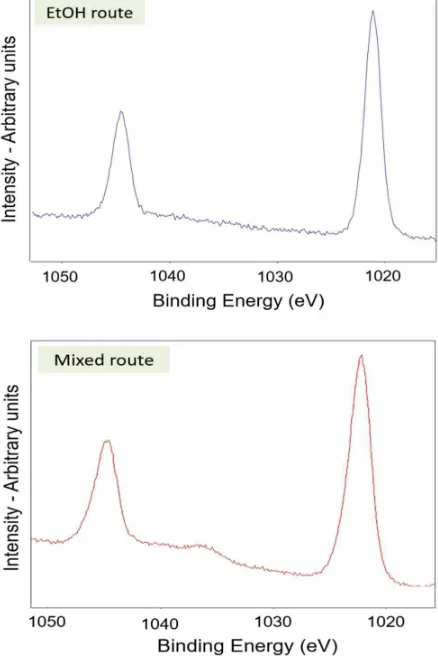
(XPS). Fig.1 shows the detected peaks for Zn 2p orbitals for precursor- route ZnO films cast
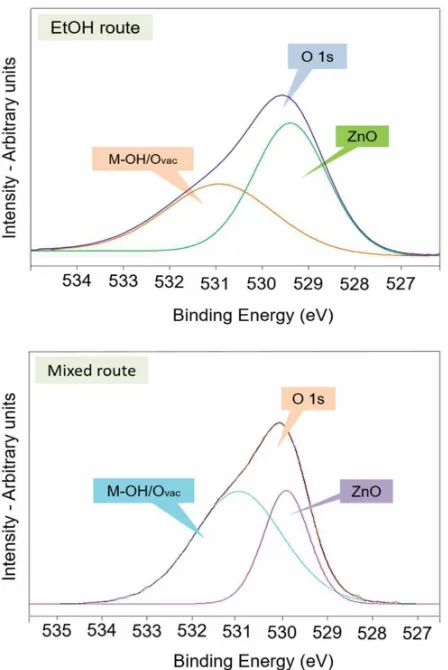
from EtOH (top) and mixed solvent (bottom), Fig. 2 shows O 1s XPS spectra for precursor-
route ZnO films cast from EtOH (top) and mixed solvent (bottom). For Zn 2p orbitals, we find
the usual split into Zn 2p1/2 Zn 2p3/2 orbitals [15-19]. The (non- Gaussian) O 1s peaks in Fig. 2
have been resolved into a superposition of two overlapping Gaussians. The lower energy
Gaussian has been attributed to O2− ions bound into the regular wurtzite structure of ZnO
Ph
ys
ic
al
C
he
m
is
tr
y
C
he
m
ic
al
Ph
ys
ic
s
A
cc
ep
te
d
Ma
nu
sc
rip
4
(Zn-O-Zn), the higher energy Gaussian to oxygen in metal-OH (M-OH) surface groups [15].
All XPS peak positions, and their widths (FWHM), are summarised in table 1.
Fig. 1: XPS spectra of Zn 2p orbitals in ZnO films resulting from the thermal conversion of precursor, ZnAc, cast
from different solvents. Top: ZnAc cast from EtOH, bottom: ZnAc cast from mixed solvent, EtOH:Acetone 1:1.
Ph
ys
ic
al
C
he
m
is
tr
y
C
he
m
ic
al
Ph
ys
ic
s
A
cc
ep
te
d
Ma
nu
sc
rip
[image:6.595.194.413.127.455.2]5
Fig. 2: XPS spectra of O1 s for ZnO films resulting from the thermal conversion of precursor, ZnAc, cast from
[image:7.595.190.407.476.576.2]different solvents. Top: ZnAc cast from EtOH, bottom: ZnAc cast from mixed solvent, EtOH:Acetone 1:1.
Table 1
EtOH route Mixed route Position
(eV)
FWHM (eV)
Position (eV)
FWHM (eV) Zn1/2 1021 1.75 1023 2.5
Zn3/2 1045 2 1047 2.5
O 1s 529.6 2.8 530 2.2
Zn-O 529.4 1.9 529.9 1.07
M-OH 531.2 2.8 531 2.2
Table 1: Summary of observed XPS peak positions, and their FWHM, for ZnO films via
ZnAc precursor route from different solvents. The (non- Gaussian) O 1s peaks have been
resolved into a superposition of overlapping Gaussian Zn-O-Zn, and Metal-OH, O 1s peaks,
as shown in Fig. 2.
All observed XPS peaks are in the range of what was found in previous XPS studies on
ZnO
Ph
ys
ic
al
C
he
m
is
tr
y
C
he
m
ic
al
Ph
ys
ic
s
A
cc
ep
te
d
Ma
nu
sc
rip
6
[14-19]. Overall, XPS analysis shows the chemical identity of our films as wurtzite ZnO, with
Zn-OH surface groups, thus confirming successful conversion of the precursor for both
casting solvents, but reveals no differences at the level of atomic binding between the
different casting solvents.
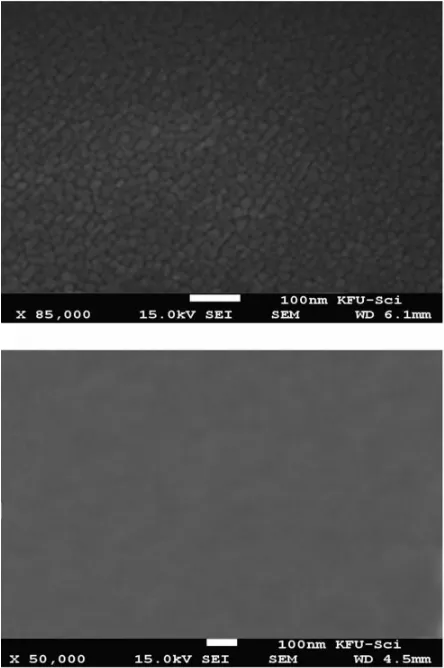
However, SEM surface imaging shows morphological differences on the ~ 10nm size scale
between ZnO films prepared using different solvents. In Fig. 3, we show images of ZnO
surfaces resulting from the conversion of EtOH cast precursor (top), and mixed solvent cast
precursor (bottom).
!
! !
Fig. 3: SEM images of ZnO films resulting from the thermal conversion of precursor, ZnAc, cast from different
solvents. Top: ZnAc cast from EtOH, bottom: ZnAc cast from mixed solvent, EtOH:Acetone 1:1.
Films from EtOH- cast precursor show recognisable small grains in the order 7 to 15 nm.
However, the image of mixed solvent cast precursor films shows little contrast, grains are
barely recognisable, and larger (17-20nm). The absence of clearly visible morphological
features on the mixed solvent cast ZnO surface indicates a very homogeneous film.
Ph
ys
ic
al
C
he
m
is
tr
y
C
he
m
ic
al
Ph
ys
ic
s
A
cc
ep
te
d
Ma
nu
sc
rip
[image:8.595.185.407.260.594.2]7
We believe that in the better quality mixed solvent, the precursor ZnAc forms a true
solution, while in poor solvent, e.g. pure EtOH, precursor molecules will cluster into small
aggregates rather than fully dissolve. On casting from such poor solution, aggregates will
transfer to the substrate, priming the formation of ZnO grains with defined boundaries on
thermal conversion. Grains are larger, and less clearly separated, when precursor is cast
from a better solvent.
As grain boundaries often limit charge carrier mobility, the homogeneous, featureless
morphology of mixed solvent cast ZnO suggests it may perform better when used as
semiconductor in a thin film transistor (TFT). We therefore tested both types of ZnO films in
TFTs gated by phosphate- buffered saline (PBS) as an aqueous gate medium. PBS is often
used to simulate bodily fluids [2-4] and is thus a realistic medium for biosensor applications.
The surface of ZnO is hydrophilic, and PBS forms a flat ‘puddle’ with small contact angle.
Resulting transistor output- and transfer characteristics are shown in Figs 4 and 5.
Ph
ys
ic
al
C
he
m
is
tr
y
C
he
m
ic
al
Ph
ys
ic
s
A
cc
ep
te
d
Ma
nu
sc
rip
8
Fig. 4: Output characteristics for Zn acetate precursor route ZnO TFTs gated by PBS electrolyte. Top: Precursor
cast from pure EtOH. Bottom: Precursor cast from mixed EtOH/acetone (1:1). Insets to output characteristics show magnified characteristics at low gate voltages.
Output characteristics show that TFTs turn on for positive gate voltages, as expected for
electron- transporting transistors. Electron- rather than hole type transistor action is well
established for ZnO [7, 8, 14, 20], but is in contrast to organic TFTs gated with aqueous
electrolytes which to date all were hole transporters. Output characteristics are near ideal,
with little hysteresis, a truly linear ‘linear’ regime, and drain current saturation at high drain
voltages. Magnified low gate voltage output characteristics (insets to Fig. 4) clearly show
TFTs are ‘off’ at VG = 0 V, but ‘on’ (above threshold) at VG = +0.2 V. Threshold voltage is
therefore between 0 and 0.2 V, similar as in previous reports on PBS- gated ZnO [14]. Low
threshold is characteristic of all electrolyte- gated TFTs, due to the high specific capacitance
of electrolyte gate media. In parallel, we monitored gate leakage currents; gate leakage was
always small (< 5 μA at VD = VG = 1V for EtOH route, 0.2 μA for mixed solvent route)
compared to drain current.
Ph
ys
ic
al
C
he
m
is
tr
y
C
he
m
ic
al
Ph
ys
ic
s
A
cc
ep
te
d
Ma
nu
sc
rip
9
[image:11.595.179.416.80.399.2]! !
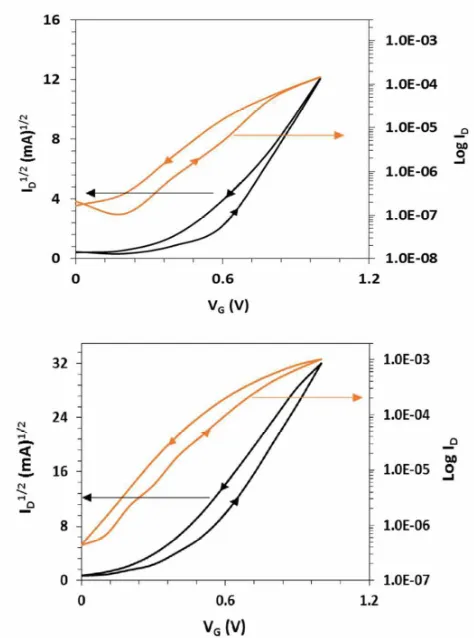
Fig. 5: Saturated transfer characteristics for Zn acetate precursor route ZnO TFTs gated by PBS electrolyte. Top:
Precursor cast from pure EtOH. Bottom: Precursor cast from mixed EtOH:acetone (1:1). Transfer characteristics are shown in two different representations (on ID
1/2
(black) and logID (orange) scale), as it is
customary in the TFT literature.
The saturated transfer characteristics, Fig. 5, both show some hysteresis, which is also
sometimes observed for ZnO TFTs under ionic liquid (IL) gate media [21]. Fig. 5, top in
particular also shows a rather curved I½D,satvs. VG plots, approaching linearity (as predicted
by generic TFT theory) only at high gate voltages (above 0.8V). This may indicate increasing
electrolyte capacitance or increasing carrier mobility, at high gate voltages/carrier densities
in the channel. Threshold voltage is therefore better estimated from low gate voltage
output characteristics, as above. Nevertheless, transfer characteristics clearly show field
effect transistor action, i.e. off → on switching of drain current with gate voltage, with
on/off ratios [ID(VG= 1V) / ID(VG= 0V)] 710 for EtOH route, and 2340 for mixed solvent route,
which are within the range 102 … 104 reported previously for ZnO TFTs under various
electrolyte gate media [14, 21].
Ph
ys
ic
al
C
he
m
is
tr
y
C
he
m
ic
al
Ph
ys
ic
s
A
cc
ep
te
d
Ma
nu
sc
rip
10
While characteristics are qualitatively similar between the different casting solvents,
there is a remarkable quantitative difference. For our EtOH- cast TFT, saturated drain
current at VG = VD = 1V is 0.26 mA, corresponding to a sheet resistance R! (1V) = W/L [VD = 1
Volt / ID,sat = 0.26 mA] = 128 kΩ/!. However, the saturated drain current for the ZnO TFT
cast from ZnAc in mixed solvent is significantly higher, 1.1 mA, corresponding to a sheet
resistance of only R! (1V) = 30 kΩ/!. We note that the calculation of a carrier mobility from
standard transistor equations is difficult in the case of electrolyte- gating due to uncertainty
on the precise figure of specific capacitance Ci [1, 7]. Instead we report the figure- of-merit
μCi that can be extracted directly from measured characteristics without assumptions on Ci
[22]. When evaluating saturated transfer characteristics at high gate voltage (VG = 0.8V …
1V), we find μCi = 33 μAV-2 for EtOH- cast films, and 117 μAV-2 for films cast from mixed
solvent, almost 5 times larger. If we assume a specific capacitance of Ci = 3 µF/cm2 [1], this
corresponds to an electron mobility of 11 cm2V-1s-1 for EtOH- cast ZnAc- precursor ZnO, and
39 cm2V-1s-1 for mixed- solvent cast ZnAc- precursor ZnO. Mobilities evaluated from
electrolyte- gated transistors should be treated with caution, but the near fivefold
improvement remains true regardless, as Ci will be equal in both cases.
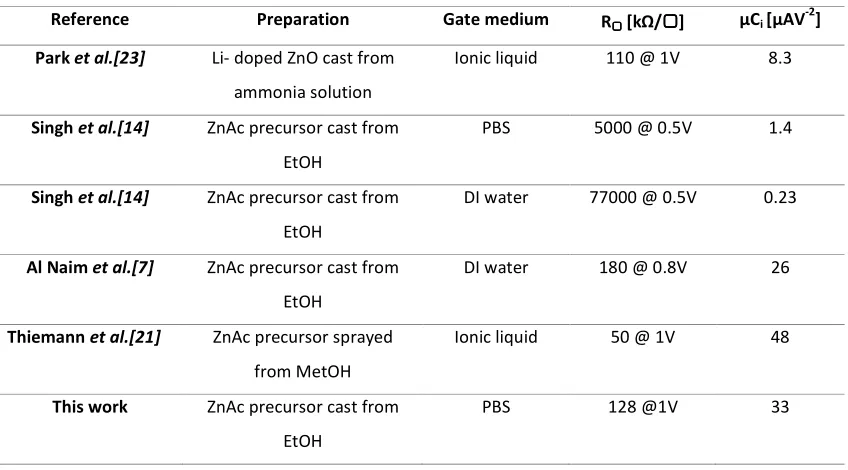
Table 1 puts our work into context with literature results on directly comparable devices,
[image:12.595.81.505.491.726.2]i.e. electrolyte- gated TFTs using solution- processed ZnO as semiconductor.
Table 2
Reference Preparation Gate medium R!!!! [kΩ/!!!!] μCi [μAV
-2
]
Park et al.[23] Li- doped ZnO cast from
ammonia solution
Ionic liquid 110 @ 1V 8.3
Singh et al.[14] ZnAc precursor cast from
EtOH
PBS 5000 @ 0.5V 1.4
Singh et al.[14] ZnAc precursor cast from
EtOH
DI water 77000 @ 0.5V 0.23
Al Naim et al.[7] ZnAc precursor cast from
EtOH
DI water 180 @ 0.8V 26
Thiemann et al.[21] ZnAc precursor sprayed
from MetOH
Ionic liquid 50 @ 1V 48
This work ZnAc precursor cast from
EtOH
PBS 128 @1V 33
Ph
ys
ic
al
C
he
m
is
tr
y
C
he
m
ic
al
Ph
ys
ic
s
A
cc
ep
te
d
Ma
nu
sc
rip
11
This work ZnAc precursor cast from
EtOH : Acetone
[image:13.595.76.506.80.117.2]PBS 30 @1V 117
Table 2: Performance characteristics of electrolyte- gated TFTs with solution- processed ZnO.
Data in table 1 confirm that ZnO films derived from mixed solvent route processed ZnAc
precursor lead to performance in electrolyte- gated TFTs superior to any other solution-
processed ZnO films. Sheet resistance is lower, and figure- of- merit higher, for mixed
solvent cast precursor even compared to work using higher capacitance ionic liquid (rather
than aqueous) gate medium[21], or casting dissolved (rather than precursor- route) ZnO
[23].
As a further comparison, mixed solvent route ZnO also compares favourably to
electrolyte- gated organic TFTs, even those using state- of- the art hole transporting
polymer, Poly(2,5-bis(3-hexadecylthiophen-2-yl)thieno[3,2-b]thiophene) (PBTTT). The best
performing electrolyte- gated PBTTT TFTs [24] display a sheet resistance R (1V) = 640 kΩ/!
for water-gated and 102 kΩ/! for ionic liquid gated PBTTT, which is still higher than the
sheet resistance we find for mixed solvent cast precursor ZnO.
The low sheet resistance and high estimated mobility we report here has so far only been
matched or surpassed for conventional ‘dry’ processed ZnO TFTs. Fortunato et al.[8] and
Zhang et al.[9] deposited ZnO by rf magnetron sputtering and reported carrier mobility of
70 cm2/Vs when gated by silicon oxynitride (SiOxNy) dielectric [8], and 60 cm2/Vs using
Ta2O5 gate insulator [9]. Both mobilities are measured at rather high voltages though
(Fortunato et al. : 10 V; Zhang et al. : 5V); Brox-Nilsen et al. [10] report 50 cm2/Vs again on
Ta2O5 at slightly lower voltage (4 V). The highest mobility to date of 110 cm2/Vs for ZnO TFTs
is reported by Bayraktaroglu et al. [11] who grew ZnO by pulsed laser deposition onto a
substrate held at 350oC. However, these direct deposition methods do not benefit from the
ease of processing afforded by soluble precursor routes, and sheet resistance even in the
device of Bayraktaroglu et al. was R!(15V) = 25 kΩ/!. None of Fortunato et al, Zhang et al.,
Brox-Nilsen et al., and Bayraktaroglu et al. report gating with an aqueous electrolyte, which
would be essential for biosensor applications.
Conclusions
Ph
ys
ic
al
C
he
m
is
tr
y
C
he
m
ic
al
Ph
ys
ic
s
A
cc
ep
te
d
Ma
nu
sc
rip
12
It is well established that the performance of organic semiconductor devices critically
depend on the choice of processing solvent [25]. Here, we report a similar observation on
inorganic semiconductor devices prepared via a solution- processed precursor. We find that
Zinc acetate (ZnAc), a precursor to the II-VI semiconductor zinc oxide (ZnO), dissolves
significantly better in a 1:1 mix of ethanol and acetone than in either pure ethanol, acetone,
or isopropanol. ZnAc cast from a better solvent will give aggregate- free precursor films that
convert into more homogeneous ZnO films, as characterised by XPS and SEM. When gated
by the aqueous electrolyte PBS, transistor sheet current and other performance
characteristics are superior to previously reported precursor- route ZnO TFTs, and
approaches performance of ZnO transistors deposited by conventional ‘dry’, precursor- free
methods such as magnetron sputtering or laser ablation, and gated by dry dielectrics.
Acknowledgements
Talal M Althagafi and Saud Algarni wish to thank the Cultural Attaché of Saudi Arabia to the UK for providing them with fellowships for their PhD studies. Javed Mazher thanks King Abdulaziz City of Science and Technology (KACST) for funding under vide project number 11-NAN1818-06.
References
[1] L. Kergoat, L. Herlogsson, D. Braga, B. Piro, M.-C. Pham, X. Crispin, M. Berggren, G. Horowitz, Advanced Materials, 22 (2010) 2565-2569.
[2] L. Kergoat, B. Piro, M. Berggren, M.-C. Pham, A. Yassar, G. Horowitz, Organic Electronics, 13 (2012) 1-6.
[3] F. Buth, A. Donner, M. Sachsenhauser, M. Stutzmann, J.A. Garrido, Advanced Materials, 24 (2012) 4511-4517.
[4] S. Casalini, F. Leonardi, T. Cramer, F. Biscarini, Organic Electronics, 14 (2013) 156-163. [5] S.H. Kim, K. Hong, W. Xie, K.H. Lee, S. Zhang, T.P. Lodge, C.D. Frisbie, Advanced Materials, 25 (2013) 1822-1846.
[6] B.S. Ong, C. Li, Y. Li, Y. Wu, R. Loutfy, Journal of the American Chemical Society, 129 (2007) 2750-2751.
[7] A. Al Naim, M. Grell, Applied Physics Letters, 101 (2012) 141603.
[8] E. Fortunato, A. Pimentel, L. Pereira, A. Gonçalves, G. Lavareda, H. Águas, I. Ferreira, C.N. Carvalho, R. Martins, Journal of Non-Crystalline Solids, 338–340 (2004) 806-809.
[9] L. Zhang, J. Li, X.W. Zhang, X.Y. Jiang, Z.L. Zhang, Applied Physics Letters, 95 (2009) 072112. [10] C. Brox-Nilsen, J. Jin, Y. Luo, P. Bao, A.M. Song, Electron Devices, IEEE Transactions on, 60 (2013) 3424-3429.
[11] B. Bayraktaroglu, K. Leedy, R. Neidhard, Electron Device Letters, IEEE, 29 (2008) 1024-1026. [12] C.D. Wagner, L.H. Gale, R.H. Raymond, Analytical Chemistry, 51 (1979) 466-482.
[13] D. Briggs, Surface and Interface Analysis, 3 (1981) v-v.
Ph
ys
ic
al
C
he
m
is
tr
y
C
he
m
ic
al
Ph
ys
ic
s
A
cc
ep
te
d
Ma
nu
sc
rip
13 [14] M. Singh, G. Palazzo, G. Romanazzi, G.P. Suranna, N. Ditaranto, C. Di Franco, M.V. Santacroce, M.Y. Mulla, M. Magliulo, K. Manoli, L. Torsi, Faraday Discussions, 174 (2014) 383-398.
[15] R. Al-Gaashani, S. Radiman, A.R. Daud, N. Tabet, Y. Al-Douri, Ceramics International, 39 (2013) 2283-2292.
[16] J.H. Zheng, Q. Jiang, J.S. Lian, Applied Surface Science, 257 (2011) 5083-5087.
[17] J. Das, S.K. Pradhan, D.R. Sahu, D.K. Mishra, S.N. Sarangi, B.B. Nayak, S. Verma, B.K. Roul, Physica B: Condensed Matter, 405 (2010) 2492-2497.
[18] L.G. Mar, P.Y. Timbrell, R.N. Lamb, Thin Solid Films, 223 (1993) 341-347.
[19] S. Oertel, M.P.M. Jank, E. Teuber, A.J. Bauer, L. Frey, Thin Solid Films, 553 (2014) 114-117. [20] P.F. Carcia, R.S. McLean, M.H. Reilly, Applied Physics Letters, 88 (2006) 123509.
[21] S. Thiemann, S. Sachnov, S. Porscha, P. Wasserscheid, J. Zaumseil, The Journal of Physical Chemistry C, 116 (2012) 13536-13544.
[22] L.A. Majewski, R. Schroeder, M. Grell, Advanced Materials, 17 (2005) 192-196.
[23] S.Y. Park, B.J. Kim, K. Kim, M.S. Kang, K.-H. Lim, T.I. Lee, J.M. Myoung, H.K. Baik, J.H. Cho, Y.S. Kim, Advanced Materials, 24 (2012) 834-838.
[24] S.A. Algarni, T.M. Althagafi, P.J. Smith, M. Grell, Applied Physics Letters, 104 (2014) 182107. [25] C.S. Kim, S. Lee, E.D. Gomez, J.E. Anthony, Y.-L. Loo, Applied Physics Letters, 93 (2008) 103302.
!