UNIVERSITI TEKNIKAL MALAYSIA MELAKA
ACTIVE SOLAR TRACKER
This report submitted in accordance with requirement of the Universiti Teknikal Malaysia Melaka (UTeM) for the Bachelor‟s Degree in Electrical Engineering
Technology (Industrial Automation and Robotics) (Hons.)
By
AFDZAL RIDZUAN BIN KHALID
B071110029
880329-08-5133
UNIVERSITI TEKNIKAL MALAYSIA MELAKA
BORANG PENGESAHAN STATUS LAPORAN PROJEK SARJANA MUDA
TAJUK: Active Solar Tracker
SESI PENGAJIAN: 2014/15 Semester 1
Saya AFDZAL RIDZUAN BIN KHALID
mengaku membenarkan Laporan PSM ini disimpan di Perpustakaan Universiti Teknikal Malaysia Melaka (UTeM) dengan syarat-syarat kegunaan seperti berikut:
1. Laporan PSM adalah hak milik Universiti Teknikal Malaysia Melaka dan penulis. 2. Perpustakaan Universiti Teknikal Malaysia Melaka dibenarkan membuat salinan
untuk tujuan pengajian sahaja dengan izin penulis.
3. Perpustakaan dibenarkan membuat salinan laporan PSM ini sebagai bahan pertukaran antara institusi pengajian tinggi.
4. **Sila tandakan ( )
SULIT
TERHAD
TIDAK TERHAD
(Mengandungi maklumat yang berdarjah keselamatan atau kepentingan Malaysia sebagaimana yang termaktub dalam AKTA RAHSIA RASMI 1972)
(Mengandungi maklumat TERHAD yang telah ditentukan oleh organisasi/badan di mana penyelidikan dijalankan)
____________________________
(TANDATANGAN PENULIS)
Alamat Tetap:________________
Tarikh: ______________________
Disahkan oleh:
___________________________
(TANDATANGAN PENYELIA)
Cop Rasmi:
Tarikh: ________________________
Tarikh: _______________________
DECLARATION
I hereby, declared this report entitled “Active Solar Tracker” is the results of my own research except as cited in references.
Signature :……….
Author‟s Name : AFDZAL RIDZUAN BIN KHALID
APPROVAL
This report is submitted to the Faculty of Engineering Technology of UTeM as a partial fulfillment of the requirements for the Bachelor‟s Degree in Electrical Engineering Technology (Industrial Automation and Robotics) (Hons.) The member of the supervisory is as follow:
i
ABSTRAK
ii
ABSTRACT
iii
DEDICATION
To my beloved parents To my kind lecturers And not forgetting to all friends
For their
iv
ACKNOWLEDGEMENT
In completing this project, I have received a lot of helps from my supervisors, lecturers, researchers and family members and fellow friends.
First, I want to give my upmost thanks to my supervisor, Miss Suziana binti Ahmad who gave me an opportunity to do this project, for guiding and assisting me through the completion of this project. Without him guidance and persistent help, this project would not have been successful.
Next, I would like to express deepest appreciation to my parents in supporting me mentally and financially, for their encouragements and supports.
It is also my duty to record my thankfulness to my fellow friends that gave advice at some points and lent me a hand in completing the project. Also to a friend that offered this private space for field test and analysis of the prototype.
v
TABLE OF CONTENTS
Abstrak i
Abstract ii
Dedication iii
Acknowledgement iv
Table of Contents v
List of Table ix
List of Figure x
CHAPTER 1: INTRODUCTION 1
1.1 Background 1
1.2 Problem statement 1
1.3 Objectives 2
1.5 Work Scopes 2
CHAPTER 2: LITERATURE REVIEW AND PROJECT BACKGROUND 3
2.1 Microcontroller 3
2.2 Solar Panel 5
2.2.1 Monocrystalline Silicon Solar Cell 6
2.2.2 Polycrystalline Silicon Solar Cell 6
2.2.3 Thin-film Solar Cell (TFSC) 7
2.3 Motor as Actuator 8
2.4 Sensor 9
2.5 Summary of Literature Review. 10
CHAPTER 3: PROJECT METHODOLOGY 12
3.1 Overview of the Project. 12
3.2 Study on A Solar Tracker 13
3.3 Hardware Development 13
vi
3.3.2 Aluminum Cylinder Bar (Shaft Part) 14
3.3.3 Housing Bearing 15
3.3.4 Bearing 8 inch 16
3.3.5 Pulley and Belting 16
3.3.6 Assemble Hardware Part 17
3.4 Electrical Development 17
3.4.1 Microcontroller (Arduino Uno) 18
3.4.2 Solar Panel (10Watt) 18
3.4.3 Stepper Motor 19
3.4.4 Photodiode 20
3.4.5 Driver Stepper Motor (SD02B) 20
3.4.6 Connection Component to the Controller 21
3.5 Software Development 22
3.6 Project‟s Tests 24
3.6.1 Testing the Photodiode 25
3.6.2 The Stepper Motor‟s Test. 25
3.6.3 Testing Overall System . 25
3.7 Experimental Setup 26
3.7.1 Indoor Experiment 26
3.7.2 Outdoor Experiment 27
CHAPTER 4: RESULT AND DISCUSION 30
4.1 Test for developed sun pointing sensor of Photodiode 30
4.1.1 Result and Analysis. 30
4.1.2 Discussion 32
4.2 Experiment for Pan-tilt tracking ability with shadow sensor. 33
4.2.1 Result and Analysis. 33
4.2.2 Discussions 36
4.3 Full System Field test 36
4.3.1 Result and Analysis 36
4.3.2 Discussion 39
CHAPTER 5: CONCLUSION AND RECOMMENDATION 40
5.1 Conclusion 40
5.2 Recommendation 41
vii
REFERENCES 42
APPENDICES
A. Microcontroller Arduino Uno
B. Nema Size 23 1.8 2-Phase Stepper Motor C. Nema Size 23 1.8 2-Phase Stepper Motor D. Driver Motor Stepper (Sd02b)
viii
LIST
OF
TABLE
3.1 List of Component 14
3.2 List of Electrical Part 17
3.3 Descriptions Arduino Uno 18
3.4 Table for Digital Value 27
3.5 Table for Data Pulse and Angle. 27
3.6 Table for Voltage Reading 29
4.1 The Reading of Photodiode in Digital 31
4.2 The Condition of Sensor and the Observation 35
4.3 Table of Pulse makes Angle 35
ix
LIST OF FIGURE
2.1 Microcontroller Arduino MEGA 3
2.2 Solar Panel 5
2.3 Motor 7
2.4 Photodiode sensor 9
3.1 Flow of Project 12
3.2 Acrylic 14
3.3 Shaft Part 15
3.4 Housing Bearing 15
3.5 Bearing 8 inch 16
3.6 Pulley and Belting 16
3.7 All Part of Hardware 17
3.8 Arduino UNO 18
3.9 Solar Panel 19
3.10 Stepper Motor 20
3.11 Shadow Sensor 20
3.12 Driver Stepper Motor 21
3.13 The Connection of the Components 22
3.14 Coding for stepper motor 23
3.15 Coding For Analog Read 24
3.16 Setup Indoor Experiment 26
3.17 Setup for Outdoor Experiment 28
3.18 Display Voltage Value 28
4.1 Circuit of Photodiode 28
4.2 View from the Top 28
4.3 Condition 1 30
x
4.5 Condition 3 30
4.6 Condition 4 31
4.7 Condition 5 31
4.8 Condition 6 31
4.9 Bar Graf Times verses Voltage 34
4.10 Bar Graph Times verses Current 34
1
CHAPTER 1
INTRODUCTION
The solar energy is the renewable energy that the popular during this day. Now day, every country is developing solar tracking to harvest the radiation of the sun energy.
1.1 Background
Solar tracker is invented to make the solar panel move towards to sunlight. A solar tracker is a device for operating a solar photovoltaic panel or concentrating the panel forward sun-concentrates, require high degree of accuracy to ensure that the concentrated sunlight is dedicated precisely to the panel. Solar tracking enables to the generated energy because this system able to maintain the panel perpendicular to the sun. To make solar energy more efficient, the solar tracking system must be maximized.
1.2 Problem Statement
2
1.3 Objectives
Project Objectives are to;
a) Develop a prototype tracking sensor.
b) Understand a mechanism for moving the solar penal by used pan-tilt. c) Analysis the voltage, current and power of active solar tracker.
1.4 Work Scopes
The scopes of this project are;
a) One solar panel connected to the system for store the energy. b) Operating system involving microcontroller Arduino Uno.
c) Development of solar tracker using two stepper motor for moving pan-tilt for controlling the solar tracker system.
3
CHAPTER 2
LITERATURE REVIEW AND PROJECT BACKGROUND
This section shows that the research that have been done. In this chapter, the review was to microcontroller, solar panel, motor, and the sensor to sense the position of the sun. Below are explanation about the previous study that they done.
[image:17.595.164.449.386.539.2]2.1 Microcontroller
Figure 2.1: Microcontroller Arduino MEGA
4 (MCU) tracking system data base S.B Elagib et al. (2013), and MPPT controller S. Kalika et al. (2012) and Loredana Cristaldi et al. (2014).
Salsabila Ahmad et al. (2012) in a journal titled „A high Power Generation, Low Power Consumption Solar Tracker shows that a solar tracker has controlled by a Programmable Logic Controller (PLC). The controller can pre-calculate the altitude and azimuth of the sun by inserting the formula that has been created. The controller can also can controls the motor in which follows the position of the sun. It can be seen that the power consumption of using the controller is very high. Salsabila ahmad et al. (2012).
N. Othman et al (2013) in a journal titled „Performance Analysis of Dual-axis Solar Tracking System‟ mention that arduion UNO controller has more advantages which are the language used easy to understand for programming and to interface with the hardware is more flexible. The controller can sense the environment by receiving input from a variety of sensor that can affect its surrounding. Arduio projects can be stand-alone and can communicate with software running on the computer. N. Othman et al. (2013).
5
[image:19.595.206.400.116.328.2]2.2 Solar Panel
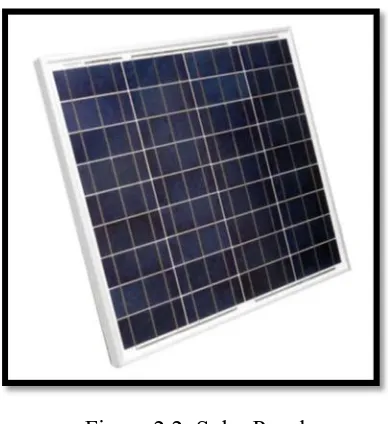
Figure 2.2: Solar Panel
A solar panel is a connected assembly of solar cell which also known as photovoltaic (PV) cell. Solar panel can be used to generate and supply electricity in commercial application by converting radiation sun light to the electricity energy. They have several type of the panel that has been used in the last paper project and they are monocrystalline, polycrystalline and thin film. N. Othman et al. (2013).
In marked, solar panel can be divided into three types: a) Monocrystalline silicon solar cell
b) Polycrystalline silicon solar cell c) Thin-film Solar Cell (TFSC)
6
2.2.1 Monocrystalline Silicon Solar Cell
Monocrystalline solar cell is made out of silicon ingots, which are cylindrical in shape. It can give this type of solar their characteristic look. The advantages of the Monocrystalline Silicon Solar Cell are:
a) This type of solar panel has the highest efficiency rates since they are made out of the highest-grade silicon. The efficiency rate of monocrystalline solar panel is typically 15-20%.
b) Monocrystalline silicon solar panels are space-efficient.
c) Monocrystalline solar panel lives the longest. Most solar panel manufacturers put a 25-year warranty.
d) Tend to perform better at low-light condition.
The disadvantages of the Monocrystalline Silicon Solar Cell are: a) Monocrystalline solar panel is the most expensive.
b) If the solar panel is partially covered with shade, dirt or show, the entire circuit can break down.
c) The czochralski process is used to produce monocrystalline silicon. It result inlarge cylindrical ingots. Four sides are cut out of the ingots to make silicon wafers. A significant amount of the original silicon ends up as waste.
d) The solar panels tend to be more efficient in warm weather.
2.2.2 Polycrystalline Silicon Solar Cell
7 a) The process used to make polycrystalline silicon is simple and cost less.
b) Polycrystalline solar panel tends to have slightly lower heat tolerance then monocrystallline solar panel.
The disadvantages of the silicon solar cell are:
a) The efficiency of polycrystalline-based solar panel is typically 13-16%. b) Lower space-efficiency.
c) The polycrystalline silicon have uniform look like less aesthetically between other solar panel.
2.2.3 Thin-film Solar Cell (TFSC)
Thin-film solar cell also known as thin-film photovoltaic cell (TFPV). The manufactured is by depositing one or several thin layers of photovoltaic material onto a substrate is the basic gist. Thin-film model prototypes have reached efficiencies between 7-13% and production modules operate at about 9%. The different type of thin-film solar cell can be categorized by which photovoltaic material is deposited onto the substrate:
a) Armorphous silicon (a-Si). b) Cadmium telluride (CdTe).
c) Copper indium gallium selenide (CIS/CIGS). d) Organic photovoltaic cell (OPC).
The advantages of the thin-film solar panel are:
a) Mass-production is simple. Potentially cheaper to manufacturing. b) Their homogenous appearance makes them look more appealing. c) Can make flexible, which open many new potential application.
8 The disadvantages of the thin-film solar panel are:
a) Thin-film solar panels are in general not very useful for in most residential situation.
b) Low space-efficiency also means that the costs of PV-equipment.
c) Thin-film solar panel tends to degrade faster than mono and polycrystalline solar panel that is why the warranty is shorter.
[image:22.595.213.396.278.438.2]2.3 Motor as actuator
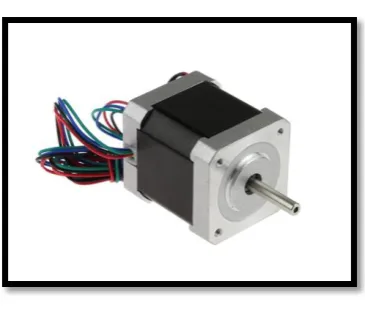
Figure 2.3: Motor
Motor is an actuator that has been used to perform movement of the solar tracker. The part of motor is assembled as a mechanism of movement to track the position of the sun. From the review of study, the journals have been a lot of motor are used such as DC motor. Salsabila et al. (2012), Stepper motor as the actuator M. Amir Abas(2010), S. Kalika et al. (2012), Wang Wai et al. (2012) and Md. Tanvir Arafat Khan (2010),and using servo motor. S.B.Elagib et al. (2013) and N.Othman et al. (2013).
9 S.B Elagib et al. (2013) in a journal titled „Design and implementation of dual axis solar tracker based on solar maps‟ shown that using servo motor mechanism is an automatic device that uses error sensing feedback to correct the performance of the mechanism. S.B Elagib et al. (2013).
Salsabila ahmad et al. (2012) in a journal titled „A high power generation, low power consumption solar tracker is mention using dc motor where the cylindrical base is able to rotate , clockwise and counter clockwise for a imuth and can upper holder is able to rotate up and down within a . Salsabila ahmad et al. (2012).
[image:23.595.219.389.367.527.2]2.4 Sensor
Figure 2.4: Photodiode sensor
10 Guangyu liu et al. (2013) in a journal titled „Principles, design, and calibration for genre of irrafiation angle sensor ‟. Advantage of the sensor with its linear regression model, yielded an accuracy of up to . . Draw back, the sensor is not sensitive to different irradiation level is supported. Guangyu liu et al. (2013).
Md Tanvir Arsfat Khan et al. (2010) in a journal titled „Design and Construction of an Automatic Solar Tracking System‟. The advantage of using photo resister is it can automatically detect the starting position itself. The sensitivity of the photo resister is between 500mm to 700mm of wave length. Md Tanvir Arsfat Khan et al. (2010).
S.B.Elagib et al. (2013) in a journal titled „Design and Implementation of Dual Axis Solar Tracker based on Solar Map‟. This solar tracker working solution for maximizing solar cell output by positioning a solar panel at the point of maximum light intensity. The system has low equipment cost in large plants. S.B.Elagib et al. (2013).
2.5 Summary of Literature Review
From the literature studied, it was proven that the solar panel with active solar tracker is better in efficiency compare to the fixed panel. No need to spend times adjusts the solar tracking since the solar just only need to place at the certain location and then the solar tracking will moved automatic based on the light source of the sun. The solar tract the sun by its own and the energy absorb by the solar panel is maximizing.