
Development of a mutton based processed meat product for export from New Zealand to Thailand : a thesis presented in partial fulfilment of the requirements for the degree of Doctor of Philosophy in product development at Massey University
273
0
0
Full text
(2) \. DEVELOPMENT OF A MunON-BASED PROCESSED M EAT PRODUCT FOR EXPORT FROM NEW ZEALAND TO THAILA N D. A thesis presented in partial fulfilment of the requirements for the degree of Doctor of Philosophy in Product Development at Massey University. NINNART CHIN PRAHAST 1 988.
(3) 1'hcsb Copyright Form. MDs sey University Library.. Devclopmcnt of n Mlltton-l\nHcd I'rocllHHod Meal. Title of thesis:. I'rciducl. 1. g ive. for. permission for. �:xJlon. from. my , thel ia. New. I.lllllnnd to. Thlllland. to be IDade AVAilAble to. r eAders in thu MAlaey Univeraity LibrAry wu)or condit iuna determined by. .. 1 do not wi s h. "ithout. my. t he. my. Librariao. thesis to be IDado Availablo to r aodura. "ritten consont for'. g. l ' a ree that my thesis, or A copy,. 1I0ntha.. mAy ba lunt to another. institution under conditions determinad by thu Librarian.. (b). (3). vlc. a). (b). I do not "ish my thesis. or a copy. to ba aent to an oth er ins titution without ury "ritten consent for .0ntlHl. I. Dgree. thDt. my. r. thesis may be copied for Li b ra y u.a.. I do not "ish my thes is to be copied for Librury u.o. ----- months.. Signed. D ote. The copy r ight of this t he si s. belongl. to. ,1<",,,, i ( /""1"" /., ,,/ It.' N,.. �;, \�, (,�. the author.. ". Reodul'U. \ '1 It'. LDUII t. 6ign the ir name in the space below to sho\l that they reco&nllu. this.. TIle y. ore asked. NAME AND ADDRESS. lor. to add thoir pCrmllncnt ad dl'clI.. lJATE. 'I..
(4) ii ABSTRACT. There is a need for the development of processed meat products from New Zealand mutton so that marketing of the country's sheepmeats can be diversified and expanded, if possible to n ew overseas markets. Thailand, a country with a relatively big population, may be one of the importing countries for mutton-based processed meat products from New Zealand. However, there was a possibility that the Thai people might be unlikely to accept the products made from this unfamiliar meat with strong aroma and flavour. There had never been research into the development of processed meat products made from New Zealand mutton for the Thais. Therefore, this thesis studied whether any p roduct could be made acceptable to the target Thai consumers who were the middl e and upper classes in the Bangkok area. The steps of the systematic p roduct development p rocess were followed to guide how such a product could be designed. In brief, the process started f ro m s u rveying the Thai market fo r some su itabl e p rod u ct s , ide ntifying t h e p roduct ( meatballs) to be developed using mutton, development of the formulation in New Zealand , improvement of the formulation in Thailand, and finally it ended with consumer testing of the developed product in the target market in Bangkok. Different types of sensory panels were used at various stages of the development. These included: a laboratory panel (n=1 2) in Bangkok to identify important sensory attributes and the ideal profiles of some potential products in the Thai markets, a laboratory panel ( n=8) to control the formulation development in New Zealand, a small household consumer panel (n=1 7) in New Zealand to test for acceptance of the intermediate product made by the selected formulation, a focus group panel (n=6) in Bangkok to optimise the formulation and a 'home use' consumer test panel (n=488) in Bangkok to test whether the final product was acceptable to the consumers. The success of the development was believed to rely heavily on the formulation process which combined the use of appropriate experimental designs with the sensory evaluation methods. Experimental designs controlled by a laboratory taste panel using the ideal profile technique were used to formu late the meatball product. A mixture design was used to choose the appropriate kinds and levels of meat and meat fat to be mixed with mutto n . A full.
(5) iii factorial design studied the texture development varying three i ngredients - salt, phosphate and tapioca starch. Empirical equations relating the quantitative characteristics, determined either by subjective tests or objective tests, to the ingredient contents were derived so that the formulation could be directed systematically. A Plackett and Burman design was then used in the flavour development for screening of suitable spices. A quarte r fraction a l factorial design was finally used to study t h e effects o f t h e six ingredients, i . e . three texture i mprovers and three spices, on the sensory attribute acceptability of the product. An optim u m formu lation was selected and tested for accept ance by a small household consumer panel. This intermediate product was not highly acceptable. A series of focus groups were therefore conducted in Thailand to optimise the formulation. The focus group panels provided valuable i nformation as to how the product could be i mproved and , as a result, the prototype fo rm u l ation was obtained and the n used in a production trial to make the final product for a consumer test in Bangkok. The consumer test panel played its role at the final stage of this project to identify whether the developed product was acceptable. The meatball p roduct developed was acceptable to the target Thai consumers. It was believed that the product was successfully made by trimming of the mutton fat to reduce the strong aroma and flavour; this resulted in the high proportion (75%) of mutton which could be used with pork and pork fat (replacing mutton fat). Added i ngredients also significantly i m proved t h e s e n s o ry ch a ract e ri s t i c s of t h e p rod u c t .. T a p i o c a s t a rch , sod i u m. tripolyphosphate and particu larly salt helped improve t h e texture and the spices, white pepper, garlic, onion and ginger, helped improve the aroma and flavour..
(6) iv ACKNOWLEDGEMENTS. This research study was financially supported by the Meat Industry Research I nstitute of New Zealand ; I express my sincere appreciation for this assistance. I shall always be g rateful to my major supervisor, Dr. Mary D. Earle , for her c o n stant inspiration, valuable guidance and patience throughout the project. To my co-supervisors, Dr. R . F . M awson, J . C . Hutton Ltd . , Hamilton; M r. S.L. Oldfield, Biotechno logy Department, Massey University and Dr. Chaiyute Thu npitayaku l , Food Technology Department, Chulalongkorn Unive rsity, I express my appreciati o n f o r their useful suggestions. The research has been successfully completed by either the direct or indirect cooperation of many people . I n particular I would like to thank:. *. Prof. R . L. Earle and the staff of the Faculty of Technology, Massey University.. *. Prof. EL Richards and the staff of the Department of Food Technology and the Sub-Department of Product Development, Massey University, especially M rs. Joan Brookes.. *. M r. Dean Stockwell and the staff of the Food Technology Research Centre, M assey University.. *. Assoc. P rof. Patc h a r e e P a r n k u l , t h e staff a n d s t u d e nt s o f t h e Department of Food Technology, Chulalongkorn University, Bangkok.. *. the staff of the Department of Home Economics, Kasetsart University, Bangkok.. *. the staff of the Department of Livestock Development, M i n istry of Agriculture and Cooperatives, Bangkok..
(7) v *. the Thai students at Massey University who were taste pane lists.. *. the consumers who tested the final product.. *. the staff of the Library and the Registry, Massey University.. *. M rs. K.B.L. McDonald for her moral support and kindness during my stay with her for two and a half years.. *. M r. Wichien Chatupote and Mr. Pairote Wiriyacharee for their help in preparation of the graphs.. *. M iss Myra Keal, Miss Louise Rose and Mrs. Anneke Visser for their work in typing and correcting the thesis.. Finally, I would like to thank my parents (Prof. Kasem and Mrs. Saing) , my aunts ( Miss Arb and M rs. Russamee) , my sisters (Arpa and Marasri) and my brother (Suwitr) . for their constant support mentally and physically during the course of my study..
(8) vi TABLE OF CONTENTS. ABSTRACT. ii. ACKNOWLEDGEM ENTS. iv. TABLE OF CONTENTS. vi. LIST OF TABLES. xi. LIST OF FIGU R ES. xv. LIST OF APPENDICES CHAPTER 1 GEN ERAL OVERVIEW 1 .1 Need for Imported M eat in Thailand 1 .2 New Zealand Sheepmeat Production and Exporting 1 .3 New Zealand Sheeepmeat Exports to Thailand 1.4 Possible Mutton Meat Products for Thailand 1 .5 Reasons for Developing a Mutton-Based Processed M eat Product for the Thais. xvii. 1. 1. 3 4 4 5. 2. PRODUCT DEVELOPM ENT AND THE PROJECT 2.1 Product Development and Consumers 2 . 1 .1 Food Product Development 2 . 1 .2 Consumer Inputs in Product Development 2.2 The Method of Product Development in the Project 2.3 Overall Aim and Objectives of the Research Project. 7 7 7 8 12 13. 3. .IDENTIFYING THE PROD UCT TO BE DEVELOPED USING M UTTON 3.1 I ntroduction 3.2 Preliminary Identification of Some Potential Products in Thailand A Market Survey and Technical I nformation 3.2.1 about the Thai Processed Meat Products Preliminary Experiments on the Four Groups 3.2.2 of Products 3.2.2.1 An Investigation on Sensory Properties of Commercial Products 3.2.2.2 An Investigation on the Effects of Using M utton on the Four Groups of Products 3.3 Selection of the Final Product in New Zealand I ntroduction 3.3.1 3.3.2 A Desk Study on Flavours for the Three Groups of Products Using Brainstorming and Screening Techniques Literature Review on Product Idea 3.3.2.1 Generation and Screening 3.3.2.2 Consumer Input for Idea Generation Preliminary Screening of Variations 3.3.2.3 of the Ideas 3.3.3 Consumer Information on the Three Groups of Products Preliminary Investigation on the Effects of 3.3.4 Using Mutton in the Three Products 3.3.5 Selection of the Final Thai Meat P roduct to be Developed Using Mutton Prediction of Market Potential for the 3.3.5.1 Three Screened Products 3.3.5.2 Selection of Meatball as the Final Product. 15 15 15 15 18 18 20 23 23 23 23 24 25 28 29 35 35 36.
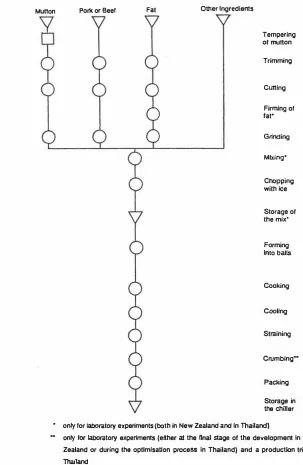
(9) vii Description of the Meatballs Use of Mutton in the Meatball Product for the Thai Consumers. 36 38. MATERIALS AND METHODS 4 . 1 Raw Materials and P rocessing Methods Raw Materials 4. 1 . 1 4. 1 .2 Processing Methods 4.2 Testing Methods 4.2.1 Introduction 4.2.2 Objective Tests 4.2.2.1 Weight 4.2.2.2 Percentage Cook Yield 4.2.2.3 pH Value The Instron Compression and Shear 4.2.2.4 Force 4.2.2.5 Chemical Analyses 4.2.3 Subjective Tests Ideal Profile Testing 4.2.3.1 4.2.3.2 Ranking Triangle Test 4.2.3.3 4.2.3.4 Category Scaling Tests 4.2.3.5 Sensory Testing Organisation 4.3 Analyses of Data 4.4 Experimental Designs Used in the Research 4.4.1 Mixture Design 4.4.2 Factorial Design 4.4.3 Plackett and Burman Design and Fractional Factorial Design . 4 .5 Chapters Related to the Method of the Product Development Process in this Study. 39 39 39 41 43 43 44 44 44 44 44. 3.4 3.5. 4. 5. SELECTION OF MEATS AND FATS FOR INCORPORATION WITH M U TTON TO PRODUCE MEATBALLS 5 . 1 I ntroduction 5.2 Literature Reviews Use of Mutton in Processed Meat Products 5.2.1 5.2.2 Meatball Products 5.2.3 Scaling for Sensory Evaluation 5.3 The Experimentation Effect of Mutton Lean, Beef or Pork Lean and 5.3.1 Mutton Fat on Characteristics of the Meatballs Experimental Methods 5.3. 1 .1 5.3. 1 .2 Subjective Evaluation Results Correlations of Subjective Evaluation 5.3. 1 .3 Results 5.3. 1 .4 Relationships between Sensory Attributes and Meatball Components 5.3. 1 .5 Objective Evaluation Results Correlation of Instron Values 5.3. 1 .6 5.3 . 1 .7 Relationships between Objective Test Values and Meatball Components Correlations between Subjective 5.3.1 .8 Evaluation Results and I nstron Values Discussion and Conclusion 5.3.1 .9 Effect of Mutton Lean, Pork Lean and Pork Fat 5.3.2 on Characteristics of the Meatballs Experimental Methods 5.3.2.1 5.3.2.2 Subjective Evaluation Results. 45 46 46 47 47 47 48 50 50 50 51 51 52 54 54 54 54 56 57 61 61 61. 63. 65 66 67 69 69 71 71 73 73 75.
(10) viii Percentage Cook Yield 5.3.2.3 Discussion and Conclusion 5.3.2.4 Overall Discussion and Conclusion. 77 79 79. D EVELOPMENT OF TEXTU RE OF MEATBALLS 6. 1 Introduction 6.2 Literature Review on Use of Salt, Phosphate and Other Added Ingredients i n Processed M eat Products 6.3 The Experimentation Effects of Tapioca Starch, Salt and STPP 6.3. 1 on Characteristics of Meatballs 6.3. 1. 1 Experimental Methods Subjective Evaluation Resu lts 6.3. 1.2 6.3. 1.3 Correlations of Subjective Evaluation Results 6.3. 1.4 Relationships betwee n Sensory Attributes and Meatball Components Objective Evaluation Results 6.3. 1.5 6.3. 1.6 Correlations of Instron Values 6.3. 1.7 Relationships between Objective Evaluation Values and Meatball Components 6.3. 1.8 Correlations between Subjective Evaluation Results and I nstron Values Use of Empirical Equations to 6.3. 1.9 Estimate the Optimum Contents of the Three Ingredients 6.3. 1. 10 Discussion and Conclusion 6.3.2 A Comparison between Sodiu m Tripolyphosphate, Tetrasodium Pyrophosphate and Borax for Their Effects on the Characteristics of Meatballs 6.3.2. 1 Experimental Methods 6.3.2.2 Subjective Evaluation Results 6.3.2.3 Objective Evaluation Results 6.3.2.4 Discussion and Conclusion 6.3.3 Overall Discussion and Conclusion. 81 81 81. 5.3.3 6. 7. DEVELOPM ENT OF THE FLAVOUR AND AROMA 7. 1 Introduction 7.2 Literature Review Masking of Mutton Flavour and Aroma 7.2. 1 7.2.2 Consumer Panel Evaluation of Acceptability of a Product 7.3 Screening of Spices 7.3. 1 Experimental Methods 7.3.2 Preliminary Investigation 7.3.3 Plackett and Burman Experiment 7.4 Effects of All Ingredients on Acceptability 7.4. 1 Experimental Methods 7.4.2 Results of Fractional Factorial Experiment Conclusion 7.4.3 7.5 Testing of the Selected Formulation 7.5. 1 Experimental Methods 7.5.2 Laboratory Panel Results Household Consumer Panel Results 7.5.3 7.5.4 Correlation of Laboratory and Household Consumer Panel Results 7.5.5 Fat Contents of the Prepared M eatballs Discussion and Conclusion 7.5.6. 84 85 85 86 88 89 90 93 93. 95 96 98 99 99 100 10 1 102 102 104 104 104 104 105 106 106 108 108 1 13 1 13 1 16 120 12 1 12 1 123 124 126 126 126.
(11) ix 7.6. 7.7 8. 9. Flavour I mprovement of the Optimum Formulation and Development of a Different Product for the Thai Market Overall Conclusion. 127. 128. OPTI M ISATION OF THE FORM ULATION USING FOCU S G ROUPS 8.1 Literature Review Focus Groups: Advantages and Disadvantages 8.1.1 8.1.2 Applications of Focus Groups in Product Development 8.2 Use of Focus Groups in Bangkok 8.3 Materials and Experimental Methods Raw Materials and Ingredients 8.3.1 Preparation of the Meatballs 8.3.2 Focus Groups and Sensory Evaluation 8.3.3 8.4 Results and Discussion Comparison of the Ideal Profiles 8.4.1 I mprovement of Sensory Attributes by the 8.4.2 Focus Groups Ideas from the Kasetsart Focus Group 8.4.3 8.4.4 Ideas from the Chulalongkorn Focus Group 8.5 Conclusion. 129 129 129 130. TESTING OF THE DEVELOPED PRODUCT 9.1 Literature Review Consumer Tests 9.1.1 Sensory Evaluation for Consumer Tests 9.1.2 9.2 Selection of the Consumer Testing Technique 9.3 Methods The Production Trial 9.3.1 9.3.1.1 Raw M aterials and Ingredients Preparation of Raw Materials 9.3.1.2 Preparation of Meatballs 9.3.1.3 9.3.2 Consumer Testing 9.3.2.1 The Sample 9.3.2.2 The Respondents 9.3.2.3 The Questionnaires Organisation of the Test 9.3.2.4 Analyses of the Data 9.3.2.5 9.4 Return from the Survey Returned Responses 9.4.1 Profile of General Respondents 9.4.2 Non-responses 9.4.3 9.5 Acceptability of the Meatballs Liking by Age Group 9.5.1 Liking by Sex 9.5.2 Frequencies of the Hedonic Scores 9.5.3 9.5.4 Correlations between Sensory Attribute Liking and Overall Liking Relationships between Overall Liking and 9.5.5 Sensory Attributes Comments on the Product 9.5.6 9.6 Buying Information 9.7 M arketing I nformation Retail Outlets 9.7.1 Packaging of the Developed Product 9.7.2 Promotion of the Developed Product 9.7.3 Estimation of Sales Potential 9.7.4 9.8 Conclusion. 144 144 144 147 148 148 148 148 149 149 150 150 150 151 151 152 152 152 152 154 154 154 155 156 157. 131 132 132 132 133 137 137 138 141 142 143. 158 158 159 160 160 161 162 163 164.
(12) x 10. DISCUSSION AND CONCLUSION 10.1 Overall Development of the M utton-Based Meatballs 10.2 The Formulation Process 10.3 Use of Experimental Designs in Formulation 10.4 Usefulness of Consumer I nputs and Sensory Evaluation 10.5 Subjective Tests vs. Objective Tests 10.6 Recommendation for Future Work 10.7 Executive Summary 10.8 Conclusion. 165 165 167 168 169 173 174 174 175. R E F ERENCES. 177. APPENDICES. 188.
(13) xi LIST OF TABLES. 1.1. Total New Zealand sheepmeat production and sheepmeat. 3. available for export, 1 985-1 987 (in thousand tonnes, bone in) 1.2. Sheepmeat exports from New Zealand to ASEAN countries,. 4. 1985-1987 (in tonnes) 3.1. M ean ideal absolute scores for sensory attributes of. 20. commercial cocktail sausages, vienna sausages and meatballs 3.2. Variation s o f ideas remaining after sequential screening. 26. 3.3. Variation s of ideas remaining after checklist screening. 27. 3.4. Consumer ranking for preference of the ideas. 29. 3.5. Triangle test to in vestigate the effect of various. 30. proportions of mutton in meat patties 3.6. Triangle test to in vestigate the effect of spices in. 30. meat patties incorporated with mutton 3.7. Factorial design to study the effects of mutton fat. 31. and beef fat content on sensory attributes and acceptability of meatballs, dried meat and sausages 3.8. CompOSition of commercial meatballs in Thailand. 37. 3.9. Ideal absolute scores for important sensory. 37. attributes of commercial meatballs 5.1. Sensory attribute scores for meatballs formulated. 64. with various proportions of mutton lean, beef or pork lean and mutton fat 5.2. Correlation coefficients between sensory. 65. characteristics of the meatballs 5.3. Correlation between the descriptive category. 66. scaling and the ideal profile testing 5.4. Regression equations showing the relationships. 67. between sensory attributes and mutton lean and pork lean 5.5. Objective test values for meatballs formulated with. 68. various proportions of mutton lean , beef or pork lean and mutton fat 5.6. Correlation coefficients between the Instron values. 69. 5.7. Regression equations showing the relationships between. 70. objective test values and mutton , beef, pork lean and mutton fat.
(14) xii 5.8. Correlation coefficients between the sensory attribute. 71. scores and the Instron objective test values of the meatballs 5.9. Ideal ratio scores for meatballs made from various. 76. proportions of mutton lean, pork lean, and mutton or pork fat 5.1 0. M ean deviations from ideal for meatballs with added. 77. pork or mutton fat 5.1 1. Percentage cook yield of the meatballs made from. 78. various proportions of mutton lean, pork lean, and mutton or pork fat 6.1. Factorial deSign to study the effects of tapioca. 85. starch, salt and STPP on the characteristics of the meatballs 6.2. Mean deviations from ideal for meatballs with. 88. different tapioca starch, salt and STPP contents 6.3. Correlation coefficients between sensory. 89. characteristics of the meatballs with salt, phosphate and tapioca starch 6.4. Regression equations showing the relationships. 90. between sensory attributes of the meatballs and tapioca starch, salt, STPP contents and their interaction s 6.5. Correlation coefficients between the Instron. 93. objective test values of the meatballs 6.6. Regression equations showing the relationships. 94. between objective test values of the meatballs and tapioca starch, salt, STPP contents and their interactions 6.7. Correlation coefficients between the sensory ideal. 95. ratio scores and the Instron values 6.8. Ideal ratio scores for sensory attributes of the. 1 00. meatballs with sodium tripolyphosphate (STPP) or tetrasodiu m pyrophosphate (TSPP) 6.9. Effect of sodium tripolyphosphate (STPP) , tetrasodium. 1 01. pyrophosphate (TSPP) and borax on the objective test values of the meatballs 7.1. Combinations of spices in a Plackett and Burman experiment to study their effects on flavour and aroma of mutton-based meatballs. 1 09.
(15) xiii 7.2. Mean ideal ratio scores for flavour and aroma. 110. of meatballs with different types and levels of spices in the Plackett and Burman experiment 7.3. Main effects of spices on flavour and aroma of. 112. meatballs in the Plackett and Burman experiment 7.4. Combinations of ingredients in a quarter fractional 2 6 factorial experiment to study their. 1 14. effects on sensory attribute acceptability of mutton-based meatballs 7.5. Yates' algorithm, the defining contrasts and the aliases in the quarter fractional 26 factorial experiment. 1 15. 7.6. M ean ideal ratio scores of sensory attribute. 1 16. acceptability and Instron initial yield forces of meatballs made with untrimmed mutton in a quarter fractional 2 6 factorial experiment 7.7. Mean ideal ratio scores of sensory attribute. 1 17. acceptibility and Instron initial yield forces of meatballs made with trimmed mutton 7.8. Main effects of the six ingredients and their. 1 18. two-factor interactions in a quarter fractional 2 6 factorial experiment 7.9. Correlation coefficients between mean ideal ratio. 119. scores of sensory attribute acceptability of meatballs 7.1 0. Regression equations showing relationships between. 1 20. overall acceptability and different attribute acceptabilities 7.1 1. Percentages of meats and fat used in meatballs. 1 22. 7. 1 2. Mean ideal ratio scores for sensory attribute. 1 23. acceptability of meatballs tested by the laboratory panel 7. 1 3. Mean hedonic scores for liking of sensory attributes. 1 24. of meatballs tested by a household consumer panel 7. 1 4. Numbers and percentages of the consumers who. 1 25. expressed their willingness to purchase meatballs in a household consumer panel 8. 1. The ideal profiles of the sensory attributes of. 1 37. the mutton-based meatballs by the two focus groups 8.2. Mean ideal ratio scores of the sensory attributes of the meatballs tested i n a sequence of focus groups. 1 38.
(16) xiv 9.1. Advantages and disadvantages of field and home use tests. 1 46. 9.2. Profile of respondents in the home use test. 1 53. 9.3. Careers of the respondents. 1 53. 9.4. Hedonic scores for sensory attributes of the developed. 1 54. meatballs by age group and for total sample 9.5. Hedonic scores for sensory attributes of the developed. 1 55. meatballs by sex 9.6. Frequencies of the hedonic scores for overall liking. 1 56. of the developed meatballs 9.7. Correlation coefficients between e ach of four sensory. 1 57. attribute liking and overall liking within each age group and for total sample 9.8. Regression equations showing relationships between. 1 58. overall liking and sensory attribute liking by total sample 9.9. Buying intentions related to price. 1 59. 9. 1 0. Buying intentions. 1 60. 9.1 1. Distribution of frequency of purchase. 1 60. 9. 1 2. Retail outlets preferred for the developed meatballs. 1 61. 9.1 3. Packaging of the meatballs. 1 61. 9.1 4. Number of balls preferred in a package. 1 62. 9. 1 5. Information o n the labels needed by the consumers. 1 62. 9. 1 6. Means of communication to promote the product. 1 63. 10.1. Specification for the meatballs. 1 66. 1 0.2. Experimental designs, stages and objectives during. 1 68. the formulation process 1 0.3. Types of panel and sensory evaluation techniques. 1 70. used in the project 1 0.4. A summary on the ideal profile as determined by the. 1 72. ideal absolute scores of the meatballs at two different stages of development 1 0.5. Comparison between hedonic scores of the sensory attributes of the intermediate product and the final product. 1 73.
(17) xv LIST OF FIGURES. 1 .1. Numberof buffalo, cattle and swine slaughtered in. 2. Bangkok, 1 973-1 982 1 .2. Number of buffalo, cattle, swine and chicken in Thailand,. 2. 1 982-1 986 2.1. A systematic process for product development. 9. 2.2. Product development and acceptance test flow. 10. 2.3. Consumer panels in product development. 11. 2.4. Stages of product development process and consumer. 12. inputs using sensory evaluation in the research project 3.1. Sensory ideal ratio scores (sample score : floating. 19. ideal score) for two brands of commercial sausages and meatballs 3.2. Sensory ideal ratio scores (sample score: fixed ideal. 21. score) for experimental cocktail sausages, vienna sausages and meatballs made with varying amounts of mutton 3.3. Sensory ideal ratio score s (sample score: floating. 22. ideal score) for experimental spiced and dried meat ( 1 00% mutton) 3.4. Sensory ideal ratio scores (sample score : floating. 22. ideal score) for experimental pressed-ham made with varying amounts of mutton 3.5. Sensory ideal ratio scores (sample score : fixed ideal. 32. score)and overall acceptability for meatballs at different beef fat and mutton fat levels 3.6. Sensory ideal ratio scores (sample score : fixed ideal. 33. score) and overall acceptability for sausages at different beet fat and mutton fat levels 3.7. Sensory ideal ratio scores (sample score: fixed ideal. 34. score) and overall acceptability for spiced and dried meat at different beef fat and mutton fat levels 4. 1. Process flow chart for production of the meatballs. 41. 5.1. Complete mixture space showing feasible area for. 62. experimentation 5.2. Complete mixture space showing feasible area for experimentation (with an extension). 74.
(18) xvi 6.1. Ideal ratio scores for sensory attributes of the. 87. meatballs as affected by tapioca starch, salt and sodium tripolyphosphate (STPP) contents 6.2. Objective test values for the meatballs as affected. 91. by tapioca starch, salt and sodium tripolyphosphate (STPP) contents 7.1. Scales used for screening of spices. 107. 8 1. The flow of focus groups and sensory evaluations to. 134. .. optimise the formul ation 8.2. Profiles of the ideal ratio scores of the sensory. 1 39. attributes of the meatballs tested i n a sequence of focus groups 9.1. Histogram o f hedonic scores for overall liking o f the developed meatballs by total sample. 157.
(19) xvii LIST OF APPENDICES. 1 .1. Average household expenditures in a 7-day period. 1 88. for food by region in Thailand 1 986 (in baht) 1 .2. Number of buffalo, cattle and swine slaughtered and. 1 89. wholesale meat price in Bangkok, 1 973-1 982 1 .3. Number of buffalo, cattle, swine, and chicken in. 1 90. Thailand, 1 982-1 986 3.1. Information concerning processed meat products sold in. 191. Bangkok supermarkets (1 NZ$ = 1 3 baht) 3.2. Processing steps for production of four groups of the. 1 95. meat products 3.3. Food additives allowed in meat products in Thailand. 1 98. 3.4. A questionnaire used for an investigation on sensory. 1 99. properties of commercial products 3.5. Formulations and methods for preparation of the four. 201. groups of processed meat products 3.6. Summary of variations of ideas obtained from the. 207. brainstorming 3.7. Sequential screening of variations of ideas. 208. 3.8. Checklist screening. 210. 3.9. Formulations and methods for preparation of the meat. 212. patties used i n the triangle test 3.1 0. Formulations of the meat patties to study the effects. 213. of spices using the triangle test 3. 1 1. Formulations used to investigate the effects of mutton. 214. fat and beef fat o n sensory attributes and acceptability of the three products 3. 1 2. Estimated annual sales potential of the three screened. 215. mutton-based processed meat products 3. 1 3. Cash outflow and cash inflow over eight years of the. 21 6. three screened mutton-based processed meat products 3. 1 4. Net present value of the three screened mutton-based. 21 8. processed meat products at 1 6% rate of interest 3. 1 5. 'Proximate composition of vienna, cocktail sausages and. 221. meatballs 5.1. Sensory evaluation questionnaire for the meatballs. 222.
(20) xviii 6.1. A questionnaire used in sensory evaluation of the. 226. meatballs with tapioca starch , salt and sodium tripolyphosphate 6.2. Ideal ratio scores for sensory attributes of the. 228. meatballs as affected by tapioca starch, salt and STP P contents 6.3. Objective test values for the meatballs as affected. 229. by tapioca starch, salt, and STP P contents 7.1. Descriptions of the spices used in the experiments. 230. 7.2. A questionnaire used for sensory evaluation in a. 232. Plackett and Burman design experiment 7.3. A questionnaire used for sensory evaluation in the. 234. fractional factorial experiment 7.4. A questionnaire used for a household consumer panel. 236. 9.1. A questionnaire used for hedonic rating i n a home. 240. use test 9.2. A supplementary questionnaire used in a home use test. 243. 9.3. Frequencies of hedonic scores for four sensory. 246. characteristics of the developed meatballs 9.4. Estimation of sales potential of the developed meatballs. 248.
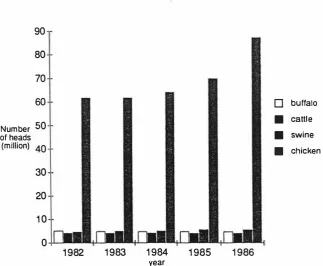
(21) 1 CHAPTER 1 GENERAL OVERVIEW. The idea for this research project was to use New Zealand mutton to develop a processed meat product for the Thai people. In this chapter, the need for such a product in Thailand is discussed and the problems of making an acceptable processed meat p roduct from mutton are outlined. 1 .1. N EED FOR I MPORTED M EAT I N THAILAND. The problem of adequate protein supply is important for the population in many countries all around the world especially the underdeveloped and developing countries. Altschul ( 1 967) stated that this problem has two parts, i) protein malnutrition and ii) the increasing d emand for animal protein concurrent with i ncreasing income in developing countries. Thailand, regarded as a developing country, has both problems. According to the report prepared by the Sub-Committee for Developmental Plann i ng for Food and Nutrition (1 977), the average daily consumption of protein by Thai adults met the acceptable requirement, i.e. 0.9 g protein/kg of body weight. However, protein defici ency in the diets of i nfants, children and teenagers still existed, particularly for those in remote rural areas and in the slums of Bangkok. Approximately two-thirds of the protein consumed by the Thais is supplied by rice, grains and vegetables which may not p rovide good quality proteins to support development of the body during the periods which require high amounts of protein, i.e. pregnant women and children from infants to teenagers. Hence, in a p roduct where the protein is contributed by meat, an improvement in good quality protein intake, i.e. providing essential amino acids, can be obtained and the Thais can gain advantage from such a product. I n 1 986, meat products were less consumed than cereals and legumes, especially rice the staple food (see Appendix 1 .1 ) . Pork was the meat consumed in the largest quantitie s . Due to the increasing population and the high demand for meat, consumption of pork increased rapidly from 1 973-1 982 (Figure 1 .1 , detailed data in Appendix 1 .2). Consumption of poultry meat also i ncre ased dramatically.. However, consu m ption of beef and buffal o meat. decreased significantly in the same period. This might be due to the increasing a n d very high prices of beef and buffalo meat when compared to that of pork, pou ltry and fish. If the Thais wish to consume more red meat, then it will have to be i mported, as t h e local production of beef did not increase during the years from 1 982 to 1 986 ( Figure 1 .2, d etailed data in Appendix 1 .3)..
(22) 120. 100. 80. Number of heads (x10,OOO). 60. 40. e. Buffalo. +. Cattle. .... Swine. 20. ����. O 1973 1974 1975 1976 1977 1978 1979 1980 1981 1982 Year Agure 1.1 Number of buffalo, cattle and swine slaughtered in Bangkok, 1973-1982. 90 80 70 60 Number of heads (million). 50 40. o. buffalo. •. cattle. •. swine. •. chicken. 30 20 10 0. 1 982. 1 983. 1 984 year. 1 985. 1 986. Figure 1.2 Number of buffalo, cattle, swine and chicken in Thailand, 1982-1986.
(23) 3 Most of the frozen retail cuts are imported. These include N ew Zealand, Australian and American beef, lamb and mutton, and are usually consumed by foreigners. Boneless beef is also imported for use in manufacturing. Sheepmeat could pos s ibly be imported as a boneless meat for manufacturing, or as meat products for the general Thai population in Bangkok. 1 .2. NEW ZEALAND SHEEPMEAT PROD UCTION AND EXPORTING. New Zealand has long been recognised as one of the major meat exporting cou ntries. In particular, New Zealand is one of the major exporters of sheepmeats in the world.. H owever, since the start of this project, the amount of sheepmeats produced and exported has, in general, decreased (see Table 1 . 1 ). Table 1 . 1. Total New Zealand sheepmeat production and sheepmeat available for export, 1 985-1 987 (in thousand tonnes, bone in) 1 985. 1 986. 1 987. Total sheepmeat production lamb mutton. 500.9 227.4. 464 . 7 1 46.7. 407.3 1 99 . 0. Sheepmeat available for export lamb mutton. 491 .0 1 60.8. 445. 4 83.3. 392. 6 1 23.0. Source:. New Zealand Meat Producers Board (1 986, 1 987) , 64th and 65th Annual Reports. It is obvious that the total sheepmeat production and the quantity of sheepmeat available for export dropped from the year 1 985 to 1 987 because of market difficulties and low prices. New Zealand normally exports sheepmeats as chilled or froze n lamb carcasses, mutton carcasses, lamb and mutton cuts and boneless mutton. Therefore, if new overseas markets cou ld be established for sheepmeats or if sheepmeats could be used in production of processed meat products for export, New Zealand wou ld earn substantially increased income from overseas trading. Mawson ( 1 985) stated that a number of commercial developments in the marketing of New Zealand sheepmeats had been established. These involved s u pplying both mass and specialty markets. The mass market for processed sheepmeat was required in t h e short term and could absorb the volume of meat from the former carcass commodity trad e , but it should not be pursued as the permanent solution to sheepmeat marketing problem s to the exclusion of specialty market development . Specialty market d evelopment offe red the.
(24) 4 potential for g reater returns per u nit raw material and, in spite of the greater difficu lties in pursuing these markets and the possibility of high risk of failure, the effort should be made. In conclusion, the author suggested that specific techniques for the use of sheep m e ats in processed products would have to be developed within the New Z ealand meat a n d food industry. N EW ZEALAND SHEEPM EAT EXPORTS TO THAILA N D. 1 .3. Thailand has not bee n a major importing country for New Zealand's sheepmeats when compared to Singapore or Malaysia (see Table 1 .2). Table 1 .2. Sheepmeat expo rt s from New Zealand to ASEAN countries, 1 985-1 987 (in tonnes). 1 985 Thailand Philippines Brunei I ndonesia Malaysia Singapore Source:. 23 9 1 78 497 936. Lamb 1 986 33 10 87 448 909. 1 987. 1 985. M utton 1 986. 41 1 5 111 51 7 935. 11. 1. 17 1 2371 637. 21 37 796. 1 987. 16 291 272. New Zealand Meat Producers Board (1 987) , 65th Annual Report. Sheepmeats are imported into Thailand normally as frozen cuts or boneless meat. There was not any processed sheepmeat product from New Zealand in the Thai markets at the beginning of this project which started in late 1 984. POSSIBLE M UTTON MEAT PRODUCTS FOR THAILAN D. 1 .4. Fresh meat is normally used as raw material i n Thai day-to-day cooking. However , there are some processed meat products being sold in the markets. These products may be categorised according to the methods of preservation as follows : •. dehydrated products such as shredded and dried pork (pork floss),sliced and dried spicy beef;. •. cooked products, preserved by using additional methods of preservation, chi lling or freezing, such as sausages (Western style : bologna, cocktail, vie nna, frankfurter, salami; Thai style: moo yor), meatballs, bacon and ham ;. •. fermented products such as nam and sai krok priew;. •. canned products such as beef curry, beef stew..
(25) 5 Furthermore, chilled or frozen retail meat cuts and beef patties also can be found i n Thai supermarkets especially in the Bangkok area. M awson (1 985) stated that the manufactu re d meat products which could be made from sheepmeats are limited only by the creativity and enthusiasm of the product development and marketing team. He suggested possible products for export : ,. Sheepmeat in combination with non-meat ingredients: burgers, sandwiches, pizzas, filled tacos and pita breads, ethnic takeaways , pies, sausage rolls , hot dog s , corn dogs, p repared meals. ,. S a u s age p ro d u ct s , e s p e c ia l ly d ri e d , f e r m en t e d a nd d ri e d , p rod ucts w h e re sheepmeats offer functional advantages during processing. *. Ham products: lamb and mutton hams, bone-in or boneless , green , cooked o r dried, or highly extended with non - meat protein .. * *. Roast meats: bone-in or boneless, smOked, flavoured, sliced with gravy. Restructured meats: sectioned and formed, chunked and formed, flaked and formed, cured, raw, precooked, f l avou red , roasts, steaks, chops, schnitzels, fingers, balls, dices, battered and breaded.. Traditionally, sheepmeats have found limited use in processed meats, but no fundamental technical reasons exist for not finding greater application in these products. Shee p meats may not be the easiest meats to market, but there are worldwide opportu nities for them. An example , in ASEAN (Association of South East Asian Nations), is Singapore which has consumed processed sheepmeat products from New Zealand (Berryman, 1 985). R EA S O N S FOR D E V ELO P I N G A M UTTON - B AS E D P R O C E S S E D M E AT PRODUCT FOR THE THAIS. 1 .5. From an investigation by the author, there were some baSic ideas supporting development of a mutton-based processed meat product for Thai people. *. *. *. A need for imported red meat. A lack of New Zealand sheepmeat exports to Thailand. There were not yet any processed meat products made from mutton in the Thai markets at the time when this research started in late 1 984. The imported mutton either from New Zealand or other countries chiefly included frozen boneless mutton or mutton cuts and were normally consumed by foreigners. M utton , in spite of having inferior fu nctionalities for processing requirements in processed meat products, may be blended with other kinds of meat or used with modification to produce processed meat products with required sensory attributes.. *. The exporting trend of New Zealand's sheepmeats, especially mutton, has declined in the past few years. A surplus amount of mutton may be confronted in the futu re . If.
(26) 6 mutto n can b e used for production of processed m eat products, the market for s heepmeats, could expand in the ASEAN region, from the S ingapore market to other markets such as Thailand. •. M utton, as one kind of meat, may be regarded as a nutritional food and a sou rce of good quality protein . Mutton is a good source of essential a mino acids a nd , to a lesser extent, of certain minerals. Therefore, a mutton-based processed product can p rovide proteinaceous food for the Thai people.. •. Conventio nal ways of l iving for some Thais have bee n c h anging in recent years. These people are absorbing the styles of living of the people in the western world. They go to supermarkets or groceries to buy every-day-needed foods and also buy some convenience foods i nstead of buying fresh foods and spending time cooking every-day meals. Therefore, if processed meat products made from mutton cou ld be e a s i l y prepared for co nsu mptio n , they may suit the n e eds of this type of Thai consumer.. The major reason against a mutton product is that mutton has a strong flavour which is not familiar to the Thais who may consider this flavour as disagre eable or obnoxious . There ought to be some possibilities for d isguising mutto n flavo u r if s o m e processed meat products are made suitable for the Thai palates. Therefore , there were some reasons why a processed meat product using New Zealand mutton should be developed for the Thai con su mers, e specially t h e m iddle and upper classes i n Bangkok who buy processed meat products from supermarkets. To develop such a product successfully, a product development process shou ld be closely followed. I n addition. since mutton, a major raw material used i n this research, was not familiar t o the Thai people, inputs from the consumers were also important in guiding the development of an acceptable product in terms of its sensory attributes..
(27) 7 CHAPTER 2 PRODUCT DEVELOPMENT AND THE PROJECT. This chapter discusses the product development process and consumer inputs u s e d in the product development process. The method of product development used in this res earch is outlined and the overall aim and objectives of the project are also defined. PRODUCT DEVELOPM ENT AND CONSUM ERS. 2.1. P roduct development is t h e applied industrial res earch which exploits knowledge in the basic sciences of c hemistry, physics , a nd mathemat ics with k nowledge in t h e social sciences in order either to produce new products or to modify existing products for a market. As it has become an increasingly important activity in industry, due to a competitive a nd changing environment, so too has the research into developing and refining the techniques for product development . The product deve lopment process c a n be utilised in many different situations. I n the least complicated situation, the product is developed for a local market and for o n ly one target market segment. However, there are more com p licated situations which may involve the following factors: •. a necessity for the product to be acceptable to a specific group of consum e rs who may be unacquainted with raw materials or ingredients in the p roduct,. • •. .. introduction of new technology either in processing or packaging, conforming to governmental regulations, and safety standards.. This thesis was a study of the product development process i n an extraordinary situation. The project was the development of a mutton-based processed meat product acceptable to Thai consumers, who belong to the middle and u pper classes in the Bangkok area, a n d who are not accustomed to mutton odour and flavour. 2.1 . 1. Food Product Developme nt. Although the principles of product development can be applied to different industries, there are specific requirements in the food industry which may be different from other industries. These may include seaso nality and properties of raw materials, s pecial dietary n eeds, restrictions imposed by food regulations, the microbiological standards of food and t h e great differences in food acceptability between specific groups of consumers, especially f o r those with d ifferent ethnic backgrounds and cultures . I n this project, t h e focus was o n food product d evelopment, albeit many of the techniques used were also relevant to product development in other industries..
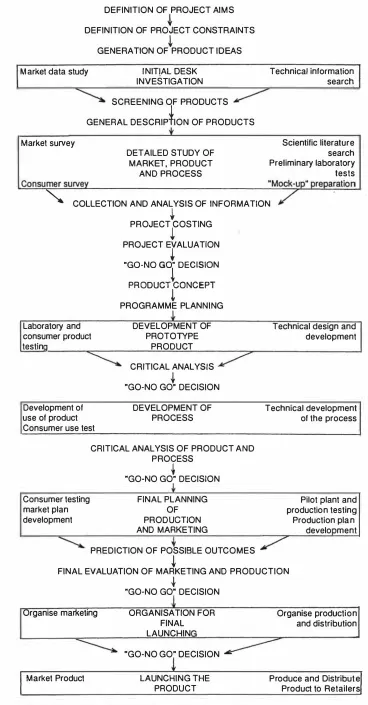
(28) 8 Wilkinson ( 1 985) pointed out that systematic food product d evelopment i s eve n more important now than thirty years ago when the number of food products for sale was s mall in comparison with today. At Massey University, there has bee n a continuing programme of research into systematic and quantitative methods for new food product d evelo p m e nt, initiated by Dr. W. Edwardson in 1 969 (Anderson, 1 975). Earle ( 1 985) outlined the product development system which was partly used as a guideline for this project (see Figure 2 . 1 ) . I n this project, t h e aim was only to develop a n acceptable product, not t o launch t h e product on the market. Therefore only the early stages of this product development process were used, that is " Definition of Project Aims" to "Final Evaluation of M arketing and P roduction".. 2. 1 .2. Consumer Inputs in Product Development. The fate of a newly developed food product has always been dependent on acceptance by the co nsum e rs, therefore formal studies of consumer prefe rence are needed to identify w h e t h e r t h at p rodu ct w i l l s u rvive i n competitio n. for t h e c o n s u m ers ' f o o d m o n ey .. Traditionally, in food product development, input from consumers w a s considered necessary at three major stages. These were the initial market research, sensory testing and the final market test ( Lai, 1 987). However, due to the nature of the major raw material, mutt o n , used in this study, input from consumers was extensively studied in the sensory testing stage. Sensory evaluation, using various types of consumers, is an essential tool in food product development. Both consumer preference panels and a laboratory type sensory panel have been u sed by investigators in order to attain a measure of the pro bable relative acceptance of products having varying degrees of differences. There has bee n considerable research o n the reliability of these two methods of sensory testing. P e ryam and Haynes ( 1 957) stated that the various types of testing of foods could be classifie d according to w hether t esting was done in "artificial" or "natural" situations. The "artificial" situations covered laboratory testing u nder controlled conditions whereas the " natural" situations i ncluded those which were more related to actual conditions of consumption . The laboratory method can frequently be u sed for selection or rejection of food items.. N e ve rtheless, t h e re has. been a tendency not to rely only on laboratory results but to requ ire additional testing in the field using the representative consumers in the population of i nterest . Amerine et al. ( 1 965) pOinted out that laboratory or expert panels were used to determine the differences between samples, a nd the direction of differences while consumer panels were used to evaluate the acceptance or preference of foods. Dethmers (1 968) also noted that the use of experienced laboratory judges to determine direction of preference appeared to b e valid. Sathe r ( 1 968) concluded that although there was some indication that the h o m e panel h ad a S l ightly greater ability to detect flavour differences, generally both home and laboratory pan e l results were in good agreement..
(29) 9. DEFINITION OF PROJECT AI M S. �. DEFIN ITION OF PROJECT CONSTRAINTS. �. GENERATION OF PRODUCT IDEAS Technical information. I NIT!AL DESK. M arket data study. INV ESTIGATION. search. SCREENING OF PRODUCTS. �. GENERAL DESCRIP ION OF PRODUCTS. i. Scientific literature. Market survey DETAILED STUDY OF MARKET, PRODUCT. search Preliminary laboratory tests. AN D PROCESS. "Mock-up" preparation. Consumer survey. �. COLLECTION AND ANALYSI S OF INFORMATION. f r. +. PROJECT. /. OSTING. PROJECT E ALUATiON ". :::::�i� :::::. N. D. c. PROGRAMME PLANN I NG Laboratory and. DEVELOPMENT OF. consumer product testin. Technical design and. PROTOTYPE. development. PRODUCT CRITICAL ANALYSIS. t. "GO-NO GO" DECISION Development of. DEVELOPMENT OF PROCESS. use of product. Technical development of the process. Consumer use test CRITICAL ANALYSIS OF PRODUCT AND P ROCESS. t. "GO-NO GO" DECISION Consumer testing. FINAL PLANNING. Pilot plant and. market plan. OF. productio n testing. development. PROD UCTiON AND MARKETING. Production pla n develo ment. PREDICTION OF POSSIBLE OUTCOMES. +. FINAL EVALUATION OF MARKETING AND PRODUCTION. t. "GO-NO GO" DECISION Organise marketing. ORGANISATION FOR FINAL. Organise producti o n and distribution. LAUNCHIN "GO-NO GO" DECISION Market Product. LAUNCHING THE PRODUCT. Figure 2.1 A systematic process for product development. Produce and Distribut e Product to Retailers.
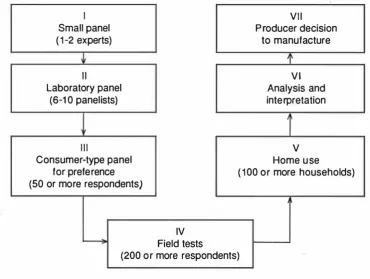
(30) 10 G atchalian ( 1 981 ) referred to Martin ( 1 973) and Stone and Sidel ( 1 978) as considering consumers as naive , not even capable of performing simple sensory evaluation tasks. She noted that consumers are untrained evaluators who based their judgement mainly on their own feelings and perceptions. The consumer impressions and judgement may be entirely different from those of trained laboratory panelists (Cross et al., 1 978; Klemmer, 1 968 and Pangborn and Russell, 1976). Moskowitz (1 985) characterised expert and consu m e r panels for product research noting that while market researchers work absolutely with consumers, sensory analysts have preferred to use expert panels. The author also stated that with the growing sophistication of p roduct d evelopers and the i nc re as i n g interest of market researchers in the early stages of the product development process, guidance by consumer panels has frequently replaced the more traditional expert panels. Gatchalian ( 1 98 1 ) outlined the flow of product development activities which involves judgements from a small expert panel, to a g roup of laboratory pane lists and t hen to untrained individuals, possibly belonging to the manufacturing firm o r to a group of people known to represent the pote ntial consumers. Afterwards , the flow involves two types of consumer acceptance tests known as the field and home-use tests. Finally, the resu lts are analysed and later used as the basis for the manufacturer's decisions either to produce the product on a commercial scale or to make further improvements for increased product acceptance (see Figure 2.2).. I Small panel ( 1 -2 experts). VI I P roducer decision to manufacture. t. l'. 11. VI Analysis and interpretation. Laboratory panel (6-1 0 panelists). III Consumer-type panel for preference (50 or more respondents). �. V Home u se ( 1 00 o r more households). IV Field tests (200 o r more respondents). Figure 2.2 Product development and acceptance test flow.
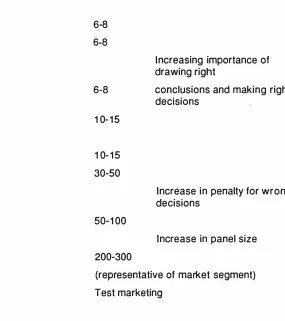
(31) 11 Anderson ( 1 98 1 ) gave an example of the application of consumer panels throughout the fu ll course of the product development process which demonstrated the relative importance of accurate i nformation and of panel size (see Figure 2.3). Steps in Product Development. Number of Consu mers. �Oduct idea generation. 6-8. Idea screening. �roduct formulation. 6-8 Increasing importance of drawing right. -- Testing. 6-8. �. 1 0- 1 5. Testing. conclusions and making right decisions. Pilot plant trials. I. --. Testing. 1 0- 1 5. -. Testing. 30-50 Increase in penalty for wrong decisions. Production trials. I J. -. Testing. 50-1 00 Increase in panel size. arket trials --. Testing. 200-300 (representative of market segment). --. Testing. Test marketing. inal product release Figure 2.3 Consumer panels in product development (adapted from Anderson, 1 98 1 ) As the product development p rocess proceeds towards the final lau nching of t h e new product, so the importance of correct decision-making increases. The penalty or cost of a wrong decision increases with every step of the process, and accordingly panel size s hould increase. Consumer panel definitions as regarded by Anderson ( 1 98 1 ) broaden, from a small g ro u p of 6 to 1 0 consumers gathering around a table for an informal discussion about some new product concepts to the full scale consumer survey of several hundred people to evaluate the potential of a new product formu lation. Ideally the co n s u m e r p a n e l shou l d be a statistically random representation of the entire market segment or population of interest. However, this ideal condition is rarely fulfilled since it will normally i nvolve a large number of consumers and result in high costs and considerable delays in data collection and a n alysis. Under these circumstances a trade-off will usually be made betwee n the cost and s p e ed of data collection and the accuracy of the results..
(32) 12 Earle ( 1 98 1 ) stated that selection of a consu mer panel depended on the market, for example, hou s ewives for the general food market, teenagers for snack foods, restaurant and hotel managers and cooks for catering foods, food processors for processing raw materials. The author also noted that in choosing a consumer panel *. *. *. it must be representative of the people in the market,. the panel must not be more knowledgeable than the other consumers and the panel must not be biased in any way.. Training of a consumer panel should be minimal. It is the spontaneous reaction from the consumer that is wanted, so training is only on how to fill in forms or the other mechanics of the test. 2.2. THE M ETHOD OF PRODUCT DEVELOPM ENT I N TH E PROJ ECT. The stages of the product development process used in this project are shown in Figure 2.4. Country. Project Stage. Types of Consumer I nput and Sensory M ethods Used. STAG E I I DENTI FYING THE PRODUCT Thailand. Preliminary identification of some potential products by a market survey and preliminary experiments concerning these products. Laboratory panel using ideal profile testing. New Zealand. Idea generation of the mutton-based products with added flavours for Thai consumers. Idea generation by small consumer panel using brainstorming. New Zealand. Screening of the product ideas. Screening techniques supported by ranking with small consume r panel. STAGE 2 DEVELOPMENT OF TH E PRODUCT New Zealand. Preliminary formulation of the selected product. Laboratory panel using triangle testing, descriptive category scaling and ideal profile testing. STAG E 3 TESTING OF THE PRODUCT New Zealand. Testing of the optimum product from the formulation process. Household consumer panel using hedonic scaling. Thailand. Optimisation of the formulatio n to improve the product's attributes. Focus groups using ideal profile testing. Thailand. Production trial, consumer testing by household distribution. Con sumer test panel using hedonic scaling. Figure 2.4 Stages of product development process and consu m e r inputs u s i ng s ensory evaluation in the research project.
(33) 13 The project started i n Thailand with an initial market survey and preliminary experiments to identify some potential processed meat products. The survey revealed some product ideas with good potential. The n ext stage was the generation by a brainstorming group of flavour variation s of the produ ct ideas suitable for Thai consumers. A large number of ideas were gen e rated . Qualitative and quantitative screening techniques were then used t o reduce t h e number of ideas. The final product was selected for development. A systematic formulation method, using exp�rimental deSigns, was u sed to formulate the product. The selected optimal formulation was tested using a household consumer p anel of Thais. The results revealed that the sensory characte ristics of the product made by the selected formulation were not highly acceptable. In Thailand, consumer input using focus groups was therefore employed to investigate how to alte r the fo rmulation and optimise the product's sensory attributes. The p rototype formulation obtained was used in a production trial. Finally, to evaluate the acceptability of the product , consumer testing was done by distributing the final product to t h e target consumers i n the Bangkok area. The importance of consumer input was highly recognised and it was therefore incorporated at various stages of development of the product in this study. S ensory evaluatio n , using different types of consumer panels, was utilised to help in guiding the development of the product u ntil it was acceptable to the Thai consumers. Four major types of sensory panels were used to achieve the important goal of this study. The laboratory panel helped to create the preliminary formu lation of the product. The househo l d consumer pane l h e lped to determine whether the product made by the selected optimal formulation was acceptable to the Thai consumers. The focus group panels then helped in alteration of the formulation and optimising the product's characteristics. Finally, the consume r test panel h elped to identify whether the developed product was acceptable to the target Thai consumers. 2.3. OVERALL AIM AND OBJECTIVES OF THE RESEARCH PROJECT. The Thai people are not accustomed to mutton flavour. However, there might be some possibilities of disguising or alleviating the mutton flavour so that a mutton-based processed meat product could be developed for the Thai consumers.. Therefore, the overall aim of this study was to develop a processed meat product f rom New Zealand mutton which was acceptable, in terms of its sensory characteristics especially odou r and flavour, to the target Thai consumers who belonged to the middle and upper.
(34) 14 classes i n the Bangkok area. A n attempt was made t o introduce a strikingly new product to the market. so. that the product would not be compared directly with present local products. made from pork or beef. I n this project, consumer acceptance of the product was t h e v ital key to its s uccess. Although consumers have been used in various situations in product development, there has been no investigation into the stages where their input is useful in developing a p roduct from a raw material with a drawback in its important characteristics, i.e. odour and flavour. Therefore, the relevance of consumer i nputs in this research project was very important. As t h e tech nology for making p rocessed meat p roducts is w e l l e st a b l i s h e d , no m ajor processing technology was involved. The objectives of this thesis were to: •. investigate sensory evaluation methods using consumers to guide the formul ation of the product by experimental design techniques.. •. study the use of the objective methods in the texture development process and also their relationships to the subjective methods.. • •. study the use of a focus group technique to improve the product's characteristics. test the final product amo ng the target Thai consu mers for the evaluation of its acceptability..
(35) 15 CHAPTER 3 IDENTIFYING THE PRODUCT TO BE DEVELOPED USING MUTTON. 3.1. INTROD UCTION. This chapter discusses the selection of the processed meat product to be developed using mutton. The selection was started in Thailand by conducting a market survey on local Thai processed meat products. This identified four processed meat products as suitable for manufacture from New Zealand mutton. Some of these commercial products were tested among a group of Thai consumers to determine the important sensory attributes a nd the ideal profiles for the products. The products were prepared using mutton as the basic meat raw material and the responses of the Thai consumers to the sensory characteristics of the mutton-based products were determined. Three groups of processed meat products were chosen for further investigation. I n N ew Zealand , a final scre ening was perfo rmed to select the product which would be d eveloped.. I d eas for variations of t he three product types w e re cre ated t h ro u g h. brainstorming among a group of consumers. The number o f product ideas were reduced using different screening techniques. Three experimental p roducts were made u sing mutton to compare the Thai consumers' acceptance of each type of p roduct. Finally, a decision was made on the Thai meat product to be developed using mutton as a major meat, taking into consideration such information as market potential and flavour acceptance. 3 .2. P R E L I M I N ARY I D E N T I F I C ATI O N O F SOM E P O T E N T I A L P R O D U C TS I N THAILAND. A retail survey was conducted in Bangkok to identify the most popular Thai processed meat p roducts w hich cou ld be processed f rom ml!tton. I n additio n , technical information concerning these products was collected. The most suitable p roducts were made in the laboratory at Chulalongkorn University and tested by a laboratory panel. As a result , three groups of products were maintained for further investigation . 3.2.1. A M a rket Su rvey and Technical I nfo rmation about t h e Thai Processed M eat Products. A retail market survey determined the sales of processed meat products in 17 supermarkets in Bangkok. The data were collected by personal visits to supermarkets and also by mailing questionnaires to the managers. The approximate sales in individual supermarkets are shown in Appendix 3.1.. M eatballs made from beef and pork were very popular and. were. bought quite often by the. Thai consumers. Among sausages, vienna and cocktail sausages had the highest monthly.
(36) 16 sales volumes. Ham and also dried meat were popular and their monthly sales volumes w e r e quite h igh. Traditional Thai p roce s s ed meat p ro d u ct s s uch as sai krok priew (fermented product) and moo yor (Thai styl e emu lsion sausage) had lower monthly sales volumes. There were quite a large number of canned products available but the monthly sales volumes , although they varied among the supermarkets, were generally low. The most suitable p roducts were c hosen according to sales volume, wholesale and retail prices and the product characteristics. The four main groups of p roducts were m e atballs, sausages, dried meat and ham. The sales volumes and also the wholesale and retail prices of these four groups of products were quite high and further sales also looked p ro mising, therefore they were retained for further investigation . Meatballs are normally consumed b y Thai people. They originated from the C hinese p eople who cook and eat meatballs with noodles. Also , there are street vendors all aro und the ,. country, selling roasted meatballs, on bamboo skewers, with sweet and sour chilli s auce. Processed meatballs normally include such products as beef and pork meatballs. However, when considering poultry and fish products, it is evident that Thai people also eat a lot of chicken, fish and shrimp balls in much the same way as they eat meatballs m ade fro m beef or pork. In the survey through the supermarkets, meatballs (not including poultry a n d fish products) were for sales the third ranked product, with maximum sales of approximat e ly 480 kg/month in an individual supermarket. This figure did not include the sales of meatballs by street vendors nation-wide as mentioned previously. There are many types of sausages on the market. The Western style sausages i nclude cocktail, vienna, frankfurter, bologna. The Thai style sausages include moo yor ( e m u lsion type) and sai krok priew (fermented product with coarse textu re) . According to t h e sales quantity, sausages were sold as the first ranked product. The Western style sausage s were sold with maximum sales quantity of 545 kg/month for supermarkets whereas for the Thai sausages the sales were approximately 1 50 kg/month as a maximum. Whe n considering the popularity of sausages especially the Western style, only the Thais who are the middle and high income classes seem to consume these kinds of products rather than those in the low income class. Dried meat is consumed by Thai people nation-wide. There are many kinds of dried meat products in markets in Thailand, both in fresh markets and supermarkets. Also, t h e re are street vendors who sell dried meat products throughout the country. Dried meat products normally consumed by the Thais include: sliced and dried salty beef (nua kem, in Thai) , sliced and dried spicy beef (nua sawan), shredded and sweetened beef ( n u a warn ) , pork floss (moo yong) . sliced and dried roasted pork (moo pan) . and chinese sausage (kun.
(37) 17 c h i e ng) . According t o the s u rvey throu g h the supermarkets i n Bangkok, dried meat products have the second highest sales with maximum sales quantity of approximately 5 1 0 kg/month i n a n individual supermarket. This figure did not include the sales of sliced and dried salty beef which is traditionally sold in fresh markets or by street vendors. Hams are also eaten by Thai people and pressed-ham is another kind of processed meat product which is also consumed. The maximum sales quantity of pressed-ham sold in an individual supermarket was approximately 1 00 kg/month. I nformation concerning packing of these fou r groups of products was also collected. M e atballs are conventionally sold in open glass cabinet s i n foods hops and o n street vendo rs' trolleys. However, there are some meatballs packed in plastiC bags and sold in display chillers in supermarkets. Sausages are normally packed in plastiC bags. Howeve r, they are frequently sold loose in trays within display chillers in supermarkets. N ormally, dried meat products are sold unpacked in fresh markets, or by street vendors. H owever, there is such a product as sliced and dried spicy beef which is packed in plastic bags. Pressed-ham is normally sold as slices in trays within display chillers in supermarkets. Promotion of all the previously mentioned products is not extensive. I n Thailand, there were some brands of sausages (Western style) p romoted on television in the past. At the p resent time, it seems that such a promotion is not suitable since its cost is exceptionally expensive. However, some popular brands of sausages and meatballs are occasionally adve rt is ed in some leading newspapers in Thailand. Dried meat is not advertised at all out of the shops. I n-store promotion is likely to be used most often for processed meat products in Thailand. This can be in the form of special and large display stands and posters. These attract the customer's attention by standing out. Free samples and live sta nds with personnel using the products are other methods of promotion within stores. This type of promotion i s aimed to introduce the products to the consumers. I n addition to the market information described previously, technical information concerning the four groups of products was also collected and it included processing and reg ulations. The processing steps required for production of the four groups of processed meat p roducts are shown in Appendix 3.2. As far as meat is concerned, it seems that as of now there are no Ministerial Regulations governing various kinds of processed meat products except for those packed in "com pletely sealed containers". The Food and Drug Administration, M inistry of Public Health, a directly responsible government organisation, is now collecting some data and information in order.
(38) 18 to produce Ministerial Regulations for some processed meat products such a s sausages with the purpo se of controlling the production for sale, importation for sal e , or sale of this kind of food. The re a re M i n iste rial Regu lat io n s governing u s e of food additives in food p rod ucts. Normally, the maximum amount of each food additive allowed to be u sed in foods according to the Ministerial Regulation is adopted from the Codex (JOint Committee betwee n the Food and Agricultural Organisation and the World Health Organisation) standards. As p reviously mentioned , the re is not yet Ministerial Regulation governing processed m eat products as "controlled foods". Howeve r, there are some regulations governing maximum amount of food additives to be used in meat products. These are shown in App e ndix 3.3. 3 .2.2 3.2.2.1. Preliminary Experiments on the Four Groups of Products An I nvestigation on Sensory Properties of Commercial Products. The senso ry properties of commercial cocktail and vienna sausages and meatba l l s were tested by a sensory panel comprised of twelve staff members and postgraduate stu d ents at the Department of Food Technology, Chulalongkorn University, Bangkok. The purpose was to determine perceptions of the Thai consumers of the important sensory attributes of some of the chosen commercial p roducts and concurrently to determine their ideal profiles for use in further development. Two brands of each of the chosen products, namely cocktail and vie n na sausages and meatballs, were randomly purchased from supermarket s . The products were cooked in boiling water for 2 min, coded with three digit random num b e rs and randomly presented to the pane lists. The panelists gave the sensory attributes they thought were important to the products. A discussion was then held so that all the pane lists agreed upo n the proposed attributes. The twelve panelists were t h e n asked to a s s e s s these sensory attributes of the products using the ideal profile testing. An example of the line scale used for evaluating the product's characteristics is give n b elow (see the d etailed questionnaire in Appendix 3.4).. o. 5. extremely soft. 10. extrem ely firm. The pane lists were requested to give both the sample score and their ideal score for each sensory characteristic. The ideal ratio score was determined by dividing the sample score by the ideal score. The results are shown in Figure 3 . 1 ..
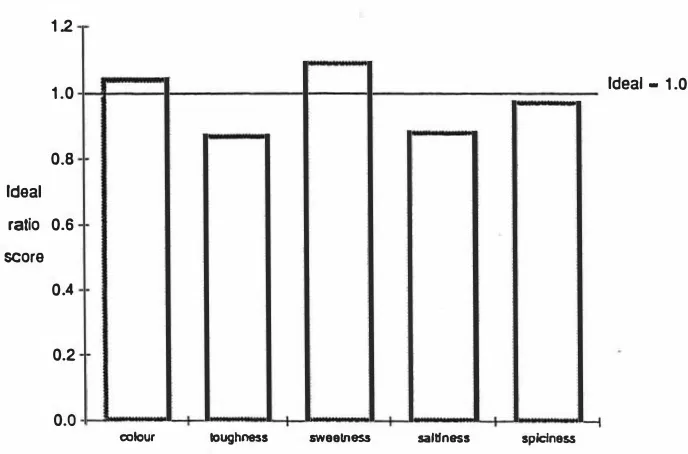
(39) 19. Cocktail. Sausage. 12. Ideal. •. Stand 1. o Stand 2 scara. colour. hi".... amoolhn.... )lldnoss. oi_. said,,".. apIcJno... Vlenna Sausage. 12 1 .0 O.B Ideal ralla. g. 0.6. scare. Brand. 1. 0. Brand 2. g. Brand 1. 0. Brand. 0.4 02 0.0. coIo... Innne.. smooChn.... Juic:iness. oiln"1. aahlness. spldnosa. Mealball. 1.4 1 .2 1 .0 Ideal raUa. 0.8. FlQure 3.1 Sensory ideal ralia scares (sample scare ; naaUng ideal scare) lor two brands al cammercial sausages and meatballs. 2.
(40) 20 In general, the commercial products had good sensory attributes with their ideal rati o scores ,. relatively near 1 , especially for cocktail sausages. The mean ideal absolute score of each sensory characteristic for t hese commercial meat products were also d etermined a n d are shown in Table 3 . 1 . Table 3 . 1. M ean ideal absolute scores for sensory attributes of comme rcial cocktail sausages, vienna sausages and meatballs. Product Colour. Firmness. Smoothness. Attribute Juiciness. Oiliness. Saltiness. Spiciness. Cocktail Sausage. 8.2. 8.3. 8.2. 6.7. 6.4. 5.5. 6.0. Vienna Sausage. 8.0. 8.3. 8.1. 7.0. 6.9. 6.3. 6.7. Meatball. 7.8. 8.0. 8.2. 6. 1. 4.3. 5.6. 3.9. It was interesting to note that the Thai consumers liked products with firm and s mooth texture and with quite intense colour. The products should not be too juicy or oily; e specially for the meatball, it should have mild oiliness. Saltiness was also another important s ensory attribute . I n general, the p roducts should be mildly salty. M e atballs shou ld not have too much spicy flavour. The mean ideal absolute score of each characteristic of the meatball was used as the "fixed" ideal for further development. 3.2.2.2. An Investigation on the Effects of Using Mutton on the Four Groups of P roducts. Another experiment was performed to investigate the effects of using various proportions of mutton together with other kinds of meats to make the four gro u ps of processed meat products. Details of formulations and methods are in Appendix 3 .5. The s a m e twelve panelists were asked to assess the sensory characteristics of these products by using the ideal profile testing. The results are shown in Figures 3.2, 3.3 and 3.4..
(41) 21. Cocktail Sausage. 12 Ideal -. 1.0. 1.0. 0.8. g 0%. Ideal ratlo. mutton. 0.6. o. score. mutton. 0.2. I:'� ; ', '". CX>lour. 12. �. .-�. :. ftrmness. smoothness. juiciness. oiliness. salIiness. spiciness. Vienna Sausage. Ideal -. 1 .0 0.8. mutton. 0.6. score. 0.4 0.2 0.0. 1.0. !m 0%. Ideal ratio. mutton. • 1 00%. 0.4. 0.0. 50%. o. I. 11. I' ·. �� ..... colour. I, .. r&rmness. smoothness. juiciness. oiliness. Meatball. .. mutton. 100010. mutton. .. ". ¥'".. 50%. .. �.. salUness. spiciness. 1 .4 1 .2 1 .0 +-----------. _ _ _ _ _ _ _ _. Ideal. 0.8. D 0%. 0.6. o 1 000/0. mutton. ratio score. mutton. 0.4 0.2 0.0 colour. Figure. Innne... smoothness. juiciness. oiliness. aal1Iness. apiclness. 3 . 2 Sensory idea l ratio scores ( sample score : f ixed ideal score) for. experimental. cocktail. sausages .. vienna sausages and. meatba l ls made �ith varying amounts of mu t ton.
(42) 22. 1 .2. Ideal - 1 .0. 1 .0. 0.8. Ideal ratio 0.6 score 0.4. 0.2. 0.0. colour. lOughness. sweetness. salllness. spiciness. Figu re 3 . 3 Sensory idea l ra t io scores ( sample score : f lo a t ing ideal score) for expe r imental spiced and d r ied meat ( l 001 mu t ton ). 1 .6 1 .4 1 .2. Ideal. Ideal - 1 .0. 1 .0. ratio 0.8 score. 0.6. 0.4. 0.2. 0.0. colour. firmness. toughness. juiciness. oiliness. saltiness. F igure 3 . 4 Senso ry idea l ratio scores ( sample score : for experimental pressed-ham mu tton. made. with. �. 0% mutton. 0. 50% mutton. 11. 1 00% mutton. spiciness. f loat i n g idea l score) varying. amou n t s of.
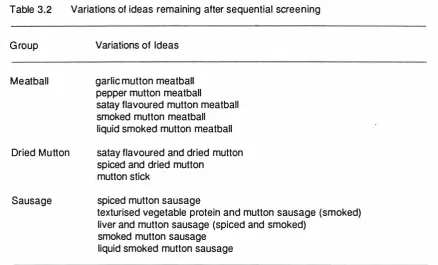
(43) 23 For cocktail sausage. it seemed that the ideal ratio scores were not near the ideals. i . e . the ideal ratio scores of 1 .0. especially for firmness and smoothness. For vienna sausage. the scores of the product which was made using solely mutton . seemed to be nearer the ideals than those of the products w ith lower mutton content. For meatballs. the scores were rather near the ideals. however. most of the sensory scores of the product made by using solely mutton were not as near the ideals as t hose of the product made without mutton . For spiced a nd dried mutton. the scores were near the ideals. For pressed-ham. most of the sensory scores were not near the ideals especially the one made by u sing solely mutton. This p roduct was very dark in co lour and very tough. I n general. it was a pparent that mutton could not be used alone in manufacturing meat products acceptable to the Thais. Considering the results from the market survey and the preliminary experiments performed. it was decided to drop pressed-ham because its sales quantity was not comparable to the sales quantities of the other three products. I n addition . it was expected this product cou ld o n ly with difficu lty be made from mutton so as to be acceptable to the Thai consu mers. Therefore only three groups of products - meatballs. s ausages. and dried meat - were retained. 3.3. SELECTION OF TH E FINAL PRODUCT IN NEW ZEALAN D. 3.3.1 ·. I ntroduction. The three groups of products selected from a preliminary study in Thailand were studied f u rther at the Department of Food Technology. Massey University. N ew Zealand. Thai consumer input. through brainstorming. was used to generate variations of the three g roups of meat products particularly with added ingredients which could impart flavour. These ideas were reduced in a screening process after further market. technical. and e specially consumer information were considered. Processing experiments on the three products (meatball. spiced and dried meat. sausage) studied the effects of mutton fat and beef fat on the sensory attributes of each product. The market potential for each screened product was also determined. Using all the information. a final product was selected. 3.3.2. 3.3.2.1. A Desk Study on Flavours for the Three Groups of Products Using Brainstorming and Screening Techniques Literature Review on Product Idea Generation and Screening. I n systematic product development. the process starts with a procedure to generate a large number of product ideas which are thereafter screened to remove the products that are not compatible with the prespecified goals. The methods for generating product ideas are classified as analytical and non-analytical. Analytical methods include morphological.
Figure
+7



Outline
RAW MATERIALS AND PROCESSING METHODS
CHAPTE RS RELATED TO THE METHOD OF THE PRODUCT DEVELOP M ENT PROCESS IN THIS STUDY
LITE RATU R E REVIEW ON USE OF PHOSPHATE AND OTHER A D DED INGREDIENTS IN PROCESSED M EAT PRODUCTS
I NTRODUCTION
SCREENING OF SPICES
MATERIALS AND EXPERIMENTAL METHODS
CONCLUSION
SELECTION OF THE CONSUMER TESTING TECHN IQUE
ACCEPTABILITY OF THE MEATBALLS
MARKETING INFORMATION
Related documents
With the overall objective of developing blood biomar- kers of angiogenesis, we examined the associations of blood levels of miRs implicated in angiogenesis with those of
In this paper we trace the early history of relativistic su- pertasks, as well as the subsequent discussions of Malament-Hogarth spacetimes as physically-reasonable models
What became evident through the process of analysis was that mothers were attempting to balance the need to keep memories of their dead child close while at the same time
The objectives in WP2 are addressed through association of novel data on disease prevalence, with risk factors and control measures and by developing decision support
The structure and magnitude of the oceanic heat fluxes throughout the N-ICE2015 campaign are sketched and quantified in Figure 4, summarizing our main findings: storms
Nitri fi cation and sedimentary denitri fi cation occurred near the river mouth, nitri fi cation prevailed further offshore under the plume, and fi nally, phytoplankton
2 Equity Market Contagion during the Global Financial Crisis: Evidence from the World’s Eight Largest Economies 10..
In 2008, the first pilot experiments were conducted in seven organic winter oilseed rape fields (total area: 4.2 ha) in North-western Switzerland.. One half of each field was
