The authors wish to acknowledge the support of staff from the following organisation:
CONTACTS
For further information about this research report, please contact:
Omar Ali is PhD candidate in school of management and enterprise, Faculty of Business, Education, Art and Law at University of Southern Queensland, Australia. His PhD research is about the adoption of cloud computing in local government councils. He had two master degree. The first one in information and communication technology, and the second one in information systems and technology by research. His research interests include RFID technology; cloud computing; VoIP; IT governance; information system security; research methodology; and systems design and analysis.
Phone: 07 4631 5387 Email: [email protected]
Professor Jeffrey Soar is professor in school of management and enterprise, Faculty of Business, Education, Art and Law at university of Southern Queensland, Australia. Also, he is a Chair in Human-Centred Technology. His research interests include Information technology; information system management; knowledge management; IT project management; cloud computing; e-business; IT governance; IT infrastructure; health information management; business process analysis.
Phone: 07 4631 1255
Email: [email protected]
Associate Professor Jianming Yong is an associate professor in information systems, school of management and enterprise, Faculty of Business, Education, Art and Law at university of Southern Queensland, Australia. His research interests include advanced networking, internet technology, m-commerce, e-business, data integration, workflow systems, information system security, network management, web service for SMEs, digital identity management.
Phone: 07 4631 2448
Contents
Abstract
1
Recommendation
2
Research Introduction
3
What is Cloud
Computing Technology
4
Research Methodology
9
Research Findings
11
Factors to be
Considered for Cloud
Adoption
15
Anticipated Benefits
17
Challenges and Issues
19
Factors Perceived to
Influence Cloud
Adoption
21
Research Practical
Contributions
Abstract
Cloud computing is becoming increasingly important in information technology as an enabler for improved productivity, efficiency and cost reduction; and is expected to offer benefits for public sector organisations. Cloud computing has the potential to improve the reliability and scalability of information technology systems, which allows organisations such as regional municipal governments to focus more on their core business and strategy. Research about the use of cloud computing in the public sector in general is limited. There is a lack of exploratory studies that provide an in-depth and holistic investigation of the factors perceived to influence the adoption of cloud computing. There are no empirical studies about the factors that are perceived to influence the adoption of cloud computing in reference to Australia.
This research aimed at exploring perceptions of the potential for value creation from cloud computing in regional councils, to identify factors that are likely to influence adoption of cloud computing including factors that need to be considered when planning to adopt cloud, anticipated benefits of cloud adoption, and challenges and issues that faced cloud adoption.
This research aimed to improve understandings related to the factors that influence cloud computing adoption decision making in regional municipal governments. The research employed a mixed method approach (qualitative and quantitative). In-depth interviews of Australian councils’ IT managers were conducted with the aim of providing insights into the factors that are perceived likely to influence adoption of cloud computing including factors that need to be considered when planning to adopt cloud, anticipated benefits of cloud adoption, and challenges and issues that faced cloud adoption. Survey data from 480 IT staff across 47 local government councils were collected to confirm the findings of the exploratory stage.
Recommendation
Australian councils should consider the potential of Cloud computing technology to drive much‐ needed improvements in overall productivity.
The Australian Government should strongly support the development of an enhanced local Cloud computing industry, building on the inherent strengths that the stable Australian financial, policy and regulatory environment provides.
There needs to be greater national support Regional council to encourage the use of Cloud computing technology in local government.
Regional councils should expand their knowledge and skills in Cloud computing technology.
The Department of Broadband Communications and the Digital Economy should review options for reducing costs of broadband (Internet) in regional areas.
Regional councils should consider developing business cases to assist in making investment decisions on Cloud computing.
There needs to be an engagement of cloud service providers with local government to build a dialogue on the adoption of cloud computing.
The adoption of cloud computing is increasing worldwide, given the opportunities and benefits to organisations to improve their performance. Research about the use of cloud computing in the public sector in general is limited (Janssen & John 2011) although there is some evidence of the benefits of cloud computing (Buyya et al. 2009; Marston et al. 2011; Tripathi & Parihar 2011; Zhang et al. 2010). There is some previous researches that concentrated about the challenges and the issues of cloud computing (Julisch & Hall 2010; Jensen et al. 2009; Pearson 2009; Wyld 2010). There is a lack of exploratory studies that provide an in-depth and holistic investigation of the factors that impact or influence the adoption of cloud computing (Low et al. 2011; Misra & Mondal 2011). There are no empirical studies about the factors that influence the adoption of cloud computing services in reference to Australian Regional councils. This limitation has hindered strategy development to improve the adoption of cloud computing in Regional councils (Department of Innovation Industry Science and Research 2011). There are calls for research on cloud computing adoption to guide implementation decisions from Regional councils to request further research (Department of Innovation Industry Science and Research 2011).
The research problem which the research intends to investigate can be stated as the identification of factors that has an impact or influence on the adoption of cloud computing in Regional councils.
Research Objectives
The main goal of this research is to explore and investigate the potential for value creation for Regional councils by identifying factors that are perceived likely to influence the adoption of cloud computing. This research also aimed to increase our knowledge and understanding on the factors that need to be considered when planning to adopt cloud. It aimed to increase our knowledge and understanding on anticipated benefits of the adoption of cloud computing and of the challenges and issues that are faced in the adoption of cloud computing. The main objectives of this research as followed:
1- To investigate the factors that need to be considered when planning to adopt cloud computing in Regional councils.
2- To explore the challenges and issues that influence the adoption of cloud computing in Regional councils.
3- To study the anticipated benefits of the adoption of cloud computing in Regional councils.
4- To explore the factors that encourage or discourage the adoption rate of cloud computing in Regional councils by evaluating the proposed model quantitatively with suitable sample size.
Scope of the Research
This research investigated the potential for value creation from adopting cloud computing in Regional councils. The extant literature on adoption of cloud computing appears to be limited in reference to Regional councils. That is, although literature addressing this issue exists, there is so many detail about the issues of interest addressed in this research. This research used a mixed methods design; an exploratory qualitative method as initial stage followed by a quantitative method to investigate the factors that influence the adoption of cloud computing in Regional councils. This research focused on IT staff in Queensland councils. The IT staff in this research divided into two groups. The first group is the IT managers. These individuals can include: IT director; IT manager who responsible for IT management and planning; and a director of IT services. These individuals were included because of their presumed level of information; knowledge and proficiency of cloud computing in Queensland councils. This might allow understanding of the issue from IT administration perspective. The second group is the IT staff who are working in IT department at Queensland councils. Those people can include: systems development, analyst, programmer, operations, systems administrator and user support, who are directly exposed to IT at the Queensland’s councils. Those people were included because of their presumed level of skills, knowledge and experience in a relation to cloud computing adoption in their councils.
Background to Cloud Computing
The advent of IT such as cloud computing in recent years has attracted interest from different stakeholders, such as business organisations, institutions and government agencies (Buyya et al. 2009). This is fuelled by the potential of cloud computing to reduce cost of services. Cloud computing offers a shift from installed software to cloud based services that can accessed anywhere and anytime. Cloud computing offers scalability and on-demand provisioning of resources (Buyya et al. 2009).
Although the concept of cloud computing is fairly a new term, it has been in existence for a while (Vaquero et al. 2009; Lyer & Henderson 2010). It’s root are related to other computing paradigms as grid computing and utility computing where terms used in cloud computing are taken from the those fields of computing (Buyya et al. 2009; Geelan 2009; Vaquero et al. 2009; Wang et al. 2008). According to Cafaro and Alonsio (2011) the roots of cloud computing can be taken back to early 1960s, when the concepts of utility computing and time-sharing were developed (Berman & Hey 2004). The main significant areas focused in computer science in this age were multiplexed information and computing service, which was a project far ahead of its time which failed due to the lack of public internet services, advanced communication technologies as well as lacking high speed processing and storage capacities. However, in this era the technologies of multitasking and time-sharing also emerged which were forerunners of cloud computing (Wang et al. 2008).
The mainframe era of computing was initiated in 1970’s when companies as Tymeshare Inc. started renting out storage space and processing power through telephone lines (Bhattacharjee 2009).The beginning of personal computers was taken place in 1980s (Durkee 2010), in 1990s the dot-com bubble and the arrival of grid computing were taken place. Grid computing allowed for linking and sharing of computing resources, while the dot-com bubble led to the emergence of data centres. However, the technology of data centres were not utilised at 100% capacity which eventually led to the invention of modern cloud computing (Bhattacharjee 2009).
The first effort on cloud computing can be identified as the “Loud Cloud” company that founded by Marc Andreesen which was based on “build the web’s next power play: custom-designed, infinitely scalable sites that blast off a virtual assembly line” (Sheff 2003). Loud cloud was a managed service provided which was the forerunner of providing services named as software as a service (SaaS). This service was done by utilising Infrastructure as a Service (IaaS) (Sheff 2003). In 2000 Microsoft launched web services as SaaS offering, followed in 2001 by IBM with their Autonomic Computing Manifesto (Kephart & Chess 2003) and with the improvement of Internet innovations and expanding requests of computer applications, cloud computing came as a multi-administration supplier that imparts data, programming, and open assets inside the Internet-based setting. In October 2007, cloud computing was initially introduced to the public through participation between two computing organisations, IBM and Google (Lohr 2007). This new idea carried a range of effects and progressions to various fields significant to IT.
The idea of cloud computing is said to be generally new and a developing ideal model (Bayrak et al. 2011; Buyya et al. 2009; Leimeister et al. 2010). In contrast, cloud computing is not a fully new idea, noting that it is similar to the 1990s’ network computing and grid computing concept (Kim et al. 2009; Marston et al. 2011). Later, various analysts (Bayrak et al. 2011) guessed that the presence of cloud computing is because of the merging of prior advances, such as virtualisation, cluster computing, grid computing, broadband marketing and large scale data centres concentrated at inexpensive areas. As such, most scientists (Foster et al. 2008; Sotomayor et al. 2009) similarly talked about cloud technology in cooperation with grid technology and virtualisation technology.
Cloud computing has been defined from different perspectives since it is still at an exploring stage (Geelan 2009). One well-known definition is “clouds or clusters of distributed computers, provide on-demand resources and services over a network, usually the Internet, with the scale and reliability of a
data centre” (Grossman 2009). The European Network and Information Security Agency (ENISA) has
defined cloud computing as “on-demand service model for IT provision, often based on virtualisation and distributed computing technologies” (Catteddu & Hogben 2009).
One of the common academic definitions described cloud computing as “a type of parallel and distributed system consisting of collection of interconnected and virtualised computers that are dynamically provisioned and present as on or more unified computing resource based on Service-Level Agreements (SLAs) established through negotiation between service provider and customer” (Buyya et
al. 2009). Another academic definition defines cloud computing as “a set of network enabled services, providing scalable, normally personalised, inexpensive computing platforms on demand, which could be accessed in a simple and pervasive way” (Wang et al. 2008). These different definitions show the
varied understanding of what cloud computing is from the different perspectives of different stakeholders such as; academicians, architects, consumers, developers, engineers and managers (CSA 2009).
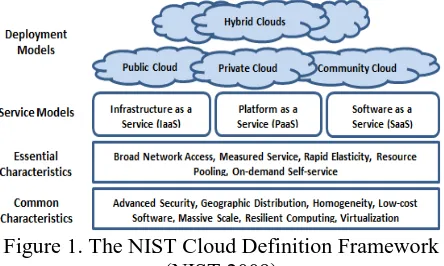
The U.S. National Institute of Standards and Technology (NIST) includes some other important aspects of cloud computing in its definition: “a model for enabling ubiquitous, convenient, on-demand network access to a shared pool of services (example include, networks, servers, storage, applications and services) that can be rapidly provisioned and released with minimal management effort or service provider interaction” (NIST 2009). This definition promotes the availability of cloud computing and
[image:9.595.187.409.357.490.2]describes its five essential characteristics to its three delivery models and four deployment models as shown in Figure 1.
Figure 1. The NIST Cloud Definition Framework (NIST 2009)
Cloud Computing Characteristics
The five characteristics of cloud computing according to the definition provided by NIST are as follows: (NIST 2009).
On-demand self-service. A consumer can unilaterally provision computing capabilities, such as
server time and network storage, as needed automatically without requiring human interaction with each service’s provider.
Broad network access. The availability of cloud computing services on the Internet makes it easily
accessible through standard mechanisms.
Resource pooling. The provider’s computing resources are pooled to serve multiple consumers
using a multi-tenant model, with different physical and virtual resources dynamically assigned and reassigned according to consumer demand. There is a sense of location independence in that the customer generally has no control or knowledge over the exact location of the provided resources but may be able to specify location at a higher level of abstraction (example include, country, state or data centre). Examples of resources include storage, processing, memory, network bandwidth, and virtual machines (CSA 2010; Mell & Grance 2009).
Rapid elasticity. Capabilities can be rapidly and elastically provisioned, in some cases automatically,
Measured service. One of the essential characteristics of cloud computing is measured service, whereby the usage of services and resources is constantly monitored, controlled and reported for fair pay-as-you-go model implementation.
Cloud Delivery/Service Models
Cloud services can be categorised on the basis of the following three service/delivery models Software as a Service (SaaS); Platform as a Service (PaaS); and Infrastructure as a Service (IaaS) (Broberg et al. 2011; CSA 2009; Mell & Grance 2009). These delivery/service model levels can be assumed as a layered architecture where services of the top layer can be created from the services of an underlying layer.
Based on the resources of virtualised computer, storage, and network, the primary layer Infrastructure as a Service (IaaS) is developed. The second layer Platform as a Service (PaaS) offers cloud development environments, which are created up on infrastructure services for providing application development and deployment abilities. At the user application level Software as a Service (SaaS) is built to providing applications and application programming interfaces (API) (Buyya et al. 2011). Each of these delivery/service models will be explored next.
Software as a Service (SaaS). The SaaS service model facilitates the usage of service provider's
programmes operating on a cloud infrastructure where consumers have the ability of accessing and using applications using a number of client devices by a client interface (ex: Web browser). The consumers have only a limited number of user-based application settings and they are unable to manage or change the base cloud infrastructure such as operating systems, servers, storage, or network (Buyya et al. 2011; Clemons & Chen 2011; Marston et al. 2011; Mell & Grance 2009; Son & Lee 2011; Velte et al. 2010; Wang et al. 2008). Examples of SaaS include, Salesforce, Netsuite and Google Apps.
Platform as a Service (PaaS).There are similarities between this cloud computing service model
and SaaS model. This model allows the consumers to adopt and develop applications acquired onto the infrastructure of the cloud with the support of programming languages as well as the tools provided by the service provider. Similar to the SaaS model, the cloud infrastructure cannot be managed or controlled by the consumers, but the user developed application as well as application hosting environments can be controlled by the consumers (Buyya et al. 2011; CSA 2010; Dillion et al. 2010; Mell & Grance 2009; Velte et al. 2010). Examples of PaaS include, Microsoft Azure Service Platform, Salesforce-Force.com, Google App Engine Amazon Relational Database Services and Rack Space Cloud Sites.
Infrastructure as a Service (IaaS). This service model supplies processing, networking and other
basic computing resources for consumers (Howell-Barber et al. 2013), where they can install and run different software such as operating systems and other programs. Similar to above mentioned service models, the consumers are incapable of managing or controlling the cloud infrastructure but they have the facility of controlling to operating systems, storage as well as other installed applications. Moreover, consumers have a limited control over certain components of the network such as firewalls (Howell-Barder et al. 2013; Buyya et al. 2011; CSA 2010; Marston et al. 2011; Mell & Grance 2009; Yadav & Hua 2010). Examples of IaaS include, Amazon S3 (Simple Storage Service), Elastic cloud computing (EC2) and Rack-space Cloud Servers.
Cloud Deployment Models
More recently, the cloud community has categorised four cloud deployment models (public, private, hybrid, and community cloud) (Catteddu & Hogben 2009; CSA 2009; Dustin-Amrhein et al. 2010; Mell & Grance 2009).
Public cloud. This deployment model supports the cloud infrastructure to be available for the general
Force.com (Marston et al. 2011). According to Dustin-Amrhein et al. (2010), this model enables clients to set the level of security that they are required, and negotiate for SLA.
Private cloud. In this deployment model, the cloud infrastructure is created only to focus in a single
organisation. The management and control of the infrastructure can be done by the organisation itself or by a third party, while the infrastructure can be set in within the organisation premises or away from the premises (Armbrust & Fox 2009; Dustin-Amrhein et al. 2010).According to Armbrust & Fox (2009), there are several reasons for setting up a private cloud within an organisation:(1) Based on security consideration related to aspects of privacy of data and trust making private cloud a favourable option for the firms. (2) For optimising the usage and allocation of existing resources internal to the firms. (3) Cost of data transfer is higher between local IT infrastructure and a public cloud. Further to this, Buyya et al. (2011) and Dustin-Amrhein et al. (2010) pointed out that there is an essential need for organisations to have full control over the critical activities existing behind firewalls.
Hybrid cloud. In this cloud deployment model, two or more clouds (private, community or public)
are connected by generic technology enabling portability of applications and data. This cloud deployment model is used by organisations with the aims of resource optimization, improving core competencies through outsourcing minor business functions onto the cloud maintaining its core activities within the premises through the private cloud (Marston et al. 2011). According to the Cloud Security Alliance (CSA) (2009), Hybrid cloud is aimed at resolving the issues related to standardization and cloud interoperability.
Community cloud. The community cloud deployment model is designed in a way to support a
certain types of communities which have similar requirements for example (security requirements, policies and compliance considerations) such that the infrastructure of the community cloud is distributed parallel across several organisations (Marston et al. 2011). The cloud infrastructure may be established within or outside the organisational premise and managed by the organisation itself or by a third party (Dustin-Amrhein et al. 2010). Up to a certain level, the cloud community behaves as having a demographical balance and economic scalability (Dustin-Amrhein et al. 2010). Examples for this cloud deployment model are cloud services offered by the governments such as passport, central excise, national ID, railway, tax as well as visa and immigration where the consumers (in this case the citizens) have the ability to access the relevant information related to the above mentioned at various department levels (Local governments, state, or centre) using the internet, phone or IVR (Dustin-Amrhein et al. 2010; Marston et al. 2011).
Anticipated Benefits Related to Cloud Computing
Relevant literature indicates that potential profits from the cloud based models is perceived to be the main cause behind the organisations appetite for adopting cloud computing (LGAQ 2013). Potential benefits can be outlined as significantly lower initial costs (Saeed et al. 2011; Saini et al. 2011), improved standardisation of services (Beaubouef 2011), improved scalability as well as accessibility which made cloud computing to be implemented across a number of sectors (Saeed et al. 2011; Liang et al. 2011).
Protection, care and technical support
Disaster recovery
Green technology
Policies management
Promoting business development
Improving service delivery
Reduced IT infrastructure cost
Ease of use and flexibility
The data collection of this research was conducted in two major phases. Phase 1 involved a qualitative investigation to understand the factors that influence the adoption of cloud computing in Regional councils. Phase 2 involved the use of quantitative questionnaire data to confirm the findings from the phase 1. The next two subsections describe the methods and results from two phases in detail.
Qualitative Investigation
The first phase of this research is exploratory in nature seeking to investigate and provide a qualitative overview of the concepts relating to the factors that influence the adoption of cloud computing in Regional councils.
[image:13.595.125.471.319.512.2]A series of in-depth interviews were conducted between May 13, 2014 and August 12, 2014. These obtained inputs from 24 local government employees at senior management levels: IT Manager (10); IT Coordinator (4); Technical Director (2); Information Service Manager (2); IT Officer (1); IT Consultant (1); IT Network Manager (1); Chief Information Officer (CIO) (1); Enterprise Architecture Manager (1); and Team Leader ICT Operation (1), see Figure 2. These occupational groups were selected based on the assumption that they represent key stakeholder groups likely to be responsible for planning and adoption of cloud computing for regional municipal governments.
Figure 2. Participants Title
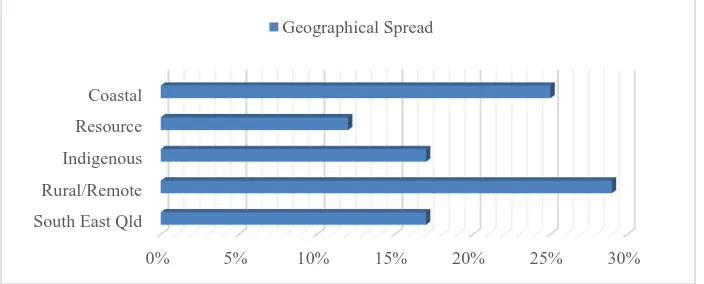
As shown in Figure 3 the sample reflects the geographical spread and size classifications of regional municipal governments throughout Queensland, Coastal with 25 percent; Resource with 12 percent; Indigenous with 17 percent; Rural/Remote with 29 percent; South East Queensland with 17 percent.
Figure 3. Geographical Spread
0 2 4 6 8 10
Team Leader ICT Operation Enterprise Architecture Manager Chief Information Officer IT Network Manager IT Consultant IT Officer Information Service Manager Technical Director IT Coordinator IT Manager
Participants Title
0% 5% 10% 15% 20% 25% 30%
South East Qld Rural/Remote Indigenous Resource Coastal
Geographical Spread
[image:13.595.123.475.577.719.2]Questionnaire (Online survey)
The second phase of this research is confirmatory in nature seeking to confirm the findings from the exploratory stage relating to the factors that influence the adoption of cloud computing in Regional councils.
A questionnaire was selected as the instrument for the second phase of data collection in this research. A questionnaire provides quick, affordable, efficient, and relatively accurate means to procure data to fulfil several goals (Zikmund 2003; Zikmund et al. 2013). The questionnaire was developed based on the previous literature on technological and organizations studies and the findings from qualitative study (exploratory stage), we developed the questionnaire to empirically test the research question. An online survey method was chosen because of the accessibility of the internet for all intended participants and the belief that participants would prefer this approach. In order to make the survey available 24/7, an online survey service provider was found and the online survey link was offered for 3 months from March 1, 2015 to May 31, 2015.
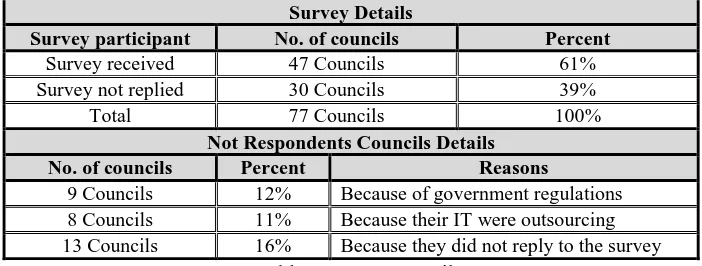
The survey was distributed online to Queensland’s 77 Councils through USQ’s Custom Survey System. IT Managers from 47 Councils responded to the survey which represented a response rate of 61 percent as shown in Table 1.
Survey Details
Survey participant No. of councils Percent
Survey received 47 Councils 61%
Survey not replied 30 Councils 39%
Total 77 Councils 100%
Not Respondents Councils Details No. of councils Percent Reasons
9 Councils 12% Because of government regulations 8 Councils 11% Because their IT were outsourcing 13 Councils 16% Because they did not reply to the survey
[image:14.595.122.473.314.447.2] Respondents’ Demographics
The respondent’s demographics data in this research including: roles in the field of IT, knowledge related to cloud computing, and total years’ experience with cloud computing. Each of these respondent’s demographics data will addressed next.
[image:15.595.95.502.278.367.2]Role in the Field of IT
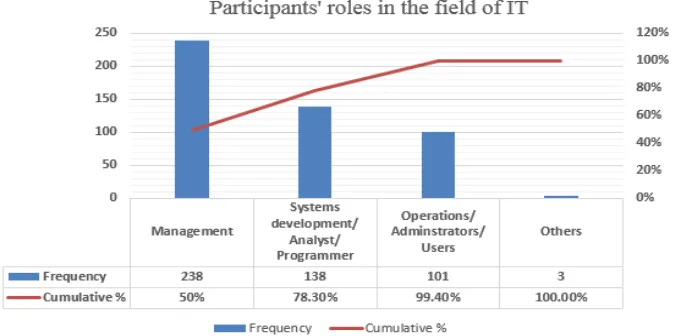
Table 2 represents the participant’s roles in the field of IT in the study. The table shows that 238 of the respondents with 49.6 percent reported they were in an IT management role, 138 of the respondents with 28.8 percent were in systems development/analyst/programmer roles, 101 of the respondents with 21 percent were in IT as operations/systems administrator/user support roles, and only 3 of the respondents with 0.6 percent indicated other roles including ICT management strategy, project management asset, and IT support.
Roles in IT Frequency Percent Cumulative %
Management 238 50% 49.6%
Systems development/ Analyst/ Programmer 138 28.8% 78.3% Operations/ Systems administrator/ User support 101 21% 99.4%
Other 3 0.6% 100%
Total 480 100%
[image:15.595.130.471.418.586.2]Table 2. Roles in the Field of IT
Figure 4 illustrates the frequency of roles in the field of IT. The mean of roles in the field of IT is 1.73. This range indicates that most roles of the participants in the field of IT is in the management.
Figure 4. Chart of Roles in IT Frequency
Knowledge Related to Cloud Computing
Table 3 represents the participant’s knowledge related to cloud computing in the study. The table indicates that nearly half of the respondents 238 with 49.6 percent reported had good knowledge related to cloud computing, 111 of the respondents with 23.1 percent reported had some knowledge about cloud. 106 of the respondents with 22.1 percent reported had a little knowledge about the cloud. Just 20 of the respondents with 4.2 percent reported had an excellent knowledge. There were only 5 respondents with 1 percent reporting no knowledge about cloud computing. These results indicate that most of the respondents have considerable knowledge related to cloud computing.
Knowledge related to cloud Frequency Percent Cumulative %
No knowledge 5 1% 1.0%
Little knowledge 106 22.1% 24.2%
Some knowledge 111 23.1% 73.8%
Good knowledge 238 49.6% 95.8%
Excellent knowledge 20 4.2% 100%
Total 480 100 %
[image:16.595.109.488.72.169.2]Table 3. Knowledge Related to Cloud Computing
Figure 5 illustrates the frequency of the participants’ knowledge in relation to cloud computing. The mean of the participants’ knowledge in cloud computing is 4.05. This range indicates that most of the participants have good knowledge in relation to cloud computing.
Figure 5. Chart of Knowledge Related to Cloud Frequency
Total Years’ Experience with Cloud Computing
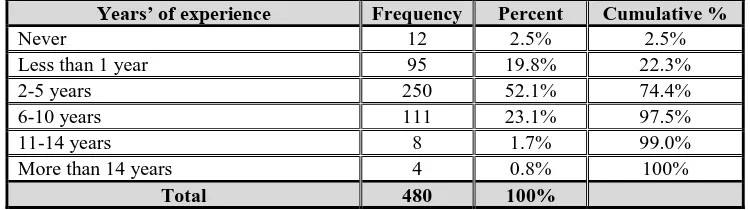
Table 4 represents the participant’s years of experience with cloud computing in the study. The table indicates that more than half of the respondents 250 with 52.1 percent reported an experience with cloud computing between 2-5 years, followed by 111 of the respondents with 23.1 percent reported an experience with cloud computing between 6-10 years. About 95 of the respondents with 19.8 percent reported an experience with cloud computing less than 1 year. 12 of the respondents with 2.5 percent were never have an experience with cloud computing, followed by 8 of the respondents with 1.7 percent reported an experience with cloud computing between 11-14 years. The lowest rate was the respondents who reported an experience more than 14 years, with only 0.8 percent. These results indicate that most of the respondents have considerable experience related to cloud computing.
Years’ of experience Frequency Percent Cumulative %
Never 12 2.5% 2.5%
Less than 1 year 95 19.8% 22.3%
2-5 years 250 52.1% 74.4%
6-10 years 111 23.1% 97.5%
11-14 years 8 1.7% 99.0%
More than 14 years 4 0.8% 100%
[image:16.595.135.463.237.430.2]Total 480 100%
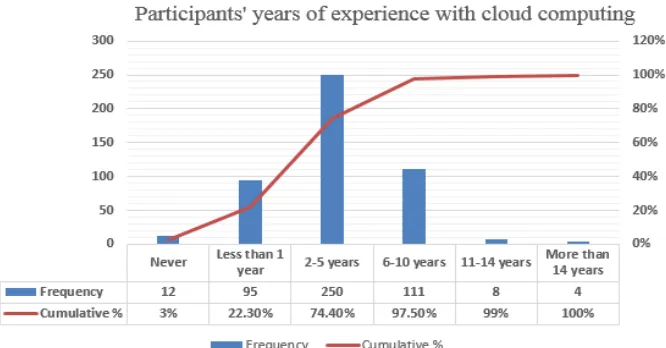
[image:16.595.110.485.600.705.2]Figure 6 illustrates the frequency of the participants’ years of experience with cloud computing. The mean of the participants’ years of experience with cloud computing is 3.04. This range indicates that most of the participants’ years of experience with cloud computing is between 2-5 years.
Figure 6. Chart of Years’ of Experience with Cloud Computing Frequency
Cloud Based Applications Used by Organisation
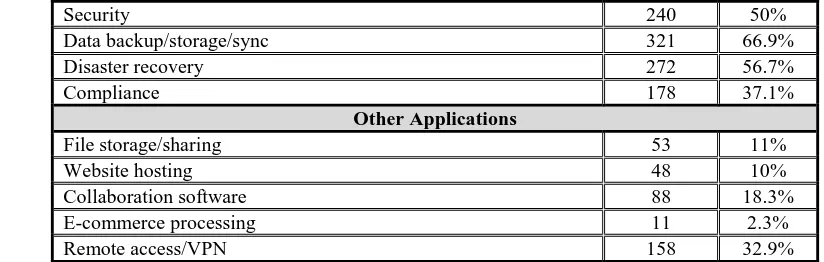
Table 5 represents the cloud based applications that used by organisation in the study. The table indicates thatthe most common applications for cloud were: email with 75.8 percent, office productivity with 68.8 percent, data back-up/storage/sync with 66.9 percent, telephone service/VoIP with 61.5 percent, disaster recovery with 56.7 percent, security with 50 percent, compliance with 37.1 percent, remote access/VPN with 32.9 percent, project management with 27.5 percent, and human resources with 25.6 percent. The other cloud based applications that have response rate about 10 percent and more, were: collaboration software with 18.3 percent, web conferencing with 13.5 percent, file storage/sharing with 11 percent, social networking and web hosting with 10 percent. The rest of the cloud based applications mentioned in Table 5 have a response rate lower than 10 percent.
Cloud based applications that used by organisation Frequency Percent Communication Applications
Email 364 75.8%
Email marketing 14 2.9%
SMS/text messaging 25 5.2%
Telephone service/VoIP 295 61.5%
Web conferencing 65 13.5%
Social networking/Web 2.0 48 10%
Media monitoring 25 5.2%
Management Applications
Office productivity 330 68.8%
Project management 132 27.5%
Accounting management 13 2.7%
Grant management 8 1.7%
Donor management 4 0.8%
Volunteer management 10 2.1%
Human resources 123 25.6%
Client/member database/CRM 12 2.5%
Payroll 12 2.5%
Billing and invoicing 13 2.7%
Data analytics 12 2.5%
Security 240 50%
Data backup/storage/sync 321 66.9%
Disaster recovery 272 56.7%
Compliance 178 37.1%
Other Applications
File storage/sharing 53 11%
Website hosting 48 10%
Collaboration software 88 18.3%
E-commerce processing 11 2.3%
[image:18.595.80.492.72.203.2]Remote access/VPN 158 32.9%
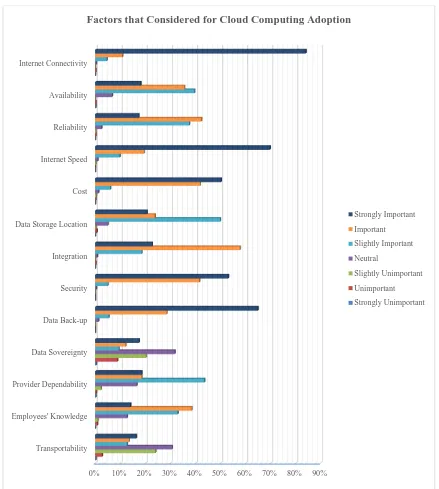
Figure 7 demonstrates the research findings related to the factors that need to be considered for the adoption of cloud computing in Regional councils. This suggests that internet connectivity seen as strongly important with nearly 85 percent, followed by internet speed with 70 percent. Then, data back-up with nearly 65 percent, security with 53 percent, and cost with 50 percent. In other opinion, participants seen integration as just important with nearly 58 percent, followed by reliability, cost, and security with over 40 percent. Next, employees’ knowledge with 38 percent, availability with 35 percent, and data back-up with 28 percent.
Other participants seen data storage location as slightly important with nearly 50 percent, followed by provider dependability with 43 percent. Then, availability and reliability were closely to 40 percent, followed by employees’ knowledge with 37 percent. Where, data sovereignty seen as neutral with nearly 32 percent, followed by transportability with 30 percent.
0% 10% 20% 30% 40% 50% 60% 70% 80% 90%
Transportability Employees' Knowledge Provider Dependability Data Sovereignty Data Back-up Security Integration Data Storage Location Cost Internet Speed Reliability Availability Internet Connectivity
Factors that Considered for Cloud Computing Adoption
Strongly Important
Important
Slightly Important
Neutral
Slightly Unimportant
Unimportant
Strongly Unimportant
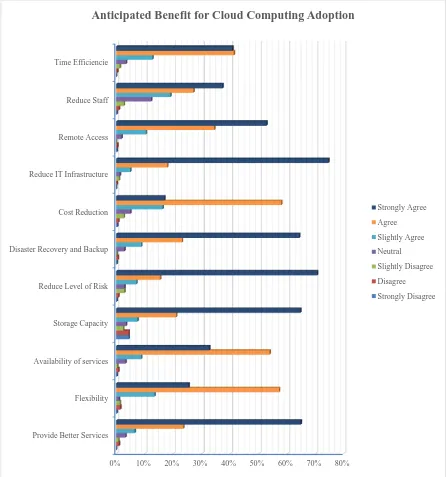
[image:19.595.69.508.253.742.2]Figure 8 demonstrates the research findings related to the anticipated benefits for the adoption of cloud computing in Regional councils. This suggests that reduce IT infrastructure seen as most important as strongly agree with nearly 75 percent, followed by reduce level of risk with 70 percent, provide better services, storage capacity, disaster recovery and back-up all of these benefits indicated by the participants as strongly agree with 65 percent, and remote access seen as most important as strongly agree with nearly 53 percent. Also, time efficiencies confirmed by the participants as strongly agree with 40 percent, followed by reduce staff with 38 percent, availability of the services with 33 percent, and flexibility with 25 percent.
Other participants seen cost reduction as important as agree with nearly 58 percent, followed by flexibility with 57 percent. Next, availability of services with 54 percent, and time efficiencies seen as important as agree with nearly 41 percent. Remote access with 34 percent, and reduce staff with 28 percent.
0% 10% 20% 30% 40% 50% 60% 70% 80%
Provide Better Services Flexibility Availability of services Storage Capacity Reduce Level of Risk Disaster Recovery and Backup Cost Reduction Reduce IT Infrastructure Remote Access Reduce Staff Time Efficiencie
Anticipated Benefit for Cloud Computing Adoption
Strongly Agree
Agree
Slightly Agree
Neutral
Slightly Disagree
Disagree
Strongly Disagree
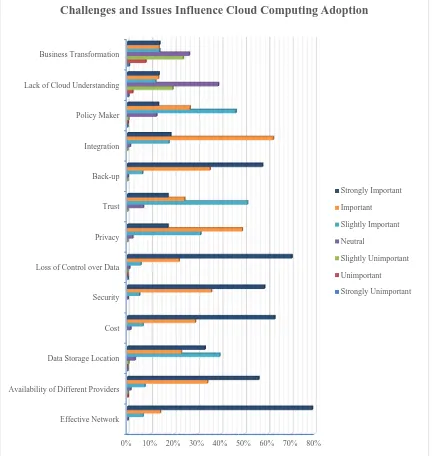
[image:21.595.74.521.267.744.2]Figure 9 illustrates the research findings related to the challenges and issues that influence the adoption of cloud computing in Regional councils. This figure indicates that the need of an effective network seen as strongly important with nearly 80 percent, followed by loss of control over data with 70 percent, cost with 62 percent, security with 58 percent, back-up with 57 percent, and availability of different providers with 55 percent, and data storage location with 32 percent.
Other participants seen integration as just important with 62 percent, followed by privacy with 49 percent. Then, security, back-up, and availability of different providers with 33 percent. Also, they seen cost and policy maker as important with 28 percent. But, others seen trust as slightly important with 50 percent, followed by policy maker with 47 percent, data storage location with nearly 39 percent, and privacy with 30 percent. Data that presented in Figure 6.6, indicated that participants seen lack of real understanding of cloud computing as neutral with nearly 39 percent, followed by business transformation with 26 percent.
0% 10% 20% 30% 40% 50% 60% 70% 80%
Effective Network Availability of Different Providers Data Storage Location Cost Security Loss of Control over Data Privacy Trust Back-up Integration Policy Maker Lack of Cloud Understanding Business Transformation
Challenges and Issues Influence Cloud Computing Adoption
Strongly Important
Important
Slightly Important
Neutral
Slightly Unimportant
Unimportant
Strongly Unimportant
[image:23.595.83.518.281.737.2]Recent developments have ensured the increasing fame of cloud computing as it is an online shared computing resource. Based on the above arguments, it can be deduced that even though it is economical and ensures an increase in performance, productivity and competency, there are a lot of challenges and issues related to the cloud adoption. Based on the findings of previous studies, the findings of this research is completely different. Because, most of the previous studies found that security as the most important issue that influence cloud adoption (Behl 2011; Julisch & Hall 2010; Jensen et al. 2009). But, the findings of this research found out that the effective network as the strongly important issue that faced Regional councils to adopt cloud computing.
Innovation change factors
How significant are the innovation factors (
compatibility
, and complexity) in driving your
organisation’s adoption of cloud computing environment?
Compatibility
Definition:
Compatibility is the degree to which innovation fits with the potential adopter’s existing values, previous practices current needs (Rogers 2003).
[image:25.595.80.524.395.719.2]According to the literature, compatibility is one of the constructs which significantly influence the adoption rate of innovations (Rogers 2003). Studies which investigated the diffusion process of innovations have found compatibility to be a significant determinant (Teo et al. 1997; Premkumar & Roberts 1999; Premkumar 2003; Ching & Ellis 2004; Daylami et al. 2005; Zhu et al. 2006a).
Figure 10. Compatibility Measurement
0% 10% 20% 30% 40% 50% 60% 70%
Cloud computing compatibility is not an issue for my organisation
Cloud computing is compatible with my organisation’s values and beliefs Using cloud computing system is compatible
with all aspects of my organisation Cloud computing is easily connected with the
existing IT infrastructure
Strongly Agree
Agree
Slightly Agree
Neutral
Slightly Disagree
Disagree
Strongly Disagree
Factors that are Perceived
to Influence Cloud Adoption
“
Compatibility, if things
were compatible with what
we are running, it will have
a positive impact. I think
there is no problem with
this factor, because it is
based on the CSPs and
most of the CSPs find
solution to this factor
”
Innovation change factors
How significant are the innovation factors (compatibility, and
complexity
) in driving your
organisation’s adoption of cloud computing environment?
Complexity
Definition:
Complexity is the degree to which an innovation is perceived to be relatively difficult to understand and use (Rogers 2003).
[image:26.595.64.512.428.728.2]The complexity of an innovation is able to act as an obstacle to the new technology adoption (Premkumar & King 1994; Low et al. 2011). A technology which is shows the characteristics of difficulty in understanding and usage is considered to be complex. If it takes extensively long time to be mastered or perform general tasks by a user, that technology is said considered to be complex. Thus, for improving the rate of adoption, technologies must have the essential characteristic of user friendliness (Sahin 2006). Complexity is proved to be a key aspect in the decision for adoption (Tiwana & Bush 2007; Chaudhury & Bharati 2008).
Figure 11. Complexity Measurement
0% 5% 10% 15% 20% 25% 30% 35% 40% 45% 50%
Cloud computing complexity is not an issue for my organisation
Integration of cloud computing with the existing IT system presents no problems for my organisation
Compared to other types of technologies cloud computing is less complex The skills needed to adopt cloud computing are not seen as complex for employees in my organisation Using cloud computing system is not seen as
complex for business operations
Strongly Agree
Agree
Slightly Agree
Neutral
Slightly Disagree
Disagree
Strongly Disagree
Factors that Perceived
to Influence Cloud Adoption
“
About the complexity,
comparing to other type of
technologies
cloud
computing technology is
less complex. We do not
see any more complex than
what we currently have
Technological change factors
How significant are the technological factors (
cost
, and security concern) in driving your
organisation’s adoption of cloud computing environment?
Cost
Definition:
Cost is refer to how a business can remain economically viable, feasible and imperishable, hardware costs and associated administrative costs have to be properly interpreted (Li et al. 2009).
[image:27.595.72.506.406.675.2]Cost savings is one of the primary capabilities of cloud computing (Cervone 2010). Cloud services providers state that their services can considerably cut down the total IS cost of an organisation including fixed costs such as initial investment, variable costs such as upgrading and maintenance as well as training costs (Zhu et al. 2006a). The minimal level of cost of getting the services improves the possibility of aim to adopt cloud computing.
Figure 12. Cost Measurement
0% 10% 20% 30% 40% 50% 60% 70% 80%
Cloud computing reduces the total cost of operational processes Cloud computing is cost effective compared with
the other IS technologies
Cloud computing reduces the costs of systems upgrades
Cloud computing decreases the investment cost in new IT infrastructure
Cloud computing has low training costs Energy and environmental costs of cloud
computing system are very low Maintenance costs of cloud computing system
are very low
Strongly Agree
Agree
Slightly Agree
Neutral
Slightly Disagree
Disagree
Strongly Disagree
Factors that Perceived
to Influence Cloud Adoption
“
The cost reduction needs
to be justified. If proved
that
cloud
computing
technology is cost saving
that means it will positive
Technological change factors
How significant are the technological factors (cost, and
security concern
) in driving your
organisation’s adoption of cloud computing environment?
Security Concern
Definition:
Security concernis refer to the level of data and the system security within the organisation (Paquette et al. 2010).
[image:28.595.62.502.397.728.2]In terms of cloud computing, security is the level which cloud computing is considered as being more secure in comparison to other models of computing. Cloud services providers’ state that they have the ability to safeguard organisations data more strongly than the organisations themselves (Kaufman 2009). Security in this research is defined as the security of services, data centres and media. This construct takes into account, the privacy and confidentiality of the organisations data (Paquette et al. 2010; Subashini & Kavitha 2011).
Figure 13. Security Concern Measurement
0% 10% 20% 30% 40% 50% 60% 70% 80%
Security concerns are not an issue with cloud computing
Cloud providers maintain effective data confidentiality
Cloud providers maintain the privacy of an organisation’s data
Cloud provider data centres have effective backup systems
Cloud provider data centres have effective redundancy
Cloud provider data centres provide greater security of data
Cloud provides a secure service Using cloud solutions is trustworthy Cloud provides a sufficient security transfer
during data interchange
Strongly Agree
Agree
Slightly Agree
Neutral
Slightly Disagree
Disagree
Strongly Disagree
Factors that Perceived
to Influence Cloud Adoption
“
I think security in the
cloud will probably be, will
most likely be stronger
than security in the house
in most case. So, I think
moving to the cloud would
be
a
more
secure
environment than what we
are currently in
”
Organisational change factors
How significant are the organisational factors (
top management support
, organisation size,
and employees’ knowledge) in driving your organisation’s adoption of cloud computing
environment?
Top Management Support
Definition:
Top management support is perceived to be the primary linkage between individual ICT innovation adoption and the organisational ICT innovation adoption.
[image:29.595.67.506.436.690.2]Top management support can affect the adoption of new technology innovation (Premkumar & Michael 1995; Eder & Igbaria 2001; Daylami et al. 2005). Through a revision of the predictors and biases in IT, Jeyaraj et al. (2006) revealed that support by top management is perceived to be the key link between individual and organisational ICT innovation adoption. These results are in line with the findings by Lertwongsatien and Wongpinunwatana (2003), who revealed that organisations have a less tendency to adopt new technologies without the support by top management.
Figure 14. Top Management Support Measurement
0% 10% 20% 30% 40% 50% 60% 70%
Top management provides resources to support the adoption of cloud computing Top management understands the benefits of
cloud computing systems Top management is seriously considering the adoption of an appropriate cloud system in my
organisation
Top management is willing to take the risks involved in adopting cloud computing
Strongly Agree
Agree
Slightly Agree
Neutral
Slightly Disagree
Disagree
Strongly Disagree
Factors that Perceived
to Influence Cloud Adoption
“
Top management support
has a positive effect on this
one because all our top
CEO Managers agree that
moving to cloud base will
increase
the
council
performance and will help
the council to provide good
services to our customers
”
Organisational change factors
How significant are the organisational factors (top management support,
organisation size
,
and employees’ knowledge) in driving your organisation’s adoption of cloud computing
environment?
Organisation Size
Definition:
Organisation size is explained as the size of the organisation including employees and resources (Rogers 2003).
[image:30.595.67.504.427.676.2]One of the significant factors associated with IT innovation is the size of the organisation (Hong & Zhu 2006). Some experiential researches have pointed out that a positive correlation exist between size and adoption of new technology in an organisation (Pan & Jang 2008). It is proposed that organisations of smaller size are poses far more flexibility in relation to changing the path (Jambekar & Pelc 2002). Others has been repeatedly found that due to the greater litheness and capacity of taking risk, larger organisations incline to adopt more innovations (Zhu et al. 2004). Apparent tactical importance of cloud computing in innovative technological development is affected by the vital factor of size of the organisation.
Figure 15. Organisation Size Measurement 0% 5% 10% 15% 20% 25% 30% 35% 40% 45%
The size of an organisation impacts its adoption of cloud computing
Bigger organisations with larger resources can easily move to adopt cloud computing Small organisations are more flexible in adopting
cloud computing
The revenue of my organisation is high compared to others in the industry
The number of employees in my organisation is high compared to others in the industry
Strongly Agree
Agree
Slightly Agree
Neutral
Slightly Disagree
Disagree
Strongly Disagree
Factors that Perceived
to Influence Cloud Adoption
“
I think that it is easier for
smaller organisations. I
think it is also easier for
young organisations that
have not yet sunk capital
investment into a whole
portfolio of technology and
applications so smaller and
younger organisations are
more likely top mover to
Organisational change factors
How significant are the organisational factors (top management support, organisation size, and
employees’ knowledge
) in driving your organisation’s adoption of cloud computing
environment?
Employees’ Knowledge
Definition:
Employee’s knowledge can be defined as the similar experiences which can be envisioned on a band that explains the level of connections between the present and practices and experiences of the past (Lippert & Forman 2005).
[image:31.595.65.505.425.675.2]Identification of previous similar practices by the employee can be considered on a scale which explains the level of connection among previous experiences and the current practice (Lippert & Forman 2005). An organisation that having employees with extensive level of knowledge on innovation encounter less confrontations and issues against introducing and practicing new technologies. Practical experiences has been noted which supports the positive correlation between adopting IS and IS knowledge level of the employees (Kuan & Chau 2001; Thong 1999).
Figure 16. Employees’ Knowledge Measurement
0% 10% 20% 30% 40% 50% 60%
Employee knowledge in my organisation plays a massive role in the adoption of cloud computing Organizations with employees who have more knowledge about cloud computing are likely to
more adoption
The IS staff in my organisation have previous IT development experience
The IS staff in my organisation have the ability to support cloud computing system development
Strongly Agree
Agree
Slightly Agree
Neutral
Slightly Disagree
Disagree
Strongly Disagree
Factors that Perceived
to Influence Cloud Adoption
“
Employees’ knowledge I
believe it will have a
positive impact if the
employees and the end
users were familiar with
using it, they would be a lot
quicker to pick up on it and
Environmental change factors
How significant are the environmental factors (
government regulation
, and information
intensity) in driving your organisation’s adoption of cloud computing environment?
Government Regulation
Definition:
Government regulation is explained as the support provided by the authority for influence the improvement of IS innovations in organisations (Jaeger et al. 2008).
[image:32.595.65.508.396.660.2]Government guidelines can be explained as the support provided by the government for the purpose of encouraging the amplification of organisations IS innovation (Jaeger et al. 2008). The notion which organisations are having on the current laws and regulations can be evaluate during this procedure. By formulating rules for safeguarding businesses using cloud computing technology, governments can promote the adoption of cloud computing (Best et al. 2008; Carrico & Smalldon 2004).
Figure 17. Government Regulation Measurement
0% 10% 20% 30% 40% 50% 60% 70%
There is no specific government policy on adoption of cloud computing Current government policy is focused on all of
the risk factors
Current government policy is focused on security Current government policy is focused on privacy Government regulations can provide a better
process for adopting cloud computing The data protection policies are regulated by
government
Government effectively promotes cloud computing adoption
Strongly Agree
Agree
Slightly Agree
Neutral
Slightly Disagree
Disagree
Strongly Disagree
Factors that Perceived
to Influence Cloud Adoption
“
Government
regulation
has the potential to drive
the use of cloud services as
regulations are refined to
make
it
easier
for
councils/agencies to utilise.
Government
regulation
could also force the use of
cloud solutions in some
circumstances
”
Environmental change factors
How significant are the environmental factors (government regulation, and
information
intensity
) in driving your organisation’s adoption of cloud computing environment?
Information Intensity
Definition:
Information intensity can be define as the level to which information is available in the product or service of a business (Thong 1999).
[image:33.595.65.502.413.680.2]Organisations in different sectors have different information intensity, for example financial organisations need to have access to most current information. Information intensity is the organisation’s reliance on accessing up to date, reliable, relevant and accurate information whenever they need it. Have reported that organisations that use more advanced ICT technologies have more ability to access internal, external, and previously encountered information (Chau & Tam 1997; Chong et al. 2009). It allows the quick retrieval of such information, and facilitates information accessibility (Huber 1990). Organisations whose businesses depends up-to-date information are more likely to adopt cloud computing.
Figure 18. Information Intensity Measurement
0% 10% 20% 30% 40% 50% 60% 70%
My organisation is dependent on up-to-date information
Organisations in the same sector as my organisation can access sufficient information to
support a change in services provided Users have access to sufficient information on
how to use services The users and organisations in the same industries as my organisation rely on each other
for information regarding services
Strongly Agree
Agree
Slightly Agree
Neutral
Slightly Disagree
Disagree
Strongly Disagree
Factors that Perceived
to Influence Cloud Adoption
“
Information intensity I
think that would have a
positive impact. Because
cloud
computing
will
provide our systems with
quick and good access to
the information
”
The deliverables of this research contribute significantly not only to the future IS research projects, but also for the improvements of the public services particularly the regional governments. Research supports such regional governments to use cloud computing effectively and efficiently by considering the influence of different factors. The detail discussion is carried out below about the implication of this research for many different groups of users: service providers and technology consultants, managers, and governments.
Implications for technology consultants and service providers
The outcomes of this research are particularly important for the technological consultants. Regional councils can be considered as organisations, which represents a vital segment of the market and the country’s economy by providing various important services to the local citizen and business. The service provider plays a significant role in implementation and that it is quite clear when the firm and public intermediaries are alert of each other’s individual input and a working connection is recognised (Brown & Lockett 2004).
Organisations that are unsuccessful in adopting technologies may become influential undesirable opinion leaders (Leonard-Barton 1988). The providers of these services should focus in investigating appropriate role models, study the different problems faced by the organisations, should be aware of the organisational context and take a more positive role to encourage successful diffusion in these organisations. To design and use strategies for the extensive adoption of cloud computing, technology consultants should have a much better understanding about the important factors that affecting the organisation’s adoption of cloud computing and related technologies.
The service providers of cloud computing technologies should have a better interaction with the regional governments, who are experiencing these novelties, in an attempt to deliver a healthy environment for the adoption of cloud computing, and to reduce uncertainties surrounding the adoption of cloud computing in these regional governments.
The process of adopting these technologies sometimes take time due to the fact that decision makers of the regional governments are not aware of the potential benefits that these technologies brings to the business. To have a better understanding and awareness of the anticipated benefits of these adoptions play a vital role in decision-making process.
It has been explored as a part of this research that IT managers of these regional governments related their late response to the adoption of cloud computing to the lack of better understanding of these technologies and knowledge level of employees on this kind of services. Service providers should develop strategies to promote the anticipated benefits of cloud computing.
Technology consultants and service providers should take necessary actions to mitigate the feelings of uncertainties associated with adoption of cloud computing. The location of the data storage is one of the uncertainties around cloud computing. Factors such as internet connectivity, cost, security, trust, integration, backup, provider dependability, employee knowledge, and transportability are significant concerns when planning to adopt cloud computing in a business. The service provider should be capable of delivering secure and reliable environments in the most accessible, economical, and convincing way. This leads to a supportive environment for the business. Service providers should provide the technical support 24/7 to minimise the concerns of customers on data stored remotely away from their locations.
Some of the Regional councils had not felt that they were adequate enough for cloud computing adoption due to many reasons. One possible explanation for this is that service providers identify alternating environment of IT industry, and they are playing a vital role in order to be an active facilitator for these services. At the same time, they don’t want their valuable investments of hardware and software to be affected. This can make stakeholders have a negative impression on service providers, who themselves have no clear aims and stance about these cloud computing technologies. It can be
suggested that further research need be carried out in this area before conclude the role of service providers in the diffusion of cloud computing, particularly as the user may be affected by the views of the service provider the extent to which cloud computing provider confident in the advantages that technology will create in their business.
Using the research proposed model in this research by the service providers can assist the following:
Improve the awareness of the reasons behind the some regional municipal government’s lack of interest on the adoption of cloud computing technology.
The providers of cloud computing technologies should have a better interaction with the regional governments, who are experiencing these novelties, in an attempt to deliver a healthy environment for the adoption of cloud computing, and to get rid of any uncertainties surrounding the adoption of cloud computing in these regional governments.
To improve clients’ confidence on could computing service providers should demonstrate their vision and aim of delivering cloud-computing technologies versus in-house services.
Implications for Managers
One of the major challenges decision makers face in business is uncertain and rapidly growing business environment. The major problems, which impact selections, change with time; effects are not yet known when adoptions are made, and often there is a lengthy period between the choices itself and when its consequences become well defined. Managers can use many different related studies to develop their process of decision making in this environment. Cloud computing adoption model proposed in this research supports managers to identify the potential adoption and develop their knowledge about the important factors that influences the outcome of such adoptions.
As demonstrated by the empirical analysis, the anticipated benefits play an important role in the adoption of cloud computing in Regional councils. These results imply that managers and decision makers should investigate and evaluate the advantages of adopting to such technologies and also they better improve their knowledge and awareness about these services. These developments will support to decrease the level of uncertainties associated with cloud computing adoption. The potential benefits and its instrument explained and discussed can be effectively used by local council managers to deeply evaluate and organise their adoption and implementation of such technologies. This will lead them to understand how cloud computing can enhance the efficiency of their work by increasing the productivity and making them have a great control of their daily work.
The outcomes of this research deliver a set of verified and reliable measures for investigation the support of cloud computing. It can be seen that to choose the ideal cloud service provider, managers must play a vital role with great attention. As explained earlier compatibility, complexity, cost, and security concern can be considered as the most important factors when adopting these technologies to business. The main task of selected service provider to deliver high level technical and organisational support to reduce the uncertainties associated with technical and organisational matters. The managers must consider the size of their organisations when selecting the most suitable cloud computing system for their firm. Findings of the research also suggest that the type of cloud computing adopted is significantly affected by the computing support delivered by the service provider. This indicates that organisations should try to obtain the all possible supports from the service provider in all critical stages; from early stage to full employment of the technology and the final stage of application.
In comparison to other models, TOE framework and the DOI theory combination contains a multitude of factors technology, organisation, environmental context, and innovation characteristics which provides higher flexibility and benefits than the other models. TOE framework (Tornatzky & Fleischer 1990) and DOI theory (Rogers 1995) can provide a better understanding of the adoption phenomenon of IT/IS through an easy to understand the methodology, which is supported by a solid theoretical basis and a reliable empirical support. Hence, the combination of TOE framework and the DOI theory shows that it can enhance the decision taking the skill of managers of Regional councils.
Implications for government
The growth and development of cloud computing may lead to evaluation of government policies and incentives encouraging the technology adoption in Regional councils. Through facilitating considerate of the aspects that affect the adoption and implementation of ICT technologies such as cloud computing, this research model can support harnessing the benefits of the ICT execution efforts of the Australian government. The research outcomes can underpin a comprehensive understanding of the factors that need to be considered when planning to adopt CC, anticipated benefits, and challenges and issues of the implementation of cloud computing in the local government councils ultimately leading to support the ICT implementation process by the Australian government. Hence, it can be assumed that cloud computing has a potential to reduce the cost of IT operations in regional governments.
REFERENCE
Ahuja, SP & Mani, S 2012, ‘Availability of services in the era of cloud computing’, Network and Communication
Technologies, vol. 1, no. 1, pp. 2-6.
Armbrust, M & Fox, A 2009, ‘Above the clouds: Berkeley view of cloud computing’, Technical Report, University of California, Berkeley, pp. 1-23.
Armbrust, M, Fox, A, Griffith, R, Joseph, A, Katz, R, Konwinski, A, Lee, G, Patterson, D, Rabkin, A, Stoica, I & Zaharia, M 2010, ‘A view of cloud computing’, Communications of the ACM, vol. 53, no. 4, pp. 50-58. Bayrak, E, Conley, JP & Wilkie, S 2011, ‘The economics of cloud computing’, The Korean Economic Review,
vol. 27, no. 2, pp. 203-230.
Beaubouef, B 2011, ‘Cloud can bring out the best of ERP, accessed on November 29, 2013, available at: http://gbeaubouef.wordpress.com/2011/11/23/cloud-erp-advantage/.
Behl, A 2011, ‘Emerging security challenges in cloud computing: an insight to cloud security challenges and their mitigation’, Proceedings of the World Congress on Information and Communication Technologies, pp. 217-222.
Berman, F & Hey, T 2004, ‘The scientific imperative’, in I Foster, & C Kesselman (eds.), The grid: blueprint for
a new computing infrastructure, 2nd edn, Morgan Kaufman, San Francisco, CA.
Best, SJ, Kreuger, BS & Ladewig, J 2008, ‘The effect of risk perceptions on online political participatory decisions’, Journal of Information Technology and Politics, vol. 4, no. 1, pp. 5-17.
Bhattacharjee, R 2009, Analysi