University of Southern Queensland
Faculty of Engineering & Surveying
Embedded Control System for Biogas Digesters
A dissertation submitted by
T. Sullavan
in fulfilment of the requirements of
ENG4112 Research Project
towards the degree of
Bachelor of Engineering, Mechatronics
Abstract
Biogas is also known as dump gas, marsh gas or sewer gas and is produced in a
com-mon, naturally occurring biological decomposition process. It is composed mainly of
methane, CH4, carbon dioxide, CO2, and hydrogen sulphide, H2S. Smaller quantities
of hydrogen, H oxygen O2, nitrogen, N and ammonia, NH3 may also be present.
Methanogens occur naturally in the digestive systems of ruminant animals such as
cattle, in marshes, brackish waters and sewage works, where, in addition to laboratories,
much knowledge of them has been gained.
Literature review reveals that biogas production and thus rate of decomposition is
influenced by temperature, and additionally that the loading conditions of a digester
may be deduced by monitoring the concentrations of individual component gasses of
the biogas produced.
It is the objective of this project to:
• Develop an electronic nose to monitor the biogas composition,
• Develop a fuzzy logic controller to increase or decrease the temperature of the
digester vessel, thus controlling the rate of decomposition, and
University of Southern Queensland
Faculty of Engineering and Surveying
ENG4111/2 Research Project
Limitations of Use
The Council of the University of Southern Queensland, its Faculty of Engineering and
Surveying, and the staff of the University of Southern Queensland, do not accept any
responsibility for the truth, accuracy or completeness of material contained within or
associated with this dissertation.
Persons using all or any part of this material do so at their own risk, and not at the
risk of the Council of the University of Southern Queensland, its Faculty of Engineering
and Surveying or the staff of the University of Southern Queensland.
This dissertation reports an educational exercise and has no purpose or validity beyond
this exercise. The sole purpose of the course pair entitled “Research Project” is to
contribute to the overall education within the student’s chosen degree program. This
document, the associated hardware, software, drawings, and other material set out in
the associated appendices should not be used for any other purpose: if they are so used,
it is entirely at the risk of the user.
Prof F Bullen
Dean
Certification of Dissertation
I certify that the ideas, designs and experimental work, results, analyses and conclusions
set out in this dissertation are entirely my own effort, except where otherwise indicated
and acknowledged.
I further certify that the work is original and has not been previously submitted for
assessment in any other course or institution, except where specifically stated.
T. Sullavan
0050011624
Signature
Acknowledgments
Special thanks go to the supervisors of this project, Dr Selvan Pather and Mr Mark
Phythian for their invaluable guidance, and to my family and fiance for their unending
patience and tolerance throughout the duration of this project and my studies. I could
have achieved little without them.
T. Sullavan
University of Southern Queensland
Contents
Abstract i
Acknowledgments iv
List of Figures ix
Chapter 1 Introduction 1
1.1 Background . . . 1
1.1.1 History . . . 1
1.1.2 Ethics . . . 2
1.2 Objectives . . . 3
1.3 Methodology . . . 3
Chapter 2 Biogas 5 2.1 Chapter Overview . . . 5
2.2 Properties of Biogas . . . 5
CONTENTS vi
2.4 Digester Control . . . 9
2.5 Safety Considerations . . . 11
2.6 Chapter Summary . . . 12
Chapter 3 Electronic Hardware 13 3.1 Chapter Overview . . . 13
3.2 Microcontroller . . . 13
3.3 E-nose . . . 15
3.3.1 Amplifier . . . 16
3.3.2 Sensors . . . 18
3.4 Testing . . . 21
3.5 Chapter Summary . . . 23
Chapter 4 Software 24 4.1 Chapter Overview . . . 24
4.2 Implementation . . . 25
4.3 Fuzzy Control Software . . . 27
4.3.1 Fuzzifying . . . 27
4.3.2 De-Fuzzify . . . 29
4.3.3 Tuning Fuzzy Parameters . . . 33
CONTENTS vii
4.3.5 Concavity . . . 35
4.4 Micro-controller Implementation . . . 36
4.5 Chapter Summary . . . 38
Chapter 5 Laboratory Gas Tests 39 5.1 Chapter Overview . . . 39
5.2 Test Equipment . . . 39
5.3 Sampling Procedure . . . 40
5.3.1 Microcontroller Configuration . . . 41
5.4 Testing . . . 42
5.4.1 Trial 1 . . . 42
5.4.2 Trial 2 . . . 43
5.4.3 Trial 3 . . . 46
5.5 Chapter Conclusion . . . 48
Chapter 6 Results 49 6.1 Chapter Overview . . . 49
6.1.1 Overload Data Determination . . . 49
6.2 Simulation Results . . . 53
6.3 Chapter Conclusion . . . 58
CONTENTS viii
7.1 Chapter Overview . . . 59
7.2 Conclusions . . . 59
7.2.1 Biological Aspects . . . 59
7.2.2 Electronic Aspects . . . 60
7.2.3 Computational Aspects . . . 60
7.3 Further Work . . . 61
7.4 Final Conclusion . . . 63
References 64 Appendix A Project Specification 66 Appendix B Source Code Listings 68 B.1 MATLAB Functions . . . 70
B.1.1 TheminicomPlot.mScript . . . 70
B.1.2 The Simulator Scripts . . . 73
B.2 C Code for the Atmega8 . . . 84
List of Figures
1.1 Biogas Control System Proposal . . . 3
2.1 Types of continuous flow digesters. (Fry 1973). . . 6
2.2 Digester indicators, conditions, and remedies. (Stafford, Hawkes & Horton 1981). 9 2.3 Methane and hydrogen levels - no control. (Murnleitner, Becker & Delgado 2002). 10 2.4 Methane and hydrogen levels - with control. (Murnleitner et al. 2002). 10 3.1 Photo of main board with Atmega 8 microcontroller and peripherals. . . 14
3.2 Main board with microcontroller, serial line driver and voltage regulators. 16 3.3 E-nose with op-amp, and temperature and gas sensors in chamber. . . . 17
3.4 Thermistor connections to LMC660CN op-amp. . . 18
3.5 MG811 CO2 sensor connections to LMC660CN op-amp. . . 20
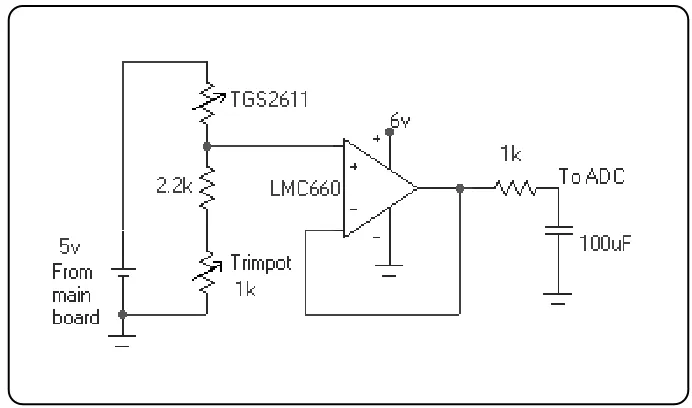
3.6 TGS2611 CH4 sensor connections to LMC660CN op-amp. . . 21
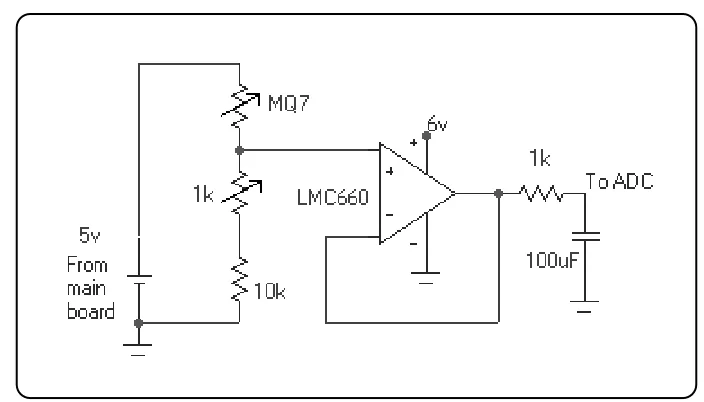
3.7 MQ7 H2 sensor connections to LMC660CN op-amp. . . 22
LIST OF FIGURES x
4.1 Main function flowchart. . . 26
4.2 Controller initial input membership functions used to fuzzify. . . 29
4.3 Controller response to an input of -20. . . 31
4.4 Controller response to an input of -10. . . 31
4.5 Controller response to an input of 0. . . 32
4.6 Controller response to an input of +5. . . 32
4.7 Controller response to an input of +20. . . 33
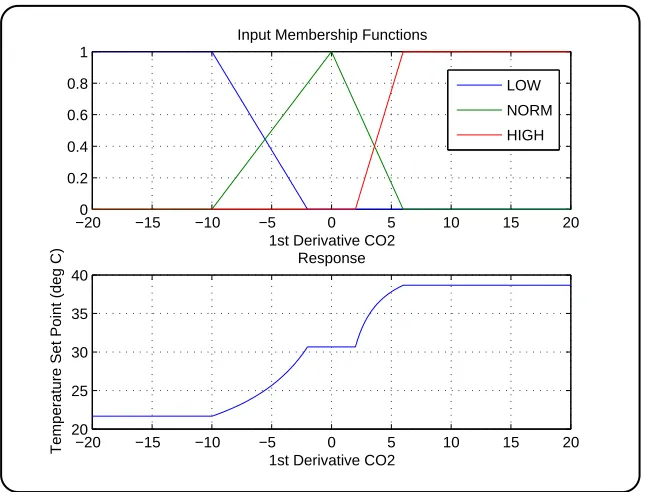
4.8 Temperature set point for expected d(CO2)/dt levels. . . 34
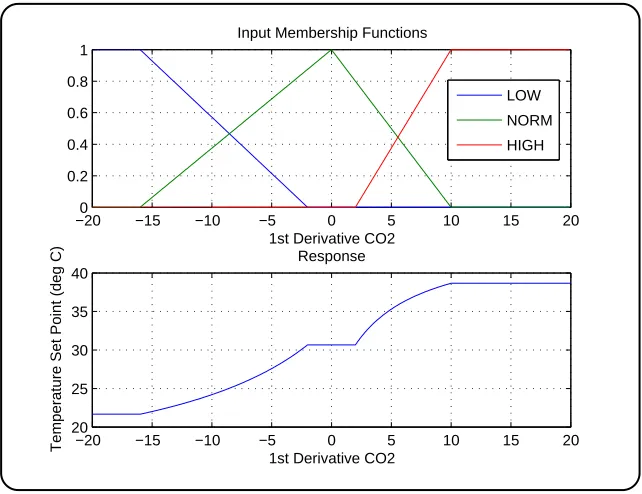
4.9 Modified Temperature set point for expected d(CO2)/dt levels. . . 35
4.10 Modified temperature set point for expected d(CO2)/dt levels. . . 36
4.11 Captured temperature set point for expected d(CO2)/dt levels. . . 37
4.12 Captured modified temperature set point for expected d(CO2)/dt levels. 37 5.1 Dilution equipment used throughout laboratory tests. . . 40
5.2 Captured data from CO2 sensor; trial 1. . . 43
5.3 Captured data from CH4 sensor; trial 1. . . 43
5.4 Captured data from H2 sensor; trial 1. . . 44
5.5 Captured data from CO2 sensor; trial 2. . . 44
5.6 Captured data from CH4 sensor; trial 2. . . 45
5.7 Captured data from H2 sensor; trial 2. . . 45
LIST OF FIGURES xi
5.9 Captured data from CH4 sensor; trial 3. . . 47
5.10 Captured data from H2 sensor; trial 3. . . 47
6.1 Trial 3 CO2 concentrations using logarithms. . . 50
6.2 Trial 3 CH4 concentrations using logarithms. . . 50
6.3 Trial 3 H2 concentrations using logarithms. . . 51
6.4 Resulting temperature setpoint using captured data. . . 53
6.5 Gas inputs against temperature setpoint; case 1. . . 55
6.6 Gas inputs against temperature setpoint; case 2. . . 56
6.7 Gas inputs against temperature setpoint; case 3. . . 57
Chapter 1
Introduction
1.1
Background
1.1.1 History
The methanogenic bacteria appear to be ancient forms of life. Hydrogen and oxygen
outgassed from the Earth’s mantle could well have supported the existence of these
organisms long before the development of primitive plant species hundreds of millions
of years ago. Anaerobic digestion of biomass has occurred throughout the existence
of life on Earth, and is therefore expected to be a highly reliable, stable and efficient
process in those environments where it occurrence is essential to maintain the natural
cycle of organic matter (Smith, Bordeux, Goto, Shiralipour, Wilkie, Andrews, Ide &
Barnett 1988).
The identification of a specific gas from the anaerobic digestive process was first made
by Volta in 1776. ‘Inflammable air’ was found to be readily generated (Stafford
et al. 1981). It has been used for at least a century in developing countries for the
decomposition of animal and human waste, in most cases from a necessity to maximise
the benefit from limited available resources in rural areas. While the combustion of cow
dung for cooking provided a renewable source combustible fuel, it was at the expense of
1.1 Background 2
rural kitchen. Exposed human waste encourages vermin and diseases. In response,
anaerobic digesters were developed to decompose the waste to provide a rich organic
fertiliser for crops and a fuel gas to power household lighting and stoves.
1.1.2 Ethics
As it stands at the moment, the time has come to address serious shortcomings in our
current socio-economic direction. Numerous mineral fuel supply interruptions, price
spikes, bloody international conflicts, and more recently, revelations concerning global
warming and environmental degradation have stimulated interest in current energy
sources. The human race is facing increasing problems associated with disposing of
waste produced directly by the population, and by the agricultural and industrialised
systems we use to feed and otherwise occupy ourselves. Soils used by mass commercial
crop cultivation methods are also increasingly showing signs of degradation due to
intensive farming paractices reliant on the extended use of chemical fertilisers and
pesticides, often also based on mineral oil derivatives.
Reflection on the benefits and surrounding issues has led to belief that the utilisation
of anaerobic digestion to produce biogas could play an important and profitable role in
addressing a wide variety of social and environmental issues faced by human beings as
we enter the 21st century. The production of human and animal waste is independent
of crude oil supplies and available to a much wider demography. Biogas combustion
produces only a fraction of the pollution of fuels and energy systems widely used today,
and competition for the raw materials required for biogas production are unlikely to
cause conflict. The effluent of anaerobic digesters can be used to organically nourish
and restore fertility to agricultural soils and hydroponics, without the health concerns
associated with chemicals. While techniques to achieve anaerobic decomposition have
been ongoing areas for research across the world for some time, many installations
could benefit from modern technology and safety features, resulting in improved
bio-gas yields, improvements in plant safety, and reduced and better targeted operational
1.2 Objectives 3
1.2
Objectives
The objective of this project is to improve the safety and performance of small digester
systems by:
1. Developing and constructing an array of gas sensors otherwise known as an e-nose
to monitor biogas composition,
2. Developing an embedded controller to monitor and control a digester vessel,
3. Adding user interface to notify personnel of the state of the digester.
[image:15.595.137.489.368.572.2]1.3
Methodology
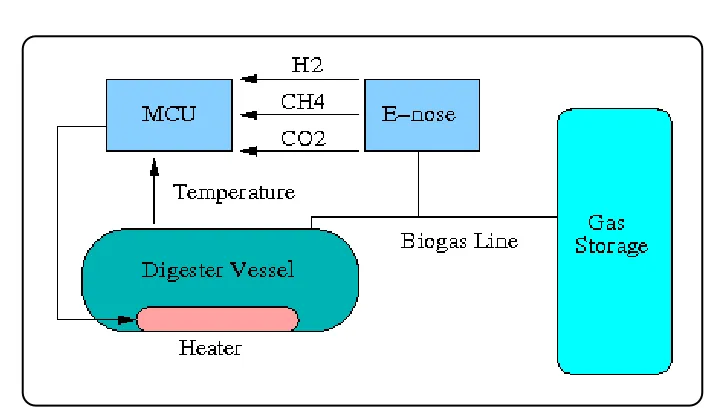
Figure 1.1: Biogas Control System Proposal
1. The monitoring of hydrogen H2, carbon dioxide CO2, and methane CH4 in the
gas economically and effectively in order to provide sufficient data to allow reliable
data concerning the health of the digester.
2. The development of an embedded micro-controller hardware and software using
fuzzy logic to control the system by autonomously maintaining appropriate
1.3 Methodology 4
3. The microcontroller is to notify personnel of the requirements of the system
through a system of semaphore lights. This information should indicate digester
health/ overload conditions as appropriate.
A simple digram of this proposal is included in Figure 1.1.
To achieve this, the following course of action should lead to the achievement of the
objectives: The system hardware must first be developed to permit monitoring of
the target gasses. The sensors may then be connected to the micro-controller. This
will permit testing of the gas sensors in the presence of pure samples of the target
gas samples and derivation of algorithms to process the readings and estimate gas
composition. Software may then be developed interpret the readings and to and set a
Chapter 2
Biogas
2.1
Chapter Overview
This chapter describes details concerning the composition and production of biogas. It
then goes into aspects of control of a simple biogas digester system.
2.2
Properties of Biogas
Biogas is also known as dump gas, marsh gas or sewer gas and produced in a common,
naturally occurring decomposition process. It is composed mainly of methane CH4,
carbon dioxide CO2, and hydrogen sulfide H2S. Smaller quantities of hydrogen H2
oxygen O2, nitrogen N, and ammonia NH3 may also be present. The component most
responsible for the flammability of biogas is the methane, which usually makes up to
70%of the composition. Carbon dioxide makes up the majority of the remainder with
smaller quantities of hydrogen sulfide, which gives raw biogas its distinctive rotten
egg smell. This can easily be removed by simple scrubbing techniques. Otherwise the
biogas resembles natural gas in composition, with a slightly lower energy content. AS
4564-2005 table 3.1 imposes limits on the composition of general purpose natural gas,
necessitating additional scrubbing of biogas in most cases for compliance if a biogas
2.3 Biogas Production 6
2.3
Biogas Production
Biogas is a product of anaerobic decomposition by methanogens, a group of bacteria
characterised by their ability to produce methane. These bacteria flourish only in
the absence of oxygen; 0.01mg/L is enough to completely inhibit growth (Stafford
et al. 1981). They occur naturally in the digestive systems of ruminant animals such as
cattle, in marshes, brackish waters and sewage works, where in addition to laboratories,
much knowledge of them has been gained.
Methanogenic decomposition is a complex series of bio-reactions far beyond the scope of
this dissertation, but the basic mechanism relies on the co-ordinated use of two different
heterogenic groups of bacteria. The first are responsible for the decomposition of lipids,
lignins, proteins ands into H2, CH2 and volatile fatty acids (VFA’s). The second type
are the methanogens, which further decompose the products of the first reactions to
form CO2 and CH4.
Digestion is the creation of an artificial environment to encourage Methanogenic
de-composition, about which considerable research has been published.
Figure 2.1: Types of continuous flow digesters. (Fry 1973).
Most digesters in operation are regularly fed with human, animal, or organic
indus-trial waste and produce biogas and an organic sludge, low in pathogens and high in
2.3 Biogas Production 7
feed. Small scale digesters generally make use of a single reaction vessel, and may be
batch fed and sealed until gas production stops, or continually fed, using an internal
system of pipes and gravity to maintain a constant operating level as shown in Fig. 2.1.
Other types of varying degrees of sophistication are used in larger installations. It is
commonly suggested that feed with a carbon to nitrogen ratio, C:N from 20:1 to 30:1
is desirable, and an operating pH of 7 or just over is optimum for the methanogenic
bacteria (Hobson, Bousfield & Summers 1981).
There are two temperature ranges over which anaerobic digestion is most effective. The
mesophillic, usually from ambient to 42 deg C, and thermophillic from 55 to 70 deg
C. In practice, few digesters operate in the thermophillic zone because of the extra
energy required for heating and less stable micro-biological environment. A
tempera-ture around 35 deg C is common to maximise biogas yield whilst minimising digester
retention time and heating energy demands. The microbes are reportedly sensitive
to changes in operating conditions, so once they have acclimatised to the conditions
of a particular digester, sudden fluctuations in temperature or feed material are not
recommended due to the destabilisation of the reactions.
The digestate material must also be agitated to a degree to promote a homogeneous
mixture, prevent micro-biologically dead zones and reduced the build up of scum, which
is a substrate consisting of lighter fractions and fibrous material such as hair and
feathers. The latter can cause significant problems when it hardens on the surface and
prevents the escape of gas from the slurry. Careful design of vessel parameters such
as operating level, gas outlet position, maintenance and slurry agitation can greatly
reduce or eliminate problems with scum.
An additional problem with anaerobic digesters is instability caused by toxic, organic
or hydraulic overload (Stafford et al. 1981). Toxic overload can be caused by
contami-nation of the feed by substances which inhibit the digestion process. Organic overload
is commonly caused by variations in feed consistency or too short a detention time.
Hydraulic overload occurs when the feed material is low in solids and retention time
is reduced to compensate, flushing out the microbial population. For each of these
conditions, there are indicators which may be monitored to allow anticipation of such
2.3 Biogas Production 8
For the purposes of this research project, overload occurs when the methanogens are
unable to keep pace with the first group of bacteria responsible for breaking down
the more complex compounds. These bacteria tend to be more robust and multiply
more rapidly than the methanogens. When this occurs, the methanogens are unable
to consume the VFA’s as they are produced. This has the effect of lowering the pH
of the substrate below that which the methanogens can survive, which is only between
pH 6.4 to 7.5. This results in the poisoning of the methanogens and digester failure.
Stafford et al (Stafford et al. 1981, p77-78) compiled an inexhaustive list of these
conditions and indicators, and suggest possible remedies as included below. These
correspond to the diagram in Figure 2.2.
• Common Faults
A)Toxic Overload
B)Organic Overload
C)Hydraulic Overload
• Typical warning sign
i)methane production falls
ii)The direction of response curves of several variables when compared with
one another can warn of potential failure; for example, VFA rises as the CH4
production falls
iii)The sign of the second derivative of common variables with respect to time
changes; for example:
A concave upward change in the slope of percentage CO2
A concave upward change in the slope of pH
A concave downward change in slope of rate of CH4 production
2.4 Digester Control 9
1)Solids recycle
2)Increase frequency of loading
3)Adequate mixing
4)Scrubbing gas to remove CO2 before recycle
5)Addition of a base
6)Recycle micro-organisms
7)Reduce or stop feed
8)Increase initial substrate conditions
9)Add plant effluent to feed
Figure 2.2: Digester indicators, conditions, and remedies. (Stafford et al. 1981).
2.4
Digester Control
More recent research has resulted in something of a trend towards the use of fuzzy logic
control systems to monitor and control digester performance. Such systems have
suc-cessfully been implemented in scale laboratory models of wastewater treatment systems
using fluid bed reactor type digesters by Murnleitner et al and Muller et al.
Stafford (Stafford et al. 1981, p78) suggests the monitoring of methane production,
VFA levels, CH4 production, as well as CO2 and pH levels and their second derivatives
with respect to time as a method of monitoring a model fluid bed reactor.
2.4 Digester Control 10
monitored parameters using off the shelf type sensors. The monitoring methane and
hydrogen levels, pH gas flow and oxidation-reduction potential and conductivity are
included. The results of their research show that hydrogen and methane levels in the
gas accurately reflect the health of the digester. If gas composition data is unavailable,
pH levels are used. They conclude that methane and hydrogen levels, pH and gas flow
are all that are needed to recognise overload conditions.
Figure 2.3: Methane and hydrogen levels - no control. (Murnleitner et al. 2002).
Figure 2.4: Methane and hydrogen levels - with control. (Murnleitner et al. 2002).
Figure 2.3 shows methane and hydrogen levels leading up to an overload. This data was
gathered without control. Notice distinctive increases in hydrogen and corresponding
drop in methane production. This is due to the inability of methanogens to consume
2.5 Safety Considerations 11
a corresponding, though delayed increase in VFA’s and reduction in pH. Figure 2.4
shows methane and hydrogen levels with the controller. No such indication of overload
is present.
Muller et al (Muller, Marsili-Libelli, Aivasidis, Lloyd, Kroner & Wandrey 1997) adopt
an even simpler approach using a fluid bed reactor; hydrogen level and biogas
pro-duction are used to distinguish between all three overload conditions using this simple
method. Problems with this system could arise if feeding is irregular, such as with a
batch type digester (Murnleitner et al. 2002).
Whilst these two experiments have made great gains in controlling the digestion
pro-cess, the fluid bed reactors in use rely on the co-ordinated use of two vessels with
sludge recirculation and buffering systems. Further advantage is taken of individual
conditions between the stages of the fermentation processes. These systems are able to
greatly stabilise the microbial environment and are fine models for automated,
large-scale wastewater installations. For the objectives of this project, the laboratory
condi-tions are stable and equipment is considered too complex to implement on small scale
community and farm digesters, which are often more simply constructed and operated
under less than optimal conditions.
2.5
Safety Considerations
Whilst most digesters operate at pressures far below the limits set for pressure vessels
in AS 1210-1997, there is a significant risk of excessive pressure in a digester resulting
in the combustion-less explosion of the vessel. This can be due to a number of possible
fault conditions, such as a blocked gas or sludge outlet, or incorrect valve operation.
Therefore, some kind of safety pressure relief arrangement is commonly recommended,
burst disks being about the simplest and most reliable. Being a once-off solution, these
have the disadvantage of replacement in the event of a breach.
Methane is an odourless gas and mixtures of 5-15% methane in air pose a substantial
risk of explosion resulting in serious injury or death. AS 4654-2005 Table 3.1 imposes
2.6 Chapter Summary 12
the start-up of a new digester or due to leaks, although the internal pressure of the
system usually means a loss of biogas rather than the entrance of oxygen.
Hydrogen sulphide (H2S) is also extremely toxic to humans and 0.002%is the maximum
allowable concentration for prolonged exposure. Higher concentrations of H2S poses a
significant risk of injury or death.
The likelihood of excessive concentrations of CH4, CO2, H2S or any gas in a confined
space is slight, but may result in serious illness or death.
Safety measures such as regular inspection for leaks, effective ventilation and
elimina-tion of ignielimina-tion sources minimise the risks and shall be followed at all times throughout
the duration of this project. It is also desirable to have an additional device to allow
the release of gas and/ or sludge in case of the presence of oxygen, poor quality gas, or
excessive pressure in the vessel, regardless of the cause.
2.6
Chapter Summary
This chapter has outlined relevant details surrounding composition and production of
biogas, and control of a digester. It concludes with safety precautions which must be
adhered to throughout the duration of this project and when dealing with toxic and/
Chapter 3
Electronic Hardware
3.1
Chapter Overview
Embedded systems are small computer systems tailored to a particular application,
usually powered by a microcontroller suited to the task. In order to gain useful
infor-mation regarding the physical environment in which the embedded system is to operate,
it must be interfaced to a series of sensors designed to provide such information. As
these sensors are the only means for the system to gain this data, the success or failure
of an embedded controller rests heavily on signals it receives from them. Such data
concerning ambient odours or gas concentrations are often determined in electronic
systems by a gas sensor array known as an electronic nose or e-nose.
This chapter contains detailed information regarding micro-controller, temperature and
gas detection sensors, and e-nose circuits.
3.2
Microcontroller
Choice of microcontroller for the project was made by comparison of features,
pro-gramming environment and cost. Accommodating analogue signals from the e-nose
3.2 Microcontroller 14
Figure 3.1: Photo of main board with Atmega 8 microcontroller and peripherals.
signals from sensors. Demand for memory space was considered to be modest, whilst
large response time constants of most digester vessels places no extraordinary demands
on the processor speed. Required outputs are simple digital ones or zeros to control
the heater, indicator lights and ancillary equipment. Past experience with several
em-bedded system projects has shown that pulse width modulation (PWM) is often useful
if available, while input/ output (I/O) pins are often running scarce towards the later
stages of an experimental embedded system project, and also carried some weight in
the selection process.
Several microcontrollers were considered for the project, the Motorola HC12 family
and Microchip’s PIC series were also considered. The Motorola chips, despite having
many relevant features and specific fuzzy logic instructions, were considered excessive
for this project. The Microchip PICs were also considered, again having many of the
required features, but do not lend themselves to high language programming, and such
well established development environments are not free.
The Atmega 8 microcontroller was chosen due to its availability, cost, features and
3.3 E-nose 15
MHz oscillator, 8 kbytes of programmable flash memory for programs and data, 512
bytes of EEPROM memory, USART for serial communication, 3 timers and a total
of 23 programmable pins for miscellaneous I/O, 6 of which may be used as ADC’s.
Additionally, 3 pins are configurable for PWM which, although considered unnecessary
initially for this application, was used to provide the two precision voltages for the H2
sensor and may be useful for proportional heating at a later stage.
Available software development environment was also considered. For the Atmega
8, the C programming environment the development tools comprised of the avr-gcc
compiler, avrlibc, avrdude programmer, and avrsim simulator permit a free software
development environment for anyone using a Unix based PC. An MS Windows
envi-ronment is also available. Significant literature, code snippets, makefiles and tutorials
are freely available with the development tools and dedicated webpages.
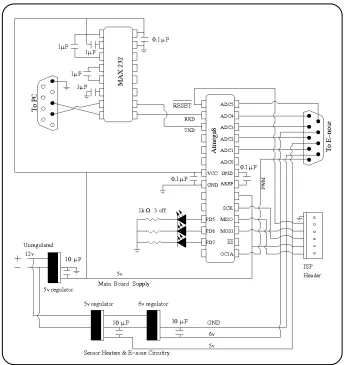
The circuit diagram in Figures 3.1 and 3.2 shows the embedded controller circuit
di-agram with peripherals. Notice this main circuit board also provides regulated power
supplies to the e-nose through the nine core shielded cable.
3.3
E-nose
E-noses in general have recently received a lot of interest due to their possible
appli-cation to numerous fields such as process control, air quality monitoring, security and
drug detection.
The e-nose construction comprised of three gas sensors for methane, carbon dioxide
and hydrogen and a resistive type temperature sensor, all connected to an LMC660CN
low power quad channel operational amplifier (op-amp). This arrangement requires
regulated voltages to power the amplifier and a total of about 2 watts (W) of power to
heating elements in the gas sensors. It plugs directly into the main circuit board via
nine core shielded cable in order to receive all power and provide analogue signals to
the analogue to digital converters (ADC’s) of the micro-controller.
3.3 E-nose 16
Figure 3.2: Main board with microcontroller, serial line driver and voltage regulators.
a consistant gas composition while samples were taken. To form the sensor chamber,
the three gas sensors were inserted into holes in the side of an empty plastic vitamin
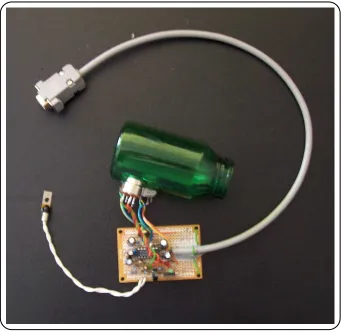
bottle which had been washed with detergent and thoroughly rinsed. Figure 3.3 shows
the completed e-nose assembly.
3.3.1 Amplifier
The LM324 op amp was originally selected for the positioning of individual op-amp
channels within the package, its ability to operate from a single supply rail, and
famil-iarity with the device.
3.3 E-nose 17
Figure 3.3: E-nose with op-amp, and temperature and gas sensors in chamber.
were connected to the individual strands of 9-core shielded cable via a one kilo ohm
(kΩ) resistor to protect the amplifiers from overloading by limiting the current to
approximately 5 milliamps (mA). This was then grounded via 100 micro fared (µF) capacitors to short AC components from the signal. This can bee seen in each of the
individual sensor circuit diagrams.
Unusually high input impedance demands of the amplifier by the CO2 sensor resulted
in replacement of the LM324 with the LMC660CN op-amp, which is a pin for pin match
with the LM324. The input impedance of over 1 Tera ohm (TΩ) and input bias and
3.3 E-nose 18
3.3.2 Sensors
Gas sensors were selected on the basis of individual gas sensitivity, cost and availability.
Three sensors were selected:
• The CO2 sensor was the MG811 by Hanwei Electronics.
• The MQ7 for H2, also by Hanwei.
• The TGS2611 by Figaro for CH4.
Manufacturer’s datasheets indicate that all of these sensors return either linear or
logarithmic inputs for logarithmic variations in gas concentrations. Ambiguous data
sheets meant considerable trial and error to obtain acceptable results.
The temperature sensor was a simple linear resistive sensor with a resistance of 50 kΩ
at room temperature. This was placed in series with two other resistors and the voltage
measure by a differential feedback amplifier. The circuit diagram is shown in Figure
[image:30.595.144.490.462.668.2]3.4.
Figure 3.4: Thermistor connections to LMC660CN op-amp.
Of concern to this project is expected cross-sensitivity of the TGS2611 CH4 sensor
to H2. It is proposed that this be resolved by choosing a hydrogen sensor which is
3.3 E-nose 19
scalar multiple of the H2 reading from the methane reading. Both Figaro and Hanwei’s
datasheets include information regarding sensitivities to other gases.
Of additional concern is the concentrations at which these sensors can provide valid
readings; composition of biogas is measured as percentages, while these sensors are
generally operated in concentrations of under 10 000 parts per million (ppm) in air.
The simplest method to achieve this is to precisely dilute sampled biogas with air in
order to carry out reliable analysis. This is covered in Chapter 5.
3.3.2.1 MG811 Carbon Dioxide Sensor
As CO2 sensors are the most easily obtained, much development of the e-nose and
software was based on trials with these. Great confusion was caused by ambiguity of
the datasheet, particularly conflicting output voltages and input impedance required of
the signal amplifier. The literature specifies such amplifiers have an input impedance
of 100 to 1000 GΩ, which resulted in the premature failure of two of these sensors and
hours of troubleshooting.
The CO2 sensor requires a precision 6 volt (V) supply and 200 mA for the heater. This
was provided by a 3 terminal regulator on the main controller board. It is an EMF type
sensor, thus producing a voltage inversely proportional to CO2 concentration. Hanwei
states that the maximum sensor output is 300 mV at atmospheric concentrations of
CO2. It is designed to return a linear EMF to logarithmic gas concentrations from 350
to 10 000 ppm. The CO2 sensor datasheet gives no indication of sensitivity to H2.
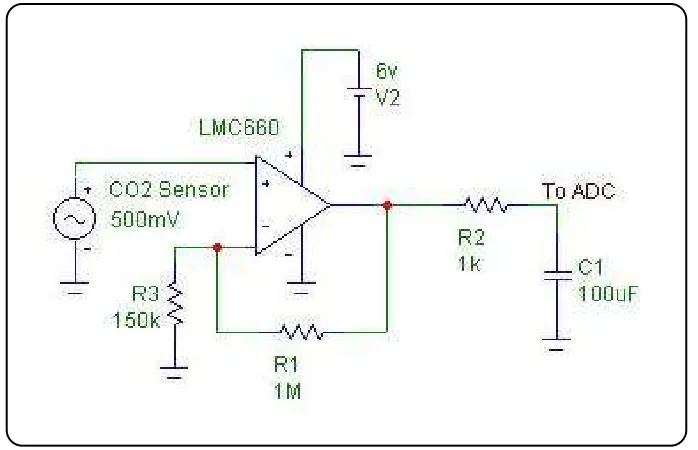
The op-amp was placed in non-inverting configuration with a conservative voltage gain
of approximately 7.7. The maximum measured output from the op-amp was about
4.95 V, meaning the sensor was producing 4.9÷ 7.7≈ 0.64 v, more than double that
stated in the datasheet. This results in slight clipping of the signal by the ADC at
atmospheric concentrations of CO2. Fortunately, the signal is inversely proportional to
concentration, so this is of no consequence to this project, as CO2 concentrations will
never be this low. Minimum measured voltage at the output of the op-amp was 0.77
3.3 E-nose 20
Figure 3.5: MG811 CO2 sensor connections to LMC660CN op-amp.
The National Semiconductor datasheet gives some useful hints for working with low
impedances, one of which was applied here; the output of the MG811 is soldered directly
to the input of the LMC660 instead of the usual practice via the printed circuit board.
This minimises the effect of leakage currents, as air is an excellent insulator. This was
not necessary with any of the other sensors.
3.3.2.2 TGS2611 Methane Sensor
The TGS 2611 methane/ natural gas sensor varies in resistance logarithmically to
logarithmic gas concentrations between 500 and 10 000 ppm CH4, and is similarly
sensitive to H2. It requires a precision 5 V, 60 mA supply for its heater, again provided
by the main controller board by a separate 3 terminal regulator. The op-amp was
placed in a non-inverting arrangement, with unity gain. Being a resistive sensor, it was
placed in an adjustable voltage divider circuit, whose output was fed into the op-amp.
The resulting output voltage ranged from 0.39 to 2.67 V. The circuit is shown in Figure
3.4 Testing 21
Figure 3.6: TGS2611 CH4 sensor connections to LMC660CN op-amp.
3.3.2.3 MQ7 Hydrogen Sensor
The MQ7 H2 sensor was the most complex to set up. Hanwei specifies a 150 second
heating cycle consisting of two precision heating voltages, the first being 5 V at 150
mA for 60 seconds, and the second 1.4 V at 43 mA for 90 seconds. This ruled out the
convenient use of 3 terminal regulators. Instead, one of the micro-controller’s timers
and PWM channels were used with a power MOSFET on the e-nose circuit board to
provide the required power and timing. The MQ7’s resistance varies logarithmically in
response to logarithmic gas concentrations up to 2000 ppm. The op-amp was set up
in a non-inverting configuration with a gain of 3, which saturated the op-amp during
practical trials detailed in chapter 5 The gain was then reduced to 2, which again led
to saturation. Unity gain finally resulted in an acceptable signal from 0.31 to 4.33 V.
The circuit is shown in Figure 3.7.
3.4
Testing
Trails with this e-nose arrangement consistently showed noisy readings. A sample of
such a signal is shown in Figure 3.8. Investigation with an oscilloscope lead to the
3.4 Testing 22
Figure 3.7: MQ7 H2 sensor connections to LMC660CN op-amp.
supply due to the switching of the serial communication and pulse-width modulation
(PWM) used to control the heater voltage of the H2 sensor. This is of little surprise as
no special precautions against noise were considered short of standard decoupling
ca-pacitors and minimal length circuit connections. The PWM spikes were approximately
0.03 V, considered acceptable and of little consequence due to compensation in the
micro-controller software described in Chapter 4, and serial communications are really
only necessary during software development, not during normal operation. The 50 Hz
noise was practically eliminated by choosing another power supply, and remaining noise
[image:34.595.140.492.99.300.2]is considered negligible for the purposes of this project.
3.5 Chapter Summary 23
3.5
Chapter Summary
This chapter has detailed the components, and circuits in which they have been used,
as well as management, adjustments and precautions taken to assist effective function
throughout the development and testing phases of the system.
It will be seen in successive chapters how the signals obtained from these circuits are
used to indicate the composition of gas samples for the purpose of controlling digester
Chapter 4
Software
4.1
Chapter Overview
This chapter demonstrates the steps taken thoughout the software development process.
Three different control algorithms were considered during the initial stages of design.
The first was simple on-off control, commonly known as bang bang control, due to the
simple objectives of this project; to turn on or off a heater. Classical linear control
theory was also briefly considered, but dismissed due to the difficulty in modelling the
system due to the necessary number of inputs and the baffling number of variables
involved in the biological and physical aspects of the system.
Fuzzy logic control was chosen because of its inherent ability to deal with non-linear
systems, multiple inputs and noisy signals, with limited or unclear data available
re-garding the physical system. Prior expert knowledge may also be used as a starting
point to determine the behaviour of the system.
The hardware subroutines were based on examples provided by the avr-libc
documen-tation (Neswold 2006). The structure of the main program is a simple loop, the major
steps of which are illustrated by Figure 4.1. Implementation resulted in the files main.c,
adc.c, uart.c, timer.c and fuzzyfuncs.c, each so named to indicate the relevant device
ap-4.2 Implementation 25
pendices.
The program firstly reads the temperature and gas sensors, calculates averages to
re-move noise, then determines derivatives which are passed to the functionfuzzify();.
The fuzzified data is then de-fuzzified by the functiondefuzzify();to obtain a crisp
output which in this case, is an ideal target temperature intended to stimulate the
methanogenic bacteria to optimise CH4 production against digester heating
require-ments. This temperature setpoint is then compared to the actual digester temperature,
semaphore lights and heater being activated or de-activated accordingly.
4.2
Implementation
Initial efforts focussed on the reading of the ADC and placing the value in the USART.
This is initiated on the overflow of timer 1 in the micro-controller. Initial sampling time
periods during development were every half-second, but were scaled up to 2.5 minutes
in the working versions to suit the H2 sensor. The USART output consists of 8 bit data
words with 1 stop bit added at 2600 baud, which once converted to RS232 signal levels,
is readable by any serial communications terminal software, Minicom being used here.
The function void uart_put_num(float) was written to convert binary numbers to
ASCII words for sending over the USART for communication with a PC. One
short-coming of this subroutine is its inability to deal with floating point numbers, which
are simply converted to integers. This was used straight from the avr-libc examples
and the benefits not considered worth the time or memory necessary to rectify. The
implications of this will become apparent later in this chapter.
It was decided to use only the first derivatives as inputs to the controller so that rates of
change in gas concentration trigger responses. This eliminates the necessity of accurate
calibration of the equipment with respect to an absolute reference. Despite several
texts recommending the use of second derivatives, it was found that noise passed from
the gas sensors was too similar to the real second derivatives to be reliable.
4.2 Implementation 26
4.3 Fuzzy Control Software 27
the latest, as is common practice with computer systems. Cases were noted when
noisy signals resulted in incorrect derivative values over longer periods of time. This
was rectified by using buffer arrays to provide several consecutive readings. An running
average is then taken of the entire buffer and stored in a separate array of 3 consecutive
averages for each gas. While only 2 are necessary, a buffer of 3 allows for the calculation
of a second derivative if deemed useful later. Although this method slows the response
of the controller, it does significantly increase the reliability of detected changes in gas
concentrations over longer periods. It was found that buffer sizes of 6, 5 and 6 elements
provided adequately stable CO2, CH4 and H2 readings respectively, but these sizes can
easily be adjusted in the preprocessor#DEFINE GAS_buffer_sizelines as necessary.
4.3
Fuzzy Control Software
Fuzzy algorithms were based on Mamdani type fuzzy logic controller, originally
de-veloped by Doctor Lofti Zadeh and further dede-veloped by Professor Ebrahim
Mam-dani (Reznik 1997) and (Sowell 2005). The principles of their designs will be detailed
throughout this section. The functions are located in the file fuzzyfuncs.c.
Once readings from the ADC’s were being successfully read and sent to the USART, the
fuzzy logic functions were created to determine an acceptable temperature set point
be-tween the stated 21 and 38 degrees C using the centre of gravity (COG) method. These
were first implemented using MATLAB script and then ported to C. Additional
MAT-LAB script was developed to graphically display memberships and responses, which
greatly simplified the process of matching fuzzy logic parameters to sensors.
4.3.1 Fuzzifying
For the purpose of this system, a detected gas concentration or its derivative may be
regarded as low, medium or high. These are assigned based on prior expert knowledge
of the system and are known as membership functions. This expert knowledge may be
gained from a person familiar with the operating characteristics of the system to be
4.3 Fuzzy Control Software 28
and 1 to each membership function, of which there may be as many as necessary to
achieve the desired control characteristics. It is common to have membership to more
than one membership function. This implementation monitors chosen variables and
assigns them a value of membership between zero and one to the membership functions
in the software ‘LOW’, ‘NORM’, and ‘HIGH’.
The exact assignment of a membership value is dependent on geometry built into the
system by the designer. For this implementation, LOWand HIGHare trapezoidal, while
NORM is triangular. These shapes were chosen due to their simplicity of
implemen-tation and simple area centroidal calculations. The positioning and dimensioning of
the geometry lies within the upper and lower expected extremities of the range of the
variable being monitored. This range is known as ‘the universe of discourse’ in fuzzy
terminology. The triangular geometry assigns a value which varies from 0 to 1 and
back to 0 again as an input value varies from the lower limits of what may be
consid-ered normal operating conditions. The trapezoids are suited to outer geometry in this
application, as they are able to assign membership for values of 1 outside the universe
of discourse, therefore maintaining control outside of normal operating ranges, while
gradually reducing membership as an input returns to normal. All geometry is set
by three, three-element arrays, ‘LOW_membs’, ‘NORM_membs’, and ‘HIGH_membs’ in the
program code. The first element of each array corresponds to the lowest point of the
geometry on the universe of discourse, the second element sets the centre point, and
the third element dictates the highest point of the geometry within the universe of
discourse.
These concepts are best illustrated by example. The arrays used in the initial MATLAB
scripts were as follows;
LOW_membs = [-16 -16 -2];
NORM_membs = [-16 0 10];
4.3 Fuzzy Control Software 29
providing input membership functions which look like;
Figure 4.2: Controller initial input membership functions used to fuzzify.
with an input equal to zero, as indicated by circles plotted on each of the membership
functions. Here an input of zero returns a membership value of one for NORM, and zero
each for LOW and HIGH. Of importance in this example is the correlation between
the values within each array and the corresponding point along the corresponding
membership function.
Close inspection of the LOW and HIGH membership functions close to zero reveals
that membership to these functions does not occur until an input of -/+2 respectively.
This was done to provide immunity to noise, for reasons which will become clear later
in section 4.3.3.
The first element of theLOW_membs[]and the last of theHIGH_membs[]arrays are not
actually used by the fuzzy algorithms, they are only used in the MATLAB scripts to
determine the range of plots.
The code mechanisms used to arrive at a membership value are simply ‘if()’ tests
followed by statements consisting of linear equations of the formy=mx+c, or assign-ments of one or zero.
4.3.2 De-Fuzzify
The determined membership valuesLOW,NORMandHIGHare then used as the height in a
appro-4.3 Fuzzy Control Software 30
priate responses such as ‘increase temperature’, ‘maintain temperature’, or ‘decrease
temperature’. Obviously this has a direct impact on the magnitude and distribution
of area, and therefore the position of the centroid, which is how the temperature set
point is calculated. This is the principle of Mamdani’s fuzzy controller. The centroid
is calculated using equation 4.1 where An is nth area, zn is the centroid of the nth
area, and cn is a scalar weighting constant of the nth input. This allows a designer
to emphasise the influence of a particular input over the others. It may be observed
that the formula lends itself well to expansion to include multiple response areas. This
allows simple monitoring of multiple inputs to determine a single output.
Z = Pn
n=1cnAnzn
Pn
n=1cnAn
(4.1)
The Mamdani fuzzy logic process is not easy to visualise through literature. Plots in
Figures 4.3 to 4.7 below show the fuzzification and defuzzification and thus response of
the controller to several progressive values of the first derivative of CO2.
As is the case with the input membership functions, the response geometry is set in the
arrays ‘DN_TEMP_membs’, ‘AB_RITE_membs’ and ‘UP_TEMP_membs’, which are included
below as implemented in MATLAB script. The upper plot in each of these figures
illustrates the membership value for each input function and is plotted as a small
circle, consistant with Figure 4.2. The lower plots show the response functions and the
temperature set point. Note that the height of each response area is dependent on the
value of the membership value of the corresponding input membership function. It is
the sum of these areas for which the centroid determines the set point.
CO2 input: CO2 output:
CO2_LOW_membs = [-16 -16 -2]; CO2_DN_TEMP_membs = [15 15 35];
CO2_NORM_membs = [-16 0 10]; CO2_AB_RITE_membs = [25 30 37];
CO_2HIGH_membs = [ 2 10 16]; CO2_UP_TEMP_membs = [29 39 45];
Figure 4.3 shows the controller’s response to an input outside the universe of discourse.
Notice that the temperature setpoint will never recede below the the COG of the
4.3 Fuzzy Control Software 31
−200 −15 −10 −5 0 5 10 15 20 0.2
0.4 0.6 0.8 1
Input Membership Functions
LOW NORM HIGH d GAS/ dt
15 20 25 30 35 40 45
0 0.5 1
Response
Temperature Set Point
dn temp ab rite up temp centroid
Figure 4.3: Controller response to an input of -20.
−200 −15 −10 −5 0 5 10 15 20 0.2
0.4 0.6 0.8 1
Input Membership Functions
LOW NORM HIGH d GAS/ dt
15 20 25 30 35 40 45
0 0.2 0.4 0.6 0.8 Response
Temperature Set Point
dn temp ab rite up temp centroid
Figure 4.4: Controller response to an input of -10.
Figure 4.4 depicts the input value rising to -10. Notice that the input has now been
assigned membership to two functions, LOW and NORM. These determine the height of
the DN_TEMP and AB_RITE triangles, the areas of which are summed and the COG
4.3 Fuzzy Control Software 32
−200 −15 −10 −5 0 5 10 15 20 0.2
0.4 0.6 0.8 1
Input Membership Functions
LOW NORM HIGH d GAS/ dt
15 20 25 30 35 40 45
0 0.5 1
Response
Temperature Set Point
dn temp ab rite up temp centroid
Figure 4.5: Controller response to an input of 0.
Figure 4.5 exhibits the selected ideal operating point of the digester. Small fluctuations
of up to±2 in input will not affect the setpoint, as theDN_TEMPandUP_TEMP response
triangles have a height of 0.
−200 −15 −10 −5 0 5 10 15 20 0.2
0.4 0.6 0.8 1
Input Membership Functions LOW
NORM HIGH d GAS/ dt
15 20 25 30 35 40 45
0 0.1 0.2 0.3 0.4 Response
Temperature Set Point dn temp
ab rite up temp centroid
4.3 Fuzzy Control Software 33
The response of the controller to an input of +5 is shown in Figure 4.6. Membership
to input function NORMand HIGHdetermine height of AB_RITE and UP_TEMP response
triangles.
Figure 4.7 depicts the response of the controller to an input exceeding the universe of
discourse. Again, temperature setpoint cannot exceed the upper limit of the COG of
theUP_TEMP response triangle.
−200 −15 −10 −5 0 5 10 15 20 0.2
0.4 0.6 0.8 1
Input Membership Functions LOW
NORM HIGH d GAS/ dt
15 20 25 30 35 40 45
0 0.5 1
Response
Temperature Set Point dn temp
ab rite up temp centroid
Figure 4.7: Controller response to an input of +20.
4.3.3 Tuning Fuzzy Parameters
Mentioned in the previous section is the point that expert knowledge of a physical
system may be used to set the fuzzy parameters. These parameters are present in the
*_membs[]arrays declared in the main file. Six of these must be declared for each gas,
three each for input and output. The program requires values which form trapezoids for
two outer membership functions and triangles for those in the centre. The temperature
set point for the range of expected inputs or universe of discourse, in this case the first
4.3 Fuzzy Control Software 34
−200 −15 −10 −5 0 5 10 15 20 0.2
0.4 0.6 0.8 1
Input Membership Functions
1st Derivative CO2
LOW NORM HIGH
−20 −15 −10 −5 0 5 10 15 20 20
25 30 35 40
Response
1st Derivative CO2
[image:46.595.158.479.104.351.2]Temperature Set Point (deg C)
Figure 4.8: Temperature set point for expected d(CO2)/dt levels.
Of interest are the slopes either side of the above-mentioned dead zone either side of
inputs of zero, for two reasons, which will now be discussed.
4.3.4 Slope
The first reason for interest in these two slopes may have already been noticed; the
gradient influences the magnitude of the response, which in this case, is the magnitude
of the change in temperature setpoint for a given change in input. Figure 4.9 shows an
experiment with this relationship using the following input membership arrays:
LOW_membs = [-16 -10 -2];
NORM_membs = [-10 0 6];
HIGH_membs = [2 6 16];
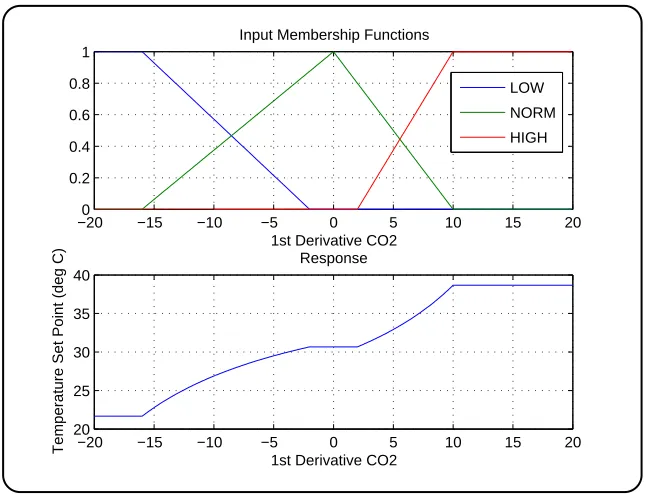
Comparing Figure 4.9 with 4.8, it may be appreciated while steeper gradient has the
effect of increasing the magnitude of the response over small fluctuations in input, it also
4.3 Fuzzy Control Software 35
−200 −15 −10 −5 0 5 10 15 20 0.2
0.4 0.6 0.8 1
Input Membership Functions
1st Derivative CO2
LOW NORM HIGH
−20 −15 −10 −5 0 5 10 15 20 20
25 30 35 40
Response
1st Derivative CO2
[image:47.595.158.481.103.349.2]Temperature Set Point (deg C)
Figure 4.9: Modified Temperature set point for expected d(CO2)/dt levels.
4.3.5 Concavity
Secondly, while the profile of Figure 4.8 could well result in a functional controller, the
concavity of these two curves means that temperature set point adjustments are smaller
close to the upper and lower limits of the operating temperature range. Conversely,
responses are more dramatic close to the centre flat spot. This situation means that
for small inputs outside the dead zone, more dramatic adjustments are made.
Great advantage may be taken of this characteristic. As it is more likely that readings
close to zero may be caused by noise, an alternative was investigated by altering
pa-rameters in the*_membsarrays to reverse the concavity of these two areas as in Figure
4.10. This has the effect of triggering smaller adjustments in set point close to zero,
which are likely to be noise, while readings further from this region will trigger more
dramatic responses, where they are more necessary.
Figure 4.10 was created by widening the base of theAB_RITE response triangle by
ini-tialising array AB_RITE_mems = [10 30 52]. Further adjustments to input functions
4.4 Micro-controller Implementation 36
−200 −15 −10 −5 0 5 10 15 20 0.2
0.4 0.6 0.8 1
Input Membership Functions
1st Derivative CO2
LOW NORM HIGH
−20 −15 −10 −5 0 5 10 15 20 20
25 30 35 40
Response
1st Derivative CO2
[image:48.595.157.482.103.350.2]Temperature Set Point (deg C)
Figure 4.10: Modified temperature set point for expected d(CO2)/dt levels.
Further exploration into the effects of various membership function shapes are thought
to be of limited additional benefit to this project and so are left as specific areas worthy
of curiosity and nothing more.
4.4
Micro-controller Implementation
Once the MATLAB routines were ported to C, experimentation with the micro-controller
could begin. Minicom was used to capture ASCII text in data files which were then
4.4 Micro-controller Implementation 37
0 5 10 15 20 25 30 35 40
−30 −20 −10 0 10 20 30
CO2: 1st Derivative
Sample No
d(CO2/dt)
−20 −15 −10 −5 0 5 10 15 20 20
30 40
d(CO2)/dt vs Temp Setpoint
Temp SP (deg C)
[image:49.595.159.481.103.348.2]d(CO2)/dt
Figure 4.11: Captured temperature set point for expected d(CO2)/dt levels.
0 5 10 15 20 25 30 35 40
−30 −20 −10 0 10 20 30
CO2: 1st Derivative
Sample No
d(CO2/dt)
−20 −15 −10 −5 0 5 10 15 20 20
30 40
d(CO2)/dt vs Temp Setpoint
Temp SP (deg C)
d(CO2)/dt
Figure 4.12: Captured modified temperature set point for expected d(CO2)/dt levels.
It is here that the limitations of the simple function void uart_put_num(float)
be-come apparent. However a clear correlation between the plots in Figures 4.11 and 4.8,
[image:49.595.159.479.393.636.2]4.5 Chapter Summary 38
4.5
Chapter Summary
This chapter has detailed the process of software development for the fuzzy logic
con-troller for a biogas system. The process has been illustrated using examples from the
first derivative of CO2 readings. Changes to the gradient of the controller’s response
and the ease with which parameters may be adjusted to suit sensor response
character-istics leads to the conclusion that this procedure may be followed to develop suitable
Chapter 5
Laboratory Gas Tests
5.1
Chapter Overview
This section explains the equipment and process used to test the response of the sensors
to expected gas concentrations and levels. The data is required to tune fuzzy parameters
to individual sensors. It concludes with comments regarding the suitability of the
signals for use with thefuzzify()and defuzzify()functions.
5.2
Test Equipment
The necessary function of the sampling equipment is to precisely dilute a gas sample
to a known concentration and expose the sensors to a consistant concentration for a
period long enough to allow the sensors to respond.
Hypodermic syringes of 6 and 3 mL volume were used to take accurately measured gas
samples. Considering the implications of 1mL variation in volumes of the sample gas
and air with which to dilute the samples, accurate measuring of air was not considered
so crucial as precision. A plastic 600 ml bottle was cleaned and pierced on the bottom
to provide a snug fit for the syringes, one of which was then inverted and inserted
5.3 Sampling Procedure 40
consitant volumes, gas samples could be diluted with sufficient precision to a desired
concentration for analysis.
A sketch of the essential components of the apparatus is shown in Figure 5.1. Arrows
[image:52.595.230.407.205.524.2]indicate the direction of applied force during a dilution operation.
Figure 5.1: Dilution equipment used throughout laboratory tests.
Pure test gas samples of CO2 and H2 were provided by the USQ Faculty of Sciences,
but CH4 was not available and so was substituted with town gas. Australian
Stan-dard 4564-2000 is somewhat arbitrary with constituent components of natural gas, the
implications of which become clear in later in Section 5.4.
5.3
Sampling Procedure
Having two known volumes allowed gas concentration to be determined using the
5.3 Sampling Procedure 41
V OLU M Esyringe=
V OLU M Ebottle×CON CEN T RAT ION(ppm)
106 (5.1)
Where V OLU M Ebottle = 600 mL, and CON CEN T RAT ION is the concentration
desired.
To sample a gas, a syringe was placed on the outlet of the gas regulator without the
plunger and thoroughly purged. The plunger was then replaced and inserted to give
the calculated volume,V OLU M Esyringe at a positive pressure.
The syringe was then quickly inserted into the hole in the base of the 600 mL bottle
which was raised slightly to give a negative pressure. The syringe plunger was then
depressed into the bottle until empty and the bottle raised to its maximum height in the
water. The breach was then covered and great care was taken to ensure the mouth of
the bottle remained below the waters surface at a consistant level. The gas sample may
then be considered diluted to the greatest precision available under the circumstances.
To test the sample, the inverted pill bottle and sensors were placed above the hole and
the 600 mL bottle pushed gently and consistently downward so that the diluted gas
entered the sensor chamber. The cap was then promptly replaced and the equipment
allowed to sit for analysis.
5.3.1 Microcontroller Configuration
As mentioned in Chapter 3, the MQ7 H2sensor requires a 150 second heating cycle. The
timer interrupt subroutine was altered to provide the necessary sensor heating states
over the required time period. Buffers were implemented as described in Chapter 4.
Raw readings, averages and first derivatives were sent via the serial port and captured
5.4 Testing 42
5.4
Testing
Unfortunately time constraints permitted only 3 useful tests, each of a single sample.
The details of these are listed below.
• Trial 1: 10 000 ppm CO2
• Trial 2: 1 000 ppm H2
• Trial 3: 10 000 ppm town gas
From these it was expected that an algorithm based on 3 linear equations could be
derived to extract individual gas concentrations, which could then be sent to the fuzzy
functions to derive a temperature setpoint.
Plots in Figures 5.2 to 5.10 show the data captured in the trails. The horizontal
axis represents the sample number, or time in increments of 150 s, while the vertical
axes represent the voltage captured by the micro-controller’s ADC’s. Apparent lags in
averages and derivatives are a result of updates in buffer arrays. Captured data files
are included in Appendix C.
5.4.1 Trial 1
Figures 5.2 to 5.4 show data captured in trial 1.
Inspection of these plots show a dramatic response from the CO2 sensor, with only
a slight, but noisy response from the CH4 sensor, and what may be interpreted as
background noise from the H2 sensor. Having replaced the noisy power supply, the
source of this noise is unknown, it is thought that it may be a characteristic of the
sensors’ cross-sensitivity, or fluctuations in air quality in the laboratory, as USQ staff
were cleaning and preparing equipment on the day. This aside, the result was very
encouraging, as it appears that CO2 levels affect the other sensors minimally. It can be
seen in the centre plots that the averaging algorithms remove the spikes to an acceptable
5.4 Testing 43
0 5 10 15 20 25 30 35 40
0 100 200
CO2
0 5 10 15 20 25 30 35 40
0 100 200
CO2 averaged
0 5 10 15 20 25 30 35 40
−50 0 50
[image:55.595.159.480.104.347.2]CO2: 1st Derivative
Figure 5.2: Captured data from CO2 sensor; trial 1.
0 5 10 15 20 25 30 35 40
60 80 100
CH4
0 5 10 15 20 25 30 35 40
70 80 90
CH4 averaged
0 5 10 15 20 25 30 35 40
−5 0 5
CH4: 1st Derivative
Figure 5.3: Captured data from CH4 sensor; trial 1.
5.4.2 Trial 2
Trial 2 as defined here did not run as smoothly as expected due to excessive gain in
[image:55.595.159.479.390.636.2]5.4 Testing 44
0 5 10 15 20 25 30 35 40
150 200 250
H2
0 5 10 15 20 25 30 35 40
150 200 250
H2 averaged
0 5 10 15 20 25 30 35 40
−10 0 10
[image:56.595.159.481.104.350.2]H2: 1st Derivative
Figure 5.4: Captured data from H2sensor; trial 1.
as anticipated, yielding the plots 5.5 to 5.7.
0 5 10 15 20 25
0 50 100
CO2
0 5 10 15 20 25
0 20 40
CO2 averaged
0 5 10 15 20 25
−20 0 20
CO2: 1st Derivative
Figure 5.5: Captured data from CO2 sensor; trial 2.
Comparing Figures 5.5 and 5.7, it appears from trial 2 plots that H2 appears to affect
the CO2 sensor noticeably, but not excessively. This is unexpected as the MG811
[image:56.595.160.479.426.671.2]5.4 Testing 45
0 5 10 15 20 25
0 200 400
CH4
0 5 10 15 20 25
0 100 200
CH4 averaged
0 5 10 15 20 25
−50 0 50
[image:57.595.159.480.104.348.2]CH4: 1st Derivative
Figure 5.6: Captured data from CH4 sensor; trial 2.
0 5 10 15 20 25
0 500 1000
H2
0 5 10 15 20 25
0 500 1000
H2 averaged
0 5 10 15 20 25
−200 0 200
H2: 1st Derivative
Figure 5.7: Captured data from H2sensor; trial 2.
also significantly affected, and this is noted in the TGS2611 datasheet. Looking at
the derivative plots, both of these signals are clearly unable to be concealed by simple
noise allowance techniques covered in Chapter 4, indicating some kind of compensation
[image:57.595.159.479.391.636.2]5.4 Testing 46
5.4.3 Trial 3
Trial 3 also suffered from complications, but this time the major source is uncertainty
in town gas composition.
Plots are shown in Figures 5.8 to 5.10.
0 5 10 15 20 25 30 35 40
0 20 40
CO2
0 5 10 15 20 25 30 35 40
0 20 40
CO2 averaged
0 5 10 15 20 25 30 35 40
−10 0 10
[image:58.595.159.481.228.470.2]CO2: 1st Derivative
Figure 5.8: Captured data from CO2 sensor; trial 3.
It is clear that all 3 sensors have again reacted to town gas, but is unclear at this point
as to exactly why. It appears the CO2 sensor’s response closely resembles that in trial
2. The CH4 sensor has also reacted strongly, as should be expected due to the high
percentage of CH4 in town gas. The H2 sensor has also reacted strongly.
Unfortunately no gas spectrum analyser was available, so it is unclear to exactly what
these responses may be attributed, and to what degree it/ these affect each sensor. The
Australian Government (Roarty 1998) suggests that natural gas may contain propane,
C3H8 and butane C4H10, which are the major constituents of liquefied petroleum gas
(LPG). Australian Standard 4564-2000 does not impose limits on the composition of
natural gas for consumption; only a minimum calorific combustion value known as the
Wobbe Index of between 46 and 52 MJ/m3
. Hanwei inform that the MQ7 H2 sensor is
5.4 Testing 47
0 5 10 15 20 25 30 35 40
0 500 1000
CH4
0 5 10 15 20 25 30 35 40
0 500 1000
CH4 averaged
0 5 10 15 20 25 30 35 40
−100 0 100
[image:59.595.159.481.105.349.2]CH4: 1st Derivative
Figure 5.9: Captured data from CH4 sensor; trial 3.
0 5 10 15 20 25 30 35 40
0 500 1000
H2
0 5 10 15 20 25 30 35 40
0 500
H2 averaged
0 5 10 15 20 25 30 35 40
−100 0 100
H2: 1st Derivative
Figure 5.10: Captured data from H2 sensor; trial 3.
Additionally, it may be expected that in the presence of such a confused array of
hydrocarbon gases, the MQ7 may also be affected by other gases present, one of which
could well be free H2. In the absence of any information, excluding the datasheet, it is
[image:59.595.159.479.390.634.2]5.5 Chapter Conclusion 48
The significance of this assumption will become clear in Chapter 6.
Similar conclusions may be drawn regarding the response of the CO2 sensor. It is
known that town gas does contain CO2, but it is uncertain in what quantity, and it is
also unknown to what degree the sensor is affected by other gases.
5.5
Chapter Conclusion
This chapter has detailed and commented on the equipment and procedure to test the
responses of the sensors to expected gas composition.
On cursory inspection, it may appear that the unravelling of this data to provide
useful information concerning individual gas concentrations, as proposed earlier in this
dissertation, means that significant further work is necessary in this area, and this is
indeed the subject of a great deal of recent research.
For the purpose of this project, two points must be highlighted. The first is that the
method used to gather this data is highly inconsistent in nature due to the sudden
expos