International Journal of Operations & Production Management
Quality management practices and their relationship to organizational performanceAnton Sabella Rami Kashou Omar Omran
Article information:
To cite this document:
Anton Sabella Rami Kashou Omar Omran , (2014)," Quality management practices and their relationship to organizational performance ", International Journal of Operations & Production Management, Vol. 34 Iss 12 pp. 1487 - 1505
Permanent link to this document:
http://dx.doi.org/10.1108/IJOPM-04-2013-0210 Downloaded on: 18 March 2017, At: 03:27 (PT)
References: this document contains references to 69 other documents. To copy this document: [email protected]
The fulltext of this document has been downloaded 2568 times since 2014*
Users who downloaded this article also downloaded:
(2014),"Distinctive features of service performance measurement", International Journal of
Operations & Production Management, Vol. 34 Iss 12 pp. 1466-1486 http://dx.doi.org/10.1108/ IJOPM-02-2013-0067
(2014),"The role of TQM in strategic product innovation: an empirical assessment", International Journal of Operations & Production Management, Vol. 34 Iss 10 pp. 1307-1337 http://dx.doi.org/10.1108/ IJOPM-03-2012-0098
Access to this document was granted through an Emerald subscription provided by emerald-srm:523001 []
For Authors
If you would like to write for this, or any other Emerald publication, then please use our Emerald for Authors service information about how to choose which publication to write for and submission guidelines are available for all. Please visit www.emeraldinsight.com/authors for more information.
About Emerald www.emeraldinsight.com
Emerald is a global publisher linking research and practice to the benefit of society. The company manages a portfolio of more than 290 journals and over 2,350 books and book series volumes, as well as providing an extensive range of online products and additional customer resources and services.
Emerald is both COUNTER 4 and TRANSFER compliant. The organization is a partner of the Committee on Publication Ethics (COPE) and also works with Portico and the LOCKSS initiative for digital archive preservation.
*Related content and download information correct at time of download.
Quality management practices
and their relationship to
organizational performance
Anton Sabella and Rami Kashou
Department of Business Administration and Marketing, Birzeit University,
Ramallah, Palestine, and
Omar Omran
Department of Business Administration and Marketing, Birzeit University,
Ramallah, Palestine
Abstract
Purpose–The purpose of this paper is to examine the extent of total quality management (TQM) practices implemented in Palestinian hospitals and their relationship to organizational performance using the Malcolm Baldrige National Quality Award criteria.
Design/methodology/approach–A survey of 51 hospitals operating in the West Bank of Palestine was conducted in order to test the validity and reliability of TQM constructs and their relationship to organizational performance.
Findings–The results showed that TQM constructs used in this study are positively related to hospital performance and for the most part the relationship was significant; they were capable of explaining a significant portion of variance in performance. Three elements were found to be strongly significant predictors of performance- people management, process management, and information and analysis.
Research limitations/implications–Although hospitals operating in the Gaza Strip were excluded from the study, this research promotes critical management practices that help channeling organization resources into areas aimed at improving quality and performance.
Practical implications–The study showed that there are certain areas where administrators or managers need to focus on should they aspire for better performance. The constructs used in this study can be used to assess the implementation of quality practices and highlight areas for movement. Originality/value–This paper provided practitioners, administrators, and academics with a fresh perspective on quality management practices and their impact on organizational performance. It also served as a foundation for future initiatives and programs aimed at improving quality in hospitals. KeywordsPerformance measurement, Quality management, Operational performance
Paper typeResearch paper
1. Introduction
The relationship between total quality management (TQM) and organizational performance is a recurrent theme in several branches of management, including operations management, and it is of interest to both academic scholars and practicing managers. TQM has gained wide popularity around the world due to the interrelationships and impact of various factors and practices on key business results, especially in developed countries (Calvo-Moraet al., 2014; Chavezet al., 2013; Evans and Lindsay, 1995; Dean and Bowen, 1994; Garvin, 1991). In this respect, substantial progress has been achieved in countries like USA, Germany, Japan, and the UK of Britain, just to name a few (e.g. in the USA the turn around that took place decades ago had astonishing improvements at different levels such as productivity, product quality, inventory management, operational processes, and others (Brown, 2013)). Under the banner of TQM, efforts were directed at
International Journal of Operations & Production Management Vol. 34 No. 12, 2014 pp. 1487-1505 © Emerald Group Publishing Limited 0144-3577 DOI 10.1108/IJOPM-04-2013-0210 Received 30 April 2013 Revised 8 January 2014 29 January 2014 Accepted 29 January 2014
The current issue and full text archive of this journal is available at www.emeraldinsight.com/0144-3577.htm
1487
Quality
management
practices
improving leadership, workforce management, customer focus, use of information and analysis, process management, and strategic planning (Laohavichienet al., 2011; Samson and Terziovski, 1999). On the other hand, traditional quality control practices in developing countries, with their focus on craftsmanship, may not be effective and efficient enough for contemporary service quality systems (Lauet al., 2004).
The impact of TQM practices (leadership, strategic planning, people management, customer oriented, information and analysis, and process management) on organizational performance is not straightforward (Vecchi and Brennan, 2011), although there are several organizations that have experienced positive revitalizations and improved performance based on TQM; very few organizations have been able to ignore the TQM domains and still thrive. Nevertheless, there have been many situations in which, despite the successful implementation of TQM, operational performance improvement could not be achieved. It is quite clear that the performance improvements resulting from implementing the TQM elements listed above are indeed not ubiquitous and are mixed in nature.
The quest of a Palestinian state continues to be an arduous process immersed in challenges that continue to endure the dire consequences resulting from the ongoing occupation. Paramount to these challenges is an improved healthcare system, which is currently characterized by incoherency and inadequacy (Barghouthi and Lennock, 1997; Massadet al., 2011), thus calling for more concentrated efforts in key areas to ensure the sector’s future viability. Over the past few years, a number of organizations, primarily the Palestinian Ministry of Health (PMoH), have undertaken several initiatives to enhance the healthcare sector and the services thereof, with quality improvement being the focal point of these initiatives. On the other hand, very limited number of studies was conducted to assess the relationship between quality management practices in Palestinian healthcare organizations and performance. This study reports on a recent survey of the current state of quality management implementation and practices in the occupied Palestinian territories (oPt) using the Malcolm Baldrige National Quality Award (MBNQA) criteria for healthcare institutions. In addition, the study provides a contribution to the literature through the analysis of TQM practices and performance in healthcare institutions. Conclusions are drawn on the explanatory and predictive power of the TQM elements. The following research questions are empirically examined in this study:
RQ1. To what extent are TQM elements implemented in Palestinian hospitals?
RQ2. Are TQM elements reliable for measuring organizational performance and to what extent can they predict organizational performance?
Answering the above research questions will provide an assessment of management practices across Palestinian hospitals operating in the West Bank area, and contribute to a deeper understanding of the value of each of the elements of TQM. This could help practitioners in channeling their resources into areas that will have significant impact on hospital performance.
2. Literature review
Dating back to the 1970s and early 1980s, several organizations have adopted relatively new methods and programs aimed at improving their processes and productivity in face of the new challenges that were taking their horrendous toll in virtually every
1488
IJOPM
34,12
industry and sector. Among these methods and programs was the introduction of the TQM system: a system that has attracted tremendous attention from practitioners and academics resulting in a plethora of literature. The revolution of quality was pioneered by W. Edwards Deming in late 1970s followed by significant contributions made by Crosby (1979) and Juran (1989).
Studies by Saraph et al.(1989) and Garvin (1983) were of the earliest to measure TQM practices across different industries and examine the relationship between TQM practices and organizational performance. A more recent study by Das et al. (2000) attempted to study the relationship between different programs of TQM systems and their effect on performance. These studies as well as others, for example Douglas and Judge (2001), Samson and Terziovski (1999), Adamet al.(1997), and Powell (1995) have produced inconsistent results which were mainly attributed to three research design-related differences:
(1) one dimension vs multiple dimensions when TQM is operationlized;
(2) variation in terms what constitutes organizational performance, e.g. financial and operational; and
(3) the type of analysis used in measuring the relationship, e.g. regressions or correlations.
There are, however, several more recent studies that focussed on studying the relationship between, for example soft and hard TQM factors and key business results (Calvo-Moraet al., 2014), lean practices and organizational performance (Chavezet al., 2013), leadership- among other factors- and quality management (Laohavichienet al., 2011); all of which have indicated that a positive relationship exists. Another recent study by Boulter
et al.(2013) indicated that a stronger performance is achieved by TQM-oriented award winning organizations.
Inspired by the seminal works of Deming (1986), Juran (1989), and Crosby (1979), several hospitals have adopted programs with such similar acronyms as TQM and continuous quality improvement with more emphasis on the latter because it encompasses all workers and eliminates the proposition that quality is only the job of managers (Huang et al., 2002; Joseph, 1996). In this respect, both “internal marketing” and
“relationship marketing” –at a more general level–concepts were considered critical for improving the quality of the services and for advancing the organization’s mission and goals (Huang et al., 2002). “Internal marketing”being a derivative concept with a focus on employees as well as customers, Lovelock (1992) argued that three management functions: marketing, operations, and human resources are intimately joined in what Lovelock has coined the“service trinity.”In healthcare services delivery, this functional integration appears to be almost flawless. Studies by Huanget al.(2002) and Ladhari and Rigaux-Bricmont (2013) showed that physicians and administrators in hospitals with market orientation perception had a positive influence on hospital-patient relationship quality and patient loyalty. From a“relationship marketing”perspective, all efforts and actions made by the organization (e.g. hospitals) toward satisfying their service recipients and developing their employees will enhance the quality of the services rendered (Iliopoulos and Priporas, 2011).
A review of the literature indicated that most TQM factors, empirically examined in quality management literature, are comprised of more than one indicator, favoring the use of latent variable model (Sila and Ebrahimpour, (2005). This is quite similar to the logic in the MBNQA framework; each factor is measured by a group of indicators.
1489
Quality
management
practices
Indeed, there are sufficient differences among the indicators that merit the use of a latent variable model, for example Forza and Filippini (1998) and Kanji and Wallace (2000).
Despite the mixed results in assessing the relationship between TQM and organizational performance, TQM continued to be pursued by virtually all organizations (Vecchi and Brennan, 2011). Several quality awards and frameworks were established, for example the MBNQA which was established in 1987. This award, among others, was viewed as an advantageous way for categorizing the elements of TQM, hence for this reason combined with the universality of such awards this study adopts MBNQA as a guiding framework. A study by Bemowski and Stratton (1995) examined the usefulness of the MBNQA criteria; the study found that MBNQA criteria exceeded the users’expectations and it was used as source of information to accomplish business excellence. Another study by Easton (1993) provides a qualitative assessment of MBNQA in which he concluded that TQM in the USA is far from mature and that TQM approaches should continue to evolve and develop.
2.1 Healthcare in the oPt
Healthcare in the oPt continues to suffer from maladies: the ongoing occupation, inefficiencies in the healthcare system, corruption within governing bodies, lack of funding, and a shortage of specialists in many fields, etc. […] As a result, up to this point healthcare, as a system remains a failing enterprise in the oPt. According to Hamdan and Defever (2002) and Matariaet al.(2009), nearly a generation has passed and most attempts to improve the effectiveness and efficiency to create an equitable system have proven unattainable. There are over four million Palestinians living in the oPt, with approximately 40 percent of the population under the age of 15. In 2011, the Palestinian Central Bureau of Statistics (PCBS) reported that total health expenditure was 12.3 percent of Gross Domestic Product (GDP), averaging $307 per capita (Palestinian Central Bureau of Statistics, 2013). Therefore, despite an adult literacy rate of 92.4 percent, as of the year 2011the oPt suffer from an unemployment rate that hovers around 24 percent, 1.5 million Palestinians living below the poverty line of $3.10 per day, and a donor based economy with roughly 25 percent of GDP being comprised of direct foreign assistance, which created an atmosphere embedded with great difficulties that hinders the offering, accessibility, and ultimately quality of healthcare services.
The structure of the Palestinian healthcare system includes Primary Healthcare Centers (PHC), Secondary Healthcare Centers (i.e. Hospitals), and Tertiary Healthcare Providers. In 2011, the total number of PHCs was 748, an increase from 672 in 2010. The UNRWA operates 61 PHCs, whereas NGOs operate 206 PHCs, with the remaining PHCs under the administrative control of the PMoH (Palestinian Ministry of Health, 2011). According to the Palestinian Ministry of Health (2011) there are 81 hospitals operating in the oPt with a total number of beds numbering 5,414. Of the 81 hospitals, 51 are located in the West Bank. Table I illustrates the distribution of the total number of hospitals, including the number of beds according to the governorate in which they operate[1].
According to Giacaman et al. (2009) the Palestinian Authority (PA) continues to upgrade and expand its health system infrastructure through institutionalization, capacity building, and human resource development. Despite these efforts, Giacaman
et al.(2009) further argue that patient referrals by the PMoH to countries such as Egypt, Jordan, and Israel, continue to highlight the lack of adequate quality in the healthcare services provided, as referenced in Figure 1 (number of patient referrals shows a sizable increase due to various deficiencies in Palestinian healthcare organizations). The lack of desired quality levels is due to restricted mobility, management, accountability, and
1490
IJOPM
34,12
Healthcare provider type Public NGO UNRWA Private Total Governorate Hospitals Beds Hospitals Beds Hospitals Beds Hospitals Beds Hospitals Beds Bethlehem 2 299 4 241 0 0 2 2 7 8 567 Hebron 2 246 3 200 0 0 4 8 6 9 532 Jenin 1 123 1 1 0 0 0 1 37 3 170 Jericho 1 5 4 0 0 0 0 0 0 1 54 Jerusalem 0 0 6 515 0 0 3 5 2 9 567 Nablus 2 267 2 111 0 0 2 138 6 516 Qaliqilia 1 5 6 0 0 1 63 1 1 7 3 136 Ramallah 1 164 2 6 3 0 0 5 91 8 318 Salfit 1 5 0 0 0 0 0 0 0 1 50 Tulkarm 1 108 2 4 5 0 0 0 0 3 153 Total 12 1,367 20 1,185 1 6 3 1 8 448 51 3,063 Table I. Distribution of hospitals and beds according to administrative type and governorate in the West Bank
1491
Quality
management
practices
the presence of under-qualified healthcare providers, as well as weak institutional capacity for monitoring and assessment.
3. Theoretical framework
The underlying assumption for choosing the most appropriate theoretical framework in this study is governed by a holistic approach that captures the main elements of TQM. In this respect, the awards criteria were found to be the most comprehensive and universally acknowledged approach. The MBNQA, regarded as one of the most well known awards, is adopted as the guiding framework in this study allowing the empirical analysis thereafter to be categorized based on the main criteria of the MBNQA. There are several studies that have used the MBNQA, for example O’Rourkeet al.(2001) and Lau
et al.(2004) used the MBNQA award because of its international standard for performance excellence, and its ability to provide a comprehensive framework for both practitioners and administrators; it is capable of identifying organizational strengths and weaknesses, as well as key areas for improvement. Other studies have adopted MBNQA for its ability to correspond with the basic principles of TQM (Evans and Jack, 2003; Wilson and Collier, 2000; Ahireet al., 1996; Black, 1993).
In this section, a brief presentation of the seven award criteria is provided through which the empirical analysis aims to validate these seven elements as constructs and assess the quality of management practices in the Palestinian hospitals:
(1) Leadership: against the backdrop of technological innovation, a growing knowledge workforce, and shifting social and demographic trends faced by organizations worldwide, few could argue that a major objective of management practices is leadership (Laohavichien et al., 2011; Limerick and Cunnington, 1993; Kanteret al., 1992; Bass, 1985). Leadership has the ultimate responsibility for setting the strategic direction and establishing systems that will facilitate high organizational performance. The leadership element has multiple dimensions: the creation of a unifying purpose, motivating change, managing the environment, and cultivating a participatory approach to improved performance.
(2) Human resource management: this particular element addresses the human resource effectiveness in the organization in terms of recruitment, training and development, communication, workforce safety, and satisfaction. Garavan (1993) argued that human resource has the most profound impact on organi-zational performance. 8,123 10,764 12,086 20,235 31,744 31,771 22,885 31,631 43,047 45,697 53,025 56,468 0 10,000 20,000 30,000 40,000 50,000 60,000 2000
Source: Palestinian Central Bureau of Statistics (2011)
2001 2002 2003 2004 2005 2006 2007 2008 2009 2010 2011 No. of Referrals
Figure 1.
Annual patient referrals from Palestinian hospitals
1492
IJOPM
34,12
(3) Customer focus: how attentive the organization is to customer needs and expectations and how effective the organization is in terms of managing customer relationships. Becoming a customer oriented organization has become one of the major challenges facing organizations (Armstrong, 1999); tailoring and implementing strategies aimed at improving customer satisfac-tion should be at the heart of any organizasatisfac-tion.
(4) Strategic planning: according to David (2001) strategic planning is a skill which requires practice; organizations that most practice this skill have a higher chance of improving their performance. This element focusses on how the organizations go about formulating and implementing their plans with a focus on the customer and the workforce.
(5) Information and analysis: this element is concerned with the scope, management and use of data and information to maintain a customer focus, to drive quality excellence and to improve performance (National Institute of Standards and Technology, 1995). A case in point, several TQM techniques such as Pareto charts and cause and effect analysis are aimed at helping organizations to process information effectively.
(6) Process management: from an open system perspective, organizations are viewed as a number of subsystems that are integrated together to make a unified whole system (Doyle, 2000). This element of TQM is responsible for assessing how organizations designs and introduces their products and services; it looks at the entire supply chain. Deming (1986) viewed organizations as interlinked processes, and that improvement in these processes is the basis for performance improvement.
(7) Performance results: several indicators make up the turf for this element: quality performance, operational, and business performance, customer satisfaction, organizational growth, and employee satisfaction. A study by Elget al. (2013) suggested that performance results and measurement may lead to improvement in healthcare organizations.
Figure 2 shows the seven elements of MBNQA and the interplay among these elements. This is in line with what Deming (1986) has stated with regards to the importance of integrating these various activities as well as linking them profoundly with results.
4. Methods
To answer the research questions, in the summer of 2012 upon obtaining an approval from the PMoH a survey was carried out by the researchers. The various factor analyses and other statistical calculations (correlations and regression) were conducted using the Statistical Package for the Social Sciences (SPSS) and Windows Excel. The sampling method used in this study was purposefully a convenience random sample of employees working in Palestinian hospitals.
Although, limited studies were conducted to address the issues relating to management practices in Palestinian hospitals, little attention was given to quality of medical treatment in very specific areas (Giacamanet al., 2009; Matariaet al., 2009; Schoenbaum,et al., 2005). The largely unstudied hospitals, that comprise a large segment of the Palestinian healthcare sector remain unexplored and for which little is known about the quality of management practices in these hospitals; this fact merits further investigation.
1493
Quality
management
practices
4.1 Sample
The sample population is a random convenience sample drawn from hospital sites. All hospitals that participated in the study were registered hospitals with the PMoH as well as having a record with PCBS. For each hospital, the number of questionnaires to be distributed was determined using the total number of beds; a worldwide accepted indicator of hospital size (Magnussen, 1996). Although the researchers were given access to conduct the survey, the researchers were unable to get a list of all employees in many of the surveyed hospitals. Hence, the decision for a random convenience sample and to spend one day at each hospital to collect the required survey responses. Respondents from the respective hospitals were divided into four groups: physicians; nurses; technicians; and administrative staff. Out of 550 questionnaires that were distributed across 49 hospitals, 501 questionnaires were completed and returned.
4.2 Survey instrument
The survey instrument was a ten pages survey conducted in hospitals sites. The questionnaire was divided into eight sections, out of which seven sections had a total of 62 questions that were assigned to the seven MBNQA criteria. The eighth section was devoted entirely to collect information about the participant’s background. All 62 questions used in the questionnaire were of a Likert scale nature, which corresponded with The Baldrige National Quality Program at the National Institute of Standards and Technology (2009-2010). The questions were slightly modified to fit the context of the study. The questionnaire was pilot tested in two hospitals, and subsequently revised.
4.3 Data management
Two distinct stages of data management and preparation were performed prior to conducting the main analysis.
4.3.1 Selection of questions. The selection of the questions to be included in the final data set was formulated in line with The Baldrige National Quality Program at the National Institute of Standards and Technology (2009-2010) and reaffirmed through a focus group and interviews with experts from the Faculty of Nursing and Applied
Organizational Profile:
Environment, Relationships, and Challenges 2 Strategic Planning 5 Workforce Focus 7 Results 1 Leadership 4
Measurement, Analysis, and Knowledge Management
Source: Adapted from National institute of Standards and Technology (1995) 3 Customer Focus 6 Process Management Figure 2. The seven elements of the MBNQA
1494
IJOPM
34,12
Health Professions at Birzeit University. Questions found irrelevant to and outside the scope of this study were discarded, e.g. questions on the extent of using medical technology are perhaps relevant to other studies but not to this investigation of TQM implementation. Hence, the use of 62 variables in the analysis which were found related to TQM and the seven elements thereof. In addition, the selection of questions corresponds to issues found in the literature (Powell, 1995; Flynnet al.(1994). The seven elements discussed in Section 3 were assigned the labels to facilitate the analysis there after (see Table III).
4.3.2 Management of incomplete responses. The second stage in the data management was the treatment of incomplete responses-a requirement of factor analysis is that all cells in the data set be complete. For the purpose of the analysis reported in this study, questionnaires with more than seven empty cells among the 62 variables were deleted from the data set. Accordingly, this approach yielded a total of 491 questionnaires of which 70 questionnaires had less than seven missing cells. Missing cells were replaced with the variable means (Sekaran and Bougie, 2009).
4.4 Validity and reliability
To make sure that this study is truly measuring what it set out to measure and to provide assurance that the findings reflect an accurate measure of the seven elements of MBNQA, information regarding validity and reliability is needed.
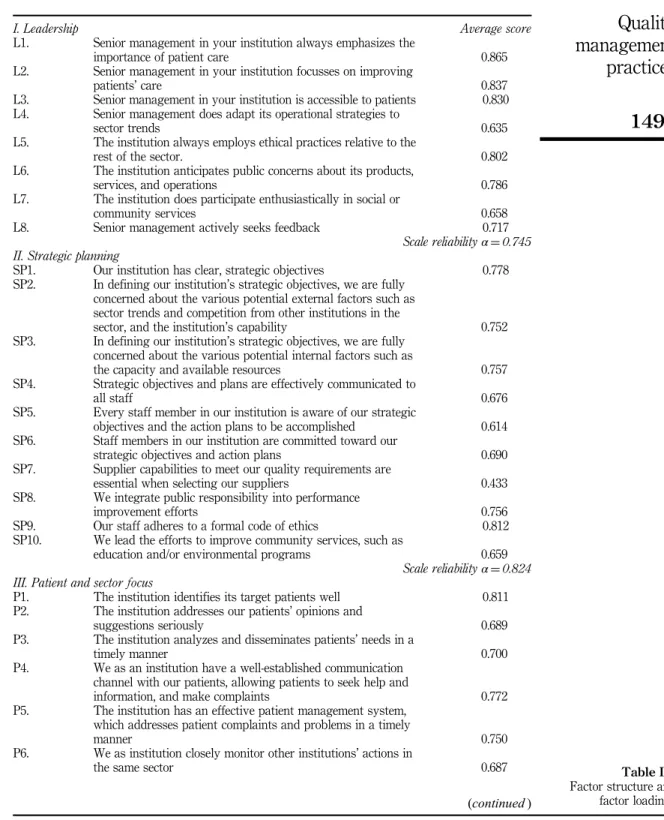
Validity in this study had two dimensions. First, content validity was achieved by comparing between the measurements items of each variable with an extensive review of literature and evaluation criteria of international quality awards; measures used in this study were capable of capturing TQM elements. Second, is construct validity which was achieved using the Principal components factor analysis ( Jolliffe, 2005). As shown in Table III, all measurement items were factor analyzed producing only one item (SP7) with factor loading of littleo0.450. All factors’ loading were acceptably good. A third dimension of validity in relation to criterion validity will be discussed in Section 6.
As for reliability, an internal consistency for the seven elements was estimated using the reliability coefficient Cronbachαranging between 0.00 and 1.00. As shown in Table I an internal consistency was performed separately for each of the seven elements. The results show that allαvalues range between 0.674 and 0.888 indicating that all scale variables demonstrate an acceptable level of reliability. Cronbach’sαfor all the factors used in this study meet the acceptable value 0.6 (Sekaran and Bougie, 2009; Hair
et al., 2006; Kaiser, 1974).
5. Results
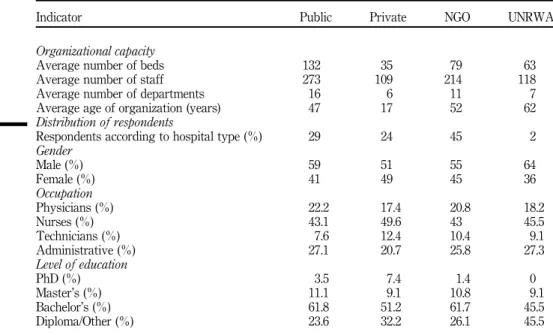
The following section provides a summary of the main findings of the analysis. Table II provides a summary description of the hospitals included in the study, and the characteristics of the respondents.
The present level of education of the respondents, as it appears in Table II, indicates that most professionals employed in Palestinian hospitals are highly educated. This was most evident in private sector hospitals, where 16.5 percent of the respondents were holders of graduate and post graduate academic degrees. Additionally, the vast majority of respondents were comprised of physicians and nurses (65 percent), followed by administrative employees (24.9 percent). The overall distribution of respondents according to gender was 44.3 percent females, whereas males represented the
1495
Quality
management
practices
remaining 54.7 percent. In terms of administrative types, the highest rate of responses came from NGO hospitals (45 percent), which is primarily due to two factors; the highest number of inadmissible questionnaires came from public hospitals; and the lack of cooperation from two hospitals (one public and one private).
As mentioned previously, this study used the MBNQA criteria as a framework to assess quality in Palestinian hospitals in the West Bank as well as to examine the relationship between TQM elements and performance. The seven MBNQA variables are leadership, strategic planning, patient and sector focus, information and analysis, human resource focus, process management, and performance results being the dependent variable. The results of the analysis are summarized in Table III, which shows the average score for each measurement item for the seven elements. It also shows the scale reliability for each section denotedα.
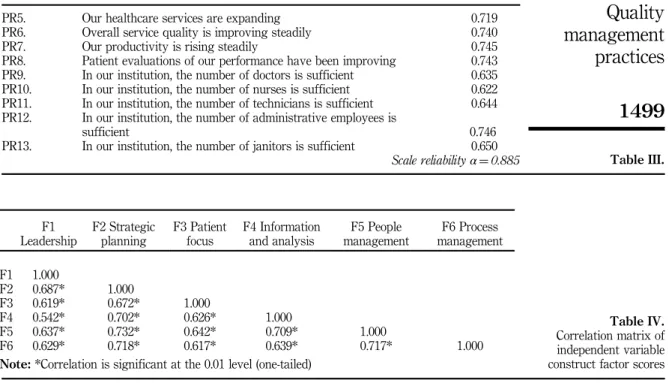
In addition, Table IV provides useful insights on the bivariate correlation of the six independent variable factors; it clearly shows that there is significant multicollinearity reflecting that organizations which are performing relatively well on some factors have a tendency to do well on other factors- one good thing leads to another. The results shown in Table IV are similar, even better, to those of Ahireet al.(1996) and Samson and Terziovski (1999) ranging between 0.542 and 0.732. This is somehow expected given the large number of observations which were over 500. It is worth noting that leadership and information and analysis had the lowest correlation coefficients with a 0.542 score.
Table V shows how reliable the latent variables (leadership, HRM, customer focus, strategic planning, information and analysis, and process management) are, using multiple-regression, in predicting organizational performance. This is in-line with Kanji and Wallace (2000) in which they used the Kanji business excellence model as a framework to create latent factors and test their impact on business results. In this case, the use of a latent variable model whereby factor loading of each indicator can be assessed, allows
Indicator Public Private NGO UNRWA
Organizational capacity
Average number of beds 132 35 79 63
Average number of staff 273 109 214 118
Average number of departments 16 6 11 7
Average age of organization (years) 47 17 52 62
Distribution of respondents
Respondents according to hospital type (%) 29 24 45 2
Gender Male (%) 59 51 55 64 Female (%) 41 49 45 36 Occupation Physicians (%) 22.2 17.4 20.8 18.2 Nurses (%) 43.1 49.6 43 45.5 Technicians (%) 7.6 12.4 10.4 9.1 Administrative (%) 27.1 20.7 25.8 27.3 Level of education PhD (%) 3.5 7.4 1.4 0 Master’s (%) 11.1 9.1 10.8 9.1 Bachelor’s (%) 61.8 51.2 61.7 45.5 Diploma/Other (%) 23.6 32.2 26.1 45.5 Table II. Summary profile of participating organizations and respondents
1496
IJOPM
34,12
I. Leadership Average score
L1. Senior management in your institution always emphasizes the
importance of patient care 0.865
L2. Senior management in your institution focusses on improving
patients’care 0.837
L3. Senior management in your institution is accessible to patients 0.830
L4. Senior management does adapt its operational strategies to
sector trends 0.635
L5. The institution always employs ethical practices relative to the
rest of the sector. 0.802
L6. The institution anticipates public concerns about its products,
services, and operations 0.786
L7. The institution does participate enthusiastically in social or
community services 0.658
L8. Senior management actively seeks feedback 0.717
Scale reliabilityα¼0.745 II. Strategic planning
SP1. Our institution has clear, strategic objectives 0.778
SP2. In defining our institution’s strategic objectives, we are fully
concerned about the various potential external factors such as sector trends and competition from other institutions in the
sector, and the institution’s capability 0.752
SP3. In defining our institution’s strategic objectives, we are fully
concerned about the various potential internal factors such as
the capacity and available resources 0.757
SP4. Strategic objectives and plans are effectively communicated to
all staff 0.676
SP5. Every staff member in our institution is aware of our strategic
objectives and the action plans to be accomplished 0.614
SP6. Staff members in our institution are committed toward our
strategic objectives and action plans 0.690
SP7. Supplier capabilities to meet our quality requirements are
essential when selecting our suppliers 0.433
SP8. We integrate public responsibility into performance
improvement efforts 0.756
SP9. Our staff adheres to a formal code of ethics 0.812
SP10. We lead the efforts to improve community services, such as
education and/or environmental programs 0.659
Scale reliabilityα¼0.824 III. Patient and sector focus
P1. The institution identifies its target patients well 0.811
P2. The institution addresses our patients’opinions and
suggestions seriously 0.689
P3. The institution analyzes and disseminates patients’needs in a
timely manner 0.700
P4. We as an institution have a well-established communication
channel with our patients, allowing patients to seek help and
information, and make complaints 0.772
P5. The institution has an effective patient management system,
which addresses patient complaints and problems in a timely
manner 0.750
P6. We as institution closely monitor other institutions’actions in
the same sector 0.687
(continued)
Table III. Factor structure and factor loadings
1497
Quality
management
practices
P7. The institution is fully aware of sector trends 0.700
Scale reliabilityα¼0.674 IV. Information and analysis
IA1. The institution has an effective system to assess its operational
performance 0.703
IA2. The institution does have a clear, comprehensive appraisal
system 0.645
IA3. All staff understand the indicators linked to their performance
well and take them seriously 0.708
IA4. The institution adjusts its performance according to the
changes in the environment 0.700
IA5. Senior management adjusts the institution’s policy and strategy
by analyzing information and facts 0.674
Scale reliabilityα¼0.689 V. Human resource focus
HR1. The institution empowers its staff 0.671
HR2. The institution has an effective appraisal system for
recognizing and rewarding the staff for their efforts 0.627
HR3. The institution encourages teamwork and team spirit 0.706
HR4. Our management motivates staff and fully develops their
potential 0.621
HR5. The institution trains its staff in quality concepts 0.689
HR6. The institution provides training and development for staff
members 0.690
HR7. The institution provides a safe and healthy work environment 0.732
HR8. The institution provides staff with patient- focussed training 0.715
Scale reliabilityα¼0.888 VI. Process management
PM1. When designing processes, the institution carefully considers
the following factors: quality, costs, productivity, new
technology 0.782
PM2. Before applying new procedures or delivery processes, the
institution conducts comprehensive tests to assure quality 0.748
PM3. The institution has appropriate management measures to
control and improve delivery processes 0.716
PM4. The institution continuously improves its delivery processes, to
enhance the overall service quality development 0.744
PM5. Process improvement initiatives are shared among departments 0.584
PM6. Individual departments work to improve their processes 0.630
PM7. The institution closely cooperates with its suppliers 0.717
PM8. We evaluate services on the basis of efficiency, including cost
and timeliness 0.718
PM9. We evaluate services on the basis of effectiveness, including
appropriateness and risk 0.698
PM10. Work procedures and possible outcomes are explained in
advance to patients 0.765
PM11. Healthcare services are contingent according to patients’needs 0.784
Scale reliabilityα¼0.812 VII. Performance results
PR1. Patients are satisfied with our healthcare services 0.771
PR2. Our institution is able to meet its financial obligations 0.667
PR3. Our system of remuneration and benefits is satisfactory 0.559
PR4. In general the staff is satisfied with their respective department 0.648
(continued) Table III.
1498
IJOPM
34,12
the evaluation of the variables’relative significance for the successful implementation of that particular factor.
The model is build using the factor scores for each of the previously mentioned factors. The results in this table will help answering the second research question stated earlier and hence examine the relationship between quality management practices and organizational performance.
PR5. Our healthcare services are expanding 0.719
PR6. Overall service quality is improving steadily 0.740
PR7. Our productivity is rising steadily 0.745
PR8. Patient evaluations of our performance have been improving 0.743
PR9. In our institution, the number of doctors is sufficient 0.635
PR10. In our institution, the number of nurses is sufficient 0.622
PR11. In our institution, the number of technicians is sufficient 0.644
PR12. In our institution, the number of administrative employees is
sufficient 0.746
PR13. In our institution, the number of janitors is sufficient 0.650
Scale reliabilityα¼0.885 Table III.
Table IV. Correlation matrix of independent variable construct factor scores F1 Leadership F2 Strategic planning F3 Patient focus F4 Information and analysis F5 People management F6 Process management F1 1.000 F2 0.687* 1.000 F3 0.619* 0.672* 1.000 F4 0.542* 0.702* 0.626* 1.000 F5 0.637* 0.732* 0.642* 0.709* 1.000 F6 0.629* 0.718* 0.617* 0.639* 0.717* 1.000
Note:*Correlation is significant at the 0.01 level (one-tailed)
Dependent Variable F7 Performance
MultipleR 0.744
R2 0.553
AdjustedR2 0.547
SE 0.107
Analysis of variance
df Sum of squares Mean square
Regression 6 6.257 1.043 Residual 438 5.055 0.012 F¼90.364 SignificantF¼0.00 Variables β T SignificantT F1 Leadership 0.104 2.188 0.029 F2 Strategic planning 0.005 0.086 0.931 F3 Patient focus 0.090 1.937 0.053
F4 Information and analysis 0.116 2.295 0.022
F5 People management 0.240 4.313 0.000 F6 Process management 0.310 6.042 0.000 Table V. Multiple regression analysis
1499
Quality
management
practices
6. Discussion of findings
Generally, the results of the analysis in particular about validity and reliability of the seven elements of TQM are consistent and accurate in terms of what they set out to measure. The results also reflect a precise measure of the underlying variables (the seven elements of MBNQA) as well as that the results are credible. This is in line with studies made by Flynn et al.(1994) and Black and Proter (1996). For example, the selection of the measurement elements was conducted based on a thorough examination of the literature and major international quality awards to ensure content validity. Another perhaps more specific example to this study is“criterion validity”which was determined by examining the MulitpleRcoefficient calculated for the six dependent variables and the independent variable performance; the score of 0.744 (Table V) indicate that the independent variables have a high degree of criterion validity when taken all together.
The overall average scores in Table III shows that Palestinian hospitals in the West Bank are operating at relatively acceptable performance levels. This is in accordance with the MBNQA scoring system, which indicates that these hospitals are relatively effective and somewhat responsive to the overall requirements of the MBNQA criteria. The scores also reflect that some organizational learning aimed at further improving the effectiveness and efficiency of overall performance is present. The results of the analysis were found to be quite similar to the results found in similar studies carried out by Manjunathet al.(2007) and Lauet al.(2004). It should be noted, however, that these scores were based on the direct responses of those employed by the participating organizations, rendering this effort a self-assessment process, as opposed to an external audit or evaluation, where the scores could possibly be lower (Lau et al., 2004). In addition, the absence of a benchmarking mechanism entailing the use of comparative information about quality which should identify, document, and apply best practices further exacerbates the relatively high scores achieved (Baidoun, 2003).
The results of the regression (Table V) show that the independent variables with strong predicting power of performance are process management, people management, and information and analysis. These three variables are positively and strongly related to performance when compared with the other three variables which are positively correlated to performance but with less significance. Based on these results it is important to emphasize that this study is not suggesting that certain factors are more important than other factors, nor it is suggesting that the MBNQA criteria is not effective enough because some of the factors are strongly related to performance. However, the relative strengths and significance of the regression coefficients and the correlations between the six independent variables are indicative of the underlying differences between a good and bad performing organization. Hence, to answer the second research question, although the correlations among the six variables are relatively strong, the regression analysis sorted out the strong predictors from the weak ones of organizational performance. The implication of these results suggest that if administrators or managers of surveyed hospitals want to improve performance, they ought to focus more on people management, process management, and information and analysis; this should not be taken at face value which means that the other less significant factors should not be ignored. The results of this study are quite similar to those of Ahire et al. (1996) and Calvo-Mora et al. (2014) where they concluded that human resource management is the most closely related factor to performance. Also, Samson and Terziovski (1999) produced similar results and
1500
IJOPM
34,12
concluded that human resource management as factor has a strong predicting power of performance. As for the R2 which had a value of 0.553, it is indeed significant for which a substantial amount of the dependent variable–performance results–is explained.
All together, the findings in this study as well as other studies such as those of Samson and Terziovski (1999); Ahire et al. (1996); Black and Porter (1996) it can be concluded that the elements or factors that make up TQM are substantially good for any organization as long as they are implemented the right way. On the other hand, this study as well as other studies have one drawback in common; they do not accommodate the gap between the introduction of a new system or process and its impact on performance which most likely is to take place in the future.
7. Conclusion
This study reports on a recent survey of TQM practices in Palestinian hospitals and their relation to the performance in these hospitals. Two important findings have manifested themselves as a result of this study: first, Palestinian hospitals located in the West Bank are operating at relatively acceptable performance levels; second, the TQM factors that were used to predict performance are valid and reliable, and more so that three factors were found significantly related to performance, namely people management, process management, and information and analysis.
The fact that this is a relatively large study in terms of its comprehensive nature, well above one third of the performance factor variance is unexplained which is due to other factors that are beyond the scope of this current study. Nonetheless, hospitals as well as other organizations are encouraged to use TQM models for the benefits they can bring forward. This study sheds light on the three of the six factors that have strong influence on performance which suggests that organizations need to invest more in their people, processes, and the analysis of information.
The study reported here, despite the large scale of the study, suffers from limitations, and these contribute to several suggestions for future research. The sampling technique used in this study is far from perfect. Further empirical research could become better than the current study by attempting to obtain a list of employees working in hospitals (sample framework). A somewhat related limitation is due to the fact that this study was based on a self-assessment of quality by managers and practitioners in the studied organizations, which could have resulted in an inherent bias. Future studies may well examine the perceptions of patients of quality in these hospitals.
The research reported here is concerned with hospitals operating in West Bank, Palestine. The researchers were unable to account for the hospitals operating in the Gaza Strip for reasons that are beyond the scope of the study. Hence the results in this study are only generalizable to West Bank hospitals. In this respect, future research should focus on hospitals in the Gaza Strip which will allow for cross-regional analysis, and possibly a longitudinal study to detect for changes over time. In addition, future qualitative research will prove to be valuable. This will not only corroborate the findings of quantitative studies but could also shed light on additional systematic factors that will ultimately enhance the measuring strength of TQM elements. For instance, case studies can be very insightful which can also detail the impact of TQM elements, more specifically which elements have the strongest impact and how they are implemented.
1501
Quality
management
practices
Note
1. The West Bank of the oPt was the de facto focus of the study, due to the political and military restrictions on the Gaza Strip which limited the accessible areas for field work.
References
Adam, E., Corbett, L., Flores, B., Harrison, N., Lee, T., Rho, B., Ribera, J., Samson, D. and Westbrook R. (1997),“An international study of quality improvement approach and firm performance”,International Journal of Operations and Production Management, Vol. 17 No. 9, pp. 842-873.
Ahire, S.L., Gohar, D.Y. and Waller, M.A. (1996), “Development and validation of TQM implementation constructs”,Decision Sciences, Vol. 27 No. 1, pp. 23-56.
Armstrong, M. (1999), A Handbook of Human Resource Management Practice, 7th ed., Kogan Page, London.
Baidoun, S. (2003),“An empirical study of critical factors of TQM in Palestinian organizations”, Logistics Information Management, Vol. 16 No. 2, pp. 156-171.
Barghouthi, M. and Lennock, J. (1997),Health in Palestine: Potential and Challenges, Palestine Economic Policy Research Institute, (MAS).
Bass, B.M. (1985),Leadership and Performance Beyond Expectations, Free Press, New York, NY. Bemowski, K. and Stratton, B. (1995),“How do people use the Baldrige award criteria”,Quality
Progress, Vol. 28 No. 5, pp. 43-47.
Black, S. (1993), Measuring the Critical Factors of Total Quality Management, University of Bradford, Bradford.
Black, S.A. and Porter, L.J. (1996), “Identification of the Critical Factors of TQM”,Decision Sciences, Vol. 27 No. 1, pp. 1-21.
Boulter, L., Bendell, T. and Dahlgaard, J. (2013), “Total quality beyond North America”, International Journal of Operations & Productions Management, Vol. 33 No. 2, pp. 197-215. Brown, S. (2013), “Operations masters series: an interview with wickham skinner, emeritus professor at Harvard Business School”,International Journal of Operations & Productions Management, Vol. 33 No. 1, pp. 104-110.
Calvo-Mora, A., Picon, A., Ruiz, C. and Cauzo, L. (2014),“The relationships between soft-hard TQM factors and key business results”,International Journal of Operations & Productions Management, Vol. 34 No. 1, pp. 115-143.
Chavez, R., Gimenez, C., Fynes, B., Wiengarten, F. and Yu, W. (2013),“Internal lean practices and operational performance”,International Journal of Operations & Productions Management, Vol. 33 No. 5, pp. 562-588.
Crosby, P.B. (1979), Quality is Free: The Art of Making Quality Certain, McGraw Hill, New York, NY.
Das, A., Handfield, R., Calantone, R. and Ghosh, S. (2000), “A contingent view of quality management-the impact of international competition on quality”,Decision Sciences, Vol. 31 No. 3, pp. 649-690.
David, F. (2001), Strategic Management: Concepts and Cases, Pearson-Prentice Hall, New York, NY
Dean, J.W. Jr and Bowen, D.E. (1994),“Managing theory and total quality: improving research and practice through theory development”, Academy of Management Review, Vol. 19 No. 3, pp. 392-418.
Deming, W.E. (1986),Out of the Crisis, MIT Press, Cambridge, MA.
1502
IJOPM
34,12
Douglas, T. and Judge W. Jr (2001),“Total quality management implementation and competitive advantage: the role of structural control and exploration”, Academy of Management Journal, Vol. 44 No. 1, pp. 158-169.
Doyle, M. (2000),“Managing development in an era of radical change: evolving a relational perspective”,Journal of Management Development, Vol. 19 No. 7, pp. 579-601.
Easton, G. (1993),“The state of US total quality management: a baldrige examiners perspective”, California Management Review, Vol. 35 No. 3, pp. 32-54.
Elg, M., Klara Palmberg, B. and Kollberg, B. (2013), “Performance measurement to drive improvements in healthcare practice”,International Journal of Operations & Productions Management, Vol. 33 No. 11, pp. 1623-1651.
Evans, J.R. and Jack, E.P. (2003),“Validating key results linkages in the baldrige performance excellence model”,Quality Management Journal, Vol. 10 No. 2, pp. 7-24.
Evans, J.R. and Lindsay, W.M. (1995), The Management and Control of Quality, 3rd ed., West Publishing, New York, NY.
Flynn, B., Schroeder, R. and Sakakibara, S. (1994), “A framework for quality management research and an associated measurement instrument”,Journal of Operations Management, Vol. 11 No. 4, pp. 339-366.
Forza, C. and Filippini, R. (1998), “TQM impact on quality conformance and customer satisfaction: a causal model”,International Journal of Production Economics, Vol. 55 No. 1, pp. 1-20.
Garavan, T. (1993) ,Training Practices in Sixteen Irish Companies, University of Limerick, Limerick.
Garvin D.A. (1983),“Quality on the line”,Harvard Business Review, Vol. 61 No. 5, pp. 65-75. Garvin, D.A. (1991),“How the baldrige award really works”,Harvard Business Review, Vol. 69
No. 6, pp. 80-95.
Giacaman, R., Khatib, R., Shabaneh, L., Ramlawi, A., Sabri, B., Sabatinelli, G., Khawaja, M. and Laurance, T. (2009), “Health status and health services in the occupied Palestinian territory”,Lancet, Vol. 373 No. 9666, pp. 837-849.
Hair, J.E., Anderson, R.E., Tatham, R.L. and Black, W.C. (2006), Multivariate Data Analysis, 5th ed., Prentice Hall, Upper Saddle River, NJ.
Hamdan, M. and Defever, M. (2002),“A transitional context for healthcare policy development: the Palestinian case”,Health Policy, Vol. 59 No. 3, pp. 193-207.
Huang, Y. and Lin, B. (2002), “An empirical investigation of total quality management: a taiwanese case”,The TQM magazine, Vol. 14 No. 3, pp. 172-181.
Iliopoulos, E. and Priporas, V.C. (2011),“The effect of internal marketing on job satisfaction in health services: a pilot study in public hospitals in Northern Greece BMC”,Health Services Research, Vol. 11 No. 1, pp. 261-269.
Jolliffe, I. (2005),“Principal component analysis”,Encyclopedia of Statistics in Behavioral Science, John Wiley & Sons, Ltd, Hoboken, NJ.
Joseph, B.W. (1996),“Internal marketing builds service quality”,Marketing Review, Vol. 16 No. 1, pp. 54-59.
Juran, J. (1989),Juran on Planning for Quality, Free Press, New York, NY.
Kaiser, H. (1974),“An index of factorial simplicity”,Psychometrika, Vol. 39, pp. 31-36.
Kanji, G.K. and Wallace, W. (2000),“Business excellence through customer satisfaction”,Total Quality Management, Vol. 11 No. 7, pp. 979-998.
Kanter, R.M., Stein, B.A. and Jick, T.D. (1992),The Challenge of Organizational Change: How Companies Experience It and Leaders Guide, It Free Press, New York, NY.
1503
Quality
management
practices
Ladhari, R. and Rigaux-Bricmont, B. (2013),“Determinants of patient satisfaction with public hospital services”,Health Marketing Quarterly, Vol. 30 No. 4, pp. 299-318.
Laohavichien, T., Fredendall, L.D. and Cantrell, R.S. (2011),“Leadership and quality management practices in Thailand”,International Journal of Operations & Productions Management, Vol. 31 No. 10, pp. 1048-1070.
Lau, R.S.M., Zhao, X. and Xiao, M. (2004),“Assessing quality management in China with MBNQA criteria”, International Journal of Quality and Reliability Management, Vol. 21 No. 7, pp. 699-713.
Limerick, D. and Cunnington, B. (1993), Managing the New Organization, Business and Professional Publishing, Sydney.
Lovelock, C.H. (1992), Managing Services, 2nd ed., Prentice-Hall, Englewood Cliffs, NJ. Magnussen, J. (1996), “Efficiency measurement and the operationalization of hospital
production”,Health Services Research, Vol. 31 No. 1, pp. 21-37.
Manjunath, U., Metri, B. and Ramachandran, S. (2007),“Quality management in a healthcare organization: a case of south Indian hospital”, The TQM Magazine, Vol. 19 No. 2, pp. 129-139.
Massad, S., Nieto, F., Palta, M., Smith, M., Clark, R. and Thabet, A. (2011),“Health related quality of life of Palestinian preschoolers in the Gaza strip: a cross sectional study”,BMC Public Health, Vol. 11 No. 253, pp. 1-13.
Mataria, A., Kahtib, R., Donaldson, C., Bossert, T., Hunter, D., Alsayed, F. and Moatti, J.P. (2009),
“The healthcare system: an assessment and reform agenda”,Lancet, Vol. 373 No. 9670, pp. 1207-1217.
National Institute of Standards and Technology (1995),“The Malcolm Baldrige National Quality Award: 1995 Award Criteria”, US Departement of Commerce, Technology Administration, National Standards and Technology, Milwaukee, Gaithersburg, MD.
O’Rourke, M., Juegmans, J., Sonin, S., Dashzeveg, G. and Batsuury, R. (2001),“Developing quality health systems in Mongolia”,International Journal of Healthcare Quality Assurance, Vol. 14 No. 5, pp. 212-217.
Palestinian Central Bureau of Statistics (2011),Economic Survey of Palestine 2010, available at: www.pcbs.gov.ps/portals/_pcbs/downloads/ (accessed September 8, 2012).
Palestinian Central Bureau of Statistics (2013),Preliminary Results of National Health Accounts in Palestine at Current Prices for 2010-2011, available at: www.pcbs.gov.ps/site/512/ (accessed December 28, 2013).
Palestinian Ministry of Health (2011), Annual Report 2010, PmoH, Ramallah.
Powell, T.C. (1995),“Total quality management as competitive advantage: a review and empirical study”,Strategic Management Journal, Vol. 16 No. 1, pp. 15-37.
Samson, D. and Terziovski, M. (1999),“The relationship between total quality management practices and operational performance”,Journal of Operations Management, Vol. 17 No. 4, pp. 393-409. Saraph, J.V., Benson, G.P. and Schroeder, R.G. (1989),“An instrument for measuring the critical
factors of quality management”,Decision Sciences, Vol. 20 No. 4, pp. 810-829.
Schoenbaum, M., Afifi, A.K. and Deckelbaum, R.J. (2005),Strengthening the Palestinian Health System, Rand Corporation, Santa Monica, CA.
Sekaran, U. and Bougie, R. (2009),Research Methods for Business: A Skill Building Approach, John Wiley & Sons Ltd, West Sussex.
Sila, I. and Ebrahimpour, M. (2005),“Critical linkages among TQM factors and business results”, International Journal of Operations & Production Management, Vol. 25 No. 11, pp. 1123-1155.
1504
IJOPM
34,12
The Baldrige National Quality Program at the National Institute of Standards and Technology (2009-2010), The Healthcare Criteria for Performance Excellence, National Institute of Standards and Technology, Gaithersburg, MD.
Vecchi, A. and Brennan, L. (2011),“Quality management: a cross-cultural perspective based on the GLOBE framework”,International Journal of Operations & Productions Management, Vol. 31 No. 5, pp. 527-553.
Wilson, D.D. and Collier D.A. (2000),“An empirical investigation of the Malcolm Baldrige national award causal model”,Decision Sciences, Vol. 31 No. 2, pp. 361-390.
Further reading
Al-Adham, M. (2004),Assessment of Perceived Healthcare Service Quality at Palestinian Hospitals: a Model for Good Hospital Management Practice, Master’s Annajah National University, Nablus.
Khawaja, M. (2000), “The recent rise in Palestinian fertility: permanent or transient”, Popular Studies, Vol. 54 No. 3, pp. 331-346.
Mataria, A., Donaldson, C., Luchini, S. and Moatti, J.P. (2004),“A stated preference approach to assessing healthcare quality improvements in Palestine: from theoretical validity to policy implications”,Journal of Health Economics, Vol. 23 No. 6, pp. 1285-1311.
Moshary, S. (2007),“Casualty of war: healthcare in Palestine”,Harvard International Review, Vol. 28 No. 4, p. 13.
United Nations Relief Works Agency (UNRWA) (2011), Annual Report of the Department of Health 2010, available at: www.unrwa.org/userfiles/2011052062220.pdf (accessed September 1, 2012). World Health Organization (WHO) (2011), Patients From the Gaza Strip Face Obstacles in
Accessing Right to Health, WHO, Gaza.
Corresponding author
Anton Sabella can be contacted at: [email protected]
To purchase reprints of this article please e-mail:[email protected] Or visit our web site for further details:www.emeraldinsight.com/reprints
1505
Quality
management
practices
This article has been cited by:
1. Tamayo-TorresJavier Javier Tamayo-Torres [email protected] Dr Javier Tamayo-Torres is an Associate Professor of Strategic Management in the Department of Organization Management at the Granada University. He received his PhD in Business Administration. He currently investigates manufacturing flexibility, organizational learning, quality management, and innovation. He has published in different journals such as European Journal of Operational Research, International Journal of Operation & Production Management, International Journal of Production Management, Industrial Management & Data Systems, and International Journal of Production Research. RoehrichJens K. Jens K. Roehrich [email protected] Dr Jens K. Roehrich is an Associate Professor at the School of Management, University of Bath, UK. Before joining the University of Bath, Jens was a Researcher at the Imperial College Business School, Imperial College London, UK. Significant strands of his research agenda explore, for instance, the long-term interplay of contractual and relational exchange governance mechanisms, the move toward procuring and managing complex performance across public and private sectors. His research has been published in journals such as International Journal of Operations & Production Management, Social Science & Medicine, Supply Chain Management: An International Journal, and Industrial Marketing Management. LewisMichael A. Michael A. Lewis [email protected] Michael A. Lewis is a Professor of Operations and Supply Management at the University of Bath, School of Management. His current public and private sector research interests include re-distributed manufacturing, professional service productivity, operations and supply leadership and the procurement of complex performance. In addition to numerous journal articles, he is the Co-author of Operations Strategy (4e, 2015, Financial Times Prentice-Hall), the Co-editor of Critical Readings in Operations Management (2003, Routledge) and the Encyclopaedic Dictionary of Operations Management (4th edition, Blackwell, 2015). Department of Business Management, University of Granada, Granada, Spain School of Management, University of Bath, Bath, UK . 2017. Ambidexterity, performance and environmental dynamism. International Journal of Operations & Production Management37:3, 282-299. [Abstract] [Full Text] [PDF]
2. Bilal Ahmad Khan, Hummayoun Naeem. 2016. Measuring the impact of soft and hard quality practices on service innovation and organisational performance. Total Quality Management & Business Excellence
1-25. [CrossRef]
3. ErikssonHenrik Henrik Eriksson GremyrIda Ida Gremyr BergquistBjarne Bjarne Bergquist GarvareRickard Rickard Garvare FundinAnders Anders Fundin WiklundHåkan Håkan Wiklund WesterMichael Michael Wester SörqvistLars Lars Sörqvist Department of Technology Management and Economics, Chalmers University of Technology, Gothenburg, Sweden Department of Quality Technology and Management, Luleå University of Technology, Luleå, Sweden School of Innovation and Design, Mälardalen University, Eskilstuna, Sweden Mid Sweden University, Östersund, Sweden Swedish Institute for Quality, Göteborg, Sweden Royal Institute of Technology, Stockholm, Sweden . 2016. Exploring quality challenges and the validity of excellence models. International Journal of Operations & Production Management36:10, 1201-1221. [Abstract] [Full Text] [PDF]
4. Niranjan Pati Ioannis N. Metaxas Department of Production and Management Engineering, Demokritus University of Thrace, Xanthi, Greece Dimitrios E Koulouriotis Department of Production and Management Engineering, Demokritus University of Thrace, Xanthi, Greece Stefanos H Spartalis Department of Production and Management Engineering, Demokritus University of Thrace, Xanthi, Greece . 2016. A multicriteria model on calculating the Sustainable Business Excellence Index of a firm with fuzzy AHP and TOPSIS. Benchmarking: An International Journal23:6, 1522-1557. [Abstract] [Full Text] [PDF]
5. AdjeiEmmanuel Emmanuel Adjei MensahMonica Monica Mensah Department of Information Studies, University of Ghana, Accra, Ghana The Balme Library, University of Ghana, Accra, Ghana . 2016. Adopting total quality management to enhance service delivery in medical records. Records Management Journal26:2, 140-169. [Abstract] [Full Text] [PDF]
6. Jayanth Jayaram Department of Management Science, Moore School of Business, University of South Carolina, Columbia, South Carolina Kefeng Xu Department of Management Science and Statistics, College of Business, University of Texas at San Antonio, San Antonio, Texas, USA . 2016. Determinants of quality and efficiency performance in service operations. International Journal of Operations & Production Management36:3, 265-285. [Abstract] [Full Text] [PDF]
7. Rateb J Sweis Business Management Department, University of Jordan, Amman, Jordan Firas Izzat Mahmoud Saleh Business Management Department, The University of Jordan, Amman, Jordan Samer Eid Dahiyat Business Management Department, The University of Jordan, Amman, Jordan Nadia J Sweis Princess Summaya University of Technology, Al Jubaiha, Jordan Rawan Ali Saleh Business Management Department, The University of Jordan, Amman, Jordan Hannah Diab Business Management Department, The University of Jordan, Amman, Jordan . 2016. Benchmarking of TQM practices in INGOs: a literature review. Benchmarking: An International Journal23:1, 236-261. [Abstract] [Full Text] [PDF]
8. Ahmed Hani Mohammed, Che Azlan Bin Taib, Santhirasegaran a/l S.R. Nadarajan. 2016. Mapping the Relationship among Quality Management Practices, Organizational Learning, Organizational Culture, and Organizational Performance in Higher Education: A Proposed Framework. American Journal of Industrial and Business Management06:04, 401-410. [CrossRef]
9. Ademir Stefano Piechnicki Department of Education, Federal Institute of Paraná (IFPR), Telêmaco Borba, Brazil Antonio Vanderley Herrero Sola Production Engineering, Federal University of Technology - Paraná (UTFPR), Ponta Grossa, Brazil Flávio Trojan Production Engineering, Federal University of Technology - Paraná (UTFPR), Ponta Grossa, Brazil . 2015. Decision-making towards achieving world-class total productive maintenance. International Journal of Operations & Production Management35:12, 1594-1621. [Abstract] [Full Text] [PDF]