CABLE AND GROUND-BASED LOGGING
By
Ross
J.
Peacock
Submitted in fulfllmeilt of the requirements for the Degree of
Doctor of Philosophy
School of Plant Science, University of Tasmania and
Co-operative Research· Centre for Sustainable Production
Forestry
Hobart Australia
Statement of Authenticity
I declare that this thesis contains no material which has been
accepted for the award of any other higher degree or graduate diploma in any tertiary institution and that, to the best of my knowledge and belief, the thesis contains no material previously published or written by another person, except where due reference is made in the text of . the thesis.
Date Signed
10
\\JWEN BfR
1Go~Ross J. Peacock
Statement of Authority of Access
This thesis is not to be made available for loan or copying for two years following the date this statement was signed. Following that time the thesis may be made available for loan and limited copying in
accordance with the Copyright Act 1968
Date Signed
10
N0YfN/3ER
la:J
3
Abstract
The relationship between forest resource management and the conservation of
biological diversity. is a controversial one, with the steep country logging of
old-growth forests in Tasmania being the source. of much of this attention, due to the
perceived greater impacts of logging on steep slopes and the greater damage caused
by the large modern cable systems.
Retrospective (chronosequence) and permanent plot studies of cable and
ground-based logging in forests aged 0-54 years on steep slopes in southern Tasmania and
comparable unlogged sites indicated that following both logging treatments, there
was a gradual recovery in floristic composition towards mature forest. Vascular
plant species richness recovered more rapidly in the ground-based logging
treatment than the cable logged treatment. Differences between treatments were
confined to the initial recovery stages where treatment effects were evident in the
extent of soil, woody debris and micro-habitat disturbance. Following canopy
closure and self-thinning (i.e. after 20-30 years) sites logged by the two techniques
resemble each other in vascular species composition and that of mature unlogged
forest. However, differences still existed in forest structure and in the composition
of the obligate epiphytic fern flora (particularly that present on Dicksonia caudexes).
Generally cable logging did less physical damage to vegetation than ground-based
logging. Ground-based logging led to a greater degree of floristic change than cable
logging. The pattern of vegetation change was related to the degree and nature of
soil and habitat disturbance.
Conventional ground-based thinning of 30 year old regrowth forest led to a greater
change in the composition of the ground stratum (an increase in the cover of weed
and other herbaceous species) than cable thinning. Cable thinning caused little soil
disturbance and ground fern species rapidly regenerated rhizomatously.
Herbaceous and weed species were infrequent after cable thinning.
Cable logging practices adjacent to or through retained stands of streamside
vegetation can result in significant changes to the vegetation. This can occur during
all phases of tree falling, establishment and movement of cable settings, yarding,
fire break construction and the regeneration burn. Many of the detrimental effects
of cable logging adjacent to retained stands of streamside vegetation are indirect,
from regeneration burning. While there has been an improvement in forest
practices since the 1980's when the attempted full suspension logging over
streamsides was ended, the on-going health and viability of retained streamside
vegetation is still in doubt.
Ground-based logging inflicted greater levels of mortality than cable logging on
populations of the tree fern .Dicksonia antarctica, a functionally important
understorey species in· wet forests. Approximately 80% of the D. antarctica
resprouted following cable logging prior to burning. Only 40% survived the
regeneration burn. This was reduced to 27% after 10 years. While ground-based
logging resulted in greater mortality, it led to a greater degree of new sporophytic
recruitment to the D. antarctica population. The significant reduction in the
abundance of this slow growing species following logging has implications for the
conservation of obligate vascular epiphytes that use it's caudex as a substrate.
The vascular epiphytic flora, the primary late successional specialist group, was
almost completely lost following cable logging. Epiphytes were slow to recolonise
following either cable or ground-based logging, although their recovery was more
rapid following ground-based logging. While most of the vascular epiphytic species
recovered 30-50 years following either logging method, their abundance was
reduced and the diversity of substrates available for colonisation was limited.
The response of vegetation to logging treatment was studied at the three levels; the
community, the functional group and the species. No general statement can be
made about the logging treatments across these levels as the treatment response
was not uniform. However, the individual species level of response provided most of
the understanqing of processes operating following either logging method in terms
of how these treatments differ in their spa~ial variability, the biological legacies they
create and t;heir intensity. The use of permanent plot monitoring associated with
the chronosequence studies effectively validated the generalised chronosequence
trends, at least for the short term predictions, and also questioned many of the
trends described elsewhere in the literature from chronosequence studies which
lack the rigour of an individual species level of experimental treatment and
monitoring.
process of vegetation disturbance and one of establishing biological legacies which
mediate the regenerative response. It also questions much of the literature which
describes vegetation responses in terms of generalised hypotheses, eg the
intermediate disturbance hypothesis, as vegetation responses are not uniform
Acknowledgments
The author gratefully acknowledges the co-operation, advice and assistance given·
by the following individuals in the preparation of this thesis.
My supervisors, Dr Neil Davidson, School of Plant Science and Co-operative
Research Centre for Sustainable Production Forestry, University of Tasmania and
Dr Michael Brown, Forestry Tasmania who provided encouragement, critical review
and practical ideas during an extended thesis preparation period while the author
was in full time employment.
Mr Fred Duncan, Senior Botanist; Forest Practices Board Hobart, for
re-measurement of the Dicksonia antarctica monitoring study.
The numerous individuals who provided assistance with the field experimentation
and preparation of the research report to Forestry Tasmania are acknowledged in
that report.
The staff of the School of Plant Science, University of Tasmania, for the use of their
facilities.
My employers, State Forests of New South Wales and the New South Wales
Department of Sustainable Natural Resources, for study leave to complete the
Table of Contents
Statements
Abstract
Acknowledgements
Table of Contents
Chapter 1
Chapter 2
Chapter 3
Chapter 4
Chapter 5
Chapter 6
Chapter 7
References
Introduction
Effects of cable and ground-based logging on woody and herbaceous species in Tasmanian forests
Effects of soil disturbance arising from cable and ground-based logging and thinning on vegetation
Effects of cable logging on streamside vegetation
Effects of cable and ground-based logging on Dicksonia antarctica ·
Effects of cable and ground-based logging on vascular epiphytes
Discussion
ii
iii
vi
vii
1
27
102
141
181
234
280
CHAPTER 1 INTRODUCTION ... · ... 2
1.1 Steep country defined ... 2
1.2 The extent of steep country logging systems globally ... 3
1.3 The extent of steep country logging systems in Australia ···~··· 3
1.4 The extent of steep country logging systems and environments in Tasmania ... -... 3
The environments and vegetation of steep slopes in Tasmania .. ~ ... 5
Cable logging systems on steep slopes in Tasmania ... 7
Skyline Systems ... 9
Highlead Systems ... 14
Ground-based logging systems on steep slopes in Tasmania ... 14
Silvicultural systems applied to steep slopes in Tasmania ... 16
1.5 Differences between environmental effects of cable and ground-based logging of steep slopes ... 16
1.6 Experimental approaches ... 23
Chapter 1 Introduction
1.1 Steep country defined
Forest logging practices on steep slopes (> 180) involve a choice between cable and
ground-based methods. The choice is made depending on economic, engineering
and environmental constraints. While, the economic (Verani 1995, Stokes and
Schilling 1997, Sauder and Wellburn 1987, Murphy et al. 1991) and engineering
(Forrester 1995, Shaffer et al. 1993, Courteau and Heidersdorf 1991, Bennett 1997)
comparisons of these logging practices are well researched, there is little published
research that compares the environmental aspects, with the exception of issues
related to soil erosion (Watt and Krag 1988, Minore and Weatherly 1988). More
specifically, there is little research that relates the choice of logging practice (cable
versus ground-based) to the observed patterns of recovery of vegetation following
logging. This is because the majority of logging on steep slopes throughout the
world is conducted using ground-based methods. Consequently, few studies have
had the opportunity to compare steep slope logging methods, in the same place, at
the same time, keeping environmental factors (such as slope, soil type and climate),
and forest types constant.
Steep slopes and cable logging are not synonymous. Steeply sloping land does not
necessarily require cable techniques (e.g. Rogers and MacDonald 1989), and cable
techniques are not necessarily restricted to steep slopes (Meek 1996). Apart from
those cable systems which rely upon a moderate slope (e.g. > 10°) for their gravity driven carriage return (e.g. cable thinning experiment in chapter 3), most cable
systems will also operate on flat terrain, in fact some are particularly suited to
environmentally sensitive sites such as wetlands (Aulerich 1990, Shabalin et al.
1991). Successful applications of cable logging systems on flat land include
Indonesia (Bertault and Sist 1997), Columbia (Aulerich 1990), the United States
(Jones et al. 2000) and the former Soviet Union (Saniga 1988). Between 1990-95, .
11. 9% of the areas logged by cable systems in Tasmania were not steep land,
according to the slope criteria in the Forest Practices Code (1995).
The aim of this study was to examine the impact of a range of steep country logging
practices on the regenerative response of native vegetation. In particular, this study
compares cable and ground-based logging in Tasmania, where both practices were
1.2 The extent of steep country logging systems globally
Steep country logging, and cable logging systems, are employed widely across north
America, Canada, the former Soviet Union, northern and central Europe, New
Zealand and with limited applications in Australia, Japan and south east Asia.
Large complex systems (for example skyline settings) predominate in north America
and Canada, while smaller more mobile systems are more common in central and
southern Europe and Japan. No data could be sourced on the proportion on steep
to non-steep land logged using cable or ground-based systems globally.
1.3 The extent of steep country logging systems in Australia
Cable logging in Australia is almost entirely a Tasmanian phenomenon, with very
limited examples of cable logging in New South Wales, in Queensland (Ward 1982)
and the A.C.T. (Melmoth 1979). Although similar forest types exist in New South
Wales and Victoria to those logged using cable techniques in Tasmania, the
widespread use of the technology in Tasmania is seen as a response to the
prevailing policies concerning forest utilisation, particularly with large logging units
and integrated sawlog and pulpwood markets, which did not exist to the same
extent in other Australian states from the 1970's.
1.4 The extent of steep country logging systems and environments in
Tasmania
Vegetation management practices associated with native forest harvesting in
Australia remain controversial despite an almost continuous series of public
inquiries since the late 1970's. Logging practices in Tasmania have received
particular scrutiny through these inquiries, with part of this attention (e.g. Madden
1991) being focussed on the increasing proportion of steep land and cable logging
since the late 1980s (Figure 1.1), which also coincided with the sharp increase in
logging activity from the 1970's associated with the export of woodchips to Japan
(RAC 1992). Cable logging. operations were. also controversial because of the lack
familiarity with a technology developed in North America, Canada, Europe and New
Zealand, the visual impact of large scale logging operations undertaken using this
technique (Forest Practices Code 1993), risks of soil erosion (Laffan 1991), potential
for regeneration difficulties and an unknown vegetation response (Madden 1991).
While of particular importance in areas such as the Florentine, Styx, and Tyenna
13% of to.ta! wood cut) in Tasmania in 1990. However, cable logging has increased
relative to ground-based logging since the early 1980's (Figure 1.2).
100 90
'"O 80
Q)
D
slopes <180bO 70 bO .Q
60
Cl:S
121
19-300Q)
....
50
Cl:S
•
31-400ta
40
[image:11.562.98.504.114.322.2] [image:11.562.87.491.372.645.2]....
.8... 30
0
II
>410~ 20
10 0
1985 1986 1987 1988 1989 1990 1991 1992 1993 1994
year
Figure 1.1 The proportion of steep slopes (>18°) relative to.shallow slopes (<18°) logged in Tasmania between 1985 and 1994, source: Forestry Tasmania. Only a small portion of land (>41°) was logged between 1988 and 1990.
'
I 16
14
12 r.n
Q)
10 0...
;:l 0 u 8
...
0 0 i::: 6
4
2
0
54 56 58 60 62 64 66 68 70 72 74176 78 80 82 84 86 88 90 92 94
year
Figure 1.2 The number of coupes logged using ·cable systems in the Florentine, Styx and Tyenna Valleys of southern Tasmania 1954-1994.
More recent applications of cable logging in regrowth thinning have expanded its
use to the extent that its future viability in both first and second rotati~n harvests
appears to be assured. Much of the information on the potential environmental
(
and regolith (soil-bedrock interface) stability, none of which is based on an explicit
consideration of the effect of logging practices on vegetation.
The environments and vegetation of steep slopes in Tasmania
Steeply sloping land in Tasmanian forests available for logging is defined by the
Forest Practices Code (1993) as land with slopes above 20° (36%) and a steep coupe
is defined as a coupe with more than 50 percent of its area on slope.s greater than
20°. A coupe is defined as an area of forest of variable size, shape and orientation,
on which harvesting takes place and is us~ally harvested and regenerated over one
or two years (Forest Practices Code 2000). Similar restrictions of 25-30° are placed
on ground-based logging on steep slopes in other Australian States.
Geomorphologists consider slopes of 18° or 20° to distinguish between steep and
moderately steep slopes (Tersleck 1983).
The environmental characteristics of steep slopes are highly variable. An analysis of
the range of forested areas available for logging in Tasmania by slope categories
revealed that one-third are steep using the above criteria. An analysis of the
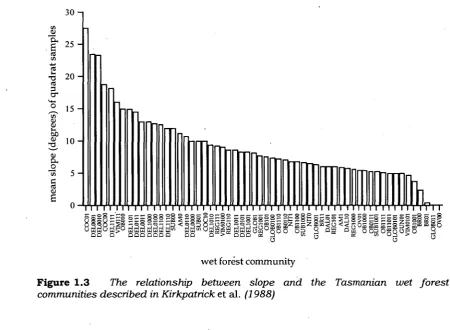
characteristic slope of wet eucalypt forested communities in Tasmania (Kirkpatrick
et al. 1988) indicated that only small proportion were recorded predominantly from
steep slopes, and the dominant species on steep slopes (E. coccifera and E.
delegatensis) were outside the optimal environments for sawlog and pulpwood
production (Figure 1.3). Similarly, no vegetation communities normally associated
with logging were described in the literature as being exclusively associated with
steep slopes. The majority of the temperate eucalypt forest communities subject to
cable logging in Tasmania are not restricted to steep slopes, they occur on a range
of steep and shallow slopes, their presence determined by other ecological factors
such as moisture and geologies (Kirkpatrick et al. 1988), and in the case of wet
eucalypt forests, characteristically on south east facing moist slopes (Reid et al.
1999). Those vegetation communities directly associated with steep slope
environments in south eastern Australia such as rock outcrops (e.g. Ashton and
Webb 1978), block streams (e.g. Caine and Jennings 1968, Ashton and Moore
1978), rock cliffs (Coates and Kirkpatrick 1992) and landslides (e.g. Cullen 1991)
30
-rJl (I)0..
25-E
ro rJl....
ro ....20
-"Oro
;:l C"'
""'
0 15--
rJl(I) (I) b'.o (I)
10
-"O ' - "(I) 0... 2 rJl 5
-i:: ro (I)
E
0
1t
wet forest community
Figure 1.3 The relationship between slope and the Tasmanian wet forest communities described in Kirkpatrick et al. (1988)
Of the geological types characterising land subjected to cable logging, dolerite and
mudstone occupy the greatest area (Table 1.1), with the patterns largely conforming
to regional geological differences across Tasmania.
Table 1.1 1990-95.
Predominant geological types within land cable logged in Tasmania
geology number of cable coupes
dolerite 41
mudstone 46
granite 13
other sediments 16
dolerite/mudstone 7
basalt 16
total 139
% of total area cable logged 35.7
34.7 9.1 7.8 6.6 6.1
100
Slope is only one component of the environment for vegetation on steep land in
southern Australia, and while it could be assumed to effect insolation, wind
exposure, run off, erosion, soil depth, etc. there are few direct references to it in- the
ecological literature, except for the following examples. On steeply sloping ground,
the activities of burrowing and digging marsupials or monotremes may be more
[image:13.562.61.512.65.395.2]groun~, litter will collect up to 20-30cm deep against obstructions including tree trunks, logs and rocks, and the soil itself is scratched downhill and heaped at its
angle of rest by lyre-birds (Ashton 1975a) at an average of 70 cm/year and 200
tonne/ha (Ashton and Bassett 1997). Foraging by lyrebirds in bare floor areas on
steep slopes will therefore result in a complex micro-topography of excavations,
accumulations and terracettes (Ashton and Bassett 1997). Slope has also been
suggested to be a determinant of the pattern of tree root development in E. regnans
due in part to wind direction and possibly soil creep (Ashton 1975b). Working in
similar forested environments, Lindenmayer et al. (1999b) argued that because
steep slopes receive less radiation than flat slopes, and less radiation equals
increased moisture and a lower probability of catastrophic fires,. these steeply
sloping environments were more likely to promote the development of multi-aged
stands of Eucalyptus regnans in high rainfall areas. For a general treatment of the
ecological literature relevant to the E. regnans-E. obliqua dominated forests of
Tasmania studied in this thesis, see Wells and Hickey (1998) and Ashton (1976,
1981) and Ashton and Attiwill (1994)
Cable logging systems on steep slopes in Tasmania
Cable logging systems can be rigged in a variety of ways to accommodate variation
in slope profile, log mass, logging area size and shape, the occurrence of streams,
and requirements for lateral yarding, etc. Cable logging systems are frequently
varied from site to site within one logging area. A brief description of the major
cable logging systems applied in the Tasmanian forested areas examined
ill
thisthesis (Table 1.2) follows. Since no descriptive accounts of the cable systems
operating in Australia are available (with the exception of cable thinning by
Cunningham 1997), overseas technical references including Studier and Binkley
(1974), McGonagill (1978) and Liley (1983) are followed. Each system is also
described diagrammatically in Figures 1.4, 1.6, 1.8, 1.10 and 1.12 and their
attributes contrasted with ground-based logging in Table 1.2. Photographs of these
logging systems are presented in Figures .1.5,. 1.7.,. 1.9 and 1.1 LThe .essential point.
here is that cable logging systems, like ground-based logging systems, are highly
Table 1.2 Summary of logging systems applied on steep slopes at the experimental sites in this thesis
_________________ _§tanding§]9'!f!:i:~-___________ _ Configuration North Bend Configuration Gravity Return (Shotgun) Experiment
Dry forest dynamics following cable and ground-based logging
Vegetation_ n~gener~tion_ ()n
draglin~s--
~!~SlqlJ.!i.~-Experiment Cable regrowth thinning
Running skyline Wet forest dynamics following cable logging with mechanical and burning
grapple
Slack line
Highlead
Dicksonia antarctica response to cable logging and bur:_ning
Epiphytic species dynamics following cable logging and burning
Disturbance to streamside reseive edges by cable logging and burning
Disturbance to a streamside reseive by cable logging
Wet forest dynamics following cable logging and burning
Vegetation regeneration on draglines Disturbance to streamside reseives by cable logging
Dicksonia antardica response to cable logging of streamside reseives
Chronosequence suiveys of vascular flora following cable logging and burning
Location Wielangta 42a _"l)/ielangta 42a Location Jungle 3a Pearce 04 Pearce 04 Pearce 04 Pearce 04 Blue 09 Wallaby Creek Blue 09
Loatta 209, 217 Roses Tier
Roses Tier
Florentine/ Styx River Valleys Chronosequence suiveys of epiphytic species Florentine/ _________________ f()ll_o~g~a!Jl~ l.Qgging !111_c!_b].!!!1ing _______ §__~ ~~r
V~ey~-Tracked feller buncher, and rubber tired grapple skidder
Regrowth thinning
[image:15.568.53.528.34.792.2]Skyline Systems
A skyline system is one where the block or carriage rides on a skyline (Figures 1.4,
1.6, 1.8, 1.10 and 1.12). A skyline is a wire rope hung between two or more
supports. The skyline provides vertical lift to the log so that the choked (tethered)
end of the log is carried free of the ground, or occasionally the log is fully suspended
in the air.
The distance between the two supports that suspend the skyline is the span.
Occasionally the span is supported by intermediate supports at some position along
its length, usually determined by the slope profile, and particularly if the slope is
convex (e.g Loatta 209, 217 see Chapter 3). The key feature of any skyline system is
deflection. Deflection is the vertical distance between a chord (an imaginary line
drawn between the· two supports suspending the skyline) and the skyline at
mid-span. A decrease in deflection will put additional tension on the skyline, reducing
its load carrying capacity. Increasing deflection (i.e. lowering the skyline) adds to
the load carrying capacity by reducing tension, however the logs may not clear
ground obstacles adequately and additional soil and vegetation disturbance will
result.
The choice of skyline system depends on the· topography, the type of carriage (e.g.
shotgun/motorized) and the amount of lateral yarding (sideways movement of logs)
required. Skyline systems can be either standing or live depending on whether the
skyline length can readily change during hauling. On a live skyline, one end of the
skyline is attache.d to one of the yarders' winch drums so it can be raised or lowered
Figure 1.4
HEAPSP'A"
SKYLINE
CAPl"IAGE
NORTH BEND SYSTEM
HAULBACK 8LOCK •STl'tA~----.J
Standing Skyline -North Bend (from Studier and Binkley 1974)
Figure 1.5 The experimental area Wielangta 42a was logged with a standing
skyline using a North Bend system between April and August 1992. The arrangement
of the skyline system was varied between settings and landings occupied by the
..
'\. 'l ~ "', f\.~
""-
'
''-_jJ.·~· --... ' ~,.,,. '~ ... [image:18.561.40.546.18.678.2]----CHOK£,.S
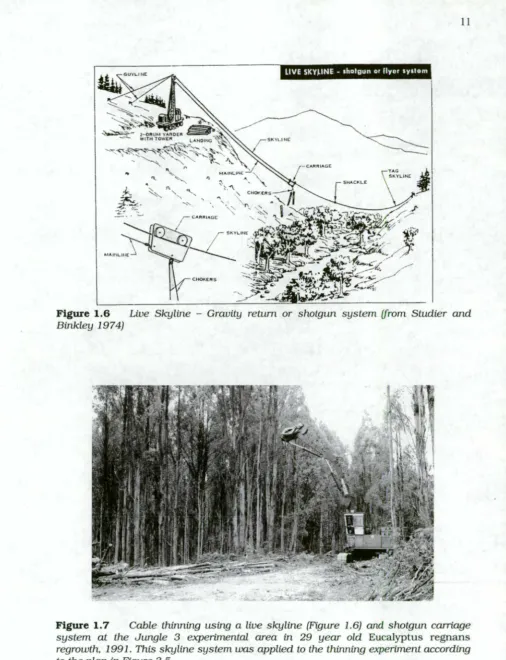
Figure 1.6 Live Skyline - Gravity return or shotgWl system (from Studier and
Binkley 197 4)
Figure 1.7 Cable thinning using a live skyline (Figure 1.6) and shotgun carriage
RUNNING SKYLINE with mechanical grapple
Figure 1.8 Live Skyline - swing yarder with mechanical grapple (from Studier and Binkley 1974)
SLACK LINE SYSTEM
-M091L.£ 5P°"'
/
/ HA.ULAIACK LINE / /
-
/--
-
~·
,.,... / / , ,,,,. ./. / / ' / ,---
·/ , / / 'r ~
,_ / / /'
/
/
Figure 1.10 Live Skyline - slackline system {from Studier and Binkley 1974)
Figure 1.11 Live Skyline - slackline system in use at Roses Tier 142a, north
Highlead Systems
The .term highlead refers to the position of the mainline lead block that is elevated
above the ground by a spar (Figure 1.12). The mainline provides some upward lift to
the choked end of the log above the ground, reducing drag and helping it avoid
obstacles (such as boulders and cut stumps). In highlead·systems vertical lift to the
logs depends upon the height of the mainline block, the ground slope proftle, the
distance of the log from the spar and the breaking capacity of the haul back drum.
Highleading is reported in forest management records as being widely used for cable
logging operations in the Florentine Valley of southern Tasmania from the 1960s
onward. The precise nature of the cable logging system used is not however
described, but it appears to have involved several Madill yarders and either fixed or
mobile tall holds (see Figure 1.12). Similar cable logging systems were also used for
cable logging relatively flat areas in the Florentine Valley bottoms from the 1960's.
Log suspension would have been minimal due to the combination of large logs and
poor deflection, and anecdotal reports by forest industry personn.el suggest
considerable soil disturbance could occur.
Figure 1.12 Live Skyline - highlead. system (from Studier and Binkley 197 4)
Ground-based logging systems on steep slopes in Tasmania
Mechanised ground-based logging has been used sporadically in Tasmania on steep
slopes since the late 1960s, often in association with the logging of more gentle
slopes within the one logging operation. The primary areas ·are the north east
Picton). As an example, the proportion of steep land logged using ground-based systems in the southern forests over a thirty year period averaged only 11.3% (Figure 1.13).
100 90 80
-0
.,
70
~
...
.,
60
=
.,
Oil
.,
50...
El
slopes > 30%"'
.,
40
...
"'
...
0 30 '$.
20 10 0
1960 1965 1970 1975 1980 1985 1990 year regenerated
Figure 1.13 The proportion of steep slopes (>30%) relative to shallow slopes (<30%)
logged in the Tasmanian Southern Forests between 1961 and 1991, source: Forestry
Tasmania.
technologies, coinciding with the introduction of the Tasmanian Forest Practices
Code in 1987, resulted in reduced soil disturbance, both in extent and intensity.
Silvicultural systems applied to steep slopes in Tasmania
Silviculture can be ~efmed as the theory and practice of managing forest
establishment, composition, and growth, to achieve specified objectives (NRE 1996).
Cable logging is predominantly associated with clearfell or clearcut logging, however
it is also used (though less commonly) in shelterwood systems (Tesch et al. 1986),
strip felling systems (Saniga 1988), group selection systems (Shaffer et al. 1993),
and coppice systems (Verani 1995). The Tasmanian experience to date has been
limited to applying cable logging to a clearfell • silvicultural regime, with the
exception of regrowth cable thinning and the retention of wedge shaped portions of
rainforest between settings on some cable logging operations in north eastern
Tasmania from the 1990's. The standard silvicultural technique for the regeneration
of the eucalypt overstorey of the cable logged wet and mixed forests in Tasmania
examined in this thesis was to clearfell, bum and broadcast sow on the ash-bed
(Pryor 1960, Renbuss et al. 1973, Chambers and Attiwill 1994) with eucalypt seed,
following the techniques initially described by Gilbert and Cunningham (1972).
Clearfelling is also the most operationally efficient logging method as any retained
stems (apart from those in the streamside reserves) are likely to interfere with the
set up and operation of the cable system.
1.5 DiJ:ferences between environmental effects of cable and
ground-based logging of steep slopes
Cable and ground-based logging systems vary in both their localised and broader
spatial effects on vegetation. Ground-based systems disturb a greater proportion of
the logging area with landings and trails, and do so with a greater intensity of soil
displacement and compaction, and litter disturbance (Table 1.2). The difference
relate to the method used to snig logs from the stump to the landing,· and the soil
disturbance resulting from this practice. Ground~based logging, more than cable
logging, results in a more variable pattern of ground disturbance, with areas of
intense disturbance separated by areas of no disturbance. Areas of vegetation
undisturbed by snigging, referred to as understorey islands by Ough and Murphy
( 1998) and Hickey et al. ( 1998, 2001) may assist the persistence of species that rely
on vegetative regeneration post-logging and burning. The vegetation of clearfelled
cable logged areas will usually be uniformly flattened, either by log falling, log
yarding, or the sideways movement of the cable skyline or mainline during log
Table 1.3 General comparison of cable and ground-based logging systems. Attributes at the planning stage that can impact directly or indirectly vegetation are indicated.
!VARIABLE
CABLE SYSTEM
GRO~=-_J
STANDING SKYLINE LIVE SKYLINE - LIVE SKYLINE - SKID DER
I
GRAPPLE, SWING HIGHLEAD ~~-~~-~~~-~~~Coupe size ~50ha ~50ha ~50ha <lOOha
Coupe shape Regular Regular Regular Variable
Productive yardlng distance 500m 150-200m 200-300m <300m
Types of settings Variable, commonly fan shaped Tall hold perpendicular to yarder As for skyline Variable Preferred yarding direction Uphill or downhill Uphill, moderate downhill OK Uphill, moderate downhill OK Downhill
Road intensity Low Moderate Moderate Moderate to high
Road quality Steeper side cuts, adequate cross As for skyline As for skyline Not a major consideration,
drainage necessary covered by Code
Landing position Centralised on knolls & ridges Continuous Centralised on knolls & ridges Variable, usually drier areas Landing size Relatively large Smaller or absent when logs are Variable Usually smaller
landed on road
Landing number /ha 1per6.4 ha 1per0.6ha
(Miller and Sirois 1986) (Miller and Sirois 1986)
Landing% coupe area 4.1 % (Miller and Sirois 1986) Greater proportion
10% (Jncertl et al. 1987) Shape of slope Concave or even, important for Uniform slope for yarder visibility Concave or even Even
deflection required
Preferred slope Steep to very steep, minimum Moderate slopes Up to moderate slopes Up to 30% slope of 20% with gravity systems
Downhill yarding ability Good Reasonable on moderate slopes Reasonable on moderate slopes Up to 30%
Table 1.3 (cont.) General comparison of cable and ground-based logging systems. Attributes at the logging stage that can impact
directly or indirectly veQetation are indicated.
VARIABLE
Wet soil conditions Terrain conditions
Soll disturbance
% of surface disturbed
% soil compacted
% litter disturbance
% of coupe area as spur · roads
STANDING SKYLINE
OK
CABLE SYSTEM LIVE SKYLINE
-GRAPPLE, SWING
OK
Steep to very steep, broken, rocks Generally even slopes, rocks OK, and gullies OK up to moderate slopes
Light to moderate (full or partial Light suspension)
. 0.45% (J. Cunningham pers. comm. 1993),
1. 75% (Basari et al. 1997) 11 % (Laffan et al. 2001)
3.8% (Miller and Sirois 1986)
0.49%
(J. Cunningham pers. comm.
1993)
2.6%
3% (Patrie and Gorman 1978)
LIVE SKYLINE -HIGHLEAD
OK
Up to moderate slopes, broken terrain, rocks generally OK Moderate, logs 'dragging'
10% (Watt and Krag 1988) 1.4-1.5% (Bennett 1997)
9.1 (Sarre 1993)
GROUND-BASED SKID DER
Increased soil disturbance Even slopes, dry, up to 30%
slope
Moderate to severe (rutting and puddling In wet weather)
19.6-20.3% (Watt and Krag
1988)
60-80% (Rab 1996)
8-20% (Roberts and Xhu 1998) 23% (Wronski 1984)
25% (Ryan etaL 1992) 1 7-61 % (Smith et al. 1988) 9. 7% (Miller and Sirois 1986) 26.9 (Dryness 1965)
20% (Lacey et al. 1994) 23% (Wronski 1984) 11-30% (Murphy 1982) 65% (Ryan et al. 1982) 40-60% (van Rees et al. 2001)
Table 1.3 (cont.) General comparison of cable and ground-based logging systems. Attributes at the logging stage that can impact directly or indirectly vegetation are indicated.
VARIABLE STANDING SKYLINE
CABLE SYSTEM LIVE SKYLINE -GRAPPLE, SWING
l _______ ---~·
% of coupe areas cable corridors/skid trails
Good deflection Tail holds
Damage to retained trees thinning
Retention of streams!de reserve vegetation
Logging away from streamsiqe reserve
Piece size variation
Residue volume per unit area
Residue distribution throughout coupe area
9.2% (Miller and Sirois 1986) 7% (Laffan et aL 2001 I
Essential Essential
23.6% (Sarre 1993)
<5% (J. Cunningham pers. comm. 1993)
minimal (Han et aL 2000) Logs can be fully suspended (but damage to trees in corridors)
Essential for visibility Mobile tailspar
8-10% (Fairweather 1991)
OK OK. as continuous landing
Less difficulty where choker lines As for grapple used
volume greater than ground- As for skyline based logging (Woodward and
Henry 1985) More continuous
LIVE SKYLINE -HIGHLEAD
GROUND-BASED SKID DER
- - - ---·-· --- _ _ _ _ _ _ _ _ _ _ _ _ _ _ _ J
Not critical Essential 56. 7 (Sarre 1993)
10-12% and 34-37% (Bennett 1997)
OK
Can reduce productivity when a ·grapple is used
As for skyline
10% (Incerti et aL 1987) 18-25% (Rab 1994, 1996) 21.4% (Miller and Sirois
1986) 28% (Dryness 1965) 9-39% (Williamson 1990) 38% (J. Cunningham pers. comm. 1993)
20% (Dykstra et aL 2000) 11-30% (Murphy 1982)
25% (Ryan et aL 1982) 14% (van Rees etaL 2001) Not applicable
Not applicable 45.5% (Sarre 1993) severe (Han et aL 2000)
Generally achievable
(van Rees et al. 2001)
Effect varies with method used to attach log
10-15% of area (Rosen et aL 1987)
Table 1.3 (cont.) General comparison of cable and ground-based logging systems. Silvicultural attributes that can impact directly or indirectly vegetation are indicated.
IVARMBLE
STANDING SKYLINE LIVE SKYLINE -CABLE SYSTEM LIVE SKYLINE - GROUND-BASED SKID DERGRAPPLE, SWING HIGHLEAD
Sllviculture ·
-S!lvicultural system used Clearfell to selective logging (but Clearfell only Clearfell Fle_xible, clearfelling to 600 m high cost of latter)
Tree retention Thinning using a gravity return No No Yes
live skyline is possible
Regeneration bum season Can be burnt later in season as As for skyline As for skyline Varies with silvicultural
fuels are continuous and on system used
steeper slopes, a better moisture differential between cut or uncut forest is present.
Regeneration bum patchiness Less patchy due to continuous As for skyline As for skyline Patchy bum possible fuels
Areas not disturbed are usually restricted to portions of the logging area where full
or partial log suspension was achieved, for example within streamside reserves.
As a general rule, cable logging results in less soil disturbance on steep slopes than
ground-based logging, both in terms of area disturbed, intensity (Dryness 1965,
Smith and Wass 1976, Patrie 1980, Miller and Sirois 1986, Watt and Krag 1988,
Sarre 1993, McMahon 1995, Hans et al. 2000, and reviews by Sauder et al. 1987,
Lousier 1990 and Krag et al. 1991) and the amount of organic matter displaced
(Minore and Weatherly 1988). The area of soil disturbed during ground-based
logging is typically twice that disturbed by cable logging (Watt and Krag 1988),
.
although the effects of soil disturbance on stream habitat due to logging method
may be masked by adequate buffers (Davies and Nelson 1994). The process of soil
being displaced and compacted during cable logging is poorly known compared to
ground-based logging, where most of the soil compaction from yarding occurs in
the first 1-3 machine passes (Amaranthus and Steinfeld 1997, Wronski 1984,
Williamson and Neilson 2000). However, with cable systems, there are no published
studies examining role of the number of cable passes on the creation of draglines or
soil and litter disturbance.
Cable logging systems are not uniform in their site impacts. Studies of soil
disturbance on steep slopes following cable logging using either skyline (Dryness
1967}, highlead (Krag et al. 1986, Dryness 1965, Borhan et al. 1990) or grapple
systems (Schwab and Watt 1981) indicate that skyline systems result in the least
soil disturbance. A moderate amount of soil disturbance occurs with the highlead
system, and the greatest soil disturbance occurs with a grapple system (Henderson
1993). Variation between these cable logging systems in resulting soil disturbance
are primarily a consequence of the way logs are yarded from the stump to the
landing. Draglines form when logs are yarded (i.e. hauled) from a stump to a
landing and the log is partially suspended and gouges a path or dragline in the soil.
Draglines can be sub-divided. into two forms,_ plowing and rutting/ gouging
(Cummins 1982, Figure 1.14). The term draglines is used in this thesis, although
this type of soil disturbance can be alternately referred to as cable ways, cable
runs, cable roads (Madden 1991}, butt gouges (Smith and Wass 1976), cable
corridors (Miller and Sirois 1986) and haul paths (Fransen 1998). Uphill yarded
logs tend to form a narrow dragline, whereas downhill yarded logs tend to zig-zag
as the weight of the log is not supported by the choker and wider draglines form.
PLOWING
"
GROUND LEVELl•:1
==========')11
==SOIL====:'.:'
GROUND LEVEL
RUTTING ·
Figure 1.14 Plowing and rutting of logs during cable logging results in dragline or
butt gouges in the soil surface (from Cummins 1982).
A light scraping of the ground surface is considered inevitable during cable log
yarding because one end of the log is usually in contact with the ground at all
times (Krag et al. 1986). Payload analyses suggest draglines are most likely on slope
mid-span ridges (McMahon 1995) and convex slopes (Krag et al. 1986) (see Figure
1.16). Draglines typically form a radiating pattern from centralised upslope
landings on ridge tops (e.g Figure 1.15) where the yarder is stationary.
Draglines can contribute to mass wasting (Sauder and Wellburn 1987), soil
depletion (Fransen 1998) and retard vegetation re-establishment (Smith and Wass
1976, Fransen 1998). Draglines less than 5 cm deep restricted to the litter layer are
considered shallow disturbance, while deeper disturbance occurs where a
compacted, base. forms._ in .. the .. dragline._.that. .is. capable. of _accumulating .. and
redirecting water into adjacent areas (Sauder and Wellburn 1987). The soils of
draglines differ from adjacent soils by their reduced hydraulic conductivity and
increased bulk density (Purser and Cundy 1992), reduced organic matter (Guo et
al. 1997, Laffan et al. 2001) and a propensity to actively erode in the short term
(Fransen 1998). The vegetation of draglines, compared to adjacent logged c
vegetation, is typically reduced .in vegetation cover, at least in the short term
(Fransen 1998). although differences between draglines and adjacent vegetation in
attributes such as seedling growth and vegetation composition will decrease with
[image:29.562.50.480.68.336.2]Figure 1.16 Typicalpattem of radiating draglinesjrom a central landing, Branches Creek, northern Tasmania, May 1993.
1
.
6 Experimental approaches
The principal experimental approaches adopted in this thesis were chronosequence
surveys and long term permanent plot or individual plant monitoring. The
strengths and weaknesses of these approaches are presented in Tables 1.4 and 1.5.
Alternate terms for the chronosequence method include retrospective surveys
(Davis 1989). the dynamic approach (Austin 1977). spare-for-time substitution
(Pickett 1989) and cross-section analysis. Long terms studies (Pickett 1989) are
alternately known as longitudinal studies (Likens 1989) and the static approach
(Austin 1977). Chronosequence studies aim to extrapolate a temporal trend from a
suite of samples of different ages where the sites are chosen to be as equivalent as
possible in all factors which may influence vegetation composition, so that
differences between them can be largely attributed to age. It assumes the past (ie.
abiotic and biotic factors influencing dispersal, establishment and growth and any
priority effects related to previous ecological states of the system) have been the
same on the sites examined in the chronosequence. In this case the past also
includes the type of harvesting and regeneration practices applied. Chronosequence
studies can also generate hypotheses which can be tested by long-term monitoring
or ecological experimentation. They are relatively common in forest disturbance
studies, providing an ability to rapidly predict plant community responses to
Table 1.4 Long tenn monitoring studies, weaknesses and strengths
Strengths Weaknesses
• probably the definitive method for studying succession
• studying only one site could result in effects· peculiar to that site being recorded, limiting the ability to extrapolate
• ability to expose mechanisms controlling • successional dynamics
• ability to detect autogenic phenomena • (with contiguous quadrats)
• ability to distinguish seasonal and short- • term fluctuations from long-term trends (with sampling at sufficient intervals) • when replicated at different locations, •
local chance events can be recognised and spatial heterogeneity in harvesting effects measure
• ability to describe seasonal effects in the • vegetation response
outcome of monitoring can be time dependent
lack of clear protocols established for subsequent researchers to trace the initial procedures and measurements, subtle differences in research
methodology over time can significantly affect the outcomes
spatial heterogeneity in treatment areas may effect ability to attribute
compositional changes to the treatment
studies extending over decades may be impractical or even impossible because of random disturbances
Table 1.5 Chronosequence analyses, weaknesses and strengths
Strengths Weaknesses
• ability to expose general or qualitative • fails where the unrecognised effects of the past were of a large magnitude or where controlling the variables such as climate, soils or certain historical factors was not possible across the study trends, regional averages or coarse scale
patterns
• can be applied with confidence to sites • fails where site history determination has been poor or where some of the independent variables are too coarse to control compositional variation which may obscure the experimental response. sufficient replicate sites may be a limiting factor
or regions with a history of initial and post-disturbance conditions
• ability to document variability among • replicate sites and expose spatial
variation
• works best in systems acknowledged to • choosing sites to represent the terminus of succession is difficult
have strong successional dynamics
• ability to generate hypotheses.by • historical .data may not.be adequate. to determine if past harvesting practices were comparable to modem clearfelling correlating vegetation patterns with
environmental or structural features of the forest.
• sampling intervals are frequently too large to allow trends to be predicted with any known variance
• the non-random nature of timber harvesting activities makes it difficult or impossible to randomly sample
Long-term studies, as studies of succession, have the ability to ~xpose mechanisms controlling successional dynamics instead of relying on the correlative approach of chronosequence studies. They also describe finer scale patterns in compositional change. Both of the above approaches have their inherent strengths and weaknesses when applied to field based logging experiments (Peacock and Duncan 1993, Table 1.4, 1.5). Chronosequence studies can proVide the general background necessary for interpreting and extending the time frame of long-term studies (Davis 1989), while long term studies, being time consuming to establish, qocument and design, can provide a particularly powerful means of testing hypotheses (generated from chronosequence studies) concerning logging effects on veget~tion.
Complementary studies using both chronosequence and long term approaches are uncommon in the forest ecology (e.g. the sand mining regeneration studies of Twigg
et al. 1989) and have been established in this thesis. The validity of the chronosequences described in this thesis are tested with data from long term monitoring plots, established at the same time, in similar environments. and with the same logging systems.
1.
7Aims of the thesis
The primary objective of this thesis is to examine the response of vegetation cover, richness and composition to the choice of logging method, cable or ground~based,
on steep slopes.
The thesis is divided into five experimental chapters.
Chapter 2 examines two forest types; wet eucalypt forest and dry shrubby forest and analyses their response to cable and ground-based logging. The analyses presented are restricted to woody and herbaceous plant species. Variation in vegetative responses are related to logging method and initial forest type using both chronosequence and long term monitoring approaches. The hypothesis tested is that the different nature of ground-based and cable logging impacts on the physical environment will result in differing vegetation responses.
reserves are normally delineated within production forests in order to protect
streamside habitats their ability to also provide for ecologically stable vegetation is
questioned. Streamside vegetation provides the interface between the terrestrial
and aquatic environment and contains a range of species and growth forms
susceptible to logging induced micro-climatic change. Streamside vegetation
structure can be significantly altered by some cable logging systems.
Chapter 5 examines the response of D. Wltarctica (Soft tree-fem) to cable and
ground-based logging. D. antarctica has a poor regenerative response after
ground-based logging and burning, attributed by Ough and Murphy (1997) to mechanical
disturbance from logging. D. Wltarctica is an important species in wet forest
environments as it acts as a host species for a range of vascular epiphytes. Its
logging response is hypothesised to have a significant role in the ability of late
successional specialist species (dependent on its substrate for germination) to
recolonise regrowth vegetation following logging and burning.
Chapter 6 addresses the regenerative response of vascular epiphytes to cable and
ground-based logging. The limited existing data indicates that vascular epiphytes
are uncommon in regrowth forest, and less common in regrowth forest originating
from logging than from wildfire (Hickey 1994, Ough 2001). Observations from
overseas studies suggest that forests regenerating following cable and
ground-based logging differ in the proportion of woody debris or ecological legacies from the
previous forest stand. Epiphytes are known from studies in boreal forests and
tropical ecosystems to require a range of substrates, including woody debris and
bark surfaces, as host substrates. The logging method employed may therefore
restrict the ability of the late successional specialists to recolonise sites
post-logging and burning.
Chapter 7 assesses the results of the five experimental chapters in terms of the
contemporary: understanding, of. post-logging. vegetation dynamics,.·. and the
CHAPTER 2 EFFECTS OF CABLE AND GROUND-BASED LOGGING
ON WOODY AND HERBACEOUS SPECIES IN TASMANIAN
FORESTS ...
28
2.1 Introduction ... 28
2.2 Methods ... ~ ... 30 Experiment 1: Chronosequence analysis comparing the response of woody and herbaceous species to cable and ground-based logging ... 30
Study Areas ... : ... 30 Survey Design ... : ... 33 Sampling Methods ... _. ... 3 7 Analytical Procedures ... 39 Experiment 2: Impacts of cable and ground-based logging on the frequency and cover of woody and herbaceous vascular in wet and dry forests ... .44
Study Areas ... 44 Survey Design ... 4 7 Sampling Methods ... 4 7 Analytical Procedures ... 57
2.3 Results ... 59 Experiment 1: Chroriosequence analysis comparing the response of woody and herbaceous species to cable and ground-based logging ... 59
Adequacy of the Experimental Design ... 59 Patterns of Secondary Succession in Cable Logged Wet Forest... ... 60
Chronosequence Analysis of Ground-Based Logging in Wet Forest ... ~ .... 65
Adequacy of the Experimental Design ... 65 Patterns of Secondary Succession in Ground-Based Logged in Wet Forest ... 66 Chronosequence Analysis Comparing Cable and Ground-Based Logging in Wet Forest ... 71
Experiment 2: Impacts of cable and ground-based logging on the frequency and cover of woody and herbaceous vascular in wet and dry forests ... 80
Short Term Effects of Cable Logging in Wet Forest ... 80 Comparitive Short Term Effects of Cable and Ground-Based Logging in Dry Forest ... 86
Chapter 2 Effects of cable and ground-based logging on
woody and herbaceous species in Tasmanian forests
2.1 Introduction
Cable logging has been used for decades in north western USA, Canada, Alaska,
New Zealand and Europe under a wide variety of operational scales, yet the global
literature on its effects on vegetation is limited, compared to the literature available
on its effect on soils (eg. Watt and Krag 1988, McMahon 1995, Davis and Nelson
1993, Laffan et al. 2001) and damage to retained stems (eg. Fairweather 1991,
Sarre 1993, Han et al. 2000). Compounding the general. absence of studies of cable
logging effects on vegetation, the relatively extensive literature initiated in the
1960's (eg. Cremer and Mount 1965, Young et al. 1967) on vegetation dynamics
following ground-based logging does not address the comparative response of
vegetation to cable and ground-based logging.
The comparative review of cable and ground-based logging techniques (Chapter 1)
indicated they differ principally in the degree of soil disturbance and the
distribution of woody debris across the logging area, assuming all other factors
such as wood utilisation standards and regeneration treatmertts are equal. These
differences have been the focus of most of the existing vegetation studies of cable
logging. Cable logged and burnt areas are also less effected by soil compaction and
humus loss than similar areas·logged with ground-based machines where debris is
piled prior to burning (Minore and Weatherly 1988). Cable logged sites can also
exhibit greater seedling growth potential (Minore and Weatherly 1990).
Studies that compare the effects on vegetation of cable and ground-based logging
are scarce (Tappeiner et al. 1991). However, their scarcity may be exaggerated by
authors from Canada and Noryn America only describing the logging method used
as clearcut or clearfell and omitting that it was achieved by cable or ground-based
methods .. Apart. from those .studies.concerned. with.draglines (Fransen_ 1998,.Smith _
and Wass 1976), only Pinard et al. (1998) and Woodward (1986) have directly
compared the vegetation response of similar environments logged by either cable or
ground-based methods. Pinard et al. (1998) did so by planting rainforest tree
seedlings into a logged forest and concluded the improved growth rates on cable
(high-lead) sites 13 years later was the result of less soil compaction compared to
the ground-based logged sites. A similar conclusion, ie. that soil compaction from
·ground-based logging can retard the post-logging vegetation response, was reached
by Jones et al. (2000) in a comparative study of helicopter and ground-based
advanced regeneration and result in less site invasion by disturbance adapted
understorey and herbaceous species (Carleton and MacLellan 1994, Gottfried 1987,
Carleton 1988, Pominville 1993). On the other hand, a similar study of seedling
mortality, tree damage and recolonisation rates following high-lead cable and
ground-based logging gave opposing results (Borhan et al. 1990). An examination of
the short term (< 10 year old) response of understorey vegetation in a relatively
species poor forest of coast redwood (Sequoia sempervirens) in California indicated
that the regenerating understorey following cable logging had almost 50% more
cover compared to ground-based logging, and that the vegetation resulting from
either logging method began to converge in these characteristics on moist sites
seven years post-logging (Woodward 1986). Differences in vegetation response
attributed to logging method, whether they are measured in terms of the
re-establishment of vegetation cover (Woodward 1986), or of regeneration damaged
during log yarding (Pothier 1996) can become less apparent five to seven years after
treatment.
Existing studies of the response of vegetation in Australia to logging have only
examined ground-based sites, and of those, several have considered mechanical
disturbance to the soil and vegetation as being central to their interpretation of the
resulting post-logging patterns (Ough and Murphy 1997, 1999). Not only is there a
significant gap in the literature examining floristic change to cable logging, there is
no published study comparing floristic change to cable and ground-based logging.
The current chapter addresses the null hypothesis that there is no difference in the
response of woody and herbaceous species· in Tasmanian forests to cable or
2.2
Methods
Two studies examining the response of woody and herbaceous species to cable and
ground-based logging are presented in this chapter;
1. a chronosequence analysis of the response of woody and herbaceous species
to cable and ground-based logging in wet forest in southern and central Tasmania
2. a long term monitoring study using permanent quadrats examining (a) the
impacts of cable logging on woody and herbaceous species in wet forests in the
upper Florentine Valley of central Tasmania, and (b) the impacts of cable and
ground-based logging on woody and herbaceous species in dry forest at Wielangta
in eastern Tasmania
The environments examined in this chapter are steep slopes in Tasmania logged by
either cable or ground-based methods in which wet forest (Kirkpatrick et al. 1988),
or dry forest (Duncan and Brown 1985) are present. This chapter presents research
on woody and herbaceous species. Studies in later chapters using these
experiments present data on Dicksonia antarctica and vascular epiphytes.
Experiment 1: Chronosequence analysis comparing the response
of woody and herbaceous species to cable and ground-based
logging.
Study
AreasThe selection of field study locations is important to a study of this kind. A number
of key factors enhanced the overall research design: First, as a member of a forest
agency, access to both industry and government forest records and private and
government forested areas was possible. Secondly, the· forest agencies Geographic
Information System (GIS) was used for survey stratification, quadrat selection and
mapping. Thirdly, access to current logging operations was possible including an
ability to ensure a consistent application of the cable and ground-based
experimental logging treatments. Fourthly, Government and industry support
enabled the field research to be supported with labour and aircraft hire for large
scale aerial photography. Finally, the implementation of this field research was
made considerably easier by the authors experience with similar studies elsewhere
(Mueck and Peacock 1992, Peacock 1995).
The chronosequence study involved two regions, one forest type and two logging
methods, cable or ground-based. Two regions were chosen to conduct the
chronosequence studies were the Florentine, Styx, and Tyenna Valleys in central
Florentine Styx, and Tyenna Valleys have one of the longest continuous histories of
cable and steep country logging in Tasmania (and therefore Australia) and
represents one of the most suitable areas to carry out such a study in
south-eastem Australia. The Arve Valley is the most comparable environment to the
Florentine Valley and differs by a lack of logging using contemporary cable logging
technology. Seventeen coupes were surveyed for the cable logged wet forest
chronosequence in the Florentine, Styx, and Tyenna Valleys, and eleven for the
ground-based logged wet forest chronosequence in the Arve Valley in southern
Tasmania (Table 2.1 and 2.2).
•
.,
.
:.
. /""'nchs
c ... ,
l..oatta • •
I . .
/r ,f' 1 " .o. t"·., \§::':··i
-\~~ ~
•• fftf!j
~' q~'fj· ol>~
~ -~"'
-~
.
....
I..."'
JM!!t. •
Wayatinah~
Florentine
Valley•
'
.•RosesT181'
4
~