USAGE OF GESTURES ALONG WITH OTHER INTERACTION MODES IN COLLABORATIVE DESIGN
Gokula Vasantha1, Jonathan Corney Hari Prakash Ramesh, Chandra Mouli
Sugavanam, Amaresh Chakrabarti2
Design Manufacture and Engineering Management Centre for Product Design and Manufacturing University of Strathclyde Indian Institute of Science
Glasgow, G1 1XJ, UK Bangalore, India
1[email protected] 2[email protected]
ABSTRACT
Currently many computer-aided multi-modal interaction tools are under development, and some have demonstrated their applications in design. To avoid disruptive transformation from current design tools to multi-modal designing, there is a need for several descriptive studies to understand commonly used interaction modes in design. To understand how gestures are amalgamated in collaborative design while using current design tools, a set of laboratory experiments were conducted with a pair of designers working together to solve a design problem. The two objectives of this paper are: 1. Which interaction mode, among verbal, gestural, textual, graphical, and combination of these, dominates in collaborative designing? and 2. How do these interaction modes change across design stages (requirement identification, development of preliminary concepts, concepts elaboration, evaluation, and detailing of chosen concepts)? The results aim to provide directions to develop new design tools which are aligned with designer’s current interaction patterns as observed in using conventional CAD design tools.
Keywords: gesture, collaborative design, interaction, design tool.
1 INTRODUCTION
Customer’s product requirements are increasingly demanding and challenging in this globalised world. Such requirements e.g. innovative products and services, reduced time to market, and wider coverage of product’s life cycle issues in early design demands productive and efficient design tools to support engineers. It has been widely cited in literature that developing three dimensional shapes with one and two dimensional tools such as keypad and mouse along with windows–icons–menu– pointer (WIMP) is unintuitive (Chu et al. 1997) and constrain engineers from exploring wider space of design solutions (Varga, 2008). Also, current CAD tools are criticized for consuming more time to learn and use appropriately (Kou et al. 2010), and for increasing premature fixation (Robertson and Radcliffe, 2009). Alternatively, paper and pencil as a tool also have limitations such as difficulty in communicating ideas and increasing time for recreating the ideas in CAD systems.
Currently many design tools are under development for aiding intuitive product development. These tools either support a single sensory user interface such as gesture recognition, or collectively support a combination of multi-sensory interactions such as gesture, voice, and tactile feedbacks. These tools intend to provide importance to human motions to create more involving and interesting virtual experiences in product development. Such tools could allow multiple transformations at a time, e.g. rotation and translation together. Although these new supportive design tools aim to provide more natural human-computer interaction that are intuitive and accessible, their acceptance by engineers and industry are very limited. One of the reasons could be due to the fact that these design tools lead to disruptive transformations from current design tools interactions. These transformations need to be studied in-detail such that new design tools could be better aligned with designers’ current interaction patterns as derived from their use of conventional CAD design tools over a prolonged period of time.
multi-modal design studies and latest tools proposed in literature, research questions and methodology, results obtained from descriptive studies, and conclusions and further work.
2 RELATED LITERATURE
Designers rated that they were satisfied only with the average value of 3.31 on a Likert scale of 1 to 5 (1-most dissatisfied and 5-most satisfied) for overall design functions in traditional CAD systems, and on the average value of 3.12 with user interfaces (UI) (Ye et al. 2006). To support advanced design functions and UIs, many advanced CAD design tools are in development to support designers to develop quicker and more creative designs through natural and intuitive human-computer and human-human interfaces. Various input and output systems are explored such as eye motion tracking, auditory information, gesture tracing and haptic feedback. Kou et al. (2010) demonstrated knowledge-guided inference for voice-enabled CAD. The key advancement in this work is to implement a flexible voice-enabled CAD system, where users are no longer constrained by predefined commands. The critical benefit of this work could be eliminating the chance of design intent misinterpretation and capturing user intent effectively. Kou et al. demonstrated that 40-50% of mouse movement can be reduced using the proposed voice-enabled CAD system. Jowers et al. (2013) evaluated an eye tracking interface for a two-dimensional sketch editor, whereas Fuge et al. (2012) proposed three-dimensional (3D) sketch-based user input for rapid creation and modification of freeform surfaces inside an augmented reality environment involving a glove-based interface and a head-mounted display.
Vinayak et al. (2013) developed a hand gesture based interactive, creative-expression system for creating 3D shapes using intelligent generalized cylinders. The authors’ claim that this system allows for faster creation of 3D shapes with minimal training. Along with single mechanism development, many multiple interaction mechanisms have been demonstrated. Song et al. (2014) proposed gaze and finger control interface for 3D model manipulation in CAD application. They reported that independent gaze pointing interfaces increase the intuitiveness of zooming task, and support user experience with higher intuitiveness than a mouse. MozArt prototype interface (speech and touch) explored multimodal inputs for conceptual 3D modelling for novice CAD users (Sharma et al. 2011). Ye et al. (2006) developed LUCID system by mapping designers’ requirements such as simple, natural, easy, direct sensory feedback, intuitive and 3D sketching into two-handed operation, haptic interaction, stereoscopic display, sound feedback, and 3D input and output systems. The VR-based HCIs so developed had received higher values than traditional mouse/keyboard interfaces. Lastly, brain–computer interface headsets for 3D CAD modelling for substituting conventional computer mouse- and keyboard-based inputs are also studied (Shankar and Rai, 2014).
Despite the significant amount of research in this area, it has been noted that still none of these VR-based CAD systems have made an impact on conventional CAD systems’ evolution (Ye et al. 2006). Ye et al. (2006) highlighted that in order to provide more responsive user interfaces (UIs) for conceptual design, there is a need for high level, understandable and effective UI specifications from practical case studies. They noted that these identified UI specifications should reveal the real needs and expectations from designers when they perform design work using CAD systems.
effective in operation activations such as rotating viewpoint, creating entities, and deleting entities; the hand and locator with its pointing beam and button clicking inputs were found to be highly effective for navigation, entity selection, and in 3D re-location of entities. Hand actions and motions were also found to be useful for complex 3D manipulations of entities and for dynamically changing an entity’s dimension in the VR-CAD system (Chu et al. 2002). They claimed that VR system could be most useful when there are more design steps, which may be required to create complex parts. The traditional systems could consume 3 to 4 times the time taken in VR systems to create complex parts.
Although evaluation of VR systems claimed that they are natural, intuitive, has effective interface and are less time consuming than conventional CAD systems, still conventional CAD systems are mostly in-practice. We postulate that the acceptance rate of advanced CAD systems could be high, if these systems were aligned with designer’s interaction modes derived from using conventional CAD systems. In this paper, we studied the most frequently used interaction modes in collaborative design using conventional CAD tools. We believe that these results provide directions to develop advanced design tools which are better aligned with a designer’s current interactions patterns, and augments well with conventional CAD design tools.
3 RESEARCH QUESTIONS AND METHODOLOGY
To avoid disruptive transformation from current conventional CAD tools to multi-modal designing, there is a need for several descriptive studies to understand the commonly used interaction modes in design with conventional CAD tools. To understand interaction modes in collaborative design while using conventional CAD tools, the following research questions are addressed in this paper:
1. Which interaction modes among verbal (voice-based), gesture (body motion to convey information), text, graphical, and combination of those dominate in collaborative designing?
a. How do interaction modes vary between original and redesign processes?
2. How do interaction modes vary across a design process (requirement identification, preliminary concepts, concepts elaboration, evaluation and detailing of chosen concepts)? 3. How do interaction modes vary with product and process information?
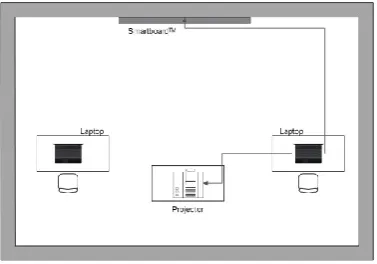
To answer these questions, a set of laboratory experiments were conducted with a pair of two designers working together to solve a design problem. Table 1 illustrates the structure of the design experiments conducted. We conducted three experiments each in the original and redesign processes. Each group worked on a different design problem to facilitate understanding on variety of interaction modes used in design. Figure 1 illustrates the experimental set-up used to conduct collaborative design. We used two laptops and a SMART BoardTM for all six experiments. We have chosen Rhinoceros® CAD as the conceptual CAD software for these experiments. All the original design
documents were given at the start in the redesign experiments. The research questions are answered from captured video recordings and transcribed audio protocols. Table 2 shows a sample transcription and coding of interaction modes. We used verbal, gesture, text, graphical, and combination of those to classify interaction modes. Product- and process are classified based on whether each transcribed portion is concerned about objects being designed or about how to design.
Table 1: Structure of the design experiments. Original Design Redesign
Design problem P1 P2 P3 P1’ P2’ P3’
Design group (two designers)
G1 G2 G3 G4 G5 G6
Table 2: Sample transcription coding for interaction modes.
Design protocol transcription Design stage Product/Process Interaction modes filters in that headphone; I thought the
noise is coming outside that system..
Requirement Identification
Product
V
ya its outside the system.. RI Product V
Figure 1: Experimental set-up of collaborative design.
4 RESULTS
The subsequent sub-sections answered the research questions from the analyses of the six experiments.
4.1 Interaction modes
Figure 2 illustrates the distribution of usage of interaction modes in the original and redesign experiments. It is quite clear from this figure that the interaction modes ‘only verbal’, and ‘verbal and gesture’ are most frequently used in both original and redesign experiments. These interactions together occupy 81.2% (53.9% and 27.2%) and 86.5% (65% and 21.5%) of interaction occurrences in the original and redesign experiments respectively. It is worth noting that the occurrences of interaction modes are almost similar irrespective of different design problems and designers in the six groups. These results illustrate that although multi-modal interactions are required in designing, developing advanced systems with complete mix of eye motion, voice commands, hand motion/gesture (tactile), 3D stereoscopic vision, auditory and haptic feedback could lead to exaggeration and overdoing to actual needs. Another finding is that in any of the original and redesign experiments, gesture interactions have never been identified independently. Gesture interactions were either part of verbal, verbal and graphical, verbal and text, or verbal, text and graphical. This result should be taken into account before committing to the many gesture alone design tools in development.
2a. Original design 2b. Redesign
V Verbal, G Gesture, Gr Graphical, T Text
Figure 2: Interaction modes distribution in the original and redesign experiments.
4.2 Interaction modes across design stages
[image:4.595.66.531.507.680.2]interaction dominates much in the ‘detailing concept’ stage than other initial stages. This observation is interesting because almost all the interactions in the detailing concept stage were carried out in front of Rhinoceros® CAD software. This result suggests that advanced design CAD tool should
incorporate a mode where designers are allowed to interact naturally through verbal communication without any tool usage disturbances. Another observation is that the ‘only verbal’ interactions is somewhat lower at the preliminary concept stage for both in original (10.9%) and redesign (12.8%) experiments. For the preliminary concept stage, designers had mostly used SMART BoardTM tool.
These results show that there will be changes within a single interaction mode itself for using different design tools. The ‘verbal and gesture’ interaction predominates in the detailing concept stage in the original experiments (32.9%), whereas it predominates in the concept exploration stage in the redesign experiments (33.6%). This variation illustrates how usage of the interaction modes varies between the original and redesign processes.
3a. Original design 3b. Redesign
Req Requirement identification, PC Priliminary concept, CE Concept elaboration, E
[image:5.595.72.529.236.425.2]Evaluation, DC Detailing concept
Figure 3: Interaction modes distribution across design stages in the original and redesign experiments.
4.3 Interaction modes for product and process design information
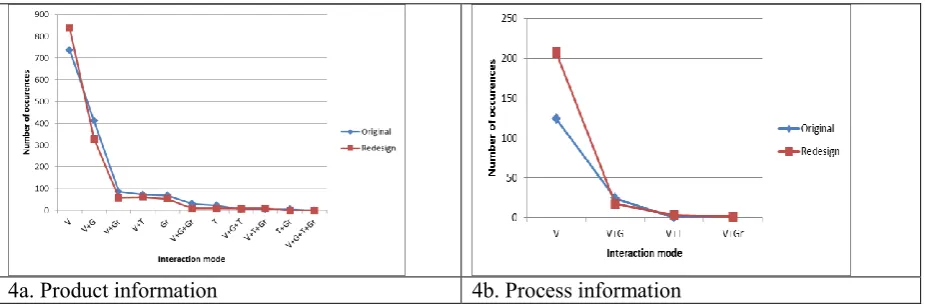
Comparing Figures 4a and 4b illustrates that the ‘only verbal’ and ‘verbal and gesture’ interaction modes predominate both in product and process design information. A very similar interactions trend between the original and redesign processes is observed for product information (Figure 4a). Product design information used eleven different types of interaction modes, whereas process information used only four interaction modes. This difference represents that product information should be supported with many interaction modes than process information.
4a. Product information 4b. Process information
[image:5.595.68.531.573.726.2]5 CONCLUSIONS AND FUTURE WORK
In this technology era, various advanced design tools are in development to support designers to produce faster designs without hindering creativity. With the possibility of rapid expansion of technology to support all senses of designers, there is a critical need to prioritize interaction modes which will have significant impact on the design process. Most of the advanced design tools reported in literature predominantly focused on shape modelling. There is a need for a broad understanding of the interaction modes across design stages. Also advanced design tools seem to give abrupt transformation to a designer’s behaviour, which has evolved over a prolonged period of conventional CAD system usage. This research aims to address some of these issues by undertaking an initial study on interaction modes used by two designers working together to solve original and redesign problems using conventional CAD and a SMART BoardTM tools. Video protocol analyses of three original and
redesign experiments observed that out of the many possible interaction modes, the designers mostly used only two interaction modes: ‘only verbal’ and ‘verbal and gesture’. These two interactions should be given priority in advanced design tools development without affecting or influencing the natural behavior of designers while designing. Since a difference in usage of interaction modes is observed for processing product and process design information, additional emphasis should be given to support variety of information appropriately. In new design tools for collaborative design, gesture interaction should be supported with verbal, graphical or text based interfaces. We are expanding this initial study for further in-depth understanding on these interaction modes across design stages, and aim to understand the best intuitive modes which could truly enhance a designer’s productivity. Further studies are required to understand influences of each interaction mode on a designer’s creativity.
REFERENCES
Chu, C. P., T. H. Dani and R. Gadh. 1997. Multi-sensory user interface for a virtual-reality-based computer aided design system. Computer-Aided Design. 29(10): 709-725.
Chu, C. P., J. Mo, and R. Gadh. 2002. A Quantitative Analysis on Virtual Reality-Based Computer Aided Design System Interfaces. Journal of Computing And Information Science In Engineering, 2: 216-223.
Fuge, M., M. E. Yumer, G. Orbay, and L. B. Kara. 2012. Conceptual design and modification of freeform surfaces using dual shape representations in augmented reality environments. Computer-Aided Design, 44: 1020–1032.
Jowers, I., M. Prats, A. McKay, and S. Garner. 2013. Evaluating an eye tracking interface for a two-dimensional sketch editor. Computer-Aided Design, 45: 923–936.
Kou, X.Y., S.K. Xue, and S.T. Tan. Knowledge-guided inference for voice-enabled CAD. 2010. Computer-Aided Design, 42: 545-557.
Robertson, B. F., and Radcliffe, D. F. (2009). Impact of CAD tools on creative problem solving in engineering design. Computer-Aided Design. 41: 136–146.
Shankar, S.S., and R. Rai. 2014. Human factors study on the usage of BCI headset for 3D CAD
modelling. Computer-Aided Design (Article in press),
http://dx.doi.org/10.1016/j.cad.2014.01.006.
Sharma, A., S. Madhvanath, Shekhawat, A. and Billinghurst, M. 2011. MozArt: a multimodal interface for conceptual 3D modeling. Proceedings of the 13th International Conference on Multimodal Interfaces. 307–10.
Song, J., S. Choa, S., Baekb, K., Lee, and H. Bang. 2014. GaFinC: Gaze and Finger Control interface for 3D model manipulation in CAD application. Computer-Aided Design. 46: 239–245.
Varga, E. 2008. Using hand motions in conceptual shape design: theories, methods and tools. Product engineering, ed. Talaba, D., and Amditis, A, 367–82, Springer, Netherlands.
Vinayak, S. Murugappan, H. Liu, K. Ramani. 2013. Shape-It-Up: Hand gesture based creative expression of 3D shapes using intelligent generalized cylinders. Computer-Aided Design, 45: 277–287.