Evaluation of The ‘You First’
Programme For Young Parents
P
o
ve
rt
EVALUATION OF YOU FIRST
Carolyn Black, Jane Eunson and Lorraine Murray, Ipsos MORI
Scotland
Professor Sarah Cunningham-Burley, Centre for Research on
Families and Relationships, University of Edinburgh
The views expressed in this report are those of the researcher and do not necessarily represent those of the Scottish Government or
Scottish Ministers.
© Crown copyright 2012
You may re-use this information (not including logos) free of charge in any format or medium, under the terms of the Open Government Licence. To view this licence, visit http://www.nationalarchives.gov.uk/doc/open-government-licence/ or write to the
Information Policy Team, The National Archives, Kew, London TW9 4DU, or e-mail: [email protected]
Table of Contents
EXECUTIVE SUMMARY 1
Background 1
Main Findings 1
1 INTRODUCTION 3
Policy background 3
The pilot 4
Programme details 5
Programme outcomes 6
Evaluation approach 7
2 METHODOLOGY 9
Analysis and reporting 10
Limitations of the research 11
3 WHAT ARE THE BENEFITS OF THE YOU FIRST PILOT PROGRAMME FOR PARENTS AND
FAMILIES? 12
Expected benefits of You First 14
Parents’ social networks and relationships 14
Parents’ mental wellbeing 15
Parents’ knowledge of child development 16
Enhanced parent-child relationships 17
Awareness of and access to sources of support and advice, learning opportunities and
careers advice 19
Practical childcare skills 21
Financial capabilities 23
Future planning capabilities for medium and long term goals 24
The SCQF qualification and the impact of You First on parents’ views about taking further
qualifications/continuing their learning 24
Personal health and risk factors 25
Wider benefits 26
4 HOW CAN THE DELIVERY OF THE PROGRAMME BE IMPROVED? 27
Programme content 27
Learning and delivery methods 27
Programme facilitators 28
Facilitator training 29
The best point in their baby’s development for parents to attend the programme 29
Programme structure 30
Session structure 30
Programme facilities and equipment 31
Support provided to parents between sessions 32
5 IS THE PROGRAMME FULFILLING ITS PERSON-CENTRED IDEALS? 33
Parents’ involvement in the design and development of the programme 33
Flexibility of the programme in adapting to the wants and needs of parents 33
Uncovering the needs and wants of parents 34
Asking private questions in the group environment 34
SQCF requirements and the person-centred approach 34
Professionals’ views on whether the person-centred approach leaves gaps in programme
6 IS THE PROGRAMME SUCCESSFULLY REACHING ITS TARGET GROUP? 36
The target group 36
Referral to the programme 37
Parents who choose not to attend the programme 39
Parents’ levels of need 39
7 HOW CAN PARENT RETENTION RATES BE IMPROVED? 40
Attendance rates 40
Parents’ motivation for attending You First 42
Reasons for not completing You First 43
Practical barriers to attendance 44
The impact of the financial incentive on initial recruitment/retention 44
8 HOW EFFECTIVE ARE THE MANAGEMENT AND SUPPORT STRUCTURES IN PLACE FOR
THE PROGRAMME? 46
The effectiveness of the management and support structures in place for the programme 46
Measuring the objectives and outcomes of the programme 46
9 WHAT IMPACT HAS THE PROGRAMME HAD ON OTHER RELATED SERVICES? 48
Fitting in with relevant local strategies and plans 48
Taking account of the local context and particular local needs 48
Linking in to other initiatives/services in the area 49
Child protection requirements 49
10CONCLUSIONS 51
Main benefits of You First 51
Areas for improvement 52
Wider Learning 55
APPENDICES
Appendix 1: You First operating specification Appendix 2: Evaluation framework
Appendix 3: SHANNARI outcomes Appendix 4: Methodology
Appendix 5: You First topics Appendix 6: Parent questionnaire
Appendix 7: Discussion guides for qualitative research with parents Appendix 8: Parent self-assessment questionnaire
Appendix 9: Discussion guides for qualitative research with professionals Appendix 10: Contributor questionnaire
EXECUTIVE SUMMARY
Background
You First was developed by Barnardo’s and funded by the Scottish Government. It targets vulnerable parents aged 21 and under, with a child under the age of one, who live in the 15% most deprived areas in Scotland. It aims to provide a boost for young, first time parents by increasing the support that they receive from their peers, the community and existing local services. The evaluation explored the benefits of the You First programme and the ways in which these could be maximised through effective delivery.
Main Findings
You First showed positive signs of helping the parents who attended. Sixty-eight per cent of those who started You First, completed it1
. They all appeared to have benefited in some way, at least saying that they had learnt something to some degree, and were pleased that they had attended.
You First parents benefited to differing extents. The three most widespread benefits were: the development of a social network; increased confidence; and greater interaction between parents and their babies. In addition to these, You First also delivered benefits that had a big impact on just a few of the parents (e.g. raising educational aspirations) and smaller benefits that many parents found useful and informative (e.g. home safety).
You First was successful in attracting parents previously defined as ‘hard to reach’. This stemmed from three main features of the referral process:
Parents were given the choice to attend You First; they were not told they had to attend. This meant that they did not feel they were being approached
because they were doing something wrong or were a ‘bad’ parent.
You First was open to those aged 21 and under, meaning that parents were not intimidated by the prospect of attending a group with older parents. Some reported that they would simply not have attended if they thought that older parents would be there.
The group was run as a cohort. This helped parents feel less nervous about attending the first session because they knew that everyone would be starting at the same time. Some parents said that they would not have attended an existing group where everybody else already knew each other.
You First created a supportive and caring atmosphere that was greatly appreciated by parents:
The parents received a high level of encouragement and reassurance from the You First facilitators. The facilitators spent a great deal of time building a rapport with the parents. They took the time to get to know them as individuals
and showed a sustained interest in their lives. This meant that parents felt welcomed and that the facilitators cared about their welfare.
You First focused on what parents were interested in and not just what they ‘should’ be doing. This non-judgemental atmosphere helped to increase parents’ self-confidence and their belief in their abilities as a parent.
Parents also received peer support at the group. Simply knowing that there were others in their situation, and spending time with those who understood what they were going through, helped parents to feel that they were doing ‘fine’; they could discuss their experiences and share any problems that they had.
Overall, the delivery of You First worked well, but was more successful in some areas of learning than others. The methods of learning that seemed most effective were: those involving practical skills and active engagement in a subject; those that did not involve too much paper work; and the explanation of the benefits of doing something rather than simply telling parents that they should do it.
You First was designed to help parents develop in the future and aid their transition into positive future pathways such as work, education or other groups in the
community that could provide them with support. The facilitators tried to encourage parents to plan for the future in three main areas:
In relation to returning to work, the facilitators linked parents to services, such as Working For Families, who could support and advise them. While many of the parents who returned to work had planned to do so before attending, these services were valuable in helping to arrange childcare and providing short-term financial support to aid the transition.
The facilitators encouraged parents to see education in a more positive light and to give more thought to completing further qualifications. While a small number of parents did take this on board, this was an area for improvement as the qualification offered at You First did not work well. More consideration should be given to introducing a new qualification to You First which would better meet the needs of parents and perhaps help to increase parents’ aspirations in this area.
1 INTRODUCTION
1.1 This report presents findings from the evaluation of the You First pilot programme, undertaken by Ipsos MORI Scotland, in collaboration with Professor Sarah Cunningham-Burley. The study was commissioned by Communities Analytical Services on behalf of the Children and Families Directorate and the Directorate for Employment, Skills and Lifelong Learning. It used a mixed method approach involving qualitative and
quantitative research with programme participants, professionals involved in delivering the programme and stakeholders. The evaluation aimed to
explore the benefits of the You First programme and the ways in which these can be maximised through effective delivery.
Policy background
1.2 The Scottish Government’s Early Years Framework sets out a commitment to “address the needs of those children whose lives, opportunities and ambitions are being constrained by Scotland’s historic legacies of poverty, poor health, poor attainment and unemployment”2
. In order to achieve this, inequalities relating to health, deprivation and social inclusion must be
addressed. One of the ways in which the Scottish Government has set out to achieve this is through a greater focus on early intervention schemes aimed at helping the most vulnerable young children and their families.
1.3 Alongside the Early Years Framework, a number of other social policy frameworks have been put in place to develop ways of tackling inequality issues. Achieving Our Potential3 aims to tackle poverty and income inequality through shorter term measures, such as removing barriers to employment, as well as by providing longer term support to parents and communities to break the inter-generational cycle of poverty. Equally Well4 recommends creating healthy environments that promote healthy lifestyles for children. GIRFEC5, a national approach to supporting and working with all children and young people, and their families, in Scotland is one
mechanism used to deliver these frameworks.
1.4 Barnardo’s Scotland were asked by the Scottish Government to look at how they could contribute to the Early Years Agenda in Scotland. A programme to support young parents from disadvantaged areas (You First) was chosen as these parents were under-represented in both Barnardo’s service user portfolio and by public services more widely. You First is an early
intervention scheme which offers short-term support to first time parents. It incorporates elements from each of the social policy frameworks mentioned above.
2
Scottish Government (2008) The Early Years Framework
3
Scottish Government (2008) Achieving Our Potential: A Framework to tackle poverty and income inequality in Scotland
4
The pilot
1.5 The Scottish Government provided funding for a pilot of You First to be delivered by Barnardo’s Scotland in East Lothian, Midlothian and West Lothian in three phases during 2010/2011. You First was very much a Barnardo’s programme but they worked in partnership with the Scottish Government and NHS Lothian. While Barnardo’s drove the design and development of the programme structure, there was very close discussion between the three partners in terms of the desired outcomes.
1.6 A total of nine6 programmes were delivered within the pilot and a further two programmes were delivered in a pre-pilot test phase. Phase 1 programmes ran between June and November 2010, Phase 2 programmes were
delivered between January and July 2011 and Phase 3 programmes took place between July and December 2011.
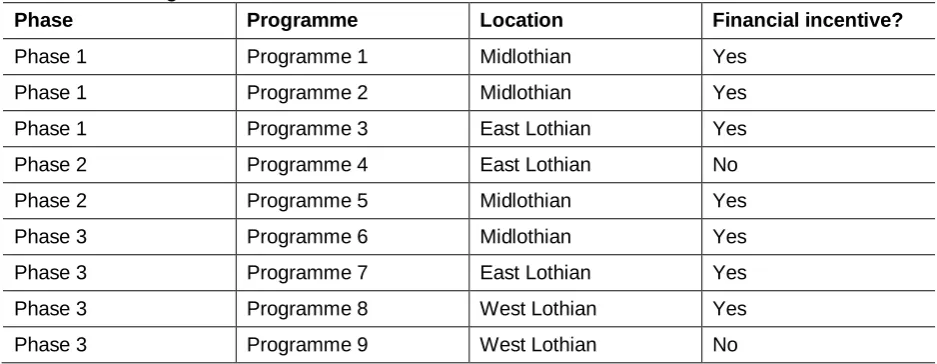
[image:9.595.65.534.395.577.2]1.7 You First offered parents a financial incentive of £20 per week for attendance and £5 per week towards travel expenses. In order that the effect of the financial incentive could be explored as part of the evaluation, it was decided that two of the programmes would operate without the financial incentive. In these programmes, parents received £5 per week towards travel expenses only. Details of the programmes are shown in Table 1.1.
Table 1.1: Programme details
Phase Programme Location Financial incentive?
Phase 1 Programme 1 Midlothian Yes
Phase 1 Programme 2 Midlothian Yes
Phase 1 Programme 3 East Lothian Yes
Phase 2 Programme 4 East Lothian No
Phase 2 Programme 5 Midlothian Yes
Phase 3 Programme 6 Midlothian Yes
Phase 3 Programme 7 East Lothian Yes
Phase 3 Programme 8 West Lothian Yes
Phase 3 Programme 9 West Lothian No
1.8 Barnardo’s Scotland has been awarded funding, through the Inspiring Scotland Fund, to run further programmesin conjunction with health boards across Inverclyde, Renfrewshire, Lanarkshire, Forth Valley, Ayrshire & Arran, Tayside, Grampian, and Highland in 2012. These programmes do not form part of this evaluation.
6
The intention was to deliver 10 programmes in the pilot. One Phase 2 programme did not go ahead as there were insufficient numbers of eligible parents in the area who were interested in attending.
Programme details
1.9 You First aims to support young parents and their children and is intended for first time parents who:
are aged 21 or under
have a child of less than one year of age
live in the 15% most deprived areas of Scotland.
1.10 Although You First was pitched at parents as opposed to just mothers, no fathers attended during the pilot. Thus, where the term ‘parents’ has been used in this report to refer to the You First participants, it should be kept in mind that all participants were mothers.
1.11 Specific areas in which to run the programmes were selected by You First facilitators, in conjunction with health visitor teams, who were able to advise on the most appropriate locations on the basis of their knowledge of the local area7. Health visitors8 were then asked to approach all parents in their
caseload who lived in the selected area. You First was presented to parents as an opportunity, rather than something that they should attend because they have done something wrong or because they ‘needed’ it. Parents who expressed an interest in attending were then visited at home by the
programme facilitators in order to learn more about the programme and to discuss the topics they would like to cover at You First.
1.12 In total, 779 parents attended the programmes. The average (mean) age of parents when they started the programme was 18 years and 11 months and the average (mean) age of their babies was 6 months. In terms of working status, 52 parents were unemployed, 21 were employed (on maternity leave) and 3 were students. All parents lived with their baby: 32 lived alone with their baby; 25 also lived with their partner; 18 also lived with their own parents and 1 parent lived with her grandparents.
1.13 Each You First programme ran for 20 weeks (group sessions one day a week for 16 weeks with home visits at the beginning and end) and aimed to help participants:
connect with local and universal services
access peer and community support
improve their financial capability
become more confident, capable parents.
7
Further information on the selection of areas is provided in Chapter 6.
8 Throughout the report, the term ‘health visitors’ is used to refer to Public Health Nurses. This reflects
1.14 In attending You First, participants were given the opportunity to complete an SCQF Level 4 qualification, the Youth Achievement Award.
1.15 Each group session lasted from 10.30am until 3.30pm with an hour for lunch at 12.30pm10. The sessions were designed to be flexible and, as such, the structure changed slightly from week to week based on the parents’
preferred activities. However, broadly, the day was divided into two parts. In the morning, the parents put their baby into the crèche. This time was used to cover the topics that parents had selected at their first home visit and to complete any necessary paperwork for the Youth Achievement Award. The parents then spent the afternoon with their babies11. This time was used to encourage parent and baby interaction and incorporated activities such as reading, singing, play and going on outings.
1.16 You First employed a person-centred approach designed to be responsive to the wants and needs of the parents. A feature of this approach was that parents were given the opportunity to select, from four predefined areas (health and well-being; finances; stages of development and a personal project), the topics they would like to cover in the morning sessions. In the programmes delivered as part of the pilot, the following topics tended to be covered:
baby brain development
baby first aid
budgeting
healthy eating (for babies and parents)
home safety
managing babies’ behaviour
meals on a budget
planning for the future
relationships
routines.
Programme outcomes
1.17 In designing the Operating Specification for the programme (Appendix 1), Barnardo’s Scotland formulated the following programme outcomes:
10
The length of the day was shortened in two of the pilots in Phase 3. Further details can be found in section 4.17
11
identify the available supports and networks within the local community (including financial support)
establish a link between available supports/networks and group participants
enable group participants to identify barriers that prevent them from engaging in already existing community activities
create a model of ongoing peer support for group participants
to offer the opportunity to work towards gaining a qualification at SCQF Level 4.
1.18 Using Barnardo’s Scotland Outcomes Framework, the programme manager identified individual outcomes for each programme participant and devised descriptors for each outcome (Pages 14-18 of Appendix 1). The outcomes stem from SHANARRI outcomes of the GIRFEC well-being wheel12.
Evaluation approach
1.19 The evaluation framework approach was designed by Ipsos MORI and was agreed by the Research Advisory Group at the outset of the evaluation. It is shaped around the following key research questions:
to what extent do parents gain benefits from the You First programme that are likely to lead to improved long term outcomes for children and families?
what lessons can be learned from the pilot in order to maximise the benefits and ensure the sustainable roll-out of You First in the future?
1.20 These questions were then broken down into the following more specific evaluation objectives:
evaluate the benefits of the You First programme for parents and families
identify ways in which the benefits can be maximised and sustained in the short and medium term
identify ways in which the content of the programme could be improved
identify ways in which the delivery of the programme could be improved
evaluate whether the programme is fulfilling its person-centred ideals
evaluate the selection, assessment and referral system for the programme
identify ways in which parent engagement can be improved, including exploring the impact of the financial incentive
assess the effectiveness of the management and support structures in place for the programme
assess the role of the facilitators and the experience skills and qualities required to fulfil the role effectively
explore the impact the programme has on other related services.
1.21 These objectives were then further refined into specific questions, detailed in the evaluation framework summary table (Appendix 2).The evaluation
framework was used to guide the data collection and analysis throughout the evaluation. The evaluation framework also provides the basis of the report structure, with the objectives forming the chapter headings and the specific questions forming subheadings within chapters. Where appropriate, specific questions have been amalgamated, amended or omitted in the report to reflect the emerging findings and the way in which the evaluation developed.
1.22 Appendix 3 shows how the specific questions in the benefits section of the evaluation framework relate to Barnardo’s programme outcomes and the SHANARRI outcomes of the GIRFEC well-being wheel. When looking at the SHANARRI outcomes included beside each question, it should be
remembered that the SHANARRI outcomes relate to children and not to parents. While children were participants of You First, they did not directly take part in the evaluation and, throughout this report, the benefits of the programme are discussed in relation to parents. Therefore, in identifying the appropriate SHANARRI outcomes, it was necessary to consider the
2 METHODOLOGY
2.1 This section provides an overview of the methods used during the evaluation. A more detailed description of the methods is included at
Appendix 4. The evaluation employed a mixed method approach comprising both qualitative and quantitative methods. The qualitative research allowed for the issues to be explored in greater depth than would have been possible using quantitative research. The quantitative elements, however, allowed for more parents and stakeholders to be included in the research and provided tools which can be used in the future evaluation of the programme.
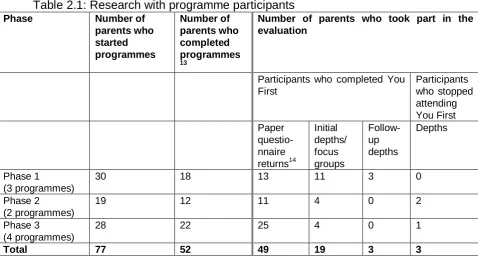
[image:14.595.39.518.296.557.2]2.2 The evaluation included a wide range of individuals involved in You First. Table 2.1 details the research methods used with parents who attended You First while Table 2.2 describes the methods used with professionals involved with the programme.
Table 2.1: Research with programme participants
Phase Number of
parents who started programmes Number of parents who completed programmes 13
Number of parents who took part in the evaluation
Participants who completed You First
Participants who stopped attending You First Paper questio-nnaire returns14 Initial depths/ focus groups Follow-up depths Depths Phase 1 (3 programmes)
30 18 13 11 3 0
Phase 2 (2 programmes)
19 12 11 4 0 2
Phase 3 (4 programmes)
28 22 25 4 0 1
Total 77 52 49 19 3 3
13 We have defined ‘completing the programme’ as attending at least one of the last two sessions
Table 2.2 research undertaken with professionals
Phase Role Research method
Phase 1 Health visitors 2 face-to-face paired depth interviews and 1 individual
depth interview
Phase 1 Programme facilitators A face-to-face paired depth interview and a session to
discuss findings and recommendations from Phase 1 research
Phase 1 NHS Lothian lead for You
First
Face-to-face depth interview
Phase 1 Barnardo’s Head of
Development
Face-to-face depth interview
Phase 1 Barnardo’s You First
Programme Manager
Face-to-face depth interview
Phase 1 Programme contributors Self-completion questionnaires (11 of 13 returned)
Phase 2 Other professionals who
had been involved with You First in Midlothian
A face-to-face paired depth interview and an individual telephone depth interview
Phase 2 Programme facilitators A session to discuss findings and recommendations from
Phase 2 research
Phase 3 Barnardo’s Senior
Manager
A face-to-face depth interview
Phase 3 Health visitors 3 face-to-face depth interviews and self-completion
questionnaires (9 of 12 returned)
Phase 3 Other professionals who
had been involved with You First in West Lothian
2 face-to-face depth interviews
Phase 3 Other professional who
had been involved with You First in East Lothian
A telephone depth interview
Phase 3 You First Facilitators A session to discuss findings and recommendations from
Phase 3 research
Analysis and reporting
2.3 With the permission of participants, interviews and focus groups were recorded and transcribed for analysis. Internal brainstorming sessions were held throughout the evaluation to identify the emerging themes. The
transcripts were analysed by the research team at the end of each phase of the pilot, and in advance of the final report, using a thematic sorting and coding system set up in Excel and based around the questions in the
evaluation framework. This involved systematically analysing transcripts for key points and illustrative verbatim comments under each heading. The results of the quantitative questionnaires were analysed and the results considered alongside the qualitative findings.
findings more generally, they had a particular focus on providing recommendations on how the programme could be developed in the subsequent phases. These recommendations were developed by the
research team and agreed with the programme facilitators and the Research Advisory Group.
Limitations of the research
2.5 As with any evaluation of this kind, there are limitations to the conclusions that can be drawn. While we can make recommendations relating to the most effective way of delivering You First, we are more limited in the extent to which we can assess the benefits of the programme. Given the methods used in the evaluation, we are making a judgement of the benefits on the basis of the perceptions of the parents and the professionals who have taken part in the research - as opposed to basing them on independent, objective measures of behavioural change. Some of the benefits are simply about whether participants feel better as a result of attending, for example if they feel that it has made them more confident, and are relatively
straightforward to assess. Other benefits are more difficult to assess on the basis of participants’ perceptions. Some examples are provided below.
2.6 One of the questions in the benefits section of the evaluation framework is:
To what extent is there greater knowledge of child development issues and
greater capacity to support children’s learning? This question has been
answered using evidence collected from the qualitative research. This evidence is parents’ perceptions of whether their knowledge is greater as a result of attending You First, and examples they give of things they have learned, as opposed to being an objective measure of their knowledge.
2.7 Another question is: To what extent have practical childcare skills improved?
Once again, it is the perceptions of parents and facilitators that have been used to answer this. We have no measures of factors such as the foods parents feed their babies or the routines they have established. This would entail observation of behaviour within the home and, even if such
observation was undertaken, without a control group, it would be difficult to ascertain how much of any change was attributable to You First and how much was due to the parents becoming more experienced or the babies becoming more settled as they got older.
2.8 Given that just two of the nine programmes operated without the £20 financial incentive, and the variation that existed between groups
3 WHAT ARE THE BENEFITS OF THE YOU FIRST PILOT
PROGRAMME FOR PARENTS AND FAMILIES?
3.1 All parents who took part in the qualitative research, and who had completed the You First programme, had benefited in some way from attending it. However, the ways in which they had benefited and the extent to which they had benefited varied. To illustrate the different ways in which parents
experienced benefits, the chapter begins by providing case studies of
parents’ experiences (details have been changed slightly to protect parents’ anonymity). The remainder of the chapter begins by discussing the benefits parents hoped they would get from attending the programme. It then moves on to consider the extent to which each of the potential benefits of the programme, identified at the outset of the evaluation, was realised15. The benefits are discussed in order of their importance to parents. The chapter ends by considering whether the programme had any wider benefits beyond the You First participants.
15
It should be borne in mind throughout this chapter that the discussion of the benefits is based on perceptions of parents and professionals who took part in the qualitative research as opposed to being based on independent, objective measures of behavioural change. See paragraphs 2.5-2.7 for further details.
Caroline: significant benefits across a range of areas
Eilidh: a few specific benefits
Eilidh was 21 when she went to You First and her baby was two months old. She was on maternity leave and lived alone with her baby. While she still saw friends, she had no friends with babies. She felt she was a fairly confident person and had already started to engage with her baby using activities such as singing. However, she found it useful to learn more about the types of things she could do with her baby, for example, she would not have thought to take her baby to the park at such a young age. Although, in some ways, she appeared to be engaging well with her baby, the programme had not successfully communicated the message that you don't need a lot of toys in order to do so; she felt that there should have been more toys at You First as it was sometimes hard to keep the babies occupied. As Eilidh's baby was quite young when she started You First, she found the advice about routines very helpful and felt that her baby slept better as a result. Eilidh also made friends at the group and has been seeing one of them regularly since finishing You First three weeks ago.
Jenny: enjoyed it but little obvious benefit
Jenny was 20 when she went to You First and her baby was 10 months old. She was unemployed and lived with her partner and their baby. She spends a lot of time with her family. She went to You First to learn things about how to look after her baby and felt that she did learn a lot. In
particular, she enjoyed learning about first aid and home safety. However, she had not enjoyed the parent and baby sessions at You First and the programme had not been successful in helping to her to understand the importance of engaging with her baby. She did not think she would stay in touch with others in the group, had no plans to go to other groups and no immediate plans to continue learning or look for employment.
Gail: a few specific benefits
Gail was 17 when she went to You First and her baby was 6 months old. She was unemployed and lived with her parents and her baby. She was supported by her family but did not have other friends with babies. She described herself as a quiet person. She felt that both her self-confidence in general and her confidence as a mum had increased as a result of attending You First. However, she had not engaged with any other
services since finishing You First as she was too nervous to go to a group where she wouldn't know anyone. You First made her more aware of the influence she has on her baby's development and she had started
Expected benefits of You First
3.2 Overwhelmingly, the main reason parents gave for deciding to attend You First was having the opportunity to meet other parents of their own age who lived locally. Many of them did not previously know other parents in the area. The fact that all of them would be a similar age was very important. Parents wanted to meet others in the same situation as themselves and some reported having negative experiences, or negative perceptions, of attending groups with older parents as they felt that they were judged or ‘looked down on’.
3.3 Parents also frequently said that they felt their babies would benefit from having the opportunity to interact with other babies. They thought that it would be important for their development, for example, that their babies would learn to crawl or walk as a result of seeing other babies doing so.
3.4 Less commonly, the following were mentioned as benefits parents hoped to experience from attending the programme:
having the chance to learn things about being a parent
having the opportunity to get used to leaving their baby with someone else (in the crèche)
increased confidence (this was specific to one parent who reported that she had been feeling ‘down in the dumps’ and whose health visitor suggested it might help to increase her confidence).
Parents’ social networks and relationships
3.5 In line with what parents hoped to get from attending You First, meeting other mums of the same age was the main benefit reported by parents. In the main, parents hoped to keep in touch with some of the others they had met at You First. Some parents felt that they had made lasting friendships and would continue to meet up while others thought it was more likely that they would keep in touch via Facebook or would stop to talk if they bumped into each other. It did not seem likely that whole groups of parents who had attended a programme together would continue to meet as a group.
Regardless of the extent to which they had formed friendships, parents Meeting other mums of the same age was the main benefit reported by parents:
some reported having made lasting friendships
others felt it was more likely that they would remain in contact via Facebook or would stop to chat if they bumped into each other there was the potential for friendships to have been formed at all
enjoyed having had the opportunity to meet other mums of the same age and felt that this had made them more confident about meeting new people.
3.6 Given that most of the interviews took place shortly after the programmes had ended, it is not possible to say whether or not the parents will stay in touch. However, the three follow-up interviews conducted around five months after the programmes had finished provided some evidence; two parents were still meeting up with three others from their groups, while one was not in contact with others but would stop to speak to them if she saw them. These findings are in line with what the parents thought would happen when they were first interviewed, shortly after the programme had finished.
3.7 Whether or not friendships had been formed seemed to be simply a result of the personalities within each group. Thus, while not all parents had
benefitted in this way, there was certainly the potential for this to have happened at each programme.
3.8 There were also a couple of instances of You First having increased parents’ confidence in other relationships. One parent reported getting advice on how to deal with problems she was having with her ex-partner while another felt able to speak up to a family member about the importance of her baby’s routine.
Parents’ mental wellbeing
3.9 Overwhelmingly, parents reported feeling more confident after having attended You First. In part, this was due to feeling a sense of reassurance that there were other parents in the same situation and that they,
themselves, were doing ‘fine’. This was very important to parents as they perceived that they were often stigmatised for being a young parent. Some felt more confident in themselves generally while others mentioned feeling more confident in relation to specific aspects of their lives, including:
confidence as a mother
confidence about meeting other people
confidence (and motivation) to leave the house with their babies and go out and do things
confidence to talk in a group situation
confidence to speak up for themselves and not to ‘let people walk all over them’
The programme had a very positive impact on parents’ confidence: almost all parents reported feeling more confident
confidence in relation to their baby going on to nursery or playgroup as a result of having used the crèche at You First.
3.10 For some parents, confidence had increased in some ways but not others. For example, one parent reported feeling more confident generally but not as a mum; she was still worried that people judge her for being a young parent. Additionally, and as discussed in more detail below, many parents still lacked the confidence to attend other parenting groups where they would not know anyone else.
3.11 Health visitors also noticed improved confidence in parents who had attended the programme. They noted that they seemed less anxious, and did not ask for as much support as they would have expected.
3.12 In terms of other aspects of mental wellbeing, there were reports of parents feeling happier as a result of having made friends at the programme and feeling less stressed as a result of the advice received from other parents and the facilitators, as well as the reassurance that other people had experienced similar problems.
Parents’ knowledge of child development
3.13 You First addressed the importance of interacting with babies from an early age and emphasised the influence that parents have on their baby’s
development. This was done through a session on baby brain development and a continued focus, in the parent and baby sessions, on activities which would aid the babies’ development, including singing, reading, going to the park and the use of toys which were suitable for the baby’s age (these sessions are discussed more fully in Chapter 4).
3.14 On the whole, parents reported having learnt things about child development while at You First. The messages which resonated varied from parent to parent. For some, the idea of reading or singing to a young baby was new; they had not previously considered doing this as they felt that their baby would be too young to understand. You First, and in particular a session delivered by the Scottish Book Trust, was cited by parents as being helpful in explaining why it is important to do so:
You think that, ‘is she too young for a book or is she going to understand what I’m saying or anything like that?’ But then, like
This was an aspect of the programme in which there were widespread benefits:
parents learned about the type of activities that are important for a baby’s development and the extent to which they, as parents, influence their babies’ development.
the Book Trust, they kind of went over it, explained it - it’s not all about you reading a story to them, it’s like you’re pointing out pictures and like the sounds and stuff like that and, [if you] kept reading the book, then they’re going to recognise it and it made more sense when they went over it. But, somebody saying to me, ‘oh, read a book to her’, I would be like, ‘oh, she is still really young and she wouldn’t understand’.
(Parent)
3.15 Similarly, parents initially tended to have been dismissive of the idea of taking their baby to the park on the grounds that they would be too young for any of the equipment. Having done so at You First, some parents could see that this was not the case and that their babies had enjoyed it.
3.16 The influence that parents have on their baby’s development had struck a chord with other parents. They remembered analogies used at You First, such as ‘a baby’s brain is like a hard drive which you have to build up’. One parent recalled being told that her baby would smile because she smiles at him and sees evidence of that as he ‘copies everything we do’.
3.17 The role of toys in a baby’s development had been taken on board by some parents who reported having learnt about the benefits of different toys and, as a result, being more knowledgeable about which ones would be suitable at different ages.
3.18 However, the programme had not managed to fully get across to all
participants the importance of the interaction between parent and baby. This is illustrated by comments made by parents that the parent and baby
sessions at You First were not enjoyable as the babies were too young for activities such as sitting in a circle reading and singing and that there were not enough toys provided for the babies to play with. In addition, after having gone to the park at You First, some parents did not see any value in this.
Enhanced parent-child relationships
.
3.19 As discussed above, prior to attending You First, parents were often unaware of the importance of engaging in activities such as reading and singing with their baby from an early age. The extent to which parents implemented what they had learnt at You First in relation to child
development varied. At one end of the scale, there were cases of parents who had started to do things with their baby that they would not otherwise This was a key benefit of the programme for many parents:
several parents reported engaging in activities such as reading, singing, swimming and going to the park with their babies that they would not have done prior to attending You First
have considered doing. You First had helped to equip them with both the knowledge and confidence to do these things. One parent, for example, who seemed to have really grasped the importance of reading, had also passed this on to her partner and reported that he was also now reading to their baby. Although some parents did not feel comfortable singing with their baby in front of others at You First, they did report having done so when alone with their baby at home. For parents who said that they had already been doing some reading and singing, You First helped to reinforce the message that this was a positive thing to do. They reported doing it more often as a result and getting more ideas, for example, different songs to try. Parents discussed the fact that, had they not attended You First, they would have tended to spend more time at home with their baby as they would not have had the confidence to go out with them to, say, the park, swimming or to meet other mums and babies for lunch.
3.20 While parents generally reported having always played with their baby, there were reports of them doing so more often, and enjoying it more, as a result of learning at You First what toys were suitable for their baby at different ages and the type of toys they enjoyed playing with. Some parents had bought toys used at You First to play with at home.
3.21 One parent discussed how the way in which she interacted with her baby more generally had changed as a result of the advice given at You First to turn everyday tasks into an opportunity to interact with her baby. For
example, involving her baby in housework and talking to her about what they were going to buy at the shops.
3.22 Less commonly, there were parents who did not report having changed the way in which they interacted with their baby. In the main, this appeared to be because the programme had not succeeded in getting across the
importance of doing so rather than because they were already interacting well with their child.
3.23 Ensuring that parents sustain the positive behaviours they have established at You First is a challenge for the programme. One parent reported that, since the programme finished, she had let things slip slightly and was not reading to her baby as often as she did while at You First.
I've went off it a bit, hopefully trying to get back on to it because it was fun, but I do… like she has got her wee books and stuff which I read during the day, just like now and again, but I've went off it a wee bit from when I was at the group, I used to do it nearly every day.
Awareness of and access to sources of support and advice, learning opportunities and careers advice
3.24 As discussed in more detail in Chapter 9, the You First facilitators
established links with local services. Representatives of these services were invited to come along to a You First session to talk about the service they provide. These services tended to be either other groups that parents could attend with their babies, e.g. Rhymetime (a library based group involving singing songs and nursery rhymes) or services that can help parents into work or further learning.
3.25 It was clear that parents' awareness of the services that are available in their local area has increased. The extent to which parents had accessed these services, however, varied. There were positive stories of parents who had gone on to attend other things including a community learning course, Jo Jingles (a music, singing and movement based group for parents and babies) and a mother and baby group and those who had used Working for Families (a Midlothian service aimed at helping parents overcome barriers to training or employment) to help them back into work. In addition, parents who were not yet sure whether they would like to work or further their education were confident that they would access the services available should they need to.
3.26 Other parents talked about the fact that they wanted to attend other groups after You First had finished and, in particular, groups specifically for young parents; ideally they would have liked You First to have continued for longer. The facilitators worked with local service providers to try to make
arrangements for them to attend other groups, either through identifying existing groups that they could attend or by trying to set up new groups, specifically for young parents, which would be organised by local service providers and designed around the wants of the parents. However, the groups that were discussed were often unsuccessful in engaging the You First participants. There were reports from parents that such groups:
did not sound appealing (for example, a service provider who came in to talk about her group said that only two people were currently going and parents felt she was not enthusiastic about it);
did not go ahead or did not continue due to a lack of people attending; You First has increased parents’ awareness of the supports available to them locally. However, the extent to which parents have accessed
these supports has varied:
a small number of parents were attending other mother and baby groups and making use of services to help them back into work several parents, however, had not engaged with other services,
with the main reason being a lack of confidence
further consideration should be given to finding the most
were not what parents had hoped for (for example, parents who did go to one group reported that they wouldn’t keep going unless it changed as they hadn’t actually done anything at the sessions, they ‘just sat and blethered').
3.27 The facilitators also encouraged parents to go to established groups, such as Rhymetime, which are for parents of all ages. It was common for parents to say that they had been 'meaning to go' to such groups 'but hadn't got round to it'. On further probing, it appeared that they were lacking in
confidence to go to a group where they would be the newcomer and where they would not know anyone else:
it's all part of being the newcomer… but it's all about confidence, like my confidence, like I don't know if I would go into something brand new again, being the new person.
(Parent)
3.28 The fact that there would be older parents at these groups made it particularly daunting. Parents would be more confident about going if
someone else they knew would go with them. However, this was made more difficult by the fact that parents who worked tended to have gone back to work around the time that You First finished and were, therefore, unable to attend. Although none of the parents alluded to this, the fact that these groups tend to be focused on singing and reading with babies, and the fact that parents felt embarrassed doing this in front of others while at You First, may also have put them off attending.
3.29 The issue is not, then, that parents are not interested in some form of continued support. Rather, it is about finding the most appropriate way to support them after the programme ends. During the pilot, there were mechanisms in place to try to ensure that the programme did not end too abruptly and to encourage parents’ continued engagement with other
services. Following the final group session, facilitators visited each parent at home. As part of this, they spent time talking to the parents on an individual basis about the progress they had made during the programme and used this to stimulate discussions about what parents' were planning to do next. A programme reunion was then held around 4 months after the programme had finished. This involved the facilitators and the parents and their babies meeting up for lunch and chatting about how things had gone since they finished You First. This was the last formal contact facilitators had with the parents, although they did tell parents that they could contact them should they ever need to. A small number of parents had done so to find out further information about groups they were interested in attending. As described above, the facilitators had also established links with local service providers and had invited them to You First to talk to the group about what they could offer them.
support. They noted that they had to be careful not to over-support the parents, partly as they are not based in the local area on a permanent basis and partly because they are not looking to build a dependency; they are aiming to give parents both the awareness and the confidence to use
available local services. This tension is illustrated by the following quote from a You First staff member:
Actually, I think you’ve got to be quite careful because we are not there to build up dependency, we’re there, this is how long we’re here for, we can help you get yourself sorted, but there are other supports to take advantage of. If we were to stay in contact, over contact, then, actually, we’re getting in the way of what can be done locally, which is kind of the opposite of what we’re trying to do, but it’s a really difficult line to balance.
(You First staff)
3.31 That a lack of confidence to attend other groups was a barrier to continued engagement was acknowledged by a member of the You First management staff. She discussed the fact that You First is a very supportive programme in terms of encouraging parents to attend each week (for example, the facilitators phoned parents before each session to check that they were able to make it). She discussed the need to consider how they build up parents' confidence to attend other groups that may not offer the same level of
support and encouragement. She suggested that there may need to be more of a transition period built in to the programme in order to increase parents' confidence. One of the options being considered was a mentoring system whereby a parent who had been to a previous You First group, and had gone on to engage with other services in the area, would be a volunteer or mentor at subsequent groups in their area. They would talk to parents about the groups they had been to and would offer to go along with them to things they were interested in. Although not mentioned by You First staff, this would not necessarily need to be a parent who had previously attended You First. It would, however, need to be a parent of a similar age to the You First parents, in order that they could relate to them.
Practical childcare skills
3.32 Parents covered a range of topics related to the practical care of their baby at You First, including: routines, weaning, first aid, home safety and
behaviour management.
This was not one of the main benefits of the programme reported by parents:
parents did not tend to report having had any particular difficulties caring for their child prior to attending You First first aid and home safety were the two areas in which parents
reported having learnt new things
3.33 In the main, parents did not report having experienced difficulties in the practical care of their baby prior to attending You First. In relation to night time routines, it was common for parents, particularly those whose babies were at the older end of the age range, to report that their baby had always slept well or that they had already established a suitable routine. However, there were those, particularly parents whose babies were younger, who reported that their baby was now in a better night time routine as a result of what they had learnt at You First. They valued both the advice provided by facilitators and the experience of the other parents. For one parent, the benefits also extended to day time routines; prior to attending You First, she had not had set meal times or bath times for her baby and had found
implementing these helpful. One parent, however, had not managed to overcome the difficulties she was having with her baby’s sleeping. Her baby would not sleep unless in the bed with her and she had concerns that her neighbours would contact social workers if she left her baby crying in her cot. She acknowledged that, despite the advice, support and reassurance she received at You First, she had been unable to resolve this issue.
3.34 Discussions about weaning and healthy eating for babies were woven into various parts of the You First programme. This included formal sessions, such as talks from local infant feeding advisors and facilitator led sessions on healthy eating and cooking on a budget, as well as use of the lunchtimes as an opportunity to promote and discuss healthy eating. Facilitators
acknowledged, however, that this was an area in which a great deal of sensitivity was required and one in which limited progress had been made. While there were parents who discussed having found the advice about weaning helpful and having learnt useful tips and ideas about the types of things they could feed their baby, there was evidence that many parents were still choosing to feed their babies foods which are generally considered inappropriate, for example crisps, chocolate and sausage rolls and, as observed by the facilitators, often used these foods in an effort to stop their babies crying.
3.35 Parents found the opportunity to learn about baby first aid and home safety useful and reported learning things that they did not already know, and which they felt might prove to be very important in future. For example, what to do if their baby bumped their head or was choking on food and to use covers for their plug sockets.
If I walked out the room or I went to get something, if my attention wasn't round her, she would go ‘off the handle’. They [You First facilitators] were like ‘put her in the playpen and come down to her level and tell her you're going to do this and even interact with her, speak to her while you're doing that and always come in and check up on her but also, as well, let her know that she has to sit and play with her toys for half an hour and that's your time’
(Parent)
Financial capabilities
3.37 The financial incentive provided at You First was used as a tool to
encourage saving. Parents had the option of receiving £20 each week or deferring payment in order to receive a lump sum at a later date. They were encouraged to save all of the money until the end of the programme. Of the 42 parents who completed a programme which offered the financial
incentive, 28 deferred payment until the end of the programme and often used it for something specific such as buying birthday or Christmas presents for their baby or buying clothes for returning to work. The You First
management saw this as a very positive outcome in terms of improving parents' financial capabilities as they reported that it was the first experience of saving money that many of the parents had had. In contrast, one parent who had instead chosen to receive £20 every week said that she had spent it on 'rubbish that I didn't even need'. She felt that it would have been better for her if they had not been given the option of receiving the money weekly.
3.38 In addition to discussion around the financial incentive, there were more general budgeting discussions in the form of sessions delivered by
facilitators (discussed in more detail in Chapter 4). There were parents who did not feel that they had taken anything from the budgeting sessions. They tended to say that they were not good with money and felt that this would always be a weakness. There were also comments that budgeting was not something that could be taught or that should be discussed in front of others.
3.39 As part of the budgeting sessions, parents created a personal budget of their incomings and outgoings over the course of a week. While none of the parents who took part in the qualitative research had created a budget and stuck to it, there were some who had taken on board money saving tips from the budgeting sessions such as buying in bulk, making a shopping list and not buying ‘treats’ for themselves or their babies every time they were in a This was not one of the elements of the programme in which there had been significant benefits:
there had not been a fundamental shift in approaches to budgeting
useful and some had tried making the meals at home. One parent had also started to put money in a savings account while another was working out what she needed to spend each week and was saving the rest to buy something at the end of the month.
Future planning capabilities for medium and long term goals
3.40 You First tried to encourage parents to think about their futures. As well as a group session on this topic, facilitators worked with parents individually at the home visits at the end of the programme to create an 'action plan' for their future (discussed in more detail in Chapter 4). In particular, the
facilitators emphasised to parents that having a baby did not mean that they could not work or undertake further learning.
3.41 As with the other benefits discussed in this chapter, parents varied in the extent to which they found this element of the programme useful. On the one hand, there were parents who had found it very helpful to have these
discussions and seemed to have gained encouragement, both from the facilitators and other parents who were going back to work, that they would be able to have a career.
… [the facilitators] were telling us that you can go to college and do all this. Because if it wasn’t for the fact of somebody telling you, you could go to college or that, I don’t think any of us would have thought of it, but they have drummed it into to our heads that we can go to college and we can do other things ...In fact, if it wasn’t for going to You First, I wouldn’t have thought about college or anything like that.
(Parent)
3.42 On the other hand, there were parents who did not see the point in discussing where they would like to be in, say, five years and who were either unable to recall what was in their 'action plan' or were not confident that they would stick to it.
The SCQF qualification and the impact of You First on parents’ views about taking further qualifications/continuing their learning
This was not one of the main benefits of the programme, although it was more useful for some parents than others:
some felt encouraged by the discussions about what they could do in the future
others did not see the benefit in thinking about what they would like to do over the coming years.
Parents did not view the SCQF qualification as a key benefit of the programme and parents’ views about undertaking further qualifications had not changed greatly as a result of You First:
some parents had enjoyed doing the qualification and were pleased to have achieved something.
3.43 Professionals who took part in the research saw the fact that parents can receive a SCQF qualification as part of the programme as very positive, particularly as they acknowledged that many of the parents will not have had a positive learning experience at school. Parents, however, did not feel that the qualification was one of the main benefits they gained from You First. Their views on the qualification tended to fall into one of three categories:
Positive - there were parents to whom the qualification appealed, who enjoyed doing it and who felt that it was good to have achieved something
Neutral - these parents didn't mind doing the qualification but were not particularly enthusiastic about it. For one parent, this was because she already had a career and could not see how it would benefit her. There was often a lack of awareness among these parents that they were actually working towards a qualification until late on in the programme
Negative - some parents had not enjoyed the qualification due to the amount of paperwork it involved. Some also felt it was badly organised.
3.44 The You First facilitators were aware of some of the negative views around the delivery of the qualification and were looking at ways to address this in the future (discussed further in Chapter 5).
3.45 However, with one exception, the negative experiences of the qualification reported by some parents had not been detrimental more generally; they had not been put off undertaking further qualifications or continuing their learning as a result. For those who said that they were not interested in continuing learning, this was more likely to be because they already had a career.
3.46 Other parents had already been considering going to college prior to attending the programme and, in some cases, You First had made them more definite in their plans. One parent had previously thought that she would go back to work but the encouragement given by the facilitators had made her consider going to college instead.
Personal health and risk factors
3.47 There was no evidence of parents who attended You First having issues related to drinking or drug use. While many of the parents smoked, there
There was little evidence of benefits to parents in relation to personal health factors:
were no reports of them having cut down or stopped as a result of attending You First. Facilitators did emphasise the importance of not smoking in close proximity to the babies and would push the baby’s buggy if a parent wished to smoke while on a You First outing. However, we cannot say whether parents had implemented this outside of the programme.
3.48 Parents could choose to cover smoking cessation at You First. The programme employs a person-centred approach (see Chapter 5) which means that, among other things, parents get to select the topics they cover. Insufficient numbers of parents chose to cover smoking cessation so the session did not run in any of the programmes. However, advice and
information about how to get further support was provided to the individuals who were interested in covering this topic.
3.49 As discussed above in relation to weaning, You First tried to encourage healthy eating among both the parents and their babies. There were some reports of parents cooking more, rather than having takeaways, as a result of the cooking sessions and the recipes provided at You First. However, this appeared to be driven, at least in part, by the financial savings that the facilitators highlighted. Other parents, however, appeared less interested in learning about healthy eating or in changing their eating habits, as
exemplified by requests for less healthy foods to be available at You First lunchtimes and the types of food they gave their babies during the
programme.
Wider benefits
4 HOW CAN THE DELIVERY OF THE PROGRAMME BE
IMPROVED?
4.1 A description of the structure of You First sessions is provided in section 1.11.
Programme content
4.2 The person-centred nature of You First meant that the content was shaped by the parents. In the main, they were happy with the topics covered
because they were able to choose what was included from four predefined areas: health and well-being; finances; stages of development and a
personal project (for a full list of topics in each area, please see Appendix 5). Individuals’ choices were collated to identify the subjects that were most popular in the group, overall. In general, this did not cause any problems as there tended to be a lot of agreement on which topics parents wanted to cover (both within and across groups). There were some specific instances when parents were not enthusiastic about undertaking certain activities at You First, mainly in the parent and baby sessions. Examples include feeling uncomfortable about singing in front of the group, feeling that their baby did not benefit from the baby massage and not wanting to go out to the park when planned. However, parents did not view these things as significant problems and, overall, were still happy with the content of the programme.
Learning and delivery methods
4.3 The facilitators used a variety of methods to deliver the topics and have revised the way in which topics are delivered throughout the three pilot phases to try to make them as engaging for parents as possible. While parents’ favourite topics were determined by individual preferences, two main themes emerged. Firstly, they did not enjoy sessions that involved a great deal of paperwork. Secondly, the most popular sessions were those in which parents had some form of practical input. For instance, in Phase 1 of the programme the baby first aid sessions consisted of a health visitor talking the parents through different healthcare scenarios (e.g. choking, a bump to the head etc.) and what they should do in those situations. While a number of parents found this useful, others were disappointed that there was no practical aspect to the session. In the subsequent phases, facilitators addressed this by inviting staff from St. John’s Ambulance Service to deliver the session instead. This gave parents the opportunity to try out CPR and other practical emergency health care skills, which proved to be extremely popular.
on practical ways of delivering budgeting messages. For instance, in one exercise they gave parents a catalogue and a budget of £1,000 to decorate a living room. The facilitators felt that this was beneficial as it was fun for the parents, but also helped them to develop the skills required to follow a predetermined budget. They have also looked to other organisations to source stimulating resources for the budgeting sessions such as Skint!, a money management resource developed by the Scottish Book Trust. Another possibility for improving the budgeting session would be to give parents responsibility over the budget for lunchtimes or, alternatively, a You First group event such as a party or outing. This would benefit parents as it not only moves budgeting messages from the hypothetical to practical, but also involves activities that they will have to budget for as their child gets older.
4.5 Parents generally enjoyed the topics delivered by both the facilitators and external speakers. When an external speaker came to the group they reported that they liked seeing a different face, speaking to someone with expert knowledge and having the opportunity to develop new contacts. While the facilitators were also positive about the input of external contributors, they did have reservations with a small number of the speakers. They felt some did not possess the necessary group work skills to engage with the parents effectively. Although rare, there were also instances of external speakers not following up on offers of assistance or appointments with parents. This suggests that it is beneficial to have other professionals deliver topics to the groups but it is important to ensure that enough guidance is provided to them in advance about what works well in the group and the best way to interact with the parents.
Programme facilitators
4.6 Overall, parents were positive about the facilitators. The characteristics that they valued were that they were friendly, easy to talk to, non-judgemental and knowledgeable. If a parent had a problem, they reported that the
facilitators would provide advice and direct them, if necessary, to the correct services. One of the most important aspects for the parents was the
consistency of the support they received from the facilitators. This was not only down to the fact that they had the same facilitators every week, but also their sustained interest in parents’ lives and availability if parents wanted to talk to them.
4.7 In Phase 1, there had been a feeling among parents that they were being told what to do in certain situations, particularly when it came to feeding their baby. In response, the facilitators made it clear to parents that they would, on occasion, offer them advice but it was their choice whether or not to take it. In Phases 2 and 3, this was not raised as an issue as the facilitators reiterated the message throughout the programme that their advice was optional and took a more sensitive approach to offering guidance.