City, University of London Institutional Repository
Citation:
Apostolou, D., Zachos, K., Maiden, N., Agell, N., Sanchez-Hernandez, G., Taramigkou, M., Star, K. & Wippoo, M. (2016). Facilitating Creativity in Collaborative Work with Computational Intelligence Software. IEEE Computational Intelligence Magazine, 11(2), pp. 29-40. doi: 10.1109/MCI.2016.2532266This is the accepted version of the paper.
This version of the publication may differ from the final published
version.
Permanent repository link:
http://openaccess.city.ac.uk/15060/Link to published version:
http://dx.doi.org/10.1109/MCI.2016.2532266Copyright and reuse: City Research Online aims to make research
outputs of City, University of London available to a wider audience.
Copyright and Moral Rights remain with the author(s) and/or copyright
holders. URLs from City Research Online may be freely distributed and
linked to.
Facilitating
Creativity
in
Collaborative
Work
with
Computational
Intelligence
Software
Dimitris Apostolou, Department of Informatics, University of Piraeus, Piraeus, Greece
Konstantinos Zachos and Neil Maiden, Department of Computer Science, School of Mathematics, City University London, London, United Kingdom
Núria Agell and Germán Sánchez‐Hernandez, ESADE Business School, Ramon Llull University, Barcelona, Spain
Maria Taramigkou, Institute of Information and Computer and Communication Systems, National and Technical University of Athens, Athens, Greece
Kam Star, Playgen Ltd, London, United Kingdom
Meia Wippoo, Waag Society, Amsterdam, Netherlands
Abstract:
The use of computational intelligence for leveraging social creativity is a relatively new approach that allows organizations to find creative solutions to complex problems in which the interaction between stakeholders is crucial. The creative solutions that come from joint thinking—from the combined knowledge and abilities of people with diverse perspectives— contrast with traditional views of creativity that focus primarily on the individual as the main contributor of creativity. In an effort to support social creativity in organizations, in this paper we present computational intelligence software tools for that aim and an architecture for creating software mashups based on the concept of affinity space. The affinity space defines a digital setting to facilitate specific scenarios in collaborative business environments. The solution presented includes a set of free and open source software tools ranging from newly developed brainstorming applications to an expertise recommender for enhancing social creativity in the enterprise. The current paper addresses software design issues and presents reflections on the research work undertaken in the COLLAGE project between 2012 and 2015.
____________________________
Corresponding Author: Núria Agell (Email: [email protected])
I.
Introduction
The complex problems faced by organizations today require creative solutions that come
from joint thinking—the combined knowledge and abilities of people with diverse
perspectives. While traditional views of creativity have mostly focused on the individual as
the main contributor of creativity, recent findings suggest that most scientific and business
innovations come from interactions with others and from joint thinking, thus emphasizing the
social dimension of creativity [1
]
, [2]. The knowledge relevant to a problem is oftendistributed among many stakeholders who have different perspectives and background
knowledge [3]. Bringing together different points of view and trying to create a shared
understanding among all stakeholders are key underpinnings of creative collaborative work
that can lead to new insights, ideas, and artifacts [4]. Creativity in collaborative work usually
springs from collaboration and conversation [5]. Working together in collaboration can
stimulate individual creativity due to the unique perspectives that the individual brings to the
tackled problem [6]. In the early stages of idea generation, the individual shares knowledge
while at the same time receives information from others that might build on ideas suggested
by others [7]. Opportunities for discovering more creative solutions can be found by
collaborating with others and, in so doing, by making use of the various individuals’ different
perspectives, knowledge and expertise.
Computational creativity has focused on applying technologies to assist humans in thinking
outside the box and expanding their exploration boundaries [8, 9]. Applications of
computational creativity range from the arts (e.g., [10], [11]) and science (e.g., [12]) to
everyday activities such as cooking—generating new ingredient combinations and finding
new flavors [13]. Researchers have often tried to pair machine creativity with the creative
capabilities of individuals to generate the best possible outcomes and results. Still, existing
computational creativity approaches have mostly focused on supporting or imitating
primarily addressing computer media and technologies for helping people work together and
share knowledge. However, more can be achieved in helping users interact with artifacts and
tools, facilitating access to novel perspectives, and providing opportunities for serendipitous
encounters that have the potential to stimulate new ideas [7]. For example, social media have
been shown to leverage social creativity by acting as conversation enablers [6] and as a source
of information and stimulation [14]. Having loose ties to many other individuals in different
social circles provides access to a large variety of information and diverse perspectives, which
act as sources of creative inspiration.
Computational intelligence (CI) [15] can enhance social creativity software by enabling users
to be aware of and draw on the experiences of others, by discovering, shaping and rendering
inspirational resources, by harnessing diversity, and by providing mechanisms to contribute
the results of creative work back to the community. For example, CI software can analyze
social networks and recommend inspirational content from like‐minded friends or from
influential thinkers. In this paper, we introduce a set of free and open source CI software and
describe how this software has been applied to enhance creativity in collaborative work. We
focus on software design issues such as architectural choices for a seamless mashup of CI
software into applications and user‐friendly interfaces for delivering end‐to‐end social
creativity support software. To this end, we introduce the concept of the affinity space that
defines a digital setting to facilitate specific scenarios in collaborative business environments.
We organize the rest of this paper as follows: First, the design method that was used to
develop creativity support software and the specific tools developed are presented in Section
II. Then, Section III introduces the architecture being able to integrate the latter tools. Section
IV presents a use‐case‐specific application to show how the presented tools and the mashup
architecture considered enhance social creativity. Finally, Section V contains the main
II.
Developing
Computational
Intelligence
Software
tools
for
Social
Creativity
The design of social creativity software is driven strongly by user needs that are latent and
therefore difficult to elicit using traditional requirements elicitation approaches. In this
section, we outline the design method that was used to develop creativity support software
by working with users on the case studies of the COLLAGE research project
(www.projectcollage.eu). The main goals of COLLAGE project were to design, develop, and
validate innovative software services and tools to support social creativity processes. We
followed a user‐centric software design approach in which user needs and requirements were
elicited and refined in an iterative and cooperative manner, including phases of divergent
thinking and of harmonization of perspectives. We proceeded iteratively with more
structured refinement of the requirements. In each cycle, we sought to understand, describe,
and define the scope of the work contexts of our case studies in terms of relevant software,
human actors, information resources, and systems that interact with elements of the new
socio‐technical system. Derived context models were used in creativity workshops with the
aim of leveraging users’ input to generate and select ideas by combining needs and solutions.
Selected ideas were represented as storyboards from which key requirements were extracted
and corresponding software prototypes were built. As a result, we developed six free and
open source CI tools with different objectives for social creativity (Table 1).
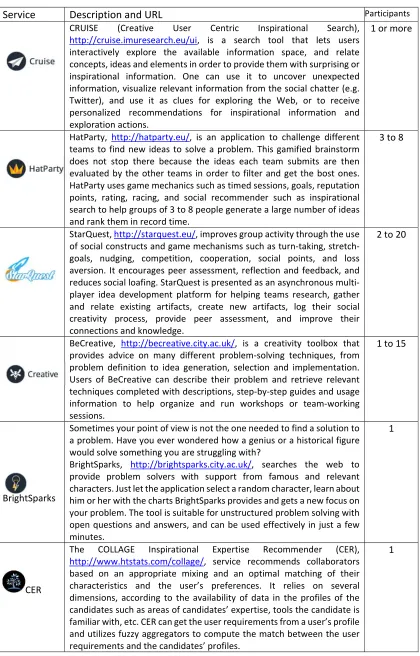
Table 1. Free and open source CI software for social creativity.
Service Description and URL Participants
CRUISE (Creative User Centric Inspirational Search),
http://cruise.imuresearch.eu/ui, is a search tool that lets users interactively explore the available information space, and relate concepts, ideas and elements in order to provide them with surprising or inspirational information. One can use it to uncover unexpected information, visualize relevant information from the social chatter (e.g. Twitter), and use it as clues for exploring the Web, or to receive personalized recommendations for inspirational information and exploration actions.
1 or more
HatParty, http://hatparty.eu/, is an application to challenge different teams to find new ideas to solve a problem. This gamified brainstorm does not stop there because the ideas each team submits are then evaluated by the other teams in order to filter and get the bost ones. HatParty uses game mechanics such as timed sessions, goals, reputation points, rating, racing, and social recommender such as inspirational search to help groups of 3 to 8 people generate a large number of ideas and rank them in record time.
3 to 8
StarQuest, http://starquest.eu/, improves group activity through the use of social constructs and game mechanisms such as turn‐taking, stretch‐ goals, nudging, competition, cooperation, social points, and loss aversion. It encourages peer assessment, reflection and feedback, and reduces social loafing. StarQuest is presented as an asynchronous multi‐ player idea development platform for helping teams research, gather and relate existing artifacts, create new artifacts, log their social creativity process, provide peer assessment, and improve their connections and knowledge.
2 to 20
BeCreative, http://becreative.city.ac.uk/, is a creativity toolbox that provides advice on many different problem‐solving techniques, from problem definition to idea generation, selection and implementation. Users of BeCreative can describe their problem and retrieve relevant techniques completed with descriptions, step‐by‐step guides and usage information to help organize and run workshops or team‐working sessions.
1 to 15
BrightSparks
Sometimes your point of view is not the one needed to find a solution to a problem. Have you ever wondered how a genius or a historical figure would solve something you are struggling with?
BrightSparks, http://brightsparks.city.ac.uk/, searches the web to provide problem solvers with support from famous and relevant characters. Just let the application select a random character, learn about him or her with the charts BrightSparks provides and gets a new focus on your problem. The tool is suitable for unstructured problem solving with open questions and answers, and can be used effectively in just a few minutes. 1 CER
The COLLAGE Inspirational Expertise Recommender (CER),
http://www.htstats.com/collage/, service recommends collaborators based on an appropriate mixing and an optimal matching of their characteristics and the user’s preferences. It relies on several dimensions, according to the availability of data in the profiles of the candidates such as areas of candidates’ expertise, tools the candidate is familiar with, etc. CER can get the user requirements from a user’s profile and utilizes fuzzy aggregators to compute the match between the user requirements and the candidates’ profiles.
1
[image:6.612.96.516.64.720.2]
In the next subsections we describe three of the said software tools in more detail. These
three tools have been selected to give an overview of the most significant COLLAGE
outcomes. Moreover, these three tools are used in an affinity space mashup application
serving the needs of a use case described in Section III.
A. CRUISE: Search for Inspirational Content
CRUISE supports the discovery of inspirational resources through a collective intelligence
approach that uses clues from social chatter (e.g., Twitter) and uses them to enable users to
explore information available in specific repositories, such as intranets, and the Web at large.
The exploration starts with the user entering a set of terms as an initial entry point to their
exploration. The tool uses these terms and queries Twitter for the most recent popular
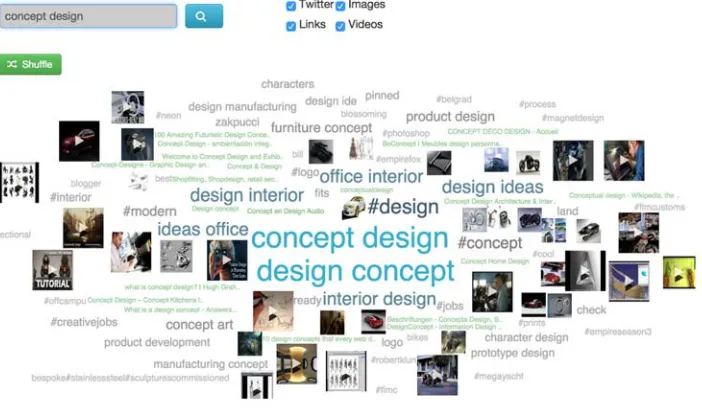
tweets. Then, it constructs a cloud of high frequency terms found in recent popular tweets as
well as tweets from the user’s social networks (see Figure 1). It can also retrieve linked images
and videos. Users can click any of the items for more details or can make multiple selections
of items appearing on the word cloud and add them into their ‘collection’. We use collections
as new queries, giving users the capability to continue their exploration in a new browser
window by selecting more items from the cloud to restrict their search or to relax it by
Figure 1. Creative User‐Centric Inspirational Search (CRUISE).
CRUISE combines diversification of content and sources with a newly developed algorithm for
filtering content in order to enhance serendipity, i.e., the unexpectedness yet relevance and
usefulness of results [16]. We diversify the results using an algorithm that re‐ranks results
with the goal to boost in the top ten results content that is related to all possible aspects of
the query. For this purpose, we use the canonical version of Maximal Marginal Relevance
(MMR) framework [17]:
Arg max
\ , 1 max , (1)
where S is the set of documents, R\S is the set of as yet unselected documents, Sim( ,Q) is
the similarity of the document with respect to the query Q, Sim( , ) is the similarity
between the current document and a document in previous ranks and λ is a parameter that
optimizes a linear combination of the criteria of relevance and diversity. When λ=1 then the
original relevance‐ranked list is produced, whereas when λ=0 a maximal‐diversity list of
documents is generated. We consider the snippet of each result item as a document. Since
[image:8.612.102.453.57.262.2]and hence do not know the native similarity scores of the results with respect to the query,
we compute them by exploiting the documents’ positions in the result list as follows [18]:
, , (2)
where Pos( ) is the position of document d in the query result list returned by the public
search API and N is the size of the list. The document ranked first gets a value of Sim( ,Q)=1
while the last one gets a value of Sim( ,Q)= 1/N. In order to compute the similarity between
the documents in the result set R we use cosine similarity:
, cos || || || ||, (3)
Where is the angle between the vectors of documents. We use the Vector Space Model
(VSM) [19] to represent each document as a vector, the components of which represent the
importance of a term using TF‐IDF metrics, given a bag of words that derives from the
documents in R [20]. For the lexicographic analysis (tokenization, stop words removal and
stemming) of the documents in R, we use the Apache Lucene Standard analyser.
Our diversification algorithm starts with the representation of each document as a vector of
all words included in the index and the calculation of the similarity of each document with
the query. It then proceeds with applying MMR that starts by placing the first document in
the final list of documents, which will be the diversified bucket of documents. It iterates
through the remaining documents and calculates the MMR score for each one summing its
similarities with each of the documents that are already in the final bucket. The document
with the maximum MMR value will occupy the place of the next element in the final bucket
of documents. The process continues until all documents are placed in the bucket. A detailed
description of the algorithm is provided in [21].
We tackle unexpectedness primarily by focusing on ‘unexpectedness from the source’ [22]: a
balancing act between relevance of content to the query and distance from the profile of the
content source. In our case, we ensure relevance by searching for tweets relevant to the
of words model [23] by constructing a dictionary with related frequencies per user. In
addition, we apply a custom filter to the results in order to filter out redundant words. Finally,
each bag contains the words included in the user’s tweets, alongside how many times they
have been used. Each profile is represented by an n‐entry vector containing the term
frequency of each of the n distinct words in the bag. Similarly, queries are also represented
as vectors of terms. In order to measure similarity, we apply cosine similarity on the two
vectors to assess divergence or closeness:
, cos
|| || || ||, (4)
where is the vector of the user profile, is the vector of the query, is the angle between
the two vectors.
We have experimented with several similarity values as a threshold for the filtering of
unexpected yet related content. Our tests showed that a similarity value less than 0.15
produced quite unexpected yet related results. We filter the set of relevant tweets based on
this value and further proceed with the ranking of the results. This threshold, though, is
dependent on each user’s perception and thus evaluation with a large number of users is
needed to come up with a definitive value recommendation.
Finally, we address usefulness primarily by focusing on social power, which can affect the user
perception of usefulness as pointed out in information diffusion theory [24]. We define the
content that derives from those users followed by a large number of followers or those tweets
re‐tweeted many times as socially powerful. The number of followers of a user indicates how
trustworthy and useful he/she is perceived by the remaining users as a source of information
[25]. We sort the tweets according to the number of followers favouring those that derive
from the users with a higher number of followers and boosting up to higher positions.
B. “BrightSparks”: Transformational Creativity Using Personas
BrightSparks implements an adapted version of the Hall of Fame creativity technique that
played by an actor either fictional or real) would solve a particular problem thanks to their
more extreme characteristics and traits. Unlike the original Hall of Fame, it does not use
quotes but rather creative clues applied to the personas for use during creative design tasks.
BrightSparks invokes a computational service that supports transformational creativity
(encouraging problem‐solvers to think about the space of possible ideas in a different, and
often larger, way) and exploratory creativity (enabling problem‐solvers to explore new spaces
more effectively with simple guidelines) by combining and mixing a problem or idea with
extreme personas selected from a static list of more than 150 personas or from the web.
BrightSparks implements two types of codified knowledge: (i) knowledge about the types of
information about a persona to present during creative problem‐solving, and (ii) knowledge
about the clues to use to prompt creative thinking about a persona. The following types of
information about each persona were externalized as important during a creative problem‐
solving process: (i) the name and a photograph of the persona, e.g., Jonathan Ive; (ii) the role
of the persona, e.g., product designer; (iii) important defining characteristics of the persona
described in less than 100 words, e.g., “he believes in the importance of materials and making
them part of the design process”; (iv) the broader persona type, to enable the classification
of personas in categories such as design and art.
Similarly, BrightSparks externalizes four types of codified clues specified for users with
personas during creative design tasks. Firstly, the persona as stakeholder: Imagine that the
persona is a stakeholder in the design process and explores what needs and knowledge the
stakeholder would contribute. Secondly, the persona as an inspiration or role model for the
product or service: Imagine that the persona has characteristics and/or qualities that the
product or service should have. Thirdly, the persona as emotional inspiration: Imagine that
the persona is a source of emotional engagement in the design process and evokes different
emotions in the designers and other stakeholders. Fourthly, combining personas to generate
new personas: Imagine that the persona is combined with another persona to generate new
combinations of characteristics and qualities that can then provide a new persona as a
The software architecture of BrightSparks is depicted graphically in Figure 2. The current
version of the repository has stable, codified knowledge about 160 fictional and real personas.
Figure 2. The software architecture of the BrightSparks web‐based software tool.
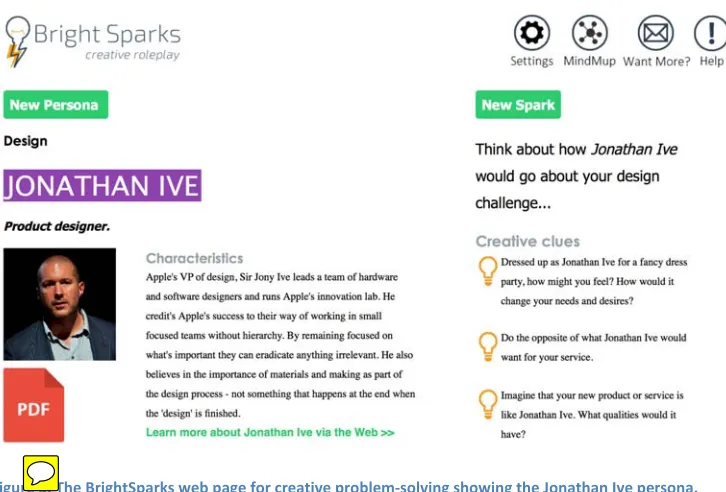
The BrightSparks creative problem‐solving web page, with the demonstration persona
Jonathan Ive, is shown in Figure 3. The web page presents stored, codified knowledge about
each persona: name, role, type, characteristics, and image. The page is divided into two parts.
The left side presents information about each retrieved persona and features for
manipulating personas, and the right side presents the codified creative clues instantiated for
the persona currently shown on the left side of the page.
Figure 3. The BrightSparks web page for creative problem‐solving showing the Jonathan Ive persona.
C. “CER”: Finding the Right Expert
Finding expertise effectively helps organizations identifying collaborators in order to unlock
knowledge, solve interdepartmental problems, and accelerate processes of creativity and
innovation. For organizations, finding an expert can be challenging because experts are
[image:12.612.94.436.99.186.2] [image:12.612.98.461.339.585.2]changes frequently [26]. In addition, experts can be culturally isolated when business units
are disconnected from one another [27]. Social creativity is leveraged by interaction among
users with different backgrounds, opinions and levels of expertise, ultimately leading to
higher creativity and inspiration.
Collage Expertise Recommender (CER) uses linguistic descriptions of candidates and a fuzzy
aggregation function to summarize the information obtained. Fuzzy systems and in particular
fuzzy aggregations are used in a wide range of problems in different application fields. A
detailed overview of freely available and open source fuzzy systems software can be found in
[28]. The CER uses four dimensions to suggest people based on their expertise, qualifications,
proximity, and availability. It focuses on three main features:
1. The strength of the relationship between a candidate and a specific knowledge area.
2. The candidate’s suitability and availability to provide information.
3. The development of personal profiles based on qualifications.
CER assesses candidates’ profiles according to the user’s preferences by determining a partial
assessment of different attributes. These attributes consider not only the candidate’s level of
expertise in different knowledge areas but also other cognitive aspects obtained from the
interaction between the candidate and the system. In addition, CER considers the candidate's
current availability and location as attributes.
A user may be better able to define the level of expertise required in relative terms such as
“low”, “medium” and “high”. Therefore, a linguistic approach to describing the user
requirements is considered. We use these linguistic terms to match user requirements with
candidate profiles. The user—the seeker of expertise—can therefore define the skill and level
of expertise desired.
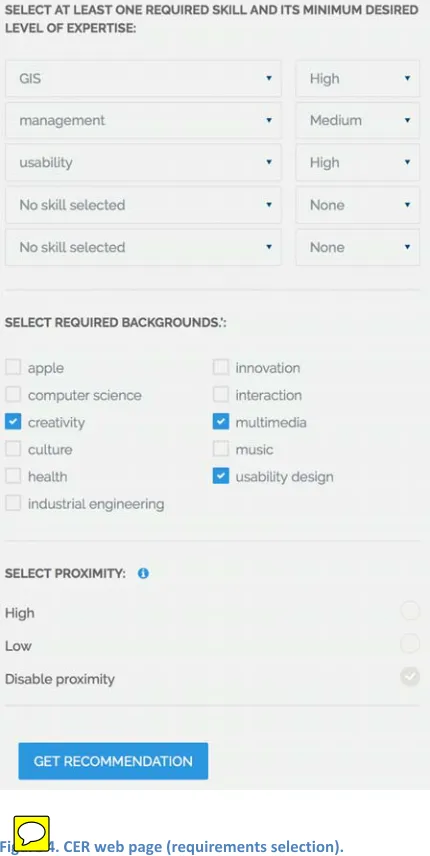
Figure 4 depicts the CER user interface that allows the seeker to specify her preferences in
Figure 4. CER web page (requirements selection).
To aggregate the partial assessments into a global index that reflects the overall adequacy of
the candidate’s profile with respect to the user requirements, we consider a fuzzy ordered
weighted averaging (OWA) aggregation operator. OWA operators [29] are a type of weighted
mean that enables the weights of each variable to be tuned according to their relative
importance for each candidate. The computation of these weights is guided by a linguistic
quantifier [30]. More specifically, the quantifier ‘most of’, represented via a Regular
Increasing Monotone (RIM) function Q is considered: . Then, the weights are
computed by the following expression: , i=1,∙∙∙,n where n is the number
of values to be aggregated. For each possible candidate, variable values are ordered before
Q
(
r
)
r
1/2w
i
Q
i
n
Q
i
1
n
[image:14.612.94.309.48.476.2]being weighted. Based on the user requirements, the system should recommend experts
according to a ranking of individuals’ similarities and differences. In addition, the
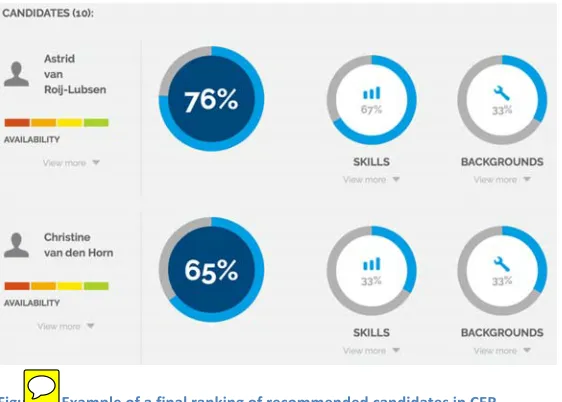
recommendation output shows the selected candidates in rows and their adequacy for each
requirement in columns (Figure 5).
Figure 5. Example of a final ranking of recommended candidates in CER.
A more exhaustive description of the methodology employed by CER is detailed in [31].
III.
A
Service
‐
Oriented
Mashup
Architecture
To support the dynamic software design and development approach outlined in Section 2, we
need a flexible architecture capable of easily integrating the developed tools with additional
third‐party software and building affinity spaces that are highly customized for each specific
use case. In addition, the architecture should support distributed deployment of tools and
loose coupling between them so as to enable quick roll‐out of new releases of affinity spaces.
The architecture employed is based on the software as a service (SaaS) cloud computing
model, in which CI software tools providing specific creativity support functionalities are
deployed as services on different cloud providers. Moreover, it exploits the concept of
“mashups”, web‐based applications that combine content or services from more than one
source into an integrated experience. Services connect to a mashup via an endpoint, which is
[image:15.612.95.376.145.346.2]Retrieve, Update and Delete (CRUD) actions. In our architecture, these actions are mapped
to Get/Put/Post/Delete operations.
Our architecture considers two types of mashups. On the one hand, mashups by aggregation
that simply assemble sets of information from different sources side by side within a single
interface. They do not require advanced programming skills and are often a matter of cutting
and pasting from one site to another. On the other hand, we consider mashups by integration
that create more complex applications integrating different APIs in order to combine data
from different sources.
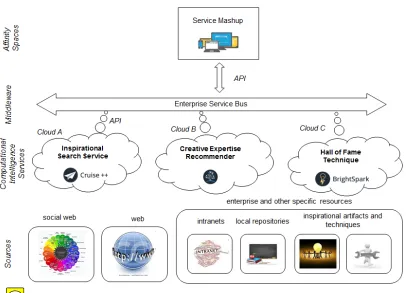
Figure 6. Architecture for creating service mashups.
Figure 6 details the designed architecture, which consists of the following four main layers:
1. The Affinity Spaces (or presentation layer). Affinity spaces represent the front‐end of
the architecture and aim to leverage social creativity by facilitating interaction
between users and CI services. To this end, affinity spaces leverage the possibility to
[image:16.612.98.504.265.558.2]space. This ranges from simply juxtaposing content retrieved from different sources
(e.g. intranets, Twitter, …) into a single interface (mashup by aggregation) to a more
complex remixing of different APIs into an integrated application to create entirely
different views or uses of the original data (mashup by integration).
2. Middleware. An Enterprise Service Bus (ESB) is used to integrate and orchestrate
mashups of the cloud‐enabled services, decoupling services and clients, regardless
where the services are dislocated in the cloud, the protocol adopted or used
technologies. It also supports secure user management, session control, and user
authentication and enabling Single Sign On (SSO).
3. CI Services. These are key architecture components that support people to undertake
creative activities. They can be installed potentially everywhere, from the application
partners intranet to cloud servers such as Amazon EC2. The installation of the
COLLAGE services on cloud servers offers advantages over dedicated, non‐virtualized
servers including scalability, almost unlimited storage capacity and flexibility.
4. Data Sources. The data sources layer provides access to external (like social web and
the Web) and internal (like expert databases, intranet) resources.
Next, we explain in more detail how the proposed architecture makes it possible to mash up
CI software into a specific Web‐based affinity space. Additional examples of mashups in free
and open source platforms, such as WordPress and Moodle, are available at:
http://projectcollage.eu/alpha‐services/.
IV.
A
Case
Study
in
Creative
Research
We present a real example of how CI software can be mashed up in a use‐case‐specific
application that exploits synergies between CI services. We worked with a team of
professional concept developers from the Waag Society institute for art, science and
technology (www.waag.org) to develop an affinity space for enhancing their creative work
outcomes. The Waag Society conducts creative research in close cooperation with
The concept developers envisaged an affinity space that would foster an open attitude for
reconsidering existing concepts and approaches in a playful way so as to promote
engagement. Users needed to be able to collaboratively engage in creative activities with
other team members. Moreover, they would need to be able to search for information and
receive inspiration for their projects as well as to find existing concepts, ideas and experts
that are relevant to their projects. They asked for support in discovering relevant, trending
topics from the social web by monitoring users’ actions (for example, on social networks),
profiling them, and using this information to recommend inspirational information that could
assist users in generating new ideas. Finally, the concept developers enjoy reading comments
posted by others about their ideas, so they asked for feedback mechanisms that would
encourage people to keep submitting comments and suggestions and leverage a sense of
ownership for their work.
A. MashupDevelopment:IdeaFocus
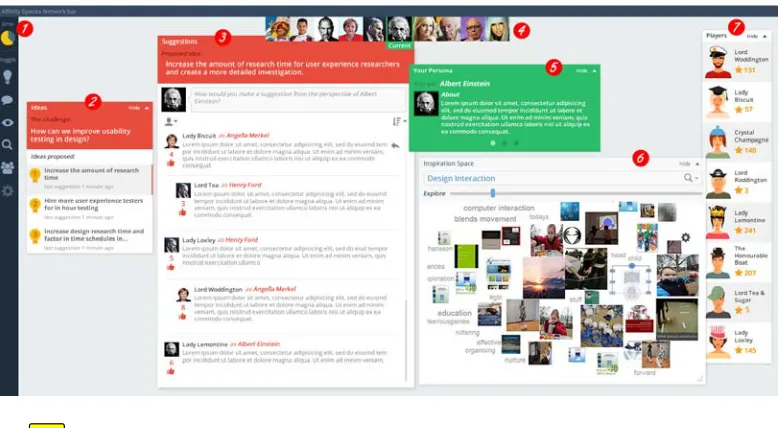
To address the aforementioned requirements, we developed IdeaFocus (Figure 7), an affinity
space where concept developers can come together to generate ideas in a funny,
collaborative environment, using game mechanics such as goals, reputation points and
ratings to help small groups generate a large number of ideas and engage in deep creative
Figure 7. IdeaFocus. Item 1: navigation bar (displays the time currently left in the session and buttons to hide/show
panels). Item 2: ideas panel. Item 3: suggestion panel (allows users to express their opinions about the ideas in focus using
the Hall of Fame technique, which prompts users to respond and debate from the perspective of known personas). Items
4 and 5: persona panels (display the persona that the user has currently become). Item 6: inspirational search (allows
users to use the inspirational search service, CRUISE, by entering a term they wish to explore and gain ideas around). Item
7: player panel.
IdeaFocus has been implemented as a server‐based mashup, which analyses and reformats
the data on a remote server and transmit the data to the user's browser in its final form. A
more exhaustive description of IdeaFocus is detailed in [32]. IdeaFocus mashes up several of
the CI tools listed in Table 1. For example, to help concept developers discover inspirational
clues, we mashed up CRUISE with BrightSparks in a way that allows persona‐related clues and
characteristics to be used to search the web for inspirational content. This mashup exploits
the proven effectiveness of the Hall of Fame technique, which prompts users to respond and
debate from the perspective of known personas, as well as the rich, far‐reaching content‐
discovery capabilities of the inspirational search tool. To implement the aforementioned
example mashup, the following steps should be followed.
1)AuthenticatingUsers:Before embarking on mashingup services, one may want to employ
user authentication through the Single Sign‐On mechanism. To do so the user authentication
service can be programmatically invoked using the following endpoint:
Get http://esb.exactls/COLLAGE/cas/user?start=0&ticket=xxx
Returns a JSON object with the currently authenticated users:
{
[image:19.612.95.486.44.258.2]{ "email": "[email protected]", "firstName": "john", "id": 1, "lastName":
"doe", "login": "admin", "roles": [ "admin", "USER_MANAGER", "superadmin"
], "skills": [],"tools":[] }
]
}
Once users are logged in to IdeaFocus through the central authentication service of the ESB,
they are automatically logged in to all services and can visit them seamlessly with no further
configuration. In case of authentication failure, the authentication or any of the invoking
services will raise one of the following exceptions: AuthenticationException,
BadCredentialsException or AuthenticationServiceException.
2)CreateaSession(StarQuestmashup):The following endpoint should be used to create a
new session (so called ‘quest’) for enabling users to collaboratively access to linked services
and to generate ideas.
POST https://private‐25c5‐gaminomics.apiary‐mock.com/quests
RETURN JSON object with the new quest id
3)CreateaTeamRetrieval(CERmashup):The following endpoint should be used to retrieve
the creation of a team. The first substep is to get the list of available skills and subskills/tools.
GET http://www.htstats.com/collage/er/{skills|tools}&token={token}
RETURN JSON object with the list of skills or subskills
Once the available items are clear, the user can ask for translating his/her preferences to
specific requirements:
POST http://www.htstats.com/collage/er/translate&token={token}
RETURN JSON object with the explicit requirements
The final step is to ask for the recommendation by passing the requirements.
POST http://www.htstats.com/collage/er/request&token={token}
RETURN JSON object with the list of recommendations
All substeps should be run as many times as components of the team we want.
4)PersonaRetrieval(BrightSparksmashup):The following endpoint should be used to
retrieve one or all persona information pertinent to the search parameter.
GET
RETURN JSON object containing all current personas with image and natural
language statements describing attributes of the personas
GET
http://achernar.soi.city.ac.uk/HallOfFame/HallOfFameService/Service1.asmx?o p=RetrievePersonaAdvanced
RETURN JSON object about the persona
5)SearchtheWebforInspirationalContent(CRUISEmashup):The following endpoint
should be used to invoke CRUISE to search the Web or specific company sources for
inspirational content:
GET http://esb.exactls.com/COLLAGE/iccs/is?ticket={ticket}&query={term}
RETURN JSON array of objects
[
{ "id": 0, "source": "twitter", "term": "streaming report", "data": [
"Canadians doubling time online with mobile devices, video streaming:
http://t.co/XCcRgmRj3a", ], "frequency": 0.06778420507907867 },
{ ... }
]
Note that the frequency count can be used by the user interface rendering code to size the
scale of the fonts used to display results, effectively creating a tag cloud effect (see Figure 1).
Results may be text‐based, images, or videos. Also note that as query terms for this service
one can use the JSON object retrieved using the BrightSparks service in the previous step so
that persona clues and characteristics to be used to trigger CRUISE to search for inspirational
content.
6) UserInterfaceDevelopment:The user interface of IdeaFocus has been developed using
the iframe Java programming paradigm. Iframes allow services to communicate with the
parent page through events: the sender (the CI service inside the iframe) sends a string to the
parent window via a JavaScript event such as the following:
window.parent.postMessage("my string", "*");
Instead of using a simple string, we use a JSON string in order to manage the passing of
parameters:
var myEvent = {
event:"search‐cruise", term: “term to search”
};
The event in the above example is used to open CRUISE with the “term to search” from
BrightSparks. The parent window has to register an event handler to capture the events from
the COLLAGE applications in the iframe:
window.addEventListener('message', function (e) { var _event = JSON.parse(e.data);
if (_event.event == "search‐cruise") {
$(window).trigger("search‐cruise", { term: _event.term });
}
});
In this example, the handler for the event type “message” is registered. If the message
contains an object structured like the above myEvent, a new “local” event using the jQuery
library will start. This local event will show the CRUISE iframe by simply changing the URL of
the page:
$(window).on('search‐cruise', function (e, pram) { var h = window.location.href;
// keep only the server address and path var i1 = h.indexOf("#");
if (i1 > 0) h = h.substring(0, i1);
window.location.href = h + "#cruise?term=" +
encodeURIComponent(param.term);
});
B. Evaluation
Concept developers used IdeaFocus and mashed‐up CI tools together with end users as part
of various projects over a six‐month period. For instance, they used it during a two‐day
workshop about open source materials. In this workshop, they generated ideas about how to
design and make their own open materials for the Fablab facility. The project included
defining open source materials, brainstorming what could be done with them, experimenting
and making materials, and developing two integrated concepts. We asked participants to use
IdeaFocus and the mashed‐up CI tools as the main idea generation platform.
The software was used with great success, resulting in the generation, in short periods, of
more ideas than those generated by concept developers with any related tool previously used
in similar assignments. We noticed a quick adoption of the software by the group, as well as
sharing and insights. Positively, users found the software more enjoyable once they were
comfortable with it. We used the Creativity Support Index (CSI) to evaluate the quantified
increases over the established baseline in the creative process and outcomes resulting from
social creative processes supported by the COLLAGE CI tools. The CSI is a survey metric
commonly used specifically to evaluate a creativity support tool’s ability to support a user’s
creative process [33]. Once participants in creative sessions finished using the CI tools, they
answered the CSI survey, which consisted of two parts: a rating scale section, where
participants assessed 12 creativity features of the tools used, and a paired comparison
section, which was used to individually assign weights to the features rated. In the 12 rating
scale questions, the users assessed six factors: exploration, collaboration, engagement, effort,
transparency, and expressiveness.
Table 2. Results from the Waag Society sessions.
Number of
Respondents
Mean
CSI
Exploration (%)
Collaboration
(%)
Engagement
(%)
Effort (%)
Transparency
(%)
Expressiveness
(%)
61 58.7 19% 21% 20% 15% 7% 18%
Table 2 provides details on the average of the results obtained from the various evaluation
sessions conducted at the Waag Society. In total, there were 61 responses to the CSI survey.
Participants’ profiles include creative developers, concept developers, back‐end developers,
and other participants from the specific sector. The relative contributions of exploration,
collaboration, engagement, effort, transparency and expressiveness to the total CSI mean are
also depicted in Table 2. Note that the ‘collaboration’ factor contributes the most among the
six factors examined, indicating the capability of the tools to leverage social creativity. The
results, CSI index 58.7 (out of 100), indicated a 23% increase over the established
collaborative and search tools previously used by Waag Society in the creative process and
outcomes. In the real case presented, the users considered that the COLLAGE tools supported
[image:23.612.92.518.343.378.2]V.
Conclusions
We have presented CI software that addresses the needs of social creativity, adopting a
mashup architecture that bundles CI software services together to create user‐centric
collaborative applications focused on specific social creativity needs, such as those of creative
research. Evaluation of a specific mashup with a group of concept developers indicated that
the software is in line with the creative research approach in which concept developers work
together with end users, taking on multiple roles throughout the design process. We saw that
CI software can effectively kick‐start social creativity by connecting stakeholders, anticipating
competencies, and leveraging available information sources. Moreover, CI software can
broaden group participation by linking groups with social networks and can facilitate
divergent thinking and inspiration by linking users to huge amounts of online information and
social media. Still, technology cannot defy cultural barriers to social creativity as long as it is
unable to offer the same quality of interaction as face‐to‐face experiences, which are deeper
and richer than their virtual counterparts.
Our experience working with users revealed several implications that the introduction of
social creativity software may have for practitioners. Despite the enhanced functionality of CI
software, the role of the facilitator cannot be underestimated. A facilitator often acts as a
catalyst, enabling the incorporation of new software and practices in collaborative work,
supporting users to deal with non‐routine or challenging business problems, and helping
users overcome possible problems with the use of the software. Facilitators are especially
valuable in creating some form of structured reflection about the shared experiences and
evaluating whether there are opportunities and challenges for added value creation.
Moreover, in our experience, for social creativity to flourish, merging physical tools such as
post‐its and infographics with computer‐based tools may yield the best results, especially in
certain stages of the process, such as promoting divergent thinking. Further, creativity
support software should be customizable and adaptable to the specific needs and problems
paramount importance, whereas its cost is relative, depending as it does on the potential
long‐term impact of the software’s use.
Further experimentation is planned in order to assess the impact of software design issues,
underlying CI algorithms and architectural issues on the creative process and outcomes.
Further studies are needed in order to assess the fitness of the software with more subtle
issues underlying creative research, such as leveraging designers’ empathy for users’ life
stories and needs, the subjectivity of interpretation of information, personal intuition, human
interaction, and trust. In so doing, we hope to improve our own understanding of creative
research and be inspired to provide improved computational support and enhanced creativity
support features.
Acknowledgments
The research leading to the results presented in this paper received funding from the
European Community’s Seventh Framework Programme [FP7‐ICT‐2011‐8] under grant
agreement no. GA318536.
References
[1] G. Fischer, E. Giaccardi, H. Eden, M. Sugimoto, and Y. Ye, “Beyond Binary Choices: Integrating Individual and Social Creativity,” International Journal of Human‐Computer Studies ‐ Special issue: Computer support for creativity archive, vol. 63, no. 4‐5, pp. 482 – 512, 2005.
[2] V. John‐Steiner, “Creative collaboration,” Oxford University Press, USA, 2000.
[3] G. Fischer, E. Scharff, and Y. Ye, “Fostering social creativity by increasing social capital,”
Social Capital and Information Technology, M. Huysman, W. Wulf, Eds., MIT Press, pp. 355–
299, 2004.
[4] A. Warr, and E. O’Neill, “Understanding design as a social creative process,” In Proc. of the
5th Conference on Creativity and Cognition, pp. 118–127, 2005.
[5] K. Sawyer, “What Mel Brooks Can Teach Us about Group Flow,” [WWW Document]. URL
http://greatergood.berkeley.edu/article/item/what_mel_brooks_can_teach_us_about_grou
p_flow [accessed 03 March 2013], 2012.
[6] K. A. Peppler, and M. Solomou, “Building creativity: collaborative learning and creativity in social media environments,” On the Horizon, vol. 19, no. 1, pp. 13–23, 2011.
2010.
[8] T. Veale, P. Gervás, and A. Pease, “Understanding creativity: A computational perspective,” New Generation Computing, 24, pp. 203–207, 2006.
[9] C. J. Thornton, “How thinking inside the box can become thinking outside the box,” In Proc.
of the 4th international Joint Workshop on Computational Creativity, pp. 113–119, 2007.
[10] S. Colton, "The painting fool: Stories from building an automated painter," Computers
and Creativity, Springer, pp. 3–38. 2012.
[11] D. Cope, "Computational Creativity and Music," Computational Creativity Research:
Towards Creative Machines, Atlantis Press, pp. 309–326. 2015.
[12] P. S. Stefaneas, I. M. Vandoulakis, M. Martinez, and H. Foundalis, "Collective Discovery Events: Web‐Based Mathematical Problem‐Solving with Codelets," Computational Creativity
Research: Towards Creative Machines. Atlantis Press, pp. 371–389, 2015.
[13] F. Pinel, and L. R. Varshney, "Computational creativity for culinary recipes," CHI'14
Extended Abstracts on Human Factors in Computing Systems, pp. 439–442, ACM, 2014.
[14] J. E. Perry‐Smith, and C. E. Shalley, “The social side of creativity: A static and dynamic social network perspective,” The Academy of Management Review, vol. 28, pp. 89–106, 2003.
[15] A. P. Engelbrecht, “Computational Intelligence: An Introduction,” John Wiley & Sons, 2007.
[16] M. Ge, C. Delgado‐Battenfeld and D. Jannach, “Beyond accuracy: Evaluating recommender systems by coverage and serendipity,” In Proc. of the fourth ACM conference
on Recommender systems, pp. 257–260, 2010.
[17] J. Carbonell, and J. Goldstein, “The use of MMR, diversity‐based reranking for reordering documents and producing summaries,” Proc. SIGIR 1998, ACM Press, pp. 335–336, 1998.
[18] G. Bordogna, A. Campi, G. Psaila, and S. Ronchi, “Disambiguated query suggestions and personalized content‐similarity and novelty ranking of clustered results to optimize web searches,” Information Processing & Management, vol. 48, no. 3, pp. 419–437, 2012.
[19] G. Salton, A. Wong, and C. S. Yang, “A Vector Space Model for Automatic Indexing”,
Communications of the ACM, vol. 18, no. 11, pp. 613‐620, 1975.
[20] C. D. Manning, P. Raghavan and H. Schütze, “Introduction to Information Retrieval”,
Cambridge University Press, 2008.
[21] M. Taramigkou, F. Paraskevopoulos, F. Bothos, D. Apostolou, and G. Mentzas, “Leveraging user inspiration with microblogging‐driven exploratory search,” In Proc. of CAiSE
Workshops, pp. 238–249, 2014.
[22] T. Sun, M. Zhang, and Q. Mei, “Unexpected relevance: An empirical study of serendipity in retweets,” Seventh International AAAI Conference on Weblogs and Social Media, pp. 592– 601, 2013.
[24] Y. Pan, F. Cong, K. Chen, and Y. Yu, “Diffusion‐aware personalized social update recommendation,” Proceedings of the 7th ACM conference on Recommender systems, pp. 69– 76, 2013.
[25] J. Chen, R. Nairn, L. Nelson, M. Bernstein, and E. Chi, “Short and tweet: experiments on recommending content from information streams,” In Proc. of the 28th international
conference on Human factors in computing systems, pp. 1185–1194, 2010.
[26] M. T. Maybury, “Discovering distributed expertise,” In Proc. of the AAAI Fall Symposium
Regarding the “Intelligence” in Distributed Intelligent Systems (RIDIS), pp. 100–103, 2007.
[27] K. Ehrlich, C. Y. Lin, and V. Griffiths‐Fisher, “Searching for experts in the enterprise: combining text and social network analysis,” In Proc. of the 2007 international ACM
conference on Supporting group work, pp. 117–126, 2007.
[28] J. Alcala‐Fdez, and J. M. Alonso, "A survey of fuzzy systems software: Taxonomy, current research trends and prospects", IEEE Transactions on Fuzzy Systems, vol. 24, no. 1, pp. 1–17, 2016.
[29] V. Torra, “The weighted OWA operator,” International Journal of Intelligent Systems, 12(2), pp. 153–166, 1997.
[30] F. Chiclana, F. Herrera, and E. Herrera‐Viedma, “Integrating three representation models in fuzzy multipurpose decision making based on fuzzy preference relations,” Fuzzy Sets and
Systems, 97(1), pp. 33–48, 1998.
[31] J. Nguyen, A. Pereda, G. Sánchez‐Hernández, and C. Angulo, “Defining Dimensions in Expertise Recommender Systems for Enhancing Open Collaborative Innovation,” 17th
International Conference of the Catalan Association of Artificial Intelligence, CCIA 2014,
Barcelona, Spain, pp. 285–288, 2014.
[32] K. Star, F. Paraskevopoulos, M. Taramigkou, D. Apostolou, M. Schot, G. N. Mentzas, “A Playful Affinity Space for Creative Research,” In Proc. of the 2015 ACM SIGCHI Conference on
Creativity and Cognition, pp. 107–110, 2015.
[33] E. Cherry, and C. Latulipe, “Quantifying the Creativity Support of Digital Tools through the Creativity Support Index,” ACM Transactions on Computer‐Human Interaction, vol. 21, no. 4, pp. 1–25, 2014.