City, University of London Institutional Repository
Citation:
Palmirini, R., Erkoyuncu, J. A. and Roy, R. ORCID: 0000-0001-5491-7437
(2017). An Innovative Process to Select Augmented Reality (AR) Technology for
Maintenance. Procedia CIRP, 59, pp. 23-28. doi: 10.1016/j.procir.2016.10.001
This is the published version of the paper.
This version of the publication may differ from the final published
version.
Permanent repository link:
http://openaccess.city.ac.uk/22032/
Link to published version:
http://dx.doi.org/10.1016/j.procir.2016.10.001
Copyright and reuse: City Research Online aims to make research
outputs of City, University of London available to a wider audience.
Copyright and Moral Rights remain with the author(s) and/or copyright
holders. URLs from City Research Online may be freely distributed and
linked to.
Procedia CIRP 59 ( 2017 ) 23 – 28
2212-8271 © 2016 The Authors. Published by Elsevier B.V. This is an open access article under the CC BY-NC-ND license (http://creativecommons.org/licenses/by-nc-nd/4.0/).
Peer-review under responsibility of the scientific committee of the The 5th International Conference on Through-life Engineering Services (TESConf 2016) doi: 10.1016/j.procir.2016.10.001
ScienceDirect
The 5th International Conference on Through-life Engineering Services (TESConf 2016)
An innovative process to select Augmented Reality
(AR) technology for maintenance
Riccardo Palmarini*, John Ahmet Erkoyuncu, Rajkumar Roy
Cranfield University, College Rd, Cranfield MK43 0AL, UK
* Corresponding author. Tel.: +44 1234 750111; E-mail address: [email protected]
Abstract
Augmented Reality (AR) technology for maintenance aims to improve human performances by providing relevant information regarding both corrective and preventive maintenance. The development of an AR system involves the choice of a hardware, a development software and a visualisation method. These selections are challenging due to the wide choice of services and options available which result in fragmentation: different development processes and different user experiences.
In order to ease the selection of an AR system for supporting maintenance operations, this paper proposes an innovative process. It guides the reader to identify the requirements and the constraints for any specific application through a number of questions developed in this study to help with the selection. This results in suggestions for the selection of the hardware, the development software and the visualisation method. The process is built based on a literature study, grey documents and experts interviews. Future works includes the validation of the selection process proposed in this project. It could be done by comparing the choices made using the proposed process with the choices made by experts for the same case study. Moreover, the decisional process could be extended to face the economical and ergonomics aspects related with the selection of an AR system. It could be done expanding the literature research including studies which investigate into the economical and ergonomics consequences of the application or AR for maintenance.
© 2016 The Authors. Published by Elsevier B.V.
Peer-review under responsibility of the Programme Committee of the 5th International Conference on Through-life Engineering Services (TESConf 2016).
Keywords: Augmented Reality, Maintenance, Process.
1.Introduction
The aim of Augmented Reality (AR) technology is to enhance human performances by providing relevant information for a given specific task. AR can be utilised through any type of hardware able to interact with human senses: Tablets, Head Mounted Displays (HMD), Hand-Held Display (HHD), projectors and headphones. The reason for selecting a device rather than another is not always trivial and it relates to the environmental conditions, the users and the processes requirements. In the same way, the software architecture of the AR System might be selected based on considerations which vary among different industrial
environments. For instance, while military could prefer to utilize “zero-connectivity” in order to ensure the cyber security, a commercial application could require connectivity for providing remote assistance. Finally, the user interface should be selected based on the user and the process requirements. It has to be mentioned that there is fragmentation between the providers of AR tools (hardware and software). It means that the combination of the devices, the Software Development Kits (SDKs), open-source platforms and the commercial ones available results in a high number of possible ways of developing an AR system, but the advantages and disadvantages are not always clear.
© 2016 The Authors. Published by Elsevier B.V. This is an open access article under the CC BY-NC-ND license (http://creativecommons.org/licenses/by-nc-nd/4.0/).
24 Riccardo Palmarini et al. / Procedia CIRP 59 ( 2017 ) 23 – 28
This paper aims to propose a process that could guide the reader to select its AR system features and capabilities, as well as the development constrains.
Section 2 explains the methodology utilised for building the proposed AR decisional process for maintenance. Section 3 reports the results including an example of the utilisation AR decisional process. Finally, Section 4 covers the conclusions, which includes the discussion and proposal for future works.
2.Methodology
This section reports the methodology utilised for developing the process to select AR technology for Maintenance.
The following objectives have to be reached in order to develop the process:
1) Identifying relevant documents for the project. 2) Compiling AR systems characteristics tables. 3) Analyse tables.
4) Develop a process to select the AR system characteristics.
2.1.Phase 1: Documents identification
The first phase of the project has been identifying relevant applications of AR in maintenance.
A systematic literature review [1] method has been used to answer the research question: how are AR systems selected and developed for maintenance? The databases selected are: Scopus, ScienceDirect and IEEE. The initial string utilised for the searching phase has been: (“AR” OR “Augmented Reality”) AND (“Maintenance”). Inclusion and exclusion criteria have been defined to narrow down the number of articles identified. This approach led to 29 relevant documents as referenced [2]-[30] to answer the research question.
2.2.Phase 2: Compiling AR systems characteristics tables
Phase 2 consists of categorizing the articles collected during Phase 1 in a form which allows comparison and analysis.
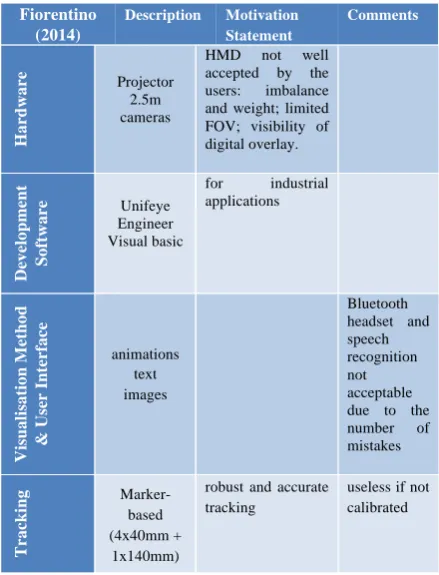
Considering the aim of the project, each document has been screened to find any trends in the correlation between the hardware, development software, visualization method (and user interface) selection and the case studies. It has been done by compiling a table for each article. In the rows are listed the hardware, the development software and the visualization methods; in the columns are reported the description, the motivation statement and the comments. If required, a raw with another relevant feature has been added. In Table 1, provided as an example, a raw with the information about tracking has been added.
[image:3.595.297.517.96.384.2]The tables have then been reviewed and modified in order to use a similar nomenclature on the cells for allowing the comparison process.
Table 1 Example of table compiled for one article. The article is reported in the top left corner.
Fiorentino (2014)
Description Motivation Statement
Comments
Hardware
Projector 2.5m cameras
HMD not well accepted by the users: imbalance and weight; limited FOV; visibility of digital overlay.
Devel
opment
Softw
are Engineer Unifeye Visual basic
for industrial applications
V
isualisation M
ethod
&
User Interface
animations text images
Bluetooth headset and speech recognition not acceptable due to the number of mistakes
Tracking
Marker-based (4x40mm + 1x140mm)
robust and accurate tracking
useless if not calibrated
2.3.Phase 3: Analysis
As a result of Phase 2, 29 tables, like Table 1, have been built. Phase 3 consists in comparing the tables. It has been done cell by cell with particular emphasis on the “motivation statement” column mentioned in Sec. 2.2. When the content of the same cell of the different tables were in agreement, the cell has been colored in green, when in partial agreement in yellow, when in disagreement in red.
As outcome of this process, the main reason for the selection of each parameter can be listed.
2.4.Phase 4: Develop decisional process
This phase aims to develop the process for selecting a specific AR technology. Based on the analysis made in phase 3, the author decided to develop four questionnaires (Sec. 3) and to provide the charts (Fig 1-4) for reading their results.
and dividing them by topic. The final output are 4 different questionnaires: one for assessing if AR could improve the operator performance, three for assessing respectively hardware, development platform and visualization method. The Nr. 4 questionnaires are reported in Sec. 3. The answer to any question would be a number from 1 to 10 respectively “completely agree” and “completely disagree”. These questions are the outcome of the correlation between the motivation for making a choice and the choice itself. For instance, if it has been proven through Phase 3 that Head Mounted Displays (HMD) are utilized when the task duration is between 30 and 60 minutes, the question would be: does the task last more than 30 minutes? For a task that lasts on average 28 minutes, the answer would be 7-8 (disagree) depending on the variance of the phenomenon.
The results of these Nr.4 questionnaires answer will be than analysed through the Nr.4 charts below (Fig.1-4). The average answer of each table corresponds to a specific choice.
These charts have been designed considering the major trends and correlations found in the literature.
Once the average scores have been compared with Fig 1-4, a feasibility check is required to assess the compatibility between hardware, development platform and visualization method. It has to be done case by case by checking the latest update from the provider and using the technical datasheet of the hardware and the development platform.
3.Results
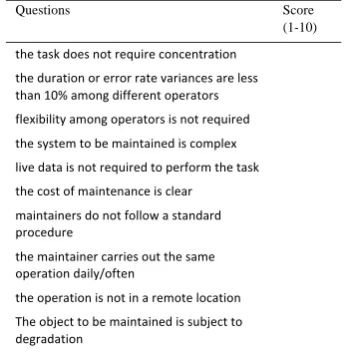
The result of this study is the process for selecting the AR technology for maintenance. The process consists in: nr. 4 questionnaires (Tables 2 - 5) and nr.4 charts (Fig.1-4) for understanding the questionnaires results.
The questionnaires are designed for assessing the AR system requirements for a specific maintenance case/task. For more than one application, it is suggested to apply the process multiple times.
The answer to each question has to be a number 1 to 10 where 1 means “completely agree” and 10 means “completely disagree”. Following the nr. 4 questionnaires.
Table 2. Questionnaire for assessing whether AR is required/feasible or not.
Questions Score (1-10)
)(- ! !
!$
[image:4.595.322.502.83.356.2]
Table 3. Questionnaire for assessing AR system Hardware
Questions Score (1-10)
*( & '
&" #'
"
!! !
$ !
[image:4.595.318.503.373.565.2]
Table 4. Questionnaire for assessing AR system Development Platform
Questions Score (1-10)
!! !
$ !
!
%
!
Table 5. Questionnaire for assessing AR system Visualisation Method
Questions Score (1-10)
!! !
[image:4.595.97.271.502.679.2]26 Riccardo Palmarini et al. / Procedia CIRP 59 ( 2017 ) 23 – 28 ! % *( &' &"#' " ! !
The nr.4 questionnaires are specifically designed to address the AR application in maintenance hence are not suitable for other fields of application (marketing, entertainment, health).
Even though some choices could appear obvious for someone that has been previously exposed to the AR technology, they are not for anyone. The questionnaires have been designed for non-technical person, with a knowledge regarding the maintenance operation. It has to be compiled considering a single maintenance operation. If more than one operation should be supported by the AR system, it would be good to compile the questionnaire for the main activities and then compare the results.
The scores of the questionnaires will then be analysed through the charts in Fig 1-4. It should help the reader understand whether AR should be utilized or not and which hardware, development platform and visualization method should be selected. Even though the selection is made using an average value, all the figures (1-4) show a trend in the selection. It does not mean that it is always possible to identify only one parameter which affects the choice. For each selection the author identified the trends and designed the questions in a way that the answer score would be increasing in the same direction.
Fig.1 is the chart for understanding whether AR could or should be implemented or not. The number to utilise is the average of the scores of Table 2. Fig. 1 has been built considering the average between two trends: the feasibility and the usefulness. Most of the figure implies a situation of uncertainty. This is due to the fact that it is not easy to find any AR application which is undoubtedly useful and at the same time extremely easy to develop and update.
Fig. 1. AR decisional chart.
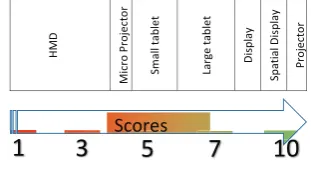
[image:5.595.330.486.215.305.2]Fig.2 is the chart for selecting what kind of Hardware/Device should be implemented. The number to utilise would be the average of the scores of Table 2. This chart does not get into the detail of the different devices available. Currently the market of wearable technology and augmented reality is rapidly evolving hence the author intent is to provide an insight of which of the main stream of hardware should be applied for the chosen case. For instance, despite the current technology, the category of HMD would always be more or less suitable in some specific cases. Fig. 2 has been built considering mainly two trends: the flexibility and operator needs (requirements, safety).
Fig. 2. Hardware decisional chart for an AR system.
Fig.3 is the chart for selecting what kind of development platform should be used. The number to utilise would be the average of the scores of Table 4. For the development platform selection the author decided not to give a specific name/brand, but to identify the main streams. It is relevant to consider that, the main key for this choice resides in the following two: the company capability and requirements under the IT point of view; The AR system complexity
[image:5.595.325.488.478.584.2]It is obvious that it is always feasible to develop a software starting from scratches and using a very “low level” programming language. It could be useful, on the other side, to rely on a commercial platform which allows the internal IT department of a company to update and modify the AR tool at their convenience.
Fig. 3. Development platform decisional chart for an AR system.
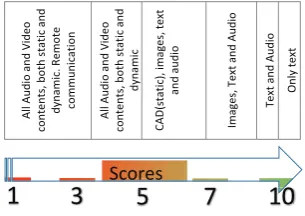
Finally, Fig.4 is the chart for selecting what kind of visualization method should be implemented. The number to utilise would be the average of the scores of Table 5. From the left to the right, the author put from the most complex visualization methods, to the easiest. The drivers for this selection are the complexity of the task and the maintainer
% [image:5.595.106.251.588.664.2]requirements. As for the previous figures, also in this case the selection will be a tradeoff among the drivers hence, for instance, if the task is very complex but the operator has been trained and carries out the operation daily, there would be no need to provide all the different kind of contents. It would add a not required complexity to the AR system.
Fig. 4. Visualization method decisional chart for an AR system.
3.1.Phase 3: Process application example.
This subsection reports an example of the application of the process designed in this paper. Firstly, the maintenance operation will be described. Then the AR system selection will be made based on the author experience.
The maintenance case is the change of a brake of a commercial car made by a mechanic in his floor shop. It is a standard operation carried out in a static location which implies the utilization of commonly available tools. It is a high occurrence operation and its variance in terms of time and error rate is very low. No live data from sensors is needed and the environment can be considered noisy and hazardous. The object to be maintained does not change its characteristics but the brake is subject to degradation.
For this specific case, the average scores for table 2-5 would be respectively 3, 4, 8 and 8. Comparing them with Fig. 1-4, it means that AR is not strongly recommended, an HMD would be suggested, commercial platform should be capable to address all the requirements of the development phase and few contents would be required as visualization method.
It has to be mentioned that the validation of the process proposed in this project has not been carried out. The example is provided to show the utilization of the process proposed and the result is based on the author experience in maintenance and AR.
4.Conclusions
This paper presents an innovative process for identifying whether or not AR is recommended and what hardware, development platform and visualization method should be selected for a specific maintenance task. The novelty is that the author is providing a tool which allows non-experts to take a top level decision for selecting an AR system.
The author believes an effort should be put in providing clear methodologies for both companies and academy, to better understand how and where AR should be used.
The validation of the process has to be made. It could be done by mean of survey and questionnaire. Experts could been put in front of the selection of the AR system based on different case studies. Their choices would then be recorded and compared with the outcome of the same selection made by non-experts with the use of the proposed process.
Other future works includes the implementation in the process of a tool for assessing the economic and ergonomics aspects of the AR application.The tool could be developed utilizing the same methodology described in this paper hence based on literature and validated through the comparison between the experts selections and the process selections.
Acknowledgments
Riccardo Palmarini research project is funded by HSSMI. The program belongs to the Visualisation and Digital Engineering Department of Cranfield University, UK.
References
[1] Booth, Andrew, Anthea Sutton, and Diana Papaioannou. “Systematic approaches to a successful literature review”. Sage, 2016.
[2] A. H. Behzadan and V. R. Kamat, “Interactive Augmented Reality Visualization for Improved Damage Prevention and Maintenance of Underground Infrastructure,” Constr. Res. Congr. 2009, pp. 1214–1222, 2009.
[3] F. De Crescenzio, M. Fantini, F. Persiani, L. Di Stefano, P. Azzari, and S. Salti, “Augmented reality for aircraft maintenance training and operations support,” IEEE Comput. Graph. Appl., vol. 31, no. 1, pp. 96–101, 2011. [4] J.-Y. Didier, D. Roussel, M. Mallem, S. Otmane, S. Naudet, Q.-C. Pham,
S. Bourgeois, C. Mégard, C. Leroux, and A. Hocquard, “AMRA : Augmented Reality assistance in train maintenance tasks,” 4th ACM/IEEE Int. Symp. Mix. Augment. Real. - Work. Ind. Augment. Real., pp. 1–10, 2005.
[5] T. Engelke, J. Keil, P. Rojtberg, F. Wientapper, S. Webel, and U. Bockholt, “Content first - A concept for industrial augmented reality maintenance applications using mobile devices,” 2013 IEEE Int. Symp. Mix. Augment. Reality, ISMAR 2013, pp. 251–252, 2013.
[6] M. Fiorentino, A. E. Uva, M. Gattullo, S. Debernardis, and G. Monno, “Augmented reality on large screen for interactive maintenance instructions,” Comput. Ind., vol. 65, no. 2, pp. 270–278, 2014.
[7] S. Goose, S. Sudarsky, X. Zhang, and N. Navab, “Speech-enabled augmented reality supporting mobile industrial maintenance,” IEEE Pervasive Comput., vol. 2, no. 1, pp. 65–70, 2003.
[8] T. Haritos and N. D. Macchiarella, “A mobile application of augmented reality for aerospace maintenance training,” AIAA/IEEE Digit. Avion. Syst. Conf. - Proc., vol. 1, pp. 1–9, 2005.
[9] V. Havard, D. Baudry, A. Louis, and B. Mazari, “Augmented Reality maintenance demonstrator and associated modelling,” IEEE Virtual Real. Conf. 2015, no. d, pp. 329–330, 2015.
[10] S. J. Henderson and S. K. 8Feiner, “Augmented Reality for Maintenance and Repair (ARMA9R),” Distribution, p. 62, 2007.
[11] S. Henderson and S. Feiner, “Exploring the benefits of augmented reality documentation for maintenance and repair,” IEEE Trans. Vis. Comput. Graph., vol. 17, no. 10, pp. 1355–1368, 2011.
[12] S. J. Henderson and S. Feiner, “Evaluating the benefits of augmented reality for task localization in maintenance of an armored personnel carrier turret,” Sci. Technol. Proc. - IEEE 2009 Int. Symp. Mix. Augment. Reality, ISMAR 2009, pp. 135–144, 2009.
[13] M. Hincapié, A. Caponio, H. Rios, and E. González Mendívil, “An introduction to Augmented Reality with applications in aeronautical maintenance,” Int. Conf. Transparent Opt. Networks, pp. 1–4, 2011.
28 Riccardo Palmarini et al. / Procedia CIRP 59 ( 2017 ) 23 – 28
[14] G. Klinker, O. Creighton, a. H. Dutoit, R. Kobylinski, C. Vilsmeier, and B. Brugge, “Augmented maintenance of powerplants: a prototyping case study of amobile AR system,” Proc. IEEE ACM Int. Symp. Augment. Real., 2001.
[15] C. Koch, M. Neges, M. König, and M. Abramovici, “Automation in Construction Natural markers for augmented reality-based indoor navigation and facility maintenance,” Autom. Constr., vol. 48, pp. 18–30, 2014.
[16] N. S. Lakshmprabha, “Augmented reality for maintenance application on a mobile platform,” IEEE Virtual Real. Conf. 2015, pp. 355–356, 2015. [17] F. Lamberti, F. Manuri, A. Sanna, G. Paravati, and P. Pezzolla,
“Challenges , Opportunities , and Future Trends of Emerging Techniques for Augmented Reality-Based Maintenance,” IEEE Trans. Emerg. Top. Comput., vol. 2, no. 4, pp. 411–421, 2015.
[18] T. Nakagawa, T. Sano, and Y. Nakatani, “Plant maintenance support system by augmented reality,” IEEE SMC’99 Conf. Proceedings. 1999 IEEE Int. Conf. Syst. Man, Cybern. (Cat. No.99CH37028), vol. 1, pp. 768–773, 1999.
[19] C. Nakajima and N. Itho, “A support system for maintenance training by augmented reality,” Proc. - 12th Int. Conf. Image Anal. Process. ICIAP 2003, pp. 158–163, 2003.
[20] J. Platonov, H. Heibel, P. Meier, and B. Grollmann, “A mobile markerless AR system for maintenance and repair,” Proc. - ISMAR 2006 Fifth IEEE ACM Int. Symp. Mix. Augment. Real., pp. 105–108, 2007. [21] H. Ramirez, E. G. Mendivil, P. R. Flores, and M. C. Gonzalez,
“Authoring software for augmented reality applications for the use of maintenance and training process,” Procedia Comput. Sci., vol. 25, pp. 189–193, 2013.
[22] A. Sanna, F. Manuri, F. Lamberti, S. Member, G. Paravati, and P. Pezzolla, “Using Handheld Devices to Support Augmented Reality-based
Maintenance and Assembly Tasks,” IEEE Int. Conf. Consum. Electron. Using, pp. 178–179, 2015.
[23] J. Wang, Y. Feng, C. Zeng, and S. Li, “An Augmented Reality Based System for Remote Collaborative Maintenance Instruction of Complex Products,” IEEE Int. Conf. Autom. Sci. Eng., pp. 309–314, 2014. [24] S. Webel, U. Bockholt, T. Engelke, N. Gavish, M. Olbrich, and C.
Preusche, “An augmented reality training platform for assembly and maintenance skills,” Rob. Auton. Syst., vol. 61, no. 4, pp. 398–403, 2013. [25] T. Wójcicki, “SUPPORTING THE DIAGNOSTICS AND THE
MAINTENANCE OF TECHNICAL DEVICES WITH AUGMENTED REALITY,” Diagnostyka, vol. 15, no. 1, pp. 43–47, 2014.
[26] N. Zenati-henda, A. Bellarbi, S. Benbelkacem, M. Belhocine, and C. De Développement, “Augmented reality system based on hand gestures for remote maintenance,” pp. 1–4, 2014.
[27] S. Zhao, Y. Zhang, B. Zhou, and D. Ma, “Research on gesture recognition of augmented reality maintenance guiding system based on improved SVM,” 7th Int. Symp. Adv. Opt. Manuf. Test. Technol. Opt. Test Meas. Technol. Equip., vol. 9282, p. 92822L, 2014.
[28] J. Zhu, S. K. Ong, and A. Y. C. Nee, “A context-aware augmented reality system to assist the maintenance operators,” Int. J. Interact. Des. Manuf., vol. 8, no. 4, pp. 293–304, 2014.
[29] S. K. Ong, M. L. Yuan, and A. Y. C. Nee, “Augmented reality applications in manufacturing: a survey,” Int. J. Prod. Res., vol. 46, no. 10, pp. 2707–2742, 2008.