Sparse model identification using orthogonal
forward regression with basis pursuit
and D-optimality
X. Hong, M. Brown, S. Chen and C.J. Harris
Abstract:An efficient model identification algorithm for a large class of linear-in-the-parameters models is introduced that simultaneously optimises the model approximation ability, sparsity and robustness. The derived model parameters in each forward regression step are initially estimated via the orthogonal least squares (OLS), followed by being tuned with a new gradient-descent learning algorithm based on the basis pursuit that minimises thel1norm of the parameter estimate vector. The model subset selection cost function includes a D-optimality design criterion that maximises the determinant of the design matrix of the subset to ensure model robustness and to enable the model selection procedure to automatically terminate at a sparse model. The proposed approach is based on the forward OLS algorithm using the modified Gram – Schmidt procedure. Both the parameter tuning procedure, based on basis pursuit, and the model selection criterion, based on the D-optimality that is effective in ensuring model robustness, are integrated with the forward regression. As a consequence the inherent computational efficiency associated with the conventional forward OLS approach is maintained in the proposed algorithm. Examples demonstrate the effectiveness of the new approach.
1 Introduction
Associative memory networks (such as B-spline networks, radial basis function (RBF) networks and support vector machines (SVM)) have been extensively studied [1 – 4]. A main obstacle in nonlinear modelling using associative memory networks or fuzzy logic has been the problem of the curse of dimensionality[5]. This factor applies to all lattice-based networks or knowledge representations such as fuzzy logic (FL), RBF, Karneva distributed memory maps, and all neurofuzzy networks (e.g. adaptive network based fuzzy inference system (ANFIS) [6], Takagi and Sugeno model
[7], etc.). For these systems it is essential to use some model construction procedure to overcome the obstacle by deriving a model with an appropriate dimension. For general linear-in-the-parameter systems, an orthogonal least squares (OLS) algorithm based on Gram – Schmidt orthogonal decomposition can be used to determine the significant model elements and associated parameter estimates, and the overall model structure[8].
Regularisation techniques have been incorporated into the OLS algorithm to produce a regularised orthogonal least squares (ROLS) algorithm that reduces the variance of parameter estimates[9, 10]. To produce a model with good
generalisation capabilities, model selection criteria such as the Akaike information criterion (AIC) [11] are usually incorporated into the procedure to determine the model construction process. Due to the fact that AIC or other information based criteria are usually simplified measures derived as an approximation formula that is particularly sensitive to model complexity. The use of AIC or other information based criteria, if used in forward regression, only affects the stopping point of the model selection, but does not penalise regressors that might cause poor model performance, e.g. too large parameter variance or ill-posedness of the regression matrix, if this is selected.
While OLS is based on the standard QR factorisation, principal component analysis (PCA) is widely used to reduce the input dimensions based on the singular vector decompositions (SVD) [12] in signal processing appli-cations. The derived model is based on an orthogonal basis that are a few significant hidden variables constructed by the full set of input variables. By using the full set of input variables, more sophisticated parameter regularisation (hierarchical prior) [13] and the Markov-chain Monte Carlo (MCMC) algorithm, improved approximation=
generation performance can be achieved with a trade-off of high computational expense. However, the OLS remains a popular practical approach in dynamical system modelling due to less computational expense compared with SVD, and the ease of conversion from the orthogonal basis to only a few selected original input variables, as these are essential requirements for online system condition monitoring and control objectives.
In optimum experimental design[14], it is common that the models are also in the form of linear-in-the-parameters. For these models the design criteria are defined as function of the eigenvalues of the design matrix, hence quantitatively measure the model adequacy. In recent studies[15, 16], we have outlined efficient learning algorithms in which composite cost functions were introduced to optimise the
qIEE, 2004
IEE Proceedingsonline no. 20040693 doi: 10.1049/ip-cta:20040693
X. Hong is with the Department of Cybernetics, University of Reading, Reading, RG6 6AY, UK
M. Brown is with the Department of Computing and Mathematics, Manchester Metropolitan University, Manchester, UK
S. Chen and C.J. Harris are with the Department of Electronics and Computer Science, University of Southampton, Southampton SO17 1BJ, UK
model approximation ability by using the forward OLS algorithm [8], and simultaneously the model adequacy by using an A-optimality design criterion (i.e. minimises the variance of the parameter estimates), or a D-optimality criterion (i.e. optimises the parameter efficiency and model robustness via the maximisation of the determinant of the design matrix). It was shown that the resultant models can be improved based on A- or D-optimality. These algorithms lead automatically to an unbiased model parameter estimate with an overall robust and parsimonious model structure. Combining a locally regularised orthogonal least squares (LROLS) model selection [17] with D-optimality experi-mental design further enhances model robustness[18]. It has been shown [18, 19] that the parameter regularisation is equivalent to a maximised a posterior PDF (MAP) of parameters from bayesian viewpoint by adopting a gaussian prior for parameters.
The regularisation [9, 10]uses a penalty function on l2
norms of the parameters. Alternatively the model sparsity can be achieved by a novel concept of the basis pursuit or least-angle regression[20, 21]that aims to obtain a model by minimising thel1norm of the parameters. The bayesian
interpretation for the basis pursuit method is simply by adopting an exponential prior for parameters (Section 2.1). The advantage of basis pursuit is that it can achieve much sparser models by forcing more parameters to zero than models derived from the minimisation of the lp norm, as mostlpnorms will produce parameters small, but nonzero, values. Compared with the method of regularisation[9, 10]
the basis pursuit method will not generally be computa-tionally efficient because by simply changing froml2norm to l1 norm in the cost function, this effectively changes a quadratic optimisation problem with a simple solution into a more sophisticated problem for which a convex, nonquadratic optimisation is generally required[20, 21].
In this paper a new model identification technique is introduced by using forward regression with basis pursuit and D-optimality design. Based on previous work[15]we incorporate the concept of basis pursuit to tune the parameter estimates as derived from the orthogonal least squares method. A gradient-descent parameter learning method is initially introduced with proven convergence, followed by its application to the parameters tuning in the modified Gram – Schmidt algorithm. It is shown that parameter tuning by basis pursuit, following the initializa-tions of least squares inherent in the Gram – Schmidt procedure, will enforce model sparsity yet fit well in the procedure automated by the D-optimality model selective criterion. In the proposed algorithm the gradient descent of the basis pursuit contributes as a tuning procedure, rather than the main optimisation method, so the computational efficiency of the method due to the forward OLS regression maintains.
2 Preliminaries
A linear regression model (RBF neural network, B-spline neurofuzzy network) can be formulated as[1, 2]
yðtÞ ¼X
M
k¼1
pkðxðtÞÞykþðtÞ ð1Þ
wheret¼1;2;. . .;N;andNis the size of the estimation data set, y(t) is system output variable, xðtÞ ¼ ½yðt1Þ;. . .;
yðtnyÞ;uðt1Þ;. . .;uðtnuÞTis the system input vector
with assumed known dimension ofðnyþnuÞ;u(t) is system
input variable,pkðÞis a known nonlinear basis function such
as RBF or B-spline fuzzy membership functions andðtÞis an uncorrelated model residual sequence with zero mean and variance ofs2:Equation (1) can be written in matrix form as
y¼PQþX ð2Þ
where y¼ ½yð1Þ;. . .;yðNÞT is the output vector. Q¼ ½y1;. . .;yM
T
is parameter vector, X¼ ½ð1Þ;. . .; ðNÞT is the residual vector, andPis the regression matrix
P¼
p1ð1Þ p2ð1Þ . . . pMð1Þ p1ð2Þ p2ð2Þ . . . pMð2Þ
...
p1ðNÞ p2ðNÞ . . . pMðNÞ 2
6 6 4
3 7 7 5
withpkðtÞ ¼pkðxðtÞÞ:Denote the column vectors in P as pk¼ ½pkð1Þ;. . .;pkðNÞ
T;
k¼1;. . .;M: An orthogonal decomposition ofPis
P¼WA ð3Þ
whereA¼ faijgis anMM unit upper triangular matrix
andW is an NM matrix with orthogonal columns that satisfy
WTW¼diagfk1;. . .;kMg ð4Þ
with
kk¼wTkwk; k¼1;. . .;M ð5Þ
so that (2) can be expressed as
y¼ ðPA1ÞðAQÞ þX¼WGþX ð6Þ
whereG¼ ½g1;. . .;gMTis an auxiliary vector.
2.1
Modified Gram – Schmidt algorithm,
parameter regularisation and basis pursuit
For the orthogonalised system (6) the least squares estimates is given by
gð0Þk ¼ w
T ky wT
kwk
; k¼1;. . .;M ð7Þ
The original model coefficient vectorQ¼ ½y1;. . .;yM T
can then be calculated fromAQ¼Gthrough back substitution. The modified Gram – Schmidt procedure, described sub-sequently, can be used to perform the orthogonalisation of (3) and parameter estimation (7). Starting fromk¼1;the columnspj;kþ1jM are made orthogonal to thekth
column at thekth stage. The operation is repeated for 1
kM1: Specifically, denoting pð0Þj ¼pj;1jM; then fork¼1;. . .;M1
wk¼p ðk1Þ k
akj¼
wTkpðk1Þj wT
kwk
; kþ1jM
pðkÞj ¼pðk1Þj akjwk; kþ1jM ð8Þ
whereakj’s are components of the upper triangular matrixA.
The last stage of the procedure is simplywM¼pðM1ÞM :The elements of the auxiliary vector G are computed by transformingyð0Þ¼yin a similar way. For 1kM
gð0Þk ¼ w
T kyðk1Þ wT
kwk
yðkÞ¼yðk1Þgð0Þk wk ð9Þ
at stepkis projected onto a set of orthogonal basis vectors
fw1;. . .wkg:The model residual is decreased by projecting the system output vectoryonto a new basiswkat this step.
Effectively (9) can be regarded as a linear fitting ofyðk1Þby using a single variable wðkÞ; and to derive the new model residualyðkÞ;and so on. This observation is explored further in Section 3.1 for the development of the proposed algorithm in Section 3.2.
For better model parameter estimation bias=variance
tradeoff, regularisation can be applied. If regularisation is performed to the parameter in orthogonal space,gk, then (9)
is simply replaced by the following
gðrÞk ¼ wTky wT
kwkþlk
; k¼1;. . .;M
yðkÞ¼yðk1ÞgðrÞk wk
ð10Þ
where lk0 are regularisation parameters which can be
optimised by being treated as hyperparameters in the Bayesian approach [18]. These results are obtained by setting the parameter optimiser as
VðrÞ¼1
2E½
2
ðtÞ þX
M
k¼1
lkg 2 k
Because the regularisation term is given as the l2 norm,
the closed-form parameter estimates solution given by (10) is available as solution to a quadratic form optimisation.
Alternatively the basis pursuit method is simply given by changing thel2 norm intol1 such that
V¼1
2E½
2
ðtÞ þlTkGk1 ð11Þ
wherel¼ ½l1;...;lny
T; kGk
1¼ ½jg1j;...;jgnyj
T; and n
yM
denotes the size of parameter vector of G with nonzero parameters;lk0 are basis pursuit parameters. Note that
only nonzero parameters that are actually included in the model are penalised, because a regressor with zero parameter does not influence model performance.
The basis pursuit method tends to produce model with greater sparsity than that of l2 parameter regularisation. Because the solution of (11) is a nonquadratic optimisation problem, there is no readily available closed-form solution as simple as (10). In general, the basis pursuit will not be computationally efficient since this is a more sophisticated problem for which a convex, nonquadratic optimisation is required[20]. The objective of this paper is to tackle this problem by introducing some simple model identification algorithm using the idea of basis pursuit, as introduced in Section 3.
2.2
Bayesian regularisation and basis pursuit
The regularised parameter estimator by optimisingVðrÞ is equivalent to a maximised a posterior PDF (MAP) of parameters in a bayesian approach[19, 18]. By the bayesian theorem
pðGjDNÞ /pðGÞpðDN;GÞ ð12Þ
It can be assumed thatNð0;s2Þ; and observations are
independent, so
pðDN;GÞ ¼
1
ð2ps2ÞN=2exp
1 2s2
XN
t¼1
2ðtÞ
" #
ð13Þ
whose maximisation leads to maximum likelihood (ML) parameter estimator, which is equivalent to the least squares
estimator for linear-in-the-parameters models. The prior
pðGÞserves as a solution to the inadequacy of ML estimator by using prior knowledge ofpðGÞthat controls superfluous parameters for improved generalization. If the priorpðGÞfor the parameters is gaussian
pðGÞ ¼exp 1
s2 XM
k¼1
lkg2k !,
ZGðrÞ ð14Þ
whereZGðrÞis a normalising coefficient. The MAP estimator can be derived by minimisingVðrÞ [1, 18, 19]. Clearly for basis pursuit estimator, the priorpðGÞis simply set as
pðGÞ ¼exp 1
s2l Tk
Gk1
,
ZG ð15Þ
whereZGis a normalising coefficient. This means that, from
a bayesian viewpoint, the basis pursuit method can be regarded as adopting a multivariable exponential distri-bution as a prior for parameters.
2.3
Model structure selection by D-optimality
A significant advantage due to orthogonalisation is that the contribution of model regressors to the model can be evaluated. The forward OLS estimator involves selecting a set of ny variablespk¼ ½pkð1Þ;. . .;pkðNÞT;k¼1;. . .;ny;
from M regressors to form a set of orthogonal basis wk;
k¼1;. . .;ny; in a forward regression manner. As the orthogonality property wT
iwj¼0 for i6¼j holds, if (6) is
multiplied by itself and then the time average is taken, the following equation is easily derived:
1
Ny T
y¼1
N XM
k¼1
g2kw T kwkþ
1
NX T
X ð16Þ
The error reduction ratio ½ERRk; which is defined as the
increment towards the overall output varianceE½y2ðtÞdue to each regressor or input variable pkðtÞ divided by the
overall output variance, is computed through[8]
½ERRk¼
g2 kwTkwk
yTy ; k¼1;. . .;M ð17Þ
The most relevant ny regressors can be forward-selected according to the value of the error reduction ratio½ERRk:At
thekth selection a candidate regressor is selected as thekth basis of the subset if it produces the largest value of½ERRk
from the remainingðMkþ1Þcandidates. By setting an appropriate tolerance r; which can be found by trial and error or via some statistical information criterion such as Akaike’s information criterion (AIC) [11] that forms a compromise between the model performance and model complexity, the variable selection is terminated when
1X
ny
k¼1
½ERRk<r ð18Þ
This procedure can automatically select a subset of ny
regressors to construct a parsimonious model. Equivalently, this procedure can be expressed as
JðkÞ¼Jðk1Þ1
Ng 2
kkk ð19Þ
criteria[14]. The D-optimality criterion is to maximise the determinant of the design matrix defined asWT
kWk;where Wk2 <Nny denotes the resultant regression matrix,
con-sisting ofny regressors selected fromMregressors inW
max JD¼det W T kWk
¼Y
ny
k¼1
kk
( )
ð20Þ
It can be easily verified that the selection of the a subset of
WkfromWis equivalent to the selection of the a subset ofny
regressors fromP[16]. To include D-optimality as a model selective criterion for improved model robustness, construct an augmented cost function as
J¼ 1
NX T
Xþalog 1 JD
¼ 1
N y T
yX
ny
k¼1
g2kkk !
þaX
ny
k¼1 log 1
kk ð21Þ
whereais a positive small number. Note that this composite cost function simultaneously minimises (19) and maximises (20)[16]. Equation (21) can be directly incorporated into the forward OLS algorithm to select the most relevant kth regressor at thekth forward regression stage, via
JðkÞ¼Jk11
Ng 2
kkkþalog
1 kk
ð22Þ
At thekth forward regression stage, a candidate regressor is selected as thekth regressor if it produces the smallestJðkÞ
and further reduction in Jðk1Þ: Because logð1=JDÞ is an
increasing function ifkk<1;which is true for somek>K;
the selection procedure will terminate ifJðkÞJðk1Þat the derived model sizenyif an properais set. This is significant because this means that the proposed approach can detect a parsimonious model size in an automatic manner. The D-optimality-based model selective criterion is applied in the proposed new model identification algorithm introduced in following Section.
3 Model identification algorithm using forward regression with basis pursuit and D-optimality
3.1
Parameter estimation by basis pursuit
function’s gradient descent
Before the introduction of the proposed algorithm we initially introduce a general concept (algorithm) of par-ameter estimation by basis pursuit function’s gradient descent, followed by the basis idea as how to incorporate this algorithm in the modified Gram – Schmidt orthogonal procedure.
Theorem 1:Suppose that the dynamics underlying data set
DN can be described by
yðtÞ ¼fðxðtÞ;YÞ þðtÞ ð23Þ
where functional fðÞ is given as appropriate. If the following parameter learning law is applied:
Yðtþ1Þ ¼YðtÞ þðtÞ @f
@Yl
T
sgnYðtÞ ð24Þ
where the operator ðÞ denotes the time averaging, and
sgnY¼ ½sgny1;. . .;sgnyM T;
in which
sgnu¼
1 ifu>0 0 ifu¼0
1 ifu<0 8
<
: ð25Þ
is an arbitrarily small positive number, then
ðiÞ lim
t!þ1VðtÞ !c
ðiiÞ lim
t!þ1kYðtÞ YðtkÞk ¼0 for any finitek
ð26Þ
where the basis pursuit cost function VðtÞ ¼1 2
2ðtÞ þ lTkYk
1; and kYk1¼ ½jy1j;. . .;jynyj
T
is constructed based on a subvector of Y with nonzero parameters (see also (11));c¼minVðtÞis the lower bound ofV(t).
Proof:Consider VðtÞ ¼1 2
2ðtÞ þlTkYk
1>0 as a
Lyapu-nov function. For an arbitrarily small neighbourhood around a current parameter estimate YðtÞ ¼ ½y1ðtÞ;. . .;
yMðtÞ T
;by the first-order Taylor series expansion of V(t)
DVðtÞ @VðtÞ
@Y
T
DYðtÞ
¼ ðtÞ@f
@Yþl
Tsgn
YðtÞ
DYðtÞ ð27Þ
where DYðtÞ ¼Yðtþ1Þ YðtÞ; DVðtþ1Þ ¼Vðtþ1Þ VðtÞ: When the learning law of (24) is applied,
DVðtÞ ¼ ðtÞ@f
@Yl
Tsgn
YðtÞ
T
ðtÞ@f
@Yl
Tsgn
YðtÞ
0 ð28Þ
that is, V(t) is nonincreasing with a lower bound. Hence
lim
t!þ1DVðtÞ ¼0 ð29Þ
Hence property (i) is established.
lim
t!þ1DVðtÞ ¼DY T
ðtÞDYðtÞ
¼kYðtÞ Yðt1Þk2 ð30Þ
yielding
lim
t!þ1kYðtÞ Yðt1Þk ¼0 ð31Þ
for a finite k
kYðtÞ YðtkÞk2¼ X
k
i¼1
Yðtiþ1Þ YðtiÞ
2
¼X
k
i¼1
Yðtiþ1Þ YðtiÞ k k2!0
ð32Þ
so property (ii) follows.
In the proposed algorithm of Section 3.2, this gradient descent of basis pursuit error function is combined with the modified Gram – Schmidt algorithm of Section 2.1 to derive a new model identification procedure. The basic idea is introduced here. Consider (9), which can be regarded as a linear fitting ofyðk1Þby using a single variablewðkÞwith the least-squares method. The derived model residual vectorJ
wk¼ ½wkð1Þ;. . .;wkðNÞT: The tuning process is an
extre-mely simple case based on theorem 1, as illustrated by the following theorem.
Theorem 2:If the learning law given by (24) is applied to a special case of one-dimensional linear system
yðk1ÞðtÞ ¼gkwkðtÞ þðtÞ ð33Þ
with the parameter estimates gk initialised as the
least-square parameter estimate gð0Þk 6¼0; given by (9), and if
lk<2N1 wTky
; then the final converged parameter esti-mate gk
ðiÞ jgkj< g ð0Þ k
ðiiÞ sgnðgkÞ ¼sgn g ð0Þ k
ð34Þ
Proof:
(i) The learning law given by (24), when applied to the system (33), can be rewritten as
gkðtþ1Þ ¼gkðtÞ þðtÞwkðtÞ lksgnðgkðtÞÞ ð35Þ
The least-squares solution means that 1 2
2ðt;g kÞ 1
2 2 t;gð0Þ
k
; and vðtÞ ¼1 2
2ðtÞ þl
kjgkj is non-increasing,
with an initial value as1 2
2ðtÞ þl kgð0Þk
;so fort! 1
VðtÞ ¼1
2
2ðt;g
kÞ þlkjgkj
1 2
2 t;gð0Þ k
þlk g ð0Þ k
ð36Þ
yieldsjgkj< g ð0Þ k
:Hence (i) follows.
(ii) For an arbitrary small learning rate it can be assumed that the parameter changes in an arbitrarily small range per time-step. Initially it is assumed that gk
change sign at a time-step denoted ast0;i.e. the parameter trajectory needs to pass zero at a pointt0 gkðt0Þ ¼ewhere
e0; and by the property that V(t) is nonincreasing, yields
Vðt0Þ ¼1
2
2ðt;eÞ þl kjej ¼
1 2½y
ðk1ÞðtÞ ew
kðtÞ2þlkjej
1
2N½y ðk1ÞT
yðk1Þ1
2
2 t;gð0Þ k
þlk g ð0Þ k ¼ 1
2N½y ðk1ÞT
yðk1Þ 1
2N g ð0Þ k h i2
wTkwkþlkg ð0Þ k
ð37Þ
So
1 2N½y
ðk1Þ
Tyðk1Þ 1
2N½y ðk1Þ
Tyðk1Þ
1
2N g ð0Þ k h i2
wTkwkþlkg ð0Þ k
ð38Þ
lkg ð0Þ k
1
2N g ð0Þ k h i2
wTkwk ð39Þ
and by applying the least-square solution gð0Þk ¼wTky
ðk1Þ wT
kwk
h i
yields
lk
1 2N w
T kyðk1Þ
¼ 1
2N w T ky
ð40Þ
This is contradictory to the assumption for lk: Therefore
gk should not change sign throughout conditional on
lk<2N1 w T ky
; hence property (ii) follows.
The significance of theorem 2 is that by setting the basis pursuit parameterslkbelow a certain value, for each stepk,
the overall effect of the tuning process is that the parameters gkis pulled towards 0. In forward regression, as the model
sizekincreases, the parameter estimatesgkas initialised by
least-squares algorithm with very small magnitudes fol-lowed by basis pursuit gradient tuning, will shrink below some threshold value and can therefore be obtained as zero to achieve model sparsity. For a sufficiently small lk the
optimality condition can be derived as
ðtÞwkðtÞ lksgngkðtÞ ¼0 ð41Þ
or
gk¼
wTkyðk1ÞNlksgngk wT
kwk
¼gð0Þk Nlksgng
ð0Þ k wT
kwk
ð42Þ
3.2
New algorithm using combined modified
Gram – Schmidt algorithm, basis pursuit and
D-optimality
The model selective criteria by D-optimality of Section 2.2
[16]is applied in the proposed algorithm. The algorithm is introduced as follows, in which, the basis pursuit parameters are assumed to be predetermined.
3.2.1
Modified Gram – Schmidt algorithm
combining basis pursuit and D-optimality:
The Gram – Schmidt orthogonalisation scheme can be used to derive a simple and efficient algorithm for selecting subset models. Introducing the definition ofPðk1ÞasPðk1Þ¼ w1;. . .;wk1;p ðk1Þ k ;. . .;p
ðk1Þ M
h i
ð43Þ
If some of the columnspðk1Þk ;. . .;pðk1ÞM inPðk1Þhave been interchanged, this will still be referred to as Pðk1Þ for notational convenience. The kth stage of the forward regression selection procedure is given as follows
(i) ForkjM;compute
gðjÞk ¼
pðk1Þj
T
yðk1Þ
pðk1Þj
T
pðk1Þj
ð44Þ
JjðkÞ¼Jðk1Þ1
N g ðjÞ k h i2
kðjÞk þalog 1
kðjÞk " #
ð45Þ
(ii) Find
JðkÞ¼JjðkÞ
k ¼min J ðkÞ
j ; kjM
n o
ð46Þ
Then thejkth column ofPðk1Þis interchanged with thekth
column of Pðk1Þ; and the jkth column of A up to the
ðk1Þth row is interchanged with thekth column ofA. This effectively selects thejkth candidates as thekth regressor in
the subset model. Then setgð0Þk ¼g ðjkÞ k :
(iii) Perform the orthogonalisation as follows:
wk¼p ðk1Þ k
akj¼
wTkpðk1Þj wT
kwk
; kþ1jM
to transform Pðk1Þ into PðkÞ and derive the kth row of A. Updatekk:
(iv) With gð0Þk 6¼0 as initialised parameter estimates, the
optimal solution of learning law (35) is given by (42), and is rewritten here
gk¼g ð0Þ k
Nlksgng ð0Þ k wT
kwk
ð48Þ
where
lk<
1 2N w
T kyðk1Þ
:
(v) Updateyðk1ÞintoyðkÞby
yðkÞ¼yðk1Þgkwk ð49Þ
and update
JðkÞ¼Jðk1Þ1
Ng 2
kkkþalog
1 kk
ð50Þ
(vi) The selection is terminated at the nyth stage where a
subset model containing ny significant regressors by the D-optimality model selective criteria JðkÞ achieves a minimum.
Note that the assumptiongð0Þk 6¼0 in theorem 2 is actually true for the selected regressors before the model achieves sufficient approximation. By (50) of step (v), it is clear that if gk¼0;the procedure terminates. In forward regression
selection each regressor is selected from step (ii) charac-terised by the largest reduction in JðkÞ; hence gð0Þk 6¼0; before the current model residual yðk1Þ becomes white. Clearly, as the model size k increases, if the parameter estimates are initialised with very small magnitudes from least-squares estimates the basis pursuit gradient tuning procedure in step (iv) will pull it even more towards zero by theorem 2. If an arbitrary small threshold was set for zero the parametergkis obtained as zero;JðkÞ will then increase
to terminate the selection procedure at a sparser model than that of without basis pursuit gradient tuning procedure.
3.2.2
Method of choosing
l
:
The identification algorithm introduced uses a predetermined basis pursuit parameter l; which reflects a tradeoff between modelling errors and thel1norm of parameter vector. An inappropriate choice ofl(too large) will cause the term representing the modelling error in V of (11) to become insignificant in deriving parameter estimates and result in poor model approximation. By the general principle in data modelling of a model with generalisation is preferred, the choice oflmay be derived based on the commonly used method of cross-validation. In the following we introduce a simple method of choosing l by the basic principle of cross-validation, i.e. using two data sets, one for training and another for testing. This method is only a heuristic approach; other optimisation methods ofl are still under investigation. For simplicity a single global basis pursuit lis used, i.e.l1¼l2¼. . .¼l:By using the constraints of
lk<ð1=2NÞjwTkyj; a feasible initial choice of l is
deter-mined as l¼ ð1=2NÞjwT
nð0Þyj;where n
ð0Þ
y is the size of the
model derived with the D-optimality selective criterion, by settingaarbitrarily small, without using basis pursuit[16]. To derive a model with excellent generalisation the complete modelling procedure of iterating the proposed algorithm by incrementally increasing l from zero in a controlled manner is given as follows.
3.2.3
Iterative
procedure
of
proposed
algorithm including choosing basis pursuit
parameters:
(i) Initialisation. Set an arbitrarily small a; applying the modelling procedure of[16]to derive a model with sizenð0Þy : (This is equivalent to the proposed algorithm with l¼0) and setl¼ ð1=2NÞjwT
nðy0Þyj:Set a counter for iterationj¼1:
(ii) Apply the proposed algorithm with the newlto derive a model with sizenðjÞy <nðj1Þy :Set a newl¼ ð1=2NÞjwT
njyðjÞyj
for the next iteration of this step, while the mean squares error (MSE) of the test data set is monitored;j¼jþ1: (iii) Step (ii) is terminated when the MSE of the test data set achieves a minimum.
Note that heuristically, for each stepj,l/ jwnðjÞ y
j:Forward regression selects the term with the largest reduction of modelling error. It can be assumed thatjwij>jwjj;fori>j:
This means thatlk¼l¼ ð1=2NÞjwTnðjÞ y
yj<ð1=2NÞjwT kyðk1Þj;
for k<nðjÞy : As the iteration stepj increases, the effect of basis pursuit cost function (shrinking the small parameters to zero) would derive at the smaller sizenðjÞy compared with the previous iteration step. Because a smaller model size means a larger value ofjwnðjÞ
y
j;lincreases gradually with the iteration, which is terminated at a proper stage via it performance over the test data set. Alternativelylcan be set as a very small value for general improvement in model sparseness.
4 Modelling examples
4.1
Example 1
Consider the benchmark Henon time series given by
zðtÞ ¼1:4z2ðt1Þ þ0:3zðt2Þ ð51Þ
1000 data points were generated with an initial condition
zð0Þ ¼0;zð1Þ ¼0:The data set was then added a very small noise eðtÞNð0;0:0012Þ to form a noisy data set yðtÞ ¼
zðtÞ þeðtÞ: The input vector is set as xðtÞ ¼ ½yðt1Þ;
yðt2ÞT;498 data samples fromt¼1500 were used as
estimation set, and 500 data samplest¼4991000 were used as test data. The gaussian radial basis function was used to construct a full model set by using all the data in the estimation data set as centres ci; i¼1;. . .498; and piðxðtÞÞ ¼exp kxðtÞ cik2=s2i
# $
; with si¼1;8i: The
modelling starts withl¼0; anda¼108 (an arbitrarily small coefficient for D-optimality). The iterative procedure of the proposed algorithm was applied. The model was automatically terminated at 30 centres. The final basis-pursuit parameter was derived at l¼1:77108: The modelling MSE for the test data set is derived as 4:7841105: Equivalently a 99:97% output variance of the test data has been explained by the model. The modelling results for the test data set are shown inFig. 1.
4.2
Example 2
Consider the chaotic two-dimensional time series, Ikeda map[22], given by
xðtÞ
yðtÞ
¼ 1þ0:9½xðt1ÞcosðrÞ yðt1Þsinr
0:9½xðt1ÞsinðrÞ þyðt1Þcosr
with r¼0:4 6:0
1þx2ðt1Þ þy2ðt1Þ
1000 data points were generated with an initial condition
xð1Þ ¼0:1; yð1Þ ¼0:1: Two models were constructed to modelx(t) andy(t), respectively. For both models the input vector is set asxðtÞ ¼ ½xðt1Þ;yðt1ÞT: A total of 498
data samples fromt¼1500 were used as estimation set, and 500 data samples t¼4991000 were used as test data. The gaussian radial basis function was used to construct full model sets by using all the data in the estimation data set as centres ci; i¼1;. . .;498; and
piðxðtÞÞ ¼exp kxðtÞ cik2=s2i
# $
;withsi¼0:5; 8i:
For the first model that model x(t), modelling starts withl¼0 anda¼108(an arbitrarily small coefficient for D-optimality). The iterative procedure of the proposed algorithm was applied. The model was automatically terminated at 63 centres. The final basis-pursuit parameter was derived at l¼7:7108: The modelling MSE for the test data set is derived at 3:13105: Equivalently a 99:81%output variance of the test data has been explained by the model. For the second model that models, y(t), the modelling starts with l¼0 and a¼108 (an arbitrarily
Fig. 2 Modelling results for example 2
a Training set
b Test set
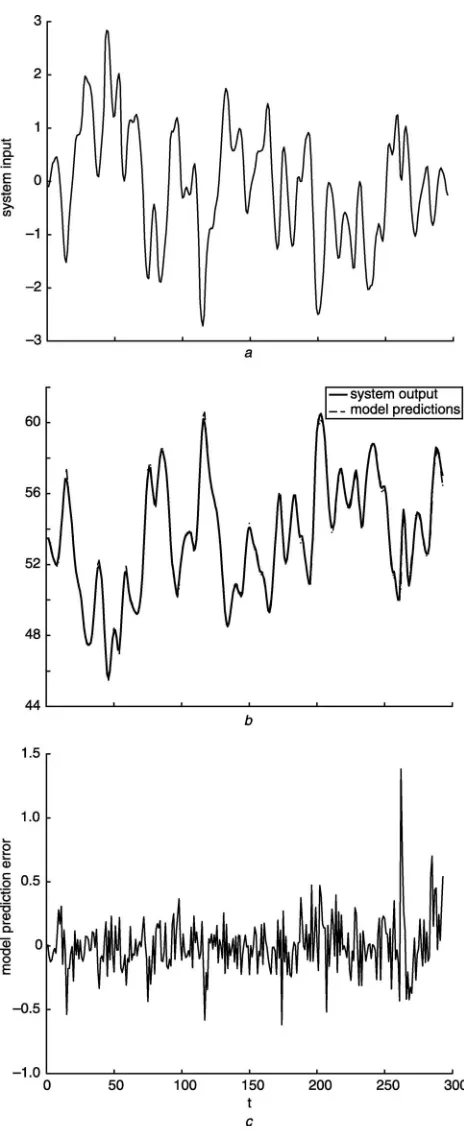
Fig. 3 Modelling results for example 3
a System input
b Model prediction and model output
c Model prediction error
[image:7.612.39.271.176.365.2] [image:7.612.301.533.180.753.2] [image:7.612.44.260.408.753.2]small coefficient for D-optimality). The iterative procedure of the proposed algorithm was applied. The model was automatically terminated at 66 centres. The final basis pursuit parameter was derived at l¼1:7108: The modelling MSE for the test data set is derived at 1:36
105:Equivalently a 99:94%output variance of the test data has been explained by the model. To illustrate the overall performance of the model in capturing the underlying system dynamics the modelling results for both estimation and test data set 5 are shown inFig. 2.
4.3
Example 3
The benchmarking gas furnace data (series J in [23]) set consists of 296 input=output pairs representing coded input gas-feed rate as input,u(t), andCO2concentration from the
gas furnace as outputy(t). All the data were used as training data set. A RBF network with the input vector xðtÞ ¼ ½uðt1Þ;uðt2Þ;uðt3Þ;yðt1Þ;yðt2Þ;yðt3ÞT; and
the thin-plate-spline basis function piðxðtÞÞ ¼ kxðtÞ cik2logkxðtÞ cikwas used as the basis function with all
data sets as candidate centresci:
The iterative procedure of the proposed algorithm was applied with b¼104: The model was automatically terminated at 36-centres. The final basis-pursuit parameter was derived atl¼0:0052:The modelling MSE for the test data set is derived at 0.045. A list of results on the same data can be found in[24]. It can be seen that the results obtained in this study are comparable. The modelling results for both estimation and test data sets are shown inFig. 3.
5 Conclusions
This paper has introduced a model identification algorithm for linear-in-the-parameters models. The pro-posed approach is based on the forward orthogonal least-square algorithm using the modified Gram – Schmidt procedure. The approach aims to simultaneously optimise the model approximation ability, sparsity and robustness by combining the modified Gram – Schmidt algorithm with basis pursuit and D-optimality design. The main contribution is to tune the model parameters, in each forward regression step, with the basis pursuit that minimises the l1 norm of the parameter estimates vector. The D-optimality design criterion is used for model selection to ensure the model robustness and automati-cally terminates at a sparse model. The choice of basis-pursuit parameters is discussed and a simple iterative procedure of the proposed algorithm is introduced to obtain a model with good generalisation. Both the parameter tuning procedure, based on basis pursuit, and the model selection criterion, based on the D-optimality that is effective in ensuring model robustness, are integrated with forward regression to maintain compu-tational efficiency.
6 Acknowledgments
XH gratefully acknowledges that part of this work was supported by the UK EPSRC. The authors would like to thank the referees for their constructive comments.
7 References
1 Harris, C.J., Hong, X., and Gan, Q.: ‘Adaptive modelling, estimation and fusion from data: a neurofuzzy approach’ (Springer-Verlag, Berlin, 2002)
2 Brown, M., and Harris, C.J.: ‘Neurofuzzy adaptive modelling and control’ (Prentice Hall, Hemel Hempstead, 1994)
3 Bossley, K.M.: ‘Neurofuzzy modelling approaches in system identifi-cation’. PhD thesis, Dept of ECS, University of Southampton, 1997 4 Murray-Smith, R., and Johansen, T.A.: ‘Multiple model approaches to
modelling and control’ (Taylor and Francis, London, 1997)
5 Bellman, R.: ‘Adaptive control processes’ (Princeton University Press, Princeton, 1966)
6 Jang, J.S.R., Sun, C.T., and Mizutani, E.: ‘Neurofuzzy and soft computing: a computational approach to learning and machine intelligence’ (Prentice Hall, Upper Saddle River, NJ, 1997)
7 Takagi, T., and Sugeno, M.: ‘Fuzzy identification of systems and its applications to modelling and control’,IEEE Trans. Syst. Man Cybern., 1985,15, pp. 116 – 132
8 Chen, S., Billings, S.A., and Luo, W.: ‘Orthogonal least squares methods and their applications to nonlinear system identification’,Int. J. Control, 1989,50, pp. 1873 – 1896
9 Chen, S., Wu, Y., and Luk, B.L.: ‘Combined genetic algorithm optimization and regularized orthogonal least-squares learning for radial basis function networks’,IEEE Trans. Neural Netw., 1999,10, pp. 1239 – 1243
10 Orr, M.J.L.: ‘Regularisation in the selection of radial basis function centers’,Neural Comput., 1995,7, (3), pp. 954 – 975
11 Akaike, H.: ‘A new look at the statistical model identification’,IEEE Trans. Autom. Control, 1974,19, pp. 716 – 723
12 Hansen, P.C.: ‘Rank-deficient and discrete ill-posed problems’ (SIAM, Philadelphia, 1998)
13 Neal, R.M., and Zhang, J.: ‘Classification for high dimensional problems using bayesian neural networks and dirichlet diffusion trees’. Presented at the NIPS Workshop on Feature Selection, Whistler, BC, 11 – 13 December 2003
14 Atkinson, A.C., and Donev, A.N.: ‘Optimum experimental designs’ (Clarendon Press, Oxford, 1992)
15 Hong, X., and Harris, C.J.: ‘Nonlinear model structure detection using optimum experimental design and orthogonal least squares’,IEEE Trans. Neural Netw., 2001,12, (2), pp. 435 – 439
16 Hong, X., and Harris, C.J.: ‘Nonlinear model structure design and construction using orthogonal least squares and D-optimality design’,
IEEE Trans Neural Netw., 2001,13, (5), pp. 1245 – 1250
17 Chen, S.: ‘Locally regularised orthogonal least squares algorithm for the construction of sparse kernel regression models’. Proc. 6th. Int. Conf. on Signal Processing, Beijing, China, 26 – 30 August 2002, pp. 1229 – 1232
18 Chen, S., Hong, X., and Harris, C.J.: ‘Sparse kernel regression modelling using combined locally regularised orthogonal least squares and D-optimality experimental design’,IEEE Trans. Autom. Control, 2003,48, (6), pp. 1029 – 1036
19 MacKay, D.J.C.: ‘Bayesian methods for adaptive models’. PhD thesis, California Institute of Technology, USA, 1991
20 Chen, S.S., Donoho, D.L., and Saunders, M.A.: ‘Atomic decomposition by basis pursuit’,SIAM Rev., 2001,43, (1), pp. 129 – 159
21 Efron, B., Hastie, T., Johnstone, I., and Tibshirani, R.: ‘Leastangle regression’,Ann. Sta., 2004,32, pp. 407 – 451
22 Ikeda, K.: ‘Multiple-valued stationary state and its instability of the transmitted light by a ring cavity system’,Opt. Commun., 1979,30, (2), pp. 257 – 261
23 Box, G.E.P., and Jenkins, G.M.: ‘Time series analysis, forecasting and control’ (Holden-Day, London, 1976)