Training Students to work in
teams: Why and How?
Dr Jane S. Prichard Dr Robert J. Stratford
&
Charlie Hardy
University
Table of Contents
Chapter 1.
Introduction………...3
Chapter 2.
‘Acting Psychologically’ – setting the context of
collaborative activity……….7
Chapter 3.
Staff and Student Responses to Team Skills
Training………...13
Chapter 4.
Researching the impact of team skills training
on collaborative performance………31
Chapter 5.
Introducing Team Skills Training into the
Curriculum: Practical issues to be considered…………...37
Appendix 1:
Team Development Day Timetable with training
objectives matched against each activity………….…....46
Appendix 2:
Tasks used for Team Development Day………..51
Appendix 3:
Useful Contacts and Links………...60
Chapter 1
Introduction
In the current age, teamwork at some level provides the basis for the performance of the majority of human work related activities. The main reason consistently cited for the extensive use of teams in the work domain is the idea that many modern tasks are both mentally and physically too demanding for one person to perform in isolation (Salas, Dickenson, Converse & Tannenbaum, 1992). In addition to this factor (which makes teamwork a necessity in certain environments), there is also the widely held belief that teams outperform individuals: that ‘two heads are better than one’. This latter point was been challenged by many researchers, and the circumstances in which teams may do better than individuals are less than clear (Steiner, 1972; Diehl & Stroebe, 1987). Despite this there appears to be a growing use of teams in the
workplace, either because of the complexity of tasks, or because of an expectation of performance gains. Given this increase in teamworking, asking how to make teams more effective has become an urgent question.
In seeking to achieve high levels of team performance, organisations have invested huge resources into the training of employees to work effectively in teams.
Increasingly, too, employers are looking to recruit employees who already have some degree of team skill, and some understanding of the importance of teamwork within modern organisations. University graduates need to be equipped with team skills in order to perform well in a recruitment process that now places greater emphasis on team skill ability (Dunne & Prince, 1997).
Employer expectation regarding teamworking skill has placed new pressure on
environments. The 1997 report by the National Committee of Inquiry into Higher Education (NCIHE) predicted a shift from narrowly defined job functions to
teamworking across functional boundaries. The final report by Coopers and Lybrand on a project commissioned by the Committee of Vice-Chancellors and Principals (CVCP), and the Department for Education and Employment (DFEE), to promote skills development in United Kingdom higher education institutions, stated “Specialist knowledge and functional skills are no longer sufficient. In flat organisations based around projects graduates must be able to work in teams” (Coopers & Lybrand, 1998, p.10).
At present, however, employers’ surveys suggest this need is not being met. The NCIHE (1997), after consultation with a number of small and medium sized organisations found that approximately 50% of the employers surveyed were dissatisfied with the skills and attributes of their employees with higher education qualifications. Generally employers said that these employees showed good thinking, learning and technical skills, but were lacking in terms of applied skills such as teamworking, communication and interpersonal skills.
Porter, (1993), reports on an evaluation of an organisational behaviour class, in which people were given the option of completing a written assignment either individually or as part of a team. In spite of the task being structured in such a way as to make it easily divisible amongst people if they chose to work together, and also in spite of advantages given to those working together in order to encourage group working, 80% of students chose to work alone. The main reason cited for this choice was a previous bad experience of teamwork, such as imbalance in the work efforts of all team members, difficulties in co-ordination, and teamwork proving more time consuming than working alone. Generally, the mere act of putting students together had done nothing to support their appreciation of the benefits of teamwork, even though these same students went on successfully to answer examination questions relating to theoretical aspects of team effectiveness.
Turning to the second research category, that of academic attitudes, several studies have looked at the views held by those within the academic community. Although team skills were not specified exclusively, Dunne, Bennett and Carré (1997) reviewed a number of papers which identified reluctance amongst lecturers to engage in the teaching of key skills generally, with many believing that it was not their role to provide skills for employment. The lecturers in these studies reported that they felt they lacked the necessary skills and time to teach them, and did not wish to assess such skills. In addition, many saw time teaching these skills as time diverted away from their own research interests and the need to focus on improving research ratings.
A further obstacle reported by Dunne et al. (1997), was that many academics did not view graduate employability and employment skills as falling within the requirements of a university degree. Rather they held the traditional view that a degree is
fundamentally concerned with broadening and developing the mind. Dunne et al., also found many academics felt that key skills training for students was a distraction from the content material, and prevented students from developing a deeper level of understanding of topics.
reservations can be met. From a theoretical perspective the social approach to learning suggests that discourse is a major way in which knowledge is constructed, developed and reconstructed by individuals and through which deep learning and understanding is promoted. Therefore in the context of team environments, tasks that reinforce discussion, explanation, argument, and justification of views may promote greater understanding. This is in essence the theoretical standpoint of the promoters of collaborative learning - that students who learn in groups, may do so more effectively than those who work individually. There is scope here for team skills training and collaborative learning to be seen as complementary. Equipping students with skills which enhance their effectiveness in collaborative groups should lead to educational gains. By providing students with the team training to meet job requirements and employers’ expectations, they may also be helped to achieve the more traditional academic objective of deep learning.
Manual Overview
This manual aims to provide practical advice to academic staff members on how team skills training programmes can be developed for use in their own departments. In Chapters 2 and 3 we describe how team skills training has been developed within our own department and present an evaluation of its impact on student performance, learning outcomes, student attitudes and peer relationships in the context of one of our own core units. In the remaining Chapters we present the outline of the team
Chapter 2
‘Acting Psychologically’ – setting the context of
collaborative activity.
The Department of Psychology had tackled the issue of transferable or key skills in the early 1990s with the introduction of a Year 1 unit titled ‘Thinking
Psychologically’ which replaced the previous rather uneven arrangements for personal tutorials. This unit had a number of functions – it was an induction to the department, to fellow students, and to the study requirements of an undergraduate degree; it encouraged but did not insist on small group discussion and collaboration; it utilised the group as an audience for students to practise presenting their ideas, and also introduced and used IT skills including email and simple graphics. The unit has been favourably rated by students but could only have a limited impact because of the University requirement for a broad based first year programme shared with other students in the same Faculty. When a response was needed to the HE proposals for more direct and accountable teaching of key skills it was decided to build on the Year 1 initiative with a new Year 2 unit to be titled ‘Acting Psychologically’ (unit code PY211).
1) Writing a report on a focused literature and information search (Cognitive: Memory)
2) Preparing and delivering a verbal argument for a theoretical position in psychology (Social Psychology: Aggression)
3) Selecting and justifying a display mode for presenting data graphically (Work Psychology: Teamworking)
4) Arranging a teaching sequence for effective transmission of information on a particular area of learning (Learning and Behaviour: Addiction)
5) Making a poster to illustrate a series of research findings from experiments in perception and speaking to the poster at a mini-conference (Seeing and Hearing: Visual display and contrast)
These five key skills were to be practised within a specific task, each requiring completion of an assignment to be assessed separately from the parent lecture course. Students were allocated into groups to undertake these tasks, with each group
expected to cooperate in the production of a group product. In this way other transferable skills would be practised across all five tasks:
a) Team working skills: leadership, sharing and co-operation. b) Organisational skills: time and project management.
work concept was expected, underlined somewhat vaguely in a note: “groups may wish to define their own ground rules before each task to ensure an even contribution from group members.”
The style of teaching and learning operating here was therefore largely experiential, with the groups doing their best sometimes despite the ‘loafing’ of some members, or relying on a particularly knowledgeable member. Complaints to the unit coordinator were frequently based on uneven contributions from members and even refusal to take part except in the final product. Overall the necessity of group working escaped a number of the participants, despite the assessment being largely group based.
In the light of the evaluation carried out at the end of the first year of this unit, which referred to the difficulties students were experiencing working in groups, changes were made to the tasks, and to the timing of some events. In essence however the programme was to be the same, except for one major innovation: that of team skills training. The University of Southampton had encouraged the use of team training for some years, initially through the good offices of BP in the Chemistry Department, and later in the Law Faculty. Tutors in the Department of Psychology had shown interest in this training, in order to develop their own skills in relation to the personal tutorial programme described above, and it was therefore possible to consider the major step of providing team work training to all the second year undergraduates before they embarked on the key skills programme. It was hoped that such training would foster the skills necessary for optimal group activity during the unit, and also illustrate the benefit of collaborative learning more widely. In particular, planning and the
assignment of roles would be enhanced, together with a reminder of the problems and pitfalls of team working, and the need to deal with conflict.
By the introduction of what became a Team Skills Training Day the Department hoped not only to help students achieve a better experience of team working, and be more likely to transfer skills in this area, but also to explore the potential benefit of such activity for academic performance. The rationale here was that there are a number of similarities between teamworking (as in an industrial context) and
demonstrated by successful group products – might therefore be expected to have wider academic benefits – reflected in individual work performance. At a theoretical level the experience of team work, with its requirements of planning and management, also provides an opportunity for social learning, and for deepening the understanding of concepts through hearing interpretations, and receiving feedback on developing ideas from peers. Accompanying this account of the introduction of team work skill development to an undergraduate unit is a report of a more rigorous evaluation of the effect of team working on both unit task and exam performance.
Team Development Day (TDD)
The team training model that we used was designed for BP Amoco by Chalybeate (see Appendix 3 for contact details). There are many variations of team skills training programs, such as: problem solving, goal setting, interpersonal relations, and role clarification (Beer, 1976; Buller & Bell, 1986, Woodman & Sherwood, 1980). Training directed at goal setting places emphasis on clarifying goals and objectives, the identification of obstacles to achieving these goals, and action planning to determine how goals are to be reached, and obstacles overcome. The interpersonal model focuses on the development of open communication, mutual trust and cohesion. Role clarification models emphasise the different interacting roles that people play in a group situation and aim to increase each person’s knowledge about the roles played by others. In practice, whilst these models serve as a basis for interventions, a generic training program such as the BP Amoco programme contains elements from all of these models, each one emphasised to greater or lesser degrees depending on the issues identified as training priorities.
The team skills training environment is experiential in nature, designed around the principles of Kolb’s learning cycle (Kolb, 1984). Students work in groups on a variety of tasks that require them to work together. Each task provides the focus for a
greater understanding of why things happened in the way that they did and establish key learning points for future team tasks. These learning points are then applied to the next task so that their new learning can be tested and practised, after which the cycle begins again. During the training students will go through a number of iterations of this learning process, depending on the length of the training programme.
A version of this programme was adapted for our undergraduates with the collaboration of Chalybeate, and funded by BP Amoco and the University of
Southampton. The day was run by the key skill Unit coordinator and the group work was facilitated by postgraduate tutors, themselves trained previously in the model. The training was targeted at 18 different training objectives (see below), which were developed to different degrees during the day dependent on the task.
Setting Objectives Problem Solving Planning
Decision Making Time Management Negotiation
Conflict Resolution Feedback
Adaptability Agreeing Roles
Creating Group Environment Leadership
Listening Co-operation
Taking Personal Responsibility Reflection
Awareness
Appendix 1 contains the timetable that we used for the day detailing the mapping of the training objectives to specific tasks. Appendix 2 contains details of the tasks themselves including student and pupil briefs.
This TDD was initiated at the start of the second year of operation of the key skills unit, as a full day activity. Given the year group numbers (100), the students followed the programme on one of three separate days, timed approximately one week before the first Unit meeting. One essential feature of the day is worth emphasising: training was by definition carried out with the undergraduates in groups, and allocation to these groups was made as a direct reflection of the task groupings for Acting Psychologically. Thus the undergraduates received their team training with other group members with whom they would work on the first two tasks of the key skills unit. The groups then changed for the second semester, and the next three tasks. (In the next year of operation of the unit it was decided to keep the same groupings for all five tasks. The effect of this variation is reported in a later section)
Chapter 3
Staff and Student Responses to Team Skills Training
For each of the four years since the team development course was introduced, we have regularly sought the opinions of both the students who have participated in the day and also the staff who have facilitated it. In this chapter we present a summary of these evaluations to give the reader an overview of the benefits that both these groups report.
Student Evaluations
Section 1. Evaluations of the team training days collected at the end of each day At the end of the TDD activities students have been asked to complete an evaluation of the impact and quality of the teaching delivered. The first part of the evaluation form asks students to rate the day for content, organisation, quality of teaching and the overall day, on a 5-point Likert scale, (where 1 = poor and 5 = excellent). The second part asks for free response comments on the day.
Table1. Mean and range of scores given in response to part one (Years 4 & 5 only) Year 4 Mean Year 4 Range Year 5 Mean Year 5 range
Content 4.27 2-5 4.06 2-5
Organisation 4.41 3-5 4.37 3-5
Teaching 4.45 3-5 4.24 2-5
Overall 4.42 3-5 4.19 3-5
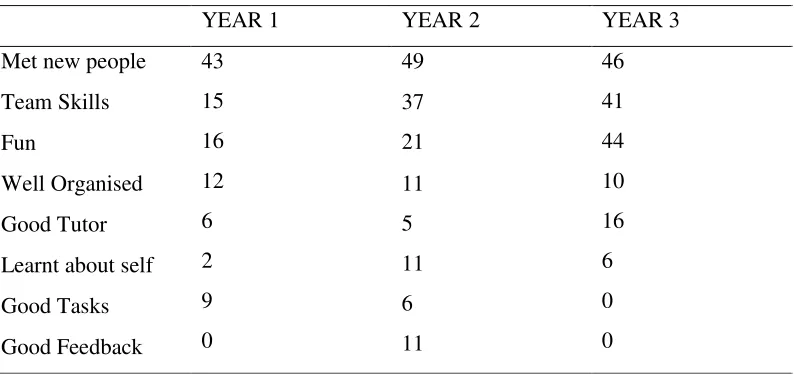
[image:14.612.110.507.527.714.2]These high ratings are further supported by the free report section of the questionnaire. A simple content analysis has been applied to these free response answers to code them into categories. The categories were all derived from the responses given and every response was coded into one or more of the categories shown in Table 2. From Table 2, it can be seen that the most frequently mentioned positive aspects of the day from the student’s point of view were: meeting new people, learning team skills and ‘having fun’. In order to examine why these aspects were important, we looked at the comments from these categories in more detail, (also explored further in focus groups reported later). The comments reveal that the
Table 2. Percentage frequency of a range of positive comments students made about the day
YEAR 1 YEAR 2 YEAR 3
Met new people 49
students felt it had been important to meet the other members of their task group, and experience success as a team.
Quotes from students regarding meeting new people included comments such as:
“Barriers were broken down, it will be easier now to get on with the tasks and not worry about how we will get on”.
“It was very valuable to meet my new group, we now know what to expect from each other and have built up trust”.
“A brilliant introduction to group work. Knowing the group will benefit our work enormously”.
Quotes from students regarding team skills included comments such as:
“The day provided important information and advice about working in teams, which we had never formally been taught before”.
“Useful aspects of group work were taught, especially the review and evaluation process”.
“It was useful to learn about my own role in a group and how I can work with others”.
Section 2. Focus groups after the day
Attitudes towards the team training day
The students’ attitudes before the day were fairly negative. They reported feeling anxious about having to work with people they didn’t know; their expectations were that the day would be boring, a waste of time, and unnecessary. At the end of the day, however, students’ reports were much more positive and that the day was seen as better than had been expected. The main element in their comment was that they had enjoyed meeting new people, and that they had the opportunity for this before the group work curriculum elements of the course.
Quotes from students included comments such as:
“The day was far better than I expected”
“It was quite good actually, it was fun
“I really enjoyed the day once I was doing it”.
New Skills Learnt
On the whole, students commented that the day made them think more about team working and felt it highlighted certain skills. They mentioned they had gained an awareness of the importance of planning before starting a task, that the day had made them think more about time management, and had generally given them a useful opportunity to practise working in a group.
“I feel a bit more conscientious towards those principles (of team working) now than I did before”
(Skills learnt) “I would say planning. If you just run into something without a plan then it’s just, you’re going to have to stop and think again before you can carry on”.
Students Concerns and Worries about the Day
The students expressed fairly negative feelings towards working in groups generally. The concerns were about free riding, one person doing all the work, or the group not getting along. These concerns were based on negative prior experience of group working and contributed to the scepticism at the start of the day. Most students reported that day helped to allay many of these fears about group work, a particular feature being that they practised team skills with their future group colleagues.
“If you don’t know the people in your group, you might worry that they are unreliable. I feel confident in my group now.”
“People are worried about so much group work counting towards their degree, so it was good to get to know who I would be working with. Now I know we can work together, I am not so worried”.
Key Positive Aspects of the day
a) The main positive aspect of the day from the student’s point of view was the social benefit. They felt it was really beneficial to get to know the group members they were going to work with on the unit tasks. They thought it important to lay down ground rules as to what they expected from each other, and many comments were made about their increased confidence about group as a result.
b) The reviews were important to the students. They thought it was a good idea to have time to reflect on what had gone on and what they needed to work on. They felt this made the activities worthwhile and helped them to put into practice what they had learnt in the next task. Students also felt that the theoretical feedback (e.g. Belbin’s team role theory, 1981) was interesting and helped make the link to Psychology.
reported as a positive influence on the group from the outset. Students also liked the idea that the facilitators were observing the group and were able to make comments and suggestions that they might not have been aware of.
e) Most students thought the day was fun, even though they hadn’t expected it to be.
f) Students appreciated the more light-hearted task at the end of the day and
commented that they had gained confidence with regard to presentations as a result.
Section 3: Student Evaluations at the end of the key skills unit
Whilst the evaluations of students immediately after the TDD are generally positive, it could be argued that such a reaction may be only temporary. A number of researchers have commented that measures taken immediately after a group training program may be subject to a phenomenon called “post-group euphoria” - a sense of elation and good feeling (Hattie, Marsh, Neill & Richards, 1997). Further data was therefore collected from students at the final session of the key skills unit in order to tap their views on the TDD after experienceof working in groups. As with the immediate post TDD evaluations, we collected student evaluation sheets and organised a further focus group. This data was collected some eight months after the TDD, by which time all students had completed the five group tasks required by the unit.
a) Evaluation sheets.
These were handed out to students at the end of the unit and asked them to reflect on the team development day and its benefit to them as they progressed through the academic year. Free response questions asked students to name one aspect of the day that had been particularly useful, to name any skills acquired that they felt would be useful to them in the future, and any suggestions for improvement. In addition they were asked to rate whether the TDD had helped in developing specific team skills that had been targeted by the team development day (detailed in Chapter 2). Results are presented in Table 4.
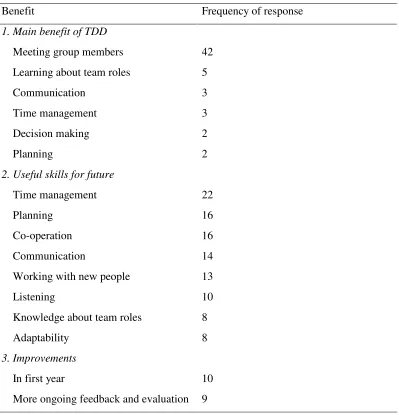
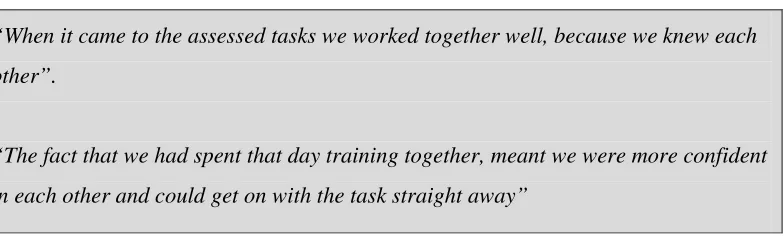
one of the categories. Table 3 shows the results of this. It can be seen again that the main perceived benefit of the day remains meeting other group members before working with them. Students felt that this aspect of the team development day helped them when they had to do assessed work as a team.
Table 3. Percentage frequency of free response answers grouped by question.
Benefit Frequency of response
1. Main benefit of TDD
Meeting group members 42 Learning about team roles 5
Communication 3
Time management 3 Decision making 2
Planning 2
2. Useful skills for future
Time management 22
Planning 16
Co-operation 16
Communication 14
Working with new people 13
Listening 10
Knowledge about team roles 8
Adaptability 8
3. Improvements
In first year 10
More ongoing feedback and evaluation 9
(These were frequencies based on free response answers, so some students chose not to write anything.)
“When it came to the assessed tasks we worked together well, because we knew each other”.
“The fact that we had spent that day training together, meant we were more confident in each other and could get on with the task straight away”
The skills that students learnt on the day that they felt would be most beneficial in the future were time management, co-operation and planning. Examples of comments made by students are:
“I used to just dive straight into a task as soon as it was given. Now I take time to plan.”
“Working with people I did not know was helpful in determining what roles we all could take and then carry these on into the future tasks.”
“We learnt to adapt and to work together as a team, even though we didn’t know each other that well.”
“Learning about team roles and each person's strengths helped us to complete tasks on time as we could share out the tasks more efficiently.”
In addition to the free response section, the students rated the group skills that had been directly targeted by the training, and the results are presented in Table 4 below. It can be seen that most students rated the team development day as essential in helping them to develop communication skills. Also rated highly were the skills of
[image:20.612.115.507.63.181.2]Skill Modal Response Defining Objectives 5
Planning 5
Decision making 5
Time management 6
Conflict Resolution 4
Adaptability 4
Agreeing task roles 5 Agreeing team roles 5 Creating a group environment 6
Leadership 4
Listening to others 6
Cooperation 6
Communication 7
Coordination 5
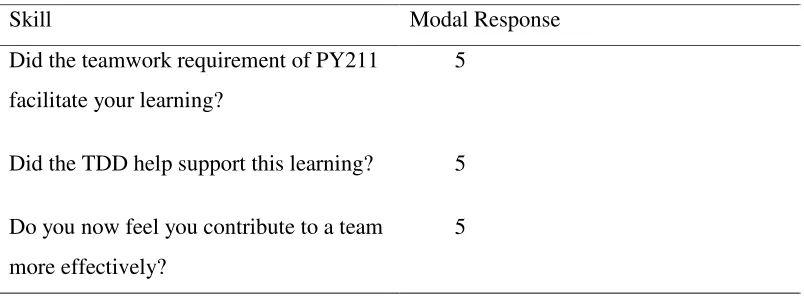
[image:21.612.106.508.512.661.2]The final part of the evaluation asked students for three more general answers regarding the usefulness of the team development day to their learning, again using a rating scale. Table 5 shows the responses.
Table 5. Most frequent responses to questions regarding student learning.
Skill Modal Response
Did the teamwork requirement of PY211 facilitate your learning?
5
Did the TDD help support this learning? 5 Do you now feel you contribute to a team
more effectively?
5
supported this learning and most students reported that they now felt they contributed more effectively to team working.
b) Follow-up Focus Group
At the end of the academic year, some of the students from the first focus groups met to further explore their thoughts about the team development day after they had completed the key skills unit, and after having experience of working in groups to complete assessed tasks. Their responses are summarised under the two main questions.
Was the Team Development Day good preparation for team working in the key skills unit?
Students’ comments were mainly focused on the social benefits the day provided. All students agreed that the day was very valuable in terms of getting to know their group before any assessed group work was carried out. Students appreciated being put in groups with people they didn’t know as they felt this helped to widen their contacts within the Psychology department. They also felt that the experience of working with people they didn’t know helped them develop their team-working skills.
“ (The team day) made it easier to do the tasks at the beginning (of PY211) as we already had broken the ice as it were, so we could just get on with it straight away without all the shyness and tension at the beginning from not knowing each other.”
“The ability to work with people that you originally don’t know; to learn to get on well with them and be a successful group”
What were the particular skills learnt from TDD and used in PY211?
An increased awareness of planning before starting a task was mentioned as
planning how to approach the task before starting and also allocating jobs to different team members as part of the planning process.
“The planning helped me: to plan what we are going to do instead of just diving straight in and then going wrong”.
“Making sure a clear plan of the task was identified at the start is important”
Students felt that they could do this more successfully from the first unit task as a result of getting to know their team members on the training day. They felt
comfortable sharing out the jobs and also felt they could make use of any person’s particular skills as these had emerged on TDD.
“It (the team training day) made it easier for us to assign tasks to people in our group, because we knew a bit about each other”
“We always made sure each person had something productive to do.”
“Remembering to divide the task into sections so each person had something to do.”
Time management was mentioned frequently – students saying the TDD had made them more conscious of this.
We were aware to allow ourselves enough time to complete the task so we were not rushing at the end.”
“ I learnt more about my natural role within a group, what I am good at”
“I learned that I am a better leader than I thought I was; this knowledge has given me confidence to take a leadership role more often”.
Other benefits mentioned were co-operation and communication – learning to work together effectively and to maintain a good team environment
c) Student evaluation of Acting Psychologically
Staff Evaluations
These student reports alone offer strong support for the use of team skills training in preparing students for future group working experiences. We now turn to the views of the tutors involved in facilitating the team development day. In collecting these views we have targeted two areas of enquiry: views on the value of the day and opinions on the students’ team skill development across the training day. In addition to this we also explored staff members’ views on the quality of the training that they themselves have received in order to prepare them for the facilitating team skills training groups.
Section 4: Facilitator ratings of the TDD
Throughout the tasks on the team development day, the facilitators assigned to each group were asked to complete a record of their teams’ skill development as the tasks progressed. The skills being assessed included time management, planning,
communication and decision-making (the complete list is shown in Table 5). The facilitators rated the groups’ competence on each of the skills on a 7-point scale from 1 (no skill) to 7 (excellent). Ratings were made after the group had completed each task. A t-test revealed that overall, the groups’ average skill scores significantly increased from the beginning of the day to the end (t (3) = 4.186; p<0.05).
The facilitators also rated the individual students in their group on level of participation and quality of participation in each task. The reported level of
(After third task) “Much improved planning and timekeeping, the group tried a new role of co-ordinator and turn taking which was discussed in the previous review session – it was very effective.”
(After third task) “Much better feeling among the team members – they really worked together, and tried to improve on their weak areas”.
(After fourth task) “Made a great effort to apply what had been learned from the previous task”.
Section 5: Interviews with the facilitators after the team development day In addition to the facilitator check lists, individual interviews were conducted with each of the facilitators after the team development day. These interviews followed the same topics as the student focus groups and aimed to find out more about the
facilitators’ experiences of the day. The following is a summary of these interviews, organised by question area.
Strong features of the day
Overall feelings about the training days were positive. New tutors reported being nervous and anxious before their first day as a facilitator, but these feelings dissipated as the day progressed. The tutors reported having enjoyed the days and were positive and enthusiastic about being part of it.
Things that went well on the day
“The reviewing process went well and was really positive”
“The reviews were the most valuable part of the day, the students really responded to them and learnt”
b) Tasks themselves. There was a general positive feeling towards the activities. The order of tasks was commented on, with particular importance on having the final task as a ‘non-failure task’. Also, the importance of the inclusion of a physical task (the Lego task) was mentioned although no reasons were given. Some of the comments made included:
“The students liked to be doing the tasks”
“The students found the tasks interesting”
“The tasks were related to much needed skills”
c) General mood / atmosphere. This was commented on frequently and on the whole was positive. At the beginning of the day, the tutors felt the students were sceptical, anxious and possibly thinking that it may be a waste of time. However, by the end of the day, the comments were that the students were more enthusiastic and had enjoyed the day.
Tutor preparation
The tutors were for the most part very positive about their own training as preparation for their roles as facilitators on the day. They felt that although there was a steep learning curve, they learnt enough of the theory they needed. However, they would have liked to receive more practice as a facilitator and more chance to lead
“I modelled myself as a facilitator during my training”
“The training was valuable, especially the reviews”.
“The training was good, but I would have liked more practise as a facilitator, once was not enough”.
Perceptions of the day as a preparation for undergraduates
Tutors were very supportive of the day in relation to its function as a preparation for future group work in the course. In terms of the overall utility of the day, they were keen to impress the importance of ensuring that the students understood why they were doing it, and to encourage them to think of ways they could use what they had learnt. One tutor commented that it may be the responsibility of the tutors to emphasise the relationship between the training and their future work. It was also suggested by several tutors that the skills learnt on the TDD need to be encouraged and reviewed as the unit progressed. The suggestion was made that this ongoing facilitation should be a formal process in order that the training can be truly beneficial.
“I think for the day to be of real value, they (the students) need to be able to make the link back to their coursework”
“They need to understand why they are doing these things and how it all fits in to the bigger picture (of their university education).”
“The reviews after each (PY211) task should be formalised”
The Effect of Team Skills Training on Student Outcomes.
The qualitative data presented in this chapter offers strong support for the use of team skills training by those people who have experienced it - both students and staff alike. Whilst such reflections are interesting and insightful, on their own they are not necessarily enough to convince a department to make a commitment to this type of training. Partly in recognition of this, but also as a point of research interest we have in recent years collected performance data that has aimed to assess the impact of the team skills training beyond the level of student opinion, and consider contributory causal variables. Specifically we have sought to measure the effect of training on student task performance, student group cohesion and students’ subjective experiences of workload when carrying out each task.
This analysis has been possible because in the first year that the key skills course was introduced, although students were required to work in groups to perform tasks, they were not given any prior training to help them to work as a team. Following the introduction of the team development day training in the next and subsequent years, we were able to use the original cohort data as a baseline against which the
performance of groups who experienced team skills preparation could be compared. Making this comparison, the second and third cohorts, both of which received training, achieved significantly higher group marks than those of the original untrained cohort. The size of this performance increase was considerable with the mean task grade for Semester 1 in the trained teams between 5.4 and 5.7 percentage points higher than the untrained teams. A shift of this size could have a significant effect on a student’s final degree classification. In addition, individual team members reported greater improvements in the key skills targeted by the course.
With regard to affective outcomes, trained team members reported higher levels of cohesion towards their team than that reported by untrained team members. In
trained cohorts showed significantly lower variance in workload scores within teams than the untrained teams in Semester 1. This latter finding is consistent with the training having led to a more equal distribution of workload amongst team members who therefore reported a more similar subjective experience of workload.
Summary
Chapter 4
Researching the impact of team skills training on
collaborative performance.
From a departmental perspective the use of team training (followed by team work) has afforded the possibility of research on aspects of team process and collaborative learning. At the end of Chapter 3 we reported findings relating to the effect of team skills training on student performance, workload and cohesion. These measures were collected as a result of a programme of research which has taken place alongside the work already reported in this manual. In the remainder of this chapter we would like to expand on our research findings, in order to provide the reader with a greater depth of knowledge on the psychology of team skills training, and also to provide a basis for the subsequent recommendations we make in the final chapter.
The semester one task marks and key skills self-ratings for those cohorts which received training were significantly higher than those of the first cohort which had no training. Whilst these findings appeared supportive of a causal effect of training on performance, the nature of this real world evaluation introduced a number of possible threats to validity (Campbell & Stanley, 1963; Stratford, Mulligan, Downie, & Voss, 1999). This is a common problem in applied research where there is often an
of research interest (Campbell et al., 1963). In this case, differences which took place in one cohort compared to the other, such as changes in the tasks students performed, or the amount of time that students spent together in training, could be argued to account for the pattern of results obtained. Another possible threat to validity may have been due to selection - that the observed effects may have been due to the differences between the kinds of people in one experimental group as opposed to another (Campbell et al., 1963). In the case of this evaluation, by assessing successive cohorts of students on a course that was part of their degree programme, no random allocation of participants to experimental conditions was possible. Consequently, the cohort to which students belonged determined the experimental condition that they were exposed to. Although some possible cohort differences such as prior ability levels were considered as covariates in the data analysis, it is possible that other cohort differences, such as levels of motivation or changes in teaching staff, may have had an impact on the performance measures.
In view of these possible confounds we felt that it was important to replicate the study in the more controlled setting of the laboratory. Student groups were randomly
allocated into either a condition in which they received team skills training or a control condition in which no training was given. The groups were then required to complete a collaborative learning task, which was followed by an individual post test on the material covered by the group. It is the findings from the latter test that are of particular interest.The collection of individual test scores had not been possible in the context of the key skills unit tasks, where student assessment requirements were already considerable. However, the greater control available in the laboratory made the use of such an individual test possible, and revealed that individual students who received team training performed better on individual tests of knowledge following collaborative task performance than untrained students. This suggests that team work training does not simply enable groups to complete tasks more efficiently, but also that it permits students to learn more in the process. Furthermore, as shown by the key skills unit evaluation, the effect size of training on individual performance was
band width of 10%. In theory an improvement on the scale reported in this study could take a high ‘2.2’ degree student to a first class degree.
The controlled environment of the laboratory also enabled the collection of process measures during and after task performance, using observation and self-report. These data provide possible explanations of the differences between trained and untrained teams. On the (self-report) task process measures, trained teams reported higher levels of time spent on the task, greater time awareness, and more equal participation
amongst team members. The observation data showed that trained teams managed their time and their planning more effectively. In addition, trained teams consistently adopted task strategies which were different from those used by untrained teams and resulted in significantly higher task performance. Each of these process measures has been identified within the teamwork literature as being necessary for effective task performance, so their relative lack in the untrained teams may explain why they failed to perform so well.
Another research line of enquiry we have followed is the effect of regrouping students on performance. When the key skills unit was originally designed it was decided that at the end of Semester 1, students should be reassigned from their original groups into new groups for Semester 2. The purpose of this regrouping was to give students the opportunity to transfer the skills which they had developed into a new group, and also to allow them the opportunity of working with more of their fellow students. We had not predicted that this would have any adverse effects on student performance. However when comparisons were made between trained and untrained students at the end of Semester 2, the performance benefits of training were not as apparent as those found in Semester 1. Whilst task marks were still significantly higher for the trained cohort, their performance significantly decreased from Semester 1 to Semester 2, to the point where much of the performance advantage which trained teams had demonstrated in Semester 1 in comparison to untrained teams, was lost.
students progressively forgot the skills learned during training or because their immediate ‘post-training euphoria’ had waned (Hattie et al., 1997). Post training euphoria, if it occurred, may have heightened student motivation following the
training thus accounting for the performance benefits demonstrated in Semester 1. The alternative explanation we have considered was that the decline in trained group performance across semesters was a result of the disruption of the original training groups, which had not been together long enough to support generalisation of team skills into new groups. In order to consider this latter possibility, in the third year in which the key skills unit was run (Cohort 3), it was decided that as with the second cohort (Cohort 2), students should receive team skills training at the beginning of the year in the groups that they would then go on to work in during Semester 1.However, unlike Cohort 2, the students in this cohort then remained in those groups for
Semester 2. We reasoned that if the findings of Cohort 2 in Semester 2 were due to students forgetting the skills learned during training then the same pattern of results would be predicted for Cohort 3. However, the results showed that Cohort 3 student performance grades remained equivalent across semesters and key skill ratings rose, remaining significantly higher than the untrained cohort on both measures. These findings support the explanation that it was the disruption of student groups which led to the performance decline of Cohort 2 in the second semester.
Currently it is only possible to speculate on the reasons why teams that stay together outperform teams that are reassigned following training. One possible interpretation relates to the transferability of the team skills. Cannon-Bowers, Tannenbaum, Salas & Volpe (1995) have proposed a classification of team competencies which suggests that some competencies are transferable from one team to another, whilst others are teams specific. This classification suggests that these two types of competency may have an additive effect on team performance. The presence of team generic competencies will raise performance in any team. However, where teams develop team specific
competencies as well, further performance gains will be achieved. The team skills training used in our own evaluations aimed to provide students with a generic set of skills that they could use in any team, such as communication or planning skills. However, it seems likely that in training together students may have also developed team specific competencies such as knowledge of team member characteristics. It is speculated that these team specific competencies that were established in training, and their associated benefits in terms of performance, were lost where training groups were disrupted. Further manipulations to evaluate whether simply increasing the length of time or number of tasks groups are together promotes transfer have not yet been possible.
Educational implications of our team research
this area has observed many new initiatives within this university. For example, the University has recently decided that team skills training should be embedded in its continuing professional development strategy for staff.
The introduction of such new policy should be informed by high quality research. However, up to this point there has been little empirical evidence to support any academic benefit of training students in teamworking skills. Consequently, it is regarded as an external pressure on universities which some academic staff see as a distraction from deeper learning. This research programme has sought to advance our understanding of the potential impact of team training initiatives on students’
academic performance.
In summary, our results show significant performance and affective benefits from team skills training for students working in collaborative groups, reflected in both group grades and individual tests. These effects are found even when training is of a relatively short duration (90 minutes). Benefits are strongest where teams perform collaborative tasks in the same groups that they originally trained with, with a reduction in benefits when teams are formed into new groups. This loss of training benefit is of concern and as previously stated further research is required to identify the transferability of different team competencies. In addition to performance and affective gains, team skills training also leads to a reduction in the experience of subjective workload. This finding is significant for learning groups where, as a consequence of the learning task, workload demands are likely to be high.
Chapter 5
Introducing Team Skills Training into the Curriculum:
Practical issues to be considered
Getting tutors trained:
Of all the tasks involved in introducing team skills training, the supply of trained facilitators is probably the most difficult to address as inevitably it has to be
resourced. We have been fortunate in our university to have had support for training from two sources. In the first instance, we received funding for tutor training through the BP Team Development in Universities Programme. This programme was funded by BP both to improve their links with universities, and also to provide students with the interpersonal skills required for the workplace. Funding was made available to train staff and postgraduate tutors so that they in turn could facilitate such training for undergraduates within their own departments. We should stress that the work in our department was heavily dependent on this training programme and in particular on the support of two external training consultants, Mike Rawlins and Peter Danby from Chalybeate. (Chalybeate is a consultancy commissioned by BP to deliver team skills training to a number of universities including our own). Their expertise and
enthusiasm facilitated the smooth introduction of the team skills training to the department. The materials/training details in the Appendices are based on Chalybeate training, and subsequently developed for use by our departments.
Research Councils Graduate Schools Programme, the UK GRAD Programme is supported and funded by the UK Research Councils and the Arts & Humanities Research Board to develop the personal skills and attributes of postgraduates by integrating them into postgraduate degree programmes. In line with this objective they provide a range of activities to support universities to develop postgraduate skills. One of the skills now targeted by the GRAD Programme is the provision of team skills. These courses are based on the principle of cascade training, such that Supervisors are trained to deliver courses to groups of students. The aim of the training is to prepare supervisors and students to work in teams. This training is funded by the UK GRAD Programme with the University expected to provide a training venue and
refreshments. Through the UK GRAD Programme it would therefore be possible to fund the development of both staff and postgraduates to deliver team skills training to undergraduate students.
A second route to funding staff training in this area is through the growth in the provision of postgraduate teaching courses for new academic staff. In our own University, all new academic staff serving a probationary period, are asked to undertake a Postgraduate Certificate in Academic Practice (PCAP). PCAP is a one-year part-time, work-based M-Level programme, designed to enable new academic staff with teaching responsibilities to reach a nationally recognised standard of competence in teaching and learning support. As part of this programme, new lecturers undergo a group development day. The main purpose of this workshop is to provide PCAP participants with an opportunity to get to know one another and to lay the foundations for how the group will work together for the remainder of the programme. However, the practical elements of the workshop are also linked to relevant theories of group work and group development, and related to learning opportunities that PCAP Participants can provide for their own students. A workshop of this type could easily be developed to provide the support needed for team skills training facilitation for undergraduate students.
development these skills will be available to their departments. In the case of the UK GRAD Programme staff members would develop the skills necessary to train
postgraduates to act as tutors in undergraduate team skills training.
Training Format, Equipment and Training Support:
The training format that we have used in our department is detailed in Appendix 1 and 2 of this manual. In addition, further information can be found by visiting our staff websites and following the links for team skills training. This information includes the tutor notes for the training day to support the timetable printed in Appendix 2, and also a facilitator check list. The facilitator check list is a sheet that we developed for tutors to use during student task performance as an aide-memoire, both to cue them about what aspects of performance to look for and to support the post-task review.
The equipment required for the training will depend on the tasks used. However, many of the team skills training tasks that can be used require inexpensive, easily obtainable equipment. Appendix 2 details the tasks that we used on our team
development training day together with lists of the equipment required for each task.
Timing:
We believe that to maximise the benefits of the team development day the timing of the event should be carefully considered in relation to the objectives of the training. If the focus is on enhancing students’ group working skills to facilitate learning, then it is clear to us that the greatest value comes from linking the training directly to a course which will require students to work together in groups. In this way students can train in the groups they will work in thus enhancing interpersonal knowledge, trust and cohesion. In addition, the students move directly from training into practising the skills whilst carrying out meaningful tasks. This immediacy, and the opportunity to make the links explicit, both facilitate transfer.
might have been more beneficial if it had been offered in the first year of study rather than the second year. The reasons given were:
“You don’t have much contact with others in the first year, or work in groups, it would be better to do it (the training) then, when you are new”.
“In the first year, it would have been ideal. It would have prepared you for your academic career. It is almost a bit late by now as we have all done group work informally”.
There is some justification for this view. For example, there are clear social benefits provided by the training which could be used to support student induction and integration into the department. In addition, the training could support informal student study groups. Against that view, however, none of the first year units formally require groupwork, a feature which we regard to be critical for the transfer of team skills. Our current first year tutorials are run on a group basis, which affords some opportunity for group process to emerge, but at a relatively informal level. In an ideal situation if there were first year units that did require group working (as for instance on a practical course) then providing training in year one could possibly enable all of the potential gains from teamwork training to be realised, provided later opportunities are taken to refresh the initial training.
Venue:
From our own experiences we identified three principle criteria to consider in
are trained on any given day, and the size of both the small and large rooms will be dependent on total student numbers. The best solution to this problem is to make use of the facilities available within the host department as the cost associated with finding alternative venues can mount up. As an alternative other departments in our university have made use of student halls of residence and these have worked very successfully. In some instances departments have also managed to secure sponsorship from local businesses to cover some costs such as the use of an external venue or catering.
The final point for consideration is that of privacy. It is important that students are able to feel comfortable in their working environment. The small group reviews can raise sensitive issues and it is important that the group does not feel it is being overheard by others as this may inhibit their engagement. In addition, the site chosen for the teams’ activities also needs to be chosen carefully so that students are able to work away from the eyes of passing students. This is important not only to protect the confidentiality of the students taking part, but also to prevent students who may not yet have received training from seeing what lies ahead!!
Group size:
Length of training:
With regard to the length of team skills training activities, the team development timetable that we currently use requires students to commit to a full day’s training, comprising 5 tasks. Despite the overall strong support for team skills training, our student evaluations identified that the length of the team development day was one of the most frequent criticisms. Many students commented that a whole day of team training was too long and tiring, and they would have preferred two ½ days. Similarly, tutors were concerned about fatigue and a general decline in spirits in the latter part of the day.
The length of training is likely to be important because new skill proficiency will clearly be related to the opportunities a person has to practise new skills. In other research we have found improvements in student performance following as little as 90 minutes worth of team skills training suggesting that relatively short training durations may be beneficial. However, currently there is no re-test data available for these teams and it is possible that with a short amount of training the benefits may also be short term. In addition, this shorter training duration did not result in any significant increase in affective outcomes. Consequently we would still recommend the day programme we currently use for our students which shows evidence of both performance and affective outcomes.
tasks (More Words) required considerable physical exertion due to the layout of our venue. It may be that replacing this task with one less physically demanding might reduce the levels of student fatigue.
Changing groups:
As discussed in Chapter 4, one of the key problems that we have identified from our evaluations of the team skills training initiative relates to the reassignment of team members from one team to another. From both our evaluation of the TDD and our laboratory based work it appears that the regrouping of students leads to a loss of the performance advantage over untrained students compared with those who train together and then remain together. This is clearly a very important issue and certainly requires further evaluation and research. If the reduced performance demonstrated results from a loss of team specific competences when students are reassigned into new groups then it may be possible to find ways in which to facilitate their
development within the new group. Until more research findings become available our advice would be that wherever possible, teams should be trained in their collaborative groups and kept together as long as possible in order to benefit from both generic and specific team competencies. Furthermore, where groups cannot stay in their original groups, it may be beneficial to provide some type of ice-breaking activity in advance of any assessed collaborative activity in order to facilitate the development of team specific competencies within the new formation.
Ongoing support
A final point that should be considered is the ongoing support of student team
resolution’. Although this was one of the training objectives targeted by the training day, unless conflict emerged in the group during training there was no real opportunity for the students to practise the skills required. Students felt they would have liked to have discussed how to resolve problems that occurred within the team, such as where one group member person was not doing their fair share of the work, or was
consistently failing to turn up. This issue is one that may have been addressed with the use of follow-up facilitated reviews.
Recommendations Summary
1. The research presented here shows that the use of team skills training is effective. Although more evaluation is necessary to explore how the approach to training may be fine-tuned, a course that addresses concepts such as planning, time management, the allocation of roles and the understanding of the ways in which people work in groups is recommended.
2. The length of training is likely to be important because, clearly, the number of times a person has to practice new skills will be related to their level of
expertise. Therefore despite resource requirements and student fatigue, we still recommend the day programme that we currently use.
3. The formation of teams also appears to be important. Wherever possible, teams should be trained in their collaborative groups and kept together for as long as possible in order to benefit from both generic and specific team competencies. Where groups cannot stay in their original groups, it may be beneficial to provide some type of ice-breaking activity in advance of any assessed collaborative activity.
5. Finally, from the research we have carried out, there is no evidence of any
Appendix 1
47
ACTING PSYCHOLOGICALLY (PY 2.11) UNIVERSITY OF SOUTHAMPTON
BP AMOCO TEAM DEVELOPMENT PROGRAMME
The following is an outline programme to provide you with a general structure of the event. It assumes that eight groups of five students are involved in each activity.
Time Activity Remarks Skills & Processes
Pre-work Learning Styles
Belbin Team Roles questionnaire 0850
10 min Students arrive Coffee / Tea available on arrival Morale enhancer! 0900
15 min
Welcome, Introductions Aims and Objectives Learning Journey
All students in main room.
Icebreaker in larger group - optional Break into Learning Groups
0915 20 min
Introducing the team members Learning Group concept Emotional Learning Curve Groundrules
Very brief session to get names of group, explain the purpose of the learning group and set expectations for the day.
Handshake exercise as an icebreaker Introduce the Emotional Learning Curve Introduce and establish basic groundrules. Move outside to the first task.
0935 40 min
Activity 1 – Outdoors ‘Neutraliser’
30 min task
10 min transfer time
Problem solving and planning activity with all team members involved.
All teams with identical exercise. Problem Solving Planning Decision Making Time Management Listening
48
Time Activity Remarks
1015 25 min
Review of ‘Neutraliser’ Establishing the review and learning process. Initial thoughts and feelings
What went well and what could be improved. Developing their own problem solving process. 1040
30 min
Activity 2 - Indoors
Getting to Know You ‘Getting to know you’ session Team members to introduce themselves in picture form with opportunity to speak about themselves.
Re-emphasise the importance of groundrules. Learning Styles input and profile.
Planning Listening
1110
15 min Tea / Coffee / Biscuits 1125
30 min
Activity 3 – Outdoors ‘Blindfold Square Exercise’ 20 min for activity
10 min to move in and out
Planning and Communication exercise - when working environment is
changed. Problem Solving Planning Decision Making Time Management Adaptability Leadership Listening Co-operation 1205 25 min
Review of Activity Development of their problem solving process and showing the importance of planning.
Introduce Adair’s circles to highlight the needs of the team and individuals as well as the task.
1230
49
Time Activity Remarks
1315 40 min
Activity 4 – Indoor / Outdoor ‘Words and Messages’ or ‘Valuable Letters’
A test of the team’s theory so far!
Practising and developing the process defined earlier.
Setting and clarifying objectives and gaining common agreement for the plan. Impact of any perceived ‘competition’ from other teams.
Setting Objectives Problem Solving Planning Decision Making Time Management Adaptability Roles Leadership Co-operation 1355
25 min Review of Activity Developing and refining their problem solving process further. Raising awareness of team roles if possible. 1420
30 min
Activity 5 – Indoors Team Roles Workshop Central Input on Belbin
Raising the awareness and importance of team roles and providing the opportunity to identify preferred roles within the team. After central input break back into small teams to create profile.
1450 20 min
Team Roles Profile Based on the input from above and their experience of each other to date, the teams to review the roles that they have seen each other perform within the team.
Opportunity for some basic feedback on their impact within the group.
Feedback Listening
1510
15 min Tea and Biscuits 1525
75 min
Activity 6 – Indoor / Outdoor Planning the Future
Team to develop a folder, which will contain a number of items
highlighting the qualities, skills and strengths of the team. To include for example - their approach to the next team project including an initial action plan, a set of groundrules for future sessions, a poster representing the team, a poem describing their exploits, their Team Belbin profile highlighting strengths & blindspots and a plan of how they are going to develop them.
50
Time Activity Remarks
1640 20min
Activity and Learning Review Review is kept brief with the emphasis on the ongoing development of individuals and transfer of the learning points to enhance their quality of their life and work.
1700
Appendix 2
NEUTRALISER
You have just 25 minutes to prevent a major disaster.
Your small team has been contacted by a secret United Nations
department. A highly sensitive transmitter system has developed a
fault and, in 25 minutes, will have initiated a series of devastating
storms around the world. The transmitter is inside the taped area in
front of you.
Your task is to ensure that the transmitter is neutralised by
positioning a container on the special sensor, i.e. the square in the
middle of the zone. The transmitter must not be touched by
anything other than the container.
The container must be placed on the transmitter, left for one minute
and then removed. The container must not be supported by,
attached to or touched by any piece of equipment other than the
square on which it stands during that minute. No other piece of
equipment can be in the taped area during the one minute.
The container holds an exact amount of a special chemical and this
must be in the container when it stands on the square for the one
minute.
It is vital that nothing or nobody touches the tape or the ground
within it - at any time during the operation.
Nothing solid may be put inside the pipes.
Tutor notes for Neutraliser task
Equipment required:
Scaffold Pole Wooden spars Plastic pipes Ropes
Plastic hazard marking tape Tent pegs
Tile or bricks Bucket and water
Equipment Layout
Use hazard tape and tent pegs to lay out square
Bucket starts here Bucket must be