UNIVERSITI TEKNIKAL MALAYSIA MELAKA
A STUDY ON THE POTENTIAL OF PELTIER IN GENERATING
ELECTRICITY USING NATURAL RESOURCES
This report submitted in accordance with requirement of the Universiti Teknikal Malaysia Melaka (UTeM) for the Bachelor of Electrical Engineering Technology
(Industrial Automation & Robotic) with Honours.
By
MOHD HUZAIF BIN ABDUL RAHIM B071310951
920909-02-5093
UNIVERSITI TEKNIKAL MALAYSIA MELAKA
BORANG PENGESAHAN STATUS LAPORAN PROJEK SARJANA MUDA
TAJUK: A STUDY ON THE POTENTIAL OF PELTIER IN GENERATING ELECTRICITY BY USING NATURAL RESOURCES
SESI PENGAJIAN: 2016/17 Semester 2
Saya MOHD HUZAIF BIN ABDUL RAHIM
mengaku membenarkan Laporan PSM ini disimpan di Perpustakaan Universiti Teknikal Malaysia Melaka (UTeM) dengan syarat-syarat kegunaan seperti berikut: 1. Laporan PSM adalah hak milik Universiti Teknikal Malaysia Melaka dan penulis. 2. Perpustakaan Universiti Teknikal Malaysia Melaka dibenarkan membuat salinan
untuk tujuan pengajian sahaja dengan izin penulis.
3. Perpustakaan dibenarkan membuat salinan laporan PSM ini sebagai bahan pertukaran antara institusi pengajian tinggi.
4. **Sila tandakan ( )
Disahkan oleh:
(TANDATANGAN PENYELIA)
Cop Rasmi:
Tarikh: _______________________ (TANDATANGAN PENULIS)
Alamat Tetap:
4-2-20 Gugusan Dedap,
Jln. Kenyalang 11/1, Kota Damansara 47810 Petaling Jaya, Selangor
Tarikh: ________________________
** Jika Laporan PSM ini SULIT atau TERHAD, sila lampirkan surat daripada pihak berkuasa/organisasi berkenaan dengan menyatakan sekali sebab dan tempoh laporan PSM ini perlu dikelaskan sebagai SULIT atau TERHAD.
SULIT
TERHAD
TIDAK TERHAD
(Mengandungi maklumat yang berdarjah keselamatan atau kepentingan Malaysia sebagaimana yang termaktub dalam AKTA RAHSIA RASMI 1972)
FAKULTI TEKNOLOGI KEJURUTERAAN Tel : +606 234 6623 | Faks : +606 23406526
Rujukan Kami (Our Ref) : Rujukan Tuan (Your Ref) :
09 DIS 2016
Pustakawan
Perpustakaan UTeM
Universiti Teknikal Malaysia Melaka Hang Tuah Jaya,
76100 Durian Tunggal, Melaka.
Tuan/Puan,
PENGKELASAN LAPORAN PSM SEBAGAI SULIT/TERHAD LAPORAN PROJEK SARJANA MUDA TEKNOLOGI KEJURUTERAAN ELEKTRIK (INDUSTRIAL AUTOMATION&ROBOTICS): MOHD HUZAIF BIN ABDUL RAHIM
Sukacita dimaklumkan bahawa Laporan PSM yang tersebut di atas bertajuk
“A STUDY ON THE POTENTIAL OF PELTIER IN GENERATING
ELECTRICITY USING NATURAL RESOURCES” mohon dikelaskan
sebagai *SULIT / TERHAD untuk tempoh LIMA (5) tahun dari tarikh surat ini.
2. Hal ini adalah kerana IANYA MERUPAKAN PROJEK YANG DITAJA OLEH SYARIKAT LUAR DAN HASIL KAJIANNYA ADALAH SULIT.
Sekian dimaklumkan. Terima kasih.
Yang benar,
________________
Tandatangan dan Cop Penyelia
* Potong yang tidak berkenaan
NOTA: BORANG INI HANYA DIISI JIKA DIKLASIFIKASIKAN SEBAGAI
SULIT DAN TERHAD. JIKA LAPORAN DIKELASKAN SEBAGAI TIDAK
TERHAD, MAKA BORANG INI TIDAK PERLU DISERTAKAN DALAM
DECLARATION
I hereby, declare that this is the original report entitled “A STUDY ON THE POTENTIAL OF PELTIER IN GENERATING ELECTRICITY USING NATURAL RESOURCES” is the results of my own work except as cited in references.
Signature :
Name : MOHD HUZAIF BIN ABDUL RAHIM Reg. Number : B071310951
APPROVAL
This report is submitted to the Faculty of Engineering Technology of UTeM as a partial fulfilment of the requirements for the degree of Bachelor of Electrical Engineering Technology (Industrial Automation & Robotics) with Honours. The member of the supervisory is as follow:
i
ABSTRAK
ii
ABSTRACT
iii
DEDICATION
iv
ACKNOWLEDGEMENT
Much appreciation is given to Mr. Mohamad Haniff bin Harun for their guidance, encouragement, advice and ideas which were given to me during my bachelor degree project as required by the university for a Bachelor of Engineering Technology (Industrial Automation & Robotics) (Hons.) students.
I would like to acknowledge gratitude to the university for the opportunity experience/practical skills and have a taste of the working environment throughout this bachelor degree project program. Nevertheless, I would like to express my gratitude to UTeM’s lecturers who has been described in detail the bachelor degree project report writing format and for helping me to successfully complete my project.
Not forgetting to thank my friends who also undergo bachelor degree project for assisting and providing support and suggestions to me during this courses.
v
TABLE OF CONTENT
ABSTRAK i
ABSTRACT ii
DEDICATION iii
ACKNOWLEDGEMENT iv
TABLE OF CONTENT v
LIST OF TABLES viii
LIST OF FIGURES ix
LIST OF ABBREVIATIONS, SYMBOLS AND NOMENCLATURE x
CHAPTER 1 1
INTRODUCTION 1
1.0 Introduction 1
1.1 Background 1
1.2 Problem Statement 3
1.3 Project Objective 3
1.4 Project Scopes 4
1.5 Thesis Outlines 4
CHAPTER 2 6
LITERATURE REVIEW 6
2.0 Introduction 6
2.1 A Study on Improved Efficiency and Cooling LED Lighting using a
Seebeck Effect 6
2.2 Renewable Energy Lamp to Replace Kerosene Lamp 7 2.3 Thermoelectric Generators as Alternate Energy Source in Heating
Systems 7
2.4 Self – Energy Generating Cook Stove 8
2.5 Waste heat energy harvesting using thermo electric generator 8 2.6 Thermoelectric generators in renewable energy 9 2.7 Performance Analysis of A Prototype Small Scale Electricity-Producing
vi 2.8 Automobile Exhaust Thermo-Electric Generator Design & Performance
Analysis 10
2.9 Thermoelectric Power Generation Using Waste-Heat Energy as an
Alternative Green Technology 10
2.10 Generation of Electricity from Gasoline Engine Waste Heat 11 2.11 Experimental Investigation of an Improved Exhaust Recovery System for
Liquid Petroleum Gas Fuelled Spark Ignition Engine 11 2.12 Multipurpose Thermal Sensor Based on Seebeck Effect 12 2.13 Data Acquisition and Virtual Instrumentation System for the Study of
Peltier and Seebeck Effects 12
2.14 The Effect of Aluminium Nanoparticle on the Seebeck Coefficient of
Biomedical Thermoelectric Devices 13
2.15 Energy harvesting from multiple sources for Battery charging 13 2.16 Pilot Centralized Solar Power Station in Remote Village, Rompin,
Pahang 14
2.17 Power Flow Control of Isolated Wind-Solar Power Generation System
for Educational Purposes 15
2.18 Fuzzy Control of a Lead Acid Battery Charger 15 2.19 Development of Battery Charge/Discharge Regulator for Photovoltaic
Systems 16
2.20 Optimum Design and Selection of Heat Sinks 16
2.21 Summary 17
CHAPTER 3 18
METHODOLOGY 18
3.0 Introduction 18
3.1 Methodology 19
3.1.1 First Phase 19
3.1.2 Second Phase 20
3.1.3 Third Phase 20
3.1.4 Forth Phase 20
3.1.5 Final Phase 21
3.2 Peltier 21
3.3 Cooling Part System 22
3.4 12V Rechargeable Lead Acid Battery 23
vii
3.5.1 LM35 Temperature Sensor 24
3.5.2 Arduino 25V Voltage Sensor Module 24
3.5.3 Liquid Crystal Display 25
3.5.4 Programming Code 25
3.5.5 PLX-DAQ Data Recording 28
3.6 High Efficient Series PWM Controller 28
3.7 Overall System 29
CHAPTER 4 30
RESULT & DISCUSSION 30
4.0 Introduction 30
4.1 Preliminary Result 30
4.2 Voltage VS Temperature Differential 33
4.3 Current VS Temperature Differential 34
4.4 Final Result 35
4.5 Calculation of Generating System 39
4.6 Power Generated by Three Peltier TEG1 4199-5.3 40
4.7 Data Collected at Asahan 41
CHAPTER 5 42
CONCLUSION 42
5.0 Introduction 42
5.1 Conclusion of Generating System 42
5.1.1 Summary of Voltage Generated 42
5.1.2 Potential of Peltier TEG1 4199-5.3 to Generate Electricity using
Natural Resources 43
5.2 Implications of Generating System and Future Work 43 5.3 Durability of Peltier in Generating Electricity 43
5.4 Limitations 44
REFERENCES 45
APPENDIX A 48
APPENDIX B 53
viii
LIST OF TABLES
Table 3.1 : Thermal Conductivity 22
Table 4.1.2: TEG1 1263-4.3 30
Table 4.1.3: TEG1 1268-4.3 31
Table 4.1.4: TEG1 4199-5.3 32
ix
LIST OF FIGURES
Figure 1.1: Seebeck Effect 2
Figure 3.1: Flowchart 18
Figure 3.2: TEG1 4199-5.3 21
Figure 3.3: Natural Cooling System using River Water 22
Figure 3.4: Battery 23
Figure 3.5: Arduino Uno Rev3 23
Figure 3.6: LM35 Temperature Sensor 24
Figure 3.7: 25V Voltage Sensor Module 24
Figure 3.8: Liquid Crystal Display 25
Figure 3.9: PLX-DAQ Data Recording 28
Figure 3.10: High Efficient Series PWM Controller 29
Figure 3.11: Overall Generating System 29
Figure 4.1: Voltage Vs Temperature Differential 33
Figure 4.2: Current Vs Temperature Differential 34
Figure 4.3: Temperature Vs Time for Hot Temperature 35 Figure 4.4: Temperature Vs Time using Cooling System 36 Figure 4.5: Relationship between Voltage and Current Vs Time for Hot Temperature 36 Figure 4.6: Relationship between Voltage and Current Vs Temperature Difference
for Hot Temperature 37
Figure 4.7: Relationship between Voltage and Current Vs Time using Cooling
System 38
Figure 4.8: Relationship between Voltage and Current Vs Temperature Difference
using Cooling System 38
x
LIST OF ABBREVIATIONS, SYMBOLS AND
NOMENCLATURE
TEG - Thermo-electric Generator
UTeM - Universiti Teknikal Malaysia Melaka °C - Degree Celsius or Centigrade
°K - Degree of Kelvin
V - Volt
A - Ampere
m/s - Meter per seconds PWM - Pulse Width Modulation USB - Universal Serial Bus
MOSFET - Metal Oxide Semiconductor Field Effect Transistor MPU - Memory Protection Unit
r.m.s. - Root Mean Square rpm - Revolutions per minute
1
CHAPTER 1
INTRODUCTION
1.0 Introduction
This chapter is explained the basic knowledge about this project. In this section, the contents enclosed are background, problem statement, project objectives and project scopes.
1.1 Background
The design of this project is to generate electricity which the source of electricity is scarce. Usually outdoor enthusiasts only rely on power banks as a source of electricity but with this project anyone can easily produce electricity by depend on natural resources. This portable generating system is focus on the cell phone charging while doing outdoor activities by using renewable source. This charger makes the utilization of renewable source of energy like camp fire or a waterfall. The device that been used to make this generating system works is peltier device.
2 Figure 1.1: Seebeck Effect
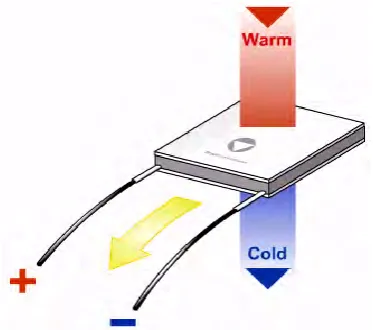
In 1821, two wires of dissimilar metals joined by Thomas Seebeck (copper wire and bismuth wire) to form a loop or circuit and accidentally discovered Seebeck effect that produce electricity when the temperature difference is resulting from hot and cold npn junction type of semiconductors. Heat will be absorbed on the hot side and leaving to the cold side of the Peltier device. During the process, the electrons in the NPN semiconductor will active and vibrate due to heat then collides with each other in order to release the heat to the cold side.
3 1.2 Problem Statement
The difficulty of finding the source of electricity when doing outdoor activities is the factor to design a device for backup electrical supply for phone charger or other usage. When the source of electricity is scarce, usually outdoor enthusiasts only rely on power banks as a source of electricity. By some estimation, the electricity usage will last in three times. Thus, the usage of power banks is not a very effective device where there is a device that can generate electricity by using natural resources. In this case, the generating system must be portable so the outdoor enthusiasts could bring it anywhere they prefer. The project will study on the potential of peltier in generating electricity using natural resources when doing outdoor activities.
1.3 Project Objective
A method has been proposed in order to overcome this problem. The objectives of these project is
a) To define the efficiency of generating electricity by using 4 types of peltier. b) To develop a portable generating system by using the best peltier in
generating electricity for outdoor purposes.
4 1.4 Project Scopes
The scope of this project is to study on the potential of peltier in generating electricity using natural resources when doing outdoor activities. The project is to develop a generating system by using the best peltier in generating electricity for outdoor purposes. Data will be analysing in term of power, current and efficiency. The scopes of this project are:
a) The efficiency of generating electricity should exceed 10%.
b) The peltier that is used in this project must be the best one so the efficiency of product achieves what is targeted.
c) The current that are produced must be 1A; voltage must be 5v so this project can charge the phone.
1.5 Thesis Outlines
Portable generated system using natural resources as a medium for heating and cooling the peltier. Basically introduction, literature review, methodology, result & discussion, conclusion and further development that can be applied in this project is attached on the topic of generating energy which called Seebeck effect.
5 Chapter 2 is about the summarize and literature review of the entire journal for the development of the portable generating system by using natural resources as a medium of generating system. This includes the future project development that can be added in this project.
Chapter 3 will discussed about the methodology of this project development. In this chapter, it will explain the flow of the project to create a portable generating system. In this chapter also, describe about the parts that used in this development project such as peltier, heat sinks, battery and overall system.
Chapter 4 will brief about expected result that can be achieved by this portable generating system. The full design and basic concept of the project will be focused in this chapter.
6
CHAPTER 2
LITERATURE REVIEW
2.0 Introduction
This chapter describe what is Seebeck effect and thermoelectric generator which have been developed by the previous researchers. This chapter is done to investigate the peltier and other generating system parts. It also consists of the information which will be the parameter for the developing this project.
2.1 A Study on Improved Efficiency and Cooling LED Lighting using a Seebeck Effect
7 2.2 Renewable Energy Lamp to Replace Kerosene Lamp
The objective of this research is to develop a renewable energy lamp for people who live far away from the power delivery system depend on traditional kerosene lamp for light. This new lamp is built to store energy in a small battery when power is available. The battery power is used in the night to obtain light. This lamp is energized with a small solar panel. Battery power is sufficient to illuminate a common size room for 4 hours and the charger is capable to charge the small battery in day time. The voltages that are supply for battery charging is 4.3v and maintain 4.3v over time. The current that are charging the battery is for the first to 5 minute is 1.25A to 1A and reduce over time. The advantages of this project are risk of fire can be minimized due to absence of oil. Then, renewable energy sources produce clean power. Therefore room can be illuminated without polluting the environment. This does not produce hazardous fires & operational cost is minimal. So, the dependence on fossil fuel to generate light is reduced. This lamp doesn’t have a flame so that it is safer than the kerosene lamp.(Jayawickrama 2014)
2.3 Thermoelectric Generators as Alternate Energy Source in Heating Systems
8 2.4 Self – Energy Generating Cook Stove
The objective of this research is to convert useful electrical energy in rural areas by emphasize on a sustainable way of utilizing waste thermal energy produced from the cook. The method used in this project is by using a thermoelectric generator (TEG) module; the process of converting thermal energy into electricity is achieved. To improve the efficiency of cook stove, the power gained from the TEG can be used for running a fan to provide sufficient air inside the combustion chamber. Due to limitation of HZ-14, it shows only 14W maximum power output of the module. Power generated by using this method also has limitation on temperature difference where Thermo Electric Generator cannot always produce constant ΔT. Next, HZ-14 also has high cost. HZ-9 module is chosen for the application due to these limitations of HZ-14. 3W is the power generated from the TEG. To improve combustion, the small DC brushless fan is required to cools the cold side of TEG and directs the air to the combustion chamber. A mobile phone will charges and LED light will glow because the generated voltage is boosted up to 5.2 V by a DC-DC boost converter.(Mal et al. 2012)
2.5 Waste heat energy harvesting using thermo electric generator
9 2.6 Thermoelectric generators in renewable energy
The objective of this research is to understand the role of conversion of geothermal energy into electrical energy by using thermoelectric generators (TEGs). The P–type and n–type semiconductors will form the thermo element connecting in series as electrical. Then, to increase the operating voltage, a large number of the thermo elements are electrically connected in series and to increase the thermal conductivity, thermally connected in parallel. The result obtained considering reuse of waste energy gain is their efficiency is about 5–10%. The advantages of this method are TEGs have no moving parts, they are long-lived and work silently, scalable, and no greenhouse gas emissions which is environmentally friendly. On the other hand, it produces low conversion efficiency which is below 10% as their biggest disadvantage. (Ahiska & Mamur 2014)
2.7 Performance Analysis of A Prototype Small Scale Electricity-Producing Biomass Cooking Stove