White Rose Research Online URL for this paper:
http://eprints.whiterose.ac.uk/1840/
Article:
Boerner, E.D., Chubykalo-Fesenko, O.A., Chantrell, R.W. orcid.org/0000-0001-5410-5615
et al. (2 more authors) (2005) Moving toward an atomistic reader model. IEEE
Transactions on Magnetics. pp. 936-940. ISSN 1941-0069
https://doi.org/10.1109/TMAG.2004.842128
[email protected] https://eprints.whiterose.ac.uk/
Reuse
Items deposited in White Rose Research Online are protected by copyright, with all rights reserved unless indicated otherwise. They may be downloaded and/or printed for private study, or other acts as permitted by national copyright laws. The publisher or other rights holders may allow further reproduction and re-use of the full text version. This is indicated by the licence information on the White Rose Research Online record for the item.
Takedown
If you consider content in White Rose Research Online to be in breach of UK law, please notify us by
Moving Toward an Atomistic Reader Model
E. D. Boerner, O. Chubykalo-Fesenko, O. N. Mryasov, R. W. Chantrell, and O. Heinonen
Abstract—With the move to recording densities up to and be-yond 1 Tb/in2, the size of read elements is continually reducing as a requirement of the scaling process. The expectation is for read el-ements containing magnetic films as thin as 1.5 nm, in which finite size effects, and factors such as interface mixing might be expected to become of increasing importance. Here, we review the limita-tions of the current (micromagnetic) approach to the theoretical modeling of thin films and develop an atomistic multiscale model capable of investigating the magnetic properties at the atomic level. Finite-size effects are found to be significant, suggesting the need for models beyond the micromagnetic approach to support the de-velopment of future read sensors.
Index Terms—Atomistic calculations, computational modeling, read elements.
I. INTRODUCTION
H
ISTORICALLY, conventional magnetic recording has been characterized by a trend of increasing storage density. This has been achieved by a continuous scaling of materials properties such as the coercivity and medium grain size, and of component sizes, particularly the read and write tranducers. Although it seems likely that a step change in the recording technology from the longitudinal to the perpendic-ular mode will occur in the near future, the scaling process must continue if the areal density progress is to continue. This process presents a number of technical and physical challenges, and it is clear that advanced modeling techniques will be nec-essary in order to understand the materials and device physics and the consequent design implications. However, device sizes are entering the regime in which finite-size effects are expected to become important. For example, it was first pointed out by Smith and Arnett [1] that thermally induced magnetization fluctuations would become an increasingly important noise source as the dimensions of read heads are reduced. This arises from simple thermodynamic considerations assuming that the magnetic element can be considered a single domain. However, an equally fundamental problem arises from the fact that film thicknesses are approaching atomic dimensions. Short-term developments demand film thicknesses on the order of 3 nm and scaling arguments lead to the requirement of a reduction of this value to around 1.5 nm. At these dimensions, it is reasonable to conjecture that finite size effects may begin to play an impor-tant role in the magnetic and transport behavior of the devices themselves. These considerations lead to a need to analyze the suitability of the currently available models. In this paper, we consider the limitations of current models and propose a new formalism based on an atomistic approach, which, althoughManuscript received October 19, 2004.
E. D. Boerner, O. N. Mryasov, and R. W. Chantrell are with Seagate Research, Pittsburgh, PA 15222 USA (e-mail: [email protected]).
O. Heinonen is with Seagate Technology, Bloomington, MN 55435 USA. O. Chubykalo-Fesenko is with the ICMMM, 28049 Madrid, Spain. Digital Object Identifier 10.1109/TMAG.2004.842128
at an early stage, is potentially capable of device simulations from a very fundamental level, including finite size effects explicitly. We first consider the micromagnetic formalism and its limitations, and outline the atomistic approach before considering some static and dynamic calculations on thin film elements which demonstrate important finite size effects on the magnetic properties.
II. MICROMAGNETICS AND THELANDAU–LIFSHITZ–GILBERT (LLG) EQUATION
The modeling approach currently used is based on the for-malism of micromagnetics, which is very successful in under-standing basic magnetization processes and the origin of mag-netic noise in read elements. The formalism of micromagmag-netics as developed by Brown [2] employs a combination of energy minimization and classical nucleation theory to predict the sta-tionary states and nucleation fields of systems large enough to exhibit nonuniform magnetization states. The total energy to be minimized is considered to be a sum of the exchange, magneto-static, anisotropy, and Zeeman terms. Of these, the most prob-lematic is the magnetostatic term, because of its long-range na-ture. Micromagnetics takes the approach of solving the magne-tostatic problem (in principle exactly) using a continuum model in which the magnetization is considered to be a spatially con-tinuous vector field. However, this forces a long-wavelength ap-proximation on the exchange term. Essentially, we start with some atomic scale representation of the exchange, most com-monly the Heisenberg form, in which the exchange energy of spin Si is given (see, for example, [3]) by
(1)
where the sum is often taken over nearest neighbors only, given the short-range nature of the exchange. Under the assumption of small angular changes between individual spins on neighboring atoms (corresponding to the approximation of long-wavelength magnetization fluctuations), it is straightforward to show that the exchange energy locally is given by
(2)
where for a simple cubic lattice with the lattice constant. The total exchange energy is given by an integration over . We note that the atomic level information has become absorbed into the constant .
During the past 15 years or so, there has been a continuous process of developing improved mathematical and compu-tational techniques for the calculation of the magnetostatic field, which is the most time consuming aspect of numerical approaches to micromagnetics. However, developments of the physical basis of the formalism have been less numerous, and here we will mention the two major developments relevant
to the current paper. First, the basic formulation of micro-magnetics gives only stationary states (before nucleation), the nucleation field, and the mode of magnetization reversal. Equally important for complex magnetization processes is the determination of the magnetic state after magnetization reversal. Given the complexity of the energy surface in realistic cases, the final magnetization state can only be determined by consideration of the dynamic path of the magnetization during the reversal process. Dynamic calculations were first made by Victora [4] using the LLG equation
(3)
where is the unit vector and is the gyromagnetic ratio. is a phenomenological damping constant. The second devel-opment of importance is the introduction of thermal activation into the micromagnetic formalism [5], [6]. The micromagnetic formalism is intrinsically athermal, with magnetization reversal taking place at 0 K. The introduction of thermally activated magnetization reversal leads to a thermodynamically consistent formalism, allowing finite temperature reversal processes to be simulated. The theory is based on the work of Brown [7]. It is assumed that thermal effects can be represented by a random field having a Gaussian distribution with zero magnitude and a variance given by
(4)
[image:3.594.304.550.65.149.2]where is the time step, is the saturation magnetization of the material, and is the particle volume. Numerically, it is easy to determine an instantaneous thermal field from (4). Adding this field to the LLG equation produces the Langevin equation of the problem, for which reason the approach is often referred to as the Langevin dynamic (LD) technique. The resulting sto-chastic differential equation can be solved, for example, using the Heun method [8] which leads to the Stratonovitch solution. Using the LD approach is not only important for the simulation ofmagnetizationreversalprocesses.SmithandArnett[1]firstsug-gested that as device sizes reduce, thermally activated magneti-zation fluctuations will become an increasingly important source of noise. This effect has been studied numerically [9]–[12]. Al-though the effects of spin momentum transfer were found to be important in [10], more recent work [11], [12] has shown that the origin of magnetic noise can also have a purely micromagnetic origin,arisingfromfluctuationsofthemagnetizationbetweentwo metastablestates.Here,wenotethatthethermalactivationisadded in a long-wavelength approximation. Previous approaches to try to use the micromagnetic formalism to simulate the variation of magnetization with temperature [13] have been unsuccessful es- sentiallybecausethisapproachdoesnotintroducetheshort-wave-length fluctuations which are central to the versus variation. It is possible that the coupling between the short- and long-wave-length modes will have a bearing on the magnetic noise, and atom-istic multiscale calculations are the most promising way to answer such questions. In this paper, we present a simple multiscale atom-istic model of thin film elements and apply the model to calcula-tions of magnetization reversal and magnetization fluctuacalcula-tions in thin film elements.
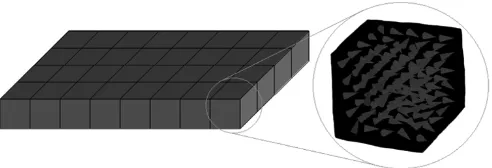
Fig. 1. Schematic diagram of the magnetostatic field calculation. The magnetic moment is averaged over the spins within a cell of the superlattice and the averaged moments are use to calculate the local magnetostatic field.
III. MODEL
The approach used is to base the calculation at the atomic rather than micromagnetic lengthscale. That is, our compu-tational cell uses atomic level discretization. As a result, we can use some physically reasonable form for the exchange interaction. Here, we use the Heisenberg form (1). The use of (1) means that we treat accurately exchange contribution to the short-wavelength fluctuations responsible for the mag-netic phase transition. However, this leaves the necessity of calculating the (long-range) magnetostatic term, which can be calculated very efficiently within the usual micromagnetic approach. Of course it is still possible to carry out the calcula-tion of the magnetostatic field exactly, using, for example, the FFT approach at the atomic level. However, this is very time consuming. Here, we use an alternative multiscale approach, in which we approximate the magnetic field by averaging the magnetic moments on a regular superlattice and then use the FFT technique to calculate the resulting magnetic field.
The calculation is shown schematically in Fig. 1. Essentially, the magnetization is averaged over each cell within the super-lattice and it is this structure of macroscopic magnetic moments which is used to calculate the field. We note that this approach averages out the fluctuations in the magnetostatic field over the atomic lengthscale. However, on this lengthscale the fluctua-tions in the exchange field are expected to be dominant, and the neglect of short-wavelength magnetostatic field fluctuations is unlikely to have a significant effect on the atomic level proper-ties such as the saturation magnetization. This approach signif-icantly speeds up the calculation of the magnetostatic field, to the extent that it is possible to simulate ensembles containing in excess of 10 spins on a single processor. Here, we present cal-culations using both Monte Carlo (MC) and LD methods. MC calculations in principle simulate static rather than dynamic pro-cesses. However, it has been shown [14] that the timescale in MC steps can be directly related to the physical time, at least for timescales much longer than the precession frequency. For the LD calculations, (4) is simply modified by replacing the mo-ment of the particle by the atomic magnetic moment .
IV. RESULTS
A. Finite Size Effects and Magnetization Fluctuations in Nanowires and Platelets
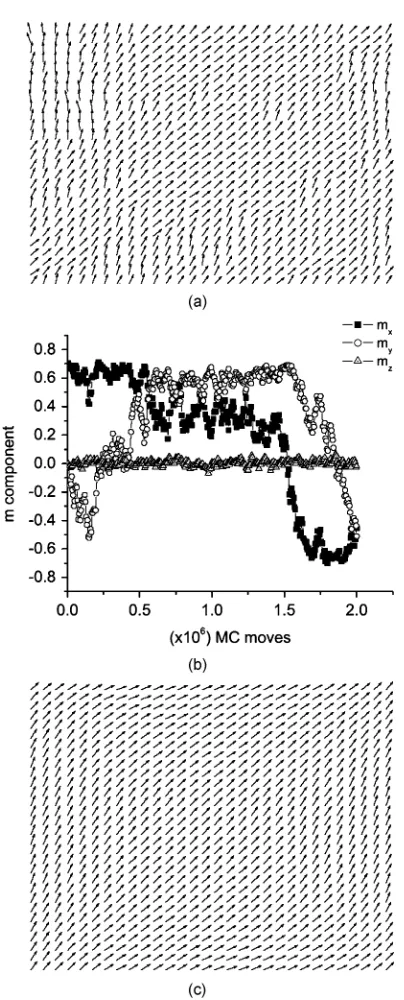
Fig. 2. (a) Leaf state for a 45245 nm21.5 nm platelet. The magnetization fluctuates between minima along the diagonals of the platelet. (b) The variation of the magnetization with the number of MC moves per spin. (c) The leaf state at a temperature of 10 K.
The material is assigned zero crystalline anisotropy, hence the net anisotropy arises entirely from shape. The calculations are made at 300 K and the assumed value of gives
[image:4.594.314.530.63.222.2]K. The atomic spins are initially aligned in the direction of the short axis, i.e., the hard axis of the platelet. After several hundred Monte Carlo steps per spin (MCS), the magnetization rotates along the easy axis of the platelet due to the effective shape anisotropy arising from the magnetostatic field. The magnetization forms a leaf-like state as shown in Fig. 2(a), with an easy magnetization direction along the platelet diagonal as expected from the configurational anisotropy. However, due to the thermal effects and the relatively low energy barriers involved, the easy (diagonal) magnetization directions are
Fig. 3. Magnetization components for a 4521521.5 nm element showing stability of the magnetization along the easy axis.
metastable, and the magnetization is able to surmount the energy barrier and rotate readily between easy directions. This is demonstrated in Fig. 2(b), which shows the variation of the magnetization components with the number of Monte Carlo steps. It can be seen that there are magnetization transitions between states close to the energy minima resulting from the configurational anisotropy. Thus, at the macroscopic level, the multiscale model predicts similar behavior to that expected from micromagnetics. This is also indicated in Fig. 2(c), which shows calculations at the lower temperature of 10 K. The reduction in temperature results, as expected, in smaller local magnetization fluctuations and stability of the magnetization along an easy axis of the configurational anisotropy.
The introduction of some shape anisotropy can of course stabi-lize the magnetization, as shown in Fig. 3, which shows the evolu-tion of the magnetizaevolu-tion components as a funcevolu-tion of the number ofMCsteps perspinfora45 15 1.5nmelement. Themagneti-zationfluctuatesasexpectedaboutthelong ( ) axisoftheelement.
Thus, the atomistic model reproduces qualitatively similar be-havior to micromagnetics. The greater significance of the atom-isticapproachisfirstapparentintheeffectsofthefinitethicknesson the magnetization structure. Fig. 4 shows the magnetization com-ponents at K for a platelet of dimensions 45 45 1.5 nm,foramaterial with K.The system was first allowed to reach equilibrium and then allowed to evolve for a further 13 000 moves. In Fig. 4 we show the total magnetization , and mag-netization of the surface plane of atoms and of the cen-tral plane of atoms . While the magnetization of the cen-tral plane of atoms is close to the calculations for the bulk material (0.73), the outer plane of atoms has a magnetization reduced by approximately 10% of the bulk value. It is reasonable to suppose that this magnetization variation should have some bearing on the transport properties of the film, although this is beyond the scope of the current work. However, finite-size effects on the transport properties would seem to be a significant consideration for future reader designs, and it should be stressed that the investigation of this phenomenon is outside the scope of micromagnetics.
B. Dynamic Calculations and Magnetization Fluctuations
Fig. 4. Magnetization components for a 4524521.5 nm platelet. There is a reduction of the magnetization in the surface planes.
model to the simulation of pump–probe dynamic measurements. Here, a field is applied at an angle of 45 to a thin film sample, in this case consisting of a 15 15 1.5 nm Fe platelet, and taking a damping constant of . The sample is heated with a laser pulse of duration 100 ps, consequently reducing the magnitude of the magnetization. As the magnetization recovers after the laser pulse, it follows a precessional motion back to the original equilibrium position.
The results are given in Fig. 5. On application of the laser pulse, there is an initial rapid decrease in the magnetization from the K spontaneous magnetization to a value close to zero. Note that this initial loss of magnetization occurs extremely rapidly, which is consistent with experimental data. After the laser pulse is switched off the magnetization recovers rather more slowly, as will be discussed in more detail else-where. Most importantly in the context of the current paper, the dynamic atomistic approach using the LLG equation reproduces qualitatively the behavior observed experimentally. Specifically, the rapid loss and slow recovery of the magnetization is fol-lowed by a transition to a damped precessional regime, with the initial magnetization state recovered after several hundred picoseconds. Pump–probe experiments are an important test of the dynamic model, and in the long-term a detailed comparison with experiment is expected to lead to improved understanding of damping processes in magnetic materials.
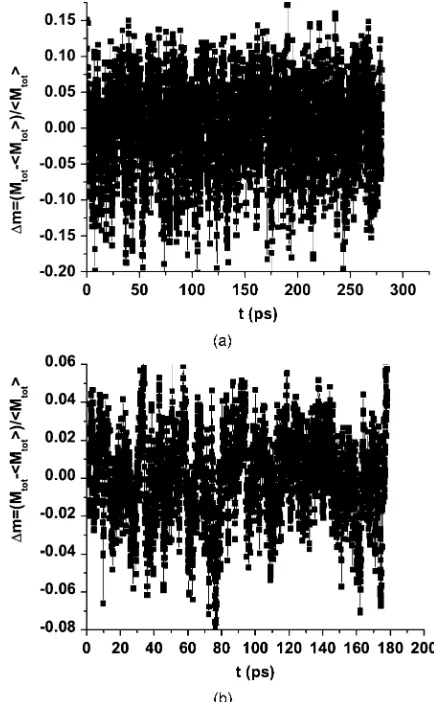
Clearly the atomistic model might be expected to exhibit fluc-tuations of the magnetization on lengthscales typical of a micro-magnetic discretization cell. This is of relevance to our compar-ison with micromagnetic calculations since the micromagnetic formalism does not include such fluctuations of the magneti-zation. Here, we present dynamic calculations of the magne-tization in Fe cubes of size 1.5 1.5 1.5 nm and 3 3 3 nm. The calculations are carried out by allowing the system to achieve thermal equilibrium, after which the magnetization is calculated dynamically using the atomistic approach with LD. The fluctuations relative to the average magnetization in each
case were calculated as ,
[image:5.594.313.539.65.228.2]with the instantaneous magnitude of the magnetization and the average. The results for the two cube sizes are given in Fig. 6(a) and (b), respectively. The fluctuations are sig-nificant in both cases, but clearly more pronounced in the case of the 1.5 nm cube, which exhibits fluctuations of the magneti-zation of 10%–15%.
Fig. 5. Magnetization components for a 1521521.5 nm Fe platelet during and after the application of a 100 ps laser pulse.
Fig. 6. Magnetization fluctuations for (a) a 1.521.521.5 nm, and (b) a 32323 nm Fe cube.
[image:5.594.315.532.270.621.2]leading to the Landau–Lifshitz–Bloch (LLB) equation, which has the following form for the longitudinal relaxation:
(5)
where is the longitudinal relaxation time. The transverse equation of motion is
(6)
The LLB equation does not conserve the magnitude of the magnetization, except for the special case , and may be more appropriate for applications in nanoparticle dynamics and in micromagnetic simulations with extremely fine discretizations. Garanin and Fesenko [15] have recently introduced thermal activation into the LLB equation, leading to a formalism capable of simulating thermally activated mag-netization reversal and magmag-netization fluctuations. A detailed analysis of our dynamic data in terms of the LLB equation is beyond the scope of this paper and will be published elsewhere, but it is important to note that the LLB equation represents an intriguing alternative to the LLG equation, in that it does allow the longitudinal fluctuations along with any impact they might have on long-wavelength fluctuations.
V. CONCLUSION
In this paper, we have explored the limits of the micromag-netic formalism arising from the use of a continuum approach and the consequent long-wavelength approximation to the ex-change which is introduced as a necessary compromise. It is argued that some form of atomistic approach is necessary for read elements as they decrease in thickness to values around 1.5 nm as recording densities of 1 Tb/in are approached. Ul-timately, the need is to introduce the short-wavelength fluctu-ations of the magnetization which are responsible for the fer-romagnetic/paramagnetic phase transition. This has also been the subject of work by Grinstein and Koch [16]. Here, we have used a relatively simple computational approach which, being based at the atomic level, has all the features of the analytical approaches. In our case, the challenge is to develop accurate techniques for the magnetostatic field term. Here, we outline an approach based on the use of a superlattice of “macrocells” imposed on the computational cell. Within each macrocell, the magnetization is averaged and the supercell of averaged spins used to calculate the magnetostatic field.
The results of the calculations demonstrate several important finite size effects which are not accessible to micromagnetic calculations. These include a loss of surface magnetization in 1.5-nm-thick films. In terms of finite size effects we have also
found that interface mixing leads to an effective reduction of the Curie temperature resulting in increased magnetic noise due to larger magnetization fluctuations [17] and the observation of longitudinal fluctuations of the magnetization, which suggest that the LLB equation could be appropriate for the description of damping in small particles and micromagnetic systems with small discretization lengths. The results suggest that it is not only realistically possible to develop an atomistic model of a read sensor, but also that there are strong indications that such a development is important, since the finite size effects revealed here must be dealt with at the atomistic level. Our results also show that it is possible to simulate pump–probe experiments, which naturally involve a change in the magnetization arising from laser-induced temperature variations. This is difficult with a purely micromagnetic model given that such models do not correctly predict the temperature variation of the magnetization.
REFERENCES
[1] N. Smith and P. Arnett, “White-noise magnetization fluctuations in mag-netoresistive heads,”Appl. Phys. Lett., vol. 78, pp. 1448–1450, 2000. [2] W. F. Brown, Jr.,Miromagnetics, Interscience New York, 1963. [3] A. Aharoni,Introduction to the Theory of Ferromagnetism. Oxford,
U.K.: Clarendon, 1996.
[4] R. A. Victora, “Quantitative theory for hysteretic phenomena in CoNi magnetic thin films,”Phys. Rev. Lett., vol. 58, pp. 1788–1791, 1987. [5] A. Lyberatos, D. V. Berkov, and R. W. Chantrell, “A method for the
numerical simulation of the thermal magnetisation fluctuations in mi-cromagnetics,”J. Phys., Condens. Matter, vol. 5, pp. 8911–8920, 1993. [6] R. W. Chantrell, J. D. Hannay, M. Wongsam, T. Schrefl, and H. J. Richter, “Computational approaches to thermally activated fast relax-ation,”IEEE Trans. Magn., vol. 34, no. 4, pp. 1839–1844, Jul. 1998. [7] W. F. Brown, “Thermal fluctuations of a single-domain particle,”Phys.
Rev., vol. 130, no. 5, pp. 1677–1686, 1963.
[8] U. Nowak, “Thermally activated reversal in magnetic nanostructures,” inAnnual Reviews of Computational Physics IX, D. Stauffer, Ed, Singa-pore: World Scientific, 2001, p. 105.
[9] V. Safonov and H. N. Bertram, “Nonuniform thermal magnetization noise in thin films: Application to GMR heads,”J. Appl. Phys., vol. 91, pp. 7279–7281, 2002.
[10] J.-G. Zhu, “Thermal magnetic noise and spectra in spin valve heads,”J. Appl. Phys., vol. 91, pp. 7273–7275, 2002.
[11] O. Heinonen and H. S. Cho, “Thermal magnetic noise in tunneling readers,”IEEE Trans. Magn., vol. 40, no. 4, pp. 2227–2232, Jul. 2004. [12] L. Berger, R. Chantrell, M. Covington, and A. Rebei, “1/f-type noise in
a spin valve,”J. Appl. Phys., to be published.
[13] E. Martinez, L. Lopez-Diaz, L. Torres, and O. Alejos, “Temperature dependence of spontaneous magnetization using a continuous model,”
IEEE Trans. Magn., vol. 39, no. 5, pp. 2522–2524, Sep. 2003. [14] U. Nowak, R. W. Chantrell, and E. C. Kennedy, “Monte-Carlo
simu-lations with time step quantification in terms of Langevin dynamics,”
Phys. Rev. Lett., vol. 84, pp. 163–166, 2000.
[15] D. Garanin and O. Chubykalo-Fesenko, “Thermal fluctuations and lon-gitudinal relaxation of single-domain magnetic particles at elevated tem-peratures,”Phys. Rev. B, vol. , p. 212409, 2004.
[16] G. Grinstein and R. H. Koch, “Coarse graining in micromagnetics,”
Phys. Rev. Lett., vol. 90, pp. 207201-1–207201-4, 2003.