8-1964
Adaptive sampling in digital control
Kenneth Allen McCollomIowa State University R. M. Stewart Jr. Iowa State University
Follow this and additional works at:http://lib.dr.iastate.edu/ameslab_isreports Part of theElectrical and Computer Engineering Commons
This Report is brought to you for free and open access by the Ames Laboratory at Iowa State University Digital Repository. It has been accepted for inclusion in Ames Laboratory Technical Reports by an authorized administrator of Iowa State University Digital Repository. For more information, please [email protected].
Recommended Citation
Abstract
This study provides a set of design curves from which effective digital control for an experiment can be obtained and at the same time efficient use of a digital computer shared with other experiments can be realized. The state variable technique is used as both a design method for obtaining the design curves for adaptive sampling and for predicting the states for control of the process. The adaptive sampling technique is defined to be that choice of constant prediction period that will satisfy control specifications over a specified range of system conditions. The complete range of system operation is divided into a number of classes for which criteria can be devised for determining when the system is in each class. In each class the prediction period is no smaller than that required over the range of the operation of the class. The objective of the adaptive sampling is to use the digital computer for control as little as possible yet maintain the system control specifications.
Disciplines
Electrical and Computer Engineering | Engineering
IOWA STATE UNIVERSITY
ADAPTIVE SAMPLING IN DIGITAL CONTROL
by
Kenneth Allen McCollom & R. M. Stewart, Jr.
RESEARCH AND
DEVELOPMENT
REPORT
UNITED STATES ATOMIC ENERGY COMMISSION Research and Development Report
ADAPTIVE SAMPLING IN DIGITAL CONTROL
by
Kenneth Allen McCollom & R. M. Stewart, Jr.
August, 1964
Ames Laboratory at
Iowa State University of Science and Technology F. H. Spedding, Director
IS-995
This report is distributed according to the category Engineering and Equipment (UC-38) as listed in TID-4500, December l, 1964.
LEGAL NOTICE---,
This report was prepared as an account of Government sponsored work.Neither the United States, nor the Commission, nor any person acting on behalf of the Commis sian:
A. Makes any warranty or representation, expressed or implied, with respect to the accuracy, completeness, or usefulness of the information contained in this report, or that the use of any information, apparatus, method, or process disclosed in this report may not infringe privately owned rights; or
B. Assumes any liabilities with respect to the use of, or for
damages resulting from the use of any information, apparatus, method, or process disclosed in this report.
As used in the above, "person acting on behalf of the Commission" includes any employee or contractor of the Commis sian, or employee of such contractor, to the extent that such employee or contractor of the Commission, or employee of such contractor prepares, disseminates, or provides access to, any information pursuant to his employment or contract with the Commission, or his employment with such contractor.
Printed in USA. Price $4. 00. Available from the Clearinghouse for Federal Scientific and Technical Information, National
Bureau of Standards, U. S. Department of Commerce, Springfield,
IS-995 CONTENTS ABSTRACT
I. INTRODUCTION
II. REVIEW OF LITERATURE III. METHOD OF INVESTIGATION
A. State Variable Technique 1. Recursion formula
2. Piecewise constant inputs B. Adaptive Sampling Technique
1. Prediction equations for unit block 2. Design parameters
C. Nonlinear, Time-varying Systems IV. EXPERIMENTAL IMPLEMENTATION
A. Description of Process System B. Derivation of Mathematical Model
1. Dynamics of sample radioactivity 2. Dynamics of sample transport
3. Dynamics of mass isotope separator 4. Combined dynamics at the target C. Solution for System Equations
D. System Control
1. Multilevel control equations 2. Application of adaptive sampling V. CONCLUSIONS AND RECOMMENDATIONS VI. BIBLIOGRAPHY
IS-995
ADAPTIVE SAMPLING IN DIGITAL CONTROL Kenneth Allen McCollom and R. M. Stewart, Jr.
ABSTRACT
This study provides a set of design curves from which effective digital control for an experiment can be obtained and at the same time efficient use of a digital computer shared with other experiments can be realized. The state variable technique is used as both a design method for obtaining the design curves for adaptive sampling and for predicting the states for control of the process. The adaptive sampling technique is defined to be that choice of constant prediction period that will satisfy control specifications over a specified range of system conditions. The complete range of system operation is divided into a number of classes for which criteria can be devised for determining when the system is in each class. In each class the prediction period is no smaller than that required over the range of the operation of the class. The objective of the adaptive sampling is to use the digital computer for control as little as possible yet maintain the system control specifications.
The method developed here is general enough to allow use by a con-trol engineer who has, or can develop, an adequate mathematical model for the process. The model is reduced to a set of first order differential
equations and then converted to Laplace Transform block diagrams. The knowledge of the behavior of a single first order differential equation, or similarly a single first order Laplace Transfer block, for a reasonable number of deterministic inputs allows the control engineer to analyze the control behavior of his complete block diagram one block at a time as sum-ing piecewise constant inputs to the block.
Using the method developed here, an interesting and useful charac-teristic is demonstrated for process systems which have particles or components that originate at the input of the process, are carried through the process in space and time and finally are expelled from the process never to return. These processes are commonly described by a set of nonlinear differential equations with time-varying coefficients. Solving this set of equations simultaneously is both a long and difficult task. For processes with the characteristics described above, this set of nonlinear differential equations can be uncoupled and the resulting sets solved in sequence. The experiment on which the adaptive sampling is demonstrated, the set of uncoupled equations prove to be individual first order differential equations that are linear.
jL,
.~
0oJ~,e__
Vr- a.-Pn.
D.~
2
~ ~
~
~~
4
.
~.
~
{bju;J.J
tf6t/-k tL__D~,~
f
~~ 'J~/
~-I. INTROD~CTION
Conventional automatic control has made significant
accomplishments in industrial and military applications. This type control is the design of control systems to determine the compensation necessary to fulfill a certain set of require-ments. The most common requirements are values of gain margin, phase margin, M-peak, rise time, settling time, peak overshoot, integral square error, and mean square error.
Pollowing many years of active development, conventional automatic control system design appears to be approaching a saturation point which, in turn, is encouraging the develop-ment of new theories of control. Perhaps the greatest impetus
for this change has been the computational aid supplied by modern digital computers. Some of the new mathematical techniques in the developing theories, such as dynamic pro-gramming, are impractical without the speed and capacity for calculations nov available.
The new techniques in control system design usually use the differential equations that describe the process mathemat-ically as a means for predicting what will happen in the
future. Then the predicted values are used to determine
usually the value of the variable in a first order
differen-tial equation describing a p~rtion of the process. If the
process is described by an nth order differential equation,
then it has n states which are normally determined in the
control problem.
The digital computer is not only aiding in the
develop-ment of such new theories but also is practically and, just
as important, economically implementing the theory by acting
as an element in the feedback loop of the control systems.
The economic advantage has resulted from two sources: first,
the cost of the computer hardware has declined to reasonable
values for use as control elements, and, second, the hardware
and software for computers has developed so that a single
computer can be shared by a number of different, otherwise
unrelated, experiments.
The purpose of this dissertation is to determine when
attention is necessary for the control of an experiment from
the computer which is shared with other experiments. To allow
investigation of the dynamic behavior of a process a unit
block which represents a first order differential equation has
been selected. Using deterministic inputs as driving
func-tions the characteristics of the unit block are determined for
a variety of inputs. A process system 1s investigated by
building up the complete system from the unit blocks. The
exactly with a piecewise constant input and approximately with
a time-varying input.
The error and deviation design curves for a number of
different deterministic inputs to the unit block are used in
the design of a multivariable control system for a nuclear
physics experiment. A sample is irradiated in a nuclear
reactorJ and the decay characteristics of the radioactive
atoms produced are examined. The sample is solidJ but through
controlled heating its vapor is continuously removed from the
reactor and inserted into the ion source of a mass isotope
separator. The mass isotope separator separates the
radio-active atoms from the parent atoms so that the decay
charac-teristics can be investigated. The control requirement is to
replace in a continuous stream from the reactor all atoms which
decay at the isotope separator target. The system is described
by a set of nonlinear differential equations with time-varying
coefficients and transport lags. The set of differential
equa-tions representing the system can be uncoupled to allow sequential
II. REVIEW 0!' LITERATURE
Prior to 1950, little was published in the area of
analysis and design of sampled-data systems. Digital
comput-ers were first used in control systems and later used in
complex automatic tracking systems for satellites in space.
The new emphasis on sampled-data systems has resulted in books
devoted solely to the subject (12, 16, 18, 19) instead of
chapters in the back of books otherwise devoted to continuous
control systems.
The design and synthesis of sampled-data control systems
can be divided into several categories. To aid in developing
the ideas for this dissertation, the categories here are
designated instantaneous feedback control systems and
predic-tive control systems. The instantaneous feedback control
system compares the present condition of the output to the
desired output and makes a correction to the system. The
pre-dictive control system, using the immediate system condition
and the expected inputs, predicts what the output will be at
some future time and makes a correction as soon as possible
following the calculations.
The instantaneous feedback control system was developed
first as sampled-data systems came into common use. The most
popular technique used to analyze these systems is the
for sampled-data systems is entirely analogous to the
applica-tion of the Laplace transformaapplica-tion to continuous-data systems.
Most of the techniques used for solving linear continuous-data
systems, such as the Nyquist criterion, root locus diagram or
Bode diagram, can be modified and extended to the studies of
linear sampled-data systems (12).
The predictive control systems predict the state of the
system at some future time using difference and state variable
equations derived from the differential equations describing
the physical system. In some sampled-data system design books
(16)
no distinction is made between the state of a differenceequation that is an approximation to the solution of the
dif-ferential equation and the state variable equation that is an
exact solution to the differential equation. A careful
docu-mentation of the history of the state variable method as
developed by both mathematicians and engineers has been made
by Fuller (5).
Kalman and Bertram (1~ have presented a general synthesis
procedure for using the state variable technique in the design
of a control system. However, the final control system uses
present values of the states for control of the system. Use
of the state variable technique in the design allows the
opti-mum choice of linear combination of all of the states to be
fed back to the input. Once these feedback terms are
controller. The authors do suggest that transport lags may be handled in the system using prediction. The digital computer is used for solving the prediction equations after each sample.
Dynamic programming theory applied to the optimum design of digital control systems (1, 2, 19) uses prediction by the
state variable method in a multistage decision process to
maximize the total return for a system. A systematic solution procedure may be derived by making use of Bellman's (1)
Principle of Optimality which states that "an optimal policy has the property that whatever the initial state and the
initial decisions are, the remaining decisions must constitute an optimal policy with regard to the state resulting from the first decision." This approach implies that to solve a speci-fic optimization problem the original problem is imbedded within a family of similar problems. The original multistage optimization problem is replaced by a sequence of single-stage decision processes which are easier to handle. The disadvan-tage is in checking all possible sequences of inputs to obtain the optimum one from each succeeding state. The number of possible paths increases with each succeeding stage.
Consid-erable computer storage is required to check every path and to allow a choice of the one which fits most satisfactorily the particular system.
using a two-level "bang-bang" type servo. The number of
possible branches of input sequences are reduced
consider-ably \'/hen only four inputs are available for choice. The
input variable operating-the controlled system is actuated
by an estimate of the error which will exist at some future
time. Repeated estimations of the future error are obtained
by predicting ahead1 on a fast time base, both the reference
and the controlled variable as well as some of their lower
order derivatives. The input signal is switched at the time
when the predicting computations determine that future
syn-chronization of reference and output w6uld occur if polarity
of the input signal were switched at that time.
The state of a linear system can theoretically be changed
to any other desired state by putting an impulse into the
state. Sufficient energy must be given by the impulse to the
system in zero time to change the state. Optimum control is
no longer a multistep requirement but can be obtained in a
single step at any time. Gupta and Hasdorff (6) have made the
technique practical by assuming that the input is a
combina-tion of a Gaussian (normal) shaped funccombina-tion and its
deriva-tives. The normal function in the limit as the standard
deviation goes to zero is the impulse function. With the
normal function the energy does not have to be delivered in
zero time. A basic difficulty is generating these normal
change the state is a function of the standard deviation which
is made as small as possible.
In many sampled-data control systems signals are sampled
periodically, although this type of sampling may not always be
possible and in some situations may not be desirable. The
introduction of aperiodic sampling may even improve the system
stability (12, p. 370). Recently a great increase of interest
has occurred in systems in which the sampling operations may
not be performed synchronously. Attempts have been made to
modify and use some of the methods for handling nonlinear
control systems such as describing functions or modifying the
Z-transform
(9).
These methods lead to complex analysis foreven simple systems.
Kalman and Bertram (11) have made a major contribution
in sampled-data analysis and control by showing how the state
variable technique can handle sampling systems of a general
type in a clear and uniform way. They claim that the method
yields simplifications even in the analysis and synthesis of
conventional periodic sampling systems. The method
auto-matically eliminates one of the chief difficulties of the
transform method, namely that it is difficult or cumbersome
to obtain information about the behavior of the system at any
time other than the sampling instants.
In their general theory, Kalman and Bertram give a very
as •a set
ot
numbers (called state variables) which contain asmuch information regarding the past history of the element as
is required tor the calculation of the entire future behavior
of the element." The evolution of a dfnamic system through
time mar be visualized as a succession or state transitions.
Since each transition is independent of everrthing except the
present state and the input during the present transition,
then the non-uniform sample period is handled as easily as the
un1rora sample period. An important characteristic or the
state variable technique is that design effort is on the
analy-tical aspects of system problems with the drudger,y of
numeri-cal computations necessarily left to be performed by a digital
computer. The computations performed by the digital computer
after a sampling instant are usually quite short compared to
the time between two samples. Since this time is usually also
short compared to the time constants in the system dynamics,
the delay caused by the computations may be disregarded
alto-gather.
For simplicity, Kalman and Bertram use sample and hold
elements and assume that the input to the system is piecewise
constant. Any input that is var,ying can be integrated, if
known beforehand, through the convolution integral with the
transition matrix. The exact value of the input as a function
of time in the future must be known for this to be an exact
III. MEtHOD OJ INVESTIGATION
The extent to Which system design can proceed in a
logi-cal, systematic, and intelligent manner is to a degree
meas-ured by the knowledge of the process dynamics. Thus, the
first goal in control system design must be the determination
·of the dynamic characteristics of the process to be controlled.
The dynamic characterization of a process is commonly
de-scribed by a set of first order differential equations which
are functions explicitly of time and functions of the plant
states, x(t); driving control functions, u(t); and disturbance
functions, n(t).
In vector form,
~Ct)
=
1[
x(t), u(t), n(t), tJ
(1)
In addition to this general equation the process usually has
limits on the permissible driving functions because of
practi-cal considerations such as saturation or power limitation.
The mathematical model of a system may be made up of
differential equations with order greater than one.
Fortu-nately, equations of higher order can always be treated
numerically by reducing them to a larger system of first order
equations of the form of Equation 1. Henrici
(7)
has shownthat such reduction does not increase discretization error in
system equations to be first order, the model must first be
reduced to a first order set of differential equations.
A. State Variable Technique
The class of control systems which have received
con-siderable attention in the literature are those described by
the following vector form of the differential equations.
ict>
=
A(t)x(t) + u(t) + n(t) (2)where A(t) is referred to as the coefficient matrix of the ·
process. This process is said to be linear and non-stationary.
However, the process is linear and stationary if A(t) is not a
function of ti.me. Por the latter case, consider the solution
to the homogeneous vector equation where there are no driving
functions or disturbances to the system. Thus
i(t)
=
A i(t) (3)rhe plant starts to move at time, t0 , from an initial state,
X •
0 The solution of this homogeneous vector differential equation is similar to the solution of a single first order
differential equation
x(t)
=
m x(t) (4)m(t-t0 )
x(t)
=
e x0 (5)where m is a constant. In the vector differential Equation 3
the term, A, is a matrix. Before a solution of the vector
differential equation can be obtained by analogy to the first
order differential equation a definition of exponentiation of
a matrix must be made. Since
(X)
emt
L
mktk=
~ (6)k=O
then let
(X)
eAt
=
L
AktkkT""
(7)
k=O
for which there are defined matrix operations. This suggests
that the solution for the vector differential equation is
i(t)
(8)
The equation
(9)
is commonly defined as the transition matrix of the system
since
shows that if i 0 are the states at some initial time, t0 , the
movement or transition of the states to new positions at t is
only a function of the initial state and the transition matrix.
The solution of the general differential equation with
driving forces and disturbances can be shown to be of the form
(11)
Differentiating with respect to t gives
-• •
x(t) =A x(t) + •<t - t0)01 (t) (12)
Setting this equal to the general form of the differential
equation in Equation 2 with A not being a function of time
makes the following equality necessarr tor Equation 11 to be
a solution.
-
•A i(t) + u(t) + n(t) =A i(t) + •<t - t0)o1(t) (13)
Cancelling terms and solving for
W
1(t) givesSubstituting this into lquation ll givea the aolut1on aa
i'(t)
the intecral sign since it is not a tunction of the
integrat-iDC Yariable. The definition of the transition matrix as an
exponential function allows consolidation ot the two
transi-tion matrices now under the integral sign. In additransi-tion, at
t
=
t0 the transition matrix, •<t - t0 ), becomes the identitymatrix. Therefore the constant 02 is just the value of x(t0 ). fhe final result is
where
and the vector form of the equation tor which this is the
solution is
....
(17)
x (
t )=
A % ( t) +u (
t ) + i ( t ) ( 18 )the linear, tima-stationar.y form of lquation 2. This powerful
equation expresses the instantaneous motion of the process in
terms of the driving control signals, aD7 disturbances and the
initial states. !hese equations describe the exact motion of
the process if the original equations are an exact
mathemati-cal model of the process and if the control signal, the other
driving functions and the disturbances are exactl7 known.
on the results. The exactness of this solution is emphasized
since the approximate numerical solution of a differential
equation is often obtained by solving a related difference
equation which results in -a state-transition equation similar
to Equation 16.
1. Recursion formula
The state variable solution developed in the last section
and shov.n 1n Equation 16 is more useful tor handling in the
computer if the equation is placed in a recursive form. This
can be accomplished if the prediction period is constant.
Disturbances also a~e assumed to be zero and all inputs are
assumed to be deterministic in nature.
Letting the present time be tk and eliminating the
disturbance term as an input to the system, Equation 16
be-comes
This general form, valid for t > tlt, is usefUl for calculating
exact output states where more than one stage is in sequence.
However, the recursion equation is obtained b7 alwa7s
predict-ing a fixed period, T, ahead
ot
the present tiae. !hua, if t(20)
The following substitution will be useful throughout:
(21)
Equation 20 is the equation with which the majority of the
future development is involved.
The recursion formula can be used· for two different
situations that appear in control systems. When the
differ-ential equations describing the dynamics of the system are
reduced to a set of first order differential equations and
states assigned, all of the states will probably not be
measurable. If ~~e state cannot be measured, the value of
the state at the present is known only through having
calcu-lated it in the prediction Equation 20, starting from a known
initial condition of the state. Thus, any error in predicting
the state T seconds later tends to accumulate as any transient
condition persists. A state that cannot be measured is
re-ferred to as an inaccessible state, and the state that is
measurable is an accessible state. Usually, through careful
choice of states, most of the state variables in a system can
be measured. Accessibility and inaccessibility are fundamental
to the application of the state variable method, since the
method requires that the present state be known. Any error in
a transient input condition and disappear during a stable
input condition to the state.
Referring again to the recursion Equation 20, the
dif-ference in using this equation for calculation of the
acces-sible and the inaccesacces-sible states is the value used for
x(tk). If the state is accessible, the value of the
measure-ment at tk for the state variable is used. If the state is
inaccessible the previously predicted value for the state is
used. The predicted values for the states x(tk+l) just T
seconds later are exact values only if both the present states
x(tk) are known and the driving functions u(t) are known for
the period.
2. Piecewise constant inputs
The state variable technique offers the control engineer
a set of tools which allows him to predict the complete state
of his process at any future time. The prediction is exact
only if he knows the input driving functions to the process
from the present to the time of the prediction. If the
driv-ing function is under his control, he has no problem. However,
there are driving functions that are not under his control and
can change at any time. To allow prediction to still be
accomplished some type of approximation for the input over the
sample period must be made.
driving function remains constant during T in Equation 20. A
more sophisticated procedure is to linearly extrapolate the
driving function from its value at the preceding time through
the value at the initial time and on to a value at the
predic-tion time. An even more intricate procedure is to curve fit
the last three input function values and represent the driving
function as a polynomial. The last two procedures require
considerable computer processing which for a real-time, shared
computer could be impractical.
The mathematical form is most simple when the driving
functions for a given differential equation in the matrix are
measured and are assumed to remain constant at that value over
the period of prediction. The amount of error is dependent on
how far the driving function changes during the period. By
investigating the system it is usually possible to determine
how rapidly a driving function can change. For example, if
the input to a given differential equation is the output from
another state of the system, the time constant for that state,
together w1 th its permissible inp·ut, will limit the rate of
magnitude change possible. Chemical reactions can only
pro-gress at certain rates which can be measured and defined. In
the system to be considered later, the neutron flux in the
reactor will normally change no faster th.an a certain
pre-scribed rate.
remains constant can be investigated. The results can
deter-mine the time available for prediction and error correction
without exceeding the control specifications of the system.
One fortunate conditicn exists for the general prediction
equation. If the driving function remains constant for several
periods, any past errors gradually are reduced to zero. This
condition fits nicely the intuitive idea that the most recent
measurements should be the ones that more readily indicate the
value of the present state and that the measurements made in
the more distant past have less and less weight on the value
ot
the present state. Then, if there are no calculationerrors for a period. of time, the total error diminishes.
Choosing the simple approximation of a piecewise constant
driVing function to all differential equations in the system
simplifies the control computations required from the digital
computer to a minimum number of simple manipulations.
B. Adaptive Sampling Technique
An adaptive sampling technique is here defined to be that
choice of constant prediction period that will satistJ S,Jstem
control specifications over a specified range of systea
condi-tions. The complete range of system operation is divided into
a number of classes for which criteria can be devised for
the prediction period is to be no smaller than that required
over the range of the operation of the class. The objective
for the adaptive sampling is to use the digital computer for
control as little as possible yet maintain the system control
specifications.
A method is developed here that is general enough to
allow use by a control engineer.who has, or can develop, an
adequate mathematical model for the process. The model is
reduced to a set of first order differential equations and
then converted to Laplace Transform block diagrams. The
knowledge of the behavior of a single first order differential
equation, or similarly a single first order Laplace Transform
block, for a reasonable number of deterministic inputs allows
the control engineer to analyze the control behavior of his
complete block diagram one block at a time.
The first order differential equation to be used as the
basic building block is given by
(22)
and the corresponding Laplace Transform unit block is shown in
Figure l. A set of deterministic inputs are also shown in
Figure l. The equations representing these inputs are
Positive exponential:
Unit step w1 th
negative exponential:
(25}
(26}
Since the differential equation is a linear equation, the
principle of .superposition applies. The total response of the output for the sum of several inputs at the same time is found by considering each input separately and swaming their
indi-vidual outputs. This allows even more variety in simulating different inputs.
1. Prediction equations ~ ~ block
Two sets of prediction equations are required to allow development of design parameters for decisions for the adap-tive sampling. One of the sets of equations is an exact solution for the output of the unit block for a given input. The other set of equations is that which uses piecewise con-stant approximations for the input and thus obtains an approx-imate solution for the output of the unit block. fhis set of equations will later be used as the control equations in the real time digital control. In this section, the approximate solutions are compared to the exact solutions for a given input to generate design parameter curves.
The recursion equation developed earlier and given in
u1( t )
block are obtained. For the first order differential equation
given in Equation 22, the transition matrix is readily
deter-mined from the homogeneous solution to be
(27)
Substituting this into the recursion equation gives
... _
This equation generates both the exact and the ~pproximate
solution for the output when u1 (t) and u1 (tk)' respectively, are used for u1 ( T) ·under the integral sign. In the
approxi-mate case, u1(tk) is no longer a function of the integrating variable, so it can be brought out in front of the integral
sign. In the exact case u1 is a function
ot
the integratingvariable so cannot be brought outside of the integral.
The simulation of the unit block is made ld.th IC and all
inputs set to unity. This allova universal curves to be
generated with gain factors inserted b7 the deSign engineer
for each s7stem investigated. The percent error used for the
exponential curves is defined b7
(29)
automatically normalizes the result since all gain factors
cancel. The inputs other than the exponential ones use the
deviation between the exact and the approximate outputs to
allow the generation of useful design curves.
Initiating each of the inputs at the instant of a sample
tends to maximize the error presented in the resulting curves.
Anytime there has been a choice of doing part of the
measure-ment or calculation two ways, the one causing the most error
has been chosen. The resulting curves tend to be pessimistic
in their estimate of the error. In the case·of the unit step,
there is only error in predicting the output between the time
the step occurs and the next sample instant, since after that
the input is constant. A constant input makes the output
prediction for both the approximate and the exact solutions
identical.
The prediction equations are obtained by substituting
u1 (t) and u1 (tk), respectively, for each input investigated. Integrating over the recursive limits gives the following set
of recursive prediction equa tiona. for the unit block transfer
function shown in ligure 1:
Case a: u1 (t)
=
t, u1 (t0 )=
0, x1 (t0 )=
0Approximate solution
Exact solution,
-(l-n)T/-r1
:x1(t1 )
=
l - et/Tp
Case c: u1 (t)
=
e , u1 (t0 )=
1, x1 (t0 )=
1Exact solution,
Approximate solution,
(31)
(32)
-T/Tl
e )
(33)
-T/Tl kT/Tp -T/Tl
xl(tk+l)
=
e x1
(tk) + e(1 -
e )(34)
Case d: . u1 (t)
=
e -t/T P, u1(t~)=
0, u1 (t+ 0 )=
1, x1 (t0 )=
0Exact solution,
-T/Tl
e )
(35)
2. Design parameters
The recursion equations describing the exact solution and
the approximate solution of the output state for the four
input cases are placed in forms that minimize the number of
variables. Wherever possible, the sample period and the time
constants, T, were put in ratio form, T/T. This is a
non-dimensional ratio which is easy to use in the general
applica-tion of these curves. · The abscissa of each of the curves
generated has been made the ratio of the sample period to the
time constant of the unit block, T/T1 . The ordinate is either some form of the percent error or the deviation of the
approx-imate value from the exact value of the output state. Finally,
the family of curves is generated by the remaining variables
in each of the cases. For instance, in all of the exponential
inputs, the families of curves are for different values of the
ratio of the unit block time constant to the exponential time
constant, T1/Tp·
The approximate solution may have either ~ accessible or
an inaccessible output. If the output is accessible, then the
present state, x1(tk), of the system is obtained from the
exact solution when prediction was made from the previous
state. The exact solution gives the same result as a
measure-ment does for the present state. If the output is
inaccessi-ble, then the present state, x1(tk), is obtained from having
The ramp input to the unit block
eventually results in a fixed amplitude deviation between the
approximate output and the exact output for a given sample
period. The time in Which the deviation ceases to increase
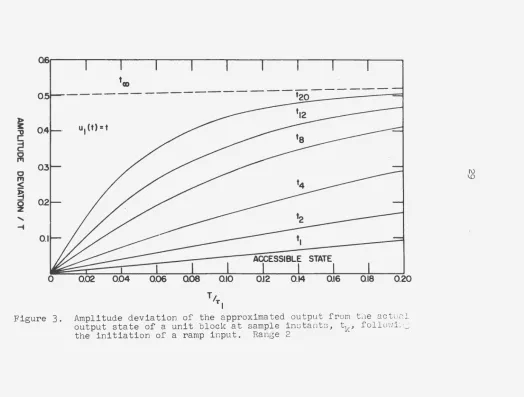
is dependent upon the time constant of the unit block, T1 • Since the abscissa of the curves is !/T1 a family of curves shows the gradual increase in amplitude at each tk following
the initiation of' the ramp. ?igures 2 and 3 show two
differ-ent scales for the abscissa and d1splaJ the deviation of' the
approximate output from the exact output. The curves
desig-nated as tk show the deViation at the end of the kth period
just kT seconds after ~n1t1at1on ot the ramp. Por the
acces-sible case, the deViation is reduced to zero again at the end
of each period by a measurement. The result is that the
deViation at the next sample is again the same value as shown
at t 1 for a given value of T/T1 • !hus, onlr one curve, that designated t 1,is used for the aooeslible output state, while all of the curves are used for the inaccessible output state,
and the deviation at lt! seconds ia indicated b7 the curve
designated as ~· A daShed line in both of the figures
indi-cates the asymptotic value of the deYiation at t00 • Since the
simulation in the digital ooaputer was carried onlr to ·lt
=
20, further specific curves are not included.b. u1(t)
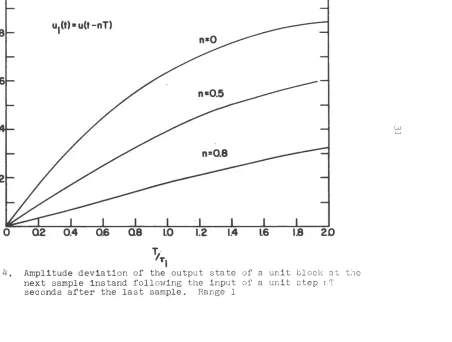
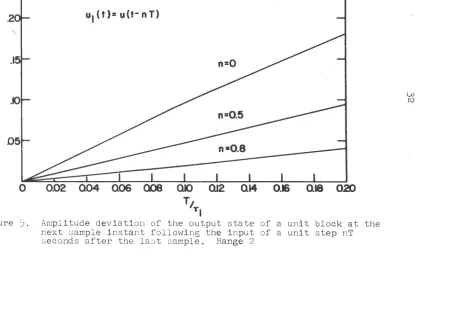
=
u(t - nT) The unit step input to the unit block results in a deviation ot the output state at the nextJ> ~
,
c
2
0 fTI
0 fTI
<
~0 u1 (t)•t.
[image:36.593.75.725.45.519.2]z 0 . ...
-t ACCESSII..E STATE
0
2.0
~
TlFigure 2. Amplitude deviation of the approximated output from the actual output state of a unit block at sample instants, tk, followitig the initiation of a ramp input. Range 1
1\)
0.
---tCI)
- - - , 2 0
_____ _
---
-
---)>
~
,
u1(t)=tc
c!
0
1"1
0
1"1
<
~
[image:37.587.63.628.47.532.2]~ ...
-i
0.20
T/.
TJ
Figure 3. Amplitude deviation of the approximated output from the actual
output state of a unit block at sample instants, tk' follol'lilJ:_:;
the initiation of a ramp input. Range 2
constant
ot
the unit block. As the sample period is madelonger, the output has time to grow larger. The deviation, as
a function of T/T 1 and the time after a sample that the step starts, is shown for
twn
ranges of T/T 1 in Figures 4 and 5.The parameter, n, varies between 0 and 1 where the step occurs
at t~ for n
=
0 and at ti for n=
1. As previously indicated,there is no .further deviation between the approximate solution
and exact solution for the output after the first sample
following the unit step.
c. ul(t)
=
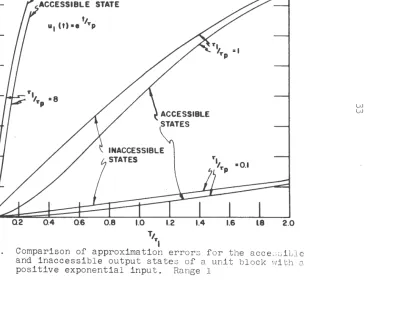
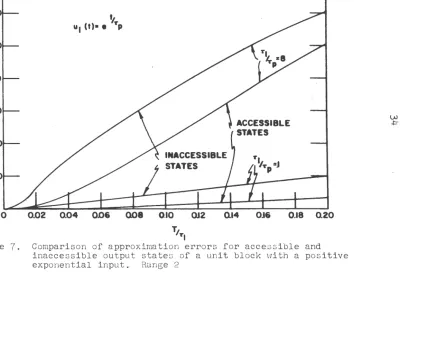
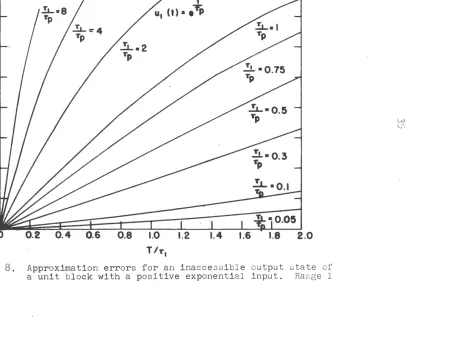
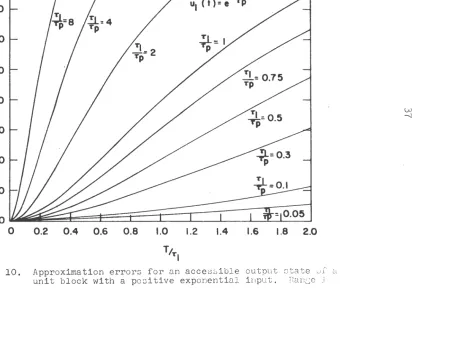
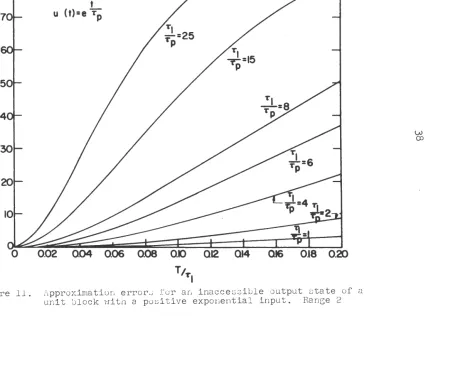
et/Tp The positive exponential input tothe unit block eventually results in a constant error between
the approximate output and the exact output for given T/T 1 and T1/Tp· The exponential input reaches this asymptotic error in a time dependent on the time constant of the unit block.
Since the abscissa is in terms of T/T 1, the small values of the abscissa take more sample periods to reach the asymptotic
error. For T/T 1 greater than 0.5 the asymptotic error is reached in three or four sample periods. The comparisons for
the asymptotic errors, resulting for the inaccessible and
accessible output states, are shown for two ranges of T/T 1 in Figures
6
and7.
These two figures are included forcompara-tive purposes only. The inaccessible state for two ranges of
T/T 1 and a more complete selection of ratios, T1/Tp' are given
in Figures 8 and 9. Similarly, the accessible output state is
I
~
~
0"'
0~
i
'
....
!4
-u1 (t) • u(t -n T)
0.
T· ~TI
n•0.5
n=0.8
[image:39.591.139.645.106.518.2]20
Figure
4.
Amplitude deviation of the output state of a unit bl ock at thenext sample instand following the input of a unit step r:T
seconds after the last sampl e. Range 1
\.AJ
~
,
r-t
c
c""
c
1"1
<
~
0
z
...
-t~
-u1 (t)= u(t-nT)
n=O
0~~~~~~~~~~
[image:40.591.130.689.117.478.2]T/ Tl
Figure 5. Amplitude deviation of the output state of a unit block at the
next sample instant following the input of a unit step nT
seconds after the last sample. Range 2
l.JJ
•
en
-<
c
.,
~
0
ITI
::u ::u
0
::u
I
.,
ITI ~ ITI
z
~
02
INACCESSIBLE STATE
ACCESSIBLE STATE
Ul (t) ae f/Tp
0.4 0.6 2.0
[image:41.593.177.623.120.498.2]~ ~
Figure 6. Comparison of approximation errors for the accesGilJle
and inaccessible output states of a unit block wi th a positive exponential input. Range 1
•
(I) ~ E.,
~~
0
"'
::u ::u0
::u
•
.,
"'
::u n"'
z ~6
0
'"
ul (t)• e "p
0.02 0.04 . 0.06 008
INACCESSIBLE STATES
0.10
T
,,.
,
OJ2 0.14 OJ& 0.18 0.20
Figure
7.
Comparison of approximation errors for accessible andinaccessible output states of a unit block with a positive
exponential input. Range 2
LU
[image:42.591.147.641.106.479.2]+:-en
-<
c
,
-t
0
-t
-
n
"'
:a
:a
0 ~I
.,
"'
~n
"'
z
-t
[image:43.593.139.610.103.505.2]TITI
Figure
8.
Approximation errors for an inaccessible output state ofa unit block with a positive exponential input. Range 1
VJ
l>
(/) -<
3:
"'U
~
0
rTI
::u ::u
0 "2,.j_ ::u
I
"'U
rTI
::u 0
rTI
z
---4
I
/
/
T
/TI
To~ _j
020
Figure S,. .\pproximatior; error e; i:cr c'i1 inacce~ot>ii.Jle output state __ r·
unit bl oclc ui tn a po ~;i t i ve exponential i!<pu t. Range 2
w
)>
(J)
70
-< 60
~
.,
-t~ 50
0
,
:u
::0
0
:u
40
30
~ 20
::0 0
,
z 10
-t
u1 ( t) = e Tp
o
!U/~
1 1C
1 1if=,o.o5]
0 0.2 0.4 0.6 0.8 1.0 1.2 1.4 1.6 1.8 2.0 [image:45.593.132.610.108.493.2]TtTI
Figure 10. Approximation errors for an accessible output state 01 ct
unit block with a positive exponential input. nar1se 1
l.AJ
l> ~
3:
~
0
1"1
:::u
~
:::uI
,
1"1
:::u
~
~
0
t
u (t)=e TP
0.02 0.04 0.06 0.08 0.10
TtT
I
Ql6 OJ8 0.20
Figure 11. Approximation error0 for ar; inaccessible output state of n
unit block with a positive exponential input. Range 2
w
[image:46.600.127.631.88.494.2]general way the error at early sample periods prior to
reach-ing the asymptotic error. However, the comparison of the
accessible and inaccessible output states may prove useful,
and it is true that the error l s alwc1ys smaller than the
asymptotic value in the earlier sample periods. -tl-r
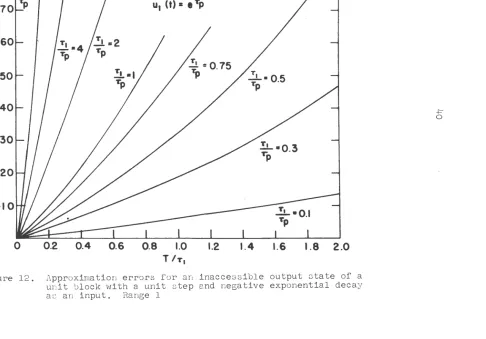
d. u1(t)
=
e 1 P The unit step followed by anexponentialiy decreasing decay has characteristics quite
similar to that of the positive exponential. Two
character-istics are different. First, the error ls negative. The
decay makes the approximate solution for the. output state have an input that is always equal to the exact input at the sample
instant, but at al~ other times the input is greater. From
the error definition of Equation 29, the error is negative.
Second, an interesting result from this input is that the
error is constant from the very first sample for the
inacces-sible state. The error, then, does not have to be called an
asymptotic error since it is constant as a function of time.
The curves for two ranges of T/-r 1 for the inaccessible case
are shown in Figures 12 and 15. The results for the accessi- ·
ble case did not reduce to conditions that could be
meaning-fully displayed on a graph. At the first sample, the error
was the same as that for the 1nacoessi ble case.. After· that, the error decreased continually for the twenty samples
simu-lated on the computer. For this type of input, then, the
1"1
::0 ::0
0
::0
I
,
,.,.
::0
0
1"1
z
-t
0.6 0.8 1.0 TIT,
1.2 1.4
!L.o
.3
T"p [image:48.595.102.588.113.504.2]1.6 1.8 2.0
Figure 12. Approximation errors for an inaccessible output otate of a
unit block with a unit step 2nd negative exponential decay
as an input. Range l
SJ
:::0
~
I
~
~
~
. -i
t u1 (t)•e- T"p
T/.
Tl
[image:49.599.72.617.79.504.2]0.20
Figure
13.
Approximation errors for an inaccessible output state of uunit block with a unit step and negative exponential decay
as an input. Range 2
C. Nonlinear, Time-varying Systems
The previous discussion has been limited to linear, time invariant processes. Unfortunately for the control engineer these characteristics seldom exist. If a linear approximation is used to describe a process that is not linear or time
stationary, the major question is the validity of the
approxi-mation.
Considering Equation 2 again, the transition matrix is
now a function of time and the initial time, t0 • The general form would be ~(t, t0 ) instead of that obtained in the linear
case ~{t - t0 ). Even though ~{t, t0 ) can also be expressed as an exponential as in the time-invariant system, the result is not nearly as satisfactory. There results no formula for +(t, t0 ), although Tou (19) indicates that the transition
matrix can be expressed as an infinite series of successive integrals. This is not a convenient form with which to work,
and general procedures to derive the transition matrix apparently have not yet been obtained.
A non-linearity found in many processes shows up as a product of two of the state variables in the set of first
order differential equations describing the plant. Solutions for values of some of the states are needed before all equa-tions can be solved. A simultaneous matrix solution can only
to the correct values ·for the states. There are obvious computing time disadvantages of an iterative procedure for a
real-time shared digital computer for system control.
There is a type of plant that can be described by a set of first order differential equations which, in matrix form,
can be reduced in order and thus simplified. In general, this system is one that has parts of the system separated in space from other parts. In a continuous chemical plant the solution may pass through one tank with a catalyst which will cause a
certain reaction to take place. When the solution leaves that tank and proceeds to the next step the reaction will stop
be-cause of absence of the catalyst. Mathematically this part of
the system can be described by an independent sub-set of the set of equations describing the complete plant. The sub-set
can be solved first and the results inserted into the rest of
the equations. An example considered in Section IV uses a nuclear reactor as a source of neutrons to activate a
radio-isotope. No more radioactive isotopes are produced ~en the
sample is removed from the reactor enviroDaent. S1m1larly, a mass isotope separator is used to separate t.he sample stream. The behavior of the separator and its controls has no effect
on the production of the radioactive nuclides in the reactor.
These, then, are independent sets of equations and should be
able to be solved independently of the complete set.
set of equations is that one of the states involved in a
product of state variables may be in an independent sub-set of
the equations. As a consequence, the state can be determined
and act as a constant, and the non-linearity is removed. The
tool is convenient for use on such non-linear equations.
The independent sub-sets of the complete set are easily
recognized when the equations are put in matrix form. If a
q x q block of elements is found in the coefficient matrix
with all other elements in the q rows being zero, then these
q equations are independent of the other equations in the
matrix. One caution is that the driving functions must be
checked to see that no states or controls from outside the q
rows are encountered. Since the set of first order
differ-ential equations describing the system can be placed in any
sequence to make up the matrix, the best combination of zero
elements in the reduction of the order of the matrix can be
IV. EXPERIMENTAL IMPLEMENTATION
The adaptive sampling technique using state variable
prediction for control has been used in the design of a
con-trol system for an experiment in a nuclear reactor. The
purpose of the experiment is to investigate the decay schemes
of radioisotopes continuously produced and removed from the
reactor at a rate approximately equal to the half life of the
particular radioisotope. The effect is to produce a
radio-isotope with an infinite lifetime. The purpose of the control
system is to maintain the rate of arrival of the radioactive
atoms equal to the rate of decay from the isotope target.
A. Description of Process System
A schematic representation of the system is shown in
Figure 14. The nuclear reactor core provides a source of
neutrons when the reactor is operating. These neutrons are
in close association with a sample in a nearby experimental
facility and thus turn a certain portion of the atoms into
'
radioactive atoms by neutron capture. The solid sample is
contained in a chamber that is at a high vacuum and is
vaporized at a controlled rate by a heater. The vapor flows
out of the chamber in the reactor through a tube approximately
I
I/
I
I
Sample Heater Current
Ion Source Magnet-...,
on Source lament
.Current
•~---Ion Accelerating and
Isotope-._.." Separator Magnet
Focusing Electrodes
[image:54.591.115.512.58.610.2]Target
this transfer line. The ion source ionizes the sample vapor
and accelerates the resulting ions through a constant
poten-tial into the magnetic field of the separator. The separator
allows isotopes with different masses to be collected at
dif-ferent physical locations in the plane of the target at the
receiving end. At this point the physicist may examine the
radioisotopes that have been produced with the appropriate
physical tools.
The sample is usually non-radioactive when inserted into
the reactor. The buildup of radioactivity depends on the time
history of the neutron flux in the reactor, the neutron
capture cross section of the atoms and the half life or decay
constant of the radioactive nuclides. The vapor from the
heated sample will gradually build a pressure that will cause
other vaporized atoms to be transported down the line and into
the lower pressure area of the ion source and mass isotope
separator. The vapor enters a plasma in the ion source that
..
is sustained there by a filamentary heating elaent, a magnetic
field and appropriate element potentials. fhe vapor·beoames
ionized When encountering the high temperature of the plaaaa.
A small opening at the end of the ion source, beyond whiCh are
located appropriate extracting, accelerating and focusing lens
potentials, allows continuous extraction and acceleration of a
accelerated into the magnetic field of the mass isotope
separator, and the curvature of the beam along its flight path
in the field depends on the mass of the ions. The parent atom
normally captures one neutron to form the radioactive daughter
atom just one mass unit heavier. The parent and daughter
atoms can be separated sufficiently in space to allow separate
manipulation by the experimentalist. This action is similar
to that in a mass spectrometer used to identify different
atomic masses in analytical measurements, except that the mass
isotope separator provides a sufficient quantity of atoms to
allow physical or chemical experiments. A simplified word
block diagram shown in Figure 15 gives a reasonable flow
dia-gram of the interactions that take place in the process.
B. Derivation of Mathematical Model
The process system naturally divides into three parts
for studying its mathematical character: the first is forming
of radioactive atoms in the sample; the second is producing
vapor from the solid sample and transporting the vapor to the
inlet of the ion source of the mass isotope separator; the
third is converting the non-ionized sample to an ionized form
in the ion source and accelerating it through the separator
magnetic field to a target. The first objective will be to
Power to sample heater
I
Pressure in radiation volume
Transport lag
Aps
Total current in isotope separator
Power to ion source filament
IT
1--Neutron flux at sample
Radioactive atoms in
sample
Transport lag
N
M
Radioactive part I R B
-L.o_f_i_s_o_t_o_p_e_s_e_p_a_-_,..._ Target rator current
Decay rate
J1gure 15. Word flow block diagram of important variables in the experiment
adequately describe the complete process system and the
interactions between the variables.
1. pynamics
2f
sample radioactivityThe differential equations that describe the behavior of
a sample in neutron flux are well worked out in the literature
(8).
The two equations that describe the process for thissystem are
dN(t) __ N(t) M( )d(t) N(t) w(t)
(37)
dt - A + ~ t P - N(t) + M(t)dM(t) __ ~ M(t)¢(t) _ Mtt) w(t)
~ - N( ) + M(t)
where N(t)
=
number of radioactive atoms at any time,M(t)
=
number of parent atoms at any time,¢(t)
=
neutron flux, neutrons/cm2-sec,(38)
~
=
neutron capture cross section of the sample, cm2'
A
=
decay constant of the sample, sec-1 ,t
=
time, sees, andw(t)
=
flow of vaporized atoms, atoms/sec.In Equation
37
the first term on the right is the rate ofdisappearance of radioactive atoms by decay, the second term
is the rate of appearance of new radioactive atoms from
cap-ture of neutrons, and the third term is the rate of
transport-ing away the solid sample. In Equation 38 the first term is
the rate of disappearance of the parent atoms due to the
form-ing of radioactive atoms, ~d the second term is the rate of
disappearance due to transporting away the vaporized sample.
Several approximations for these equations are
appropri-ate when the conditions of the irradiations and the particular
samples used in this system are considered. It is expected
that a sample will seldom be smaller than 100 grams which is
approximately 1025 atoms of the parent. The maximum
vaporiza-tion rate that can be tolerated as an input to the mass
iso-tope separator is approximately lo15 atoms/second. Of this
total vaporization.rate the number that will be radioactive
is no greater than 109 atoms/second for the half lives,
neutron flux and sample cross sections involved. Thus, the
ratio N/M is no greater than lo-6 • In Equation 38 both terms
are negligible compared to the other time constants in the
system. Thus M(t) is no longer a function of time but rather
a constant equal to the total sample. In the case of a sample
that is very small or a combination of a very mull sample and
a long irradiation time, this approximation is no longer true,
and the second differential equation must be considered to
give a complete description of the system.
In Equation 37 the rate of change of the number of
active atoms in the sample due to vaporization of the