arXiv:cs/0207008v1 [cs.AI] 3 Jul 2002
Agent Programming with Declarative Goals
F.S. de Boer
abK.V. Hindriks
aW. van der Hoek
cJ.-J.Ch. Meyer
aa
Institute of Information & Computing Sciences, Utrecht
University, The Netherlands
P.O. Box 80 089, 3508 TB Utrecht
{
koenh,frankb,jj
}@
cs.uu.nl
bNational Research Institute for Mathematics and Computer
Science (CWI), Amsterdam, The Netherlands
c
Department of Computer Science, University of Liverpool,
United Kingdom
{
wiebe
}@
csc.liv.ac.uk
Abstract
A long and lasting problem in agent research has been to close the gap between agent logics and agent programming frameworks. The main reason for this problem of establishing a link between agent logics and agent programming frameworks is identified and explained by the fact that agent programming frameworks have not incorporated the concept of adeclarative goal. Instead, such frameworks have focused mainly on plans orgoals-to-doinstead of the end goals to be realised which are also called
goals-to-be. In this paper, a new programming language called GOAL is introduced which incorporates such declarative goals. The notion of a
commitment strategy - one of the main theoretical insights due to agent logics, which explains the relation between beliefs and goals - is used to construct a computational semantics for GOAL. Finally, a proof theory for proving properties of GOAL agents is introduced. Thus, we offer a complete theory of agent programming in the sense that our theory provides both for a programming framework and a programming logic for such agents. An example program is proven correct by using this programming logic.
1
Goal-Oriented Agent Programming
Agent technology has come more and more into the limelight of computer science. Intelligent agents have not only become one of the central topics of artificial intelligence (nowadays sometimes even defined as “the study of agents”, [27]), but also mainstream computer science, especially software en-gineering, has taken up agent-oriented programming as a new and exciting paradigm to investigate, while industries experiment with the use of it on a large scale, witness the results reported in conferences like Autonomous Agents (e.g. [18]) and books like e.g. [17].
ofautonomy, in the sense that an agent is bothreactive (responding to its en-vironment) andpro-active(taking initiative, independent of a user). Often this aspect of autonomy is translated to agents having amental statecomprising (at least)beliefson the environment andgoalsthat are to be achieved ([35]).
In the early days of agent research, an attempt was made to make the concept of agents more precise by means of logical systems. This effort resulted in a number of - mainly - modal logics for the specification of agents which formally defined notions likebelief,goal,intention, etc. associated with agents [25, 19, 5, 6]. The relation of these logics with more practical approaches remains unclear, however, to this day. Several efforts to bridge this gap have been attempted. In particular, a number ofagent programming languages have been developed to bridge the gap between theory and practice [24, 14]. These languages show a clear family resemblance with one of the first agent programming languages Agent-0 [30, 12], and also with the language ConGolog [10, 13, 16].
These programming languages define agents in terms of their corresponding beliefs, goals, plans and capabilities. Although they define similar notions as in the logical approaches, there is one notable difference. In logical approaches, a goal is a declarative concept, (also called agoal-to-be), whereas in the cited programming languages goals are defined as sequences of actions or plans (or
goals-to-do). The terminology used differs from case to case. However, whether
they are called commitments (Agent-0), intentions (AgentSpeak [24]), or goals (3APL [15]) makes little difference: all these notions are structures built from
actionsand therefore similar in nature to plans. With respect to ConGolog, a
more traditional computer science perspective is adopted, and the corresponding structures are simply called programs. The PLACA language [32], a successor of AGENT0, also focuses more on extending AGENT0 to a language with complex planning structures (which are not part of the programming language itself!) than on providing a clear theory of declarative goals of agents as part of a programming language and in this respect is similar to AgentSpeak and 3APL. The type of goal included in these languages may also be called agoal-to-doand provides for a kind ofproceduralperspective on goals.
In contrast, adeclarativeperspective on goals in agent languages is still miss-ing. Because of this mismatch it has not been possible so far to use modal logics which include both belief and goal modalities for the specification and verifica-tion of programs written in such agent languages and it has been impossible to close the gap between agent logics and programming frameworks so far. The value of adding declarative goals to agent programming lies both in the fact that it offers a new abstraction mechanism as well as that agent programs with declarative goals more closely approximate the intuitive concept of an intelli-gent aintelli-gent. To fully realise the potential of the notion of an intelliintelli-gent aintelli-gent, a declarative notion of a goal, therefore, should also be incorporated into agent programming languages.
designed by Chandy and Misra [4], be it that GOAL incorporates complex agent notions. We offer a complete theory of agent programming in the sense that our theory provides both for a programming framework and a programming logic for such agents. In contrast with other attempts [30, 34] to bridge the gap, our programming language and programming logic are related by means of a formal semantics. Only by providing such a formal relation it is possible to make sure that statements proven in the logic concern properties of the agent.
2
The Programming Language GOAL
In this section, we introduce the programming language GOAL. As mentioned in the previous section, GOAL is influenced by by work in concurrent program-ming, in particular by the language UNITY ([4]). The basic idea is that a set of actions which execute in parallel constitutes a program. However, whereas UNITY is a language based on assignment to variables, the language GOAL is an agent-oriented programming language that incorporates more complex no-tions such as belief, goal, and agent capabilities which operate on high-level information instead of simple values.
2.1
Mental States
As in most agent programming languages, GOAL agents select actions on the basis of their current mental state. A mental state consists of the beliefs and goals of the agent. However, in contrast to most agent languages, GOAL in-corporates a declarative notion of a goal that is used by the agent to decide what to do. Both the beliefs and the goals are drawn from one and the same logical language, L, with associated consequence relation|=C. In this paper,
L is a propositional language, and one may think about|=C as ‘classical
con-sequence’. In general however, the language L may also be conceived as an arbitraryconstraint system, allowing one to combine tokens (predicates over a given universe) using the operator∧(to accumulate pieces of information) and
∃x (to hide information) to represent constraints over the universe of discourse (Cf. [28]). In such a setting, one often assumes the presence of a constraint solver that tests Γ|=C ϕ, i.e., whether information Γ entailsϕ.
Definition 2.1 (mental state)
Amental stateof an agent is a pairhΣ,Γiwhere Σ⊆ Lare the agent’s beliefs
and Γ ⊆ Lare the agent’s goals (both sets may be infinite) and Σ and Γ are such that:
• Σ is consistent (Σ6|=C false)
• Γ is such that, for anyγ∈Γ:
(i) γis not entailed by the agent’s beliefs (Σ6|=C γ),
(ii) γis consistent (6|=C ¬γ), and
(iii) for any γ′, if |=
c γ → γ′ and γ′ satisfies (i) and (ii) above, then
γ′∈Γ
A mental state doesnotcontain a program or plan component in the ‘classi-cal’ sense. Although both the beliefs and the goals of an agent are drawn from the same logical language, as we will see below, the formal meaning of beliefs and goals is very different. This difference in meaning reflects the different fea-tures of the beliefs and the goals of an agent. The declarative goals are best thought of asachievement goals in this paper. That is, these goals describe a goal state that the agent desires to reach. Mainly due to the temporal features of such goals many properties of beliefs fail for goals. For example, the fact that an agent has the goal tobe at home and the goal tobe at the movies does not allow the conclusion that this agent also has the conjunctive goal tobe at home
and at the moviesat the same time. As a consequence, less stringent consistency
requirements are imposed on goals than on beliefs. An agent may have the goal to be at home and the goal to be at the movies simultaneously; assuming these two goals cannot consistently be achieved at the same time does not mean that an agent cannot have adopted both in the language GOAL.
In this paper, we assume that the languageL used for representing beliefs and goals is a simple propositional language. As a consequence, we do not discuss the use of variables nor parameter mechanisms. Our motivation for this assumption is the fact that we want to present our main ideas in their simplest form and do not want to clutter the definitions below with details. Also, more research is needed to extend the programming language with a parameter passing mechanism, and to extend the programming logic for GOAL with first order features.
The languageLfor representing beliefs and goals is extended to a new lan-guageLM which enables us to formulate conditions on the mental state of an
agent. The languageLM consists of so calledmental state formulas. A mental
state formula is a boolean combination of the basic mental state formulasBφ, which expresses thatφis believed to be the case, andGφ, which expresses that
φis a goal of the agent.
Definition 2.2 (mental state formula)
• ifφ∈ L, thenBφ∈ LM,
• ifφ∈ L, thenGφ∈ LM,
• ifϕ1, ϕ2∈ LM, then¬ϕ1, ϕ1∧ϕ2∈ LM.
The usual abbreviations for the propositional operators ∨, →, and ↔ are used. We writetrue as an abbreviation for B(p∨ ¬p) for some p andfalsefor
¬true.
The semantics of belief conditions Bφ, goal conditionsGφand mental state formulas is defined in terms of the classical consequence relation|=C.
Definition 2.3 (semantics of mental state formulas)
LethΣ,Γibe a mental state.
• hΣ,Γi |=M Bφiff Σ|=C φ,
• hΣ,Γi |=M Gψiffψ∈Γ,
• hΣ,Γi |=M ¬ϕiffhΣ,Γi 6|=M ϕ,
• hΣ,Γi |=M ϕ1∧ϕ2 iffhΣ,Γi |=M ϕ1andhΣ,Γi |=M ϕ2.
We write|=M ϕfor the fact that mental state formulaϕis true in all mental
stateshΣ,Γi.
A number of properties of the belief and goal modalities and the relation between these operators are listed in Tables 1 and 2. Here,⊢C denotes
deriv-ability in classical logic, whereas ⊢M refers to derivability in the language of
mental state formulasLM.
The first rule (R1) below states that mental state formulas that ‘have the form of a classical tautology’ (like (Bφ ∨ ¬Bφ) and Gφ1 → (Bφ2 → Gφ1)),
are also derivable in ⊢M. By the necessitation rule (R2), an agent believes all
classical tautologies. Then, (A1) expresses that the belief modality distributes over implication. This implies that the beliefs of an agent are closed under logical consequence. Finally,A2 states that the beliefs of an agent are consistent. In essence, the belief operator thus satisfies the properties of the systemKD(see [9, 21]). Although in its current presentation, our language does not allow for nested (belief-) operators, from [21, Section 1.7] we conclude that we may assumeas ifour agent has positive (Bφ→BBφ) and negative (¬Bφ→B¬Bφ) introspective properties: every formula in the system KD45 (which is KD
together with the two mentioned properties) is equivalent to a formula without nestings of operators.
R1 ifϕis an instantiation of a classical tautology, then⊢M ϕ
R2 ⊢C φ⇒⊢M Bφ, forφ∈ L
A1 ⊢M B(φ→ψ)→(Bφ→Bψ)
A2 ⊢M ¬Bfalse
Table 1: Properties of Beliefs
the agent does not believe that ψis the case. Axiom A5 below then allows to conclude that Gψ holds. From now on, for any mental state formula ϕ, ⊢M ϕ
means that that there is a derivation of ϕ using the proof rules R1 and R2 and the axioms A1− −A6. If ∆ is a set of mental state formulas from LM,
then ∆⊢M ϕmeans that there is a derivation of ϕusing the rules and axioms
mentioned, and the formulas of ∆ as premises.
A3 ⊢M ¬Gfalse
A4 ⊢M Bφ→ ¬Gφ
A5 ⊢C φ→ψ⇒ ⊢M ¬Bψ→(Gφ→Gψ)
Table 2: Properties of Goals
The goal modality is a weak logical operator. For example, the goal modality does not distribute over implication. A counter example is provided by the goal base that is generated from {p,p → q}. The consequences of goals are only computed locally, from individual goals. But even from the goal base {p ∧
(p →q) one cannot conclude that q is a goal, since this conclusion is blocked in a mental state in whichq is already believed. Deriving only consequences of goals locally ensures that from the fact thatGφandGψhold, it is not possible to conclude thatG(φ∧ψ). This reflects the fact that individual goals cannot be added to a single bigger goal; recall that two individual goals may be inconsistent (Gφ∧G¬φ is satisfiable) in which case taking the conjunction would lead to an inconsistent goal. In sum, most of the usual problems that many logical operators for motivational attitudes suffer from do not apply to ourGoperator (cf. also [22]). On the other hand, the last property of Lemma 2.4 justifies to callGa logical, and not just a syntactical operator:
Lemma 2.4
• 6|=M G(φ→ψ)→(Gφ→Gψ),
• 6|=M G(φ∧(φ→ψ))→Gψ,
• 6|=M (Gφ∧Gψ)→G(φ∧ψ)
One finds a similar quest for such weak operators in awareness logics for doxastic and epistemic modalities, see e.g. [8, 31]. As agents do not want all the side-effects of their goals, being limited reasoners they also do not always adopt all the logical consequences of their belief or knowledge. However, the question remains whether modal logic is the formal tool to reason with and about goals. Allowing explicitly for mutually inconsistent goals, our treatment of goals resides in the landscape of paraconsistent logic (cf. [23]). One might even go a step further and explore to use linear logic ([11] to reason about goals, enabling to have the same goal more than once, and to model process and resource use in a fine-tuned way. We will not pursue the different options for logics of goals in this paper.
Theorem 2.5 (Soundness and Completeness of⊢M)
For anyϕ∈ LM, we have
⊢M ϕ⇔|=M ϕ
Proof. We leave it for the reader to check soundness (i.e., the ‘⇒’-direction).
Here, A1 and A2 are immediate consequences of the definition of a belief as a consequence from a given consistent set, A3 follows from condition (ii) of Definition 2.1,A4 from property (i) andA5 from (iii) of that same definition. For completeness, assume that 6⊢M ϕ. Then ¬ϕ is consistent, and we will
construct a mental statehΣ,Γithat verifiesϕ. First, we build a maximal⊢M
-consistent set ∆ with ¬ϕ∈∆. This ∆ can be split in a set Σ and a set Γ as follows: Σ ={φ|Bφ∈∆}and Γ ={φ|Gφ∈∆}. We now prove two properties ofhΣ,Γi:
1. hΣ,Γiis a mental state
2. hΣ,Γisatisfies the following coincidence property:
for allχ∈ Lm : hΣ,Γi |=M χ⇔χ∈∆
The proofs for these claims are as follows:
1. We must show thathΣ,Γisatisfies the properties of Definition 2.1. Obvi-ously, Σ is classically consistent, since otherwise we would haveB⊥in the
⊢M-consistent set ∆, which is prohibited by axiom A2. Also, by axiom
A3, noγ∈Γ is equivalent to⊥. We now show that noγ∈Γ is classically entailed by Σ. Suppose that we would have that σ1, . . . , σn ⊢C γ, for
certainσ1, . . . , σn ∈Σ andG∈Γ. Then, by construction of Σ and Γ, the
formulasBϕ1, . . . ,Bϕn,Gγall are members of the maximal⊢M-consistent
set ∆. Since σ1, . . . , σn ⊢C γ, by the deduction theorem for⊢C, R2 and
A2 we conclude ⊢M (Bσ1, . . . ,Bσn)→Bγ. But this means that both Bγ
andGγ are members of ∆, which is prohibited by axiomA4. Finally, we show (iii) of Definition 2.1, Suppose γ ∈ Γ, |=C γ → γ′ and thatγ‘ is
consistent, and not classically entailed by Σ. We have toγ′∈Γ, and this
2. The base case for the second claim is aboutBφandGφ, withφ∈ L. We havehΣ,Γi |=M Bφiff Σ|=C φiff, by definition of Σ,{σ|Bσ∈∆} |=C φ.
Using compactness and the deduction theorem for classical logic, we find
⊢C σ1 ∧ · · · ∧ σn)→φ, for some propositional formulasσ1, . . . , σn. By
the rule R2 we conclude ⊢M B(σ1 ∧ · · · ∧ σn) → φ). By A1, this is
equivalent to⊢M (Bσ1 ∧ · · · ∧Bσn)→Bφand, since all the Bσi(i ≤n)
are members of ∆, we haveBφ ∈ ∆. For the other base case, consider
hΣ,Γi |=M Gφ, which, using the truth-definition forG, holds iffγ∈Γ. By
definition of Γ, this means that Gγ ∈ ∆, which was to be proven. The cases for negation and conjunction follow immediately from this. Hence, in particular, we havehΣ,Γi |=M ¬ϕ, and thus6|=M ϕ.
2.2
GOAL Agents
A third basic concept in GOAL is that of an agentcapability. The capabilities of an agent consist of a set of so calledbasic actions. The effects of executing such a basic action are reflected in the beliefs of the agent and therefore a basic action is taken to be a belief update on the agent’s beliefs. A basic action thus is
amental state transformer. Two examples of agent capabilities are the actions
ins(φ) for insertingφin the belief base anddel(φ) for removingφfrom the belief base. Agent capabilities directly affect the belief base of the agent and not its goals, but because of the constraints on mental states they may as a side effect modify the current goals. For the purpose of modifying the goals of the agent, two special actionsadopt(φ) anddrop(φ) are introduced to respectively adopt a new goal or drop some old goals. We write Bcap and use it to denote the set of all belief update capabilities of an agent. Bcap thus does not include the two special actions for goal updating adopt(φ) and drop(φ). The set of all capabilities is then defined as Cap = Bcap∪ {adopt(φ),drop(φ) | φ ∈ L}. Individual capabilities are denoted bya.
The set of basic actions or capabilities associated with an agent determines what an agentis able to do. It does not specifywhensuch a capability should be exercised and when performing a basic action is to the agent’s advantage. To specify such conditions, the notion of aconditional actionis introduced. A con-ditional action consists of a mental state condition expressed by a mental state formula and a basic action. The mental state condition of a conditional action states the conditions that must hold for the action to be selected. Conditional actions are denoted by the symbolb throughout this paper.
Definition 2.6 (conditional action)
Aconditional actionis a pairϕ→do(a) such thatϕ∈ LM anda∈Cap.
A GOAL agent consists of a specification of aninitial mental stateand a set of conditional actions.
Definition 2.7 (GOAL agent)
AGOAL agentis a triplehΠ,Σ0,Γ0iwhere Π is a non-empty set of conditional
actions, andhΣ0,Γ0iis the initial mental state.
2.3
The Operational Semantics of GOAL
One of the key ideas in the semantics of GOAL is to incorporate into the seman-tics a particularcommitment strategy(cf. [26, 5]). The semantics is based on a particularly simple and transparent commitment strategy, calledblind commit-ment. An agent that acts according to a blind commitment strategy drops a goal if and only if it believes that that goal has been achieved. By incorporating this commitment strategy into the semantics of GOAL, adefault commitment strategy is built into agents. It is, however, only a default strategy and a pro-grammer can overwrite this default strategy by means of the drop action. It is not possible, however, to adopt a goalφ in case the agent believes thatφis already achieved.
The semantics of action execution should now be defined in conformance with this basic commitment principle. Recall that the basic capabilities of an agent were interpreted as belief updates. Because of the default commitment strategy, there is a relation between beliefs and goals, however, and we should extend the belief update associated with a capability to a mental state transformer that updates beliefs as well as goals according to the blind commitment strategy. To get started, we thus assume that some specification of the belief update semantics of all capabilities - except for the two special actionsadoptanddrop
which only update goals - is given. Our task is, then, to construct a mental state transformer semantics from this specification for each action. That is, we must specify how a basic action updates the complete current mental state of an agent starting with a specification of the belief update associated with the capability only.
From the default blind commitment strategy, we conclude that if a basic action a - different from an adopt or drop action - is executed, then a goal is dropped only if the agent believes that the goal has been accomplished after doinga. The revision of goals thus is based on the beliefs of the agent. The beliefs of an agent represent all the information that is available to an agent to decide whether or not to drop or adopt a goal. So, in case the agent believes that a goal has been achieved by performing some action, then this goal must be removed from the current goals of the agent. Besides the default commitment strategy, only the two special actionsadoptand dropcan result in a change to the goal base.
The initial specification of the belief updates associated with the capabilities
Bcap is formally represented by a partial functionT of type :Bcap×℘(L)→
℘(L). T(a,Σ) returns the result of updating belief base Σ by performing action
not beenabledor executable in some belief states. The mental state transformer functionMis derived from the semantic function T and also is a partial func-tion. As explained, M(a,hΣ,Γi) removes any goals from the goal base Γ that have been achieved by doinga. The functionM also defines the semantics of the two special actionsadoptanddrop. Anadopt(φ) action adds φto the goal base ifφ is consistent and φis not believed to be the case. A drop(φ) action removes every goal that entailsφfrom the goal base. As an example, consider the two extreme cases: drop(false) removes no goals, whereasdrop(true) removes all current goals.
Definition 2.8 (mental state transformerM)
LethΣ,Γibe a mental state, andT be a partial function that associates belief updates with agent capabilities. Then the partial function M is defined by:
M(a,hΣ,Γi) = hT(a,Σ),Γ\ {ψ∈Γ | T(a,Σ)|=C ψ}i
fora∈Bcap, ifT(a,Σ) is defined
M(a,hΣ,Γi) is undefined fora∈Bcap ifT(a,Σ) is undefined
M(drop(φ),hΣ,Γi) = hΣ,Γ\ {ψ∈Γ | ψ|=C φ}i
M(adopt(φ),hΣ,Γi) = hΣ,Γ∪ {φ′ |Σ6|=
M φ′ & |=C φ→φ′}i
if6|=C ¬φand Σ6|=C φ
M(adopt(φ),hΣ,Γi) is undefined if Σ|=C φor|=C ¬φ
The semantic functionMmaps an agent capability and a mental state to a new mental state. The capabilities of an agent are thus interpreted asmental
state transformersbyM. Although it is not allowed to adopt a goalφthat is
inconsistent - an adopt(false) is not enabled - there is no check on the global consistency of the goal base of an agent built into the semantics. This means that it is allowed to adopt a new goal which is inconsistent with another goal present in the goal base. For example, if the current goal base Γ containsp, it is legal to execute the actionadopt(¬p) resulting in a new goal base containing
p,¬p, (if ¬p was not already believed). Although inconsistent goals cannot be achieved at the same time, they may be achieved in some temporal order. Individual goals in the goal base, however, are required to be consistent. Thus, whereas local consistency is required (i.e. individual goals must be consistent), global consistency of the goal base is not required.
The second idea incorporated into the semantics concerns the selection of
conditional actions. A conditional actionϕ→do(a) may specify conditions on
the beliefs as well as conditions on the goals of an agent. As is usual, conditions on the beliefs are taken as a precondition for action execution: only if the agent’s current beliefs entail the belief conditions associated withϕthe agent will select
a for execution. The goal condition, however, is used in a different way. It is used as a means for the agent to determine whether or not the action will help bring about a particular goal of the agent. In short, the goal condition specifies where the action is good for. This does not mean that the action necessarily establishes the goal immediately, but rather may be taken as an indication that the action is helpful in bringing about a particular state of affairs.
In the definition below, we assume that the action component Π of an agent
stepformally denoted by the transition relation−→b where b is the conditional action executed in the computation step. More than one computation step may be possible in a current state and the step relation −→ thus denotes a
possiblecomputation step in a state. A computation step updates the current
state and yields the next state of the computation. Note that becauseMis a partial function, a conditional action can only be successfully executed if both the condition is satisfied and the basic action is enabled.
Definition 2.9 (action selection)
LethΣ,Γibe a mental state andb=ϕ→do(a)∈Π. Then, as a rule, we have: If
• the mental conditionϕholds inhΣ,Γi, i.e. hΣ,Γi |=ϕ, and
• ais enabled in hΣ,Γi, i.e. M(a,hΣ,Γi) is defined,
thenhΣ,Γi−→ Mb (a,hΣ,Γi) is a possible computation step. The relation−→
is the smallest relation closed under this rule.
Now, the semantics of GOAL agents is derived directly from the operational semantics and the computation step relation −→ . The meaning of a GOAL agent consists of a set of so called traces. A trace is an infinite computation sequence of consecutive mental states interleaved with the actions that are sched-uled for execution in each of those mental states. The fact that a conditional action is scheduled for execution in a trace does not mean that it is also enabled in the particular state for which it has been scheduled. In case an action is scheduled but not enabled, the action is simply skipped and the resulting state is the same as the state before. In other words, enabledness is not a criterion for selection, but rather it decides whether something is happening in a state, once selected.
Definition 2.10 (trace)
A trace s is an infinite sequence s0,b0,s1,b1,s2, . . . such that si is a mental
state,bi is a conditional action, and for every i we have: si −→bi si+1, orbi is
not enabled insi andsi =si+1.
(and therefore, the selection of the action may result in an idle step which does not change the state).
The meaning of a GOAL agent now is defined as the set of fair traces in which the initial state is the initial mental state of the agent and each of the steps in the trace corresponds to the execution of a conditional action or an idle transition.
Definition 2.11 (meaning of a GOAL agent)
The meaning of a GOAL agenthΠ,Σ0,Γ0iis the set offairtraces S such that
fors∈S we haves0=hΣ0,Γ0i.
2.4
Mental States and Enabledness
We formally said that a capabilitya∈Cap isenabled in a mental state hΣ,Γi
in case M(a,hΣ,Γi) is defined. This definition implies that a belief update capabilitya∈Bcapis enabled ifT(a,Σ) is defined. Let us assume that this only depends on the actiona–this seems reasonable, since a paradigm like AGM ([1]) only requires that a revision withϕfails iffϕis classically inconsistent, whereas expansions and contractions succeed for allϕ, hence the question whether such an operation is enabled does not depend on the current beliefs. A conditional actionbisenabledin a mental statehΣ,Γiif there are Σ′,Γ′such thathΣ,Γi−→b hΣ′,Γ′i. Note that if a capability a is not enabled, a conditional action ϕ→ do(a) is also not enabled. The special predicateenabled is introduced to denote that a capabilitya or conditional action b is enabled (denoted by enabled(a) respectivelyenabled(b)).
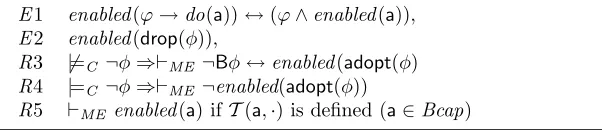
The relation between the enabledness of capabilities and conditional actions is stated in the next table together with the fact thatdrop(φ) is always enabled and a proof rule for deriving enabled(adopt(φ)). Let LME be the language
obtained by Boolean combinations of mental state formulas and enabledness formulas. We denote derivability in the system for this language by⊢ME. Then,
⊢ME consists of the axioms and rules for⊢M, plus
E1 enabled(ϕ→do(a))↔(ϕ∧enabled(a)),
E2 enabled(drop(φ)),
R3 6|=C ¬φ⇒⊢ME ¬Bφ↔enabled(adopt(φ)
R4 |=C ¬φ⇒⊢ME ¬enabled(adopt(φ))
[image:12.612.154.455.500.565.2]R5 ⊢ME enabled(a) ifT(a,·) is defined (a∈Bcap)
Table 3: Enabledness
RuleR5 enforces that we better write⊢T
ME given a belief revision function
T, but in the sequel we will suppress this T. The semantics|=ME forLME is
Definition 2.12 (Truth of enabledness)
• hΣ,Γi,T |=ME enabled(a) iffT(a,Σ) is defined
• hΣ,Γi,T |=ME enabled(drop(φ)) iff true
• hΣ,Γi,T |=ME enabled(adopt(φ)) iff6|=C ¬φandhΣ,Γi,T |=ME ¬Bφ
• hΣ,Γi,T |=ME enabled(ϕ→do(a)) iff hΣ,Γi,T |=ME φand at the same
timehΣ,Γi,T |=ME enabled(a)
Note that we can summarize this definition to:
• hΣ,Γi,T |=ME enabled(a) iffM(a,hΣ,Γi) is defined fora∈Cap,
• hΣ,Γi,T |=ME enabled(b) iff |=ME ϕ and there are Σ′,Γ′ such that
hΣ,Γi−→ hb Σ′,Γ′ifor conditional actions whereb=ϕ→do(a).
Theorem 2.13 (Soundness and Completeness of⊢ME)
We have, for all formulasϕin LME,
⊢ME ϕiff |=ME ϕ
Proof. Again, checking soundness is straightforward and left to the reader.
For the converse, we have to make a complexity measure explicit for LME
-formulas, along which the induction can proceed. It suffices to stipulate that the complexity ofenabled(ψ→do(a) is greater than that ofBψandenabled(a). Furthermore, the complexity ofenabled(adopt(φ) is greater than that of (¬)Bφ. Now, suppose that6⊢ME ϕ, i.e.,¬ϕis consistent. Note that the languageLME
is countable, so that we can by enumeration, extend{¬ϕ} to a maximal⊢ME
-consistent set ∆. From this ∆, we distill a pairhΣ,Γi,T as follows: Σ = {ϕ| Bϕ∈∆}, Γ ={ϕ|Gϕ∈∆}, andT(a,Σ) is defined iffenabled(a)∈∆, for any belief capabilitya. We claim, for allχ∈ LME:
hΣ,Γi,T |=χiffχ∈∆
For formulas of type Bψ and Gψ this is easily seen. Let us check it for enabledness formulas.
• χ=enabled(a), withaa belief capability. By construction ofT, the result
immediately holds
• χ=enabled(drop(φ)). By construction of ∆, everyenabled(drop(φ)) is an
element of ∆ (because of axiomE2), and also, every such formula is true inhΣ,Γi,T.
• χ = enabled(adopt(φ)). Suppose hΣ,Γi,T |=ME χ. Then, 6|= ¬φ and
hΣ,Γi,T 6|=ME Bφ. By the induction hypothesis, we have that Bφ6∈ ∆,
suppose enabled(adopt(φ)) ∈ ∆. Then (by R4), we cannot have that
|=C ¬φ. Hence,6|=C ¬φ, and by R3, we also have ¬Bφ ∈∆ and hence,
by applying the induction hypothesis, hΣ,Γi,T |=C ¬Bφ. SinceR3 is a
sound rule, we finally conclude thathΣ,Γi,T |=ME enabled(adopt(φ)).
• χ =enabled(ψ →a). We can write this as ψ∧ enabled(a) and then use
the induction hypothesis.
3
A Personal Assistant Example
In this section, we give an example to show how the programming language GOAL can be used to program agents. The example concerns a shopping agent that is able to buy books on the Internet on behalf of the user. The example provides for a simple illustration of how the programming language works. The agent in our example uses a standard procedure for buying a book. It first goes to a bookstore, in our case Am.com. At the web site of Am.com it searches for a particular book, and if the relevant page with the book details shows up, the agent puts the book in its shopping cart. In case the shopping cart of the agent contains some items, it is allowed to buy the items on behalf of the user. The idea is that the agent adopts a goal to buy a book if the user instructs it to do so.
The set of capabilitiesBcap of the agent is defined by
{goto website(site),search(book),put in shopping cart(book),pay cart}
The capability goto website(site) goes to the selected web page site. In our example, relevant web pages are the home page of the user, the main page of Am.com, web pages with information about books to buy, and a web page that shows the current items in the shopping cart of the agent. The ca-pability search(book) is an action that can be selected at the main page of Am.com and selects the web page with information about book. The action
put in shopping cart(book) can be selected on the page concerning book and
putsbook in the cart; a new web page calledContentCart shows up showing the content of the cart. Finally, in case the cart is not empty the actionpay cart
can be selected to pay for the books in the cart.
In the program text below, we assume thatbook is a variable referring to the specifics of the book the user wants to buy (in the example, we use variables as a means for abbreviation; variables should be thought of as being instantiated with the relevant arguments in such a way that predicates with variables reduce to propositions). The initial beliefs of the agent are that the current web page is the home page of the user, and that it is not possible to be on two different web pages at the same time. We also assume that the user has provided the agent with the goals to buyThe Intentional Stanceby Daniel Dennett andIntentions,
Π ={
B(current website(hpage(user))∨current website(ContentCart))
∧G(bought(book))→do(goto website(Am.com)),
B(current website(Am.com))∧ ¬B(in cart(book))∧
G(bought(book))→do(search(book)),
B(current website(book))∧G(bought(book))
→do(put in shopping cart(book)),
B(in cart(book))∧G(bought(book))→do(pay cart)},
Σ0={current webpage(hpage(user)),
∀s,s′((s 6=s′∧current webpage(s))→ ¬current webpage(s′))},
Γ0={bought(The Intentional Stance)
∧bought(Intentions, Plans and Practical Reason)}
GOAL Shopping Agent
Some of the details of this program will be discussed in the sequel, when we prove some properties of the program. The agent basically follows the recipe for buying a book outlined above. For now, however, just note that the program is quite flexible, even though the agent more or less executes a fixed recipe for buying a book. The flexibility results from the agent’s knowledge state and the non-determinism of the program. In particular, the ordering in which the actions are performed by the agent - which book to find first, buy a book one at a time or both in the same shopping cart, etc. is not determined by the program. The scheduling of these actions thus is not fixed by the program, and might be fixed arbitrarily on a particular agent architecture used to run the program.
4
Logic for GOAL
On top of the language GOAL and its semantics, we now construct a temporal logic to prove properties of GOAL agents. The logic is similar to other temporal logics but its semantics is derived from the operational semantics for GOAL. Moreover, the logic incorporates the belief and goal modalities used in GOAL agents. We first informally discuss the use of Hoare triples for the specification of actions. In Section 4.3 we give a sound an complete system for such triples. These Hoare triples play an important role in the programming logic since it can be shown that temporal properties of agents can be proven by means of proving Hoare triples for actions only. Finally, in 4.4 the language for express-ing temporal properties and its semantics is defined and the fact that certain classes of interesting temporal properties can be reduced to properties of actions, expressed by Hoare triples, is proven.
4.1
Hoare Triples
they play such an important role in the proof theory of GOAL, the specifica-tion of the basic agent capabilities requires special care. In the proof theory of GOAL, Hoare triples of the form {ϕ} b {ψ}, where ϕ and ψ are mental
state formulas, are used to specify actions. The use of Hoare triples in a formal
treatment of traditional assignments is well-understood [2]. Because the agent capabilities of GOAL agents are quite different from assignment actions, how-ever, the traditional predicate transformer semantics is not applicable. GOAL agent capabilities are mental state transformers and, therefore, we require more extensive basic action theories to formally capture the effects of such actions. Hoare triples are used to specify thepostconditionsand theframe conditionsof actions. The postconditions of an action specify the effects of an action whereas the frame conditions specify what is not changed by the action. Axioms for the predicateenabled specify the preconditions of actions.
The formal semantics of a Hoare triple for conditional actions is derived from the semantics of a GOAL agent and is defined relative to the set of tracesSA
associated with the GOAL agentA. A Hoare triple for conditional actions thus expresses a property of an agent and not just a property of an action. The semantics of the basic capabilities are assumed to be fixed, however, and are not defined relative to an agent.
Definition 4.1 (semantics of Hoare triples for basic actions)
AHoare triple for basic capabilities{ϕ}a{ψ}means that for all Σ,Γ
• hΣ,Γi |=ϕ∧enabled(a)⇒ M(a,hΣ,Γi)|=ψ, and
• hΣ,Γi |=ϕ∧ ¬enabled(a)⇒ hΣ,Γi |=ψ.
To explain this definition, note that we made a case distinction between states in which the basic action is enabled and in which it is not enabled. In case the action is enabled, the postcondition ψ of the Hoare triple {ϕ}a{ψ}
should be evaluated in the next state resulting from executing actiona. In case the action is not enabled, however, the postcondition should be evaluated in the same state because a failed attempt to execute actionais interpreted as an idle step in which nothing changes.
Hoare triples for conditional actions are interpreted relative to the set of
tracesassociated with the GOAL agent of which the action is a part. Below, we
writeϕ[si] to denote that a mental state formula ϕholds in state si.
Definition 4.2 (semantics of Hoare triples for conditional actions)
Given an agent A, a Hoare triple for conditional actions {ϕ}b{ψ} (for A) means that for all tracess∈SA andi, we have that
(ϕ[si]∧b=bi∈s)⇒ψ[si+1]
wherebi∈s means that actionbi is taken in statei of traces.
Lemma 4.3 LetA be a GOAL agent andSA be the meaning of A. Suppose
that we have {ϕ∧ψ}a{ϕ′} and S
A |= (ϕ∧ ¬ψ) → ϕ′. Then we also have
{ϕ}ψ→do(a){ϕ′}.
Proof: We need to prove that (ϕ[si]∧(ψ → do(a)) = bi ∈ s) ⇒ ϕ′[si+1].
Therefore, assume ϕ[si] ∧(ψ → do(a)) = bi ∈ s). Two cases need to be
distinguished: The case that the condition ψ holds in si and the case that
it does not hold insi. In the former case, because we have {ϕ∧ψ}a{ϕ′} we
then know that si+1 |= ϕ′. In the latter case, the conditional action is not
executed and si+1 = si. From ((ϕ∧ ¬ψ) → ϕ′)[si], ϕ[si] and ¬ψ[si] it then
follows thatϕ′[s
i+1] sinceϕ′ is a state formula.
The definition of Hoare triples presented here formalises a total correctness
property. A Hoare triple {ϕ}b{ψ} ensures that if initially ϕ holds, then an
attempt to executebresults in a successor state and in that stateψholds. This is different frompartial correctness where no claims about the termination of actions and the existence of successor states are made.
4.2
Basic Action Theories
Abasic action theory specifies the effects of the basic capabilities of an agent.
It specifies when an action is enabled, it specifies the effects of an action and what does not change when an action is executed. Therefore, a basic action theory consists of axioms for the predicate enabled for each basic capability, Hoare triples that specify the effects of basic capabilities and Hoare triples that specify frame axioms associated with these capabilities. Since the belief update capabilities of an agent are not fixed by the language GOAL but are user-defined, the user should specify the axioms and Hoare triples for belief update capabilities. The special actions for goal updating adoptand drop are part of GOAL and a set of axioms and Hoare triples for these actions is specified below.
4.2.1 Actions on beliefs: capabilities of the shopping assistant
Because in this paper, our concern is not with the specification of basic action theories in particular, but with providing a programming framework for agents in which such specifications can be plugged in, we only provide some example specifications of the capabilities defined in the personal assistant example that we need in the proof of correctness below.
Reason. In the shopping agent example, we then have:
enabled(goto website(site))↔true,
enabled(search(book))↔B(current website(Amazon.com)),
enabled(put in shopping cart(book))↔B(current website(book)),
enabled(pay cart)↔
((Bin cart(T)∨Bin cart(I))∧Bcurrent website(ContentCart)).
Second, we list a number of effect axioms that specify the effects of a capa-bility in particular situations defined by the preconditions of the Hoare triple.
• The actiongoto website(site) results in moving to the relevant web page:
{true}goto website(site){Bcurrent website(site)},
• At Amazon.com, searching for a book results in finding a page with rele-vant information about the book:
{Bcurrent website(Amazon.com)}search(book){Bcurrent website(book)}
• On the page with information about a particular book, selecting the action
put in shopping cart(book) results in the book being put in the cart; also,
a new web page appears on which the contents of the cart are listed:
{Bcurrent website(book)}
put in shopping cart(book)
{B(in cart(book)∧current website(ContentCart))}
• In casebook is in the cart, and the current web page presents a list of all the books in the cart, the actionpay cart may be selected resulting in the buying of all listed books:
{B(in cart(book)∧current website(ContentCart))}
pay cart
{¬Bin cart(book)∧B(bought(book)∧current website(Amazon.com))}
Finally, we need a number of frame axioms that specify which properties are not changed by each of the capabilities of the agent. For example, both the capabilitiesgoto website(site) andsearch(book) do not change any beliefs about
in cart. Thus we have, e.g.:
{Bin cart(book)}goto website(site){Bin cart(book)} {Bin cart(book)}search(book){Bin cart(book)}
It will be clear that we need more frame axioms than these two, and some of these will be specified below in the proof of the correctness of the shopping agent.
4.2.2 Actions on goals
A theory of the belief update capabilities and their effects on the beliefs of an agent must be complemented with a theory about the effects of actions upon the goals of an agent. Such a theory should capture both the effects of the default commitment strategy as well as give a formal specification of the thedropand
adoptactions. Only in Section 4.3 we aim at providing a complete system, in the discussion in the current section, there are dependencies between the axioms and rules discussed.
Default commitment strategy The default commitment strategy imposes
a constraint on the persistence of goals. A goal persists if it is not the case that after doing a the goal is believed to be achieved. Only action drop(φ) is allowed to overrule this constraint. Therefore, in casea6=drop(φ), we have that
{Gφ}a{Bφ∨Gφ}(using the rule for conditional actions from Table 9, one can derive that this triple also holds for general conditional actionsb, rather than just actions a). The Hoare triple precisely captures the default commitment strategy and states that after executing an action the agent either believes it has achievedφor it still has the goalφifφwas a goal initially.
a6=drop(φ)
{Gφ}a{Bφ∨Gφ}
Table 4: Persistence of goals
A similar Hoare triple can be given for the persistence of the absence of a goal. Formally, we have
{¬Gφ}b{¬Bφ∨ ¬Gφ} (1)
This Hoare triple states that the absence of a goal φ persists, and in case it does not persist the agent does not believe φ (anymore). The adoption of a goal may be the result of executing anadopt action, of course. However, it may also be the case that an agent believed it achievedφbut after doingb no longer believes this to be the case and adoptsφas a goal again. For example, if the goal base is{p∧q}and the belief base Σ ={p}, then the agent does not have a goal to achievep because it already believesp to be the case; however, in case an action changes the belief base such thatpis no longer is believed, the agent has a goal to achievep(again). This provides for a mechanism similar to that of maintenance goals. We do not need the Hoare triple (1) as an axiom, however, since it is a direct consequence of the fact that Bφ → ¬Gφ (this is exactly the postcondition of (1). Note that the stronger{¬Gφ}b{¬Gφ} does not hold, even if b 6=ϕ → do(adopt(φ)). This occurs for example if we have
In the semantics of Hoare triples (Definition 4.2) we stipulated that ifa is not enabled, we verify the postcondition in the same state as the pre-condition:
ϕ→ ¬enabled(a)
{ϕ}a{ϕ}
Table 5: Infeasible actions
Frame properties on Beliefs The specification of the special actionsdrop
and adopt involves a number of frame axioms and a number of proof rules. The frame axioms capture the fact that neither of these actions has any effect on the beliefs of an agent. Note that, combining such properties with e.g. the Consequence Rule (Table 10) one can derive the triple {Bψ}adopt(φ){¬Gψ} .
{Bφ}adopt(ψ){Bφ} {¬Bφ}adopt(ψ){¬Bφ} {Bφ}drop(ψ){Bφ} {¬Bφ}drop(ψ){¬Bφ}
Table 6: Frame Properties on Beliefs foradoptand drop
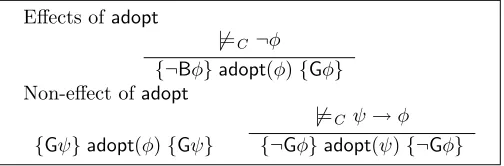
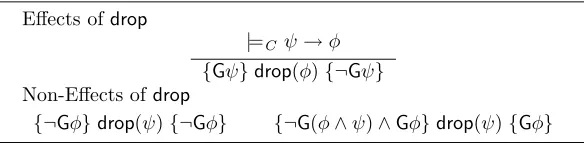
(Non-)effects ofadopt The proof rules for the actionsadoptanddropcapture
the effects on the goals of an agent. For each action, we list proof rules for the effect and the persistence (‘non-effect’) on the goal base for adoption (Table 7) and dropping (Table 8) of goals, respectively.
An agent adopts a new goalφin case the agent does not believeφandφis not a contradiction. Concerning persistence, an adopt action does not remove any current goals of the agent. Any existing goals thus persist when adoptis executed. The persistence of the absence of goals is somewhat more complicated in the case of anadoptaction. An adopt(φ) action does not add a new goalψ
in caseψis not entailed byφor ψis believed to be the case:
Effects ofadopt
6|=C ¬φ
{¬Bφ}adopt(φ){Gφ}
Non-effect ofadopt
{Gψ}adopt(φ){Gψ}
6|=C ψ→φ
{¬Gφ}adopt(ψ){¬Gφ}
Table 7: (Non-)effects ofadopt
[image:20.612.181.433.527.610.2]Effects ofdrop
|=C ψ→φ
{Gψ}drop(φ){¬Gψ}
Non-Effects ofdrop
{¬Gφ}drop(ψ){¬Gφ} {¬G(φ∧ψ)∧Gφ}drop(ψ){Gφ}
Table 8: (Non-)effects ofdrop
Concerning persistence of goals under drop: a drop action drop(φ) never results in the adoption of new goals. The absence of a goalψthus persists when a drop action is executed. It is more difficult to formalise the persistence of a goal with respect to a drop action. Since a drop actiondrop(φ) removes goals which entailφ, to conclude that a goalψpersists after executing the action, we must make sure that the goal does not depend on a goal (is a subgoal) that is removed by the drop action. In case the conjunctionφ∧ψ is not a goal, we know this for certain.
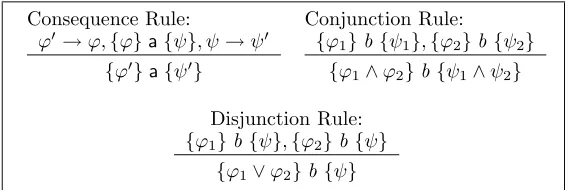
The basic action theories for GOAL include a number of proof rules to derive Hoare triples. The Rule for Infeasible Actions (Table 5) allows to derive frame axioms for an action in case it is not enabled in a particular situation. The Rule for Conditional Actions allows the derivation of Hoare triples for conditional actions from Hoare triples for capabilities. This rule is justified by lemma 4.3. Finally, there are three rules for combining Hoare triples and for strengthening the precondition and weakening the postcondition: they are displayed in Table 10.
Finally, we list how one goes from simple actionsa to conditional actionsb, and how to use complex formulas in pre- and post-conditions.
{ϕ∧ψ}a{ϕ′},(ϕ∧ ¬ψ)→ϕ′ {ϕ}ψ→do(a){ϕ′}
Table 9: Rule for conditional actions
We did not aim in this section at giving a weakest set of rules: in fact, the rules that manipulate the pre- and post-conditions in Table 10 for conditional actionsbcould already be derived if we had only given them from simple actions
a.
4.3
A Complete Hoare System
We now address the issue of finding a complete Hoare system for GOAL. Let⊢H
{ρ}S {σ}denote that the Hoare triple with pre-conditionρand postconditionσ
is derivable in the calculusH that we are about to introduce, and let|=H denote
[image:21.612.159.451.124.196.2]Consequence Rule: Conjunction Rule:
ϕ′ →ϕ,{ϕ}a{ψ}, ψ→ψ′ {ϕ′}a{ψ′}
{ϕ1}b{ψ1},{ϕ2}b{ψ2}
{ϕ1∧ϕ2}b{ψ1∧ψ2}
Disjunction Rule:
{ϕ1}b{ψ},{ϕ2}b{ψ}
[image:22.612.164.448.124.219.2]{ϕ1∨ϕ2}b{ψ}
Table 10: Structural rules
formulas (Definition 2.3), that of formulas withenabled(−) (Definition 2.12) and that of Hoare triples (Definition 4.1), on mental stateshΣ,Γi. From now on, the statement S ranges over basic actionsa and conditional actionsb. Then, this subsection wants to settle whether our calculus H is sound and complete, i.e. whether it can be proven that, for any pre- and postconditionρandσ∈ LM,
⊢H {ρ}S {σ} ⇐⇒ |=H {ρ}S {σ}
Finding such a complete system is, even for ‘ordinary deterministic pro-grams’, impossible, since such programs are interpreted over domains that in-clude the integers, and by G¨odel’s Incompleteness Theorem, we know that ax-iomatize a domain that includes those integers (cf. [3]). Here, our domain is not that of the integers, but, instead, we will assume a completeness result for the basic capabilitiesBcapthat modify the belief base, so that we can concentrate on the actions that modify the goals.
Definition 4.4 (General Substitutions)
We define the following general substitution scheme. Let σ, α, β be mental state formulas, and X a variable ranging over formulas from L. Then β(X) denotes that X may occur in β. Let C(X) denote a condition on X. Then
σ[α/β(X)|C(X)] denotes the formula that is obtained fromσby substituting all occurrences inσofβ(X) for whichC(X) holds, byα.
For instance, the result of (Gp ∧ ¬Gq ∧ Gs)[Br/Gφ | (p ∧ q) → φ] is
Br ∧ ¬Br ∧Gs.
Definition 4.5 (The system H)
Belief Capabilities {ρ(a)}a{σ(a)}
Adopt {(enabled(adopt(φ))∧σ[¬Bφ′/Gφ′|⊢
C φ→φ′])
∨(¬enabled(adopt(φ))∧σ)}{adopt(φ)}{σ}
Drop {σ[true/¬Gφ′| ⊢
C φ′ →φ]}drop(φ){σ}
Conditional Actions
{ρ∧ψ}a{σ},|=ME (σ∧ ¬ψ)→ρ
{ρ}ψ→do(a){σ}
Consequence Rule
|=ME σ→ϕ,{ϕ}a{ψ},|=ME ψ→σ
{ρ}a{σ}
Lemma 4.6 (Substitution Lemma)
(i) Let hΣ,Γi |=M enabled(adopt(φ)) and lethΣ′,Γ′i=M(adopt(φ),hΣ,Γi).
Then:
hΣ,Γi |=M σ[¬Bφ′/Gφ′|⊢C φ→φ′]⇐⇒ hΣ′,Γ′i |=M σ
(ii) Let hΣ′,Γ′i=M(drop(φ),hΣ,Γi). Then:
hΣ,Γi |=M σ[true/¬Gφ′| ⊢C φ′→φ]⇐⇒ hΣ′,Γ′i |=M σ
Proof. We only prove (i), the proof of (ii) is similar. We prove (i) by induction
on the mental state formulaσ.
1. σis of the formGχ. We distinguish two cases.
(a) ⊢C φ→χ. By definition ofM(adopt(φ),hΣ,Γi), we immediately see
thathΣ,Γi |=M ¬Bχ iffhΣ′,Γ′i |=M Gχ.
(b) 6⊢C φ → χ. The definition of M(adopt(φ),hΣ,Γi) guarantees that
the adopt has no effect on the fact that χ is a goal, thus we have
hΣ,Γi |=H GχiffM(adopt(φ),hΣ,Γi)|=H Gχ. Also, the substitution
has no change as an effect: (Gχ)[¬Bφ′/Gφ′ |⊢
C χ →φ′] =Gχ, and
we have the desired result.
2. σif of the formBχ. In this case, the substitution had no effect, and also, since theadopthas no effect on the belief base, we have thathΣ,Γi |=M Bχ
iffhΣ′,Γ′i |=
M Bχ.
3. The cases thatσ is a negation or a conjunction of mental states, follows immediately.
Lemma 4.7 (Soundness of⊢H)
Proof. Soundness of Belief Capabilities is assumed. The cases for adoptand
dropimmediately follow from Lemma 4.6. The soundness ofConsequence Rule
is easily proven using Theorem 2.5. Let us finally consider the rule
Condi-tional Actions. Suppose that |=H {σ∧ψ}a{ρ} (1), and |=ME (ρ∧ ¬ψ) →σ
(2), and take an arbitrary mental statehΣ,Γi. We have to demonstrate that
hΣ,Γi |=ME {ρ}ψ→do(a){σ} (3). Hence, we assume thathΣ,Γi |=ME ρ. We
then distinguish two cases. First, assumehΣ,Γi |=ER ψ. Then, by our
assump-tion (1), we have thathΣ′,Γ′i |=
M σ, forhΣ′,Γ′i=M(a,hΣ,Γi). The second
case is the one in which hΣ,Γi 6|=M ψ, i.e., hΣ,Γi |=M ¬ψ. By (2), we know
thathΣ′,Γ′i |=
ERσ, for anyhΣ′,Γ′ifor whichhΣ,Γi b
−→ hΣ′,Γ′i. All in all, we
have proven (3).
We first introduce the notion of weakest liberal precondition, originally due to Dijkstra ([7]). However, we introduce it immediately in the syntax.
Definition 4.8 (Weakest Liberal Precondition)
For S = a′,adopt(φ)drop(φ) and ψ → a, (a′ a belief capability, a any
ba-sic capability), we define the weakest liberal precondition for S to achieve σ,
wlp(S, σ)∈ Lm, as follows:
1. If a′ is a belief capability, and⊢H {σ−1(a′)}a′ {σ(a′)} is the rule for a′,
thenwlp(a′, σ(a′)) =σ−1
2. wlp(adopt(φ), σ) = (enabled(adopt(φ))∧σ[¬Bφ′/Gφ′|⊢
C φ→φ′)
∨(¬enabled(adopt(φ))∧σ) 3. wlp(drop(φ), σ) =σ[true/¬Gφ′ | ⊢
C φ′→φ]
4. wlp(ψ→a, σ) = (ψ∧wlp(a, σ))∨(¬ψ∧σ)
Note that the weakest preconditionwlp(S, σ) is indeed an mental state for-mula.
Lemma 4.9 (Weakest Precondition Lemma)
We have: ⊢H {wlp(S, σ}S {σ}, for everyS and every postconditionσ.
Proof. For S = a′,adopt(φ),drop(φ), this follows immediately from
Defini-tion 4.5. For condiDefini-tional acDefini-tionsb=ψ→a, we have to prove
⊢H {(ψ∧wlp(a, σ))∨(¬ψ∧σ)}ψ→a{σ}
Let us abbreviate (ψ∧wlp(a, σ))∨(¬ψ∧σ) toσ−1
b . The induction hypothesis
tells us that⊢H {wlp(a, σ)}a{σ} (1). Note that|=M σb−1→wlp(a, σ). Hence,
by theConsequence Ruleand (1), we have⊢H {σb−1}a{σ} (2). Obviously, we
also have|=M (σb−1 ∧ ¬ψ)→σ (3). Applying theConditional Actionsrule to
(2) and (3), we conclude⊢H {σb−1}ψ→a{σ}, which was to be proven.
Lemma 4.10
Proof. We even prove a stronger statement, i.e., that for all mental states
hΣ,Γi, if hΣ,Γi |=H {ρ}S {σ}, then hΣ,Γi |=M ρ → wlp(S, σ). To prove
this, we take an arbitraryhΣ,Γi for which both hΣ,Γi |=M ρ and hΣ,Γi |=H
{ρ}S {σ} and we then have to show thathΣ,Γi |=M wlp(S, σ).
1. S =adopt(φ). We know thathΣ,Γi |=H {ρ}adopt(φ){σ}. We distinguish
two cases, the first of which says that hΣ,Γi |=M ¬enabled(adopt(φ)).
Then we have a transition from hΣ,Γi to itself, and hence hΣ,Γi |=M
σ, and hence hΣ,Γi |=M ¬enabled(adopt(φ)) ∧ σ, so that hΣ,Γi |=M
wlp(adopt(φ), σ). In the second case, hΣ,Γi |=M enabled(adopt(φ)). By
the Substitution Lemma 4.6, case (i), we then immediately seehΣ,Γi |=M
σ[¬Bφ′/Gφ′ |⊢
C φ→φ′], and hencehΣ,Γi |=M wlp(adopt(φ, σ).
2. S =drop(φ). This case follows immediately from the Substitution Lemma and the definition ofwlp(drop(φ, σ).
3. S =ψ→a. We know thathΣ,Γi |=H {ρ}ψ→a{σ}and thathΣ,Γi |=M
ρ. IfhΣ,Γi |=M ¬ψ, then the transition belonging toS ends up inhΣ,Γi,
and hence we then havehΣ,Γi |=M ¬ψ∧σ, and in particularhΣ,Γi |=M
wlp(S, σ). In the other case we havehΣ,Γi |=M ψ, and we then know that
hΣ,Γi |=H {ρ}a{σ}. By induction we conclude thathΣ,Γi |=M wlp(a, σ,
and hencehΣ,Γi |=M wlp(ψ→a), σ).
Theorem 4.11 (Completeness of⊢H))
For any pre- and postconditionρandσ∈ LM,
⊢H {ρ}S {σ} ⇐⇒ |=H {ρ}S {σ}
Proof. Suppose|=M {ρ}S {σ}. The Weakest Precondition Lemma (4.9)
tells us that ⊢H {wlp(S, σ)}S {σ} (1). By Lemma 4.10, we have |=M σ →
wlp(S, σ) (2). We finally apply theConsequence Ruleto (1) and (2) to conclude to conclude that⊢H {σ}S {ρ}.
4.4
Temporal logic
On top of the Hoare triples for specifying actions, a temporal logic is used to specify and verify properties of GOAL agents. Two new operators are in-troduced. The proposition init states that the agent is at the beginning of execution and nothing has happened yet. The second operator until is a weak until operator. ϕuntilψmeans that ψ eventually becomes true andϕis true untilψbecomes true, orψnever becomes true andϕremains true forever.
Definition 4.12 (language of temporal logicLT based onL)
Thetemporal logic language LT is inductively defined by:
• init∈ LT,
• ifφ∈ L, thenBφ,Gφ∈ LT,
• ifϕ, ψ∈ LT, then¬ϕ, ϕ∧ψ∈ LT,
• ifϕ, ψ∈ LT, thenϕuntilψ∈ LT.
A number of other well known temporal operators can be defined in terms of the operator until. Thealwaysoperator✷ϕis an abbreviation forϕuntilfalse, and theeventuality operator⋄ϕis defined as¬✷¬ϕas usual.
Temporal formulas are evaluated with respect to a traces and a time point
i. State formulas likeBφ, Gψ, enabled(a) etc. are evaluated with respect to mental states.
Definition 4.13 (semantics of temporal formulas)
Lets be a trace andi be a natural number.
• s,i|=initiffi = 0,
• s,i|=enabled(a) iffenabled(a)[si],
• s,i|=enabled(ϕ→do(a)) iffenabled(ϕ→do(a))[si],
• s,i|=BφiffBφ[si],
• s,i|=GφiffGφ[si],
• s,i|=¬ϕiffs,i6|=ϕ,
• s,i|=ϕ∧ψiffs,i|=ϕands,i|=ψ,
• s,i |= ϕ until ψ iff ∃j ≥ i(s,j |= ψ∧ ∀k(i ≤ k < j(s,k |= ϕ))) or
∀k≥i(s,k |=ϕ).
We are particularly interested in temporal formulas that are valid with re-spect to the set of traces SA associated with a GOAL agent A. Temporal
formulas valid with respect toSA express properties of the agentA.
Definition 4.14 LetS be a set of traces.
• S |=ϕiff∀s ∈S,i(s,i |=ϕ),
• |=ϕiffS |=ϕwhereS is the set of all traces.
In general, two important types of temporal properties can be distinguished. Temporal properties are divided into liveness and safety properties. Liveness properties concern the progress that a program makes and express that a (good) state eventually will be reached. Safety properties, on the other hand, express that some (bad) state will never be entered. In the rest of this section, we discuss a number of specific liveness and safety properties of an agentA=hΠA,Σ0,Γ0i.
properties of agents can be proven by inspection of the program text only. The fact that proofs of agent properties can be constructed by inspection of the program text means that there is no need to reason about individual traces of an agent or its operational behaviour. In general, reasoning about the program text is more economical since the number of traces associated with a program is exponential in the size of the program.
The first property we discuss concerns a safety property, and is expressed by the temporal formula ϕ→ (ϕ until ψ). Properties in this context always refer to agent properties and are evaluated with respect to the set of traces associated with that agent. Therefore, we can explain the informal meaning of the property as stating that ifϕ ever becomes true, then it remains true until
ψbecomes true. By definition, we write this property asϕunlessψ:
ϕunlessψdf=ϕ→(ϕuntilψ)
An important special case of an unless property isϕunlessfalse, which expresses that ifϕever becomes true, it will remain true. ϕunlessfalsemeans
thatϕis a stableproperty of the agent. In case we also have init→ϕ, where
initdenotes the initial starting point of execution, ϕis always true and is an
invariantof the program.
Now we show that unless properties of an agent A = hΠ, σ0, γ0i are
equivalent to a set of Hoare triples for basic actions in Π. This shows that we can prove unless properties by proving a finite set of Hoare triples. The proof relies on the fact that if we can prove that after executing any action from Π eitherϕpersists orψbecomes true, we can conclude that ϕunlessψ.
Theorem 4.15 LetA=hΠA,Σ0,Γ0i. Then:
∀b∈ΠA({ϕ∧ ¬ψ}b{ϕ∨ψ}) iffSA|=ϕunlessψ
Proof: The proof from right to left is the easiest direction in the proof.
Sup-poseSA |=ϕunless ψ ands,i |=ϕ. This implies thats,i |=ϕuntil ψ. In
case we also haves,i |=ψ, we are done. So, assumes,i |=¬ψand action b is selected in the trace at statesi. From the semantics of until we then know
thatϕ∨ψ holds at statesi+1, and we immediately obtain{ϕ∧ ¬ψ}b{ϕ∨ψ}
sinces andi were arbitrarily chosen trace and time point. To prove the Hoare triple for the other actions in the agent programA, note that when we replace actionb with another action c from ΠA in trace s, the new trace s′ is still a
valid trace that is in the setSA. Because we have SA |=ϕ unlessψ, we also
haves′,i |=ϕ unless ψ and from reasoning by analogy we obtain the Hoare
triple for actionc (and similarly for all other actions).
We prove the left to right case by contraposition. Suppose that
(∗) ∀b ∈ΠA({ϕ∧ ¬ψ}b{ϕ∨ψ})
and for somes∈SAwe haves,i6|=ϕunlessψ. The latter fact means that we
is never established at somej ≥i but we do have¬ϕat some time point k>i
or (ii) ψis established at some timej >i, but in between i and any suchj it is not always the case thatϕholds.
In the first case (i), letk >i be the smallestk such thats,k 6|=ϕ. Then, we haves,k−1|=ϕ∧ ¬ψand s,k |=¬ϕ∧ ¬ψ. In state sk−1, however, either
a conditional action is performed or no action is performed. From (*) we then derive a contradiction.
In the second case (ii), letk>i be the smallestk such thats,k |=ψ. Then we know that there is a smallestj such thati <j<k ands,j 6|=ϕ(j 6=i since
s,i |= ϕ). This means that we have s,j−1 |=ϕ∧ ¬ψ. However, in state sj
either a conditional action is performed or no action is performed. From (*) we then again derive a contradiction.
Liveness properties involve eventualities which state that some state will be reached starting from a particular situation. To express a special class of such properties, we introduce the operatorϕ ensuresψ. ϕ ensuresψ informally means thatϕguarantees the realisation ofψ, and is defined as:
ϕensuresψdf=ϕunlessψ∧(ϕ→ ⋄ψ)
ϕensuresψthus ensures thatψis eventually realised starting in a situation
in which ϕ holds, and requires that ϕ holds until ψ is realised. For the class
of ensures properties, we can show that these properties can be proven by
proving a set of Hoare triples. The proof of a ensures property thus can be reduced to the proof of a set of Hoare triples.
Theorem 4.16 LetA=hΠA, σ0, γ0i. Then:
∀b∈ΠA({ϕ∧ ¬ψ}b{ϕ∨ψ})∧ ∃b∈ΠA({ϕ∧ ¬ψ}b{ψ})
⇒SA |=ϕensuresψ
Proof: In the proof, we need the weak fairness assumption. Sinceϕensuresψ
is defined as ϕ unless ψ ∧(ϕ → ⋄ψ), by theorem 4.15 we only need to prove that SA |= ϕ → ⋄ψ given that ∀b ∈ ΠA({ϕ∧ ¬ψ}b{ϕ∨ψ})∧ ∃b ∈
ΠA({ϕ∧ ¬ψ}b{ψ}). Now suppose, to arrive at a contradiction, that for some
time pointi and traces ∈SA we have: s,i |=ϕ∧ ¬ψ and assume that for all
later pointsj >i we haves,j |=¬ψ. In that case, we know that for all j >i
we have s,j |= ϕ∧ ¬ψ (because we may assume ϕ unless ψ). However, we also know that there is an actionb that is enabled in a state in whichϕ∧ ¬ψ
holds and transforms this state to a state in whichψholds. The actionbthus is always enabled, but apparently never taken. This is forbidden by weak fairness, and we arrive at a contradiction.
Finally, we introduce a third temporal operator ‘leads to’7→. The operator
ϕ7→ψdiffers from ensures in that it does not requireϕto remain true until