This is a repository copy of
Testing the Theoretical Accuracy of Travel Choice Models
Using Monte Carlo Simulation.
.
White Rose Research Online URL for this paper:
http://eprints.whiterose.ac.uk/2403/
Monograph:
Ortuzar, J.D. (1979) Testing the Theoretical Accuracy of Travel Choice Models Using
Monte Carlo Simulation. Working Paper. Institute of Transport Studies, University of
Leeds , Leeds, UK.
Working Paper 125
[email protected] https://eprints.whiterose.ac.uk/ Reuse
Unless indicated otherwise, fulltext items are protected by copyright with all rights reserved. The copyright exception in section 29 of the Copyright, Designs and Patents Act 1988 allows the making of a single copy solely for the purpose of non-commercial research or private study within the limits of fair dealing. The publisher or other rights-holder may allow further reproduction and re-use of this version - refer to the White Rose Research Online record for this item. Where records identify the publisher as the copyright holder, users can verify any specific terms of use on the publisher’s website.
Takedown
If you consider content in White Rose Research Online to be in breach of UK law, please notify us by
White Rose Research Online
http://eprints.whiterose.ac.uk/
Institute of Transport Studies
University of Leeds
This is an ITS Working Paper produced and published by the University of
Leeds. ITS Working Papers are intended to provide information and encourage
discussion on a topic in advance of formal publication. They represent only the
views of the authors, and do not necessarily reflect the views or approval of the
sponsors.
White Rose Repository URL for this paper:
http://eprints.whiterose.ac.uk/
2403/
Published paper
Ortuzar, J.D. (1979)
Testing the Theoretical Accuracy of Travel Choice Models
Using Monte Carlo Simulation.
Institute of Transport Studies, University of Leeds,
Working Paper 125
UNIVERSITY OF LEEDS
Institute for Transport Studies
ITS
Working
Paper
125
November
1979
TESTING THE THEORETICAL ACCURACY OF
TRAVEL CHOICE MODELS USING MONTE CARLO
SIMULATION
BY J. D. ORTUZAR
ITS
Working Papers are intended to provide information and encourage discussion on a topic in advance of formal publication. They represent only the views of the authors, and do not necessarily reflect the views or approval of the sponsors.CONTENTS
Abstract
1. Introduction 1
2. The Generation of Random U t i l i t y Models
3. A t t r i b u t e C o r r e l a t i o n and Model S t r u c t u r e s
4.
The P r o b i t Model: S t r u c t u r e and Transformations5 .
The Theoretical Accuracy o f A l t e r n a t i v e Logit Model S t r u c t u r e s6 .
ConclusionsReferences
Acknowledgements
Figures
ABSTRACT
ORTUZAR,
J.de D.
(1979)
Testing the theoretical accuracy of
travel choice models using Monte Carlo simulation. Leeds:
University of Leeds, Inst. Trans. Stud.,
WP
125 (unpublished)
In recent years a considerable advance has been made in
the construction of micro-travel demand models from choice
theoretic principles. Within random utility theory, the structure
of models
maybe shown to relate to the perceived similarity
between discrete choice alternatives, and this aspect may be
interpreted mathematically in terms of the correlation between
the components of random utility functions. Several possible
model structures have now been proposed, varying from the
multinomial logit model (uncorrelated) through the partly
correlated structures (hierarchical and cross-correlated logit
kctions) to the most general form of probit model which allows
an arbitrary variance-covariance matrix.
In this paper, these model structures are discussed using a
geometric interpretation of random utility theory, and the
possibility of invoking transformations on the general probit
model is examined. Monte Carlo simulation methods are then used
to investigate some aspects of the trade-off between the generality
and accuracy of correlated structures (the cross-correlated logit
model in particular) and the greater ease with which less consistent
structures may be implemented. In this way, the theoretical
accuracy of the multinomial logit model is assessed.
TESTING THE THEORETICAL ACCURACY OF TRAVEL
CHOICE MODELS USING MONTE CARLO SIMULATION
1. INTRODUCTION
I n recent y e a r s considerable i n t e r e s t has centred on t h e r e l a t i o n s h i p
between t h e s t r u c t u r e of a t r a v e l demand model and t h e behavioural
p r i n c i p l e s a s s o c i a t e d with its formation. This has a r i s e n not only
-
because of t h e need t o underpin models with a c o n s i s t e n t t h e o r e t i c a l
r a t i o n a l e , b u t a l s o from t h e recognition of s t r u c t u r a l ambiguities i n
e x i s t i n g models
-
a s , f o r example, with t h e r e l a t i v e p o s i t i o n s ofd i s t r i b u t i o n and modal s p l i t models i n t h e conventional planning system
-
which can give r i s e t o s i g n i f i c a n t l y d i f f e r e n t r e s u l t s i n p o l i c y a n a l y s i sen-Akiva,
1974; Williams and Senior, 1977). One p a r t i c u l a r framework within which t h i s r e l a t i o n s h i p has been sought i s t h a t providedby random u t i l i t y t h e o r y ( f o r a review, s e e Dcanencich and McFadden, 1975).
I n t h i s quanta1 choice theory i n d i v i d u a l s a r e considered t o a s s o c i a t e
with each member An; n = l ,
...,
N of a d i s c r e t e s e t of options A , a net u t i l i t y Un; n = l ,...,
N, and t o s e l e c t t h a t member with t h e highest value of U. To account f o r i n t e r p e r s o n a l v a r i a t i o n i n t h e value of a t t r i b u t e sincorporated i n t h e u t i l i t y f u n c t i o n s , a n d t h e i n f l u e n c e of unobserved
f a c t o r s , t h e modeller considers t h e v a r i a b l e s (U1,
...,
Un,...,
UN) t o be randomly d i s t r i b u t e d over t h e population confronted by a choice. Thep r o b a b i l i t y P t h a t an i n d i v i d u a l with p a r t i c u l a r c h a r a c t e r i s t i c s s e l e c t s n
an a l t e r n a t i v e An i s t h e n simply expressed i n terms of t h e p r o b a b i l i t y
t h a t Un be g r e a t e r than those values associated with a l l o t h e r options.
A formal choice model may be derived when t h e d e n s i t y function
f ( U )
-
= f (U1,. . .
,
U N ) of t h e u t i l i t y components i s s p e c i f i e d .It has r e c e n t l y been recognised t h a t t h e a n a l y t i c s t r u c t u r e of a model
i s c r u c i a l l y r e l a t e d t o t h e interdependency, o r s t a t i s t i c a l c o r r e l a t i o n ,
between t h e u t i l i t y f u n c t i o n s a s s o c i a t e d with each a l t e r n a t i v e
-
t h a t i s ,with t h e s t r u c t u r e of
f(U)
(Williams, 1977; Langdon 1976; Daly andZachary, 1978; McFadden, 1979). A s e t of formal models now e x i s t s which
accommodates varying degrees of " s i m i l a r i t y " o r c o r r e l a t i o n between
generated by uncorrelated distributions, through the hierarchical logit
model
(HI.,),to the generalised probit function
(GP) with arbitrary
correlation, expressed in terms of a variance
-
covariance matrix.
Until recently application of the generalised probit model has
been restricted to a small number
(3
or
4)
of choice options (Haussman
and Wise, 1978
).
However by invoking the Clark approximation (Clark,
19611,
Daganzo et al
(1977)
have extended its practical range. In
spite of the advances in its applicability there appear to be many
practical cases in which (a) the model cannot cope (~aganzo,
1979),
or
(b) there is a need for a compromise between the generality it can
afford m d
the greater ease with which less consistent structures may
,
be implemented. One such compromise is the cross-correlated logit (CCL)
function (Williams,
1977).
which is a closed-form model containing
alternative
HL
functions as special cases.
In this paper we wish to examine some general themes such as the
relationship between certain utility functions and the structure of
travel choice models; the possibility of invoking transformations in
order to simplify models and derive conceptual links between them; the
theoretical accuracy of particular choice models, and the problems of
misspecification associated with model structures and utility functions.
More specifically, we wish to address the following questions:
i)
Is it possible to apply transformations in 'utility space' in order
to simplify 'symmetric' probit models and enable conceptual links
to be forged with the logit family?
ii) How serious is the absence of 'similarity effects' in the multi-
nomial logit model? In other words, how much is the well known
'independence
from irrelevant alternatives' (IIA) property of the
model an impediment in choice modelling?
iii) How good an approximation to a general function is the cross-
correlated logit model?
iv) What is the effect of misspecification of choice models with
respect to model structure and their utility components?
v)
Can any of the logit models display pathological response
properties, and is it possible to recognise their symptons at the
vi) Can we discriminate between contending model structures on the
basis of goodness of statistical fit, and the character of their
inherent elasticity parameters? In particular, does a
good
agreement to bese year data necessarily imply good response
characteristics?
It should be stressed at the outset that any reference to the
accuracy of a model will refer to its consistency with the underlying
theoretical rationale, and not necessarily to its appropriateness in
choice modelling.
-
In Section
2,
the basic principles of generating random utilitymodels are reviewed, a geometric interpretation of the theory is
presented, and the Monte Carlo method as a means for numerical
evaluation of choice models is outlined. The existence and implications
of correlation between the utility functions associated with different
alternatives are then examined in Section
3
and the various approachesto its incorporation in choice models noted. In Section
4
we investigatethe possibility of invoking transfomations in utility space as a means
of simplifying the general probit model. Although conceptionally
appealing in terms of its links with MNL,
HL
and CCL structures, thepotential for implementing such transfomations does not, in general,
appear practicable.
The numerical tests to determine the theoretical accuracy of the
alternative logit structures in a general choice context are then
described in detail in Section
5.
2. THE GENERATION OF M D O M UTILITY MODELS
Formally, we can express the model generator equations of rando~
utility theory as follows:
P
=
Prob (Un > Unl,V
Ant
EA)n (2.1)
in which f(U) is the joint distribution function of (U1,
. . .
,
UN) andRn:
Un
LUnt
vAnl EA
(2.3)Un
L 0(2.4)
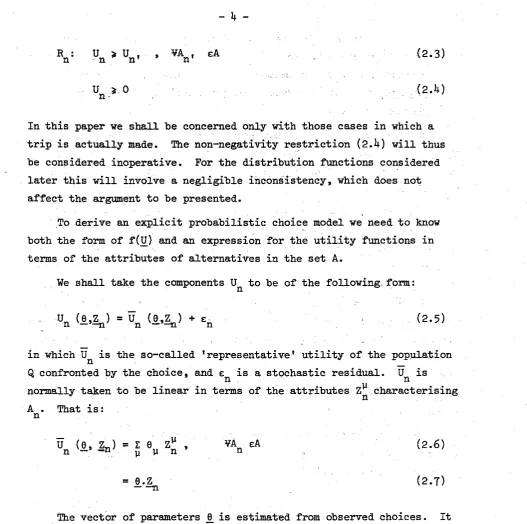
In this paper we shall be concerned only with those cases in which a
trip is actually made. The non-negativity restriction (2.4) will thus
be considered inoperative. For the distribution functions considered
later this will involve a negligible inconsistency, which does not
affect the argument to be presented.
To derive an explicit probabilistic choice model we need to know
both the form of f(1) and
an expression for the utility functions in
terms of the attributes of alternatives in the set A.
We shall take the components Un to be of the following form:
Un
=
un
(g.$)
+ E,(2.5)
in which
is the so-called 'representative' utility of the population
n
-
Q confronted by the choice, and
E~is a stochastic residual. U is
n
normally taken to be linear in terms of the attributes
'
Z
characterising
n
A
.
That is:
n
The vector of parameters
g
is estimated from observed choices. It
remains to specify the distribution function f(g) or equivalently that
of the stochastic residuals
g .A geometric interpretation of the theory may readily be derived
from expression (2.2).
In the utility space%&
bounded by the components
(U1,
. . .
,
U
),
the probability Pn is, for normalised f
(g),
the total
N
density of points in the region Rn bounded by the hyperplanes defined by:
and
U
=
U
V AneA
n
n'
This can be more easily seen in the convenient cartesian space. In
Figure l(a) we illustrate the fundamental utility distributions
[image:9.595.53.581.33.557.2]distinguish those distributions g (U ) and g2(U )'which are associated
1 1
2with the population
Q
confronted by the choice between alternativesA1 and A2, from
gl(ul)
andg2(u2)
which are the "choice specific"distributions of utility, for those members of
Q
who have selectedoptions A1 and A2 respectively. The sum of these last two distributions
is termed the distribution of maximum utility g,(U), and the three
functions are formally defined as follows:
We shall also write the distribution of maximum utilities in the form
-
and we note here that the mean value of this distribution, U,, has great
significance in the evaluation problem (Williams,
1977).
The geometric interpretation of this simple choice process, which
is an extension of that provided by Robertson
(1977),
is given in Figurel(b). For identical and independent distributions (IID), f(g) has a
-
circularly symmetric shape centred on and U2. The line OZ divides
1
the positive quadrant into the regions R1 and R2, and P1 and P2 comprise
of those corresponding portions of the distribution in these regions.
The distinction between g(U1) and the choice specific distribution g(U )
1 can readily be seen in terms of the respective projections onto the U
1 axis of the density function f(g), and that portion of f(g) bounded by
OZ
and the U1 axis. IAn
important class of random utility models includes those generatedby IID utility distributions for which we can decompose
f(E)
as follows:N
- 6 -
Here g(Un)
i s
t h e d i s t r i b u t i o n of t h e u t i l i t y component a s s o c i a t e d w i t h A.
The expression f o r Pn can now b e w r i t t e nn
h i s s i o n of t h e c o n s t r a i n t (2.4) allows t h e lower l i m i t s of
i n t e g r a t i o n t o be extended t o minus i n f i n i t y .
It i s by now widely known t h a t t h e much favoured multinomial l o g i t
model
(MNL)
i s an I I D model generated from Weibull (Gnedenko) p r o b a b i l i t y
d i s t r i b u t i o n s ( ~ h a r l e s Rivers Associates, 1972) f o r which
This i s a skewed unimodal d i s t r i b u t i o n , i n which t h e d i s p e r s i o n parameter
A i s inversely r e l a t e d t o t h e standard deviation, a , a s follows ( Cochrane
,
1975 ) :Similarly simple p r o b i t models a r e generated from I I D Normal d i s t r i b u t i o n s .
For a number of s p e c i a l d i s t r i b u t i o n s , it i s possible t o evaluate
t h e i n t e g r a l (2.2) t o produce a n a l y t i c a l expressions f o r Pn, such a s t h e
MNL
i n equation (2.15). I n general, however, we have t o r e s o r t t o someform of numerical method. One such approach involves Monte Carlo
simulation. A s f a r a s we a r e aware t h e first a p p l i c a t i o n of t h i s method
t o t h e s o l u t i o n of random u t i l i t y models i s t h a t of Albright, Lerman and
Manski (1977). i n t h e development of an estimation program f o r t h e g e n e r a l
p r o b i t model. However, and i n most cases independently, t h e power of t h e
approach has a t t r a c t e d numerous a p p l i c a t i o n s r e c e n t l y (Bonsall, 1979;
Chicago Area Transportation Study, 1979; Horowitz, 1978; Kreibich, 1979;
Manski and Lerman, 1978; Ortuzar, 1978; Robertson, 1977; Robertson and
Kennedy, 1979; W i l l i a m s and &uzar, 1979) but c l e a r l y its r o o t s can be
I n t h i s approach we follow t r a d i t i o n (~ammersley and Handscomb,
1965); a sample of s i z e S is c r e a t e d , and each ' i n d i v i d u a l ' member t ,
of S, i s confronted by t h e choice between A1,
...,
%.
Using a random number generatora
set
of u t i l i t y values (U1,.
.
.
,
u ~ ) is drawn fromf ( ~ ) ,
-
and t h e membert
i s assigned t o t h a t option with t h e maximum a s s o c i a t e d u t i l i t y . For l a r g e S, t h e proportion Sn of ' i n d i v i d u a l s 'assigned t o option An w i l l approximate t o Pn, which i s given by
I n t h e simple Cartesian u t i l i t y plane examined before, t h e method
involves r a n d m sampling of p o i n t s from f(U1, U2). For a given sampled
t t
observation (U1. U 2 ) , t h e corresponding 'individual' w i l l be assigned
t o A1 o r
A2
according t o t h e region i n which t h e ' p o i n t ' may be found.t
t
t tif U > U2, i . e . (U1,U2) sR1, a s s i g n t o A1 1
(2.19)
t
t
t
t
if U < U2, i . e . (U1,u2) cR2, assign t o A2 1
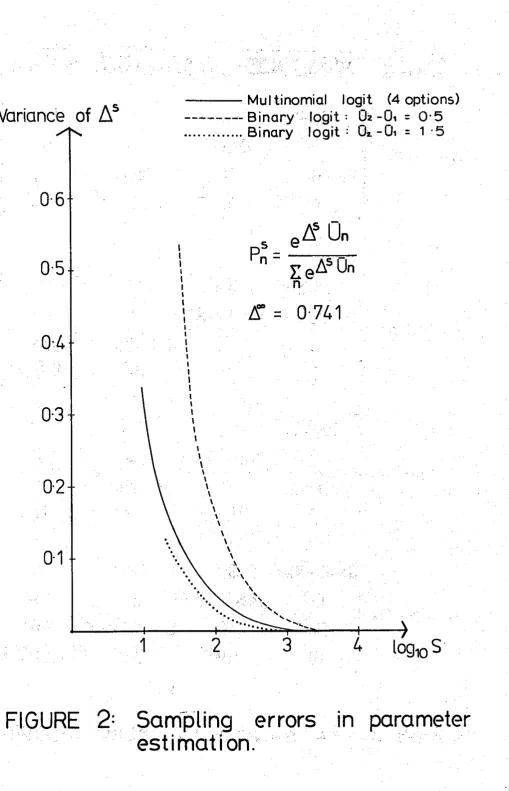
To t e s t t h e accuracy of t h e method with sample s i z e , t h e numerical
s o l u t i o n of a b o p t i o n l o g i t model was compared with t h e a n a l y t i c s o l u t i o n .
For a sample of s i z e S, t h e choice p r o b a b i l i t i e s P' were determined by n
drawing random values from four I I D Weibull f u n c t i o n s , with given means
-
- -
-
(ul, U2, U3, U q ) and standard d e v i a t i o n 0. Tnese numerically derived
p r o b a b i l i t i e s were then f i t t e d by a l o g i t function
S
i n which t h e parameter A was estimated by t h e usual maximum l i k e l i h o o d
method (Domencich and McFadden, 1975). I n Figure 2 , we show t h e empirically derived r e l a t i o n s h i p between t h e variance of A~ with t h e
s i z e of t h e sample S. I n order t o examine t h e accuracy of t h e numerical
s o l u t i o n under d i f f e r e n t c o n d i t i o n s , we repeated t h i s procedure f o r a
b i n a r y l o g i t model and d i f f e r e n t values of t h e d i f f e r e n c e between mean
u t i l i t i e s . A s it can be seen, t h e c l o s e r t h e options ( s m a l l e r d i f f e r e n c e
numerical t e s t s d e s c r i b e d i n later s e c t i o n s t h e sample s i z e was f i x e d
a t
S
=
30,000. (2We now proceed t o consider more complex choice contexts i n which
t h e presence of c o r r e l a t i o n between u t i l i t y functions i s c e n t r a l t o t h e
s t r u c t u r a l develoment of t h e models.
3. ATTRIBUTE CORRELATION AM) MODEL
STRUCTURES
-
For t h e u t i l i t y d i s t r i b u t i o n s Un; n=l,
...,
N we can define a variance-covariance matrix & w i t h elements C given by:nn'
= E ( e n E ) V A n , A n t EA
n'
(3.1)
i n which E ( . ) denotes an expectation value. I n t h e c a s e of I I D u t i l i t y
components t h e matrix has, by c o n s t r u c t i o n , a simple diagonal form
where
I
-
i s t h e u n i t m a t r i x of dinension N , and u t h e common standard d e v i a t i o n of t h e d i s t r i b u t i o n s g(U), t h a t i sIt i s one o f t h e i n t e n t i o n s of t h i s work t o determine t h e extent t o
which t h i s very simple s t r u c t u r e c o n s t i t u t e s a r e a l r e s t r i c t i o n t o choice
modelling.
The multinomial l o g i t ( Y ~ I L ) model (2.15) generated from I I D Weibull
d i s t r i b u t i o n s , which i s t h e r e f o r e c h a r a c t e r i s e d by a matrix with t h e
diagonal s t r u c t u r e ( 3 . 2 ) , has been very widely applied i n mode choice,
and nore r e c e n t l y d e s t i n a t i o n choice modelling ( f o r a review, s e e Spear
1977). It i s now well known, however, t h a t t h e model s u f f e r s a
r e s t r i c t i v e property o f c r o s s - s u b s t i t u t i o n , t h e 'independence from
irrelevant alternatives' ( I I A ) property, whereby the ratio
is independent of the utility values associated with other options.
The IIA property, once seen as a positive advantage to be exploited
in 'new option' situations, is now recognised to be a potential hazard
when certain alternatives are more 'similar' than others in the set A.
In random utility theory this notion of 'similarity' is interpreted in
tens of the presence of off-diagonal elements in the matrix
2.
-
In certain applications, specific forms for the utility functions
tend to suggest themselves. Consider 'two dimensional' choice contexts
involving, for example, combinations of destination (D) and mode ( ! I ) .
Alternatives in each dimension will be denoted by (Dl,
.
,
D ,...,
DN)
and
(y,
..
.
,X
.
.
..,:$*),
respectively, and the combination of m ydimensions produces the 1P.J discrete choice options (Dl
5,
. .
.,
DM
n m' ....Dd$l), which comprise the set A. The general element An is now
D
M
which might be a specific destination-mode combination for then m
purpose of performi~g an activity.
For such choice contexts we shall be particularly interested in
utility functions of the form
U(n,m)
=
U+
U+
Urnn m
V
Dn!ImcA(3.5)
here U and U may, for example, correspond to destination and mode
n m
specific utilities, respectively, while U might be the travel disutility
nm
associated with D
M
combination. This form was used in the shoppingn m
model developed by Ben Akiva
(1974),
and in a number of other applicationsin the United States since that time.
Writing U(n,m) in terms of a 'representative' term b(n,m) and
a stochastic residual ~(n,m) we have
i n which
and
-
We s h a l l now assume t h a t t h e r e s i d u a l s E ~ ,E~ and E~ a r e s e p a r a t e l x
I I D , with
i n which 6 i s t h e Kronecker d e l t a . The elements of
-
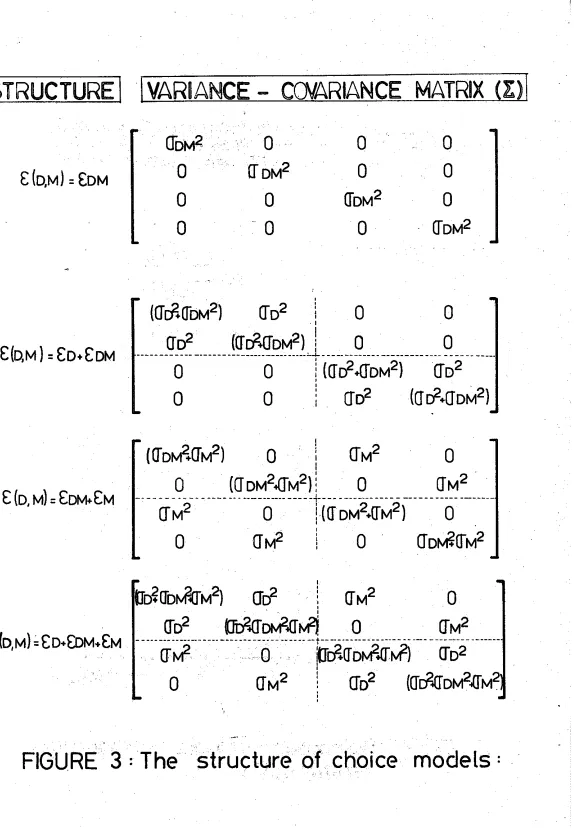
now becomeand t h e matrix i s expressed i n Figure 3, t o g e t h e r with t h o s e corresponding
t o t h e r e s i d u a l s t r u c t u r e s
~ ( n , m )
=
cm+
(3.13)which a r e c l e a r l y s p e c i a l cases of t h a t defined i n Equation ( 3 . 8 ) . It
i s r e a d i l y seen t h a t t h e source of c o r r e l a t i o n i n 'multiple dimension'
cases i s t h e existence of a ccamnon term o r 'dimension s p e c i f i c ' element
we have developed i n Figure 3 ,
a
p i c t o r i a l r e p r e s e n t a t i o n of t h e s t r u c t u r e of t h ez
-
matrix with c o r r e l a t i o n between a l t e r n a t i v e s incorporated throughcommon bonds
as
shown. Thisi s
t h e b a s i s f o r a r e p r e s e n t a t i o n of t h e choice model i t s e l f (Williams, 1977). I n t h e f i r s t case both oD and oMa r e zero and a diagonal
C
-
matrix r e s u l t s . This case which i s c o n s i s t e n twith Equation (3.11) w i l l correspond t o t h e
W L
model (2.15) i f t h eu t i l i t y functions a r e drawn from I I D Weibull d i s t r i b u t i o n s . It i s c l e a r
t h a t t h e use of t h e u t i l i t y 'function ( 3 . 5 ) i n a KNL model of t h e form
(2.15) w i l l be i n c o n s i s t e n t because t h e a p p r o p r i a t e
z
-
matrix, correspondingt o t h a t u t i l i t y function, i s not of t h e diagonal form involved i n t h e
generation of t h e model.
Before t r e a t i n g t h e more g e n e r a l case ( 3 . 8 ) , which i s c o n s i s t e n t
with t h e u t i l i t y f u n c t i o n
(3.5)
and which corresponds t o t h e f o u r t h2
-
matrix of Figure3,
we s h a l l consider t h e d e r i v a t i o n of a h i e r a r c h i c a l o r nested model f r o m a f u n c t i o n c o n s i s t e n t with t h e r e s i d u a l s t r u c t u r eand which corresponds t o t h e second r e p r e s e n t a t i o n i n Figure
3.
I n t h i s case t h e component o vanishes and t h e two parameters oD and oDM allowM
d i f f e r e n t degrees of c r o s s - s u b s t i t u t i o n between
intra
andinter-
brancha l t e r n a t i v e s i n t h e ' t r e e ' form shown i n Figure 3 ( b ) ; t h a t
is,
betweenDn Mm and DnMm,
,
i n t h e former c a s e , and between D ?I and D,M
i n t h e n m n m'l a t t e r . It may be shown (Williams, 1977) t h a t P(n,m), t h e p r o b a b i l i t y
of s e l e c t i n g D M can be w r i t t e n n m
P(n,m) = Pn.Pm (3.15)
i n which
and
Pn
=
Prob (Un
+Unw
>Unl
+
Unl+
,
Y
Dd ED)
(3.17)
with
If the components Urn are Weibull distributed variables
w(u.~~~,A)
with mean
if
+
y/A (where
yis Euler's constant), and standard deviation
nm
K / ( ~ A
),then it is readily shown (Cochrane,
1975)
that Un, is also
Weibull distributed, with mean
and standard deviation given by
The marginal distribution P is then derived from the sum of
n
Weibull distributed variables Un+ and variables Un, derived from some
distribution
r(~,<), n=l,
...,
N to be specified.
Now the hierarchical logit
(HL)
model (~illiams,
1977; Daly and
Zachary,
1978;
McFadden,
1979)
can be generated by specifying that r(~,&)
be that distribution of a
variate which is formed from the difference between random variables
-
(3)
drawn from Weibull functions W(U,
En
+
tnr, 6) and W(U, Una,
A).
Because
Un and Un, are independent, the variance of their sum is
given by
... ... . . . . . . . . . .
..
... ... . . . . . .
...
.
. .
-
13-
When uD = 0, the model collapses to the MNL, characterised by the
single parameter
A.
It can be seen that for a consistent model (and forT(U,
5
n ) to have a non-negative variance), we require (~illiams,1977)
This condition is of particular importance, and its violation may
imply cross-elasticities of the wrong sign. Violation has, in fact,
been observed in conventional transport models (Williams and Senior,
1977).
We will come back to this concept later when discussing the pathological response properties of certain mis-specified models.In the simulation tests to be described in Section
5,
in which themodel corresponding to Equation (3.8) is derived numerically, cn, cm
and E~~ will themselves be taken as Weibull functions, and it is necessary
to know what approximations are made if the resultant model is assumed
to be of HL form. In fact, the only approximation is involved in the
marginal probability Pn, because the sum of the two Weibull variates,
drawn from the distributions W(U,
Gn,,
A)
and W(U,T,
n/(&-uD)) isitself distributed Weibull.
For an example with
N
=
M
=
2, the parameters f? andA
(the lattershould be exact) were estimated from the logit function (3.21) by
Maximum Likelihood, and their ratio was plotted against the standard
deviation u associated with the residuals E and compared with the
D n'
theoretical values in Equation (3.22). The results of this exercise
are shown in Figure
4.
It can be seen that a reasonably goodapproximation is obtained.
We now turn to consider the choice model generated from the utility
function (3.5). Because of the form of the random residuals,
(3.8),
we can say immediately that this model should contain as special cases
the MNL and alternative HL functions. As far as the author is aware no
explicit analytic function has been obtained for such a structure.
Clearly one could appeal to the probit form and exploit the Clark
approximation (Clark,
1961),
but this would for medium size problemsstill be unmanageable. Alternatively, we could try to exploit the very
symmetric structure of
Z
(as shown in Figure 3(d)) and attempt to-
-
transform the probit model into an equivalent MNL model. In fact, this
will be the subject of the next section.
-
14
-
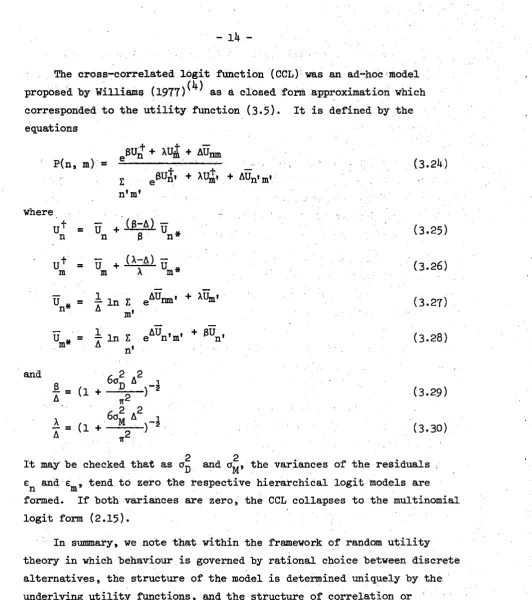
The cross-correlated logit function (CCL) was an ad-hoc model
proposed by Williams
(197'1')'~)
as a closed form approximation which
corresponded to the utility function (3.5).
It is defined by the
equations
where
-t
-
(0-A)-
un
=
un
+
-
B
'
n
*
U'f
=-
um
+
-
(A-A)
-
m
x
'
m
*
2
2
It maybe checked that as uD and uM, the variances of the residuals
E
and cm, tend to zero the respective hierarchical logit models are
n
formed. If both variances are zero, the CCL collapses to the multinomial
logit form (2.15).
In summary, we note that within the framework of random utility
theory in which behaviour is governed by rational choice between discrete
alternatives, the structure of the model is determined uniquely by the
underlying utility functions, and the structure of correlation or
similarity between alternative choices is the essential feature which
dictates the complexity of the model. Varying degrees of similarity
[image:19.595.55.588.20.621.2]may be accommodated within the logit family. The first three cases in
Figure 3 involve utility maximisations in which the variance-covariance
...
.
. .
...
...
...
...
...
.
.
.
...
.
.
,... . . .
(4)
In that paper (section 5.3.2, pp 321-323), the function was denoted
General Choice Model. Mere recently, and in deference to the general
probit model and to the class of General Extreme Value (GEV) models
matrices -
g
a r e s p e c i a l cases of t h e cross-correlated s t r u c t u r e , with aE
matrix and p i c t o r i a l r e p r e s e n t a t i o n summarised i n Figure 3 ( d ) . I n-
-
Section 5 we w i l l p r e s e n t a s e t of simulation t e s t s on s t r u c t u r a l
m i s s p e c i f i c a t i o n designed t o examine some s p e c i f i c questions concerning
how good an approximation t o ( 3 . 5 ) i s t h e t h r e e parameters CCL model,
and what p o t e n t i a l e r r o r s can be introduced by using t h e s i n g l e parameter
MNL and two parameters HL models i n s t e a d . F i r s t , however, we w i l l examine
t h e general p r o b i t model and t h e scope f o r applying transformations i n
order t o produce more t r a c t a b l e models.
4.
THE GENERAL PROBIT MODEL, STRUCTURE AND !tWNSFORMATIOiYSI n random u t i l i t y theory, t h e d e n s i t y f u n c t i o n which g e n e r a t e s t h e
general p r o b i t model (GP); f o r choice between N a l t e r n a t i v e s i s given by:
We s h a l l immediately transform Equation
( 4 . 1 )
fromg-
space i n t o-
space using Equation ( 2 . 5 ) , giving1
-N/2 - a T -1 1
f ( ~ ) =
-
(2n)IgI
= P I - z g
&
5) ( 4 . 2 )I f we define
-
-
-
Unnr
=
Un,-
Un (4.3;then r e s o r t i n g t o Equation ( 2 . 2 ) t h e model can be s t a t e d a s
-
-
-
Uln + En U2n + En
m
U ~ n + En
Pn
=
I I...
I . . . I f ( g ) ( 4 . 4 )-m -m -m -m
Although t h e GP(4.4) i s more general i n i t s t h e o r e t i c a l statement,
it i s considerably more cumbersome than t h e MNL o r HL t o implement. The
d i f f i c u l t i e s of achieving a s o l u t i o n t o t h e GP by d i r e c t n m e r i c a l
i n t e g r a t i o n f o r o t h e r t h a n 'small' problems, involving 3 o r
4
options(Hausman and Wise, 1978) a r e w e l l known, and have l e d t o t h e formulation
of approximate s o l u t i o n schemes. One method involves Monte Carlo
The method is elegant, theoretically appealing and has the advantage
of being completely general, in the sense that in principle any function
can be integrated. However, it is not well suited for optimisation
purposes near the neighbourhood of the optimum, it is biased, and very
slow and expensive to use. (Bouthelier,
1978).
The second method, due to Daganzo et a1
(1977)
invokes the Clark(1961)
approximation, which essentially involves the replacement of themaxi
di
urn of bivariate normal variables by one normally distributed variable.By repeated application of the Clark approximation, the multiple integral
in Equation
(4.4)
may be reduced to a particular univariate integral.When the correlation between variables is non-negative, this approximation
which has been extensively examined by Manski and Lerman
(19781,
usingMonte Carlo simulation, is apparently accurate to a few per cent, for up
to 20 alternatives. However, problems with the possible existence of
multiple optima associated with the likelihood function of GP models, for
more than 2 alternatives, have recently been reported (Daganzo,
1979).
These imply that in general, there is no guarantee that the model can be
calibrated. The program and documentation of a powerful algorithm for
calibrating the GP model, using this method, are now widely available
(Daganzo and Schoenfeld
,
1978
).
When encountering normally distributed variables, it has often been
the case that a transformation to a co-ordinate system in which the
structure of variation in a data set is more appropriately described, has
provided not only insight into the nature of factors giving rise to the
variation, but has also formed the basis for approximation schemes.
hincipal component analysis is perhaps the best such example. (For a very
didactic treatment of transformation theory in multivariate analysis, see
Green and Carroll,
1976).
Moreover, it is well known that the MNL andan uncorrelated, equal variance probit model (with suitably normalised
standard deviation) are almost indistinguishable. That is, if we could
transform general probit models into equivalent functions with diagonal
variance-covariance matrices, it might be possible to establish conceptual
links with the logit family, and in the process erase the burden of
numerical integration.
If this were not enough motivation, consider that the hierarchical
logit (3.21) may be written as-a MNL function with transformed utilities
The reader can check this by reorganising and using Equation
(3.19). In fact, this should not be too surprising, since McFadden
(1979)
has shown that any model derived from extreme value (Weibull) or
generalised extreme value functions may be written as an equivalent
multinomial logit model. In this group follow, for example, the hedonic
demand models developed recently by Charles Rivers Associates (Cordell
and Reddy,
1977).
Let us first examine and illustrate the power of transformations in
the convenient cartesian two dimensional space.
Equation
(4.4)
reduces in two dimensions simply to:where p is the coefficient of correlation, and
C
is given by2
-
(4.7)
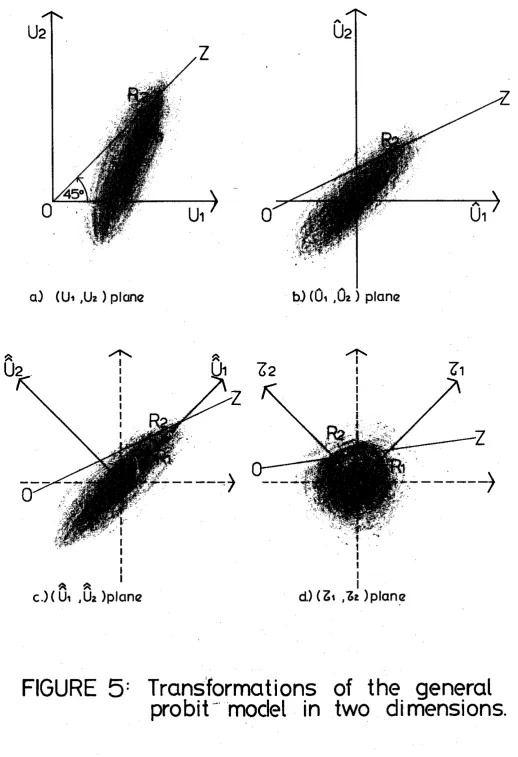
Figure 5(a) presents a pictorial representation of f(g) in g-space
for the general variance-covariance matrix
(4.7).
0 2 , the iso-utilityline, is defined by
0 2 :
u = u 2
1
(4.8)
and the region of integration R is defined by 1
Figure 5(b) presents a pictorial representation of the density function
..
[image:22.595.58.586.25.765.2]-
18
-
In this transformed space the line
OZ,
which defines the region ofintegration is given by
-
..
-
0 2 :
cru
+ U 2 = a U +U12
2
1 1 (4.11)and consequently the region of integration is:
a
--
fU1
d-
Recall that we are searching for transformations that will restore the
symmetry of the independent case. The next move possible is to apply a
rotation in order to have the elipse-shaped density function oriented
along the new axes of the co-ordinate system. Figure 5(c) presents a
pictorial representation of the probability density function in this new
..
space
fi
defined byNotice that this transformation requires algebraic operations which
entangle the previous axes. The region of integration is this time
defined by:
- - a u l f m
The symmetry will be restored by a h t h e r compression of the axes.
It can easily be seen that this is achieved by:
..
..
Tl
=
U1 )h-p
)1
z
1
(1.151
T2
=
u2 ))
The corresponding pictorial representation is given in Figure 5(d), and
the region of integration is defined by
-OD 6T1 6 w
)
1
I$:
6 T2s
h-p
(a1-a2) T f i 2 a 2 )(hel6)
1
+
1
6
(a1+a2)fl+p
(a1+a2)Appendix 1 gives a matrix treatment of the problem, and shows
how the inverse of the variance-covariance matrix defining the quadratic
form of the bivariate normal is gradually transformed from the general
expression
to the simple expression of the independent equal variance model
after the three transformations defined by Equations
(4.10),
(4.13) and(4.15).
Notice that because all the transformations are linear the iso-utility
line OC remains a line throughout; indeed it is given by
Now, the structural and numerical characteristics of the variance-
covariance matrix
C
-
are dependent on the coordinate system (utility space)-
20-
form of t h e b a s i c problem i n t h e new space i n which t h e transformed
-
matrix
-
i s
diagonal. We should not expect t h e b e n e f i t of an a n a l y t i c a l l y simpler d e n s i t y function t o be obtained a t zero c o s t , f o r t h e regionof i n t e g r a t i o n R over which An i s p r e f e r r e d i n Equation ( 2 . 2 ) , w i l l n'
a l s o be transformed.
I n general, under t h e t r a n s f o m a t i o n
t h e expression f o r P given i n Equation (2.2) n
becomes
i n which h(T) i s t h e transformed density function, J i s t h e Jacobian and
Rn, t h e new region of i n t e g r a t i o n .
In t h e p r o b i t model ( 4 . 4 ) , t h e algebraic manipulations and geometric
i n t e r p r e t a t i o n s of t h e required transformations a r e e s s e n t i a l l y t h o s e of
p r i n c i p a l component a n a l y s i s . The surfaces of constant d e n s i t y i n g-space
a r e t h i s time e l l i p s o i d s , given by t h e quadratic form.
T z-l
E = constant
Q F = E =
-
(4.22)We wish t o invoke an orthogonal transformation
T
=
4 g
-
(4.23)in which A1,
...,
AN
are the eigenvalues ofC .
-
The eigenvalues andcorresponding eigenvectors are determined from the usual equation
Z v r =
A
fl
=
-
r - r=
1,...,
N
(4.25)The quadratic form (4.22) may now be written
and the transformed probit model becomes
the Jacobian of the ~rthogonal'~) transformation being unity.
The transformed region of integration becomes
which is quite an unhospitable region involving all components of
T
on both sides of the inequality without possibilities of simplification,-
and therefore rendering useless the effort to decompose the multivariate
density function
(4.1)
into the product of univariate functions (4.27).Notice that this is not the case in the binomial context. Consider
equation
(4.6)
and define...
. A .. . .
...
... ... ... . . . . . . ..,
...
. . . . . .
(5)
Variance covariance matrices are especially well-behaved. They aresquare, symmetric and positive semidefinite. All their eigenvalues are real and non-negative, the transformations that diagonalise them are orthogonal, and further, their inverse is equal to their transpose.
t h e n it can be seen t h a t Equation
(4.6)
reduces t ot h a t i s , by means of t h e transformation (4.29) t h e m u l t i p l e i n t e g r a l
( 4 . 6 )
has been separated i n i t s two components,
and
el has been eliminated fromt h e upper l i m i t of i n t e g r a t i o n of t h e second i n t e g r a l . Note a l s o t h a t
i s p r e c i s e l y n2
,
t h e variance of t h e newly defined v a r i a b l en2
=
c2-el. "2By making another transformation, namely
equation (4.30) f u r t h e r reduces t o :
where t h e f i r s t i n t e g r a l equals 1 and t h e second i s none o t h e r t h a n t h e
is very simple and efficient to use while still being completely general,
both in terms of correlation among alternatives and standard deviations
of the marginal distributions.
A
workable version of the model, alongthese lines, but for three alternatives has recently been put forward by
Hausman and Wise
(1978).
Unfortunately, this method is also non-generalizable.Before abandoning the transformation theory, let us examine probit -
models corresponding to symmetric variance-covariance matrices, appropriate
to the utility functions.
I
and U(n,m)
=
Un+
Um+
Unmas depicted in Figure 3. The block diagonal structure of
-
in these casesimply that the eigenvalues and eigenvectors of the matrix, will not mix
many utility components from the 'branch' associated with D and from
n
other branches. Although this occurs, there is a l s ~ considerable degeneracy
in the system characteristics, some eigenvalues being not unique. Consider
the model (3.14) in the simplest 2 x 2 case. The
-
matrix is given by2
"D + 'DM 'D
0 0
C
=
-
-
(4.34)0
0 0 u 2 aD2
+
ODD
Solving for the eigenvalues
h
yields the equation(4.35)
which simply reduces to
2
4
+{(a
+
'EM
-
u D l
= 0-
D (4.36)the degeneracy already apparent. The solution of Equation (4.35) is simply:
2 2
h1
=
2uD +%
2
-
h2
=
'DM(4.37)
I n conclusion, it has been shown t h a t it i s p o s s i b l e t o define
s u i t a b l e transformations t h a t allow one t o r e s t o r e t h e s i m p l i c i t j of
t h e integrand of independent equal variance models, t o a r j more general
function, although i n t h e case of models incorporating c o r r e l a t i o n
among many a l t e r n a t i v e s , t h e method does not commenrl i t s e l f because
t h e l i m i t s of i n t e g r a t i o n of Equation
( 4 . 4 )
become a f u n c t i o n of t h e u t i l i t i e s of s e v e r a l , if not a l l , t h e options. lieither does t h e methodwork f o r simpler symmetric matrix s t r u c t u r e s , t h e problem tinis t i n e
being highlighted by t h e high degeneracy of t h e eigenvalues of t h e
matrix.
5.
THE THEORETICAL ACCURACY OF kLTERIIATITJE LOGIT 140D2L STFUCTJ3SSI n Sections 2 and
3 ,
we o u t l i n e d a theory of choice behavio-a-,random u t i l i t y theory. Within i t s framework t h e behaviour of i n i i - ~ i d u a l s
i s governed by r a t i o n a l decision-making among d i s c r e t e a l t e r n a t i - r e s ,
('homo economicus'), t h e s t r u c t u r e of models i s determine* uniq-iely by
t h e underpinning u t i l i t y f u n c t i o n s , and t h e s t r u c t u r e of c o r r e l a t i o n
or s i m i l a r i t y between a l t e r n a t i v e choices i s t h e e s s e n t i a l featlz-e which
d i c t a t e s t h e complexity of t h e model.
I f it i s accepted t h a t i n d i v i d u a l s s e l e c t a l t e r n a t i v e s and responrl
t o changes i n a manner which approximates t h e a s s m p t i o n s c f ti;:. t h ~ o r y ,
t h e r e a r e two immediate p r a c t i c a l consequences. F i r s t l y a s t h ~ tLree
model s t r u c t u r e s i n Figure 3 ( a ) , ( b ) and ( c ) , (!4!:L a r d two a l t e r n a t i v e
HL
models) a r e a l l s p e c i a l cases of t h e more general s t r ' i c t u r e i n Bigure3 ( d ) ( i n which
oD,
oIq and aDM a r e a l l non-zero), any s t r 3 1 c t u r a lambiguity, a s r e f e r r e d t o e a r l i e r i n t h e paper, may be o b r i a t e i i f t h s
l a t e r model i s implemented.
Secondly, i f a p a r t i c u l a r model, say t h e h i e r a r c s i c a l s t r - ~ c t u r e is
Equation (3.21) is adopted f o r f o r e c a s t i n g demand response, t h e composite
u t i l i t i e s (3.19) and estimated e l a s t i c i t y paraueters 0 a n i A , m;st be c o n s i s t e n t with t h e t h e o r e t i c a l conditions underginning t h e r o d e l i . 5 .
s a t i s f y i n e q u a l i t y (3.23). It has been found i n S r i t i s h Trans?ort
Studies which have employed
a
HL of t h i s forn, t h a t e i t h e r condition(3.19)
o r t h e parameter r e l a t i o n0
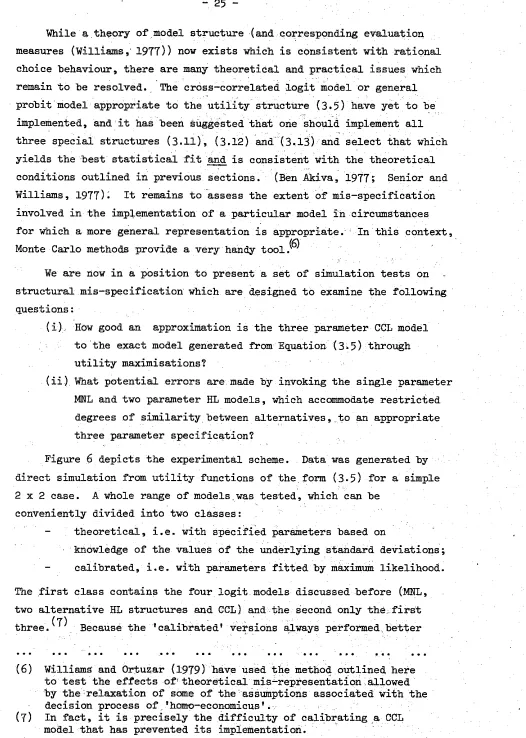
d A have been v i o l a t e 8 . Tnese v i o l a t i o n s can give r i s e t o hyghly u n r e a l i s t i c respocse ? r o ? e r t i e s ofWhile a theory of model structure (and corresponding evaluation
measures (~illiams,
1977))
now exists which is consistent with rationalchoice behaviour, there are many theoretical and practical issues which
remain to be resolved. The cross-correlated logit model or general
probit model appropriate to the utility structure (3.5) have yet to be
implemented, and it has been suggested that one should implement all
three special structures 3 . 1 1 ) (3.12) and (3.13) and select that which
yields the best statistical fit
g&
is consistent with the theoreticalconditions outlined in previous sections. (Ben Akiva,
1977;
Senior andWilliams,
1977).
It remains to assess the extent of mis-specificationinvolved in the implementation of a particular model in circumstances
for which a more general representation is appropriate. In this context,
Monte Carlo methods provide a very handy tool. (6)
We are now in a position to present a set of simulation tests on -
structural mis-specification which are designed to examine the following
questions:
(i) How good an approximation is the three parameter CCL model
to the exact model generated from Equation (3.5) through
utility maximisations?
(ii) What potential errors are made by invoking the single parameter
MNL and two parameter HL models, which accommodate restricted
degrees of similarity between alternatives, to an appropriate
[image:30.595.69.596.45.783.2]three parameter specification?
Figure
6
depicts the experimental scheme. Data was generated bydirect simulation from utility functions of the form (3.5) for a simple
2 x 2 case.
A
whole range of models was tested, which can beconveniently divided into two classes:
-
theoretical, i.e. with specified parameters based onknowledge of the values of the underlying standard deviations;
-
calibrated, i.e. with parameters fitted by maximum likelihood.The first class contains the four logit models discussed before
(MNL,
two alternative HL structures and CCL) and the second only the first
three.
(7)
Because the 'calibrated' versions always performed better...
... ...
.
. .
...
...
... . . .
...
...
...
Williams and Ortuzar
(1979)
have used the method outlined hereto test the effects of theoretical mis-representation allowed by the relaxation of some of the assumptions associated with the decision process of 'homu-economicus'.
than the 'theoretical' we will consider only the former
from now on.
The simulated data sets consisted of the mean utilities and
aggregate shares of each alternative. The
MNL(~)
( 4
options) parameterA
was estimated by maximum likelihood (using a Newton Raphson procedure
described in Appendix 2) and the EII,(l0) models were calibrated heuristically
and similarly as a series of binary logit models; the appropriate
composite utilities providing a link between the two levels in the
hierarchy.
Having estimated or theoretically determined the parameters of the
models for a given data set (base data), a second set of data was
generated for a particular change in the values of the mean utilities
-
new
-
Old
+
1)
consistent with the effects of a particular policy.(say U = U r n
This second set, the 'design year data' was compared with the
predictions of the models for the same change in mean utility values.
By this means, the response properties of the models were also assessed.
The complete mechanism is depicted in Figure
6;
it can be seen that itcan easily be adapted to test not only structural mis-specification as
we did here, but more profound problems of theoretical mis-representation
(Williams and Ortuzar,
1979).
The simulation tests involved variation of the co-ordinates
(uD, uM, uDM).
A
standardisation or 'normalisation' condition to boundthe joint variation of these quantities, of the following form was used:
2
u2
+
o+
u2=
constantD
M DM (5.1)and a particular co-ordinate
(OD&
,
uM.
a uDM) corresponds to a particular asimulation test. To illustrate the possible combinations of these three
quantities, we appealed to that property of equilateral triangles whereby
the sum of perpendicular distances to the three sides from an interior
( 8 ) The approximations involved in the models preventing the specified parameters to replicate the data as closely as the fitted parameters.
(9)
Ina
first set oftests the mean utility in Equation (2.15) was takenas
U
=
U + U+
Unm. In a second set of tests, we examined then m
effect of omitting a particular component, say by putting
&
= 0.(10) In the first set of tests, the mean gtili* in the lower hierarchy
of Equation (3.21) was taken as U
=
Um+
Unm (and correspondingly-
Un
+
t,,
for the alternafive form). In the second set of tests the..
-
-
effect of omitting a particular component, say Um
=
0, could easilypoint is a constant, equal to the height of the triangle. Any test
point may thus be identified with a point in or on the boundary of the
triangle, as shown in Figure 7(a). At interior points a three parameter
model (such as the CCL model) is necessary to capture the full range of
cross substitution implied by the utility function (3.5). On the
boundaries
CB
andCA
the alternate HL models for which oM=
0 and oD = 0respectively, are appropriate (see Figures 3(b) and (c) ) . It is only
at the vertex C
(i
.e. oD=
aM=
0) that the MNL is an appropriatespecification.
In addition to test points randomly sampled from within the triangle,
four particular co-ordinate test points, as shown in Figure 7(b), were
selected for the presentation of results. Recall that in all tests two
alternatives were taken in each of the D and M dimensions, allowing a
four alternative choice model to be generated.
The general performance of the four models for these test points (11)
is shown in Figure 7(c). We have restricted ourselves to a comparative
quality assessment of the fit, in that it is the relative performance of
the models in which interest lies. (12)
A
visual display of the meaningof this informal assessment, in the form of a particular set of base and
response results for the four models used to fit data generated from
test point 2 in Figure 7(b), is shown in Figure 7(d).
Under conditions of change, points in the second and fourth
quadrants of the right hand side of Figure 7(d) are deemed pathological
because the change in behaviour predicted by the model is opposite to
that simulated. We found that this behaviour is associated with the r
violation of the condition (3.23) in hierarchical logit specifications.
If, for example, oD >> oM, then the HL specification
MID
correspondingto oM > oD will involve pathological behaviour. The condition, however,
(11) Results are shown for the first set of test only, i.e. when it
was assumed complete knowledge of the mean utilities. I
(12) The performance measures used were average relative errors
(ARE)
Idefined as:
N
ARE
=
$
c
{1
psim-
?dl /?dli=l 1
-
xnd a izeasure, defined as :
appears also to depend on the underlying representative utility
values. (13)
If we further examine the performance of the models as reported
in Figure 7(c), we note that the CCL appears to be a good approximation
to the general fuuction
(3.5).
Its superiority to the other logitforms was especially apparent when the three coordinates oD, uM and
u were different from zero and from each other. The most surprising
DM
and welcome outcome, however, was the remarkably robust performance
of the MNL, even at interior points of the triangle and especially when
uD uM. AS expected the IIA property was a considerable impediment
near the sides of the triangle, except in the immediate region of
point
C.
The last point to note in this section is, that out of the
estimated models (MNL and two HL forms), that with the best base fit
consistently provided a good estimate of the response to change:
this would seem to lend some theoretical/numerical support for the
suggestion of Ben Akiva
(1977)
that results of alternativeHL
andMNL
models could be compared and the appropriate model selectedaccording to the estimated value of the 'similarity' parameter,
which in our notation is 6 / A .
We offer no apologies for the fact that the simulation tests
1
were confined to a 2 x
2
example(4
options). We believe that the1
results and conclusions in next section, would not be qualitatively
modified when the number of alternatives are increased, because the
structure of the variance-covariance matrix itself was the focus of the
mis-specification tests. The dependence of the results on the number
of options could, of course, be tested.
(14)
...
...
...
...
... ...
.
. .
...
...
.
.
.
...
...
(13) In the second series of tests the effect of omitting a
particular utility ccanponent
-
by puttingim
=
0, for example-was determined. All results were inferior to their counterparts in the first series, as would be expected because the number of
'degrees of freedom' of the model specifications had been
reduced. The performance of HL (asymmetric in nature) was
particularly suspect and pathological behaviour became more
prevalant.
-
(14) More important, in exercises of this kind, is to make sure that the process converges. We found it was necessary to smple 30,000 observations to get consistent results. The reader is referred
6.
CONCLUSIONSIn this paper we have presented the essential features of random
utility theory, both formally and in a geometric framework which
provides a clear interpretation of the nature of choice.
We have studied the role of correlation and how the form of the
utility function uniquely determines the structure of models, their
complexity being dictated precisely by the structure of similarity
or correlaticnbetween the alternatives. In this way, we have been
able to present the basic assumptions of the most popular models,
multinomial logit, general probit and hierarchical logit, and
discuss their implications.
The general probit model is the more conceptually appealing
of model forms, although unfortunately the least tractable of them
for more than small problems, and even then with some yet unknown
properties. We have investigated the possibility of invoking
transformations in utility space as a means of simplifying it. We have
shown that it is indeed possible to define suitable transformations
that allow one to restore the simplicity of the integrand of independent
'equal variance' models to any more general model, although in the
case of models incorporating correlation among many alternatives,
what is gained on the joundabouts is lost on the swings because
of the non-separability of the multiple integral (4.27) which in
turn is due to the unhospitable form of the region of integration (4.28).
Although transformations certainly give more insight into the problem,
the potential for implementing them, even in the case of models with
symmetric variance-covariance matrices, does not appear practicable.
The results of the simulation tests are consistent with the
following conclusions:
i) The cross-correlatedlogit model is a good theoretical
approximation to the three parameter utility lunction
(3.5).
The superiority to other logit forms is especially apparent when
the standard deviations
oD,
oM andoDM
are rather different fromzero and from each other. However its estimation is very complex
ii) The multinomial l o g i t model performs reasonably w e l l at
i n t e r i o r p o i n t s of t h e t r i a n g l e (indeed it i s considerably
more robust t h a n we had a n t i c i p a t e d ) and t h i s i s p a r t i c u l a r l y
t r u e when o
D
-
oM. Its maximum e r r o r occurs near t h e s i d e s of t h e t r i a n g l e (except i n t h e immediate region of p o i n t C )where t h e 'independence from i r r e l e v a n t a l t e r n a t i v e s '
property i s a considerable impediment.
iii) A good base f i t does not n e c e s s a r i l y imply a good response
model, after all every m o d e l k a l i b r a t e s ' . However, out of
t h e t h r e e a l t e r n a t i v e l o g i t s t r u c t u r e s (multinomial l o g i t and
two h i e r a r c h i c a l l o g i t forms), t h e model which provides t h e
b e s t base f i t provides a good estimate of t h e response t o change.
i v ) A mis-specified model ( t y p i c a l case i s t h e i n a p p r o p r i a t e
h i e r a r c h i c a l l o g i t form) w i l l tend t o display pathological
behaviour i n a response context. However it i s p o s s i b l e t o
recognise t h e symptoms a t t h e c a l i b r a t i o n s t a g e , by examining
t h e consistency conditions (eg. r u l e ( 3 . 2 3 ) ) .
I n t h e s e t e s t s we examined t h e c a p a b i l i t y of extended members
of t h e l o g i t family t o accomodate t h e s t r u c t u r e of s i m i l a r i t y between
a l t e r n a t i v e s embodied i n t h e u t i l i t y function ( 3 . 5 ) . The general
p r o b i t function would be a p p r o p r i a t e i n t h i s ' case, and indeed t o more
general u t i l i t y forms. Horowitz (1978) h a s , i n f a c t , examineQthe
p o t e n t i a l mis-specification problems of t h e multinomial l o g i t model
when compared with a
3-
a l t e r n a t i v e p r o b i t model. H i s r e s u l t s a r e complementary and c o n s i s t e n t with ours, i n t h e sense t h a t i n moatp r a c t i c a l c a s e s , t h e g r e a t e r ease with which l e s s c o n s i s t e n t s t r u c t u r e s
-
provided t h e y a r e robust enough t o cope r e l a t i v e l y well with not s e r i o u s
mis-specification -may be implemented, w i l l win t h e day.
F i n a l l y t h e powerful t o o l employed i n our a n a l y s i s , Monte Carlo
simulation, deserves an e s p e c i a l word of p r a i s e . We noted t h e increasing
a p p l i c a t i o n of t h e method i n t h e t r a n s p o r t f i e l d , but we b e l i e v e t h a t
our p a r t i c u l a r use h e r e , c r e a t i n g a r t i f i c i a l d a t a s e t s on which t h e
e f f e c t s of s p e c i f i c model mis-specifications can be t e s t e d i n a c o n t r o l l e d
manner, i n d i c a t e s one way ahead t o a t t a c k t h e problem of model evaluation.
Indeed, it has a l r e a d y been u:ed i n a more ambitious p r o j e c t t o t e s t f o r
t h e o r e t i c a l misrepresentation and t o a s s e s s t h e v a l i d i t y of cross-sectional