by
SAID RUSLI
A thesis submitted in partial fulfilment of the
requirements for the degree of Master of Arts in Demography in the Australian National University
D E C L A R A T I O N
E x c e p t w h e r e o t h e r w i s e i n d i c a t e d , t h i s t h e s i s i s my own w o r k .
ß l ' ■—
S a i d R u s l i
AC KNOWLEDGEMENTS
To D r G r a e m e H u g o I o w e d e e p g r a t i t u d e f o r h i s
g e n e r o s i t y i n g r a n t i n g m e c o m p l e t e a c c e s s t o d a t a h e c o l l e c t e d
i n t h e ' W e s t J a v a P o p u l a t i o n M o b i l i t y S u r v e y ' u s e d h e r e . W i t h
o u t t h e s e d a t a t h i s w o r k c o u l d n o t h a v e b e e n c o m p l e t e d .
T e r i m a k a s i h b a n y a k . T h e u s e o f t h e s e d a t a w a s m a d e p o s s i b l e b y
a t t e n t i o n a n d a s s i s t a n c e f r o m M r s P . M . V a n c e , M r s J . W i d d o w s o n ,
a n d o t h e r c o m p u t e r s t a f f . I am i n d e b t e d t o t h e m .
I e x p r e s s m y s i n c e r e a p p r e c i a t i o n t o m y s u p e r v i s o r :
D r S . K . J a i n f o r h i s e a s y a c c e s s i b i l i t y , c o n s t r u c t i v e c o m m e n t s ,
a n d g u i d a n c e w h i c h c o n t r i b u t e d g r e a t l y t o t h i s w o r k . S p e c i a l
t h a n k s g o t o D r P . F . M c D o n a l d f o r h i s u s e f u l s u g g e s t i o n s , c o m m e n t s , a n d e n c o u r a g e m e n t t h r o u g h o u t t h e d i f f e r e n t s t a g e s o f t h i s w o r k .
V a l u a b l e c o m m e n t s c a m e f r o m D r D .W . L u c a s a n d D r R . J . P r y o r ; I am
r e a l l y g r a t e f u l t o t h e m . C o m m e n t s a l s o c a m e f r o m o t h e r v a r i o u s
p e o p l e . E s p e c i a l l y , t o Ms T . S h e r l a i m o f f a n d M r s P . A . M e y e r w ho
w e n t t h r o u g h t h e d r a f t o f t h i s t h e s i s , I w i s h t o e x p r e s s m y
a c k n o w l e d g e m e n t s .
S p e c i a l t h a n k s a l s o g o t o M r s P . A s h m a n f o r h e r
e x c e l l e n t s e c r e t a r i a l a s s i s t a n c e a n d o t h e r t y p e s o f a s s i s t a n c e
d u r i n g t h e c o u r s e o f t h i s s t u d y . I w i s h t o t h a n k M r s P . H . Q u i g g i n , a n d t h e s t a f f o f t h e M e n z i e s L i b r a r y f o r t h e i r a s s i s t a n c e i n
I would like to thank the Australian Government who
offered me a - scholarship to participate in the program, and the
Bogor Agricultural University, Indonesia for permission to study
in Australia. To A.D.A.B. officers, especially to Mr Jeff Cliandlcr,
I wish to show my appreciation for their assistance during my stay
in Australia.
Professor Dr Ir. Sajogyo from the Bogor Agricultural
University, Indonesia was always a source of encouragement through
his letters. My thanks also go to him.
Finally, my sincere gratitude goes to my wife,
Yulia Suchermiati, for her encouragement and patience during the
preparation and completion of this thesis.
ABSTRACT
Migration studies in Indonesia have been concentrated mostly on the examination of 'transmigration'^, and the estimation of net migration between regions and islands. Also, there have been a few studies on rural-urban population mobility. Commonly, all these works have been at the macro-level of analysis.
The main objective of this study has been to examine population mobility between villages. Specifically, aspects such as inter-rural migration, inter-rural circulation and commuting between villages have been investigated. The study deals more with micro-analysis than macro analysis. It is based mainly upon the
survey data from 14 villages of the West Java Population Mobility 2
Survey, 1973 . The survey villages are from different parts of West Java.
The findings of this study amply illustrate the fact that the nature and process of population movement between the villages cannot be well understood unless migration (permanent movement), circulation and commuting (temporary movement) are con
sidered simultaneously. This study found that the inter-rural permanent movements were not dominated by economic motives. On the other hand the dominant economic motives of most inter-rural
1 Transmigration means the efforts to move as many people as possible from Java, Bali and Lombok (densely populated areas) to the rest of the islands (sparsely populated areas).
circulators and commuters were clear. Most migrants, circulators and commuters were not farmers but were among the newly emerging groups in rural areas. Marriage migration had a unique position
in the context of inter-rural migration.
C O N T E N T S
Page
ACKNOWLEDGEMENTS iii
ABSTRACT v
LIST OF TABLES ix
LIST OF FIGURES xi
GLOSSARY xii
CHAPTER
1 INTRODUCTION 1
1.1 The Study of Inter-Rural Population
Movement in Indonesia 1
1.2 Objectives 4
1.3 Sources of Data and Method of Data Analysis 5
2 MIGRATION AND CIRCULATION: THEORETICAL FRAMEWORK 9 2.1 Internal Migration and Circular Movement 9
2.2 Macro and Micro Analysis 17
3 WEST JAVA: MAIN SETTING OF THE STUDY AREA 21
3.1 Location and Land 21
3.2 Transportation Network 26
3.3 Agriculture 29
3.4 Population Density and Distribution 33
3.5 Mortality and Fertility 36
3.6 Occupation in Rural Areas 39
3.7 Education 43
3.8 Village Communities and Survey Villages 46
CHAPTER Page
4 INTER-RURAL MIGRATION 54
4.1 Marriage Migration 55
4.1.1 The extent of endogamy and exogamy 55 4.1.2 Marriage distance, and pre- and
post-marriage distance 59
4.1.3 Movement after divorce and widowhood 60
4.2 Non-Marital Migration 62
4.2.1 The extent of inter-rural migration
and the distance travelled 64 4.2.2 Characteristics and backgrounds of
migrants 67
4.2.2.1 Age-sex differential 68
4.2.2.2 Education 69
4.2.2.3 Occupation 70
4.2.2.4 Persons who accompanied
migrants 74
4.2.3 Reasons for leaving the origin area 75 4.2.4 Reasons for selecting the
destination area 82
4.3 Summary 86
5 CIRCULAR MIGRATION AND COMMUTING 88
5.1 Extent of Inter-Rural Circulation and
Commuting 88
5.2 Types of Transport Used and Distance to
the Place of Destination 92
5.3 Reasons for Leaving Village at Particular
Times 95
5.4 Reasons for Selecting the Destination Area 98
6 CONCLUSIONS AND IMPLICATIONS OF THE STUDY FINDINGS
FOR INDONESIA'S DEVELOPMENT 101
6.1 Conclusions 101
6.2 Implications of the Study Findings for
Indonesia's Development 103
BIBLIOGRAPHY 108
LIST OF TABLES
Table Page
1.1 West Java Population Mobility Survey: The items on the household questionnaire and the
eligible persons who were interviewed, 1973 6
1.2 West Java Survey Villages: Total number of
resident households and sampling fraction 8
2.1 Relationship between socio-economic and
population dynamics 15
2.2 Time/space typology of population mobility
in Africa 16
3.1 West Java: The pattern of agricultural land
utilization, 1973 25
3.2 West Java: The harvested area of the important
food crops for 1961 and 1971 32
3.3 West Java: Population densities to agricultural
land and distribution by regencies, 1971 35
3.4 Estimates of crude birth rates in regions of
Java, period of 1960-1971 38
3.5 West Java: The number of farmers by status in
rural area, 1971 42
3.6 West Java: The size of holding structure by
the number of farms, 1973 43
3.7 Percentage distribution of education levels of
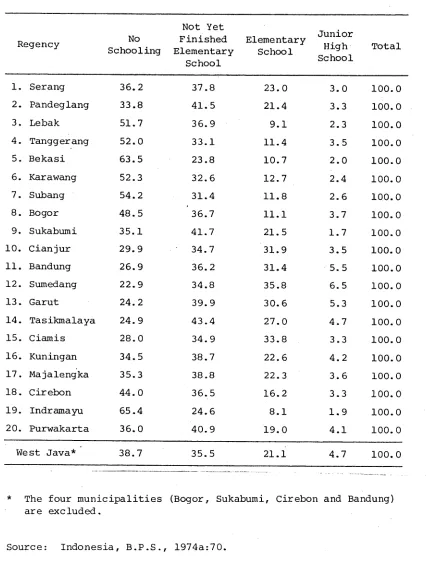
population 10 years of age and over by regency 45 3.8 Locational characteristics of the survey
villages 50
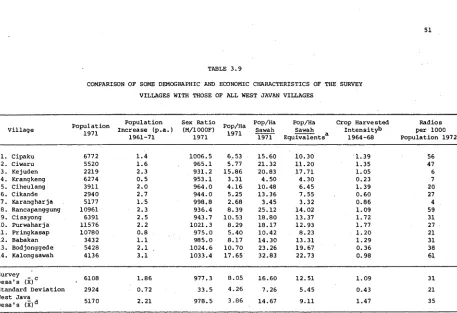
3.9 Comparison of some demographic and economic characteristics of the survey villages with
those of all West Javan villages 51
4.1 West Java Survey Villages: The extent of endogamy and exogamy of the first and second
Table Page 4.2 West Java Survey Villages: The distribution
of marriage distance of first marriage in
rural areas 61
4.3 West Java Survey Villages: The extent of
movement after first divorce and widowhood 63 4.4 West Java Survey Villages: The extent of
inter-rural migration 65
4.5 West Java Survey Villages: First Move Inter-Rural Migration - The distribution of
education levels of migrants 71
4.6 West Java Survey Villages: First Move Inter-Rural Migration - The distribution of marital
status of migrants 74
4.7 West Java Survey Villages: First Move Inter-Rural Migration: The distribution of persons
who accompanied migrants 76
4.8 West Java Survey Villages: First Move Inter-Rural Migration - The distribution of main
reasons for leaving the origin area 77 4.9 West Java Survey Villages: First Move
Inter-Rural Migration - The distribution of main
reasons for selecting the destination area 83
5.1 West Java Survey Villages: The extent of
inter-rural circulation and commuting 90 5.2 West Java Survey Villages: Inter-Rural
Circulation and Commuting - The distribution
of types of transport used 93
5.3 West Java Survey Villages: Inter-Rural Circulation and Commuting - The distribution
Figure
3.1 Provinces of the Republic of Indonesia
Circulator
Commuter
Inter-rural areas
Madrasah and pesantren
Migrant
Mover
Mover household
Opelet and colt Population movement
Sawah
Tegalan
Village (desa)
GLOSSARY
- has spent a continuous period of less than six months outside of
the village for the purpose of work or education
is merely involved in the daily movement between his/her village and his/her place of work or school
is used in the same meaning as inter-villages
- religious school or religious vocational school
has spent a continuous period of six months or longer outside of the village
has at some time moved to outside of the village
is one which has at least one member who has at some time moved to an urban area
small or mini-bus
is used in the same sense as population mobility
- irrigated field or flooded field
dry field
is the lowest administrative unit of the government
CHAPTER 1 INTRODUCTION
1.1 The Study of Inter-Rural Population Movement in Indonesia
Indonesia's peculiar population distribution and its diversity of over 300 ethnic groups offers to researchers a wide range of possibilities to study population movement in the country. Despite this, the accumulated knowledge on the subject is still relatively limited. A bibliography on 'Internal migration and transmigration' for 1930-1972 period can be found in the work of Singarimbun (Singarimbun, 1974:74-89). For the pre-colonial period, when inland and coastal kingdoms still had control over their popu
lation, some evidence of population movement is available from the description of historians who commonly wrote in relation to the expansion of the kingdoms and the colonial power at that time. In recent decades, attention has been chiefly directed to 'transmigration'^, which is regarded as an integral part of
Indonesia's development plan (Indonesia, 1974). Many studies have been conducted which directly relate to the transmigration programme.
There have been a number of efforts to estimate migra tion flows between regions in Indonesia based on census data12.
1 Transmigration means the efforts to move as many people as possible from Java, Bali and Lombok (densely populated areas) to the rest of the islands (sparsely populated areas).
But due to the limitations of the census which, for example in 1971,
collected information only on the province of birth, last previous province of residence, and duration of residence in the province of current residence, an in-depth analysis of the migration flows has not been made. For example, population movements of the circulation
type cannot be studied from census d a t a \ Other useful sources of population movement data in the country are the population registers
and the large scale National Socio-Economic surveys. In fact, the former source has existed in many villages for a relatively long time
although it has been utilized only for very limited purposes because of doubts concerning its completeness and accuracy. The latter source has been used by McNicoll, for example, to analyse net migra tion between Java and the outer islands (McNicoll, 1969:78-80). This source also does not enable a detailed analysis and in addition it does not reveal circulation flows.
Recently, there have been a few studies on rural-urban migration. Among these can be included the study of Migration and Education in Jakarta (Suharso et a l ., 1975) and Population Mobility in West Java (Hugo, 197 5d). The subject of inter-rural population movement has been almost ignored so far, although in fact the bulk of the movement from Java to the rest of the islands can be inter preted as inter-rural population movement.
In Indonesia, inter-rural population redistribution is important because of the uneven population distribution throughout
t h e r u r a l a r e a s . I n t h i s c o n t e x t , i t s h o u l d be n o t e d t h a t m ore
t h a n 80 p e r c e n t o f I n d o n e s i a ' s p o p u l a t i o n l i v e i n r u r a l a r e a s .
P e r h a p s some r u r a l a r e a s s t i l l h a v e ' f r o n t i e r c h a r a c t e r i s t i c s ' .
The e x t e n t o f i n t e r - r u r a l m i g r a t i o n and c i r c u l a t i o n h a s n o t y e t
b e e n a n a l y s e d t h e o r e t i c a l l y . F o r i n s t a n c e , t h e f i n d i n g s from
t h i s phenom enon h a v e n o t y e t b e e n c o n s i d e r e d i n t h e c o n t e x t o f
Z e l i n s k y ' s h y p o t h e s e s on t h e p o p u l a t i o n m o b i l i t y t r a n s i t i o n , and
o f Gould and P r o t h e r o ' s t i m e / s p a c e t y p o l o g y ^ . The m o b i l i t y
t r a n s i t i o n p h a s e o f a c o u n t r y i s m ore o r l e s s p a r a l l e l t o i t s
m o d e r n i z a t i o n an d s o c i o - e c o n o m i c d e v e l o p m e n t s t a t u s . C e r t a i n
e t h n i c g r o u p s s u c h a s t h e S u n d a n e s e a r e o f t e n d e s c r i b e d a s r e l u c t a n t
m o v e r s . T h i s n e e d s e l a b o r a t i o n a s t o t h e e x t e n t t h a t t h e d e s c r i p
t i o n i s a p p r o p r i a t e , p a r t i c u l a r l y f o r m ovem en ts w i t h i n t h e i r own
s o c i o - c u l t u r a l s e t t i n g i n c o n n e c t i o n w i t h w o rk , t h e d i f f e r e n t
d e g r e e s o f e n v i r o n m e n t a l s t r e s s e s among t h e v i l l a g e s , l i f e c y c l e
c o n s e q u e n c e s , a n d o t h e r f a c t o r s .
F o r W est J a v a a s was m e n t i o n e d , r u r a l - u r b a n p o p u l a t i o n
movement h a s b e e n s t u d i e d by Hugo. T h e r e f o r e , t h i s i n t e r - r u r a l
m i g r a t i o n and c i r c u l a t i o n s t u d y would be c o m p l e m e n t a r y t o t h a t
s t u d y . The s p e c i f i c k n o w le d g e on i n t e r - r u r a l p o p u l a t i o n movement
i s n o t o n l y u s e f u l t o t h e t r a n s m i g r a t i o n program m e b u t a l s o t o
o t h e r ' r u r a l - r u r a l p o p u l a t i o n r e d i s t r i b u t i o n ' p l a n s i n I n d o n e s i a .
M o r e o v e r , t h e i n v e s t i g a t i o n i n t o i n t e r - r u r a l p o p u l a t i o n movement
s u c h a s i n W est J a v a , I n d o n e s i a , i s i m p o r t a n t f o r t h e d e v e l o p m e n t
o f m i g r a t i o n t h e o r y i n t h e t h i r d w o r l d . I n t h e t h i r d w o r l d , t h e
knowledge of this phenomenon is still meagre indeed. Most of existing migration theories were based upon experiences of the developed world.
1.2 Objectives
The main objectives of this study are to examine the nature of inter-rural migration, inter-rural circulation, and commuting or population mobility between the villages. Firstly, this study will examine marriage migration and non-marital
migration. The aspects of marriage migration which will be examined are: the extent of endogamy and exogamy, marriage dis tance, and pre- and post-marriage distance, and movement after divorce and widowhood. The examination of non-marital migration will cover the different aspects such as the extent of inter-rural migration, characteristics and background of migrants, reasons for leaving the origin area, and reasons for selecting the destination area. Secondly, the different aspects of circu lation and commuting will be examined. These aspects are:
extent of inter-rural circulation and commuting, types of trans port used and distance to the place of destination, reasons for leaving village at particular times, and reasons for selecting the destination area.
1.3 Sources of Data and Methods of Data Analysis
This study is mainly based upon the data collected in the West Java Population Mobility Survey, 1973^. Interviews were
carried out in 14 villages in West Java. In the survey, it was decided to sacrifice quantitative precision in the selection of villages, 'for the greater depth attainable by more intensive methods of attack' (Moser and Kalton, 1975) in striving toward an
understanding of the causes and impact of population movement (Hugo, 1975:372). Tow types of questionnaires were employed in the survey: a village questionnaire and a household questionnaire.
The items covered in the village questionnaire were on population, land, agriculture, other aspects of the village economy, service
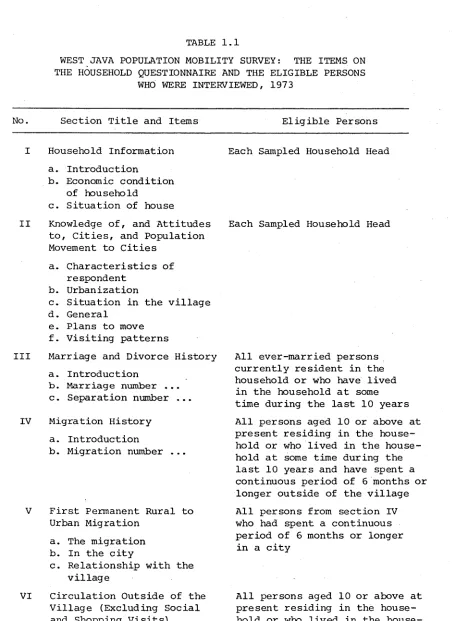
provision, urban-rural relationships, and population movement. Only one village questionnaire was applied in each village and the information for this questionnaire was supplied by the village secretary (juru tulis) . The items on the household questionnaire and the eligible persons who were interviewed are shown in Table 1.1. About 100 households in each village were interviewed. Among them were included around 10 households of village leaders, 40 of mover, and 50 of stayer households. In the survey, a mover household was defined as the one which has at least one member who has at some time moved to an urban area. A stayer household is that whose members have never lived, worked or attended school in an urban
area. A mover is the one who has at some time moved to outside
of the village while a stayer is the one who has never lived,
1 The survey was conducted by Hugo for his Thesis (PhD) Population Mobility in West Java, Research School of Social Sciences,
TABLE 1.1
WEST JAVA POPULATION MOBILITY SURVEY: THE ITEMS ON THE HOUSEHOLD QUESTIONNAIRE AND THE ELIGIBLE PERSONS
WHO WERE INTERVIEWED, 1973
No. Section Title and Items Eligible Persons
I Household Information a. Introduction
b. Economic condition of household
c. Situation of house
II Knowledge of, and Attitudes to, Cities, and Population Movement to Cities
a. Characteristics of respondent
b. Urbanization
c. Situation in the village d. General
e. Plans to move f. Visiting patterns
III Marriage and Divorce History a. Introduction
b. Marriage number ... c. Separation number ... IV Migration History
a. Introduction
b. Migration number ...
V First Permanent Rural to Urban Migration
a. The migration b. In the city
c. Relationship with the village
VI Circulation Outside of the Village (Excluding Social and Shopping Visits) a. Commuters and circular
migrants
b. For circular migrants to cities only
Each Sampled Household Head
Each Sampled Household Head
All ever-married persons currently resident in the household or who have lived in the household at some time during the last 10 years All persons aged 10 or above at present residing in the house hold or who lived in the house hold at some time during the last 10 years and have spent a continuous period of 6 months or longer outside of the village All persons from section IV who had spent a continuous period of 6 months or longer in a city
All persons aged 10 or above at present residing in the house hold or who lived in the house hold at some time during the last 10 years who spent contin uous periods of less than 6 months outside of the village to earn a living or attend an edu cational institution
VII Interviewer Assessment
[image:18.554.62.516.52.673.2]worked or attended school outside of the village. Except for the households of the village leaders, which were chosen purposively, the others were selected at random in two parts of each village
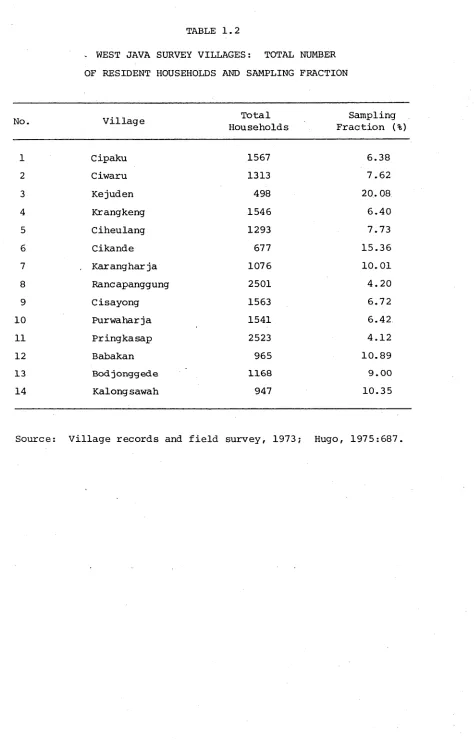
area (rukun kampung). The leaders were chosen among the most influ ential leaders in the survey villages. Table 1.2 presents the total
number of resident household and the sampling fraction in each survey village. The figures in the table show a wide range of
sampling fraction from 4.12 per cent in Pringkasap to 20.08 per cent in Kejuden. The main sections or items on the household questionnaire which will be used for this inter-rural population movement study are: plans of household heads to move, marriage
and divorce history, migration history, circulation outside the village by commuters and circular migrants. This study is based on questions listed in Appendix A. The village questionnaire will help to clarify the situation in the survey villages. The data of the West Java Population Mobility Survey are available on a com puter tape. Other sources of data such as the censuses will also
be utilized as far as the data from these sources are available from publications.
The problem of the adoption of a purposive rather than a random sample of villages dictates that this study treats every survey village as a unit of analysis with only careful generalization.
No
1 2 3 4 5 6 7 8 9 10 11 12 13
TABLE 1.2
- WEST JAVA SURVEY VILLAGES: TOTAL NUMBER OF RESIDENT HOUSEHOLDS AND SAMPLING FRACTION
Village Total
Households
Sampling Fraction (%)
Cipaku 1567 6.38
Ciwaru 1313 7.62
Kejuden 498 20. 08
Krangkeng 1546 6.40
Ciheulang 1293 7.73
Cikande 677 15.36
Karangharja 1076 10. 01
Rancapanggung 2501 4.20
Cisayong 1563 6.72
Purwaharja 1541 6.42
Pringkasap 2523 4.12
Babakan 965 10.89
Bodjonggede 1168 9.00
Kalongsawah 947 10.35
[image:20.554.61.535.62.802.2]CHAPTER 2
*
MIGRATION AND CIRCULATION: THEORETICAL FRAMEWORK
2.1 Internal Migration and Circular Movement
Migration and circulation or circular movement are the two dimensions of geographical population mobility. The general term 'population mobility' which is used in demography usually refers to spatial, physical or geographic movement (Shryock and Siegel, 1973:616). The term 'internal migration and circulation' is proposed to describe the phenomena within a given nation, commonly between the regional units. Migration involves a rela tively permanent change of residence between communities or across certain statistical boundaries. Circulation refers to 'a great variety of movements usually short term repetitive or cyclic in character, but all having in common the lack of any declared
intention of a permanent or longstanding change of residence' (Zelinsky, 1971:226, Gould and Prothero, 1975:41). The existence of circulation to some extent may be explained by economic factors such as the imbalance of economic opportunities among the different places. However, economic factors are not sufficient conditions, but they provide the necessary conditions for circulation
(Mitchell, 1969:177-178).
based upon the statistical data of the United Kingdom and then
extended into the principal countries of Europe and North America, Ravenstein had put forward successively in 1885 and 1889 what he called 'The Laws of Migration' and these laws have often been
reiterated by many authors. Ravenstein's laws of migration emerged
as his reaction to a renark of William Farr, to the effect that migration appeared to go on without any definite law (Ravenstein,
1885:167-235, and idem, II, 1889:241-305). In the course of this
century, the generalizations of Ravenstein have been shown to be correct in several studies, although his thesis on migration by stages has never been adequately verified (Jansen, 1970:10).
Since Ravenstein's time there have been several foci of migration studies, such as migration selectivity, migration and distance, and migration and intervening opportunities. Several theories have been derived by the different authors in this field. In 1940 Stouffer developed the intervening opportunities theory which proposed that:
"... the number of persons going a given distance is directly proportional to the number of opportunities at that distance and inversely proportional to the number of intervening opportunities' (Stouffer, 1940:846; also Jansen, 1970:11).
But the biggest problem in testing this theory is that of defining
opportunities. Another old theory in migration is push-pull theory. According to this theory, reasons for leaving the origin area can
push factors can be seen as the moves caused by necessity or
obligation, whereas the pull factors are caused by needs. However, the actual situations suggest that there are social, personal, and economic forces of attraction and repulsion which operate in both the origin and the destination, all of which vary over time and
space. Therefore, because of its simplicity, the push-pull theory is also regarded as unsatisfactory in explaining migration behaviour
which is a complex phenomenon.
Recently the theorists on migration with new experi ences have returned and restated Ravenstein's law, and some of them have developed new typologies of migration. Lee is one who developed a series of hypotheses concerned with the volume of migration, stream and counterstrearn, and the characteristics of migrants (Lee, 1969: 282-297, also Kosinski and Prothero, 1975:9-10). According to Lee, every act of migration, either for a long or short distance, involves factors associated with the area of origin, factors associated with the area of destination, intervening obstacles, and personal factors. In each area there are three sets of factors:
(1) factors which act to hold people within
the area or attract people to it (plus factors),
(2) factors which tend to repel them, and
(3) factors which are essentially indifferent
for them.
intervening obstacles, the distance and transportation cost between the origin and destination area are examples. There are also many personal factors which affect individual thresholds and either facilitate or retard migration. In relation to these, the stages of the individual life cycle are important as well as personality characteristics, such as personalities which are resistant to change. The individuals' life cycle stages can
induce their movements such as in relation to marriage and dissolu tion of marriage, the continuance of education to higher levels, the commencement of work, and dependence as in the case of children who have to follow their parents. In addition, it can be stated that individuals' movements are highly related to their stages of life cycle (Jansen, 1969:70-71, Mitchell, 1969:178, and Lee,
1969:288). Considering the life cycle stages phenomena, it can be understood that inter-rural marriage migration plays an important role in the context of inter-rural migration. For instance, it has been observed in rural India, that the movement of a large number of females has long been attributed in part to marriage migration (Libbee and Sopher, 1975:347-351). The customs and kinship systems of a given society often dictate the bride's movement to the bridegroom's place of residence or the reverse.
They also condition the movement of people after their divorce and widowhood, and their remarriage.
For the purposes of this study, it is useful to mention Lee's hypotheses concerning the characteristics of migrants, namely:
2. Migrants responding primarily to plus factors at destination tend to be positively selected. By positive selection is meant selection of migrants of high quality.
3. Migrants responding primarily to minus factors at origin tend to be negatively selected: or, where the minus factors are overwhelming to entire population groups, they may not be selected at all. By negative selection is meant selection of migrants of low quality. 4. Taking all migrants together, selection tends
to be bimodal. For any given origin, some of the migrants who leave are responding pri marily to plus factors at destination and
therefore tend to be positively selected, while others are responding to minus factors and therefore tend to be negatively selected.
5. The degree of positive selection increases with the difficulty of the intervening obstacles. 6. The heightened propensity to migrate at certain
stages of the life cycle is important in the selection of migrants.
7. The characteristics of migrants tend to be intermediate between the characteristics of the population at origin and the population at destination.' (Lee, 1969:294-296)
In the development of a framework of the migration system, Goldscheider differentiates between the stability component and types of migration flows (Goldscheider, 1969:2747-2748). One must take into account not only the decisions to move but also the decisions not to move. Both movers and stayers are important. Three complementary types of migration flows were identified by GoIdscheide r : reverse or counter stream flows, first time movers
T h e t o t a l d i m e n s i o n s o f p o p u l a t i o n m o v e m e n t i n a n a r e a c a n n o t b e w e l l u n d e r s t o o d i n t e r m s o f m i g r a t i o n w h i c h o n l y d e n o t e s t h e p o p u l a t i o n m o v e m e n t i n v o l v i n g a c h a n g e o f r e s i d e n c e . P e r m a n e n t m o v e m e n t o r m i g r a t i o n p e r h a p s i s l e s s i m p o r t a n t t h a n t h e t e m p o r a r y m o v e m e n t i n c e r t a i n a r e a s . The n u m b e r o f t e m p o r a r y m o v e m e n t s may c o n s t i t u t e a g r e a t e r p a r t i n t h e t o t a l m o v e m e n t s i n t h o s e a r e a s . N o w a d a y s , c i r c u l a t i o n i s p a r t i c u l a r l y i m p o r t a n t i n some c o u n t r i e s o f t h e t h i r d w o r l d . Hugo f o u n d i n W e s t J a v a t h a t , d u e t o t h e s t r o n g f a m i l y t i e s a n d t h e u n c e r t a i n t y i n t h e d e s t i n a t i o n a r e a , p e o p l e w e r e m o r e l i k e l y t o b e i n v o l v e d i n c i r c u l a t i o n r a t h e r t h a n i n m i g r a t i o n , a t l e a s t i n t h e f i r s t s t a g e o f m o v e m e n t (H ugo, 1 9 7 5 d ) .
The t y p o l o g y o f p o p u l a t i o n m o v e m e n t i s o f t e n r e l a t e d t o t h e d e v e l o p m e n t o r m o d e r n i z a t i o n s t a t u s o f t h e c o u n t r y c o n c e r n e d . The r e l a t i o n s h i p b e t w e e n ' s o c i o - e c o n o m i c t r a n s i t i o n ' a n d ' m o b i l i t y t r a n s i t i o n p h a s e ' f o r i n s t a n c e h a s b e e n d e v e l o p e d b y Z e l i n s k y a n d b y P r y o r a s p r e s e n t e d i n T a b l e 2 . 1 . A c o u n t r y l i k e I n d o n e s i a , w h e r e t h e b i r t h r a t e i s s t i l l h i g h a n d t h e d e a t h r a t e i s d e c l i n i n g , c a n b e i d e n t i f i e d a s b e l o n g i n g t o t h e d e m o g r a p h i c t r a n s i t i o n p h a s e B a n d t h e m o b i l i t y t r a n s i t i o n p h a s e I I . I n d o n e s i a i s t r y i n g t o a c c e l e r a t e t h e t r a n s i t i o n i n t o d e m o g r a p h i c t r a n s i t i o n p h a s e C.
The m o b i l i t y t r a n s i t i o n p h a s e I I b r i n g s a b o u t a n i n c r e a s e i n r u r a l - r u r a l m o v e m e n t b e s i d e s a m a j o r r u r a l - u r b a n m o v e m e n t .
TABLE 2.1
RELATIONSHIP BETWEEN SOCIO-ECONOMIC AND POPULATION DYNAMICS
Socio-Economic Dynamics Population Dynamics
Economic Modernization
development status
status Demographic transition phase Mobility transition phase
Pre-industrial Traditional A: High BR I: 0 RU
independent, High DR -- C
dispersed settlements Sub-regional agrarian enclaves
Low NI
Early transitional B: + BR
Centre/periphery Initial diffusion - DR II: + + RU
differentiation of modernization + NI + RR
commences; from innovative or 'Demographic + + E
incipient node in the centre relapse' - - U
industrialization + C
Late transitional C: - BR III: RU
Emergence of Extensive diffusion - DR - RP
sub-dominant of modernization - NI - E
centres; major from multiple nodes; + C
industrialization upward social mobility increasing
Advanced industrial Modern D : Low BR IV: - - RU
Interdependent Maximum spatial Low DR - - or 0 RR
central place diffusion; Low NI + + UU
network; qualitative + E?
industrial differences declining + I
maturation + + C
Post-industrial Neo-modern E : Low BR V: + + UU
industry socio-cultural Low DR - I
declining as % convergence controlled NI + + C
of GNP
Interregional and international linkages dominant
Communications developments may modify migration and circulation
Notes: 1. Demographic transition: BR = Birth Rate/Fertility DR = Death Rate/Mortality NI = Natural Increase
2. Mobility transition: RR = Rural-Rural Migration (Colonization) RU = Rural-Urban Migration
UU = Inter/Intra-Urban Migration E = Emigration
I = Immigration
C = Circulation (reciprocal movements) 3. Direction and intensity of change: + increasing, - decreasing,
0 none, — minor, + + major.
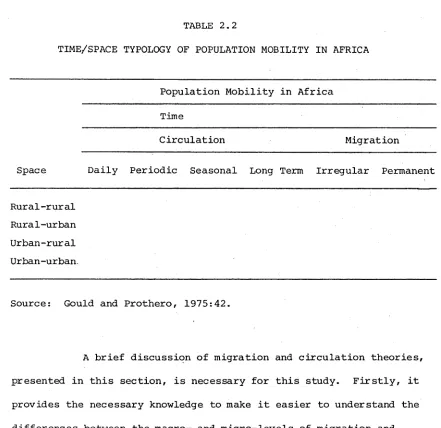
[image:27.554.50.521.36.657.2]TABLE 2.2
TIME/SPACE TYPOLOGY OF POPULATION MOBILITY IN AFRICA
Population Mobility in Africa
Time
Circulation Migration
Space Daily Periodic Seasonal Long Term Irregular Permanent
Rural-rural Rural-urban Urban-rural Urban-urban.
Source: Gould and Prothero, 1975:42.
A brief discussion of migration and circulation theories, presented in this section, is necessary for this study. Firstly, it provides the necessary knowledge to make it easier to understand the differences between the macro- and micro-levels of migration and circulation analysis which will be established in the next section.
Secondly, in different ways the insights gained from the theories will provide guidance for the examination of inter-rural migration,
circular migration and commuting in Chapter 4 and Chapter 5. Marriage migration is regarded as a consequence of individuals'
life cycles. For the examination of inter-rural migration, circu lation and commuting, basically the time/space typology of Gould
and Prothero is adopted. Commuting is assigned to denote daily circulation, while other types of circulations are termed as
[image:28.554.64.505.68.496.2]one who has spent a continuous period of less than six months out side of the village. Moreover, for the purposes of this study migra tion will not be divided into irregular and permanent. A migrant is defined as the one who has spent a continuous period of six months or longer outside of the village.
2.2 Macro and Micro Analysis
The migration phenomenon can be analysed at both macro and micro levels. The two levels of analysis are complementary for a better understanding of the phenomenon in a given area.
At the macro level of analysis, the causes of migration are inferred by reference to the supposedly objective characteristics of the areas of origin and of destination, and possibly the
structural characteristics of migration streams (Pryor, 1975b:9). At this level of analysis, the interest lies in studying the volume of migration and the net migration between the regions. The
characteristics of the population/migrants at both the origin and destination areas are also analysed. The migration data from censuses and population registers at various levels are often used at the macro level of analysis. The regions, like the provinces
in Indonesia, are considered as basic units for analysis.
analysis. The macro level of analysis, as was made by Speare in Indonesia in.analysing the migration data from the 1971 census, revealed the migration flows (in and out migration from the
different regions), and the age, sex, and education characteristics of migrants (Speare, 1975:66-85). The circular migration, such as that existing in Indonesia, cannot be detected from the census data as there is no recording of the phenomenon in the census.
The micro level of migration and circulation analysis deals with motivation and in-depth analysis of the decision-making process (Thomlinson, 1965:6, and Pryor, 1975b:13-21). This level of analysis is often based on data from small scale surveys due to the limitation of resources which are available for the purpose, and for technical reasons. The problems with the micro level of analysis lie in measuring motivations. Human behaviour is complex and ultimate motives for movements are sometimes not stated by the respondent. Also, if the 'recall' questions are applied, the motives at the time the respondents were about to move (ultimate motives) can be strongly influenced by the present situation in their place of destination and their experiences during the act of moving and at present. This means that the response to the
questions of motives for migration should be interpreted carefully.
In the context of migration and circulation, the adjust ment behaviour of individuals to moving or staying should also be mentioned. The adjustment behaviour to moving is more compulsory
Population movement processes involve individuals. Therefore, the subjective perceptions, attitudes, opinions and values of individuals are important (Hugo, 1975c:56). All of
those operate in a given situation - a social system of society with its culture. The community's norms and values cannot be neglected by individuals in a given community. The community's norms are the rules and regulations governing behaviour in a
community, while values are the purposes or goals which call forth the norms and make of the norms meaningful expectations
within the community's cultural context (Lowry and Rankin, 1969:110).
On the line of rural-rural population movement, the identification of the villagers can be made into the following groups (see as a comparison: Hugo, 1975d:24-25):
1. Rural residents who have not yet even thought about moving to another rural area.
2. Rural residents who have thought about moving to another rural area but rejected it.
3. Rural residents who have intentions of moving to another rural area but have not yet departed.
4. Persons who are in the actual physical process of moving to another rural area from the village.
5. Persons who have moved out of a rural area into
another rural area.
Pryor mentioned one other level of analysis that he
termed 'meso-analysis' (Pryor, 1975b:9). But since this level of analysis is based on interview or questionnaire responses to a
limited number of questions, it seems close to the micro level of analysis. The differences between 'reasons for migration' and
'motives for migration' in any actual investigation are rather blurred. While it is realized that motives are only reflected by
certain reasons, some reasons may be spurious and others are the
reflection of situations.
This section has established the differences between
the macro and micro levels of migration and circulation analysis. As was pointed out in Chapter 1, this study deals more with micro
analysis rather than macro analysis. Having provided this micro level of framework in the context of a general framework which was outlined in the last section, a careful examination of reasons
for leaving the origin area (own villages) and for selecting the destination area (other villages) will be made in Chapter 4 and
CHAPTER 3
WEST JAVA: MAIN SETTING OF THE STUDY AREA
3.1 Location and Land
West Java is one of the provinces in Indonesia and extends to the western part of Java island. Its area is about 46,300 square kilometres. Although its location is on the island of Java, Geertz in his efforts to divide Indonesia into two parts included the southern part of the province in 'Outer Indonesia'^, because this area and the areas in the islands outside Java have similar ecosystems (Geertz, 1963). West Java is bordered by Central Java in the east, whereas its southern part ends in the
2
Indonesian Ocean . This ocean also borders the south west of West Java. The Special Region of Jakarta (the Republic of
Indonesia's capital) and the Java Sea lie to the north of the province, and the Sunda Straits are to the west (Figure 3.1). The province is connected by ships, ferries, and planes to the regions outside Java. Ships and ferries are also important in relation to migration and circulation flows between Java and the outer islands. People from other provinces on Java can reach West Java by bus, train, and other vehicles.
1 By 'Outer Indonesia' he meant all parts of Indonesia excluding Northwest, Central, and East Java, South Bali, and West Lombok. These latter parts, he referred to as 'Inner Indonesia'.
P
R
O
V
I
N
C
E
S
O
F
T
H
E
R
E
P
U
B
LI
C
O
F
IN
DO
NE
SI
A
(— I t-j
/ W H
' I- rrl
5
0
0
1
0
0
West Java consists of 20 regencies (kabupaten) and 4 municipalities (kotamadya). The northern part forms the first row of regencies which include Serang, Tanggerang, Bekasi, Karawang,
Indramayu, and Cirebon. These regencies are dominated by the lowlands of the coastal plain area. A big dam, Jatiluhur, which serves thousands of hectares of rice fields lies in this part. The second row consists of the regencies of Pandeglang, Lebak, Bogor, Purwakarta, Bandung, Sumedang, Majalengka, and Kuningan. The major part of these regencies consists of hilly, upland areas. Except for Pandeglang and Lebak which, in the south, border on the Indonesian Ocean, these regencies are inland areas. Bandung city, the capital of West Java province, which had a population of 1.2 million in 1971, lies in this area. The southern regencies which form the third row are Sukabumi, Cianjur, Garut, Tasikmalaya and Ciamis. Commonly, these regencies have a steep coastal area running down to the Indonesian Ocean to the south.
The soil fertility varies in different parts of West Java. Generally, the southern part is less fertile than the central and northern parts. The volcanic areas such as the plateaux of Cianjur, Bandung and Garut are more fertile than others. Commonly, the volcanoes lie in the second row regencies or in the central part of West Java. The volcanoes still active are as follows: Karang, Gede, Tangkuban Perahu, Malabar, Papandayan, and Ciremai. Whereas the dormant volcanoes are Pangrango, Salak, Burangrang, Sawal, and Patuha. In the past, the volcanoes had enriched the
e s t u a r i e s i n t h e s e a r e a s a n d t h e y e m p t y i n t o t h e J a v a S e a . The two l o n g e s t r i v e r s a r e C i t a r u m a n d C im a n u k w h i l e t h e o t h e r s o f
i m p o r t a n c e a r e C i s a d a n e , C i t a n d u y , C i m a n d i r i a n d C i p u n e g a r a .
W e s t J a v a i s a t r o p i c a l h u m id r e g i o n . L i k e o t h e r p a r t s o f I n d o n e s i a , i t h a s o n l y tw o s e a s o n s : t h e w e t s e a s o n f r o m a r o u n d O c t o b e r t o A p r i l a n d t h e d r y s e a s o n f r o m a r o u n d A p r i l t o O c t o b e r . F o r i n s t a n c e , t h e m ean t e m p e r a t u r e i n B a n d u n g , a t 743 m e t r e s a l t i t u d e , r a n g e d fr o m 2 1 . 6 t o 2 4 . 0 ° C w i t h t h e m ean m inim um 1 4 . 6 t o 1 9 . 2 ° C a n d t h e m ean maximum 2 5 . 0 t o 3 2 . 0 ° C i n 1 9 7 1 - 1 9 7 2
( I n d o n e s i a , B . P . S . , 1 9 7 4 b : 9 - 1 1 ) . F o r l o w l a n d a r e a s , t h e m ean
t e m p e r a t u r e i s h i g h e r t h a n t h e a b o v e f i g u r e s , u s u a l l y a r o u n d 2 7 . 0 ° C . G e n e r a l l y s p e a k i n g , no r e g e n c y h a d a n a n n u a l r a i n f a l l o f l e s s t h a n 1 5 0 0 m i l l i m e t r e s . B a s e d o n 1 9 7 1 d a t a , t h e r e g e n c i e s o f S e r a n g , P a n d e g l a n g , B e k a s i , S u b a n g , B o g o r , S u k a b u m i , T a s i k m a l a y a , a n d
M a j a l e n g k a r e c e i v e d a n a n n u a l r a i n f a l l o f m o r e t h a n 3 0 0 0 m i l l i m e t r e s (J a w a B a r a t , K a n t o r S e n s u s d a n S t a t i s t i k , 1 9 7 2 : 5 4 ) . On t h e o t h e r h a n d , f o r K a r a w a n g , P u r w a k a r t a , S u m e d a n g , G a r u t , K u n i n g a n , C i r e b o n a n d I n d r a m a y u r e g e n c i e s t h e f i g u r e s w e r e b e t w e e n 2 0 0 0 m i l l i m e t r e s a n d 3 0 0 0 m i l l i m e t r e s , w h i l e f o r t h e r e s t o f t h e r e g e n c i e s t h e f i g u r e w a s b e t w e e n 1 0 0 0 m i l l i m e t r e s a n d 2 0 0 0 m i l l i m e t r e s . I n t h i s r e s p e c t S c h m i d t a n d F e r g u s o n h a v e i d e n t i f i e d r a i n f a l l r e g i m e s f o r W e s t J a v a (H ugo, 1 9 7 5 d : 3 4 ) . M o s t o f W e s t J a v a h a s b e t w e e n 9 a n d 12 w e t m o n t h s e a c h y e a r . O n l y a s m a l l p a r t o f t h e p r o v i n c e w h i c h e x t e n d s a l o n g t h e n o r t h c o a s t a l a r e a h a s b e t w e e n 4 . 5 a n d 6 w e t m o n t h s e a c h y e a r .
1976:1). Its pattern of utilization can be seen from Table 3.1. Farm agricultural land consisting of wet land and dry land was about 1,524,965 hectares (82.7 per cent of agricultural land). Commonly this land is owned by the villagers. On the other hand, estate land under the control of modern enterprises in the agri cultural sector, is lamost entirely exclusive of the traditional system. In addition, it is important to note that only 26 per cent of the land area of West Java is estimated to be under forest. In 1970, forest land was about 1,217,872 hectares in the province.
TABLE 3.1
WEST JAVA: THE PATTERN OF AGRICULTURAL LAND UTILIZATION, 1973
Land Utilization Area
(Hectares)
Percentage of Total Area
Wet land (irrigated field) 838,989 45.5
Dry land:
House compound 96,838 5.3
Dry field 268,940 14.6
Shifting cultivation 58,391 3.2
Permanent crops 157,293 8. 5
Pasture 6,152 0.3
Wood and forest 37,309 2.0
Temporary fallow 37,058 2.0
Others 23,988 1.3
Estate land 319,551 71.3
Total 1,844,516 100. 0
The description of location and land as presented in this section- will help us to better understand the population mobility in the study area which will be discussed in Chapters 4
and 5. The variation in soil fertility and rainfall, and the existence of rivers among areas may have an effect on the pattern of agricultural land utilization and the practice of agriculture. Hence, the distribution of population may be affected. However, this is a classical explanation of population distribution. Rivers may flood certain areas in the rainy season, while these areas may
experience drought in the dry season. These situations can act as push factors for the villagers to leave their village. Conversely, rivers may facilitate a good irrigation system in some areas where the people can practice double cropping. These will provide more job opportunities in the agricultural sector compared with the areas which experience the lack of an irrigation system. The job opportunities may hold people in those areas while they may also attract people from other areas. Moreover, agricultural systems which are present in West Java will be described in Section 3.3.
Population mobility takes place between regional units or communities. Therefore, the picture of the transportation network will be presented
in the next section.
3.2 Transportation Network
In West Java can be found a wide range of public trans port vehicles with different sizes, speeds, and qualities; from three-wheel vehicles (bemo) to the different kinds of mini-bus
three-wheel vehicles operate in cities. Bus, opelet and colt are the most important forms of public transportation connecting
regencies, sub-regencies (kecamatan) and villages. ■ Trucks are also often used by villagers as a means of transportation, particularly between remote areas. However, the main function of the truck is to transport agricultural products from hinterland areas to cities, and different goods from cities to towns or smaller centres. In 1974 there were 2751 buses and 22,994 trucks listed in the province
(Indonesia, B.P.S., 1975:312). Since the use of trains is limited, they seem to be not very important for the entire inter-rural trans portation system. Private vehicles, such as cars and motor-cycles, are only important for those in the very limited group of relatively high and medium income earners of West Java. But the bicycle is the chief means of transport over short distances for many villagers in the plain areas of the region.
Another important aspect of the transportation network is the quality of the roads. In West Java, like in other regions in Indonesia, different kinds of roads exist according to the level of government responsibility. These are state roads, provincial roads, regency roads, and village roads. Generally, state or central government roads are of the best quality. For instance, in 1971 all the state roads in West Java (624 kilometres) had an asphalt surface while in the same year the provincial roads
(1828 kilometres) were respectively 76.6 per cent asphalt, 16.6 per cent gravel, and 6.8 per cent soil in surface (Indonesia, B.P.S., 1974b). Although the figures for the regency roads are not
cases these regency roads have a surface of gravel or soil which in some parts cannot be passed by trucks in the rainy season. The state, provincial and regency roads are fundamental for traffic flow between regencies, sub-regencies and villages. The village roads are the responsibility of the village administration and almost all of these roads have a surface of soil and gravel. The main function of the village roads is to connect hamlets (rukun
kampung or parts of a village) although in certain cases they connect villages. Moreover, the road network is more developed
in the northern and central parts than in the southern part of West Java. In the northern part can be found the busy roads which connect Jakarta, Tanggerang, and Serang to the west, and Jakarta, Karawang, and Cirebon to the east. The busy roads in the central parts of the region link Bogor, Cianjur, and Bandung - its capital city. The busiest roads are the ones which link Bogor-Jakarta, Karawang-Jakarta, and Tanggerang-Jakarta. These roads are the gateways to Indonesia's capital for West Java from the south, east and west.
This section has provided a picture of the transportation network in West Java. The most important public transportations which can be used by the villagers for their travel between certain villages are bus, opelet and colt. It should also be mentioned that commonly the relative cost for travelling would be cheaper by bus than by opelet and colt. The road network is more developed
of the area concerned. The types of transport used by circulators and commuters will be examined in Chapter 5. The next section will
give a picture of agricultural systems in the study area as was mentioned in the last section.
3.3 Agriculture
The pattern of 'settled agriculture' has been present in Indonesia at least for a millenium, although it is believed that the people of West Java (Sundanese) were primarily shifting culti vators and herdsmen before the eighteenth century. Wet rice culture, for instance, had supported the Mataram Empire in the past. Temples such as Borobudur and Prambanan are evidence of the production sur
pluses of early 'settled agriculture'.
There are four basic agricultural systems which had been recognized before the Europeans effectively took control of the Indonesian islands (Missen, 1972:31-32):
1. The production of a variety of quick growing, predominantly food crops on a short term cultivation and long term fallow basis
(shifting cultivation or ladang) ;
2. The cultivation of wet rice in the flooded
or irrigated field (sawah) ;
4 . The m o r e o r l e s s p e r m a n e n t c u l t i v a t i o n o f f o o d c r o p s i n d r y f i e l d s (t e g a l a n ) .
T o d a y , i n W e st J a v a , t h e p r o m i n e n t a g r i c u l t u r a l s y s t e m i s f l o o d e d f i e l d o r i r r i g a t e d f i e l d ( s a w a h ) . I n a d d i t i o n , o t h e r s y s t e m s a r e a l s o p r e s e n t . From t h e a v a i l a b l e e v i d e n c e i t i s known t h a t t h e d e v e l o p m e n t o f t h e s a w a h s y s t e m i n W e s t J a v a t o o k p l a c e p a r t i c u l a r l y d u r i n g t h e l a s t c e n t u r y . T h i s s y s t e m p e n e t r a t e d fr o m C e n t r a l J a v a t o t h e h i g h l a n d s a r e a o f t h e p r o v i n c e . I t h a s b e e n w r i t t e n t h a t :
'T h e f i r s t r e p o r t o f s a w a h p e n e t r a t i o n i n t o t h e h i g h l a n d s came a s l a t e a s 1 7 5 0 f r o m t h e S um edang a n d T a s i k m a l a y a a r e a s , s m a l l p i e d m o n t r i v e r v a l l e y s n e a r t h e e a s t e r n e d g e o f t h e h i g h l a n d s , a n d a h a l f c e n t u r y l a t e r f r o m t h e s o m e w h a t l a r g e r a n d h i g h e r p l a t e a u b a s i n s o f B an d u n g a n d B o g o r t o t h e w e s t . ' ( T e r r a , 1 9 5 8 , G e e r t z , 1 9 6 3 : 4 4 )
L a t e r , t h e s a w a h s y s t e m h a d e x p a n d e d t o t h e n o r t h c o a s t a l a r e a s . C e r t a i n p a r t s o f t h e s e a r e a s ( s u c h a s K a ra w a n g r e g e n c y ) a r e p r e s e n t l y w e l l known a s t h e w e t r i c e b o w l i n t h e n o r t h . C o n t r a r y t o t h i s , t h e r e i s a b e l i e f t h a t t h e s y s t e m w a s i n i t i a t e d b y S u l t a n M a u l a n a J u s u f i n t h e a r e a o f t h e B a n t e n Kingdom ( a r o u n d S e r a n g , P a n d e g l a n g a n d L e b a k r e g e n c i e s ) i n t h e e i g h t e e n t h c e n t u r y , a n d t h a t i t p e n e t r a t e d i n t o t h e B a n d u n g p l a t e a u a n d o t h e r p a r t s o f t h e p r o v i n c e ( S u r j a d i , 1 9 7 4 : 3 1 ) . The s y s t e m u s e d , h o w e v e r , o r i g i n a t e d
is able to support more people than other agricultural systems in a-given areal unit. The system is also labour intensive which means that it can absorb an increasing labour force in rural
areas. It is often described how in Java the system modifies itself in response to new agricultural technologies without con
siderable socio-economic development of the village communities. This description was termed as 'static expansion' or the moderniza
tion without development (Boeke, 1942; Wetheim, 1964; Sajogyo, 1972-1973). Geertz referred to this phenomenon in Java as
'agricultural involution' (Geertz, 1963). It was partly caused by the Dutch colonial policy of the past. On the other hand,
shifting cultivation has a low 'carrying capacity' as it is only able to support a very limited population. This system needs an extensive area and is not suitable for densely populated regions.
The distribution of sawah, tegalan and agricultural land by regencies is shown in Appendix B. It seems that most of the northern lowland regencies have more than 65 per cent of their agricultural land as sawah (irrigated field). For the southern
regencies, the figures are only around 20 to 30 per cent.
The important food crops which are cultivated in West Java are rice, maize, cassava, sweet potatoes, peanuts and soybean. Table 3.2 presents their harvested areas in 1961 and 1971. It
indicates that although the total harvested area had increased by 10.3 per cent during the ten year interval, the cropping pattern was only slightly different. The increase in harvested