The Effects of Group Decision Support Systems and Task Structures
on Group Decision Processes and Outcomes:
An Experimental Investigation
By
Simon Sing Kwong Lam
A Thesis Submitted for the Degree of
Doctor of Philosophy
of The Australian National University
Declaration
It is declared that this submission represents my own original work, and
no part of this thesis has been submitted previously to this University, or
to any other institution for a degree, diploma, or any other qualification.
Signed
To Wervdy
A wife of noble character who can find?
She is worth far more than pearl.
Abstract
This research examines whether structures of decision tasks moderate the effects of group decision support systems (GDSS) on patterns of group communication and decision outcomes of decision making groups. This research also examines the relationship between patterns of group communication and decision outcomes. Although prior research has shown that the effects of GDSS on group decision making are not uniformly positive, conditions under which the use of GDSS is appropriate and beneficial are not well understood. The characteristics of the group task are emerging as important variables that are believed to moderate the effects of GDSS on group decision making. Failure to explicitly study the role of group communication in group decision making is another reason why prior research on GDSS has yielded much conflicting evidence. This research seeks to show that the effects of GDSS on decision making processes and outcomes are task structure dependent and the effects of GDSS cannot be evaluated on the basis of outcomes alone; decision processes must also be evaluated in order to understand how decisions are made and why GDSS can improve group outcomes in some situations but provide negative effects in others.
Acknowledgements
I would like to express my whole-hearted gratitude to my supervisor, Roger Clarke for his unfailing support and constant encouragement throughout this study. He has provided intellectual and moral support at critical times during the research and writing of this thesis. I am also grateful to Prof. S.G. Redding, Dr. Dieter Fink and Peter Jubb for their useful guidance, assistance, and encouragement.
I would like to thank the Department of Management Studies at the University of Hong Kong which had provided many facilities for this studies. Many other friends and colleagues generously contributed their time and effort to this work, without which it would have been impossible to do the experiment.
I would like to express my greatest thank to my wife Wendy for her constant love and unfailing support throughout these years. Stephanie, my baby girl, has been a special blessing in this process. You have shared in my fight, I hope you will now share in my
Ta ble o f Co n ten ts
Abstract
Acknowledgements Table of Contents List of Tables List of Figures
Page i iii iv viii x
Chapter 1: Introduction
1.1 Background to the Research 1
1.2 Statement of the Problem 3
1.2.1 GDSS Research 3
1.2.2 Task Structures 4
1.2.3 Patterns of Group Communication 5
1.3 Research Questions 6
1.4 Justification for the Research 6
1.5 The Research Method 8
1.6 Organisation of the Chapters 9
1.7 Chapter Summary 10
Chapter 2: Literature Review
2.1 Introduction 12
2.2 GDSS and the Roots of its Research 13
2.2.1 GDSS Technology 13
2.2.2 The Roots of GDSS Research 14
2.3 Theoretical Foundations of the Effects of GDSS 16
2.4 Review of GDSS Empirical Research 21
2.4.1 Laboratory Studies 21
2.4.2 Field Studies 27
2.5 Summary of GDSS Empirical Research and Implications 29
2.5.1 GDSS Research Implications 29
2.5.2 Task Structures 33
2.5.3 Patterns of Group Communication 36
2.6 Research Questions 38
2.7 Chapter Summary 39
Chapter 3: Research Framework and Hypotheses
3.1 Introduction 41
3.2 Theoretical Perspectives 42
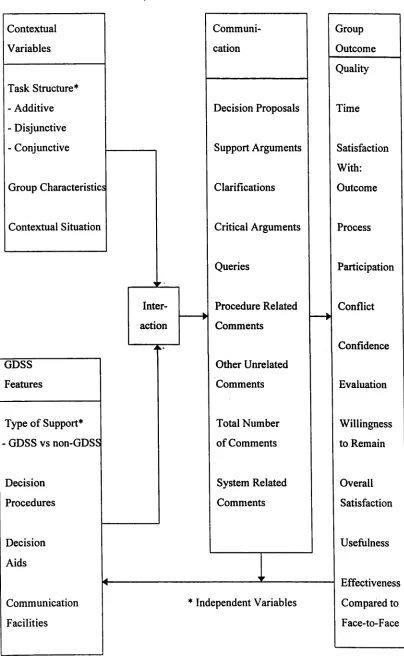
3.3 Theoretical Framework 49
3.3.1 Contextual Variables 50
3.3.2 GDSS Features 51
3.3.3 Interaction 53
3.3.4 Patterns of Group Communication 53
3.3.5 Group Outcomes 53
3.4 Research Hypotheses 57
3.6 Chapter Summary 63
Chapter 4: Research Method
4.1 Introduction 65
4.2 Information Systems Research Approaches 65
4.2.1 Positivist Approaches 67
4.2.2 Interpretivist Approaches 69
4.3 Experimental Design 70
4.4 Subjects 73
4.5 Experimental Task 78
4.5.1 Pilot Tests on Experimental Task 79
4.6 Experimental Manipulations 81
4.6.1 GDSS Environment 81
4.6.2 Pilot Tests on GDSS Environment 85
4.6.3 Task Structures 86
4.6.4 Pilot Test on Task Structure Manipulation 87
4.7 Experimental Procedures 88
4.7.1 Pilot Tests on Experimental Procedures 90
4.8 Dependent Variables 93
4.8.1 Objective Decision Performance 93 4.8.2 Patterns of Group Communication 93 4.8.3 Perceived Decision Satisfaction 94 4.8.4 Pilot Tests on Post-Meeting Questionnaires 95
4.9 Chapter Summary 96
Chapter 5: Analysis of Experimental Results
5.1 Introduction 97
5.2 Construct Validity 99
5.2.1 Factor Analysis of Questionnaire A 101 5.2.2 Factor Analysis of Questionnaire B 103 5.2.3 Factor Analysis of Questionnaire C 103
5.3 Reliability 106
5.4 Requirements of Statistical Tests 107
5.4.1 Homogeneity of Variance 107
5.4.2 Normality of Error Terms 109
5.5 Manipulation Checks 111
5.6 Testing of Hypotheses 112
5.6.1 Decision Quality 112
5.6.3 Patterns of Group Communication 120
5.6.4 Perceived Satisfaction 132
5.7 Chapter summary 139
Chapter 6: Summary and Conclusion
6.1 Introduction 140
6.2 Findings regarding Research Hypotheses 141
6.2.1 Research Question 1 141
6.2.1.1 Decision Quality 141
6.2.1.2 Decision Time 142
6.2.1.3 Perceived Satisfaction 143
6.2.2 Research Question 2 144
6.2.3 Research Question 3 145
6.3 Discussion 146
6.3.1 GDSS Support and Group Communication 146 6.3.2 Group Communication and Decision Outcomes 149 6.3.3 Decision Quality Versus Group Satisfaction 154
6.4 Theoretical Implications 155
6.5 Practical Implications 157
6.6 Limitations of Current Research 160
6.7 Directions of Future Research 162
References 166
Appendices 184
A - Description of the Experimental Task 184
Simulation Exercise on Decision Making (SEDM) Consolidated Commodities Ltd (ConCom)
Job Description
Candidate’s Information Group Decision Sheet
B - CAMH Training Guide 206
Group Talk Decision Aids Voters
Decision Making
C - Experiment Questionnaires 213
List o f Ta b l e s
Tables Page
2.1 GDSS Features and Expected Effect on Process Losses 18
2.2 Summary of Empirical GDSS Results 30
3.1 Definition of the Dependent Variables 55
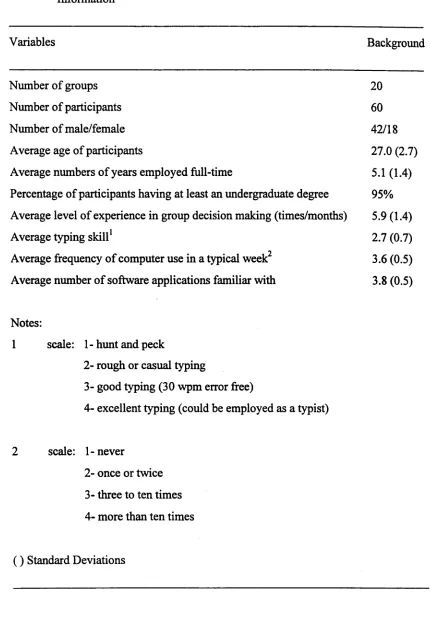
4.1 Means and Standard Deviations for Subject’s Background 75 Information
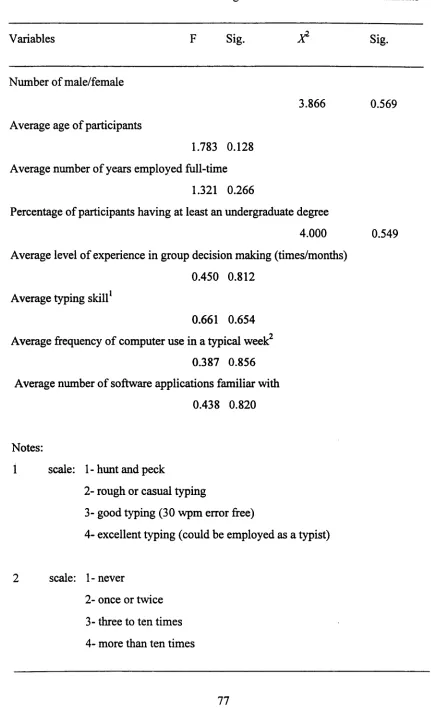
4.2 Results of Statistical Tests for Background Information 77 Across Treatments
4.3 Means and Standard Deviations of Pilot-Test Participants’ 80 Background Information
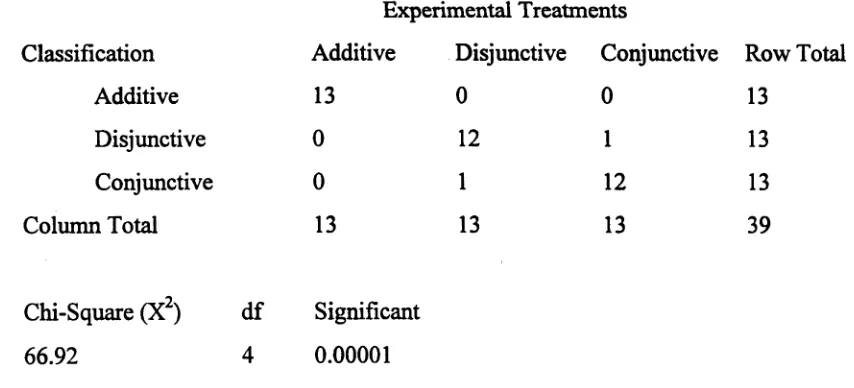
4.4 Classification of Experimental Treatments on Task Structure 87
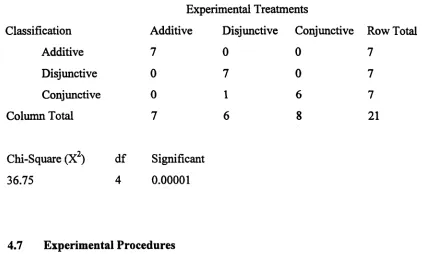
4.5 Classification of Pilot-Test Experimental Treatments on 88 Task Structure
4.6 Means and Standard Deviations for Experimental Procedures 91 Pilot-Test Participants’ Background Information
5.1 Post-Experimental Instruments and the Corresponding 100 Construct Measures
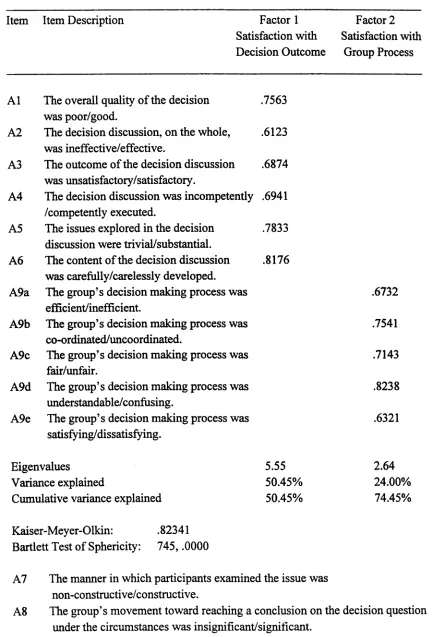
5.2 Factor Loadings Matrix for Questionnaire A 102
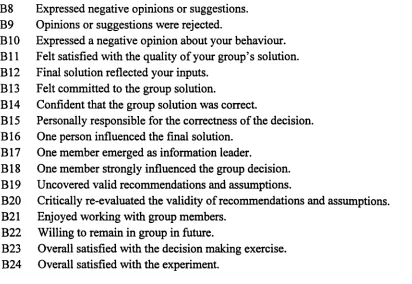
5.3 Factor Loadings Matrix for Questionnaire B 104
5.4 Factor Loadings Matrix for Questionnaire C 105
5.5 Cronbach Alpha of the Constructs Used as Dependent Variables 106
5.6 Hartley’s Test for the Homogeneity of Variance 108
5.7 Lillefors’ Test for the Normality of Error Terms 110
5.8 Classification of Experimental Treatments on Task Structure 111
5.10 Means and Standard Deviations for Decision Quality across 113 Experimental Treatments
5.11 Two-Way ANOVA Results for Decision Quality across GDSS 115 and Non-GDSS Supported Groups on Different Task Structures
5.12 Means and Standard Deviations for Decision Time across 118 Experimental Treatments
5.13 Two-Way ANOVA Results for Decision Time across GDSS 119 and Non-GDSS Supported Groups on Different Task Structures
5.14 Means and Standard Deviations for Group Communication 122 Variables
5.15 Percentage Statistics for Group Communication Variables 123
5.16 Two-Way ANOVA Results for Group Communication Variables 124
5.17 Two-Way ANOVA Results on Critical Arguments across GDSS 126 and Non-GDSS Supported Groups on Different Task Structures
5.18 Two-Way ANOVA Results for Procedural Related Comments 128 across GDSS and Non-GDSS Supported Groups on Different
Task Structures
5.19 Two-Way ANOVA Results for Total Comments across GDSS 130 and Non-GDSS Supported Groups on Different Task Structures
5.20 Means and Standard Deviations for Perceived Satisfaction 133
5.21 ANOVA Results for Satisfaction Variables 134
Listof Figures
Figures Page
2.1 Input-Process-Output GDSS Research Framework 32
3.1 Theoretical Framework for the Effects of GDSS on Different 52 Task Structures
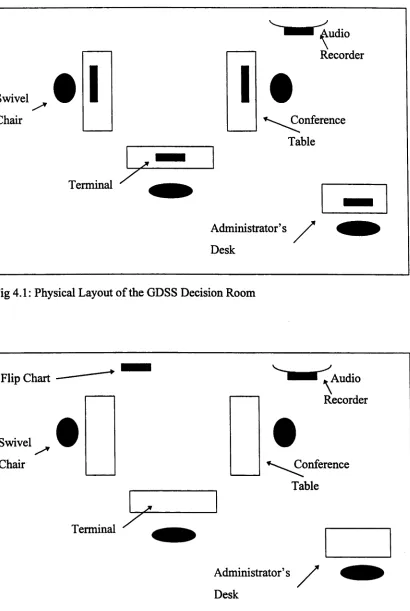
4.1 Physical Layout of the GDSS Decision Room 84
4.2 Physical Layout of the Face-to-Face Decision Room 84
5.1 Means of Decision Quality across Experimental Treatments 113
5.2 Means of Decision Time across Experimental Treatments 118
5.3 Means of Critical Arguments across Experimental Treatments 127
5.4 Means of Procedural Related Comments across Experimental 129 Treatments
5.5 Means of Total Comments across Experimental Treatments 131
Ch a pt e r 1
In t r o d u c t io n
l.I Background to the Research
Managers and professionals spend much time in group decision meetings (Mintzberg, 1973; Sproull, 1983). A decision group in an organisation may decide what new products should be manufactured and how they are to be designed, advertised, and sold. Another decision group may decide who should be hired for the newly created management post and how much the organisation is prepared to spend on funding a training program. One objective of the gathering of individuals in group decision meetings is to make the participants more effective and productive than they would be if they were working individually on the problem, through an elimination of duplication of effort and the gaining of deeper understanding of the situation from the varying points of view of other people. Group members can share the task of recalling information and each member may bring to the discussion information that others in the group did not have (Stasser, 1992). However, this is not always achieved; many managers have a negative view of group decision meetings and consider them non productive and a waste of their time (Drucker, 1988; Hymowtis, 1988; Mosvick and Nelson, 1987).
Because a significant amount of decision making in organisations is performed in group meetings, non-productive group meetings can have major consequences for the success of organisations. Several techniques such as the Nominal Group Technique and the Delphi Method (Delbecq and Van de Ven, 1971; Dalkey and Halmer, 1963) have been developed to improve the decision making processes of group meetings (McGrath, 1984). With recent advances in computer, telecommunication and management science techniques, serious efforts have been made to use computer technology to enhance group decision making performance in meetings (Jelassi and Beauclair, 1987; George, et al., 1990; Dennis and Gallupe, 1993 and Benbasat and
Group decision support systems (GDSS) are a development in computer technology which have been designed as a tool to improve the effectiveness and efficiency of group meetings involving problem solving and decision making (Huber, 1984). GDSS can be defined as interactive computer-based systems which combine communication, computer and decision technologies to support problem formulation and solution in group meetings (DeSanctis and Gallupe, 1987). GDSS are distinguishable from other computer systems from which they developed by their focus on group rather than individual activities. The goal of GDSS is to improve the process of group decision making by removing common communication barriers, providing techniques for structuring decision analysis, and systematically directing the pattern, timing, or content of discussion (Turoff and Hiltz, 1982; Huber, 1984; DeSanctis and Gallupe, 1987). By reducing this ‘process loss’ (Steiner, 1972) associated with group meetings, GDSS aim to increase the efficiency, reliability, and quality of group decision making.
Whether GDSS technology can really improve the decision quality of group decision making is an important research issue. Although there has been a substantial amount of research in this area, the effectiveness of GDSS remains an open issue (Dennis and Gallupe, 1993). The literature on GDSS has progressed beyond the early thinking that GDSS have unequivocal effects, regardless of other moderating variables. Instead, what is considered more important and of greater interest is the issue of how GDSS affect group outcomes and under what conditions (Benbasat and Lim, 1993).
1.2 Statement of the Problem
1.2.1 GDSS Research
There has been a substantial amount of research activity on GDSS dealing with the effects of GDSS on group decision making (for example, Pinsonneault and Kraemer, 1990; Gray, Vogel, and Beauclair, 1990; Nunamaker, et al., 1991; Dennis and Gallupe, 1993). These studies attempted to establish the effectiveness of groups supported by GDSS in comparison to groups not supported by GDSS. However, generalisations about the effects of GDSS on group decision making have been plagued by inconsistencies between study findings. Some of these studies found strongly positive results (for example, Steeb and Johnston, 1981; Gallupe, 1985; Cass, Heintz, and Kaiser, 1992), while others found mildly positive results (for example, Lewis, 1982; Gallupe, DeSanctis and Dickson, 1988; Applegate, Konsynski and Nunamaker, 1986), and still others found mixed, neutral or negative results (for example, Watson, DeSanctis and Poole, 1988; Turoff and Hiltz, 1982; Beauclair, 1987; Jarvenpaa, Rao, and Huber, 1988; Gallupe and McKeen, 1990). As Dennis and Gallupe put it ‘The result of these studies can be summed up in one word: mixed’ (Dennis and Gallupe, 1993, p.64). It is clear that the effectiveness of GDSS remains an open issue and the conditions under which the use of GDSS is appropriate and beneficial are still not well understood.
These research efforts suggest that the effects of GDSS are dependent on a variety of factors. GDSS use is not beneficial in some situations and the commonly stated advantages of GDSS have been shown not to hold in the circumstances in which they were studied. The effects of GDSS are contingent on a myriad of situational factors. It is inappropriate to say that the use of GDSS improves group decision performance or reduces member satisfaction, because such statements must be qualified by the situation (Nunamaker, et al., 1993).
1.2.2 Task Structures
Of all of the factors which have been suggested as moderating the effects of GDSS use, the variable ‘group task’ is emerging as an important variable. Poole, Seibold, and McPhee (1985) point out that ‘the general variable group task is emerging as an especially important variable, often accounting for as much as 50% of the variance in group performance’ (p.88). Poole and Hirokawa (1986) declare that ‘In the pantheon of factors determining decision behaviour and outcomes, task stands in the first position, both in terms of evidence supporting its effect strength and in terms of a theoretical linkage to decision processes’ (p.26). Task differences should be expected to affect significantly the communication process as well as the task performance
(McGrath, 1984).
al., 1993). Some researchers also argue that the task structure is a more fundamental concept than the type of task (Steiner, 1972, Gouran and Hirokawa, 1983; Hirokawa,
1982, 1990).
Although the main objective of GDSS technology is to provide support for the group decision process, we still lack empirical studies of how GDSS technology may affect group decision performance under different task structures.
1.2.3 Patterns of Group Communication
Another possible reason why previous research on GDSS effectiveness has yielded much conflicting evidence is its failure to acknowledge explicitly the important role of group interaction or communication in group decision making. According to Simon (1960, 1976), decision making is a process, and the understanding of this process is just as important as the decision outcome. Steiner (1972) and Shiflett (1979) have identified intra-group processes as one of the key determinants of group effectiveness. Their research explicitly acknowledged the important function of group communication interaction as the moderator of the input-output linkage. The need for controlled, microlevel studies of the process of interaction, as a key to understanding the relationships between decision support and decision quality, has been pointed out by several GDSS scholars (McCartt and Rohrbaugh, 1989; Pinsonneault and Kraemer,
1990).
1.3 Research Questions
The primary objective of this study is to examine whether the structure of a decision task moderate the effects of GDSS on the patterns of group communication and decision outcomes in a decision making group. Decision outcomes are to be measured by the objective decision performance and perceived decision satisfaction of the group decision process. The secondary objective is to examine the relationship between the patterns of group communication and decision outcomes in face-to-face and GDSS supported groups working on a decision task. Within the framework of the objectives, this study seeks to answer the following questions:
1. Are there any systematic differences in the decision outcomes between GDSS supported and face-to-face decision making groups across different task structures?
2. Are there any systematic differences in the patterns of group communication between GDSS supported and face-to-face decision making groups across different task structures?
3. Is there any systematic relationship between the patterns of group communication and the decision outcomes among the GDSS supported and face-to-face decision making groups across different task structures?
1.4 Justification for the Research
In theoretical terms, this study makes a contribution to the development of an emerging trend of GDSS research. As Nunamaker, et al., (1991) pointed out, we are at the conclusion of the initial phase of GDSS research, a phase that mainly focused on experimental work comparing GDSS to non-GDSS groups. This indicated that the second phase of GDSS research ought to isolate and explain why GDSS are of value to certain groups and not others. This research isolates task structure as one of the variables which may mediate the effect of GDSS use among decision making groups. This research also recognises the importance of decision process as a key to explaining the relationships between the effect of GDSS technology and group decision making. This research conducts a more microlevel analysis and provides empirical evidence which indicates how GDSS effects can be different across different task structures and how these effects can be explained through the study of the decision process of the decision making groups. This research makes a contribution not only to the existing GDSS literature but also extends the so far very limited second phase of GDSS research.
In practical terms, this study contributes to the further development of GDSS technology by looking into how GDSS can best be used for different decision task structures. It provides reliable information so that future GDSS can be designed to suit the different requirements of different decision task structures.
conjunctive task. One member of the group may examine the financial implications of various alternative acquisition targets, another group member may evaluate the legal ramifications of the acquisition, such that no single group member has all the information needed to make the optimal decision. Only if all members communicate their unique information to the group is it likely to identify effective solutions.
Not only will decision task structures vary across organisations, but the task structure of different types of decisions may vary within an organisation itself. An acquisition may be additive, a strategic human resources decision may be disjunctive, and a decision concerning global expansion could be conjunctive. This research sets out to provide empirical evidence for how GDSS use changes the patterns of group communication in group decision making and under which decision task structures GDSS are most effective. Organisations deciding whether to acquire or use a GDSS will be able to do so with the knowledge that the technology can change some patterns of decision group communication. Organisations can also evaluate the task structure of their decision making group before deciding how or when to use GDSS technology.
1.5 The Research Method
Most of the experimental research on GDSS has involved students as participants and researchers have widely discussed the problem of validity of using student subjects for experimental research (Gordon, Slade, and Schmitt, 1986; McFarlan, 1986; Burnett and Dunne, 1986; Greenberg, 1987). In this study, practising managers were chosen as subjects in the experiment. This approach should enhance the ability to generalise the findings for organisations. Using a personnel recruitment exercise as the experimental task, group members worked in a decision room with either a face-to- face or a GDSS environment. Task structures were manipulated by varying the group member roles and the information distribution of the experimental task. The experiment was administered when the subjects were participating in a management training course. All the experimental materials and procedures were carefully pilot- tested before the experiment. To study the group interaction communication, the discussion records of the decision making group were coded using the coding scheme developed by Gettys, et al., (1987). Decision outcomes were measured by objective decision performances and perceived decision satisfaction of the group decision process.
In order to test the questionnaires used to gather perceptual data, factor analysis was used to assess the construct validity of the questionnaires. The reliability of the construct was assessed using the standard Cronbach coefficient alpha. Two-way analysis of variance (ANOVA) was applied to each of the dependent variable across the experimental treatments. Before subjecting the data to testing, the assumptions of this statistical test were also verified.
1.6 Organisation of the Chapters
Chapter 3 presents the two theoretical perspectives that are relevant to the study of GDSS across different task structures. A research framework is then developed together with the hypotheses to be tested in this study.
Chapter 4 describes the controlled laboratory experiment for testing the research hypotheses. The research method is briefly described and justified. The chapter then describes the subjects, the decision task, the experimental manipulations, the procedures and the measurement of dependent variables in the experimental task. The pilot-test of the experimental materials and procedure are also described.
Chapter 5 presents the results of the experiment. The statistical methods for testing the research hypotheses are described. The results of the tests of construct validity and reliability of the dependent variables are presented. The requirements of the statistical tests and the manipulation check of the experimental treatments are described. The results of testing the research hypotheses are then provided.
Chapter 6 concludes this thesis with a summary and discussion of the major findings of the research. The theoretical and practical implications of the findings are presented. The limitations of this research and recommendation for future research are also discussed.
1.7 Chapter Summary
This chapter has laid the foundations for the report. It has provided the background to the research and a statement of the problems being addressed. The research questions have been presented, the importance of the research was justified, the research method briefly described and the report outlined. On these foundations, the report can proceed with a detailed description of the research.
Ch a pt e r 2 Liter a tu r e Re v ie w
2.1 Introduction
The study of GDSS has become an important topic of interest in recent years. The promising use of computers in aiding the manager to cope with the complexity of group decision making has aroused much attention in the development of GDSS technology. The increase in the amount of research into GDSS usage is well documented. The recent bibliographies by DeSanctis (1989) and the 3M Corporation (1991) indicated that by 1991 between 200 and 300 papers were directly related to GDSS. Recent reviews (Kraemer and King, 1988; Kraemer and Pinsonneault, 1990; Seibold and Contractor, 1991; Vogel and Nunamaker, 1990; Wagner, Wynne and Mennecke, 1993) pointed to at least twelve different universities that have GDSS research facilities. Annual international conferences have been held on the subject (Blanning and King, 1989; Galagher, et al., 1989). At least ten major companies including IBM, Marriott, and Dell Computer have invested hundreds of thousands of dollars installing GDSS facilities in their companies (Bulkeley, 1992).
importance of task structures as a moderating variable on the effects of GDSS on group decision making. Finally Section 2.6 presents a summary of this chapter.
2.2 GDSS and the Roots of its Research
2.2.1 GDSS Technology
The essence of GDSS technology in group meetings is to provide computer-based information exchange and decision making support for group members. Group decision making is an integral part of organisational life (Fisher and Ellis, 1990). Computer technologies are being configured in an attempt to enhance the efficiency and effectiveness of such activities. GDSS can be defined as computer-based systems that combine communication, computer, and decision technologies to support problem finding, formulating solutions and decision making in group meetings (DeSanctis and Gallupe, 1987). As decision support tools designed to improve group performance, GDSS vary in their capability to support meetings (Huber, 1984, Kraemer and Pinsonneault, 1990). DeSanctis and Gallupe (1987) suggested that GDSS can be classified into three levels. Level 1 GDSS provide technological support such as electronic mail or electronic brainstorming tools to improve the decision process by removing communication barriers between members. Level 2 GDSS provide decision modelling and group decision techniques such as risk analysis models or multiple criteria voting techniques aimed at improving effectiveness and reducing uncertainty that would otherwise occur in the group’s decision process. Level 3 GDSS are characterised by machine-induced group communication patterns which involve machine generated advice in the selecting and arranging of rules to be applied during interpersonal communication.
1. GDSS provide equal opportunities for participation, since they enable all group members to work simultaneously in a computer-mediated communication environment (Huber, 1982; Nunamaker, et al., 1991) and there is no competition for speaking time (Siegel, et al., 1986; Turoff and Hiltz, 1982).
2. GDSS, by incorporating anonymity features, permit ideas to be evaluated on their own merits, rather than on the basis of who contributed them (Nunamaker, et al
1991; Valacich, Dennis and Nunamaker, 1992).
3. GDSS facilitate group processes by the implementation of a decision model, the application of group process structuring techniques, and the creation of a meeting memory (Nunamaker, et al., 1991; DeSanctis and Gallupe, 1987).
Multiple avenues of research have proliferated to examine these claims. In order to understand these studies, one needs to examine the roots of GDSS research and the theoretical foundation for explaining the effects of GDSS on group decision making
2.2.2 The Roots of GDSS Research
The idea of ‘Group Decision Systems’ existed before the advent of computers or electronic communication. Researchers have long been trying to devise ways to improve the effectiveness of group decision making and specifically to help groups avoid what Steiner (1972) called ‘process losses’ or process deficiency. Most of these systems did not involve the use of electronic or high-tech devices. Computer-based group decision support systems are relatively recent developments. A great deal of GDSS theoretical development and research can be traced back to its roots in the earlier work on individual-based decision support systems (Keen and Scott-Morton
1978; Sprague, 1980; Sprague and Watson, 1979) that, in turn, is based largely on the theory of decision making put forward by Herbert Simon (Simon, I960, 1976).
of enhancing individual rational capacity so that individual utility can be maximised. This is done primarily through the provision of some well structured decision making tools to enhance user ability in decision problem solving. Michael Scott-Morton (1970) was among the first to study the use of computers for supporting individual decision makers. The early empirical works done with individual DSS were focused on computer support for intellectual tasks such as idea generation and problem solving. Although the focus was on individual decision makers using computer support, most of the researchers (Stabell, 1974; Grudnitski, 1975; and Alter, 1975) in DSS speculated about the impact of computer-based DSS on group decision making. Most of their research suggested that individual decision support systems could be extended to support groups of decision makers. Just as DSS were designed to overcome the limitations of the individual decision maker, computer decision support systems can be designed to overcome the limits of rationality experienced by groups (Huber, 1984; Nunamaker, Applegate, and Konsynski, 1988) so that their aggregate utilities are maximised. This perspective has given birth to a new direction of research and development into group decision support systems (GDSS).
The second foundation of GDSS research has its roots in communication theories. Traditionally, communication theories have focused on message exchange between two or more parties and research in communication has been focused on the information channels and the nature of the message between the senders and receivers (Berio, 1977; Bormann, 1980). Early GDSS research has drawn from a variety of communication theories. Most of the early works studied how computer-mediated communication was different from verbal exchange between group members.
has been argued that computerised communication channels reduce individuation (Hiltz, Turoff, and Johnson, 1989) and social presence (Sproull and Kiesler, 1986).
Early experimental work conducted during the late 1960s and 1970s (Williams, 1977; Short, Williams, and Christie, 1976) also found that the use of computer-mediated communication strongly influenced how a group approached a specific task. These researchers suggested that computer-mediated communication could introduce new factors into the normal group processes and alter the communication patterns of a group. Although these early studies, in using computers to support communication between group members, were done using simple computer-messaging systems, these studies provided a foundation for further studying the differences between computer- mediated communication and face-to-face meetings and whether the differences can lead to better group performance.
In short, the origins of GDSS theoretical development and research are found in both the early individual DSS research and computer-mediated communication research. The DSS researchers noted that computer support for individual decision makers was useful but the true power of the computer technology lay in supporting group decision making. The computer messaging research demonstrated that using computers as a medium of information exchange is very different from face-to-face verbal exchange. These two areas of research have facilitated the development of a rich literature on GDSS and have provided a foundation for studying the effects of GDSS on group decision making.
2 3 Theoretical Foundations of the Effects of GDSS
The theoretical foundation for studying the effects of GDSS on group decision making has centred on the group process model proposed by Steiner (Steiner, 1972). The central concept in Steiner’s model is the notion of a group’s potential productivity in a task. Like machines which can never achieve 100 per cent efficiency, Steiner argued that people working in a group would expect to fall short of their maximum potential. Steiner called this ‘process losses’. He suggested that there are two general sources of process loss. Co-ordination losses occur when group members do not organise optimally and motivation losses occur when group members fail to be motivated in a group task. The actual productivity of the group will be reduced as a result of these process losses. Although working in a group can result in process losses, Steiner argued that group productivity can, at the same time, be improved by group learning or stimulation. Steiner called these ‘process gains’. Certain aspects of the meeting process improve groups’ outcomes (process gains), whereas others impair groups’ outcomes (process losses) (Hill, 1982; Steiner, 1972). Steiner (1972) and Huber (1982) have suggested that the actual group effectiveness is equal to the sum of capabilities of the individual group members plus the group process gains minus the group process losses. In other words, the group meeting outcomes are contingent upon the balance of the process gains and process losses (Connolly, Jessup, and Valacich,
1990; Steiner, 1972).
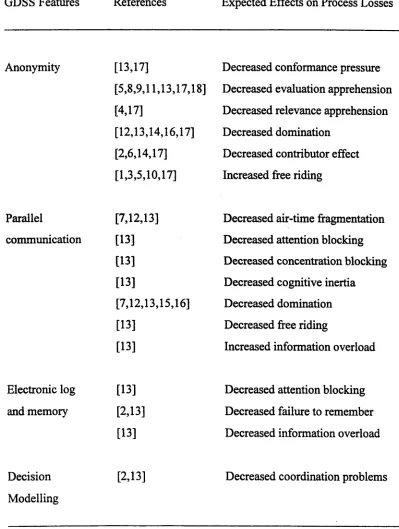
remember and socialising. Table 2.1 summarises the expected effects of GDSS features on group process gains and losses.
Table 2.1: GDSS Features and Expected Effects on Process Losses
GDSS Features References Expected Effects on Process Losses
Anonymity [13,17] Decreased conformance pressure [5,8,9,11,13,17,18] Decreased evaluation apprehension [4,17] Decreased relevance apprehension [12,13,14,16,17] Decreased domination
[2,6,14,17] Decreased contributor effect [1,3,5,10,17] Increased free riding
Parallel [7,12,13] Decreased air-time fragmentation communication [13] Decreased attention blocking
[13] Decreased concentration blocking [13] Decreased cognitive inertia [7,12,13,15,16] Decreased domination
[13] Decreased free riding
[13] Increased information overload
Electronic log [13] Decreased attention blocking and memory [2,13] Decreased failure to remember
[13] Decreased information overload
[1] Albanese and Van Fleet (1985) [2] DeSanctis and Gallupe (1987) [3] Diehl and Stroebe (1987) [4] Gallupe (1985)
[5] Harkins and Jackson (1985) [6] Hiltz, Turoff and Johnson (1989) [7] Huber (1982)
[8] Jablin and Seibold (1978)
[10] Kerr and Bruun (1983)
[11] Lamm and Trommsdorff (1973) [12] Lim, Raman and Wei (1990) [13] Nunamaker, et al.(1991) [14] Nunamaker, Applegate and
Konsynski (1988) [15] Siegel, etal.(1986) [16] Turoff and Hiltz (1982) [9] Jablin, Seibold and Sorenson (1977) [17] Valacich, Dennis and
Nunamaker (1992)
[18] Vroom, Grant and Cotton (1969)
Anonymity of GDSS mediated communication may minimise the process losses generated by conformance pressure and evaluation and relevance apprehension. When group members are reluctant to critique the comments of others due to politeness or fear of negative evaluation from the group, the group productivity will be reduced. Anonymity provides a low-threat environment in which group members can feel free to express criticism without fear of reprisals or embarrassment (Nunamaker, et al., 1991; Valacich, Dennis and Nunamaker, 1992). However, anonymity in GDSS environments may result in more free riding because it is more difficult to find out whether someone is active or not (Albabese and VanFleet, 1985).
Jackson, 1985; Kerr and Bruun, 1983; Valacich, Dennis and Nunamaker, 1992). Domination may also be reduced since computer supported communication systems prevent dominant members from restraining other members from expressing their ideas (Jablin and Seibold, 1978; Nunamaker, et al., 1991). Parallel communication can reduce attention and concentration blocking as group members do not need to devote their concentration to listening to others (Nunamaker, et al., 1991). Cognitive inertia is also reduced as group members can communicate simultaneously and no longer need to restrain from contributing comments as they occur (Nunamaker, et al., 1991). However, parallel communication may lead to some information overload. This effect may increase the cognitive burden of the group members.
Group memory in GDSS can record all electronic comments so that group members can retrieve information anytime they want. This feature should reduce attention blocking. It also provides a way to reduce the process losses of information overloading resulting from the parallel communication medium (Nunamaker, et al.,
1991; DeSanctis and Gallupe, 1987).
Decision Modelling in GDSS can reduce the process losses by increasing the co ordination of the decision making groups (DeSanctis and Gallupe, 1987). It provides a way to structure the decision making process and reduces the efforts of co-ordination between group members.
theoretical foundation for the effects of GDSS, the next section reviews GDSS empirical research.
2.4 Review of GDSS Empirical Research
This section provides a review of the major GDSS empirical research. This review is divided into laboratory studies and field studies. The review is organised in chronological order and it provides a historical perspective of the main findings of GDSS research (Dennis and Gallupe, 1993).
2.4.1 Laboratory Studies
Empirical research on GDSS has grown immensely in the past ten years. Laboratory studies have dominated the literature, and they have been the primary method for investigating the effects of GDSS.
Steeb and Johnson (1981) conducted an experiment to compare the effects of a chauffeured GDSS called Group Decision Aid. The system was tested using ten groups each with three members. The decision task was a specialised, complex crisis scenario derived from an international terrorist simulation case. Five groups had computer support while the other five groups relied on manual tools (they were given pencils, paper, and blackboard). All groups were asked to reach a group consensus as to what decision to make. Results indicated that the GDSS groups were more satisfied with the process and more confident with the decision they had made. The GDSS groups also developed higher-quality decisions according to the experts who evaluated the decision outcomes.
role in learning more about obstacles in using a GDSS system. A control treatment group had no support, the first experimental treatment group used ‘Facilitator’, and the second experimental treatment group used a structured paper-and-pencil technique that incorporated the same features as ‘Facilitator’. Lewis found that the use of GDSS produced decisions of higher quality generated more alternatives per decision, and reduced domination by single group members when compared to either the control group or the paper-and-pencil group. This study also provided suggestions for future GDSS design such as informing group members of the time they were taking on different stages of a process and maintaining a record of minutes.
Turoff and Hiltz (1982) conducted two experiments to show that ‘computers may indeed be used to support group communications as an integral part of decision support systems’ (p.83). Their system was built around an automated Delphi technique and provided computer conferencing capabilities. The experiments were conducted to investigate the impact of computed-based support on group decision making. The first experiment was essentially an experiment into the effects of computer conferencing on group decision making. The second experiment, however, manipulated leadership in the group, the use of GDSS and the mode of group interaction (either face-to-face or computer-conference). The results indicated that the use of a GDSS aided the groups in reaching quality decisions more often than groups unaided by a GDSS. The results also revealed that leaders tended to emerge less often in computer-supported groups.
made better quality decisions than non-GDSS groups but GDSS groups were less satisfied than non-GDSS groups.
Watson (1987) studied the impact of using a GDSS on consensus formation in small groups. He developed a GDSS in C programming language running under the UNIX operating system. This system became the Software Assisted Meeting Management System (SAMM). In a task requiring resolution of competing personal preferences, 3 or 4 person groups were randomly assigned to one of the three experimental treatments: a computer-based support system; a manual, paper and pencil, support system and no support. He found that GDSS technology appeared to offer some advantage over no support, but little advantage over the paper and pencil method of supporting group discussion. He also found that GDSS groups were less satisfied with the process than non-GDSS groups.
Beauclair (1987) conducted a GDSS study using a small GDSS developed on a small local area network. Groups had to reach a decision regarding a student discipline case. Using a 2x2 factorial design, she compared control groups, groups with computer- aided brainstorming support, groups with computer-aided ranking and voting support, and groups with both computer-aided brainstorming and ranking/voting support. Beauclair found that there were no differences between GDSS groups and non-GDSS groups for decision quality, time to make the decision, amount of participation by group members, and satisfaction with the group outcome.
Jarvenpaa, Rao, and Huber (1988) conducted an experiment in which the same three groups used three different forms of GDSS technology. Groups were given unstructured problems and asked to use either an electronic blackboard, or workstations, or were given no support. They found that GDSS had no effect on participation or satisfaction with the process.
major dependent variables. The major empirical findings of the study showed no significant differences between the overall amount of influence behaviour attempted in computer-supported groups, although significant differences were found in the pattern of influence behaviour, i.e., the different types of influence behaviour used in the computer supported group. They also found that using a GDSS resulted in a more even distribution of influence in the group compared to non-GDSS groups.
Lim, Raman, and Wei (1990) conducted an experiment to look at GDSS effects on the equality of influence and dominance among decision groups. They found no differences in the equality of influence, except for the no-leader GDSS groups, which had a more even distribution of influence. The dominant member in GDSS groups had less influence than the dominant member in non-GDSS groups.
Gallupe (1990) conducted two experiments using two different GDSS but the same type of task to study the effect of use of a GDSS on individual versus group decision making. The study compared the performance of GDSS groups, non-GDSS groups, and the ‘best members’ of those groups to determine if use of a GDSS improved decisions. The results were consistent in both experiments. The findings indicated that GDSS groups did not do as well as the best members of their group and non-GDSS groups did as well as or better than the best members. One explanation proposed was that GDSS generated more equal participation among group members, making it more difficult for the best member to influence the group.
Jessup, Connolly and Galegher (1990) studied the influence of anonymity on group process in groups using GDSS with an idea-generating task. They found that the anonymous GDSS groups generated more comments, were more critical, and were more likely to embellish ideas proposed by others than the non-anonymous groups.
Gallupe and McKeen (1990) conducted a laboratory experiment to examine the effects of the use of a GDSS in face-to-face versus remote meetings. Use of a GDSS was found to increase the time it took to reach a decision but had no impact on the decision quality of the groups. The study also demonstrated that decision satisfaction was less in GDSS groups.
Winniford (1991) studied the use of the GroupSystem GDSS using five and ten member groups for a chosen task. The results were similar to George, Easton, Nunamaker, and Northcraft (1990). There were no differences in decision quality or member satisfaction.
Sengupta and Te’eni (1991) investigated the effect of computer generated cognitive feedback in GDSS supported group decision processes. In a laboratory experiment with groups of three decision makers, 15 groups received on-line cognitive feedback and 15 groups did not. The results showed that users receiving cognitive feedback maintained a higher level of control over the decision making process as their decision strategies converged.
Jessup and Tansik (1991) conducted an experiment using a GDSS to evaluate effects of anonymity and proximity on group process. Twenty groups of four persons each performed an idea-generating task. The results indicated that group members working anonymously and apart generated more comments. Close proximity groups were more satisfied and the highest levels of perceived system effectiveness were reported under the conditions of anonymity.
voice connection. Members solved a preference allocation task and reported their satisfaction with the meeting process and its outcome. The results demonstrated that both GDSS and location effects were significant for decision quality, with face-to-face non-GDSS group members reporting the highest level of satisfaction. Dispersed subjects without GDSS technology were more satisfied with both the process and the outcome of their meeting. But when a GDSS was available, face-to-face subjects reported higher satisfaction with the meeting outcome than dispersed subjects.
Valacich, Dennis and Nunamaker (1992) studied the effects of group size (3 and 9 members) and group member anonymity on the performance of groups using a computer-mediated idea-generation system. The results indicated that although group members in all conditions made a similar number of comments, larger groups generated significantly more and higher quality ideas than smaller groups. Anonymity however had no effect on group performance. Members of small identified groups made the fewest critical remarks, were the most satisfied, and rated themselves more effective than group members from the other experimental conditions.
Dickson, Partridge and Robinson (1993) studied the effects of facilitative support of GDSS on group performance. The study explored two facilitative supports: chauffeur- driven and facilitator-driven. The results showed that chauffeur-driven groups had higher levels of post-meeting consensus than the facilitator-driven groups; there were no differences with the performance of the person guided groups.
Hwang and Guynes (1994) conducted an experiment to investigate the effects of GDSS in groups of nine persons and the effects of group size (three versus nine persons) in the computer supported environment. A 2x2 completely randomised factorial design was employed. The results indicated that decision quality can be improved in large computer-supported groups and large groups generated more alternatives but took longer to reach a final decision than the smaller ones.
2.4.2 Field Studies
Dennis, Nunamaker and Vogel (1990) defined GDSS field studies as research to study the use of GDSS technology by specific business groups (public or private sector) addressing problems in their organisation or in another institution. One of the first organised field studies of GDSS was conducted by Nunamaker, Applegate, and Konsynski (1988). After studying 40 groups using GDSS, they concluded that anonymity had an important influence on how a group used GDSS technology. They also concluded that larger groups were more satisfied with GDSS use than smaller groups.
In 1987, a GDSS called GroupSystems was adopted by IBM and this has resulted in a series of research studies over several years. The first of these studies was conducted by Nunamaker, et al. (1989). GroupSystems was used by 441 participants from 29 groups and the results showed that the participants reported GDSS to be very effective and satisfying. Their results also indicated that the planning time of some managerial tasks can be reduced by 55 percent.
anonymity, which led to increased equality of participation and improved communication across the organisational hierarchy.
Dennis, et al. (1990) studied the strategic-planning processes of 17 organisations (later expanded to 30 organisations) and found the use of GDSS could lead to more successful strategic management. They suggested that GDSS use could enhance idea generation, problem identification, innovation, communication between top management, organisational learning and functional and operational integration within an organisation.
Vogel, et al. (1990) examined a study undertaken by IBM. Participants again reported high satisfaction and improvements in meeting efficiency and effectiveness. A study by Grohowski, et al. (1990) attributed this success to increasing the number of participants attending meetings, more participation and an increasing task focus during the meetings.
Dennis (1991), who studied ten operations management groups from five public and private organisations, also found larger GDSS-supported groups to be more satisfied than smaller groups. His other finding suggested that anonymity was less important in hierarchically structured groups which included members with different status and power.
2.5 Summary of GDSS Empirical Research and Implications
Table 2.2 presents a summary of the empirical results of GDSS research. As is evident from this summary, generalisations about the effects of GDSS on group decision making have been plagued by inconsistencies between study findings. As Dennis and Gallupe put it ‘The result of these studies can be summed up in one word: mixed’ (Dennis and Gallupe, 1993, p.64). In GDSS research, some of the studies found GDSS use had improved quality performance, while other found negative or mixed results. Participation has been shown to be more equally distributed among group members supported by GDSS but some studies have shown no effect from GDSS use. GDSS use has been shown to reduce group consensus but the results were not consistent in other studies. Effects on member satisfaction on GDSS use in the laboratory have been positive, negative or mixed.
2.5.1 GDSS Research Implications
Based on this literature review, it is clear that the effects of GDSS use are not uniform across all situations and conditions. The situations under which the use of GDSS are beneficial are still not well understood. The anticipated reduction of group process losses (Steiner, 1972) with GDSS use are not beneficial in all situations and the commonly stated advantages of GDSS have not been shown to hold with all the GDSS research. GDSS use improved group performance in some situations whereas in others its use reduced the group performance. It is inappropriate to say that GDSS use improves group decision performance or reduces member satisfaction, all statements must be qualified by the situation (Nunamaker, et al., 1993).
Table 2.2: Summary o f Empirical GDSS results Dependent Variable Decision quality Equal Participation References
Steeb and Johnson (1981)
Lewis (1982)
Turoff and Hiltz (1982)
Gallupe (1985)
Beauclair (1987)
Jarvenpaa, Rao, and Huber (1988)
Watson, et al. (1988)
George, et al. (1990)
Gallupe, et al. (1990)
Dennis, et al. (1990)
Gallupe and McKeen (1990)
Winniford (1991)
Cass, Heintz, and Kaiser (1992)
Hwang and Guynes (1994)
Turoff and Hiltz (1982)
Lewis (1987)
Beauclair (1987)
Jarvenpaa, Rao, and Huber (1988)
Hiltz, Turoff and Johnson (1989)
George, et al. (1990)
Vogel, et al. (1990)
Poole, Holmes, and DeSanctis (1991)
Experimental
Results
GDSS>non-GDSS
GDSS>non-GDSS
GDSS>non-GDSS
GD S S>non-GD S S
Level of Watson (1987) Mixed
consensus Lim, Raman, and Wei (1990) GDSS=non-GDSS George, et al. (1990) GDSS<non-GDSS
Tan, et al. (1991) Mixed
Satisfaction Steeb and Johnson (1981) GDSS>non-GDSS
Gallupe (1985) GDSS<non-GDSS
Watson (1987) GDSS<non-GDSS
Beauclair (1987) GDSS=non-GDSS
Jarvenpaa, Rao, and Huber (1988) GDSS=non-GDSS
Vogel, et al. (1990) GDSS>non-GDSS
Dennis, et al. (1991) GDSS>non-GDSS
Winniford (1991) GDSS=non-GDSS
Cass, Heintz, and Kaiser (1992) GDSS>non-GDSS Wheeler, Mennecke, and Scudder (1993) Mixed
GDSS>non-GDSS GDSS<non-GDSS GDSS=non-GDSS Mixed
Effect of GDSS is significantly higher Effect of GDSS is significantly lower No significant difference
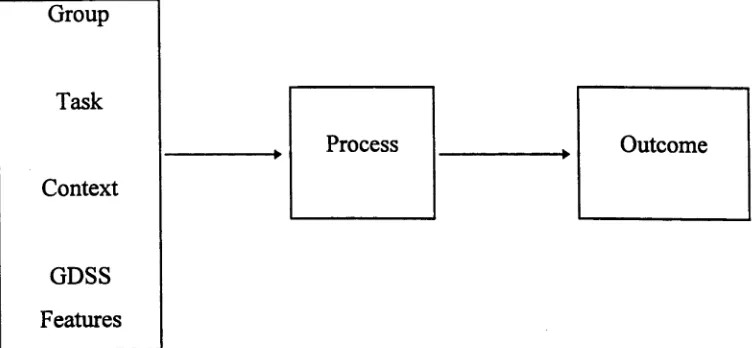
Fig 2.1: Input-Process-Output GDSS Research Framework
Group
Task
Context
GDSS Features
Process Outcome
2.5.2 Task Structures
Although the input-process-output scheme provided a framework for the analysis of GDSS effects, it did not suggest the situations under which the use of GDSS can have a positive impact on group decision making. Of all the factors which have been suggested as moderating the effects of GDSS use in the input-process-output framework, the variable ‘group task’ is emerging as an important variable. Poole, Seibold, and McPhee (1985) point out that: ‘the general variable, group task, is emerging as an especially important variable, often accounting for as much as 50% of the variance in group performance’ (p.88). DeSanctis and Gallupe (1987) note the importance of tasks and task differences in GDSS research. Kraemer and Pinsonneault (1989) provide a conceptual framework for analysing the impacts of GDSS on group process and outcome. Task differences are depicted as an important class of contextual variables for GDSS use. Several authors studying group decision making (Hackman and Morris, 1975; Hiltz, Johnson, and Turoff, 1986; McGrath, 1984; Poole and Hirokawa, 1986) also point out the importance of the task in group decision research. Poole and Hirokawa (1986) declare that: ‘In the pantheon of factors determining decision behaviour and outcomes, task stands in the first position, both in terms of evidence supporting its effect strength and in terms of a theoretical linkage to decision processes’ (p.26). Task differences should be expected to affect significantly the communication process as well as the task performance (McGrath, 1984).
In spite of the importance of the task dimension and the elapsed time since its importance was identified, little effort has been devoted to a systematic analysis of the differences between tasks and how these differences affect group performance. GDSS research has generally been based on empirical evidence gathered in relation to a single task. Nor has the growing volume of research on GDSS focused on a specific class of task. Studies have been lumped together in efforts to understand process and outcome variable effects of small group decisions. Little systematic consideration has been given to the differences in tasks from one study to another (Pinsonneault and
to take into account the ways in which effective work in groups is contingent upon features of the group task (McGrath and Hollingshead, 1993).
Group tasks can refer to the characteristics of the group’s substantive work (McGrath, 1984). Group tasks can be classified according to the degree of complexity (Kraemer and Pinsonneault, 1989), for example, simple versus complex tasks; the type of the task (McGrath, 1984), for example, decision task versus idea generation task; and the structure associated with the particular task (Steiner, 1972), for example, additive, disjunctive versus conjunctive tasks. GDSS researchers have studied some aspects of task differences and their effects on GDSS use. Gallupe (1985) compared the effects of GDSS support between a simple and complex task and suggested that GDSS was more suitable for a complex task. Hollingshead, McGrath and O’Conner (1993) studied the effects of GDSS among different task types and found that there were no differences in performance between computer groups and face-to-face groups for idea generation and decision making tasks, but face-to-face groups performed better on negotiation and intellectual tasks than did their computed-mediated counterparts.
and procedural orientation and planning. That is, with different task structures, the group faces different procedural requirements for accomplishing its objective(s).
Some researchers also argue that task structure is a more fundamental concept than the type of task (Steiner, 1972; Gouran and Hirokawa, 1983; Hirokawa, 1980, 1990). Even within the same task type, there may be different task structures. Within a decision task, each group can make their group decision differently. Steiner (1972) identified three types of task structures typically imposed upon decision groups: additive, disjunctive, and conjunctive.
In an additive task, each group member contributes a part to the group decision and the success of the task is determined by the aggregation of individual effort. Group performance is determined by the aggregation of individual effort. Each group member has similar responsibilities and information. According to Zaccaro and Lowe (1988), each group member must maximise his or her own individual performance in order to maximise the overall group effort in an additive task.
In a disjunctive task, a group selects one optimal solution from an array of solutions proposed by individual group members (Littlepage, 1991; Steiner, 1972). The success of the decision group depends on whether a member who has the ability to solve the problem exists and whether group members recognise and accept the superior contribution of an individual’s solution to the exclusion of all others. The success of a disjunctive task is therefore heavily influenced by the performance of the members who make the greatest contribution.
group members. The whole group will fail even if only one member fails to contribute to the decision task. The success of the decision task is heavily influenced by the performance of the member who makes the least contribution.
According to Steiner (1972), even within a decision task, different task structures can exist and these task structures within a decision task will alter how a group approaches the task and eventually affect the behaviour of the group members and the performance of the decision groups. Although research on GDSS is starting to provide some empirical evidence for how decision performance across different group tasks are affected by GDSS support, the primary focus has been on the type of task (idea generating task versus decision task). Although the main objective of GDSS technology is to provide support for the group decision process, we still lack empirical studies of how GDSS technology may affect group decision performance under different task structures. This thesis is an attempt to bridge this gap in current GDSS literature.
2.5.3 Patterns of Group Communication
important function of group communication interaction as the moderator of the input- output linkage.
Thus, another possible reason why previous research on GDSS effectiveness has yielded much conflicting evidence is its failure to acknowledge explicitly the important role of the group decision process, especially the communication process, in group decision making. Although there has been a substantial amount of research activity in the area of GDSS, most of this research has focused exclusively on the effects of GDSS on the decision outcome, with very little focusing on understanding the effects of GDSS use on the decision process. The theoretical foundation of GDSS research stated that it was by studying the sources of group process gains or losses, and their balance within the decision making process that the effects of GDSS use could be predicted. It is surprising that so little of GDSS research has looked at the micro-level of how GDSS use can reduce process losses and how the change of decision making processes influences the decision outcomes of the group.
The need for controlled, micro-level studies of the process of interaction, as a key to understanding the relationships between decision support and decision quality, has been pointed out by several GDSS scholars. McCartt and Rohrbaugh (1989) state that GDSS decision processes cannot be evaluated on the basis of outcomes alone, the process must be evaluated in order to understand how decisions are made. Pinsonneault and Kraemer (1990) also point out that GDSS research needs to study dynamic interactions and process activities of the group.
and total decision time. However, global effects do not necessarily indicate why members are not satisfied with the GDSS support process nor do they provide an insight into the manner in which decisions get shaped. GDSS can be characterised as a social technology (Poole and DeSanctis, 1990; Contractor and Seibold, 1993) and understanding the communication patterns is especially likely to provide an answer to how GDSS shape the process and the outcome of group decision making and hence explain why GDSS can improve group performance in some situations but fail to perform in another situation (Poole, Holmes, and DeSanctis (1991).
2.6 Research Questions
Although research reviews of the empirical work on GDSS use have attempted to integrate the conflicting results by attributing differences to different types of task the GDSS try to support, a systematic empirical study of the effects of GDSS use on different group tasks, especially on different decision task structures is still lacking. On the basis of an extensive review of the literature, this research appears to be the first empirical study to examine GDSS effects on different task structures.
The primary objective of this study is to examine whether the structure of a decision task moderates the effects of GDSS on the patterns of group communication and decision outcomes in a decision making group. Decision outcomes are measured by objective decision performance and perceived decision satisfaction with the group decision making process. The second objective is to examine the relationship between the patterns of group communication and decision outcomes in face-to-face and GDSS supported groups working on a decision task. Within the framework of the objectives, this study seeks to answer the following questions:
2. Are there any systematic differences in the patterns of group communication between GDSS supported and face-to-face decision making groups across different task structures?
3. Is there any systematic relationship between the patterns of group communication and the decision outcomes among the GDSS supported and face-to-face decision making groups across different task structures?
This study attempts to make a contribution to the development of an emerging trend of GDSS research by isolating task structure as one of the variables which can moderate the effect of GDSS use among decision making groups as well as recognising the importance of the decision process as the key to explaining the relationship between the effects of GDSS technology and group decision making. This research would appear to be the first empirical investigation designed to examine systematically GDSS technology and task structure and their influence on patterns of group communication and the decision performance of decision making groups. It is designed to provide reliable information so that future GDSS can be designed to suit the different requirements of different decision task structures.
2.7 Chapter Summary
This chapter examined the roots of GDSS research and the theoretical foundation for understanding the effects of GDSS use in group decision meetings. This chapter also reviewed both laboratory and field studies on GDSS and suggested further research areas based on the results of prior research. It can be concluded that the effects of GDSS appear to depend on a variety of contingent factors. Understanding how GDSS affect tasks with different structures can help to explain the inconsistent empirical results of GDSS research and provides a better understanding of how GDSS can be used under different task structures. A research question was developed in this study. This question was examined according to a research framework developed in Chapter