Theses and Dissertations
May 2014
Self-regulated Learning (SRL) Microanalysis for
Mathematical Problem Solving: a Comparison of a
SRL Event Measure, Questionnaires, and a Teacher
Rating Scale
Gregory Lee Callan
University of Wisconsin-Milwaukee
Follow this and additional works at:https://dc.uwm.edu/etd
Part of theEducational Psychology Commons,Psychology Commons, and theScience and Mathematics Education Commons
This Dissertation is brought to you for free and open access by UWM Digital Commons. It has been accepted for inclusion in Theses and Dissertations by an authorized administrator of UWM Digital Commons. For more information, please [email protected].
Recommended Citation
Callan, Gregory Lee, "Self-regulated Learning (SRL) Microanalysis for Mathematical Problem Solving: a Comparison of a SRL Event Measure, Questionnaires, and a Teacher Rating Scale" (2014).Theses and Dissertations. 557.
SELF-REGULATED LEARNING (SRL) MICROANALYSIS FOR MATHEMATICAL PROBLEM SOLVING: A COMPARISON OF A SRL EVENT MEASURE,
QUESTIONNAIRES, AND A TEACHER RATING SCALE
by
Gregory L Callan
A Dissertation Submitted in Partial Fulfillment of the Requirements of the Degree of
Doctor of Philosophy in Educational Psychology
at
The University of Wisconsin-Milwaukee August, 2014
ii
ABSTRACT
SELF-REGULATED LEARNING (SRL) MICROANALYSIS FOR MATHEMATICAL PROBLEM SOLVING: A COMPARISON OF A SRL EVENT MEASURE,
QUESTIONNAIRES, AND A TEACHER RATING SCALE by
Gregory L Callan
The University of Wisconsin-Milwaukee, 2014 Under the Supervision of Professor Timothy Cleary
The current dissertation examined the validity of a context-specific assessment tool, called Self-regulated learning (SRL) microanalysis, for measuring self-regulated learning (SRL) during mathematical problem solving. SRL microanalysis is a structured interview that entails assessing respondents’ regulatory processes as they engage with a task of interest.
Participants for this dissertation consisted of 83 eighth grade students attending a large urban school district in Midwestern USA. Students were administered the SRL microanalytic interview while completing a set of mathematical word problems to provide a measure of their real-time thoughts and regulatory behaviors. The SRL microanalytic interview targeted the SRL processes of goal-setting, strategic planning, strategy use, metacognitive monitoring, attributions, and adaptive inferences. In addition, students completed two questionnaires measuring SRL strategy use, and one questionnaire measuring self-esteem. The participant’s mathematics teacher completed a teacher rating scale of SRL for each participant. Mathematical skill was measured
iii
with three measures including a three item measure of mathematical problem solving skill completed during the SRL microanalytic interview, a fifteen item posttest of mathematical problem solving skill completed two weeks after the SRL microanalytic interview, and a standardized test of mathematics skill.
The primary objectives of this dissertation were to compare the newly developed SRL microanalytic interview to more traditional measures of SRL including two self-report
questionnaires measuring adaptive and maladaptive SRL and a teacher rating scale of SRL. In addition, the current dissertation examined whether SRL microanalysis would diverge from a theoretically unrelated construct such as self-esteem. Finally, the primary interest of the current dissertation was to examine the relative predictive validity of SRL microanalysis and SRL questionnaires. The predictive validity was compared across three related but distinct mathematics outcomes including a short set of mathematical problem solving items, a more comprehensive posttest of MPS problem solving skill, and performance on a standardized mathematics test.
The results of this study revealed that SRL microanalysis did not relate to self-report questionnaires measuring adaptive or maladaptive SRL or teacher ratings of SRL. The SRL microanalytic interview diverged from the theoretically unrelated measure of self-esteem. Finally, after controlling for prior achievement and SRL questionnaires, the SRL microanalytic interview explained a significant amount of unique variation for all three mathematics outcomes. Furthermore, the SRL microanalytic protocol emerged as a superior predictor of all three
iv
© Copyright by Gregory Callan, 2014 All Rights Reserved
v
TABLE OF CONTENTS
1. CHAPTER ONE: INTRODUCTION……….…………...1
2. CHAPTER TWO: REVIEW OF THE LITERATURE....………….………...15
Self-Regulated Learning Defined…………...……….……….………...16
Mathematical Problem Solving and SRL.………...……...31
Measurement of SRL ………..………..…………..……...42
SRL Microanalysis………..………….…………..……...………...53
3. CHAPTER THREE: METHODOLOGY………....……….….…...62
Participants……….62
Measures……..………..63
Procedures………..………...74
Research Questions & Analyses………....…83
4. CHAPTER FOUR: RESULTS……….…87
Convergence of SRL Measures………...…..93
Divergence of SRL and Self-Esteem………...98
Predictive Validity of SRL Microanalysis………...100
5. CHAPTER FIVE: DISCUSSION………..106
Discussion of Convergence of SRL Measures……….106
Discussion of Divergence of SRL Measures………..….113
Discussion of Predictive Validity………....114
Limitations………...………121
Future Research …..………... 122
6. APPENDICES……… ……….…….……….125
Appendix A: SRL Microanalytic Protocol……...……….….….………125
Appendix B: SRL Microanalytic Coding Manual………...…143
Appendix C: SRL Microanalytic Scoring Scheme………...155
Appendix D: Posttest MPS Items………157
vi
LIST OF FIGURES
Figure Page
vii
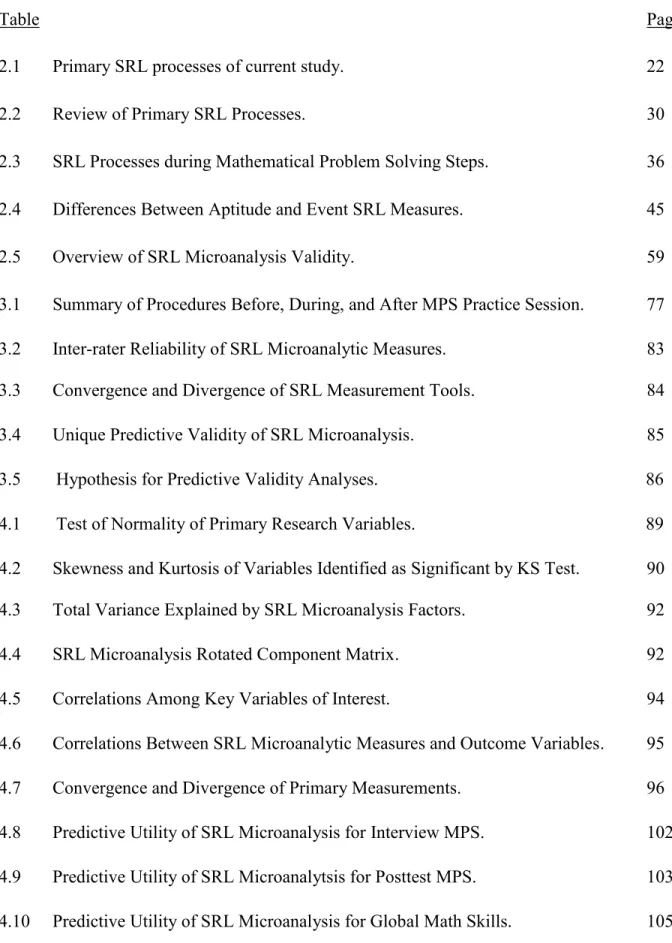
LIST OF TABLES
Table Page
2.1 Primary SRL processes of current study. 22
2.2 Review of Primary SRL Processes. 30
2.3 SRL Processes during Mathematical Problem Solving Steps. 36 2.4 Differences Between Aptitude and Event SRL Measures. 45 2.5 Overview of SRL Microanalysis Validity. 59 3.1 Summary of Procedures Before, During, and After MPS Practice Session. 77 3.2 Inter-rater Reliability of SRL Microanalytic Measures. 83 3.3 Convergence and Divergence of SRL Measurement Tools. 84 3.4 Unique Predictive Validity of SRL Microanalysis. 85 3.5 Hypothesis for Predictive Validity Analyses. 86 4.1 Test of Normality of Primary Research Variables. 89 4.2 Skewness and Kurtosis of Variables Identified as Significant by KS Test. 90 4.3 Total Variance Explained by SRL Microanalysis Factors. 92 4.4 SRL Microanalysis Rotated Component Matrix. 92 4.5 Correlations Among Key Variables of Interest. 94 4.6 Correlations Between SRL Microanalytic Measures and Outcome Variables. 95 4.7 Convergence and Divergence of Primary Measurements. 96 4.8 Predictive Utility of SRL Microanalysis for Interview MPS. 102 4.9 Predictive Utility of SRL Microanalytsis for Posttest MPS. 103 4.10 Predictive Utility of SRL Microanalysis for Global Math Skills. 105
viii
ACKNOWLEDGEMENTS
I would like to begin by thanking the members of my dissertation committee: Dr. Timothy Cleary, Dr. Cindy Walker, Dr. John Surber, Dr. Jay Beder, and Dr. Bonnie Klein-Tassman for their help and support throughout my dissertation project. I would especially like to thank, Dr. Timothy Cleary for his continued guidance and mentorship throughout the completion of my dissertation and my development as a researcher and scholar. I truly appreciate the vast amount of time and energy that you have dedicated to this dissertation project and how you persistently challenge your students to strive for excellence.I also would like to specifically thank Dr. Cindy Walker for her assistance and support on my dissertation. I very much appreciated your support with statistical decision making, but also for sharing your expert knowledge in mathematics education and assistance with IRB procedures during Dr. Cleary’s transition to Rutgers University.
I also owe a debt of gratitude to my family and friends. I greatly appreciate all of your encouragement and support. I particularly want to thank my parents for being a continual source of support and for discussing research ideas frequently. My sister, Kristy, deserves special note since her insight as a mathematics educator was called upon many times throughout my
dissertation project.
I would also like to thank the Society for the Student of School Psychology for awarding the “Society for the Study of School Psychology Dissertation Grant Award” to this dissertation project. This award enabled me to enlist the help of several excellent research assistants and this project would not have been possible without this support.
Chapter 1: Introduction
Although a number of personal (e.g., aptitude, disabilities, or engagement) and environmental (e.g., school funding problems, socio-economic disadvantages, high rates of mobility, or teacher quality) factors have been identified as contributors to academic achievement, researchers in many fields have identified self-regulated learning (SRL) as a critical determinant of student success (DeCorte, Mason, Depaepe, & Verschaffel, 2011; Eccles & Wigfield, 2002; Fuchs & Fuchs, 2003; Schunk & Swartz, 1993a). In general, SRL has been defined as a variety of processes and beliefs that an individual can engage to optimize their behavior, motivation, and cognitions in relation to a task (Bandura, 1986; Zimmerman, 2000). In academic contexts, a vast literature base demonstrates a strong connection between SRL and a myriad of academic outcomes, such as reading comprehension, writing, and math-problem solving (Fuchs & Fuchs, 2003; Graham & Harris, 2005; Guthrie & Wigfield, 2000).
Furthermore, intervention programs that consistently enhance student regulatory functioning, academic achievement, and learning have been developed in the past decade (Butler,
Beckingham, & Lauscher, 2005; Cleary & Zimmerman, 2004; Glaser & Brunstein, 2007). From an educator’s or school-based practitioner’s point of view, SRL is critical for many reasons beyond the established link between SRL and academic outcomes and the proliferation of SRL interventions. For example, as many as 25% of students referred for special education evaluations have underlying regulatory or motivation deficiencies. In addition, both teachers and school psychologists have identified the assessment of SRL as a key area of professional
development training need and interest (Cleary, 2009; Cleary, Gubi, & Prescott, 2010). Researchers have echoed this sentiment with a recent emphasis on the development of new
assessment methodologies that more adequately reflect contemporary views of SRL as a context-specific and dynamic construct which occurs in relation to context-specific events in time.
Although some new measurement methodologies have emerged, a great deal of research is needed to explore their utility for measuring SRL during authentic academic activities (Winne & Perry, 2000; Zimmerman, 2008). There is a particular need to examine the utility of a semi-structured interview called SRL microanalysis in academic domains (Zimmerman, 2008). Another emergent area of need in the SRL research literature is comparing traditional measures of SRL, such as questionnaires with more contemporary measures, such as behavioral traces, think alouds, and SRL microanalysis to identify the most effective and valid methods for measuring SRL (Winne & Jamieson-Noel, 2002; Zimmerman, 2008).
Self-regulation defined
Stated simply, self-regulation, also known as self-regulated learning (SRL) when applied to learning or academic contexts, is conceptualized as a cyclical process wherein individuals enact a variety of sub-processes (e.g., goal-setting, planning, task- and regulatory strategies, and reflection) to control, monitor, and regulate their cognitions, motivation, and behavior while engaged with a task (Bandura, 1986; Zimmerman, 2000). The construct of SRL entails a diverse set of related processes, such as self-efficacy, goal-setting, strategy use, and attributions, each of which have been examined and supported by a rich research base.
Many theorists believe that SRL is best understood as a set of inter-connected processes that operate in a recursive or cyclical fashion (Ames & Archer, 1988; Pintrich, 2000;
Zimmerman & Schunk, 2011). For example, Zimmerman (2000) defined SRL in terms of a cyclical loop, characterized by three related, yet distinct phases of forethought, performance control, and self-reflection. In the forethought phase, an individual employs distinct processes
before engaging in an academic task, such as setting goals and developing strategic plans. During performance or learning, also known as the performance control phase, individuals employ specific behaviors and strategies to optimize their learning and to keep track of their performance progress (e.g., use of strategies and self-monitoring). Finally, regulated individuals also engage in a systematic process of self-reflection whereby a number of sub-processes are enlisted such as self-evaluation, causal attributions, and or adaptive or reactive inferences (Zimmerman, 2000). This cycle is described as a feedback loop because the processes of each phase (forethought, performance, and reflection) exert an influence on the subsequent phases such that forethought processes impact subsequent performance control processes, which in turn, influence reflection. The cycle is considered complete when self-reflection processes influence forethought
(Zimmerman, 2000).
Linking SRL and Mathematical Problem Solving
Mathematics is a multi-faceted academic domain that includes several important components such as completion of computations or knowledge of mathematical terminology, concepts, and mathematical operations. Computation refers to the processes involved in the actual solving of a mathematical problem (Rutherford-Becker & Vanderwood, 2009). Mathematical knowledge can refer to awareness of formulas, multi-step procedures, or
understandings of underlying mathematical theory. Although educators can and often do isolate these aspects of mathematics for various tasks, in other cases, such as mathematical problem solving (MPS), students must synthesize their mathematical knowledge and computational skills to solve a mathematical problem.
Mathematics problem-solving (MPS), the academic task of interest in the proposed dissertation project, is among the most essential, yet complex facets of mathematics. Problem
solving skills are an important area for study because it requires many mathematical skills, is highly related to general mathematical achievement (Bryant, Bryant, & Hammill, 2000; Geary, 2003; Lewis, 1989) and is considered the basis for developing critical thinking skills (Baroody, 2003; Hiebert & Wearne, 1993; NCTM, 2000). Furthermore, problem solving is a difficult skill for students to master because it requires a fluid synthesis of many core mathematics and general academic skills such as: reading, translating language into mathematical terms, and the
mathematical knowledge and computation skills described previously (Bednarz & Janvier, 1996; Martin & Bassok, 2005).
Although SRL is related to many academic tasks, (MPS) was selected as the academic area of focus for the current study for several reasons. First of all, prior research has established a strong link between SRL and more effective problem solving. For example, regulated learners who strategically apply cognitive, metacognitive, resource, and task-specific strategies as well as set quality goals, plan, self-monitor, reflect, and adapt their approach throughout the problem solving process, tend to out-perform their less strategic peers (see Table 2.2) (Efklides,
Kourkoulou, Mitsiou, & Ziliaskopoulou, 2006; Lucangeli & Cabrele, 2006; Montague, 2008; ). Moreover, MPS was selected because current mathematical research suggests a need for
measures similar to SRL microanalysis to aid educational professionals. Finally, minimal
research has extended the SRL microanalytic measurement methodology to academic tasks, with no study (to the author’s knowledge) applying SRL microanalysis to mathematics.
Measurement of SRL Overview of SRL Measurement
Over the past couple of decades, SRL has been studied using a variety of measures, such as self-report questionnaires, (Pintrich, Smith, Garcia, & McKeachie, 1993) structured
interviews, (Zimmerman & Martinez-Pons, 1988) teacher rating scales, (Cleary & Callan, 2013; Zimmerman & Martinez-Pons, 1986) behavior traces (Winne & Perry, 2000), direct observations (Corno, 2001), diaries (Randi & Corno, 1997), think-alouds (Azevedo,Greene, & Moos, 2007; Perry, 1998; Perry & Winne, 2006), and SRL microanalysis (Cleary & Zimmerman, 2001; Cleary, Zimmerman, & Keating, 2006; DiBendetto & Zimmerman, 2010; Kitsantas & Zimmerman, 2002).
In general, most SRL measures can be categorized into two major measurement classes, aptitude measures or event measures (Winne & Perry, 2000). Although there are commonalities amongst these assessment classes, there is also great variation across and within each of these categories. In the following sections, the author will review aptitude measures and event
measures, providing examples of each measurement class to illustrate key features, differences, strengths, and weaknesses of each measurement classification.
Aptitude measures. Aptitude measures come in many formats, but most commonly take
the form of self-report questionnaires and teacher ratings. Self-report questionnaires have been particularly popular in SRL research and in educational practice while teacher rating scales have received respectively less attention. The popularity of self-report questionnaires is largely attributed to their relative ease of administration and scoring, their efficiency in terms of time and financial resources, and the wide availability of questionnaire measures (Jamieson-Noel & Winne, 2003; Pintrich et al., 1991;). On the other hand, teacher rating scales have received relatively less attention in the SRL literature, but some initial research suggests that teachers’ ratings of student SRL are highly predictive of future achievement and may more accurately depict actual student regulation (Cleary & Callan, 2013; Dibendetto & Zimmerman, 2013).
A key feature of aptitude measurements, like self-reports, is that they tend to measure SRL as a global ability (aptitude) by relying on averaged or “aggregated” scores across several items that often target multiple events or heterogeneous instances of regulation. For example, most questionnaires or teacher rating scales require respondents to provide ratings to a number of statements that describe a single regulatory construct (e.g., a regulatory belief or behavior) across various tasks, academic domains, or contexts (Winne & Perry, 2000). For example, a questionnaire measuring the use of a specific SRL strategy such as “elaboration” may ask students to rate how often they elaborate in a number of slightly different contexts (e.g., taking notes, studying for an exam, doing homework, etc…). These ratings would then be averaged yielding a composite score that describes a student’s general use of elaboration. Statistically speaking, this process is often considered advantageous since it enables an examination of the internal consistency of scales and subscales.
The interpretation of these aggregated scale scores is problematic because of the tendency to render SRL as a dispositional or global trait of an individual, rather than the multi-component process that is described in contemporary SRL theories. Moreover, recent research suggests that SRL is best understood as a dynamic process that adapts over time and is influenced by
contextual factors (Cleary & Chen, 2009; Hadwin, Winne, Stockley, Nesbit, & Woszczyna, 2001; Lodewyk, Winne, & Jamieson-Noel, 2009; Urdan & Midgley, 2003). That is, individuals employ different SRL processes for different tasks and thus, the composite scores derived from aptitude measures may have little relevance to any one task (Hadwin et al., 2001; Lodewyk et al., 2009). The interpretation of SRL aptitude measurement is also problematic because these
Among the many different types of aptitude measures, self-report questionnaires in particular have received criticism in recent years because respondents are required to report their behaviors, cognitions, or beliefs retrospectively(Dyson, 2003; Gresham, MacMillan, Beebe-Frankenberger, & Bocian, 2000; Heath & Glen, 2005; Schacter, 1999; Stone & May, 2002; Zimmerman, 2008). This is problematic given the large body of evidence that illuminates the fallibility of memory for one’s own behaviors or cognitions. For example, research has depicted that questionnaires measuring SRL are often inconsistent with direct observations of how students actually regulate their thoughts and behaviors (Jamieson-Noel & Winne, 2003; Winne & Jamieson-Noel, 2002; Winne & Perry, 2000; Winne, 2010).
In response to these criticisms, researchers have developed and refined a variety of alternative assessment approaches (event measures) over the past decade that are better equipped than questionnaires to measure SRL as a dynamic, contextualized process. A few of the more common approaches include behavior traces, think-alouds (verbal protocols), direct observations, and SRL microanalysis (semi-structured interview).
Event measures. Event measures, the other major class of SRL assessments, differ from
the more traditional aptitude questionnaires because the former tend to be more context-specific, fine grained, and are directly linked with behaviors or regulatory processes as they occur in real-time during relevant tasks (Gordon & Feldman, 2008; Stiles, Leiman, Shapiro, Hardy, Barkham, Detert, Llwwelyn, 2006; Winne & Perry, 2000; Zimmerman, 2008). An important characteristic of most event measures is that they are designed to capture SRL at select moments, in particular situations, or in relation to a single task (Winne & Perry, 2000). When measuring SRL as an event, for example, one might be interested exclusively in a student’s SRL processes while
solving mathematical problems, but not how that student prepares for a math exam because these two tasks entail very different contexts and demands.
Although the term “event measure” describes a category of related measures that share the above characteristics, there is a considerable amount of variation among these approaches. For example, one type of event measure, behavior traces, analyzes the observable artifacts left behind from studying behaviors such as highlighted text or instances of note taking that indicate the engagement in SRL processes (Winne & Perry, 2000). In contrast to behavior traces, think aloud protocols involve asking students to report their real-time cognitions while performing a task (Ericsson & Simon, 1980), such as when a student is asked to describe their thoughts and approaches to solving a mathematical problem. This dissertation describes a semi-structured interview, event measure known as SRL microanalysis.
SRL microanalysis. The primary focus of this dissertation project is a type of
contextualized self-report measure known as SRL microanalysis. This measure adheres to a structured interview format involving the administration of context-specific SRL questions at specific points during task completion. SRL microanalytic protocols elicit information about students’ forethought, performance, and self-reflection phase regulatory processes while they are engaged in a narrowly defined task (Cleary, 2011).
Although SRL microanalytic protocols and aptitude questionnaires are technically both forms of self-report measure (i.e., students provide responses to specific questions or statements), they are quite different. Unlike questionnaires, SRL microanalytic protocols are customized around specific contexts and tasks (rather than global or general items), attempt to measure SRL processes as they unfold in real time (rather than retrospective student accounts), tend to rely on open-ended questions (rather than exclusively Likert scale items), and often use highly specific,
single item measures to capture well-defined sub-processes of the SRL cyclical feedback loop (as opposed to multi-item subscales) (Cleary, 2011). SRL microanalytic protocols are also distinct from all other SRL measures because they are grounded theoretically in the three-phase cyclical model of SRL (see chapter two for more details) and attempt to directly examine the cognitive and metacognitive dimensions of SRL in a highly systematic and structured manner. The key features of SRL microanalysis are outlined below.
Core features of SRL microanalysis. SRL microanalytic protocols can be differentiated from all other SRL measurement forms by a number of features. First, it is important to
understand that SRL microanalystic protocols are designed to capture the cyclical phase processes described in the three-phase model of SRL described by Zimmerman (2000). SRL microanalysis is closely linked with the three-phase model of SRL (Zimmerman, 2000) in that the processes to be measured are selected directly from the three-phase model and the question phrasing is derived from the definitions found in the model. Microanalytic question
administration is also temporally linked with the three-phase model. For example, items measuring forethought processes (goal-setting, planning) are administered before task engagement, when forethought processes are most salient.
Although a more thorough description of SRL microanalysis will be provided in chapter two, some of the core components will be highlighted briefly (1) individualized administration, (2) selection of target SRL processes from Zimmerman’s model of SRL, (3) task-specific questions targeting SRL as a context specific construct, (4) temporal sequencing of SRL microanalytic questions, and (5) verbatim recording and coding of participants’ responses.
First, SRL microanalysis is administered to one examinee individually to control for social and normative influences. Second, constructs are selected from the three-phase model of
SRL (Zimmerman, 2000) and the respective microanalytic questions are developed directly from the operational definitions found within the SRL literature (Bandura, 1997; 2000). The three-phase model of SRL is grounded in social-cognitive theory, which assumes variation in SRL processes across contextual factors. Therefore, a third and related point is that SRL microanalytic questions are designed to measure SRL in relation to a specific task for which the context is known (Cleary, 2011). Due to the contextualized focus of social-cognitive theory and because SRL has been shown to often vary across contexts and tasks (Hadwin et al., 2001), SRL
microanalytic protocols are comprised of several highly focused and independent items, most of which target a single SRL process individually.
A fourth point is that SRL microanalytic protocols also link the administration of the questions during the task (before the task, during the task, after the task) with the temporal properties of the three-phase model (forethought, performance, and self-reflection; Cleary, 2011). For example, microanalytic items measuring forethought processes will be administered before an individual engages with a task, when the forethought processes are most salient. By mapping item administration onto the three-phase model (i.e., administering forethought SRL questions before performance), researchers are able to make interpretations about theoretically-linked regulatory processes in relation to task performance.
Rationale of the Study
There is emerging evidence that SRL microanalytic protocols demonstrate strong psychometric properties for motoric tasks such as serving a volley ball, dart throwing, or shooting a basketball free-throw. Across such tasks, SRL microanalytic protocols have been shown to differentiate high and low achievers and predict future achievement (Cleary & Zimmerman, 2001; Cleary, Zimmerman, & Keating, 2006; Kitsantas & Zimmerman, 2002).
Since many SRL microanalytic measures consist of single items, reliability is most often calculated in terms of inter-rater reliability. Several studies have shown that SRL microanalytic measures display acceptable reliability (Cleary, Callan, & Zimmerman, 2012; Cleary &
Zimmerman, 2001; Cleary et al., 2006; Kitsantas & Zimmerman, 2002).
In academic settings, the use of SRL microanalytic protocols has been sparse. For example, DiBenedetto and Zimmerman (2010) used this assessment approach to differentiate high achievers from low achievers in high school in terms of the quality of strategic plans when studying a text passage, the use of strategies during performance (e.g., the frequency of self-monitoring), and the nature of student self-reflections (e.g., attributions). Another application of SRL microanalysis with college students, showed that self-reflection processes measured with microanalytic measures were a key predictor of student success in school (Cleary, Callan,
Peterson, & Adams, 2011). These studies aside, there is very minimal support for the use of SRL microanalytic assessment methodology in academic contexts, with no studies targeting
mathematic skills. Thus, there is a need to advance our understanding of the applicability and validity of infusing SRL microanalysis into academic tasks such as mathematical problem solving.
As indicated previously, SRL and mathematics problem-solving skills are very much linked; however, very few studies have examined SRL during mathematics problem-solving. This study will attempt to examine what mathematics educators have been encouraging from researchers by examining the types of strategies that students employ during mathematics tasks as well as how students select, apply, and adapt specific strategies and SRL processes to meet task demands (Fuchs & Fuchs, 2003; Pape, Bel, & Yetkin, 2003; Resnick, 1988). From the author’s perspective, and that of other researchers, to more validly measure this dynamic process,
researchers need to use event-related measures, such as SRL microanalysis, that are more sensitive to the specific characteristics and features of specific academic tasks or activities (De Corte, Verschaffel, & Eynde, 2000; Winne & Perry, 2000; Zimmerman, 2008). Although researchers have suggested that event-based assessment tools may be more adequate for measuring SRL as a contextualized process, minimal research directly compares the utility of different SRL assessment approaches. Given that self-report questionnaires continue to be the most widely used form of SRL measurement, and that there is emerging evidence for the utility of SRL event measures, it is of particular interest to determine how SRL questionnaires, teacher ratings, and event measures relate to one another and if SRL microanalysis predicts unique variation in academic tasks. The current dissertation addresses this research need by examining the validity of SRL microanalysis relative to more traditional questionnaire assessment tools.
The validation of SRL microanalytic protocols is also of importance because this assessment procedure is highly applicable to recent service delivery changes in the field of education. In recent years, the service delivery models used in schools tend to rely on a process-oriented assessment and intervention framework whereby educators rely on contextualized forms of assessment, such as functional behavior assessment, direct observations, and curriculum-based measurement, to identify students who struggle in school and ways to most effectively help them. This model advocates for continuous assessment to measure changes in student functioning as a result of intervention services or pedagogical adaptations (Bergan, Curry, Currin, Haberman, & Nicholson, 1973; Deno, 1985; Fuchs & Fuchs, 2006; Reschley, 2008). Microanalysis fits exceptionally well with this emerging model because it is context specific, more sensitive to very fine changes in SRL and thus is optimal for tracking intervention progress (Cleary, 2011; Cleary et al., 2008; Cleary & Zimmerman, 2004). Although this dissertation topic
does not address the issue of how to use SRL microanalysis in terms of service delivery in school, it can bridge the academic gap in microanalytic research by determining the predictive and concurrent validity of SRL microanalysis for a problem solving task.
Purposes
Given the recent emphasis placed on SRL as a contextualized, dynamic process, there is a clear need, particularly in academic contexts, to develop measures capable of assessing SRL as a context-specific construct that occurs in real-time on specific tasks. Furthermore, research is needed to better understand which measures may be most effective for predicting achievement across a range of academic outcomes and whether there is convergence and divergence across different measurement tools. These emergent issues in the SRL literature are addressed in part by this study. Moreover, this study examines the predictive validity of a SRL microanalytic protocol in relation to MPS skill. Since very little research has explored whether event based measures can effective predictive more global, distal outcomes, this study will also explore whether SRL microanalysis displays predictive validity for general mathematical achievement outcomes.
For this study, a SRL microanalytic protocol was designed for the purpose of measuring students’ SRL while they prepare for, complete, and reflect on a set of mathematical problem solving items. In doing so, several specific research objectives are addressed regarding the relationships between SRL microanalysis and more traditional measures of SRL and the
predictive validity of SRL microanalysis as it relates to mathematical problem solving and more global mathematics skill. Specific research questions are addressed below:
(1) This study examined whether SRL microanalytic measurement converges with SRL questionnaires and teacher ratings that were designed to measure students’ strategy use in the context of their mathematics class.
(2) In addition, this study examines if SRL microanalytic measurement diverges from theoretically unrelated constructs such as self-esteem.
(3) Finally, this study examines the predictive validity of SRL microanalytic protocol in relation to SRL questionnaires and prior achievement to determine if SRL microanalysis explains unique variation in students’ achievement in MPS tasks and more general mathematics achievement (i.e., standardized test performance).
Chapter Two - Literature Review Introduction
Over the past forty years, there has been a great deal of interest in SRL from both researchers and educational professionals (Boekaerts, Zeidner, & Pintrich, 2000; Butler, 1998; Clark, Gong, & Kaciroti, 2001; Kolovelonis, Goudas, & Dermitzaki, 2010). Self-regulated learning (SRL) research in academic settings has addressed several issues including the examination of achievement group differences in SRL processes and contextual factors that promote SRL (DiBendetto & Zimmerman, 2010; Perry & VandeKamp, 2000), development of intervention programs designed to teach or remediate regulatory skills (Butler et al., 2005; Cleary, Platten, & Nelson, 2008; Glaser & Brunstein, 2007), and even initiatives to improve the regulation of teachers (Bolhuis & Voten, 2001; Cardelle-Elawar et al., 2007; De la Fuente & Justicia, 2007). Of particular interest in recent years, however, has been the development of different types of assessment tools capable of measuring SRL (Boekaearts & Corno; 2005; Noell & Gansle, 2009).
Overview of Chapter
In this chapter, the author will address the key constructs and concepts related to this dissertation project. First, a definition of SRL and description of a comprehensive model of SRL based on a social cognitive perspective will be presented. The SRL processes of greatest
pertinence to the current study will be highlighted and expanded upon. In doing so, a framework is provided to illustrate why SRL constructs such as goal setting, strategic planning, strategy use, metacognitive monitoring, causal attributions, and adaptive inferences are of exceptional
importance for academic endeavors. Given that this dissertation will focus specifically on the measurement of SRL during MPS, the author will also explore the connection between SRL and
mathematics. Furthermore, the author will highlight the importance of mathematics competence for students’ academic and professional future, describe the skills necessary for effective
problem solving, and how primary SRL processes are involved in problem solving. Finally, a major focus of this chapter will center on several important issues related to SRL assessment tools. In addition to providing an overview of a broad array of assessment tools for measuring SRL and the specific characteristics and features of SRL microanalysis, the author will conduct an analysis of how SRL microanalysis compares to several questionnaire and teacher report measures.
Self-Regulated Learning Defined
There are several theoretical models of academic SRL including social cognitive theory (Zimmerman, 2000), process-oriented model of metacognition (Pintrich, 1989), four-stage information processing model of SRL (Winne & Hadwin, 1998), and adaptable learning (Boekaerts & Niemivirta, 2000). While a great deal of diversity can be found from one
perspective to another, there are a number of areas of overlap amongst core characteristics of the most popular theoretical perspectives (Mace, Belfiore, & Hutchinson, 2001; Weinstein, Husman, & Dierking, 2000; Puustinen & Pulkkinen, 2001). For example, many theorists agree that self-regulation is a cyclical process (Boekaerts & Niemivirta, 2000; Puustinen & Pulkkinen, 2001; Winne & Hadwin, 1998; Zimmerman, 2000) and that highly regulated students are those who actively engage in learning by means of multiple processes that optimize thoughts, feelings, and actions. Researchers also typically agree that standards and goals are used as benchmarks that direct learning and behavior. Finally most agree that SRL is influenced by a host of biological, contextual, developmental, and individual factors (Boekaerts & Corno, 2005).
Although every theoretical perspective entails strengths and weaknesses and the author does not posit that any one perspective should be considered superior to another for all purposes, the current study is conceptualized from a social cognitive perspective (SCT). From this account, SRL is understood as a process of self-generated thoughts, feelings, and behaviors that are strategically and continuously adapted to enhance performance and attainment of self-set goals (Zimmerman, 1989). Self-regulated learners actively employ cognitive, metacognitive, and behavioral processes in a strategic and proactive manner to optimize outcomes or may also respond reactively to adjust when encountering challenges (Bandura, 1986; Pintrich, 2000; Zimmerman, 2000). From a SCT perspective, specific SRL processes are organized within three broad phases (forethought, performance, and reflection) that operate in a cyclical fashion
(Zimmerman, 2000). Before delving further into the specific characteristics and sub-processes of the three-phase cyclical model, the author will briefly review the broader SCT from which cyclical SRL was conceived.
Social Cognitive Theory and SRL
The roots of social cognitive theory (SCT) are most often recognized with the work of Albert Bandura in the 1970’s (Evans, 1989) and were more fully solidified in the 1980’s
(Bandura, 1986). When SCT first emerged, it evidenced drastic differences from the behavioral and information processing schools of psychology that reigned superior at that time. Prior to the introduction of SCT, most psychological theories supported a unidirectional understanding of causation (Bandura, 1986; Evans, 1989). In other words, many believed that human behavior was the result of a single entity, such as the behavioral psychology explanation that actions arose as a result of the association between stimulus and response (Skinner, 1938; Watson, 1913), whereas information processing theorists were primarily concerned with internal cognitive
processes (Luszyczynska & Schwarzer, 2005; Neisser, 1967). SCT can be distinguished from these theories across many assumptions. Some of the most pertinent differences in core
assumptions include a triadic reciprocal understanding of causation, context-specificity, and the personal-agency of human behavior.
A core element of SCT and characteristic that distinguishes SCT from most other theories is a more inclusive theory of causation known as triadic reciprocal determinism (Bandura, 1986; Evans, 1989). Triadic reciprocal determinism indicates that behavior, cognition (and other personal factors), and the environment bi-directionally interact as determinants of human behavior such that each factor can simultaneously influence and be influenced by the other factors (Bandura, 1986). That is, behavior can affect cognition while behavior is reciprocally affected by cognition, or behavior can be influenced by cognitions that have been influenced by past behavior. Each factor does not necessarily influence the other factors simultaneously, the relationships among these three factors may not be equal in strength, and these factors need not occur concurrently to influence each other (Bandura, 1986; Bandura, 1989; Luszyczynska & Schwarzer, 2005).
The triadic reciprocal relationship between person, behavior, and environment is of importance for SCT, but regardless of the interaction amongst these factors, the mere inclusion of environmental causal factors is fundamental to SCT. That is, in comparison to many other major psychological frameworks, SCT is unique by its recognition that the environment in which an individual operates has a powerful impact on his/her thoughts and behaviors (Bandura, 1986). This environmental sensitivity, often referred to as “context-specificity,” is a recognition that although an individual may possess a range of specific “competencies” (i.e., developed skills such as social skills), those competencies do not exist within a vacuum. Instead, the physical or
social environment, the type of task, or even features of that task (e.g., difficulty) often influence the proficiency with which one applies these competencies or whether he/she chooses to apply them at all (Bandura, 1986). The context-specific nature of SCT has particularly important implications for SRL. When conceptualizing SRL from a SCT perspective, SRL should not be misconstrued as an exclusively global or trait-like construct of a person. Rather it may be best to recognize that SRL is comprised of both averaged competencies and context-specific application of those competencies (Bandura, 1986). That is, through a number of processes, individuals may acquire different skill sets, but may not always effectively or consistently apply them (Bandura, 1986).
Likewise, since the turn of the millennium, many researchers have strongly advocated the context-specific nature of SRL. Research supports this notion in that the types of strategies or regulatory processes that one employs often varies from one task to another and SRL tends to develop and adapt over time (Hadwin, Winne, Stockley, Nesbit, & Woszczyna, 2001; Pintrich, 2000; Urdan & Midgley, 2003; Zimmerman, 2000). Also, contextual factors such as the demand of a task in relation to one’s skill level may determine the extent that students engage
strategically or if they even have to at all (Cleary & Chen, 2009). The data supporting the context-specificity of SRL has become very difficult to ignore and as will be discussed in more detail shortly, this notion has been central to a more recent re-conceptualization of SRL
measurement procedures (Boekaerts & Corno, 2005; Winnie & Perry, 2000).
(SCT) can also be distinguished from other theoretical models, particularly behavioral models, by an assumption of personal agency. That is, human behavior is goal-directed and therefore an individual can proactively act to rearrange his or her environment or personal situation (Bandura, 1986). For example, Bandura (1986) originally proposed that people can
enact a number of behaviors, originally coined “the capabilities” to produce changes in their environment. The key “capabilities” included and ability to (1) use of symbols for the purpose of communicating or internalizing concepts (symbolizing capability), (2) anticipate consequences of potential actions, set goals, and plan actions that will enable the achievement of selected goals (forethought capability), (3) reflect on life experiences and cognitions while evaluating how adaptive one’s choices were and whether future modifications are required (self-reflective capability), (4) to learn through observation of consequences of other’s actions (vicarious capability), and finally (5) the capability to self-regulate (Bandura, 1986;Luszyczynska & Schwarzer, 2005). Although the final capability was titled the self-regulation capability, it should be noted that more current understandings of SRL is better reflected as a combination of all of the aforementioned capabilities. This “self-regulation capability” referred to the fact that human behavior is motivated by self-set standards, thus behavior is motivated to attain and evaluated against one’s internal standards (Bandura, 1986). When current performance is inconsistent with internal standards an individual can “self-regulate” his or her cognitions, motivation, or
behaviors by arranging facilitative environments, implementing cognitive strategies, and creating personal incentives to motivate behavior (Bandura, 1986). Bandura also postulated that SRL functioned via three sub-processes: self-observation, self-judgments, and self-reactions. observation is a process of monitoring performance across time (Bandura, 1986). Self-observation, also referred to as self-monitoring, will be more fully elaborated upon in the discussion of Zimmerman’s model. Self-judgment on the other hand, refers to a process of comparing performance to a set of internal standards. The comparison of performance against self-judgments sets the stage for the last process, self-reactions which consist of the feedback provided to oneself in relation to performance and self-judgments. Depending on whether
performance is viewed as desirable or undesirable, self-rewards or punishments can be
administered. Bandura’s model predates the more current model of self-regulated learning that more directly relates to the proposed dissertation.
Zimmerman’s (2000) Model of SRL
Building upon Bandura’s work to define social cognitive theory, Zimmerman (2000) described a more comprehensive model of SRL that encompasses a cyclical feedback loop consisting of three major phases: forethought, performance control, and self-reflection (see Figure 2.1). Each phase of SRL is comprised of a number of sub-processes that collaboratively enable the regulation of motivation, cognition, and behavior. In the following section, the author will describe the three major phases while focusing additional attention to the processes that are of greatest importance to the current dissertation study.
Overview of three-phase model. The forethought phase consists of the processes and motivational beliefs that are salient before engagement with a task (e.g., goal-setting & strategic planning), performance control highlights the processes (cognitive and behavioral) that occur while an individual is engaged in performance (monitoring & strategy use), and
self-reflection refers to the processes occurring immediately following performance or after receiving feedback (self-evaluation, causal attributions, satisfaction, & adaptive inferences; Zimmerman, 2000). These phases are described as cyclical because each phase influences the processes of the subsequent phase processes such that forethought processes influence performance processes, and performance influences reflection processes. Of greatest importance, however, to the notion of a “cyclical” feedback loop is that reflection phase processes hypothetically impact forethought processes during future learning and iterations of the loop (Zimmerman, 2000).
Figure 2.1
Zimmerman, (2000) Model of SRL.
Table 2.1
Primary SRL processes of current study.
Forethought processes Performance processes Self-reflection processes Goal setting Strategy Use Causal attributions Strategic planning Metacognitive monitoring Adaptive inferences
Performance Phase
Self-Control
Self-instruction Imagery Attention focusing Task strategiesSelf-Observation
Self-recording Self-experimentationForethought Phase
Task Analysis
Goal setting Strategic planningSelf-Motivation Beliefs
Self-efficacy Outcome expectations Intrinsic interest/value Goal orientationSelf-Reflection Phase
Self-Judgment
Self-evaluation Causal attributionSelf-Reaction
Self-satisfaction/affect Adaptive/defensiveForethought.
SRL Forethought processes. The forethought phase is a combination of self-regulatory
processes (e.g., goal setting and strategic planning) and motivational beliefs (e.g., self-efficacy, goal orientation, intrinsic interest, and outcome expectations; Zimmerman, 2000). Within
forethought, there are two major self-regulatory processes collectively described as task analysis. Task analysis is the decomposition of task requirements wherein students set goals and decide upon actions necessary to reach those goals. That is, regulated learners first set goals, by selecting a desired outcome or making a conscious decision as to what constitutes a successful completion of the target task. Strategic planning, which often follows the goal setting process, is the selection or construction of a plan involving one or more specific strategies or tactics that are believed to increase the odds of obtaining one’s goal (Zimmerman, 2000). Both forethought processes of goal-setting and strategic planning will receive particular attention in this dissertation project. Therefore, the author will provide a more extensive review of these constructs.
Goal-setting. Research suggest a strong link between goal types and improved achievement for many academic tasks, including mathematics (Cleary & Zimmerman, 2001; Church, Elliot, & Gable, 2001; Pajares & Graham, 1999). Setting goals is an important task within the larger three phase model of SRL because (during performance) it directs efforts and attention toward a desired outcome and serves as a bench mark against which one’s performance can be evaluated against (during reflection). In regard to the latter point, setting goals in the forethought phase is useful because an individual can evaluate progress toward his or her selected goal over time. As a result, an individual can strategically reflect to make appropriate adjustments to strategic plans to maximize his or her successful attainment of selected goals.
Goals can be very diverse in focus. Outcome goals also known as performance goals are focused on the attainment of a certain level of performance, whereas process goals involve correctly performing a set of procedures. Process goals are considered more adaptive during earlier stages of skill development (Zimmerman, 2002) because it promotes the mastery of a skill or understanding content (Ames & Archer, 1988; Dweck, 1986). Later in skill development, it may become more appropriate for learners to shift their focus to more outcome or performance related goals (Zimmerman, 2002). Goals can focus on different time frames as well. Long term goals, which are often more ambitious, are referred to as distal goals. On the other hand, goals focused on shorter durations of time or even check points along the way toward distal goals are known as proximal goals.
Goals not only facilitate performance control and self-reflection processes but also reciprocally enhance the motivational beliefs of the forethought phase. For example, accomplishing distal or proximal goals or making progress toward a goal (possibly
accomplishing a proximal goal along the path of a distal goal) theoretically produces an increase in motivation. This motivational boost may take the form of an increase in self-efficacy to accomplish more distal goals (long term goals) or to accomplish other future goals (Bandura & Schunk, 1981).
Strategic planning. Effective planning wherein students select the specific tactics and strategies to enlist is an important regulatory process that is linked to future achievement (DiBendetto & Zimmerman, 2010; Kitsantas & Zimmerman, 2002). In the three phase model, this process is known as strategic planning. Strategic planning is not merely applying a set of strategies because no single strategy is optimal for all tasks, situations, or individuals. Instead, strategic planning is best understood as a process of matching strategies and regulatory processes
to current task demands and modifying those plans as necessary (Weinstein & Mayer, 1986). As part of a strategic plan, students may choose to enact a number of regulatory strategies (cognitive and metacognitive strategies), task specific strategies, or even invent their own strategies to address task demands (Zimmerman, 1989). Employment of strategies often enhances
performance by controlling motivation, facilitating cognitions, or coordinating task execution. However, the benefit of strategic planning is not limited to the effect of later strategy use but can also serve a motivational function since a well-developed plan of action can increase efficacy for success.
Forethought motivational beliefs. Motivation is a term that has historically been used to
describe the processes that guide the development of behavior preferences, arouse and instigate behavior, give direction and purpose to behavior, and reinforce behavior to persevere (Reeve, 2005). Motivation and SRL are related in the sense that SRL is a broader construct within which motivation is subsumed. Although motivation is necessary for effective SRL, motivation alone does not sufficiently produce desired outcomes. Instead, SRL phase processes coupled with adequate motivation is deemed most advantageous because this combination is more likely to lead to the instigation and maintenance of SRL. Motivational beliefs have had a prominent impact in SRL theories and from a social cognitive point of view, motivational beliefs are considered a component of the forethought phase because motivation plays a significant role subsequent effort and quality of engagement (Christenson, Reschly, Appleton, Berman-Young, Spanjers, & Varro, 2008; Zimmerman & Cleary, 2009).
Some of the most prominent motivation beliefs in the three phase model are self-efficacy, outcome expectations, interest, and goal orientation. Self-efficacy, which is described as the beliefs one holds about his or her capabilities to organize and execute the courses of action
required to produce given attainments, (Bandura, 1997) is essential in promoting student
engagement in learning, plays a role in effort and task persistence, and can promote achievement (Linnenbrink & Pintrich, 2003; Schunk, & Swartz, 1993a). The role of self-efficacy has been implicated as a key process underlying overcoming phobias (Bandura, Jeffery, & Gajdos, 1975), the development of depression (Holahan & Holahan, 1987), and athletic performance (Daroglou, 2011) to name just a few. Of greatest interest to this dissertation, self-efficacy has a strong link to academic outcomes such as mathematics achievement (Hackett & Betz, 1989; Lent, Lopez, & Bieschke, 1993; Usher & Pajares, 2006; 2008). Outcome expectations, which is a distinct
motivational belief, consist of an individual’s judgments of the most probable consequences that will result from performing a particular behavior (Bandura, 1986). Interests are understood as the patterns of likes, dislikes, and indifferences regarding particular activities or tasks. Goal
orientation describes one’s predisposition to set certain types of goals (e.g., performance goals or outcome goals).
Performance control. During learning or when performing a task, there are a number of things that highly regulated persons will do to optimize performance, such as engaging in self-control and self-observation (Zimmerman, 2000).
Self-control. Self-control is a general category of actions and tactics that manage
motivation, affect, attention, or even motoric execution of the task. Some of the more common self-control tactics include: attention focusing, self-instruction, implementing task-specific strategies, or common SRL strategies (Zimmerman, 2000). Research has identified several common SRL strategies that are observed across many academic settings such as organizing and transforming information, seeking information or assistance, environmental structuring, setting self-consequences, or rehearsing appear frequently in academic pursuits (Zimmerman &
Martinez-Pons, 1986). Given that task-specific strategies differ from one task to another and that individuals are capable of inventing their own strategies, the list of potential strategies is nearly limitless.
Self-monitoring. Self-monitoring also known as self-observation will receive primary
attention in the proposed dissertation project. Self-monitoring is a systematic monitoring of performance such as recording task performance over time or maintaining metacognitive awareness of one’s actions and performance. Self-monitoring is essential to the larger SRL system and task performance in many respects. At its core self-monitoring enables a person to gather performance data against thus enabling evaluation and modification of performance. Monitoring fosters self-awareness of behaviors or cognitions, a precursor to modifying
inadequate strategic plans or actions (Bandura, 1991). Additionally, self-monitoring is directly linked to motivation given that a desire to observe an improvement in performance is usually accompanied by consistent monitoring over time. Hence, this desire to improve should result in increased effort expenditures (Bandura, 1991).
Self-reflection. During the final phase of the cyclical loop, self-regulated learners engage in several reflective processes, which are subsumed within one of two categories: self-judgments and self-reactions. Self-self-judgments are comprised of (1) self-evaluations, where an individual evaluates his or her performance based on internal and external standards and (2) causal attributions or the perceived cause of successful or unsuccessful performance. Judgment of one’s performance is most often followed by some form of cognitive and affective reaction. In the cyclical feedback loop, these self-reactions includean individual’s level of satisfaction (i.e., the degree to which one is pleased or displeased with performance outcome(s)). If an individual is dissatisfied with performance, he or she may consider necessary strategic adjustments
(adaptive inferences) to remediate the deficits in performance. In the case that such self-reactions influence future performance or forethought (i.e., goal setting or planning) the three phase cycle of SRL is considered to be complete (Zimmerman, 2000).
Two reflection phase processes (i.e., attributions and adaptive inferences) are of particular interest in this dissertation project because of their central role in determining
adaptations for future motivation, forethought, and performance in relation to future performance situations. Bandura (1986) postulated such processes to be so essential that it was suggested that all other regulatory processes, are of little use unless followed by effective self-reflection. For this reason, additional attention will be devoted to describing attributions and adaptive
inferences.
Attributions. Causal attributions refer to an individual’s perception of the cause of the
outcomes in a particular activity (Weiner, 1979) and are of primary interest to the proposed study because of the prominent role they play in determining future motivational beliefs, regulation, mental health, and behaviors (Robertson, 2000; Ross, Rodin, & Zimbardo, 1969). The impact of attributions has been noted across a wide variety of fields beyond academics and SRL. For example, attributions importance is noted for: academics, (Dweck, 1975; Schunk 1990), athletics (Cleary & Zimmerman, 2001; Kitsantas & Zimmerman; 2002), and psychology (Robertson, 2000; Weiner, 1979).
The construct of attributions first emerged with the work of Heider (1958) that examined individual’s perceptions of the cause of an event. Heider found that people tended to focus on either internal or external factors (Heider, 1958). Several years later, additional research by Weiner and colleagues more fully conceptualized an attribution theory, which outlined the primary qualitative features of attributions, identified the most prevalent forms of attributions,
and hypothesized potential consequences and benefits of producing various attribution types (Weiner, 1979). Although the target of an attribution can be nearly limitless, Weiner (1979) suggested that individuals most commonly attribute outcomes to one of four major categories: ability, effort, task difficulty, or luck and proposed that attributions can be classified across three dimensions: stability (stable or unstable over time), locus (internal or extern to the individual), and controllability (controllable or uncontrollable) (Weiner, 1979). To provide an example of how different attribution types might be classified across these dimensions; an ability attribution is considered an internal, stable, and uncontrollable attribution because ability is an internal characteristic of a person (internal), relatively unchangeable over time (stable), and under little control of the individual (uncontrollable). In comparison, an effort attribution would be
considered an internal, unstable, and controllable attribution.
The controllability of attributions is of primary importance to the proposed study because more controllable attributions have been linked to greater success in achievement settings and more productive SRL (Dweck, 1986; Dweck & Leggett, 1988; Schunk, 1990). That is, in academic settings more controllable attributions enhance: academic SRL (strategy use, goal setting, monitoring) (Thomas & Mathieu, 1994), motivational beliefs such as self-efficacy, persistence, & affect (Schunk, 1990), and task performance (Borkowski, Weyhing, & Carr, 1988; Clifford, 1986; Robertson, 2000).
Adaptive inferences. The construct of “adaptive inference” is yet another important
reflection process that is essential to the current dissertation project. Adaptive inferences
describe the strategic adjustments to regulatory behaviors or strategies that are deemed necessary following a performance or learning task (Zimmerman, 2000). Such a process of modifying one’s approach is essential to the cyclical nature of the three phase model because it serves as a
fulcrum point at which one has the opportunity to improve strategic plans or select more effective strategies that may ultimately result in enhanced achievement (Zimmerman, & Martinez-Pons, 1992). On the other hand, it is possible that an individual will engage in maladaptive forms of regulation such as rejecting responsibility or detracting from the task. In addition, it is further possible that students may neglect to identify the adaptive inferences needed to improve future performance. Research has suggested that students who generate adaptive inferences following a performance situation tend to achieve higher and regulate more effectively than peers who neglect to or generate defensive inferences (Cleary, et al., 2012; Schoenfeld, 1985; Zimmerman, 2000). Defensive inferences describe another set of thoughts or behaviors that one might generate following performance. These defensive inferences although strategic, in that they will protect students’ self-worth, may be termed as forms of maladaptive SRL because they often hinder later performance.
Table 2.2
Review of Primary SRL Processes.
Forethought processes Performance processes Self-reflection processes Goal setting Strategy Use Causal attributions Strategic planning Metacognitive monitoring Adaptive inferences
Maladaptive regulation. SRL is not only the types of things that students engage to optimize their performance, but also consists of many maladaptive practices or ineffective strategies that students may use. Although the current dissertation will not address the entirety of maladaptive regulation, one subscale implemented in this study identifies students’ use of
is important to mention several aspects of maladaptive regulation. Maladaptive regulation may take several forms such as self-handicapping (Urdan & Midgley, 2003; Zimmerman, 2000), procrastination (Burka, 2008), defensive pessimism (Martin et al., 2001) failing to seek help when needed, or forgetting important materials may also be considered maladaptive regulation. Self-handicapping is the engagement in activities that prevent or seriously hamper an
individual’s attempts to accomplish important academic activities (Urdan & Midgley, 2003). Procrastination is a subtype of self-handicapping, in which students put off work until the
remaining time to finish a project is so inadequate that their final performance is greatly hindered (Burka, 2008). Essentially defensive pessimism is a trade off in which a student prefers to
knowingly fail rather than experience an “unwanted” or unplanned failure. As a result, failure is less detrimental to one’s self-worth because failure was his or her goal.
Mathematical Problem Solving and SRL
The current study examines the measurement of SRL in the context of mathematics. The next portion of this chapter will describe the rationale for selecting mathematics for this
dissertation, different aspects of mathematics, the primary mathematical focus of this study, mathematical problem solving, and the relationship between SRL and problem solving tasks. . Selection of Mathematics
Mathematics was chosen as the academic domain of interest in this dissertation for several reasons. First, mathematics achievement is currently a national concern amongst educators because math achievement in the United States lags behind students of other leading nations. Statistics gathered from the National Center for Education Statistics convey that fourth grade students in the United States were ranked as 11th out of 38 countries in overall math performance and in the 8th grade, students in the United States ranked 10th in overall math (Aud,
Hussar, Planty, Snyder, Bianco, Fox, Frohlich, Kemp, Drake, 2010). At a national level, students’ competence in mathematics is an important factor in a nation’s ability to compete in fields such as engineering, technology, and pharmacology. These professional fields are
generally considered essential to a maintaining our nation’s position as a world leader (Forgione, 1999). Mathematics is also a source of difficulty for individuals when choosing a career path or course of study in college because poor mathematical skills severely limits career options and has been identified as a large barrier to college completion for many students (Forgione, 1999). Description of Mathematics
Mathematics itself is a diverse area of study with research exploring a variety of individual components such as computation, fluency, or problem solving. Computation in mathematics refers to the processes involved in the actual solving of a mathematical problem (Rutherford-Becker & Vanderwood, 2009). Mathematical fluency, another area of study in the field of mathematics, refers to the speed with which one calculates answers to simple
mathematical problems (Widaman, Little, & Geary, 1992; Zentall, 1990).
Mathematical problem-solving, a familiar task that most encounter on a frequent basis during their education, generally consists of one or more sentences of text or a combination of text and graphics that describe a real life application of mathematics. MPS has important implications for mathematics in general because it is strongly correlated with mathematics achievement (Bryant, Bryant, & Hammill, 2000; Geary, 2003; Lewis, 1989). Moreover, many advocate for the development of MPS skills because the application of mathematics to real world problems builds invaluable mathematical and critical thinking skills (Baroody, 2003; Hiebert & Wearne, 1993; Knapp, Shields & Turnbull, 1992). MPS is also one of the most challenging mathematics tasks to master. For example, students need strong computational skills and a
conceptual understanding of mathematics to deconstruct a problem and devise an effective plan to strategically apply the necessary computational procedures (Bryant, Bryant, & Hammill, 2000; Geary, 2003; Lewis, 1989). Further, students’ attempts to complete mathematical word problems are often derailed by deficits in: understanding mathematical symbols, effectively decoding the semantics of a word problem, using cues in the problem to construct a plan for solution and translating that plan into a mathematical equation (Bednarz & Janvier, 1996; Carpenter, Corbitt, Kepner, Lindquist, & Reys, 1981; Martin & Bassok, 2005).
Over the last several decades, a great deal of research attention has been devoted to the study of MPS. In fact, a number of frameworks for approaching MPS tasks have been posited. For example, mathematicians suggest that MPS should be deconstructed into a series of four steps: (1) Understand, (2) Plan, (3) Solve, and (4) Check (Polya, 1990). First a student must understand what the problem is asking. During this step students identify what data is provided, what is known about the problem, what are the parameters of the problem, and if a solution objective can be identified for the problem. To facilitate this process, students will often create a visual representation or write down the pertinent data (Polya, 1990). The next step in the
problem solving process is to create a solution plan for the problem (Polya, 1990). During this time, the problem solver will attempt to make a connection between the known and unknown “conditions” of the problem. To connect these conditions, students may construct an equation or select the specific mathematical operations required for problem solution. Students may consider similar problems they have solved in the past or restate the problem in different terminology to facilitate planning processes (Polya, 1990). Next, students engage in the “solve” step of problem solving wherein the computations will be carried out. Finally, checking one’s work and solutions to ensure accuracy is an essential component of the problem solving process. To do this, students