!
Yorùbá Yé Mi
A BEGINNING YORÙBÁ TEXTBOOK
FËHÌNTÆLÁ MOSÁDOMI, Ph.D
THE UNIVERSITY OF TEXAS AT AUSTINDEPARTMENT OF AFRICAN AND AFRICAN DIASPORA DEPARTMENT OF MIDDLE EASTERN STUDIES
AND
THE WARFIELD CENTER
FOR AFRICAN AND AFRICAN-AMERICAN STUDIES
ISBN: 978-1937963-02-6
!
COERLL - Yorúbà Yé Mi Page 2 CC – 2012 The University of Texas at Austin
Table of Contents
Preface ... 4!
Contributors ... 5!
Creative Commons License ... 7!
Abbreviation of Grammatical Terms ... 7!
Technology ... 8!
Introduction ... 9!
Map of Africa ... 9!
Map of Nigeria ... 10!
Map Yorùbá Land (showing some Yorùbá cities) ... 11!
Map of Yorùbá World ... 12!
Vowels ... 14!
Consonants ... 15!
The syllabic [m] and [n] ... 16!
Titles in Yorùbá Culture ... 18!
Yorùbá Names ... 19!
Communication in Class ... 20!
Chapter 1 - Orí Kìíní | GREETINGS ... 23!
Àwæn örö (Vocabulary) ... 24!
Lesson 1 - Ëkô Kìíní: Ìkíni (Greetings) ... 26!
Lesson 2 - Ëkô Kejì: Verbs ... 33!
Lesson 3 - Ëkô K÷ta: Subject Pronouns ... 37!
Lesson 4 - Ëkô K÷rin: Interrogatives ‘Kí ni?’ and ‘»é? ... 41!
Chapter 2 - Orí Kejì | MY CLASSROOM ... 47!
Àwæn örö (Vocabulary) ... 48!
Lesson 1 - Ëkô Kìíní Possessive Pronouns ... 51!
Lesson 2 - Ëkô Kejì The Plural marker 'àwæn' ... 55!
Lesson 3 - Ëkô K÷ta: Nínú Kíláàsì (In the Classroom) ... 57!
Lesson 4 - Ëkô K÷rin: Nôñbà (Numbers) ... 66!
Chapter 3 - Orí K÷ta | MARK THE DATE ... 71!
Àwæn örö (Vocabulary) ... 72!
Lesson 1 - Ëkô Kìíní: Nôñbà (Numbers) continued ... 73!
Lesson 2 - Ëkô Kejì: Future Tense Máa ... 76!
Lesson 3 - Ëkô K÷ta The Yorùbá Calendar (Days of the Week) ... 79!
Lesson 4 - Ëkô K÷rin: The Yorùbá Calendar Kàlêñdà Yorùbá (Months of the Year) ... 82!
Chapter 4 - Orí K÷rin | WHAT TIME DO WE MEET? ... 87!
Àwæn örö (Vocabulary) ... 88!
Lesson 1 - Ëkô Kìíní The Interrogative Mélòó ... 90!
Lesson 2 - Ëkô Kejì Aago mélòó ni ó lù? (What time is it?) ... 95!
Lesson 3 - Ëkô K÷ta: Asking for Age ... 104!
Lesson 4 - Ëkô K÷rin: Àwæn Àwö (Colors) ... 108!
Chapter 5 - Orí Karùnún | MY FAMILY TREE ... 111!
Àwæn örö (Vocabulary) ... 112!
Lesson 1 - Ëkô Kìíní: The verbs ‘jê’ ‘to be’ and ‘ni’ ‘to be’ ... 115!
Lesson 2 - Ëkô Kejì: The interrogative ‘Ta ni’ ... 119!
Lesson 3 - Ëkô K÷ta: ¿bí ní ìdílé Mêta (Three Generations of a Family) ... 121!
!
Chapter 6 - Orí K÷fà | SHOP WITH ME ... 139!
Àwæn örö (Vocabulary) ... 140!
Lesson 1 - Ëkô Kìíní: Interrogative: Eélòó ... 142!
Lesson 2 - Ëkô Kejì: Oní-/Al-/¿l-/Æl- ... 144!
Lesson 3 - Ëkô K÷ta: Níná Æjà (Haggling) ... 146!
Lesson 4 - Ëkô K÷rin: Nôñbà (Numbers) ... 152!
Chapter 7 - Orí Keje | LET’S FIND SOMETHING TO EAT! ... 157!
Àwæn örö (Vocabulary) ... 158!
Lesson 1 - Ëkô Kìíní: Verbs ‘fê, fêràn ... 163!
Lesson 2 - Ëkô Kejì: Àwæn oùnj÷ òòjô (Daily meals) ... 167!
Lesson 3 - Ëkô K÷ta: In the market ... 173!
Lesson 4 - Ëkô K÷rin: Ríra oúnj÷ nínúu búkà tàbí ilé ìtajà oúnj÷. (Ordering food in a restaurant) ... 180!
Chapter 8 - Orí K÷jæ | ARE YOU FEELING GOOD TODAY? ... 185!
Àwæn örö (Vocabulary) ... 186!
Lesson 1 - Ëkô Kìíní: Possessive forms of emphatic pronouns ... 192!
Lesson 2 - Ëkô Kejì Parts of the body ... 194!
Lesson 3 - Ëkô K÷ta: Ìlera àti àìsàn (Health and illness) ... 198!
Lesson 4 - Ëkô K÷rin: Eré Ìdárayá (Sports) ... 206!
Chapter 9 - Orí K÷sànán | MY WORK PLACE ... 211!
Àwæn örö (Vocabulary) ... 212!
Lesson 1 - Ëkô Kìíní: Verbs for professions ... 216!
Lesson 2 - Ëkô K÷ta: Negation: kò tí ì (has not) / kò ì tí ì (has not yet) ... 218!
Lesson 3 - Ëkô K÷rin: Professions ... 220!
Chapter 10 - Orí K÷wàá | HOME SWEET HOME! ... 227!
Àwæn örö (Vocabulary) ... 228!
Lesson 1 - Ëkô Kìíní Ordinals ... 231!
Lesson 2 - Ëkô Kejì: Reflexives - Vowel Assimilation, Vowel Lengthening, and Vowel Deletion ... 238!
Lesson 3 - Ëkô K÷ta: Our House ... 246!
Lesson 4 - Ëkô K÷rin Our House ... 254!
Ilée wa (Our house) ... 254!
! Chapter 11 - Orí Kækànlá | NICE STYLE! ... 259!
Àwæn örö (Vocabulary) ... 260!
Lesson 1 - Ëkô Kìíní: A«æ wíwö ní ilë÷ Yorùbá (Types of Clothing) ... 263!
Lesson 2 - Ëkô Kejì: More Interrogatives ... 267!
Lesson 3 - Ëkô K÷ta: Verbs fi_lé/fi_ kô, wö, dé, wé, ró, gë ... 269!
Lesson 4 - Ëkô K÷rin: Seasonal Clothings ... 276!
Chapter 12 - Orí Kejìlá | CAMPUS LIFE ... 281!
Àwæn örö (Vocabulary) ... 282!
Lesson 1 - Ëkô Kìíní: Ilé-Ìwé (School System) ... 286!
Lesson 2 - Ëkô Kejì: University Course Schedules ... 289!
Lesson 3 - Ëkô K÷ta: Facilities ... 293!
Lesson 4 - Ëkô K÷rin: Campus Life ... 298!
COERLL - Yorúbà Yé Mi Page 4 CC – 2012 The University of Texas at Austin
Preface
Yorùbá Yémi is a new multi-media program designed to enliven classroom activities. It promotes and enhances the learning of Yorùbá by incorporating the four language learning skills: listening, speaking, reading, and writing. It is the first part of a two-part series, and the first edition.
Introduction: The introduction consists of Yorùbá alphabets—vowels (oral and nasal), and consonants, as well as a description and use of tones. A few Yorùbá titles, names and classroom expressions are also in the introduction.
Text: The book is comprised of twelve themed chapters each of which contains four lessons organized around a cultural theme and associated grammatical structures. Each chapter contains a vocabulary list from the texts. Some chapters consist of cultural vignettes that provide abundance of additional elements of culture that may or may not necessarily be included in the body of the text. The texts are in the form of a dialogue, a monologue, or a comprehension passage with exercises following. Each lesson within the chapters consists primarily of skill-building interactive exercises and activities. Songs and proverbs enrich our learning of the culture.
Appendix: The appendix consists of alphabets with phonetic and phonological examples where necessary, tone practice, pronunciation exercises, and glossary. Tongue twisters in the Appendix create a fun environment conducive to the learning of tones.
Vocabulary: Students are provided with a comprehensive vocabulary list, which consists of basic words and expressions found in the text. This comprehensive list is found at the beginning of each chapter and serves as a base for the main text.
Glossary: This is a vocabulary list arranged in alphabetic order and found in the appendix. This list is derived from texts in the chapters.
Cultural Vignettes: Cultural vignettes are designed to enhance the learning of language through culture, and they follow certain lessons.
Contributors
Producer/Author
Fehintola Mosadomi Ph.D.
Department of African and African Diaspora Studies
The Warfield Center for African and African-American Studies
Department of Middle Eastern Studies, UT Austin
With initial contributions by
Prof. Judith Maxwell,
Department of Anthropology, Tulane University, New Orleans, Louisiana
Dean Dotun Ogundeji, former Head of
Department of African Languages, University of Ibadan, Nigeria
Other Contributors
Prof. Saheed Aderinto
Bunmi Adeleke (Fulbright, FLTA 07-08) Bisi Fawole (Fulbright, FLTA 08-09)
Asimiyu Adekunle (Fulbright, FLTA 2010-11)
Developers
Prof. Fehintola Mosadomi, UT Austin Tressa Westermann, UT Austin Asimiyu Adekunle, UT Austin Lola Awodola, UT Austin Busola Ogunnaike, UT Austin Stefanie Weber, UT Austin
Linguistic Consultation
Prof. Dotun Ogundeji, University of Ibadan, Nigeria
Prof. Kristen Brustad, The University of Texas at Austin
Editing
Katryna Watkins Jenna Creech
Inspiration
Associate Dean Esther Raizen, College of Liberal Arts, The University of Texas at Austin All former UT Austin students of Yor 506, 507, 312K and 312L
Prof. Kola Owolabi, University of Ibadan, Nigeria Prof. Judith Maxwell
Prof. Kristen Brustad
Design and Layout
Nathalie Steinfeld, UT Austin
Audio Recording
Mike Heidenreich, UT Austin Kayla Croft, UT Austin Jacob Weiss, UT Austin
Audio recording
Phonetics
Fehintola Mosadomi, UT Austin
Dialogues, Monologues, and Songs
Asimiyu Adekunle, UT Austin Lola Awodola, UT Austin Adelekan Adewuyi, UT Austin Tosin Abiodun, UT Austin Tomisin Lagunjoye, UT Austin
Web Design and Multimedia
COERLL - Yorúbà Yé Mi Page 6 CC – 2012 The University of Texas at Austin
Support
Dean Randy Diehl, College of Liberal Arts Liberal Arts Instructional Technology Services (LAITS)
U.S. Department of Education University of Ibadan, Nigeria
The University of Texas at Austin, Austin, Texas
Assistant Dean Joe Tenbarge Associate Dean Esther Raizen Former Dean Lariviere
Prof. James Henson Prof. Niyi Osundare Prof. Carl Blyth
Prof. Akintunde Akinyemi Prof. Ted Gordon
Prof. Omi Osun (a.ka. Joni L. Jones) Prof. Bolaji Aluko
Prof. Kale Oyedeji
Centers and Departments
Department of African and African Diaspora Studies
Warfield Center for African and African American Studies
Department of Middle Eastern Studies Center for Middle Eastern Studies
COERLL staff: Rachael Gilg Karen Kelton Nathalie Steinfeld LAITS staff: Joe Robertson Suloni Robertson Carol Ancelet Laura Welch
Other Support
Chief Mrs. Moji Ladipo,
Former Registrar of University of Ibadan The Olatawura family
Jide Ogunjobi Sade Ogunro Toni Aluko Remi Aluko Akinsola Ogundeji Bisi Martins Kemi Mosadomi Ladi Mosadomi Dipo Mosadomi
Photographs
University of Texas at Austin University of Ibadan, Nigeria
College of Liberal Arts Instructional Technology Services
Prof. Dotun Ogundeji Chief Mrs. Moji Ladipo Dele Balogun
Oluwole Orimogunje Kevin West
Carrie Wells
Her Royal Highness Olorì Ajede Friends in Ibadan markets
Interviewees
Friends in Ibadan markets
Maps
Muyiwa Joseph, University of Ibadan
Illustrations
Student Assistant Worker (STA), UT Austin: Camri Hinkie
Creative Commons License
This work is licensed under the Creative Commons Attribution-Noncommercial-No Derivative Works 3.0 United States License. To view a copy of this license, visit http://creativecommons.org/licenses/by-nc-nd/3.0/us/ or send a letter to Creative Commons, 171 Second Street, Suite 300, San Francisco, California, 94105, USA.
Abbreviation of Grammatical Terms
adj. ... adjective adv. ... adverb f. ... feminine n. ... noun
COERLL - Yorúbà Yé Mi Page 8 CC – 2012 The University of Texas at Austin
Technology
The Yorùbá Yé Mi textbook provides all the audio files and chapters of the textbooks in electronic format on the Yorùbá Yé Mi website at the following link:
http://www.coerll.utexas.edu/yemi/
The Yorùbá Yé Mi textbook is using a new technology that quickly delivers the audio for this textbook to the reader's camera-enabled cell phone using
programmed quick response (QR) codes. The QR codes are placed in this textbook with every dialogue, monologue, song, and other texts with audio files. The following symbols in combination with QR codes indicate a corresponding audio file on the Yorùbá Yé Mi website:
Text (e.g. dialogue or monologue) with audio files
Songs lyrics with audio files
What is a QR code?
A QR code is a type of barcode programmed with information that a camera-enabled smart phone can read. Originally introduced in Japan in 1994 as a tracking method for packages, QR codes have evolved into a diverse range of uses.
How does it work?
By far the best way to read QR codes is to use a smart phone with a barcode reader app (there are many in the app store or marketplace). But what if you don’t have a smart phone?
If you don't have a smart phone, you will need at least a phone or a computer with a camera and an adequate zoom. Take a clear, crisp picture of the QR code. Then, email or text the picture to [email protected]. You’ll get an instant email or text back.
Introduction
Introduction
Introduction
COERLL - Yorúbà Yé Mi Page 10 CC – 2012 The University of Texas at Austin
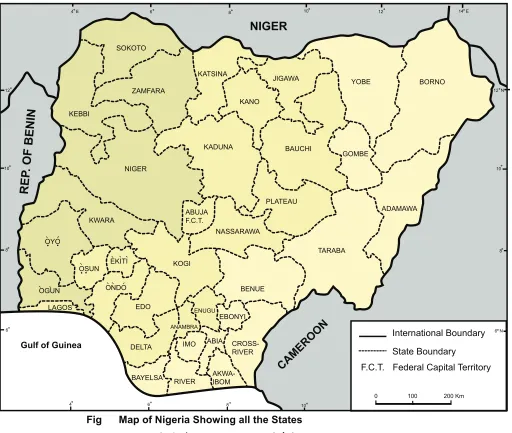
Map of Nigeria
SOKOTO ZAMFARA KEBBI NIGER KADUNA KATSINA KANO
JIGAWA YOBE BORNO
NIGER BAUCHI GOMBE ADAMAWA TARABA PLATEAU ABUJA F.C.T. NASSARAWA BENUE KOGI KWARA OSUN OGUN OYO LAGOS EKITI ONDO EDO DELTA
BAYELSA RIVER AKWA-IBOM CROSS-RIVER IMO ANAMBRA ENUGU EBONYI ABIA Gulf of Guinea
CAMEROON REP
. OF BENIN
Fig Map of Nigeria Showing all the States Maapu Naijiria ti o n safihan gbogbo ipinle
International Boundary State Boundary
F.C.T. Federal Capital Territory
0 100 200 Km 12
10
8
6
4 6 8 10
6 N 8 10 12 N 14 E
12 10
8 6
[image:10.612.55.567.106.539.2]Introduction
Map Yorùbá Land (showing some Yorùbá cities)
0 50 100 Km
OYO ONDO EDO STATE OGUN OSUN KWARA STATE REP
. OF BENIN
Shaki Kisi Ogbomoso Oyo Ibadan Eruwa Iseyin Iwo Ede Oshogbo Ikirun Ilesha Ife Ijero Ado Ekiti Ikere EKITI Ikole ikare AKure Owo Ondo Shagamu Abeokuta Ilaro Ijebu Ode Okiti pupa Epe LAGOS Ikeja Badagry
[image:11.612.45.571.138.635.2]Gulf of Guinea
Fig. Map of South-Western Nigeria Showing the Current
Yoruba States
Introduction
COERLL - Yorúbà Yé Mi Page 12 CC – 2012 The University of Texas at Austin
Map of Yorùbá World
TRINIDAD
BRAZIL CUBA
USA (South Carolina)
SIERRA LEONE REPUBLIC OF BENIN
Introduction
Yorùbá Alphabets
Yorùbá language has eighteen consonants and seven oral vowels as found below:
IPA Yorùbá Letters Yorùbá Words English Meanings English Examples [a] [b] [d] [e] [¢] [f] [g] [gb] [h] [i] [dʒ] [k] [l] [m] [n] [o] [¡] [kp] [r] [s] [∫] [t] [u*] [w] [j] a b d e ÷ f g gb h i j k l m n o æ p r s « t u* w y àga bàtà dùndún ehoro ÷«in fìlà garawa gbágùúdá hanrun igi jígí kôkôrô légbélègbé máñgòrò náírà ológbò öbæ pêpêy÷ ràkúnmí sálúbàtà «íbí tata tú wárápá yànmùyánmú chair shoe
a type of drum rabbit horse hat bucket cassava to snore tree mirror key tadpole mango nigerian money cat monkey duck camel sandal spoon grasshopper to untie epilepsy mosquito
as in ‘apple’ as in ‘boy’ as in ‘dog’ as in ‘eight’ as in ‘egg’ as in ‘feather’ as in ‘go’
pronounced [gb] as in ’hall’
as in ‘igloo’ as in ‘jog’ as in ‘koala’ as in ‘lie’ as in ‘mom’ as in ‘never’ as in ‘oven’ as in ‘oil’
Introduction
COERLL - Yorúbà Yé Mi Page 14 CC – 2012 The University of Texas at Austin
*No Standard Yorùbá language word starts with the vowel ‘u’. However, in certain Yorùbá dialects such as the Èkìtì, and Ìjë«à dialects, a word can begin with ‘u’ as in urô
(a lie) and u«u (yam) which is written in Standard Yorùbá as irô and i«u.
Vowels
Oral Vowels
- Fáwëlì Àìránmúpè
There are seven oral vowels in Standard Yorùbá:
Below are examples of the vowels with their English meanings.
IPA Yorùbá Letters Yorùbá Words English Meanings English Examples [a] [e] [¢] [i] [o] [¡] [u] a e ÷ i o æ u ajá erin ÷y÷ imú owó æwô *ooru dog elephant bird nose money hand heat
as in ‘apple’ as in ‘day’ as in ‘egg’ as in ‘ignore’ as in ‘open’ as in ‘oil’ as in ‘put’
*Remember that there is no Standard Yorùbá word that begins with the vowel ‘u’ except in some other Yorùbá dialects as mentioned earlier.
Introduction
Nasal Vowels - Fáwëlì Àránmúpè Yorùbá has five nasal vowels:
an as in 'Ìbàdàn' a city in Western Nigeria
÷n as in 'ìy÷n' that one
in as in 'erin' elephant
æn as in 'ìbæn' gun
un un as in 'fun' to blow
While there is a distinction between /–an/ and /–æn/ in Standard Yorùbá orthography, both are pronounced the same, i.e. [£]. Therefore, the nasal vowels in words like àgbæn [àgb£] coconut and ìran [ìr£] generation are pronounced the same, i.e. [£], though they are orthographically different.
Consonants
Yorùbá language has eighteen consonants as found below:
Note that the English alphabets c, q, v, x, z do not exist in Yorùbá.
-an -÷n -in -æn -un
b d f g gb h j k l
Introduction
COERLL - Yorúbà Yé Mi Page 16 CC – 2012 The University of Texas at Austin
Consonants IPA Yorùbá Letters Yorùbá Words English Meanings English Examples [b] [d] [f] [g] [gb] [dʒ] [k] [l] [m] [n] [kp] [r] [s] [∫] [t] [w] [y] b d f g gb j k l m n p r s « t w y bàtà dùõdú fìlà igi gbogbo jöwô kôkôrô labalábá méjì nísisìnyí pátápátá rìkísí sálúbàtà «íbí tata wàrà yànmùyánmú shoe fried yam hat tree all please key butterfly two now completely conspiracy sandal spoon grasshopper milk mosquito
as in ‘bag’ as in ‘date’ as in ‘foot’ as in ‘gig’ N/A
as in ‘jaws’ as in ‘kitchen’ as in ‘lollipop’ as in ‘mouth’ as in ‘near’ N/A
as in ‘risky’ as in ‘sun’ as in ‘shy’ as in ‘tea’ as in ‘wheat’ as in ‘yes’
The syllabic [m] and [n]
Introduction
Adéñrelé a/dé/ñ/re/lé name of a person
Bímbôlá Bí/m/bô/lá name of a person
dùõdú dù/õ/dú fried yam
Tones
Yorùbá language has three primary but contrastive tones that are marked as follows:
High [ ⁄ ] as in [bí], to give birth to
Mid [ ] usually left unmarked as in [bi], to ask
Low [ \ ] as in [bì], to vomit
However, there is also a down-stepped tone marked in the following in which a high tone is followed by a high tone and a low tone:
[\ /] as in [akêköô], astudent
as in [ælôpàá], a police officer
Tones can sometimes be marked on a nasal consonant as in the example below:
Mò ñ læ I am going
Tones distinguish words when they contrast in Yorùbá language as in the following examples:
eré play
èrè gain, benefit
ère carved, wooden image
edé shrimp
Introduction
COERLL - Yorúbà Yé Mi Page 18 CC – 2012 The University of Texas at Austin
à«à custom
à«á hawk, falcon
owó money
òwò trade
æwô hand
öwö respect, honor
Titles in Yorùbá Culture
It is not uncommon in Yorùbá culture for people to have titles precede their names when they are being addressed. These titles can be in English or in Yorùbá. Some examples include: Lawyer Bísí Adéælá, Justice Bôlá Adébísí, Engineer Dayö Ælálékan, Chief Táyö Adélarí, Accountant Bádé
Adélékè, Olorì »adé Akíntáyæ, and Æba Adélékè Adéælá
Adájô Judge
Agb÷jôrò Lawyer
Alága Chairman (e.g of a meeting) Arábìnrin Mrs.
Arákùnrin Master
Dókítà Doctor (medical)
Æba King
Ögá Boss
Ögbêni Mr.
Öjögbôn Professor
Olorì Queen
Olóyè Chief
Introduction
Ömöwé Doctor of philosophy (Ph.D)
Ààr÷ President (e.g of a club or school.)
Yorùbá Names
Some Yorùbá names are gender specific while other names are gender neutral. Yorùbá people give names to a newborn baby based on the circumstances surrounding the birth of that baby. Meanings of Yorùbá names are discussed in Book II of this series.
Male Female
Adékúnlé Similólú
Ælásëìndé Fælá«adé
Àbáyömí Folúkêmi
Æládàpö Olúwátómi
Olúgbénga Mojísôlá
Gbénró Fadékêmi
Akíntúndé Adérónkê
»êgun Fælákêmi
Olúwadáre Ìyábö
Babátúndé Yéwándé
Gbóyèga Similólú
Introduction
COERLL - Yorúbà Yé Mi Page 20 CC – 2012 The University of Texas at Austin
Neutral (Male or female)
Mobôlájí Adébísí
Abíôdún Bùnmi
Adékóyè Adébôlá
Olúrëmí Modúpê
Olúfêmi Adéælá
Adé«ælá Ayökúnlé
Olú«ëy÷ Bùsôlá
Fèyí«ayö Bámidélé
Moyösôlá Æláyínká
Bôlájí Títílælá
Adétósìn Abímbôlá
Communication in Class
÷ dákê ariwo! silence, be quiet! (you pl.) dákê ariwo! silence, be quiet! (you sg.)
÷ «í ìwée yín sí ojú ìwée open your text books to page.. (you pl.) «í ìwéè r÷ open your text book (you sg.)
÷ dìde! stand up! (you pl.)
dìde stand up! (you sg.)
÷ pa ìwée yín dé close your books (you pl.) pa ìwéè r÷ dé close your book (you sg.)
÷ túnun sæ repeat! (you pl. or mark of respect)
túnun sæ repeat! (you sg.)
÷ jöwô please! (you pl.); mark of respect
Introduction
÷ f’etí sílë! listen! (you pl.)
fetísílë! listen! (you sg.)
÷ jókòó! sit down! (you pl.)
jókòó! sit down! (you sg.)
÷ sæ ô ní Yorùbá say it in Yorùbá (you pl. or for respect) sæ ô ní Yorùbá say it in Yorùbá (you sg.)
÷ nawô sókè raise your hand (you pl.)
nawô sókè raise your hand (you sg.)
mo ní ìbéèrè I have a question
báwo ni a «e ñ sæ wí (pé)… how do we say that…
báwo ni a «e ñ sæ ___ ní Yorùbá how do we say ___ in Yorùbá?
«é ó yée yín? do you (pl.) understand?
bêë ni, ó yé wa yes, we understand
«é ó yé ÷? do you (sg.) understand?
bêë ni, ó yé mi yes, I understand
Introduction
Chapter 1 - Orí Kìíní | GREETINGS
OBJECTIVES:
In this chapter you will learn: -How to greet people - About Yorùbá verbs -The use of negation ‘kò’ -About Yorùbá pronouns
Orí Kìíní (Chapter 1) Àwæn örö (Vocabulary)
COERLL - Yorúbà Yé Mi Page 24 CC – 2012 The University of Texas at Austin
Àwæn örö (
Vocabulary
)
Nouns
àgbàdo corn
a«æ clothing
bàbá father
bôölù ball
eré play
÷mu palm wine
÷yin egg
Ìbàdàn a city in south western Nigeria
ilé house
ìr÷sì rice
kóòkì Coke
môínmôín a meal made from black-eyed peas
Ögbêni Mr.
olùkô teacher
æmæ child
orúkæ name
owó money
æbë stew
Noun Phrases
aagoo yín your clock/wristwatch
a dúpê thank you
a«æö r÷ your clothes
bàbáa Fúnmi Fúnmi’s father
iléè rë his/her house
ìwéè mi my book
o «é thank you
ó tì no
owóo wæn their money
æjô ìbí birthday
Orí Kìíní (Chapter 1) Àwæn örö (Vocabulary)
Verbs
gbá to kick
fê to want
gbé to live
j÷un to eat
kàwé to read a book
mu to drink
ní to have
Verb Phrases
báwo ni? how are you? / how are things?
Conjunctions
«úgbôn but
tàbí or
Interrogatives
kí ni? what?
kí ni nõkan? how are things?
«é àlàáfíà ni? how are you/ how are things?
«é dáadáa ni? how are you? How are things?
«é nõkan ñ læ? are things are going well?
«é wà á jókòó? would you like to sit down?
Other Expressions
àlàáfíà ni fine/I am fine/ things are fine/peace
dáadáa ni I am fine
káàbö o you are welcome
kó o kí wæn greet them (members of your family)
mo kàn sáré wá kí ÷ ni I quickly came to say ‘hi’ to you
Orí Kìíní (Chapter 1) Ëkô Kìíní (Lesson 1)
COERLL - Yorúbà Yé Mi Page 26 CC – 2012 The University of Texas at Austin
Lesson 1 - Ëkô
Kìíní:
Ìkíni (Greetings)
Greeting people is an important aspect of Yorùbá culture. ‘Kú’ is an expression used for greetings by Yorùbá people regardless of the time of day. However, in order to express good night, Yorùbá people will rather say ‘ó dààárö.’ Some examples are found below:
A. Kú + time of the day:
kú + àárö káàárö good morning kú + ösán káàsán good afternoon kú + ìrölê kúùrölê good early evening
kú + alê káalê good evening
B. Kú + weather:
kú + òtútù kú òtútù a greeting said when the weather is cold kú + æyê kú æyê a greeting for the Harmattan Season kú + òjò kú òjò a greeting for the rainy season kú +ögìnnìntìn kú ögìnnìntìn a greeting for damp weather
C. Kú can also be used in other circumstances:
kú + i«ê kúu«ê a greeting said to someone working kú + ìjókòó kúùjókòó a greeting said to someone seated
kú + ìsinmi kúùsinmi a greeting said to someone resting or to someone on Sunday
D. ‘Kú’ is also used as a greeting during festivities such as New Year, Christmas, birthday, and anniversaries.
kú + ædún kú ædún a greeting said to someone during festivities(for example, happy new year / birthday, merry Christmas)
Orí Kìíní (Chapter 1) Ëkô Kìíní (Lesson 1)
Times of the day
àárö from about 12:01a.m. to 11:59a.m.
ösán from about noon to 4:59p.m.
ìrölê from about 5:00p.m. to 6:59p.m.
alê from about 7:00p.m. to 11:59p.m.
The middle of the night is referred to as òru but there is no greeting with the word òru in Standard Yorùbá. Therefore, Yorùbá people do not greet by saying ‘¿ kú òru’ unless something is going on at that time of night! Besides, who walks around in the middle of the night?
À»À
The period between 12.01 am and 3 am to 4 am is usually considered òru because people are still sleeping. After 4 am, the greeting káàárö or ¿ káàárö is used.
Ìsöröngbèsì
(Dialogue)
1.
- ¿ káàárö o, bàbá.
Tádé greets his father, Wálé, early in the morning.
Orí Kìíní (Chapter 1) Ëkô Kìíní (Lesson 1)
COERLL - Yorúbà Yé Mi Page 28 CC – 2012 The University of Texas at Austin
2.
- ¿ káàbö o, Màmá
A daughter greeting her mother - Kúulé O, Lælá. »é àlàáfíà ni?
- Àlàáfíà ni. - Ëgbônæn r÷ ñkô? - Wôn wà nílé. - Ó dáa o. Dìde.
3.
- ¿ káàárö mà.
Túndé and Títí are greeting their mother early in the morning
- ¿ káàárö o. »é dáadáa ni o? - Dáadáa ni mà.
- »é ÷ sùn dáadáa?
- Bêë ni mà.
4.
- Káàsán o, Fúnmi.
»adé greets her friend, Fúnmi, at school in the afternoon.
- Káàsán o, »adé. »é dáadáa ni? - A dúpê. Ìwæ náà ñkô?
Orí Kìíní (Chapter 1) Ëkô Kìíní (Lesson 1)
5.
- Kí ni orúkæö r÷?
A teacher, Mr. Adébólú, and a student, Olúfêmi, get to know each other on the first day of school.
- Orúkæö mi ni Olúfêmi. - Kí ni orúkæ bàbáà rë?
- Orúkæ bàbáà mi ni Kúnlé Akínlàjà.
- Bá mi kí àwæn òbíì r÷ tí o bá délé, - Mo gbô sà.
- Ó dàbö o, Olúfêmi. - Ó dàbæ sà.
6.
- ¿ káàsán o, Màmáa Fúnmi.
»adé’s mother and Fúnmi’s mother greet each other at the market.
- ¿ káàsán o, Màmáa »adé. Gbogbo ilé ñkô?
- Dáadáa ni o. Bàbáa Fúnmi ñkô? - Wôn wà. ¿ «é o. Ó dàbö o
- Ó dàbö o.
7.
- ¿ káalê mà.
Títí goes to visit her friend, »adé. »adé is not at home but her mother is.
- Káalê o, Títí. »é àlàáfíà ni?
- A dúpê mà. »é »adé wà nílé? - Rárá o. Ó ti jáde.
- Ó dàárö mà.
Orí Kìíní (Chapter 1) Ëkô Kìíní (Lesson 1)
COERLL - Yorúbà Yé Mi Page 30 CC – 2012 The University of Texas at Austin
I«ê »í«e 1
Pèsè ìdáhún sí àwæn örö wönyí.
Provide the appropriate response to the following. 1. »é àlàáfíà ni?
2. »é dáadáa ni? 3. Báwo ni?
4. Ilé ñkô?
5. Kí ni orúkæ bàbáà rë?
I«ê »í«e 2
Pèsè ìkíni sí àwæn örö wönyí.
Provide the appropriate greeting to the following.
1. ? Wôn wà.
2. ? A dúpê.
3. . Káàbö.
4. . ¿ káàárö.
Orí Kìíní (Chapter 1) Ëkô Kìíní (Lesson 1)
I«ê »í«e 3
In pairs, let A greet B at the indicated time of the day and let B respond appropriately.
Bí àp÷÷r÷: Your son at 2pm A: Kúule o, Akin. B: ¿ káàbö o, màmá.
1. Your father at 8pm. A.
B.
2.Your friend at 1pm. A.
B.
3.Your teacher at 9am. A.
B.
4.Your friend’s mother at 5pm. A.
B.
5.Your mother at noon. A.
B.
I«ê »í«e 4
Pèsè ìbéèrè tí ó ba àwæn ìdáhùn wönyí mu. Provide the question to each of the following. 1. Wôn wà.
________________________________________________________ 2. Dáadáa ni.
________________________________________________________ 3. Ó dàbö sà.
________________________________________________________ 4. A dúpê.
________________________________________________________ 5. Káàsán o.
________________________________________________________ 6. Orúkæö mi ni Jídé.
Orí Kìíní (Chapter 1) Ëkô Kìíní (Lesson 1)
COERLL - Yorúbà Yé Mi Page 32 CC – 2012 The University of Texas at Austin
I«ê »í«e 5
Wá àwæn örö wönyí
Look for these words in this puzzle below. Pay attention to the tones! àárö‚ «adé‚ ösán‚ àlàáfíà‚ fúnmi‚ dáadáa‚ kúnlé‚ tútù‚ æyê‚ òjò
à a ê « n s t a í m u k f ù ö
í á ö í a a m ö n ê f n u y t
ù r r d ê d y á t ö n ú m ó i
m æ è ö t é é j ù ó í l n ê s
á í t ê n í y ó t n t e s m d
ó ö m a j t n k ö « á n ê ù i
d ê ù t à á k n k s t ó m n e
á á ö o ê l m ú ù a á i t á n
a n a m ù á à l n t f n ê ó a
d ö t d i f m á l l n ú n m i
í m o ù á i ó é f t é ó æ á í
ù t á j ó a f á m í ó Í y a n
Orí Kìíní (Chapter 1) Ëkô Kejì (Lesson 2)
Lesson 2 - Ëkô
Kejì:
Verbs
There are different types of verbs in Standard Yorùbá. The simple structure of the following Yorùbá verbs is monosyllabic:
Verbs
j÷ to eat
kà to read
«e to do
fê to want
ní to have
wá to come
læ to go
sùn to sleep
jó to dance
fò to jump
rà to buy
tà to sell
mu to drink
sè to cook
gbé to carry
rìn to walk
Olú ñ j÷ i«u Olu is eating yam
Bàbá ñ sùn Father is sleeping
Mò ñ læ I am leaving/going
Adé ñ mu omi Adé is drinking water
Orí Kìíní (Chapter 1) Ëkô Kejì (Lesson 2)
COERLL - Yorúbà Yé Mi Page 34 CC – 2012 The University of Texas at Austin Examples of splittable verb-nominals include:
A B
rêrìnín rín ërín to laugh sunkún sun ÷kún to cry
jagun ja ogun to fight a war
sáré sá eré to run
gégi gé igi to cut a tree pænmi pæn omi to fetch water kôlé kô ilé to build a house gbálë gbá ilë to sweep the floor sörö sæ örö to say a word (speak) kærin kæ orin to sing a song (sing)
Not all verb-nominals are splittable. The examples below in column B are ungrammatical:
A (correct) B (incorrect)
tæjú take care of tô ojú
dìde to stand dì ìde
dúró stop wait dú aró
jókòó sit jó ìkó
A verb can be followed by another verb. An example of this is fê ‘to want’ or ‘to wish’. Àwa fê j÷ ÷yin. We want to eat eggs.
Ëyin fê fæ a«æ. You want to wash clothes.
Fê can also be used in an interrogative sentence.
For example:
»é ìwæ fê fæ a«æ? Do you want to wash clothes? Bêë ni, èmi fê fæ a«æ. Yes, I want to wash clothes.
Orí Kìíní (Chapter 1) Ëkô Kejì (Lesson 2)
The verb fêràn ‘to like’, ‘to love’
Mo fêràn ajá I like dogs.
Olú fêràn æmædé Olú loves children.
Negation of Verbs
Negation of verbs using ‘kò’
One way to negate a verb in a sentence is to precede the verb with the negator ‘kò’. Olú ñ j÷ iyán
Olú kò j÷ iyán
Wálé ñ rêrìnín Wálé kò rêrìnín
Mo fê j÷ búrêdi N kò fê j÷ búrêdi
Bôlá ñ mu omi Bôlá kò mu omi
Jökê ñ di irunun Dúpê Jök÷ kò di irunun Dúpê
Màmá ñ se ìr÷sì Màmá kò se ìr÷sì
Olú is eating pounded yam Olú is not eating pounded yam
Wálé is laughing Wálé is not laughing
I want to eat bread
I do not want to eat bread
Bôlá is drinking water Bôlá is not drinking water
Jökê is weavingDúpê’s hair Jökê is not weavingDúpê’s hair
Orí Kìíní (Chapter 1) Ëkô Kejì (Lesson 2)
COERLL - Yorúbà Yé Mi Page 36 CC – 2012 The University of Texas at Austin
I«ê »í«e 1
Tún àwæn gbólóhùn wönyí kæ ní òdì. Turn the following sentences into negative. 1. Bádé ñ ka ìwé.
________________________________________________________ 2. Wôn ñ j÷ ìr÷sì.
________________________________________________________ 3. Àwa ñ fæ a«æ.
________________________________________________________ 4. Mo ñ gbin àgbàdo.
________________________________________________________ 5. Ëyin ñ j÷ ÷yin.
________________________________________________________ 6. Àwæn ñ ta i«u.
________________________________________________________ 7. Mo fê ra àgbàdo.
________________________________________________________ 8. Àwa jê örê.
________________________________________________________ 9. Ò ñ sùn.
________________________________________________________ 10.Ó fê j÷un.
________________________________________________________
I«ê »í«e 2
Dáhùn àwæn ìbéèrè wönyí ní òdì.
Respond to the following questions in the negative.
Orí Kìíní (Chapter 1) Ëkô K÷ta (Lesson 3)
Lesson 3 - Ëkô
K÷ta:
Subject Pronouns
There are two types of subject pronouns in Yorùbá: emphatic and regular.
Regular Pronouns
Singular Plural
1st pers. Mo I 1st pers.
A We
2nd pers. O You 2nd pers.
¿ You
3rd pers. Ó She/He/It 3rd pers.
Wôn They
Note that the vowels in the 3rd person singular and plural take a high tone.
Note that in each of these pronouns, the first vowel is marked with a low tone.
Yorùbá, however, has a second set of pronouns referred to as the emphatic pronouns:
Emphatic Pronouns
Singular Plural
1st pers. Èmi I 1st pers. Àwa We
2nd pers. Ìwæ You 2nd pers. Ëyin You
3rd pers. Òun She/He/It 3rd pers. Àwæn They
Emphatic and regular pronouns can be used interchangeably in many situations, though not in all situations. For example, the following are used interchangeably when using the progressive marker ñ (-ing):
Èmi ñ læ / Mò ñ læ I am going Àwa ñ j÷un / À ñ j÷un We are eating
Ëyin ñ sùn / Ë ñ sùn You (pl) are sleeping Òun ñ «eré / Ó ñ «eré She/he/it is playing
Below, the expressions in column A below are grammatically correct, while the expressions in column B are incorrect:
A (correct) B (incorrect)
Orí Kìíní (Chapter 1) Ëkô K÷ta (Lesson 3)
COERLL - Yorúbà Yé Mi Page 38 CC – 2012 The University of Texas at Austin
The Honorific Pronoun / ÷ /
Respect for elders is highly appreciated and strongly encouraged in Yorùbá culture. In fact, it is an integral part of the culture. As a result, when you greet an elderly person, you use the regular pronoun of respect ‘÷’ followed by the greeting:
÷ káàbö a greeting to welcome someone older than you
÷ kúulé a response to ‘÷ káàbö’. It is said to someone
(older than you) that one finds at home when one returns home.
The Honorific Pronoun ‘wôn’
Wôn is another regular pronoun of respect in Yorùba. For example, when you are asked how your mother or father is doing, you respond ‘wôn wà’ (he/she is doing fine), even though wôn is a 3rd person plural subject pronoun.
A: Awæn àbúrò r÷ ñkô? How are your younger siblings?
B: Wôn wà. They are fine.
A: Bàbáà r÷ ñkô? How is your father?
B: Wôn wà. He is fine.
The progressive marker ñ
The progressive marker 'ñ' is used to express a continuous or an on-going action. It is similar in use to the English -ing. However, in Yorùbá, it occurs before the verb. If it is omitted following the noun or pronoun subject, that verb then indicates ‘past.’
Hence: Whereas:
Èmi ñ læ I am going Èmí læ I went
Orí Kìíní (Chapter 1) Ëkô K÷ta (Lesson 3)
I«ê »í«e 1
Dáhùn àwæn ìbéèrè wönyí ní ëkúnrêrê.
Answer the following questions in complete sentences.
Bí àp÷÷r÷:
Kí ni Wálé ñ «e? (eré) Wale ñ «e eré.
1. Kí ni Bödé ñ «e? (æjô ìbí)
________________________________________________________ 2. Kí ni màmáà ñ sè? (æbë ædún)
________________________________________________________ 3. Kí ni bàbáà ñ tà? (a«æ)
________________________________________________________ 4. Kí ni ìwæ ñ «e? (kàwé)
________________________________________________________ 5. Kí ni wôn ñ «e? (j÷un)
________________________________________________________
I«ê »í«e 2
Replace the words in bold with regular pronouns.
Bí àp÷÷r÷:
Ëyin ñ gbé ní Austin. Ë ñ gbé ní Austin.
1. Èmi àti àwæn fê j÷un.
2. Bàbáa Jíde ñ gbé ní Ikölé-Èkìtì.
3. Olú ñ «i«ê ní Òdè-Èkìtì.
4. Ìwæ ñ gbé ni Adó-Èkìtì.
Orí Kìíní (Chapter 1) Ëkô K÷ta (Lesson 3)
COERLL - Yorúbà Yé Mi Page 40 CC – 2012 The University of Texas at Austin
I«ê »í«e 3
Replace the words in bold with emphatic pronouns.
Bí àp÷÷r÷:
Wôn ñ fæ a«æ. Àwæn ñ fæ a«æ.
1. Mo tàbí Adé ñ læ sí æjà.
2. A pëlu Tósìn fê gbá bôölù.
3. Túnjí àti ó ñ fê æmæ
4. ¿ àti a jê örê
5. Kêmi tàbí o ñ gbé ní Houston.
I«ê »í«e 4
Replace the regular pronoun in bold with an emphatic pronoun.
Bí àp÷÷r÷: A fê læ sí æjà. Àwa fê læ sí æjà.
1. Wôn ñ ta i«u
________________________________________________________ 2. Mò ñ se ìr÷sì
________________________________________________________ 3. Ó fê ra àgbàdo
________________________________________________________ 4. O ní owó
________________________________________________________ 5. ¿ fê se môínmôín
Orí Kìíní (Chapter 1) Ëkô K÷rin (Lesson 4)
Lesson 4 - Ëkô
K÷rin:
Interrogatives ‘Kí ni?’ and ‘»é?
‘Kí ni’ (what) and ‘»é’ (do/does) are two forms of Yorùbá interrogatives. They are used in the following examples:
Q: Kí ni o fê? What do you (sg.) want?
R: Mo fê owó. I want money.
Q: Kí ni orúkæö r÷? What is your (sg.) name?
R: Orúkæö mi ni Bádé Adéléké. My name is Bádé Adélékè.
Q: »é wôn fê owó? Do they want money?
R: Bêë ni, wôn fê owó. Yes, they want money.
Q: »é o fê j÷un? Do you want to eat?
Orí Kìíní (Chapter 1) Ëkô K÷rin (Lesson 4)
COERLL - Yorúbà Yé Mi Page 42 CC – 2012 The University of Texas at Austin
I«ê »í«e 1
Dáhùn àwæn ìbéèrè wönyí ní ëkúnrêrê.
Answer the following questions in complete sentences.
Bí àp÷÷r÷:
Kí ni wôn ñ kà? (ìwé) Wôn ñ ka ìwé.
1. Kí ni a fê j÷? (oúnj÷)
2. Kí ni wôn ñ kæ? (ìwé)
3. Kí ni ëyin ñ tà? (ìr÷sì) (in conversational context)*
4. Kí ni Olú ñ fê? (owó)
5. Kí ni ìwæ ní? (ilé)? (in conversational context)*
6. Kí ni ìwæ àti òun ñ fê? (æmæ)
7. Kí ni àwa àti ëyin ní? (àlàáfíà)
8. »é ó ñ fê owó? Bêë ni,
9. »é ò ñ fê owó? (in conversational context)* Bêë ni,
10.»é wôn ñ fê kóòkì? Bêë ni,
Orí Kìíní (Chapter 1) Ëkô K÷rin (Lesson 4)
I«ê »í«e 2
Respond to the following questions in conversational context using a regular subject pronoun.
Bí àp÷÷r÷:
»é ìwæ fêràn ìr÷sì? Bêë ni, mo fêràn ìr÷sì.
1. »é ìwæ ñ gbé ní Ilé-Ifë?
Bêë ni, ñ gbé ní Ilé-Ifë.
2. »é bàbáà r÷ ní owó?
Bêë ni, ní owó.
3. »é Kóyè fê j÷ ìr÷sì?
Bêë ni, fê j÷ ìr÷sì.
4. »é bàbá àti màmáà r÷ ní ilé?
Bêë ni, ní ilé.
5. »é Bùnmi ni ækö?
Bêë ni, ní ækö.
I«ê »í«e 3
In pairs, ask your friend the following questions. Let your friend respond. Then take turns.
1. Kí ni ò ñ rà? 2. Kí ni o fê? 3. Kí ni ò ñ sè?
Orí Kìíní (Chapter 1) Ëkô K÷rin (Lesson 4)
COERLL - Yorúbà Yé Mi Page 44 CC – 2012 The University of Texas at Austin
I«ê »í«e 4
Parí àwæn gbólóhùn wönyí.
Complete the following sentences.
1. Wálé fê j÷ ìr÷sì‚ ó sì fê omi. a. j÷
b. mu c. w÷ d. se
2. Túndé fê sí ibí yìí. a. rí
b. ní c. wá d. mú
3. Títí fê sí oríi bêëdì. a. sùn
b. wà c. wá d. lé
4. Bàbáa Jídé fê bàtà fún Jídé. a. læ
b. ra c. gé d. tà
5. Kúnlé fê sí orí àga. a. jó ìkó
Orí Kìíní (Chapter 1) Ëkô K÷rin (Lesson 4)
I«ê »í«e 5
In pairs, ask your partner in class what his/her father wants in life, followed by what the partner wants in life. Write down what your partner’s father wants in life, and what you want in life. Then take turns.
I«ê »í«e 6
Let one student ask the teacher what the teacher wants in life. That student should report to the rest of the class what the teacher said h/she wants in life.
I«ê »í«e 7
Orí Kìíní (Chapter 1) Ëkô K÷rin (Lesson 4)
Chapter 2 - Orí Kejì | MY CLASSROOM
OBJECTIVES:
Orí Kejì (Chapter 2) Àwæn örö (Vocabulary)
COERLL - Yorúbà Yé Mi Page 48 CC – 2012 The University of Texas at Austin
Àwæn örö (Vocabulary
)
Nouns
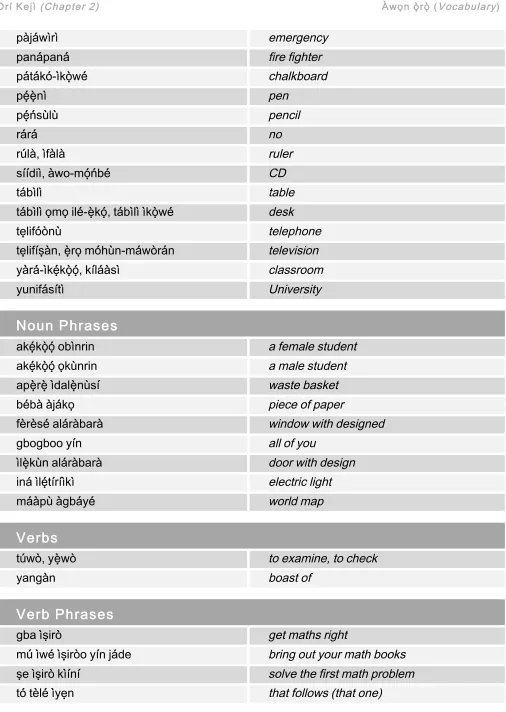
àga chair
àjà ceiling
àp÷÷r÷ example
àròpö the sum of
àwòrán picture
÷fun-ìköwé, «ôökì chalk
fáìlì file
fèrèsé window
fídíò video
gbólóhùn sentence
ìdánwò exam
ilé house
ilëkùn door
iná light
ìrésà, ìpàwérê eraser
ì«irò mathematics
ìwé-ìköwé notebook
ìwée gírámà grammar book
ìwé-ìtumö dictionary
kííbæödù, àt÷-ìtëwé keyboard
köõpútà, ëræ ayára-bí-à«á computer
lôpölæpö very much
máòsì mouse
mônítö monitor
nõkan something
nôñbà number
ògiri wall
öjögbôn a professor
öla tomorrow
ælôpàá police
Orí Kejì (Chapter 2) Àwæn örö (Vocabulary)
pàjáwìrì emergency
panápaná fire fighter
pátákó-ìköwé chalkboard
pêënì pen
pêñsùlù pencil
rárá no
rúlà, ìfàlà ruler
[image:49.612.46.552.20.732.2]síídiì, àwo-môñbé CD
tábìlì table
tábìlì æmæ ilé-ëkô, tábìlì ìköwé desk
t÷lifóònù telephone
t÷lifí«àn, ëræ móhùn-máwòrán television
yàrá-ìkêköô, kíláàsì classroom
yunifásítì University
Noun Phrases
akêköô obìnrin a female student
akêköô ækùnrin a male student
apërë ìdalënùsí waste basket
bébà àjákæ piece of paper
fèrèsé aláràbarà window with designed
gbogboo yín all of you
ìlëkùn aláràbarà door with design
iná ìlêtíríìkì electric light
máàpù àgbáyé world map
Verbs
túwò, yëwò to examine, to check
yangàn boast of
Verb Phrases
gba ì«irò get maths right
mú ìwé ì«iròo yín jáde bring out your math books
«e ì«irò kìíní solve the first math problem
Orí Kejì (Chapter 2) Àwæn örö (Vocabulary)
COERLL - Yorúbà Yé Mi Page 50 CC – 2012 The University of Texas at Austin
Interrogatives
«é ...gba ì«iròo rë? did ….get the math problem right?
«é …… gbà á? did ….. get it right?
Other Expressions
÷ dákê ariwo (You all)be quiet
÷ «í ìwé yín sí ojú-ìwé open your books to
o gba ... r÷ «ámú«ámú you got your ... exactly right
ojú-ìwé karùnúnlélôgbön page 35
o káre! good job
ó ku ÷ësànán nine is left
ó y÷ kí á tun ì«iròo wa wò we need to review our math
öla ni ojô ìdánwò tomorrow is exam day
Orí Kejì (Chapter 2) Ëkô Kìíní (Lesson 1)
Lesson 1 - Ëkô
Kìíní
Possessive Pronouns
Singular Plural
1st pers. mi my 1st pers. Wa our
2nd pers. r÷/÷ your 2nd pers. Yín your
3rd pers. rë/ë hers, his, its 3rd pers. Wæn their
ìwéè mi my book
ilée wæn their house
ojúu wa our eyes
ìyàwóò rë his wife
ìwàa yín your (sg./pl.) behavior
màmáà r÷ your (sg.) mother
Wæn and yín can also be used as pronouns of respect. Status, apart from old age, demands respect in Yorùbá society. These pronouns are, therefore, used for people like doctors, judges, professors, one’s boss, one’s father, mother, uncle, or aunt, etc. For example, when you want to ask someone a professor’s name, i.e. ‘What is his/her name?’ You say ‘kí ni orúkææ wæn?’ If the Professor’s name is Àlàdé), you respond: Orúkææ wæn ni Öjögbôn Àlàdé (His/her name is Professor Àlàdé).
Recall the emphatic pronouns below that you learned in Chapter 1 lesson 3, and compare them to the possessive pronouns above:
Emphatic Pronouns
Singular Plural
1st pers. èmi I 1st pers. Àwa we
2nd pers. ìwæ you 2nd pers. ëyin you
3rd pers. òun she, he, it 3rd pers. àwæn they
To form the possessive pronouns, the vowels at the beginning of the subject pronouns drop in the 1st
Orí Kejì (Chapter 2) Ëkô Kìíní (Lesson 1)
COERLL - Yorúbà Yé Mi Page 52 CC – 2012 The University of Texas at Austin
I«ê »í«e 1
Fi arôpò orúkæ ìní rôpò örö tí a kæ gòdògbò.
Replace the words in bold with possessive pronouns.
Bí àp÷÷r÷:
Orúkæ èmi àti Túnde. Orúkææ wa.
1. Bàbá ìwæ àti Kêmi. (in conversational context)
2. Ìwé ìwæ (not in conversational context).
3. Ilé-ìwé Àìná.
4. Ilée bàbá àti màmáà mi.
Orí Kejì (Chapter 2) Ëkô Kìíní (Lesson 1)
I«ê »í«e 2
Lo arôpò orúkæ ìní tó tönà.
Use a possessive pronoun.
Bí àp÷÷r÷:
Bàbáa Túndé = Bàbáa rë
1. Bàbá àti mámáa Títí
2. Ëgbônæn Jídé
3. Àbúròo Títí àti Wálé
4. Àbúròo bàbáa Wálé
5. Màmá èmi àti ìwæ
6. Ìwé ìwæ (conversational context)
7. Pêñsùlù ëyin (not in conversational context)
8. Kíláàsì àwa àti ëyin
9. Ìwée Jídé àti Títí
Orí Kejì (Chapter 2) Ëkô Kìíní (Lesson 1)
COERLL - Yorúbà Yé Mi Page 54 CC – 2012 The University of Texas at Austin
I«ê »í«e 3
Dí àwæn àlàfo wönyí pëlú àwæn örö tí wôn bá wæn mu. Rí wí pé àwæn örö náà «e déédé pëlú àwæn olùwà inú gbólóhùn náà.
Use a possessive pronoun to fill in the space below. Let the pronoun correspond to the subject of the sentence or phrase.
1. Olú fêrànan bàbáa , «ùgbôn kò fêràn ìyáa .
2. Èmí fêrànan olùkôö ,«ùgbôn Adé kò fêràn olùkôæ .
3. Ó fêràn ajáa , èmi fêràn ológbò .
4. Àwæn òbí Olú fêràn àwæn æmææ ,«ùgbôn wæn kò fêràn ìdötí nínú ilée .
Orí Kejì (Chapter 2) Èkô Kejì (Lesson 2)
Lesson 2 - Ëkô
Kejì
The Plural marker 'àwæn'
‘Àwæn’ is a plural marker that is placed before the noun. For example:
1. Mo ri àwæn obìnrin náà lánàá I saw the women yesterday
2. Àwæn ilé nàá ñ jó. The houses are burning
3. Àwæn ækùnrin máa ñ dé fìlà Men do wear hats
Compare:
1b. Mo ri obìnrin náà lánàá I saw the woman yesterday
2b. Ilé nàá ñ jó. The house is burning.
However, the use of àwæn is sometimes redundant and therefore does not necessarily have to be used. For example:
4. Obìnrin kì í dé fìlà Women do not wear hats
5. Æmædé kì í sùn Children don’t sleep
In 4 and 5, the subjects do not have to be preceded by ‘àwæn’ to indicate plurality.
We should, however note that àwæn can be singular when used honorifically--as a mark of respect as for example ' àwæn bàbáà mi ní kí n kí i yín ' my father asked me to say 'hi' to you.
More examples:
Àwæn ilé Houses
Àwæn òbí Parents
Àwæn æmædé Children
Àwæn ilée wæn their houses
Ilée wæn their house
Àwæn aráà mi my people
Ilé òbíì mi my parent’s house
Ilé àwæn òbíì mi my parents’ house
Àwæn ilé àwæn òbíì mi the houses of my parents
Orí Kejì (Chapter 2) Èkô Kejì (Lesson 2)
COERLL - Yorúbà Yé Mi Page 56 CC – 2012 The University of Texas at Austin
I«ê »í«e 1
Kæ àwæn gbólóhùn wönyí ní Yorùbá. Lo ‘àwæn’ ni ibi tí ó bá y÷.
Write the sentences below in Yorùbá using the plural marker where necessary.
1. I like her father’s books. 2. My hands are clean. 3. I love children.
4. My parent’s house is in Austin. 5. I want to buy four books.
I«ê »í«e 2
Fi àrôpò orúkæ tó bá y÷ dí àwæn àlàfo wönyí.
Fill out the spaces below with appropriate pronouns.
Nígbà tí____________ délé‚ ____________ òbíì ____________ bi____________ pé níbo ni ____________ tí ñ bö. ____________ pinnu láti sæ òtítô fún____________.
Orí Kejì (Chapter 2) Ëkô K÷ta (Lesson 3)
Lesson 3 - Ëkô
K÷ta:
Nínú Kíláàsì (In the Classroom)
Örö àdásæ (Monologue)
Kíláàsì mi (My classroom)
Orúkæô mi ni Wálé. Mo jê akêköô ní Yunifásítì ti Texas ní Austin. Mo fêràn ilé-ìwéè mi gan-an ni nítorí pé gbogbo ohun tí ó lè mú kí ëkô ræ ènìyàn lôrùn ni ó wà níbë àgàgà nínú kíláàsìì mi.
Orí«irí«i nõkan ni ó wà nínú kíláàsìì mi. Láraa wæn ni àga‚ tábìlì, àwòrán‚ köõpútà‚ mônítö‚ máòsì‚ kííbæædù‚ ìwé atúmö-èdè‚ pêënì‚ pêñsùlù‚ rúlà‚ ìrésà‚ fídíò‚ síídiì‚ fáìlì‚ máàpù àgbáyé‚ «ôökì‚ pátákó-ìköwé àti bêë bêë læ.
Lêyìn èyí‚ a tún lè rí àwæn nõkan mìíràn tí wôn mú kíláàsìì mi yàtö sí kíláàsì mìíràn ni Yunifásítì bíi ìlëkùn aláràbarà‚ fèrèsé aláràbarà‚ iná ìlêtíríìkì‚ àjà‚ apërë-ìdalënùsí àti bêë bêë læ.
Mo fêràn ilé-ìwéè mi lôpölæpö. Mo sì máa ñ fi í yangàn láàárín àwæn örêë mi nítorí pé náánní náànnì náánní‚ ohun a ní là á náánní bí æmæ a«êgità «e ñ náánní èpo igi.
I«ê »í«e 1
Dáhùn àwæn ìbéèrè wönyí.
Respond to the following questions.
Òótô ni Òótô kô 1. Ò«ì«ê ni Wálé ní Yunifásítì ti Texas ní Austin.
☐
☐
2. Wálé fërànan kíláàsì rë.
☐
☐
3. Fááànù wà ní kíláàsì Wálé.
☐
☐
4. Wálé máa ñ fi ilé-ìwé rë yangàn.
☐
☐
5. Wálé máa kúrò ní ilé-ìwé rë nítorí pé kò fêrànan ilé-ìwé
Orí Kejì (Chapter 2) Ëkô K÷ta (Lesson 3)
COERLL - Yorúbà Yé Mi Page 58 CC – 2012 The University of Texas at Austin
Prepositions
Preposition of location is one of the grammatical classes in Yorùbá. 'Ní' combines with the following to form prepositions.
For example: Ní + abê
Ní + iwájú Ní + ëyìn Ní + àárín Ní + inú Ní + ëgbê Ní + orí
lábê níwájú lêyìn láàárín nínú lêgbëê lórí under in front of behind
in between / in the middle of inside
beside on top of
These prepositions do not require ní: súnmô
jínnà sí nearfar from
Wà ‘to be’ precedes the preposition to express location. For example: Ìwé wà lóríi tábìlì The book is on the table.
Other examples are found below:
Orí Kejì (Chapter 2) Ëkô K÷ta (Lesson 3)
Pêënì wà láàárín ìwé àti àpò. Pêñsùlù wà nínú ìwé.
Apërë ìdalënùsí wà lêgbëê ilëkùn. Bàtà wà lábê àga.
Orí Kejì (Chapter 2) Ëkô K÷ta (Lesson 3)
COERLL - Yorúbà Yé Mi Page 60 CC – 2012 The University of Texas at Austin
I«ê »í«e 2
Kæ àwæn gbólóhùn wönyí ní èdèe Yorùbá.
Write the following sentences in Yorùbá.
1. The book is inside the bag._ 2. The bag is under the table._ 3. The pencil is beside the bag._
4. The table is in front of the chalkboard.
5. The book is between the pencil and the pen. 6. I am far from the chalkboard.
7. The bag is near the student.
I«ê »í«e 3
Olùkôö r÷ yó fi àwæn nõkan kan hàn ê nínúu kíláàsì. Dáhùn àwæn ìbéèrè tí ó bá tëlé ìfihàn náà.
Your teacher will show you some objects in the classroom and their location. Provide a response to your teacher’s questions.
The interrogative Níbo Atôka À«ebéèrè Níbo
‘Níbo’ is an interrogative form that means where?.
Níbo ni…..? Where is….?
The verb wà (to be / to exist) is used in combination with níbo ni to ask a question concerning the location of something or someone.
For example:
Ìbéèrè: Níbo ni ìwé wà? Where is the book?
Ìdáhùn: Ìwé wà lóríi tábìlì. (The) book is on the table.
Ìbéèrè: Níbo ni köõpútàá wà? Where is the computer?
Ìdáhùn: Kííbæödù wà níwájúu
köõpútàá. The keyboard is in front of the computer.
However, wà can also be used as a response to indicate how someone is doing, as in the following:
Orí Kejì (Chapter 2) Ëkô K÷ta (Lesson 3)
Orí Kejì (Chapter 2) Ëkô K÷ta (Lesson 3)
COERLL - Yorúbà Yé Mi Page 62 CC – 2012 The University of Texas at Austin
I«ê »í«e 4
Wo àwæn àwòrán ti a pèsè sókè láti fi dáhùn àwæn ìbéèrè wönyí.
Use the pictures of objects of the classroom and their locations provided above to respond to the following questions
1. Níbo ni ìwé wà?
_________________________________________________________ 2. Níbo ni ìrésà wà?
_________________________________________________________ 3. Níbo ni pêënì wà?
_________________________________________________________ 4. Níbo ni pêënì àti pêñsùlù wà?
_________________________________________________________ 5. Níbo ni pêñsùlù wà?
_________________________________________________________ 6. Níbo ni ìwé-atúmö wà?
_________________________________________________________ 7. Níbo ni pátákó-ìköwé wà?
_________________________________________________________ 8. Níbo ni àga wà?
_________________________________________________________ 9. Níbo ni àpò wà?
_________________________________________________________ 10. Níbo ni tábìlì wà?
_________________________________________________________
I«ê »í«e 5
Dáhùn àwæn ìbéèrè wönyí ní ëkúnrêrê.
Answer the following questions in complete sentences.
1. Níbo ni ìwéè r÷ wà?
_________________________________________________________ 2. Níbo ni pêënì r÷ wà?
_________________________________________________________ 3. Níbo ni ìwæ náa wà?
_________________________________________________________ 4. Níbo ni olùkôö r÷ wà?
_________________________________________________________ 5. Níbo ni örêë r÷ wà?
Orí Kejì (Chapter 2) Ëkô K÷ta (Lesson 3)
I«ê »í«e 6
Béèrè ìbéèrè márùnún nínú àwæn ìbéèrè tí wôn wà ní I«ê »í«e 4 ní æwô örêë r÷ kan nínúu kíláàsì. Kæ àwæn ìdáhùnun rë sílë.
Orí Kejì (Chapter 2) Ëkô K÷ta (Lesson 3)
COERLL - Yorúbà Yé Mi Page 64 CC – 2012 The University of Texas at Austin
Wá àwæn örö wönyí
Look for these words in the puzzle below.Pay attention to the tones!
àga‚ tábìlì‚ köõpútà‚ mônítö‚ pêënì‚ pêñsùlù‚ ilëkùn‚ àjà, t÷lifí«àn‚ akêköô
I«ê »í«e 7
Dárúkæ àwæn nõkan mêwàá tí ó wà nínúu kíláàsì r÷ kí o sì sæ ibi tí wôn wà.
Mention ten objects in your classroom and provide the location.
Orí Kejì (Chapter 2) Ëkô K÷ta (Lesson 3)
I«ê »í«e 8
Lo àwæn nõkan márùnún tí ó wà nínúu kíláàsì yìí ní gbólóhùn pëlúu Níbo ni…, kí o sì pèsè ìdáhùn sí wæn.
Use five objects in this classroom to form questions with Níbo ni… , and provide answers to your questions.
Bí àp÷÷r÷:
1a. Níbo ni àgá wà? 1b. Ó wà níwájúu tábìlì.
1a.
1b.
2
2a.
2b.
3
3a.
3b.
4
4a.
4b.
5
5a.
Orí Kejì (Chapter 2) Ëkô K÷rin (Lesson 4)
COERLL - Yorúbà Yé Mi Page 66 CC – 2012 The University of Texas at Austin
Lesson 4 - Ëkô
K÷rin:
Nôñbà (
Numbers)
Nôñbà 0 - 40
0 òdo 21 oókànlélógún
1 oókan 22 eéjìlélógún
2 eéjì 23 ÷êtàlélógún
3 ÷êta 24 ÷êrìnlélógún
4 ÷êrin 25 aárùnúndínlôgbön
5 aárùnún 26 ÷êrìndínlôgbön
6 ÷êfà 27 ÷êtàdínlôgbön
7 eéje 28 eéjìdínlôgbön
8 ÷êjæ 29 oókàndínlôgbön
9 ÷êsànán 30 ægbön
10 ÷êwàá 31 oókànlélôgbön
11 oókànlá 32 eéjìlélôgbön
12 eéjìlá 33 ÷êtàlélôgbön
13 ÷êtàlá 34 ÷êrìnlélôgbön
14 ÷êrìnlá 35 aárùnúndínlógójì
15 aárùnúndínlógún 36 ÷êrìndínlógójì 16 ÷êrìndínlógún 37 ÷êtàdínlógójì 17 ÷êtàdínlógún 38 eéjìdínlógójì 18 eéjìdínlógún 39 oókàndínlógójì 19 oókàndínlógún 40 ogójì
Orí Kejì (Chapter 2) Ëkô K÷rin (Lesson 4)
I«ê »í«e 1
Dáhùn àwæn ìbéèrè wönyí ní ëkúnrêrê.
Answer the following questions in complete sentences.
Bí àp÷÷r÷:
3 + 3 = ÷êfà 10 - 6 = ÷êrin
3 x 9 = ÷ëtàdínlôgbön 20 / 2 = ÷êwàá
1. 12 + 2 =
2. 10 + 5 =
3. 41 –20 =
4. 18 / 3 =
5. 2 x 8 =
6. 20 – 11 =
7. 15 + 5 =
8. 8 x 4 =
9. 19 - 5 =
Orí Kejì (Chapter 2) Ëkô K÷rin (Lesson 4)
COERLL - Yorúbà Yé Mi Page 68 CC – 2012 The University of Texas at Austin
I«ê »í«e 2
Dáhùn àwæn ìbéèrè wönyí ní ëkúnrêrê.
Answer the following questions in complete sentences.
Bí àp÷÷r÷:
1 + 1 = 2 Oókan àti oókan jê eéjì.
7 - 3 = 4 Yæ ÷êta kúrò nínú eéjé, ó jê ÷êrin. 2 x 7 = 14 Eéjì lônà méje jê ÷êrìnlá.
18 / 2 = 9 Fi eéjì pín eéjìdínlógún, ó jê ÷êsànán.
1. 7 + 8 = 15
2. 19 - 6 = 13
3. 15 - 5 = 10
4. 18 / 9 = 2
5. 4 x 5 = 20
I«ê »í«e 3
Kôkô kæ àwæn nôñbà náà sílë kí o tó kæ wôn níYorùbá.
Write the numbers first in figures then in Yorùbá words.
1. Kí ni nôñbàa t÷lifóònù r÷?
_________________________________________________________ 2. Kí ni nôñbàa t÷lifóònù àwæn ælôpàá?
_________________________________________________________ 3. Kí ni nôñbàa t÷lifóònù àwæn panápaná?
_________________________________________________________ 4. Kí ni nôõbàa t÷lifóònù ilêè r÷?
_________________________________________________________ 5. Kí ni nôñbàa t÷lifóònù fún nõkan pàjáwìrì?
Orí Kejì (Chapter 2) Ëkô K÷rin (Lesson 4)
I«ê »í«e 4
Dáhùn àwæn ìbéèrè wönyí ní ëkúnrêrê.
Answer the following questions in complete sentences.
Bí àp÷÷r÷:
Eéjì àti oókan jê ÷êta
1. Eéjì àti ÷êjæ jê?
_________________________________________________________ 2. Yæ ÷êfà kúrò nínú eéjìlá, ó jê?
_________________________________________________________ 3. ¿êta lônà mêfà jê?
_________________________________________________________ 4. Yæ eéje kúrò nínú ÷êtàlá, ó jê?
_________________________________________________________ 5. Oókànlá àti oókan jê?
_________________________________________________________
I«ê »í«e 5
So àwæn tí ó bara mu ni öwô A àti öwô B papö.
Match the words in column A with those in column B.
A B
¿êrin àti ÷êrìndínlógún ogójì
Eéjìlá àti ÷êtàlá ægbön
Aárùnún àti aárùnúndínlôgbön eéjìlélôgbön
Oókànlàá àti oókànlélógún aárùnúndínlôgbön
Orí Kejì (Chapter 2) Ëkô K÷rin (Lesson 4)
COERLL - Yorúbà Yé Mi Page 70 CC – 2012 The University of Texas at Austin
Ìsöröngbèsì (Dialogue)
1.
Olùkô: Gbogbo yín, ÷ mú ìwé ì«iròo yín jáde. ¿ «í ìwé yín sí ojú-ìwé
karùnlélôgbön. Títí, «e ì«irò kìíní. Títí: Aárùnúndínlógún àti ÷êtàlá jê
eéjìdínlôgbön.
Olùkô: Títí, o gba ì«irò r÷ «ámú«ámú. Kêmi, «e ì«irò kækànlá. Yæ ÷êrin kúrò nínú ÷êtàlá.
Kêmi: ¿m ÷m ÷m, ó ku ÷êsànán.
Olùkô: O káre, Kêmi. Fælákê, «e ì«irò tó tëlé ìy÷n. Yæ ÷êsànán kúrò nínú ÷êtàdínlógún.
Fælák÷: Ó kù ÷êjæ. Nínú kíláàsì, Olùkô áti àwæn æmæ ilé-íwé ñ
«e ì«írò.
Inside the classroom, the teacher and students are solving math problems
Olùkô: Ó káre Fælák÷.
2.
Olùkô: Ëyin æmæ, ÷ dákê ariwo. Öla ni æjô ìdánwò. Ó y÷ kí á tún ì«iròo wa wò. Lælá, Kí ni ì«iròo eéjì àti ÷êfà?
Lælá: ¿êjæ ni.
Olùkô: Ó káre Lælá. Títí, kí ni oókàndínlógún àti ogún? Títí: Oókàndínlôgbön ni
Olùkô: Fêmi, «é Títí gba ì«iròo rë?
Fêmi: Rárá, oókàndínlógójì ni àròpö oókàndínlógún àti ogún.
Olùkô: O káre Fêmi. Rëmí, yæ aárùnúndínlógún kúrò nínú oókànlélôgbön. Rëmí: ¿êrìndínlógún ni.
Olùkô: Fúnmi, «é Rëmí gba ì«iròo rë? Fúnmi: Bêë ni, ó gba ì«iròo rë.