City, University of London Institutional Repository
Citation
:
Jarzabkowski, P. & Balogun, J. (2009). The practice and process of delivering integration through strategic planning. Journal of Management Studies, 46(8), pp. 1255-1288. doi: 10.1111/j.1467-6486.2009.00853.xThis is the accepted version of the paper.
This version of the publication may differ from the final published
version.
Permanent repository link:
http://openaccess.city.ac.uk/13629/Link to published version
:
http://dx.doi.org/10.1111/j.1467-6486.2009.00853.xCopyright and reuse:
City Research Online aims to make research
outputs of City, University of London available to a wider audience.
Copyright and Moral Rights remain with the author(s) and/or copyright
holders. URLs from City Research Online may be freely distributed and
linked to.
City Research Online: http://openaccess.city.ac.uk/ [email protected]
The Practice and Process of Delivering Integration through Strategic Planning
Authors Paula Jarzabkowski Aston Business School
Aston University
Aston Triangle, Birmingham, UK, B4 7ET
Tel: +44 (0)121 204 3139
Julia Balogun
Lancaster University Management School Lancaster University
Lancaster LA1 4YX
Tel: +44 (0)1524 593909 / 594405
Abstract
This paper explains how strategic planning is able to deliver strategic integration within organizations. While communication and participation within planning processes are
perceived to have an integrative effect, we argue that these effects are unlikely to arise simply from bringing people together. Rather, we suggest that, given the varying interests of actors in different business units, integration will only arise from active negotiations and compromises between these actors. The paper is based upon a case of strategic planning in a multinational that was attempting to develop greater strategic integration across Europe. Drawing upon an activity theory framework, we examine how a common strategy emerges over time through modifications to the planning process and to different actors roles within it. The findings are used to develop a process model that shows how different business unit characteristics of planning experience and relative power shape different experiences of communication and participation activities and different processes for achieving integration. The paper concludes with a discussion of how this process model contributes to the literature on strategic planning, political processes of strategy-making, and strategy-as-practice.
Keywords: Strategy-as-practice, strategizing, strategic planning, activity theory, integration
Acknowledgements
The Practice and Process of Delivering Integration through Strategic Planning
While some authors have described strategic planning as a annual ritual that delivers
little in the way of strategic thinking or genuine change (Mintzberg, 1994), others find that
strategic planning remains a widely used organizational practice (Rigby, 2003; Whittington &
Cauillet, 2008). Furthermore, organizations are placing increased emphasis on planning as a
means of enabling communication, participation and integration around common goals
(Andersen, 2004; Grant, 2003; Ketokivi & Castaner, 2004). Yet empirical evidence for these
espoused integration benefits remains mixed (Wooldridge, Schmidt & Floyd, 2008), with
many issues raised about the political nature of planning processes and the way that different
interests are accommodated. Given that strategy making is inherently political (Guth &
MacMillan, 1986; Narayanan & Fahey, 1982), the process by which strategic planning
delivers strategic integration between actors in business divisions with different interests
remains unclear. This paper thus sets out to investigate those activities that enable
participation and communication between actors with different interests, in order to generate
the expected benefits of increased commitment to common strategic goals.
Our starting point is that communication and participation are unlikely to result just
from “bringing people together”. Different interests and different experiences of
communicative and participative activities by actors occupying different organizational roles
are likely to impede the process, leading to only partial integration, or ‘lip service’ to
supposedly shared goals. We therefore need to explore how issues of power, interests and
perceptions of integration arise and are resolved through the negotiations and compromises
that occur as actors interact over the plan. An activity theory framework is adopted in order to
study these negotiations and compromises from the perspective of multiple participants. We
argue that activity theory is particularly well suited to the exploration of how strategic
planning delivers communication, participation and integration because it encourages us to
consider the reciprocal processes through which different actors’ perspectives and the
planning mechanism itself are modified over time in order to enable common activity to
emerge (Jarzabkowski, 2005). This view of strategic planning is consistent with the strategy
actions, interactions and negotiations of multiple actors (Jarzabkowski, Balogun& Seidl,
2007; Johnson, Melin & Whittington, 2003; Johnson, Langley, Melin & Whittington, 2007;
Whittington 2006).
Empirically we draw on a longitudinal, real-time case study of a multinational
attempting to deliver greater strategic integration across Europe through the implementation
of a new strategic planning system. Multinationals offer a relevant site for the exploration of
how integration is or is not achieved in practice across diverse business units, particularly at
times of change from a local to a more global approach, as this will require negotiation
between previously differentiated and autonomous units (Ghoshal and Bartlett, 1998). Our
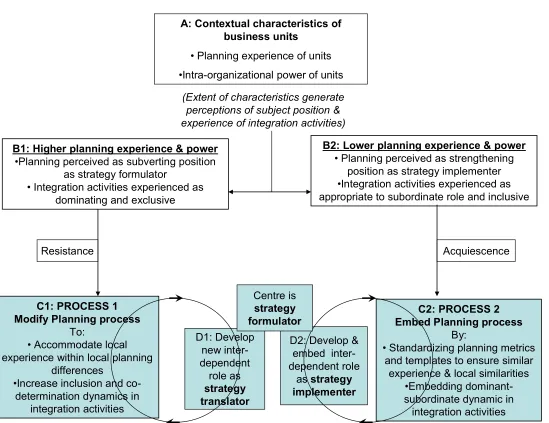
findings are used to develop a process model that shows how differences between business
units, such as planning experience and relative power, create different experiences of
inclusion or exclusion and dominant or subordinate roles (Westley, 1990) in strategy making
and therefore different responses to communication and participation activities within the
planning process. More powerful units experience the process as dominant and exclusive and
therefore resist and seek to modify the planning process to reduce its subordinating effects
whereas less powerful units actually feel more included and accept their subordinate role. The
key contribution of this model is that it accounts for how strategic integration, when it is
achieved, emerges out of strategic planning processes through an evolving and reciprocal
relationship between the subject positions of different participants and their negotiated
modifications to the planning process. This model shows that planning processes should not
be reified in the way they often are as imposed actions that actors resist or comply with, but
rather how different participants (and their subject positions), strategic plans and strategic
outcomes both shape and are shaped by each other through activities of resistance and
compliance. This process model enables us to extend current literature on the political nature
of strategic planning and strategy making in general by demonstrating the nuanced and
varying nature of communication and participation activities.
This paper starts with a review of the literature on strategic planning, strategy making
and political activity, using this to build the case for the use of an activity theory framework.
findings are used to develop the process model which captures the different paths through
which participation and communication activities can enable strategic integration between
diverse business units within strategic planning mechanisms. Finally the paper considers the
contributions of the findings and the implications for practice.
THEORETICAL BACKGROUND
Various claims have been made about the efficacy of strategic planning. While
planning was a staple in earlier strategy studies (e.g. Ackoff, 1970; Lorange, 1975), it has
been subjected to considerable critique. For example, Mintzberg (1994) claimed that strategic
planning had failed wherever it had been implemented, whereas Miller and Cardinal (1994)
found that strategic planning did add value by focussing on the link between strategic
planning and firm performance. Such critique is reflected in a steady decrease in publications
on strategic planning since 1994 (Whittington and Cailluet 2008). However, an annual survey
by Bain and Company indicates that strategic planning remains one of the most popular
techniques used in leading companies worldwide (Rigby, 2003). Recent research also
suggests that the communication and coordination function of strategic planning is of key
importance to firms. For example, Grant (2003) shows that oil majors value the
communicative functions of strategic planning, while Ketokivi and Castaner’s (2004) survey
highlights strategic planning as a key integrative device enabling diverse organizational
divisions to embrace common organizational goals. Others argue that it is precisely this
communicative property that makes strategic planning so valuable to firms in a modern
environment, where they are increasingly required to cope with uncertainties and to
coordinate goals across multiple functional, product and geographical divisions (Andersen,
2000; Brews and Hunt, 1999; Liedtka, 2000; Wilson, 1994).
Consistent with the emphasis on its integrative potential, we follow Andersen’s (2004)
definition of strategic planning processes “as organizational activities that systematically
discuss mission and goals, explore the competitive environment, analyse strategic
alternatives, and coordinate actions of implementation across the entire organization”
(Andersen, 2004: 1275). Two features of planning, participation and communication, increase
2004; Mintzberg, 1994) has informational, affective and motivational effects on different
groups’ commitment to a common goal. Second, communication of planning goals
(Mintzberg, 1994) reduces goal ambiguity because employees know what the organization is
trying to achieve. Building upon these two integrative effects of the planning process,
Ketokivi and Castaner (2004) find a complementary association between communication and
participation that enhances integration effects when both are used.
These findings on the integrative role of strategic planning raise many questions about
the social dynamics involved in integration. While communication and participation may help
to achieve organizational integration around common goals (e.g. Andersen, 2004; Ketokivi
and Castaner, 2004; Mintzberg, 1994; Vancil and Lorange, 1975; Wooldridge and Floyd,
1989), it is not clear how groups with different interests develop shared understanding or at
least common pursuit of the same strategic goals. Implicitly, the findings suggest that
communication and participation have integrative effects by “bringing people together”.
However, empirical evidence on the integrative effects of strategic planning is mixed (e.g.
Wooldridge & Floyd, 1989; 1990). In particular, even when people interact directly in the
planning process, some interests are suppressed and others promoted in ways that affect
commitment to strategic goals (e.g. Hardy et al, 2000; Jarzabkowski, 2008; Narayanan and
Fahey, 1992; Westley, 1990). Thus, findings on the integrative effects of strategic planning
need to be elaborated through fine-grained studies of the compromises, interactions and
negotiations that take place over the planning process. These social and political interactions
over strategy making are at the heart of the strategy-as-practice perspective, which calls for
studies that illuminate the micro-activities involved in the social accomplishment of strategy
(Jarzabkowski 2005, Jarzabkowski et al. 2007; Johnson et al. 2003, 2007; Whittington 2006).
There is, however, little research into how the integrative effects of planning are constructed
in practice, through the actions and interactions of multiple actors with different interests. Our
paper responds to this gap in the literature. We first examine issues of communication,
participation and politics in strategic planning, then propose an activity theory framework as
Strategic planning is perceived as important for communicating an organization’s
strategy internally and externally (Bartkus et al. 2000; Beer and Eisenstat 2000; Kotter 1995;
Mintzberg 1994). While most of these authors have assumed that communication occurs after
a plan has been formulated, others indicate that communication is important during formation
in order that different organizational actors can have input into the plan (e.g. Grant 2003;
Ketokivi and Castañer 2004; Lines 2004). However, the communicative purpose of planning,
the activities that are involved in communication, and its impact on either organizational
members or on the planning process itself are still under-researched. Organizational goals are
seldom unitary, as they may originate with one group of actors, top managers (Simon, 1964),
but then be significantly modified, or indeed new goals may be motivated, by middle
managers (Bower, 1970; Burgelman, 1983; Burgelman & Grove, 1996; Floyd and Lane,
2000). In particular, goals are not stable but rather emerge and are modified through the
communication process (Hardy et al, 2000). Hence, it is important to study how goals that are
communicated through strategic planning are modified and adapted over the course of the
planning process, in order to become goals to which all members can subscribe.
Many studies of strategic planning as an integrative device largely view participation
as a socialization mechanism that generates shared meanings (Lines, 2004). However,
nuanced studies of participation indicate that identification with common goals varies
according to the nature of the participation activities and the social positions of different
actors (e.g. Korsgaard et al, 1995; Mantere and Vaara, 2008; Sagie and Koslowski, 2000;
Schaffer and Willauer, 2003). For example, the extent of socialization may vary according to
the gap between participants’ desired and perceived levels of participation (Driscoll, 1978).
The association between participation and common goals is complex, as individuals
participate in multiple communities, through which they construct a range of interests and
identities that may not align with organizational goals (Handley et al, 2006). Thus, subjects
may experience participation in different ways, from a threat to their own autonomy, to a
political or social opportunity, according to the different roles that they construct for
themselves within the organization (Musson & Duberley, 2007). These roles may also shape
different organizational levels, such as top versus middle managers, may construct different
ways of participating in strategy processes. These varying nuances in participation activities,
the way that they are experienced by different actors, and the way that different actors attempt
to engage in them, indicate that the way in which participation enhances the integrative effects
of strategic planning is complex and bears further investigation.
The wider literature on strategy and, particularly decision processes provides insights
into the political issues that might obscure some of the participation and communication
effects on strategic planning. Strategy making is an inherently political process (Chakravarthy
& White, 2002; Eisenhardt & Bourgeois, 1988; Narayanan & Fahey, 1982), which is
sometimes overlooked in the literature specifically on planning. Strategy making involves
self-interested parties with different perceptions of what constitutes an appropriate
organizational goal (Narayanan & Fahey, 1982). The negotiation of self-interest is
particularly likely to play out in the interactions between different organizational roles, in
which top managers attempt to establish strategy and middle managers either seek to
influence the strategy according to their own interests, or to resist its implementation where it
does not meet these interests (Balogun & Johnson, 2004; Guth & MacMillan, 1986; Floyd &
Wooldridge, 1997; Narayanan and Fahey, 1982). Lower level managers gain influence
through various forms of coalition formation that enable them to have greater influence on the
strategy process, despite their apparent lack of hierarchical power (e.g. Balogun et al, 2005;
Narayanan and Fahey, 1982; Westley, 1990). There is a focus in these studies on resistance to
and influence upon the strategy process arising from actors in different hierarchical positions
in the organization (e.g. Floyd & Lane, 2000; Mantere, 2008; Mantere & Vaara, 2008).
Indeed, Quinn (1980) proposed that in order to overcome political and emotional resistances,
strategy-making should proceed incrementally, learning from and adjusting the strategy
according to the feedback received over time. Hence planning mechanisms do not necessarily
enable strategic decisions to be implemented but rather serve as mechanisms through which
managers at different levels are able to influence strategic action (e.g. Bower, 1970;
Burgelman, 1983; Chakravarthy & Doz, 1992; Chakravarthy & White, 2001; Floyd & Lane,
actors to negotiate their own interests (Chakravarthy & Lorange, 1991; Dutton & Duncan,
1987; Johnson, 1988; Quinn, 1980)
Different interests, particularly between middle managers and top managers, have
received growing attention. These differences are an inevitable part of the strategic decision
process that can either give rise to conflict and obscure strategy implementation (e.g. Guth &
Macmillan, 1986), or alternatively be productive, giving impetus to strategic renewal (Bower,
1970; Burgelman 1983; Burgelman and Grove, 1996; Floyd and Lane, 2000; Rouleau, 2005).
Middle managers are important not only for implementing strategies but also for facilitating
strategic change and giving impetus to or championing new strategies to top managers. Thus,
the way the inevitable conflict is managed is important. For example, increasing middle
manager integration into the strategy process has been associated with increased firm
performance (Floyd & Wooldridge, 1997). That is, reducing conflict may increase consensus,
smooth implementation and so, enhance firm performance (Wooldridge and Floyd, 1989).
However, performance enhancement also occurs from participation in strategy-making
activities, even when consensus between different organizational levels is not an outcome
(Wooldridge & Floyd, 1990). There is thus something powerful about participation in the
strategic planning process that has positive effects, even where consensus is not an outcome.
The different interests of those occupying different roles within the strategy process may be
managed through reciprocal interaction, vertically and laterally (Balogun & Johnson, 2005;
Mantere, 2008), adaptive control systems (Floyd and Lane 2000; Marginson 2002) and flatter
organizational structures that enable increased communication (Wooldridge et al, 2008).
However, there has been little fine-grained empirical research into the dynamics through
which different level actors are involved in strategy making (Wooldridge et al, 2008: 1209) or
how intra-organizational relationships are realised within strategy making (ibid: 1213).
The way that political processes play out will also be influenced by the way in which
the organization values input from different actors in the strategy process (Dutton & Duncan,
1987; Westley, 1990). Actors assume or are allocated different political roles in the strategy
process (Narayan and Fahey, 1982). However, we know little about how such roles are
of consensus or shared goals. It is not simply the fact of inclusion in a strategic conversation
that enables managers at different levels to feel committed to a strategic goal (Westley, 1990).
Even when they are included in a strategic conversation, lower level managers may be
allocated a subordinate role, in which the scope of views that they may express and the
emotions that they may feel about the strategy are demarcated by senior managers. Such
findings indicate that we need to pay greater attention to how different level actors perceive
their inclusion and ability to influence those strategic planning activities in which they
participate if we are to account for their varying experiences of integration.
Taken together, the above literature indicates that strategic planning is important
within organizations because it has an integrative effect. Furthermore, this integration arises
from the communicative and participative properties of strategic planning. However,
communication, participation and the subsequent integration that is to arise from planning is
likely to be fraught with difficulties arising from different interests and experiences of
communication and participation activities by actors occupying different organizational roles.
We therefore need to develop more nuanced understandings of strategic planning as it occurs
in practice, in order to understand how issues of power, interests and perceptions of
integration arise and are resolved through the negotiations and compromises that occur as
actors interact over the plan. In particular, we need to understand how these interactions
enable the planning process and the goals and interests of different actors to be modified to
the extent that common organizational goals may be pursued. In doing so, we respond to calls
for future research “to examine these dynamics and to extend the work of Ketokivi and
Castañer (2004) in describing conditions that help to align individual and subunit interests
with those of the larger organization” (Wooldridge et al, 2008: 1216).
Activity theory lens
We now propose an activity theory framework for examining the strategic planning
process over time. Activity theory is a useful conceptual apparatus because it suggests that
planning will be experienced differently by different actors according to their different
interests and that the planning process itself plays an important role in these experiences.
seek to modify the planning process according to their own interests, using it to dominate
other actors or to advance their own interests. Activity theory is a useful framework for
analysing these reciprocal strategy processes because it is fundamentally concerned with
understanding dynamic processes over time; “Let us take the metaphor that strategy process
is like a river. … This metaphor helps to understand why dynamic aspects of a larger active
process cannot be fully explored with static samples from that process. Process, contexts and
outcomes all change with time” (Chakravarthy and White, 2001: 200-201). While process,
context and outcomes continuously evolve in interaction with each other, we have few
strategy studies that explicitly adopt an ontological framework that allows them to explore
this reciprocal process. However, this reciprocity is at the heart of practice-based studies (see,
for example, Orlikowski, 1996; 2000; Jarzabkowski, 2008). By adopting an activity
framework, we take a practice-based ontology, as espoused by multiple authors
(Jarzabkowski 2004; Johnson et al, 2003; 2007; Whittington, 2006), in order to analyse
strategy as a continuously unfolding stream of activity that is constructed through the
interactions and negotiations between different actors.
Activity theory (Leontiev, 1978; Vygotsky, 1978) is increasingly being drawn upon to
look at problems of coordination and shared activity in organizations (e.g. Adler, 2005;
Blackler, 1993; 1995; Blackler and McDonald, 2000; Blackler et al, 2000; Foot 2002;
Jarzabkowski, 2003; 2005; Miettinen and Virkkunen, 2005; Spender, 1995). In these studies,
the organization is conceptualized as an activity system, accomplishing common activity
through the interactions within the system. Three concepts in activity theory are useful for
looking at our problem of strategic planning as an integrative mechanism; goal-directed
activity; subject; and mediation. Activity theory focuses upon practical activity as the
goal-directed interactions through which actors engage with their contexts over time. Practical
activity provides a focus for interactions; different actors interact in order to do something.
These actors each have their own concept of the purpose of the activity, based on their
localized understandings about ‘the way we do things here’ (Spender, 1995), that will need to
be modified in order to establish common activity for the system as a whole. If an
corporate-communicated intentions about what the organization should do and partly emergent features
of localized divisions’ own activities and interests (Blackler et al, 2000: 284). The focus or
‘goal-directedness’ of activity is thus evolving, emerging out of the interactions and contests
between actors, and this is a key feature of activity theory analysis; examining how a
collective output is accomplished through interactions and contests between actors, which
modify both the goal and how the actors engage in actions directed at the goal (Engestrom et
al, 1999; Foot, 2002).
In activity theory, actors are conceptualized as subjects who interact purposefully with
their contexts; “People act as subjects in the world, constructing and instantiating their
intentions and desires” (Kaptelinin and Nardi, 2006: 10). It is through this subject’s intentions
and actions that activity may be understood. Such activity is always collective, in so much as,
even in acting alone, an actor relates to the collective and draws upon the tools and symbols
of that collective. While individuals act by drawing upon and contributing to collective tools
and symbols, they are not simply pawns of the collective. Rather, they have motives and
desires that they impute to their own actions within wider collective activity. This concept of
subjects as purposeful actors is important for studying the problem of strategic planning as an
integrative mechanism. It indicates a focus on the purposes that different actors attribute to
their own actions within the planning process and its resultant outcomes. In particular, this
framing invites us to compare different subjects and understand interactions from different
subject positions. We thus have a richer view of the communication and participation
activities through which strategic planning generates integration. From an activity theory
perspective, we cannot look at strategic planning as a set of common organizational goals that
must be communicated to other actors, in order that they might adopt those goals, but rather
as a study of how different actors interact with the goals that are presented and what
modifications are necessary to accomplish those goals as common activity.
Mediation is the third activity theory concept drawn upon in this paper; “Activity
theory casts the relationship between people and tools as one of mediation; tools mediate
between people and the world” (Kaptelinin and Nardi, 2006: 10). Mediating tools or
heuristics, scripts, routines and languages (Omicini and Ossowski, 2004). Mediation suggests
that, despite their potentially different perspectives and interests, actors are able to integrate
their actions in the pursuit of shared activity (Engestrom, 1993; Kozulin, 1990). However,
activity theory does not conceptualise mediation mechanisms as primarily the instruments of
any particular constituent, such as senior managers (Jarzabkowski, 2009). Rather, the same
mechanisms may be appropriated by different constituents in order to mediate between their
varied purposes and interests (Rabardel and Beguin, 2005). From this perspective, strategic
planning is a mediating mechanism that cannot simply be imposed but must be brought into
being by the actors who participate in it, during which process it will be modified. This is
because strategic planning has a ‘general’ or cross-contextual character when it is introduced,
which will come into tension with the local situated actions of different subjects (Miettinen
and Virkkunen, 2005: 444). Thus, different subjects continuously interact with the planning
mechanism, modifying it to suit their own interests, even as these interests are modified by
the planning process. Such modifications involve ongoing and unfolding power dynamics
(Blackler & McDonald, 2000), as new ways of relating and new activities emerge around
reactions to and modifications of the planning process. Mediation is therefore a valuable
concept for examining the integrative role of planning processes in organizations (Blackler
1993; 1995; et al, 2000; Jarzabkowski, 2003; 2005; Miettinen and Virkkunen, 2005). It goes
beyond simply explaining how common strategic actions are integrated through planning,
possibly with some resistance, to examining how common strategic actions, different actors’
interests in those actions and the planning processes that mediate between them evolve
together.
However, we have few studies that examine these reciprocally evolving processes
within strategic planning (Chakravarthy & White, 2001). Rather, planning processes are
reified as ‘things’ which actors resist or acquiesce, with little understanding of how the
process is itself accomplished through resistance and acquiescence, and how that process also
shapes the participants and the activity in which they engage. An activity theory perspective
is, therefore, adopted in this paper in order to explore the reciprocal relationship between the
The paper seeks to explain the process by which strategic integration is ultimately delivered,
identifying the specific types of modifications that need to take place in the planning process,
the actors involved in that process, and the way that a common strategy emerges.
RESEARCH DESIGN AND METHOD
As typical in longitudinal case-based research, we used theoretical sampling to select a
case that reflected the phenomena under investigation (Eisenhardt, 1989; Pettigrew, 1990).
Access was granted to the European Division of Brandco, a large producer of branded
consumer goods, that reflected the traditional multinational with a country centric way of
working (Ghoshal and Bartlett, 1998). We were able to track longitudinally the evolution of a
new annual strategic planning process established in 2004 to achieve greater strategic
integration across Europe. Multinational firms that are using strategic planning in an attempt
to deliver globally integrated strategies are an appropriate site in which to examine the
integrative effects of strategic planning (e.g. Ghoshal and Bartlett, 1998; Ketokivi and
Castaner, 2004). We chose to focus on one in-depth qualitative case study to enable us to
capture a multi-level perspective and be closer to the actions and interpretations of the
participants involved consistent with a strategy as practice perspective (Balogun, Huff &
Johnson, 2003; Johnson et al, 2007). Whilst single site case studies have their limitations,
topical contexts, such as here building strategic integration across Europe, give findings
broader relevance (Balogun & Johnson, 2004).
The new planning process was facilitated by the creation of new European Marketing
Teams (EMT). Consistent with our research problem, the new EMTs were intended to create
integration while allowing for locally tailored delivery. Specifically, the EMTs were to
develop new pan-European strategies and campaigns by working collaboratively with the
country-based brand teams, who were then to implement these strategies locally. We focus on
the EMT and associated planning processes for Brand X. The Brand X EMT was located in
the UK and sponsored by the UK Country President but it was to work in a pan-European
fashion. The new strategy was to be implemented through a new annual planning process,
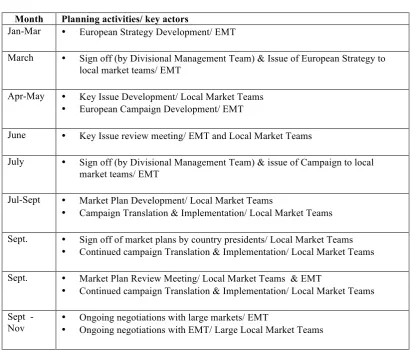
which comprised a series of activities occurring at the EMT-level, the country-based brand
management teams, providing a series of natural data collection points (see Table 1).
Implementing the process was challenging, as different geographic regions had different
levels of knowledge about the product, the market and, particularly, the planning process,
while different hierarchical levels had diverse interests that they wished to realize through the
new planning process.
INSERT TABLE 1 ABOUT HERE
We took a longitudinal, qualitative, case-based approach (Eisenhardt, 1989; Pettigrew,
1990). In order to track over time developing reciprocal relationships between the planning
process, the different actors’ subject positions and the emergence of common strategic
activity, we tracked the planning process from the perspective of the key actors: the Brand X
EMT and the European brand X teams, including the European Brand Network (EBN)
members of the key geographic regions. As the second author had long research engagement
with the company, we quickly were able to identify and access the key players, as well as
having considerable contextual understanding of the case study. Specifically, we collected
data from most of the main regions into which Brandco divided its European market; the UK,
Germany, France, Spain, Nordic and Central Europe. Additionally, as the EMT was based in
the UK and sponsored by the UK Country President, we interviewed UK senior managers
involved in the change. Data were collected primarily through 30 interviews conducted from
March 2004 to January 2005, with dates coinciding to key events in Table 1. Each interview
lasted about an hour and all were audio-recorded and transcribed. We also collected copies of
the pertinent strategic planning documents and presentations, in order to analyze what the
planning process entailed and how different groups engaged in the planning activities. To
further triangulate, we reported our findings for the Head of the EMT, the EMT Marketing
Director, and the UK Country President (also sponsor of the Brand X EMT) at a one and a
half hour meeting in 2005. Detailed notes including verbatim quotes were taken during this
meeting and subsequently typed up.
Our interview questions focused on how the new planning process was perceived by
the EMT and Brand X teams in the different geographic regions at different points in the
they perceived their own position within the planning process and within common European
strategic activity. The data collection was split between the authors, enabling each author to
be immersed in the activities of specific hierarchical and geographic communities, whilst
cross-checking impressions and tentative findings after each set of interviews in order to
inform subsequent rounds of interviews. This research design enabled us to access the subject
positions of the key hierarchically- and geographically-based participants responsible for
managing the new integration process, conducting repeat interviews at key points in the
process, so that we could trace how subject positions changed over time, in interaction with
changes in the planning process and changes in perceptions about common strategic activity.
In order to ensure trustworthiness in our qualitative data, we followed many of the criteria laid
down by Lincoln and Guba (1985). The second author had prolonged engagement with the
research site, not only during this research project, but through previous research projects.
Multiple sources of data collection were used. The final report and meeting provided research
participant feedback. Finally, the research was written up through a thick description of the
findings to enable their transfer to other settings
Data Analysis
Analysis progressed over five stages. We adopted an inductive approach to the data
(Miles & Hubermann, 1994) in order to develop emergent themes, which we followed by
iterative references to the theoretical framework in order to interpret our findings and develop
labels for particular themes that arose (see Eisenhardt, 1989; Suddaby, 2006). First, each
author constructed rich narratives of the strategic planning activities of those groups she had
tracked (Langley, 1999). These narratives provided thick descriptions of each groups’
perceptions of their own and others’ activities in the new strategic planning process and how
they acted to shape the planning process according to their own perceived subject position
within the common European strategy. We then read and discussed each other’s stories, with
each author acting as an ‘outsider’ in questioning the findings and themes of the other’s story
(Evered and Louis, 1981).
In the second phase, based on our discussion of the stories, we identified that different
within the planning process. Specifically, drawing on political frameworks (see Narayanan
and Fahey, 1982), we looked at the positions that particular groups either assumed in the
planning process, meaning the way they self-identified in that position, or were allocated,
meaning the way that they were identified by others. Our three groups were:
– the European Marketing Team (EMT), which assumed a subject position as strategy
formulators and allocated others a subject position as strategy implementers
– Large European Markets, which initially assumed a subject position as strategy
formulators, resisted the allocation of a position as strategy implementers and eventually
assumed a position as strategy translators
– Small European Markets, which were initially allocated a position as strategy
implementers and came to assume that as an appropriate position.
Third, drawing upon the concept of mediation in our activity theory framework we
analysed these evolving subject positions in relation to the planning mechanism, examining
how different subjects drew upon the mechanism in order to either justify the positions that
they assumed or how they sought to modify it, in order to better meet the positions that they
wished to assume. For example, we found that the EMT emphasized standardization of the
planning process in order to reinforce their assumed position as strategy formulators, while
Large Markets tried to modify the planning process in order to assert their own position as
formulators, or to discredit it in order to resist the allocated position of strategy implementers.
We traced the meanings that different groups attributed to the planning process in order to
justify their own actions and how the groups negotiated and modified the process over time
until it could deliver a common understanding of integrated European strategy.
Fourth, we tied these analyses of subject positions and planning process modifications
together by comparing and contrasting the different groups’ experiences of integration over
time, particularly in terms of how they referred to communication and participation activities.
In this analysis, the different experiences of communication and participation that we found
could be usefully interpreted with reference to Westley’s (1990) concepts of inclusion/
exclusion and domination/ subordination/ codetermination within strategic conversations.
planning mechanism and their own subject positions were associated with their different
experiences of inclusion or exclusion and domination, subordination or codetermination in
particular communication and participation activities within the planning process.
Fifth, we compared the different subject positions, experiences of integration and
attempts to modify the planning process, in order to derive some understanding of the
different way that the process unfolded over time for Large Markets and Small Markets, and
the different way that the EMT responded to these two groups. From this analysis, we
recognized that two main characteristics of the different groups were important in the
different processes; the extent of a particular market’s experience of planning and the extent
of intra-organizational power of a particular market, in terms of its market size and revenue
with Brand X. This final analytic stage enabled us to develop a process model explanation of
our findings, which is presented in the discussion section of the paper and constitutes our
main contribution.
We now present our findings over three phases, showing how each group’s subject
position evolved in association with that group’s experiences of integration as inclusion or
exclusion and domination, subordination or codetermination and that group’s attempts to
modify the planning process.
FINDINGS
Phase 1: Phase 1 covers the period from the April strategic issue development through
to the June key issue review meeting, each of which were parts of the new planning process
(see Table 1). April provided an opportunity to communicate the new strategy, while in June
different geographic markets were able to participate in the planning process by sharing their
key issues based on the EMT’s new strategy at a review meeting. At the same time, the EMT
had set up the European Brand Network (EBN), comprising regular meetings between the
EMT and members of all the main local markets and regions, in order to enable ongoing
communication of and participation in strategy across local markets. From the outset, it was
apparent that strategic planning had been introduced into a context in which actors had
different experience of strategic planning, different levels of Brand X penetration within their
There were thus different subject positions in relation to what strategic planning constituted
and where strategy should be formulated for Brand X.
EMT assume a position as strategy formulators. At the outset, the EMT were keen to
embrace communication and participation as a way to ensure that strategic planning could
deliver a common European strategy; “… I see us as the coordinators, facilitators, and the
people who have to make the call at the end of the day, but actually there are extended
members of the EMT within the market. We have single, senior marketing representatives
from each of the major countries and each of the major regions sitting on, as we call it, the
EBN. We very closely work with them in strategy development, information gathering,
campaign development and roll out”.
At the same time, however, they saw strategic planning as a useful standardization
tool that could cause local markets to behave in similar ways; “I want to be able to sit there
looking at Italy, Germany, Spain, the Northern region, the Southern region, and actually be
able to benchmark and see the consistencies and inconsistencies across Europe, so if someone
comes in and says OK, this is what the market analysis has said they are using the same
parameters to analyse their market as someone in Italy or Spain. Otherwise it is incredibly
difficult for me to sit there and say that’s a good plan, that’s not a good plan, here’s the
challenge, and here’s the support”. This view of planning, which involved the development
of a common set of planning templates to be used by all local markets, indicated two points.
First, from the EMT perspective, integration was possible because local markets were
perceived as largely undifferentiated. If markets had inconsistencies, planning provided
comparators to benchmark and standardize outputs. Planning was thus not only about
communicating a common strategy but also about ensuring that the EMT could evaluate
common output across markets, leading to the second point. As local markets were
undifferentiated, the strategizing role of actors in local markets was negated, emphasizing a
particular subject position for EMT as strategy formulators, who adjudicated on local strategy.
Despite their initial intentions to be strategy coordinators and facilitators, with strong
participation from local markets, as the standardizing aspects of planning took hold, the EMT
integration activities; “We are there to set the European strategy which includes brand
positioning and includes the key messages and includes the campaign”.
Small Markets are allocated a position as strategy implementers. Small markets, with
little experience in strategic planning found the new process, with its templates and rigorous
planning format, quite challenging; “In Finland we never kind of split the planning process in
two so kind of firstly the issues and kind of ok on those, and then go onto the next phase which
is how we are going to solve these things … So people are not so used to ... They are used to
filling in templates but they are not so used to kind of understand why they should do” (Nth
EU). At the same time, smaller markets played a small part in the Brand X market penetration
and revenues; “And very different market situations as well, so in some markets the product
was launched two years ago, and is quite successful. In other markets the product is still not
available” (Central EU); “if you represent one country and come back home and basically
these guys normally also work with Brand X products … it’s their kind of their main work.
While representing a country or area … I didn’t even know what Brand X was when I started
to represent Northern Europe” (Nth EU). Thus, small markets’ experiences of
communication and participation activities were largely of a subordinate nature as they tried
to learn about both Brand X and about more formalized ways of planning.
While the new experiences were challenging, the small markets also began to perceive
that this new process could support them in implementing a Brand X strategy; “it doesn’t take
away any work load, but it actually adds things, analysis etc., you know, materials that you
were not able to produce before” (Nth EU); “in this way when I work locally I can count on
the support of those programmes that have been at the European level and I can profit and
capitalise on those a lot” (SP). Small markets thus embraced opportunities to participate with
other markets and the EMT.
Large markets assume a position as strategy formulators in their own markets. The
large markets were already experienced in strategic planning. They had considerable market
share in Brand X and were important revenue streams for Brandco. When they heard about
the EMT, the new planning templates, the common strategy and the common campaign for
actions; “it is good to have a common way of us presenting the figures, that’s ok, but for the
action plans, actions are very different from one country to another one” (FR). They expected
that the planning process was largely to help develop the smaller, inexperienced markets; “I
think if you are talking to some other countries my observations are that somebody can go
through that planning process with much more, like a new thing for them and make them
consider elements of the situation analysis that they have never considered before” (UK).
Due to their experience in formulating strategy, they expected to have a lot of input into the
common European strategy; “so I see it as two-way … they will have to market .. there will be
a lot of communication between the markets and the EMT to develop strategy, and then
actually implement it” (UK).
As these large markets participated in strategic planning sessions with the EMT and
other countries, their perceptions about the importance of Brand X and its different
positioning in their markets were reinforced; “Needs are different: we were so different in our
key issues, and the market is … was at this time totally different, the position of Germany and
France regarding the product was totally different … we were not at the same time in the
same situation (FR); “… the UK is a very different market. … we are in a very different
place” (UK); “in our case, we had a slightly different understanding of what the key issues
are for Germany” (Germany). They were thus convinced that they would participate in
developing common elements of strategy, whilst maintaining their own distinctiveness as
important, knowledgeable markets with good experience of planning for their own markets.
As the planning process evolved and the EMT began to take a stronger view of
planning as a standardization tool for adjudicating on what they saw as largely
undifferentiated markets, so these larger markets developed a negative view of the
communication and participation they were experiencing; “a classic one is this week when it
could have been a slide show that they could have sent to everyone, because they didn’t get
that debate. And my brand planner said, you know, everyone was quiet listening to the
presentation. That to me isn’t an effective EBN and how we should be working. I think we
should really be challenging understanding … the debate is where we move on and develop
everybody and they take it … nobody owns that then. It’s the EMT Marketing Director and
his team that own it, we don’t in EBN” (UK). Hence, as they moved towards the June review
meeting, large markets felt that, even so that they were being physically included in
communication activities, they were being excluded from participating in formulating the
strategy. They thus experienced their dynamic with the EMT as one of domination and
subordination that was inappropriate to their position as strategy formulators.
Phase 2: In Phase 2, which began with the June key issue review, and progressed to
the development of Brand X market and campaign plans, the patterns of differentiation that
emerged in the previous phase were accentuated, provoking resistance. At the June meetings,
many markets, small and large were exposed to the standardization of the planning process, as
they were pulled into line for not developing appropriate “key issues”, based on the EMT’s
templates and definitions; “And now in June, last week, we had meetings with all the most
important countries from the regions. And they presented those key issues to us, we had the
discussion” … “And then, if you agree with them the strategic direction and the key issues,
then they go back and they write plans to address to those key issues and plans” (EMT)..
EMT assume a stronger position as strategy formulators. The EMT ambitions for the
June meetings indicated some contradictions in their perceptions of communication and
participation. They felt the June reviews should generate key issues for each country
consistent with the EMT strategy for Brand X, because they had used the EBN to
communicate the strategy and expectations, indicating that they were already quite entrenched
in their own subject position as strategy formulators, with planning as a mechanism for
communicating that strategy “Actually we have taken them through each step of the start up
document, so that actually there’s more understanding of what we are asking them to do and
why we are asking them to do it”. At the same time, they clung to views of strategic planning
as participative; “I’ve chosen to do that one (June) by a meeting as well, or several meetings
so we get several countries together presenting their plans to us, so it doesn’t feel quite as
much of us going and saying, right, present a plan, you know we are the superior bods with
great brains, because that’s not the case at all … we are trying to add support and actually
However, at the June meetings, the EMT actually reinforced their positions as strategy
formulators, using the standardization of the planning mechanism to dominate other parties;
“It all used to be about strategic options … and the key messages and the campaign, and how
are we going to implement, as well as the tactics. All that’s going to be gone. They should
just be, in these templates, sticking in what we are saying …and the key messages should be
exactly what the EMT said they are”.
Small markets assume a position as strategy implementers. Small markets began to
realise that these planning templates, review meetings, EBN meetings, and the subsequent
campaign aids being developed were to their advantage. They recognized that their
opportunities for participation in formulating European strategy were limited and that they
would need to conform to common activity if they wanted to gain traction with Brand X;
“Actually in one of the sessions when all the Northern European GMs were there, I just had to
stand up and say, guys, you are way out of line here … you need to understand what you can
effect and what you can’t effect, and you know you should stop discussing those things where
actually you don’t have the power to say anything about this … we are not actually changing
the strategy, we are actually coming to really think how can we, in our country, or in our
region, or whatever, do the best in terms of implementing things” (Nth EU). They thus
curtailed their expectations of participation in strategy formulation, trading these off for the
value of participating in implementation plans with more experienced European countries;
“So to me even though it is a much more different country , the tactics on some of the issues,
the approach to the issues is quite useful to me because I like to see what happened there so
what can we take from that and how did they approach to this. So in that way that interaction
is quite good” (SP).
These trade-offs enabled small markets to accept their subordinate role in the planning
process and to assume the subject position of implementers of a common European strategy
that had been allocated to them by the EMT. They thus began to experience the EBN
meetings and interactions with the EMT as participative and were willing to subordinate their
local differences; “And I felt really, really involved. We all know that when you work with
local things. But all the, everyone had the opportunity to provide with input and try to bring
here the Spanish situation or what ever the situation is to be. So in that way I think there was
much of a consensus going on in between all the decisions” (SP).
As small markets had gained by accepting the subject position of strategy
implementers and the associated standardization in planning, they were amenable to adopting
the EMT designed campaign with no amendments other than translation into their own
language and amending plans at the September sign-off as requested, which further reinforced
their subject position as strategy implementers; “Honestly I must say that the smaller markets
would never have a strategy for our brands in the first place without the EMT, so really it’s
just great that we now have one” (Nth EU); “So coming from a small market like Hungary,
and I see the same in other markets in the region, I can see that we never did such a
professional market research and strategy and planning procedure like in this case with
Brand X” (Central EU). This strategy implementer position was complementary to and
reinforced the EMT position as strategy formulators, reinforcing the dominant-subordinate
dynamic in communication and participation activities. Thus small markets became
increasingly integrated into a common European strategy through their acceptance of the
standardized planning process and their role in it.
Large Markets resist the EMT allocated position of strategy implementers. In the large
markets, the challenges at the September meeting and over the campaign affected their
experiences of the planning process. They realized that they were not able to use their local
knowledge to participate in common strategy formulation. They thus began to disparage the
planning process as largely irrelevant, rather than as opportunities to participate in
strategy-making; “What I am not seeing from the EMT is say, Germany did this, and it was fantastic.
What a great idea. We don’t see that, sort of, sharing of best practice. What they seem to be
doing is generating support for the markets that are needing to come up to a certain level, but
actually the other markets that are already there ... There isn’t enough to sort of push them
on” (UK). They began to assert the importance of their local markets and adherence to their
local procedures during the market and campaign development; “We have a German planning
we actually did, we split up the work and used our core competences from different team
members and gathered the plans in a way that we all agree on it. … So I think the direction,
where we are going with Brand X … if there are then some specific things for the adjustment
of the strategy to the German market, that is certainly in my understanding, the responsibility
of the market” (DE). In this reaction to what they perceived as an overly standardized
planning process, the large markets were rejecting the subordinate role in their interactions
with the EMT and asserting their subject position as distinctive and powerful markets that
should formulate their own local strategy.
However, the EMT were increasingly convinced that local markets were largely
undifferentiated, and so should conform to a central, EMT-formulated strategy. They used the
planning process as a standardization mechanism to control local differentiation and reinforce
their own dominance in strategy communications; “Yesterday one country was saying we
want to do educational promotions, and we are developing such a programme. And we say to
them no you shouldn’t do that, you should stop it, we have got it in our plans. We will deliver
it to you, you don’t need to invest money, put that money into something else” (EMT). Thus,
the EMT extended their own scope as strategy formulators and reduced the opportunities for
local teams to participate in strategy formulation. Planning was extended from
communicating a central strategy to providing many additional elements with which the local
markets were to comply. In effect, the EMT now perceived that, in order to complement their
own subject position as strategy formulators, the appropriate subject positions of local
markets was to be strategy implementers; “[They] should not be planning strategy, they
should not be developing campaigns; their remit is very different now. Therefore the way
that they are going to go through the planning is more about how do I take what the EMT is
putting out, and implement it brilliantly”.
Large markets protested that this was outside the EMT remit. They were assuming too
much control over local strategy; “I think they have exceeded the remit, because they have
provided the strategy … they have provided material, they have delivered a programme of
market shaping, and also a process in order to improve market access across Europe, and in
market building and the market access campaign” (France). In response, the large markets
disparaged the EMT market planning process as inferior to local planning processes; “they
didn’t do a competitor review, and they didn’t do a segmentation review, and they hadn’t sort
of; they hadn’t done all the stuff they were asking us to do and yet they’d got key issues and
you kind of thought, why haven’t they” (UK). They also criticized the dominant-subordinate
dynamic of the EMT in integration activities; “The marketing campaign, when we adjusted it
for the German market, and we had to ask for approval in the EMT, and we went through
each page and so on, this is more in a direction of centralisation” (Germany). Tension
mounted, as large markets resisted their EMT-allocated position as strategy implementers.
The EMT reacted by asserting their position as strategy formulators for Europe, and
exerting dominance in their interactions with the large markets; “we are not negotiating with
them, we are politely trying to explain to them why they should do it. It’s a process that we
have been tasked to do, either that or every country will go back and do their own thing just
with a different look, which is not the point, the point is to have a consistent campaign, both
in terms of the way it looks and its content” (EMT). While large markets insisted that the
planning process was too standardized and needed modifying to local demands, the EMT
prevented them from adapting the EMT-driven brand campaign. Instead of complying with
the changes, the large markets resisted; “So if I am saying we are implementing the strategy,
and we are using the sales aid, even if we are saying we are adapting it to the German market
maybe slightly, this should be possible” (Germany). In particular, a confrontation arose over
the UK market’s insistence that they needed a different campaign because that was best for
their market revenues. The large markets were emphasizing their power as knowledgeable
strategy formulators in local markets.
Drawing on their successful experiences in generating common strategy with the
smaller markets, the EMT insisted that strategic planning was about standardization, “If your
model is doing things 90% right across the whole of Europe is better than every market trying
to do it 100% right in their market, then your bottom line has got to be that that applies
equally to the bigger markets as to the smaller”. They particularly wanted the defiant UK to
about exemption from the rules, so that other markets can pick it up and use it as an example
to be inconsistent within the European strategy or the European campaign” (EMT). However,
the UK refused to accept EMT jurisdiction, appealing to their country President, who was also
the sponsor of the EMT, to adjudicate, on the basis that their local market expertise and their
strong revenue, would be damaged by the common campaign; “What we want to make sure
happens is that we have got the strongest messages that we possibly can, and that we don’t
lose out on that”. It was made clear to the EMT that as far as large local markets were
concerned, the new planning process risked Brandco’s profitability, with large markets
asserting their rights to pursue local activities.
At the end of Phase 2, the planning process had thus had only partial success in
generating a common European strategy. Managers in small markets accepted their allocated
subject positions as strategy implementers, subordinated themselves to the standardized
planning process and so began to experience the integration activities as positive and
appropriately dominant-subordinate in terms of communication and participation. However,
actors in large markets resisted the allocated position of strategy implementers and attempted
to modify the planning process in order to assert themselves as strategy formulators and avoid
a subordinate role in their interactions with the EMT.
Phase 3: From October onwards, following the resistance in Phase 2, there was much
face-to-face discussion between the EMT, the UK president, the UK market and the other
large markets. Eventually, assured by the UK President as the EMT sponsor, that he would
authorize the changes that markets such as the UK wanted to make, the EMT made
compromises, such as allowing the UK to modify their campaign; “So there was a conscious
compromise in several areas in order to get the model working and delivering” (EMT). More
importantly, in order to account for knowledge and expertise in local markets, the planning
process was modified to include red, amber and green categories. These modifications
indicated where European strategy and messages must be asserted (red), where local activities
could take precedence (green) and amber areas that were to be negotiated around a mix of
local and European activity, which would involve greater interaction between these large
European strategy. The EMT’s right to standardize much future planning was emphasized;
strategic activity was to be seen as 90-95% undifferentiated.
EMT are strategy formulators who seek active participation from large markets in
formulating local campaigns. The EMT was pleased to have their position as strategy
formulators reinforced hierarchically; “if it’s a much better thing for 95% of the markets then
we should do it. People should think European and what’s best for Europe”. At the same
time, they had made a subtle but important modification to their understanding of common
European strategy. They now recognized that in their efforts to achieve a common strategy
they needed to acknowledge and allow for large market differences, where subtle
differentiations were specifically geared to maximizing market share in those markets; “the
variety tends to be in the more important markets” (EMT).
As they modified their understanding of common strategy to allow for small
variations, so the EMT also modified the planning process, not only in those areas on which
local markets could negotiate, but also in terms of opportunities for participation for the larger
markets. They proposed to increase participation as part of their own acceptance that they
needed to change from a dominant-subordinate dynamic in their interactions with large
markets to one that enhanced co-determination of the common strategy; “Anna might take the
lead on that, and pull a small team together from the UK, Germany and France … They will
do some work for a month, or 2 months, and then come back to report back … if we just had
us here, the group of 4 managers and myself, we were developing everything, we wouldn’t
have this European flavour”. Common strategy had to be sure to incorporate greater
receptiveness to strategy-making in important markets, where some differentiation might be
linked to profitability. Thus the EMT subtly modified their subject position, remaining
strategy formulators but with more participation in formulation from the large markets.
Small markets embed their position as strategy implementers. Managers in the small
markets were satisfied with the outcomes of the strategic planning process. Their own
experience of the standardizing aspects of the planning process, with its associated subject
position as strategy implementers, had been positive in raising their status in Brandco; “Being