Copyright( 1971 American SocietyforMicrobiology Printedin U.S.A.
Ribonucleic
Acid Polymerase Activity in Sendai
Virions and Nucleocapsid
WILLIAM S. ROBINSON
Department ofMedicine, Stanford University, Stanford, California 94305
Receivedforpublication 12 March 1971
After dissociation of purified Sendai virus with the neutral detergent Nonidet
P-40 and 2-mercaptoethanol, it catalyzed the incorporation of ribonucleoside
triphosphates into an acid-insoluble product. The enzyme activity was associated
with viral nucleocapsid as well as whole virions. The reaction product was
ribo-nucleic acid (RNA)which annealed specifically with virion RNA. Sedimentation
of the 3H-RNAreactionproductrevealedtwo components, a 45S componentwith
properties of double-stranded RNA and 4 to 6S component which appeared to be mostlysingle-stranded RNA.
Recent experiments have shown that when
cellsareinfected with Sendaivirusinthepresence of cycloheximide, which inhibits protein
syn-thesis, virus-specific ribonucleic acid (RNA) species complementary to virion RNA but not
the 57S virion RNA are synthesized (W. S.
Robinson, Virology, inpress). Thisindicates that synthesis of the complementary RNA species
afterinfection does not require newprotein
syn-thesis and suggested that the enzymeinvolved in
synthesis of these RNAspecies might be part of
thevirion.
Very recently, Huang, Baltimore, and Bratt
(8) foundRNApolymerase activityinNewcastle diseasevirions, andthis reportdescribesasimilar
activity inSendaivirionsand inviralnucleocapsid isolatedfromvisions.
MATERIALS AND METHODS
Materials. Uridine-5'-triphosphate-5-3H (3H-UTP)
and 3H-adenosine-5'-triphosphate (3H-ATP) were
purchasedfromNewEnglandNuclearCorp.;Nonidet
P40(NP40)was agiftof theShell Oil Co.Crystalline
bovine pancreatic ribonuclease A free from
deoxy-ribonuclease and T1 deoxy-ribonuclease were purchased
from Worthington Biochemical Corp.; crude yeast
RNA and sodium deoxycholate (DOC) were
pur-chased fromSigmaChemical Co.
Virus. TheHarris strain ofSendai viruswasgrown in embryonated eggs as previously described (2),
and chorioallantoic (CA) fluid containing 109 egg infectiveunits of virus per ml (2) wasused for virus
purification.
Virus purification. Sendai virus was purified from
large volumes of CA fluid by first centrifuging the
fluidat 10,000rev/minin the Sorvall GSA rotor to
remove cell debris and then by pelleting the virus in theSpinco 19 rotor at 19,000rev/minfor 4 hrat
4C. The virus was resuspended in buffer 1 which consisted of 0.01 M
tris(hydroxymethyl)aminometh-ane(Tris)-hydrochloride (pH 7.5), 0.10 M NaCl, and 0.001M ethylenediaminetetraacetic acid (EDTA) at 0.01 of the original volume and was sonically treated to disperse aggregated virus. The virus was then
layered over astepwisedensity gradient consisting of
5 ml of 65% sucrose in D20 with buffer 1 and 15 ml of20%Osucroseinbuffer 1 andcentrifuged in the
Spinco SW 27 rotor for 2hr at 26,000rev/min and
4C. The band ofvirus floating on the65% sucrose
layer was collected, and the virus was then
centri-fuged to equilibrium (15 hr) in a linear 20 to
65%,'O
(in D20) sucrose gradientcontaining buffer 1 in the
Spinco SW27rotor at 26,000rev/min and 4 C.
Hemagglutination. Serial twofold dilutions of virus or dissociated viral fractions were made in phosphate-buffered saline for the chicken erythrocyte agglutination test as previously described (2).
Proteindetermination.Theconcentration of protein in virus preparations and dissociated viral fractions
was determined by the method ofLowry etal. (13)
or estimated by ultraviolet absorbency (A) for pro-teinsolutions with 280/260 greater than 1.0 byusing
theformula: 1.54 X Am - 0.76 X A260 = protein concentration in milligrams per milliliter (18).
RNA extraction. RNA was extracted from
puri-fied virus and from enzyme reaction mixtures by
addingsodium dodecylsulfate,extractingwithphenol,
andprecipitatingthe RNAwith alcoholaspreviously
described (5). Chick embryo cell RNA was usedas
carrier insomeexperiments.
RNA-RNA annealing. RNA samples were heat-denatured, placedin buffer consisting of 0.1 M
Tris-hydrochloride (pH 7.5) and 0.1 M NaCl,annealedat
85C, and incubated in pancreatic ribonuclease and T1 ribonuclease before determining trichloroacetic
acid-precipitableradioactivityaspreviouslydescribed
(15).
Assays for radioactivity. Radioactivity in sucrose
81
on November 11, 2019 by guest
http://jvi.asm.org/
ROBINSON
densitygradientfractionswasdeterminedby washing trichloroacetic acid precipitates on glass fiber filters
andcounting in a scintillation counter aspreviously described (16). The trichloroacetic acid-precipitable radioactivity in enzyme reaction mixtures was
de-termined by spotting samples on Whatman no. 3 paper discs; washing the discs batchwise in 5% trichloroacetic acid in 0.1M sodium pyrophosphate
three times, in 5% trichloroacetic acid in water one time, and in 95% ethanol two times; drying; and
countinginascintillationcounter. RESULTS
Incorporation of 3H-UTP into acid-insoluble
product bypurified Sendai virus. After incubation
ofpurified Sendai virus with NP40 detergent and
2-mercaptoethanol, it was shownto convert
3H-UTP intoatrichloroaceticacid-insolubleproduct.
Table 1 shows the basic reaction. The enzyme
reaction with detergent-treated Sendai virus
pro-ceeded without added primer andwasdependent
TABLE 1. Sendai virion RNA polymerase reaction
Reactionmixture Counts/min
Complete... 310b
-MgC12... 23
-CTP, ATP, GTP... 70
-ATP... 102
-CTP... 101
-GTP... 93
-NP40... 21
+Actinomyin D (10 gg/ml)... 285
+Rifampin (100,jg/ml)... 305
+Ribonuclease AC... ... 45
+Deoxyribonucleased... 325
aComplete reaction mixture contained 30
/.molesofTris-hydrochloride (pH 7.4);3/Amolesof
MgCl2;0.10Mmoleeachof adenosine triphosphate
(ATP), cytidine triphosphate (CTP), and
guano-sine triphosphate (GTP); and 0.5 pmole of
3H-UTP (16Ci permmole) inavolume of200liters
plus100julitersof enzymeconsistingofapurified
preparation ofSendai virus (14 mg per ml of pro-tein and hemagglutination-positive at 1:100,000) made up to 0.2%with respect to both 2-mercapto-ethanol andNonidet P-40 (NP40) and incubated
at roomtemperaturefor5minbefore addition to the reaction mixture. The numbers represent the trichloroacetic acid-precipitable radioactivity in
100-isliter
samples of the reaction mixtures after 60 minofincubationat31 C.I Sampleswerecounted for10min, and the
back-ground of ablank filter (6counts/min) was sub-tractedfrom each value.
cPancreatic ribonuclease was added to make
100
tg/ml
in the Sendai viruspreparation beforeaddition of the2-mercaptoethanol and NP40. dDeoxyribonuclease was added to make 100
,ug/ml in theSendai virus preparation before ad-dition of the 2-mercaptoethanol and NP40.
for optimal activity on MgCl2 and all four
ribonucleosidetriphosphates.Noenzymeactivity
was detected without treating the virus with detergent. Both NP40 and Brij 35 were found to beeffective in concentrations from0.01 to 1.0%, and optimal activitywasfoundwith 0.1 to 0.2%
final detergent concentration. Sodium dodecyl
sulfate- and DOC-treated virus added directly to
the reaction mixture resulted in no enzyme
activity. Actinomycin D and rifampin had no
effect onthe reaction. Prior incubation of
deter-gent-treated virus with ribonuclease abolished
almost allactivity anddeoxyribonucleasehad no
effect. The results with actinomycin D and
deoxyribonuclease indicate that the enzyme
reac-tion is not a deoxyribonucleic acid (DNA)-dependent polymerase reaction.
Table 2 shows that the optimum MgCl2
con-centrationwasaround 10,umoles/ml, and almost
no enzyme activity was found with MnCl2 or
CoCl2 over a concentration range from 0.1 to
10
,moles/ml.
The maximum rate of 3H-UTPincorporation was found over a broad range
between 30 and 37C, with lower activity above and belowthese values. At 30 or 31 C, the
reac-tion remainedlinear for atleast2hr.
The pH optimum of thereaction was between
7.0 and 7.5, with decreasing activity above and
below this pH range. The rate of nucleotide incorporation into trichloroacetic
acid-insoluble
product was not stimulated by adding Sendai visionRNAorothersingle-strandedRNAspecies
or several double-stranded DNA species to the reactionmixture. Under optimal reaction condi-tions, the vision enzyme activity was extremely
low as shown in Table 1, in which the enzyme
concentration was limiting the reaction rate.
3H-UTP with very high specific activity was needed to detect incorporation, and higher UTP
[image:2.493.260.453.475.597.2]concentrations than that in the experiment in
TABLE 2. Polymerase reaction dependence
on MgC12
Reaction timeat Amt(I moles)
permlofMgCl2
0min 20min 60min
0 14b 21 27
5 21 52 92
10 19 120 271
15 17 74 142
Complete reaction mixture, as described in Table1 exceptfor the
MgCl2
concentration whichwas varied as designated in the table, was incu-batedat31 C and100-,uliter sampleswereremoved
atthe designated times.
bResultsexpressed as counts per minute.
82 J. VIROL.
on November 11, 2019 by guest
http://jvi.asm.org/
Table 1 did not increase the rate of UTP incorpor-ation. Similar low activity was observed for several preparations of virus including freshly prepared
virus which wasrapidly purified and immediately
tested for enzyme activity without freezing or storage.
Properties of the RNA product of the reaction. Table 3 shows some properties of the
trichloro-acetic acid-insoluble reaction product. After
heating to 100 C for 10 min in 0.01 M
Tris-hydrochloride (pH 7.5), the productwas almost
completely digested by ribonucleaseto a
trichloro-acetic acid-insoluble form, and without prior
heatdenaturation 37% was resistant to digestion
by using conditions under which double-stranded
or base-paired RNA is resistant to ribonuclease
digestion (7). After heat denaturation, self
annealing the reaction product increased the
ribonuclease-resistant fraction to 56% and
annealing in the presence of added 57S virion RNA increased the fraction to 91 %. In other
experiments, no annealing was observed with
57SNewcastle disease virus RNA or with chick
cell ribosomal RNA. These results indicate that
the reaction product is RNA and suggest that
more than one-third which is not digested by
ribonuclease
beforeheatingisprobablyinabase-TABLE 3. Properties ofthe reaction product
Determination Counts/min Per centof Total acid-precipitable
3H-RNA... 1,280 100
Afterribonuclease ... 480 37
Afterheating, rapid cooling,
and ribonucleaseb... 19 1.5
After annealing and then
ri-bonucleaseb... 712 56
After annealing (4 ug of
vir-ion 57S RNA) and then
ribonuclease .. 1,165 91
aA10-mlreaction mixture with all components
in the proportions described for the complete reaction mixture in Table1,except thatadenosine triphosphate (ATP) was replaced with 1 pmoleof 3H-ATP (7 Ci permmole), wasincubatedat31 C for 1 hr. EDTA and sodium dodecyl sulfate were then added to make concentrations of 0.005 M
and 1%, respectively. Water (10 ml) was added,
and the RNA was isolated by phenol extraction and alcohol precipitation. The RNA was redis-solved in2mlofbuffer1 and0.1-mlsampleswere
usedfor eachdetermination in the table.
b Pancreaticribonuclease (10
jig),
ribonucleaseT, (1
Mg),
and RNAsamplein0.5ml with 0.10 MTris-hydrochloride (pH 7.5) and 0.10 M NaCl
were incubated at37 C for 1 hr before trichloro-acetic acid precipitation.
paired or double-stranded form. The 57S virion
RNA has been shown to be a mixture of
com-plementary RNA molecules with 5- to 10-fold
moreof one strand than of its complement (15,
16). Since almost all of the RNA product an-neals with a large excess of virion RNA, most of the RNA product is complementary to the
major strand of 57S virion RNA, although an-nealing to both virion strands may occur. The
complementarity of the product with virion RNA is consistent with the virion RNA serving as the templatefor thepolymerasereaction.
The RNA productfrom a1-hr enzyme reaction
was further characterized by sedimentation in a
sucrosedensity gradient, and the results are shown
in Fig. 1. TheA260 tracing shows the position of
57S virion RNA (peak in fraction 16) and cellular RNA species sedimenting at 28S (peak in fraction 26), 18S (peak in fraction 30), and 4S
(peak in fractions 33 and 34). Two main
com-ponents of 3H-RNA were present. The faster
sedimenting component had a sedimentation
5 3 s15 2O 25 30 35
Ft'octionnumber
FIG. 1. Sedimentation of the Sendaivirion enzyme reaction product. One-half of the RNA product from the reaction describedin Table 3 andunlabeled chick
cell RNA weredissolvedin 0.2 mlofbuffer 1, layered
over a 13.5-ml 5 to 20% sucrose density gradient
containingbuffer 1,andcentrifugedat 40,000 rev/min
and 4 Cfor4.5hr in theSpincoS W 40 rotor. Fractions
collectedfrom the bottom ofthe tubes were used to determine A260 (0), and trichloroacetic acid-pre-cipitable radioactivity before (A) and after (A)
ribonuclease digestion as described in Table 3 was determined for one-halfof each fraction.
83
on November 11, 2019 by guest
http://jvi.asm.org/
[image:3.493.249.439.292.524.2] [image:3.493.48.237.346.483.2]ROBINSON
coefficient around 45S (peak in fractions 18 and
19), andabout 75% of thisradioactiveRNA was
resistant todigestion byribonuclease, suggesting
that it consisted of base-paired or partially
double-strandedRNA.The other 3H-RNA
com-ponent sedimented around 4 to 6S (peak in
fractions 31 and32),andabout 20% ofthis RNA
was resistant to ribonuclease digestion.
Sedi-mentation of the product synthesized during a
15-min enzyme reaction revealedthat more than
50% of the radioactive RNA was in the 45S
component.
RNA polymerase activity associated with viral
nucleocapsid. Purifiedvirus treated with DOC in
concentrations from 0.01 to 1.0% was found to
have no detectable enzyme activity in an assay
including detergent in thereaction mixture.
How-ever, when virus was dissociated with 1% DOC
and theresulting nucleocapsid (3) was separated
from thedetergent and other virioncomponents
1.200 a.
.0- 300 1
20
10
- a2OO
1- 100
bycentrifugation, the nucleocapsidwasfound to
possessRNApolymeraseactivity. Figure 2 shows
the results of RNA polymerase assays on
frac-tions of sucrose density gradients after
equilib-rium centrifugation of (a) intactvirus, (b) virus
treated with 1 % NP40, and (c) virus treated
with 1 % DOC.
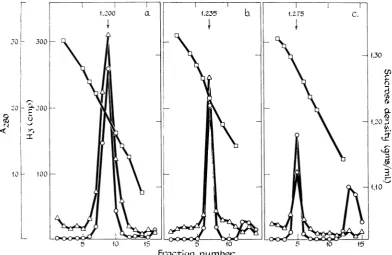
Treatment of the virus with both NP40 and
DOC resulted in visible clearing of the turbid
virus solution (greater with DOC than with
NP40) and much sharper bands of particulate
material compared with intact virus after
cen-trifugation. This was demonstrated by the
A42
tracing in Fig. 2 andwasclearlyevidentbyvisual
inspection of thematerial in thecentrifuge tubes.
The buoyantdensitywas1.200 g perml forwhole
virions, 1.235 for the structures resulting from
NP40 treatment, and 1.275 forthe DOC-treated
material. The peak fraction from each gradient
wastestedforhemagglutinating activity. Fraction
.235 b 1.275 C.
I
I
.00
1.20Z
t~
Frac-tjrion
number-FIG. 2. Equilibriumdensity gradient centrifugation of (a)Sendaivirusand(b and c)
detergeni-dissociated
virus.(a)A 1-mlamountofpurifiedSendai virus(14mgpermlofproteinandhemagglutination-positiveat1:100,000), (b) Imlofvirusafter incubationat room temperaturefor10 minwith1%Nonidet P-40 (NP40) and 0.01M
2-mercaptoethanol, and (c) 1ml ofvirusincubated with 1% sodium deoxycholate and0.01 M2-mercaptoethanol
wereeachlayeredovera 12.5-mlpreformedlineardensitygradient from 65%sucrose inD20 to 20% sucrose in watercontainingbufferI and0.01M 2-mercaptoethanol andcentrifuged at 40,000 rev/minand 2 C for 4hr in the Spinco SW 40 rotor. Fractionscollectedfrom the bottom ofeach tube were used todeterminesolution density
(E) andAgo (0). Thefractions fromeachgradient weremadeup to0.1% with respectto NP40,and0.10-ml samples of eachfraction wereaddedtocompleteenzyme reaction mixtures forincubationat 31 Cfor1hras
de-scribedin Table Ibeforedetermining trichloroacetic acid-precipitableradioactivity in the whole reaction mixture
(A).
84 J. VIROL.
on November 11, 2019 by guest
http://jvi.asm.org/
[image:4.493.61.454.274.529.2]9(Fig. 2a; intact virus) was positive at 1 :100,000, fraction 7 (Fig. 2b; from NP40-treated virus) was positive at 1:100, and fraction 5 (Fig. 2c; from
DOC-treated virus) was negative at 1:10. These
results are consistent with previous experiments from this laboratory, showing that after DOC
treatment ofvirus the hemagglutinating activity
remains near the top of the tube and the
com-ponent with a density of about 1.27 is without
hemagglutinating activity and has the structure
of viral nucleocapsid (3). The intermediate
buoyant density of the material resulting from NP40 treatment of virus suggests that it may
represent anintermediate stage in virus
dissocia-tion between intact virus and free nucleocapsid.
The sharpness ofthe band suggests that it is an
homogeneous structure.
In several experiments, RNA polymerase
assays consistently showed the presence of
sub-stantialenzymeactivity associatedwith the
struc-tureresulting from NP40 treatment (Fig. 2b) and
significantly less but regularly observed activity
associated with nucleocapsid (Fig. 2c).
DISCUSSION
The virus-specific RNA synthesized in
para-influenza virus-infected cells differs in several
respectsfrom the RNA in cells infected by small
RNAviruses such aspoliovirusand RNAphages.
Eighty to
90%/0
of the virus-specific RNAsyn-thesized in Newcastle disease virus (5, 12) and
Sendai virus (2)-infected cells consists of several
single-stranded RNA components which are
complementary in base sequenceto virionRNA, unlike cells infected with poliovirus and other small RNA viruses in which most of the
virus-specific RNA synthesized is identical to virion RNA (6, 9). The complementary RNA species
and notthe virionRNA appear tobeassociated
with polyribosomes in Newcastle disease
virus-(5) and Sendai virus (3)-infected cells incontrast
to the small RNA viruses in which the vision
RNA is associated with polyribosomes and
un-doubtedly
functions as viral messenger RNA(6, 9). In Sendai virus-infected cells, the vision
RNA is rapidly and quantitatively incorporated
intoviralnucleocapsid (3).The freevirion RNA of paramyxoviruses has not been demonstrated
tobe infectious (11;W.S.
Robinson,
unpublished
data) asis the RNA of many smallRNAviruses
(9). These findings suggest the possibility that,
unlike small RNA viruses, the complementary
RNA species function as messenger RNA and
the virion RNA alone is insufficient to initiate
parainfluenzavirusinfection.
Consistent withthispossibilityare more recent
findings with Sendai virus. When cells were
in-fected at a high
multiplicity
with Sendaivirus inthe presence ofcycloheximide sothat no
detect-able protein synthesis occurred, early synthesis of the complementary RNA components but not of the 57S virion RNA was observed (W. S. Robinson, Virology, in press). The Sendai virion
enzyme described in the present study may be
involved in the synthesis of the complementary
RNA components ininfected cells in the presence
of cycloheximide, and this enzyme, in addition
to vision RNA, may be essential for successful
infection. Virus-specific RNA synthesis is not
initiated in cellsinfected with smallRNA viruses
in the absence of protein synthesis (9).
The RNA product of the virion enzyme
reac-tion was complementary in base sequence to
virion RNA, although little of the product
sedi-mented in the 35, 22, and 18S positionsobserved
for the complementary RNA species synthesized
in infected cells (2). Most of the RNA product
synthesized during a short reaction time
sedi-mented around45S and had properties of
base-paired or partially double-stranded RNA
sug-gestingthatthenewly synthesized complementary
RNA species were probably complexed with
virion RNA. This RNA componentis similarto
thedouble-strandedRNAfound in Sendai
virus-infected cellswhich appearsto beanintermediate
in virus-specificRNA synthesis (16). Longer
en-zyme reaction times resulted in formation of
smaller pieces of mostly single-stranded RNA
sedimenting around4 to6S. The smallsize could
result from ribonuclease breakdown of larger
single-stranded RNApieces or synthesis of only
small piecesbythe invitro enzyme. The purified
viruspreparationhasbeenfoundtocontainsome
ribonuclease activity when tested by its ability
to degrade radioactive viral RNA to smaller
pieces, although none was converted to a
trichloroacetic acid-soluble iorm (W. S.
Robinson,unpublisheddata).
The Sendai virion enzyme activity was
ex-tremely low under all reaction conditions used.
With the optimal detergent and divalent cation
concentrations, ionic strength, pH, and
tempera-ture, very large amounts of virus were required
to even detect enzyme
activity.
Under optimumreaction conditions as in Table 1, in which the
enzyme concentration was
limiting, only
0.02pmole of 3H-thymidine monophosphate per mg
of virionproteinperhr wasincorporatedinto the
trichloroacetic acid-insoluble product. This is at
least100-fold loweractivitythanreported for the
vaccinia virus (10,
14),
reovirus (4,17),
andvesicular stomatitis virus
(1)
RNApolymerases.
Whether this isanintrinsicpropertyof theSendai
virion enzyme or
alternatively
the enzyme isun-stable or requires still different reaction
condi-tions for greater in vitro enzyme
activity
is not85
on November 11, 2019 by guest
http://jvi.asm.org/
ROBINSON
clear atthis time. The enzyme recently found in Newcastle disease virions (8) has many properties
similartothe Sendai virion enzyme and it has a
similar low activity.The very lowenzyme activity undoubtedly accounts for the failure of earlier
attempts to demonstrate virion enzyme for
Newcastle disease virus (1) and Sendai virus
(W. S. Robinson, unpublished data) in which
smaller amounts of virus were used. The low
enzyme activity is probably not due to the
presenceof the small amounts of nuclease in the
virus preparation. The observation that the re-action is linear for at least 2 hr suggests that the
RNA template is not extensively degraded, and
none of the RNA product was degraded to a
trichloroacetic acid-soluble form in an
experi-ment in which the reaction was stopped with
EDTA and incubation was continued for 4 hr
(W. S. Robinson, unpublisheddata). In addition, Baltimore et.al. (1) showed that no inhibitionof
a vesicular stomatitis virus RNA polymerase re-action occurred when Newcastle disease virus
enzyme wasmixed with it.
Vesicular stomatitis virus (1) is the only virus
known outside of the parainfluenza virus group
which appears to share the unique features ofviral
RNA structure and synthesis found for Sendai
virus andNewcastledisease virus.
ACKNOWLEDGMENTS I thank Nona Stone for technical assistance.
This investigation was supported by Public Health Service grantCA10467 fromtheNational Cancer Institute.
LITERATURE CITED
1. Baltimore, D.,A.S.Huang, andM.Stampfer. 1970. RNA synthesis of vesicular stomatitis virus. II. An RNA poly-merasein thevirion.Proc. Nat. Acad. Sci. U.S.A. 66:572-576
2. Blair,C.D.,and W. S.Robinson.1968.Replication of Sendai
virus. 1. Comparisonof theviralRNAandvirus-specific RNA synthesis with Newcastle disease virus. Virology 35:537-549.
3. Blair,C.D., andW.S. Robinson.1970.ReplicationofSendai virus.II.Stepsinvirusassembly.J.Virol. 5:639-650. 4. Borsa, J., and Graham, A. F. 1968. Reovirus: RNA
poly-merase activity in purified virions. Biochem. Biophysical Res.Commun.33:895-901.
5. Bratt,M.A.,and W.S.Robinson. 1967.RNAsynthesisin cells infected with Newcastle disease virus. J. Mol. Biol. 23:1-21.
6. Darnell,J.E., S. Penman, and D.Baltimore. 1964. Molecular eventsinsynthesis of polio virus. Perspect. Virol. 4:16-33. 7. Geiduschek,E. P., J.W.Moohr,and S.B.Weiss. 1962.The
secondary structure ofcomplementary RNA. Proc. Nat. Acad.Sci. U.S.A. 48:1078-1086.
8. Huang, A. S., D. W. Baltimore, and M. A. Bratt. 1971. Ribonucleicacidpolymerase invirions of Newcastle disease virus:comparison withthevesicular stomatitis virus poly-merase. J.Virol.7:389-394.
9. Hofschneider, P. H.,and P. Hansen. 1968. The replication cycle, p. 169-208.In H. Frankel-Conrat (ed.), Molecular basisofvirology.ReinholdBookCo., NewYork. 10.Kates, J. R., and B. R. McAuslan. 1967. Poxvirus
DNA-dependentRNApolymerase.Proc. Nat. Acad.Sci. U.S.A. 58:134-141.
11. Kingsbury, D.W. 1966.Newcastledisease virus.I.Isolation and preliminary characterization of RNA from virus particles.J. Mol.Biol.18:195-203.
12. Kingsbury, D. W.1966.Newcastlediseasevirus.II. Preferen-tialsynthesisofRNAcomplementary toparentalviral RNA by chick embryo cells. J. Mol. Biol.18:204-214. 13. Lowry, 0.H., N. J.Rosebrough, A.L. Farr, andR.J.
Ran-dall. 1951. Protein measurement with the Folin phenol reagent. J. Biol. Chem.193:265-275.
14. Munyon, W., E. Paobetti, and J. T. Grace. 1967. RNA polymerase activity in purified infection vaccinia virus. Proc. Nat. Acad. Sci. U.S.A.58:2280-2287.
15. Robinson, W. S. 1970. Self annealing of subgroup2 myxo-virusRNAs. Nature(London)225:944-945.
16. Robinson, W. S. 1971. Intracellular structures involved in Sendaivirusreplication. Virology 43:90-100.
17. Shatkin, A. J., and J. D. Sipe. 1968. RNA polymerase ac-tivity inpurified reoviruses. Proc.Nat.Acad.Sci. U.S.A. 61:1462-1463.
18. Warburg,O., and W. Christian. 1941.Isolierung und Kristal-lisationdesGarungsferments Enolase. Biochem.Z. 310:384-421.
86 J. VIROL.