
City, University of London Institutional Repository
Citation
:
MacFarlane, A., Robertson, S. E. and McCann, F. A. (2004). Parallel computing
for passage retrieval. Aslib Proceedings; New Information Perspectives, 56(4), pp. 201-211.
doi: 10.1108/00012530410549231
This is the accepted version of the paper.
This version of the publication may differ from the final published
version.
Permanent repository link: http://openaccess.city.ac.uk/4497/
Link to published version
:
http://dx.doi.org/10.1108/00012530410549231
Copyright and reuse:
City Research Online aims to make research
outputs of City, University of London available to a wider audience.
Copyright and Moral Rights remain with the author(s) and/or copyright
holders. URLs from City Research Online may be freely distributed and
linked to.
City Research Online:
http://openaccess.city.ac.uk/
[email protected]
Parallel Computing for Passage Retrieval
A. MacFarlane1, S.E.Robertson1,2 and J.A.McCann3
1Centre for Interactive Systems Research, City University, London 2Microsoft Research Ltd, Cambridge
3Department of Computing, Imperial College London
{email: [email protected]}
Abstract: In this paper we examine methods for both speeding up passage processing and examining more passages using parallel computers. We vary the number of passages processed in order to examine the effect on retrieval effectiveness and efficiency. The particular algorithm we apply has previously been used to good effect in Okapi experiments at TREC. We describe this algorithm and our mechanism for applying parallel computing to speed up the processing.
1. Introduction
This paper addresses the issue of applying parallel techniques to a computationally intensive passage retrieval method used by Okapi at the Text Retrieval Conference (TREC). This method of passage retrieval would require vast CPU resources; therefore parallel techniques could be useful to speed up the process. The research presented here is part of an overall study of parallelism and data distribution methods in information retrieval [1]. Our research has a two fold purpose: to show a reduction for the elapsed time of this passage retrieval algorithm and examine more of the search space to obtain increased retrieval effectiveness.
The aims and objectives of our research are set out in section 2. We define and describe passage retrieval in section 3, then outline the Okapi algorithm in section 4. We then describe our work. The implementation of the parallel algorithm is described in section 5. The hardware and software used is declared in section 6. The data and settings used for experiments are described in section 7. We discuss retrieval efficiency and effectiveness results together in section 8. A conclusion is given in section 9.
2. Experimental aims and objectives
The aim of the research presented in this paper is two fold: is it possible to decrease the run time costs for the passage retrieval algorithm using parallelism and; is it possible to increase the number of relevant documents retrieved by examining more of the search space. We therefore have a two-fold hypothesis to examine in this paper:
Hypothesis 2: Examining more passages will increase the retrieval effectiveness of query processing, that is more relevant documents will be found.
We vary the number of documents processed in order to examine the validity of these hypotheses. In terms of retrieval efficiency this allows us to examine different rates of passage processing, while for effectiveness we can show how the retrieval of relevant documents varies if at all.
3 Description of passage retrieval
The work that motivates the research described in this paper is from Okapi experiments conducted within the TREC conference framework in particular Okapi at TREC-3 [2]. We describe the Okapi algorithm used in section 4, but first we give an overview of what passage retrieval actually is and the context in which we use it. Passage retrieval can take on a number of forms and we list some examples here:
• Retrieval of part of a document that is most likely to be of interest to a user. • To help in the identification of relevant documents.
• A component of a question-answering system. • A component of a query-specific summarising system.
Our interest is in the second of these and all of the discussion that follows concentrates on using passage processing for the identification of more relevant documents. It should be noted that a passage could be a whole document.
Retrieval is done on the basis of text atoms, which is the smallest piece of text manipulated by passage processing. Atoms can be paragraphs [2], blocks, sentences, words or even characters: we use an atom size of five sentences. A passage is usually defined as a contiguous sequence of atoms, and new passages may be generated iteratively from old ones by adding or removing blocks of atoms in increments: we use an increment of one. Once the text atom and its incremental level are defined we can either define static or arbitrary lengths for passages based on the atom and the increment size. A fixed length passage starts from a given atom position, and the passage weight is computed using n atoms. An arbitrary length passage mechanism relaxes the fixed length constraint and allows computation of passage weight for a passage of arbitrary length. This is rather expensive computationally requiring O(a3) steps [2] where a is the number of atoms processed. We compromise
between the two methods and have maximum length passages, reducing the time complexity to O(a(a-1)/2): this is the complexity of the algorithm we use in this paper. A further refinement is the choice of increment. We may disallow overlapping passages to reduce the computation even further, but we do compute on overlapping passages. We may consider single best passages or combining evidence from several passages: we use the former. Passages and atoms are determined at index time in our methods: we save this data in the inverted file when the index is generated.
The basic idea behind the passage retrieval method in Okapi is to iterate through contiguous sequences of text atoms and find the combination that yields the best weight for that document. This procedure is done on inverted files. The algorithm is shown in figure 1.
There are two stages to the sequential algorithm: retrieve the top ranked documents (say 1000) and then apply the passage retrieval algorithm to all top ranked documents. Restricting processing to 1000 documents is a time saving process: in principle we could consider all documents. The first phase is a simple probabilistic search as described in [3]. In the second phase a list of positions is obtained for each document and word pair in the query. We do not need to analyse full text since position data is saved in our inverted file during the indexing process [1]. The passage retrieval algorithm is then applied, recording the best passage weight for each document.
The processing requires the weighting of a document for terms in the query sets given the relevant position data, and iterating through the defined passage,
Function do_passage( IN: document data ) RETURN OUT: weight
For( start=0; start < no_of_atoms; start++ ) For( finish=start+INCREMENTAL_VALUE;
finish< no_of_atoms AND finish-start < MAX_PASSASGE_LEN; finish=finish+INCREMENTAL_VALUE )
If(at least one query term is in start and finish atoms) calculate weight for current passage
EndIf
if( current passage weight > largest passage weight ) record details of current passage as best passage EndIf
EndFor EndFor
return best passage weight
END do_passage
(1st Phase)
Obtain the top 1000 ranked documents for query terms
(2nd Phase)
Get position lists for the terms in the query. loop 1000 documents
call do_passage function to obtain best passage for that document EndLoop
[image:4.595.146.447.215.554.2]Re-rank the top 1000 documents. Display top x documents to the user.
recording the highest weighted passage. In the case of best match functions such as BM25 [4], the requirements may also include the calculation of the passage length. This passage length is available from the inverted file having being recorded at indexing time. Once all documents have been processed the top set is re-ranked and can be presented to the user. We can reduce the time complexity for this method by setting a maximum passage length (the term MAX_PASSAGE_LEN in figure 1), set to twenty atoms in our case [2]. The minimum passage length could be sensibly set to one atom [2]. Our arbitrary length passages therefore range from one atom to a maximum of twenty atoms per passage. A further refinement is to specify the number of increment steps for examined atoms: this can be altered by changing the INCREMENTAL_VALUE constant. It should be noted that if either the start atom or the finish atom contains no query term, we do not calculate the weight for that passage. In general there must be a shorter passage that would be better, given that the BM25 scoring function increases with reducing document length (see appendix 2).
5. The Parallel Algorithm
In this section we describe the parallel implementation of the passage retrieval algorithm described in section 4. There are a number of issues when considering the application of parallelism to the Okapi passage retrieval algorithm. In particular the issue of how the algorithm is applied to the inverted file with a chosen data partitioning method must be addressed. A data partitioning method is a strategy for distributing inverted file data to the nodes in a parallel computer. We define a
node as being made up of a processor, memory and disk space.
The scheme we use for data partitioning is as follows. Each node has its own disk and processor and we split up or partition the inverted file among the disks such that each disk has its own unique set of documents (that is each node has its own sub-collection). Another big issue is how processes in the parallel program can communicate with each other: this network of communicating processes is called a process topology. We use a process topology described in more detail in [3] but we give an example process configuration in appendix 1. We have a number of leaf nodes
6. Hardware and software used
The system used to do the experiments is the PLIERS system (ParaLLel Information rEtrieval Research System) that has been developed to investigate various aspects of parallelism in IR [1]. All results presented in this paper were obtained on 8 nodes of a 12 node Fujitsu AP3000 at the Australian National University (ANU) in Canberra. The AP3000 is a distributed memory parallel computer using Ultra 1 nodes with clock speed of 167Mhz running Solaris 2.5.1. Each node in the AP3000 architecture has its own local disk: that is a shared nothing architecture [1] is used by PLIERS. The torus network has a top bandwidth of 200 Mbytes/s per second.
7. Data and settings used
The data used in the experiments was the BASE1 and BASE10 collections, both sub-sets of the official 100 Gigabytes VLC2 collection for TREC [5]. BASE1 is 1 Gigabyte in size, while BASE10 is approximately 10 Gigabytes in size. We ran queries on 8 nodes for BASE10 and 1 to 8 nodes for BASE1. The queries are based on topics 351 to 400 of the TREC-7 ad-hoc track: 50 queries in all. The terms were extracted from TREC-7 topic descriptions using an Okapi query generator utility to produce the final queries. We used two types of query sets: one based on title only
(average number of terms per query is 2.46) and one based on the whole topic
(average number of terms per query is 19.58). The whole topic query set has 51 queries, one extra being for VLC2 experiment initialisation [5]. Our timing methodology was as follows: for title only queries we declare the average of 10 runs, while we declared the average for 5 runs on whole topic. The model we use for term weighting in our experiments is the Robertson/Sparck Jones Probabilistic model [6] and we use the BM25 weighting function (see appendix 2). Recall that the atom size
Top node sends query to P leaf nodes InParallel for P leaf nodes
(1st Phase)
Obtain N top ranked documents for the fragments query terms.
(2nd Phase)
Get position lists for the terms in the query. Loop N documents
call do_passage function to obtain best passage for that document EndLoop
Re-rank the top N documents. EndParallel
[image:6.595.169.400.158.308.2]Top node retrieve top x documents from P leaf nodes. Display x documents to the user.
used in our experiments is 5 sentences using an incremental step of one for atoms. We select the top 20 of all runs for evaluation (the relevance data is targeted at this figure).
8. Experimental results
To facilitate the discussion below (which is the examination of parallel runs) we declare sequential passage retrieval results used for comparison on the BASE1 collection. The average elapsed time in seconds was 1.33 for title only queries and 45.6 for whole topic queries. The figure for title only is acceptable and is within the scope of 10 second response times suggested by Frakes [7]. However whole topic
response time is not acceptable within such criterion: it does however demonstrate how computationally costly passage retrieval can be. Retrieval effectiveness is increased on all precision points when applying passage retrieval on the BASE1 collection using title only queries: precision at 20 was increased from 0.130 to 0.148 (an increase in performance of 13.8%). For all other runs improvements were found only on some of the precision points (see table 1 for effectiveness results on runs without passage processing). It should be noted that we were unable to get the same level of retrieval effectiveness on longer queries as with shorter queries: this merits further investigation.
Collection Query Type
p@5 p@10 p@15 p@20
BASE1 title only whole topic
0.244 0.188
0.178 0.172
0.149 0.145
0.130 0.128 BASE10 title only
whole topic
0.324 0.356
0.282 0.298
0.273 0.271
0.264 0.247
Table 1 - Retrieval effectiveness results (no passage processing)
8.1 Experiment Results on 1000 documents per node
0 0.2 0.4 0.6 0.8 1 1.2 1.4
1 2 3 4 5 6 7 8
Leaf nodes El ap se d Ti m e: s ec s
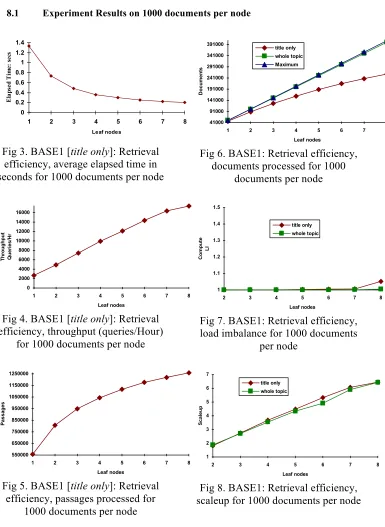
Fig 3. BASE1 [title only]: Retrieval
efficiency, average elapsed time in
seconds for 1000 documents per node
Leaf nodes T hr o u gh p ut Q ue ri es/ H r 0 2000 4000 6000 8000 10000 12000 14000 16000
1 2 3 4 5 6 7 8
Fig 4. BASE1 [title only]: Retrieval
efficiency, throughput (queries/Hour)
for 1000 documents per node
Leaf nodes P ass age s 550000 650000 750000 850000 950000 1050000 1150000 1250000
1 2 3 4 5 6 7 8
Fig 5. BASE1 [title only]: Retrieval
efficiency, passages processed for
1000 documents per node
Leaf nodes D oc u men ts 41000 91000 141000 191000 241000 291000 341000 391000
1 2 3 4 5 6 7 8
title only whole topic Maximum
Fig 6. BASE1: Retrieval efficiency,
documents processed for 1000
documents per node
Leaf nodes C om p ute LI 1 1.1 1.2 1.3 1.4 1.5
2 3 4 5 6 7 8
title only whole topic
Fig 7. BASE1: Retrieval efficiency,
load imbalance for 1000 documents
per node
Leaf nodes S cal e u p 1 2 3 4 5 6 72 3 4 5 6 7 8 title only
[image:8.595.118.503.152.679.2]whole topic
Fig 8. BASE1: Retrieval efficiency,
scaleup for 1000 documents per node
run on BASE1 is under a second (see fig 3) and meets the 10 second requirement suggested by Frakes [7]. The run using 8 leaf nodes is faster than 8 out of the 11 runs submitted by other participants at VLC2 [5]. Overall the results show a time reduction for BASE1 parallel runs over the sequential run, with a linear increase in throughput (see fig 4). Scaleup is super linear and increases with more leaf nodes in the topology (see fig 8): although the number of extra documents examined actually decreases with more leaf nodes (see fig 6). This increase in performance with respect to scale can be explained in part by the number of passages processed as the leaf node set is increased (see fig 5). Passages processed from 2 to 7 leaf nodes grow at a very slow rate, from just over half a million passages at 2 leaf nodes to 1.2 million inspected at 8. This effect occurs because more passage intensive documents are placed higher up the rank by the term weighting mechanism. The load imbalance figures demonstrate that the workload is fairly distributed amongst leaf nodes (see fig 7). It should be noted that the slight drop in relative performance on 8 leaf nodes for title only queries is because client processes had to be mapped to one of the search leaf nodes and this affected the timings very slightly.
The elapsed time for whole topic queries on BASE1 (see fig 9) do not meet the 10 second requirement for elapsed time suggested by Frakes [7] on runs up to 5 leaf nodes. Throughput is therefore much reduced compared to title only (see fig 10). The comparison with other VLC2 participants is not so good: the run at 8 leaf nodes only betters 2 out of the 11 submitted runs [5]. While run times are much slower than title only, the other evidence found in those experiments are confirmed in these. Scaleup is super linear (see fig 8) which is surprising since the number of documents processed is very near the maximum (see fig 6). As with title only the number of passages processed reduces with increasing the number of leaf nodes and for the same reason (see fig 11). The actual number of passages inspected is more with whole topic than with title only (see figs 5 and 11). Load imbalance is very small with whole topic queries (see fig 7).
Leaf nodes
E
lap
se
d
Tim
e: s
ecs
0 5 10 15 20 25 30 35 40 45
[image:9.595.202.401.577.686.2]1 2 3 4 5 6 7 8
Fig 9. BASE1 [whole topic]: Retrieval
efficiency, average elapsed time in
seconds for 1000 documents per node
Leaf nodes
T
hr
o
u
gh
p
ut
Q
ue
ri
es/
H
r
0 100 200 300 400 500
1 2 3 4 5 6 7 8
Fig 10. BASE1 [whole topic]:
Retrieval efficiency, throughput
for 1000 documents per node
Leaf nodes
P
ass
age
s
4550000 6550000 8550000 10550000 12550000 14550000 16550000
1 2 3 4 5 6 7 8
Fig 11. BASE1 [whole topic]: Retrieval efficiency,
passages processed for 1000 documents per node
However no decrease or increase found is statistically significant. We can state that examining the extra passages does not bring any benefit to any of the retrieval effectiveness measures used. It is also a clear indication that the ranking process is doing its job: the best documents useful for passage retrieval are contained in the top 1000 ranked documents.
Leaf nodes
p@ 5 p@ 10 p@ 15 p@ 20
[image:10.595.196.402.130.192.2]1 0.268 0.186 0.161 0.148 2 to 4 0.268 0.186 0.161 0.147 5 to 8 0.268 0.186 0.161 0.146
Table 2. BASE1 [title only]: Retrieval effectiveness results for 1000 documents per node
Leaf nodes
p@ 5 p@ 10 p@ 15 p@ 20
1 0.196 0.160 0.140 0.126 2 to 8 0.200 0.162 0.141 0.127
Table 3. BASE1 [whole topic]: Retrieval effectiveness results for 1000 documents per node
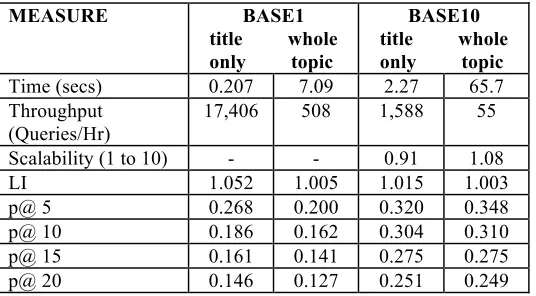
Table 4 shows the comparison of BASE1 and BASE10 measures. Elapsed times in general are good apart from whole topic queries on BASE10: a minute or more response time for queries is not acceptable [7]. The average elapsed time for title only queries on BASE10 is better than half the runs of other VLC2 participants [5]. The scalability derived from BASE1 to BASE10 is particularly good for whole topic queries which recorded 1.08 (a figure of 1.0 is linear scalability). Throughput on BASE1 is much better than BASE10 as one would expect. All precision measures are better at BASE10 than BASE1: all record a reasonable increase. As with BASE1, there is little variation in BASE10 precision results for both types of queries.
MEASURE BASE1
title whole only topic
BASE10 title whole only topic
Time (secs) 0.207 7.09 2.27 65.7 Throughput
(Queries/Hr)
17,406 508 1,588 55
Scalability (1 to 10) - - 0.91 1.08
LI 1.052 1.005 1.015 1.003
[image:10.595.193.402.237.290.2]p@ 5 0.268 0.200 0.320 0.348 p@ 10 0.186 0.162 0.304 0.310 p@ 15 0.161 0.141 0.275 0.275 p@ 20 0.146 0.127 0.251 0.249
Table 4. BASE1/BASE10: Retrieval effectiveness and efficiency results for 1000 documents per node (8 nodes).
[image:10.595.166.434.451.599.2]
8.2 Experiment Results for 1000 documents overall
The results gained in these experiments for title only queries can only be described as remarkably good. The parallel measurements demonstrate this clearly with a super linear speedup recorded on all parallel runs (see fig 17). As a result all parallel efficiency results are greater than 1 with most figures greater than 1.5 (see fig 18). Load imbalance is very small with most figures very near 1 (see fig 16). All elapsed times are very good and under half a second (see fig 12). The scalability from BASE1 to BASE10 is very good, recording a figure of 1.32 (refer to table 5).
Leaf nodes E lap se d Tim e: s ecs 0 0.2 0.4 0.6 0.8 1 1.2 1.4
[image:11.595.118.512.191.341.2]1 2 3 4 5 6 7 8
Fig 12. BASE1 [title only]: Retrieval efficiency, average elapsed time in seconds for 1000 documents overall
Leaf nodes T hr o u gh p ut Q ue ri es/ H r 0 5000 10000 15000 20000 25000 30000
1 2 3 4 5 6 7 8
Fig 13. BASE1 [title only]: Retrieval efficiency, throughput (queries/ hour) for
1000 documents overall
The method gains substantially from very low communication overhead. Why does a substantial speed advantage over sequential processing occur with this method of parallel passage retrieval? There is no obvious effect from the number of passage processed (see fig 14), as the number processed fluctuates with leaf node count. This effect has to occur because the documents examined in paralleism are less computationally intensive to examine than the set examined on the uniprocessor i.e. each passage on the uniprocessor is on average more expensive to process than on the parallel nodes. There is an interesting interaction between the parallel algorithm and the weighting function that merits investigation. 555000 556000 557000 558000 559000 560000
1 2 3 4 5 6 7 8
Leaf nodes Pa s sa g es
Fig 14. BASE1 [title only]: Retrieval efficiency, passages processed for 1000
documents overall Leaf nodes D oc u men ts 47000 47500 48000 48500 49000 49500 50000 50500 51000
1 2 3 4 5 6 7 8
title only whole topic
Fig 15. BASE1 [title only]: Retrieval efficiency, documents processed for 1000
documents overall Leaf nodes C om p ute LI 1 1.05 1.1 1.15 1.2 1.25 1.3 1.35 1.4 1.45 1.5
2 3 4 5 6 7 8
title only whole topic
Fig 16. BASE1 [title only]: Retrieval efficiency, load imbalance for 1000
documents overall
1 6 11 16
2 3 4 5 6 7 8
[image:11.595.116.508.460.729.2]Leaf nodes Sp ee d u p title only whole topic
Leaf nodes E ffi ci enc y 1 1.2 1.4 1.6 1.8 2 2.2 2.4 2.6
2 3 4 5 6 7 8
[image:12.595.119.499.74.233.2]title only whole topic
Fig 18. BASE1 [title only]: Retrieval efficiency, parallel efficiency for 1000
documents overall Leaf nodes E lap se d Tim e: s ecs 0 5 10 15 20 25 30 35 40 45
1 2 3 4 5 6 7 8
Fig 19. BASE1 [whole topic]: Retrieval efficiency, average elapsed time in seconds for 1000 documents overall
The query processing results are even more remarkable using whole topic queries than using the title only query set. A large part of the difference can be put down to the number of passages processed in these experiments as compared with a uniprocessor on
whole topic: just over three million for the former compared with five and half million for the later (see fig 21). As with title only queries the numbers do not vary much on runs with differing numbers of leaf nodes. Response times for parallel runs are only unacceptable at 2 leaf nodes (see fig 19) and throughput is much improved in these experiments compared to uniprocessor experiments (see fig 20).
Leaf nodes T hr o u gh p ut Q ue ri es/ H r 0 200 400 600 800 1000 1200 1400 1600
1 2 3 4 5 6 7 8
Fig 20. BASE1 [whole topic]: Retrieval efficiency, throughput (queries/ hour) for
1000 documents overall
3000000 3500000 4000000 4500000 5000000 5500000
1 2 3 4 5 6 7 8
[image:12.595.115.507.359.463.2]Leaf nodes Pa s sa g es
Fig 21. BASE1 [whole topic]: Retrieval efficiency, passages processed for 1000
documents overall
The retrieval effectiveness found on uniprocessor experiments is also found in these experiments for both types of queries, e.g. 0.148 for precision at 20 for title only. Precision at 20 varies very slightly for whole topic queries, but the difference is not significant, e.g. values of 0.126/0.127 were recorded. From this we deduce that examining the top 1000 documents on the uniprocessor is no different from examining 1000 documents by selecting top ranked documents locally on each leaf node. The evidence from this leads directly on to experimentation described in the next section.
8.3 Experiment results for reduced document sets
Docs pro-cesse
d
p@ 5 p@ 10 p@ 15 p@ 20
[image:13.595.203.396.70.180.2]1000 0.268 0.186 0.161 0.148 504 0.268 0.186 0.161 0.147 256 0.268 0.184 0.160 0.146 128 0.268 0.184 0.159 0.149 0 0.244 0.178 0.149 0.130
Table 5. BASE1 [title only]: Retrieval effectiveness results on varying the number of documents in which passage processing is applied.
Docs pro-cesse
d
p@ 5 p@ 10 p@ 15 p@ 20
[image:13.595.200.395.226.335.2]1000 0.200 0.162 0.141 0.127 504 0.200 0.162 0.141 0.127 256 0.200 0.162 0.141 0.127 128 0.196 0.160 0.140 0.126 0 0.188 0.172 0.145 0.128
Table 6. BASE1 [whole topic]: Retrieval effectiveness results on varying the number of documents in which passage processing is applied.
Docs pro-cesse
d
p@ 5 p@ 10 p@ 15 p@ 20
1000 0.324 0.302 0.275 0.254 504 0.324 0.302 0.275 0.254 256 0.324 0.304 0.276 0.252 128 0.320 0.300 0.279 0.253 0 0.324 0.282 0.273 0.264
Table 7. BASE10 [title only]: Retrieval effectiveness results on varying the number of documents in which passage processing is applied.
The evidence given in tables 5 to 8 demonstrates that we do not need to examine the full 1000 documents to achieve very nearly the same level of retrieval effectiveness at lower precision. There are some differences but they are very minor for both types of query. We can reduce the level of computation on the passage retrieval method and still obtain the extra retrieval effectiveness found when using that method. The experiments reinforce the assertion that the BM25 ranking function does its job well. This function in conjunction with passage retrieval applied to smaller document sets can improve retrieval effectiveness.
[image:13.595.200.395.391.501.2]Docs pro-cesse
d
p@ 5 p@ 10 p@ 15 p@ 20
[image:14.595.203.395.93.203.2]1000 0.352 0.310 0.275 0.251 504 0.356 0.312 0.271 0.249 256 0.356 0.304 0.272 0.246 128 0.364 0.306 0.267 0.246 0 0.356 0.298 0.271 0.247
Table 8. BASE10 [whole topic]: Retrieval effectiveness results on varying the number of documents in which passage processing is applied.
Measure docs=1000
BS1 BS10
docs=504 BS1 BS10
docs=256 BS1 BS10
docs=128 BS1 BS10
Time (secs) 0.11 0.84 0.10 0.71 0.09 0.62 0.08 0.58 Throughput
(Queries/Hr)
32k 4.2k 38k 5.1k 42k 5.8k 46k 6.2k
[image:14.595.144.454.259.346.2]Scalability - 1.32 - 1.35 - 1.37 - 1.34 LI 1.11 1.04 1.14 1.04 1.16 1.04 1.18 1.05
Table 9. BASE1/BASE10 [title only]: Retrieval efficiency results for on varying numbers of documents
Measure docs=1000
BS1 BS10
docs=504 BS1 BS10
docs=256 BS1 BS10
docs=128 BS1 BS10
Time (secs) 2.29 16.3 1.64 10.4 1.28 8.47 1.09 7.50 Throughput
(Queries/Hr)
1.5k 221 2.2k 346 2.8k 425 3.3k 480
Scalability - 1.41 - 1.58 - 1.52 - 1.45 LI 1.01 1.01 1.01 1.01 1.01 1.01 1.01 1.01
Table 10. BASE1/BASE10 [whole topic]: Retrieval efficiency results for on varying numbers of documents
The figures for whole topic queries show more improvement than title only queries with respect to average query processing time (see table 10). The timings from term weighting searches without passage processing (0.77 for BASE1, 6.45 for BASE10) show that the time reduction is very near linear. Load balance for all runs is very good. The scalability is excellent for all BASE10 runs, and confirms the effect of collection size and term weighting function on performance.
9. Summary and conclusion
[image:14.595.141.456.391.478.2]parallel computing.
With respect to retrieval effectiveness, the passage retrieval algorithms do bring benefits on web data over ordinary term weighting but such is not guaranteed. However it is clear from the above that the algorithm only needs to be applied to a subset of the top ranked documents to gain effectiveness. Clearly the ranking process using BM25 does its job very well. However gains are collection and query set dependent (this result is confirmed in our TREC8 experiments [8] and independently confirmed by Kazkiel & Zobel [9]). With title only queries on the BASE1 database yield an increase of 13.8% from 0.130 to 0.148 in precision at 20 when passage retrieval is applied. A reduction in effectiveness on some precision points is recorded when the same queries are applied to the BASE10 collection: any increase found is not significant. Whole topic queries do not do as well as title only, a problem that merits further investigation.
While retrieval efficiency improvement is significant using parallelism on passage retrieval clearly many of the experiments described above to do not bring any benefits with respect to effectiveness over the sequential passage retrieval algorithm. A hypothesis which asserts that examining more of the search space in passage retrieval yields more relevant documents is not supported by the results given in this paper - indeed, the evidence is against it. This is not to suggest that applying parallelism to passage retrieval does not work, but the choice will depend on whether to use parallelism with term weighting or not. We can apply the passage retrieval algorithm to fewer documents, at a computational cost slightly higher than that term weighting to obtain better retrieval effectiveness. The implication is that parallelism is not worth applying to passage retrieval on a reduced set of documents, if it is not worth applying the strategy to term weighting.
10. Acknowledgements
This work is supported by the Arts and Humanities Research Board (AHRB) under grant number IS96/4203. We are also grateful to ACSys for awarding the first author a visiting fellowship at the Australian National University in order to complete this research and the use of their equipment. We are particularly grateful to David Hawking for making the arrangements for the visit to the ANU.
References
1. A. MacFarlane, Inverted files and performance: A study of parallelism and data distribution methods in IR, PhD thesis, City University London, 2000.
2. S.E. Robertson, S.Walker, S. Jones, M.M. Hancock-Beaulieu and M Gatford, Okapi at TREC-3. In: D.K.Harman, (ed.): Proceedings of the Third Text Retrieval Conference, NIST Gaithersburg (1995) 109-126.
3. A. MacFarlane, S.E. Robertson, and J.A. McCann. Parallel Methods for the Search of Partitioned Inverted Files, In: P. De La Fuente, (ed.), SPIRE 2000: Proceedings of String Processing and Information Retrieval, September 2000, A Coruna, Spain, (IEEE Computer Society Press, Los Alamitos, 2000).
4. S.E. Robertson, S. Walker, and M.M. Hancock-Beaulieu. Large test collection experiments on an operational, Interactive systems: Okapi at TREC, Information
Processing and Management, 31(3) (1995) 345-360.
5. D., Hawking, N. Craswell, and P. Thistlewaite. Overview of TREC-7 Very Large Collection Track. In: Voorhees E., and Harman, D.K., (eds.), Proceedings of the Seventh Text Retrieval Conference, Gaithersburg, U.S.A, November 1998, NIST SP 500-242 (NIST, Gaithersburg, 1999).
6. S.E. Robertson and K. Sparck Jones. Relevance weighting of search terms. Journal of
the American Society for Information Science May-June (1976) 129-145.
7. W.B. Frakes Introduction to Information Storage and Retrieval Systems. In: W.B. Frakes, and R. Baeza-Yates (eds.), Information Retrieval: Data Structures and Algorithms, (Prentice-Hall, New Jersey, 1992).
8. A. MacFarlane, S.E. Robertson & J.A. McCann. PLIERS at TREC8. In: E. Voorhees and D.K. Harman (eds.), Proceedings of the Eighth Text Retrieval Conference,
Gaithersburg, U.S.A, November 1999, Gaithersburg, NIST SP 500-246, (NIST,
Gaithersburg, 2000).
American Society for Information Science and Technology, 52(4) (2001) 344-364.
Appendix 1 - Example of search topology used
Final Result
Top Node Client query
Intermediate
Results query
Leaf Node1 Leaf Node2 Leaf Noden
Disk1 Disk2 Diskn
Appendix 2 – The BM25 Term Weighting Function
CW(i,j) = CFW(i) * TF(i,j) * K1+1 ---
K1 * ((1-B)+(B*(NDL(j)))) + TF(i,j)
Variables
CW(i,j) : Weight for term t(i) in document d(j). CFW(i,j) : Collection frequency weight log(N) - log(n). n(i) : The number of documents term t(i) occurs in. N : The number of documents in the collection.
TF(i,j) : The number of occurrences of term t(i) in document d(j). (term frequency)
DL(j) : The total number of terms in document d(j) NDL(j) : Normalised document length
(DL(j) / average DL for all documents.)
Constants


![Fig 9. BASE1 [ whole topic]: Retrieval efficiency, average elapsed time in seconds for 1000 documents per node](https://thumb-us.123doks.com/thumbv2/123dok_us/1653213.118867/9.595.202.401.577.686/base-topic-retrieval-efficiency-average-elapsed-seconds-documents.webp)
![Fig 17. BASE1 [title only]: Retrieval efficiency, speedup for](https://thumb-us.123doks.com/thumbv2/123dok_us/1653213.118867/11.595.116.508.460.729/fig-base-title-retrieval-efficiency-speedup.webp)
![Fig 21. BASE1 [whole topic]: Retrieval efficiency, passages processed for 1000 documents overall](https://thumb-us.123doks.com/thumbv2/123dok_us/1653213.118867/12.595.115.507.359.463/base-topic-retrieval-efficiency-passages-processed-documents-overall.webp)
![Table 5. BASE1 [title only]: Retrieval effectiveness results on varying the number of documents in which passage processing is applied](https://thumb-us.123doks.com/thumbv2/123dok_us/1653213.118867/13.595.200.395.391.501/retrieval-effectiveness-results-varying-documents-passage-processing-applied.webp)
![Table 8. BASE10 [whole topic]: Retrieval effectiveness results on varying the number of documents in which passage processing is applied](https://thumb-us.123doks.com/thumbv2/123dok_us/1653213.118867/14.595.141.456.391.478/retrieval-effectiveness-results-varying-documents-passage-processing-applied.webp)
