BORANG PENGESAHAN STATUS TESIS JUDUL: SCHOOL INFORMATION SYSTEM (SIS)
SESI PENGAJIAN: 2-200812009 Saya HADZLI ZUL BIN HAMRAN
(HURUF BESAR)
mengaku membenarkan tesis (PSM/Sarjana/Doktor Falsafah) ini disimpan di Perpustakaan Fakulti Teknologi Maklumat dan Komunikasi dengan syarat-syarat kegunaan seperti berikut:
1. Tesis adalah hakmilik Universiti Teknikal Malaysia Melaka.
2. Perpustakaan Fakulti Teknologi Maklumat dan Komunikasi dibenarkan membuat salinan untuk tujuan pengajian sahaja.
3. Perpustakaan Fakulti Teknologi Maklumat dan Komunikasi dibenarkan membuat salinan tesis ini sebagai bahan pertukaran antara institusi pengajian tinggi.
4.
**
Sila tandakan (I)SULIT (Mengandungi maklumat yang berdarjah keselamatan atau kepentingan Malaysia seperti yang termaktub di dalam
AKTA RAHSIA RASMI 1972)
TERHAD (Mengandungi maklumat TERHAD yang telah ditentukan oleh organisasilbadan
I
-- TIDAK TERHAD
(TANDATANGAN PENULIS)
Alamat tetap: No 32 Jalan DP 8, Nama Penyelia : En. Abdul Shukor
Taman Duyong Permai bin Mohamad Jaya
75460 Melaka
SCHOOL INFORMATION SYSTEM (SIS)
HADZLI ZUL BIN HAMRAN
This report is submitted in partial fulfillment of the requirements for the Bachelor in Computer Science (Software Development)
FACULTY OF INFORMATION AND COMMUNICATIONS TECHNOLOGY UNIVERSITI TEKNIKAL MALAYSIA MELAKA
DECLARATION
I hereby declare that this project report entitled
SCHOOL INFORMATION SYSTEM (SIS)
is written by me and is my own effort and that no part has been plagiarized without citations.
STUDENT
:DEDICATION
To my beloved wife, Zaireen Adlina binti Zain.
To my mother and father,
Rafidah binti Nawawi and Hamran bin Hassan. To my son and daughter,
ACKNOWLEDGEMENTS
First and foremost, I thank Allah the Almighty for blessing me to complete my Project Sarjana Muda. I would like to enlarge my appreciation to Encik Abdul Syukor bin Mohamad Jaya because of the kindness heart to accept me as one of the student under his supervision. Special thanks also dedicated to him for all comments, idea, and a guideline begin from the first day I start this project.
This appreciation also goes to my fiiend that always gives support, opinion, and advices for me to complete this report. Not forgotten to Cik Hajah Jamilah bt Ismail, principle of SMK Telok Mas, exam coordinator, time table coordinator and all school staff because give me some information for completing this report.
Especially to my beloved wife and family, I would like to forward my obliged to them for their continuous support during my study period, their patience and benevolence. Lastly, I would like to thank to everyone who has contributed during my Project Sarjana Muda. Your kindness and cooperacivri in completion of my paper work is much appreciated.
ABSTRACT
School Information System (SIS) is a web based application that developed to
help school management manage their student's information, teacher's information,
teaching and time table management. This application also allows the parent to
access on-line their children information assessment and achievement. SIS used
Rapid Application Development (RAD) as development methodology. Active Server
Page (ASP) is a programming language that used to develop this application. The
target users of this application are school staff such as teachers, administrator,
students and parent. ?'he main objective of the development this application is to
solve problem that occurs from present system and manual method that being used.
In addition, SIS is developing with security features such as using of password and
user level access to the system. School management also can manage their students,
teachers, subjects and e~arnil~&ion information efficiently and effectively. The main
added feature to this system is time table management. Online accesses allow user to
access the application at anytime and anywhere as long as they are connected to the
internet. Centralize and systematic data storage can reduce duplication of information
ABSTRAK
School Information System (SIS) adalah aplikasi web yang dibangunkan
untuk membantu pihak sekolah dalam menguruskan maklumat yang berkaitan
dengan pelajar, guru, pengajaran serta pengurusan jadual waktu. Aplikasi ini juga
membenarkan ibu bapa pelajar mencapai maklumat berkaitan pencapaian dan
prestasi anak mereka secara atas talian. SIS menggunakan metodologi Pembangunan
Aplikasi Pesat (RAD) di dalam pembangunannya. Bahasa pengaturcaraan yang di gunakan ialah Active Server Page (ASP) yang menyokong pembangunan aplikasi
web. Sasaran pengguna aplikasi ini terdiri daripada kakitangan sekolah iaitu guru- guru, bahagian pentadbiran, pelajar dan juga ibu bapa pelajar. Objektif utama
pembangunan aplikasi ini adalah untuk mengatasi masalah yang dihadapi oleh
aplikasi sedia ada dan kaedah manual yang dipraktikkan. Sebagai nilai tambah,
aplikasi ini dibangunkan dengan menerapkan ciri-ciri kese~amatan seperti
penggunaan katalaluan dan pengkelasan capaian pengguna mengikut tahap. Pihak
penguman sekolah juga dapat menguruskan maklumat seperti maklumat pelajar,
guru, matapelajaran dan peperiksaan dengan lebih efektif dan efisien. Tambah nilai yang utama yang terdapat pada sistem ini ialah pengurusan jadual waktu. Capaian
secara atas talian membolehkan pengguna mencapai aplikasi ini pada bila-bila masa
dan di mana sahaja asalkan mempunyai capaian internet. Kaedah penyimpanan data
yang berpusat dan sistematik dapat mengurangkan masalah pertindihan maklumat
TABLE OF CONTENTS
CHAPTER SUBJECT
DECLARATION
DEDICATION
ACKNOWLEDGMENT
ABSTRACT
ABSTRAK
T M L E CT CS<TEPiTS
LIST OF TABLES
LIST OF FIGURES
CHAPTER I INRODUCTION
1.1 Project Background
1.2 Problem Statements
1.3 Objective
1.4 Scopes
1.5 Project Signifirmce
1.6 Expected Output
1.7 Conclusion
PAGE
. .
11.
. .
111
iv
v vi
vii
xii
...
CHAPTER I1
LITERATURE REVIEW AND PROJECTMETHODOLOGY
2.1 Introduction
2.2 Fact and Finding 2.2.1 Domain
2.2.1.1 Web Base Application 2.2.1.2 Active Server Page (ASP) 2.2.1.3 Microsoft SQL Server 2005
2.2.2 Existing System 2.2.3 Technique 2.3 Project Methodology
2.3.1 Software Development Methodology 2.3.2 Software Process Model
2.3.3 Rapid Application Development Model 2.3.4 Justification in Choosing RAD Model 2.4 Project Requirement
2.4.1 Hardware Requirement 2.4.2 Software Requirement
2.5 Project Schedule and Milestone
CHAPTER I11 ANALYSIS
3.1 Introduction 3.2 Problem analysis
3.2.1 Background of Current System 3.3 Requirement Analysis
3.3.1 Data Requirement 3.3.2 Functional Requirement 3.3.3 Non-Functional Requirement
3.3.3.1 Standard
3.3.3.2 Product Requirement Usability 3.3.3.3 Efficiency (Performance and Space) 3.3.3.4 Reliability
CHAPTER IV DESIGN
4.1 Introduction 4.2 High-Level Design
4.2.1 System Architecture 4.2.2 User Interface Design
4.2.2.1 Navigation Design 4.2.2.2 Input Design 4.2.2.3 Output Design 4.2.3 Database Design
4.2.3.1 Conceptual and
Logical Database Design 4.3 Detailed Design
4.3.1 Software Specification 4.3.2 Physical Database Design 4.4 Conclusion
CHAPTER V IMPLEMENTATION
5.1 Introduction
5.2 Software Development Environment Setup 5.3 Software Configuration Management
5.3.1 Configuration Environment Setup 5.3.2 Version Control Procedure
CHAPTER VI TESTING
6.1 Introduction
6.2 Testing Plan
6.2.1 Test Organization
6.2.2 Test Environment
6.2.3 Test Schedule
6.3 Test Strategy
6.3.1 Classes of test
6.4 Implementation Status
6.4.1 Test Description
6.4.2 Test Data
6.5 Test Result and Analysis
6.6 Conclusion
CHAPTER VII PROJECT CONCLUSION
7.1 Observation on Weakness and Strengths
7.2 Proposition of Improvement
7.3 Contribution
7.4 Conclusion
BIBLIOGRAPHY REFERENCES
APPENDIXES
APPENDIX A - DATA NORMALIZATION
APPENDIX B - DATA DICTIONARY
APPENDIX C
-
PROGRAM SPECIFICATIONAPPENDIX D - PHYSICAL DATABASE
DESIGN
APPENDIX E - GANTT CHART
xii
LIST OF TABLES
TABLE Table 2.1 Table 2.2 Table 2.3 Table 2.4 Table 3.1
TkLk 3.2 Table 3.3 Table 3.4 Table 3.5 Table 3.6 Table 3.7 Table 3.8 Table 5.1 Table 5.2 Table 5.3
TITLE PAGE
Comparison between Case Study and SIS Basis Principle of RAD Model
Strength of RAD Model Schedule and Milestones Functional Requirement
Subject and Class Coding Standard Usability Product Requirement
Efficiency (Performance and Space) Product Requirement Reliability Product Requirement
Portability Product Requirement Software Requirement
Hardware Requirement
SIS Configuration Environment Setup SIS Numbering of Product Version
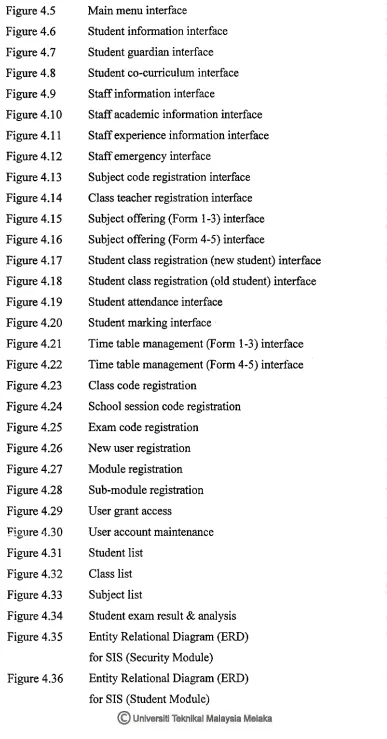
Figure 4.5
Figure 4.6
Figure 4.7
Figure 4.8
Figure 4.9
Figure 4.1 0
Figwe 4.1 1
Figure 4.12
Figure 4.13
Figure 4.1 4
Figure 4.1 5
Figure 4.16
Figure 4.17
Figure 4.18
Figure 4.19
Figure 4.20
Figure 4.2 1
Figure 4.22 Figure 4.23 Figure 4.24 Figure 4.25 Figure 4.26 Figure 4.27 Figure 4.28 Figure 4.29 Figure 4.30
Figure 4.3 1
Figure 4.32
Figure 4.33
Figure 4.34
Figure 4.35
Figure 4.36
Main menu interface
Student information interface
Student guardian interface
Student co-curriculum interface
Staff information interface
Staff academic information interface
Staff experience information interface
Staff emergency interface
Subject code registration interface
Class teacher registration interface
Subject offering (Form 1-3) interface
Subject offering (Form 4-5) interface
Student class registration (new student) interface
Student class registration (old student) interface
Student attendance interface
Student marking interface
Time table management (Form 1-3) interface
Time table management (Form 4-5) interface Class code registration
School session code registration
Exam code registration
New user registration
Module registration
Sub-module registration
User grant access
User account maintenance
Student list
Class list
Subject list
Student exam result & analysis
Entity Relational Diagram (ERD)
for SIS (Security Module)
Entity Relational Diagram (ERD)
Figure 4.37 Entity Relational Diagram (ERD)
for SIS (Staff Module)
Figure 4.38 Entity Relational Diagram (ERD)
for SIS (Subject Module)
Figure 4.39 Entity Relational Diagram (ERD)
for SIS (Exam Module)
Figure 4.40 Entity Relational Diagram (ERD)
for SIS (Time table Module)
Figure 5.1 SIS Development Environment Setup
CHAPTER I
INTRODUCTION
1.1 Project Background
This project is based on analysis of current system, "Integrated Student Information System (ISIS)" and "Sistem Maklumat Murid (SMM)".
The ISlS was developed by DMH Software Sdn Bhd and it is license software. This system is used by some school in Melaka and one of them is SMK Telok Mas. This system is a client-based and was developed using Microsoft Access as interface and as database. This system is used to record student details, academic information, disciplinary details, co-curriculum and other else.
The SMM was developed by Ministry of Education. This system is allocated to entire school in Malaysia. This system is standalone and it's only used to record student details using upload and download file data mechanism. School administration will key-in all particular that have in the system and send the database to Pejabat Pendidikan Daerah (PPD) for merging in the main database. This system is more on gathering the students' information in Malaysia at one database.
One of the major issues faced by the existing information system is data inconsistency due to errors caused by multiple data entry involving multiple databases. This problem is totally eliminated with the use a single database. Another issue that didn't overcome with current system is time tabling. The new system that proposed will consider and overcome this issue.
1.2 Problem Statement
Nowadays, information system is required in every organization. When we talk about school, they are a lot of important information that every schools must kept. On reality, some schools manage their information using a computer system. Some of them still using Microsoft Excel or Microsoft Word to store the information. For those schools that don't have computers, they still use a manual approaches paper, files. The thing happen because lack of budget, different management approaches, poor IT literate and other else.
Base on my early observation at SMK Telok Mas as my case study, the current system has several problem. There are:
i. Using a client-based architecture
The system was developed using client-based approach. Users must install it first before can use it. The worst thing is, the system can only be operating in a simple computer network environment, browsing the database through the computer neiworn. aser must map the database fiom the remote pc, before it can mapping to the centralized database. The problems arise when school management wants to implement dynamic IP (DHCP) concept, workgroup concept or virtual LAN
(VLAN) concept. They can't browse the database.
ii. Data storage
iii. User access
Currently, ISIS and SMM can be accessed using school~computers' only. Users, especially teachers can operate the system during working hours only. The main problem is they have a lot of work to do. Sometimes they don't have time to navigate the system during working hours. This problem is more critical during the exam week. All teachers are rushing to key-in their students mark.
iv. System not consider the current needs
Now, parents are more concern on their children activities in school likes attendance, time table, result and so on. Current system cannot give them this privilege. The system is developed only for administrative used, input the data, do some process if needed and then produce an outputs likes reports, statistics, listing and other else. Parents must wait for the children to bring back student performance card or 'report card' to view their children's performance. Parent also can't observer their children academic status, disciplinary, fees and also co- curriculum activities.
v. Class time tabling
1.3 Objective
1. Improve system security and database security.
Security is an important issue. Security can consist of system security and database security. Only authorize user can access the system. Accessing to the system is based on user level. Certain user level can only do certain thing. For database security, database administrator can create a user that can access the database and can grant what function that the user can access. These features are implemented for users that interact direct with the database.
.
.
11. Automate or simplify workflow processes to reduce non-productive
administrative task.
The system offers a systematic workflow process that will improve school management productivity. Systematic workflow process is important in order to govern user operate the system correctly. It also can help school management to manage, organize and disseminate records systematically
iii. Promote dara re-us&viiii;- to eiiminate frequent data entry or re-entry.
Data consistency and reliability is important. User will enter the data through this system. System will store the data into the database with unique identification. This means that no duplication is allowed. User can retrieve the data again by using search method or other method that the system will provide.
iv. Centralize information and easy to access.
This system will offer a using of single database and web access of the information. User can access it from anywhere, any place and any time that they like. All the information will store and retrieve in one source its call database.
V. Class time tabling.
1.4 Scope
1. School administrative, teachers, students, time table coordinator and parents are the target users of this system.
. .
11. Module for SIS:
a. Student information
The system is able to receive an input from a user to store student profiles, students' guardian profiles, co-curriculum activities.
b. Staff information
The system is able to receive an input from a user to store staff profiles and able to generate teachers' time table base on data that input in time table scheduling module.
c. Subject information
The system is able to register subject's information anG can assign a subject to the classes. The system also can assign a subject to teachers whose teach that particular subject.
d. Time table schedule
The system is able to create a class time table base on subjects, classrooms or laboratories and teachers. System will preview the overall time table and overall contact hours per week for every teachers. User also can create an examination time table.
e. Result information
f. Attendance information
The system is able to record students' attendance everyday and able to
generate a warning letter to the student. This module is replaced of
attendance book concept to computerize concept.
g- School administration
The system is able to record all the utilities information that will
support the primary process. For example, subject code, class code,
grade code and other else.
h. Security management
The system is able allow user to create their account for accessing the
system. Administrator is allowing to assigning module and sub-
module base on group level or individual.
1.5 Project Significant
School Information System (SIS) is developed to help schools organization
including administrative and teachers to manage their resource, data and information
in a proper way. It's also can help schools in term of dissemination of school information especially to the students' guardians.
Besides that, the system can improve working environment and make it
efficient and effective. The centralized database concept can avoid data redundancy,
data lost and other else. The centralized information concept can make information is
1.6 Expected Output
The project is expected to produce a comprehensive web based system. This
system shall benefit five (5) groups of users' school administrative, teachers, time table coordinator, students and parents. The major key-points that system shall help
the user are:
1. Centralized System
a. This system will be developing using a web based concept. On that
point, user can access the system at anywhere and anytime as long as
they have an internet connection.
b. This system will provide a user friendly interface and navigation. User
will input the information once and use or navigate the information
many.
.
.
11. Centralized Database
This system will be using an enterprise database and used a single database. This centralized database concept, will incre-G acc~s:iSiliy, k r e a s e
volume of concurrency, increase reliability, increase consistency, increase
security and access control, robust and many else.
iii. Generating Report
1.7 Conclusion
This chapter contains the detail description of the propose project, School Information System (SIS). From this chapter, the problem faced by the school was identified and the main objective and the scope of the project were clearly defined. In this chapter, the possible solution is suggested.