147
VARIABILITY OF GENETIC RESOURCES OF COWPEA
(VIGNA UNGUICULATA) STUDIED IN THE
SANDY SOIL CONDITIONS FROM ROMANIA
Reta Draghici*, Draghici Iulian, Aurelia Diaconu, Milica Dima,
Development Research Center for Field Crops on Sandy Soils, Dabuleni, Dolj County, Romania, Phone: +40251334402, Fax: +40251334347, E-mail [email protected]; http://www.ccdcpndabuleni.ro/
Corresponding author*: [email protected]
Keywords: system of agriculture, Vigna unguiculata, thermal-hydr conditions
ABSTRACT
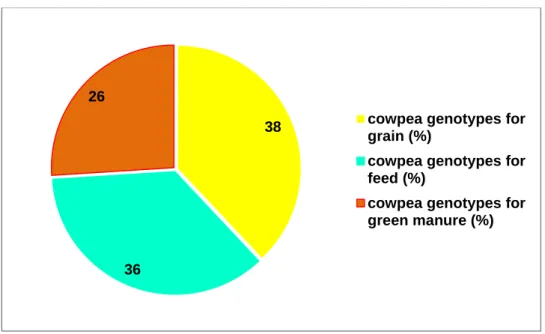
In order to achieve an efficient system of agriculture in sandy soils of southern Romania and promote sustainable agriculture, must be found that species of plants that are more easily to thermal-hydr conditions in this areas. Cowpea (Vigna unguiculata L. Walp), is one of the plants which recover very well the specific climatic conditions of the area psamo-pelitic soils in southern Romania, being a plant resistant to drought, with reduced requirements to soil fertility.The results obtained during the 2009-2015 from Development Research Center for Plants Crops on Sands, Dabuleni, Romania, concerning the behavior of 144 genotypes of cowpea, revealed variability of the species, in terms of morphology and plant productivity. Of the 144 genotypes studied, 38% allow selection for obtaining varieties of cowpea for grains, 26% allow for selection of genotypes of cowpea for feed, and 36% allow selection of obtaining genotypes for green manure. Grain yield obtained from cowpea was negatively correlated with rainfall.
INTRODUCTION
148
promote a sustainable agriculture, we have found those plant genotypes that are more easily converted thermo-hydric to stress conditions, and in this sense cowpea is one of the plants that use highly specific climatic conditions of the area psamo-pelitic soils in southern Romania, which is why was studied germplasm collection comprised of 144 genotypes.
MATERIAL AND METHODS
The researches were conducted during 2009-2015 on a collection of germplasm from cowpea (Vigna unguiculata L. Walp), which included 144 genotypes collected in the country (Foto 1). The study was conducted in conditions of irrigation on a psamosol with reduced fertility, poorly stocked in nitrogen (0.035%), middle stocked in phosphorus (25.5 ppm) and with low potassium (127ppm). Experience was placed in a 3-year rotation: cowpea - rye – sorghum to Development Research Center for Plants Crops on Sands, Dabuleni, Romania. The genotypes of cowpea were sown in the period 1 to 10 May, when average soil temperature was 10 -120C, being fertilized with 60 kg / ha N, 60 kg / ha P2O5 and 60 kg / ha K2O. Determinations were carried out on the development of plant, on the physiological resistance to pests agencies, the number of pods per plant, number of grains in pod and grains production.
Photo 1. Image of field research to cowpea (Vigna unguiculata)
RESULTS AND DISCUSSIONS
149
Figure 1. Climatic conditions at the weather station RDCSPS, Dabuleni in the study period og cowpea germplasm
During vegetation, the cowpea plants are frequently infected with various pathogens, but the virus cowpea aphid borne, which is transmitted by the bite of aphids, can cause great damage to plant of cowpea and choice of material biologically healthy is a means to streamline the culture (Cojocaru Doina et. al., 1996, Ofuya T. I., 2008).The results obtained in the dry savanna of North-West Nigeria, from Institute for Agricultural Research (IAR) and Ahmadu Bello University (ABU), Zaria area of Nigeria, revealed correlations between the drought resistance and certain genotypes of cowpea and selection of new sources of genes for Striga and aphid (Aphid craccivora Koch) resistance (M.F. Ishiyaku and H. Aliyu, 2013). Analyzing the plants resistance to virus Cowpea aphid borne from 144 genotypes of cowpea, studied on the sandy soils from southern Romania, in phases 3-4 true leaves and blooming, is noted very good resistance to this pathogen a majority genotypes studied (grades 1-2). The results obtained, show a distinct significant negative correlation, between infection with the virus cowpea aphids borne and grain yield (Figure 2). The determinations made at flourished, as regards type of plant growth, allows selection and use of the cowpea biotypes in breeding plant process of plant, according to the the desired variety. Of the 144 cowpea genotypes studied, 38% allows selection to obtaining varieties of grain, 26% allows selected genotypes for feed, and 36% allows selection of obtaining genotypes for green manure (Figure 3).
May June July August
Amount of raifall
2009-2015 (250,8mm) 78.27 87.58 69.28 15.67 Amount of raifall
1956-2015 (222 mm) 61.6 68.5 54.2 37.7
Average air temperature 2009-2015
(21,77 (oC))
17.84 21.44 24 23.8
Average air temperature 1956-2015
(20,9 (oC))
16.5 21.6 23.1 22.4
0 5 10 15 20 25 30
0 10 20 30 40 50 60 70 80 90 100
A
ir
t
emp
er
atu
re
(o
C)
Rainf
all
(
mm
150
Figure 2. The correlation between grain yield obtained to an assortment of 144 a genotypes of cowpe and Cowpea aphid borne virus infection
Figure 3. Morphological diversity of cowpea genotypes studied in the Dabuleni
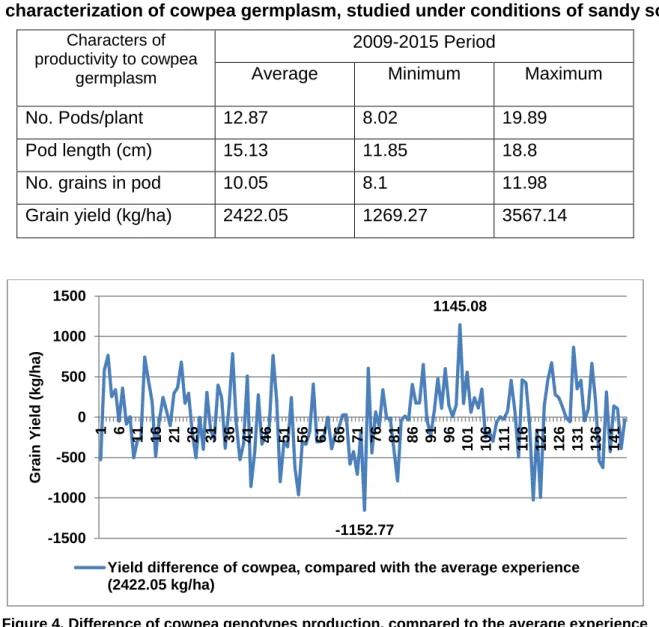
Within the species Vigna unguiculata, the pod is a character with a great variability, in terms of shape, size, color, number of grains, etc. At the 144 genotypes of cowpea the number of pods per plant varies between 8.02 - 19.89 pods, with an average of 12.87 pods / plant, number of seeds in pods varies between 8.1 -11.98 grains / pod with an average of 10.05 grains in pod, the pod length varies between 11.85 and 18.8 cm, with an average of 15.13 cm (Table 1). The grain yield varied from 1269.27 to 3567.14 kg / ha, with an average of 2422.05 kg / ha. From the average were recorded production differences, between -1152.77 kg / ha and 1145.08 kg / ha, with an distribution over average of 52.2% of the genotypes (Figure 4).
y = -294,67x + 2914,8 r = - 0,522**
0 500 1000 1500 2000 2500 3000 3500 4000
0 1 2 3 4 5 6
G
ra
in
Y
ie
ld (kg/ha)
Plant resistance to cowpea aphid borne virus (grades 1-9)
Grain yield (kg/ha) from 144 genotypes of cowpea
Linear (Grain yield (kg/ha) from 144 genotypes of cowpea)
38
36 26
cowpea genotypes for grain (%)
cowpea genotypes for feed (%)
151
Table 1
The characterization of cowpea germplasm, studied under conditions of sandy soils
Characters of productivity to cowpea
germplasm
2009-2015 Period
Average Minimum Maximum
No. Pods/plant 12.87 8.02 19.89
Pod length (cm) 15.13 11.85 18.8
No. grains in pod 10.05 8.1 11.98
Grain yield (kg/ha) 2422.05 1269.27 3567.14
Figure 4. Difference of cowpea genotypes production, compared to the average experience
Between production of grain recorded at the 144 genotypes of cowpea and pods per plant number, there is a distinctly significant positive correlation, r = 0.358 ** (Figure 5). The pods are forming floral axes, their number reaching and 6 pods / floral axis in conditions of vegetation, being differentiated by genotype. When conditions during flowering are unfavorable (drought persist), the flowers aborting from one level to another. In this case, the floral axis is prolonged constantly giving birth to new flowers, until the emergence of favorable conditions for fertilization, that pods can form at the tip axis. Production results obtained from cowpea can be influenced by the rainfall. If we analyze the yields obtained in the 7-year study correlated with rainfall recorded during the growing plant (May-August) is observed a polynomial correlation II, which showsan ascendant trend of production up to a value of 3104.04 kg/ha when it recorded a 233.2 mm rainfall, after which production decreases with increasing precipitation (Figure 6). In terms of rainfall, is registered a luxuriant plant grows at the expense of the fructification.
-1152.77
1145.08
-1500 -1000 -500 0 500 1000 1500
1 6
11 16 21 26 31 36 41 46 51 56 61 66 71 76 81 86 91 96
1
0
1
1
0
6
11
1
11
6
12
1
12
6
13
1
13
6
14
1
G
rain
Y
iel
d
(
kg/h
a)
152
Figure 5. The correlation between grain yield and number of pods / plant to cowpea
Figure 5. The correlation between grain yield obtained at 144 cowpea genotypes and the annual amount of rainfall, recorded during the growing season
CONCLUSIONS
The areaof sandy soilsfrom the south Oltenia provides an optimal microclimate for growth and development of cowpea plant.
At the 144 genotypes of cowpea the number of pods per plant varies between 8.02 - 19.89 pods, with an average of 12.87 pods / plant, number of seeds in pods varies between 8.1 -11.98 grains / pod with an average of 10.05 grains in pod, the pod length varies between 11.85 and 18.8 cm, with an average of 15.13 cm
The grain yield of 144 genotypes of cowpea, ranged between of 1269.27 to 3567.14 kg / ha and an average of 2422.05 kg / ha, was negatively correlated with infection by cowpea aphids borne virus and the amount of rainfall and positively with the number of pods per plant.
Diversity of germplasm cowpea (38%, specific genotypes for grain yield: 26%, specific genotypes feed and 36%, specific genotypes green manure), allows the selection of genetic material used in the improvement of the plant, depending on the intended objective in improvement.
y = 37,667x + 1844,5 r = 0,358** 0
1000 2000 3000 4000
5 10 15 20 25 30
G
rain
y
iel
d
(
kg/h
a)
No. pods / plant
Grain yield (kg/ha) from 144 genotypes of cowpea
Linear (Grain yield (kg/ha) from 144 genotypes of cowpea)
2204.15 2361.67 2302.57 2109.1
3104.04
2148.98 2723.95
y = -0,0464x2 + 22,837x - 224,05 r = - 0,55
0 500 1000 1500 2000 2500 3000 3500
100 125 150 175 200 225 250 275 300 325 350 375 400
G
rai
n
y
ie
ld
(k
g/
ha
)
Rainfall (mm)
153
BIBLIOGRAPHY
1. Anyia, A. O. and Herzog, H., 2004 - Genotypic Variability in Drought Performance and Recovery in Cowpea under Controlled Environment. Journal of Agronomy and Crop Science, 190: 151–159. doi: 10.1111/j.1439-037X.2004.00096.x.
2. Baudoin J.P., Marechal R., 1990 - Wide copsses and taxonomy of pulse crop with special emphasis on Phaseolus and Vigna. Workshop Africa, Plant Genetiq Resourse Ibadan, 17-20 oct., 1988, I.I.T.A. Ibadan, Nigeria.
3. Boukar O, F. Massawe, S. Muranaka, J. Franco, B. Maziya-Dixon, and C. Fatokun, 2010 - Evaluation of cowpea germplasm lines for minerals and protein content in grains. 5th World Cowpea Research Conference, 27 September–1 October 2010, Palm Beach Hotel, Saly, Senegal, p.18.
4. Cojocaru Doina, Nicolaescu Maria, Severin V., Stancescu C., Bleoju Maria, 1996 - Cowpea mosaic and bacteriosis. Means testing Plant Protection, vol. XXIV, pag. 65 – 70. 5. Dadson, R. B., Hashem, F. M., Javaid, I., Joshi, J., Allen, A. L. and Devine, T. E., 2005 - Effect of Water Stress on the Yield of Cowpea (Vigna unguiculata L. Walp.) Genotypes in the Delmarva Region of the United States. Journal of Agronomy and Crop Science, 191: 210–217. doi: 10.1111/j.1439-037X.2005.00155.x.
6. Drăghici Reta, 2013. Assess the bioenergetic potential from primary and secondary production of cowpeas culture in sandy soil conditions. Annals of University of Craiova, Series: Biology, Horticulture. Agricultural Products Processing Technology, Environmental Engineering, Vol. XVII (LIV), I.S.S.N. 1453 – 1275. Universitaria Editura.
7. Hamidou, F., Zombre, G. and Braconnier, S., 2007 - Physiological and Biochemical Responses of Cowpea Genotypes to Water Stress Under Glasshouse and Field Conditions. Journal of Agronomy and Crop Science, 193: 229–237. doi: 10.1111/j.1439-037X.2007.00253.x.
8. Karp Angela, Ian Shield, 2008 - Bioenergy from plants and the sustainable yield challenge.Article first published online: 14 APR 2008. DOI: 10.1111/j.1469-8137.2008.02432.x. Journal New Phytologist , Volume 179, Issue 1, pages 15–32.
9. M.F. Ishiyaku and H. Aliyu, 2013 - Field Evaluation of Cowpea genotypes for drought tolerance and Striga resistance in the dry savanna of the North-West Nigeria. International Journal of Plant Breeding and Genetics, 7: 47-56.
10. Marinica Gh., 1994 - Research on irrigation regime in cowpea (Vigna sinensis) grown on sandy soils from the south Oltenia. Scientific papers SCCCPN Dabuleni, vol VIII, Bucharest, p.43-53.
11. Ofuya T. I., 2008 - The effect of pod growth stages in cowpea on aphid reproduction and damage by the cowpea aphid, Aphis craccivora (Homoptera: Aphididae).Annals of Applied Biology Volume 115, Issue 3, pages 563–566, December 1989 published online26 FEB 2008 DOI: 10.1111/j.1744-7348.1989.tb06578.x.
12. Reta Drăghici, 2003 - Variability of characters and traits to some phenotypes cowpea under of sandy soilsfrom the south Oltenia. Scientific papers SCCCPN Dăbuleni, vol.XV, ISBN 973-656-514-4, p. 44-50.
13. Sarah Hearne, Jorge Franco-Duran, Eric Magembe and Inosters Nzuki, 2010 - A8-Understanding and unlocking cowpea (Vigna unguiculata) genetic diversity. 5th World Cowpea Research Conference, 27 September–1 October 2010, Senegal.