Resource-Bounded Agents
ANTHIASOLAKI1Abstract:In this paper, we present a dynamic epistemic logic suitable for resource-bounded agents. Our setting is informed by empirical evidence on deductive reasoning performance and therefore it avoids the problem of logical omniscience. In particular, we introduce actions capturing how the agent learns, forgets, and applies inference rules. Our model is a variant of Kripke models extended with impossible worlds and our updates modify its components (epistemic accessibility, rule availability, cognitive capac-ity) according to each action’s effect. We further provide a sound and com-plete axiomatization, through a method connecting this semantic approach to logical omniscience with more syntactically-oriented ones. Finally, we use similar tools to model moderate introspective ability and thus avoid the unrealistic commitment to unbounded introspection.
Keywords: dynamic epistemic logic, logical omniscience, bounded ratio-nality, resource-bounded agents, impossible worlds, rule-based agents
1
Introduction
The work of Hintikka (1962) paved the way for the formal study of propo-sitional attitudes via possible-worlds semantics. Still,S5modal logic, seen as the standard epistemic logic, facesthe problem of logical omniscience (Fagin, Halpern, Moses, & Vardi, 1995): agents are modelled as reasoners with unbounded inferential power, always knowing anything that logically follows from what they know. For example, all tautologies are known re-gardless of their complexity, knowledge is closed under logical equivalence etc. However, it takes time to compute whether a complex formula is indeed a tautology; empirical evidence (e.g., onframing effects, Tversky & Kahne-man, 1981) shows that logically equivalent statements are assessed differ-ently by subjects, depending on their presentation. These examples suggest that cognitive effort involved in reasoning tasks needs to be accounted for.
1This work is funded by the Dutch Science Foundation, under the “PhDs in the Humanities”
TheS5approach is sometimes defended due to its normative status; it models how weought toreason. Yet experimental evidence suggests that mistakes in deductive reasoning are in fact systematic (Stanovich & West, 2000; Stenning & van Lambalgen, 2008). For example, people’s perfor-mance in theWason Selection Task2, which essentially requires an appli-cation of modus ponens and modus tollens, is notoriously poor (Wason, 1966). Similarly, cognitive limitations affect the extent of introspection one can achieve. Apart from philosophical objections (Stroll, 1967; Williamson, 2000), theS5axioms ofpositiveandnegativeintrospection (Kφ→KKφ
and¬Kφ→ K¬Kφ, respectively) are not in agreement with experimen-tal findings (Verbrugge, 2009). We therefore seek another normative model tailored to such observations. This is why we propose modelling how a ra-tional agent comes to know things, informed by empirical facts to ensure that “ought” actually implies “can”.
To that end, we emphasize that although we are fallible and non-omnis-cient humans, we still arelogically competent. Despite our failures, we still engage in bounded reasoning and introspection. As a result, we ask that agents should know those consequences that can be feasibly reached from their current epistemic state. Descriptive facts, e.g., regarding limitations of time and memory, are instrumental in determining the extent of feasibility.
The problem of logical omniscience has generally attracted much at-tention. One of the early suggestions (Hintikka, 1975) was to supplement possible-worlds models with impossible (or non-normal) worlds, that are not logically closed. If these are accessible to the agent, and given the com-mon interpretation of knowledge as quantifying over accessible worlds, the closure properties for knowledge are invalidated. Still, such approaches are criticized on grounds of logical competence and explanatory power. To-wards this direction, there are attempts discerning explicitly and implicitly held attitudes. In (Fagin & Halpern, 1987), agents have to be addition-allyawareof something to know it explicitly; hence their models are aug-mented by anawareness function, yielding the formulas the agent is aware of. However, aspects of the problem can be retained, logical competence may be sidestepped and it is not clear how the crucial notion of resource-boundedness can be accounted for. In (Quesada, 2009), the awareness set can be modified depending on the agent’s applications of inference rules.
2The subject is given four cards, which have a number on one side and a color on the other.
Bjerring and Skipper (2018) provide an impossible-worlds framework that also focuses on reasoning steps the agent takes to come to know more.
While we build on the above-mentioned attempts, we are interested in capturing how resource-boundedness affects the reasoning processes under-pinning knowledge; in particular, we use Dynamic Epistemic Logic (DEL) (Baltag & Renne, 2016; van Benthem, 2011; van Ditmarsch, van der Hoek, & Kooi, 2007) to keep track of the reasoning steps available to the agent, their (orderly) applications, and the cognitive effort required. This attempt is first presented in Sect. 2, dealing with deductive reasoning alone, thereby proposing a way out of logical omniscience. In Sect. 3, we give a sound and complete axiomatization, via a method that further allows for comparative remarks between syntactic and semantic approaches to the problem. This is followed by an extension of this framework towards a balanced view to introspection, given in Sect. 4.3
2
Resource-bounded deductive reasoning
2.1 Syntax
To begin with, we need a logical language where the rules of deductive reasoning are explicitly introduced. This is why we define:
Definition 1(Inference rule) Givenφ1, . . . , φn, ψ∈ LP, whereLP is the
propositional language based on a set of atomsΦ, an inference ruleρis a formula of the form{φ1, . . . , φn} ψ.
We denote the set of premises and the conclusion ofρwithpr(ρ)and
con(ρ), whileLRdenotes the set of all inference rules. However, since we
focus on an agent’sknowledge, we are interested intruth-preservingrules.
Definition 2(Translation) The translation of a ruleρis given bytr(ρ) :=
V
φ∈pr(ρ)φ→con(ρ).
Then the definition of our framework’s logical language is given by:
Definition 3(Language) First, we fix a set of constantsT :={cρ | ρ ∈
LR} ∪ {cp}. Then the languageLis built as follows:
φ ::= z1s1+. . .+znsn≥z|p| ¬φ|φ∧φ|Kφ|Aρ|[+ρ]φ|[−ρ]φ| hρiφ
wherez1, . . . , zn∈Z,z∈Zr,s1, . . . , sn ∈T,p∈Φ, andρ∈ LR
3This paper is part of a recently initiated line of work, using DEL to model reasoning
So the language is an extension of that of standard epistemic logic with:
• Numerical inequalities introduced to deal with cognitive effort (e.g., of the forms1≥s2). As we will see, this is possible because the
con-stants ofT essentially express the cognitive costs of inference rules and the agent’s cognitive capacity.4
• A, an operator introduced to capture the agent’s availability of infer-ence rules. Specifically,Aρis to say thatρis available to the agent, who can therefore apply it.
• Dynamic operators of the form[+ρ] (resp.[−ρ]), such that: [+ρ]φ
(resp.[−ρ]) says “after the agent learns (resp. forgets)ρ,φis true”.
• Dynamic operators of the formhρi, such that: hρiφstands for “after applyingρ,φis true”.
2.2 Semantics: defining models
Our semantic model makes use ofimpossible worlds. Here, we abide by the so-calledAmerican stance(Berto, 2013): impossible worlds are not closed underanynotion of logical consequence. Still, we want to build a model respecting theminimal rationalityof agents. According to Cherniak (1986) we need a “theory of feasible inferences” where the difficulty of deductive reasoning is responsible for the agent performingsome, but not all appropri-ate inferences, so in fact, we need a “well-ordering of inferences” in terms of difficulty. It is natural to connect this with the consumption of cognitive resources and use it to determine where the cutoff of an inferential chain lies. To start with, we rule out what is an obvious case of inconsistency for any logically competent agent: explicit contradictions. As the cognitive load increases while deductive reasoning evolves, we need to keep track of the cognitive costs of rules, with respect to each resource, having determined be-forehand the resources (e.g., memory, attention, time etc.) considered. This is so because not all inference rules require equal cognitive effort, as indi-cated by experimental evidence (Johnson-Laird, Byrne, & Schaeken, 1992; Rips, 1994; Stenning & van Lambalgen, 2008). The cognitive effort will be captured by a (partial) function c : LR → Nr, whereris the number of
resources considered. This function assigns a cost to each (sound) inference rule w.r.t. each resource. In addition, we will introducecognitive capacity
in our model, a component expressing what the agent can afford w.r.t. each resource, meant to be decreased following each rule application.
Definition 4 (Semantic model) Given a set of r-many resourcesRes, a modelis a tupleM =hWP, WI, f, V, R,cpiwhere:
• WP, WI are non-empty sets of possible and impossible worlds re-spectively. LetW :=WP ∪WI.
• f : W → P(W)is a function mapping each world to its set of epis-temically accessible worlds.
• V : W → P(L)is a function mapping each world to a set of for-mulas. In possible worlds, the function intuitively assigns the set of atomic formulas true at the world. In impossible worlds, the function assigns all formulas true at the world.5
• R:W → P(LR)is a function yielding the rules the agent has
avail-able (i.e., has acknowledged as truth-preserving) at each world.
• cpdenotes the agent’s cognitive capacity, i.e., cp ∈ Zr, intuitively
standing for what the agent can afford w.r.t. each resource.
In accordance to the remarks made above, we ask that:6
Minimal Consistency(MC):{φ,¬φ} 6⊆V(w)for allw∈WI, φ∈ L
Soundness of rules(SoR): forw∈WP,ifρ∈R(w)thenM, w|=tr(ρ)
2.3 Logical dynamics: learning, forgetting and applying a rule
The language contains operators for actions capable of changing the rules that are available to the agent as well as her epistemic state following a certain rule-application. The semantic effect of these actions is, as usual in DEL, captured viamodel transformations. If a formula is of the form[]φ
with[]such an operator, then it is evaluated in a model by examining what the truth value ofφis at the transformed model.
The model transformation due to learning (resp. forgetting)ρis obtained by suitably expanding (resp. restricting) the relevant model component.
5For simplicity, we view the valuation function asV :=V
p∪Vi, where the functionsVp
andVithat take care of possible and impossible worlds are injective.
Definition 5(Model transformation by learning a rule) Given a modelM, its transformation by learning a ruleρis a modelM+ρwith
R+ρ(w) =
(
R(w)∪ {ρ} ifρis sound
R(w) otherwise
for allw∈WP. Everything else remains as in the original model.
Definition 6(Model transformation by forgetting a rule) Given a model
M, its transformation by forgetting a ruleρis a modelM−ρwithR−ρ(w) =
R(w)\ {ρ}, for allw∈WP. Everything else remains as in the original.
To capture the change induced by applications of inference rules, we have to encode them on the structure of our models. The effect of applying a rule is an expansion of the agent’s information. We first introduce the notationV∗(w)to restrictV(w)to the propositional formulas satisfied at worldw. We then impose the following condition to ensure that there are worlds capable of representing such expansions:
Succession:For everyw∈W, if: (a)pr(ρ)⊆V∗(w), (b)¬con(ρ)6∈
V∗(w), and (c)con(ρ)6=¬φfor allφ∈V∗(w), then there is someu∈W
such thatV∗(u) =V∗(w)∪ {con(ρ)}. We calluaρ-expansion.
Next, we define theρ-radius, in order to represent howρ triggers an informational change, to the extent thatMinimal Consistencyis respected.
Definition 7(ρ-radius) We define theρ-radius of a worldwas follows:
wρ:=
{w}, ifpr(ρ)6⊆V∗(w)
∅, ifpr(ρ)⊆V∗(w)and
(¬con(ρ)∈V∗(w)orcon(ρ) =¬φfor someφ∈V∗(w))
{u|uis aρ-expansion ofw}, ifpr(ρ)⊆V∗(w)and
¬con(ρ)6∈V∗(w)andcon(ρ)6=¬φfor allφ∈V∗(w)
Notice thatw’sρ-radius amounts to{w}forw∈WP, due to the closure
of possible worlds, while the radius of an impossible world may contain another impossible world. The radius is instrumental in modifying epistemic accessibility in the transformed model, after a rule-application.
Definition 8(Model transformation by application of a rule) TakeM =
hWP, WI, f, V, R,cpiandw ∈ WP. The transformation of the pointed
• Wρ=W,Vρ =V,Rρ=R, andcpρ=cp−c(ρ).
• fρ=gsuch thatg(v) =
S
u∈f(w)
uρ, forv=w
f(v), forv6=w
That is,(Mρ, w)is obtained by (a) replacingw’s epistemically acces-sible worlds inM with the elements of theirρ-radii, and (b) reducing the cognitive capacity by the cost of performing the ρ-step. Notice that the properties of our models are preserved under the three operations defined.
2.4 Truth clauses
In order to give the truth clauses for our formulas, we first need to assign interpretations to the constants inT:
Definition 9(Interpretation of terms) GivenM =hWP, WI, f, V, R,cpi
parameterized by resourcesResand the cognitive cost functionc, the con-stants ofT are interpreted as follows:cpM =cpandcMρ =c(ρ).
Definition 10(Truth clauses) The clauses below define when a formula is true atwinM. Forw∈WI:M, w|=φiffφ∈V(w). Forw∈WP:
M, w|=z1s1+. . .+znsn≥ziffz1sM1 +. . .+znsMn ≥z
M, w|=p iff p∈V(w)
M, w|=¬φ iff M, w6|=φ
M, w|=φ∧ψ iff M, w|=φandM, w|=ψ M, w|=Aρ iff ρ∈R(w)
M, w|= [+ρ]φ iff M+ρ, w|=φ M, w|= [−ρ]φ iff M−ρ, w|=φ
M, w|=Kφ iff M, w0|=φfor allw0∈f(w)
M, w|=hρiφ iff M, w|=cp≥cρ,M, w|=AρandMρ, w|=φ
Notice that our intended reading of≥is that, for example,s1 ≥s2iff
everyi-th component ofs1is greater or equal than thei-th component ofs2.
Validity is defined with respect to possible worlds only. Given our clause for
(a) the rule is executable, (b) the rule is available to the agent, (c)φfollows from the accessible worlds via an application ofρ. Moreover, the actions of learning and forgetting rules can affect the availability, and thus account for the flexibility of actual reasoning and its possible failures. Cognitive ca-pacity, decreasing suitably after every rule-application, determines to which extent consequences of one’s knowledge can come to be in turn known. This cutoff is therefore cognitively informed and not arbitrarily fixed. Over-all, this approach encompasses each rule’s different contribution and effort, and explains how resources are consumed as reasoning evolves.
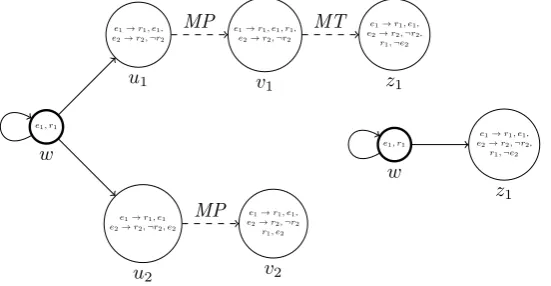
Example 1 Consider the following scenario: agent Alice is given 2 cards, each has a number on one side and a color (red or brown) on the other. Alice knows that if a card has an even number on one side, it hasred on the other. Suppose that the 1st card has 8 on its visible side (fact denoted by
e1), and the 2nd card has brown (denoted by¬r2;r2stands for “the second
card is red”). What should the agent derive? In seeing the even card and performing a modus ponens (MP) step (if affordable), she comes to know
r1. In seeing the brown card and performing a modus tollens (MT) step (if
affordable), she comes to know ¬e2. Figure 1 shows the original and the
MP,MT-updated model. However, empirical evidence suggests thatMT is more cognitively costly thanMP(Johnson-Laird et al., 1992; Rips, 1994; Stenning & van Lambalgen, 2008). So the cost ofMT exceeds the cost of MP, and it might be the case that it is so cognitively costly for Alice to apply that she cannot do so, e.g., under time pressure (consider subjects given the Wason Selection Task to complete in specific time bounds). Moreover, as many argue that MT, unlikeMP, is not a primitive rule (Rips, 1994), it might be that the rule is not even available to Alice, so she needs tolearnit and then apply it. Such scenarios exemplify how our tools can fit reasoning tasks studied in psychology of reasoning.
3
Axiomatization
3.1 Semantic and syntactic approaches
manipu-e1, r1
w
e1→r1, e1,
e2→r2,¬r2
u1
e1→r1, e1
e2→r2,¬r2, e2
u2
e1→r1, e1, r1,
e2→r2,¬r2
v1
MP
e1→r1, e1,
e2→r2,¬r2
r1, e2
v2
MP
e1→r1, e1,
e2→r2,¬r2,
r1,¬e2
z1
MT
e1, r1
w
e1→r1, e1,
e2→r2,¬r2,
r1,¬e2
[image:9.442.76.352.99.242.2]z1
Figure 1: For worlds inWP, unlike those inWI, we use thicker nodes and write down only the atomic formulas satisfied there. Dashed lines indicate rule expansions. Left: the original model for Alice, who has not yet derived all consequences of her knowledge, entertaining an incomplete (u1) and an inconsistent (u2) world. Right: the updated model, following the applications ofMP,MT.
lation of structures resembling those of Fagin and Halpern (1987). Besides, a rough division of attempts against logical omniscience is between syntac-tic and semansyntac-tic ones. According to Fagin and Halpern (1987), a syntacsyntac-tic approach lacks the elegance of a semantic (impossible-worlds) one, but the latter’s semantic rules do not adequately capture intuitions about knowledge and belief. To increase explanatory power and intuitiveness, we limited the arbitrariness of impossible worlds (via SuccessionandMinimal Con-sistency) and modelled logically competent agents, in that they gradually refine their epistemic state through rule-applications. In what follows, we reduce our models to syntactic structures to extract a sound and complete logic. In combination with Wansing (1990), it can be claimed that there is a “correspondence” between the two styles of attacking logical omniscience.
3.2 A common background languageLr
In order to show that the same formulas are valid under the original and the reduced models, we introduce auxiliary operators to thestaticfragment of
M, w|=Lφ iff M, u|=φfor allu∈WP∩f(w)
M, w|=Iφ iff M, u|=φfor allu∈WI∩f(w)
M, w|= ˆIφ iff M, u|=φfor someu∈WI∩f(w)
M, w|=hRADiρφ iff for someu∈wρ:M, u|=φ7
Abbreviations: (a)[RAD]ρφ:=hRADiρ> → hRADiρφ, and (b) Ifφ
is of the form¬ψ, for some formulaψ, thenIφ:= ˆIψ, elseIφ:=⊥
3.3 The reduced model
Take a model M = hWP, WI, f, V, R,cpi and V
r(w) := {φ ∈ Lr |
M, w|=φ}, forw∈WI. We constructM=hW,f,V,I,ˆI,R,cpiwhere:
• W =WP,f(w) =f(w)∩Wforw∈W,V =V|
W, andR =R|W.
• I : W → P(Lr)such thatI(w) = T v∈f(w)∩WI
Vr(v). Intuitively, I
takes a possible worldwand yields the set of those formulas that are true at all impossible worlds accessible fromw.
• ˆI : W → P(Lr)such thatˆI(w) = S v∈f(w)∩WI
Vr(v). Intuitively,ˆI
takes a possible worldw and yields the set containing any formula true at some impossible world accessible fromw.
The interpretation of terms inMis as before, for it depends on the pa-rametercand the model componentcp. The semantics based onMis:
M, w|=z1s1+. . .+znsn≥ziffz1sM1 +. . .+znsMn ≥z
M, w|=p iff p∈V(w)
M, w|=Lφ iff for allu∈f(w):M, u|=φ
M, w|=¬φ iff M, w6|=φ
M, w|=Iφ iff φ∈I(w)
M, w|=φ∧ψ iff M, w|=φandM, w|=ψ
M, w|= ˆIφ iff φ∈ˆI(w) M, w|=Aφ iff φ∈R(w)
M, w|=Kφ iff M, w|=LφandM, w|=Iφ
M, w|=hRADiρφ iff for someu∈wρ:M, u|=φ
Theorem 1 (Reduction) Given a model M, construct M as described above. Then Mis a reduction ofM, i.e., for anyw ∈ WP and formula
Proof. By induction on the complexity ofφ. Recall that validity is defined with respect to possible worlds in the original model. The base case, and the steps for inequalities,¬,∧andAare straightforward. ForL,I,Iˆ,hRADiρ
we rely on the construction of the auxiliary operators and the definition of M. ForK, the claim holds as it can be re-expressed in terms ofLandI.
3.4 Static axiomatization and reduction axioms
We first present an axiomatic system for the static part and show that it is sound and complete w.r.t. the reduced Kripke models. For the dynamic part, involvinghρi,[+ρ],[−ρ], we givereduction axioms. As usual in DEL, the static logic combined with these axioms, suffices to get a complete logic for our full framework.
Definition 11(Axiomatization) The static logic is axiomatized by the fol-lowing axioms and the rulesModus Ponens and Necessitation (fromφ
inferLφ).
PC All instances of classical propositional tautologies Ineq All instances of valid formulas about linear inequalities K L(φ→ψ)→(Lφ→Lψ)
T Lφ→φ
MC ¬(Iφ∧I¬φ) SoR Aρ→tr(ρ) Succession (V
ψ∈pr(ρ)Iψ∧¬Iˆ¬con(ρ)∧¬Icon(ρ))→IhRADiρcon(ρ)∧
(Iφ→IhRADiρφ), forφ∈ LP
IhRADiρφ→Iφ, forφ∈ LP andφ6=con(ρ)
¬V
ψ∈pr(ρ)Iψ→(Iφ↔IhRADiρφ), forφ∈ LP
V
ψ∈pr(ρ)Iψ∧( ˆI¬con(ρ)∨Icon(ρ))→I[RAD]ρ⊥
Red1 Kφ↔(Lφ∧Iφ)
Red2 hRADiρφ↔φ
Red3 I[RAD]ρφ↔(IhRADiρ> →IhRADiρφ
Ineq, described by Fagin and Halpern (1994), is introduced to deal with inequalities.8 MC,SoR andSuccession correspond to our model condi-tions, given how these are reflected on our language. We useTtoo, because this corresponds to factivity of knowledge. Red1reducesKin terms ofL
andI.Red2andRed3capture the properties ofρ-expansions. UsingMfor
the class of reflexiveMmodels we show:
Theorem 2(Soundness, Completeness) The static logic is sound and com-plete w.r.t.M.
Proof. Soundness: It suffices to show that the reduction axioms are valid in this class. Completeness: We need to construct a suitable canonical model, corresponding to ourMmodels and their properties. This can be defined as M = hW,F,V,I,Iˆ,R,cpi, where W,F,V are defined as usual (Blackburn, de Rijke, & Venema, 2001). Its functions are given by:
I(w) ={φ|Iφ∈w},Iˆ(w) ={φ|Iφˆ ∈w}andR(w) ={ρ|Aρ∈w},
withw∈ W. Then we show the truth lemma (i.e.,M, w|=φiffφ∈w) by induction onφ. Completeness follows by standard modal logic results.
Before we move to reduction axioms for our three actions, we have to express the updated terms in the language:cpρ:=cp−c
ρandcρρ:=cρ.
Theorem 3(Reduction axioms) The following are valid inM:
hρi(z1s1+. . .+znsn≥z)↔(cp≥cρ)∧Aρ∧(z1sρ1+. . .+znsρn≥z)
hρip↔(cp≥cρ)∧Aρ∧p
hρi¬φ↔(cp≥cρ)∧Aρ∧ ¬hρiφ
hρi(φ∧ψ)↔(cp≥cρ)∧Aρ∧ hρiφ∧ hρiψ
hρiLφ↔(cp≥cρ)∧Aρ∧Lφ
hρiIφ↔(cp≥cρ)∧Aρ∧I[RAD]ρφ
hρiKφ↔(cp≥cρ)∧Aρ∧K[RAD]ρφ
hρiAσ↔(cp≥cρ)∧Aρ∧Aσ
hρiIφˆ ↔(cp≥cρ)∧Aρ∧IˆhRADiρφ
hρihRADiρφ↔(cp≥cρ)∧Aρ∧ hRADiρφ
[+ρ](z1s1+. . .+znsn≥z)↔(z1s1+. . .+znsn≥z)
[+ρ]p↔p
[+ρ]¬φ↔ ¬[+ρ]φ
[+ρ](φ∧ψ)↔[+ρ]φ∧[+ρ]ψ
[+ρ]Lφ↔L[+ρ]φ
[+ρ]Iφ↔Iφ
[+ρ]Kφ↔L[+ρ]φ∧Iφ
[+ρ]Aσ↔Aσ, forσ6=ρ
[+ρ] ˆIφ↔Iφˆ
[+ρ]Aρ↔ >, forρsound.[+ρ]Aρ↔ ⊥, otherwise
[−ρ](z1s1+. . .+znsn≥z)↔(z1s1+. . .+znsn≥z)
[−ρ]p↔p
[−ρ]¬φ↔ ¬[−ρ]φ
[−ρ](φ∧ψ)↔[−ρ]φ∧[−ρ]ψ
[−ρ]Lφ↔L[−ρ]φ
[−ρ]Iφ↔Iφ
[−ρ]Kφ↔L[−ρ]φ∧Iφ
[−ρ]Aσ↔Aσ, forσ6=ρ
[−ρ] ˆIφ↔Iφˆ
[−ρ]Aρ↔ ⊥
[−ρ]hRADiρφ↔ hRADiρ[−ρ]φ
Theorem 4(Dynamic axiomatization) The logic given by the system of Def. 11 and the reduction axioms of Th. 3 is sound and complete w.r.t.M.
Proof. We first check that the reduction axioms are indeed valid inM. This, in combination with the result in Th. 2, suffices to prove the claim.
4
Resource-bounded introspection
S5models are reflexive, symmetric and transitive in order to capture prop-erties of knowledge like factivity, positive and negative introspection. We have explained above that it is reasonable to impose reflexivity on our mod-els too. However, due to the impossible worlds, symmetry and transitivity would not correspond to introspection. This is viewed as a desirable feature since avoiding unlimited introspection falls within the wider goal to model non-ideal agents. In analogy to our argumentation for resource-bounded factual reasoning, real agents are never fully introspective due to cognitive limitations therefore representation of reflective powers should be up to a certain modal depth (Ditmarsch & Labuschagne, 2007). In determining this depth, we adapt the tools used earlier for deductive reasoning.9
We first need to introduce introspective rules, add the respective terms and operators to the language (similar to the deductive case, e.g.,hιistands for “after applying introspective ruleι”), and fix cognitive costs. Then we need a model structure similar to the one provided bySuccessionto ensure that given sufficient resources, the agent can achieve higher and higher de-grees of introspection. ExtendingV∗with the epistemic assertions satisfied
9Similar motivations fuel the works of Jago (2009) and Fervari and Velázquez-Quesada
at each world, we imposeIntrospective Succession: roughly, for every as-sertion composed bynK’s there should be a successor world that validates an assertion with(n+ 1)K’s:10
Introspective Succession:For everyw∈W, if: (i)ψ∈V∗(w), where
ψis of the formKnφfor someφ∈ LP andn= 0, . . . , n, and (ii)¬Kψ6∈
V∗(w), then there is someu∈W such thatV∗(u) =V∗(w)∪ {Kψ}. Negativeintrospective succession works similarly. For simplicity, let
pr(ι)denote the initial assertion andcon(ι)the new one. Then, defining the introspective radius and model transformation is analogous to the deductive case. In order to get w’s introspective radius (wι), we replace ρwith ι
in Def. 7, taking cases based on the new succession condition. Then the transformation becomes:
Definition 12(Model transformation by applying an introspective rule) LetM =hWP, WI, f, V, R,cpiandw∈WP. The transformation of the
pointed model(M, w)by an application ofιis(Mι, w), where:
• Wι=W,Vι=V,Rι=R, andcpρ=cp−c(ι).
• fι=gsuch thatg(v) =
S
u∈f(w)
uι, forv=w
f(v), forv6=w
This definition naturally leads to the truth conditions for applying ι:
M, w|=hιiφiffM, w|=cp≥cι,M, w|=AιandMι, w|=φ.
While the main idea (viewing both deduction and introspection as rea-soning actions) is shared between this and earlier sections, the processes are discernible from a cognitive point of view. Both the costs and the availabil-ity of introspective rules may be treated differently, e.g., it might be that introspective rules are in principle always available and it is only the accu-mulated cost after each application that is responsible for limited reflection.
5
Conclusions
Overall, our dynamic logical framework overcomes logical omniscience but is also informed by empirical facts on the boundedness of real reasoners, as evinced by its formal results. The same considerations are extended to introspective abilities of agents. Meanwhile, we argue for the adequacy of this semantic approach against logical omniscience in terms of explanatory
power, but also show that it can be reduced to a syntactic one that enables the extraction of a sound and complete logic. Further work is especially needed on the optimal choice of cognitive parameters and on a multi-agent extension, building on the construction of inferential and introspective rules.
References
Baltag, A., & Renne, B. (2016). Dynamic epistemic logic. In E. N. Zalta (Ed.),The Stanford Encyclopedia of Philosophy (Winter 2016 ed.). Metaphysics Research Lab, Stanford University.
Berto, F. (2013). Impossible worlds. In E. N. Zalta (Ed.), The Stanford Encyclopedia of Philosophy(Winter 2013 ed.). Metaphysics Research Lab, Stanford University.
Berto, F., Smets, S., & Solaki, A. (2018). The logic of fast and slow think-ing.working paper.
Bjerring, J. C., & Skipper, M. (2018). A dynamic solution to the problem of logical omniscience.Journal of Philosophical Logic.
Blackburn, P., de Rijke, M., & Venema, Y. (2001).Modal Logic. New York, NY, USA: Cambridge University Press.
Cherniak, C. (1986). Minimal Rationality. MIT Press.
Ditmarsch, H. V., & Labuschagne, W. (2007). My beliefs about your beliefs: A case study in theory of mind and epistemic logic.Synthese,155(2), 191–209.
Fagin, R., & Halpern, J. Y. (1987). Belief, awareness, and limited reasoning. Artif. Intell.,34(1), 39–76.
Fagin, R., & Halpern, J. Y. (1994). Reasoning about knowledge and proba-bility.J. ACM,41(2), 340–367.
Fagin, R., Halpern, J. Y., Moses, Y., & Vardi, M. Y. (1995). Reasoning About Knowledge. MIT press.
Fervari, R., & Velázquez-Quesada, F. R. (2017). Dynamic epistemic logics of introspection. InInternational Workshop on Dynamic Logic(pp. 82–97).
Hintikka, J. (1962).Knowledge and Belief: An Introduction to the Logic of the Two Notions. Ithaca, N.Y.,Cornell University Press.
Hintikka, J. (1975). Impossible possible worlds vindicated. Journal of Philosophical Logic,4(4), 475–484.
Johnson-Laird, P. N., Byrne, R. M., & Schaeken, W. (1992). Propositional reasoning by model.Psychological Review,99(3), 418-439.
Quesada, F. V. (2009). Small steps in dynamics of information(Vol. 1). Rips, L. J. (1994). The Psychology of Proof: Deductive Reasoning in
Hu-man Thinking. Cambridge, MA, USA: MIT Press.
Smets, S., & Solaki, A. (2018). The effort of reasoning: Modelling the infer-ence steps of boundedly rational agents. In L. S. Moss, R. de Queiroz, & M. Martinez (Eds.),Logic, Language, Information, and Computa-tion(pp. 307–324). Berlin, Heidelberg: Springer Berlin Heidelberg. Stanovich, K. E., & West, R. F. (2000). Individual differences in
reason-ing: Implications for the rationality debate? Behavioral and Brain Sciences,23(5), 645–665.
Stenning, K., & van Lambalgen, M. (2008). Human Reasoning and Cogni-tive Science. Boston, USA: MIT Press.
Stroll, A. (Ed.). (1967). Epistemology. New York: Harper and Rowe. Tversky, A., & Kahneman, D. (1981, 02). The framing of decisions and the
psychology of choice.Science (New York, N.Y.),211, 453-8.
van Benthem, J. (2011). Logical Dynamics of Information and Interaction. Cambridge University Press.
van Ditmarsch, H., van der Hoek, W., & Kooi, B. (2007). Dynamic Epis-temic Logic(1st ed.). Springer Publishing Company, Incorporated. Verbrugge, R. (2009). Logic and social cognition.Journal of Philosophical
Logic,38(6), 649–680.
Wansing, H. (1990). A general possible worlds framework for reasoning about knowledge and belief.Studia Logica,49(4), 523–539.
Wason, P. C. (1966). Reasoning. In B. Foss (Ed.),New Horizons in Psy-chology(pp. 135–151). Harmondsworth: Penguin Books.
Williamson, T. (2000).Knowledge and its Limits. Oxford University Press.
Anthia Solaki
ILLC, University of Amsterdam The Netherlands
E-mail:[email protected]