What should have been the case.
A temporal update semantics for necessity deontic
modals
MSc Thesis
(Afstudeerscriptie)
written by
Alessandra Marra
(born February 2nd, 1985 in Padova, Italy)
under the supervision of Prof.dr Frank Veltman, and submitted to the Board of Examiners in partial fulfillment of the requirements for the degree of
MSc in Logic
at theUniversiteit van Amsterdam.
Date of the public defense: Members of the Thesis Committee: August 30, 2013 Dr Maria Aloni
Abstract
The thesis develops a formal semantics for present necessity deontic modals, such asshould,ought to,must, and past necessity deontic modals, such asshould have,ought to have,had to. Contrary to the traditional approaches in deontic logic, we concentrate on the prescriptive use of such modals.
In analyzing the different behavior of present and past necessity deontic modals in everyday discourse practice, we focus on the contrast that arises when the proposition embedded under those modals is eventive and non-progressive. We distinguish between a “counterfactual” and an “open-past” reading of past necessity deontic modals, and argue that the semantic differences between present and (the two readings of) past necessity deontic modals are ultimately due to two factors: (i) when the embedded proposition is evaluated, and (ii) whether the embedded proposition is an open possibility according to the common ground of the participants in the conversation.
We develop a framework from the update semantics’ tradition. The approach we propose, called Temporal Deontic Update Semantics (TDUS), permits us to take into account the two factors (i) and (ii), and to model present and past necessity deontic modals by means of a single deontic operator: Oblige.
Acknowledgments
I have accumulated big debts for such a small piece of work. The biggest debt I have is with Frank Veltman. He has been a great teacher, a patient counselor and an encouraging supervisor. I am very happy that I had the opportunity to discuss about logic and philosophy with him. It was a honor, and big fun. I would like to thank also the other committee’s members: Maria Aloni and Robert van Rooij. Thanks for their insightful questions, precious remarks and for all the time they dedicated to me during my master studies and beyond.
Going back in time, it is Venice where everything started. I want to thank my first logic teacher, Francesco Berto: a truly serious philosopher who “does not take himself too seriously”.
Thanks also to Katya Garmash, Alberto Gatto, Umberto Grandi, Pawel Lojko, Tong Wang and Fabio Zanasi. They proved me that the MoL(room) can also be a place for friendship.
Contents
1 Introduction 3
1.1 Obligation sentences . . . 4
1.2 Two readings . . . 5
1.2.1 Reportative Reading . . . 6
1.2.2 Prescriptive Reading . . . 7
2 Deontics, Time and Common Ground 8 2.1 Present necessity deontic modals . . . 8
2.1.1 Presuppositions . . . 9
2.2 Past necessity deontic modals . . . 14
2.2.1 Counterfactual Reading . . . 15
2.2.2 Open-Past Reading . . . 17
2.3 Time and common ground, summing up . . . 18
3 Temporal Deontic Update Semantics (TDUS) 20 3.1 Logical forms . . . 20
3.2 A dynamic setting . . . 22
3.3 Information states . . . 23
3.4 Updates with descriptive sentences . . . 25
3.5 Updates with obligation sentences . . . 26
3.5.1 Present necessity deontic modals . . . 26
3.5.2 Past necessity deontic modals under the open-past reading 28 3.5.3 Past necessity deontic modals under the counterfactual reading . . . 29
3.6 Complexvs Sequential Updates, Acceptance and Logical Conse-quence . . . 31
3.7 Conclusions . . . 32
4 Applying TDUS to deontic paradoxes 34 4.1 Conditional obligations, contrary-to-duty obligations and For-rester’s Paradox . . . 34
4.2 The Miners’ Paradox . . . 37
5 Conclusion 43
Chapter 1
Introduction
The goal of this thesis is to provide a new formalism which captures some aspects of the semantics of necessity deontic modals. In particular, we aim at laying the foundations for an analysis of present necessity deontic modals (such asmust,ought to,should) and past necessity deontic modals (such asought to have,should have,had to). Literature in deontic logic, however, has concentrated mostly on problems related to conditional obligations. Different approaches have been proposed, but they tend to focus only on present necessity deontic modals, and to consider the difference between present and past deontic modals as an unrelated issue. We think that that view is misleading. We propose an update semantics for present and past deontic modals, and show how it may also enlighten some of the puzzles which have been traditionally ascribed to conditional obligations.
The starting points of our analysis are Thomason’s (1981) work on temporal deontic logic, Condoravdi’s (2002) and Arregui’s (2010) works on present and past modals, and van der Torre and Tan’s (1999) work on dynamic deontic logic. Our framework is intended to be a development of those works. In particular, none of them can account for sentences likeYou ought to have sent everybody a remainder by email (but you didn’t), where the necessity deontic modalought to have is used to express a new obligation, rather than report an existing one. The present paper aims at filling that gap. We propose an update semantics in which obligation sentences are interpreted as inducing updates onbetterness-relations. Moreover, we takehistories as basic elements of the framework. Intuitively, a history represents the evolution of the world in time, while betterness-relations establish which histories are deontically ideal. Information states consist in sets of histories and betterness-relations, and represent agents’ knowledge of the facts of the world and of its normative configuration. In particular, an information state can be understood as the representation of the conversational context that speaker and listener share in conversation. The framework is dynamic, in the sense that information states can be modified and evolve in time.
focuses on the contrast that emerges when the proposition embedded under the modals is eventive and non-progressive. Moreover, two different readings of past necessity deontic modals are discussed: the counterfactual reading and the so-called “open-past” reading.
Chapter three is devoted to our framework, which we callTemporal Deontic Update Semantics (TDUS). The framework aims at modeling the aspects of the semantics of present and past deontic modals that have been discussed in Chapter two. We provide the basic definitions of our framework, and focus on updates induced by sentences which contain present necessity deontic modals and past necessity deontic modals.
Chapter four focuses on some classical deontic paradoxes, such as Forrester’s Paradox, the Miners’ Paradox and Chisholm’s Paradox. The paradoxes involve contrary-to-duty obligations, disjunction of obligations and conflicting obligations. Those scenarios are not problematic in our framework, and the paradoxes do not arise in TDUS. Moreover, we show that our previous considerations regarding present and past necessity deontic modals are relevant to a solution of the paradoxes, especially in the case of Chisholm’s Paradox.
Chapter five concludes with some final remarks.
Before turning to Chapter two, it is worth introducing some of the prelimi-naries, and setting the boundaries of our inquire. In particular, we choose to focus our attention on obligation sentences, and provide an analysis of their prescriptive use.
1.1
Obligation sentences
Deontic logic is the formal study of normative concepts, such as obligation, permission and forbidness.1 Here we concentrate on the concept of “obligatory”.
In natural language, obligations can be expressed by the use of several modals, which may differ in their strength. Consider, for instance, the following sentences:
1. You must go
2. Sara should return the library book on time
When modals such as must andshould are used to express a sort of duty or obligation, they are callednecessity deontic modals.2 In the present paper, we
take 1 and 2 to have the following logical form:
3. must [you go]
4. should [Sara returns the library book on time]
1See von Wright (1951), page 1.
2It is common to distinguish between strong necessity modals (such asmust) and weak
wheremustandshould are necessity deontic modals which range over the domain of propositions. We formalize 1 and 2 asOblige(α), where αis a descriptive sentence andObligeis an impersonal deontic necessity operator – meaning that “It must/should/ought to be that”.
In our analysis, necessity deontic modals are, therefore, treated asS-operators, i.e, modals which operate on sentence phrases. There are a few examples in which the reduction of all obligation sentences to the formOblige(α) may be problematic.3 However, for the purposes of the present thesis, it is sufficient
to consider that in the majority of cases (but not all) we can fairly represent obligations in the formOblige(α). By doing so, we are able to give a preliminary and general semantic account of necessity deontic modals.
1.2
Two readings
One of the first topics discussed in the development of deontic logic was the question whether obligation sentences have truth-values. The question was motivated by the fact that obligation sentences like 1 and 2 look like commands, rather than descriptive sentences. Thus arises a puzzle sometimes known as “Jørgensen’s Paradox”. The puzzle can be reformulated as follows: If obligation sentences do not describe facts of the world, they cannot have truth values; and, since logic concerns itself exclusively with things that have truth values, then how can there be anything as deontic logic? 4
The paradox, which appeared to challenge the entire enterprise of deontic logic, relies instead on a number of questionable assumptions. Firstly, it should be observed that obligation sentences can be used both toreport and tobring about obligations. To illustrate the difference, consider the following examples:5
• Tax lawyer to client:
You must report this donation as income.
• Lecturer to class:
The final assignment must be in my mailbox by six pm on Friday.
In the first case, the lawyer reports to the client an already existent obligation (hence, reportative use). In the second case, however, the lecturer enacts a new obligation (hence, prescriptive use). Concerning the first, reportative obligation,
3Consider, for instance, the following scenario. Suppose that Fred ought to dance with
Ginger. This is represented, using the impersonal necessity deontic operator, as “It ought to be that Fred dances with Ginger”. However, the relation of dancing is symmetric. In any possible world in which Fred dances with Ginger, it is also the case that Ginger dances with Fred. So, it seems that the two statements “Fred dances with Ginger” and “Ginger dances with Fred” are equivalent. It follows that if two statementsαandβare equivalent, then the statement
Oblige(α) cannot be distinguished fromOblige(β). Thus, since it ought to be that Fred dances with Ginger, it ought to be also that Ginger dances with Fred, which is an incorrect conclusion. These are examples in which the notion of agency plays a predominant role, hence the use of an impersonal deontic operator is problematic. Cf. Horty (2001), pp. 50-51.
it seems perfectly reasonable to admit that it can be true or falseaccording to a particular norm: for instance, it can be a true (or false) description of a norm of the tax code.
Secondly, we argue that there can be alogicalso for prescriptive obligations, even if they lack truth values. In particular, we are interested in the semantics of prescriptive necessity deontic modals, and semantics deals with meaning, which should not be reduceda priori to truth conditions.
1.2.1
Reportative Reading
We have said that obligation sentences are used reportatively if they are a description of some norm. Therefore, under the reportative reading, our sentences 1 and 2 are interpreted as:
5. According to the law/ moral code/ library rules, You must go
6. According to the law/ moral code/ library rules, Sara should return the library book on time
where the agent who utters those sentences refers to some pre-existing code of norms, and intends to give a description of it. Traditionally, works in the field of deontic logic have focused precisely on the reportative reading of obligation sentences, by providing a truth-conditional analysis based on a primitive ordering among possible worlds (cf. Hansson 1969; Lewis 1973; Spohn 1975; Kratzer 1981). The approach is similar to the one in doxastic logic and conditional logic: obligation sentences are interpreted by making use of an “ideality relation” between possible worlds, and by the notion of maximality. In particular, from Hansson (1969) on, conditional obligations of the type If α, it is obligatory thatβ (whereαexpresses the condition under which the obligation holds) are formalized by the use of a dyadic deontic operator(β/α), and interpreted as follows:
(∗) M, s|=(β/α)⇐⇒M ax(JαKM)⊆JβKM
whereM is a model built on a Kripke frameF = (S,) andJ·KM is the truth-set
function ofM.6 Given our purposes, it is worth to note that truth-conditional
analyses take the ideality relationto be primitive, that is, what counts as “ideal” is already given in the model.
Thus, according to (∗), obligation sentences express only true or false descrip-tions of a normative code, which is (semantically) represented by the ideality ordering.7 In particular, a sentence such asIfα, it is obligatory thatβ asserts
that the best worlds in whichαis the case, i.e., the worlds which are maximal in
6Depending on the proprieties of the ideality relation, different logics can be obtained.
For instance Hansson (1969) considers frames in whichis only reflexive, and then moves to frames in whichis a total pre-order. See Hansson (1969) and van Benthem, Grossi and Liu (2010).
the ideality ordering, are also worlds in whichβ is the case. As we said above, that semantic analysis is very similar to the one used in Lewis-Stalnaker’s seman-tics for counterfactual conditionals, and in plausibility models for conditional belief.8
However, by interpreting obligations as descriptions, truth-conditional anal-yses miss the prescriptive effect which is a distinguishing feature of deontic statements. As Austin (1962) noticed, obligation sentences are typically used tobring about new duties and obligations. Sentences like 1 and 2 are generally used tocommand something rather than assert it.
1.2.2
Prescriptive Reading
Alchourr´on explains the difference between reportative and prescriptive readings of obligation sentences in terms of the difference between making a picture of reality and building a part of reality. He uses the following box metaphor: Think of the obligatory set as a box ready to be filled. When an authority uses an obligation sentence prescriptively, his activity belongs to the same category asputting something into a box. When that authority, or someone else, uses the obligation sentence reportatively his activity belongs to the same category asmaking a picture of the authority putting something into a box.9
In other words, only under the prescriptive reading, obligation sentences are used tocreateandchange an aspect of reality, i.e., its normative configuration. In that case they have, therefore, adynamiccharacter.
One question should now be addressed: what is the relation between the two readings? In the current literature, there is no agreement about that issue. Some authors argue that deontic modals are ambiguous between thetwo meanings
(e.g., Kamp 1973; van Rooij 2000), while others assume that the semantics of deontic modals is constant, and the prescriptive effect pertains to thepragmatic domain(e.g., Schwager 2006; Kaufmann and Schwager 2009). According to the latter view, the semantics ofmust,ought to andshould is the same across the two readings, while the prescriptive effect is trigged by certain contextualist settings. For instance, in Schwager (2006) and Kaufmann & Schwager (2009), the contextualist settings responsible for the prescriptive effect are characterized on the basis of a Kratzer-style semantics. This means that obligation sentences are always interpreted in terms of truth conditions, and the prescriptive effect arises just in the presence of particular contextual factors.
In the present thesis, we adopt a different perspective. We take the prescrip-tive use of obligation sentences to be the primary one, and provide an update semantics which models it. The reportative use, on the other hand, can be derived in the semantics by means of the notion of “support”.
Chapter 2
Deontics, Time and
Common Ground
The present chapter analyses deontic expressions such as must, ought to,
should,have to (usually calledpresent modals1) and deontic expressions such as
ought to have,should have,had to (usually calledpast modals2). In particular,
we focus on the contrast that emerges between present and past necessity deontic modals in the case in which the embedded proposition is eventive and non-progressive.
2.1
Present necessity deontic modals
Present necessity deontic modals are expressions such as must, ought to,
should,have to which are used to indicate obligations, duties, or requirements.3
Consider the following example:
7. (a) You should call your parents
(b) should [you call your parents]
Intuitively, sentence 7a says that a certain event has to obtain. It establishes, indeed, a duty: in uttering 7a, the speaker prescribes that the listener has the duty of calling her parents. If the listener, in turn, accepts 7a, she comes to believe that writing a letter to her parents is better than not doing it.4
7b illustrates the logical form of 7a. The deontic modalshould ranges over the sentence You call your parents, whose verb-phrase (VP) is headed by an eventive predicate with a non-progressive aspect. The predicatecall is eventive
1See Condoravdi (2002), pp. 59-60. 2Ivi.
3By defining deontic modals in terms of their meaning contribution, we can include under
that category also expressions likehave to, which are not, strictly speaking, modal verbs. Cf. Adger (2004), pp. 158-159.
because it denotes a property of events (rather than a property of states of affairs), and is non-progressive because the action of calling is not ongoing (as it would be in the case ofYou are calling your parents).5 It is worth noticing that even if the eventive predicate is in present tense, the evaluation of the embedded clause takes place after the utterance time.6 This is reasonable if we consider that a deontic sentence like 7a can be used to direct the addresse to perform the action of calling. In the case of 7a, the eventive predicate refers to an event that is contained in an interval which starts immediately after the utterance time and ends in an indefinite future. Frame adverbials can, however, make explicit the temporal interval in which the event has to be located:
8. You should call to your parents by 5pm/ (later) today/ tomorrow
Present deontic modals with eventive embedded clause establish, therefore, that the corresponding event has to obtain somewhere in the future. The event can take place in the interval which starts immediately after the utterance time, and ends at 5pm or at the end of the current day, or in an interval which starts tomorrow and expands till the end of that day. However, the event cannot take place in the past:
9. You should call to your parents #yesterday
2.1.1
Presuppositions
Present necessity deontic modals appear to be sensitive to the context in which they are used. Consider the following scenario:
Today you need to call the Municipality Office. The office usually closes at 3pm, but today it is exceptionally open until 5pm.
10. (a) It is 7pm and you forgot to call the Municipality Office. # But you should call the Municipality Office by 5pm.
(b) It is 7pm and you forgot to call the Municipality Office. But you should have called the Municipality Office by 5pm.
Given the context above, the use of present necessity deontic modals is not really possible. It might be argued that the oddity of 10a is basically a temporal issue. Temporal considerations play indeed a prominent role in the scenario above. At 7pm the addressee’s duty of calling the Municipality Office by 5pm cannot obtain; rather, it becomes a duty which refers to an event of the past. After 5pm, it makes no sense to say that the addressee has the duty of calling the Municipality Office by 5pm. At that point, what makes sense is only to say that shehad that duty.
5For a discussion on eventivevs. stative predicates and the various aspectual distinctions,
see, for instance, Arregui (2010) and Condoravdi (2002).
6On this point see, for instance, Arregui (2010), Condoravdi (2002), Mastop (2005), Schwager
That line of argument is suggested, for instance, by Feldman (1986). He proposes a time-based analysis of obligation sentences, and argues that the contrast between 10a and 10b is ultimately reducible to a tense contrast. Even if his semantics is truth-functional, i.e., it is concerned only with the evaluation of descriptive obligation sentences, it is worth to discuss here some aspects of his analysis.
Feldman (1986) develops a possible worlds-semantics where statements’ truth values are made relative to certain temporal parameters. His main points are that deontic modals have tense, and that, in evaluating an obligation sentence, one has to see what happens in the ideal accessible worlds that arephysically possible at the relevant temporal parameter. In particular, according to Feldman,should/
ought to/must are anchored in the present, whileshould have/ought to have/
must haveare nothing but the past forms of the corresponding present deontic modals. Sentences likeIt should be the case thatα would contain, therefore, a silent temporal parameter corresponding to the time of utterance, while sentences likeIt should have been the case thatα indicate that the temporal parameter precedes the time of utterance. This means that simpleshould-statements like 7a require to look at the worlds which are physically possible at the utterance time, whileshould have-statements shift the temporal parameter of the accessibility relation to the past.
Consider 10b. At 7pm, there are no physically possible worlds in which the addressee has called the Municipality Office by 5pm; in fact, she forgot to do it. That is the reason why we need to use the deontic modal should have to express an obligation sentence which might be true. The deontic modalshould have takes us back to a moment of timet0 in which it was still possible to call the Municipality Office by 5pm, a moment in the past such that among the physically possible worlds att0 there are worlds in which the addressee calls the Municipality Office by 5pm.
The analysis proposed by Feldman (1986) suggests that deontic modals are dependent on temporal parameters, and are evaluated in light of the physically possible alternatives available at the corresponding time. However, it is possible to find some examples which cannot be captured by Feldman’s analysis. Consider the following conversation between a mother and her son:
11. m: Remember that tomorrow you must take your little brother to the Luna Park.
s: Oh, no! So, all day tomorrow I will be stuck there.
m: Well, I have already bought the entrance tickets for you both
s: OK. I will go even though I should have written my report tomorrow!
It is worth noticing that the use of should-have happens in a context in which the son hasagreed to take the little brother to the Luna Park (agreement expressed by the utterance ofOK). Inthat context, spending the day writing his report is not taken to be possible anymore.
The choice betweenshould andshould-have seems to have little to do with physical possibilities. Rather, what matters are the possibilities that the speaker assumes to be opened during the conversation. Consider the case in which the son refuses to take his little brother to the Luna Park. In that case, the use of
should is not problematic:
12. s: I am sorry, Mom. I prefer not to take him to the Luna Park tomorrow. I should write my report tomorrow.
Feldman’s temporal analysis fails in distinguishing the context in 11 from the one in 12. In fact, the two contexts do not differ in terms of the physical possibilities. However, the use of the simple deontic modalshould is acceptable in 12 but not in 11.
Similar criticisms to the purely temporal account of the difference between
should andshould-have-statements have been suggested also by Arregui (2010). She argues that the choice betweenshould andshould-have is not conditioned by what has happened in the world so far (i.e., by the physical possibilities that are left open). Rather, she concludes, the choice is determined by what the agents accept as knowledge, or are willing to assume in the conversational context.7
The example we have discussed above agrees indeed with what Arregui claims. As Arregui herself points out, the idea of focusing on the role of the con-versational context comes from Stalnaker’s (1975) analysis of indicative and subjunctive conditionals. While indicative conditionals are concerned with possi-bilities that are within the common ground, i.e., the common knowledge among the participants in a conversation, subjunctive conditionals regard possibilities that can fall outside it.8 The subjective mood, Stalnaker argues, indicates that
the assumptions made during the conversation are suspended.9
Contrary to Feldman (1986), we argue that the difference betweenshould and
should-haveis not about tense (whereshould-havewould be conceived as the past form ofshould), nor about the physical possibilities open at the corresponding temporal anchoring. Rather, the difference has to do with the embedded clause and the common ground of the participants in the conversation. By combining Stalnaker’s and Arregui’s analyses with what we have observed in the examples above, we can conclude that felicitous uses of present necessity deontic modals require the propositions embedded under them to be compatible with what has been assumed during the conversation, i.e., with the common ground that speaker and listener share at the utterance time.10 We call it theCompatibility
7See Arregui (2010), p.271. 8See Stalnaker (1975), p. 273 9Ibidem, p. 276
10Here we follow Arregui (2010) in understandingcompatibilityin a broad sense, meaning
Presupposition:
Compatibility Presupposition: The embedded proposition is compatible with the common ground.
Some further remarks are needed here. First, the Compatibility Presupposition (CP) does not depend on any particular reading of deontic modals. That is, the observations which led to CP apply to the case where deontic modals are interpreted reportatively, and to the case where deontic modals are interpreted prescriptively. Consider, for instance, 12. The deontic modalshould can have been used by the son to inform the mother about an already existent duty (for example, to describe a duty previously established by his teacher), or to put into existence that duty (for instance, because he has just realized that the report is due the day after). In both cases, CP holds, and the utterance ofshould is felicitous.
Second, we have argued that simple deontic modalspresuppose compatibility; that is, we have considered compatibility a presupposition, and not an impli-cature. The reason is that, contrary to implicatures, CP cannot be cancelled. Compatibility constitutes, indeed, a felicity condition of present deontic modals in which the embedded clause is eventive and non-progressive. In the case of an eventive, non-progressive embedded clause, if compatibility fails the use of present deontic modals is not acceptable.11 Moreover, CP can be considered as
an instance of the well known Ought implies Can Principle (OiC).12 It links,
indeed, the notion of obligation with the notion of possibility, where the latter is understood as epistemic possibility.
Finally, it is worth to remark that present deontic modals with eventive embedded clauses establish that the corresponding event has to obtain in an interval which ends somewhere in the future. We have already observed that the temporal interval in which the event is located can be specified by the use of frame adverbials. In certain cases, such a specification is needed to see whether CP is violated or not. For the sake of illustration, consider the following example:
13. You ought not to steal
11CP does not hold, however, in the cases where the embedded clause contains a stative
predicate, or is in progressive form. Consider the following examples: 13. Your mother isn’t here. She should be here.
14. You forgot to wear your school uniform. Your teacher sees you when you enter in class and utters: you should be wearing your school uniform!
We will not consider those cases in the present thesis. However, we think that the difference may lie on the fact that stative and progressive indicate a state of affairs or an action which is continuous, located in a temporal interval of time whose end is not determined. If the state of affairs or action are in progress, then it is not possible to say that they contradict the events assumed in the common ground. We leave this issue to further investigations. For the semantic interpretation of stative predicates, see Arregui (2010), Condoravdi (2002), Mastop (2003).
12For a discussion on OiC see, for instance, Sinnott-Armstrong (1984), Thomason (1981),
In uttering 13, we might want to forbid that the event of stealing takes place today, tomorrow, or from the utterance-time on. We can make it explicit, by means of frame adverbials:
14. You ought not to steal today/ tomorrow/ the day after tomorrow/...
What CP says is that, if 13 is interpreted asYou ought not to steal today, then the common ground does not have to contain the information that the listener has already stolen something today. On the other hand, if that information is included in the common ground, CP predicts thatYou ought not to steal today
is not felicitous. Of course, if it is known that the addressee has already stolen something today, the speaker can still felicitously utter 13. But it can do it only by shifting the evaluation of the embedded proposition further in the future, e.g., by interpreting it asYou ought not to steal tomorrow.
We want to discuss now a proposal that has been suggested by Arregui (2010). In her analysis, Arregui considers a further felicity condition for present necessity deontic modals, which can be calledDiversity Presupposition:
Diversity Presupposition: The embedded proposition is an open possibility within the common ground.
While CP only requires the embedded proposition to be conceived as a possibility at the utterance time, the Diversity Presupposition (DP) goes further, by imposing the condition that the embedded proposition does not trivially hold in the common ground at the utterance time.13 Intuitively, DP claims that
genuine and felicitous obligations do not prescribe actions that are taken to be inevitable. DP could be motivated by appealing to the idea that obligations, like imperatives, are generally uttered with the aim of prescribing something and, therefore, of influencing deontic preferences and addressee’s actions.14 If
DP was violated and the embedded proposition was already taken to be the case, there would not be any proper alternatives to prefer nor actions to perform. Even if there are also meta-ethical considerations which support DP,15 Arregui’s motivation for taking the embedded proposition to be an open possibility is mainly technical. In particular, she is interested in avoiding that sentences like
φ: Ifα, then must/ought to/should αtrivially hold. Ifφis always the case, it follows that the truth ofαmakes the deontic statementMust/ought to/should αtrivially acceptable. That is something problematic, indeed.16 Consider, for
13A similar condition is adopted by Condoravdi (2002) for the semantics of non-root modals.
See Condoravdi (2002), p. 83.
14Cf. Condoravdi (2010).
15As CP, also DP is relevant to the ethical and meta-ethical debate about determinism and
moral responsibility. In the ethical tradition, (moral) obligations are analyzed in relation to the notions of blame and praise. In particular, it is traditionally argued that an agent cannot be praised for having fulfilled an obligation if she could not do otherwise. DP seems, therefore, to affirm the same principle. See Eshleman (2009) for an overview and a discussion about moral responsibility and determinism.
16However,φis derivable in Standard Deontic Logic and in many other deontic systems
instance, the case in which it is known that John robs banks. From that it does not trivially follow that John ought to rob banks.17 Another example: assume that it is known that today the sun rises at 6 am; ifφwas the case, we could derive that today the sun is obliged to rise at 6 am. All those unwanted derivations are blocked by DP.
We are not claiming that adopting DP is the only way of blocking the derivation of φ. In the literature of deontic logic, other solutions have been suggested. For instance, Frank (1997) and van Rooij (2000) argue that the derivation ofφshows that the traditional treatment of conditional obligations is unsatisfactory. The problem would not be due to a violation of a deontic presupposition (like DP); rather it would concern the analysis of sentences of the formIfα, then must/ought to/shouldβ, whereαconstitutes theconditionunder which the obligation Must/ought to/should β applies. In that perspective, a proper treatment of the interaction between the conditional operator and deontic modals would, therefore, avoid the derivation ofφ. We will not present here the details of the semantics which invalidateφ.18 What is relevant to our discussion is that there exist at least two different strategies to blockφ: (i) ruling outφ
as a violation of DP (as in Arregui 2010) or (ii) providing an interpretation of conditional obligations which falsifiesφ(as in van Rooij 2000) .
In this paper, we adopt DP and follow strategy (i). The reason behind our choice is that DP is supported by considerations that are independent fromφ. It enlightens some aspects of the prescriptive meaning of deontic modals, and is related to traditional meta-ethical issues. However, it remains an open question whether DP constitutes a presupposition for every kind of obligation (moral, legal, ...) that can be expressed by present necessity deontic modals. We agree that more research has to be done in that direction, and we leave the issue to future investigations.
2.2
Past necessity deontic modals
This section is devoted to past necessity deontic modals, that is, deontic modals likeought to have,should have,had to. Semantically, they are ambiguous between two readings: a counterfactual reading and an open-past reading.19 We
discuss them in what follows.
thatφis not problematic. For instance, Thomason (1981) justifiesφby saying thatφholds in deliberative contexts, i.e., contexts in which deontic statements are used to give “practical advices”. If there are no other options thanα, thenαis inevitable, andMust/ought to/should αis harmless. We find that solution unsatisfactory. As we have already argued, if there are no other options thanα, then whatMust/ought to/shouldαlooses is precisely its character of practical advice. Therefore, especially in deliberative contexts,φturns out to be not felicitous.
17Example taken from van Rooij (2000), p.10. 18On that point, see van Rooij (2000).
19The distinction draws back to Condoravdi’s (2002) work on the temporal interpretation of
2.2.1
Counterfactual Reading
Under the counterfactual reading, past necessity deontic modals are used to prescribe events that might not be realizable anymore. This is possible only for modals that are in subjective form in English, such asought to have andshould have.20 Consider the following example:
15. You ought to have sent everybody a reminder by email (but you didn’t)
When the speaker utters 15, she communicates that we are now located in a world whose past included the (unactualized) possibility of the addressee sending everybody a remainder by email.21 Sentence 15 establishes, indeed, what would have been ideal. It requires to go back to a certain point of the past in which the addressee had the possibility of sending everybody a remainder by email; the worlds in which she did it are deontically more ideal than the one we occupy now.
It is worth noticing that he counterfactual reading is allowed also in cases of obligations about issues that are located in the future. Compare 15 with the last sentence in 11:
11. m: Remember that tomorrow you must take your little brother to the Luna Park.
s: Oh, no! So, all day tomorrow I will be stuck there.
m: Well, I have already bought the entrance tickets for you both
s: OK. I will go even though I should have written my report tomorrow!
In one case,ought to have indicates an obligation about an event in the past; in the other, should have refers to an event located in the future. However, what is relevant for the counterfactual reading is that, in both sentences, the obligations refer to issues that are considered already settled: neither the listener sent everybody a remainder via email, nor the son will spend the following day writing his report.
A purely temporal analysis cannot make sense of the counterfactual reading ofought to have andshould havein 15 and 11. First, as we have already noticed above, if we reduceshould have to the past form ofshould we are not able to predict its use in contexts which regard the future (like in 11). Second, ifought to have and should have were interpreted simply as the past forms ofought to
andshould, then we would expect that all the presuppositions which hold for
ought toandshould apply toought to have andshould have. However, it is clear that neither CP nor DP hold in 15 and 11 at the utterance time.
In fact, the counterfactual reading indicates that the presuppositions CP and DP are suspended. The reading is indeed “counterfactual”, in the sense that the propositions embedded under the past necessity deontic modals may be incompatible with what is currently assumed in the common ground. To
paraphrase Arregui (2010), under the counterfactual reading past necessity deontic modals do not encode any presupposition regarding the common ground: the worlds which satisfy the embedded proposition may be inside the common ground or not.22 On the other hand, it seems that the counterfactual reading implies something stronger, that is, that the worlds which satisfy the embedded proposition actuallyare outside the common ground. Ought to have andshould have-statements, like 15 and 11, are generally used by the speaker to convey the information that the relevant events did not/will not in fact take place. In order to account for that, Condoravdi (2002) uses an argument based on conversational maxims: if at the utterance time it were still possible that the event did take place, considering also what falls outside the common ground would not be necessary and would only make the statement weaker. So, for reasons of informativity and economy, it makes sense to exclude that the embedded proposition is verified inside the common ground.23
Even if the embedded propositions are not assumed to be possible at the time of utterance, when the speaker utters 15 and 11, she makes a felicitous and meaningful conversational contribution. Even if the embedded propositions are not inside the common ground anymore,ought to have andshould have can be used prescriptively, in the sense that they can bring about new obligations. Actu-ally, as Mastop (2005) notices, those modals induce a vivid sense of commitment in the addressee:
Sentences starting with “you should have” are not always, perhaps not even normally, responded to by saying “Oh, I did not know that” merely accepting its informational content. Natural reactions, such as “I guess you are right, I should have” or “Yeah, stupid of me”, express an attitude of remorse or regret. This remorse or regret indicates the presence of an actual, felt commitment instead of merely the belief that the commitment would have been reasonable under the circumstances [...] “you should have” sentences can be used in a non-negative sense, suggesting how some alternative course of action would also have been nice, perhaps even better than the one actually
taken. (Mastop 2005, p.145)
Hence, the fact that the embedded proposition is not conceived as a realizable possibility does not prevent the speaker to make a prescriptive deontic statement about it. In other words, when a sentence like 15 or 11 is uttered and accepted, it creates a new ideality order among possible worlds, by establishing, for instance, that the worlds in which the listener sent everybody the remainder by email are more ideal than the ones in which she did not. Under the counterfactual reading,
ought to have andshould have in 15 and 11 create a new ideality order which is not restricted to the worlds in the common ground.
We have argued that, in order to understand the counterfactual reading of past necessity deontic modals, it is crucial to look at the common ground. The
22See Arregui (2010), pp. 251, 261.
reading is indeed “counterfactual”, because past necessity deontic modals express obligations about issues that contradict (what are assumed to be) the facts. However, it is worth noticing that the temporal dimension plays a role in the counterfactual reading as well. The counterfactual reading, as we have described it, does not consist in simply imagining that things are different than they are presumed to be by the participants in the conversation. It makes reference to alternative possibilities that were open in the past. As observed also by Arregui (2010), Condoravdi (2002) and Mastop (2005), the counterfactual reading of statements such asIt ought to have/should have been the case that αrequires backtracking, i.e., to go back to a moment of time in whichIt ought to/should be the case that α was felicitous. All this suggests that the counterfactual reading can be obtained by means of a PAST operator (responsible for the cg-backtracking). In the next chapter, we will argue that it is indeed the case, and propose to analyze deontic statements such as 11 and 15 as follows:
16. (a) I should have spent the day writing my report
(b) have [should [I spend the day writing my report]]
(c) PAST[should [α]]
17. (a) You ought to have sent everybody a reminder by email
(b) have [ought to [you send everybody a reminder by email]]
(c) PAST[ought to [α]]
2.2.2
Open-Past Reading
Under the open-past reading, past necessity deontic modals are used to express obligations about facts which happened in the past. Contrary to the counterfactual reading, those facts are consistent with the common ground. Consider the following scenario:
You work as a teacher, and Sara is one of your students. You told your students that they have time till Friday afternoon to leave their homework in your pigeonhole. On Thursday, everybody but Sara handed in the homework. On Friday you could not check your pigeonhole. Now it is Saturday, and the department is closed.
You meet Sara’s parents and you utter:
18. Sara had to hand in her homework yesterday
Sentence 18 expresses, indeed, an obligation about an issue of the past which is supposed to be settled at the utterance time, but such that the speaker does not know which way it was settled.24 In other words, 18 refers to an issue of the past which is still open according to the knowledge of the speaker. In the example above, it is indeed clear that the issue whether Sara handed in her homework
yesterday or not is actually settled; however, the speaker cannot know if she succeeded in doing it or if she failed.
Given the speaker’s state of knowledge, the common ground contains at least two worlds which differ in their past history: one world such that yesterday Sara handed in her homework, the other such that she did not do it. A sentence like 18 establishes that the worlds whose past included the event of Sara handing in her homework are more ideal than the ones in which she did not do it. In that sense, 18 is prescriptive; it induces a modification of the ideality order among the worlds in the common ground.
The open-past reading differs from the counterfactual one because it only requires to look at the worlds which belong to the common ground. Moreover, while the counterfactual reading expresses a contrast between the embedded proposition and the facts, the open-past reading has an epistemic flavor. It is about epistemic uncertainty at the utterance time. A sentence like 18 does not communicate what would have been ideal, but whatwas ideal. It establishes an obligation about an issue of the past which is still an epistemic possibility. Even if, in the present thesis, we are largely abstracting from differences between the various deontic modals, we would like to speculate that the open-past reading is generally excluded in the case of subjective modals. In fact, we have already argued that a sentence likeSara should have handed in her homework yesterday
conversationally implies that she did not do it. Unless the implicature is canceled, the open-past reading is excluded.
Finally, we can observe that only under the open-past reading, past necessity deontic modals meet the conditions CP and DP. By definition, the open-past reading requires the embedded proposition to be compatible with the common ground, and to be an open possibility at the time of utterance. In fact, under the open-past reading, past necessity deontic modals behave as present necessity deontic modals, with the exception that the embedded clause is evaluated in the past. Then, we propose to represent the the logical form of 18 as follows:
19. (a) Sara had to hand in her homework yesterday
(b) have to [Sara handed in her homework yesterday]
(c) have to [Past[Sara hand in her homework]]
(d) have to [Past[α]]
wherePastis a temporal operator which shifts the evaluation of the verb in α
to the past (“yesterday”).
2.3
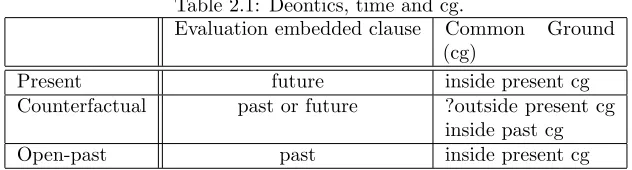
Time and common ground, summing up
Table 2.1: Deontics, time and cg.
Evaluation embedded clause Common Ground (cg)
Present future inside present cg
Counterfactual past or future ?outside present cg inside past cg
Open-past past inside present cg
Chapter 3
Temporal Deontic Update
Semantics (TDUS)
The present chapter represents present necessity deontic modals and past necessity deontic modals by making use of a deontic operatorOblige. It analyses the different necessity deontic modals in terms of scope interactions between the deontic operator, a past tense operator and an operator responsible for cg-backtracking. Finally, it develops a temporal update semantics which models the prescriptive use of such deontic modals.
3.1
Logical forms
In Chapter two we have considered the semantic differences between present necessity deontic modals, past necessity deontic modals under the counterfactual reading, and past necessity deontic modals under the open-past reading. One question now naturally arises: how many deontic operators do we need to model those differences? The answer, we argue, is: one.
We have seen that time and common ground (cg) should be taken into account for the interpretation of present and past necessity deontic modals. In particular, we can express the differences that those modals display in terms of when the evaluation of the embedded proposition takes place, and whether it belongs to the current common ground or to a past one.1 We argue that even if those factors may vary, the semantic contribution of the deontic operator is constant.
LetOblige be a sentential deontic operator. LetPRESENTandPAST be operators which applies to cg: PRESENTanchors the deontic operator to the current cg, whilePASTis responsible for cg-backtracking, and anchors the deontic operator to a past cg. Let Past be a past-tense, sentential operator, which moves the evaluation of the embedded clause to a time which precedes the
1Recall that we are limiting our analysis to the cases in which the embedded propositions
utterance time. Then, the logical forms of sentences containing present necessity deontic modals, past necessity deontic modals under the counterfactual reading, and past necessity deontic modals under the open-past reading are along the lines of 20b, 21b and 22b, respectively.
20. (a) You should call your parents
(b) PRESENT Oblige(you call your parents)
21. (a) You ought to have sent everybody a remainder by email
(b) PAST Oblige(you send everybody a remainder by email) 22. (a) Sara had to hand in her homework yesterday
(b) PRESENT Oblige Past(Sara hand in her homework)
Since we are dealing with eventive predicates, the default is that the embedded event follows the anchoring time of the deontic operator, but this can be changed by introducing a past tense operator in the scope ofOblige.2 If we define the semantics of Oblige such that the presuppositions CP and DP hold at the anchoring time, then we can take care of all the semantic differences between present necessity deontic modals and past necessity deontic modals.
Consider 20a. The propositionYou call your parents is an open possibility at the time of utterance, and is evaluated sometime after the utterance time. Hence the deontic operator is anchored in the current common ground, CP and DP hold there, and the embedded proposition is evaluated in the future. This is predicted by 20b.
Now, consider past necessity deontic modals under the counterfactual reading. We have said that it does not really matter whether the embedded event takes place at a time that follows or precedes the utterance time. What matters for the counterfactual reading is that the embedded proposition may be outside the current common ground. Take 21a. It establishes what would have been ideal, and requires to go back to a certain point of the past in which the propositionYou send everybody a remainder by email was an open possibility. This is predicted by 21b. ThePAST operator shifts the anchoring of the deontic operator to a past cg. At that anchoring time CP and DP hold. Moreover the embedded proposition is evaluated at a time which follows the anchoring time.
Consider 22a. The propositionSara hands in her homework is evaluated at a time which precedes the utterance time (“yesterday”). Moreover, that Sara handed in her homework (yesterday) is an open possibility at the utterance time. This is what 22b says. The deontic operator is anchored in the current common
2As Condoravdi (2002) notices, when eventive predicates appear in the scope of present
ground, and CP and DP hold there (for Past(Sara hand in her homework)). Moreover,Pastshifts the evaluation ofSara hands in her homework to the past. Finally we propose that, unless it is specified otherwise, the deontic operator Obligeanchors to the current cg. This permits us to simplify 20b, 21b and 22b as 23, 24 and 25, respectively:
23. Oblige(you call your parents)
24. PAST Oblige(you send everybody a remainder by email) 25. Oblige Past(Sara hand in her homework)
In the next section we develop a formal semantics for present necessity deontic modals, past necessity deontic modals under the counterfactual reading, and past necessity deontic modals under the open-past reading. We adopt the analysis described above.
3.2
A dynamic setting
As we have already said, the present thesis focuses on the prescriptive reading of obligation sentences. As noticed by Austin (1962), in everyday discourse practice the prescriptive reading takes the priority over the reportative one: obligation sentences are typically used to bring about new duties and obligations, rather than to give a true or false description of the existing ones. They are intrinsically prescriptive, and they are used tocreate and change an aspect of reality, i.e., its normative configuration. They have, therefore, a dynamic character. That is what we want to model in our semantics.
We develop here a framework from the dynamic logic tradition, especially Veltman’s (1996) work on Update Semantics.3 Given that we aim at representing
the dynamics of discourse practice, especially concerning obligation sentences, the semantic framework interprets “meanings” as the change that every sentence induces in the context in which it is uttered and accepted by the agents involved in the conversation. As it is said, the slogan “You know the meaning of a sentence if you know the conditions under which it is true” is replaced by the following one: “You know the meaning of a sentence if you know the change it brings about in the information state of anyone who accepts the news conveyed by it.”4
In a well-run conversation, speaker and listener share a certain background information, or conversational context, which gets updated during the dialogue.5 When a sentence is uttered and accepted by the participants in the conversation, the information the sentence carries (i.e., its meaning) modifies and strengthens that context, by putting aside all possibilities that are incompatible with it. Every sentence affects the conversational context: during a conversation, agents
3For another use of Veltman’s update semantics for the analysis of prescriptive obligation
sentences, see van der Torre and Tan (1999).
can acquire factual knowledge and new moral obligations. In what follows, we consider the conversational exchange between a moral authority (the speaker) and a listener.
3.3
Information states
In the present section, we define the notion of information state. An informa-tion state represents the conversainforma-tional context that speaker and listener share during a conversation. The basic elements of information states arehistories, which represent the temporal evolution of the world, and deontic betterness-relationsbetween histories. Just as it happens during a dialogue, information states can be modified and evolve in time.
Definition 1 (History). Let I be a set of indeces, and N the set of natural numbers. Fori∈I, a historyhi is defined as follows: hi={(i, n)|n∈N}.
We take everyn∈Nto represent a temporal span, i.e., a certain temporal interval. Then, the pair (i, n) indicates the temporal span n which belongs to a certain evolution i of the world. Let < be the “less than”-relation on natural numbers (i.e., a binary strict total relation onN). If m < n, then (i, m) temporally precedes (i, n). Hence, a history is a set of lineally ordered temporal spans. For the sake of simplicity, we assume that all histories have the same temporal structure.
This is a simplistic representation of time. However, it permits us to enlighten the semantic contribution of the different deontic modals, and, as we will see in the next chapter, to take into account some of the main deontic paradoxes. Nevertheless, our simplistic representation has some drawbacks. We discuss some of its limits when we define complex updates, and when we consider Chisholm’s Paradox in the next chapter.
We introduce now the languageL0(which contains only descriptive sentences)
and the valuation functionV.
Definition 2(LanguageL0). LanguageL0 is built from a countable setAof
atoms according to the following BFN:
L0: φ:=p| > | ¬α|α∧β |α∨β |Pastα
wherep∈A.
Definition 3(Valuation function V). LetAbe the set of atoms ofL0, and let
v be the interpretation functionv: A−→ P(I×N). A formulaφ∈L0 is true at
(i, n) under the interpretation v(written (i, n)∈Vv(φ)) iff:
• ifφ=p, then (i, n)∈Vv(p) iff (i, n)∈v(p)
• ifφ=¬α, then (i, n)∈Vv(¬α) iff (i, n)6∈Vv(α)
• ifφ=α∨β, then (i, n)∈Vv(α∨β) iff (i, n)∈Vv(α) or (i, n)∈Vv(β)
• ifφ=Pastα, then (i, n)∈Vv(Pastα) iff∃(i, m), such thatm < n and (i, m)∈Vv(α)
Given the definition above, every sentence is evaluated with respect to a temporal span and a history. LetφbeYou call your parents. If (i, n)∈Vv(φ), then we say that the event of you calling your parents obtains inside the temporal spannaccording to the historyhi. Finally, notice that the operatorPastshifts
the evaluation of the embedded clause to a certain past time. We can now define the notion of information state.
Definition 4(Information State). An information stateSnis a tuplehn, H, H∗n, v, Betteriwhere:
• n∈Nrepresents the current temporal collocation
• H is the set ofall physically possible historieshi, fori∈I
• H∗n⊆H is the common ground atn
• v is an interpretation function
• Betteris a function that assigns to every historyhi∈H and every m∈Na set of couples (hk, hl), such thathk, hl∈Handhk mhl(read as: history hk is at least as deontically ideal ashl from the point of view ofhi atm).
The information state Sn represents the conversational context that the
speaker and the listener share. It has a temporal collocation,n, which is the current temporal location of the speaker and the listener. H is the set of all possible evolutions of the world which obey to the physical laws. H∗n is a
subset of physically possible histories that are considered possible at n. In other words,H∗n represents the current common ground, i.e., the knowledge
that the speaker and the listener have in common at time n. Finally, the
Better-function represents what we have called the normative configuration of reality. Take, for the sake of illustration,Better(hi, n). It consists of a set of pairs{(hk, hl),(hs, ht), ...}which indicates what are the deontic preferences
according to the historyhi atn. Of course, deontic preferences may vary with
respect to another history, or change with time. It is worth highlighting that, for everym∈N, we take the relation m to be reflexive, but we do not assume
transitivity.6
We conclude the present section by introducing two special information states: the initial state0and the absurd state1.
Definition 5(Initial State). We call initial state0every information stateSn=
hn, H, H∗n, v, Betterisuch that:
6We agree that talking about a “Better-function” might convey the idea that the relation
• H∗n=H
• For everyhi∈H andm∈N,Better(hi, m)= H×H
Definition 6(Absurd State). We call absurd state1every information state
Sn=hn, H, H∗n, v, Betterisuch that:
• H∗n=∅;
or:
• for somehi∈H andm∈N,Better(hi, m) is such that there are hk, hj∈
H: (hk, hj)6∈Better(hi, m) and (hj, hk)6∈Better(hi, m)
Intuitively, in the initial state0agents have no factual knowledge (hence, all physical possibilities are still open) and no deontic preference is assumed (hence, for everyhi∈H andm∈Nthe relationmis universal). On the other hand,
the absurd state1is such that the agents have reached a contradiction either about what they take to be the facts (hence, there are no possibilities left open), or about what counts as deontically ideal.7
3.4
Updates with descriptive sentences
We define now various update operations on information states. We develop an eliminative approach, since every update operation results in an elimination of the relevant possibilities. First consider the case of updates with descriptive sentences. When an information state is updated with a sentence which describes an event of the world, the common ground shrinks. The resulting information state has a new temporal collocation, and is such that the new common ground contains only histories in which that event happened. We writeSn[φ] to denote
the result of updatingSn with the sentenceφ.8
Definition 7(Update with descriptive sentence). Ifφis a descriptive sentence ofL0, then:
• Sn[φ] = Sn+1 = hn+ 1, H, H∗n+1 = {hi | hi ∈ H∗n and (i, n) ∈ Vv(φ)}, v, Better0=Betteri
In other words, the resulting information state is such that the new common ground includes the information that the event described byφhas obtained inn.
Consider, for example, the following information state Sn= hn, H, H∗n, v, Betteri, where:
7The latter condition refers to the so-called deontic dilemmas: if there are two histories
such that the first one is better than the second one (according to a certain obligation) and the second one is better than the first one (according to another obligation), then we have a deontic dilemma. The present framework rules out deontic dilemmas, in the sense that they lead to absurd states.
• H =H∗n={hi, hj}
• v is such that (i, n)∈Vv(p) and (j, n)∈Vv(¬p)
• Betteris such that: Better(hi, n−1) =Better(hj, n−1) ={(hi, hj),(hi, hi),
(hj, hj)}, and for allm6=n−1,Better(hi, m) =Better(hj, m) =H×H.
Hence, no factual knowledge is assumed (sinceH =H∗n) and, from the point
of view of bothhi andhj at a past timen−1, hi is deontically more ideal that hj. However, no other deontic preferences are assumed (in particular, no current deontic preference is assumed sinceBetter(hi, n) =Better(hj, n) =H ×H). Then if the speaker utters “p” (i.e., “pholds inn”) and then the listener accepts it, the resulting state isSn+1=hn+ 1, H, H∗n+1, v, Better0isuch that:
• H ={hi, hj} • H∗n+1={hi}
• Better0(h
i, n−1) =Better0(hj, n−1) ={(hi, hj),(hi, hi),(hj, hj)} and
for allm6=n,Better0(h
i, m) =Better0(hj, m) =H×H.
That is, the historyhj wherepwas false atnis eliminated from the common
ground.
Finally, notice that an information state can be updated also with a sentence likePastα, i.e., agents can acquire information concerning facts of the past.9
3.5
Updates with obligation sentences
In this section, we enrich the languageL0 with the deontic operatorOblige,
and define the main update operations with obligation sentences.
Definition 8(LanguageL1). L1=L0∪ {Oblige}.
3.5.1
Present necessity deontic modals
We have argued that obligation sentences have a certain relation with the common ground. Before introducing the update operations with sentences which contain present and past necessity deontic modals, we define what it means to be an open possibility:
Definition 9 (Open possibility). Let φ be a descriptive sentence ofL0. For
m∈N, we say thatφis an open possibility inH∗miff:
• ∃hi∈H∗m such that (i, m)∈Vv(φ); and
• ∃hj∈H∗msuch that (j, m)∈Vv(¬φ)
9It is also possible to add a future operatorFutto our languageL
0, in order to allow agents
In particular, present necessity modals obey to preconditions CP and DP with respect to the current common ground. Hence the embedded proposition is an open possibility inH∗n, where nis the temporal collocation of speaker and
listener.
Now we define the update operation trigged by the utterance and the accep-tance of an obligation sentence containing a present necessity deontic modal. As we argued above, we represent it as “Obligeα”:10
Definition 10 (Update with present necessity deontic modal). Ifφ=Oblige
α(whereα∈L0\ {Past}), then:
• ifαis an open possibility inH∗n, thenSn[φ] =Sn+1=hn+1, H, H∗n+1, v,
Better0iwhere: – H∗n+1=H∗n
– for everyhi∈H∗n,Better0(hi, n+ 1) =Better(hi, n+ 1)\{(hk, hl)|
(k, n)∈Vv(¬α) and (l, n)∈Vv(α)}
– for all the otherhj∈H andm∈N,Better0(hj, m) =Better(hj, m)
• otherwiseSn[φ]=1
In the previous chapter, we have argued that the proposition embedded under a present deontic modal has to be an open possibility in the current common ground. If it is not the case, the utterance is not felicitous and the obligation sentence cannot be accepted as such. This is predicted by definition 10: ifαis not an open possibility in the current common ground, thenSn[Obligeα] results
in the absurd state. On the other hand, ifαis an open possibility, then accepting Obligeαresults in a new state in which the deontic preferences are different from the previous ones. Given that present deontic modals are defined in light of the possibilities in the common ground (i.e, felicitous utterances of sentences containing present deontic modals depend on the physical possibilities that are in the common ground), the update concerns only the deontic preferences of histories which belong toH∗n. In particular, the updated information state is
such that the histories in which the event described byαobtained are better than the ones in which it did not. Letα beYou call your parents. Assume that the sentenceObligeαis uttered by the speaker at a certain moment in the temporal spann. If the listener then accepts that sentence, she comes to have a new deontic preference: she agrees that calling her parents is better than not doing it. With the listener’s acceptance, histories in which the event of calling her parents occurred within the temporal spann(after the speaker’s utterance) become therefore more ideal than the others.
Consider, for example, the following information state Sn= hn, H, H∗n, v, Betteri, where:
• H ={hi, hj, hk}
• H∗n={hi, hj}
• v is such that (i, n)∈Vv(α), (j, n)∈Vv(¬α) and (k, n)∈Vv(¬α)
• for everym∈N,Better(hi, m)=Better(hj, m)=Better(hk, m)=H×H
Hence, the histories that are considered still possible atnarehi andhj, and no deontic preference is assumed. If the speaker utters “Obligeα” and then the listener accepts it, the resulting state isSn+1 =hn+ 1, H, H∗n+1, v, Better0i
such that:
• H ={hi, hj, hk} • H∗n={h
i, hj}
• Better0(hi, n+1) =Better0(hj, n+1) ={(hi, hj),(hi, hk),(hj, hk),(hk, hj)}11,
andBetter0(h
k, n+ 1) =Better(hk, n+ 1) =H×H
• for all m6=n+ 1 ,Better0(hi, m) =Better0(hj, m) =Better0(hk, m) =
H×H.
Sinceαis an open possibility in H∗n, Sn+1 6= 1. In particular, Sn+1 is such
that from the point of view of the histories in the common ground atn+ 1, the histories which led toαare deontically better than the others.
3.5.2
Past necessity deontic modals under the open-past
reading
Updates with past necessity modals under the open-past reading are like updates in definition 10. The only difference is that they concern the cases in whichα:=Pastβ.
Definition 11 (Update with past necessity deontic modal, open-past). If
φ=Oblige Pastβ (whereβ∈L0), then:
• if Past β is an open possibility in H∗n, then Sn[φ] = Sn+1 = hn+
1, H, H∗n+1, v, Better0iwhere:
– H∗n+1=H∗n
– for everyhi∈H∗n,Better0(hi, n+ 1) =Better(hi, n+ 1)\ {(hk, hl)|
(k, n)∈Vv(¬Pastβ) and (l, n)∈Vv(Pastβ)}
– for all the otherhj∈H and m∈N,Better0(hj, m) =Better(hj, m)
• otherwiseSn[φ]=1
As we have argued above, the difference between past deontic modals under the open-past reading and present deontic modals lies on the fact that the embedded event takes place in the past. That is precisely the difference between updates defined in 11 and in 10.
3.5.3
Past necessity deontic modals under the
counterfac-tual reading
We consider now updates with past necessity deontic modals under the counterfactual reading. Contrary to updates defined in 10 and 11, the events embedded under past necessity deontic modals under the counterfactual reading may obtain outside the common ground. Updating a state with past necessity deontic modals under the counterfactual reading eventually requires to go back to a past common ground where the embedded proposition was an open possibility. The update, hence, concerns those histories which were part of that past common ground.
Definition 12 (LanguageL2). L2=L1∪ {PAST Oblige}.
We define now the update operation trigged by the utterance and acceptance of an obligation sentence containing past necessity deontic modals under the counterfactual reading. As we have argued above, we represent it as PAST Obligeα:12
Definition 13 (Update with past necessity deontic modal, conterfactual). Let
φ=PAST Obligeα(whereα∈L0). Sn[φ] is such that:
• if there exists Sb = hb, H, H∗b, v, Better00isuch that b ≤n andαis an
open possibility inH∗b, thenSn[φ] =Sn+1=hn+1, H, H∗n+1, v, Better0i
where:
– H∗n+1=H∗n
– for everyhi∈H∗b,Better0(hi, b+ 1) =Better(hi, b+ 1)\{(hk, hl)|
(k, b)∈Vv(¬α) and (l, b)∈Vv(α)}
– for all the otherhj∈H and m∈N,Better0(hj, m) =Better(hj, m)13
• otherwiseSn[φ] =1
In the previous chapter, we have argued that the counterfactual reading of statements such asIt ought to have/should have been the case thatαmay require backtracking, i.e., to go back to a moment of time in whichIt ought to/should be the case thatαwas felicitous. That is what definition 13 establishes. Updating the current information state withPAST Obligeαrequires to consider a (possibly) past information state in whichObligeαwas felicitous. In particular, updating the current information state withPAST Obligeαcorresponds to updating that past information state withObligeα.14 Finally, notice that, contrary to
12See 24 in section 3.1.
13Notice that, given thatPASTis a function from information states and sentences to
information states, while [·] is a function which assigns to each sentenceφan operation [φ] on information states, it is not possible to define [PAST Obligeα] compositionally.
14If more than oneSb satisfies the condition in definition 13, we establish that the past