City, University of London Institutional Repository
Citation
:
Cook, R., Bird, G., Catmur, C., Press, C. and Heyes, C. (2014). Mirror neurons: from origin to function.. Behavioral and Brain Sciences, 37(2), pp. 177-192. doi:10.1017/S0140525X13000903
This is the accepted version of the paper.
This version of the publication may differ from the final published
version.
Permanent repository link:
http://openaccess.city.ac.uk/4536/Link to published version
:
http://dx.doi.org/10.1017/S0140525X13000903Copyright and reuse:
City Research Online aims to make research
outputs of City, University of London available to a wider audience.
Copyright and Moral Rights remain with the author(s) and/or copyright
holders. URLs from City Research Online may be freely distributed and
linked to.
In press atBehavioral and Brain Sciences
Long abstract: 249 words
Main text: 13788 words
References (227 items): 5759 words
Entire text: 20271 words
MIRROR NEURONS:
FROM ORIGIN TO FUNCTION
Richard Cook1, Geoffrey Bird2, Caroline Catmur3, Clare Press4& Cecilia Heyes5,6*
1
Department of Psychology, City University London
2
MRC Social, Genetic and Developmental Psychiatry Centre, Institute of Psychiatry,
King’s College London
3
Department of Psychology, University of Surrey
4
Department of Psychological Sciences, Birkbeck College, University of London
5
All Souls College, University of Oxford
6
Department of Experimental Psychology, University of Oxford
*Corresponding author: [email protected]
Keywords
Action understanding; associative learning; contextual modulation; contingency; genetic adaptation;
Long abstract
This article argues that mirror neurons originate in sensorimotor associative learning and therefore a
new approach is needed to investigate their functions. Mirror neurons were discovered about 20 years
ago in the monkey brain, and there is now evidence that they are also present in the human brain. The
intriguing feature of many mirror neurons is that they fire not only when the animal is performing an
action, such as grasping an object using a power grip, but also when the animal passively observes a
similar action performed by another agent. It is widely believed that mirror neurons are a genetic
adaptation for action understanding; that they were designed by evolution to fulfill a specific
socio-cognitive function. In contrast, we argue that mirror neurons are forged by domain-general processes
of associative learning in the course of individual development, and, although they may have
psychological functions, they do not necessarily have a specific evolutionary purpose or adaptive
function. The evidence supporting this view shows that 1) mirror neurons do not consistently encode
action ‘goals’; 2) the contingency- and context-sensitive nature of associative learning explains the
full range of mirror neuron properties; 3) human infants receive enough sensorimotor experience to
support associative learning of mirror neurons (‘wealth of the stimulus’); and 4) mirror neurons can be
changed in radical ways by sensorimotor training. The associative account implies that reliable
information about the function of mirror neurons can be obtained only by research based on
Short abstract
Mirror neurons have been described as “the neurons that shaped civilization” (Ramachandran, 2009).
It is widely assumed that mirror neurons were designed by evolution to enable action understanding.
In contrast, we argue that mirror neurons are forged by domain-general processes of associative
learning, and do not necessarily have a specific evolutionary purpose or adaptive function. The
associative account allows that mirror neurons may have psychological effects or functions.
However, it implies that, to get reliable information about the function of mirror neurons, we need a
Mirror neurons (MNs) were discovered serendipitously in 1992 and given their brilliant name four
years later (di Pellegrino, Fadiga, Fogassi, Gallese, & Rizzolatti, 1992; Gallese, Fadiga, Fogassi, &
Rizzolatti, 1996). The striking feature of many MNs is that they fire not only when a monkey is
performing an action, such as grasping an object using a power grip, but also when the monkey
passively observes a similar action performed by another. Neurons with this capacity to match
observed and executed actions, to code both ‘my action’ and ‘your action’, were originally found in
area F5 of the ventral premotor cortex (PMC) (di Pellegrino et al., 1992; Gallese et al., 1996) and the
inferior parietal lobule (IPL) (Bonini et al., 2010; Fogassi et al., 2005) of the monkey brain. There is
now a substantial body of evidence suggesting that MNs are also present in the human brain
(Molenberghs, Cunnington, & Mattingley, 2012).
MNs have received a great deal of attention from specialists and in the scientific and public media.
Hailed as “cells that read minds”(Blakesee, 2006), “the neurons that shaped civilization”
(Ramachandran, 2009), and a “revolution” in understanding social behavior (Iacoboni, 2008), MNs
have been ascribed a wide variety of functions. The primary candidates relate to action understanding
(Gallese & Sinigaglia, 2011; Rizzolatti, Fadiga, Gallese, & Fogassi, 1996), imitation (Iacoboni et al.,
1999) and language processing (Rizzolatti & Arbib, 1998). However, signifying the way in which
MNs have captured the attention and imagination of neuroscientists, psychologists and philosophers,
they have also been implicated in: embodied simulation (Aziz-Zadeh, Wilson, Rizzolatti, & Iacoboni,
2006), empathy (Avenanti, Bueti, Galati, & Aglioti, 2005), emotion recognition (Enticott, Johnston,
Herring, Hoy, & Fitzgerald, 2008), intention-reading (Iacoboni et al., 2005), language acquisition
(Theoret & Pascual-Leone, 2002), language evolution (Arbib, 2005), manual communication
(Rizzolatti et al., 1996), sign language processing (Corina & Knapp, 2006), speech perception
(Glenberg et al., 2008), speech production (Kuhn & Brass, 2008), music processing (Gridley & Hoff,
2006), sexual orientation (Ponseti et al., 2006), and aesthetic experience (Cinzia & Gallese, 2009). In
addition, it has been suggested that MN dysfunction contributes to a number of disorders, including
autism (Dapretto et al., 2006; Nishitani, Avikainen, & Hari, 2004; J. H. Williams, Whiten,
Suddendorf, & Perrett, 2001), schizophrenia (Arbib & Mundhenk, 2005), Down’s syndrome
(Virji-Babul et al., 2008), multiple sclerosis (Rocca et al., 2008), cigarette addiction (Pineda & Oberman,
2006), and obesity (Cohen, 2008).
Thus, much of the first 20 years of MN research has been devoted to theorizing and speculation about
their functions. In contrast, the primary focus of this article is the origin of MNs. Our principal
questions are not ‘What do MNs do?’ or ‘What are they for?’, but ‘What is the process that gives
The standard view of MNs, which we will call the ‘genetic account’, alloys a claim about the origin of
MNs with a claim about their function. It suggests that the mirrorness of MNs is due primarily to
heritable genetic factors, and that the genetic predisposition to develop MNs evolved because MNs
facilitate action understanding. In the sense of ‘an adaptation’ developed by G. C. Williams, and used
in Evolutionary Psychology, the genetic account casts MNs as an adaptation for action understanding.
In contrast, we argue in this article that the balance of evidence currently favors an ‘associative
account’ of MNs, which separates questions about their origin and function. It suggests that MNs
acquire their capacity to match observed with executed actions through domain-general processes of
sensorimotor associative learning, and that the role of MNs in action understanding, or any other
social cognitive function, is an open empirical question. The associative account is functionally
permissive; it allows, but does not assume, that MNs make a positive contribution to social cognition.
Thus, there are three critical differences between the genetic and associative accounts: 1) The former
combines, and the latter dissociates, questions about origin and function. 2) The genetic account
suggests that natural selection has acted directly on MNs, whereas the associative account suggests
that natural selection has played a background role; for example, acting on domain-general
mechanisms of associative learning. 3) The genetic account assigns a relatively minor, facilitative
role to sensory and/or motor experience in the development of MNs, whereas the associative account
suggests that sensorimotor experience plays a major, instructive role in their development.
We begin with some basic information about the ways in which MNs have been defined and
investigated in both monkeys and humans1. In the second section we present the genetic and associative accounts, and introduce four kinds of evidence that have the potential to favor one of these
hypotheses over the other. Sections 3-6 discuss each of these types of evidence in turn. In section 7
we survey recent theories that are, or appear to be, alternatives to the genetic and associative accounts,
and suggest that the associative account is stronger. Finally, in section 8 we argue that the associative
account has major methodological implications for research investigating the functions of MNs.
Unlike the genetic account, the associative account doesn’t claim to tell us what MNs do or what they
are for, but it does tell us how we can find out.
1. Mirror neuron basics
1.1 Locations and definitions
MNs have been found in the monkey brain (Macaca nemistrina and Macaca mulatta), not only in
‘classical’ areas – ventral PMC and IPL - but also in ‘non-classical’ areas, including primary motor
cortex (Dushanova & Donoghue, 2010; Tkach, Reimer, & Hatsopoulos, 2007) and dorsal PMC
(Tkach et al., 2007). There is also evidence of single neurons, or circumscribed populations of
F5) (Kilner, Neal, Weiskopf, Friston, & Frith, 2009) and inferior parietal cortex (Chong, Cunnington,
Williams, Kanwisher, & Mattingley, 2008), and non-classical areas of the human brain, including
dorsal PMC, superior parietal lobule, and cerebellum (Molenberghs et al., 2012), supplementary
motor area, and medial temporal lobe (Mukamel, Ekstrom, Kaplan, Iacoboni, & Fried, 2010).
Some researchers apply the term ‘MN’ only to neurons found in classical areas (Brown & Brune,
2012; Molenberghs et al., 2012), whereas others, like us, use the term to refer to neurons in both
classical and non-classical areas (Gallese & Sinigaglia, 2011; Keysers & Gazzola, 2010). In addition
to this variation in anatomical specificity, some researchers reserve the term ‘MN’ for units that
discharge during the observation and execution of precisely (Dinstein, Thomas, Behrmann, & Heeger,
2008; Keysers, 2009) or broadly similar actions (Kilner et al., 2009), whereas others use the term, at
least on occasions, to refer to any neuron that is responsive to both the observation and execution of
action, regardless of whether the observed and executed actions are even broadly similar to one
another (Gallese et al., 1996; Rizzolatti & Craighero, 2004). In accord with the majority of
researchers in the field, and the meaning of the word ‘mirror’, we take it to be a cardinal feature of
MNs that they are responsive to observation and execution of similar actions. However, following
common usage, we also refer to ‘logically-related’ MNs (see section 1.2), which fire during
observation and execution of dissimilar actions, as ‘MNs’.
1.2 Monkeys
Early studies of the field properties of monkey MNs – the sensory and motoric conditions in which
they fire – revealed three basic types: ‘Strictly congruent’ MNs discharge during observation and
execution of the same action, for example, precision grip. ‘Broadly congruent’ MNs are typically
active during the execution of one action (e.g. precision grip) and during the observation of one or
more similar, but not identical, actions (e.g. power grip alone, or precision grip, power grip, and
grasping with the mouth). ‘Logically-related’ MNs respond to different actions in observe and
execute conditions. For example, they fire during the observation of an experimenter placing food in
front of the monkey, and when the monkey grasps the food in order to eat it. MNs do not respond to
the presentation of objects alone (di Pellegrino et al., 1992). However, ‘canonical neurons’, which are
active during object observation and performance of an action that is commonly performed on that
object, are co-located with MNs both in area F5 (Murata et al., 1997) and in the anterior intraparietal
sulcus (Murata, Gallese, Luppino, Kaseda, & Sakata, 2000).
To date, monkey MNs have been found that are responsive to the observation and execution of hand
and mouth actions. The hand actions include grasping, placing, manipulating with the fingers and
behaviors such as breaking food items, chewing and sucking, and communicative gestures such as
lip-smacking, lip-protrusion and tongue-protrusion (Ferrari, Gallese, Rizzolatti, & Fogassi, 2003).
1.3 Humans
Only one study purports to offer direct evidence – from single cell recording - of MNs in the human
brain (Mukamel et al., 2010). However, there is a considerable body of indirect evidence – from
neuroimaging, transcranial magnetic stimulation (TMS), and behavioral studies - suggesting that
human brains contain MNs or comparable ‘mirror mechanisms’; circumscribed cortical areas involved
in both action production and observation (Glenberg, 2011).
Neuroimaging. Functional magnetic resonance imaging (fMRI) has identified regions of PMC (both
classic BA6, and BA44) and inferior parietal areas that are active during both action observation and
execution (Aziz-Zadeh, Koski, Zaidel, Mazziotta, & Iacoboni, 2006; Buccino et al., 2004; Carr,
Iacoboni, Dubeau, Mazziotta, & Lenzi, 2003; Grezes, Armony, Rowe, & Passingham, 2003; Iacoboni
et al., 1999; Leslie, Johnson-Frey, & Grafton, 2004; Tanaka & Inui, 2002; Vogt et al., 2007).
Overlapping responses to action observation and execution have been found in single-subject analyses
of unsmoothed data (Gazzola & Keysers, 2009), confirming that the foregoing reports are not artifacts
of group averaging. Most recently, repetition suppression protocols have been used to provide
evidence of mirror populations encoding visual and motor representations of the same action. These
paradigms exploit the logic that repeated stimulus presentation or action execution causes a decrease
in neural responses (Grill-Spector, Henson, & Martin, 2006). ‘Cross-modal’ repetition suppression
effects have been reported, whereby action observation followed by execution of the same action, or
vice versa, elicits repetition suppression in inferior parietal regions (Chong et al., 2008; Lingnau,
Gesierich, & Caramazza, 2009) and in PMC (Kilner et al., 2009; Lingnau et al., 2009).
Mirror pattern of MEPs. A human mirror mechanism is further suggested by ‘mirror’ motor evoked
potentials (MEPs) elicited during action observation (Fadiga, Fogassi, Pavesi, & Rizzolatti, 1995).
When TMS is applied to M1 during passive action observation, the amplitude of the MEPs recorded
from the muscles required to execute that action is greater than the amplitude of the MEPs recorded
when observing a different action. For example, observing index and little finger abduction
movements selectively facilitates the amplitude of MEPs recorded from the first dorsal interosseus
and abductor digiti minimi muscles, responsible for index and little finger moments, respectively
(Catmur, Mars, Rushworth, & Heyes, 2011). That action observation selectively increases
corticospinal excitability to action relevant muscles is suggestive of ‘mirror’ sensorimotor
Automatic imitation is said to occur when observation of an action involuntarily facilitates
performance of a topographically similar action (body parts make the same movements relative, not to
external frames of reference, but to one another) and/or interferes with performance of a
topographically dissimilar action (Brass, Bekkering, & Prinz, 2001; Stürmer, Aschersleben, & Prinz,
2000). Humans show robust automatic imitation when they observe hand, arm, foot and mouth
movements (Heyes, 2011). This is regarded by many researchers as evidence of a human mirror
mechanism (Blakemore & Frith, 2005; Ferrari, Bonini, & Fogassi, 2009; Iacoboni, 2009; Kilner,
Paulignan, & Blakemore, 2003; Longo, Kosobud, & Bertenthal, 2008; van Schie, van Waterschoot, &
Bekkering, 2008). Supporting this view, several studies have shown that application of disruptive
TMS to the IFG - a classical mirror area – interferes with automatic imitation (Catmur, Walsh, &
Heyes, 2009; Newman-Norlund, Ondobaka, van Schie, van Elswijk, & Bekkering, 2010).
2. The mirrorness of mirror neurons: Genetic or associative?
This section presents the standard, genetic account of the origin of MNs, and the alternative
associative account.
2.1 Genes for mirroring?
The genetic account assumes: 1) among common ancestors of extant monkeys and humans, some
individuals had a stronger genetic predisposition to develop MNs, and 2) these individuals were more
reproductively successful than those with a weaker genetic predisposition because the development of
MNs enhanced their capacity to understand the actions of other agents. Consequently, 3) a genetic
predisposition to develop MNs became universal, or nearly universal, in monkeys and humans. 4)
Motor experience (the performance of actions) and/or sensory experience (the observation of actions)
plays a facilitative (Gottlieb, 1976) or permissive (Gilbert, 2003) role in the development of MNs, but
their matching properties are primarily due to this genetic predisposition.
The term ‘action understanding’ was introduced by Rizzolatti and colleagues to characterize the
function of MNs (Rizzolatti & Fadiga, 1998; Rizzolatti et al., 1996). As far as we are aware, it had
not previously been used in research on animal or human cognition. The term plays a key role in the
genetic account; it describes the adaptive function of MNs, the effects that made them a target of
positive selection pressure. However, there is still no consensus about exactly what is meant by
‘action understanding’, or how it differs from cognate functions such as ‘action perception’, ‘action
recognition’, and ‘action selection’ (Gallese, Gernsbacher, Hickok, Heyes, & Iacoboni, 2011).
Attempts to clarify have emphasized that, in comparison with purely visual processing of action, MN
activity relates to the ‘meaning’ of an action, and yields a ‘richer understanding’, ‘real understanding’
understanding; a definition that would allow behavior based on (this kind of) action understanding to
be distinguished empirically from behavior based on other processes.
Until recently, the genetic account was largely implicit in discussions of the ‘evolution’ of MNs
(Gallese & Goldman, 1998; Rizzolatti & Arbib, 1998; Rizzolatti & Craighero, 2004; M. J. Rochat et
al., 2010). For example, it has been suggested that “the mirror neuron mechanism is a mechanism of
great evolutionary importance through which primates understand actions done by their conspecifics”
(Rizzolatti & Craighero, 2004, p.172) and that “in their basic properties, MNs constitute a relatively
simple action-perception mechanism that could have been exploited several times in the course of
animal evolution” (Bonini & Ferrari, 2011, p.172). A number of discussions also expressed the view
that MNs are present at birth (Ferrari et al., 2009; Gallese, Rochat, Cossu, & Sinigaglia, 2009; Lepage
& Theoret, 2007; Rizzolatti & Fadiga, 1998), a feature commonly associated with traits for which
there is strong genetic predisposition (Mameli & Bateson, 2006). For example, Casile and colleagues
suggested that “both face processing and the mirror neuron system, or at least the part involved in
facial movements, rely on a brain network that is present already at birth and whose elements are
probably genetically predetermined” (Casile, Caggiano, & Ferrari, 2011, p.531).
In its starkest form, the genetic hypothesis would suggest that gene-based natural selection has
provided each individual – monkey and human - with MNs that code the mapping between a fixed set
of observed and executed actions, and that experience plays a minimal role in the development of the
observation-execution matching properties of these neurons. However, the genetic hypothesis does
not necessarily assume that experience plays a minimal role. For example, in a recent explicit
statement of the genetic account, Gallese et al. (2009) suggested that links form during gestation
between motor regions and “to-become-visual” regions that will subsequently mediate sensorimotor
matching abilities in young infants. They implied that these projections are genetically predisposed to
target certain visual areas, and therefore that the matching properties of MNs are produced by
information encoded in the genome. However, they also suggested that motor experience plays a part
in preparing motor regions to send projections to visual areas, and that visual experience may also
facilitate the maturation of fully-functioning MNs.
2.2 A product of associative learning
The associative hypothesis assumes that gene-based natural selection has played a significant
background role with respect to the development of MNs; for example, in shaping the anatomy of
visual and motor cortex for visual guidance of action, and in producing the capacity for associative
learning in neural tissue. However, it suggests that the cardinal matching properties of MNs are a
(Catmur et al., 2009; Heyes, 2010; Ray & Heyes, 2011). Associative learning is found in a wide
range of vertebrate and invertebrate species, indicating that it is an evolutionarily ancient and highly
conserved adaptation for tracking predictive relationships between events (Heyes, 2012; Schultz &
[image:11.595.79.517.159.384.2]Dickinson, 2000).
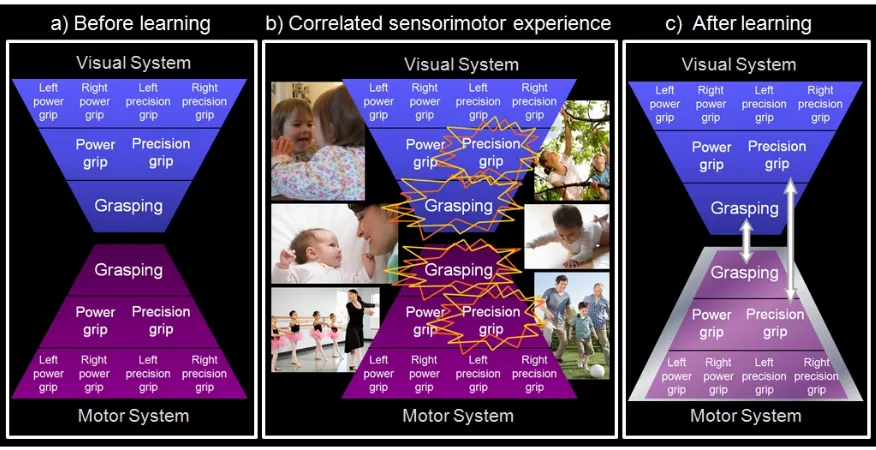
Figure 1: Mirror neurons from associative learning. a) Before learning, sensory neurons in STS, encoding visual descriptions of observed action, are not systematically connected to motor neurons in premotor and parietal areas involved in the production of similar actions. b) Through social interaction and self-observation in the course of typical development, agents receive correlated sensorimotor experience; they see and do the same action at about the same time (contiguity), with one event predicting the other (contingency). This experience produces correlated activation of sensory and motor neurons coding similar actions, and, through associative learning, c) strengthens connections between these neurons. Due to these connections, neurons that were once involved only in the execution of action will also discharge during observation of a similar action; motor neurons become MNs (see section 2.2). Because the visual system and motor system are organised hierarchically, some types of sensorimotor experience produce correlated activation of sensory and motor neurons coding relatively low-level features of action (e.g. left or right hand, power or precision grip), and thereby generate strictly congruent, hand- and direction-sensitive MNs. Other types produce correlated activation of neurons coding relatively high-level features (e.g. grasping), and generate broadly congruent MNs (see section 4.1).
Figure 1 is a schematic representation of how MNs could acquire their matching properties through
sensorimotor associative learning. Before associative learning, sensory neurons in the superior
temporal sulcus (STS), responsive to different high-level visual properties of observed action (Oram
& Perrett, 1994, 1996), are weakly connected, directly or indirectly, to motor neurons in PMC
(Rizzolatti et al., 1988) and parietal cortex (Gallese, Fadiga, Fogassi, & Rizzolatti, 2002). Some of
these connections may be stronger than others, but the links between sensory and motor neurons
coding similar actions are not consistently stronger than other, nonmatching links. The kind of
learning that produces MNs occurs when there is correlated (i.e. contiguous and contingent) excitation
of sensory neurons and motor neurons that code similar actions. For example, when an adult imitates
an infant’s facial movements, there might be correlated excitation of neurons that are responsive to
the observation and execution of lip protrusion. Correlated excitation of the sensory and motor
sensory neuron propagates to the motor neuron. Thereafter, the motor neuron fires, not only during
execution of lip protrusion, but also, via its connection with the sensory neuron, during observation of
lip protrusion; what was originally a motor neuron has become a lip protrusion MN. Correlated
excitation of sensory and motor neurons encoding the same property of action occurs not only when
humans are imitated, but also when we observe our own actions – directly or using an optical mirror;
observe others during the kind of synchronous activities involved in sports and dance training; and as
a consequence of ‘acquired equivalence’ experience, for example, when the same sound (a word, or a
sound produced by an action) is paired sometimes with observation of an action and sometimes with
its execution (Catmur et al., 2009; Ray & Heyes, 2011).
There are several important things to note about the associative hypothesis: 1) Strong
experience-dependence – It suggests that correlated sensorimotor experience plays an inductive (Gottlieb, 1976)
or instructive (Gilbert, 2003) role; without this kind of experience, MNs would not develop at all. 2)
Social construction – It proposes that much of the sensorimotor experience required for MN
development comes from being imitated, synchronous action, and exposure to action words (Ray &
Heyes, 2011), and therefore that MNs are to a very large extent built through social interaction. 3)
Contingency - Following contemporary learning theory, the associative account specifies that MN
development requires, not just that sensory and motor neurons ‘fire together’ in a Hebbian way
(contiguity), but that the event provoking firing of one predicts the event provoking firing of the other
(contingency; Cook, Press, Dickinson, & Heyes, 2010). 4) Testability – The associative account
makes novel predictions about the development and mature properties of MNs, many of which have
already been tested and supported by experiments using a variety of methods (see section 6).
Thus, the associative hypothesis implies that the characteristic, matching properties of MNs result
from a genetically evolved process, associative learning, but this process was not ‘designed’ by
genetic evolution to produce MNs. Rather, it just happens to produce MNs when the developing
system receives correlated experience of observing and executing similar actions. When the system
receives correlated experience of observing objects and executing actions, the same associative
process produces canonical neurons. When the system receives correlated experience of observing
one action and executing a different action, the same associative process produces logically-related
MNs.
2.3 Not nature versus nurture
The contrast between the genetic and associative hypotheses does not represent a dichotomous nature
- nurture debate. It has been recognized for decades that the development of all phenotypic
they assign to genetic evolution and to learning, and in the types of experience they take to be
important, in producing the characteristic matching properties of MNs. The genetic hypothesis says
that genetic evolution has played a specific and decisive role, and learning – based on sensory and/or
motor experience - plays a merely facilitative role, in the development of MNs. In contrast, the
associative hypothesis says that genetic evolution has played a non-specific background role, and that
the characteristic matching properties of MNs are forged by sensorimotor learning.
Regarding the function of MNs, the genetic account assumes that they play a fundamental role in
action understanding, and that this is why a specific genetic predisposition to develop MNs was
favored by natural selection. In other words, it proposes that action understanding is the ‘adaptive
function’ of MNs, or that MNs are ‘an adaptation’ for action understanding. In this way, the genetic
account offers a hypothesis about the function of MNs as an explanation for their origins. In contrast,
the associative account separates questions about the origin and function of MNs. It suggests that
MNs develop through associative learning, and that further research is needed to find out how they
contribute to social cognition (see section 8). If this research reveals that MNs make positive
contributions to social cognition, these would be ‘psychological uses’ or ‘psychological functions’,
but not necessarily ‘adaptive functions’; they may not have enhanced reproductive fitness, or resulted
in the evolution of mechanisms specifically designed to foster the development of MNs (see section
7). Rather, it is possible that MNs are constructed by domain-general processes of associative
learning, and recruited in the course of development to contribute to one or more psychological
functions, without either the construction or the recruitment processes having become a specific target
of gene-based selection (Elman et al., 1996).
In this respect, MNs may be like beak morphology in neotropical woodcreepers, which has been
selected for foraging and food manipulation (a non-social function, analogous to visuomotor
capability) but also has effects on song production (a social function, analogous to action
understanding; Derryberry et al., 2012). Another more closely related example comes from
honeybees, which are able to use associative learning to discriminate among human faces (Dyer,
Neumeyer, & Chittka, 2005). Given the taxonomic- and domain-generality of associative learning,
and the fact that human faces were not part of the environment in which honeybee nervous systems
evolved, we can be sure that associative learning is not an adaptation for face discrimination in
honeybees. However, when they are put in an environment where faces are important, honeybees can
use associative learning about faces to optimize their foraging behavior. Another example, which
may be closely related in a different way, is the area of the human occipito-temporal cortex known as
the ‘visual word form area’ (VWFA; Petersen, Fox, Snyder, & Raichle, 1990). This area plays an
very unlikely to be a genetic adaptation for reading. Rather, the reading-related properties of the
VWFA are forged in the course of development, by literacy training, from a system adapted for
generic object recognition.
2.4 Four kinds of evidence
Four evidence-based arguments are crucial in deciding between the genetic and associative accounts.
The first provided the inspiration and foundation for the genetic hypothesis. It suggests that the field
properties of MNs indicate that they were designed for action understanding. The terms ‘design’ and
‘purpose’ are used here as they were by Williams in his seminal work on ‘Adaptation and Natural
Selection’ (G. C. Williams, 1966). Williams described adaptations as designed by natural selection to
fulfill a particular purpose, and emphasized that the mark of an adaptation is that it has features
making it peculiarly apt to achieve a specific end in a highly efficient way. For example, “An
examination of the legs and feet of the fox forces the conclusion that they are designed for running
and walking, not for the packing or removal of snow” (p. 13). In a similar way, supporters of the
genetic hypothesis argue that examination of the field properties of MNs – and, in particular, their
‘goal’ coding - forces the conclusion that MNs are designed for action understanding. In section 3 we
examine the field properties of MNs and suggest that this argument is not compelling.
The second argument is complementary to the first; it has a similar form but advocates the associative
hypothesis. It suggests that research using conditioning procedures shows associative learning to be
the right kind of learning to produce MNs. Specifically, as we discuss in section 4, the ways in which
associative learning tracks contingent relationships, and enables contextual modulation of these
connections, makes it apt to produce MNs (and non-matching visuomotor neurons) in typical
developmental environments.
The second pair of arguments draws on research examining the development of MNs and their
modification through sensorimotor experience. Section 5 discusses research with infants and adults
that has been used to support a “poverty of the stimulus” argument (Chomsky, 1975); to suggest that
MNs emerge too early in development or, more generally, after too little sensorimotor experience, to
have been forged by associative learning. In contrast, we offer a “wealth of the stimulus” argument.
Finally, section 6 focuses on evidence that, even in adulthood, the properties of MNs can be changed
in radical ways by relatively brief periods of sensorimotor experience. We argue, against various
objections, that this evidence is sound, and therefore supports the associative hypothesis by showing
3 Designed for action understanding
Supporters of the genetic hypothesis argue that examination of the field properties of MNs shows that
they encode ‘goals’ and this characteristic indicates that they were designed by genetic evolution to
mediate action understanding (Bonini & Ferrari, 2011; Rizzolatti & Craighero, 2004; Rizzolatti &
Sinigaglia, 2010). We therefore begin our survey of the evidence by considering how well the
neurophysiological data accord with this view. The term ‘goal’ affords numerous interpretations
(Hickok, 2009). We will consider two definitions commonly adopted, assuming that MNs encode
‘goals’ if they encode object-directed actions (3.1) or high-level action intentions (3.2).
3.1 Goals as object-directed actions
Early descriptions of MN field properties reported that pantomimed actions (e.g. miming a precision
grip in the absence of an object), and intransitive actions (e.g. tongue protrusion) did not elicit MN
responses (di Pellegrino et al., 1992; Gallese et al., 1996). In contrast, robust responses were reported
when monkeys observed object-directed actions. This pattern raised the possibility that MNs encode
‘goals’ in the sense that they are responsive only to object-directed actions (di Pellegrino et al., 1992;
Gallese et al., 1996).
However, a close reading of the single cell data suggests that only a small subset of MNs appeared to
have been ‘designed for’ encoding action goals in these terms. A subset of the MNs described in the
early reports continued to respond, albeit less strongly, to pantomimed or intransitive actions (di
Pellegrino et al., 1992; Gallese et al., 1996 Figure 5b), and subsequent studies confirmed that sizable
proportions, perhaps the majority, of MNs exhibit robust responses to the observation of object-free
body movement. Kraskov et al. (2009) reported that 73% of MN responses modulated by observation
of object-directed grasping showed similar modulation during observation of pantomimed grasping.
Also, substantial proportions of MNs respond to intransitive mouth movements such as lip-smacking,
lip-protrusion and tongue-protrusion (Ferrari et al., 2003).
Single-unit data also show that, even when they are responding to object-directed actions, MNs have
field properties suggesting that they were not tuned to do this by genetic evolution. For example, after
training in which tools were used to pass food items to monkeys, MNs were discovered that respond
to the observation of actions such as grasping with pliers (Ferrari, Rozzi, & Fogassi, 2005). Similarly,
‘audiovisual’ MNs respond to unnatural sounds associated with actions; for example, the sound of
metal striking metal, plastic crumpling, and paper tearing (Keysers et al., 2003; Kohler et al., 2002).
Importantly, large numbers of tool-use and audiovisual MNs respond more to the sight of tool-actions
and to action sounds than to the sight of gripping or tearing executed with the hands. The fact that
contemporary monkeys could not possibly have been exposed – is hard to reconcile with the genetic
hypothesis (Cook, 2012; see section 6).
3.2 Goals as high-level intentions
The term ‘goal’ has also been used to refer to what, at a high level of generality, the actor intends to
achieve through their behavior – for example, “grasp in order to eat” (Fogassi et al., 2005) or “taking
possession of an object” (M. J. Rochat et al., 2010). Rizzolatti and Sinigaglia (2010, p.269) stated:
“only those [neurons] that can encode the goal of the motor behavior of another individual with the
greatest degree of generality can be considered to be crucial for action understanding”. The
suggestion that MNs encode high-level action intentions is made plausible by reports that MN
responses to grasping can be modulated by the final outcome of the motor sequence (Bonini et al.,
2010; Fogassi et al., 2005). It is also consistent with reports that some broadly congruent MNs
respond to the observation of multiple actions; for example any ‘grasping’ action executed with the
hand or mouth (Gallese et al., 1996).
However, the single cell data again suggest that relatively few MNs have the field properties one
would expect of a system designed by genetic evolution to represent high-level action intentions. For
example, Gallese et al. (1996) reported that during action observation 37.5% of MNs responded
differently depending on whether the action was executed with the left or right hand, and 64% showed
direction sensitivity, preferring either left-to-right or right-to-left grasping actions. Similarly, many
MNs (53%) respond selectively to the observation of actions executed within (‘peripersonal’ MNs) or
beyond (‘extrapersonal’ MNs), not the actor’s, but the observing monkey’s reach (Caggiano, Fogassi,
Rizzolatti, Thier, & Casile, 2009). The majority (74%) of MNs also exhibit view-dependent
responses; some MNs are tuned to egocentric (first-person) presentation, while others respond
maximally to allocentric (third-person) perspectives (Caggiano et al., 2011). Each of these classes of
MN is sensitive to features of action that fall well below the “greatest degree of generality”, and of
intentions such as “grasping in order to eat” or “taking possession of an object”.
The field properties of logically-related MNs are perhaps the hardest to reconcile with the idea that
MNs were designed by genetic evolution to mediate action understanding by activating in the
observer the same ‘goal’ that is guiding the actor’s behavior. Logically-related MNs fire when a
monkey observes an action with one goal (e.g. placing food items on a table, with the intention of
giving food to the monkey) and when the monkey executes an action with a different goal (e.g.
grasping the food with a precision-grip and bringing it to the mouth, with the intention of eating).
Thus, these MNs respond to different object-directed actions, with different intentions, in observe and
4 The right kind of learning
The previous section argued that many MNs have field properties incompatible with the hypothesis
that they were designed by genetic evolution to mediate action understanding via goal coding. In
complementary fashion, this section argues that research on the roles of contingency and contextual
modulation in associative learning enables the associative hypothesis to provide a unified account of
all the MN field properties reported to date.
4.1 Predictive relationships
It has long been recognized that associative learning depends, not only on contiguity – events
occurring close together in time – but also on contingency – the degree to which one event reliably
predicts the other. Where the predictive relationship between two events is weak - that is, where one
event is equally likely to occur in the presence and absence of the other event - contiguous pairings
produce little or no learning (Elsner & Hommel, 2004; Rescorla, 1968; Schultz & Dickinson, 2000).
The associative account therefore predicts that MNs will acquire sensorimotor matching properties
only when an individual experiences contingencies between sensory events and performed actions
(Cooper, Cook, Dickinson, & Heyes, 2012). This feature of associative learning ensures that the
matching properties of MNs reflect, not just chance co-occurrences, but sensorimotor relationships
that occur reliably in the individual’s environment. Evidence that the human mirror mechanism is
modified by contingent but not by non-contingent sensorimotor experience has been reported by
Cook, Press, Dickinson and Heyes (2010).
Contingency sensitivity explains the mix of strictly congruent MNs, sensitive to the low-level features
of observed actions (type of grip, effector used, direction of movement, view-point, proximity to the
observer), and broadly congruent MNs, responsive to multiple related actions irrespective of the
manner of their execution. Both visual and motor systems are known to be organized hierarchically
(Felleman & Van Essen, 1991; Giese & Poggio, 2003; Jeannerod, 1994; Perrett et al., 1989),
comprising different populations encoding relatively low-level (e.g. descriptions of particular
‘precision’ or ‘power’ grips) and more abstract representations (e.g. descriptions of ‘grasping’).
Therefore, contingencies can be experienced between both low- and high-level sensory and motor
representations. When a monkey observes itself performing a precision grip, the excitation of sensory
and motor populations encoding a specific grip are correlated. However, during group feeding, a
monkey might observe and perform a range of grasping actions, thereby causing correlated excitation
of higher-level visual and motoric descriptions of grasping. Contingency sensitivity therefore explains
the existence of both strictly congruent MNs, tuned to a particular sensory representation (e.g. a
right-to-left precision grip executed with the right hand viewed egocentrically), and broadly congruent
Contingency sensitivity also explains the existence of logically-related, audiovisual and tool-use MNs.
According to the associative hypothesis, MNs acquire sensorimotor properties whenever individuals
experience a contingency between ‘seeing’ and ‘doing’. There is no requirement that contingencies
are between action performance and the observation of the same action, or indeed of natural
action-related stimuli, such as the sight of animate motion or sounds that could have been heard by ancestors
of contemporary monkeys. Both monkeys and humans frequently experience non-matching
sensorimotor contingencies, where the observation of one action predicts the execution of another; for
example, you release and I grasp (Newman-Norlund, van Schie, van Zuijlen, & Bekkering, 2007;
Tiedens & Fragale, 2003). The associative account therefore explains in a very straightforward way
why logically-related MNs respond to different actions in observe and execute conditions. Equally,
the associative account explains in a simple way why ‘tool-use’ MNs (Ferrari et al., 2005) develop
when action performance is reliably predicted by the sight of actions performed with tools (e.g. food
items being gripped with pliers), and why ‘audiovisual’ MNs (Keysers et al., 2003; Kohler et al.,
2002) develop when action performance predicts characteristic action sounds (e.g. paper tearing or
plastic crumpling; Cook, 2012).
4.2 Contextual modulation
Studies of conditioning indicate that learned responses are often subject to contextual control; if a
stimulus is associated with two responses, each in a different context, then the context determines
which response is cued by the stimulus (Bouton, 1993, 1994; Peck & Bouton, 1990). For example,
Peck and Bouton (1990) initially placed rats in a conditioning chamber with a distinctive scent (e.g.
coconut) where they learned to expect electric shock following a tone. The rats were then transferred
to a second chamber with a different scent (e.g. aniseed) where the same tone predicted the delivery of
food. The rats quickly learned the new contingency and conditioned foraging responses replaced
conditioned freezing. However, learning in the second phase was context dependent. When returned
to the first chamber, or transferred to a third chamber with a novel scent, the tone once again elicited
freezing. By drawing on the components of associative learning theory that explain this kind of
effect, the associative account of MNs can explain contextual modulation of MN firing (Cook,
Dickinson, & Heyes, 2012).
Many, possibly all, of the findings cited as evidence that monkey MNs code action goals can also be
interpreted within an associative framework as evidence that MNs are subject to contextual control.
For example, some MNs show stronger visual responses to object-directed grasping than to
pantomimed grasping in object-absent contexts (Gallese et al., 1996), and in some cases, the
modulating influence of the object-context can be seen even when the target object is occluded prior
MNs responding more strongly in the presence of high-value (food, or non-food objects predictive of
reward), and some in the presence of low-value (non-food objects not associated with reward)
stimuli. In the clearest example, the same motor act, grasping with a precision grip, elicits different
MN responses dependent on whether the action is observed in the presence (“grasp to place”) or
absence (“grasp to eat”) of a plastic cup (Bonini et al., 2010; Fogassi et al., 2005). Rather than the
plastic cup providing a cue to the actor’s intention, it may act as a contextual cue modulating the
operation of two associations. In the same way that the sound of the tone elicited different behaviors
when presented in the coconut and aniseed contexts (Peck & Bouton, 1990), observing a precision
grip may excite different MNs in the cup-present and cup-absent contexts.
Thus, many of the field properties cited as evidence of goal (intention) coding by MNs can also be
explained by contextual modulation within an associative framework. Under the ‘goal’ interpretation,
these field properties constitute direct evidence that MNs mediate action understanding. Under the
associative interpretation, they are very interesting but not decisive. The flexibility apparent in the
field properties of MNs gives them the potential to make a useful contribution to social behavior.
However, further research, examining the behavior of whole organisms, not only of neurons, is
needed to find out how this potential is realized (see Section 8).
5 Wealth and poverty of the stimulus
Research involving infants (section 5.1) and adults (5.2) has been used to support a poverty argument
suggesting that MNs emerge too early in development or, more generally, after too little sensorimotor
experience, to have been forged by associative learning.
5.1 Mirroring in infancy
It has been argued: 1) imitation is mediated by MNs (or a mirror mechanism); 2) both human and
monkey infants are able to imitate observed actions when they have had minimal opportunity for
visuomotor learning; 3) therefore the associative account of the origin of MNs must be wrong
(Gallese et al., 2011). The structure of this argument is valid, but the evidence supporting the second
assumption (e.g. Heimann, Nelson, & Schaller, 1989; Meltzoff & Moore, 1977; Nagy et al., 2005) has
been challenged in two respects. Building on previous analyses (e.g. Anisfeld, 1996), a recent review
found evidence that human neonates copy only one action – tongue protrusion – and that this copying
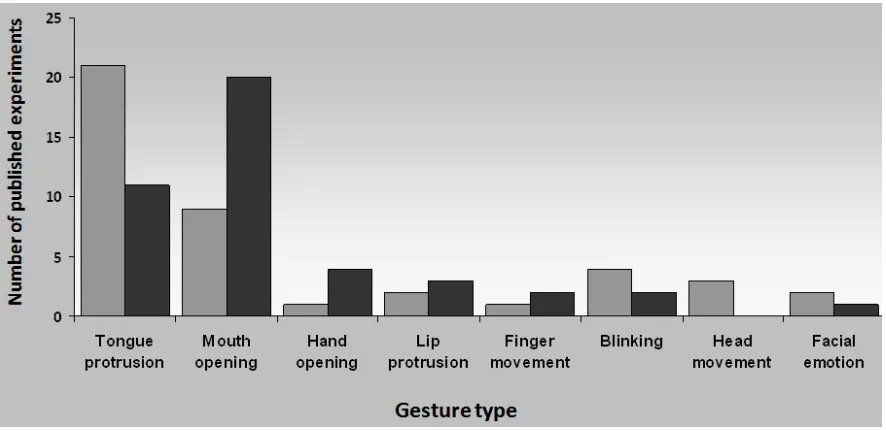
does not show the specificity characteristic of imitation or of MNs (Ray & Heyes, 2011). Figure 2
illustrates the first of these points. For each of the action types tested in young infants, it shows the
number of published studies reporting positive evidence of imitation and the number reporting
negative evidence. This is a highly conservative measure of how often young infants have failed
negative reports only for tongue protrusion. Evidence that even the tongue protrusion effect lacks the
specificity characteristic of imitation and MNs – that it is an exploratory response, rather than an
effect in which action observation is met with performance only of a similar action - comes from
research showing that tongue protrusion can be elicited by a range of arousing stimuli, including
flashing lights and lively music (Jones, 1996, 2006), and that it is greater when infants observe a
mechanical ‘tongue’ or disembodied mouth (Soussignan, Courtial, Canet, Danon-Apter, & Nadel,
2011)2. More broadly, evidence that the development of imitation is crucially dependent on learning is provided by a study of 2-year-old twins showing that individual differences in imitation were due
predominantly to environmental rather than genetic factors (McEwen et al., 2007), and by a recent
study of infants indicating that individual differences in associative learning ability at 1-month
predicted imitative performance 8 months later (Reeb-Sutherland, Levitt, & Fox, 2012).
Turning from human to monkey infants, Ferrari et al. (2006) reported immediate imitation of tongue
protrusion and lip smacking in 3 day-old monkeys. However, the effects were not present on days 1,
7 and 14 postpartum, and it is not clear whether they were replicated in a subsequent study using a
similar procedure (Paukner, Ferrari, & Suomi, 2011). The later study did report imitation of lip
smacking in monkeys less than one week old, but this effect seems to have been due to a low
frequency of lip smacking in the control condition, when infants were observing a static neutral face,
rather than to an elevated frequency of lip smacking when the infants were observing lip smacking.
Therefore, in common with the data from human infants, studies of imitation in newborn monkeys do
[image:20.595.78.521.475.690.2]not currently support a poverty argument.
A similar poverty argument suggests that the associative account must be wrong because 1)
suppression of alpha band (~6-13 Hz) oscillations over central scalp locations during action
observation (and execution) reflects the operation of MNs or a mirror mechanism, and 2)
electroencephalographic (EEG) studies indicate that both human and monkey infants show alpha
suppression when they have had minimal opportunity for sensorimotor learning (Gallese et al., 2011;
Nyström, Ljunghammar, Rosander, & von Hofsten, 2010). In this case, both of the assumptions are
questionable. First, the functional significance of alpha band oscillatory activity is poorly understood
even in human adults, and is yet more difficult to interpret in human and monkey infants where, for
example, less information is available about the source (Marshall & Meltzoff, 2011). Second, human
adult studies have traced the likely source of central alpha suppression during action execution to the
somatosensory cortex (Hari & Salmelin, 1997), suggesting that it may not index motor processing at
all3. Third, even if alpha suppression does index motor processing, it does not show that the motor activation matches or mirrors the actions observed (Marshall & Meltzoff, 2011; Pfurtscheller, Neuper,
& Krausz, 2000). For example, alpha suppression during observation of lipsmacking, which has been
reported in neonatal monkeys (Ferrari et al., 2012), may reflect a generalized readiness to act, or
arousal-related motor activation of tongue protrusion, rather than motor activation of lipsmacking, and
thereby the occurrence of MN or mirror mechanism activity. Furthermore, studies of human infants,
which provide superior source information, have not shown that central alpha suppression occurs
when infants have had insufficient correlated sensorimotor experience to build a mirror mechanism
through associative learning. Indeed, studies of human infants suggest an age-related trend consistent
with the associative hypothesis (see Marshall, Young, & Meltzoff, 2011 for a review).
Sound evidence of MN activity in newborns – which, we suggest, has not been provided by research
to date on imitation and alpha suppression – would be inconsistent with the associative model.
However, it is important to note that the associative account is predicated on a ‘wealth of the
stimulus’ argument, and therefore anticipates MN activity in young infants (Ray & Heyes, 2011).
This wealth argument points out that human developmental environments typically contain multiple
sources of the kind of correlated sensorimotor experience necessary to build MNs; each of these
sources is rich; and the mechanisms of associative learning can make swift and efficient use of these
sources. The range of sources available to young human infants includes self-observation, being
imitated by adults, being rewarded by adults for imitation, and the kind of experience in which, for
example, lip movements make the same smacking or popping sound when observed and executed.
Evidence of the richness of these sources comes from studies showing that infants spend a high
proportion of their waking hours observing their own hands in motion (P. Rochat, 1998; White,
every minute (Jones, 2009; Pawlby, 1977; Uzgiris, Benson, Kruper, & Vasek, 1989); and ‘noisy
actions’, which provide an early source of acquired equivalence experience, are among the first that
infants imitate (Jones, 2009). A common misconception about associative learning is that it always
occurs slowly. Directly relevant evidence that this is not the case comes from studies showing that,
when the contingency is high, infants can learn action-effect associations in just a few trials (Paulus,
Hunnius, van Elk, & Bekkering, 2012; Verschoor, Weidema, Biro, & Hommel, 2010).
5.2 Motor training in adulthood
It has been claimed that the associative account “cannot explain why motor experience obtained
without visual feedback can affect perception of human biological motion related to that
experience”(Gallese et al., 2011, p.383). This claim assumes that the perception of human biological
motion is mediated by MNs or a mirror mechanism, and appeals to a subtle poverty argument; it
suggests that the fundamental properties of MNs – the way in which they map observed with executed
actions – can be changed by motor experience alone, i.e. in the absence of correlated sensorimotor
experience.
Two types of evidence, from studies that were not designed to investigate MNs, have been cited in
support of this subtle poverty argument (Gallese et al., 2011). First, when observing point-light
displays of whole body movements such as walking, from a third party perspective, people are better
able to recognize themselves than to recognize their friends (Beardsworth & Buckner, 1981; Loula,
Prasad, Harber, & Shiffrar, 2005). Second, practice in executing actions can improve visual
discrimination of those actions, even when actors are prevented from observing their movements
during execution (Casile & Giese, 2006; Hecht, Vogt, & Prinz, 2001). These motor training effects,
and the self-recognition advantage, are interesting and important phenomena in their own right. If
they were mediated by a mirror mechanism – i.e. a mechanism in which there is a direct, unmediated
connection between visual and motor representations of action – they would also support a poverty
argument. However, a recent study provided evidence that these effects depend on an indirect
mechanism representing temporal cues. It showed, using avatar facial motion stimuli, that the
self-recognition advantage is maintained despite gross distortion of the kind of spatial cues that
characterize biological motion, but abolished by even relatively minor disturbance of domain-general
temporal cues (Cook, Johnston, & Heyes, 2012). In the absence of appropriate visual experience,
actors appear to be able to use their considerable knowledge of the rhythmic characteristics of their
own actions to recognize and better represent allocentric movement displays. Thus, motor training
effects and the self-recognition advantage are of independent interest, but they do not support a
6 Sensorimotor learning changes mirror neurons
6.1 Testing the predictions of the associative account
The associative account has been explicitly tested in experiments examining the effects of
laboratory-based sensorimotor training on mirror mechanisms in human adults. Building on the results of more
naturalistic studies (Calvo-Merino, Glaser, Grezes, Passingham, & Haggard, 2005; Calvo-Merino,
Grezes, Glaser, Passingham, & Haggard, 2006; Cross, Hamilton, & Grafton, 2006; Ferrari et al.,
2005; Haslinger et al., 2005; Jackson, Meltzoff, & Decety, 2006; Keysers et al., 2003; Kohler et al.,
2002; Margulis, Mlsna, Uppunda, Parrish, & Wong, 2009; Vogt et al., 2007), these experiments have
isolated the effects of sensorimotor experience from those of purely visual and purely motor
experience. Using all of the measures of mirror mechanism activity commonly applied to humans
(section 1.3), they have shown that relatively brief periods of sensorimotor experience can enhance
(Press, Gillmeister, & Heyes, 2007; Wiggett, Hudson, Clifford, Tipper, & Downing, 2012), abolish
(Cook, Dickinson et al., 2012; Cook et al., 2010; Gillmeister, Catmur, Liepelt, Brass, & Heyes, 2008;
Heyes, Bird, Johnson, & Haggard, 2005; Wiggett, Hudson, Tipper, & Downing, 2011), reverse
(Catmur et al., 2008; Catmur et al., 2011; Catmur, Walsh, & Heyes, 2007) and induce (Landmann,
Landi, Grafton, & Della-Maggiore, 2011; Petroni, Baguear, & Della-Maggiore, 2010; Press, Catmur
et al., 2012) mirror mechanism activity. Each of these findings confirms a novel prediction of the
associative account; it reveals flexibility of exactly the kind one would expect if MNs / mechanisms
are forged by sensorimotor associative learning. In contrast, this kind of flexibility does not provide
any support for the genetic hypothesis. Indeed, if MNs were a genetic adaptation, some evolutionary
frameworks would predict that the development of MNs would be protected or ‘buffered’ against
environmental perturbations that could interfere with their adaptive function (Cosmides & Tooby,
1994; Pinker, 1997). In the case of a genetic adaptation for action understanding, this would include
perturbations with the potential to divert MNs from coding properties of action, rather than of
inanimate stimuli, and from coding similar, rather than dissimilar, observed and executed actions.
Evidence that MNs / mechanisms are not resistant to coding inanimate stimuli comes from studies
showing that arbitrary sound, color and shape stimuli can induce mirror MEP (D’Ausilio,
Altenmüller, Olivetti Belardinelli, & Lotze, 2006; Petroni et al., 2010), fMRI (Cross, Hamilton,
Kraemer, Kelley, & Grafton, 2009; Landmann et al., 2011; Press, Catmur et al., 2012) and behavioral
effects (Press et al., 2007) following sensorimotor training (Press, 2011). For example, Press and
colleagues (2007) gave participants approximately 50 minutes of sensorimotor training in which they
repeatedly opened their hand when seeing a robotic pincer open, and closed their hand when seeing
the robotic pincer close. Prior to this training, the pincer movement elicited less automatic imitation
(see section 1.3) than human hand movement, but 24 hours after training, the automatic imitation
Evidence that MNs / mechanisms are not resistant to coding dissimilar actions comes from studies
showing that non-matching (or ‘counter-mirror’) sensorimotor training abolishes automatic imitation
(Cook, Dickinson et al., 2012; Cook et al., 2010; Gillmeister et al., 2008; Heyes et al., 2005; Wiggett
et al., 2011), and reverses both fMRI (Catmur et al., 2008) and MEP mirror responses (Catmur et al.,
2007). For example, Catmur and colleagues (2007) gave participants approximately 90 minutes of
non-matching sensorimotor training in which they repeatedly made an index finger movement while
observing a little finger movement, and vice versa. Before this training they showed mirror MEP
responses, for example, observation of index finger movement elicited more activity in an index
finger muscle than observation of little finger movement, and vice versa for the little finger muscle.
After training, this pattern was reversed, for example, observation of index finger movement elicited
more activity in the little finger muscle than observation of little finger movement.
6.2 Objections to sensorimotor training evidence
Objections to this evidence suggest, in various ways, that it does not show that sensorimotor
experience can change MNs / mechanisms. For example, it has been suggested that the evidence
comes only from studies of object-free actions and yet MNs code only object-directed actions
(Rizzolatti & Sinigaglia, 2010). However, a study of pianists has shown that experience modulates
mirror responses to object-directed actions (Haslinger et al., 2005) and, as discussed in section 3.1,
monkey studies of communicative gestures (Ferrari et al., 2003) and pantomimed reaching
movements (Kraskov et al., 2009) have identified MNs that code object-free actions.
A related concern is that, because they use indirect measures (fMRI, MEPs and automatic imitation),
rather than single cell recording, sensorimotor learning experiments may not be measuring MN
responses. Section 1.3 reviewed the evidence for human MNs from a range of experimental
techniques. These include conjunction of neural responses during action observation and performance
(Gazzola & Keysers, 2009; Iacoboni et al., 1999; Vogt et al., 2007), suppression of neural responses
to cross-modally (perceptual-motor or motor-perceptual) repeated actions (Kilner et al., 2009; Press,
Weiskopf, & Kilner, 2012), muscle-specific MEPs (Catmur et al., 2011; Fadiga et al., 1995), and
automatic imitation (Brass et al., 2001; Stürmer et al., 2000). In isolation, each of these measures is
imperfect (Caggiano et al., 2013), but together they provide strong converging evidence for human
MNs. Sensorimotor learning effects have been demonstrated for all these measures of mirror
responses: fMRI conjunction (Catmur et al., 2008; Landmann et al., 2011); repetition suppression
(Press, Catmur et al., 2012); MEPs (Catmur et al., 2011; Catmur et al., 2007; D’Ausilio et al., 2006;
Petroni et al., 2010); and automatic imitation (Cook, Dickinson et al., 2012; Cook et al., 2010;
Gillmeister et al., 2008; Heyes et al., 2005; Press et al., 2007; Wiggett et al., 2011). Thus, converging
sensorimotor learning (in which sensory, motor and sensorimotor experience are compared and/or
controlled) have not been performed using single-unit recording, this conclusion is supported by
single-unit data showing that experience with tools creates MN responses to observed tool use (Ferrari
et al., 2005; M. J. Rochat et al., 2010; see section 3).
Considerations regarding anatomical specificity raise another possible objection to the sensorimotor
training evidence: sensorimotor experience may only affect neurons in non-classical mirror areas (e.g.
dorsal PMC). However, while recordings of monkey MNs have mostly been confined to ventral PMC
and IPL, measurements in humans using single-unit recording and fMRI conjunction suggest that
MNs are more widespread (e.g. Arnstein, Cui, Keysers, Maurits, & Gazzola, 2011; Gazzola &
Keysers, 2009; Landmann et al., 2011; Mukamel et al., 2010; Vogt et al., 2007). Furthermore,
paired-pulse TMS indicates that functional connections from dorsal (as well as ventral) PMC to primary
motor cortex enhance muscle-specific MEP responses to action observation (Catmur et al., 2011).
Thus, several sources of evidence suggest that MNs are not restricted to classical mirror areas.
Therefore, even if sensorimotor experience were altering neuronal responses only outside ventral
PMC and inferior parietal cortex, it could still be affecting MNs. However, there is also evidence that
sensorimotor learning affects classical mirror areas. Many studies have demonstrated effects of
sensorimotor experience on classical mirror areas (Cross et al., 2009; Haslinger et al., 2005;
Landmann et al., 2011; Margulis et al., 2009; Vogt et al., 2007); counter-mirror sensorimotor learning
reverses ventral PMC and inferior parietal cortex responses to observed actions (Catmur et al., 2008);
and such learning is supported by ventral PMC-M1 connections (Catmur et al., 2011). Furthermore,
localizing the effects of sensorimotor learning to specific neural populations using repetition
suppression suggested that sensorimotor experience affects MNs in classical mirror areas (Press,
Catmur et al., 2012). Therefore it appears that MNs are not restricted to classical mirror areas, and that
sensorimotor experience has effects both on classical mirror areas and elsewhere.
A final possibility is that counter-mirror training changes relatively late neural responses to action
observation, leaving earlier responses, mediated by MNs, intact (Barchiesi & Cattaneo, 2012). Such a
finding might indicate that counter-mirror responses result from a more indirect route (e.g. via
prefrontal areas for rule retrieval) than mirror responses. Barchiesi and Cattaneo (2012) tested this
hypothesis using a task that is likely to have provoked coding of domain-general spatial cues, rather
than action-specific topographic cues, and therefore to have failed to index mirror responses at any
timepoint. A more recent study, using a more specific test of mirror responses, found effects of
counter-mirror training on MEPs from 200ms, the earliest timepoint at which mirror responses have
been observed in monkeys and humans (Cavallo, Heyes, Becchio, Bird, & Catmur, under review; see
counter-mirror effects occur at different times. It is likely that a prefrontal route is involvedduringthe
training session, when participants retrieve a rule in order to implement task instructions (e.g. “if
index, do little”). However, the finding that after counter-mirror training, effects of training are
present in MEPs from 200ms suggests that such rule-based responding merely initiates associative
learning: after learning, action observation activates counter-mirror responses as quickly as the
original mirror responses.
In summary: although there are currently no studies systematically testing the effects of sensorimotor
learning on MN responses in monkeys, a substantial body of evidence from studies of training and
expertise in humans has confirmed the predictions of the associative account, showing that mirror
responses can be changed in radical ways by sensorimotor learning. Furthermore, these studies have
provided no evidence that MNs / mechanisms are buffered or protected against sensorimotor
experience of a kind that makes them code inanimate stimuli and dissimilar actions.
7. Other models: Canalization and Exaptation
This article focuses on the genetic and associative accounts of the origins of MNs because these were
the first models to be proposed, and the associative hypothesis is the most fully developed alternative
to the standard, genetic view. For example, unlike other alternatives, it has been used to generate and
test novel empirical predictions. However, two other alternatives, which have been motivated in part
by the data generated in these tests (see section 6) should be considered. One raises the possibility
that the development of MNs is ‘canalized’, and the other that it represents an ‘exaptation’ for action
understanding. These are interesting possibilities but, we argue, they are not supported by the
evidence reviewed in sections 3-6.
7.1 Canalization
It has been suggested that MNs are acquired through “Hebbian learning” (Keysers & Perrett, 2004)
and their development is supported or “canalized” by genetically predisposed features of the
perceptual-motor system, including the tendency of infants to look at their own hands in motion (Del
Giudice, Manera, & Keysers, 2009). On one reading, this canalization hypothesis is identical in
substance to the associative hypothesis; it is helpful in providing a more detailed neuronal model of
how sensorimotor experience makes MNs out of motor neurons, and in contrast with the associative
hypothesis it emphasizes self-observation over social interaction as a source of relevant sensorimotor
experience in development, but otherwise the canalization hypothesis is identical to the associative
account. On this reading, the term “Hebbian learning” is understood to be a synonym for “associative
learning”, and the canalization hypothesis suggests that if the infant tendency to look at their own