City, University of London Institutional Repository
Citation
:
Murphy, J., Gray, K. & Cook, R. (2016). The Composite Face Illusion. Psychonomic Bulletin & Review, doi: 10.3758/s13423-016-1131-5This is the accepted version of the paper.
This version of the publication may differ from the final published
version.
Permanent repository link:
http://openaccess.city.ac.uk/15072/Link to published version
:
http://dx.doi.org/10.3758/s13423-016-1131-5Copyright and reuse:
City Research Online aims to make research
outputs of City, University of London available to a wider audience.
Copyright and Moral Rights remain with the author(s) and/or copyright
holders. URLs from City Research Online may be freely distributed and
linked to.
City Research Online: http://openaccess.city.ac.uk/ [email protected]
In press: Psychonomic Bulletin & Review
Format: ReviewArticle
Running head: The Composite Face Illusion
The Composite Face Illusion
Jennifer Murphy1,2, Katie Gray3, Richard Cook1,*
1Department of Psychology, City University London, London, U.K.
2MRC Social, Genetic and Developmental Psychiatry Centre, Institute of Psychiatry,
Psychology, and Neuroscience, King’s College London, London, U.K.
3Department of Psychology, University of Reading, Reading, U.K.
*Corresponding author: [email protected]
Department of Psychology,
City University London,
Whiskin Street
London, EC1R OJD
2
Abstract
Few findings in cognitive science have proved as influential as the composite face effect.
When the top half of one face is aligned with the bottom half of another, and presented
upright, the resulting composite arrangement induces a compelling percept of a novel facial
configuration. Findings obtained using composite face procedures have contributed
significantly to our understanding of holistic face processing, the detrimental effects of face
inversion, the development of face perception, and aberrant face perception in clinical
populations. Composite paradigms continue to advance our knowledge of face perception, as
exemplified by their recent use for investigating the perceptual mechanisms underlying
dynamic face processing. However, the paradigm has been the subject of intense scrutiny,
particularly over the last decade, and there is a growing sense that the composite face illusion,
whilst easy to illustrate, is deceptively difficult to measure and interpret. In this review we
provide a focussed overview of the existing composite face literature, and identify six
priorities for future research. Addressing these gaps in our knowledge will aid the evaluation
and refinement of theoretical accounts of the illusion.
Key words:
3
1. Introduction
In their seminal paper, Young, Hellawell and Hay (1987) presented a new ‘composite face paradigm’ for investigating the perception of facial configurations. The authors described
how, when the top half of one face was aligned with the bottom half of another, the resulting
composite arrangement induced the perception of a novel facial configuration; the presence
of the bottom half altered the appearance of the top half, and vice versa. The illusory fusion
of the two aligned halves hindered recognition – observers took longer to identify the source
faces. Importantly, however, the illusion was observed only when the composite
arrangements were aligned spatially and presented upright; free from illusion-induced
interference, observers were able to identify the sources of upright, misaligned halves with
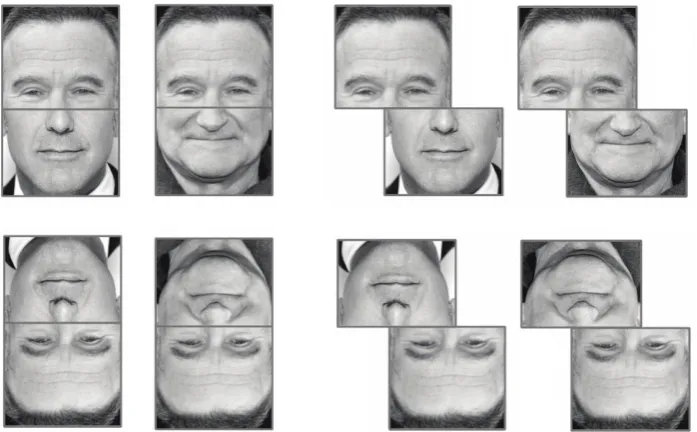
comparative ease (Figure 1). When presented upside-down, observers’ recognition of the
source faces was broadly similar in the aligned and misaligned conditions.
The composite face illusion has proved enormously influential. Crucially, the effect reveals a
tendency to integrate feature information from disparate facial regions. Findings from studies
employing composite face techniques have therefore informed the development of holistic
theories of face perception, which posit that local facial features are integrated into a unified
representation for the purposes of efficient analysis and interpretation (Farah, Wilson, Drain,
& Tanaka, 1998; Maurer, Le Grand, & Mondloch, 2002; Piepers & Robbins, 2013).
Moreover, the finding that greater illusory fusion is induced by upright arrangements
suggests that the orientation-specific processes responsible for composite interference may
also be disrupted in the classic face inversion effect, whereby orientation inversion
disproportionately impairs the recognition of faces, relative to other classes of object (Yin,
1969).
The purpose of this review is to provide a focussed overview of the existing composite face
literature with a view to identifying priorities for future research. We begin by discussing
some of the practical issues associated with measurement (Section 2). We then consider how
susceptibility to the illusion develops during ontogeny and the relative contribution of genetic
and environmental factors (Section 3). In the following sections we consider the neural
signatures associated with the illusion (Section 4), and discuss findings obtained from clinical
populations (Section 5). Having reviewed the available empirical data on the composite face
effect, we present and evaluate different theoretical accounts of the illusion (Section 6). We
4
Figure 1: When aligned with different lower halves, it is surprisingly difficult to recognise that the upper regions of the two composites are identical (left top). However, the illusion-induced interference is greatly diminished when the composites are misaligned (right top). When composite arrangements are shown upside-down, little illusion-induced interference is seen in either the aligned (left bottom) or misaligned (right bottom) conditions.
2. Measuring observers’ susceptibility to the illusion
2.1 Paradigms
In the original composite study (A. W. Young et al., 1987), participants were presented with a
single facial composite and the degree of illusion-induced interference was inferred from
their response latencies. When asked to identify the source of a task-relevant half (e.g., upper
half; hereafter ‘target half’), whilst disregarding the remaining task-irrelevant half (e.g., lower half; hereafter ‘distractor half’), observers were disproportionately slower in the
upright-aligned condition. The application of this naming paradigm is limited, however, by the need
to use familiar faces. To allow participants to name the source of the target half, composites
must be constructed from personally familiar, celebrity, or otherwise learned faces. This is
potentially problematic in light of known differences in the perceptual processing of familiar
and unfamiliar faces (Jenkins & Burton, 2011; Murphy, Ipser, Gaigg, & Cook, 2015). For
example, observers are better able to match familiar faces using their internal features,
including the eyes, nose, and mouth (Osborne & Stevenage, 2008). In contrast, unfamiliar
face matching is frequently based on external features, such as hairstyle and face shape.
Familiar faces also place lower demands on visual working memory (Jackson & Raymond,
2008) and are easier to detect under conditions of reduced attention, compared with
[image:5.595.124.473.72.288.2]5 Since the initial description of the illusion, simultaneous and delayed matching procedures
have been developed which overcome the need to use familiar faces (i.e., that allow
investigation of holistic processing of unfamiliar faces). Crucially, these paradigms confirm
that arrangements constructed from unfamiliar faces also produce composite face effects. In
simultaneous-matching paradigms, two composite arrangements – either aligned or
misaligned, upright or inverted – are presented simultaneously and observers asked whether
two target regions (e.g., the upper halves) are identical or not (Hole, 1994). In
delayed-matching paradigms, participants are again presented with two composite arrangements and
asked to judge whether the target regions are identical or not. However, rather than appear
simultaneously, the composites are presented sequentially (Goffaux & Rossion, 2006; Le
Grand, Mondloch, Maurer, & Brent, 2004; Michel, Rossion, Han, Chung, & Caldara, 2006).
In a popular variant, the first composite is presented briefly (e.g., 500 ms), followed by an
inter-stimulus-interval, typically between 500 ms and 2 seconds. Thereafter, the second
composite is presented until the participant responds (e.g., Michel et al., 2006). In both
matching procedures, observers’ responses are disproportionately impaired (slower and/or
less accurate) when composite arrangements are aligned and presented upright, than when
misaligned or inverted.
2.2 Original and complete matching procedures
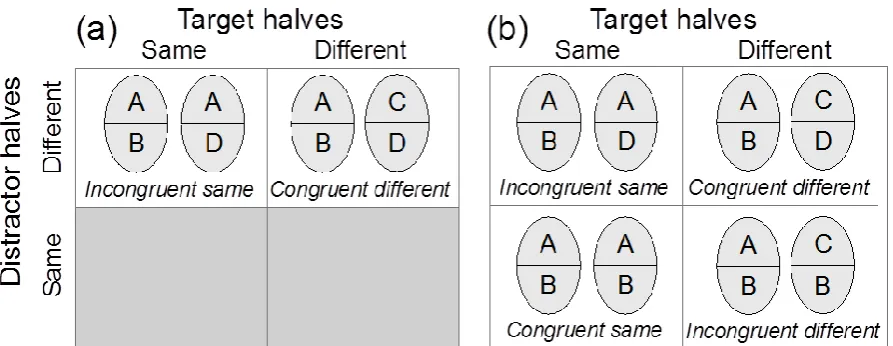
In simultaneous and sequential matching paradigms, the factorial combination of target-half
(Tsame, Tdifferent) and distractor-half (Dsame, Ddifferent) yields four possible trial types:
congruent-same (Tsame, Dsame), incongruent-same (Tsame, Ddifferent), congruent-different (Tdifferent, Ddifferent),
incongruent-different (Tdifferent, Dsame). Note that on ‘congruent’ and ‘incongruent’ trials,
susceptibility to the illusion therefore helps and hinders observers, respectively. Traditionally,
researchers have employed a variant whereby distractor halves always differ, and therefore
exert different illusory biases on the target regions (e.g., Cassia, Picozzi, Kuefner, Bricolo, &
Turati, 2009; de Heering, Houthuys, & Rossion, 2007; Goffaux & Rossion, 2006; Konar,
Bennett, & Sekuler, 2010; Le Grand et al., 2004; Robbins & McKone, 2007). The original
matching procedure excludes congruent-same and incongruent-different trial types (Figure
2a). More recently, some groups have advocated the use of so-called ‘complete design’
matching procedures (Figure 2b), incorporating identical and different distractor halves and
all four trial types (e.g., Cheung, Richler, Palmeri, & Gauthier, 2008; Richler, Cheung, &
Gauthier, 2011a; Richler, Gauthier, Wenger, & Palmeri, 2008; Richler, Mack, Palmeri, &
6 and original matching designs do not correlate (Richler & Gauthier, 2014), suggesting that
the variants measure different phenomena, however the reason for the discrepancy remains
contested (Meinhardt, Meinhardt-Injac, & Persike, 2014; Richler & Gauthier, 2013; Rossion,
[image:7.595.75.522.155.328.2]2013).
Figure 2: Illustration of the (a) original and (b) complete designs used in simultaneous and sequential matching paradigms.
Proponents argue that, compared to the original matching procedure, the complete design
estimates observers’ susceptibility to the composite illusion more accurately. Unlike
estimates inferred using the complete design, composite effects measured using the original
matching task may be influenced by differences in response bias (Richler & Gauthier, 2014).
For example, estimates of composite interference derived from original matching designs are
disproportionately driven by responses on incongruent-same trials where the presence of the
different distractors makes it harder to recognise that same target halves are identical. Where
observers have a pre-existing bias to respond ‘different’, original matching designs may
underestimate their susceptibility to the illusion. Consistent with this view, belief
manipulations that affect response bias distort composite effect estimates measured using the
original matching design, but not the complete design (Richler, Cheung et al., 2011a).
However, the complete design has also been criticised. Importantly, the effects of alignment
seen in the additional congruent-same and incongruent-different trials may have a distinct
origin to those seen in the incongruent-same and congruent-different trials included in the
original matching design. Specifically, the facilitation seen on congruent-same trials, and the
interference seen on incongruent-different trials, may reflect domain-general processes akin
7 Accordingly, complete designs may be prone to strategic effects (see Section 7.2) and may be
more likely to find effects with non-face composites (see Section 6.1); for example,
composite effects have been observed for unfamiliar Chinese characters using this paradigm
(Hsiao & Cottrell, 2009). A further objection relates to the predicted pattern of responses in
the congruent-different condition. On these trials, different distractor regions are paired with
different target regions. On some trials it is reasonable to assume that the additional different
signal present in the distractors is fused with the physical differences between the targets,
thereby making it easier for observers to respond ‘different’. However, where the physical
difference between the targets is already large, it is conceivable that fusion with distractor
regions with less obvious differences may actually dilute the difference signal, hindering
correct responding (Robbins & McKone, 2007).
2.3 Control conditions
While different research groups employ different control conditions, the aim of these
manipulations is consistent: to rule out simpler, generic accounts of the performance
decrements seen when upright composites are aligned. The most commonly used control
conditions, misalignment and inversion (see Figure 1), were introduced by Young and
colleagues (1987). Interference is greatly reduced when composites are misaligned
horizontally excluding the possibility that the interference is simply caused by the proximity
of the distractor half. Transposing the position of upper and lower halves (Abbas &
Duchaine, 2008) and presenting halves side-by-side (Richler, Tanaka, Brown, & Gauthier,
2008) also speak against this account. Similarly, the finding that composite interference is
greatly diminished – although not eliminated entirely (e.g., Susilo, Rezlescu, & Duchaine,
2013) – when stimulus arrangements are shown upside-down confirms that performance
decrements in the upright-aligned condition are not induced by the presence of the continuous
boundary when the halves are aligned; whereas the boundary is disrupted by misalignment, it
is preserved by inversion (Rossion, 2013). Where effects of alignment are seen for upright,
but not inverted arrangements, authors can also exclude the possibility that the differential
interference observed in these conditions reflects differences in the size of the spotlight of
visuospatial attention (e.g., McKone et al., 2013). For these reasons, many consider the use of
convergent inverted and misaligned control conditions necessary for clear interpretation of
composite interference (McKone et al., 2013; Rossion, 2013). Finally, some investigations
have included parallel tasks where observers judge composites constructed from non-face
8 observed, findings of face-specificity argue against the possibility that decrements in the
upright-aligned condition reflect domain-general interference that may be produced by any
object with a canonical orientation (e.g., Robbins & McKone, 2007).
2.4 Which judgments are affected?
In the original description of the illusion, observers were slower to name the identity of the
faces from which target regions were sourced as a consequence of the composite interference
(A. W. Young et al., 1987). It appears, however, that composite interference affects several
other attributions, extending beyond facial identity. For example, viewers are slower to
identify the emotion present in a target half, when paired with a distractor half sourced from
the same face, but expressing a different emotion. Once again, disproportionate interference
is seen when composite arrangements are presented upright and aligned, with little or no
interference seen when the halves are misaligned or inverted (Calder, Young, Keane, &
Dean, 2000; Palermo et al., 2011; Tanaka, Kaiser, Butler, & Le Grand, 2012; Wegrzyn,
Bruckhaus, & Kissler, 2015). Composite interference also appears to bias the perception of
facial gender and age. Observers were slower and made more errors in categorising the
gender of target halves when composite faces were constructed using halves from different
genders, relative to same-gender and misaligned control conditions (Baudouin & Humphreys,
2006). Similarly, when estimating the age of composite top halves, observers’ estimates were
biased towards the age of the bottom halves, a pattern of performance that was attenuated, but
not eliminated, by inversion (Hole & George, 2011). Composite interference also distorts
evaluative impressions. Top halves of upright composite faces were judged more attractive
(Abbas & Duchaine, 2008) and trustworthy (Todorov, Loehr, & Oosterhof, 2010) when
aligned with attractive and trustworthy bottom halves, respectively.
2.5 Low-level stimulus characteristics
Several studies have sought to investigate how observers’ susceptibility to the composite face
illusion is affected by low-level image manipulations. For example, results obtained using the
original matching procedure suggest that filtered composites that preserve low-spatial
frequencies, induce stronger illusion-induced interference than high-spatial frequency
composites (Goffaux & Rossion, 2006). While this finding is consistent with the view that
holistic processing is supported predominantly by low-spatial frequencies (Sergent, 1986), it
has been contested; subsequent findings obtained using the complete design have found no
9 effects vary as a function of face size, with arrangements resembling faces viewed at ~2m
inducing the strongest illusions when measured using the complete design (Ross & Gauthier,
2015). Facial composites presented in grayscale have been found to induce greater composite
interference in the original matching procedure, than composites shown in colour (Retter &
Rossion, 2015). Interestingly, photographic negation has little effect on the strength of the
illusion when measured using the original matching procedure; grayscale composites induce
similar interference in positive and negative contrast polarity (Hole, George, & Dunsmore,
1999; Taubert & Alais, 2011).
3. Development
Susceptibility to the composite face illusion appears to be present early in development. For
example, de Heering and colleagues (2007) found that four, five and six-year-olds displayed
similar susceptibility to each other and to adults when tested using the original matching
procedure (see also Carey & Diamond, 1994; Mondloch, Pathman, Maurer, Le Grand, & de
Schonen, 2007; Susilo, Crookes, McKone, & Turner, 2009). Comparable results have also
been reported for expression composites (Durand, Gallay, Seigneuric, Robichon, &
Baudouin, 2007). Susceptibility, however, may be present at an even younger age. Composite
interference has been reported in 3-year-olds when tested on a simultaneous variant of the
original matching procedure (Cassia et al., 2009). Remarkably, recent evidence from a visual
preference paradigm indicates that infants as young as 3 months may also be susceptible to
the illusion. When misaligned, 3-month-old infants exhibited a looking preference for
familiar eye-regions over unfamiliar eye-regions. However, when aligned with an unfamiliar
mouth, no systematic preference was observed (Turati, Di Giorgio, Bardi, & Simion, 2010).
Early susceptibility to the composite face illusion may partly reflect a genetic contribution.
Having tested 173 twin pairs (102 monozygotic and 71 dizygotic, age 7–19 years) using the
original matching procedure, the correlation between the composite effects estimated for the
monozyotic twins exceeded that seen for the dizygotic twins (Zhu et al., 2010). The authors
estimated that genetic heritability accounted for 31% of the variance in the twins’
susceptibility to the illusion. As is often the case with heritable traits (e.g., Haworth et al.,
2010), the genetic influence appeared to increase with age; the variance attributable to genetic
factors was greater in the 13-19 year–olds, than in 7-12 year-olds. No concordance was
10 (Navon, 1977), suggesting that the heritability of the composite face illusion may show a
degree of face-specificity.
Complementary evidence suggests that visual experience also plays a critical role in shaping
susceptibility to the composite face illusion. Twelve individuals (age 9-23 years) deprived of
visual experience during the first 3-6 months of development due to bilateral congenital
cataracts, showed little or no susceptibility to the composite face illusion when measured
using the original matching design. Free from illusion-induced interference, these individuals
outperformed controls when the target and distractor halves were aligned (Le Grand et al.,
2004). When tested using the original matching design, Michel and colleagues (2006) found
that observers’ susceptibility to the composite illusion was also greater when participants
viewed composite faces of their own race (but for conflicting results obtained with the
complete design see Horry, Cheong, & Brewer, 2015; Zhao, Hayward, & Bülthoff, 2014).
For a review of this literature, see Hayward, Crookes, & Rhodes, (2013). Similarly, Susilo
and colleagues (2009) found stronger effects using the original matching procedure when
composites were constructed from own-age faces (but see Wiese, Kachel, & Schweinberger,
2013). However, preschool teachers (i.e. observers with extensive contact with child faces)
failed to show an own-age effect when tested using the original matching task; they showed
similar composite effects for arrangements constructed from own-age faces and the faces of
children (de Heering & Rossion, 2008). Where observed, these biases may therefore be
products of experience.
4. Neural basis
4.1 Neural markers revealed by fMRI and EEG
The neural representation of composite faces has been addressed using fMRI adaptation
paradigms. These studies take advantage of the fact that repeated presentation of the same
stimulus elicits a weaker change in the blood-oxygen-level-dependent (BOLD) signal, than
presentation of two different stimuli. The same top half of a face elicits a larger response – a
bigger release from adaptation – in the fusiform face area (FFA) when aligned with a lower
half sourced from a different facial identity than when taken from the same face (Schiltz,
Dricot, Goebel, & Rossion, 2010; Schiltz & Rossion, 2006). However, this difference is not
found when the top and bottom face regions are spatially misaligned (Schiltz et al., 2010;
Schiltz & Rossion, 2006; but see Harris & Aguirre, 2010) or when arrangements are inverted
11 The composite face illusion is also associated with a characteristic electroencephalography
(EEG) signature. In comparison to aligned composite faces, consistent evidence indicates that
misalignment elicits a delayed and enhanced N170 (Jacques & Rossion, 2009, 2010; Kuefner,
Jacques, Prieto, & Rossion, 2010; Letourneau & Mitchell, 2008; Soria Bauser, Schriewer, &
Suchan, 2014; Wiese et al., 2013), a response that bears striking similarity to the modulation
elicited by face inversion (Eimer, 2000). Consistent with behavioural findings, the effect
associated with misalignment is not observed when the composites are inverted (Jacques &
Rossion, 2010). However, the response elicited may also depend on the stimulus attributes; a
stronger effect of misalignment has been reported for young faces in comparison to older
faces, regardless of participant age (Wiese et al., 2013). For aligned composite faces a larger
N170 is also observed when sequentially presented top halves differ than when they are
identical (Jacques & Rossion, 2009). Crucially, however, a similar increase in the N170 is
observed when aligned distractor halves induce the illusion that two identical target halves
differ (Jacques & Rossion, 2009; Kuefner et al., 2010). This effect is not seen with
misaligned composites (Jacques & Rossion, 2009).
4.2 Brain stimulation and neuropsychology
Findings that illusory composite fusion can modulate FFA and N170 responses are of great
interest. However, it is important to note that these observations are correlational. For
example, the fMRI adaptation effects may reveal a causal role for the FFA in the emergence
of the illusory percept, or may merely be a consequence of the illusion. The functional
significance of these neural signatures thus remains unclear. In contrast, brain stimulation and
neuropsychological paradigms potentially provide evidence that a particular neural substrate
is causally involved in the experience of the illusory percept; where a region makes a
necessary contribution to the illusion, interference in the form of stimulation or acquired
lesion, should alter observers’ susceptibility. To date, few investigations have employed brain
stimulation to understand the neural basis of the composite face illusion. However, a recent
study employing the complete design found that transcranial direct current stimulation
(tDCS) applied to occipito-temporal cortex reduced observers’ susceptibility to the composite
face illusion, relative to a sham condition (Yang et al., 2014; but see Renzi et al., 2015).
In cases of Acquired Prosopagnosia (AP), individuals are left with face recognition
difficulties following brain injury. To date, surprisingly few APs have been tested on
12 Ceccaldi, & Rossion, 2010; Ramon, Busigny, & Rossion, 2010) or anterior (Busigny et al.,
2014) regions of the right temporal lobe have been found to exhibit reduced composite face
effects, measured using original matching procedures, relative to matched controls. Typical
susceptibility to the original matching procedure was reported in patient Herschel, who
developed AP following extensive lesions predominantly in the right occipitotemporal cortex
(Rezlescu, Pitcher, & Duchaine, 2012). When tested using the complete design, patient LR,
an individual who developed AP following focal damage to the anterior portion of the right
temporal lobe, exhibited a typical composite effect (Bukach, Bub, Gauthier, & Tarr, 2006).
However, this result is qualified by an abnormal pattern of responses; specifically, the time
taken by LR to identify the top half of the face was influenced by the bottom half in both the
aligned and misaligned conditions, indicative of an atypical composite effect (Busigny et al.,
2014).
Patient CK, who exhibited severe integrative object agnosia, showed broadly typical
recognition of upright aligned faces; for example, CK was able to identify celebrity faces as
well as age-matched controls, even when the identity was obscured by a disguise. However,
CK’s recognition was drastically impaired relative to controls when upper and lower face
halves were misaligned horizontally or when spatially aligned faces were inverted
(Moscovitch, Winocur, & Behrmann, 1997). Interestingly, CK’s recognition was largely
unaffected when left and right facial halves were misaligned vertically, hinting at qualitative
differences between the disruption induced by horizontal and vertical displacement. Because
of the nature of CKs injury (MRI revealed no obvious circumscribed lesion), it is not possible
to localize the sources of his impairments. Nevertheless, these results suggest that the
neurocognitive mechanisms responsible for processing upright aligned faces dissociate from
those mediating recognition of inverted or horizontally misaligned faces (see discussion of
gated processing in Section 6.1).
5. The susceptibility of clinical populations to the illusion
5.1 Developmental Prosopagnosia
Individuals with Developmental Prosopagnosia (DP) experience life-long face recognition
difficulties, despite normal levels of intelligence and typical low-level vision (Behrmann &
Avidan, 2005; Cook & Biotti, 2016; Duchaine & Nakayama, 2006b; Susilo & Duchaine,
2013). DPs show reduced susceptibility to both the identity (Avidan, Tanzer, & Behrmann,
13 variants of the composite face illusion, assessed using original matching procedures.
However, DP is thought to be a heterogeneous condition (e.g., Susilo & Duchaine, 2013), and
cases have been described who show broadly typical composite face effects on simultaneous
variants of the original matching task (Le Grand et al., 2006). The contribution of task
differences (e.g., simultaneous vs. sequential matching paradigms) to the discrepant findings
remains unclear. We also note that several studies employing the original matching design
fail to report participants’ performance on different trials (e.g., Avidan et al., 2011; Palermo
et al., 2011). While individual differences in illusion susceptibility may be most pronounced
in the incongruent-same condition (e.g., Le Grand et al., 2004), failure to report observers’
performance when targets differ (typically 50% of trials) makes it impossible to assess the
potential contribution of response bias to group differences, where observed.
5.2 Autism Spectrum Disorder
It has been suggested that people with Autism Spectrum Disorders (ASD) may exhibit
reduced susceptibility to the illusion. Observers with ASD often focus on local features and
may therefore experience problems forming integrated global representations (Happe & Frith,
2006). Moreover, many individuals with ASD often exhibit reduced sensitivity to illusions
induced by contextual influence (Behrmann, Thomas, & Humphreys, 2006; Simmons et al.,
2009). Research examining composite face effects in ASD has yielded mixed results
(Weigelt, Koldewyn, & Kanwisher, 2012). High-functioning adults with ASD showed
broadly typical composite face effects to age- and IQ-matched controls on a sequential
matching task (Nishimura, Rutherford, & Maurer, 2008). In contrast, a sample of adolescents
with ASD failed to show the typical composite effect on a sequential matching task; their
matching ability was very similar in the upright-aligned and upright-misaligned conditions
(Teunisse & de Gelder, 2003). Whereas the foregoing studies employed the original matching
design, Gauthier, Klaiman and Schultz (2009) found evidence of atypical composite face
effects in a sample of adolescents with ASD using the complete design; the distractor halves
induced similar interference in both aligned and misaligned conditions.
5.3 Schizophrenia
There is growing interest in the face recognition of observers with schizophenia. In particular
there has been suggestion that they may exhibit reduced holistic representation (Bortolon,
Capdevielle, & Raffard, 2015). Schwartz, Marvel, Drapalski, Rosse and Deutsch (2002)
14 medicated observers with schizophrenia. Using the naming paradigm (A. W. Young et al.,
1987), the authors found a comparable composite effect (i.e., greater composite interference
in the aligned, than in the misaligned condition) in their clinical sample and matched controls,
suggesting typical susceptibility to the illusion. However, in this particular investigation the
authors utilized a misaligned control condition only; it is unclear whether the misalignment
advantage is also seen for inverted composite arrangements (McKone et al., 2013).
6. Theoretical interpretations
Many explanations of the composite face effect appeal to the idea that upright aligned
composites gain access to high-level face-specific processing, whereas misaligned and
inverted composites do not. In contrast, some authors have challenged this view and have
advanced domain-general accounts (Section 6.1). Domain-specific accounts have been
heavily influenced by the concepts of configural and holistic representations (Section 6.2).
However, while these ideas remain valuable theoretical heuristics, they are under-specified as
theories in their own right (Burton, Schweinberger, Jenkins, & Kaufmann, 2015; Piepers &
Robbins, 2013; Richler, Palmeri, & Gauthier, 2012). Drawing on the computer vision
literature, attempts have therefore been made to provide instantiated image-processing
accounts of the composite face illusion (Section 6.3).
6.1 Domain specific vs. domain general processing
Faces may recruit additional perceptual processing not engaged by other classes of object
(Kanwisher, 2000; McKone, Kanwisher, & Duchaine, 2007; McKone & Robbins, 2011).
However, employing resource-intensive processing indiscriminately is inefficient. Some
stages of face processing may therefore be gated, whereby sophisticated domain-specific
processing only commences once a face has been detected in the environment (Tsao &
Livingstone, 2008). Detection of simple, proto-facial features, or ‘faciotopy’ (Henriksson,
Mur, & Kriegeskorte, 2015), possibly mediated by subcortical visual processing, may be
sufficient to engage more complex cortical processing (Johnson, 2005; Shah, Gaule, Bird, &
Cook, 2013). When composite faces are aligned and presented upright, the presence of the
intact facial arrangement may therefore permit access to face-specific processing, responsible
for the composite illusion. Inverted or misaligned composites may lack the basic faciotopy
necessary to gain access to the highest levels of face-specific processing, and therefore do not
induce composite interference (Tsao & Livingstone, 2008). It is striking that these
15 Section 4.2). Potential accounts of this high-level face processing are described in the
following sections (see Sections 6.2 and 6.3).
In contrast, some authors reject the idea that the composite-face illusion is a product of
face-specific representation mechanisms; rather, they argue that composite interference reflects a
form of automatic processing recruited by ‘objects of expertise’. Objects of expertise are
categories of objects i) with which the observer has extensive visual experience, and ii)
comprising exemplars that share a common prototypical feature arrangement. Thus, birds
(Gauthier, Skudlarski, Gore, & Anderson, 2000) and dogs (Diamond & Carey, 1986) may be
objects of expertise for ornithologists and dog show judges, respectively. Following extensive
experience individuating exemplars, observers are thought to process the separate features of
objects of expertise as a unified whole (Diamond & Carey, 1986; Richler et al., 2012;
Richler, Wong, & Gauthier, 2011; A. C. Wong, Palmeri, & Gauthier, 2009).
Consistent with this domain-general account, composite effects obtained using the complete
design have been reported for non-face objects of expertise encountered naturally, including
cars (Bukach, Phillips, & Gauthier, 2010; Gauthier, Curran, Curby, & Collins, 2003), words
(A. C. Wong et al., 2011), Chinese characters (A. C. Wong et al., 2012), and chess boards
(Boggan, Bartlett, & Krawczyk, 2012). Similar composite effects have been reported with
synthetic non-face objects, including ‘Greebles’ (Gauthier & Tarr, 2002; Gauthier, Williams,
Tarr, & Tanaka, 1998) and ‘Ziggerins’ (A. C. Wong et al., 2009), where expertise is acquired
through lab-based training. Crucially, the type of training administered appears to modulate
illusion susceptibility. Participants who received individuation training – naming particular
exemplars – exhibited greater composite effects than those who received categorisation
training – judging which group a given exemplar belonged to (A. C. Wong et al., 2009).
There have been relatively few reports of composite effects for non-face objects obtained
using the original matching procedure. For example, Robbins and McKone (2007) failed to
find a composite effect when dog experts were presented with arrangements constructed from
dog stimuli. Similarly, Greeble experts failed to show composite effects for Greebles
(Gauthier & Tarr, 2002; Gauthier et al., 1998). Recently, however, a study found evidence of
composite effects for body postures using the original procedure (Willems, Vrancken,
Germeys, & Verfaillie, 2014), possibly reflecting similarities in the way that faces and bodies
16 6.2 Configural and holistic processing
It has been widely suggested that upright faces may recruit a rapid parallel analysis of the
whole face. The terms ‘holistic’ and ‘configural’ are often used interchangeably to describe
this whole-face processing, leading to some confusion in the literature (e.g., Piepers &
Robbins, 2013). However, two broadly distinct accounts may be delineated.
Faces are defined by the presence and prototypical arrangement of certain basic features; i.e.,
two eyes above a nose and mouth, so-called first-order relations. Because all faces share this
common arrangement, the spatial distances between internal features, so-called second-order
relations, may be particularly important for the recognition of individual faces (Diamond &
Carey, 1986). The processing of these second-order relations has been commonly termed
‘configural’ processing. It is possible that the composite face illusion alters configural
processing; for example, when composite faces are presented upright and aligned, observers
may perceive a novel configuration that hinders recognition of the constituent parts
(Hancock, Burton, & Bruce, 1996; A. W. Young et al., 1987). Consistent with this
interpretation, observers’ ability to discriminate faces that share common features and differ
only in their spatial arrangement (e.g., eyes close together or far apart), is greatly diminished
when stimuli are inverted (Barton, Keenan, & Bass, 2001; Freire, Lee, & Symons, 2000;
Goffaux & Rossion, 2006; Haig, 1984; Leder & Bruce, 2000; Leder, Candrian, Huber, &
Bruce, 2001; Rhodes, Brake, & Atkinson, 1993; Searcy & Bartlett, 1996).
Alternatively, variation in feature shape and the spatial relations may be described within a
single non-decomposable holistic representation – a ‘Gestalt’ that cannot be broken down
into its constituent parts or the inter-relations between them (Farah et al., 1998). Because
different distractor regions induce the modelling of a new face Gestalt, they alter the
appearance of the target half. This view accords with recent findings that the composite face
illusion alters observers’ perception of feature shape as well as feature configurations
(Hayward, Crookes, Chu, Favelle, & Rhodes, 2016). This holistic account is also consistent
with the part-whole effect, whereby individual features are judged more accurately in the
context of an upright face than when shown in isolation, despite the context remaining
uninformative (Tanaka & Farah, 1993). Interestingly, this contextual advantage disappears
when stimulus arrangements are shown upside-down. Similarly, individuals’ ability to
17 spacing, are highly-correlated for upright faces, but not for inverted faces or non-face objects
(Yovel & Kanwisher, 2008).
In an attempt to reconcile these views, it has been proposed that holistic, configural, and
piecemeal (‘parts-based’) processing, are points on a processing continuum defined by degree
of feature integration (Reed, Stone, Grubb, & McGoldrick, 2006). However, the distinction
between holistic and configural processing remains contentious. Changing the spatial
relations between features necessarily changes the Gestalt representation hypothesised by the
holistic account. The distinction between the accounts therefore relies on the assumption that
feature shape may be changed independently of the spatial relations between the features.
While this view is accepted by some authors (Farah et al., 1998; Yovel & Kanwisher, 2008),
it is disputed by others on the ground that changing local contour and shading cues also
changes the configural relations between features (Hancock et al., 1996; McKone & Yovel,
2009; Piepers & Robbins, 2013).
6.3 Image processing models
According to the Gabor jet model (Biederman & Kalocsais, 1997; Wiskott, Fellous, Kuiger,
& Von Der Malsburg, 1997), faces are described by columns of multi-scale, multi-orientation
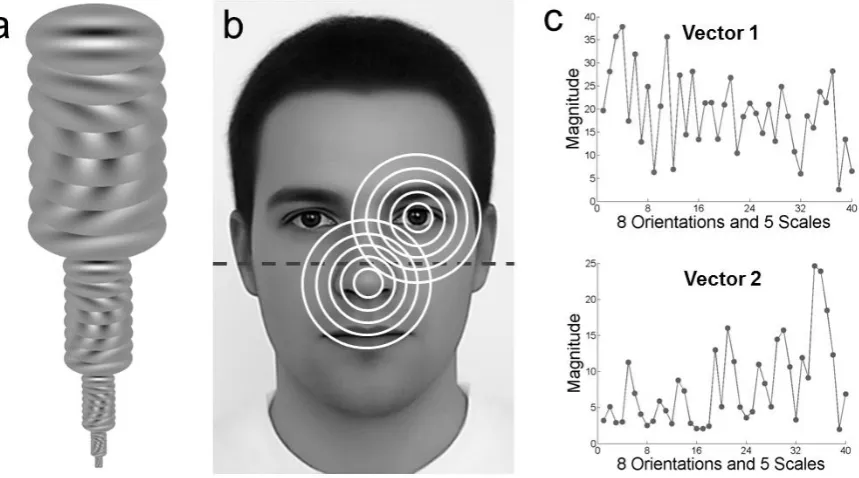
filters (Figure 3a), with their receptive fields centered on facial landmarks defined relative to
the first-order features (Figure 3b). The model retains biological plausibility, insofar as a
Gabor jet approximates the multiscale, multiorientation tuning properties of cells in a V1
hypercolumn (De Valois & De Valois, 1988). For a given face, a Gabor jet centered on the
left pupil, with different filters for eight orientations and five scales would yield 40-item
vectors describing the contrast variation around the left eye (Figure 3c). Face recognition is
achieved by comparing the combined readout from all of the Gabor jets, with stored
templates for known faces. Importantly, variation in one part of the face will affect kernels
with medium and large receptive fields centered on other parts of the face (Xu, Biederman, &
Shah, 2014). Where aligned composite faces are shown upright, image variation present in
the lower face half will therefore alter the readout of Gabor Jets centered on features in the
upper half, biasing observers’ perception of its identity (Herald, Shah, Xu, Biederman, &
18
Figure 3: (a) Illustration of a Gabor Jet, comprising different multi-scale, multi-orientation filters. (b) The receptive fields of the filters in a particular Gabor Jet are centered on a particular facial landmark. The receptive fields of the intermediate and larger scale filters overlap and cover wide areas of the face. (c) Gabor jets comprising n filters yield a vector of n items describing the contrast variation at the particular facial landmark sampled by the Gabor Jet.
There has also been interest in the utility of unsupervised data reduction algorithms as models
of human face perception. Following an initial pre-processing stage – input images are
typically cropped to a common aspect ratio and faces aligned using sets of fiducial points –
algorithms are able to extract dimensions that describe the variation within a set of input
images. To date, many authors have used Principal Components Analysis (PCA) to illustrate
the value of this approach (Calder, 2011; Calder, Burton, Miller, Young, & Akamatsu, 2001;
Calder & Young, 2005; Hancock et al., 1996). When applied to faces, PCA returns the n
Eigenface dimensions (whole face components that may be combined linearly to reconstruct a
given facial exemplar) that most effectively describe the variation present within the set of
sampled images (Turk & Pentland, 1991). Thereafter, facial exemplars are represented as
vectors in the facespace defined by the n Eigenface dimensions. Importantly, where PCA is
applied only to intact, naturalistic faces, components will reflect the natural covariation
present in different face halves; for example, happy and angry mouth regions will have been
encountered in the presence of accompanying happy and angry eye-regions. Unless the
algorithm encounters faces with different emotion signals in their top and bottom halves, the
resulting PCA space will lack the dimensionality with which to represent mixed-emotion
composites (Cottrell, Branson, & Calder, 2002). The illusion-induced interference first
[image:19.595.82.512.74.313.2]emotion-19 incongruent composites within an emotion-congruent face-space. By appealing to the same
logic, PCA models can explain other types of composite binding such as that seen for age and
gender (see Section 2.4). Many of the principles and predictions derived from PCA models
generalize well to other data reduction algorithms, notably Architecture II Independent
Components Analysis (ICA; Bartlett, Movellan, & Sejnowski, 2002; Calder & Young, 2005;
Nestor, Plaut, & Behrmann, 2013).
7. Future directions
In the foregoing sections, we have reviewed the body of empirical findings reported with
composite paradigms and existing theoretical accounts of the illusion. In this section, we look
forward, highlighting priorities for future research. In particular, several critical questions
remain unresolved. These gaps in our knowledge undermine attempts to evaluate and refine
theoretical accounts of the composite face illusion.
7.1 The functional significance of the composite face illusion
The view that holistic representation, as measured by the composite face illusion, is causally
related to face recognition ability remains extremely popular; for example, holistic processing
may permit accurate and efficient representation (Maurer et al., 2002; Piepers & Robbins,
2013). However, the functional significance of the composite face illusion remains uncertain.
First, the literature is inconsistent with respect to the relationship between individuals’
susceptibility to the composite face illusion and other markers of holistic representation,
including the part-whole (Tanaka & Farah, 1993) and face-inversion (Yin, 1969) effects.
Whilst some authors have found associations between these measures using the complete
design (DeGutis, Wilmer, Mercado, & Cohan, 2013), others using the original matching
procedure have not (Durand et al., 2007; Wang, Li, Fang, Tian, & Liu, 2012). For example,
Wang and colleagues (2012) found susceptibility to the composite and part-whole effects
were unrelated. Second, studies comparing observers’ susceptibility to the composite face
illusion and face recognition ability have also yielded equivocal results; whilst some studies
have found little or no correlation using the original matching procedure (de Heering &
Maurer, 2014; Konar et al., 2010; Wang et al., 2012), other authors have observed
associations with ability using the complete (DeGutis et al., 2013) and original procedures
(Avidan et al., 2011). It is likely that differences between the composite tasks used (e.g.,
Richler, Cheung, & Gauthier, 2011b), their analyses (e.g., DeGutis et al., 2013), the
20 composition (e.g., Avidan et al., 2011), all contribute to the discrepant findings. It is
imperative that future research teases apart these sources of variation to understand the
functional significance of the illusion.
7.2 Strategic and contextual influences
The composite face illusion is frequently attributed to automatic holistic processing – either
mediated by face-specific mechanisms or a product of perceptual expertise (see Section 6).
Importantly, however, several results suggest that strategic and contextual factors influence
susceptibility to the illusion. For example, Navon priming manipulations that bias observers’
attention towards global form increase susceptibility to the composite-face illusion measured
using the complete design (Gao, Flevaris, Robertson, & Bentin, 2011). Conversely, induction
of negative mood (Curby, Johnson, & Tyson, 2012) and the presence of unrelated observers
(Garcia-Marques, Fernandes, Fonseca, & Prada, 2015), were found to decrease illusion
susceptibility when measured using the original matching procedure. In a study employing
the complete design, greater distractor interference was observed for composites made from
unfamiliar non-face objects when trials were preceded by an aligned composite face (Richler,
Bukach, & Gauthier, 2009). Aligned composites also induce more interference when
preceded by misaligned composites – possibly reflecting the creation of a larger ‘attentional
window’ that biases subsequent perceptual processing – than when preceded by aligned
composites (Richler et al., 2009). Where observed, composite effects for unfamiliar non-face
objects (e.g., Hsiao & Cottrell, 2009), may be a product of contextual and strategic
influences, whereas composite effects observed with objects-of-expertise, including faces,
may be the product of increasingly automatic holistic processing (Richler, Wong et al., 2011).
Understanding how strategic and contextual factors influence performance on composite
paradigms will inform investigation into the perceptual origins of the illusion (Richler,
Cheung et al., 2011a; Rossion, 2013).
7.3Top-down or bottom up?
There is growing interest in how flexible strategic factors, including attention and response
base-rates, can affect the size of composite face effects (Section 7.2). A related question is the extent to which the illusion itself is a product of ‘bottom-up’ feed-forward processing of upright aligned composite arrangements, or a ‘top-down’ interpretation imposed on a sensory
description (see Gregory, 1997). Several theoretical approaches, including the Gabor Jet (Xu
21 emergent property of feed-forward descriptive processes. Alternatively, however, the
composite illusion may be a product of a top-down modelling process. The goal of visual
perception is to infer the causes of sensory input; percepts can be thought of as inferences
from sensory data and knowledge derived from the past (Friston, 2005; Gregory, 1997;
Kersten, Mamassian, & Yuille, 2004). The generative models we have acquired for faces will
likely reflect the whole-face covariation we experience during the course of our lives. These
whole-face models will aid perception of ambiguous forms or expressions under typical
[image:22.595.113.488.255.425.2]conditions, but will tend to generate holistic illusions when inputs come from different faces.
Figure 4: Compelling demonstrations of the composite illusion can be provided using highly abstract cartoon-face stimuli. In the upright-aligned condition (left), the presence of the difference mouths makes it harder to recognise that the eyes are the same. The illusion is diminished in the misaligned (middle) and inverted (right) conditions.
While little attempt has been made to distinguish these possibilities, several lines of evidence
suggest that a top-down account is plausible. For example, should the composite illusion be
an emergent property of feed-forward processing, some degree of illusory bias might be
expected where distractor regions are masked and fail to reach conscious awareness.
However, studies employing continuous flash suppression suggest that distractor face regions
do not induce illusory bias when presented outside of conscious awareness (Axelrod & Rees,
2015). Conversely, when observers are consciously aware of stimulus arrangements, a
surprising array of stimuli successfully elicit the composite illusion. For example,
photographic negation drastically distorts the appearance of faces (Galper, 1970); in
particular, the inversion of shape-from-shading cues, whereby patterns of shading are used to
infer three dimensional form, give negated faces a grotesque appearance (Kemp, Pike, White,
& Musselman, 1996). While this manipulation might be expected to severely hamper
22 arrangements shown in typical polarity and photographic negative induce broadly similar
composite effects (Hole et al., 1999; Taubert & Alais, 2011). Similarly, compelling
demonstrations of the composite illusion can be achieved using abstract cartoon faces (Figure
4). While cartoon and naturalistic faces may share conceptual characteristics, they bear little
physical resemblance. Knowledge about faces therefore appears to modulate the composite
face illusion in the absence of typical appearance.
7.4 Not all facial composites are created equal
While considerable research has addressed differences in individuals’ susceptibility to the
composite face illusion (Avidan et al., 2011; DeGutis et al., 2013; Richler, Cheung et al.,
2011b; Wang et al., 2012), there is a paucity of research examining inter-stimulus
differences. While it is recognised that some facial composites induce stronger
illusion-induced interference than others (e.g., Richler & Gauthier, 2014; Ross, Richler, & Gauthier,
2015), little explanation has been offered for these differences. A better understanding of
these differences might inform theoretical accounts; for example, it will be interesting to see
whether image processing approaches (e.g. Gabor Jet and PCA accounts; see Section 6.3) can
model this inter-stimulus variability. Moreover, an appreciation of inter-stimulus-variability
may help disambiguate some of the equivocal aspects of the literature (e.g., the functional
significance of the illusion, findings from clinical populations). Some of the variability may
reflect low-level image differences including image scale, spatial frequency and colour
information (see Section 2.5). Differences in shape and texture variation may also be
important. For example, in original matching paradigms, distractors with incongruent shape
but congruent texture exert more influence on a target region, than distractors with
incongruent texture but congruent shape (Jiang, Blanz, & Rossion, 2011).
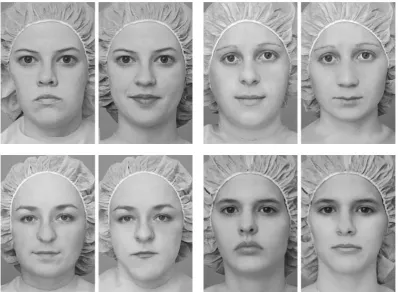
A further possibility is that observers are detecting emotion cues in some of the ostensibly
‘neutral’ faces used to construct facial composites (Figure 5). When posing for photos, actors
seeking to appear neutral may appear anxious or bored. Moreover, it is not always easy to
distinguish a stranger’s permanent facial shape from their transient facial expressions; e.g.,
whether an unfamiliar actor is scowling or simply has narrow eyes (e.g., Todorov, Said,
Engell, & Oosterhof, 2008). Crucially, observers may therefore perceive emotion where
actors do not intend to convey emotion. It is well established that facial emotions induce
strong composite effects (Calder et al., 2000; Palermo et al., 2011; Tanaka et al., 2012).
23 effects when observers are asked to judge whether target regions are, or are not identical
(e.g., in original or complete matching paradigms). Interestingly, gaze direction – known to
modulate the perception of facial emotion; for example direct gaze makes expressions appear
angrier (Adams & Kleck, 2003, 2005) – has been found to influence the magnitude of
composite effects measured using the original matching design (S. G. Young, Slepian,
Wilson, & Hugenberg, 2014). We also note that a study employing the original matching
procedure recently found composite effects with expressive body postures (Willems et al.,
2014), suggestive of holistic coding of body posture. In contrast, authors have failed to
[image:24.595.99.498.273.565.2]observe composite effects with neutral bodies (e.g., Soria Bauser, Suchan, & Daum, 2011).
Figure 5: Examples of facial composites taken from a commonly used stimulus set developed by Le Grand et al. (2004). While the composites are constructed with ostensibly neutral faces, subtle emotion cues are present in many of the faces.
7.5 The nature of holistic information representation
The composite face illusion is frequently attributed to whole-face processing (see Section
6.1). However, surprisingly little is known about the nature of the integrated representations derived from this analysis. At least two lines of evidence suggest that current ‘holistic’ and ‘configural’ accounts may be under-specified. First, observers’ face recognition is
24 recognise faces stretched to twice their true height (Hole, George, Eaves, & Rasek, 2002).
Whole-face processing is thought to mediate accurate and efficient description of the spatial
relationships between features (see Rossion, 2008). However, such findings suggest that
spatial relations may be coded relatively – for example, the height of one feature may be
described through reference to the height of another – not through absolute metrics – where
horizontal and vertical distances are measured in units akin to degrees of visual angle (Burton
et al., 2015). Second, recent findings suggest that, in comparison to vertical information, the
horizontal information structure of faces contributes disproportionately to face recognition
(Dakin & Watt, 2009) and is disproportionately sensitive to orientation inversion (Goffaux &
Dakin, 2010). These findings raise the possibility that holistic representations may be
dominated by horizontal information. Composite face paradigms may offer researchers a way
to test these hypotheses.
7.6 Dynamic Face Processing
While the overwhelming majority of existing research has examined the composite face
illusion using static faces, the faces we typically encounter outside of the lab are moving
(O'Toole, Roark, & Abdi, 2002). A recent study employing the naming paradigm found that
the presence of an aligned dynamic distractor impairs identification of dynamic target halves,
learned beforehand (Favelle, Tobin, Piepers, Burke, & Robbins, 2015). Importantly,
composite interference is diminished when the dynamic halves are misaligned or presented
upside-down. Similarly, when asked to judge the speed of eye opening and closing
movements, the presence of task-irrelevant mouth opening and closing induces illusory
slowing of the eye changes (Cook, Aichelburg, & Johnston, 2015). Interestingly, this
illusion-induced interference is only seen in upright dynamic faces, at particular relative-phase
relationships. Whereas static composite effects are disrupted by spatial misalignment,
phase-specificity suggests that dynamic integration may be sensitive to temporospatial alignment.
It is important that future research addresses the relationship between composite interference
seen with dynamic faces and the recognition of moving faces. The presence of motion cues
often improves facial recognition (Knight & Johnston, 1997; Lander, Christie, & Bruce,
1999). However, observers’ ability to use motion cues is sensitive to orientation, suggestive
of holistic or configural representation (Hill & Johnston, 2001; Knight & Johnston, 1997).
Interestingly, observers with ASD are relatively poor at recognising individuals’ facial
25 susceptibility to the illusory slowing induced by dynamic cross-feature interactions (Shah,
Bird, & Cook, 2016). Moreover, the relationship between the dynamic and static composites
remains unclear; while both illusions exhibit sensitivity to alignment and orientation, it is
uncertain whether they are products of common processes or representations.
8. Conclusion
Results obtained from composite face procedures have contributed significantly to our
understanding of holistic face processing, the detrimental effects of inversion, and aberrant
face perception in clinical populations. The ongoing value of the paradigm is illustrated by its
recent application to investigate dynamic face processing. However, composite procedures
have been the subject of intense scrutiny, particularly over the last decade, and there is a
growing sense that the composite face illusion, whilst easy to illustrate, is deceptively
difficult to measure and interpret. Considerable debate has focussed on the use of original and
complete designs (Richler & Gauthier, 2014; Richler et al., 2012; Rossion, 2013), control
conditions (McKone et al., 2013), the analyses employed (DeGutis et al., 2013), and the
effects of strategic and contextual factors (Richler, Wong et al., 2011). We have suggested
that inter-stimulus variability may also affect the susceptibility estimates obtained by
different authors and warrants greater consideration. Despite overarching disagreements on
how to refine the paradigm, the composite face effect remains a compelling and fascinating
visual illusion. As a tool, it still holds much potential in our investigation of how faces and
26
References
Abbas, Z. A., & Duchaine, B. (2008). The role of holistic processing in judgments of facial attractiveness. Perception, 37(8), 1187-1196.
Adams, R. B., & Kleck, R. E. (2003). Perceived gaze direction and the processing of facial displays of emotion. Psychological Science, 14(6), 644-647.
Adams, R. B., & Kleck, R. E. (2005). Effects of direct and averted gaze on the perception of facially communicated emotion. Emotion, 5(1), 3-11.
Avidan, G., Tanzer, M., & Behrmann, M. (2011). Impaired holistic processing in congenital prosopagnosia. Neuropsychologia, 49(9), 2541-2552.
Axelrod, V., & Rees, G. (2015). Conscious awareness is required for holistic face processing.
Consciousness and Cognition, 27, 233-245.
Bartlett, M. S., Movellan, J. R., & Sejnowski, T. J. (2002). Face recognition by independent component analysis. IEEE Transactions on Neural Networks, 13(6), 1450-1464.
Barton, J. J., Keenan, J. P., & Bass, T. (2001). Discrimination of spatial relations and features in faces: Effects of inversion and viewing duration. British Journal of Psychology, 92(3), 527-549.
Baudouin, J. Y., & Humphreys, G. W. (2006). Configural information in gender categorisation.
Perception, 35(4), 531-540.
Behrmann, M., & Avidan, G. (2005). Congenital prosopagnosia: face-blind from birth. Trends in Cognitive Sciences, 9(4), 180-187.
Behrmann, M., Thomas, C., & Humphreys, K. (2006). Seeing it differently: visual processing in autism. Trends in Cognitive Sciences, 10(6), 258-264.
Biederman, I., & Kalocsais, P. (1997). Neurocomputational bases of object and face recognition.
27 Boggan, A. L., Bartlett, J. C., & Krawczyk, D. C. (2012). Chess masters show a hallmark of face
processing with chess. Journal of Experimental Psychology: General, 141(1), 37-42.
Bortolon, C., Capdevielle, D., & Raffard, S. (2015). Face recognition in schizophrenia disorder: A comprehensive review of behavioral, neuroimaging and neurophysiological studies.
Neuroscience and Biobehavioral Reviews, 53, 79-107.
Bukach, C. M., Bub, D. N., Gauthier, I., & Tarr, M. J. (2006). Perceptual expertise effects are not all or none: Spatially limited perceptual expertise for faces in a case of prosopagnosia. Journal of Cognitive Neuroscience, 18(1), 48-63.
Bukach, C. M., Phillips, W. S., & Gauthier, I. (2010). Limits of generalization between categories and implications for theories of category specificity. Attention, Perception, & Psychophysics, 72(7), 1865-1874.
Burton, A. M., Schweinberger, S. R., Jenkins, R., & Kaufmann, J. M. (2015). Arguments against a configural processing account of familiar face recognition. Perspectives on Psychological Science, 10(4), 482-496.
Busigny, T., Joubert, S., Felician, O., Ceccaldi, M., & Rossion, B. (2010). Holistic perception of the individual face is specific and necessary: evidence from an extensive case study of acquired prosopagnosia. Neuropsychologia, 48(14), 4057-4092.
Busigny, T., Van Belle, G., Jemel, B., Hosein, A., Joubert, S., & Rossion, B. (2014). Face-specific impairment in holistic perception following focal lesion of the right anterior temporal lobe.
Neuropsychologia, 56, 312-333.
Calder, A. J. (2011). Does facial identity and facial expression recogniton involve separate visual routes? In A. J. Calder, G. Rhodes, J. V. Haxby & M. H. Johnson (Eds.), The Oxford Handbook of Face Perception Oxford, UK: Oxford University Press.
Calder, A. J., Burton, A. M., Miller, P., Young, A. W., & Akamatsu, S. (2001). A principal component analysis of facial expressions. Vision Research, 41(9), 1179-1208.
28 Calder, A. J., Young, A. W., Keane, J., & Dean, M. (2000). Configural information in facial
expression perception. Journal of Experimental Psychology: Human Perception Performance, 26(2), 527-551.
Carey, S., & Diamond, R. (1994). Are faces perceived as configurations more by adults than by children? Visual Cognition, 1, 253-274.
Cassia, V. M., Picozzi, M., Kuefner, D., Bricolo, E., & Turati, C. (2009). Holistic processing for faces and cars in preschool-aged children and adults: evidence from the composite effect.
Developmental Science, 12(2), 236-248.
Cheung, O. S., Richler, J. J., Palmeri, T. J., & Gauthier, I. (2008). Revisiting the role of spatial frequencies in the holistic processing of faces. Journal of Experimental Psychology: Human Perception and Performance, 34(6), 1327-1336.
Cook, R., Aichelburg, C., & Johnston, A. (2015). Illusory feature slowing: evidence for perceptual models of global facial change. Psychological Science, 26(4), 512-517.
Cook, R., & Biotti, F. (2016). Developmental prosopagnosia. Current Biology, 26(8), R312-R313.
Cottrell, G. W., Branson, K. M., & Calder, A. J. (2002). Do expression and identity need separate representations. Paper presented at the Proceedings of the 24th Annual Conference of the Cognitive Science Society.
Curby, K. M., Johnson, K. J., & Tyson, A. (2012). Face to face with emotion: holistic face processing is modulated by emotional state. Cognition & Emotion, 26(1), 93-102.
Dakin, S. C., & Watt, R. J. (2009). Biological "bar codes" in human faces. Journal of Vision, 9(4), 2.
de Heering, A., Houthuys, S., & Rossion, B. (2007). Holistic face processing is mature at 4 years of age: Evidence from the composite face effect. Journal of Experimental Child Psychology, 96(1), 57-70.