COMMISSION OF THE EUROPEAN COMMUNITIES
Brussels, 12.7.2006
SEC(2006) 912
COMMISSION STAFF WORKING DOCUMENT
Annex to the
2005 Report from the Commission on the protection of the European Communities’
financial interests and the fight against fraud
Follow-up of the Commission action plan 2004-2005 - Implementation of Article 280 of
the Treaty by the Member States in 2005
TABLE OF CONTENTS
Follow-up of the Commission action plan 2004-2005... 4
Implementation of Article 280 of the EC treaty by the Member States in 2005... 18
INTRODUCTION... 18
1.
Legal instruments that give effect to article 280 of the ec treaty — principal
developments... 19
1.1. Horizontal
developments: ... 19
1.2.
Own resources (including VAT):... 24
1.3.
Agricultural expenditure (expenditure financed by EAGGF - Guarantee Section):.. 29
1.4. Structural
operations: ... 34
1.5.
Description of key developments:... 39
1.6.
Complementary measures for the protection of the Community Financial Interests. 50
2.
RECOVERY OF SUMS UNDULY PAID OR NOT COLLECTED BY THE
COMMUNITIES IN THE FIELD OF INDIRECT EXPENDITURE... 53
2.1. Preliminary... 53
2.2.
The administrative recovery procedure (or procedure for recovering amounts
wrongly paid) ... 70
2.3. Enforcement ... 70
2.4.
The administrative contentious procedure ... 87
2.5.
Priority given to public claims ... 95
2.6. Offsetting... 101
3.
THE DAS PROCEDURE (STATEMENT OF ASSURANCE BY THE MEMBER
STATES) FOR CERTIFYING THE PROPER MANAGEMENT OF PUBLIC
EXPENDITURE IN THE MEMBER STATES ... 108
3.1.
Certification of national funds ... 108
3.1.1. By an internal body ... 108
3.1.2. By an external body ... 112
3.2.
Control of Community funds (jointly managed funds)... 120
3.2.1. EAGGF Guarantee Section... 120
COMMISSION STAFF WORKING DOCUMENT
This document is intended to accompany the Commission’s Annual Report for the year 2005
1on the protection of the European Communities’ financial interests and fight against fraud
which is drafted in accordance with Article 280 of the Treaty.
The first part contains a detailed description of the implementation of the 2004-2005 Action
Plan for the protection of the Communities’ financial interests and the fight against fraud in
2005. The Action Plan defines the priority actions for the protection of the Community’s
financial interests which are intended to implement the first phase of the overall strategic
approach 2001-2005 adopted in June 2000. In the second section the services of the
Commission make available all the answers given by the Member States to a questionnaire
sent to them in preparation for the 2005 Annual Report on the Protection of the Financial
Interests of the Member States.
F
OLLOW-
UP OF THEC
OMMISSION ACTION PLAN2004-2005
In the strategic global approach adopted in the 28
th ofJune 2001
2, the Commission has established the political objectives for the period 2001-2005. The
Commission has identified 4 priority actions for the protection of the Community’s financial interests:
- a global legislative anti-fraud policy;
- a new cooperation culture;
-an interinstitutional action for the prevention and fight against corruption;
-the reinforcing of the dimension of the penal field
The implementation of the global strategy has been achieved in the action plan 2001-2003
3and 2004-2005
4.
The following table presents the objectives implementing actions foreseen in the 2004-2005 action Plan.
OBJECTIVES Measure LEAD DEPT.5 IMPLEMENTATION AND FOLLOW-UP
1. AN OVERALL ANTIFRAUD LEGISLATIVE POLICY
1.1. DEVELOPING A CULTURE OF PREVENTION AND TIGHTENING UP LEGAL TEXTS
Consolidation of the structure and functions of OLAF by reinforcement of its legal framework
Proposals for amendment of Regulations No 1073 and 1074/1999.
OLAF, SG Action completed.
Proposals for amendment of Regulations No 1073 and 1074/1999 have been adopted by the Commission6.
2 Communication from the Commission (COM/2000/358/Final, 28.6.2000). 3 Communication from the Commission (COM/2001/254/Final, 15.5.2001).
The Commission is preparing a consolidated proposal.
Cooperation between the Community and the Member States to protect the Communities’ financial interests.
Extension of cooperation mechanisms, exchange of information and assistance to new areas, especially to money laundering and VAT fraud
Proposal for a Regulation based on Article 280 of the EC Treaty on mutual administrative assistance, especially on money laundering and VAT fraud.
OLAF, TAXUD, MARKT, JAI
Action completed.
Adoption of the proposal by the Commission7.
Assessment of Regulations No. 1469/1995 and No. 745/1996 8
(Black list mechanism in EAGGF-Guarantee Section)
Second report on the application of Regulation (EC) No 1469/95 (“black list”) in the EAGGF-Guarantee Section.
Proposal for amendment of the regulations concerned. Examination of their field of application.
OLAF,
AGRI, SJ Action postponed to 2006.
Adoption of the second report from the Commission to the European Parliament and the Council on the on the application of Regulation (EC) No 1469/95 (“black list”)9.
Defining OLAF’s objectives, taking into account the strategic guidelines and the contributions of the Institutions in the field of anti-fraud action
Preparation of a Commission communication on the main themes for strategic anti-fraud guidelines.
OLAF Action temporarily withdrawn as far as the Commission communication is concerned.
OLAF defines yearly its objectives in line with the SPP-ABM cycle and it reports on its achievements.
6 COM (2004) 103 and 104 final of 10.02.2004. 7 COM (2004) 509 final of 20.7.2004.
Definitive setting-up of the European Technical and Scientific Centre (ETSC) to finalise Council Decisions 2003/861 and 862/EC
10
Commission decision. OLAF,
ECFIN
Action completed. The European Technical and Scientific Centre (ETSC) is established within the Commission, attached to the European Anti-fraud Office (OLAF)11.
The ETSC shall analyse and classify every new type of counterfeit euro coin in line with the provisions of Article 5 of Regulation (EC) 1338/2001. It contributes to the fulfilment of the objectives of the ‘Pericles’ programme pursuant to Article 4 of Council Decision 2001/923/EC of 17 December 2001. It assists the Coin National Analysis Centres (CNAC) and the law-enforcement authorities; and collaborates with the relevant authorities in the analysis of counterfeit euro coins and the strengthening of the protection.
Continuation and adaptation of the training, exchange and assistance action programme for the protection of the euro against counterfeiting (PERICLES programme12 )
Evaluation of the PERICLES programme with a view to a new legislative proposal.
Communication on the adaptation of the PERICLES programme.
Proposal for a Council Decision amending and extending the Council Decision of 17/12/2001 (PERICLES programme).
OLAF Action completed. Communication on the he implementation and continuation of the PERICLES programme13.
Adoption of a proposal for a Council Decision amending and extending Council Decision of 17/12/2001 establishing an exchange, assistance and training programme for the protection of the euro against counterfeiting (the "PERICLES" programme)14, proposal for a Council Decision extending to the
non-participating Member States15.Adoption by the Council the
30.1.200616.
10 Council Decisions of 8 December 2003 Nos. 2003/861/EC and 2003/862/EC (OJ L 325, 12.12.2003) 11 Commission decision of 29 October 2004 (2005/37/CE).
12 Council Decisions of 17 December 2001 Nos. 2001/923/EC and 2001/924/EC (OJ L 339, 21.12.2001). 13 COM (2005) 127/F3-1.
1.2. STRENGTHENING MEANS OF DETECTION, CONTROLS AND SANCTIONS
Clarification of fraud investigation powers at Community level, particularly in the area of direct expenditure
Proposals for amendment of Article 3(2) of Regulations 1073 and 1074/1999.
OLAF, SG Action completed. Proposals for amendment of Regulations No 1073 and 1074/1999 have been adopted by the Commission17.
The Commission is preparing a consolidated proposal.
Extension of the administrative penalty system to the following areas:
- customs
- direct expenditure
- structural funds
Preliminary examination with a view to including administrative penalties in the regulations concerned.
Examination of the need for a specific regulation on fraud and irregularities in connection with contracts involving Community financing
TAXUD, SJ, REGIO, EMPL, AGRI, FISH, OLAF
Action partially completed. Proposal for a Regulation of the European Parliament and the Council laying down the Community Customs Code18.
The new Financial Regulation (Council Regulation No 1605/2002) provides for the possibility to impose administrative and financial penalties against candidates, tenderers or contractors.
- OLAF investigations (resistance to checks)
Proposals for amendment of Article 6(6) of Regulations 1073 and 1074/1999.
OLAF, SG Action completed. Proposals for amendment of Regulations No 1073 and 1074/1999 have been adopted by the Commission19.
The Commission is preparing a consolidated proposal.
Technical guidelines for competent authorities in the Member States which may wish to carry out or supervise the process of authenticating euro coins on their territory.
Commission recommendation on methods of authenticating euro coins.
OLAF Action completed. Commission recommendation of 27 May 2005 concerning authentication of euro coins and handling of euro coins unfit for circulation20.
17 COM (2004) 103 and 104 final of 10.02.2004. 18 COM (2005)608/final of 30.11.2005.
1.3. ENSURE A MORE EFFECTIVE MANAGEMENT OF ADMINISTRATIVE AND FINANCIAL FOLLOW-UP
Improvement of the recovery of sums wrongly paid (EAGGF-Guarantee Section, Regulation No. 1258/199921 ).
Proposal for amendment of Regulation
No. 1258/1999, on financing of the CAP. AGRI, OLAF Action a single legal framework for financing the common agricultural completed. The purpose of this proposal is to establish policy.
To that end, this proposal sets up two Funds:
- European Agricultural Guarantee Fund (EAGF)
- European Agricultural Fund for Rural Development (EAFRD)
This Regulation creates the legal bases for financing the different measures covered by those two Funds, including the technical assistance necessary for the establishment and monitoring of the CAP22.
Handling the backlog of irregularities reported before 1.1.1999 under Regulation No. 595/1991 23 (EAGGF/Guarantee
Section). Recovery Task Force 24
Conclusion of work. OLAF, AGRI Action ongoing. The Task Force Recovery (TFR) continued its activities in 2005 in order to solve the backlog of all non recovered amounts of irregularity cases communicated before 1999.
In 2005 with assistance of the TFR the formal bilateral meetings in the Clearance of Account procedures with all nine member states involved have been completed in order to define the financial liability for the non recovery for a total financial impact of ca. 765 million €. The TFR has also processed the information on 32 “missing” cases exceeding 500.000€ each not audited before. “Article 8 letters” with the proposal on the financial liability for 92 million € have been sent by DG AGRI to all Member States involved.
21 Council Regulation (EC) No 1258/99 of 17.5.99 (OJ L 160, 26.6.99). 22 COM (2004) 489 Final
The “SAGE” (Système Automatisé de Gestion et Evaluation) application for in total ca. 3.250 remaining “smaller” cases (each under 500.000€) from before 1999 and a non recovered amount of ca. 200 million € has been completed by all Member States and returned to the TFR (electronic datasets and hardcopy checklists).
OBJECTIVES Measure LEAD DEPT. IMPLEMENTATION AND FOLLOW-UP
2. NEW CULTURE OF COOPERATION
2.1. ENHANCED USE AND ANALYSIS OF INFORMATION (“INTELLIGENCE”)
Developing operational cooperation between customs administrations. Setting up the FIDE (Customs Investigations Information Files)
Proposal for amendment of Regulation No 515/97 26
Reinforced coordination to support and manage joint operations.
OLAF,
TAXUD, JAI Postponed to 2006.
Simplifying the procedure for notifying irregularities based on Regulation (EC) No 1681/9427
concerning the Structural Funds
Proposal for amendment of Regulation
No 1681/1994 OLAF, DGs authorising
Structural Funds
Action completed. Adoption of Commission Regulation (EC) No 2035/200528
Simplifying the procedure for notifying irregularities based on Regulation (EC) No 1831/94 29
concerning Cohesion Funds
Proposal for amendment of Regulation No 1831/1994
OLAF, REGIO
Action completed. Adoption of Commission Regulation (EC) No 2168/200530
Simplifying the procedure for notifying irregularities based on
Regulation (EC) No 595/91
Proposal for amendment of Regulation No 595/1991
OLAF, AGRI Postponed to 2006.
25 Règlement (CE) N° 2035/2005 de la Commission du 12 décembre 2005 « modifiant le Règlement (CE) N° 1681/94 concernant les irrégularités et le recouvrement des
sommes indûment versées dans le cadre du financement des politiques structurelles ainsi que l'organisation d'un système d'information dans ce domaine », JO L328 du 15.12.2005.
26 Council Regulation (EC) No 515/97 of 13.03.97 - OJ L 082, 22.03.97. 27 Commission Regulation (EC) No 1681/94 of 11.07.94 - OJ L 178, 12.07.94.
28 Règlement (CE) N° 2035/2005 de la Commission du 12 décembre 2005 « modifiant le Règlement (CE) N° 1681/94 concernant les irrégularités et le recouvrement des
sommes indûment versées dans le cadre du financement des politiques structurelles ainsi que l'organisation d'un système d'information dans ce domaine », JO L328 du 15.12.2005.
29 Commission Regulation (EC) No 1831/94 of 26.07.94 - OJ L 191, 27.07.94.
concerning EAGGF-Guarantee expenditure
2.2. DEVELOPING A CLOSER PARTNERSHIP WITH MEMBER STATES AND NON-COMMUNITY COUNTRIES
Strengthening relations with Member States
Update of Commission Decision 94/140/
/EC31 establishing the COCOLAF. OLAF, SG, SJ Action completed 32.
Improving information from Member States at Community level on the follow-up given to OLAF’s investigations
Proposals for amendment of Articles 9 (3) of Regulations N°s 1073 and 1074/1999.
SG, OLAF Action completed.
Proposals for amendment of Regulations No 1073 and 1074/1999 have been adopted by the Commission33.
The Commission is preparing a consolidated proposal.
Enhancing cooperation structures and exploitation of possibilities for synergy
Inventory of the services that the Commission/OLAF can provide to the institutions and Member States.
Implementation of multidisciplinary Service Platform
OLAF Action temporarily withdrawn.
Assistance to new Member States to reinforce their own capacities for fighting fraud
Implementation of Transition Facility funds (2004-2006) for the protection of the Community’s financial interests and the fight against fraud
Deployment of OLAF Regional Assistants in the new Member States
OLAF, ELARG
Action completed. 2004: transition facility project. Poland: 2004-016-829.01.09 CRIS, EU financial Interests’ protection; Slovenia: 2004-016-710.02.02 Public Internal Financial Control and antifraud coordination.
Reinforcement of anti-fraud coordination services in candidate countries
Ongoing assistance to Bulgaria and Romania through the Multi-Countries Anti-fraud PHARE Programme for the protection of PHARE financial interests
Assistance to anti-fraud coordination in the new candidate countries
Deployment of OLAF Regional Assistants in certain candidate countries
OLAF,
ELARG Action completed.
The PHARE multi-country anti-fraud programme targeted at protecting the Community’s financial interests for almost all events went ahead as planned and its implementation ended by year 2005 A Networking programme was put in place for Bulgaria and Romania.
OLAF contributed to the Inter-Service consultations on the establishment of the negotiating framework for Croatia and Turkey.
Establishment of two liaison officers of OLAF in the EU delegations in Romania and Bulgaria to help those countries strengthen their action as regards protection of the Communities’ financial interests.
Memoranda of understanding with candidate countries and third countries
Conclusion of administrative arrangements with Anti-fraud Coordination Services (AFCOS) of the candidate countries and, where appropriate, with competent services in third countries
OLAF Action ongoing.
Conclusion of administrative arrangements with Anti-fraud Coordination Services (AFCOS):
2004-2005: Romania, Poland, Lithuania, Malta.
Negotiations conducted with Switzerland on the fight against fraud
Conclusion of negotiations. OLAF,
RELEX Action completed
34.
The agreement binds the parties (EU and Swiss Confederation) to provide each other with full judicial and administrative assistance in all cases of fraud and other illegal activities, including customs and indirect taxation offences committed when trading goods and services.
Administrative cooperation and mutual assistance in customs matters with third countries
Negotiations of international mutual administrative assistance agreements in the customs area
OLAF, TAXUD, RELEX
Action completed.
Two agreements entered into force in 2004 and 2005, one with India on customs cooperation and mutual administrative assistance in customs matters35.
A protocol on mutual assistance between administrative authorities in customs matters between the EU and Mexico was adopted on 17-12-2001 by the council and entered into force on 01-01-2005.
Analysis, cooperation and information exchanges on matters relating to the euro with third countries
Inclusion of anti-counterfeiting clauses in cooperation and association agreements, pursuant to Article 9(2) of Regulation No 1338/200136
OLAF,
ECFIN The action is ongoing.
2.3. POLICY OF ONGOING EVALUATION OF ANTI-FRAUD ACTIONS
34 COM (2004) 559 Final. 35 OJ L 304 of 30-09-04
Inventory of new measures at Community and Member State level in 2003 and 2004
2003 and 2004 Annual Report Article
280(5) of the EC Treaty. OLAF Action completed
37.
Every year the Commission adopt a Report on the “Protection of the Communities financial interests – Fight against fraud” pursuant article 280 of the Treaty and reports on the measures taken by the member States to protect the Communities’ financial interests.
OBJECTIVES Measure LEAD DEPT.
3. AN INTERINSTITUTIONAL APPROACH TO PREVENT AND COMBAT CORRUPTION
3.1. DEVELOP A CULTURE OF COOPERATION AT ALL LEVELS
Possible definition of practical arrangements for cooperation between OLAF and other Commission departments
Examine the usefulness of adopting a memorandum of understanding (or another type of text)
OLAF, SG,
other services The action is ongoing and is expected to be completed in 2006. A draft memorandum of understanding has been prepared. Negotiations between OLAF and the Secretariat General were completed in October 2005, but the signature of the revised document was not possible until a decision was taken on appointment of OLAF’s Director General. The action is expected to be completed in 2006.
Facilitate the conducting of internal investigations within other institutions and bodies
Examine the usefulness of proposing protocols / memoranda of understanding with other institutions
OLAF, SG,
SJ Action ongoing.
Possible definition of practical arrangements for cooperation between OLAF and IDOC
Appropriateness of re-examining the memorandum of understanding agreed upon in 2003, in the light of recent developments.
OLAF, IDOC, ADMIN
Action completed38.
Improvement of transparency in the flow of information between OLAF and other DGs to assure an appropriate follow-up
Creation of high level interdepartmental group
SG, IDOC, ADMIN, IAS, (OLAF)
Action completed.
Creation of high level interdepartmental group to ensure that pertinent information is collected from all sources, analysed rapidly and communicated to the College39. The group meets
regularly, the first meeting was held on 17.2.2004.
3.2. IMPROVE THE LEGAL FRAMEWORK FOR ADMINISTRATIVE INVESTIGATIONS
Clarification of arrangements for performing internal/external investigations and related measures by precise rules
Proposals for amendment of Articles 6, paragraphs 7, 7(a) and 7(b) of Regulations N°s 1073 and 1074/1999
SG, OLAF Action completed.
Proposals for amendment of Regulations No 1073 and 1074/1999 have been adopted by the Commission40.
The Commission is preparing a consolidated proposal.
Compliance with and standardised application of information procedures with regard to the institutions, bodies and offices concerned and the persons involved
Proposals for amendment of Articles 6, paragraphs 5(a), 7(a) and 7(b) of Regulations N°s 1073 and 1074/1999
SG, OLAF Action completed.
Proposals for amendment of Regulations No 1073 and 1074/1999 have been adopted by the Commission41.
The Commission is preparing a consolidated proposal.
OBJECTIVES Measure LEAD DEPT. IMPLEMENTATION AND FOLLOW-UP
4. ENHANCEMENT OF THE CRIMINAL-LAW JUDICIAL DIMENSION
Reinforcement of the effectiveness of criminal prosecutions by establishing a European Public Prosecutor
Preparation of a White Book OLAF, JAI As the process of ratifying the Constitutional Treaty is still in progress, this action is temporarily withdrawn.
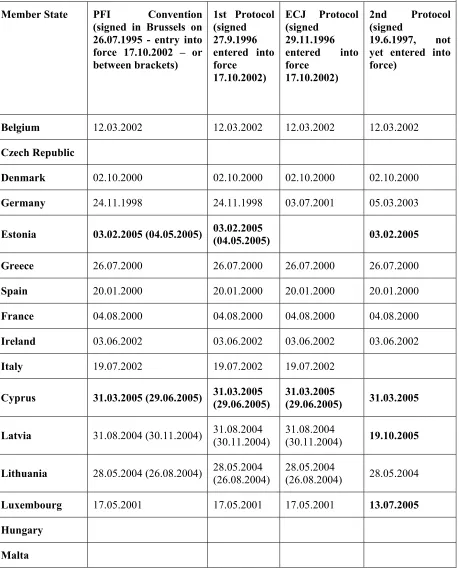
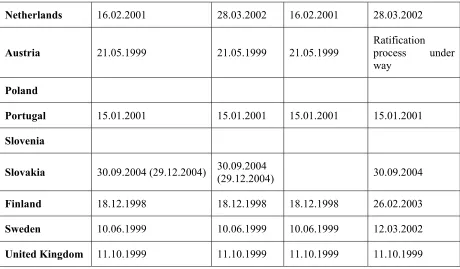
Follow up the application of the Convention and its protocols to the protection of the Community’s financial interests
Report on the implementation of the Convention by the Member States.
OLAF, JAI,
SJ Action completed
42.
Improvement of structured relations with Europol
Conclusion of a protocol OLAF,
Europol
Action completed.
Administrative agreement was signed by OLAF and Europol on April 8, 2004 in order to fight international organised crime in the context of fraud, corruption or any other criminal offence.
More specific the agreement indicates that OLAF and Europol should cooperate in areas of common interest, exchange strategic and technical information, cooperate in the field of intelligence and technical support, write common reports with mutual consultations, participate in joint investigation teams and cooperate in the field of professional training and working groups.
Development of the judicial dimension and the function of interlocutor of the police and judicial authorities
Establishment with Member States of a Practical Guide for cooperation with criminal prosecution authorities
OLAF Postponed to 2006.
IMPLEMENTATION OF ARTICLE 280 OF THE EC TREATY BY THE MEMBER STATES IN 2005
INTRODUCTION
The protection of the European Communities’ financial interests and the fight against fraud is an area in which responsibility is shared between the Community and the Member States. Consequently, each year the Commission draws up a report in cooperation with the Member States on the measures taken to implement this obligation, according to article 280 of the EC Treaty. This report is adressed to the European Parliament and the Council and is published.
The Commission bases its report on the measures taken by Member States on the replies to the “Article 280” questionnaire. This questionnaire covers the period from 1 January to 31 December 2005.
The present document lists all the answers of Member States to the 2005 questionnaire.
Over time the report had become more and more voluminous. Both the Council and the European Parliament were concerned that its size was increasing and that it’s being annual, horizontal and multisectoral hampered a detailed assessment of all the aspects of the protection of the Community's financial interests by the Member States. Since 2003, the Commission has therefore applied a new approach. After the traditional question asking Member States to report on new measures taken in 2005, the questionnaire focuses on a few major themes. The aim is to gather information on topics which go beyond the measures taken in the course of a calendar year, thereby allowing a more detailed analysis of these topics. The topics change from year to year.
As always, the first part of the questionnaire asks Member States to list the legal instruments that
give effect to Article 280, i.e. measures to combat fraud and all illegal activities affecting the financial
interests of the Community in the areas of own resources, agricultural expenditure and structural measures. The Member States has been asked to list only national measures and not those which simply transpose Community legislation, and to do so in brief so as to reduce the volume of the
staff
workingdocument
which incorporates
the replies from the 25 Member States. At the end of this first question, Member States have the opportunity of giving a more detailed description of a few measures which they consider to have been the most important in the calendar year.This year, the question on
own resources covers not just traditional own resources as in previous years but also VAT.
Some Member States indicated to have a reservation about the inclusion of VAT in the
questionnaire, so it has been agreed that it is open to Member States to answer this question.
Ireland declared in its answer that as a matter of principle, Ireland will not be responding to
the question in respect of VAT.
The second question concerns the recovery of sums unduly paid or not collected by the Communities.
In 2003 and 2004, the questionnaire focused on joining civil actions to criminal proceedings. The 2005 questionnaire is dealing with certain aspects of administrative and judicial recovery procedures, but not with joining civil actions.
The third part of the questionnaire addresses
the
procedures which exist in the Member States forcertifying the proper implementation of public expenditure. This question comes in the context of
1.
LEGAL INSTRUMENTS THAT GIVE EFFECT TO ARTICLE 280 OF THE EC TREATY —
PRINCIPAL DEVELOPMENTS1.1.
Horizontal developments:
Have there been any significant new legislative horizontal developments (not just implementing measures) contributing to the implementation of Article 280 of the Treaty in 2005? Member States are asked to list only measures adopted on their own initiative and not those which simply transpose Community legislation.
If so, please indicate below:
– the type of legal instrument (e.g. law, regulation, legislative decree),
– the references of the legal instrument (number/date of publication in Official Gazette, etc.),
– the legal instrument or code which it amends (if any),
– the title of the legal instrument or a brief description (no longer than one to two
sentences).
BE
With regard to customs, the law of 7 July 2005 (Moniteur Belge of 14 October 2005) approved the following international acts:1. The Convention, drawn up on the basis of Article K.3 of the Treaty on European Union, on the use of information technology for customs purposes, done at Brussels on 26 July 1995;
2. The agreement on the provisional application between certain Member States of the European Union of the convention drawn up on the basis of Article K.3 of the Treaty on European Union on the use of information technology for customs purposes, done at Brussels on 26 July 1995;
3. The Protocol, drawn up on the basis of Article K.3 of the Treaty on European Union, on the interpretation, by way of preliminary rulings, by the Court of Justice of the European Communities of the Convention on the use of information technology for customs purposes, done at Brussels on 29 November 1996;
4. The Protocol, drawn up on the basis of Article K.3 of the Treaty on European Union, on the definition of money-laundering in the Convention on the use of information technology for customs purposes and the inclusion of the registration number of the means of transport in the Convention, and the Declarations, done at Brussels on 12 March 1999.
1.1.
Horizontal developments:
Have there been any significant new legislative horizontal developments (not just implementing measures) contributing to the implementation of Article 280 of the Treaty in 2005? Member States are asked to list only measures adopted on their own initiative and not those which simply transpose Community legislation.
EL
Law 3316/2005 (Government Journal Issue 42/A/22.2.2005) governing the allocation
and performance of public contracts for conducting studies and rendering relevant
services, and other provisions.
Law 3310/2005 (Government Journal Issue 30/A/14.2.2005) governing the measures to
ensure the transparency and prevent infringements of the procedure for concluding
public contracts as amended by Article 12 of Law 3414/2005. The provisions of this
law are implemented in the procedure for concluding and performing public contracts,
with a view to ensuring transparency and healthy competition as well as strengthening
pluralism and the provision of objective information on equal terms. It amends Law
2328/2005 (Government Journal Issue 159/A).
Law 3296/2004 governing natural and legal persons’ income tax, tax inspection, and
other provisions, which established the Special Audit Service (YPEE) and abolished
the Economic Crimes Enforcement Agency (SDOE) set up by Law 2343/95
(Government Journal Issue 211/A/11.10.1995). Presidential Decree 85 (Government
Journal Issue 122/A/25.05.2005) governing the organisation of the YPEE, by which :
i) Two new regional business directorates (the Athens and Thessaloniki Special Affairs
Directorates) have been set up, which are coordinated by the Staff Directorate for
Special Affairs. There are units working in these directorates whose main responsibility
is to research and eradicate all forms of fraud in respect of the EU budget.
ii) Two new units have been added to the Administrative Support Directorate: a. The
International Cooperation and Mutual Assistance Unit, whose responsibility is the
coordination of the exchange of information and research within the framework of the
implementation of Regulation No 515/97 and bilateral and multilateral agreements on
customs cooperation; b. The Audit and Internal Audit Unit, whose responsibility is to
discover omissions and errors in the implementation of national and Community
legislation.
Law 3424/3.12.2005 (Government Journal Issue 305/A/13.12.2005) introduces
amendments to the legislation regarding money-laundering (amendment to Law
2331/1995 Government Journal Issue 173/A/24.08.1995). Besides the general focus on
criminal activities related to money-laundering, special attention is given, among other
aspects, to the protection of the EU’s economic interests.
1.1.
Horizontal developments:
Have there been any significant new legislative horizontal developments (not just implementing measures) contributing to the implementation of Article 280 of the Treaty in 2005? Member States are asked to list only measures adopted on their own initiative and not those which simply transpose Community legislation.
Agricultural Development and Food on the implementation of the regime of
cross-compliance and other supplementary measures in the performance of Council
Regulation No 1782/2003.
ES
Royal Decree 939/2005 of 29 July, adopting the General Collection Regulation (B.O.E.
of 2 September, which entered into force on 1 January 2006). See point 1.5.
Royal Decree 520/2005 of 13 May, adopting the general implementing Regulation of
General Tax Law 58/2003 of 17 December, regarding administrative review (B.O.E of
27/5/2005).
It lays down the main procedural aspects for the recovery of sums unduly paid.
Furthermore, it regulates economic and administrative claims, general economic and
administrative procedure, enforcement (general rules regarding administrative
decisions and special rules on the implementation of economic-administrative and
court decisions) and refund of guarantee costs.
The second additional provision determines its supplementary application to the refund
of unduly collected incomes from custom debts that will be governed in the first place
by EU law, and to the refund of other unduly collected public incomes.
Order 3987/2005 of 15 December, partially implementing the General Implementing
Regulation of General Tax Law 58/2003 of 17 December, regarding administrative
review.
It governs the adequacy requirements that must be met by surety and fidelity bond
insurances and other taxpayers’ personal or joint guarantee for them to be given as
guarantee with a view to obtaining a stay of execution of the challenged acts.
Resolution of 14 November 2005 on VAT, regulating the right to tax deduction of
grant recipients, pursuant to the European Court of Justice judgment
FR
Law No 2005-1549 of 12 December 2005 on dealing with criminal recidivism (Article
2): convictions handed down by the criminal courts in a Member State of the European
Union are now taken into consideration in case of recidivism under the French Code of
Criminal Procedure, in accordance with the provisions of this Law (Official Gazette
No 289 of 13 December 2005).
1.1.
Horizontal developments:
Have there been any significant new legislative horizontal developments (not just implementing measures) contributing to the implementation of Article 280 of the Treaty in 2005? Member States are asked to list only measures adopted on their own initiative and not those which simply transpose Community legislation.
criminal conduct. Crime/criminal conduct covers all forms of criminal behaviour
including fraud in relation to Own Resources. An explicit power to search for cash at
points of entry/exit from the State is also provided under the legislation.
IT
Act No 11 of 4 February 2005 laying down general rules on Italy’s participation in the
European Union’s legislative process and on procedures for complying with
Community obligations (Official Gazette No 37, 15 February 2005), modified the
process of transposing legislation adopted by the institutions of the European
Communities, the European Union and the Court of Justice of the European
Communities. Article 280 of the EC Treaty will now be implemented by means of
these new provisions.
Section 3 of Act No 62 of 18 April 2005 on provisions for complying with obligations
deriving from Italy’s membership of the European Community (2004 Community Law
Act, Official Gazette No 96, 27 April 2005), gave the Government powers to punish
violations of Community law, while, with the aim of simplifying legislation, section 5
granted the Government powers to amend laws on matters covered by Community law.
Under section 1(533) of Act No 266 of 23 December 2005 on rules for drawing up the
national annual and multi-annual budgets (the 2006 Budget Act, Official Gazette No
302, 29 December 2005), “To receive Community grants and investment aid
companies in all sectors shall be required to produce certification to the effect that
contributions have been paid as required under section 2(2) of Decree Act No 210 of 25
September 2002, as converted into law and amended by Act No 266 of 22 November
2002.”
LV
The Law “Amendments of the Criminal law” adds to the Criminal law Article 1771
„Fraud in an Automated Data Processing System” which defines liability of a person
who knowingly enters false data into an automated data processing system for
acquisition of the property of another person or rights to such property, or acquisition
of other material benefits, in order to thereof influence the operation of resources.
Article 177 „Fraud” of the Criminal law defines liability of a person who acquires
property of another person, or rights to such property, by the use, in bad faith, of trust,
or by deceit (fraud).
Article 178 „Insurance Fraud” of the Criminal law defines liability of a person who
commits intentional destruction, damage or concealment of their property for the
purpose of receiving insurance money.
1.1.
Horizontal developments:
Have there been any significant new legislative horizontal developments (not just implementing measures) contributing to the implementation of Article 280 of the Treaty in 2005? Member States are asked to list only measures adopted on their own initiative and not those which simply transpose Community legislation.
HU
Government Decree No. 55/2005 (III.26.) on the recovery procedure of governmental
assistance deriving from or related to the European Union’s resources used illegally,
improperly or contrary to an agreement is new legislation. See point 1.5.
MT
Counterfeiting of the Euro is sanctioned by Articles 49-49F of the Central Bank Act.
AT
The Legal Persons’ Liability Act (Verbandsverantwortlichkeitsgesetz - VbVG), BGBl I
No 151/2005. See point 1.5.
PT
Law No 55-B/2004 of 30 December 2004 (State budget for 2005): amends Article 63.B
of the General Tax Act, approved by Decree-Law No 398/98 of 17 December 1998, on
access to bank data and documents and, more specifically, the administration's
exemption from banking secrecy rules. The amended article stipulates that the tax
authorities are entitled to access any banking data or documents without the consent of
the data subject where there is evidence that a tax-related crime has been committed
and where there is specific evidence that false declarations have been made.
SI
The Tax Administration Act (Official Gazette of the Republic of Slovenia, Nos
57/2004, 139/2004, 59/2005), No 516/24.2.2005/17; brought into effect a new tax
administration task – the performance of "tax investigations," and defined the concept
of a tax investigation as the implementation of acts and measures when there are
grounds for suspicion that a violation of taxation regulations has been committed.
SK
Act No. 300/2005 Coll., the Penal Act, as amended by Act No. 650/2005 Coll. of 2
July 2005, published in section 129/2005 of the Collection of Acts of the Slovak
Republic.
Act No. 301/2005 Coll., the Penal Code, as amended by Act No. 650/2005 Coll. of 2
July 2005, published in section 130/2005 of the Collection of Acts of the Slovak
Republic.
The Penal Act and the Penal Code are principle regulations of substantive and
procedural law for penal law in the Slovak Republic, whereas damage to the financial
interests of the European Communities is arranged as a separate body of a crime
(Section 261 of Act No 300/2005, the Penal Act, as amended by Act No 650/2005
Coll.), for which a punishment of imprisonment for 6 months to 12 years can be
imposed. Hearings and judgements are in the competence of a Special Court (Section
14 of the Penal Code).
Act No 372/1990 Coll. on offences, as amended by Act No 650/2005 Coll.
1.1.
Horizontal developments:
Have there been any significant new legislative horizontal developments (not just implementing measures) contributing to the implementation of Article 280 of the Treaty in 2005? Member States are asked to list only measures adopted on their own initiative and not those which simply transpose Community legislation.
amended by Act No 331/2005 Coll., of 10 December 2004, published in section
276/2004 of the Collection of Acts of the Slovak Republic;
Act No 199/2004 Coll. on customs and amendments to some acts (the Customs Act)
was amended; this act established the Customs Crime Authority with applicability from
1 January 2005 (Section 11 of Act No 652/04 Coll.), which fulfils tasks in the area of
combating infringement of customs regulations or tax regulations and secures other
tasks concerning prevention of illegal actions endangering the interests of the European
Communities.
Act No 626/2005 Coll., amending Act No 473/2003 Coll. on the Agriculture Payment
Agency, on support for agricultural trading, published in section 245/2005 of the
Collection of Acts of the SR on 29 December 2005 (the amendment only relates to
application of sanctions for infringement of the prohibition on illegal employment).
1.2.
Own resources (including VAT):
Have there been any significant new legislative developments (not just implementing measures) contributing to the implementation of Article 280 of the Treaty in 2005? Member States are asked to list only measures adopted on their own initiative and not
those which simply transpose Community legislation
.
If so, please indicate below:
– the type of legal instrument (e.g. law, regulation, legislative decree),
– the references of the legal instrument (number/date of publication in Official Gazette, etc.),
– the legal instrument or code which it amends (if any),
– the title of the legal instrument or a brief description (no longer than one to two
sentences).
BE
1) The following were the most significant new developments concerning own resources legislation in 2005:1.2.
Own resources (including VAT):
Have there been any significant new legislative developments (not just implementing measures) contributing to the implementation of Article 280 of the Treaty in 2005? Member States are asked to list only measures adopted on their own initiative and not
those which simply transpose Community legislation
.
2005 –2nd edition) introduced a measure to combat abuse of the law in the field of VAT.
It was felt that there was good reason to introduce a specific VAT provision, similar to what is provided for in Article 344 of the income tax code 92, incorporating into national law the concept of abuse of law in cases where the sole purpose of the legal status given by the parties to an act or several different acts executing the same transaction, even if this transaction is genuinely intended and performed, was to avoid VAT.
Article 128 of the aforementioned law inserts into Article 59 of the VAT code a paragraph (3) to read as follows:
“The authorities will not accept the legal status given by the parties to an act or to several different acts executing a single transaction where they have evidence, by presumption or other means of evidence provided for in paragraph (1), that the sole purpose of this legal status is to avoid VAT, unless the taxable person proves that this status is justified on the grounds of legitimate financial or economic needs”.
The aim of this new provision is to combat manoeuvres whose sole purpose is to avoid VAT by means of legal combinations, and to enable the authorities to be certain that VAT due or deductible is based on the normal legal status that should be assigned to the transaction performed between the parties.
However, since these are cases of tax avoidance, there is no infringement of the law and there can be no question of refusing the taxable person the right to opt for whichever solution carries the lightest tax burden.”
This provision applies to acts concluded from 1 November 2005.
2) The law of 10 August 2005 introduced a new Article 93 undecies (B) in the VAT 2 Code
aimed at combating the organisation of insolvency in cases of fraudulent assignment of a set of assets.
This article states that:
“(1). Without prejudice to the application of Articles 93ter to 93 decies, the assignment of ownership, or beneficial ownership, of a set of assets, including assets needed in order to retain clients, relating to exercise of a profession, responsibility or office or an industrial, commercial or agricultural business, or the assignment of beneficial ownership of these assets, can only be accepted by the collector at the end of the month following that in which an authenticated copy of the act was submitted to the collector responsible for the assignor’s domicile or registered office.
1.2.
Own resources (including VAT):
Have there been any significant new legislative developments (not just implementing measures) contributing to the implementation of Article 280 of the Treaty in 2005? Member States are asked to list only measures adopted on their own initiative and not
those which simply transpose Community legislation
.
assignment before the expiry of this time.
(3). (1) and (2) shall not be applicable if the assignor attaches to the deed of assignment a certificate issued solely for this purpose by the collector referred to in (1) within the thirty days before notification of the creditors’ arrangement is given.
This certificate shall only be issued if the assignor submits a request in two copies to the collector responsible for the assignor’s domicile or registered office.
The certificate will not be issued by the collector if, at the date of the request, the assignor owes any taxes, interest, tax fines or additional payments or if the request is submitted after an inspection has been announced, during an inspection or after the assignor has sent a request for information on his tax situation.
The collector must either issue the certificate or refuse to grant it within thirty days after the request is submitted by the assignor.
(4) This article shall not apply to assignments made by a receiver, liquidator or as part of a merger transaction, an unbundling transaction, or the assignment of a totality of assets or of an activity carried on in accordance with the Companies Code.
(5) The request and the certificate referred to in this article must be submitted using the standard models specified by the ministry responsible for finance.”
The aim of this new provision is, firstly, to prevent a natural or legal person from transferring his business assets without settling his VAT debts and, secondly, to prevent the fraudulent procedure whereby certain tax debtors hastily sell off their business assets as soon as they become aware that their tax situation is subject to special scrutiny.
Circular No AREC 7/2005 (IR/I-1/76.268) of 05.12.2005, which is posted on the Fisconet site Federal Public Service for Finance comments on the new provision.
EL
1) Document No Ε799/857/Α0034/4.03.05 giving instructions to the customs authorities toaudit and make good any irregularities in their old cases in order to assess the related tariffs and fines inside the scheduled deadlines and prevent them from lapsing.
2) Document No L 159/32/A0034/8.06.05 giving instructions to the customs authorities to
audit the documentation of own resources in the B accounts and to confirm that fraud and irregularity forms have been drawn up for documents above €10 000, as specified in Article 6(5) of Regulation No 1150/00.
3) Document No Ε1976/726/Α0034/21.11.05 giving instructions to the customs authorities to
1.2.
Own resources (including VAT):
Have there been any significant new legislative developments (not just implementing measures) contributing to the implementation of Article 280 of the Treaty in 2005? Member States are asked to list only measures adopted on their own initiative and not
those which simply transpose Community legislation
.
IE
With regard to VAT, it was agreed at the Cocolaf meeting in October 2005, that it is open to Member States not to answer this question. Ireland has already indicated its reservation about the inclusion of VAT in this questionnaire. Ireland continues to maintain this reservation. As a matter of principle, Ireland considers that all tax matters must be taken under unanimity. As such, Ireland will not be responding to this question in respect of VAT.IT
Act No 248 of 2 December 2005 amending and converting into law Decree Act No 203 of30 September 2005 on measures to combat tax evasion and urgent tax and financial measures (Official Gazette No 281, 2 December 2005), stepped up the fight against tax evasion by involving the local authorities and supporting the work of the Revenue Agency, the Customs Service and the Guardia di Finanza by increasing their powers of investigation and enforcement.
LV
The amendments made to the Law on VAT adopted on 20 October 2005 were made in order to: 1) specify the definition of “a person taxable with the value added tax”; 2) to specify the procedure how persons are registered in and excluded from the State Revenue Service Register of Value Added Tax Taxable Persons; 3) define responsibility of persons who avoid presenting their VAT declarations to the State Revenue Service and do not submit documents for tax calculation control.Amendments to Article 10 of the Law On Value Added Tax specify that a taxable person registered with the State Revenue Service has the right to deduct input value added tax for the taxable transactions. This ensures a possibility to control validity of input value added tax deductions.
The amendment in paragraph 12 of Article 12 expands possibility of tax authorities to evaluate cases of refund of the tax from the budget.
The Regulation of the Cabinet of Ministers No 651 of 30 August 2005 “Procedures for
application of the value added tax to import, delivery and acquisition of goods in the territory of the European Union and delivery of services financed by the foreign financial assistance”.
The Regulation of the Cabinet of Ministers No 346 of 24 May 2005 “Amendments to the
Regulation of the Cabinet of Ministers No 163 of 23 March “Procedure on European Community’s own resources system functioning”. Regulation defines procedure how functioning of European Community’s own resources system including definition, forecasting, collection, transfer and control of own resources and performance of related tasks is ensured.
Regulation of the Cabinet of Ministers No 731 of 27 September 2005 “Amendments to the
Regulation of the Cabinet of Ministers No 502 of 9 September 2003 “Procedure on how State Revenue Service excludes persons from the State Revenue Service Register of Value Added Tax Taxable Persons””. Regulation envisages a simplified procedure how persons are excluded from the said register of the State Revenue Service.
1.2.
Own resources (including VAT):
Have there been any significant new legislative developments (not just implementing measures) contributing to the implementation of Article 280 of the Treaty in 2005? Member States are asked to list only measures adopted on their own initiative and not
those which simply transpose Community legislation
.
arrangements for administration of contributions paid to the budget of the European Community by the Republic of Latvia and procedure No 3 approved by the Ministry of Finance on 18 January 2005 defines procedure how annual report on VAT resource base is elaborated.
Instructions of the State Revenue Service, adopted on the 16 May 2005. The aim of the
instruction is to ensure performance of joint tax controls by the Member States as set by the EU law and international agreements signed by the State Revenue Service on administrative assistance and exchange of information.
HU
On 1 January 2005 Article 208 of Act CI of 2004 amending legislation on taxes,contributions and other payments to the budget entered into force, amending Article 88 (5) of Act XCII of 2003 on the rules of taxation. See point 1.5.
SI
The Act amending the Value Added Tax Act (ZDDV-F, Official Gazette of the Republic ofSlovenia No 108/2005); No 434-02/96-13/86; date: 2 December 2005; in its new Article 59a stipulates that the tax administration decides ex officio on the cessation of identification for VAT purposes, if it finds there are no longer grounds for VAT identification. Main reason for supplementing the Act: tax evasion and increasing occurrence of so-called missing traders, as defined in Commission Regulation (EC) No 1925/2004.
SK
Act No 652/2004 Coll. on national customs bodies and amendments to some acts, as amendedby Act No 331/2005 Coll. of 10 December 2004, published in section 276/2004 of the
Collection of Acts of the Slovak Republic;
Act No 199/2004 Coll. on customs and amendments to some acts (the Customs Act) was amended;
this act established the Customs Crime Authority with applicability from 1 January 2005 (Section 11 of Act No 652/04 Coll.), which fulfils tasks in the area of combating infringement of customs regulations or tax regulations and secures other tasks concerning prevention of illegal actions endangering the interests of the European Communities.
1.3.
Agricultural expenditure (expenditure financed by EAGGF - Guarantee
Section):
Have there been any significant new legislative developments (not just implementing measures) contributing to the implementation of Article 280 of the Treaty in 2005? Member States are asked to list only measures adopted on their own initiative and not
those which simply transpose Community legislation
.
If so, please give a brief description below. Please indicate:
– the type of legal instrument (e.g. law, regulation, legislative decree),
– the references of the legal instrument (number/date of publication in Official Gazette, etc.),
– the legal instrument or code which it amends (if any),
– the title of the legal instrument or a brief description (no longer than one to two
sentences),
– whether the measures are general or whether they apply to a specific sector of the
EAGGF-Guarantee Section and which one.
ES
Royal Decree 754/2004 of 24 June, regulating the milk levy scheme. (BOE nr 162,8-07-2005).
Its main purpose is to set up the basic operational requirements of the control system, to assess whether the milk quota's national reference quantities allocated to Spain have been exceeded and how to proceed with the appropriate assessments in case of quota overrun. Furthermore, an information system is set up to ensure harmonisation of all the information the public administrations concerned should have concerning the milk quota scheme. Besides, a coordination board, consisting of representatives of the Autonomous Communities and the Ministry of Agriculture, Fisheries and Food, has been established (with a view to laying down a transitional regime until the full entry into force of the new legal framework, at the end of the levy period 2006-2007).
Under the provisions of this Royal Decree and of Regulation (EC) 595/2004, the following FEGA General Instructions have been established:
14/2005 of 7 November, establishing the procedure for carrying out checks on milk deliveries
by producers.
16/2005 of 1 December, establishing the procedure for carrying out controls on milk transport
from farmers to buyers. It prevents the non-declaration of milk delivered outside the quota.
19/2005 of 2 December, establishing the most efficient control mechanisms over farmers,
buyers and milk transport in order to manage the milk levy scheme. The scope of these measures covers the cow’s milk sector.
1.3.
Agricultural expenditure (expenditure financed by EAGGF - Guarantee
Section):
Have there been any significant new legislative developments (not just implementing measures) contributing to the implementation of Article 280 of the Treaty in 2005? Member States are asked to list only measures adopted on their own initiative and not
those which simply transpose Community legislation
.
operational fund.
It lays down the minimum administrative and on-the-spot checks on applications for financial aid to producer organizations constituting an operational fund, as well as the criteria for implementing those checks. The scope of theses measures covers the fruit and vegetables sector.
It harmonises check criteria and optimizes coordination between paying agencies.
IT
Act No 231 of 11 November 2005 amended and converted into law Decree Act No 182 of9 September 2005, introducing a series of provisions aimed at improving procedures to recover amounts unduly paid in the EAGGF Guarantee Section.
LV
Decree of the Cabinet of Ministers No 5 of 1 January 2006 „Amendments to the Decree ofthe Cabinet of Ministers No 5 of 7 January 2004 „Responsible bodies of the European Agricultural Guidance and Guarantee Fund Guarantee Section and Cohesion Fund”.
The Decree specifies accreditation criteria for the Paying agency and states that the accreditation criteria are laid down in the Annex of the Commission regulation (EC) No 1663/95 laying down detailed rules for the application of Council Regulation (EEC) No 729/70 regarding the procedure for the clearance of the accounts of the EAGGF Guarantee Section.
The measures laid down in the Decree shall be applied to the operation and accreditation of the Paying agency.
HU
The rules concerning the legal consequences included in Act LXXIII of 2003 on certain matters of procedures related to supports for agriculture and rural development and other measures and the related amendments of law were amended as of 6 May 2005. The most important new rules (Articles 37/A-37/B) are:– A default penalty of a maximum of one hundred thousand Hungarian forints may be imposed on private clients, while other clients may be liable to pay a default penalty of a maximum of two hundred thousand Hungarian forints if such clients, according to the legislation enacted on the basis of the present act,
fail, in connection with using the assistance, to produce the receipts and keep the books and records prescribed by law, or if they issue receipts in a manner that is not in accord with the regulations and keep incomplete books and records in a manner that is not in accord with the regulations, [Article 37/B/c)]
fail to fulfil their obligation to retain files, [Article 37/B/d)]
1.3.
Agricultural expenditure (expenditure financed by EAGGF - Guarantee
Section):
Have there been any significant new legislative developments (not just implementing measures) contributing to the implementation of Article 280 of the Treaty in 2005? Member States are asked to list only measures adopted on their own initiative and not
those which simply transpose Community legislation
.
– If the client fails to meet its obligations to register, report, report changes or provide information, the Agricultural and Rural Development Agency (ARDA) sets a default penalty at the same time as it calls on the client to perform by a given deadline. Twice the amount of the penalty that had been imposed must be set along with a new deadline in the event that the client failed to meet the deadline prescribed in the previous decision compelling performance. In the event that the obligation is fulfilled, the penalty set on the basis of the present paragraph may be reduced freely. [Article 37/B (3)]
– Any natural or legal person not qualifying as a client may be sanctioned for obstructing an inspection. [Article 37/B (4)]
When imposing a default penalty, ARDA considers all the circumstances of the matter, the gravity and frequency of the client’s illegal behaviour (activity or default) as well as whether the client or its representative, employee, member or agent who is handling the matter proceeded with due care in the given situation. On the basis of an assessment of the circumstances, ARDA imposes a penalty in accordance with the gravity of the default or decides not to impose a penalty. [Article 37/B (5)].
MT
Paying Agency Regulations, 2004 – A legal Notice issued under the AGRICULTURE AND FISHERIES INDUSTRIES(FINANCIAL ASSISTANCE) ACT, (CAP. 146)Government Gazette of Malta No. 17,551 – 12th March 2004
Establishes a Paying Agency, which has the function set out in these regulations.
The Paying Agency performs the following three
Functions:
(a) the authorisation of payments from the aid scheme
(b) the execution of payments from the aid schemes by issuing instructions to the bankers of the agency, or, in appropriate cases, a governments payments office, to pay the authorised amount to the claimant or his assignee; and
(c) the accounting for payments made under the scheme
Furthermore, the Agency shall provide two services, namely
(a) an internal audit service, having the tasks referred to in paragraph 3 (i) of the Annex to Commission Regulation1663/95
1.3.
Agricultural expenditure (expenditure financed by EAGGF - Guarantee
Section):
Have there been any significant new legislative developments (not just implementing measures) contributing to the implementation of Article 280 of the Treaty in 2005? Member States are asked to list only measures adopted on their own initiative and not
those which simply transpose Community legislation
.
Companies Act (The Prospectus) Regulations, 2005. Government Gazette of Malta No. 17, 846 – 25.11.2005.
L.N. 390 of 2005, COMPANIES ACT (CAP.386). Art 7, 8, 10 etc. Companies Act (Amendments to the Second Schedule) Regulations, 2005. Government Gazette of Malta No. 17, 846 – 25.11.2005
L.N. 401 of 2005, SET-OFF AND NETTING ON INSOLVENCY ACT (CAP.459). Financial Collateral Arrangements (Amendment) (No.2) Regulations, 2005. Government gazette of Malta No. 17 , 850 – 09.12.2005
L.N. 7 of 2005, ARBITRATION ACT (CAP.387). Arbitration Act (Amendment of Fourth Schedule) Regulations, 2005. Government Gazette of Malta No. 17, 707 – 14.01.2005.
L.N. 414 of 2005, COMMISSIONERS FOR JUSTICE ACT (CAP.291). Petitions (Local Tribunals) Regulations, 2005. Government Gazette of Malta No. 17, 859 – 30.12.2005.
L.N. 382 of 2005, FINANCIAL ADMINISTARTION AND AUDIT ACT (CAP.174). Public Contracts (Amendment) Regulations, 2005. Government Gazette No. 17, 845 – 22.11.2005.
L.N. 49 of 2005. INCOME TAX ACT (CAP.123) INCOME TAX MANAGEMNET ACT (CAP.372). Sale of Agricultural Produce Rules, 2005. Government Gazette of Malta No. 17, 729 -18.02.2005.
L.N.279 of 2005. ARBITRATION ACT (CAP.387). Arbitration Act (Amendment of Fourth Schedule) Regulations, 2005. Government Gazette of Malta No. 17, 799 – 29.07.2005
AT
Agricultural expenditure – Amendment to the specific Directive.PL
On 10 February 2005 the Minister for Finance and the President of the Agricultural Market1.3.
Agricultural expenditure (expenditure financed by EAGGF - Guarantee
Section):
Have there been any significant new legislative developments (not just implementing measures) contributing to the implementation of Article 280 of the Treaty in 2005? Member States are asked to list only measures adopted on their own initiative and not
those which simply transpose Community legislation
.
procedures.
On 16 February 2005 the Order laying down procedural rules for customs bodies under the common agricultural policy was amended. The information contained in the Order was updated as regards the horizontal rules and individual agricultural sectors.
PT
The following legislation was adopted on Portugal's own initiative in2005 in certain specificsectors. The respective pieces of legislation contain provisions on control and associated
systems, recovery of undue payments and for penalties for infringements:
Cross compliance
Ministerial Order No 36/2005 of 17 January 2005 (Official Gazette, Series I B, No 11,
17.1.2005) – lays down national rules for implementing the control system for cross compliance.
Ministerial Order No 23/2005 of 7 April (Azores Region Official Gazette No 14, 7.4.2005) –
lays down the rules for implementing the control system for cross compliance in the Autonomous Region of the Azores.
Animal identification
Order No 9133/2005 (2nd series) of 12 April 2005 (Official Gazette, Series II, No 80,
26.4.2005) – on the creation by INGA of a centralised national computerised database on the sheep and goat population, called Sistema Nacional de Identificação e Registo de Animais (SNIRA - O/C) (National System for the identification and registration of animals (sheep and goats)).
Order No 10 178/2005 (2nd series) of 22 April 2005 (Official Gazette, Series II, No 88,
6.5.2005) – on the creation by INGA of a national computerised database containing a register of pig holdings and movements of pigs, called Sistema Nacional de Identificação e Registo de Animais (SNIRA - Suínos) (National System for the identification and registration of animals (pigs)).
Olive oil
Decree-Law No 231/2005 of 29 December2005 (Official Gazette, Series I A, No 249,
29.12.2005) – abolishes the Control Agency for Community assistance to the olive oil sector (ACACSA) and assigns tasks relating to the Community olive oil aid scheme to the Financing and Supporting Institute for the Development of Agriculture and Fisheries (IFADAP) and the National Institute of Agricultural Intervention and Guarantee (INGA), in accordance with their respective responsibilities.