International Journal of Innovative Technology and Exploring Engineering (IJITEE)
ISSN: 2278-3075, Volume-8 Issue-10, August 2019
Abstract: This paper presents technology which deals with low cost and efficient for example Bluetooth technology for controlling yeelight. This is achieved by incorporating java code into artik board. Technology has been developed at a high pace. Furthermore, it will never stop. Web of Things is getting to be prevalent nowadays because of putting tremendous effects on life. To structure an item utilizing current technology that ought to be gainful to the lives of others is an extraordinary test now a world. This paper exhibits cost effective technology for example ble, an artik board, yeelight, and test system simulator. The test system is utilized to control the shade of the yeelight in the scope of ble. The wireless communication has been established between the light and the board. This entire procedure will be incorporated according to popular request/response in accordance with the JSON format. The advantages of the light are it possesses low cost with less utilization of power.
Index Terms:
I.
INTRODUCTION
Smart home automation system framework incorporates
technologies and system control which results in a decrease of
human labor. It not only reduces labor but also consumes less
energy and time[1-2]. This quick development constrains us
to control home apparatuses through our cell phones.
Automation can diminish mistakes to zero[3]. Prior home
automation system expected to decrease the human remaining
task at hand yet nowadays it is well known for incapacitated
and older individuals. In the USA, 1.6 million home
robotization systems were introduced during 2012 and now it
has been expanded by 45.1%. Home automaton can
incorporate different interfaces for example WIFI [4-5],
Bluetooth [6], ZigBee, and so forth. Gadgets which have
Bluetooth interface has simple to arrange at low cost[7].
Bluetooth has a limit of 3 Mbps in a distance of 10-100 m.
The home automation system can send voice call alarms
utilizing the internet of the owner in the event that anybody
has gone into his home. On the off chance that the individual
is obscure or a cheat, at that point a security alert will be
raised. Furthermore, in the event that an individual is known,
at that point there will be the opening of entryway naturally,
lights and fan will go on to make the visitor agreeable. This all
should be possible with IOT as it were. These alarms can be
produced using anyplace if there is an internet availability
accessible.
A few home automation systems have been considered.
Among them, there was a work containing full usefulness of
Revised Manuscript Received on August 05, 2019.
Sonam Manchanda Student, Department, JCDMCOE, Sirsa, India
Aman Parul Assistant Professor, Computer Department, JCDMCOE, Sirsa , India
Bindu Thakral Assistant Professor, School of Engineering And
home appliances associated through Bluetooth technology
Board (Arduino) associated with the gadget and constrained
by the OS mobile phone. This OS mobile phone did not
support java application but rather just support python [8]. In
any case, these days, java application has been incorporated
into all mobile phones. So this model was not good with the
present mobiles. Another examination was planned uniquely
for supporting 4 electrical gadgets not more than 4 appliances
[9]. Smart home research additionally introduced a model
where diligent kit and Arduino Uno was implemented. This
model utilized Bluetooth interface yet because of the
surprising expense of utilized gadgets made the general model
more expensive [10]. This model was not monetary. In
addition, this changed the qualities of Bluetooth technology
for which it is well known. When considering this purpose of
the cost effectiveness of Bluetooth technology, one more
research had been done. In any case, this examination was
appropriate for older and incapacitated persons [11].In one
research paper [12], by and large interfaces, for example,
Zigbee, WIFI, Bluetooth had been looked at. It additionally
abridged that Bluetooth technology is a cost effective solution
inside a restricted range length.
II.
PROBLEM
DEFINITION
Home automation has been developing quickly. It isn't to
lessen human work yet in addition used to spare time and
energy. The ble light has taken an interest in making a smart
system. This was finished with Arduino board [8] yet because
of cost this was not monetary. Another moved toward utilized
diligent Kit with Arduino board to lessen cost however not
unreasonably attractive [10]. There was a design which was
intended for disabled people [11] which was not reasonable
for people having knowledge. most of the research found in
literature have been done are not appropriate for certain
reasons either the expense is high or data bandwidth
utilization is high. There was a need to build up a system
which is practical, utilizes less bandwidth and reasonable for
all periods of individuals. What's more, java is a language
which is well known, developing quickly in each field and
good with different languages as well. So we planned to
framework a system which is java compatible and primary
goal of this structure was to pursue a solitary statement i.e.
"Everybody can do it". It implies uneducated individual can
likewise get this chance. There is no need of having any
knowledge to operate the system. It is much the same as an
order as we likewise provide for other individual while
speaking with others. We are utilizing an Artik board, which
is supported by Samsung .Actually Samsung has given
numerous functionalities to
this board. A ble light will
change its shading just by
Smart Home Automation System using Ble
on a seat at a distance with the light. This spares the power and
time as well.
III.
SIMULATION
AND
RESULTS
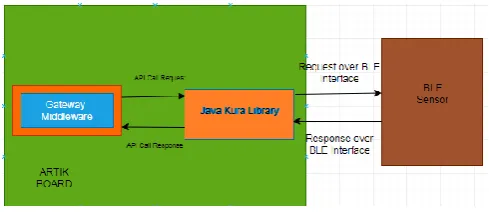
[image:2.595.314.559.49.155.2]Prior, Bluetooth technology has been expanded quickly in
cell phones. Moreover this technology has brought a move
into home automation system. BLE light can be controlled
starting with one story then onto the next floor in a structure.
There is no compelling reason to go close to the light and after
that turn on/off. It has given a dimension of simplicity to the
lives of people. A BLE light is associated with the Artik board
by turning the light on then send a json response to filter the
light. The board will gets this request and after that begin
filtering as indicated by the code embedded into it in java
language. Also, return the json response which contains
characteristics of checked ble light. After that another request
is raised to arrangement the ble light. In this request,
properties of ble light are stored in the database and
association with the light is made for further operation. After
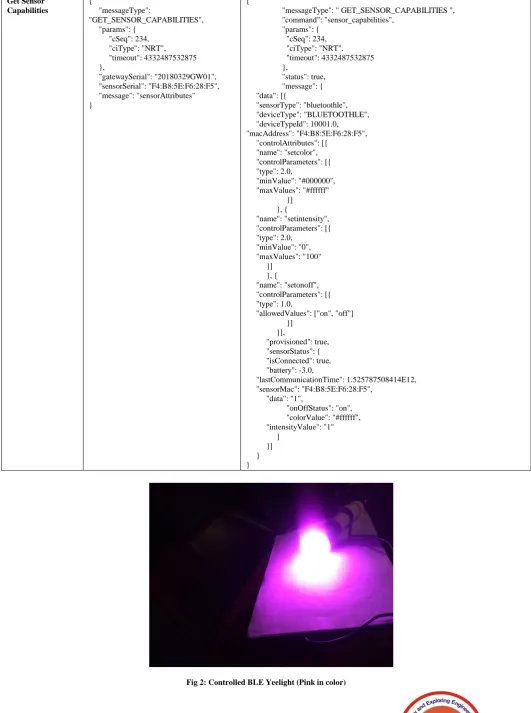
that a request to change color of the light is made and
accordingly we get the light of the shading is changed just as a
entry is additionally recorded into db. Along these lines, artik
board which contained java code and light interacts.
Fig 1 BLE Sensor interaction with board
There are following messages which can be sent to gateway
middleware through mobile app:
PROVISION_SENSOR: It will add the particular sensor
into artik board.
DELETE_SENSOR: It will delete the provisioned (added)
sensor.
SENSOR_COMMAND: It will control the sensor which is
controllable i.e. ble yeelight.
SCAN_SENSORS: It will scan all available sensors.
GET_SENSOR_CAPABILITIES: It will give information
related to provisioned device.
Type of Request Request Response
WifiStationModeOn :This request will give internet to the gateway or device on which java code is running.
{
"command": "WifiStationModeOn", "userID":
"EGrv8kQhp6TptTtqzOCuoRnP3In1", "message": {
"ssId": "gw_middleware", "password": "12345678", "keyType": "WPA-PSK2" }
}
Gateway has successfully connected to WIFI
Scan Sensor: This request will scan all Bluetooth lights which is nearby to the device so that it can be controlled further.
{
"interfaceTypes": ["BLUETOOTHLE”], "params": {
"cSeq": 234, "ciType": "NRT", "timeout": 4332487532875 },
"messageType": "SCAN_SENSORS", "gatewaySerial": "20180322011G" }
{
"messageType": "SCAN_SENSORS_RESPONSE", "gatewaySerial": "20180322011G",
"results": [{
"interfaceType": "bluetoothle", "sensorList": [{
"networkInterfaceType": "bluetoothle", "type": "Yeelight Blue II",
"deviceTypeId": 10001,
"macAddress": "F4:B8:5E:F6:1B:63", "manufacturerName": "avighna", "provisioned": true,
"bundleAttribute": "colorintensitylight", "isStartUpCall": false
International Journal of Innovative Technology and Exploring Engineering (IJITEE)
ISSN: 2278-3075, Volume-8 Issue-10, August 2019
Add Sensor: This request will bind Bluetooth light with the device so that it can be controlled.
{
"messageType": "PROVISION_SENSOR, "gatewaySerial": "530MWC2R10400557", "sensorSerial": "F4:B8:5E:F6:28:F5", "message": {
"type": "Yeelight Blue II", "macAddress":
"F4:B8:5E:F6:28:F5", "deviceTypeId": 10001, "manufacturerName": "avighna", "bundleAttribute":
"colorintensitylight", "networkInterfaceType": "bluetoothle"
} }
{
"messageType": "PROVISION_SENSOR_RESPONSE", "sensorInfo": {
"macAddress": "F4:B8:5E:F6:28:F5", "manufacturer": "avighna", "type": "Yeelight Blue II",
"networkInterfaceType": "bluetoothle", "isControllable": true,
"attributes": [{ "name": "setcolor", "type": 2,
"minValue": "#000000", "maxValue": "#ffffff"
}, {
"name": "setintensity", "type": 2,
"minValue": "0", "maxValue": "100"
}, {
"name": "setonoff", "type": 1,
"allowedValues": ["on", "off"] }]
},
"status": true }
Sensor Control Command : This request will change the color of a light.
SET COLOR COMMAND
{
"messageType": "SENSOR_COMMAND",
"params": { "cSeq": 234, "ciType": "NRT", "timeout": 4332487532875 },
"sensorDetail": {
"serial": "F4:B8:5E:F6:28:F5", "command": {
"name": "setcolor", "value": "#ff00aa" }
} }
{
"messageType": "ACTUATOR_ACTION", "params": {
"cSeq": 234, "ciType": "NRT", "timeout": 4332487532875 },
"sensorDetail": {
"serial": "F4:B8:5E:F6:28:F5", "command": {
"name": "setcolor", "value": "#ff00aa" }
},
"timestamp": "1542277142808", "status": true
}
Delete Sensor: This request will unbind the light with the device or Disconnect the light.
{
"messageType": "DELETE_SENSOR", "params": {
"cSeq": 234, "ciType": "NRT", "timeout": 4332487532875 },
"gatewaySerial": "20180329GW01", "sensorMacAddress":
"F4:B8:5E:F6:28:F5" }
{
"messageType": "DELETE_SENSOR_RESPONSE", "params": {
"cSeq": 234, "ciType": "NRT", "timeout": 4332487532875 },
"gatewaySerial": "20180329GW01", "sensorMacAddress": "F4:B8:5E:F6:28:F5", "status": true/false
Get Sensor Capabilities
{
"messageType":
"GET_SENSOR_CAPABILITIES", "params": {
"cSeq": 234, "ciType": "NRT", "timeout": 4332487532875 },
"gatewaySerial": "20180329GW01", "sensorSerial": "F4:B8:5E:F6:28:F5", "message": "sensorAttributes" }
{
"messageType": " GET_SENSOR_CAPABILITIES ", "command": "sensor_capabilities",
"params": { "cSeq": 234, "ciType": "NRT", "timeout": 4332487532875 },
"status": true, "message": { "data": [{
"sensorType": "bluetoothle", "deviceType": "BLUETOOTHLE", "deviceTypeId": 10001.0, "macAddress": "F4:B8:5E:F6:28:F5",
"controlAttributes": [{ "name": "setcolor", "controlParameters": [{ "type": 2.0,
"minValue": "#000000", "maxValues": "#ffffff"
}] }, {
"name": "setintensity", "controlParameters": [{ "type": 2.0,
"minValue": "0", "maxValues": "100"
}] }, {
"name": "setonoff", "controlParameters": [{ "type": 1.0,
"allowedValues": ["on", "off"] }]
}],
"provisioned": true, "sensorStatus": { "isConnected": true, "battery": -3.0,
"lastCommunicationTime": 1.525787508414E12, "sensorMac": "F4:B8:5E:F6:28:F5",
"data": "1",
"onOffStatus": "on", "colorValue": "#ffffff", "intensityValue": "1"
[image:4.595.31.563.55.769.2]} }] } }
International Journal of Innovative Technology and Exploring Engineering (IJITEE)
ISSN: 2278-3075, Volume-8 Issue-10, August 2019
IV.
C
ONCLUSIONThe work has been done on Bluetooth technology since this
innovation is cost effective and wireless. This isn't just helpful
to the typical people yet in addition for incapacitated and old
matured people. Presently they don't have to rely upon others
for switching on/off their lights. They can do it by single order
without anyone else's input as it were. We can give it an
inviting User Interface (UI) by building a mobile application
for this in future. Moreover there are numerous interfaces
which can be bolstered with a similar code with little change
so that with a similar code numerous sensors might be
mechanized. With a straightforward GUI, a versatile
application can be made for client so it resembles a control
remote of power on his hand. At whatever point or any place
the client is available, he can switch on/off his lights of home
to spare power and lessen bills
.
REFERENCES
1. D. Chowdhary, R. Paranjape and P. Laforge, “Smart home automation system for instrusiondetection ,” 2015 IEEE 14th Canadian Workshop on Information Theory (CWIT), St. John’s, NI., 2015, pp. 75-78 2. N. Skeledzija , J.C. Edin, V. Bachler, H. N. Vucemilo, H. Dzapo, “Smart
home automation system for energy efficient housing”, 37th International Convention on Information and Communication Technology, Electronics and Microelectronics(MIPRO), 2014 , pp. 166-171
3. K. Mandula , R. Parupali , C.A.S. Murty, E.Magesh and R. Luna ,”Mobile based home automation using Internet of Things(IoT)”, 2015 International Conference on control Instrumentation, Communication and Computational Technologies (ICCICCT), Kumaracoil, 2015, pp. 340-343
4. R. K. Kodali , V. Jain, S. Bose and L. Boppana, “IoT based smart security and home automation system”, 2016 International Conference on Computing , Communication and Automation (ICCCA), Noida , 2016, pp. 1286-1289
5. M. Asadullah and A. RecaiCelik, “An Effective Approach to Build Smart Building Based on Internet of Things (IoT)”, Journal of Basic and Applied Scientific Research(JBASR), vol. 6, no. 5, pp. 56-62, May 2016 6. V. Puri and A. Nayyar, “Real time smart home automation based on PIC microcontroller, Bluetooth and Android technology”, 2016 3rd International Conference on Computing for Sustainable Global Development (INDIACom), New Delhi, 2016, pp. 1478-1484 7. S. Palaniappan, N. Hariharan, N. T. Kesh, V. S.. and A. Deborah S,
“Home automation systems – A study, “ International Journal of Computer Applications, vol. 116, pp. 11-18, April 2015
8. R. Piyare and M. Tazil, “ Bluetooth based home automation system using cell phone”, 2011 IEEE 15th International Symposium on Consumer Electronics (ISCE), Singapore, 2011, pp. 192-195
9. M. N. N. A. Asghar, M.H., “Principle application and vision in internet of things (iot)”, in Communication Technologies (GCCT), 2015 Global Conference on , may 2015
10. A. R. AI-Ali, M. Qasaimeh, M. AI-Mardini, S. Radder and I. A.Zualkernan, "ZigBee-based irrigation system for home gardens,"Communications. Signal Processing. and their Applications (iCCSPA).2015 International Conference on, Sharjah, 2015, pp. 1-5. 11. T. Ming Zhao, Chua, “Automatic face and gesture recognition, 2008.fg
’08. 8th IEEE international conference on,” pp. 1–6, September 2008. 12. A. R. . C. Y. . O. K. Withanage, C., “A comparison of the popular
homeautomation technologies,” pp. 1 – 11, may 2014
13. B. S. S. Tharaniyasoundhari, M., “Intelligent interface based speechrecognition for home automation using android application,” pp. 1 –11, march 2015.
14. O. N. C. S. A. P. B. Sahani, M, “Circuit, power and computingtechnologies (ICCPCT), 2015 international conference on,” pp. 1–6, March2015.
15. M. J. H. B. T. A. M. K. T. Baig, M.Q., “Artificial intelligence, modellingand simulation (aims), 2014 2nd international conference on,” pp. 109–114, November 2014.
16. M. N. N. A. Asghar, M.H., “Principle application and vision in internetof things (iot),” in Communication Technologies (GCCT), 2015 GlobalConference on, may 2015.
17. A. Pramanik, Rishikesh, V. Nagar, S. Dwivedi and B. Choudhury, "GSMbased Smart home and digital notice board," 2016 InternationalConference on Computational Techniques in Information andCommunication Technologies (ICCTfCT) ,New Delhi, 2016, pp. 41-46.
18. A. R. AI-Ali, M. Qasaimeh, M. AI-Mardini, S. Radder and I. A.Zualkernan, "ZigBee-based irrigation system for home gardens,"Communications. Signal Processing. and their Applications (ICCSPA), 2015 International Conference on, Sharjah, 2015, pp. 1-5. 19. X. Wu, C. Hu, C. Zheng and Q. Zhang, "Solar street lamp system
usingGPRS and ZIGBEE technology," 2016 IEEE11thConference onIndustrial Electronics and Applications (ICIEA) ,Hefei, 2016, pp. 2561-2564.
E. A. Elkamchouchi, H., “Design and prototype implementation of smsbased home automation system,” pp. 162 – 167, november 2012. 20. R. J. Vidmar. (1992, August). On the use of atmospheric plasmas as
electromagnetic reflectors. IEEE Trans. Plasma Sci. [Online]. 21(3). pp. 876—880.
AUTHORS
PROFILE
Sonam Manchanda did her B.Tech in Computer Science from Jan Nayak Chaudhary DevilAl College of Engineering under Guru Jambeshwar University, Hisar. She was a University topper during her graduation and hence has been awarded a gold medal. Her area of research is Internet of Things. Now she is pursuing M.Tech from Jan Nayak Chaudhary Devi Lal College of Engineering under CDLU Sirsa.
Aman Paul has done her B.Tech. in CSE from CDLM College of Engineering Panniwala Mota Sirsa under KUK in 2007 and M.Tech. in CSE from JCDMCOE Sirsa under KUK in 2011. She qualified UGC NET in Computer Science in December 2018. My research area is Data Mining. She has 3 year regular experience of teaching in Eternal University, Himachal Pradesh. Presently she is working as Assistant professor in JCDMCOE sirsa .