International Journal of Innovative Technology and Exploring Engineering (IJITEE) ISSN: 2278-3075, Volume-8 Issue-11, September 2019
Abstract: In the era of modern communication, the transmission of video is the most demanded feature and that makes the bandwidth issues crucial. The only solution to fight with is the video compression techniques/ standards.The High efficiency video coding standard(H.265/ HEVC) is newly evolved standard that is popularly used. this standard is better in saving bandwidth giving more compression. This research work deals with narrates the steps of implementation, simulation with MATLAB and the results obtained. from the obtained results, the 4G technique for wireless communication has been obtained in an enhanced way from the compression perspective.
Keywords : Entropy Coding ,HEVC, Intra picture prediction; Inter picture prediction; In loop filtering , Integer transform and Quantization , Prediction mode, Video Compression.
I. INTRODUCTION
T
he high efficiency video coding standard- HEVC offers a similar fundamental incentive about multiplying compression ability like the previous standard h.264/AVC. A video can be compress about twice using the new standard HEVC as compared to previous standard h.264/AVC without yielding quality, on the other hand, be utilized to empower delivery of higher resolution and picture rates—or different types of higher quality, for example, a higher power range or higher exactness for improved color quality. It additionally comes at some other point when new video services are developing—for UHDTV, more power range, and more extensive color scale.II. HIGH EFFICIENCY VIDEO CODING STANDARD
OVERVIEW
The High Efficiency Video Coding (HEVC)
standard defines particular steps with the guideline of square-based hybrid video coding. According to that guideline, a picture is first divided into squares and afterward, each square is anticipated by utilizing either intra-picture or inter-picture prediction. A decoded samples inside a similar picture are utilized in a previous coding standard, while a
Revised Manuscript Received on September 05, 2019.
* Correspondence Author
Ms. Kavita Monpara*, Electronics and Communication department, C.U.Shah University, Wadhwan , India. Email: [email protected]
Dr. Bhavin Sedani, Electronics and Communication department, L.D. Engineering College, Ahmedabad, India. Email: [email protected]
Dr. Ved Vyas Dwivedi, Electronics and Communication department, C.U. Shah University, Wadhwan, India. Email: [email protected]
[image:1.595.316.542.382.522.2]dislodged squares of decoded pictures are utilized in a new standard as a kind of perspective. The inter-picture prediction commonly makes up a motion vector for the motion between frames of a video sequence. The prediction would be done using motion between two frames which is illustrated as the motion-compensated prediction. While the spatial redundancy of consecutive squares of an image can be removed using the intra-picture prediction. In both prediction the subsequent prediction error is shaped by calculating the difference between the original square and its forecast, which is forwarded using transform coding which is responsible to remove spatial redundancy but inside a square and furthermore a linear transform, scalar quantization of the transform coefficients and entropy coding of the subsequent transform are applied to individual square.
Fig. 1.High efficiency video coding standard-A general block diagram
A. Square Partitioning for Prediction
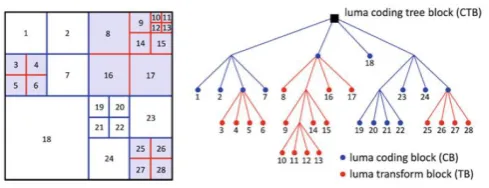
Consider that the transform squares select indistinguishable to the comparing coding squares are not expressly set apart in the figure 2.
Fig. 2.Square partitioning
Simulation and Performance Enhancement of
High Efficiency Video Coding Standard for
Video Compression
[image:1.595.307.552.626.720.2]Compression
A case for the dividing of a 64 x 64 luma coding tree block(black) into coding squares (blue) and transform squares (red). In the portrait on the right, the blue lines demonstrate the relating coding tree with the coding tree square at its root and the coding squares (blue circles) at its leaf hubs, the red lines demonstrate the non-declined leftover quad trees with the transform squares (red circles) as leaf hubs. The numbers demonstrate the coding request of the transform squares.
B. Intra Picture Prediction
[image:2.595.309.547.84.179.2]In the HEVC , the intra prediction strategies grouped in two types. The primary classification is angular prediction structure which gives the codec a likelihood to precisely show structures with directional borders. The planar prediction and DC prediction, a second classification, provide indicators predicting flat picture content. The HEVC supports total intra prediction modes is 35, the complete distribution of modes are summarize in table 1. The adjacent reproduced squares are used as a reference samples by all intra prediction modes. The intra prediction is worked at the prediction of square sizes 4 x 4 to 32 x 32 samples.
Table- I: Distribution of Intra prediction modes
Intra Prediction mode Mode name
0 PLANAR
2 DC
[image:2.595.69.275.325.596.2]2...34 ANGULAR
Fig. 3.Intra prediction different modes of 8 x 8 luma squares
Figure 3 shows the typical attributes of the diverse intra prediction modes. The 35 HEVC Intra expectations modes are specified in the figure which elaborates to the final prediction when utilizing reference tests. The modes 10 and 26 are used for the DC prediction and angular prediction which impacts the post-handling prediction with square boundaries incorporate apart from the adjacent sample values.
C. Inter Picture Prediction
In the HEVC, the inter picture prediction can be viewed as a constant refinement furthermore, consideration of all parts familiar from past standards of video coding. An inter prediction square combining strategy altogether rearranged
[image:2.595.319.442.504.554.2]the square wise movement information flagging by inducing all motion information from as of now decoded squares.
Fig. 4.Functional representation of Inter picture prediction
An outline functional representation of the HEVC inter-picture prediction appears in figure 4. The movement information of a square is related to the adjacent squares. The motion information is not straightforward converted into a bitstream, however, with prediction coded information is dependent on adjacent motion information. The different two ideas are utilized in HEVC for this inter-picture prediction. The different tool, advanced motion vector prediction(AMVP) which is used to upgrade the predictive coding of the motion vectors in HEVC, where the best predictor is selected and it is assigned to a decoder for each motion square. Also, another strategy in which inter-prediction squares combines and concludes that in H.264/AVC, the direct and angular modes are replaced by the adjacent motion information of square.
D. Integer transform and Quantization
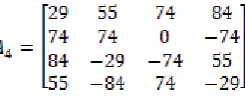
HEVC indicates an integer transforms with two dimensions which are having different sizes from 4 x 4 to 32 x 32 that are given accurate approximations by using the discrete cosine transform (DCT). The onward alternate integer transform which is applied to residual blocks is illustrated in the below matrix.
The inverse transform matrix is A4T. Elements aij of the
alternate transform matrix A4 are the discrete sine transform
with fixed point representation ,which is obtained by the following equation.
[image:2.595.308.543.612.653.2]
International Journal of Innovative Technology and Exploring Engineering (IJITEE) ISSN: 2278-3075, Volume-8 Issue-11, September 2019
In HEVC, the quantization step size is decided by a quantization parameter(QP) which is as similar as a quantization parameter in H.264/AVC. For the 8-bit video process, the value of QP is between 0 and 51. The subsequent relation among QP and the equal quantization step size for an orthonormal transform is currently defined in the below equation.
E. Integer transform and Quantization
[image:3.595.328.539.155.220.2]There are two in loop filters present in HEVC standard, one is a deblocking filter and the next one is a sample adaptive offset (SAO). In the encoding and decoding process, the in-loop filters are connected between inverse quantization and the decoded picture buffer. The first implemented filet is the deblocking filter, which reduces the lack of coherence at the prediction and transforms square ends. A next in-loop filter is the sample adaptive offset (SAO), which is connected to the next to the deblocking filter and enhance the quality of the output picture of decoder, while SAO primarily reduces the effect of ringing artifacts originated by integer transform and replaces the sample offset values which is generated by coding of motion vectors. The main objective of the in-loop filter is to improve the subjective quality of reconstructed pictures. Additionally, the presence of in-loop filters in decoder improves reference pictures quality and therefore the efficiency of compression.
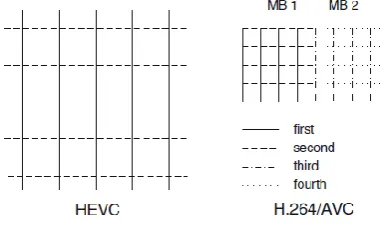
Fig. 5.Comparision of the square boundary
With compared to previous standard H.264, the process steps are different in HEVC deblocking filtering , the filter process is first carried out on the vertical boundaries of a picture and after then on the horizontal boundaries. The main element is macroblock in h.264,so in deblocking filter in which the four vertical boundaries in an MB are handled successively beginning from the furthest left MB boundary, and afterward, the four horizontal MB boundaries are prepared beginning from the top-most MB boundary. The comparison of handling the process of filtering in square boundary in HEVC and H.264/AVC is illustrates in figure 5. It can be seen that the deblocking filter in HEVC is more consistent than that in H.264/AVC.
F. Entropy Coding
In the HEVC standard - which is a novel approach, entropy coding concept is used which was not there in AVC standard. the combination is known as CABAC - Context-based Adaptive Binary Arithmetic Coding. For making this latest standard a better one - there are certain
limitations which must be removed - mainly related to the throughput while maintaining a fair amount of coding efficiency along-with obtained value of through-put, i.e., kind of managing the trade-off. CABAC - the related entropy code manages to maintain the trade-off. There are three basic tasks in entropy coding of HEVC in decoder: binarization, context modeling, and arithmetic coding.
Fig. 6.Comparision of the square boundary
The functional block diagram of entropy coding is illustrates in figure 6, in which the dashed lines describes feedback loops.
III. SIMULATION RESULTS
[image:3.595.65.260.399.513.2]The simulation results for compression of monchrome video using HEVC standard is carried out in MATLAB. The partitions in individual frame is carried out based on coding tree structures and there are total 35 intra picture prediction modes are used based on the content of individual frame. The simulation was carried out by DST integer transform with quantization parameter 27 are used to implement compression. The golomb code, arithmatic code are used in entropy coding. The compression results for monochrome video for HEVC standard for the frame is shown in Table 2.
Table- II: Simulation Results for monchrome video frames
Frame
Size of Frame (before compression)
(KB)
Size of frame (after compression)
(KB)
compression Rate (Space
saving)
I 25.34 4.37 82.75%
P1 25.00 2.03 91.88%
B1 25.56 2.25 91.19%
P2 25.34 1.20 95.26%
P3 25.33 1.00 96.05%
P4 35.71 1.55 95.65%
B2 25.01 1.89 92.44%
P5 25.05 1.65 93.41%
P6 25.67 1.10 95.71%
Compression
It can be seen that the frames which are P-frames, whenthey are compressed with this method, they almost undergo a very higher level of compression with the rate of compression more than 94% and frames which are B- frames when subjected to compression with this method, they are likely to undergo a very higher level of compression with the rate of compression above 90% to 91%. the B frames depend on the motion content of the video signal for the backward process.
[image:4.595.47.299.197.336.2]The graph is shown below also expresses the above analytical detail regarding the size of actual frame and compressed frame.
Fig. 7.Comparision of of size of frames
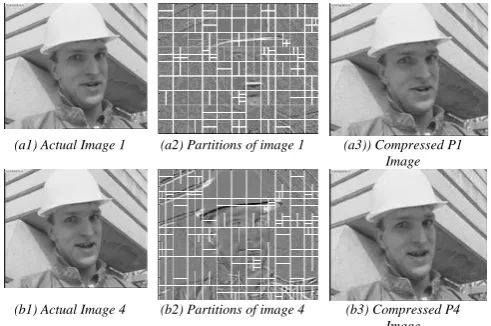
The actual image-size around 25Kb, the partitioned frame and the compressed image-size around 2 Kb are shown in figure 8 for two different frames. The middle picture of the results defines the partitions based on the coding tree structures, the frame first divided with 64 x 64 pixels and then according to the information content in frame it is further divided and converted into prediction square.
Fig. 8.The simulation results
IV. CONCLUSION
The main focus of proposed work is the implementation of HEVC compression standard on monochrome video by simulation and with the HEVC/H.265 standard the compression rate achieved is approximately 90 to 96%. So the space saving is huge and for the same, no quality compromise has been done. The performance of the proposed work is evaluated using the DST integer transform and quantization parameter 27. With this high compression rate, the HEVC standard is suitable to be used for 4G wireless networks for
HD and ultra HD video transmission.
ACKNOWLEDGMENT
We, the authors are thankful to our parent organizations –V.V.P. Engineering College, L.D. College of Engineering, and C. U. Shah University for supporting us in the research work by providing the technical platform and giving us an opportunity to develop ourselves.
REFERENCES
1. "High Efficiency Video Coding (HEVC)",Springer nature,2014. 2. Bhavin Sedani,Dipesh Kamdar, Kavita Monpara, "A novel
Approach of video compression over 4g system using H.265 standard:,2017 ICICI.
3. A A Muhit, M R Pickering, M R Frater and J F Arnold “Video Coding using Elastic Motion Model and Larger Blocks,” IEEE Trans. Circ. And Syst. for Video Technology, vol. 20, no. 5, pp. 661-672, 2010
4. Lee, Jung Won Kang, Jinho Lee, Jin Soo Choi, Jinwoong Kim, and Donggyu Sim “Scalable Extension of HEVC for FlexibleHigh-Quality Digital Video Content Services” ETRI Journal 2013
5. Recommendation ITU-T H.265: High Efficiency Video Coding. Tech. rep., ITU-T (2013).
6. J.Ohm et al.,"Comparison of the Coding Efficiency of Video sCoding Standards—Including High Efficiency Video Coding (HEVC),"IEEE Transac9ons on Circuits and Systems for Video Technology, 2012
7. E. M. El-Bakary, W. El-Shafai, S. El-Rabaie, O.Zahran, F. E. Abd El-Samie. "Efficient hybrid framework for transmission enhancement of composite 3D H.264 and H.265 compressed video frames", Multimedia Tools and Applications, 2018 8. V.Sze,M.Budagavi,G.J.Sullivan(Editors),“HighEfficiencyVideoCo
ding(HEVC):AlgorithmsandArchitectures,”Springer,2014 9. Gary J. Sullivan, Jens-Rainer Ohm, Woo-Jin HanandThomas
Wiegand “Overview of the High Efficiency Video Coding(HEVC) Standard” IEEE transaction on circuits and systems for video technology, VOL. 22, NO. 12, December 2012
AUTHORSPROFILE
Ms. Kavita Monpara is research scholar for PhD programme of C.U. Shah University(Faculty of Technology and Engineering), in the field of electronics and communication and working as an assistant professor in Electronics and Communication Department at VVP Engineering College, Rajkot, Gujarat, a leading engineering college of saurashtra- kutch region. She has teaching experience of 9 years. She has done her masters in electronics and communication in from Gujarat Technological University and has secured the gold medal of branch topper as well as course topper in entire university. She has presented more than 7 research papers in various international and national conferences. Her 3 research papers are published in various international journals and Scopus indexed IEEE Xplore digital library. Her area of research are wireless communication and image and video processing.
Dr. Bhavin Sedani is working as a professor in Electronics and Communication Department at L.D. College of Engineering (Government Engineering College),Ahmedabad. He has teaching experience of 17 years. He has presented more than 46 research papers in various international and national conferences. His 27 research papers are published in various international journals and Scopus indexed IEEE Xplore digital library.He has achieved best paper presentation awards 7 times for his research articles.
(a1) Actual Image 1 (a2) Partitions of image 1 (a3)) Compressed P1 Image
[image:4.595.45.291.462.625.2]International Journal of Innovative Technology and Exploring Engineering (IJITEE) ISSN: 2278-3075, Volume-8 Issue-11, September 2019
He is awarded with pedagogical award for continuing efforts towards teaching learning methodology, research and innovation in 2017 by Gujarat Technological University, Young Researcher Award in 2018 by Integrated Intelligent Research, ISTE Professional Center, Anna University Campus, Chennai – India. His area of research is in wireless communication and speech processing and video processing.